

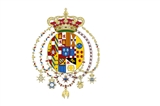
Kingdom of the Two Sicilies

Encyclopedia
The Kingdom of the Two Sicilies, commonly known as the Two Sicilies even before formally coming into being, was the largest and wealthiest of the Italian states before Italian unification
. It was formed of a union of the Kingdom of Sicily
and the Kingdom of Naples
in 1816 and lasted until 1860, when it was annexed by the Kingdom of Sardinia
, which became the Kingdom of Italy
in 1861. The Two Sicilies had its capital in Naples
and was commonly referred to in English as the "Kingdom of Naples". The kingdom extended over the Mezzogiorno
(the southern part of mainland Italy) and the island of Sicily
.
The name "Two Sicilies" originated from the division of the medieval Kingdom of Sicily
. Until 1285, the island of Sicily
and the Mezzogiorno
were both part of the Kingdom of Sicily
. As a result of the War of the Sicilian Vespers
the King of Sicily lost Sicily proper to the Aragonese
but remained king over the peninsular part of the realm. Although his territory became known as the Kingdom of Naples
, he and his successors never gave up the title of "King of Sicily" and they referred to their realm as the "Kingdom of Sicily". At the same time, the Aragonese
rulers of the island of Sicily
called their realm the "Kingdom of Sicily". Thus, formally, there were two kingdoms calling themselves "Sicily": hence, the Two Sicilies
with the Kingdom of Naples
(called the kingdom of peninsular Sicily), by King Alfonso V of Aragon
in 1442. The two had been separated since the Sicilian Vespers
of 1282. At the death of King Alfonso in 1458, the kingdom became divided between his brother John II of Aragon
, who kept Sicily, and his bastard son Ferdinand
, who became King of Naples.
In 1501, King Ferdinand II of Aragon
, son of John II, conquered Naples and reunified the two kingdoms under the authority of the newly united Spanish throne. The title King of Sicily and of the Two Coasts of the Strait was then borne by the Kings of Spain until the War of the Spanish Succession
. At the end of the war, the Treaty of Utrecht in 1713 granted Sicily to the Duke of Savoy, until the Treaty of Rastatt
in 1714 left Naples to the Emperor Charles VI. In 1720 the Emperor and Savoy exchanged Sicily for Sardinia
, thus reuniting Naples and Sicily.
In 1734, Charles, Duke of Parma
, son of Philip V of Spain, took the Sicilian crown from the Austrians and became Charles the VII & V, giving Parma to his younger brother, Philip. In 1754, he became King Carlos III of Spain and resigned Sicily and Naples to his younger son, who became Ferdinand III of Sicily and Ferdinand IV of Naples, and later crowned Ferdinand I of the Two Sicilies. Apart from an interruption under Napoleon
, the Kingdom of the Two Sicilies remained under the Bourbon line (Bourbon Duo-Sicilie) continually until 1860.
In January 1799, Napoleon Bonaparte, in the name of the French Republic
, captured Naples and proclaimed the Parthenopaean Republic
, a French client state, as successor to the kingdom. King Ferdinand
fled from Naples to Sicily until June of that year. In 1806, Bonaparte, by then French Emperor, again dethroned King Ferdinand and appointed his brother, Joseph Bonaparte
, as King of Naples. In the Edict of Bayonne of 1808, Napoleon removed Joseph to Spain and appointed his brother-in-law, Joachim Murat
, as King of the Two Sicilies, though this meant control only of the mainland portion of the kingdom. Throughout this Napoleonic interruption, King Ferdinand remained in Sicily, with Palermo
as his capital.
King Ferdinand I was restored by the Congress of Vienna
of 1815. He established a concordat
with the Papal States
, which previously had a claim to the land.
There were several rebellions on the island of Sicily
against the King Ferdinand II
but the end of the kingdom was only brought about by the Expedition of the Thousand
in 1860, led by Garibaldi
, an icon of the Italian unification, with the support of the House of Savoy
and their Kingdom of Piedmont-Sardinia. The expedition resulted in a striking series of defeats for the Sicilian armies against the growing troops of Garibaldi. After the capture of Palermo and Sicily, he disembarked in Calabria and moved towards Naples, while in the meantime the Piedmontese also invaded the Kingdom from the Marche
. The last battles fought were that of the Volturnus in 1860
and the siege of Gaeta
, where King Francis II had sought shelter, hoping for French help, which never came. The last towns to resist Garibaldi's expedition were Messina (which capitulated on 13 March 1861) and Civitella del Tronto
(which capitulated on 20 March 1861). The Kingdom of the Two Sicilies was dissolved and annexed to the new Kingdom of Italy
, founded in the same year.
The fall of the Sicilian aristocracy in the face of Garibaldi’s invasion is recounted in the novel The Leopard
by Giuseppe Tomasi di Lampedusa
and its film adaptation
.
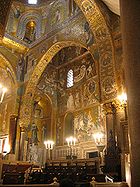 The monarchy over the areas which would later become known as the Two Sicilies, existing as one single kingdom including peninsula
and insular
, in fact goes back to the time of the Middle Ages
. The Norman
king Roger II
formed the Kingdom of Sicily
by combining the County of Sicily
with the southern part of the Italian Peninsula (then known as the Duchy of Apulia and Calabria) as well as the Maltese Islands. The capital of this kingdom was Palermo
— on the actual island of Sicily
. The state existed in that form from 1130 until 1285. In the reign of the Capetian House of Anjou
king Charles I,
the kingdom was split by the War of the Sicilian Vespers
.
Charles, who was of French
origin, lost Sicily proper to the House of Barcelona
, who were Aragonese
and Catalan
, with support from the natives.
Charles remained king over the peninsular part of the realm, thereafter informally known as the Kingdom of Naples
. Officially he never gave up the "Kingdom of Sicily" name and thus there were two kingdoms calling themselves "Sicily".
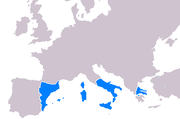 It wasn't until the Peace of Caltabellotta
in 1302, sponsored by Pope Boniface VIII
, that the two kings of "Sicily" recognized each other's legitimacy; the island kingdom then became the "Kingdom of Trinacria" in an official context, though the populace still called it Sicily. Eventually by 1442 the Angevin line of Kings of Naples was coming to an end. Alfonso V of Aragon
who was the King of Sicily in terms of the island itself via direct rule from the Crown of Aragon
, conquered Naples and became king of both.
Alfonso V described the geographical area in Latin
as Utriusque Siciliæ, which is along the lines of "Both Sicilies", this is the title he used. After the death of Alfonso, both remained under direct rule from the Crown of Aragon
, but Naples had a different Aragonese king from the island of Sicily from 1458 until 1501. For a brief period Naples was controlled by a different power than Sicily, in the form of French king Louis XII of France
who took the mainland kingdom and held it for around three years. After the Battle of Garigliano
led by last Aragonese king Ferdinand II of Aragon
however, the two areas were once again under control of the same power and exactly the same king.
From 1516 when Charles V, Holy Roman Emperor
became the first King of Spain, both Naples and Sicily were under direct Spanish rule. It was during this era that Charles V granted the islands of Malta
and Gozo
, which had been part of the Kingdom of Sicily for four centuries, to the Knights Hospitaller
(thereafter known as the Order of Malta).
The period of direct Spanish rule under the same line of kings lasted until 1713, when Spain and both Sicilies passed to Philip, duke of Anjou
, who founded the Spanish branch of the House of Bourbon
.
Briefly interrupted by an eight year spell of Savoy
rule of Sicily, the two kingdoms fell under the same king after the Treaty of The Hague
, as Austrian king Charles VI, Holy Roman Emperor
was named ruler.
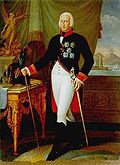 The kingdoms were conquered from the Austrians by a young Spanish prince during the War of the Polish Succession
who would then become Charles VII of Naples
. The two kingdoms were then recognised as both independent and under Charles' rule as a cadet branch
of the Spanish Bourbons by the Treaty of Vienna
. After Charles' brother, Fernando VI of Spain died childless, Charles inherited the Spanish Crown in 1759, reigning as Charles III of Spain. His son Ferdinand
then became king of the two kingdoms so as to maintain them as separate realms (as required by the treaties restoring junior Spanish dynasts to the southern Italian kingdoms). Ferdinand was highly popular with the lazzaroni
class. Ferdinand's reign was highly eventful. For a brief period the Parthenopaean Republic
was instated in Naples by French Revolution
supporters; however, a counter-revolutionary army of lazzaroni retook Naples
in order to restore royal power.
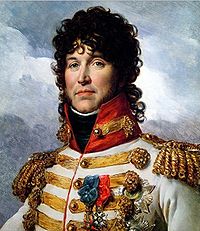 However only eight years later, Napoleon
conquered the peninsula part of the kingdom during the War of the Third Coalition and instated his brother Joseph Bonaparte
as king.
Ferdinand fled to his other kingdom, on the island of Sicily itself; here the alliance he had previously made with George III of the United Kingdom
and Tory Prime Minister the Earl of Liverpool
saved him.
The British protected Ferdinand and the island of Sicily from Napoleonic conquest with the presence of a powerful Royal Navy
fleet.
Meanwhile, back on the mainland Joachim Murat
had become the second Bonapartist
king. In the Edict of Bayonne he was named as "King of the Two Sicilies", though de facto he never actually held the island of Sicily where Ferdinand was, and is usually referred to as just a King of Naples.
Murat actually switched sides for a while, abandoning the Grand Army
after the disastrous Battle of Leipzig
in an attempt to save his Neapolitan throne. However, as the Congress of Vienna
progressed, tensions arose as there was strong pressure to restore Ferdinand to the Neapolitan kingdom as well as keeping his Sicilian one.
Murat returned to Napoleon and together they declared war on the Austrian Empire
, leading to the Neapolitan War
in March 1815. Ferdinand and his allies Austria, Britain and Tuscany
were victorious, restoring him to his Neapolitan throne. To avoid further French attempts, it was agreed at the Congress of Vienna
that Ferdinand would reunite his kingdom.
experienced three popular revolts against Bourbon rule, including the revolution of independence
of 1848, when the island was fully independent of Bourbon control for 16 months.
Apart from having occurred at the same time as the Revolutions of 1848
, there is a clear link between this revolution and the Risorgimento
eleven years later.
 The peninsula was divided into fifteen departments and the island of Sicily was divided into seven departments. The island itself had a special administrative status, with its base at Palermo
.
In 1860, when the Two Sicilies were conquered by the Kingdom of Sardinia
, the departments became provinces of Italy
, according to the Rattazzi law.
* The city of Benevento
was formally included in this department, but it was occupied by the Papal States
and was de facto an exclave of that country.
, the kingdom had 443.3 million golden lire (about 65.7% of all the money circulating in the peninsula), and it was the richest among the other Italian states.
One of the most important industrial complexes in the kingdom was the Shipyard of Castellammare di Stabia, which employed 1800 workers.
Another important complex was the engineering factory of Pietrarsa, the largest industrial plant in the Italian peninsula which produced tools, cannons, rails, locomotives. The complex also included a school for train drivers, and naval engineers and thanks to this school, the kingdom was able to replace the English personnel which was necessary until then. The first steamboat with screw propulsion known in the Mediterranean Sea is the Giglio delle Onde, with mail delivery and passenger transport purposes since 1847.
There was the Fonderia Ferdinandea in Calabria, which was a large foundry where cast iron was produced in huge amounts and the Polo siderurgico di Mongiana (an iron processing complex and weapons factory). The latter employed 2700-2800 workers. In Sicily (near Catania and Agrigento), there was a very well developed mining industry, focused on the extraction of sulphur which was a fundamental element in the production of gunpowder. The sicilian mines were able to satisfy most of the sulphur world demand. The cloth production was focused in San Leucio (near Caserta), particularly silk. The region of Basilicata also had several of such facilities, like the ones in Potenza and San Chirico Raparo, where cotton, wool and silk were processed.
The food industry was scattered all over the territory, and it was particularly focused near the area of Naples (Torre Annunziata and Gragnano), with many exportations of pasta which involved many European states and the United States of America.
The rails for the first Italian railways were built in Mongiana as well. All the rails of the old railways that went from the south to as far as Bologna were built in Mongiana.
Naples was the most populated city in Italy, and third in Europe and, according to many official sources, it was the 7th or 4th most populated city in the world prior to the 19th century. Naples was also the city with the highest amount of typographies in Italy and also had the highest number of theaters and music schools.
, and the title dropped. It is still claimed by the head of the House of Bourbon-Two Sicilies
.
, Piacenza, Castro, etc., Hereditary Grand Prince of Tuscany, etc.
, the Kings of Bavaria, Württemberg and Hanover, the Queen of Spain, the Emperor of Russia
, and the Papacy.
Upon Ferdinando Pio's death in 1960, there was a dispute about who inherited the headship of the house. Ferdinando's next brother Carlo had, in anticipation of his marriage to the eldest sister
and heiress presumptive
of King Alfonso XIII of Spain
, signed the so-called Act of Cannes on 14 December 1900:
The laws of the deposed Sicilian dynasty and Spain's Pragmatic Decree required a renunciation to prevent a union of the Crown of the Two Sicilies in the person of the King of Spain or his heir apparent
, which could have happened in the event of a restoration, however unlikely. Most theories advanced to suggest that the 1900 renunciation was in some way unnecessary have been formulated long after the fact.
from 1901–44, and in the Libro d'Oro
of the Italian Nobility from the first edition in 1907 until 1964, at which time the editor came out in support of the cadet line claimant. Infante Don Alfonso took the title of Duke of Calabria, considering that the title of Duke of Castro (a Farnese inheritance) had been lost with the sale of the last portions of the duchy to the Italian government in 1941 (a sale from which Prince Carlo received his portion of the proceeds, along with his brothers and sisters, although if the alleged renunciation of 1900 had been valid he would not have been entitled to do so). Prince Carlo married as his second wife, in 1907, Princess Louise of Orléans, and by her had a son (Carlos, killed in the Spanish Civil War
) and three daughters (of whom Princess Maria Mercedes married Juan, Count of Barcelona and was the mother of King Juan Carlos I of Spain
, and Princess Esperanza married Prince Pedro Gastão of Orléans-Braganza
). The descent in the senior line is as follows:
The latter's immediate heir is Pedro, Duke of Noto
, married to D. Sofia de Landaluce y Melgarejo (a descendant through her mother of the Dukes of San Fernando de Quiroga).
They also claim the office of the Grand Master of the Sacred Military Constantinian Order of Saint George.
Italian unification
Italian unification was the political and social movement that agglomerated different states of the Italian peninsula into the single state of Italy in the 19th century...
. It was formed of a union of the Kingdom of Sicily
Kingdom of Sicily
The Kingdom of Sicily was a state that existed in the south of Italy from its founding by Roger II in 1130 until 1816. It was a successor state of the County of Sicily, which had been founded in 1071 during the Norman conquest of southern Italy...
and the Kingdom of Naples
Kingdom of Naples
The Kingdom of Naples, comprising the southern part of the Italian peninsula, was the remainder of the old Kingdom of Sicily after secession of the island of Sicily as a result of the Sicilian Vespers rebellion of 1282. Known to contemporaries as the Kingdom of Sicily, it is dubbed Kingdom of...
in 1816 and lasted until 1860, when it was annexed by the Kingdom of Sardinia
Kingdom of Sardinia
The Kingdom of Sardinia consisted of the island of Sardinia first as a part of the Crown of Aragon and subsequently the Spanish Empire , and second as a part of the composite state of the House of Savoy . Its capital was originally Cagliari, in the south of the island, and later Turin, on the...
, which became the Kingdom of Italy
Kingdom of Italy (1861–1946)
The Kingdom of Italy was a state forged in 1861 by the unification of Italy under the influence of the Kingdom of Sardinia, which was its legal predecessor state...
in 1861. The Two Sicilies had its capital in Naples
Naples
Naples is a city in Southern Italy, situated on the country's west coast by the Gulf of Naples. Lying between two notable volcanic regions, Mount Vesuvius and the Phlegraean Fields, it is the capital of the region of Campania and of the province of Naples...
and was commonly referred to in English as the "Kingdom of Naples". The kingdom extended over the Mezzogiorno
Mezzogiorno
The Midday is a wide definition, without any administrative usage, used to indicate the southern half of the Italian state, encompassing the southern section of the continental Italian Peninsula and the two major islands of Sicily and Sardinia, in addition to a large number of minor islands...
(the southern part of mainland Italy) and the island of Sicily
Sicily
Sicily is a region of Italy, and is the largest island in the Mediterranean Sea. Along with the surrounding minor islands, it constitutes an autonomous region of Italy, the Regione Autonoma Siciliana Sicily has a rich and unique culture, especially with regard to the arts, music, literature,...
.
The name "Two Sicilies" originated from the division of the medieval Kingdom of Sicily
Kingdom of Sicily
The Kingdom of Sicily was a state that existed in the south of Italy from its founding by Roger II in 1130 until 1816. It was a successor state of the County of Sicily, which had been founded in 1071 during the Norman conquest of southern Italy...
. Until 1285, the island of Sicily
Sicily
Sicily is a region of Italy, and is the largest island in the Mediterranean Sea. Along with the surrounding minor islands, it constitutes an autonomous region of Italy, the Regione Autonoma Siciliana Sicily has a rich and unique culture, especially with regard to the arts, music, literature,...
and the Mezzogiorno
Mezzogiorno
The Midday is a wide definition, without any administrative usage, used to indicate the southern half of the Italian state, encompassing the southern section of the continental Italian Peninsula and the two major islands of Sicily and Sardinia, in addition to a large number of minor islands...
were both part of the Kingdom of Sicily
Kingdom of Sicily
The Kingdom of Sicily was a state that existed in the south of Italy from its founding by Roger II in 1130 until 1816. It was a successor state of the County of Sicily, which had been founded in 1071 during the Norman conquest of southern Italy...
. As a result of the War of the Sicilian Vespers
War of the Sicilian Vespers
The War of the ' Vespers started with the insurrection of the Sicilian Vespers against Charles of Anjou in 1282 and finally ended with the peace of Caltabellotta in 1302...
the King of Sicily lost Sicily proper to the Aragonese
Crown of Aragon
The Crown of Aragon Corona d'Aragón Corona d'Aragó Corona Aragonum controlling a large portion of the present-day eastern Spain and southeastern France, as well as some of the major islands and mainland possessions stretching across the Mediterranean as far as Greece...
but remained king over the peninsular part of the realm. Although his territory became known as the Kingdom of Naples
Kingdom of Naples
The Kingdom of Naples, comprising the southern part of the Italian peninsula, was the remainder of the old Kingdom of Sicily after secession of the island of Sicily as a result of the Sicilian Vespers rebellion of 1282. Known to contemporaries as the Kingdom of Sicily, it is dubbed Kingdom of...
, he and his successors never gave up the title of "King of Sicily" and they referred to their realm as the "Kingdom of Sicily". At the same time, the Aragonese
Crown of Aragon
The Crown of Aragon Corona d'Aragón Corona d'Aragó Corona Aragonum controlling a large portion of the present-day eastern Spain and southeastern France, as well as some of the major islands and mainland possessions stretching across the Mediterranean as far as Greece...
rulers of the island of Sicily
Sicily
Sicily is a region of Italy, and is the largest island in the Mediterranean Sea. Along with the surrounding minor islands, it constitutes an autonomous region of Italy, the Regione Autonoma Siciliana Sicily has a rich and unique culture, especially with regard to the arts, music, literature,...
called their realm the "Kingdom of Sicily". Thus, formally, there were two kingdoms calling themselves "Sicily": hence, the Two Sicilies
Establishment of the Kingdom of the Two Sicilies
The Kingdom of the Two Sicilies resulted from the unification of the Kingdom of SicilyKingdom of Sicily
The Kingdom of Sicily was a state that existed in the south of Italy from its founding by Roger II in 1130 until 1816. It was a successor state of the County of Sicily, which had been founded in 1071 during the Norman conquest of southern Italy...
with the Kingdom of Naples
Kingdom of Naples
The Kingdom of Naples, comprising the southern part of the Italian peninsula, was the remainder of the old Kingdom of Sicily after secession of the island of Sicily as a result of the Sicilian Vespers rebellion of 1282. Known to contemporaries as the Kingdom of Sicily, it is dubbed Kingdom of...
(called the kingdom of peninsular Sicily), by King Alfonso V of Aragon
Alfonso V of Aragon
Alfonso the Magnanimous KG was the King of Aragon , Valencia , Majorca, Sardinia and Corsica , and Sicily and Count of Barcelona from 1416 and King of Naples from 1442 until his death...
in 1442. The two had been separated since the Sicilian Vespers
Sicilian Vespers
The Sicilian Vespers is the name given to the successful rebellion on the island of Sicily that broke out on the Easter of 1282 against the rule of the French/Angevin king Charles I, who had ruled the Kingdom of Sicily since 1266. Within six weeks three thousand French men and women were slain by...
of 1282. At the death of King Alfonso in 1458, the kingdom became divided between his brother John II of Aragon
John II of Aragon
John II the Faithless, also known as the Great was the King of Aragon from 1458 until 1479, and jure uxoris King of Navarre from 1425 until his death. He was the son of Ferdinand I and his wife Eleanor of Alburquerque...
, who kept Sicily, and his bastard son Ferdinand
Ferdinand I of Naples
Ferdinand I , also called Don Ferrante, was the King of Naples from 1458 to 1494. He was the natural son of Alfonso V of Aragon by Giraldona Carlino.-Biography:...
, who became King of Naples.
In 1501, King Ferdinand II of Aragon
Ferdinand II of Aragon
Ferdinand the Catholic was King of Aragon , Sicily , Naples , Valencia, Sardinia, and Navarre, Count of Barcelona, jure uxoris King of Castile and then regent of that country also from 1508 to his death, in the name of...
, son of John II, conquered Naples and reunified the two kingdoms under the authority of the newly united Spanish throne. The title King of Sicily and of the Two Coasts of the Strait was then borne by the Kings of Spain until the War of the Spanish Succession
War of the Spanish Succession
The War of the Spanish Succession was fought among several European powers, including a divided Spain, over the possible unification of the Kingdoms of Spain and France under one Bourbon monarch. As France and Spain were among the most powerful states of Europe, such a unification would have...
. At the end of the war, the Treaty of Utrecht in 1713 granted Sicily to the Duke of Savoy, until the Treaty of Rastatt
Treaty of Rastatt
The Treaty of Rastatt of 7 March 1714, ended hostilities between France and Austria at the end of the War of the Spanish Succession. It complemented the Treaty of Utrecht, which had, the previous year, ended hostilities with Britain and the Dutch Republic...
in 1714 left Naples to the Emperor Charles VI. In 1720 the Emperor and Savoy exchanged Sicily for Sardinia
Sardinia
Sardinia is the second-largest island in the Mediterranean Sea . It is an autonomous region of Italy, and the nearest land masses are the French island of Corsica, the Italian Peninsula, Sicily, Tunisia and the Spanish Balearic Islands.The name Sardinia is from the pre-Roman noun *sard[],...
, thus reuniting Naples and Sicily.
In 1734, Charles, Duke of Parma
Charles III of Spain
Charles III was the King of Spain and the Spanish Indies from 1759 to 1788. He was the eldest son of Philip V of Spain and his second wife, the Princess Elisabeth Farnese...
, son of Philip V of Spain, took the Sicilian crown from the Austrians and became Charles the VII & V, giving Parma to his younger brother, Philip. In 1754, he became King Carlos III of Spain and resigned Sicily and Naples to his younger son, who became Ferdinand III of Sicily and Ferdinand IV of Naples, and later crowned Ferdinand I of the Two Sicilies. Apart from an interruption under Napoleon
Napoleon I of France
Napoleon Bonaparte was a French military and political leader during the latter stages of the French Revolution.As Napoleon I, he was Emperor of the French from 1804 to 1815...
, the Kingdom of the Two Sicilies remained under the Bourbon line (Bourbon Duo-Sicilie) continually until 1860.
In January 1799, Napoleon Bonaparte, in the name of the French Republic
French First Republic
The French First Republic was founded on 22 September 1792, by the newly established National Convention. The First Republic lasted until the declaration of the First French Empire in 1804 under Napoleon I...
, captured Naples and proclaimed the Parthenopaean Republic
Parthenopaean Republic
The Parthenopean Republic was a French-supported republic in the territory of the Kingdom of Naples, formed during the French Revolutionary Wars after King Ferdinand IV fled before advancing French troops...
, a French client state, as successor to the kingdom. King Ferdinand
Ferdinand I of the Two Sicilies
Ferdinand I reigned variously over Naples, Sicily, and the Two Sicilies from 1759 until his death. He was the third son of King Charles III of Spain by his wife Maria Amalia of Saxony. On 10 August 1759, Charles succeeded his elder brother, Ferdinand VI, as King Charles III of Spain...
fled from Naples to Sicily until June of that year. In 1806, Bonaparte, by then French Emperor, again dethroned King Ferdinand and appointed his brother, Joseph Bonaparte
Joseph Bonaparte
Joseph-Napoléon Bonaparte was the elder brother of Napoleon Bonaparte, who made him King of Naples and Sicily , and later King of Spain...
, as King of Naples. In the Edict of Bayonne of 1808, Napoleon removed Joseph to Spain and appointed his brother-in-law, Joachim Murat
Joachim Murat
Joachim-Napoléon Murat , Marshal of France and Grand Admiral or Admiral of France, 1st Prince Murat, was Grand Duke of Berg from 1806 to 1808 and then King of Naples from 1808 to 1815...
, as King of the Two Sicilies, though this meant control only of the mainland portion of the kingdom. Throughout this Napoleonic interruption, King Ferdinand remained in Sicily, with Palermo
Palermo
Palermo is a city in Southern Italy, the capital of both the autonomous region of Sicily and the Province of Palermo. The city is noted for its history, culture, architecture and gastronomy, playing an important role throughout much of its existence; it is over 2,700 years old...
as his capital.
King Ferdinand I was restored by the Congress of Vienna
Congress of Vienna
The Congress of Vienna was a conference of ambassadors of European states chaired by Klemens Wenzel von Metternich, and held in Vienna from September, 1814 to June, 1815. The objective of the Congress was to settle the many issues arising from the French Revolutionary Wars, the Napoleonic Wars,...
of 1815. He established a concordat
Concordat
A concordat is an agreement between the Holy See of the Catholic Church and a sovereign state on religious matters. Legally, they are international treaties. They often includes both recognition and privileges for the Catholic Church in a particular country...
with the Papal States
Papal States
The Papal State, State of the Church, or Pontifical States were among the major historical states of Italy from roughly the 6th century until the Italian peninsula was unified in 1861 by the Kingdom of Piedmont-Sardinia .The Papal States comprised territories under...
, which previously had a claim to the land.
There were several rebellions on the island of Sicily
Sicily
Sicily is a region of Italy, and is the largest island in the Mediterranean Sea. Along with the surrounding minor islands, it constitutes an autonomous region of Italy, the Regione Autonoma Siciliana Sicily has a rich and unique culture, especially with regard to the arts, music, literature,...
against the King Ferdinand II
Ferdinand II of the Two Sicilies
Ferdinand II was King of the Two Sicilies from 1830 until his death.-Family:Ferdinand was born in Palermo, the son of King Francis I of the Two Sicilies and his wife and first cousin Maria Isabella of Spain.His paternal grandparents were King Ferdinand I of the Two Sicilies and Queen Marie...
but the end of the kingdom was only brought about by the Expedition of the Thousand
Expedition of the Thousand
The Expedition of the Thousand was a military campaign led by the revolutionary general Giuseppe Garibaldi in 1860. A force of volunteers defeated the Kingdom of the Two Sicilies, leading to its dissolution and annexation by the Kingdom of Sardinia, an important step in the creation of a newly...
in 1860, led by Garibaldi
Giuseppe Garibaldi
Giuseppe Garibaldi was an Italian military and political figure. In his twenties, he joined the Carbonari Italian patriot revolutionaries, and fled Italy after a failed insurrection. Garibaldi took part in the War of the Farrapos and the Uruguayan Civil War leading the Italian Legion, and...
, an icon of the Italian unification, with the support of the House of Savoy
House of Savoy
The House of Savoy was formed in the early 11th century in the historical Savoy region. Through gradual expansion, it grew from ruling a small county in that region to eventually rule the Kingdom of Italy from 1861 until the end of World War II, king of Croatia and King of Armenia...
and their Kingdom of Piedmont-Sardinia. The expedition resulted in a striking series of defeats for the Sicilian armies against the growing troops of Garibaldi. After the capture of Palermo and Sicily, he disembarked in Calabria and moved towards Naples, while in the meantime the Piedmontese also invaded the Kingdom from the Marche
Marche
The population density in the region is below the national average. In 2008, it was 161.5 inhabitants per km2, compared to the national figure of 198.8. It is highest in the province of Ancona , and lowest in the province of Macerata...
. The last battles fought were that of the Volturnus in 1860
Battle of Volturnus (1860)
The Battle of Volturnus or Volturno refers to a series of military clashes between Giuseppe Garibaldi's volunteers and the troops of the Kingdom of Two Sicilies occurred around the river Volturno, in northern Campania, in September and October 1860...
and the siege of Gaeta
Siege of Gaeta (1860)
The Siege of Gaeta was the concluding event of the war between the Kingdom of Sardinia and the Kingdom of the Two Sicilies. It started on November 5, 1860 and ended February 13, 1861, and took place in Gaeta, in today's Southern Lazio .-Background:...
, where King Francis II had sought shelter, hoping for French help, which never came. The last towns to resist Garibaldi's expedition were Messina (which capitulated on 13 March 1861) and Civitella del Tronto
Civitella del Tronto
Civitella del Tronto is a town and comune in the province of Teramo, within the Abruzzo region of central Italy. It is located in the Gran Sasso e Monti della Laga National Park.-History:...
(which capitulated on 20 March 1861). The Kingdom of the Two Sicilies was dissolved and annexed to the new Kingdom of Italy
Kingdom of Italy (1861–1946)
The Kingdom of Italy was a state forged in 1861 by the unification of Italy under the influence of the Kingdom of Sardinia, which was its legal predecessor state...
, founded in the same year.
The fall of the Sicilian aristocracy in the face of Garibaldi’s invasion is recounted in the novel The Leopard
The Leopard
The Leopard is a novel by Giuseppe Tomasi di Lampedusa that chronicles the changes in Sicilian life and society during the Risorgimento...
by Giuseppe Tomasi di Lampedusa
Giuseppe Tomasi di Lampedusa
Giuseppe Tomasi di Lampedusa , was a Sicilian writer. He is most famous for his only novel, Il Gattopardo which is set in Sicily during the Risorgimento...
and its film adaptation
The Leopard (film)
The Leopard is a 1963 Italian film by director Luchino Visconti, based on Giuseppe Tomasi di Lampedusa's novel of the same name.-Cast:* Burt Lancaster as Prince Don Fabrizio Salina* Claudia Cardinale as Angelica Sedara / Bertiana...
.
Origins of the two kingdoms
Italian Peninsula
The Italian Peninsula or Apennine Peninsula is one of the three large peninsulas of Southern Europe , spanning from the Po Valley in the north to the central Mediterranean Sea in the south. The peninsula's shape gives it the nickname Lo Stivale...
and insular
Sicily
Sicily is a region of Italy, and is the largest island in the Mediterranean Sea. Along with the surrounding minor islands, it constitutes an autonomous region of Italy, the Regione Autonoma Siciliana Sicily has a rich and unique culture, especially with regard to the arts, music, literature,...
, in fact goes back to the time of the Middle Ages
Middle Ages
The Middle Ages is a periodization of European history from the 5th century to the 15th century. The Middle Ages follows the fall of the Western Roman Empire in 476 and precedes the Early Modern Era. It is the middle period of a three-period division of Western history: Classic, Medieval and Modern...
. The Norman
Normans
The Normans were the people who gave their name to Normandy, a region in northern France. They were descended from Norse Viking conquerors of the territory and the native population of Frankish and Gallo-Roman stock...
king Roger II
Roger II of Sicily
Roger II was King of Sicily, son of Roger I of Sicily and successor to his brother Simon. He began his rule as Count of Sicily in 1105, later became Duke of Apulia and Calabria , then King of Sicily...
formed the Kingdom of Sicily
Kingdom of Sicily
The Kingdom of Sicily was a state that existed in the south of Italy from its founding by Roger II in 1130 until 1816. It was a successor state of the County of Sicily, which had been founded in 1071 during the Norman conquest of southern Italy...
by combining the County of Sicily
County of Sicily
The County of Sicily was a Norman state comprising the islands of Sicily and Malta from 1071 until 1130. The county began to form during the Christian reconquest of Sicily from the Muslim Emirate, established by conquest in 965. The county is thus a transitionary period in the history of Sicily...
with the southern part of the Italian Peninsula (then known as the Duchy of Apulia and Calabria) as well as the Maltese Islands. The capital of this kingdom was Palermo
Palermo
Palermo is a city in Southern Italy, the capital of both the autonomous region of Sicily and the Province of Palermo. The city is noted for its history, culture, architecture and gastronomy, playing an important role throughout much of its existence; it is over 2,700 years old...
— on the actual island of Sicily
Sicily
Sicily is a region of Italy, and is the largest island in the Mediterranean Sea. Along with the surrounding minor islands, it constitutes an autonomous region of Italy, the Regione Autonoma Siciliana Sicily has a rich and unique culture, especially with regard to the arts, music, literature,...
. The state existed in that form from 1130 until 1285. In the reign of the Capetian House of Anjou
Capetian House of Anjou
The Capetian House of Anjou, also known as the House of Anjou-Sicily and House of Anjou-Naples, was a royal house and cadet branch of the direct House of Capet. Founded by Charles I of Sicily, a son of Louis VIII of France, the Capetian king first ruled the Kingdom of Sicily during the 13th century...
king Charles I,
the kingdom was split by the War of the Sicilian Vespers
War of the Sicilian Vespers
The War of the ' Vespers started with the insurrection of the Sicilian Vespers against Charles of Anjou in 1282 and finally ended with the peace of Caltabellotta in 1302...
.
Charles, who was of French
France
The French Republic , The French Republic , The French Republic , (commonly known as France , is a unitary semi-presidential republic in Western Europe with several overseas territories and islands located on other continents and in the Indian, Pacific, and Atlantic oceans. Metropolitan France...
origin, lost Sicily proper to the House of Barcelona
House of Barcelona
The House of Barcelona was a medieval dynasty that ruled the County of Barcelona continuously from 878 and the Crown of Aragon from 1137 . From the male part they descend from the Bellonids, the descendants of Wifred the Hairy...
, who were Aragonese
Crown of Aragon
The Crown of Aragon Corona d'Aragón Corona d'Aragó Corona Aragonum controlling a large portion of the present-day eastern Spain and southeastern France, as well as some of the major islands and mainland possessions stretching across the Mediterranean as far as Greece...
and Catalan
Catalan people
The Catalans or Catalonians are the people from, or with origins in, Catalonia that form a historical nationality in Spain. The inhabitants of the adjacent portion of southern France are sometimes included in this definition...
, with support from the natives.
Charles remained king over the peninsular part of the realm, thereafter informally known as the Kingdom of Naples
Kingdom of Naples
The Kingdom of Naples, comprising the southern part of the Italian peninsula, was the remainder of the old Kingdom of Sicily after secession of the island of Sicily as a result of the Sicilian Vespers rebellion of 1282. Known to contemporaries as the Kingdom of Sicily, it is dubbed Kingdom of...
. Officially he never gave up the "Kingdom of Sicily" name and thus there were two kingdoms calling themselves "Sicily".
Aragonese and Spanish direct rule
Peace of Caltabellotta
The Peace of Caltabellotta, signed on 31 August, 1302, was the last of a series of treaties, including those of Tarascon and Anagni, designed to end the conflict between the Houses of Anjou and Barcelona for ascendancy in the Mediterranean and especially Sicily and the Mezzogiorno.The peace divided...
in 1302, sponsored by Pope Boniface VIII
Pope Boniface VIII
Pope Boniface VIII , born Benedetto Gaetani, was Pope of the Catholic Church from 1294 to 1303. Today, Boniface VIII is probably best remembered for his feuds with Dante, who placed him in the Eighth circle of Hell in his Divina Commedia, among the Simonists.- Biography :Gaetani was born in 1235 in...
, that the two kings of "Sicily" recognized each other's legitimacy; the island kingdom then became the "Kingdom of Trinacria" in an official context, though the populace still called it Sicily. Eventually by 1442 the Angevin line of Kings of Naples was coming to an end. Alfonso V of Aragon
Alfonso V of Aragon
Alfonso the Magnanimous KG was the King of Aragon , Valencia , Majorca, Sardinia and Corsica , and Sicily and Count of Barcelona from 1416 and King of Naples from 1442 until his death...
who was the King of Sicily in terms of the island itself via direct rule from the Crown of Aragon
Crown of Aragon
The Crown of Aragon Corona d'Aragón Corona d'Aragó Corona Aragonum controlling a large portion of the present-day eastern Spain and southeastern France, as well as some of the major islands and mainland possessions stretching across the Mediterranean as far as Greece...
, conquered Naples and became king of both.
Alfonso V described the geographical area in Latin
Latin
Latin is an Italic language originally spoken in Latium and Ancient Rome. It, along with most European languages, is a descendant of the ancient Proto-Indo-European language. Although it is considered a dead language, a number of scholars and members of the Christian clergy speak it fluently, and...
as Utriusque Siciliæ, which is along the lines of "Both Sicilies", this is the title he used. After the death of Alfonso, both remained under direct rule from the Crown of Aragon
Crown of Aragon
The Crown of Aragon Corona d'Aragón Corona d'Aragó Corona Aragonum controlling a large portion of the present-day eastern Spain and southeastern France, as well as some of the major islands and mainland possessions stretching across the Mediterranean as far as Greece...
, but Naples had a different Aragonese king from the island of Sicily from 1458 until 1501. For a brief period Naples was controlled by a different power than Sicily, in the form of French king Louis XII of France
Louis XII of France
Louis proved to be a popular king. At the end of his reign the crown deficit was no greater than it had been when he succeeded Charles VIII in 1498, despite several expensive military campaigns in Italy. His fiscal reforms of 1504 and 1508 tightened and improved procedures for the collection of taxes...
who took the mainland kingdom and held it for around three years. After the Battle of Garigliano
Battle of Garigliano (1503)
The Battle of Garigliano was fought on December 29, 1503 between a Spanish army under Gonzalo Fernández de Córdoba and a French army commanded by Ludovico II, Marquis of Saluzzo.-Preliminary phase:...
led by last Aragonese king Ferdinand II of Aragon
Ferdinand II of Aragon
Ferdinand the Catholic was King of Aragon , Sicily , Naples , Valencia, Sardinia, and Navarre, Count of Barcelona, jure uxoris King of Castile and then regent of that country also from 1508 to his death, in the name of...
however, the two areas were once again under control of the same power and exactly the same king.
From 1516 when Charles V, Holy Roman Emperor
Charles V, Holy Roman Emperor
Charles V was ruler of the Holy Roman Empire from 1519 and, as Charles I, of the Spanish Empire from 1516 until his voluntary retirement and abdication in favor of his younger brother Ferdinand I and his son Philip II in 1556.As...
became the first King of Spain, both Naples and Sicily were under direct Spanish rule. It was during this era that Charles V granted the islands of Malta
Malta
Malta , officially known as the Republic of Malta , is a Southern European country consisting of an archipelago situated in the centre of the Mediterranean, south of Sicily, east of Tunisia and north of Libya, with Gibraltar to the west and Alexandria to the east.Malta covers just over in...
and Gozo
Gozo
Gozo is a small island of the Maltese archipelago in the Mediterranean Sea. The island is part of the Southern European country of Malta; after the island of Malta itself, it is the second-largest island in the archipelago...
, which had been part of the Kingdom of Sicily for four centuries, to the Knights Hospitaller
Knights Hospitaller
The Sovereign Military Hospitaller Order of Saint John of Jerusalem of Rhodes and of Malta , also known as the Sovereign Military Order of Malta , Order of Malta or Knights of Malta, is a Roman Catholic lay religious order, traditionally of military, chivalrous, noble nature. It is the world's...
(thereafter known as the Order of Malta).
The period of direct Spanish rule under the same line of kings lasted until 1713, when Spain and both Sicilies passed to Philip, duke of Anjou
Philip V of Spain
Philip V was King of Spain from 15 November 1700 to 15 January 1724, when he abdicated in favor of his son Louis, and from 6 September 1724, when he assumed the throne again upon his son's death, to his death.Before his reign, Philip occupied an exalted place in the royal family of France as a...
, who founded the Spanish branch of the House of Bourbon
House of Bourbon
The House of Bourbon is a European royal house, a branch of the Capetian dynasty . Bourbon kings first ruled Navarre and France in the 16th century. By the 18th century, members of the Bourbon dynasty also held thrones in Spain, Naples, Sicily, and Parma...
.
Briefly interrupted by an eight year spell of Savoy
Savoy
Savoy is a region of France. It comprises roughly the territory of the Western Alps situated between Lake Geneva in the north and Monaco and the Mediterranean coast in the south....
rule of Sicily, the two kingdoms fell under the same king after the Treaty of The Hague
Treaty of The Hague (1720)
The Treaty of The Hague was signed on February 17, 1720. The treaty ended the War of the Quadruple Alliance, a conflict that arose between King Philip V of Spain and an alliance of Great Britain, France, Austria and the Dutch Republic.Philip was confirmed king of Spain by the Treaty of Utrecht in...
, as Austrian king Charles VI, Holy Roman Emperor
Charles VI, Holy Roman Emperor
Charles VI was the penultimate Habsburg sovereign of the Habsburg Empire. He succeeded his elder brother, Joseph I, as Holy Roman Emperor, King of Bohemia , Hungary and Croatia , Archduke of Austria, etc., in 1711...
was named ruler.
Uniting of the Crowns
War of the Polish Succession
The War of the Polish Succession was a major European war for princes' possessions sparked by a Polish civil war over the succession to Augustus II, King of Poland that other European powers widened in pursuit of their own national interests...
who would then become Charles VII of Naples
Charles III of Spain
Charles III was the King of Spain and the Spanish Indies from 1759 to 1788. He was the eldest son of Philip V of Spain and his second wife, the Princess Elisabeth Farnese...
. The two kingdoms were then recognised as both independent and under Charles' rule as a cadet branch
Cadet branch
Cadet branch is a term in genealogy to describe the lineage of the descendants of the younger sons of a monarch or patriarch. In the ruling dynasties and noble families of much of Europe and Asia, the family's major assets – titles, realms, fiefs, property and income – have...
of the Spanish Bourbons by the Treaty of Vienna
Treaty of Vienna (1738)
The Treaty of Vienna or Peace of Vienna was signed on November 18, 1738. It ended the War of the Polish Succession. By the terms of the treaty, Stanisław Leszczyński renounced his claim on the Polish throne and recognized Augustus III, Duke of Saxony. As compensation he received instead the...
. After Charles' brother, Fernando VI of Spain died childless, Charles inherited the Spanish Crown in 1759, reigning as Charles III of Spain. His son Ferdinand
Ferdinand I of the Two Sicilies
Ferdinand I reigned variously over Naples, Sicily, and the Two Sicilies from 1759 until his death. He was the third son of King Charles III of Spain by his wife Maria Amalia of Saxony. On 10 August 1759, Charles succeeded his elder brother, Ferdinand VI, as King Charles III of Spain...
then became king of the two kingdoms so as to maintain them as separate realms (as required by the treaties restoring junior Spanish dynasts to the southern Italian kingdoms). Ferdinand was highly popular with the lazzaroni
Naples Lazzaroni
The Naples Lazzaroni is used as a generic term to include various kinds of the lower class people in Naples, Italy. Described as "street people under a chief", they were often depicted as "beggars"—which some actually were, while others subsisted partly by service as messengers, porters, etc.No...
class. Ferdinand's reign was highly eventful. For a brief period the Parthenopaean Republic
Parthenopaean Republic
The Parthenopean Republic was a French-supported republic in the territory of the Kingdom of Naples, formed during the French Revolutionary Wars after King Ferdinand IV fled before advancing French troops...
was instated in Naples by French Revolution
French Revolution
The French Revolution , sometimes distinguished as the 'Great French Revolution' , was a period of radical social and political upheaval in France and Europe. The absolute monarchy that had ruled France for centuries collapsed in three years...
supporters; however, a counter-revolutionary army of lazzaroni retook Naples
Naples
Naples is a city in Southern Italy, situated on the country's west coast by the Gulf of Naples. Lying between two notable volcanic regions, Mount Vesuvius and the Phlegraean Fields, it is the capital of the region of Campania and of the province of Naples...
in order to restore royal power.
Napoleon I of France
Napoleon Bonaparte was a French military and political leader during the latter stages of the French Revolution.As Napoleon I, he was Emperor of the French from 1804 to 1815...
conquered the peninsula part of the kingdom during the War of the Third Coalition and instated his brother Joseph Bonaparte
Joseph Bonaparte
Joseph-Napoléon Bonaparte was the elder brother of Napoleon Bonaparte, who made him King of Naples and Sicily , and later King of Spain...
as king.
Ferdinand fled to his other kingdom, on the island of Sicily itself; here the alliance he had previously made with George III of the United Kingdom
George III of the United Kingdom
George III was King of Great Britain and King of Ireland from 25 October 1760 until the union of these two countries on 1 January 1801, after which he was King of the United Kingdom of Great Britain and Ireland until his death...
and Tory Prime Minister the Earl of Liverpool
Robert Jenkinson, 2nd Earl of Liverpool
Robert Banks Jenkinson, 2nd Earl of Liverpool KG PC was a British politician and the longest-serving Prime Minister of the United Kingdom since the Union with Ireland in 1801. He was 42 years old when he became premier in 1812 which made him younger than all of his successors to date...
saved him.
The British protected Ferdinand and the island of Sicily from Napoleonic conquest with the presence of a powerful Royal Navy
Royal Navy
The Royal Navy is the naval warfare service branch of the British Armed Forces. Founded in the 16th century, it is the oldest service branch and is known as the Senior Service...
fleet.
Meanwhile, back on the mainland Joachim Murat
Joachim Murat
Joachim-Napoléon Murat , Marshal of France and Grand Admiral or Admiral of France, 1st Prince Murat, was Grand Duke of Berg from 1806 to 1808 and then King of Naples from 1808 to 1815...
had become the second Bonapartist
Bonapartist
In French political history, Bonapartism has two meanings. In a strict sense, this term refers to people who aimed to restore the French Empire under the House of Bonaparte, the Corsican family of Napoleon Bonaparte and his nephew Louis...
king. In the Edict of Bayonne he was named as "King of the Two Sicilies", though de facto he never actually held the island of Sicily where Ferdinand was, and is usually referred to as just a King of Naples.
Murat actually switched sides for a while, abandoning the Grand Army
La Grande Armée
The Grande Armée first entered the annals of history when, in 1805, Napoleon I renamed the army that he had assembled on the French coast of the English Channel for the proposed invasion of Britain...
after the disastrous Battle of Leipzig
Battle of Leipzig
The Battle of Leipzig or Battle of the Nations, on 16–19 October 1813, was fought by the coalition armies of Russia, Prussia, Austria and Sweden against the French army of Napoleon. Napoleon's army also contained Polish and Italian troops as well as Germans from the Confederation of the Rhine...
in an attempt to save his Neapolitan throne. However, as the Congress of Vienna
Congress of Vienna
The Congress of Vienna was a conference of ambassadors of European states chaired by Klemens Wenzel von Metternich, and held in Vienna from September, 1814 to June, 1815. The objective of the Congress was to settle the many issues arising from the French Revolutionary Wars, the Napoleonic Wars,...
progressed, tensions arose as there was strong pressure to restore Ferdinand to the Neapolitan kingdom as well as keeping his Sicilian one.
Murat returned to Napoleon and together they declared war on the Austrian Empire
Austrian Empire
The Austrian Empire was a modern era successor empire, which was centered on what is today's Austria and which officially lasted from 1804 to 1867. It was followed by the Empire of Austria-Hungary, whose proclamation was a diplomatic move that elevated Hungary's status within the Austrian Empire...
, leading to the Neapolitan War
Neapolitan War
The Neapolitan War was a conflict between the Napoleonic Kingdom of Naples and the Austrian Empire. It started on 15 March 1815 when Joachim Murat declared war on Austria and ended on 20 May 1815 with the signing of the Treaty of Casalanza...
in March 1815. Ferdinand and his allies Austria, Britain and Tuscany
Grand Duchy of Tuscany
The Grand Duchy of Tuscany was a central Italian monarchy that existed, with interruptions, from 1569 to 1859, replacing the Duchy of Florence. The grand duchy's capital was Florence...
were victorious, restoring him to his Neapolitan throne. To avoid further French attempts, it was agreed at the Congress of Vienna
Congress of Vienna
The Congress of Vienna was a conference of ambassadors of European states chaired by Klemens Wenzel von Metternich, and held in Vienna from September, 1814 to June, 1815. The objective of the Congress was to settle the many issues arising from the French Revolutionary Wars, the Napoleonic Wars,...
that Ferdinand would reunite his kingdom.
Invasion by Sardinia
Between 1816 and 1848, the island of SicilySicily
Sicily is a region of Italy, and is the largest island in the Mediterranean Sea. Along with the surrounding minor islands, it constitutes an autonomous region of Italy, the Regione Autonoma Siciliana Sicily has a rich and unique culture, especially with regard to the arts, music, literature,...
experienced three popular revolts against Bourbon rule, including the revolution of independence
Sicilian revolution of independence of 1848
The Sicilian revolution of independence of 1848 occurred in a year replete with revolutions and popular revolts. It commenced on 12 January 1848, and therefore was one of the first of the numerous revolutions to occur that year...
of 1848, when the island was fully independent of Bourbon control for 16 months.
Apart from having occurred at the same time as the Revolutions of 1848
Revolutions of 1848
The European Revolutions of 1848, known in some countries as the Spring of Nations, Springtime of the Peoples or the Year of Revolution, were a series of political upheavals throughout Europe in 1848. It was the first Europe-wide collapse of traditional authority, but within a year reactionary...
, there is a clear link between this revolution and the Risorgimento
Italian unification
Italian unification was the political and social movement that agglomerated different states of the Italian peninsula into the single state of Italy in the 19th century...
eleven years later.
Departments
Palermo
Palermo is a city in Southern Italy, the capital of both the autonomous region of Sicily and the Province of Palermo. The city is noted for its history, culture, architecture and gastronomy, playing an important role throughout much of its existence; it is over 2,700 years old...
.
In 1860, when the Two Sicilies were conquered by the Kingdom of Sardinia
Kingdom of Sardinia
The Kingdom of Sardinia consisted of the island of Sardinia first as a part of the Crown of Aragon and subsequently the Spanish Empire , and second as a part of the composite state of the House of Savoy . Its capital was originally Cagliari, in the south of the island, and later Turin, on the...
, the departments became provinces of Italy
Provinces of Italy
In Italy, a province is an administrative division of intermediate level between a municipality and a region .-Overview:...
, according to the Rattazzi law.
Benevento
Benevento is a town and comune of Campania, Italy, capital of the province of Benevento, 50 km northeast of Naples. It is situated on a hill 130 m above sea-level at the confluence of the Calore Irpino and Sabato...
was formally included in this department, but it was occupied by the Papal States
Papal States
The Papal State, State of the Church, or Pontifical States were among the major historical states of Italy from roughly the 6th century until the Italian peninsula was unified in 1861 by the Kingdom of Piedmont-Sardinia .The Papal States comprised territories under...
and was de facto an exclave of that country.
Assets
According to the studies of Francesco Saverio NittiFrancesco Saverio Nitti
Francesco Saverio Vincenzo de Paola Nitti was an Italian economist and political figure. A Radical, he served as the 36th Prime Minister of Italy between 1919 and 1920....
, the kingdom had 443.3 million golden lire (about 65.7% of all the money circulating in the peninsula), and it was the richest among the other Italian states.
Assets distribution in the Italian peninsula before unification
| State | Assets (in millions of golden lires) | Percentage of circulating money |
| Kingdom of the Two Sicilies | 443,3 | 65,7% |
| Papal State | 90,7 | 14% |
| Tuscany Tuscany Tuscany is a region in Italy. It has an area of about 23,000 square kilometres and a population of about 3.75 million inhabitants. The regional capital is Florence .... |
85,3 | 12,9% |
| Kingdom of Sardinia Kingdom of Sardinia The Kingdom of Sardinia consisted of the island of Sardinia first as a part of the Crown of Aragon and subsequently the Spanish Empire , and second as a part of the composite state of the House of Savoy . Its capital was originally Cagliari, in the south of the island, and later Turin, on the... |
27,1 | 4% |
| Venice Venice Venice is a city in northern Italy which is renowned for the beauty of its setting, its architecture and its artworks. It is the capital of the Veneto region... |
12,8 | 1,9% |
| Lombardia | 8,1 | 1,2% |
| Parma and Modena | 1,7 | 0,3% |
Industry
The industry, as in many other states at the time, was much less important than agriculture, but it was very well developed and advanced at the time and it was indeed, supported by the government.One of the most important industrial complexes in the kingdom was the Shipyard of Castellammare di Stabia, which employed 1800 workers.
Another important complex was the engineering factory of Pietrarsa, the largest industrial plant in the Italian peninsula which produced tools, cannons, rails, locomotives. The complex also included a school for train drivers, and naval engineers and thanks to this school, the kingdom was able to replace the English personnel which was necessary until then. The first steamboat with screw propulsion known in the Mediterranean Sea is the Giglio delle Onde, with mail delivery and passenger transport purposes since 1847.
There was the Fonderia Ferdinandea in Calabria, which was a large foundry where cast iron was produced in huge amounts and the Polo siderurgico di Mongiana (an iron processing complex and weapons factory). The latter employed 2700-2800 workers. In Sicily (near Catania and Agrigento), there was a very well developed mining industry, focused on the extraction of sulphur which was a fundamental element in the production of gunpowder. The sicilian mines were able to satisfy most of the sulphur world demand. The cloth production was focused in San Leucio (near Caserta), particularly silk. The region of Basilicata also had several of such facilities, like the ones in Potenza and San Chirico Raparo, where cotton, wool and silk were processed.
The food industry was scattered all over the territory, and it was particularly focused near the area of Naples (Torre Annunziata and Gragnano), with many exportations of pasta which involved many European states and the United States of America.
Transports
In the late 18th century, the road conditions in the kingdom were poor, especially in the country and hinterland areas. This situation made transporting goods and trading inside the kingdom, quite difficult. In the last 30 years of its history, many improvements were made but no attempt was efficient enough to radically improve the overall road conditions.Technological and Scientific achievements
The kingdom achieved several scientific and technological accomplishments, such as the first steamboat in the Mediterrean Sea (1818), built in the shipyard of Stanislao Filosa al ponte di Vigliena, near Naples, and the first railway in the Italian peninsula (1839), which connected Naples to Portici. However, until the Italian unification, the railway development was highly limited. In the year 1859, the kingdom had only 99 kilometers of rails, compared to the 800 kilometers of Piedmont. This was because the kingdom could count on a very large and efficient merchant navy, which was able to compensate and replace the need for railways. Also , southern landscape was mainly mountainous making the process of building railways quite difficult, as building railway tunnels was much harder at the time. However, the first railway tunnel in the world was built there. Among the other achievements, one worth mentioning is the first suspension bridge in Continental Europe (1832), the first gaslight in Italy (1839), the first volcano observatory in the world, l'Osservatorio Vesuviano (1841), the first and actual archaeological excavations in the world( in the ancient cities of Pompei and Ercolano), the first faculty of Economics in Europe and the first faculty of Astronomy in Italy . The first suspension bridge, built in iron, the "Real Ferdinando" on the river Garigliano and it was built in the Reali Ferriere factory and Weapons factory in Mongiana.The rails for the first Italian railways were built in Mongiana as well. All the rails of the old railways that went from the south to as far as Bologna were built in Mongiana.
Naples was the most populated city in Italy, and third in Europe and, according to many official sources, it was the 7th or 4th most populated city in the world prior to the 19th century. Naples was also the city with the highest amount of typographies in Italy and also had the highest number of theaters and music schools.
Kings of the Two Sicilies
In 1860–61 the kingdom was conquered by the Kingdom of SardiniaKingdom of Sardinia
The Kingdom of Sardinia consisted of the island of Sardinia first as a part of the Crown of Aragon and subsequently the Spanish Empire , and second as a part of the composite state of the House of Savoy . Its capital was originally Cagliari, in the south of the island, and later Turin, on the...
, and the title dropped. It is still claimed by the head of the House of Bourbon-Two Sicilies
House of Bourbon-Two Sicilies
The House of Bourbon-Two Sicilies is a cadet Italian branch of the House of Bourbon. It is thus descended from the Capetian dynasty in male line...
.
Titles of King of the Two Sicilies
Francis I, King of the Two Sicilies, of Jerusalem, etc., Duke of ParmaDuchy of Parma
The Duchy of Parma was created in 1545 from that part of the Duchy of Milan south of the Po River, as a fief for Pope Paul III's illegitimate son, Pier Luigi Farnese, centered on the city of Parma....
, Piacenza, Castro, etc., Hereditary Grand Prince of Tuscany, etc.
The House of Bourbon in exile
Some Sovereigns continued to maintain diplomatic relations with the exiled Court, including the Emperor of AustriaFranz Joseph I of Austria
Franz Joseph I or Francis Joseph I was Emperor of Austria, King of Bohemia, King of Croatia, Apostolic King of Hungary, King of Galicia and Lodomeria and Grand Duke of Cracow from 1848 until his death in 1916.In the December of 1848, Emperor Ferdinand I of Austria abdicated the throne as part of...
, the Kings of Bavaria, Württemberg and Hanover, the Queen of Spain, the Emperor of Russia
Alexander II of Russia
Alexander II , also known as Alexander the Liberator was the Emperor of the Russian Empire from 3 March 1855 until his assassination in 1881...
, and the Papacy.
Heads of the Royal House of the Two Sicilies, 1861–present
- 1861–1894: Francis IIFrancis II of the Two SiciliesFrancis II , was King of the Two Sicilies from 1859 to 1861. He was the last King of the Two Sicilies, as successive invasions by Giuseppe Garibaldi and Victor Emmanuel II of Sardinia ultimately brought an end to his rule, and marked the first major event of Italian unification...
- 1894–1934: Prince Alfonso, Count of CasertaPrince Alfonso, Count of CasertaPrince Alfonso Maria Giuseppe Alberto of Bourbon-Two Sicilies, Count of Caserta was the third son of Ferdinand II of the Two Sicilies and Archduchess Maria Theresa of Austria....
- 1934–1960: Prince Ferdinando Pius, Duke of Noto, later, Duke of Calabria
- 1960–1964: Disputed between Infante Alfonso, Duke of CalabriaInfante Alfonso, Duke of CalabriaInfante Alfonso, Duke of Calabria was one of two claimants to the title of the head of the House of Bourbon-Two Sicilies from 1960 until his death in 1964...
and Prince Ranieri, Duke of CastroPrince Ranieri, Duke of CastroPrince Ranieri Maria Gaetano, Duke of Castro was a claimant to the headship of the House of Bourbon-Two Sicilies.-Biography:... - 1964–1966: Disputed between Infante Carlos, Duke of CalabriaInfante Carlos, Duke of CalabriaInfante Carlos of Spain, Prince of the Two Sicilies, Duke of Calabria, KOGF, KGCHS is the son of Don Alfonso of Bourbon-Two Sicilies, Duke of Calabria and Princess Alicia of Bourbon-Parma .-Biography:Infante Carlos is one of two claimants of the dignity of...
and Prince Ranieri, Duke of CastroPrince Ranieri, Duke of CastroPrince Ranieri Maria Gaetano, Duke of Castro was a claimant to the headship of the House of Bourbon-Two Sicilies.-Biography:... - 1966–2008: Disputed between Infante Carlos, Duke of CalabriaInfante Carlos, Duke of CalabriaInfante Carlos of Spain, Prince of the Two Sicilies, Duke of Calabria, KOGF, KGCHS is the son of Don Alfonso of Bourbon-Two Sicilies, Duke of Calabria and Princess Alicia of Bourbon-Parma .-Biography:Infante Carlos is one of two claimants of the dignity of...
and Prince Ferdinand, Duke of CastroPrince Ferdinand, Duke of CastroPrince Ferdinando of the Two Sicilies was a claimant to the headship of the House of the Two Sicilies. He was known as the Duke of Castro.-Biography:... - 2008–present: Disputed between Infante Carlos, Duke of CalabriaInfante Carlos, Duke of CalabriaInfante Carlos of Spain, Prince of the Two Sicilies, Duke of Calabria, KOGF, KGCHS is the son of Don Alfonso of Bourbon-Two Sicilies, Duke of Calabria and Princess Alicia of Bourbon-Parma .-Biography:Infante Carlos is one of two claimants of the dignity of...
and Prince Carlo, Duke of CastroPrince Carlo, Duke of CastroPrince Carlo of Bourbon-Two Sicilies, Duke of Castro is one of two claimants to the headship of the House of Bourbon-Two Sicilies.-Early life and education:...
Upon Ferdinando Pio's death in 1960, there was a dispute about who inherited the headship of the house. Ferdinando's next brother Carlo had, in anticipation of his marriage to the eldest sister
Mercedes, Princess of Asturias
Infanta María de las Mercedes of Spain , Princess of the Asturias, for all 24 years of her life the heiress presumptive to the Crown of Spain, was the eldest daughter of King Alfonso XII of Spain and his second wife, Maria Christina of Austria.For a period from...
and heiress presumptive
Heir Presumptive
An heir presumptive or heiress presumptive is the person provisionally scheduled to inherit a throne, peerage, or other hereditary honour, but whose position can be displaced by the birth of an heir or heiress apparent or of a new heir presumptive with a better claim to the position in question...
of King Alfonso XIII of Spain
Alfonso XIII of Spain
Alfonso XIII was King of Spain from 1886 until 1931. His mother, Maria Christina of Austria, was appointed regent during his minority...
, signed the so-called Act of Cannes on 14 December 1900:
…Here present is His Royal Highness Prince Don Carlo our dearest loved Son and he has declared that he shall be entering into marriage with Her Royal Highness the Infanta Doña Maria Mercedes, Princess of the Asturias, and assuming by that marriage the nationality and quality of Spanish Prince, intends to renounce, and by this present act solemnly renounces for Himself and for his Heirs and Successors to any right and rights to the eventual succession to the Crown of the Two Sicilies and to all the Properties of the Royal House found in Italy and elsewhere and this according to our laws, constitutions and customs of the Family and in execution of the Pragmatic Decree of King Charles III, Our August ancestor, of the 6th October 1759, to whose prescriptions he declares freely and explicitly to subscribe to and obey.
The laws of the deposed Sicilian dynasty and Spain's Pragmatic Decree required a renunciation to prevent a union of the Crown of the Two Sicilies in the person of the King of Spain or his heir apparent
Heir apparent
An heir apparent or heiress apparent is a person who is first in line of succession and cannot be displaced from inheriting, except by a change in the rules of succession....
, which could have happened in the event of a restoration, however unlikely. Most theories advanced to suggest that the 1900 renunciation was in some way unnecessary have been formulated long after the fact.
Calabria line
Prince Carlo's son, Infante Alfonso, became the senior male of the house on the death of his uncle, Ferdinando Pio, Duke of Calabria, in 1960 and was proclaimed Head of the Royal House of the Two Sicilies, with the recognition of the Heads of the royal houses of Spain, Parma and Portugal, and the senior line (Bourbon) pretender to the throne of France. Prince Carlo and his descendants continued to be included as Princes of the Two Sicilies in the Almanach de GothaAlmanach de Gotha
The Almanach de Gotha was a respected directory of Europe's highest nobility and royalty. First published in 1763 by C.W. Ettinger in Gotha at the ducal court of Frederick III, Duke of Saxe-Gotha-Altenburg, it was regarded as an authority in the classification of monarchies, princely and ducal...
from 1901–44, and in the Libro d'Oro
Libro d'Oro
The Libro d'Oro , once the formal directory of nobles in the Republic of Venice, is now a respected, privately-published directory of the nobility of Italy ....
of the Italian Nobility from the first edition in 1907 until 1964, at which time the editor came out in support of the cadet line claimant. Infante Don Alfonso took the title of Duke of Calabria, considering that the title of Duke of Castro (a Farnese inheritance) had been lost with the sale of the last portions of the duchy to the Italian government in 1941 (a sale from which Prince Carlo received his portion of the proceeds, along with his brothers and sisters, although if the alleged renunciation of 1900 had been valid he would not have been entitled to do so). Prince Carlo married as his second wife, in 1907, Princess Louise of Orléans, and by her had a son (Carlos, killed in the Spanish Civil War
Spanish Civil War
The Spanish Civil WarAlso known as The Crusade among Nationalists, the Fourth Carlist War among Carlists, and The Rebellion or Uprising among Republicans. was a major conflict fought in Spain from 17 July 1936 to 1 April 1939...
) and three daughters (of whom Princess Maria Mercedes married Juan, Count of Barcelona and was the mother of King Juan Carlos I of Spain
Juan Carlos I of Spain
Juan Carlos I |Italy]]) is the reigning King of Spain.On 22 November 1975, two days after the death of General Francisco Franco, Juan Carlos was designated king according to the law of succession promulgated by Franco. Spain had no monarch for 38 years in 1969 when Franco named Juan Carlos as the...
, and Princess Esperanza married Prince Pedro Gastão of Orléans-Braganza
Prince Pedro Gastão of Orléans-Braganza
Prince Pedro Gastão of Orléans-Braganza was one of two claimants to the Brazilian throne and head of the Petrópolis branch of the Brazilian Imperial House.-Biography:Prince Pedro Gastão was the son of Prince Pedro de Alcântara...
). The descent in the senior line is as follows:
- 1960-1964: Alfonso, Duke of CalabriaInfante Alfonso, Duke of CalabriaInfante Alfonso, Duke of Calabria was one of two claimants to the title of the head of the House of Bourbon-Two Sicilies from 1960 until his death in 1964...
, Infante of Spain (married in 1936 to Princess Alicia of Bourbon-ParmaPrincess Alicia of Bourbon-ParmaInfanta Alicia, Dowager Duchess of Calabria is a daughter of Elias, Duke of Parma and Piacenza and his wife Archduchess Maria Anna of Austria. Alicia was Duchess of Calabria through her marriage to Infante Alfonso, Duke of Calabria...
, born 1917, daughter of Elias, Duke of ParmaElias, Duke of ParmaElias, Duke of Parma and Piacenza was the head of the House of Bourbon-Parma and pretender to the defunct throne of Parma between 1950 and 1959...
) - 1964–present: Carlos, Duke of Calabria, Infante of Spain since 1994 (married in 1965 to Princess Anne of OrléansAnne, Duchess of CalabriaPrincess Anne of Bourbon-Two Sicilies, Duchess of Calabria is the wife of Infante Carlos, Duke of Calabria...
, daughter of the late Count and Countess of Paris)
The latter's immediate heir is Pedro, Duke of Noto
Prince Pedro, Duke of Noto
Pedro of Bourbon-Two Sicilies, Duke of Noto is the son of Infante Carlos, Duke of Calabria and his wife Princess Anne of Orléans.-Background:...
, married to D. Sofia de Landaluce y Melgarejo (a descendant through her mother of the Dukes of San Fernando de Quiroga).
Castro Line
The rest of the Bourbon-Two Sicilies family rejected Alfonso's claims, however, and recognized Ranieri, the next surviving brother of Ferdinando Pius, as head of the house. Ranieri took the style of "Duke of Castro" as his title of pretence. The representatives of the junior branch are as follows:- 1960-1973: Prince Ranieri, Duke of CastroPrince Ranieri, Duke of CastroPrince Ranieri Maria Gaetano, Duke of Castro was a claimant to the headship of the House of Bourbon-Two Sicilies.-Biography:...
(died 1973), married to Countess Maria Carolina ZamoyskaCountess Maria Carolina ZamoyskaCountess Maria Carolina Zamoyska was the wife of Prince Ranieri, Duke of Castro, claimant to the headship of the House of Bourbon-Two Sicilies...
(whose mother was a Princess of Bourbon-Two Sicilies). - 1973-2008: Prince Ferdinand, Duke of CastroPrince Ferdinand, Duke of CastroPrince Ferdinando of the Two Sicilies was a claimant to the headship of the House of the Two Sicilies. He was known as the Duke of Castro.-Biography:...
, who had one son and two daughters by his wife Mlle Chantal de Chevron-VilletteChantal de Chevron-VilletteChantal Françoise Marie Camille de Chevron-Villette was the wife of Prince Ferdinand of Bourbon-Two Sicilies, Duke of Castro, claimant to the headship of the House of Bourbon-Two Sicilies...
, including Princess BéatricePrincess Béatrice of Bourbon-Two SiciliesPrincess Béatrice Marie Caroline Louise Françoise of Bourbon-Two Sicilies is the eldest daughter of Prince Ferdinand, Duke of Castro, Castro-line claimant to the Head of the House of Bourbon-Two Sicilies, and his wife Chantal de Chevron-Villette...
, the former wife of Prince Charles Napoléon. - 2008–present: Prince Carlo, Duke of CastroPrince Carlo, Duke of CastroPrince Carlo of Bourbon-Two Sicilies, Duke of Castro is one of two claimants to the headship of the House of Bourbon-Two Sicilies.-Early life and education:...
married to Ms. Camilla CrocianiPrincess Camilla, Duchess of CastroPrincess Camilla of Bourbon-Two Sicilies, Duchess of Castro is the wife of Prince Carlo of Bourbon-Two Sicilies, Duke of Castro, a claimant to the headship of the House of Bourbon-Two Sicilies....
They also claim the office of the Grand Master of the Sacred Military Constantinian Order of Saint George.
Flags of the Kingdom of the Two Sicilies
Orders of knighthood
- Order of St. JanuariusOrder of St. JanuariusThe Illustrious Royal Order of Saint Januarius is an order of knighthood bestowed by the head of the Royal House of Bourbon of the Two Sicilies...
- Sacred Military Constantinian Order of Saint GeorgeSacred Military Constantinian Order of Saint GeorgeThe Sacred Military Constantinian Order of Saint George is a Roman Catholic order of chivalry. It was fictively established by Constantine the Great, though in reality it was founded between 1520 and 1545 by two brothers of the Angeli Comneni family. Members of the Angeli Comneni family remained...
- Order of Saint George and ReunionOrder of Saint George and ReunionThe Order of Saint George and Reunion is a order of knighthood of the Kingdom of the Two Sicilies.It was created on 1 January 1819 by Ferdinand I of the Two Sicilies to reward military valor and merit...
- Order of Saint Ferdinand and MeritOrder of Saint Ferdinand and MeritThe Illustrious Royal Order of St. Ferdinand and Merit is an order of knighthood of the Kingdom of the Two Sicilies.It was established on 1 April 1800 by Ferdinand IV of Naples and III Sicily to award those who did important deeds and gave proof of loyalty to the Head of the Royal House and to the...
- Royal Order of Francis IRoyal Order of Francis IThe Royal Order of Francis I is a dynastic Order of Knighthood of the Royal House of Bourbon Two Sicilies...
See also
- Historical states of ItalyHistorical states of ItalyItaly, until the present era, was a conglomeration of city-states and other small independent entities. The following is a list of the various states that made up what we now know as Italy during the past...
- MezzogiornoMezzogiornoThe Midday is a wide definition, without any administrative usage, used to indicate the southern half of the Italian state, encompassing the southern section of the continental Italian Peninsula and the two major islands of Sicily and Sardinia, in addition to a large number of minor islands...
- List of monarchs of the Two Sicilies
- Southern Italy autonomist movementsSouthern Italy autonomist movementsThere are various regional Southern Italy autonomist movements, covering the political spectrum from socialist to Bourbon monarchist.Since the fall of the Roman Empire, Southern Italy often experienced distinct historical developments when compared to Northern Italy. As a result, it has developed...