
All Topics  
Norman architecture

 
Norman Architecture

   Email Print
   Bookmark   Link


Norman architecture


For other buildings in Normandy
Normandy

Normandy is a geographical region corresponding to the former Duchy of Normandy. It is situated along the coast of France south of the English Channel between Brittany and Picardy and comprises territory in northern France and the Channel Islands....
 see Architecture of Normandy
Architecture of Normandy

The architecture of Normandy spans a thousand years.In Haute-Normandie, the late medieval vernacular domestic architecture is typically Half-timbered construction: some fine examples in Rouen escaped the devastation of the Second World War....
.
The term Norman architecture is used to categorise styles of Romanesque architecture
Romanesque architecture

Romanesque architecture is the term that is used to describe the architecture of Middle Ages Europe which evolved into the Gothic architecture style beginning in the 12th century....
 developed by the Normans
Normans

The Normans were the people who gave their names to Normandy, a region in northern France. They descended from Viking conquerors of the territory and the native population of mostly Frankish and Gallo-Roman stock....
 in the various lands under their dominion or influence in the 11th and 12th centuries.


Discussion
Ask a question about 'Norman architecture'
Start a new discussion about 'Norman architecture'
Answer questions from other users
Full Discussion Forum


Encyclopedia


For other buildings in Normandy
Normandy

Normandy is a geographical region corresponding to the former Duchy of Normandy. It is situated along the coast of France south of the English Channel between Brittany and Picardy and comprises territory in northern France and the Channel Islands....
 see Architecture of Normandy
Architecture of Normandy

The architecture of Normandy spans a thousand years.In Haute-Normandie, the late medieval vernacular domestic architecture is typically Half-timbered construction: some fine examples in Rouen escaped the devastation of the Second World War....
.
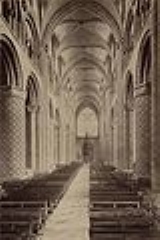
Durham Cathedral
The term Norman architecture is used to categorise styles of Romanesque architecture
Romanesque architecture

Romanesque architecture is the term that is used to describe the architecture of Middle Ages Europe which evolved into the Gothic architecture style beginning in the 12th century....
 developed by the Normans
Normans

The Normans were the people who gave their names to Normandy, a region in northern France. They descended from Viking conquerors of the territory and the native population of mostly Frankish and Gallo-Roman stock....
 in the various lands under their dominion or influence in the 11th and 12th centuries. In particular the term is traditionally used for English Romanesque architecture. The Normans introduced large numbers of castle
Castle

A castle is a defensive structure seen as one of the main symbols of the Middle Ages. The term has a history of scholarly debate surrounding its exact meaning, but it is usually regarded as being distinct from the general terms fort or fortress in that it describes a residence of a monarch or noble and commands a specific defensive territor...
s and fortification
Fortification

Fortifications are military constructions and buildings designed for defense in warfare and military bases. Humans have constructed defensive works for many thousands of years, in a variety of increasingly complex designs....
s including Norman keep
Keep

A keep is a strong central tower which is used as a dungeon or a fortress. Often, the keep is the most defended area of a castle, and as such may form the main Human habitat area, or contain important stores such as the Armory , food, and the main water well, which would ensure survival during a siege....
s, and at the same time monasteries
Monastery

Monastery , a term derived from the Greek language word ???ast?????, neut. of ???ast????? - monasterios denotes the building, or complex of buildings, that houses a room reserved for prayer as well as the domestic quarters and workplace of Monk, whether monks or nuns, and whether living in Cenobium or alone ....
, abbey
Abbey

An abbey , is a Christianity monastery or convent, under the government of an Abbot or an Abbess, who serves as the spiritual father or mother of the community....
s, churches and cathedral
Cathedral

A cathedral is a Christian church that contains the seat of a bishop. It is a Religion building for worship, specifically of a denomination with an episcopal hierarchy, such as the Roman Catholic Church, Anglicanism, Orthodox Christian and some Lutheranism churches, which serves as a bishop's seat, and thus as the central church of a dioc...
s, in a style characterised by the usual Romanesque rounded arch
Arch

An arch is a structure that Span a space while supporting weight . Arches appeared as early as the 2nd millennium BC in Mesopotamian brick architecture, but their systematic use started with the Ancient Rome who were the first to apply the technique to a wide range of structures....
es (particularly over windows and doorways) and especially massive proportions compared to other regional variations of the style.

These Romanesque
Romanesque architecture

Romanesque architecture is the term that is used to describe the architecture of Middle Ages Europe which evolved into the Gothic architecture style beginning in the 12th century....
 styles originated in Normandy
Normandy

Normandy is a geographical region corresponding to the former Duchy of Normandy. It is situated along the coast of France south of the English Channel between Brittany and Picardy and comprises territory in northern France and the Channel Islands....
 and became widespread in north western Europe
Europe

Europe is, conventionally, one of the world's seven continents. Comprising the westernmost peninsula of Eurasia, Europe is generally divided from Asia to its east by the water divide of the Ural Mountains, the Ural , the Caspian Sea, and by the Caucasus Mountains to the southeast....
, particularly in England
England

native_name =|conventional_long_name = England|common_name = England|image_flag = Flag of England.svg|image_coat = England COA.svg|symbol_type = Royal Coat of Arms...
, which contributed considerable development and has the largest number of surviving examples. At about the same time a Norman dynasty
Hauteville family

The family of the Hauteville was a petty baronial Normans family from the Cotentin which rose to prominence in Europe, Asia, and Africa through its conquests in the Mediterranean, especially Southern Italy and Sicily....
 ruled in Sicily
Sicily

Sicily is an Autonomous regions with special statute of Italy. Of all the regions of Italy, Sicily covers the largest land area at 25,708 km? and currently has just over five million inhabitants....
, producing a distinctive variation incorporating Byzantine
Byzantine Empire

Byzantine Empire and Eastern Roman Empire are conventional names used to describe the Roman Empire during the Middle Ages, centered on its capital of Constantinople....
 and Saracen
Saracen

Saracen was a term used by Europeans in the Middle Ages for Fatimids at first, then later for all who professed the religion of Islam....
 influences which is also known as Norman architecture, or alternatively as Sicilian Romanesque.

Origin of the term, development into Gothic

The term may have originated with 18th century antiquarian
Antiquarian

An antiquarian or antiquary is an aficionado of antiquities or things of the past. Also, and most often in modern usage, an antiquarian is a person who deals with or collects rare and ancient "Antiquarian book trade in the United States"....
s, but its usage in a sequence of styles has been attributed to Thomas Rickman
Thomas Rickman

Thomas Rickman , was an England architect who was a major figure in the Gothic Revival.He was born at Maidenhead, into a large Quaker family, and avoided the medical career envisaged for him by his father, a grocer and druggist; he went into business for himself and married his first cousin Lucy Rickman in 1804, a marriage that estranged hi...
 in his 1817 work An Attempt to Discriminate the Styles of English Architecture from the Conquest to the Reformation which used the labels "Norman, Early English, Decorated, and Perpendicular". The more inclusive term romanesque was used of the Romance languages
Romance languages

The Romance languages are a branch of the Indo-European languages comprising all the languages that descend from Latin language, the language of ancient Rome....
 in English by 1715, and was applied to architecture of the eleventh and twelfth centuries from 1819. Although Edward the Confessor
Edward the Confessor

Saint Edward the Confessor , son of Ethelred the Unready and Emma of Normandy, was the penultimate Anglo-Saxons List of the monarchs of the Kingdom of England and the last of the House of Wessex, ruling from 1042 until his death....
 built Westminster Abbey
Westminster Abbey

The Collegiate Church of St Peter at Westminster, which is almost always referred to popularly and informally as Westminster Abbey, is a large, mainly Gothic architecture Church , in Westminster, London, just to the west of the Palace of Westminster....
 in Romanesque style (now all replaced by later rebuildings) just before the Conquest, which is still believed to be the earliest major Romanesque building in England, no significant remaining Romanesque architecture in Britain can clearly be shown to predate the Conquest, although historians believe that many surviving "Norman" elements in buildings, nearly all churches, may well in fact be Anglo-Saxon.

As master masons developed the style and experimented with ways of overcoming the geometric difficulties of groin vault
Groin vault

A groin vault or groined vault is produced by the intersection at right angles of two barrel vaults. The word groin refers to the edge between the intersecting vaults; cf....
ed ceilings, they introduced features such as the pointed arch which were later characterised as being Gothic
Gothic architecture

Gothic architecture is a style of architecture which flourished during the high and late Middle Ages. It evolved from Romanesque architecture and was succeeded by Renaissance architecture....
 in style. Architectural historians and scholars consider that a style must be assessed as an integral whole rather than an aggregate of features, and while some include these developments within the Norman or Romanesque styles, others describe them as transitional or "Norman-Gothic Transitional". A few websites use the term "Norman Gothic", but it is unclear whether they refer to the transitional style or to the Norman style as a whole. ,

Norman architecture in Normandy

Viking
Viking

A Viking is one of the Norsemen explorers, warriors, merchants, and Piracy who raided and colonized wide areas of Europe from the late eighth to the early eleventh century....
 invaders arrived at the mouth of the river Seine in 911, at a time when Franks
Franks

The Franks or Frankish people were a West Germanic ethnic group first identified in the 3rd century as living north and east of the Lower Rhine River....
 were fighting on horseback and Frankish lords were building castles. Over the next century the population of the territory ceded to the Vikings, now called Normans
Normans

The Normans were the people who gave their names to Normandy, a region in northern France. They descended from Viking conquerors of the territory and the native population of mostly Frankish and Gallo-Roman stock....
, adopted these customs as well as Christianity and the langue d'oïl. Norman Barons built timber castles on earthen mounds, beginning the development of motte-and-bailey
Motte-and-bailey

A motte-and-bailey is a form of castle. Many were built in Britain in the Middle Ages, Ireland and France in the 11th and 12th centuries, favoured as a relatively cheap but effective defensive fortification that could repel most small attack forces....
 castles, and great stone churches in the Romanesque style of the Franks. By 950 they were building stone keep
Keep

A keep is a strong central tower which is used as a dungeon or a fortress. Often, the keep is the most defended area of a castle, and as such may form the main Human habitat area, or contain important stores such as the Armory , food, and the main water well, which would ensure survival during a siege....
s. The Normans were among the most travelled peoples of Europe, exposed to a wide variety of cultural influences including the Near East
Near East

Near East today is an ambiguous term that covers different countries for archeologists and historians, on one hand, and for political scientists, economists, and journalists, on the other....
, some of which became incorporated in their art and architecture. They elaborated on the Early Christian basilica plan, longitudinal with side aisles and an apse, and a western facade with two towers as at the Church of Saint-Étienne
Abbaye-aux-Hommes

The Abbaye aux Hommes is a former abbey church in the France city of Caen, Normandy. Dedicated to Saint Stephen , it is considered, along with the neighbouring Abbaye aux Dames, to be one of the most notable Romanesque architecture buildings in Normandy....
 at Caen begun in 1067, which formed a model for the larger English cathedral
Cathedral

A cathedral is a Christian church that contains the seat of a bishop. It is a Religion building for worship, specifically of a denomination with an episcopal hierarchy, such as the Roman Catholic Church, Anglicanism, Orthodox Christian and some Lutheranism churches, which serves as a bishop's seat, and thus as the central church of a dioc...
s beginning some twenty years later.

Norman architecture in England

In England
England

native_name =|conventional_long_name = England|common_name = England|image_flag = Flag of England.svg|image_coat = England COA.svg|symbol_type = Royal Coat of Arms...
, Norman nobles and bishops had influence before the Norman Conquest of 1066, and Norman influences affected late Anglo-Saxon architecture
Anglo-Saxon architecture

Anglo-Saxon architecture was a period in the history of architecture in England, and parts of Wales, from the mid-5th century until the Norman Conquest of 1066....
. Edward the Confessor
Edward the Confessor

Saint Edward the Confessor , son of Ethelred the Unready and Emma of Normandy, was the penultimate Anglo-Saxons List of the monarchs of the Kingdom of England and the last of the House of Wessex, ruling from 1042 until his death....
 was brought up in Normandy, and in 1042 brought masons to work on Westminster Abbey
Westminster Abbey

The Collegiate Church of St Peter at Westminster, which is almost always referred to popularly and informally as Westminster Abbey, is a large, mainly Gothic architecture Church , in Westminster, London, just to the west of the Palace of Westminster....
, the first Romanesque building in England. In 1051 he brought in Norman knight
Knight

File:Gothic armor 2.jpgKnight is the term for a social position originating in the Middle Ages. In the Commonwealth of Nations, knighthood is a non-heritable form of gentry....
s who built "motte" castles as a defence against the Welsh
Wales

native_name = Cymru|conventional_long_name = Wales|common_name = Wales|image_flag = Flag of Wales 2.svg|national_motto = ...
. Following the invasion Normans rapidly constructed motte-and-bailey
Motte-and-bailey

A motte-and-bailey is a form of castle. Many were built in Britain in the Middle Ages, Ireland and France in the 11th and 12th centuries, favoured as a relatively cheap but effective defensive fortification that could repel most small attack forces....
 castles, and in a burst of building activity built churches and abbey
Abbey

An abbey , is a Christianity monastery or convent, under the government of an Abbot or an Abbess, who serves as the spiritual father or mother of the community....
s, as well as more elaborate fortification
Fortification

Fortifications are military constructions and buildings designed for defense in warfare and military bases. Humans have constructed defensive works for many thousands of years, in a variety of increasingly complex designs....
s including Norman stone keep
Keep

A keep is a strong central tower which is used as a dungeon or a fortress. Often, the keep is the most defended area of a castle, and as such may form the main Human habitat area, or contain important stores such as the Armory , food, and the main water well, which would ensure survival during a siege....
s.

The buildings show massive proportions in simple geometries, the masonry
Masonry

Masonry is the building of structures from individual units laid in and bound together by mortar , and the term "masonry" can also refer to the units themselves....
 with small bands of sculpture
Sculpture

Sculpture is Three-dimensional space artwork created by shaping or combining hard and or plastic material, sound, and or text and or light, commonly Stone sculpture , metal, glass, or wood....
, perhaps as blind arcading, and concentrated spaces of capital
Capital (architecture)

In several traditions of architecture including Classical architecture, the capital forms the crowning member of a column or a pilaster. The capital projects on each side as it rises, in order to support the abacus and unite the form of the latter with the circular shaft of the column....
s and round doorways and in the tympanum
Tympanum (architecture)

A tympanum is the semi-circular or triangular decorative wall surface over an entrance bounded by a lintel and arch. It often contains sculptures or other ornaments....
 under an arch
Arch

An arch is a structure that Span a space while supporting weight . Arches appeared as early as the 2nd millennium BC in Mesopotamian brick architecture, but their systematic use started with the Ancient Rome who were the first to apply the technique to a wide range of structures....
. The "Norman arch" is the round arch. Norman mouldings are carved or incised with geometric ornament, such as chevron patterns around arches. The cruciform churches often had deep chancel
Chancel

"Chancel" is an architectural term for the space around the altar at the liturgical east end of a traditional Christian church building. It may terminate in an apse....
s and a square crossing tower which has remained a feature of English ecclesiastical architecture. Hundreds of parish
Parish

A parish is a local church; it is an administrative unit typically found in Roman Catholic, Anglican, United Methodist, and Presbyterianism churches....
 churches were built and the great English cathedral
Cathedral

A cathedral is a Christian church that contains the seat of a bishop. It is a Religion building for worship, specifically of a denomination with an episcopal hierarchy, such as the Roman Catholic Church, Anglicanism, Orthodox Christian and some Lutheranism churches, which serves as a bishop's seat, and thus as the central church of a dioc...
s were founded from 1083.

After a fire damaged Canterbury Cathedral
Canterbury Cathedral

Canterbury Cathedral in Canterbury, Kent, is one of the oldest and most famous Christianity structures in England and forms part of a World Heritage Site....
 in 1174 Norman masons introduced the new Gothic architecture
Gothic architecture

Gothic architecture is a style of architecture which flourished during the high and late Middle Ages. It evolved from Romanesque architecture and was succeeded by Renaissance architecture....
. Around 1191 Wells Cathedral
Wells Cathedral

Wells Cathedral is a Church of England cathedral in Wells, Somerset, England. It is the seat of the Bishop of Bath and Wells, who lives at the adjacent Bishop's Palace, Wells....
 and Lincoln Cathedral
Lincoln Cathedral

Lincoln Cathedral is a historic Anglican cathedral in Lincoln, Lincolnshire in England and seat of the Diocese of Lincoln in the Church of England....
 brought in the English Gothic style, and Norman became increasingly a modest style of provincial building.

Ecclesiastical architecture

  • Oxford Castle
    Oxford Castle

    Oxford Castle, located in Oxford city centre, was built by a Normans baron, Robert D'Oyly , in 1071 .It was originally an earth mound with a rock keep on top, known as St George's Tower, and later a fifty foot wall with towers was built around the structure....
     1074: church tower doubles as a place of refuge
  • St John's Chapel (ca 1087), Tower of London
    Tower of London

    Her Majesty's Royal Palace and Fortress, more commonly known as the Tower of London , is a historic monument in central London, England, on the north bank of the River Thames....
  • Durham Cathedral
    Durham Cathedral

    The Cathedral Church of Christ, Blessed Mary the Virgin and St Cuthbert of Durham, commonly referred to as Durham Cathedral, in the city of Durham, England, is the seat of the Anglican Church Bishop of Durham....
     (from 1093) was the first to employ a ribbed vault system with pointed arches
  • Winchester Cathedral
    Winchester Cathedral

    Winchester Cathedral at Winchester, Hampshire in Hampshire is one of the largest cathedrals in England, with the longest nave and overall length of any Gothic architecture cathedral in Europe....
     (from 1079)
  • Ely Cathedral
    Ely Cathedral

    Ely Cathedral is the principal Church of the Diocese of Ely, in Cambridgeshire, England, and the seat of the Bishop of Ely. It is known locally as "the ship of the The Fens", because of its prominent shape that towers above the surrounding flat and watery landscape....
     (1083–1109)
  • Peterborough Cathedral
    Peterborough Cathedral

    Peterborough Cathedral, or the Cathedral Church of St Peter, St Paul and St Andrew – also known as Saint Peter's Cathedral – the seat of the Bishop of Peterborough, is dedicated to Saint Peter, Paul of Tarsus and Saint Andrew whose statues look down from the three high gables of the famous West Front....
     (from 1118)
  • Kilpeck
    Kilpeck

    Kilpeck is a small village in Herefordshire, England. It is about southwest of Hereford, just south of the A465 road to Abergavenny, and about from the border with Wales....
     Church, Herefordshire
    Herefordshire

    Herefordshire is a Historic counties of England and Ceremonial counties of England Counties of England in the West Midlands Regions of England of England....
  • St. Nicholas Church, Pyrford
    Pyrford

    Pyrford is an English village that for centuries had historical links with the monastery of Westminster, in whose possession it remained between the Norman Conquest and the Dissolution of the Monasteries nearly five hundred years later....
    , Surrey
    Surrey

    Surrey is a counties of England in the South East England of England and is one of the Home Counties. The county borders Greater London, Kent, East Sussex, West Sussex, Hampshire, and Berkshire....
     (c.1140)
  • Southwell Minster
    Southwell Minster

    Southwell Minster is a Minster and cathedral, in the England town of Southwell, Nottinghamshire in Nottinghamshire, six miles away from Newark-on-Trent and thirteen miles from Mansfield....
  • St. Mary the Virgin, Iffley
    Iffley

    Iffley is a village in Oxfordshire, England, within the boundaries of the city of Oxford, located between the estates of Rose Hill, Oxford, Cowley, Oxford, and Donnington, Oxfordshire, and in proximity to the River Thames ....
    , Oxfordshire (1170)


Bibliography
  • Sedding, Edmund H. (1909) Norman Architecture in Cornwall: a handbook to old ecclesiastical architecture. With over 160 plates. London: Ward & Co.


Military architecture

  • White Tower (Tower of London)
    White Tower (Tower of London)

    The White Tower is a central tower at the Tower of London. The great central keep was started in 1078 by William the Conqueror who ordered the White Tower to be built inside the south-east angle of The City walls, adjacent to the River Thames....
  • Rochester Castle
    Rochester Castle

    Rochester Castle stands on the east bank of the River Medway, in Rochester, Kent. It is one of the best-preserved castles of its kind in the UK....


Domestic architecture

  • Jew's House
    Jew's House

    The Jew's House is one of the earliest extant town houses in England. It lies on Steep Hill in Lincoln, Lincolnshire, immediately below Jew's Court....
    , Lincoln
    Lincoln, Lincolnshire

    Lincoln is a cathedral city and county town of Lincolnshire, England.The non-metropolitan district of Lincoln has a population of around 101,000 - the 2001 census gave the entire urban area of Lincoln a population of 120,779....
  • Boothby Pagnell Manor, Lincolnshire
    Lincolnshire

    Lincolnshire is a Counties of England in the east of England. It borders Norfolk, Cambridgeshire, Rutland, Leicestershire, Nottinghamshire, South Yorkshire, and the East Riding of Yorkshire....
  • Oakham Castle
    Oakham

    |country= England|official_name= Oakham|latitude= 52.6705|longitude=-0.7333|population= 9,975 ...
    , Rutland
    Rutland

    Rutland is a Counties of England of mainland England, bounded on the west and north by Leicestershire, northeast by Lincolnshire, and southeast by Peterborough and Northamptonshire....
  • Moyse's Hall Museum Bury St Edmunds Suffolk
    Suffolk

    Suffolk is a Non-metropolitan counties of England of Historic counties of England in East Anglia, England. It has borders with Norfolk to the north, Cambridgeshire to the west and Essex to the south....
     (c.1180)


Norman architecture in Scotland

Scotland
Scotland

conventional_long_name = ScotlandAlba|common_name= Scotland|image_flag = Flag of Scotland.svg|flag_width = 130px...
 also came under early Norman influence, with Norman nobles at the court of King Macbeth
Macbeth of Scotland

Mac Bethad mac Findla?ch , anglicised as Macbeth, and nicknamed R? Deircc, "the Red King" , was King of the Scots from 1040 until his death....
 around 1050. His successor Máel Coluim III
Malcolm III of Scotland

M?el Coluim mac Donnchada , called in most Anglicisation regnal lists Malcolm III, and in later centuries nicknamed Canmore, "Big Head" or Long-neck , was King of Scots....
 overthrew him with English and Norman assistance, and his queen Margaret
Saint Margaret of Scotland

Saint Margaret , was the sister of Edgar ?theling, the short-ruling and uncrowned Anglo-Saxons King of England. She married Malcolm III of Scotland, King of Scots, becoming his Queen consort....
 encouraged the church. The Benedictine
Benedictine

Benedictine refers to the spirituality and consecrated life in accordance with the Rule of St Benedict, written by Benedict of Nursia in the sixth century for the cenobitic communities he founded in central Italy....
 order founded a monastery at Dunfermline
Dunfermline

Dunfermline is a town in Fife which had official City_status_in_the_United_Kingdom#Pretenders until 1970. It is located on high ground five miles from the northern shore of the Firth of Forth on the route of major road and rail crossings across the firth to Edinburgh and the south....
. Her fourth son who became King David
David I of Scotland

David I or Dabhidh Mac Maol Chaluim was a 12th-century ruler who was Prince of the Cumbrians and later List of monarchs of Scotland . The youngest son of Maol Chaluim Mac Donnchaidh and Saint Margaret of Scotland, David spent most of his childhood in Scotland, but was exiled to England temporarily in 1093....
 built St. Margaret's Chapel
St. Margaret's Chapel

St. Margaret's Chapel, the oldest surviving building in Edinburgh Castle, is an example of Norman architecture and the oldest building in Edinburgh, Scotland....
 at the start of the 12th century.

Ecclesiastical architecture

  • Dunfermline Abbey
    Dunfermline Abbey

    Dunfermline Abbey is a large Benedictine abbey in Dunfermline, Fife, Scotland. It was administered by the Abbot of Dunfermline. The abbey was founded in 1128 by King David I of Scotland, but the monastic establishment was based on an earlier foundation dating back to the reign of King Malcolm III of Scotland ....
    , Dunfermline
    Dunfermline

    Dunfermline is a town in Fife which had official City_status_in_the_United_Kingdom#Pretenders until 1970. It is located on high ground five miles from the northern shore of the Firth of Forth on the route of major road and rail crossings across the firth to Edinburgh and the south....
     (founded about 1070 by St Margaret
    Saint Margaret of Scotland

    Saint Margaret , was the sister of Edgar ?theling, the short-ruling and uncrowned Anglo-Saxons King of England. She married Malcolm III of Scotland, King of Scots, becoming his Queen consort....
    )
  • St Andrew Cathedral (from about 1070)
  • St. Margaret's Chapel
    St. Margaret's Chapel

    St. Margaret's Chapel, the oldest surviving building in Edinburgh Castle, is an example of Norman architecture and the oldest building in Edinburgh, Scotland....
    , Edinburgh Castle
    Edinburgh Castle

    Edinburgh Castle is an ancient stronghold which dominates the sky-line of the city of Edinburgh from its position atop the volcanic Castle Rock....
     (early 12th century)
  • Dalmeny
    Dalmeny

    Dalmeny is a village and parish within the City of Edinburgh council of Scotland. Now more or less a suburb of South Queensferry, Dalmeny is located near the south end of the Forth Road Bridge, and though it falls administratively under Edinburgh it is not contiguous with the city, which lies further to the east....
     parish church (from about 1130)
  • St Magnus Cathedral, Kirkwall
    Kirkwall

    Kirkwall is the largest town and capital of the Orkney Islands, off the coast of northern mainland Scotland. The town is first mentioned in the Orkneyinga saga in the year 1046....
     (from about 1137)
  • Jedburgh Abbey
    Jedburgh Abbey

    File:Thomas Girtin 006.JPGJedburgh Abbey is a ruined 12th century Augustinian abbey, situated in Jedburgh, in the Scottish Borders of Scotland....
    , Jedburgh
    Jedburgh

    Jedburgh is a town and former royal burgh in the Scottish Borders and historically in Roxburghshire....
     (founded about 1138 by David I
    David I of Scotland

    David I or Dabhidh Mac Maol Chaluim was a 12th-century ruler who was Prince of the Cumbrians and later List of monarchs of Scotland . The youngest son of Maol Chaluim Mac Donnchaidh and Saint Margaret of Scotland, David spent most of his childhood in Scotland, but was exiled to England temporarily in 1093....
    )
  • St Athernase Church
    St Athernase Church

    St Athernase Church, Leuchars, Fife is, though unfortunately lacking its original nave, is one of the finest surviving examples of a Romanesque architecture church in Scotland, with architectural detail as fine as that found in contemporary cathedrals or abbeys....
    , Leuchars
    Leuchars

    Leuchars is a small town near the north-east coast of Fife in Scotland.The town is nearly 2 miles to the north of the village of Guardbridge, which lies on the north bank of the River Eden, Fife where it widens to the Edenmouth estuary before joining the North Sea at St Andrews Bay....
     (12th century) and they ate pie


Norman architecture in Ireland

The Normans settled mostly in an area in the east of Ireland
Ireland

Ireland is the List of islands by area in Europe, and the twentieth-largest island in the world. It lies to the north-west of continental Europe and is surrounded by hundreds of islands and islet....
, later known as the Pale
The Pale

The Pale or the English Pale , was the English-controlled part of Ireland that had reduced by the late 1400s to an area along the east coast stretching from Dalkey, south of Dublin, to the garrison town of Dundalk north of Drogheda....
, and constructed many Norman buildings including Trim Castle
Trim Castle

Trim Castle , Trim, County Meath, Ireland, on the shores of the Boyne has an area of 30,000 m?. It is the remains of the largest Norman architecture castle in Europe, and Ireland's largest castle....
, County Meath
County Meath

County Meath is a county in Republic of Ireland, often informally called The Royal County. The county town is Navan, where the county hall and government are located, although Trim, County Meath, the former county town, has historical significance and remains a sitting place of the courts of the Republic of Ireland....
 , Swords Castle
Swords Castle

Swords Castle was built as the manorial residence of the Archbishop of Dublin around 1200 in Ireland or a little later in Swords, Dublin, just north of Dublin....
 in County Fingal (North Co. Dublin), and Dublin Castle
Dublin Castle

Dublin Castle off Dame Street, Dublin, Republic of Ireland, is a major Republic of Ireland governmental complex, formerly the fortified seat of United Kingdom of Great Britain and Ireland rule in Ireland until 1922....
.

Norman architecture in Italy


Mezzogiorno

The Normans began constructing castles, their trademark architectural piece, in Italy from an early date. William Iron Arm
William Iron Arm

William Iron Arm was a Normans adventurer, founder of the fortunes of the Hauteville family. One of twelve sons of Tancred of Hauteville, he journeyed to the Mezzogiorno with his younger brother Drogo of Hauteville in the first half of the eleventh century , in response to requests for help made by fellow Normans under Rainulf Drengot, count...
 built one at an unidentified location (Stridula) in Calabria
Calabria

Calabria , is a Regions of Italy in Southern Italy Italy, south of Naples, located at the "toe" of the Italian peninsula. It is bounded to the north by the region of Basilicata, to the south-west by the region of Sicily, to the west by the Tyrrhenian Sea, and to the east by the Ionian Sea....
 in 1045. After the death of Robert Guiscard
Robert Guiscard

Robert Guiscard, from Latin Viscardus and Old French Viscart, often rendered the Resourceful, the Cunning, the Wily, or the Fox, was a Normans adventurer conspicuous in the Norman conquest of southern Italy....
 in 1085, peninsular southern Italy experienced a series of civil wars and fell under the control of increasingly weaker princes. Revolts characterised the region until well into the twelfth century and minor lords sought to resist ducal or royal power from within their own castles. In the Molise
Molise

Molise is a region of Southern Italy, the second smallest of the regions. It was formerly part of the region of Abruzzi e Molise and now a separate entity....
, the Normanas embarked on their most extensive castle-building programme. There they introduced the opus gallicum
Opus gallicum

The opus gallicum was a technique of construction whereby precise holes were created in stone masonry for the insertion of wooden beams to create a wooden infrastructure....
 technique to Italy.

Besides the encastellation
Encastellation

Encastellation is the process whereby the feudal kingdoms of Europe became dotted with castles, from which local lords could dominate the countryside of their fiefs and their neighbours', and from which kings could command even the far-off corners of their realms....
 of the countryside, the Normans erected several religious buildings which still survive. They edified the shrine at Monte Sant'Angelo
Monte Sant'Angelo

Monte Sant'Angelo is a town of Apulia, southern Italy, in the province of Province of Foggia, about 15 km north of Manfredonia by road and 4 km west of Mattinata, on the southern slopes of Monte Gargano....
 and built a mausoleum
Mausoleum

A mausoleum is an external free-standing building constructed as a monument enclosing the interment space or burial chamber of a deceased person or persons....
 to the Hauteville family
Hauteville family

The family of the Hauteville was a petty baronial Normans family from the Cotentin which rose to prominence in Europe, Asia, and Africa through its conquests in the Mediterranean, especially Southern Italy and Sicily....
 at Venosa
Venosa

Venosa is a town and comune in the province of Potenza, in the Southern Italian region of Basilicata, in the Vulture area. It is bounded by the comuni of Barile, Ginestra, Lavello, Maschito, Montemilone, Palazzo San Gervasio, Rapolla and Spinazzola....
. They also built many new Latin monasteries, including the famous foundation of Sant'Eufemia.

Sicily

Sicily
Sicily

Sicily is an Autonomous regions with special statute of Italy. Of all the regions of Italy, Sicily covers the largest land area at 25,708 km? and currently has just over five million inhabitants....
's Norman period lasted from circa 1070 until about 1200. The architecture was decorated in gild
Gilding

Gilding is the technique of applying a thin layer of gold to a surface. Gilding is performed through a mechanical process, known as leafing, or using one of many chemical processes....
ed mosaics such as that at the cathedral at Monreale
Monreale

Monreale is a town and comune in the province of Palermo, in Sicily, Italy, on the slope of Monte Caputo, overlooking the very fertile valley called "La Conca d'oro" , famed for its Orange , olive and almond trees, the produce of which is exported in large quantities....
. The Palatine Chapel in Palermo
Palermo

Palermo is a historic city in southern Italy, the Capital of the autonomous region Sicily and the province of Palermo. The city is noted for its rich history, culture, architecture and gastronomy, playing an important role throughout much of its existence; it is over 2,700 years old....
 built in 1130 is the perhaps the strongest example of this where the interior of the dome
Dome

A dome is a structural element of architecture that resembles the hollow upper half of a sphere. Dome structures made of various materials have a long architectural lineage extending into prehistory....
 (itself a Byzantine feature) is decorated in mosaic
Mosaic

Mosaic is the art of creating images with an assemblage of small pieces of colored glass, stone, or other material. It may be a technique of Decorative arts, an aspect of interior decoration or of cultural and spiritual significance as in a cathedral....
 depicting Christ Pantocrator accompanied by his angel
Ángel

?ngel is the third single from Belinda Peregr?n's debut album: Belinda. It was a massive hit in Mexico and an international hit for Belinda....
s.

During Sicily's later Norman era early Gothic influences can de detected such as those in the cathedral at Messina consecrated in 1197. However, here the high Gothic campanile
Campanile

A campanile – pronounced – is, especially in Italy, a free-standing bell tower, often adjacent to a church or cathedral....
 is of a later date, and should not be confused with the early Gothic built during the Norman period, which featured pointed arches and windows rather than the flying buttress
Flying buttress

A flying buttress, or arc-boutant, is a specific type of buttress usually found on a religious building such as a cathedral. They are used to transmit the horizontal thrust of a Vault across an intervening space , to a buttress outside the building....
es and pinnacle
Pinnacle

A pinnacle is an architecture ornament originally forming the cap or crown of a buttress or small turret, but afterwards used on parapets at the corners of towers and in many other situations....
s later to manifest themselves in the Gothic era.

  • Edifices in Palermo
    Palermo

    Palermo is a historic city in southern Italy, the Capital of the autonomous region Sicily and the province of Palermo. The city is noted for its rich history, culture, architecture and gastronomy, playing an important role throughout much of its existence; it is over 2,700 years old....
    • Norman palace
      Palazzo dei Normanni

      The Palazzo dei Normanni is a palace in Palermo, Italy. It was the seat of the Kings of Sicily.It was started in the 9th century by the Emir of Palermo and extended in the 12th century by Roger II of Sicily and other italo-Normans....
       with its Palatine Chapel
      Cappella Palatina

      The Palatine Chapel is the royal chapel of the Italo-Normans kings of Sicily situated on the ground floor at the center of the Palazzo dei Normanni in Palermo....
    • Zisa
      Zisa, Palermo

      The Zisa is a castle in the western part of Palermo, Sicily.The construction was begun in the 12th century by Arabian craftsmen for king William I of Sicily, and completed by his son William II of Sicily....
    • Cuba
      Cuba, Palermo

      The Cuba is a palace in the Sicilian city of Palermo. It was built in 1180 by William II of Sicily in his great Royal Park, as his personal recreation pavilion, together with an artificial lake: it shows strong Islamic architecture influences, as it was designed and decorated by Arab artist still living in Palermo after the Normans conquest...
    • Cathedral of Palermo
      Cathedral of Palermo

      The Cathedral of Palermo is an architectural complex in Palermo . It is characterized by the presence of different styles, due to a long history of additions, alterations and restorations, the last of which occurred in the 18th century....
    • San Giovanni dei Lebbrosi
    • San Giovanni degli Eremiti
      San Giovanni degli Eremiti

      San Giovanni degli Eremiti is a church in Palermo, near the Palazzo dei Normanni....
    • La Martorana
    • San Cataldo
      San Cataldo, Palermo

      San Cataldo is a church of the Sicilian city of Palermo, on the central Piazza Bellini. It is a notable example of Norman architecture. The church is annexed to that of Santa Maria dell'Ammiraglio....
  • Monreale Cathedral
    Monreale

    Monreale is a town and comune in the province of Palermo, in Sicily, Italy, on the slope of Monte Caputo, overlooking the very fertile valley called "La Conca d'oro" , famed for its Orange , olive and almond trees, the produce of which is exported in large quantities....
     and Benedictine
    Benedictine

    Benedictine refers to the spirituality and consecrated life in accordance with the Rule of St Benedict, written by Benedict of Nursia in the sixth century for the cenobitic communities he founded in central Italy....
     cloister
    Cloister

    A cloister is a covered walk with an open colonnade on one side, running along the walls of buildings that face a quadrangle or garth. The attachment of a cloister to a cathedral or church usually indicates that it is part of a monastic foundation....
  • Messina Cathedral
  • Cefalù Cathedral
    Cefalù

    Cefal? is a city and comune in the province of Palermo, located on the northern coast of Sicily, Italy on the Tyrrhenian Sea about 75 km east from the provincial capital and 185 km west of Messina, Italy....


Malta

After its Norman conquest in 1091, Malta saw the construction of several still-surviving Norman pieces of architecture. Fortresses and houses still exist in Mdina
Mdina

Mdina, Citt? Vecchia, or Citt? Notabile, is the old capital of Malta. Mdina is a medieval town situated in the centre of the island....
 and Vittoriosa.

Gallery


Sources


  • Bilson, J.: Durham cathedral and the cronology of its vaults, Archeol. Journal 79, 1929
  • Clapham, A. W.: English Romanesque Architecture after the conquest. Oxford 1934
  • Clifton-Taylor, A.: The Cathedrals of England. London 1967
  • Cook, G. H.: The English Cathedrals through the Centuries. London 1957
  • Escher, K.: Englische Kathedralen. Zürich 1929
  • Lexikon der Weltarchitektur. Von Pevsner, Nikolaus / John Fleming / Hugh Honour [1966]. München 1971.
  • Rieger, R.: Studien zur mittelalterlichen Architektur Englands. In: Wiener Kunstwiss. Blätter, Jg. 2, 1953
  • Short, Ernest H.: Norman Architecture in England, 2005
  • Spengler, Dietmar: Die anglo-normannischen Kirchen. Referat im HS SS 1980, Köln (unveröffentlicht)
  • Webb, G.: Architecture in Britain: The Middle Ages (Pelican History of Art), London 1956


External links

  • : detailed analysis, illustrations]