

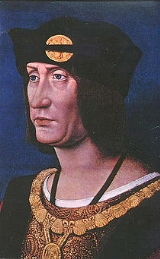
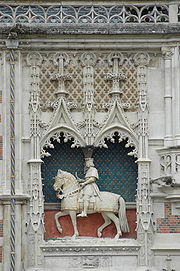
Louis XII of France

Encyclopedia
Louis proved to be a popular king. At the end of his reign the crown deficit was no greater than it had been when he succeeded Charles VIII in 1498, despite several expensive military campaigns in Italy. His fiscal reforms of 1504 and 1508 tightened and improved procedures for the collection of taxes. He had duly earned the title of Father of the People ("Le Père du Peuple"), conferred upon him by the Estates in 1506.
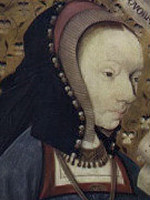
 In 1476, Louis XI
(the "Spider King") forced Louis (his second cousin) to marry his pious daughter Joan of France
(1464–1505).
Louis XI was succeeded by Charles VIII
, who died childless in 1498, and was succeeded by Louis XII. Charles had been married to Anne, Duchess of Brittany (1477–1514), to unite the quasi-sovereign Duchy of Brittany
with the Kingdom of France. To sustain this union, Louis had his marriage to Joan annulled so that he could marry Anne, now a widow.
The annulment, described as "one of the seamiest lawsuits of the age", was not simple, however. Louis did not, as might be expected, argue the marriage to be void due to consanguinity (the general allowance for the dissolution of a marriage at that time). Though he could produce witnesses to claim that the two were closely related due to various linking marriages, there was no documentary proof, merely the opinions of courtiers. Likewise, Louis could not argue that he had been below the legal age of consent
(fourteen) to marry: no one was certain when he had been born, with Louis claiming to have been twelve at the time, and others ranging in their estimates between eleven and thirteen. As there was no real proof, however, he was forced to make other arguments.
Accordingly, Louis (much to the horror of his wife) claimed that she was physically malformed, providing a rich variety of detail precisely how, and that he had therefore been unable to consummate the marriage. Joan, unsurprisingly, fought this uncertain charge fiercely, producing witnesses to Louis' boast of having "mounted my wife three or four times during the night." Louis also claimed that his sexual performance had been inhibited by witchcraft
; Joan responded by asking how he was able to know what it was like to try to make love to her.
 Had the Papacy been a neutral party, Joan would likely have won, for Louis' case was exceedingly weak. Unfortunately for the Queen, Pope Alexander VI
(Roderigo Borgia) was committed for political reasons to grant the divorce, and accordingly he ruled against Joan. He granted the annulment on the grounds that Louis did not freely marry but was forced to marry by Joan's father Louis XI. Outraged, Joan reluctantly submitted, saying that she would pray for her former husband. She became a nun and was canonized as a saint in 1950.
Louis married the equally reluctant queen dowager, Anne, in 1499. They had four stillborn sons, and two daughters. The elder daughter, Claude
(1499-1524), was betrothed by her mother's arrangement to the future Emperor Charles V
in 1501. But after Anne failed to produce a living son, Louis dissolved the betrothal and betrothed Claude to his heir presumptive
, Francis of Angoulême
, thereby insuring Brittany would remain united with France. Anne opposed this marriage, which took place only after her death in 1514. Claude succeeded her mother in Brittany
, and became queen consort to Francis. The younger daughter, Renée
(1510–1575), married Duke Ercole II of Ferrara
.
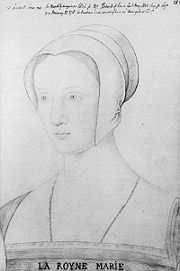
After the death of Anne, Louis married Mary Tudor (1496–1533), the sister of King Henry VIII of England
, in Abbeville
, France, on 9 October 1514. This was a final attempt to produce an heir to his throne; despite two previous marriages, the king had no living sons. Louis died on 1 January 1515, less than three months after he married Mary, reputedly worn out by his exertions in the bedchamber. Their union produced no children.
. Due to the tradition of Salic Law
, which did not allow women to inherit the throne of France, he was succeeded by his first cousin's son, Francis I
(who was also his son-in-law), who founded his own line of French kings.
Louis XII had an illegitimate son, Michel de Bucy, Archbishop of Bourges from 1505, died in 1511 and was buried in Bourges
.
Marriages
Louis XI of France
Louis XI , called the Prudent , was the King of France from 1461 to 1483. He was the son of Charles VII of France and Mary of Anjou, a member of the House of Valois....
(the "Spider King") forced Louis (his second cousin) to marry his pious daughter Joan of France
Joan of France, Duchess of Berry
Joan of France was briefly Queen consort of France as wife of King Louis XII of France, in between the death of her brother, Charles VIII, and the annulment of her marriage....
(1464–1505).
Louis XI was succeeded by Charles VIII
Charles VIII of France
Charles VIII, called the Affable, , was King of France from 1483 to his death in 1498. Charles was a member of the House of Valois...
, who died childless in 1498, and was succeeded by Louis XII. Charles had been married to Anne, Duchess of Brittany (1477–1514), to unite the quasi-sovereign Duchy of Brittany
Duke of Brittany
The Duchy of Brittany was a medieval tribal and feudal state covering the northwestern peninsula of Europe,bordered by the Alantic Ocean on the west and the English Channel to the north with less definitive borders of the Loire River to the south and Normandy to the east...
with the Kingdom of France. To sustain this union, Louis had his marriage to Joan annulled so that he could marry Anne, now a widow.
The annulment, described as "one of the seamiest lawsuits of the age", was not simple, however. Louis did not, as might be expected, argue the marriage to be void due to consanguinity (the general allowance for the dissolution of a marriage at that time). Though he could produce witnesses to claim that the two were closely related due to various linking marriages, there was no documentary proof, merely the opinions of courtiers. Likewise, Louis could not argue that he had been below the legal age of consent
Age of consent
While the phrase age of consent typically does not appear in legal statutes, when used in relation to sexual activity, the age of consent is the minimum age at which a person is considered to be legally competent to consent to sexual acts. The European Union calls it the legal age for sexual...
(fourteen) to marry: no one was certain when he had been born, with Louis claiming to have been twelve at the time, and others ranging in their estimates between eleven and thirteen. As there was no real proof, however, he was forced to make other arguments.
Accordingly, Louis (much to the horror of his wife) claimed that she was physically malformed, providing a rich variety of detail precisely how, and that he had therefore been unable to consummate the marriage. Joan, unsurprisingly, fought this uncertain charge fiercely, producing witnesses to Louis' boast of having "mounted my wife three or four times during the night." Louis also claimed that his sexual performance had been inhibited by witchcraft
Witchcraft
Witchcraft, in historical, anthropological, religious, and mythological contexts, is the alleged use of supernatural or magical powers. A witch is a practitioner of witchcraft...
; Joan responded by asking how he was able to know what it was like to try to make love to her.
Pope Alexander VI
Pope Alexander VI , born Roderic Llançol i Borja was Pope from 1492 until his death on 18 August 1503. He is one of the most controversial of the Renaissance popes, and his Italianized surname—Borgia—became a byword for the debased standards of the Papacy of that era, most notoriously the Banquet...
(Roderigo Borgia) was committed for political reasons to grant the divorce, and accordingly he ruled against Joan. He granted the annulment on the grounds that Louis did not freely marry but was forced to marry by Joan's father Louis XI. Outraged, Joan reluctantly submitted, saying that she would pray for her former husband. She became a nun and was canonized as a saint in 1950.
Louis married the equally reluctant queen dowager, Anne, in 1499. They had four stillborn sons, and two daughters. The elder daughter, Claude
Claude of France
Claude of France was a princess and queen consort of France and ruling Duchess of Brittany. She was the eldest daughter of Louis XII of France and Anne, Duchess of Brittany....
(1499-1524), was betrothed by her mother's arrangement to the future Emperor Charles V
Charles V, Holy Roman Emperor
Charles V was ruler of the Holy Roman Empire from 1519 and, as Charles I, of the Spanish Empire from 1516 until his voluntary retirement and abdication in favor of his younger brother Ferdinand I and his son Philip II in 1556.As...
in 1501. But after Anne failed to produce a living son, Louis dissolved the betrothal and betrothed Claude to his heir presumptive
Heir Presumptive
An heir presumptive or heiress presumptive is the person provisionally scheduled to inherit a throne, peerage, or other hereditary honour, but whose position can be displaced by the birth of an heir or heiress apparent or of a new heir presumptive with a better claim to the position in question...
, Francis of Angoulême
Francis I of France
Francis I was King of France from 1515 until his death. During his reign, huge cultural changes took place in France and he has been called France's original Renaissance monarch...
, thereby insuring Brittany would remain united with France. Anne opposed this marriage, which took place only after her death in 1514. Claude succeeded her mother in Brittany
Brittany
Brittany is a cultural and administrative region in the north-west of France. Previously a kingdom and then a duchy, Brittany was united to the Kingdom of France in 1532 as a province. Brittany has also been referred to as Less, Lesser or Little Britain...
, and became queen consort to Francis. The younger daughter, Renée
Renée of France
Renée de France was the younger daughter of Louis XII of France and Anne, Duchess of Brittany. Her elder sister was Queen Claude of France. She was the Duchess of Ferrara due to her marriage to Ercole II d'Este, grandson of Pope Alexander VI...
(1510–1575), married Duke Ercole II of Ferrara
Ercole II d'Este
Ercole II d'Este was Duke of Ferrara, Modena and Reggio from 1534 to 1559. He was a member of the house of Este and the eldest son of Alfonso I d'Este and Lucrezia Borgia....
.
After the death of Anne, Louis married Mary Tudor (1496–1533), the sister of King Henry VIII of England
Henry VIII of England
Henry VIII was King of England from 21 April 1509 until his death. He was Lord, and later King, of Ireland, as well as continuing the nominal claim by the English monarchs to the Kingdom of France...
, in Abbeville
Abbeville
Abbeville is a commune in the Somme department in Picardie in northern France.-Location:Abbeville is located on the Somme River, from its modern mouth in the English Channel, and northwest of Amiens...
, France, on 9 October 1514. This was a final attempt to produce an heir to his throne; despite two previous marriages, the king had no living sons. Louis died on 1 January 1515, less than three months after he married Mary, reputedly worn out by his exertions in the bedchamber. Their union produced no children.
Death
Louis died on 1 January 1515, and was interred in Saint Denis BasilicaSaint Denis Basilica
The Cathedral Basilica of Saint Denis is a large medieval abbey church in the commune of Saint-Denis, now a northern suburb of Paris. The abbey church was created a cathedral in 1966 and is the seat of the Bishop of Saint-Denis, Pascal Michel Ghislain Delannoy...
. Due to the tradition of Salic Law
Salic law
Salic law was a body of traditional law codified for governing the Salian Franks in the early Middle Ages during the reign of King Clovis I in the 6th century...
, which did not allow women to inherit the throne of France, he was succeeded by his first cousin's son, Francis I
Francis I of France
Francis I was King of France from 1515 until his death. During his reign, huge cultural changes took place in France and he has been called France's original Renaissance monarch...
(who was also his son-in-law), who founded his own line of French kings.
Ancestors
Issue
| By Anne of Brittany Anne of Brittany Anne, Duchess of Brittany , also known as Anna of Brittany , was a Breton ruler, who was to become queen to two successive French kings. She was born in Nantes, Brittany, and was the daughter of Francis II, Duke of Brittany and Margaret of Foix. Her maternal grandparents were Queen Eleanor of... |
|||
| Name | Birth | Death | Notes |
|---|---|---|---|
| Claude of France Claude of France Claude of France was a princess and queen consort of France and ruling Duchess of Brittany. She was the eldest daughter of Louis XII of France and Anne, Duchess of Brittany.... |
14 October 1499 | 20 July 1524 | married Francis I of France Francis I of France Francis I was King of France from 1515 until his death. During his reign, huge cultural changes took place in France and he has been called France's original Renaissance monarch... on 18 May 1514; had issue |
| Unnamed son | 1500 | 1500 | stillborn |
| Unnamed son | 21 January 1503 | 21 January 1503 | stillborn |
| miscarriage | by the end of 1503 | by the end on 1503 | some sources cited |
| miscarriage | 1505 | 1505 | |
| Unnamed son | 21 January 1508 | 21 January 1508 | stillborn; some sources cited this was a miscarriage |
| miscarriage | 1509 | 1509 | some sources cited |
| Renée of France Renée of France Renée de France was the younger daughter of Louis XII of France and Anne, Duchess of Brittany. Her elder sister was Queen Claude of France. She was the Duchess of Ferrara due to her marriage to Ercole II d'Este, grandson of Pope Alexander VI... |
25 October 1510 | 12 June 1574 | married Ercole II d'Este Ercole II d'Este Ercole II d'Este was Duke of Ferrara, Modena and Reggio from 1534 to 1559. He was a member of the house of Este and the eldest son of Alfonso I d'Este and Lucrezia Borgia.... in April 1528; had issue |
| Unnamed son | 21 January 1512 | 21 January 1512 | stillborn |
Louis XII had an illegitimate son, Michel de Bucy, Archbishop of Bourges from 1505, died in 1511 and was buried in Bourges
Bourges
Bourges is a city in central France on the Yèvre river. It is the capital of the department of Cher and also was the capital of the former province of Berry.-History:...
.