

Svalbard

Encyclopedia
Svalbard is an archipelago
in the Arctic
, constituting the northernmost part of Norway
. It is located north of mainland Europe
, midway between mainland Norway and the North Pole
. The group of islands range from 74°
to 81° north
latitude (inside the Arctic Circle
), and from 10°
to 35° east
longitude. Spitsbergen
is the largest island, followed by Nordaustlandet
and Edgeøya
. The administrative center is Longyearbyen
, and other settlements include the Russian mining community of Barentsburg
, the research community of Ny-Ålesund
and the mining outpost of Sveagruva. The archipelago is administered by the Governor of Svalbard
.
The islands were first utilized as a whaling
base in the 17th and 18th centuries, after which they were abandoned. Coal mining
started at the beginning of the 20th century, and several permanent communities were established. The Spitsbergen Treaty of 1920 recognizes Norwegian sovereignty
, and the 1925 Svalbard Act
made Svalbard a full part of the Kingdom of Norway. This act also established Svalbard as a free economic zone
and a demilitarized zone
. The Norwegian Store Norske
and the Russian Arktikugol are the only mining companies remaining on the islands. Research and tourism have become important supplementary industries. Two major research facilities are the University Centre in Svalbard
and the Svalbard Global Seed Vault
. No roads connect the settlements; instead snowmobiles, aircraft and boats serve inter-community transport. Svalbard Airport, Longyear serves as the main gateway to the rest of Europe.
The archipelago features an Arctic climate, although with significantly higher temperatures than other areas at the same latitude. The flora
take advantage of the long period of midnight sun
to compensate for the polar night
. Svalbard is a breeding ground for many seabirds, and also features polar bears, reindeer
and marine mammal
s. Seven national parks and twenty-three nature reserves cover two-thirds of the archipelago, protecting the largely untouched, yet fragile, nature. Sixty percent of the archipelago is glacier
, and the islands feature many mountains and fjord
s.
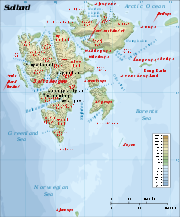 Svalbard is an archipelago between the Arctic Ocean
, Barents Sea
, Greenland Sea
and Norwegian Sea
, constituting the northernmost part of Norway. The treaty defines Svalbard as all islands, islets and skerries
from 74° to 81° north latitude, and from 10° to 35° east longitude. The land area is 61022 km² (23,560.7 sq mi), and dominated by the island Spitsbergen, which constitutes more than half the archipelago, followed by Nordaustlandet and Edgeøya. All settlements are located on Spitsbergen, except the meteorological outposts on Bjørnøya and Hopen
. The Norwegian state took possession of all unclaimed land, or 95.2% of the archipelago, at the time the Spitsbergen Treaty entered into force; Store Norske owns 4%, Arktikugol owns 0.4%, while other private owners hold 0.4%.
Svalbard is located in the north-western corner of the Eurasian Plate
. To the south and east, the seabed is shallow at 200 to 300 m (656.2 to 984.3 ), while to the north and west it sinks down to about 4 kilometres (2.5 mi). North of Svalbard there is pack ice and the North Pole
, and to the south mainland Norway. The Russian archipelago Franz Josef Land
and Novaya Zemlya
are located to the east, Greenland
is to the west.
Being located north of the Arctic Circle
, Svalbard experiences both midnight sun
in summer and polar night
in winter. At 74° north, the midnight sun lasts 99 days and polar night 84 days, while the respective figures at 81° are 141 and 128 days. In Longyearbyen, midnight sun lasts from 20 April until 23 August, and polar night lasts from 26 October to 15 February. In winter, the combination of full moon
and reflective snow can give additional light.
Glaciation
covers 36502 km² (14,093.5 sq mi) or 60% of Svalbard; 30% is barren rock while 10% is vegetated. The largest glacier is Austfonna
(8412 km² (3,247.9 sq mi)) on Nordaustlandet, followed by Olav V Land
and Vestfonna
. During summer, it is possible to ski from Sørkapp
in the south to the north of Spitsbergen, with only a short distance not being covered by snow or glacier. Kvitøya
is 99.3% covered by glacier.
The landforms of Svalbard were created through repeated ice age
s, where glaciers cut the former plateau into fjord
s, valleys and mountains. The tallest peak is Newtontoppen
(1713 m (5,620.1 ft)), followed by Perriertoppen
(1712 m (5,616.8 ft)), Ceresfjellet
(1675 m (5,495.4 ft)), Chadwickryggen
(1640 m (5,380.6 ft)) and Galileotoppen
(1637 m (5,370.7 ft)). The longest fjord is Wijdefjorden (108 km (67.1 mi)), followed by Isfjorden (107 km (66.5 mi)), Van Mijenfjorden (83 km (51.6 mi)), Woodfjorden (64 km (39.8 mi)) and Wahlenbergfjorden (46 km (28.6 mi)). Svalbard is part of the High Arctic Large Igneous Province
, and experienced Norway's strongest earthquake on 6 March 2009, which hit 6.5 on the Richter scale
.
 Scandinavians
may have discovered Svalbard as early as the 12th century. Traditional Norse
accounts exist of a land known as Svalbarð—literally "cold shores"—although this may have referred to Jan Mayen
, or a part of eastern Greenland
. Contemporary understanding was that both Svalbard and Greenland were connected to the mainland. The archipelago may in that period have been used for fishing and hunting. The Dutchman Willem Barentsz made the first indisputable discovery of Svalbard in 1596, in an attempt to find the Northern Sea Route
. In 1604, an English ship landed at Bjørnøya and started hunting walrus
; annual expeditions followed. From 1611, Spitsbergen became a base for whaling, where they targeted the bowhead whale
. Because of the lawless nature of the area, English, Danish, Dutch and French companies and authorities tried to use force to keep out other countries' fleets.
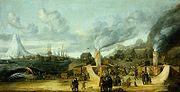
Smeerenburg
was one of the first settlements, established by the Dutch in 1619. Smaller bases were also built by the English, Danish and French. At first the outposts were merely summer camps, but from the early 1630s, a few individuals started to overwinter. Whaling at Spitsbergen lasted until the 1820s, when the Dutch, British and Danish whalers moved elsewhere in the Arctic. By the late 17th century, Russian hunters arrived; they overwintered to a greater extent and hunted land mammals such as the polar bear and fox. After British ships destroyed most of the Russian fleet in 1812, Russian activity on Svalbard diminished, and became non-existent from the 1820s. Norwegian hunting—mostly for walrus—started in the 1790s, but was abandoned about the same time as the Russians left. Whaling continued around Spitsbergen until the 1830s, and around Bjørnøya until the 1860s.
By the 1890s, Svalbard had become a destination for Arctic tourism, coal deposits had been found and the islands were being used as a base for Arctic exploration
. The first mining was done along Isfjorden by Norwegians in 1899; by 1904, British interests had established themselves in Adventfjorden
and started the first all-year operations. Production in Longyearbyen commenced by American interests in 1908; and Store Norske established itself in 1916, as did other Norwegian interests during the war, in part by buying American interests.
Discussions to establish the sovereignty of the archipelago commenced in the 1910s, but were interrupted by World War I. On 9 February 1920, following the Paris Peace Conference
, the Spitsbergen Treaty was signed, granting full sovereignty to Norway. However, all signatory countries were granted non-discriminatory rights to fishing, hunting and mineral resources. The treaty took effect on 14 August 1925, at the same time as the Svalbard Act regulated the archipelago and the first governor, Johannes Gerckens Bassøe
, took office. The archipelago has traditionally been known as Spitsbergen, and the main island itself as West Spitsbergen. From the 1920s, Norway renamed the archipelago Svalbard, and the main island became Spitsbergen. Kvitøya, Kong Karls Land, Hopen and Bjørnøya were not regarded as part of the Spitsbergen archipelago. Russians have traditionally called the archipelago Grumant . The Soviet Union retained the name Spitsbergen to support undocumented claims that Russians were the first to discover the island. In 1928, Italian explorer Umberto Nobile and the crew of the airship Italia crashed on the icepack off the coast of Foyn Island. The subsequent rescue attempts were covered extensively in the press and Svalbard received short-lived fame as a result.
 In 1941 Operation Gauntlet
, all Norwegian and Soviet settlements on Svalbard were evacuated, and a German presence was established with a meteorological outpost, although a small Norwegian garrison was kept on Spitsbergen. The German Operation Zitronella
took this garrison by force in 1943, and at the same time destroying the settlements at Longyearbyen and Barentsburg. After the war, the Soviet Union proposed common Norwegian and Soviet administration and military defense of Svalbard. This was rejected in 1947 by Norway, which two years later joined NATO. The Soviet Union retained high civilian activity on Svalbard, in part to ensure that the archipelago was not used by NATO.
After the war, Norway had re-established operations at Longyearbyen and Ny-Ålesund, while the Soviet Union had established mining in Barentsburg, Pyramiden
and Grumant
. The mine at Ny-Ålesund had several fatal accidents, killing 71 people while it was in operation from 1945 to 1954 and from 1960 to 1963. The Kings Bay Affair
, caused by the 1962-accident killing 21 workers, forced Gerhardsen's Third Cabinet to withdraw. From 1964, Ny-Ålesund became a research outpost, and a facility for the European Space Research Organisation. Petroleum test drilling was started in 1963 and continued until 1984, but no commercially viable fields were found. From 1960, regular charter flights were made from the mainland to a field at Hotellneset
; in 1975, Svalbard Airport, Longyear opened, allowing year-round services.
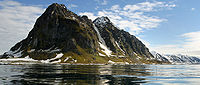 During the Cold War, the Soviet Union retained about twice the population on the island as Norway—with the archipelago's population slightly under 4,000. Russian activity has diminished considerably since then, falling from 2,500 to 450 people from 1990 to 2010. Grumant was closed after it was depleted in 1962. Pyramiden was closed in 1998, and since 2006, no coal has been exported from Barentsburg. The Russian community has also experienced two air accidents, Vnukovo Airlines Flight 2801
, which killed 141 people, and the Heerodden helicopter accident.
Longyearbyen remained a pure company town until 1989, when utilities, culture and education was separated into Svalbard Samfunnsdrift. In 1993, it was sold to the national government, and the University Centre was established. Through the 1990s, tourism increased and the town developed an economy independent of Store Norske and the mining. Longyearbyen was incorporated on 1 January 2002, receiving a community council.
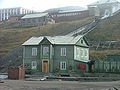 In 2009, Svalbard had a population of 2,753, of which 423 were Russia
n and Ukrainian
, 10 were Polish
and 322 were other non-Norwegians living in Norwegian settlements. The largest non-Norwegian groups in Longyearbyen in 2005 were from Thailand
, Sweden
, Denmark
, Russia
and Germany
. Svalbard is among the safest places on Earth, with virtually no crime.
Longyearbyen
is the largest settlement on the archipelago, the seat of the governor and the only town to be incorporated. The town features a hospital, primary and secondary school, university, sports center with a swimming pool, library, culture center, cinema,
bus transport, hotels, a bank, and several museums. The newspaper Svalbardposten
is published weekly. Only a small fraction of the mining activity remains at Longyearbyen; instead, workers commute to Sveagruva (or Svea) where Store Norske operates a mine. Sveagruva is a dorm town, with workers commuting from Longyearbyen on a weekly basis.
Ny-Ålesund
is a permanent settlement based entirely around research. Formerly a mining town, it is still a company town
operated by the Norwegian state-owned Kings Bay. While there is some tourism at the village, Norwegian authorities limit the access to the outpost to minimize impact on the scientific work. Ny-Ålesund has a winter population of 35 and a summer population of 180. The Norwegian Meteorological Institute
has outposts at Bjørnøya and Hopen, with respectively ten and four people stationed. Both outposts can also house temporary research staff. Poland operates the Polish Polar Station at Hornsund
, with ten permanent residents.
Barentsburg
is the only remaining Russian settlement, after Pyramiden
was abandoned in 1998 (although as of April 2010, a small Russian community of 15-20 people exists at Pyramiden, involved mainly in dismantling and transporting usable equipment to Barentsburg). A company town, all facilities are owned by Arktikugol, who operate a coal mine, although operation has been halted since 2006. In addition to the mining facilities, Arktikugol has opened a hotel and souvenir shop, catering to tourists taking day trips or hikes from Longyearbyen. The village features facilities such as a school, library, sports center, community center, swimming pool, farm and greenhouse. Pyramiden features similar facilities; both are built in typical post-World War II Soviet architectural and planning style and contain the world's two most northerly Lenin statues and other socialist realism
artwork.
of 1920 established full Norwegian sovereignty over the archipelago. The islands are, unlike the Norwegian Antarctic Territory
, a part of the Kingdom of Norway and not a dependency
. The treaty came into effect in 1925, following the Svalbard Act. All forty signatory countries of the treaty have the right to conduct commercial activities on the archipelago without discrimination, although all activity is subject to Norwegian legislation. The treaty limits Norway's right to collect taxes to that of financing services on Svalbard. Therefore, Svalbard has a lower income tax
than mainland Norway, and there is no value added tax
. There is a separate budget for Svalbard to ensure compliance. Svalbard is a demilitarized zone
, as the treaty prohibits the establishment of military installations. Norwegian military activity is limited to fishery surveillance by the Norwegian Coast Guard
as the treaty requires Norway to protect the natural environment.
The Svalbard Act
established the institution of the Governor of Svalbard
, who holds the responsibility as both county governor and chief of police
, as well as holding other authority granted from the executive branch. Duties include environmental policy
, family law
, law enforcement
, search and rescue
, tourism management, information services, contact with foreign settlements, and judge in some areas of maritime inquiries and judicial examinations—albeit never in the same cases as acting as police. Since 2009, Odd Olsen Ingerø
has been governor; he is assisted by a staff of 26 professionals. The institution is subordinate to the Ministry of Justice and the Police
, but reports to other ministries in matters within their portfolio.
Since 2002, Longyearbyen Community Council has had many of the same responsibilities of a municipality
, including utilities, education, cultural facilities, fire department, roads and ports. No care or nursing services are available, nor is welfare payment available. Norwegian residents retain pension and medical rights through their mainland municipalities. The hospital is part of University Hospital of North Norway, while the airport is operated by state-owned Avinor
. Ny-Ålesund and Barentsburg remain company town
s with all infrastructure owned by Kings Bay and Arktikugol, respectively. Other public offices with presence on Svalbard are the Norwegian Directorate of Mining
, the Norwegian Polar Institute
, the Norwegian Tax Administration and the Church of Norway
. Svalbard is subordinate to Nord-Troms District Court
and Hålogaland Court of Appeal
, both located in Tromsø
.
Although Norway is part of the European Economic Area
(EEA) and the Schengen Agreement
, Svalbard is not part of the Schengen Area
nor EEA. Non-Norwegian Svalbard residents do not need Schengen visas, but are prohibited from reaching Svalbard from mainland Norway without such. People without a source of income can be rejected by the governor. Nationals of any treaty signatory country may visit the archipelago without a visa. Russia retains a consulate in Barentsburg.
In September, 2010 a treaty was made between Russia and Norway fixing the boundary between the Svalbard archipelago and the Novaya Zemlya archipelago. Increased interest in petroleum exploration in the Arctic increased interest in resolution of the dispute. The agreement takes into account the relative position of the archipelagos, rather than being based simply on northward extension of the continental border of Norway and Russia.
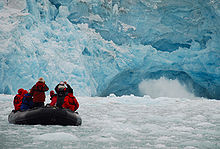 The three main industries on Svalbard are coal mining
, tourism
and research
. In 2007, there were 484 people working in the mining sector, 211 people working in the tourism sector and 111 people working in the education sector. The same year, the mining gave a revenue of NOK 2,008 million, tourism NOK 317 million and research NOK 142 million. In 2006, the average income for economically active people was NOK 494,700—23% higher than on the mainland. Almost all housing is owned by the various employers and institutions and rented to their employees; there are only a few privately owned houses, most of which are recreational cabins. Because of this, it is nearly impossible to live on Svalbard without working for an established institution.
Since the resettlement of Svalbard in the early 20th century, coal mining has been the dominant commercial activity. Store Norske Spitsbergen Kulkompani
, a subsidiary of the Norwegian Ministry of Trade and Industry
, operates Svea Nord in Sveagruva and Mine 7 in Longyearbyen. The former produced 3.4 million tonnes in 2008, while the latter uses 35% of its output to Longyearbyen Power Station. Since 2007, there has not been any significant mining by the Russian state-owned Arktikugol in Barentsburg. There have previously been performed test drilling for petroleum on land, but these did not give satisfactory results for permanent operation. The Norwegian authorities do not allow offshore petroleum activities for environmental reasons, and the land formerly test-drilled on has been protected as natural reserves or national parks. In 2011 a 20 year plan to develop offshore oil and gas resources around Svalbard was announced.
_5.jpg) Svalbard has historically been a base for both whaling
Svalbard has historically been a base for both whaling
and fishing
. Norway claimed a 200 NM exclusive economic zone
(EEZ) around Svalbard in 1977, with 31688 square kilometres (12,234.8 sq mi) of internal waters
and 770565 square kilometres (297,516.8 sq mi) of EEZ. Norway retains a restrictive fisheries policy in the zone, and the claims are disputed by Russia. Tourism is focused on the environment and is centered around Longyearbyen. Activities include hiking, kayaking, walks through glacier caves and snow-scooter and dog-sled safari. Cruise ships generate a significant portion of the traffic, including both stops by offshore vessels and expeditionary cruises starting and ending in Svalbard. Traffic is strongly concentrated between March and August; overnights have quintupled from 1991 to 2008, when there were 93,000 guest-nights.
Research on Svalbard centers around Longyearbyen and Ny-Ålesund, the most accessible areas in the high Arctic. Norway grants permission for any nation to conduct research on Svalbard, resulting in the Polish Polar Station and the Chinese Arctic Yellow River Station
, plus Russian facilities in Barentsburg. The University Centre in Svalbard
in Longyearbyen offers undergraduate, graduate and postgraduate courses to 350 students in various arctic sciences, particularly biology
, geology
and geophysics
. Courses are provided to supplement studies at the mainland universities; there are no tuition fees and courses are held in English, with Norwegian and international students equally represented. The Svalbard Global Seed Vault
is a "doomsday
" seedbank
to store seeds from as many of the world's crop varieties and their botanical wild relatives as possible. A cooperation between the Government of Norway and the Global Crop Diversity Trust
, the vault is cut into rock near Longyearbyen, keeping it at a natural −6 C and refrigerating the seeds to −18 C. The Svalbard Undersea Cable System
is a 1440 km (894.8 mi) fibre optic
lines from Svalbard to Harstad
, needed for communicating with polar orbit
ing satellite
through Svalbard Satellite Station and installations in Ny-Ålesund.
Svalbard Airport, Longyear, located 3 kilometres (2 mi) from Longyearbyen, is the only airport offering air transport off the archipelago. Scandinavian Airlines has daily scheduled services to Tromsø
and Oslo
; there are also irregular charter services to Russia. Lufttransport
provides regular corporate charter services from Longyearbyen to Ny-Ålesund Airport and Svea Airport
for Kings Bay and Store Norske; these flights are in general not available to the public. There are heliport
s in Barentsburg and Pyramiden, and helicopters are frequently used by the governor and to a less extent the mining company Arktikugol.
moderates Svalbard's temperatures, particularly during winter, giving it up to 20 C-change higher winter temperature than similar latitudes in Russia and Canada. This keeps the surrounding waters open and navigable most of the year. The interior fjord areas and valleys, sheltered by the mountains, have larger temperature differences than the coast, giving about 2 C-change warmer summer temperatures and 3 C-change colder winter temperatures. On the south of Spitsbergen, the temperature is slightly higher than further north and west. During winter, the temperature difference between south and north is typically 5 C-change, while about 3 C-change in summer. Bear Island has average temperatures even higher than the rest of the archipelago.
Svalbard is the meeting place for cold polar air from the north and mild, wet sea air from the south, creating low pressure and changing weather and fast winds, particularly in winter; in January, a strong breeze is registered 17% of the time at Isfjord Radio
, but only 1% of the time in July. In summer, particularly away from land, fog is common, with visibility under 1 kilometre (0.621372736649807 mi) registered 20% of the time in July and 1% of the time in January, at Hopen and Bjørnøya. Precipitation is frequent, but falls in small quantities, typically less than 400 millimetres (15.7 in) in western Spitsbergen. More rain falls in the uninhabited east side, where there can be more than 1000 millimetres (39.4 in).
_26.jpg) In addition to humans, four primarily terrestrial mammalian species inhabit the archipelago: the Arctic Fox
In addition to humans, four primarily terrestrial mammalian species inhabit the archipelago: the Arctic Fox
, the Svalbard reindeer
, polar bear
s and accidentally introduced Southern Vole
—which is only found in Grumant. Attempts to introduce the Arctic Hare
and the muskox have both failed. There are fifteen to twenty types of marine mammals, including whale
s, dolphin
s, seals
and walrus
es.
Polar bears are the iconic symbol of Svalbard, and one of the main tourist attractions. While protected, anyone outside of settlements is required to carry a rifle
to kill polar bears in self defense, as a last resort, should they attack. Svalbard and Franz Joseph Land share a common population of 3,000 polar bears, with Kong Karls Land being the most important breeding ground. The Svalbard reindeer (R. tarandus platyrhynchus) is a distinct sub-species, and while previously almost extinct, hunting is permitted for both it and the Arctic Fox. There are a limited number of domesticated animals in Russian settlements.
About thirty species of bird are found on Svalbard, most of which are migratory. The Barents Sea is among the areas in the world with most seabird
s, with about 20 million individuals during late summer. The most common are Little Auk
, Northern Fulmar
, Thick-billed Murre and Black-legged Kittiwake
. Sixteen species are on the IUCN Red List
. Particularly Bjørnøya, Storfjorden, Nordvest-Spitsbergen and Hopen are important breeding ground for seabirds. The Arctic Tern
has the furthest migration, all the way to Antarctica. Only two songbirds migrate to Svalbard to breed: the Snow Bunting
and the Wheatear
. Rock Ptarmigan is the only bird to overwinter. Remains of Predator X
from the Jurassic
period have been found; it is the largest dinosaur-era marine reptile
ever found—a pliosaur
estimated to have been almost 15 m (49.2 ft) long.
Svalbard has permafrost
and tundra
, with both low, middle and high Arctic vegetation
. 165 species of plants have been found on the archipelago. Only those areas which defrost in the summer have vegetations, which accounts for about 10% of the archipelago. Vegetation is most abundant in Nordenskiöld Land, around Isfjorden and where affected by guano
. While there is little precipitation, giving the archipelago a steppe
climate, plants still have good access to water because the cold climate reduces evaporation. The growing season is very short, and may only last a few weeks.
There are seven national parks in Svalbard: Forlandet
, Indre Wijdefjorden
, Nordenskiöld Land
, Nordre Isfjorden Land, Nordvest-Spitsbergen, Sassen-Bünsow Land
and Sør-Spitsbergen
. The archipelago has fifteen bird sanctuaries, one geotopic protected area and six nature reserves—with Nordaust-Svalbard
and Søraust-Svalbard
both being larger than any of the national parks. Most of the nature reserves and three of the national parks were protected in 1973, with nearly all the remaining protected occurring in the 2000s. All human traces dating from before 1946 are automatically protected. The protected areas make up 65% of the archipelago. Svalbard is on Norway's tentative list for nomination as a UNESCO World Heritage Site.
Archipelago
An archipelago , sometimes called an island group, is a chain or cluster of islands. The word archipelago is derived from the Greek ἄρχι- – arkhi- and πέλαγος – pélagos through the Italian arcipelago...
in the Arctic
Arctic
The Arctic is a region located at the northern-most part of the Earth. The Arctic consists of the Arctic Ocean and parts of Canada, Russia, Greenland, the United States, Norway, Sweden, Finland, and Iceland. The Arctic region consists of a vast, ice-covered ocean, surrounded by treeless permafrost...
, constituting the northernmost part of Norway
Norway
Norway , officially the Kingdom of Norway, is a Nordic unitary constitutional monarchy whose territory comprises the western portion of the Scandinavian Peninsula, Jan Mayen, and the Arctic archipelago of Svalbard and Bouvet Island. Norway has a total area of and a population of about 4.9 million...
. It is located north of mainland Europe
Europe
Europe is, by convention, one of the world's seven continents. Comprising the westernmost peninsula of Eurasia, Europe is generally 'divided' from Asia to its east by the watershed divides of the Ural and Caucasus Mountains, the Ural River, the Caspian and Black Seas, and the waterways connecting...
, midway between mainland Norway and the North Pole
North Pole
The North Pole, also known as the Geographic North Pole or Terrestrial North Pole, is, subject to the caveats explained below, defined as the point in the northern hemisphere where the Earth's axis of rotation meets its surface...
. The group of islands range from 74°
74th parallel north
The 74th parallel north is a circle of latitude that is 74 degrees north of the Earth's equatorial plane, in the Arctic. It crosses the Atlantic Ocean, Europe, Asia, the Arctic Ocean and North America....
to 81° north
81st parallel north
The 81st parallel north is a circle of latitude that is 81 degrees north of the Earth's equatorial plane, in the Arctic. It crosses the Atlantic Ocean, Europe, Asia, the Arctic Ocean and North America....
latitude (inside the Arctic Circle
Arctic Circle
The Arctic Circle is one of the five major circles of latitude that mark maps of the Earth. For Epoch 2011, it is the parallel of latitude that runs north of the Equator....
), and from 10°
10th meridian east
The meridian 10° east of Greenwich is a line of longitude that extends from the North Pole across the Arctic Ocean, Europe, Africa, the Atlantic Ocean, the Southern Ocean, and Antarctica to the South Pole....
to 35° east
35th meridian east
The meridian 35° east of Greenwich is a line of longitude that extends from the North Pole across the Arctic Ocean, Europe, Asia, Africa, the Indian Ocean, the Southern Ocean, and Antarctica to the South Pole....
longitude. Spitsbergen
Spitsbergen
Spitsbergen is the largest and only permanently populated island of the Svalbard archipelago in Norway. Constituting the western-most bulk of the archipelago, it borders the Arctic Ocean, the Norwegian Sea and the Greenland Sea...
is the largest island, followed by Nordaustlandet
Nordaustlandet
Nordaustlandet is the second-largest island in the archipelago of Svalbard, Norway, with an area of . It lies north east of Spitsbergen, separated by Hinlopenstretet. Much of Nordaustlandet lies under large ice caps, mainly Austfonna and Vestfonna, the remaining parts of the north being tundra...
and Edgeøya
Edgeøya
Edgeøya, occasionally anglicised as Edge Island, is an uninhabited Norwegian island in southeast of the Svalbard archipelago; it is the third largest island in this archipelago. An Arctic island, it forms part of the South East Svalbard Nature Reserve, home to polar bears and reindeer. Its eastern...
. The administrative center is Longyearbyen
Longyearbyen
Longyearbyen is the largest settlement and the administrative centre of Svalbard, Norway. It is located on the western coast of Spitsbergen, the largest island of the Svalbard archipelago, on the southern side on Adventfjorden , which continues inland with Adventdalen...
, and other settlements include the Russian mining community of Barentsburg
Barentsburg
Barentsburg is the second largest settlement on Svalbard, with about 500 inhabitants , almost entirely Russians and Ukrainians. The Russian-owned Arktikugol has been mining coal here since 1932.-Status:...
, the research community of Ny-Ålesund
Ny-Ålesund
Ny-Ålesund is one of the four permanent settlements on the island of Spitsbergen in the Svalbard archipelago. It is located on the Brøgger peninsula at Kongsfjorden...
and the mining outpost of Sveagruva. The archipelago is administered by the Governor of Svalbard
Governor of Svalbard
The Governor of Svalbard represents the Norwegian government in exercising its sovereignty over the Svalbard archipelago .The position reports to the Norwegian Ministry of Justice, but it maintains all Norwegian interests in the area, including environmental protection, law enforcement,...
.
The islands were first utilized as a whaling
Whaling
Whaling is the hunting of whales mainly for meat and oil. Its earliest forms date to at least 3000 BC. Various coastal communities have long histories of sustenance whaling and harvesting beached whales...
base in the 17th and 18th centuries, after which they were abandoned. Coal mining
Coal mining
The goal of coal mining is to obtain coal from the ground. Coal is valued for its energy content, and since the 1880s has been widely used to generate electricity. Steel and cement industries use coal as a fuel for extraction of iron from iron ore and for cement production. In the United States,...
started at the beginning of the 20th century, and several permanent communities were established. The Spitsbergen Treaty of 1920 recognizes Norwegian sovereignty
Sovereignty
Sovereignty is the quality of having supreme, independent authority over a geographic area, such as a territory. It can be found in a power to rule and make law that rests on a political fact for which no purely legal explanation can be provided...
, and the 1925 Svalbard Act
Svalbard Act
The Svalbard Act of 17 July 1925 no. 11, normally referred to as the Svalbard Act , is a law of Norway which governs the major aspects of the Svalbard archipelago. The law was passed by the Parliament of Norway on 17 July 1925, establishes Norwegian sovereignty of the island, and states that...
made Svalbard a full part of the Kingdom of Norway. This act also established Svalbard as a free economic zone
Free economic zone
Many countries have, or have had at some time, designated areas where companies are taxed very lightly or not at all to encourage development or for some other reason...
and a demilitarized zone
Demilitarized zone
In military terms, a demilitarized zone is an area, usually the frontier or boundary between two or more military powers , where military activity is not permitted, usually by peace treaty, armistice, or other bilateral or multilateral agreement...
. The Norwegian Store Norske
Store Norske Spitsbergen Kulkompani
Store Norske Spitsbergen Kulkompani , or simply Store Norske, is a Norwegian coal mining company based on the Svalbard archipelago. It was formed in 1916, after a Norwegian purchase of the American Arctic Coal Company ....
and the Russian Arktikugol are the only mining companies remaining on the islands. Research and tourism have become important supplementary industries. Two major research facilities are the University Centre in Svalbard
University Centre in Svalbard
The University Centre in Svalbard is a Norwegian state-owned limited company that provides university-level education in arctic studies. The universities of Oslo, Bergen, Tromsø and the Norwegian University of Science and Technology in Trondheim are represented on its board. The centre is known as...
and the Svalbard Global Seed Vault
Svalbard Global Seed Vault
The Svalbard Global Seed Vault is a secure seedbank located on the Norwegian island of Spitsbergen near the town of Longyearbyen in the remote Arctic Svalbard archipelago, about from the North Pole. The facility preserves a wide variety of plant seeds in an underground cavern. The seeds are...
. No roads connect the settlements; instead snowmobiles, aircraft and boats serve inter-community transport. Svalbard Airport, Longyear serves as the main gateway to the rest of Europe.
The archipelago features an Arctic climate, although with significantly higher temperatures than other areas at the same latitude. The flora
Flora of Svalbard
There are 164 vascular plant species on the Norwegian Arctic archipelago of Svalbard. This figure does not include algae, mosses, and lichens, which are non-vascular plants. For an island so far north, 164 species constitutes an astonishing variety of plant life. Because of the harsh climate and...
take advantage of the long period of midnight sun
Midnight sun
The midnight sun is a natural phenomenon occurring in summer months at latitudes north and nearby to the south of the Arctic Circle, and south and nearby to the north of the Antarctic Circle where the sun remains visible at the local midnight. Given fair weather, the sun is visible for a continuous...
to compensate for the polar night
Polar night
The polar night occurs when the night lasts for more than 24 hours. This occurs only inside the polar circles. The opposite phenomenon, the polar day, or midnight sun, occurs when the sun stays above the horizon for more than 24 hours.-Description:...
. Svalbard is a breeding ground for many seabirds, and also features polar bears, reindeer
Reindeer
The reindeer , also known as the caribou in North America, is a deer from the Arctic and Subarctic, including both resident and migratory populations. While overall widespread and numerous, some of its subspecies are rare and one has already gone extinct.Reindeer vary considerably in color and size...
and marine mammal
Marine mammal
Marine mammals, which include seals, whales, dolphins, and walruses, form a diverse group of 128 species that rely on the ocean for their existence. They do not represent a distinct biological grouping, but rather are unified by their reliance on the marine environment for feeding. The level of...
s. Seven national parks and twenty-three nature reserves cover two-thirds of the archipelago, protecting the largely untouched, yet fragile, nature. Sixty percent of the archipelago is glacier
Glacier
A glacier is a large persistent body of ice that forms where the accumulation of snow exceeds its ablation over many years, often centuries. At least 0.1 km² in area and 50 m thick, but often much larger, a glacier slowly deforms and flows due to stresses induced by its weight...
, and the islands feature many mountains and fjord
Fjord
Geologically, a fjord is a long, narrow inlet with steep sides or cliffs, created in a valley carved by glacial activity.-Formation:A fjord is formed when a glacier cuts a U-shaped valley by abrasion of the surrounding bedrock. Glacial melting is accompanied by rebound of Earth's crust as the ice...
s.
Geography
Arctic Ocean
The Arctic Ocean, located in the Northern Hemisphere and mostly in the Arctic north polar region, is the smallest and shallowest of the world's five major oceanic divisions...
, Barents Sea
Barents Sea
The Barents Sea is a marginal sea of the Arctic Ocean, located north of Norway and Russia. Known in the Middle Ages as the Murman Sea, the sea takes its current name from the Dutch navigator Willem Barents...
, Greenland Sea
Greenland Sea
The Greenland Sea is a body of water that borders Greenland to the west, the Svalbard archipelago to the east, Fram Strait and the Arctic Ocean to the north, and the Norwegian Sea and Iceland to the south. The Greenland Sea is often defined as part of the Arctic Ocean, sometimes as part of the...
and Norwegian Sea
Norwegian Sea
The Norwegian Sea is a marginal sea in the North Atlantic Ocean, northwest of Norway. It is located between the North Sea and the Greenland Sea and adjoins the North Atlantic Ocean to the west and the Barents Sea to the northeast. In the southwest, it is separated from the Atlantic Ocean by a...
, constituting the northernmost part of Norway. The treaty defines Svalbard as all islands, islets and skerries
Skerry
A skerry is a small rocky island, usually defined to be too small for habitation. It may simply be a rocky reef. A skerry can also be called a low sea stack....
from 74° to 81° north latitude, and from 10° to 35° east longitude. The land area is 61022 km² (23,560.7 sq mi), and dominated by the island Spitsbergen, which constitutes more than half the archipelago, followed by Nordaustlandet and Edgeøya. All settlements are located on Spitsbergen, except the meteorological outposts on Bjørnøya and Hopen
Hopen
Hopen is an island in the southeastern part of the Svalbard archipelago . Hopen was discovered in 1613, probably by Thomas Marmaduke of Hull, who named it after his former command, the Hopewell....
. The Norwegian state took possession of all unclaimed land, or 95.2% of the archipelago, at the time the Spitsbergen Treaty entered into force; Store Norske owns 4%, Arktikugol owns 0.4%, while other private owners hold 0.4%.
Svalbard is located in the north-western corner of the Eurasian Plate
Eurasian Plate
The Eurasian Plate is a tectonic plate which includes most of the continent of Eurasia , with the notable exceptions of the Indian subcontinent, the Arabian subcontinent, and the area east of the Chersky Range in East Siberia...
. To the south and east, the seabed is shallow at 200 to 300 m (656.2 to 984.3 ), while to the north and west it sinks down to about 4 kilometres (2.5 mi). North of Svalbard there is pack ice and the North Pole
North Pole
The North Pole, also known as the Geographic North Pole or Terrestrial North Pole, is, subject to the caveats explained below, defined as the point in the northern hemisphere where the Earth's axis of rotation meets its surface...
, and to the south mainland Norway. The Russian archipelago Franz Josef Land
Franz Josef Land
Franz Josef Land, Franz Joseph Land, or Francis Joseph's Land is an archipelago located in the far north of Russia. It is found in the Arctic Ocean north of Novaya Zemlya and east of Svalbard, and is administered by Arkhangelsk Oblast. Franz Josef Land consists of 191 ice-covered islands with a...
and Novaya Zemlya
Novaya Zemlya
Novaya Zemlya , also known in Dutch as Nova Zembla and in Norwegian as , is an archipelago in the Arctic Ocean in the north of Russia and the extreme northeast of Europe, the easternmost point of Europe lying at Cape Flissingsky on the northern island...
are located to the east, Greenland
Greenland
Greenland is an autonomous country within the Kingdom of Denmark, located between the Arctic and Atlantic Oceans, east of the Canadian Arctic Archipelago. Though physiographically a part of the continent of North America, Greenland has been politically and culturally associated with Europe for...
is to the west.
Being located north of the Arctic Circle
Arctic Circle
The Arctic Circle is one of the five major circles of latitude that mark maps of the Earth. For Epoch 2011, it is the parallel of latitude that runs north of the Equator....
, Svalbard experiences both midnight sun
Midnight sun
The midnight sun is a natural phenomenon occurring in summer months at latitudes north and nearby to the south of the Arctic Circle, and south and nearby to the north of the Antarctic Circle where the sun remains visible at the local midnight. Given fair weather, the sun is visible for a continuous...
in summer and polar night
Polar night
The polar night occurs when the night lasts for more than 24 hours. This occurs only inside the polar circles. The opposite phenomenon, the polar day, or midnight sun, occurs when the sun stays above the horizon for more than 24 hours.-Description:...
in winter. At 74° north, the midnight sun lasts 99 days and polar night 84 days, while the respective figures at 81° are 141 and 128 days. In Longyearbyen, midnight sun lasts from 20 April until 23 August, and polar night lasts from 26 October to 15 February. In winter, the combination of full moon
Full moon
Full moon lunar phase that occurs when the Moon is on the opposite side of the Earth from the Sun. More precisely, a full moon occurs when the geocentric apparent longitudes of the Sun and Moon differ by 180 degrees; the Moon is then in opposition with the Sun.Lunar eclipses can only occur at...
and reflective snow can give additional light.
Glaciation
Glacier
A glacier is a large persistent body of ice that forms where the accumulation of snow exceeds its ablation over many years, often centuries. At least 0.1 km² in area and 50 m thick, but often much larger, a glacier slowly deforms and flows due to stresses induced by its weight...
covers 36502 km² (14,093.5 sq mi) or 60% of Svalbard; 30% is barren rock while 10% is vegetated. The largest glacier is Austfonna
Austfonna
Austfonna is an ice cap located on Nordaustlandet in the Svalbard archipelago in Norway. Covering an area of 8,105 km² it is the largest ice cap by area and with 1,900 km³ the second largest by volume in Europe, after the Vatnajökull in Iceland Austfonna is an ice cap located on Nordaustlandet in...
(8412 km² (3,247.9 sq mi)) on Nordaustlandet, followed by Olav V Land
Olav V Land
Olav V Land is the largest glacier of Spitsbergen Island, Svalbard. It covers about 4150 km².The only larger ice cap in the Svalbard Archipelago is Austfonna in Nordaustlandet with 8492 km².-References:* http://www.ssb.no/aarbok/kart/i.html...
and Vestfonna
Vestfonna
Vestfonna is an ice cap located on the western part Nordaustlandet in the Svalbard archipelago in Norway. The glacier covers an area of about 2,500 km². It is the third largest ice cap in Svalbard and Norway by area, after Austfonna and Olav V Land....
. During summer, it is possible to ski from Sørkapp
Sørkapp
Sørkapp is the southernmost point on Sørkappøya, south of Spitsbergen of Svalbard, Norway. The cape itself is long. The point borders to the Greenland Sea to the west, the Norwegian Sea to the south and the Barents Sea to the east. The point is within Sørkapp Bird Sanctuary....
in the south to the north of Spitsbergen, with only a short distance not being covered by snow or glacier. Kvitøya
Kvitøya
Kvitøya is an island in the Svalbard archipelago in the Arctic Ocean, with an area of . It is located at , making it the easternmost part of the Kingdom of Norway...
is 99.3% covered by glacier.
The landforms of Svalbard were created through repeated ice age
Ice age
An ice age or, more precisely, glacial age, is a generic geological period of long-term reduction in the temperature of the Earth's surface and atmosphere, resulting in the presence or expansion of continental ice sheets, polar ice sheets and alpine glaciers...
s, where glaciers cut the former plateau into fjord
Fjord
Geologically, a fjord is a long, narrow inlet with steep sides or cliffs, created in a valley carved by glacial activity.-Formation:A fjord is formed when a glacier cuts a U-shaped valley by abrasion of the surrounding bedrock. Glacial melting is accompanied by rebound of Earth's crust as the ice...
s, valleys and mountains. The tallest peak is Newtontoppen
Newtontoppen
Newtontoppen is the largest and highest mountain in Svalbard, at 1713 m. Its peak is the highest point on Svalbard. It is located at the north east corner on the island of Spitsbergen. The mountain is mostly made of Silurian and granite....
(1713 m (5,620.1 ft)), followed by Perriertoppen
Perriertoppen
Perriertoppen is the second highest mountain in Svalbard, at 1712 m. It is located in the north east of the island of Spitsbergen. The mountain is late Silurian granite....
(1712 m (5,616.8 ft)), Ceresfjellet
Ceresfjellet
Ceresfjellet is a mountain on Spitsbergen in Svalbard, Norway. At tall, it is the third-largest peak on Svalbard. It is located west of Wijdefjorden and is named for the dwarf plant Ceres....
(1675 m (5,495.4 ft)), Chadwickryggen
Chadwickryggen
Chadwickryggen is a mountain on Spitsbergen in Svalbard, Norway. At high, it is the fourth-largest peak on Svalbard. It is located west of Wijdefjorden between Smutsbreen and Ryggvebreen in Ny-Friesland. It is named for the English physicist James Chadwick ....
(1640 m (5,380.6 ft)) and Galileotoppen
Galileotoppen
Galileotoppen is a mountain on Spitsbergen in Svalbard, Norway. At tall, it is the fifth-tallest peak on Svalbard. It is located west of Wijdefjorden northwest of Newtontoppen in the south of Ny-Friesland. It is named for the Italian astronomer Galileo Galilei ....
(1637 m (5,370.7 ft)). The longest fjord is Wijdefjorden (108 km (67.1 mi)), followed by Isfjorden (107 km (66.5 mi)), Van Mijenfjorden (83 km (51.6 mi)), Woodfjorden (64 km (39.8 mi)) and Wahlenbergfjorden (46 km (28.6 mi)). Svalbard is part of the High Arctic Large Igneous Province
High Arctic Large Igneous Province
The High Arctic Large Igneous Province is a major Late Cretaceous large igneous province located in the Arctic. It includes the Ellesmere Island Volcanics, Strand Fiord Formation, Alpha Ridge, Franz Josef Land and Svalbard.-See also:...
, and experienced Norway's strongest earthquake on 6 March 2009, which hit 6.5 on the Richter scale
Richter magnitude scale
The expression Richter magnitude scale refers to a number of ways to assign a single number to quantify the energy contained in an earthquake....
.
History
Scandinavians
Scandinavians are a group of Germanic peoples, inhabiting Scandinavia and to a lesser extent countries associated with Scandinavia, and speaking Scandinavian languages. The group includes Danes, Norwegians and Swedes, and additionally the descendants of Scandinavian settlers such as the Icelandic...
may have discovered Svalbard as early as the 12th century. Traditional Norse
Norsemen
Norsemen is used to refer to the group of people as a whole who spoke what is now called the Old Norse language belonging to the North Germanic branch of Indo-European languages, especially Norwegian, Icelandic, Faroese, Swedish and Danish in their earlier forms.The meaning of Norseman was "people...
accounts exist of a land known as Svalbarð—literally "cold shores"—although this may have referred to Jan Mayen
Jan Mayen
Jan Mayen Island is a volcanic island in the Arctic Ocean and part of the Kingdom of Norway. It is long and 373 km2 in area, partly covered by glaciers . It has two parts: larger northeast Nord-Jan and smaller Sør-Jan, linked by an isthmus wide...
, or a part of eastern Greenland
Greenland
Greenland is an autonomous country within the Kingdom of Denmark, located between the Arctic and Atlantic Oceans, east of the Canadian Arctic Archipelago. Though physiographically a part of the continent of North America, Greenland has been politically and culturally associated with Europe for...
. Contemporary understanding was that both Svalbard and Greenland were connected to the mainland. The archipelago may in that period have been used for fishing and hunting. The Dutchman Willem Barentsz made the first indisputable discovery of Svalbard in 1596, in an attempt to find the Northern Sea Route
Northern Sea Route
The Northern Sea Route is a shipping lane officially defined by Russian legislation from the Atlantic Ocean to the Pacific Ocean specifically running along the Russian Arctic coast from Murmansk on the Barents Sea, along Siberia, to the Bering Strait and Far East. The entire route lies in Arctic...
. In 1604, an English ship landed at Bjørnøya and started hunting walrus
Walrus
The walrus is a large flippered marine mammal with a discontinuous circumpolar distribution in the Arctic Ocean and sub-Arctic seas of the Northern Hemisphere. The walrus is the only living species in the Odobenidae family and Odobenus genus. It is subdivided into three subspecies: the Atlantic...
; annual expeditions followed. From 1611, Spitsbergen became a base for whaling, where they targeted the bowhead whale
Bowhead Whale
The bowhead whale is a baleen whale of the right whale family Balaenidae in suborder Mysticeti. A stocky dark-colored whale without a dorsal fin, it can grow to in length. This thick-bodied species can weigh to , second only to the blue whale, although the bowhead's maximum length is less than...
. Because of the lawless nature of the area, English, Danish, Dutch and French companies and authorities tried to use force to keep out other countries' fleets.
Smeerenburg
Smeerenburg
The settlement of Smeerenburg on Amsterdam Island in north-west Svalbard, originated with Danish and Dutch whalers in 1619: one of Europe's northernmost outposts.-Reality:...
was one of the first settlements, established by the Dutch in 1619. Smaller bases were also built by the English, Danish and French. At first the outposts were merely summer camps, but from the early 1630s, a few individuals started to overwinter. Whaling at Spitsbergen lasted until the 1820s, when the Dutch, British and Danish whalers moved elsewhere in the Arctic. By the late 17th century, Russian hunters arrived; they overwintered to a greater extent and hunted land mammals such as the polar bear and fox. After British ships destroyed most of the Russian fleet in 1812, Russian activity on Svalbard diminished, and became non-existent from the 1820s. Norwegian hunting—mostly for walrus—started in the 1790s, but was abandoned about the same time as the Russians left. Whaling continued around Spitsbergen until the 1830s, and around Bjørnøya until the 1860s.
By the 1890s, Svalbard had become a destination for Arctic tourism, coal deposits had been found and the islands were being used as a base for Arctic exploration
Arctic exploration
Arctic exploration is the physical exploration of the Arctic region of the Earth. The region that surrounds the North Pole. It refers to the historical period during which mankind has explored the region north of the Arctic Circle...
. The first mining was done along Isfjorden by Norwegians in 1899; by 1904, British interests had established themselves in Adventfjorden
Adventfjorden
Adventfjorden is a 7 km long and 4 km wide bay on the southern side of Isfjorden, on the west coast of Spitsbergen. The name is a corruption of Adventure Bay, which was probably named after the Hull whaleship Adventure, which resorted to Isfjorden in 1656. The fjord was originally known as Klass...
and started the first all-year operations. Production in Longyearbyen commenced by American interests in 1908; and Store Norske established itself in 1916, as did other Norwegian interests during the war, in part by buying American interests.
Discussions to establish the sovereignty of the archipelago commenced in the 1910s, but were interrupted by World War I. On 9 February 1920, following the Paris Peace Conference
Paris Peace Conference, 1919
The Paris Peace Conference was the meeting of the Allied victors following the end of World War I to set the peace terms for the defeated Central Powers following the armistices of 1918. It took place in Paris in 1919 and involved diplomats from more than 32 countries and nationalities...
, the Spitsbergen Treaty was signed, granting full sovereignty to Norway. However, all signatory countries were granted non-discriminatory rights to fishing, hunting and mineral resources. The treaty took effect on 14 August 1925, at the same time as the Svalbard Act regulated the archipelago and the first governor, Johannes Gerckens Bassøe
Johannes Gerckens Bassøe
Johannes Gerckens Bassøe was a Norwegian jurist and civil servant. He is known as the first Governor of Svalbard, assuming office in October 1925, although there had been an Acting Governor since August. Bassøe was later County Governor of Troms and Vestfold.-Career:Bassøe was born in Råde, and...
, took office. The archipelago has traditionally been known as Spitsbergen, and the main island itself as West Spitsbergen. From the 1920s, Norway renamed the archipelago Svalbard, and the main island became Spitsbergen. Kvitøya, Kong Karls Land, Hopen and Bjørnøya were not regarded as part of the Spitsbergen archipelago. Russians have traditionally called the archipelago Grumant . The Soviet Union retained the name Spitsbergen to support undocumented claims that Russians were the first to discover the island. In 1928, Italian explorer Umberto Nobile and the crew of the airship Italia crashed on the icepack off the coast of Foyn Island. The subsequent rescue attempts were covered extensively in the press and Svalbard received short-lived fame as a result.
Operation Gauntlet
During World War II, Operation Gauntlet was a Combined Operations raid by Canadian troops, with British Army logistics support and Free Norwegian Forces servicemen on the Norwegian island of Spitsbergen, 600 miles south of the North Pole, from 18 August 1941....
, all Norwegian and Soviet settlements on Svalbard were evacuated, and a German presence was established with a meteorological outpost, although a small Norwegian garrison was kept on Spitsbergen. The German Operation Zitronella
Operation Zitronella
Operation Zitronella, also known as Operation Sizilien was an eight-hour German raid on Spitzbergen on 8 September 1943.-Background:...
took this garrison by force in 1943, and at the same time destroying the settlements at Longyearbyen and Barentsburg. After the war, the Soviet Union proposed common Norwegian and Soviet administration and military defense of Svalbard. This was rejected in 1947 by Norway, which two years later joined NATO. The Soviet Union retained high civilian activity on Svalbard, in part to ensure that the archipelago was not used by NATO.
After the war, Norway had re-established operations at Longyearbyen and Ny-Ålesund, while the Soviet Union had established mining in Barentsburg, Pyramiden
Pyramiden
Pyramiden is an abandoned Russian settlement and coal mining community on the archipelago of Svalbard, Norway. It was founded by Sweden in 1910 and sold to the Soviet Union in 1927...
and Grumant
Grumant
Grumant was a Soviet Russian settlement in Svalbard, Norway, established in 1912 and abandoned in 1965. The population peaked at 1106 in 1951/52 . The name ‘Grumant’ is Pomor in origin, and is also use to refer to the whole of the Svalbard archipelago...
. The mine at Ny-Ålesund had several fatal accidents, killing 71 people while it was in operation from 1945 to 1954 and from 1960 to 1963. The Kings Bay Affair
Kings Bay Affair
The Kings Bay Affair was a political issue in Norway that reached its apex in 1963 and brought down the government of Einar Gerhardsen and formed the basis for non-socialist coalition politics in Norway that persisted to the end of the 20th century....
, caused by the 1962-accident killing 21 workers, forced Gerhardsen's Third Cabinet to withdraw. From 1964, Ny-Ålesund became a research outpost, and a facility for the European Space Research Organisation. Petroleum test drilling was started in 1963 and continued until 1984, but no commercially viable fields were found. From 1960, regular charter flights were made from the mainland to a field at Hotellneset
Hotellneset
Hotellneset is a peninsula north-west of Longyearbyen in Svalbard, Norway, sticking out into Adventfjorden. It is the location of Svalbard Airport, Longyear and the port for shipping of coal from Longyearbyen. Above Hotellneset is Platåberget, which is the location for Svalbard Satellite Station....
; in 1975, Svalbard Airport, Longyear opened, allowing year-round services.
Vnukovo Airlines Flight 2801
Vnukovo Airlines Flight 2801 was an international charter flight that, on 29 August 1996 at 10:22:23 Central European Summer Time, crashed in Operafjellet, Svalbard, Norway. All 141 people aboard the Tupolev Tu-154M were killed during the approach to Svalbard Airport, Longyear, making it the...
, which killed 141 people, and the Heerodden helicopter accident.
Longyearbyen remained a pure company town until 1989, when utilities, culture and education was separated into Svalbard Samfunnsdrift. In 1993, it was sold to the national government, and the University Centre was established. Through the 1990s, tourism increased and the town developed an economy independent of Store Norske and the mining. Longyearbyen was incorporated on 1 January 2002, receiving a community council.
Population
Russians
The Russian people are an East Slavic ethnic group native to Russia, speaking the Russian language and primarily living in Russia and neighboring countries....
n and Ukrainian
Ukrainians
Ukrainians are an East Slavic ethnic group native to Ukraine, which is the sixth-largest nation in Europe. The Constitution of Ukraine applies the term 'Ukrainians' to all its citizens...
, 10 were Polish
Poles
thumb|right|180px|The state flag of [[Poland]] as used by Polish government and diplomatic authoritiesThe Polish people, or Poles , are a nation indigenous to Poland. They are united by the Polish language, which belongs to the historical Lechitic subgroup of West Slavic languages of Central Europe...
and 322 were other non-Norwegians living in Norwegian settlements. The largest non-Norwegian groups in Longyearbyen in 2005 were from Thailand
Thailand
Thailand , officially the Kingdom of Thailand , formerly known as Siam , is a country located at the centre of the Indochina peninsula and Southeast Asia. It is bordered to the north by Burma and Laos, to the east by Laos and Cambodia, to the south by the Gulf of Thailand and Malaysia, and to the...
, Sweden
Sweden
Sweden , officially the Kingdom of Sweden , is a Nordic country on the Scandinavian Peninsula in Northern Europe. Sweden borders with Norway and Finland and is connected to Denmark by a bridge-tunnel across the Öresund....
, Denmark
Denmark
Denmark is a Scandinavian country in Northern Europe. The countries of Denmark and Greenland, as well as the Faroe Islands, constitute the Kingdom of Denmark . It is the southernmost of the Nordic countries, southwest of Sweden and south of Norway, and bordered to the south by Germany. Denmark...
, Russia
Russia
Russia or , officially known as both Russia and the Russian Federation , is a country in northern Eurasia. It is a federal semi-presidential republic, comprising 83 federal subjects...
and Germany
Germany
Germany , officially the Federal Republic of Germany , is a federal parliamentary republic in Europe. The country consists of 16 states while the capital and largest city is Berlin. Germany covers an area of 357,021 km2 and has a largely temperate seasonal climate...
. Svalbard is among the safest places on Earth, with virtually no crime.
Longyearbyen
Longyearbyen
Longyearbyen is the largest settlement and the administrative centre of Svalbard, Norway. It is located on the western coast of Spitsbergen, the largest island of the Svalbard archipelago, on the southern side on Adventfjorden , which continues inland with Adventdalen...
is the largest settlement on the archipelago, the seat of the governor and the only town to be incorporated. The town features a hospital, primary and secondary school, university, sports center with a swimming pool, library, culture center, cinema,
bus transport, hotels, a bank, and several museums. The newspaper Svalbardposten
Svalbardposten
Svalbardposten, founded in 1948, is a Norwegian weekly paper, which operates from Longyearbyen . It is the northernmost regularly published newspaper in the world. In 2003 it had 3,224 subscribers. According to its estimates it has more subscribers than there are people in Svalbard. The newspaper...
is published weekly. Only a small fraction of the mining activity remains at Longyearbyen; instead, workers commute to Sveagruva (or Svea) where Store Norske operates a mine. Sveagruva is a dorm town, with workers commuting from Longyearbyen on a weekly basis.
Ny-Ålesund
Ny-Ålesund
Ny-Ålesund is one of the four permanent settlements on the island of Spitsbergen in the Svalbard archipelago. It is located on the Brøgger peninsula at Kongsfjorden...
is a permanent settlement based entirely around research. Formerly a mining town, it is still a company town
Company town
A company town is a town or city in which much or all real estate, buildings , utilities, hospitals, small businesses such as grocery stores and gas stations, and other necessities or luxuries of life within its borders are owned by a single company...
operated by the Norwegian state-owned Kings Bay. While there is some tourism at the village, Norwegian authorities limit the access to the outpost to minimize impact on the scientific work. Ny-Ålesund has a winter population of 35 and a summer population of 180. The Norwegian Meteorological Institute
Norwegian Meteorological Institute
Norwegian Meteorological Institute is the Norwegian national institute for weather forecasts.The three main offices are located in Oslo, Bergen and Tromsø. The Institute has around 500 employees and keeps around 650 paid observers of various kinds around the country...
has outposts at Bjørnøya and Hopen, with respectively ten and four people stationed. Both outposts can also house temporary research staff. Poland operates the Polish Polar Station at Hornsund
Hornsund
Hornsund is a fjord on the western side of the southernmost tip of Spitsbergen island.The fjord's mouth faces west to the Greenland Sea, and is 12 km wide. The length is 30 kilometres, the mean depth is 90 metres, and the maximal depth is 260 metres...
, with ten permanent residents.
Barentsburg
Barentsburg
Barentsburg is the second largest settlement on Svalbard, with about 500 inhabitants , almost entirely Russians and Ukrainians. The Russian-owned Arktikugol has been mining coal here since 1932.-Status:...
is the only remaining Russian settlement, after Pyramiden
Pyramiden
Pyramiden is an abandoned Russian settlement and coal mining community on the archipelago of Svalbard, Norway. It was founded by Sweden in 1910 and sold to the Soviet Union in 1927...
was abandoned in 1998 (although as of April 2010, a small Russian community of 15-20 people exists at Pyramiden, involved mainly in dismantling and transporting usable equipment to Barentsburg). A company town, all facilities are owned by Arktikugol, who operate a coal mine, although operation has been halted since 2006. In addition to the mining facilities, Arktikugol has opened a hotel and souvenir shop, catering to tourists taking day trips or hikes from Longyearbyen. The village features facilities such as a school, library, sports center, community center, swimming pool, farm and greenhouse. Pyramiden features similar facilities; both are built in typical post-World War II Soviet architectural and planning style and contain the world's two most northerly Lenin statues and other socialist realism
Socialist realism
Socialist realism is a style of realistic art which was developed in the Soviet Union and became a dominant style in other communist countries. Socialist realism is a teleologically-oriented style having its purpose the furtherance of the goals of socialism and communism...
artwork.
Politics
The Svalbard TreatySvalbard Treaty
The Treaty between Norway, The United States of America, Denmark, France, Italy, Japan, the Netherlands, Great Britain and Ireland and the British overseas Dominions and Sweden concerning Spitsbergen signed in Paris 9th February 1920, commonly called the Svalbard Treaty or the Spitsbergen Treaty...
of 1920 established full Norwegian sovereignty over the archipelago. The islands are, unlike the Norwegian Antarctic Territory
Norwegian Antarctic Territory
Norway has three dependent territories within the Antarctic and Subantarctic. These consist of Queen Maud Land on Antarctica and Peter I Island , which both are subject to the Antarctic Treaty System; and the Subantarctic Bouvet Island...
, a part of the Kingdom of Norway and not a dependency
Dependent territory
A dependent territory, dependent area or dependency is a territory that does not possess full political independence or sovereignty as a State, and remains politically outside of the controlling state's integral area....
. The treaty came into effect in 1925, following the Svalbard Act. All forty signatory countries of the treaty have the right to conduct commercial activities on the archipelago without discrimination, although all activity is subject to Norwegian legislation. The treaty limits Norway's right to collect taxes to that of financing services on Svalbard. Therefore, Svalbard has a lower income tax
Income tax
An income tax is a tax levied on the income of individuals or businesses . Various income tax systems exist, with varying degrees of tax incidence. Income taxation can be progressive, proportional, or regressive. When the tax is levied on the income of companies, it is often called a corporate...
than mainland Norway, and there is no value added tax
Value added tax
A value added tax or value-added tax is a form of consumption tax. From the perspective of the buyer, it is a tax on the purchase price. From that of the seller, it is a tax only on the "value added" to a product, material or service, from an accounting point of view, by this stage of its...
. There is a separate budget for Svalbard to ensure compliance. Svalbard is a demilitarized zone
Demilitarized zone
In military terms, a demilitarized zone is an area, usually the frontier or boundary between two or more military powers , where military activity is not permitted, usually by peace treaty, armistice, or other bilateral or multilateral agreement...
, as the treaty prohibits the establishment of military installations. Norwegian military activity is limited to fishery surveillance by the Norwegian Coast Guard
Norwegian Coast Guard
The Norwegian Coast Guard, or Kystvakten in Norwegian, is a military force and part of the Royal Norwegian Navy, but has separate vessels, many of which are purpose-built. All coast guard vessels have the prefix KV. Four of these vessels are capable of embarking one or more helicopters...
as the treaty requires Norway to protect the natural environment.
The Svalbard Act
Svalbard Act
The Svalbard Act of 17 July 1925 no. 11, normally referred to as the Svalbard Act , is a law of Norway which governs the major aspects of the Svalbard archipelago. The law was passed by the Parliament of Norway on 17 July 1925, establishes Norwegian sovereignty of the island, and states that...
established the institution of the Governor of Svalbard
Governor of Svalbard
The Governor of Svalbard represents the Norwegian government in exercising its sovereignty over the Svalbard archipelago .The position reports to the Norwegian Ministry of Justice, but it maintains all Norwegian interests in the area, including environmental protection, law enforcement,...
, who holds the responsibility as both county governor and chief of police
Chief of police
A Chief of Police is the title typically given to the top official in the chain of command of a police department, particularly in North America. Alternate titles for this position include Commissioner, Superintendent, and Chief constable...
, as well as holding other authority granted from the executive branch. Duties include environmental policy
Environmental policy
Environmental policy is any [course of] action deliberately taken [or not taken] to manage human activities with a view to prevent, reduce, or mitigate harmful effects on nature and natural resources, and ensuring that man-made changes to the environment do not have harmful effects on...
, family law
Family law
Family law is an area of the law that deals with family-related issues and domestic relations including:*the nature of marriage, civil unions, and domestic partnerships;...
, law enforcement
Police
The police is a personification of the state designated to put in practice the enforced law, protect property and reduce civil disorder in civilian matters. Their powers include the legitimized use of force...
, search and rescue
Search and rescue
Search and rescue is the search for and provision of aid to people who are in distress or imminent danger.The general field of search and rescue includes many specialty sub-fields, mostly based upon terrain considerations...
, tourism management, information services, contact with foreign settlements, and judge in some areas of maritime inquiries and judicial examinations—albeit never in the same cases as acting as police. Since 2009, Odd Olsen Ingerø
Odd Olsen Ingerø
Odd Olsen Ingerø is a Norwegian civil servant and currently serving as the Governor of Svalbard.He was born in Skjeberg. In 2005 he was appointed director of Kripos. He was the Governor of Svalbard between 2001 and 2005. He was succeeded by Sven Ole Fagernæs, and was preceded by Morten Ruud....
has been governor; he is assisted by a staff of 26 professionals. The institution is subordinate to the Ministry of Justice and the Police
Norwegian Ministry of Justice and the Police
The Royal Norwegian Ministry of Justice and the Police is a Norwegian government ministry in charge of justice, police and domestic intelligence. The main purpose of the Ministry is to provide for the maintenance and development of the basic guarantees of the rule of law...
, but reports to other ministries in matters within their portfolio.
Since 2002, Longyearbyen Community Council has had many of the same responsibilities of a municipality
Municipalities of Norway
Norway is divided into 19 administrative regions, called counties , and 430 municipalities...
, including utilities, education, cultural facilities, fire department, roads and ports. No care or nursing services are available, nor is welfare payment available. Norwegian residents retain pension and medical rights through their mainland municipalities. The hospital is part of University Hospital of North Norway, while the airport is operated by state-owned Avinor
Avinor
Avinor AS is a state owned limited company in that operates most of the civil airports in Norway. The Norwegian state, via the Norwegian Ministry of Transport and Communications controls 100 percent of the share capital. Avinor was created on 1 January 2003, by the privatization of the...
. Ny-Ålesund and Barentsburg remain company town
Company town
A company town is a town or city in which much or all real estate, buildings , utilities, hospitals, small businesses such as grocery stores and gas stations, and other necessities or luxuries of life within its borders are owned by a single company...
s with all infrastructure owned by Kings Bay and Arktikugol, respectively. Other public offices with presence on Svalbard are the Norwegian Directorate of Mining
Norwegian Directorate of Mining
The Norwegian Directorate of Mining with the Commissioner of Mines at Svalbard is a Norwegian government agency responsible for administrating the extraction of mineral resources within the kingdom...
, the Norwegian Polar Institute
Norwegian Polar Institute
The Norwegian Polar Institute is Norway's national institution for polar research. It is run under the auspices of the Norwegian Ministry of Environment. The institute organizes expeditions to the Arctic and Antarctic regions and runs a research station at Ny-Ålesund...
, the Norwegian Tax Administration and the Church of Norway
Church of Norway
The Church of Norway is the state church of Norway, established after the Lutheran reformation in Denmark-Norway in 1536-1537 broke the ties to the Holy See. The church confesses the Lutheran Christian faith...
. Svalbard is subordinate to Nord-Troms District Court
Nord-Troms District Court
Nord-Troms District Court is a district court in Tromsø, Norway. It covers Troms north of Malangen, plus Svalbard, and is subordinate Hålogaland Court of Appeal, with whom it shares a courthouse. The municipalities which are under the court are Tromsø, Karlsøy, Balsfjord, Storfjord, Gáivuotna –...
and Hålogaland Court of Appeal
Hålogaland Court of Appeal
Hålogaland Court of Appeal is the court of appeal located in Tromsø, Norway. It serves the counties of Nordland, Troms and Finnmark. In addition to Tromsø, the court may meet in Bodø and Mo i Rana. The court is administrated by the Norwegian National Courts Administration.From the Middle Ages,...
, both located in Tromsø
Tromsø
Tromsø is a city and municipality in Troms county, Norway. The administrative centre of the municipality is the city of Tromsø.Tromsø city is the ninth largest urban area in Norway by population, and the seventh largest city in Norway by population...
.
Although Norway is part of the European Economic Area
European Economic Area
The European Economic Area was established on 1 January 1994 following an agreement between the member states of the European Free Trade Association and the European Community, later the European Union . Specifically, it allows Iceland, Liechtenstein and Norway to participate in the EU's Internal...
(EEA) and the Schengen Agreement
Schengen Agreement
The Schengen Agreement is a treaty signed on 14 June 1985 near the town of Schengen in Luxembourg, between five of the ten member states of the European Economic Community. It was supplemented by the Convention implementing the Schengen Agreement 5 years later...
, Svalbard is not part of the Schengen Area
Schengen Area
The Schengen Area comprises the territories of twenty-five European countries that have implemented the Schengen Agreement signed in the town of Schengen, Luxembourg, in 1985...
nor EEA. Non-Norwegian Svalbard residents do not need Schengen visas, but are prohibited from reaching Svalbard from mainland Norway without such. People without a source of income can be rejected by the governor. Nationals of any treaty signatory country may visit the archipelago without a visa. Russia retains a consulate in Barentsburg.
In September, 2010 a treaty was made between Russia and Norway fixing the boundary between the Svalbard archipelago and the Novaya Zemlya archipelago. Increased interest in petroleum exploration in the Arctic increased interest in resolution of the dispute. The agreement takes into account the relative position of the archipelagos, rather than being based simply on northward extension of the continental border of Norway and Russia.
Economy
Coal mining
The goal of coal mining is to obtain coal from the ground. Coal is valued for its energy content, and since the 1880s has been widely used to generate electricity. Steel and cement industries use coal as a fuel for extraction of iron from iron ore and for cement production. In the United States,...
, tourism
Tourism
Tourism is travel for recreational, leisure or business purposes. The World Tourism Organization defines tourists as people "traveling to and staying in places outside their usual environment for not more than one consecutive year for leisure, business and other purposes".Tourism has become a...
and research
Research
Research can be defined as the scientific search for knowledge, or as any systematic investigation, to establish novel facts, solve new or existing problems, prove new ideas, or develop new theories, usually using a scientific method...
. In 2007, there were 484 people working in the mining sector, 211 people working in the tourism sector and 111 people working in the education sector. The same year, the mining gave a revenue of NOK 2,008 million, tourism NOK 317 million and research NOK 142 million. In 2006, the average income for economically active people was NOK 494,700—23% higher than on the mainland. Almost all housing is owned by the various employers and institutions and rented to their employees; there are only a few privately owned houses, most of which are recreational cabins. Because of this, it is nearly impossible to live on Svalbard without working for an established institution.
Since the resettlement of Svalbard in the early 20th century, coal mining has been the dominant commercial activity. Store Norske Spitsbergen Kulkompani
Store Norske Spitsbergen Kulkompani
Store Norske Spitsbergen Kulkompani , or simply Store Norske, is a Norwegian coal mining company based on the Svalbard archipelago. It was formed in 1916, after a Norwegian purchase of the American Arctic Coal Company ....
, a subsidiary of the Norwegian Ministry of Trade and Industry
Norwegian Ministry of Trade and Industry
The Royal Norwegian Ministry of Trade and Industry is a Norwegian ministry responsible for business, trade and industry. It is led by Trond Giske . The department must report to the legislature, Storting.-History:The Norwegian Ministry of Trade, Shipping, Industry, Craft and Fisheries was created...
, operates Svea Nord in Sveagruva and Mine 7 in Longyearbyen. The former produced 3.4 million tonnes in 2008, while the latter uses 35% of its output to Longyearbyen Power Station. Since 2007, there has not been any significant mining by the Russian state-owned Arktikugol in Barentsburg. There have previously been performed test drilling for petroleum on land, but these did not give satisfactory results for permanent operation. The Norwegian authorities do not allow offshore petroleum activities for environmental reasons, and the land formerly test-drilled on has been protected as natural reserves or national parks. In 2011 a 20 year plan to develop offshore oil and gas resources around Svalbard was announced.
Whaling
Whaling is the hunting of whales mainly for meat and oil. Its earliest forms date to at least 3000 BC. Various coastal communities have long histories of sustenance whaling and harvesting beached whales...
and fishing
Fishing
Fishing is the activity of trying to catch wild fish. Fish are normally caught in the wild. Techniques for catching fish include hand gathering, spearing, netting, angling and trapping....
. Norway claimed a 200 NM exclusive economic zone
Exclusive Economic Zone
Under the law of the sea, an exclusive economic zone is a seazone over which a state has special rights over the exploration and use of marine resources, including production of energy from water and wind. It stretches from the seaward edge of the state's territorial sea out to 200 nautical...
(EEZ) around Svalbard in 1977, with 31688 square kilometres (12,234.8 sq mi) of internal waters
Internal waters
A nation's internal waters covers all water and waterways on the landward side of the baseline from which a nation's territorial waters is defined. It includes waterways such as rivers and canals, and sometimes the water within small bays. According to the United Nations Convention on the Law of...
and 770565 square kilometres (297,516.8 sq mi) of EEZ. Norway retains a restrictive fisheries policy in the zone, and the claims are disputed by Russia. Tourism is focused on the environment and is centered around Longyearbyen. Activities include hiking, kayaking, walks through glacier caves and snow-scooter and dog-sled safari. Cruise ships generate a significant portion of the traffic, including both stops by offshore vessels and expeditionary cruises starting and ending in Svalbard. Traffic is strongly concentrated between March and August; overnights have quintupled from 1991 to 2008, when there were 93,000 guest-nights.
Research on Svalbard centers around Longyearbyen and Ny-Ålesund, the most accessible areas in the high Arctic. Norway grants permission for any nation to conduct research on Svalbard, resulting in the Polish Polar Station and the Chinese Arctic Yellow River Station
Arctic Yellow River Station
The Polar Research Institute of China established its Arctic Yellow River Station in Ny-Ålesund, on Svalbard, in 2003.Scientists at the station conducted research into the Aurora Borealis and microbes in the ice-pack, glacier monitoring, atmospheric research.-References:...
, plus Russian facilities in Barentsburg. The University Centre in Svalbard
University Centre in Svalbard
The University Centre in Svalbard is a Norwegian state-owned limited company that provides university-level education in arctic studies. The universities of Oslo, Bergen, Tromsø and the Norwegian University of Science and Technology in Trondheim are represented on its board. The centre is known as...
in Longyearbyen offers undergraduate, graduate and postgraduate courses to 350 students in various arctic sciences, particularly biology
Biology
Biology is a natural science concerned with the study of life and living organisms, including their structure, function, growth, origin, evolution, distribution, and taxonomy. Biology is a vast subject containing many subdivisions, topics, and disciplines...
, geology
Geology
Geology is the science comprising the study of solid Earth, the rocks of which it is composed, and the processes by which it evolves. Geology gives insight into the history of the Earth, as it provides the primary evidence for plate tectonics, the evolutionary history of life, and past climates...
and geophysics
Geophysics
Geophysics is the physics of the Earth and its environment in space; also the study of the Earth using quantitative physical methods. The term geophysics sometimes refers only to the geological applications: Earth's shape; its gravitational and magnetic fields; its internal structure and...
. Courses are provided to supplement studies at the mainland universities; there are no tuition fees and courses are held in English, with Norwegian and international students equally represented. The Svalbard Global Seed Vault
Svalbard Global Seed Vault
The Svalbard Global Seed Vault is a secure seedbank located on the Norwegian island of Spitsbergen near the town of Longyearbyen in the remote Arctic Svalbard archipelago, about from the North Pole. The facility preserves a wide variety of plant seeds in an underground cavern. The seeds are...
is a "doomsday
Doomsday event
A doomsday event is a specific, plausibly verifiable or hypothetical occurrence which has an exceptionally destructive effect on the human race...
" seedbank
Seedbank
A seedbank stores seeds as a source for planting in case seed reserves elsewhere are destroyed. It is a type of gene bank. The seeds stored may be food crops, or those of rare species to protect biodiversity. The reasons for storing seeds may be varied...
to store seeds from as many of the world's crop varieties and their botanical wild relatives as possible. A cooperation between the Government of Norway and the Global Crop Diversity Trust
Global Crop Diversity Trust
Global Crop Diversity Trust is an independent international organization which exists to ensure the conservation and availability of crop diversity for food security worldwide...
, the vault is cut into rock near Longyearbyen, keeping it at a natural −6 C and refrigerating the seeds to −18 C. The Svalbard Undersea Cable System
Svalbard Undersea Cable System
The Svalbard Undersea Cable System consists of two 1400 km long submarine communications cables from Harstad on the Norwegian mainland to Svalbard. It is operated by Telenor and officially opened 2004-02-01...
is a 1440 km (894.8 mi) fibre optic
Optical fiber
An optical fiber is a flexible, transparent fiber made of a pure glass not much wider than a human hair. It functions as a waveguide, or "light pipe", to transmit light between the two ends of the fiber. The field of applied science and engineering concerned with the design and application of...
lines from Svalbard to Harstad
Harstad
is the second largest city and municipality by population, in Troms county, Norway – the city is also the third largest in North Norway. Thus Harstad is the natural centre for its district. Situated approximately north of the Arctic Circle, the city celebrated its 100th anniversary in...
, needed for communicating with polar orbit
Polar orbit
A polar orbit is an orbit in which a satellite passes above or nearly above both poles of the body being orbited on each revolution. It therefore has an inclination of 90 degrees to the equator...
ing satellite
Satellite
In the context of spaceflight, a satellite is an object which has been placed into orbit by human endeavour. Such objects are sometimes called artificial satellites to distinguish them from natural satellites such as the Moon....
through Svalbard Satellite Station and installations in Ny-Ålesund.
Transport
Within Longyearbyen, Barentsburg and Ny-Ålesund, there are road systems, but they do not connect with each other. Off-road motorized transport is prohibited on bare ground, but snowmobiles are used extensively during winter—both for commercial and recreational activities. Transport from Longyearbyen to Barentsburg (45 km (28 mi)) and Pyramiden (100 km (62.1 mi)) is possible by snowmobile by winter, or by ship all year round. All settlements have ports and Longyearbyen has a bus system.Svalbard Airport, Longyear, located 3 kilometres (2 mi) from Longyearbyen, is the only airport offering air transport off the archipelago. Scandinavian Airlines has daily scheduled services to Tromsø
Tromsø
Tromsø is a city and municipality in Troms county, Norway. The administrative centre of the municipality is the city of Tromsø.Tromsø city is the ninth largest urban area in Norway by population, and the seventh largest city in Norway by population...
and Oslo
Oslo
Oslo is a municipality, as well as the capital and most populous city in Norway. As a municipality , it was established on 1 January 1838. Founded around 1048 by King Harald III of Norway, the city was largely destroyed by fire in 1624. The city was moved under the reign of Denmark–Norway's King...
; there are also irregular charter services to Russia. Lufttransport
Lufttransport
Lufttransport is a Norwegian helicopter and fixed-wing airline that operates primarily air ambulance helicopters and planes for the Norwegian and Swedish governments...
provides regular corporate charter services from Longyearbyen to Ny-Ålesund Airport and Svea Airport
Svea Airport
Svea Airport , is an airport that services the mining community of Sveagruva on the Norwegian overseas territory of Svalbard. The airport is owned, operated and used by the mining company Store Norske Spitsbergen Kulkompani to transport personnel to Svalbard Airport, Longyear at Longyearbyen...
for Kings Bay and Store Norske; these flights are in general not available to the public. There are heliport
Heliport
A heliport is a small airport suitable only for use by helicopters. Heliports typically contain one or more helipads and may have limited facilities such as fuel, lighting, a windsock, or even hangars...
s in Barentsburg and Pyramiden, and helicopters are frequently used by the governor and to a less extent the mining company Arktikugol.
Climate
The climate of Svalbard is dominated by its high latitude, with the average summer temperature at 4 °C (39 °F) to 6 °C (43 °F) and January averages at −16 C to −12 C. The North Atlantic CurrentNorth Atlantic Current
The North Atlantic Current is a powerful warm ocean current that continues the Gulf Stream northeast. West of Ireland it splits in two; one branch, the Canary Current, goes south, while the other continues north along the coast of northwestern Europe...
moderates Svalbard's temperatures, particularly during winter, giving it up to 20 C-change higher winter temperature than similar latitudes in Russia and Canada. This keeps the surrounding waters open and navigable most of the year. The interior fjord areas and valleys, sheltered by the mountains, have larger temperature differences than the coast, giving about 2 C-change warmer summer temperatures and 3 C-change colder winter temperatures. On the south of Spitsbergen, the temperature is slightly higher than further north and west. During winter, the temperature difference between south and north is typically 5 C-change, while about 3 C-change in summer. Bear Island has average temperatures even higher than the rest of the archipelago.
Svalbard is the meeting place for cold polar air from the north and mild, wet sea air from the south, creating low pressure and changing weather and fast winds, particularly in winter; in January, a strong breeze is registered 17% of the time at Isfjord Radio
Isfjord Radio
Isfjord Radio is a radio station and weather station located at Kapp Linné on Spitsbergen, Svalbard. The station was established in 1933, and has played an important role in the telecommunications between the Svalbard archipelago and the outside world. The station was destroyed during World War II,...
, but only 1% of the time in July. In summer, particularly away from land, fog is common, with visibility under 1 kilometre (0.621372736649807 mi) registered 20% of the time in July and 1% of the time in January, at Hopen and Bjørnøya. Precipitation is frequent, but falls in small quantities, typically less than 400 millimetres (15.7 in) in western Spitsbergen. More rain falls in the uninhabited east side, where there can be more than 1000 millimetres (39.4 in).
Nature
Arctic fox
The arctic fox , also known as the white fox, polar fox or snow fox, is a small fox native to Arctic regions of the Northern Hemisphere and is common throughout the Arctic tundra biome. The Greek word alopex, means a fox and Vulpes is the Latin version...
, the Svalbard reindeer
Reindeer
The reindeer , also known as the caribou in North America, is a deer from the Arctic and Subarctic, including both resident and migratory populations. While overall widespread and numerous, some of its subspecies are rare and one has already gone extinct.Reindeer vary considerably in color and size...
, polar bear
Polar Bear
The polar bear is a bear native largely within the Arctic Circle encompassing the Arctic Ocean, its surrounding seas and surrounding land masses. It is the world's largest land carnivore and also the largest bear, together with the omnivorous Kodiak Bear, which is approximately the same size...
s and accidentally introduced Southern Vole
Southern Vole
The Southern Vole is a species of rodent in the family Cricetidae.It is found in Albania, Bulgaria, Finland, Greece, Iran, Svalbard , the Republic of Macedonia, Romania, Russia, Serbia and Montenegro, Slovakia, Turkey, Ukraine and Norway.-References:*Musser, G. G. and M. D. Carleton. 2005....
—which is only found in Grumant. Attempts to introduce the Arctic Hare
Arctic Hare
The arctic hare , or polar rabbit is a species of hare which is adapted largely to polar and mountainous habitats. The arctic hare survives with a thick coat of fur and usually digs holes under the ground or snow to keep warm and sleep...
and the muskox have both failed. There are fifteen to twenty types of marine mammals, including whale
Whale
Whale is the common name for various marine mammals of the order Cetacea. The term whale sometimes refers to all cetaceans, but more often it excludes dolphins and porpoises, which belong to suborder Odontoceti . This suborder also includes the sperm whale, killer whale, pilot whale, and beluga...
s, dolphin
Dolphin
Dolphins are marine mammals that are closely related to whales and porpoises. There are almost forty species of dolphin in 17 genera. They vary in size from and , up to and . They are found worldwide, mostly in the shallower seas of the continental shelves, and are carnivores, mostly eating...
s, seals
Pinniped
Pinnipeds or fin-footed mammals are a widely distributed and diverse group of semiaquatic marine mammals comprising the families Odobenidae , Otariidae , and Phocidae .-Overview: Pinnipeds are typically sleek-bodied and barrel-shaped...
and walrus
Walrus
The walrus is a large flippered marine mammal with a discontinuous circumpolar distribution in the Arctic Ocean and sub-Arctic seas of the Northern Hemisphere. The walrus is the only living species in the Odobenidae family and Odobenus genus. It is subdivided into three subspecies: the Atlantic...
es.
Polar bears are the iconic symbol of Svalbard, and one of the main tourist attractions. While protected, anyone outside of settlements is required to carry a rifle
Rifle
A rifle is a firearm designed to be fired from the shoulder, with a barrel that has a helical groove or pattern of grooves cut into the barrel walls. The raised areas of the rifling are called "lands," which make contact with the projectile , imparting spin around an axis corresponding to the...
to kill polar bears in self defense, as a last resort, should they attack. Svalbard and Franz Joseph Land share a common population of 3,000 polar bears, with Kong Karls Land being the most important breeding ground. The Svalbard reindeer (R. tarandus platyrhynchus) is a distinct sub-species, and while previously almost extinct, hunting is permitted for both it and the Arctic Fox. There are a limited number of domesticated animals in Russian settlements.
About thirty species of bird are found on Svalbard, most of which are migratory. The Barents Sea is among the areas in the world with most seabird
Seabird
Seabirds are birds that have adapted to life within the marine environment. While seabirds vary greatly in lifestyle, behaviour and physiology, they often exhibit striking convergent evolution, as the same environmental problems and feeding niches have resulted in similar adaptations...
s, with about 20 million individuals during late summer. The most common are Little Auk
Little Auk
The Little Auk, or Dovekie , is a small auk, the only member of the genus Alle. It breeds on islands in the high Arctic. There are two subspecies: A. a. alle breeds in Greenland, Iceland, Novaya Zemlya and Spitsbergen, and A. a...
, Northern Fulmar
Northern Fulmar
The Northern Fulmar, Fulmarus glacialis, Fulmar, or Arctic Fulmar is a highly abundant sea bird found primarily in subarctic regions of the north Atlantic and north Pacific oceans. Fulmars come in one of two color morphs: a light one which is almost entirely white, and a dark one which is...
, Thick-billed Murre and Black-legged Kittiwake
Black-legged Kittiwake
The Black-legged Kittiwake is a seabird species in the gull family Laridae.This species was first described by Linnaeus in his Systema naturae in 1758 as Larus tridactylus....
. Sixteen species are on the IUCN Red List
IUCN Red List
The IUCN Red List of Threatened Species , founded in 1963, is the world's most comprehensive inventory of the global conservation status of biological species. The International Union for Conservation of Nature is the world's main authority on the conservation status of species...
. Particularly Bjørnøya, Storfjorden, Nordvest-Spitsbergen and Hopen are important breeding ground for seabirds. The Arctic Tern
Arctic Tern
The Arctic Tern is a seabird of the tern family Sternidae. This bird has a circumpolar breeding distribution covering the Arctic and sub-Arctic regions of Europe, Asia, and North America...
has the furthest migration, all the way to Antarctica. Only two songbirds migrate to Svalbard to breed: the Snow Bunting
Snow Bunting
The Snow Bunting , sometimes colloquially called a snowflake, is a passerine bird in the longspur family Calcariidae. It is an arctic specialist, with a circumpolar Arctic breeding range throughout the northern hemisphere...
and the Wheatear
Wheatear
The wheatears are passerine birds of the genus Oenanthe. They were formerly considered to be members of the thrush family Turdidae, but are now more commonly placed in the flycatcher family Muscicapidae...
. Rock Ptarmigan is the only bird to overwinter. Remains of Predator X
Predator X
Predator X is a comic book character, in Marvel Comics' main shared universe. The character is an adversary of Marvel's mutant characters, including the X-Men.-History:...
from the Jurassic
Jurassic
The Jurassic is a geologic period and system that extends from about Mya to Mya, that is, from the end of the Triassic to the beginning of the Cretaceous. The Jurassic constitutes the middle period of the Mesozoic era, also known as the age of reptiles. The start of the period is marked by...
period have been found; it is the largest dinosaur-era marine reptile
Marine reptile
Marine reptiles are reptiles which have become secondarily adapted for an aquatic or semi-aquatic life in a marine environment.The earliest marine reptiles arose in the Permian period during the Paleozoic era...
ever found—a pliosaur
Pliosaur
Pliosauroidea is an extinct clade of marine reptiles. Pliosauroids, also commonly known as pliosaurs, are known from the Jurassic and Cretaceous Periods. The pliosauroids were short-necked plesiosaurs with large heads and massive toothed jaws. These swimming reptiles were not dinosaurs but distant...
estimated to have been almost 15 m (49.2 ft) long.
Svalbard has permafrost
Permafrost
In geology, permafrost, cryotic soil or permafrost soil is soil at or below the freezing point of water for two or more years. Ice is not always present, as may be in the case of nonporous bedrock, but it frequently occurs and it may be in amounts exceeding the potential hydraulic saturation of...
and tundra
Tundra
In physical geography, tundra is a biome where the tree growth is hindered by low temperatures and short growing seasons. The term tundra comes through Russian тундра from the Kildin Sami word tūndâr "uplands," "treeless mountain tract." There are three types of tundra: Arctic tundra, alpine...
, with both low, middle and high Arctic vegetation
Arctic vegetation
In the Arctic, the low tundra vegetation clothes a landscape of wide vistas, lit by the low-angle light characteristic of high latitudes. Much of the Arctic shows little impact from human activities, making it one of the few places on earth one can see intact ecosystems. Those who have had the...
. 165 species of plants have been found on the archipelago. Only those areas which defrost in the summer have vegetations, which accounts for about 10% of the archipelago. Vegetation is most abundant in Nordenskiöld Land, around Isfjorden and where affected by guano
Guano
Guano is the excrement of seabirds, cave dwelling bats, and seals. Guano manure is an effective fertilizer due to its high levels of phosphorus and nitrogen and also its lack of odor. It was an important source of nitrates for gunpowder...
. While there is little precipitation, giving the archipelago a steppe
Steppe
In physical geography, steppe is an ecoregion, in the montane grasslands and shrublands and temperate grasslands, savannas, and shrublands biomes, characterized by grassland plains without trees apart from those near rivers and lakes...
climate, plants still have good access to water because the cold climate reduces evaporation. The growing season is very short, and may only last a few weeks.
There are seven national parks in Svalbard: Forlandet
Forlandet National Park
Forlandet National Park lies on the Norwegian archipelago of Svalbard. The park was created by a royal resolution on June 1, 1973 and covers the entire island of Prins Karls Forland and well as the sea around it...
, Indre Wijdefjorden
Indre Wijdefjorden National Park
Indre Wijdefjorden National Park is located in a steep fjord landscape in northern Spitsbergen in Svalbard, Norway. It covers the inner part of Wijdefjorden—the longest fjord on Svalbard. The national park was established on 9 September 2005 and covers , of which is on land and is sea...
, Nordenskiöld Land
Nordenskiöld Land National Park
Nordenskiöld Land National Park lies on Spitsbergen island in the Svalbard archipelago, Norway. The park was opened in 2003 and otherwise consists of the isfrie Reindalen.-References:...
, Nordre Isfjorden Land, Nordvest-Spitsbergen, Sassen-Bünsow Land
Sassen-Bünsow Land National Park
Sassen – Bünsow Land National Park lies on Spitsbergen island in the Svalbard archipelago, Norway. The park was opened in 2003 and includes both glaciers and several glacially carved valleys. The sealer/whaler Hilmar Nøis built the hunting station Fredheim on the north side of the Sassen river...
and Sør-Spitsbergen
Sør-Spitsbergen National Park
Sør-Spitsbergen National Park lies on south end of Spitsbergen island in the Svalbard archipelago, Norway. The park was opened in 1973 and includes Wedel Jarlsberg Land, Torell Land and Sørkapp Land. Over 65% of the region is covered with glacier or permanent ice and snow.-References:...
. The archipelago has fifteen bird sanctuaries, one geotopic protected area and six nature reserves—with Nordaust-Svalbard
Nordaust-Svalbard Nature Reserve
Nordaust-Svalbard Nature Reserve is located in the north-eastern part of the Svalbard archipelago in Norway. The nature reserve covers all of Nordaustlandet, Kong Karls Land, Kvitøya, Sjuøyane, Storøya, Lågøya, Wilhelmøya, Wahlbergøya and a small section of the north-east corner of Spitsbergen...
and Søraust-Svalbard
Søraust-Svalbard Nature Reserve
Søraust-Svalbard Nature Reserve is located in the south-eastern part of the Svalbard archipelago in Norway. The nature reserve covers all of Edgeøya and Barentsøya in addition to a number of smaller islands, including Tusenøyane, Ryke Yseøyane and Halvmåneøya...
both being larger than any of the national parks. Most of the nature reserves and three of the national parks were protected in 1973, with nearly all the remaining protected occurring in the 2000s. All human traces dating from before 1946 are automatically protected. The protected areas make up 65% of the archipelago. Svalbard is on Norway's tentative list for nomination as a UNESCO World Heritage Site.
See also
- List of islands of Norway by area#Outside the mainland of Norway
External links
- Sysselmannen.no – website of the Governor of SvalbardGovernor of SvalbardThe Governor of Svalbard represents the Norwegian government in exercising its sovereignty over the Svalbard archipelago .The position reports to the Norwegian Ministry of Justice, but it maintains all Norwegian interests in the area, including environmental protection, law enforcement,...
- Svalbard Tourism – website of the official tourist board
- TopoSvalbard – Interactive Svalbard map by the Norwegian Polar InstituteNorwegian Polar InstituteThe Norwegian Polar Institute is Norway's national institution for polar research. It is run under the auspices of the Norwegian Ministry of Environment. The institute organizes expeditions to the Arctic and Antarctic regions and runs a research station at Ny-Ålesund...
- Svalbard: nature and history, useful tips
- The Svalbard Islands from Visitnorway.com