
|
|
|
|
Santa Claus
|
| |
|
| |
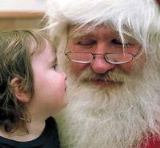
Santa Claus (also known as Saint Nicholas, Saint Nick, Father Christmas, Kris Kringle, Santy or simply Santa) is a folklore figure in various cultures who distributes gifts to children, normally on Christmas Eve. Each name is a variation of Saint Nicholas, but refers to Santa Claus. In today's North American, European and worldwide celebration of Christmas, people young and old simply refer to the hero of the season as Santa, or Santa Claus.
Conventionally, Santa Claus is portrayed as a kindly, round-bellied, merry, bespectacled white man in a red coat trimmed with white fur, with a long white beard.

Discussion
Ask a question about 'Santa Claus'
Start a new discussion about 'Santa Claus'
Answer questions from other users
|
Encyclopedia
Santa Claus (also known as Saint Nicholas, Saint Nick, Father Christmas, Kris Kringle, Santy or simply Santa) is a folklore figure in various cultures who distributes gifts to children, normally on Christmas Eve. Each name is a variation of Saint Nicholas, but refers to Santa Claus. In today's North American, European and worldwide celebration of Christmas, people young and old simply refer to the hero of the season as Santa, or Santa Claus.
Conventionally, Santa Claus is portrayed as a kindly, round-bellied, merry, bespectacled white man in a red coat trimmed with white fur, with a long white beard. On Christmas Eve, he rides in his sleigh pulled by flying reindeer from house to house to give presents to children. To enter the house, Santa Claus comes down the chimney and exits through the fireplace. During the rest of the year he lives together with his wife Mrs. Claus and his elves manufacturing toys. Some modern depictions of Santa (often in advertising and popular entertainment) will show the elves and Santa's workshop as more of a processing and distribution facility, ordering and receiving the toys from various toy manufacturers from across the world. According to American public opinion, Santa Claus lives in the North Pole, though North Pole is in the middle of the Arctic Ocean and there is no land. According to legend the Santa Claus at Macy's in New York City is often said to be the real Santa Claus.
Since most activities associated with Santa Claus are extraordinary, such as delivering presents to all of the believing children in one night, how he squeezes down chimneys, how he enters homes without chimneys, why he never dies, and how he makes reindeer fly, magic is usually used to explain his actions.
Origins
The modern Santa Claus is thought to be a composite character from the merging of quite separate figures.
Ancient Christian origins The first of these is Saint Nicholas of Myra, an 4th century AD Christian bishop of Myra in Lycia, a province of Byzantine Anatolia, now in Turkey. Nicholas was famous for his generous gifts to the poor, in particular presenting the three impoverished daughters of a pious Christian with dowries so that they would not have to become prostitutes. He was born at Patara, province of Lycia, Asia Minor. He was very religious from an early age and devoted his life entirely to Christianity. In Europe (more precisely the Netherlands, Belgium, Austria and Germany) he is still portrayed as a bearded bishop in canonical robes. The relics of St. Nicholas were transported to Bari in southern Italy by some enterprising Italian merchants; a basilica was constructed in 1087 to house them and the area became a pilgrimage site for the devout. Saint Nicholas became revered by many as the patron saint of seamen, merchants, archers, children, prostitutes, pharmacists, lawyers, pawn brokers, prisoners, the city of Amsterdam and of Russia. In Greece, Saint Nicholas is sometimes substituted for Saint Basil (Vasilis in Greek), a 4th century AD bishop from Caesarea. Also, a few villages in West Flanders, Belgium, celebrate a near identical figure, Sint-Maarten (Saint Martin of Tours).
Germanic folklore
Prior to the Germanic peoples' conversion to Christianity, Germanic folklore contained stories about the god Odin (Wodan), who would each year, at Yule, have a great hunting party accompanied by his fellow gods and the fallen warriors residing in his realm. Children would place their boots, filled with carrots, straw or sugar, near the chimney for Odin's flying horse, Sleipnir, to eat. Odin would then reward those children for their kindness by replacing Sleipnir's food with gifts or candy. (Note that the Sleipnir has eight legs, corresponding to Santa's eight reindeer.) This practice survived in Belgium and the Netherlands after the adoption of Christianity and became associated with Saint Nicholas. Children still place their straw filled shoes at the chimney every winter night, and Saint Nicholas (who, unlike Santa, is still riding a horse) rewards them with candy and gifts. Odin's appearance was often similar to that of Saint Nicholas, being depicted as an old, mysterious man with a beard. (Other features, like the absence of one eye, are not found in Saint Nicholas.) This practice in turn came to the United States via the Dutch colony of New Amsterdam, New York and New York City prior to the British seizure in the 17th century, and evolved into the hanging of socks or stockings at the fireplace.
Another early folk tale, originating among the Germanic tribes, tells of a holy man (sometimes Saint Nicholas), and a demon (sometimes the Devil, Krampus, or a troll). The story states that the land was terrorized by a monster who at night would slither down the chimneys and slaughter children (disembowelling them or stuffing them up the flue, or keeping them in a sack to eat later). The holy man sought out the demon, and tricked it with blessed or magical shackles (in some versions the same shackles that imprisoned Christ prior to the crucifixion, in other versions the shackles were those used to hold St. Peter or Paul of Tarsus); the demon was trapped and forced to obey the saint's orders. The saint ordered him to go to each house and make amends, by delivering gifts to the children. Depending on the version, the saint either made the demon fulfil this task every year, or the demon was so disgusted by the act of good will that it chose to be sent back to Hell. Yet other versions have the demon reform under the saint's orders, and go on to recruit other elves and imps into helping him, thus becoming Santa Claus. In an alternate Dutch version, the saint is aided by Moorish slaves, commonly typified as Zwarte Piet ("Black Peter"). Some tales depict Zwarte Piet beating bad children with a rod or even taking them to Spain (formerly ruled by the Moors) in a sack.
Another form of the above tale in Germany is of the Pelznickel or Belsnickle ("Furry Nicholas") who visited naughty children in their sleep. The name originated from the fact that the person appeared to be a huge beast since he was covered from head to toe in furs.
Modern origins
Pre-modern representations of the gift-giver from church history and folklore merged with the British character Father Christmas to create the character known to Britons and Americans as Santa Claus. Father Christmas dates back at least as far as the 17th century in Britain, and pictures of him survive from that era, portraying him as a well-nourished bearded man dressed in a long, green, fur-lined robe. He typified the spirit of good cheer at Christmas, and was reflected in the "Ghost of Christmas Present" in Charles Dickens's A Christmas Carol.
The name Santa Claus is derived from Sinterklaas, the Dutch name for the mythical character based on St. Nicholas. He is also known there by the name of Sint Nicolaas which explains the use of the two fairly dissimilar names Santa Claus and Saint Nicholas or St. Nick.
Sinterklaas wears clothing similar to a bishop's. He wears a red miter (a liturgical headdress worn by bishops and abbots) with a 'golden' cross and carries a bishop's staff. The connection with the original bishop of Myra is still evident here. He rides a white horse over rooftops and his helpers climb down chimneys to deposit gifts (sometimes in children's shoes by the fireplace). Sinterklaas arrives from Spain on a steamboat and is accompanied by his assistant Zwarte Piet.
Presents given during this feast are often accompanied by poems, sometimes fairly basic, sometimes quite elaborate pieces of art that mock events in the past year relating to the recipient (who is thus at the receiving end in more than one sense). The gifts themselves may be just an excuse for the wrapping, which can also be quite elaborate. The more serious gifts may be reserved for the next morning. Since the giving of presents is Sinterklaas's job presents are traditionally not given at Christmas in the Netherlands, but commercialism is starting to tap into this market.
In other countries, the figure of Saint Nicholas was also blended with local folklore. As an example of the still surviving pagan imagery, in Nordic countries there is the Yule Goat (Swedish julbock), a somewhat startling figure with horns which will deliver the presents on Christmas Eve, and a straw goat is a common Christmas decoration. Later, in Sweden and Norway, the gift bringer was seen as identical with the Tomte, or tomtenisse, another folklore creature. In Finland, the Yule goat is joulupukki.
American origins
In the British colonies of North America and later the United States, British and Dutch versions of the gift-giver merged further. For example, in Washington Irving's History of New York, Sinterklaas was Americanized into "Santa Claus" but lost his bishop's apparel, and was at first pictured as a thick-bellied Dutch sailor with a pipe in a green winter coat. Irving's book was a lampoon of the Dutch culture of New York, and much of this portrait is his joking invention.
Modern ideas of Santa Claus seemingly became canon after the publication of the poem "A Visit From St. Nicholas" (better known today as "The Night Before Christmas") in the Troy, New York, Sentinel on December 23, 1823. The poem is ascribed to Clement Clarke Moore, although there is some question as to his authorship. In this poem Santa is established as a heavyset individual with eight reindeer (who are named for the first time). Santa Claus later appeared in various colored costumes as he gradually became amalgamated with the figure of Father Christmas, but red soon became popular after he appeared wearing such on an 1885 Christmas card. Still, one of the first artists to capture Santa Claus's image as we know him today was Thomas Nast, an American cartoonist of the 19th century. In 1863, a picture of Santa illustrated by Nast appeared in Harper's Weekly (it is believed the inspiration for his image came from the Belsnickel). Another popularization came in 1902 in The Life and Adventures of Santa Claus by L. Frank Baum, author of The Wonderful Wizard of Oz.
Images of Santa Claus were further cemented through Haddon Sundblom's depiction of him for The Coca-Cola Company's Christmas advertising. The popularity of the image spawned urban legends that Santa Claus was in fact invented by Coca-Cola. Nevertheless, Santa Claus and Coca-Cola have been closely associated, except for 2005 when Santa was replaced in advertising by Coca-Cola's polar bears.
The image of Santa Claus as a benevolent character became reinforced with its association with charity and philanthropy, particularly organizations such as the Salvation Army. Volunteers dressed as Santa Claus typically became part of fundraising drives to aid needy families at Christmas time.
Some suspect that the depiction of Santa at the North Pole reflected popular opinion about industry at the time. In some images of the early 20th century, Santa was depicted as personally making his toys by hand in a small workshop like a craftsman. Eventually, the idea emerged that he had numerous elves responsible for making the toys, but the toys were still handmade by each individual elf working in the traditional manner. By the end of the century, the reality of mass mechanized production became more fully accepted by the Western public. That shift was reflected in the modern depiction of Santa's residence—now often humorously portrayed as a fully mechanized production facility, equipped with the latest manufacturing technology, and overseen by the elves with Santa and Mrs. Claus as managers [see Nissenbaum, chap. 2; Belk, 87-100]. Many television commercials depict this as a sort of humorous business, with Santa's elves acting as a sometimes mischievously disgruntled workforce, cracking jokes and pulling pranks on their boss. Santa Claus continues to inspire writers and artists, such as in author Seabury Quinn's 1948 novel Roads. Other additions to early ideas of Santa include Rudolph the Red-Nosed Reindeer, the ninth reindeer immortalized in a Gene Autry song, written by a Montgomery Ward copywriter. Adding even more to the legend, a current popular comic book series Jingle Belle by writer/cartoonist Paul Dini depicts Santa Claus as a harried father with a rebellious half-human, half-elf teenage daughter.
Santa Claus rituals
- See: Santa Claus
Santa Claus in film
Songs
Over the years, Santa Claus has inspired several songs and even orchestral works. As early as 1853, Louis Antoine Jullien composed an orchestral piece titled Santa Claus which premiered to mixed reviews in New York that year [Horowitz, 213]. More popular, well-known songs about Santa Claus (mostly sung by children) include:
Christian opposition to Santa Claus
- See: Santa Claus
See also
External links
- "Official" Santa Claus site:
-
- The Original 1860s Illustrations
-
-
- - the Web's oldest Santa-related website, founded in 1991 by former Library of Congress archivist Jeff Guide
-
-
-
-
-
-
|
| |
|
|