
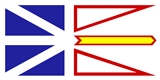
Newfoundland and Labrador n is the easternmost
provinceThe provinces and territories of Canada combine to make up the world's second-largest country by area. There are ten provinces and three territories...
of
CanadaCanada is a North American country consisting of ten provinces and three territories. Located in the northern part of the continent, it extends from the Atlantic Ocean in the east to the Pacific Ocean in the west, and northward into the Arctic Ocean...
. Situated in the country's
Atlantic regionAtlantic Canada is the region of Canada comprising the four provinces located on the Atlantic coast, excluding Quebec: the three Maritime provinces – New Brunswick, Prince Edward Island, and Nova Scotia – and Newfoundland and Labrador...
, it incorporates the island of
Newfoundland and mainland
LabradorLabrador is the distinct, northerly region of the Canadian province of Newfoundland and Labrador. It comprises the mainland portion of the province, separated from the island of Newfoundland by the Strait of Belle Isle...
(located Northwest of the island) with a combined area of 405212 square kilometre. As of April 2011, the province's estimated population is 508,400. Approximately 94 percent of the province's population resides on the Island of Newfoundland (including its associated smaller islands), of which over half live on the
Avalon PeninsulaThe Avalon Peninsula is a large peninsula that makes up the southeast portion of the island of Newfoundland.The peninsula is home to 257,223 people, which is approximately 51% of Newfoundland's population in 2009, and is the location of the provincial capital, St. John's. It is connected to the...
. The Island of Newfoundland has its own dialects of
EnglishNewfoundland English is a name for several accents and dialects thereof the English found in the province of Newfoundland and Labrador. Most of these differ substantially from the English commonly spoken elsewhere in Canada...
,
FrenchNewfoundland French or Newfoundland Peninsular French refers to the French spoken on the Port au Port Peninsula of Newfoundland. The francophones of the region are unique in Canada, tracing their origins to Continental French fishermen who settled in the late 1800s and early 1900s, and not to the...
, and
IrishNewfoundland Irish is an extinct dialect of the Irish language specific to the island of Newfoundland, Canada. It was very similar to Munster Irish, as spoken in the southeast of Ireland, due to mass immigration from the counties Waterford, Wexford, Kilkenny, Tipperary, and Cork.-Irish settlement...
. The English dialect in Labrador is similar to that of Newfoundland. Labrador also has its own dialects of Innu-aimun and
InuktitutInuktitut or Eastern Canadian Inuktitut, Eastern Canadian Inuit language is the name of some of the Inuit languages spoken in Canada...
.
Newfoundland and Labrador's capital and largest city,
St. John'sSt. John's is the capital and largest city in Newfoundland and Labrador, and is the oldest English-founded city in North America. It is located on the eastern tip of the Avalon Peninsula on the island of Newfoundland. With a population of 192,326 as of July 1, 2010, the St...
, is Canada's 20th-largest Census Metropolitan Area, and is home to nearly 40 percent of the province's population. St. John's is the seat of government, home to the House of Assembly of Newfoundland and Labrador and the highest court in the jurisdiction, the Newfoundland and Labrador Court of Appeal.
A former colony and
dominionThe Dominion of Newfoundland was a British Dominion from 1907 to 1949 . The Dominion of Newfoundland was situated in northeastern North America along the Atlantic coast and comprised the island of Newfoundland and Labrador on the continental mainland...
of the
United KingdomThe United Kingdom of Great Britain and Northern IrelandIn the United Kingdom and Dependencies, other languages have been officially recognised as legitimate autochthonous languages under the European Charter for Regional or Minority Languages...
, Newfoundland and Labrador became the tenth province to enter the
Canadian ConfederationCanadian Confederation was the process by which the federal Dominion of Canada was formed on July 1, 1867. On that day, three British colonies were formed into four Canadian provinces...
on March 31, 1949, as
Newfoundland. On December 6, 2001, an
amendmentAmendments to the Constitution of Canada are changes to the Constitution of Canada initiated by the government. Only since 1982 has there been an official protocol to amend the Constitution.- History :...
was made to the
Constitution of CanadaThe Constitution of Canada is the supreme law in Canada; the country's constitution is an amalgamation of codified acts and uncodified traditions and conventions. It outlines Canada's system of government, as well as the civil rights of all Canadian citizens and those in Canada...
to
change the province's official nameGeographical renaming is the changing of the name of a geographical feature or area. This can range from the uncontroversial change of a street name to a highly disputed change to the name of a country. Some names are changed locally but the new names are not recognised by other countries,...
to
Newfoundland and Labrador. In day-to-day conversation, however, Canadians generally still refer to the province itself as Newfoundland and to the region on the Canadian mainland as Labrador.
The name
Newfoundland is derived from English as "New Found Land" (a translation from the Latin
Terra Nova). The origin of
Labrador is uncertain; it is credited to both
João Fernandes LavradorJoão Fernandes Lavrador was a Portuguese explorer of the late 15th century. He was the first modern explorer in the coasts of the Northeast of Northern America, including the Labrador peninsula, which bears his name.-Expeditions:Fernandes was granted a patent by King Manuel I in 1498 given him...
, a Portuguese explorer, and
lavrador – a title meaning "landholder".
Pre-colonization
Human habitation in Newfoundland and Labrador can be traced back about 9000 years. The
Maritime Archaic peoplesThe Maritime Archaic is a North American cultural complex of the Late Archaic along the coast of Newfoundland, the Canadian Martimes and northern New England. The Maritime Archaic began in approximately 7000 BC and lasted into the 18th century. The culture consisted of sea-mammal hunters in the...
were groups of Archaic cultures of sea-mammal hunters in the
subarcticThe Subarctic is a region in the Northern Hemisphere immediately south of the true Arctic and covering much of Alaska, Canada, the north of Scandinavia, Siberia, and northern Mongolia...
. They prospered from approximately 7,000 BC1,500 BC (9,0003,500 years ago) along the
Atlantic CoastThe Arctic Ocean, located in the Northern Hemisphere and mostly in the Arctic north polar region, is the smallest and shallowest of the world's five major oceanic divisions...
of North America. Their settlements included longhouses and boat-topped temporary or seasonal houses. They engaged in long-distance trade, using as currency white
chertChert is a fine-grained silica-rich microcrystalline, cryptocrystalline or microfibrous sedimentary rock that may contain small fossils. It varies greatly in color , but most often manifests as gray, brown, grayish brown and light green to rusty red; its color is an expression of trace elements...
, a rock quarried from northern Labrador to Maine. The Maritime Archaic period is best known from a mortuary site in Newfoundland at
Port au ChoixPort au Choix or Port aux Choix is a town in the Canadian province of Newfoundland and Labrador. The nearest airport is Port au Choix Airport, 2.8 km to the southeast.- History :...
. The Maritime Archaic peoples were gradually displaced by people of the
Dorset CultureThe Dorset culture was a Paleo-Eskimo culture that preceded the Inuit culture in Arctic North America. It has been defined as having four phases, with distinct technology related to the people's hunting and tool making...
(last major
Paleo-EskimoThe Paleo-Eskimo were the peoples who inhabited the Arctic region from Chukotka in present-day Russia across North America to Greenland prior to the rise of the modern Inuit and/or Eskimo and related cultures...
) and then by the
InuitThe Inuit are a group of culturally similar indigenous peoples inhabiting the Arctic regions of Canada , Denmark , Russia and the United States . Inuit means “the people” in the Inuktitut language...
in Labrador and the Beothuks on the island of Newfoundland. The Dorset Culture (800 BC – 1500) were highly adapted to living in a very cold climate, and much of their food came from hunting sea mammals through holes in the ice. The massive decline in sea-ice which the
Medieval Warm PeriodThe Medieval Warm Period , Medieval Climate Optimum, or Medieval Climatic Anomaly was a time of warm climate in the North Atlantic region, that may also have been related to other climate events around the world during that time, including in China, New Zealand, and other countries lasting from...
produced would have had a devastating impact upon their way of life.
The appearance of the Beothuk culture is believed the most recent cultural manifestation of peoples who first migrated from Labrador to Newfoundland around 1 AD. Inuit are the descendants of what
anthropologistAnthropology is the study of humanity. It has origins in the humanities, the natural sciences, and the social sciences. The term "anthropology" is from the Greek anthrōpos , "man", understood to mean mankind or humanity, and -logia , "discourse" or "study", and was first used in 1501 by German...
s call the
Thule cultureThe Thule or proto-Inuit were the ancestors of all modern Inuit. They developed in coastal Alaska by AD 1000 and expanded eastwards across Canada, reaching Greenland by the 13th century. In the process, they replaced people of the earlier Dorset culture that had previously inhabited the region...
, who emerged from western Alaska around 1000 AD and spread eastwards across the Arctic, reaching Labrador around 1300–1500. Researchers believe that the Dorset culture lacked dogs, larger weapons and other technologies that gave the expanding Inuit society an advantage. With the passage of time, groups started to focus on resources available to them locally. The inhabitants eventually organized themselves into small
bandsA band society is the simplest form of human society. A band generally consists of a small kin group, no larger than an extended family or clan; it has been defined as consisting of no more than 30 to 50 individuals.Bands have a loose organization...
of a few families, grouped into larger
tribeA tribe, viewed historically or developmentally, consists of a social group existing before the development of, or outside of, states.Many anthropologists use the term tribal society to refer to societies organized largely on the basis of kinship, especially corporate descent groups .Some theorists...
s and chieftainships. The
InnuThe Innu are the indigenous inhabitants of an area they refer to as Nitassinan , which comprises most of the northeastern portions of the provinces of Quebec and some western portions of Labrador...
are the inhabitants of an area they refer to as
NitassinanNitassinan is the ancestral homeland of the Innu, an Aboriginal people of Eastern Quebec and Labrador, Canada. The territory covers the eastern portion of the Labrador peninsula....
, which comprises most of what is now referred to as northeastern
QuebecQuebec or is a province in east-central Canada. It is the only Canadian province with a predominantly French-speaking population and the only one whose sole official language is French at the provincial level....
and Labrador. Their subsistence activities were historically centred on hunting and trapping caribou,
mooseThe moose or Eurasian elk is the largest extant species in the deer family. Moose are distinguished by the palmate antlers of the males; other members of the family have antlers with a dendritic configuration...
,
deerDeer are the ruminant mammals forming the family Cervidae. Species in the Cervidae family include white-tailed deer, elk, moose, red deer, reindeer, fallow deer, roe deer and chital. Male deer of all species and female reindeer grow and shed new antlers each year...
and small game. Coastal clans also practised agriculture, fished, and managed maple sugarbush. The Innu engaged in tribal warfare along the coast of Labrador with the Inuit groups that had significant populations. The Míkmaq of the southern Newfoundland spent most of their time on the shores harvesting seafood; during the winter they would move inland to the woods to hunt. Over time, the Mi'kmaq and Innu divided their lands into traditional "districts". Each district was independently governed and had a district chief and a council. The council members were band chiefs, elders, and other worthy community leaders. In addition to the district councils, the Mi'kmaq tribes also had (have) a Grand Council or Santé Mawiómi that according to oral tradition was formed before 1600.
European contact
The oldest accounts of European contact was made over a thousand years ago as described in the
VikingThe term Viking is customarily used to refer to the Norse explorers, warriors, merchants, and pirates who raided, traded, explored and settled in wide areas of Europe, Asia and the North Atlantic islands from the late 8th to the mid-11th century.These Norsemen used their famed longships to...
(Norse) Icelandic Sagas. Around the year 1001, the sagas refer to
Leif EricsonLeif Ericson was a Norse explorer who is regarded as the first European to land in North America , nearly 500 years before Christopher Columbus...
landing in three places to the west, the first two being
HellulandHelluland is the name given to one of the three lands discovered by Leif Eriksson around 1000 AD on the North Atlantic coast of North America....
(possibly
Baffin IslandBaffin Island in the Canadian territory of Nunavut is the largest island in the Canadian Arctic Archipelago, the largest island in Canada and the fifth largest island in the world. Its area is and its population is about 11,000...
) and
MarklandMarkland is the name given to a part of shoreline in Labrador, Canada, named by Leif Eriksson when he landed in North America. The word Markland is from the Old Norse language for "forestland" or "borderland". It is described as being north of Vinland and south of Helluland...
(possibly
LabradorLabrador is the distinct, northerly region of the Canadian province of Newfoundland and Labrador. It comprises the mainland portion of the province, separated from the island of Newfoundland by the Strait of Belle Isle...
). Leif's third landing was at a place he called
VinlandVinland was the name given to an area of North America by the Norsemen, about the year 1000 CE.There is a consensus among scholars that the Vikings reached North America approximately five centuries prior to the voyages of Christopher Columbus...
(possibly Newfoundland). Archaeological evidence of a Norse settlement was found in
L'Anse aux MeadowsL'Anse aux Meadows is an archaeological site on the northernmost tip of the island of Newfoundland in the Canadian province of Newfoundland and Labrador. Discovered in 1960, it is the only known site of a Norse or Viking village in Canada, and in North America outside of Greenland...
,
Newfoundland, which was declared a
World Heritage siteA UNESCO World Heritage Site is a place that is listed by the UNESCO as of special cultural or physical significance...
by
UNESCOThe United Nations Educational, Scientific and Cultural Organization is a specialized agency of the United Nations...
in 1978.
Based on the
Treaty of TordesillasThe Treaty of Tordesillas , signed at Tordesillas , , divided the newly discovered lands outside Europe between Spain and Portugal along a meridian 370 leagueswest of the Cape Verde islands...
, the
Portuguese Crown claimed it had territorial rights in the area visited by
John CabotJohn Cabot was an Italian navigator and explorer whose 1497 discovery of parts of North America is commonly held to have been the first European encounter with the continent of North America since the Norse Vikings in the eleventh century...
in 1497 and 1498. Historians disagree on whether Cabot, commissioned by King Henry VII of England, landed in Nova Scotia in 1497 or in Newfoundland. In 1499 and 1500, the Portuguese mariner
João Fernandes LavradorJoão Fernandes Lavrador was a Portuguese explorer of the late 15th century. He was the first modern explorer in the coasts of the Northeast of Northern America, including the Labrador peninsula, which bears his name.-Expeditions:Fernandes was granted a patent by King Manuel I in 1498 given him...
visited the north Atlantic coast, which accounts for the appearance of "Labrador" on topographical maps of the period. Subsequently, in 1501 and 1502 the
Corte-RealCorte-Real, sometimes Corte Real, is a surname of Portuguese origin, which means literally "Royal Court". It may refer to:*João Vaz Corte-Real , Portuguese explorer*Miguel Corte-Real , Portuguese explorer...
brothers explored Newfoundland and Labrador, claiming them as part of the
Portuguese EmpireThe Portuguese Empire , also known as the Portuguese Overseas Empire or the Portuguese Colonial Empire , was the first global empire in history...
. In 1506, king
Manuel I of PortugalManuel I , the Fortunate , 14th king of Portugal and the Algarves was the son of Infante Ferdinand, Duke of Viseu, , by his wife, Infanta Beatrice of Portugal...
created taxes for the cod fisheries in Newfoundland waters.
João Álvares FagundesJoão Álvares Fagundes , an explorer and ship owner from Viana do Castelo in Northern Portugal, organized several expeditions to Newfoundland and Nova Scotia around 1520-1521....
and
Pêro de BarcelosPêro de Barcelos , sometimes Pedro de Barcelos, was a Portuguese explorer of North America, whom, together with João Fernandes Lavrador, was the first to sight the Coast of Labrador in 1499....
established fishing outposts in Newfoundland and Nova Scotia around 1521; however, these were later abandoned, with the
Portuguese colonizersPortugal was the leading country in the European exploration of the world in the 15th century. The Treaty of Tordesillas divided the Earth, outside Europe, in 1494 into Spanish and Portuguese global territorial hemispheres for exclusive conquest and colonization...
focusing their efforts on
South AmericaSouth America is a continent situated in the Western Hemisphere, mostly in the Southern Hemisphere, with a relatively small portion in the Northern Hemisphere. The continent is also considered a subcontinent of the Americas. It is bordered on the west by the Pacific Ocean and on the north and east...
. Sir
Humphrey GilbertSir Humphrey Gilbert of Devon in England was a half-brother of Sir Walter Raleigh. Adventurer, explorer, member of parliament, and soldier, he served during the reign of Queen Elizabeth and was a pioneer of English colonization in North America and the Plantations of Ireland.-Early life:Gilbert...
, provided with letters patent from Queen Elizabeth I, landed in St John's in August 1583, and formally took possession of the island.
Colony of Newfoundland 1610–1728
Newfoundland became one of the first permanent English colonies in the New World From 1610 to 1728,
Proprietary GovernorProprietary Governors were individuals authorized to govern proprietary colonies. Under the proprietary system, individuals or companies were granted commercial charters by the King of England to establish colonies. These proprietors then selected the governors and other officials in the colony....
s were appointed to establish colonial settlements on the island. John Guy was governor of the first settlement at
Cuper's CoveCuper's Cove, on the southwest shore of Conception Bay on Newfoundland's Avalon Peninsula was an early English settlement in the New World, and the second one after the Jamestown Settlement to endure for longer than a year...
. Other settlements were
Bristol's HopeBristol's Hope is the modern name of a community in the province of Newfoundland and Labrador, Canada. It is located on Conception Bay between Carbonear and Harbour Grace....
, Renews, New Cambriol,
South FalklandSouth Falkland was an English colony in Newfoundland established by Henry Cary, 1st Viscount Falkland, in 1623 on territory in the Avalon Peninsula including the former colony of Renews. Cary appointed Sir Francis Tanfield, his wife's cousin, to be the colony's first Proprietary Governor. Tanfield...
and
AvalonProvince of Avalon was the area around the settlement of Ferryland, Newfoundland and Labrador, in the 17th century, which upon the success of the colony grew to include the land held by Sir William Vaughan and all the land that lay between Ferryland and Petty Harbour.Sir George Calvert had acquired...
which became a province in 1623. The first governor given jurisdiction over all of Newfoundland was Sir
David KirkeSir David Kirke was an adventurer, colonizer and governor for the king of England. Kirke was the son of Gervase Kirke, a wealthy London-based Scottish merchant, who had married a Huguenot woman, Elizabeth Goudon, and was raised in Dieppe, in Normandy.In 1627 Kirke's father and several London...
in 1638.
Explorers soon realized that the waters around Newfoundland had the best fishing in the North Atlantic. By 1620, 300 fishing boats worked the Grand Bank, employing some 10,000 sailors; many were French or Basques from Spain. They dried and salted the cod on the coast and sold it to Spain and Portugal. Heavy investment by Sir George Calvert, 1st Baron Baltimore, in the 1620s in wharves, warehouses, and fishing stations failed to pay off. French raids hurt the business, and the weather was terrible, so he redirected his attention to his
other colony in MarylandThe history of Maryland included only Native Americans until Europeans, starting with John Cabot in 1498, began exploring the area. The first settlements came in 1634 when the English arrived in significant numbers and created a permanent colony. In 1776, during the American Revolution, Maryland...
. After Calvert left, small-scale entrepreneurs such as Sir
David KirkeSir David Kirke was an adventurer, colonizer and governor for the king of England. Kirke was the son of Gervase Kirke, a wealthy London-based Scottish merchant, who had married a Huguenot woman, Elizabeth Goudon, and was raised in Dieppe, in Normandy.In 1627 Kirke's father and several London...
made good use of the facilities. Kirke became the first governor in 1639. A triangular trade with New England, the West Indies, and Europe gave Newfoundland an important economic role. By the 1670s there were 1700 permanent residents and another 4500 in the summer months.
BasqueThe Basques as an ethnic group, primarily inhabit an area traditionally known as the Basque Country , a region that is located around the western end of the Pyrenees on the coast of the Bay of Biscay and straddles parts of north-central Spain and south-western France.The Basques are known in the...
fishermen, who had been fishing
codCod is the common name for genus Gadus, belonging to the family Gadidae, and is also used in the common name for various other fishes. Cod is a popular food with a mild flavor, low fat content and a dense, flaky white flesh. Cod livers are processed to make cod liver oil, an important source of...
shoals off Newfoundland's coasts since the beginning of the fifteenth century, founded Plaisance (today Placentia), a haven which started to be also used by French fishermen. In 1655, France appointed a governor in Plaisance, thus starting a formal French colonization period of Newfoundland. The rest of the island was nearly conquered by
New FranceNew France was the area colonized by France in North America during a period beginning with the exploration of the Saint Lawrence River by Jacques Cartier in 1534 and ending with the cession of New France to Spain and Great Britain in 1763...
explorer
Pierre Le Moyne d'IbervillePierre Le Moyne d'Iberville pronounced as described in note] Pierre Le Moyne d'Iberville pronounced as described in note] Pierre Le Moyne d'Iberville pronounced as described in note] (16 July 1661 – 9 July 1702 (probable)was a soldier, ship captain, explorer, colonial administrator, knight of...
in the 1690s. The Mi'kmaq, as allies with the French, were amenable to limited French settlement in their midst. After France lost political control of the area after the
Siege of Port Royal in 1710The Siege of Port Royal , also known as the Conquest of Acadia, was conducted by British regular and provincial forces under the command of Francis Nicholson against a French Acadian garrison under the command of Daniel d'Auger de Subercase, at the Acadian capital, Port Royal...
, the Mí'kmaq engaged in warfare with the British throughout
Dummer's WarDummer's War , also known as Lovewell's War, Father Rale's War, Greylock's War, the Three Years War, the 4th Indian War or the Wabanaki-New England War of 1722–1725, was a series of battles between British settlers of the three northernmost British colonies of North America of the time and the...
,
King George's WarKing George's War is the name given to the operations in North America that formed part of the War of the Austrian Succession . It was the third of the four French and Indian Wars. It took place primarily in the British provinces of New York, Massachusetts Bay, New Hampshire, and Nova Scotia...
,
Father Le Loutre's WarFather Le Loutre’s War , also known as the Indian War, the Micmac War and the Anglo-Micmac War, took place between King George's War and the French and Indian War in Acadia and Nova Scotia. On one side of the conflict, the British and New England colonists were led by British Officer Charles...
and the
French and Indian WarThe French and Indian War is the common American name for the war between Great Britain and France in North America from 1754 to 1763. In 1756, the war erupted into the world-wide conflict known as the Seven Years' War and thus came to be regarded as the North American theater of that war...
. The French colonization period lasted until the
Treaty of UtrechtThe Treaty of Utrecht, which established the Peace of Utrecht, comprises a series of individual peace treaties, rather than a single document, signed by the belligerents in the War of Spanish Succession, in the Dutch city of Utrecht in March and April 1713...
, in 1713, which ended the
War of the Spanish SuccessionThe War of the Spanish Succession was fought among several European powers, including a divided Spain, over the possible unification of the Kingdoms of Spain and France under one Bourbon monarch. As France and Spain were among the most powerful states of Europe, such a unification would have...
. France ceded its claims to Newfoundland to the British (as well as its claims to the shores of
Hudson BayHudson Bay , sometimes called Hudson's Bay, is a large body of saltwater in northeastern Canada. It drains a very large area, about , that includes parts of Ontario, Quebec, Saskatchewan, Alberta, most of Manitoba, southeastern Nunavut, as well as parts of North Dakota, South Dakota, Minnesota,...
). In addition, the French possessions in
AcadiaAcadia was the name given to lands in a portion of the French colonial empire of New France, in northeastern North America that included parts of eastern Quebec, the Maritime provinces, and modern-day Maine. At the end of the 16th century, France claimed territory stretching as far south as...
were yielded to England. Afterward, under the supervision of the last French governor, the French population of Plaisance moved to Île Royale (now
Cape Breton IslandCape Breton Island is an island on the Atlantic coast of North America. It likely corresponds to the word Breton, the French demonym for Brittany....
), part of Acadia which remained then under French control.
In the
Treaty of UtrechtThe Treaty of Utrecht, which established the Peace of Utrecht, comprises a series of individual peace treaties, rather than a single document, signed by the belligerents in the War of Spanish Succession, in the Dutch city of Utrecht in March and April 1713...
(1713), France acknowledged British ownership of the island. However, in the Seven Years War (1756–63), control of Newfoundland became a major source of conflict between Britain, France and Spain who all pressed for a share in the valuable fishery there.
Britain's victories around the globeThe Kingdom of Great Britain was one of the major participants in the Seven Years' War which lasted between 1756 and 1763. Britain emerged from the war as the world's leading colonial power having gained a number of new territories at the Treaty of Paris in 1763 and established itself as the...
led
William PittWilliam Pitt, 1st Earl of Chatham PC was a British Whig statesman who led Britain during the Seven Years' War...
to insist that nobody other than Britain should have access to Newfoundland. The
Battle of Signal HillThe Battle of Signal Hill was a small skirmish, the last of the North American theatre of the Seven Years' War. The British under Lieutenant Colonel William Amherst forced the French to surrender St...
was fought in Newfoundland in 1762, when a French force landed and tried to occupy the island, only to be repulsed by the British. In 1796 a Franco-Spanish expedition
succeeded in raidingThe Newfoundland expedition was a series of fleet manoeuvres and amphibious landings in the coasts of Newfoundland, Labrador and Saint Pierre and Miquelon carried out by the combined French and Spanish fleets during the French Revolutionary Wars...
the coasts of Newfoundland and Labrador.
By the Treaty of Utrecht (1713), French fishermen were given the right to land and cure fish on the "French Shore" on the western coast. They had a permanent base on nearby St. Pierre and Miquelon islands; the French gave up their rights in 1904. In 1783, the British signed the Treaty of Paris with the United States that gave American fishermen similar rights along the coast. These rights were reaffirmed by treaties in 1818, 1854 and 1871 and confirmed by arbitration in 1910.
In 1854 the British government established Newfoundland's
Responsible governmentResponsible government is a conception of a system of government that embodies the principle of parliamentary accountability which is the foundation of the Westminster system of parliamentary democracy...
. In 1855,
Philip Francis LittlePhilip Francis Little was the first Premier of Newfoundland Colony between 1855 and 1858. He was born in Charlottetown, Prince Edward Island. Little studied law there with Charles Young and was admitted to the bar in 1844. He came to Newfoundland in 1846 and articled in law. He got involved in...
, a native of
Prince Edward IslandPrince Edward Island is a Canadian province consisting of an island of the same name, as well as other islands. The maritime province is the smallest in the nation in both land area and population...
, won a parliamentary majority over Sir
Hugh HoylesSir Hugh Hoyles was a politician and lawyer who served as the third premier of the Newfoundland Colony. Hoyles was the first premier of Newfoundland to have been born in the colony, and served from 1861 to 1865. Born in St...
and the Conservatives. Little formed the first administration from 1855 to 1858. Newfoundland rejected confederation with Canada in the 1869 general election.
Prime Minister of CanadaThe Prime Minister of Canada is the primary minister of the Crown, chairman of the Cabinet, and thus head of government for Canada, charged with advising the Canadian monarch or viceroy on the exercise of the executive powers vested in them by the constitution...
Sir John Thompson came very close to negotiating Newfoundland's entry into Confederation in 1892.
Dominion of Newfoundland
Newfoundland remained a colony until acquiring Dominion status in 1907. A dominion constituted a self-governing state of the British Empire or British Commonwealth and the Dominion of Newfoundland was relatively autonomous from British rule.
Newfoundland's own regiment, the 1st Newfoundland Regiment, fought in the First World War. On July 1, 1916, the German Army nearly wiped out the entire regiment at
Beaumont HamelThe Beaumont-Hamel Newfoundland Memorial is a memorial site in France dedicated to the commemoration of Dominion of Newfoundland forces members who were killed during World War I. The preserved battlefield park encompasses the grounds over which the Newfoundland Regiment made their unsuccessful...
on the
first day on the SommeThe first day on the Somme, 1 July 1916, was the opening day of the Battle of Albert, which was the first phase of the British and French offensive that became known as the Battle of the Somme...
. The regiment went on to serve with distinction in several subsequent battles, earning the prefix "Royal." Despite people's pride in the accomplishments of the regiment, the Dominion's war debt due to the regiment and the cost of maintaining a trans-island railway led to increased and ultimately unsustainable government debt in the post-war era.
It was during this period of dominion status that the Labrador mainland and the island of Newfoundland merged into a single political entity. Since the early 1800s, Newfoundland and Quebec (or Lower Canada) had been in a border dispute over the Labrador region. In 1927, however, the British government ruled that the area known as modern day Labrador was to be considered part of the Dominion of Newfoundland.
Due to Newfoundland's high debt load and the loss of faith in the government the Newfoundland legislature voted itself temporarily out of existence in 1933. On 16 February 1934, responsible government came to an end when the
Commission of GovernmentThe Commission of Government was a non-elected body that governed Newfoundland from 1934 to 1949...
was sworn in, ending 79 years of
responsible governmentResponsible government is a conception of a system of government that embodies the principle of parliamentary accountability which is the foundation of the Westminster system of parliamentary democracy...
. The Commission consisted of seven persons appointed by the British government. For 15 years no elections took place, and no legislature was convened.
When prosperity returned to the colony in 1942 agitation began to end the Commission. Newfoundland, with a population of 313,000 (plus 5,200 in Labrador), seemed too small to be independent. The British government decided to let Newfoundlanders deliberate and choose their own future by calling a
National ConventionThe Newfoundland National Convention of 1946 was a forum established to decide the constitutional future of Newfoundland-Nominations:On 11 December 1945 the Government of Britain announced that there would be an election to a National Convention, which would debate constitutional options and make a...
in 1946. Chaired by Judge
Cyril J. FoxCyril James Fox was a lawyer, judge and political figure in Newfoundland. He represented St. John's East in the Newfoundland and Labrador House of Assembly from 1919 to ....
, it consisted of 45 elected members one of whom was the future first premier of Newfoundland,
Joey SmallwoodJoseph Roberts "Joey" Smallwood, PC, CC was the main force that brought Newfoundland into the Canadian confederation, and became the first Premier of Newfoundland . As premier, he vigorously promoted economic development, championed the welfare state, and emphasized modernization of education and...
.
The Convention set up committees to study where Newfoundland's future lay. Many members assumed that the final decision was due near the end of their deliberations, but the timeline was upset when Smallwood moved that the Convention should send a delegation to Ottawa to discuss a union in October 1946. His motion was defeated, although the Convention later decided to send delegations to both
LondonLondon is the capital city of :England and the :United Kingdom, the largest metropolitan area in the United Kingdom, and the largest urban zone in the European Union by most measures. Located on the River Thames, London has been a major settlement for two millennia, its history going back to its...
and Ottawa.
Three main factions actively campaigned during the lead up to the referendums. One faction, led by Smallwood, was the
Confederate AssociationThe Confederate Association was a political party formed and led by Joey Smallwood and Gordon Bradley to advocate that the Dominion of Newfoundland join Canadian Confederation. The party was formed on February 21, 1948 prior to the launch of the 1948 Newfoundland referendums on Confederation...
(CA) advocating union with the Canadian Confederation. They campaigned through a newspaper known as
The Confederate. The
Responsible Government LeagueThe Responsible Government League was a political movement in the Dominion of Newfoundland.The Responsible Government League of Newfoundland, led by Peter Cashin, was formed in February 1947 by anti-Confederation delegates to the Newfoundland National Convention on the future of the colony...
(RGL), led by Peter Cashin, advocated an independent Newfoundland with a return to responsible government. They also had their own newspaper
The Independent. A third smaller
Economic Union PartyThe Economic Union Party was a political party formed in the Dominion of Newfoundland on 20 March 1948, during the first referendum campaign on the future of the country. The British-appointed Commission of Government had administered the country since the financial collapse of 1934...
(EUP), led by
Chesley CrosbieChesley A. Crosbie was a Newfoundland businessman and politician.Crosbie belonged to a prominent St. John's family involved in hotels, fish exporting, insurance, shipping and manufactring...
, advocated closer economic ties with the United States. The EUP failed to gain much attention, and merged with the RGL after the first referendum.
The first referendum took place on June 3, 1948, 44.5% of people voted for responsible government, 41.1% voted for confederation with Canada, while 14.3% voted for Commission of Government. Since none of the choices had gained over 50%, a second referendum with only the two most popular choices was held on July 22, 1948. In that referendum 52.3% voted for confederation with Canada while 47.7% voted for responsible government.
As the results of the binding referendum were to join Canada, Newfoundland began to negotiate with Canada to enter into Confederation. After negotiations were completed, the British Government received the terms and subsequently passed the
British North America Act, 1949The Newfoundland Act was an Act of the Parliament of the United Kingdom that confirmed and gave effect to the Terms of Union agreed to between the then-separate Dominions of Canada and Newfoundland on March 23, 1949...
in the
British House of CommonsThe House of Commons is the lower house of the Parliament of the United Kingdom, which also comprises the Sovereign and the House of Lords . Both Commons and Lords meet in the Palace of Westminster. The Commons is a democratically elected body, consisting of 650 members , who are known as Members...
. Newfoundland officially joined Canada at midnight, March 31, 1949.
Geography
Newfoundland and Labrador is the most easterly province in Canada, and is located on the north-eastern corner of North America. The
Strait of Belle Isle separates the province into two geographical divisions, Labrador, which is a large land mass connected to mainland Canada, and Newfoundland, which is an island surrounded by the Atlantic Ocean. The province also includes over 7,000 tiny islands.
Newfoundland is roughly triangular, with each side being approximately 400 km (248.5 mi), and has an area of 108860 km² (42,031.1 sq mi). Newfoundland and its associated small islands have a total area of 111390 km² (43,007.9 sq mi). Newfoundland extends between latitudes 46°36′N and 51°38′N.
Labrador is an irregular shape: the western part of its border with
QuebecQuebec or is a province in east-central Canada. It is the only Canadian province with a predominantly French-speaking population and the only one whose sole official language is French at the provincial level....
is the drainage divide of the
Labrador PeninsulaThe Labrador Peninsula is a large peninsula in eastern Canada. It is bounded by the Hudson Bay to the west, the Hudson Strait to the north, the Labrador Sea to the east, and the Gulf of Saint Lawrence to the south-east...
. Lands drained by rivers that flow into the
Atlantic OceanThe Atlantic Ocean is the second-largest of the world's oceanic divisions. With a total area of about , it covers approximately 20% of the Earth's surface and about 26% of its water surface area...
are part of Labrador, the rest belong to Quebec. Labrador’s extreme northern tip, at 60°22′N, shares a short border with
NunavutNunavut is the largest and newest federal territory of Canada; it was separated officially from the Northwest Territories on April 1, 1999, via the Nunavut Act and the Nunavut Land Claims Agreement Act, though the actual boundaries had been established in 1993...
. Labrador’s area (including associated small islands) is 294330 km² (113,641.4 sq mi). Together, Newfoundland and Labrador make up 4.06 % of Canada’s area.
Labrador is the easternmost part of the
Canadian ShieldThe Canadian Shield, also called the Laurentian Plateau, or Bouclier Canadien , is a vast geological shield covered by a thin layer of soil that forms the nucleus of the North American or Laurentia craton. It is an area mostly composed of igneous rock which relates to its long volcanic history...
, a vast area of ancient
metamorphic rockMetamorphic rock is the transformation of an existing rock type, the protolith, in a process called metamorphism, which means "change in form". The protolith is subjected to heat and pressure causing profound physical and/or chemical change...
comprising much of northeastern North America. Colliding tectonic plates have shaped much of the geology of Newfoundland.
Gros Morne National ParkGros Morne National Park is a world heritage site located on the west coast of Newfoundland. At , it is the second largest national park in Atlantic Canada ....
has a reputation as an outstanding example of tectonics at work, and as such has been designated a
World Heritage SiteA UNESCO World Heritage Site is a place that is listed by the UNESCO as of special cultural or physical significance...
. The
Long Range MountainsThe Long Range Mountains are a series of mountains along the west coast of the Canadian island of Newfoundland. They also form the northernmost section of the Appalachian chain on the eastern seaboard of North America...
on Newfoundland's west coast are the northeasternmost extension of the
Appalachian MountainsThe Appalachian Mountains #Whether the stressed vowel is or ,#Whether the "ch" is pronounced as a fricative or an affricate , and#Whether the final vowel is the monophthong or the diphthong .), often called the Appalachians, are a system of mountains in eastern North America. The Appalachians...
.
The north-south extent of the province (46°36′N to 60°22′N), prevalent westerly winds, cold ocean currents and local factors such as mountains and coastline combine to create the various climates of the province. Northern Labrador is classified as a
polarEarth's polar regions are the areas of the globe surrounding the poles also known as frigid zones. The North Pole and South Pole being the centers, these regions are dominated by the polar ice caps, resting respectively on the Arctic Ocean and the continent of Antarctica...
tundraIn physical geography, tundra is a biome where the tree growth is hindered by low temperatures and short growing seasons. The term tundra comes through Russian тундра from the Kildin Sami word tūndâr "uplands," "treeless mountain tract." There are three types of tundra: Arctic tundra, alpine...
climate, southern Labrador has a
subarctic climateThe subarctic climate is a climate characterized by long, usually very cold winters, and short, cool to mild summers. It is found on large landmasses, away from the moderating effects of an ocean, generally at latitudes from 50° to 70°N poleward of the humid continental climates...
while most of Newfoundland would be
humid continental climateA humid continental climate is a climatic region typified by large seasonal temperature differences, with warm to hot summers and cold winters....
, Dfb: Cool summer subtype.
Climate
Newfoundland and Labrador is home to a variety of climates and weather. One of the main reasons for this diversity is the geography of the province. The province spans 5.5 degrees of latitude, which is comparable to that of the
Great LakesThe Great Lakes are a collection of freshwater lakes located in northeastern North America, on the Canada – United States border. Consisting of Lakes Superior, Michigan, Huron, Erie, and Ontario, they form the largest group of freshwater lakes on Earth by total surface, coming in second by volume...
.
The province has been divided into six climate types, but in broader terms Newfoundland has a cool summer subtype of a
humid continental climateA humid continental climate is a climatic region typified by large seasonal temperature differences, with warm to hot summers and cold winters....
, which is greatly influenced by the sea since no part of the island is more than 100 km (62 mi) from the ocean. Northern Labrador is classified as a
polarEarth's polar regions are the areas of the globe surrounding the poles also known as frigid zones. The North Pole and South Pole being the centers, these regions are dominated by the polar ice caps, resting respectively on the Arctic Ocean and the continent of Antarctica...
tundraIn physical geography, tundra is a biome where the tree growth is hindered by low temperatures and short growing seasons. The term tundra comes through Russian тундра from the Kildin Sami word tūndâr "uplands," "treeless mountain tract." There are three types of tundra: Arctic tundra, alpine...
climate, southern Labrador have a
subarctic climateThe subarctic climate is a climate characterized by long, usually very cold winters, and short, cool to mild summers. It is found on large landmasses, away from the moderating effects of an ocean, generally at latitudes from 50° to 70°N poleward of the humid continental climates...
.
Monthly average temperatures, rainfall and snowfall for four communities are shown in the attached graphs.
St. John'sSt. John's is the capital and largest city in Newfoundland and Labrador, and is the oldest English-founded city in North America. It is located on the eastern tip of the Avalon Peninsula on the island of Newfoundland. With a population of 192,326 as of July 1, 2010, the St...
represents the east coast,
GanderGander is a Canadian town located in the northeastern part of the island of Newfoundland in the province of Newfoundland and Labrador, approximately south of Gander Bay, south of Twillingate and east of Grand Falls-Windsor...
the interior of the island, Corner Brook the west coast of the island and
WabushWabush is a small town in the western tip of Labrador, known for transportation and iron ore operations for over three decades ....
the interior of Labrador. The detailed information and information for 73 communities in the province is available from a government website. The data used in making the graphs is the average taken over thirty years. Error bars on the temperature graph indicate the range of daytime highs and night time lows. Snowfall is the total amount which fell during the month, not the amount accumulated on the ground. This distinction is particularly important for St. John's where a heavy snowfall can be followed by rain so that no snow remains on the ground.
Surface water temperatures on the Atlantic side reach a summer average of 12 °C (53.6 °F) inshore and 9 °C (48.2 °F) offshore to winter lows of -1 °C inshore and 2 °C (35.6 °F) offshore. Sea temperatures on the west coast are warmer than Atlantic side by 1 to 3 °C (1 to 5 °F). The sea keeps winter temperatures slightly higher and summer temperatures a little lower on the coast than at places inland. The maritime climate produces more variable weather, ample precipitation in a variety of forms, greater
humidityHumidity is a term for the amount of water vapor in the air, and can refer to any one of several measurements of humidity. Formally, humid air is not "moist air" but a mixture of water vapor and other constituents of air, and humidity is defined in terms of the water content of this mixture,...
, lower visibility, more clouds, less sunshine, and higher winds than a continental climate.
Average daily maximum and minimum temperatures for selected locations in Newfoundland and Labrador'
| Location |
July (°C) |
July (°F) |
January (°C) |
January (°F) |
| St. John’s |
20/11 |
68/52 |
−1/−9 |
30/16 |
| Gander Gander is a Canadian town located in the northeastern part of the island of Newfoundland in the province of Newfoundland and Labrador, approximately south of Gander Bay, south of Twillingate and east of Grand Falls-Windsor... |
21/11 °C |
71/51 |
−3/−12 |
26/11 |
| Corner Brook |
22/13 |
71/55 |
−3/−10 |
28/15 |
StephenvilleStephenville is a Canadian town in Newfoundland and Labrador on the west coast of the island of Newfoundland.... |
23/15 |
75/59 |
−1/−8 |
30/17 |
| Happy Valley – Goose Bay |
20/10 °C |
68/49 |
−13/−23 |
9/−9 |
| Nain Nain or Naina is the northernmost town of any size in the Canadian province of Newfoundland and Labrador, located about 370 kilometres by air from Happy Valley-Goose Bay. The town was established as a Moravian mission in 1771 by Jens Haven and other missionaries... |
15/5 |
59/41 |
−14/−23 |
7/−10 |
Demographics
Newfoundland and Labrador has a population of 508,400, more than half of which lives on the
Avalon PeninsulaThe Avalon Peninsula is a large peninsula that makes up the southeast portion of the island of Newfoundland.The peninsula is home to 257,223 people, which is approximately 51% of Newfoundland's population in 2009, and is the location of the provincial capital, St. John's. It is connected to the...
. In recent years the population of the province has started to increase for the first time since the early 1990s, the population in 2006 stood at 505,469 after decreasing by 1.5% in five years.
largest municipalities by population
| Municipality |
2001 |
2006 |
St. John'sSt. John's is the capital and largest city in Newfoundland and Labrador, and is the oldest English-founded city in North America. It is located on the eastern tip of the Avalon Peninsula on the island of Newfoundland. With a population of 192,326 as of July 1, 2010, the St...
|
99,182 |
100,646 |
| Mount Pearl Mount Pearl is the second largest city in Newfoundland and Labrador, Canada. The city is located southwest of St. John's, on the eastern tip of the Avalon Peninsula on the island of Newfoundland. Mount Pearl is part of the St...
|
24,964 |
24,671 |
| Conception Bay South |
19,772 |
21,966 |
| Corner Brook |
20,103 |
20,083 |
| Grand Falls-Windsor |
13,340 |
13,558 |
| Paradise Paradise is a town on the Avalon Peninsula in the province of Newfoundland and Labrador, Canada. The town is a part of the St. John's Metropolitan Area. The town borders the City of St. John's, the City of Mount Pearl, the Town of Portugal Cove-St. Philip's, and the town of Conception Bay South...
|
9,598 |
12,584 |
| Gander Gander is a Canadian town located in the northeastern part of the island of Newfoundland in the province of Newfoundland and Labrador, approximately south of Gander Bay, south of Twillingate and east of Grand Falls-Windsor...
|
9,651 |
9,951 |
| Happy Valley – Goose Bay |
7,969 |
7,572 |
| Labrador City |
7,744 |
7,240 |
StephenvilleStephenville is a Canadian town in Newfoundland and Labrador on the west coast of the island of Newfoundland....
|
7,109 |
6,588 |
| Table source: Statistics Canada |
Population of Newfoundland and Labrador since 1951
| Year |
Population |
Five Year % change |
Ten Year % change |
Rank Among Provinces |
| 1951 |
361,416 |
n/a |
n/a |
9 |
| 1956 |
415,074 |
14.8 |
n/a |
9 |
| 1961 |
457,853 |
10.3 |
26.7 |
9 |
| 1966 |
493,396 |
7.8 |
18.9 |
9 |
| 1971 |
522,100 |
5.8 |
14.0 |
9 |
| 1976 |
557,720 |
6.8 |
13.0 |
9 |
| 1981 |
567,681 |
1.8 |
8.7 |
9 |
| 1986 |
568,350 |
0.1 |
1.9 |
9 |
| 1991 |
568,475 |
0.02 |
0.1 |
9 |
| 1996 |
551,790 |
| 9 |
| 2001 |
512,930 |
| 9 |
| 2006 |
505,469 |
| 9 |
Source: Statistics CanadaStatistics Canada is the Canadian federal government agency commissioned with producing statistics to help better understand Canada, its population, resources, economy, society, and culture. Its headquarters is in Ottawa....
| Rank |
Language |
Respondents |
Percentage |
| 1. |
English English is a West Germanic language that arose in the Anglo-Saxon kingdoms of England and spread into what was to become south-east Scotland under the influence of the Anglian medieval kingdom of Northumbria...
|
488,405 |
97.7% |
| 2. |
FrenchFrench is a Romance language spoken as a first language in France, the Romandy region in Switzerland, Wallonia and Brussels in Belgium, Monaco, the regions of Quebec and Acadia in Canada, and by various communities elsewhere. Second-language speakers of French are distributed throughout many parts...
|
1,885 |
0.4% |
| 3. |
Innu-aimun Innu-aimun or Montagnais is an Algonquian language spoken by over 11,000 people, called the Innu, in Labrador and Quebec in Eastern Canada...
|
1,585 |
0.3% |
| 4. |
ChineseThe Chinese language is a language or language family consisting of varieties which are mutually intelligible to varying degrees. Originally the indigenous languages spoken by the Han Chinese in China, it forms one of the branches of Sino-Tibetan family of languages...
|
1,080 |
0.2% |
| 5. |
SpanishSpanish , also known as Castilian , is a Romance language in the Ibero-Romance group that evolved from several languages and dialects in central-northern Iberia around the 9th century and gradually spread with the expansion of the Kingdom of Castile into central and southern Iberia during the...
|
670 |
0.1% |
| 6. |
German German is a West Germanic language, related to and classified alongside English and Dutch. With an estimated 90 – 98 million native speakers, German is one of the world's major languages and is the most widely-spoken first language in the European Union....
|
655 |
0.1% |
| 7. |
InuktitutInuktitut or Eastern Canadian Inuktitut, Eastern Canadian Inuit language is the name of some of the Inuit languages spoken in Canada...
|
595 |
0.1% |
| 8. |
Urdu Urdu is a register of the Hindustani language that is identified with Muslims in South Asia. It belongs to the Indo-European family. Urdu is the national language and lingua franca of Pakistan. It is also widely spoken in some regions of India, where it is one of the 22 scheduled languages and an...
|
550 |
0.1% |
| 9. |
ArabicArabic is a name applied to the descendants of the Classical Arabic language of the 6th century AD, used most prominently in the Quran, the Islamic Holy Book...
|
540 |
0.1% |
| 10. |
DutchDutch is a West Germanic language and the native language of the majority of the population of the Netherlands, Belgium, and Suriname, the three member states of the Dutch Language Union. Most speakers live in the European Union, where it is a first language for about 23 million and a second...
|
300 |
0.1% |
| 11. |
RussianRussian is a Slavic language used primarily in Russia, Belarus, Uzbekistan, Kazakhstan, Tajikistan and Kyrgyzstan. It is an unofficial but widely spoken language in Ukraine, Moldova, Latvia, Turkmenistan and Estonia and, to a lesser extent, the other countries that were once constituent republics...
|
225 |
< 0% |
| 12. |
ItalianItalian is a Romance language spoken mainly in Europe: Italy, Switzerland, San Marino, Vatican City, by minorities in Malta, Monaco, Croatia, Slovenia, France, Libya, Eritrea, and Somalia, and by immigrant communities in the Americas and Australia...
|
195 |
< 0% |
The largest single religious denomination by number of adherents according to the 2001 census was the
Roman Catholic ChurchThe Catholic Church, also known as the Roman Catholic Church, is the world's largest Christian church, with over a billion members. Led by the Pope, it defines its mission as spreading the gospel of Jesus Christ, administering the sacraments and exercising charity...
, at 36.9% of the province's population (187,405 members). The major Protestant denominations make up 59.7% of the population, with the largest group being the
Anglican Church of CanadaThe Anglican Church of Canada is the Province of the Anglican Communion in Canada. The official French name is l'Église Anglicane du Canada. The ACC is the third largest church in Canada after the Roman Catholic Church and the United Church of Canada, consisting of 800,000 registered members...
at 26.1% of the total population (132,680 members), the
United Church of CanadaThe United Church of Canada is a Protestant Christian denomination in Canada. It is the largest Protestant church and, after the Roman Catholic Church, the second-largest Christian church in Canada...
at 17.0% (86,420 members), and the
Salvation ArmyThe Salvation Army is a Protestant Christian church known for its thrift stores and charity work. It is an international movement that currently works in over a hundred countries....
at 7.9% (39,955 members), with other Protestant denominations in much smaller numbers. The
Pentecostal ChurchPentecostalism is a diverse and complex movement within Christianity that places special emphasis on a direct personal experience of God through the baptism in the Holy Spirit, has an eschatological focus, and is an experiential religion. The term Pentecostal is derived from Pentecost, the Greek...
made up 6.7% of the population with 33,840 members. Non-Christians made up only 2.7% of the total population, with the majority of those respondents indicating "no religion" (2.5% of the total population).
According to the
2001 Canadian censusThe Canada 2001 Census was a detailed enumeration of the Canadian population. Census day was May 15, 2001. On that day, Statistics Canada attempted to count every person in Canada. The total population count of Canada was 30,007,094. This was a 4% increase over 1996 Census of 28,846,761. In...
, the largest ethnic group in Newfoundland and Labrador is
EnglishThe English are a nation and ethnic group native to England, who speak English. The English identity is of early mediaeval origin, when they were known in Old English as the Anglecynn. England is now a country of the United Kingdom, and the majority of English people in England are British Citizens...
(39.4%), followed by
IrishThe Irish people are an ethnic group who originate in Ireland, an island in northwestern Europe. Ireland has been populated for around 9,000 years , with the Irish people's earliest ancestors recorded having legends of being descended from groups such as the Nemedians, Fomorians, Fir Bolg, Tuatha...
(19.7%),
ScottishThe Scottish people , or Scots, are a nation and ethnic group native to Scotland. Historically they emerged from an amalgamation of the Picts and Gaels, incorporating neighbouring Britons to the south as well as invading Germanic peoples such as the Anglo-Saxons and the Norse.In modern use,...
(6.0%),
FrenchFranco-Newfoundlanders, also known as Franco-Terreneuvians in English or Franco-Terreneuviens in French, are francophone and/or French Canadian residents of the Canadian province of Newfoundland and Labrador...
(5.5%), and
First NationsFirst Nations is a term that collectively refers to various Aboriginal peoples in Canada who are neither Inuit nor Métis. There are currently over 630 recognised First Nations governments or bands spread across Canada, roughly half of which are in the provinces of Ontario and British Columbia. The...
(3.2%). While half of all respondents also identified their ethnicity as "Canadian," 38% report their ethnicity as "Newfoundlander" in a 2003
Statistics CanadaStatistics Canada is the Canadian federal government agency commissioned with producing statistics to help better understand Canada, its population, resources, economy, society, and culture. Its headquarters is in Ottawa....
Ethnic Diversity Survey.
Government and politics
Newfoundland and Labrador is ordered by a
parliamentary governmentA parliamentary system is a system of government in which the ministers of the executive branch get their democratic legitimacy from the legislature and are accountable to that body, such that the executive and legislative branches are intertwined....
within the construct of
constitutional monarchyConstitutional monarchy is a form of government in which a monarch acts as head of state within the parameters of a constitution, whether it be a written, uncodified or blended constitution...
; the
monarchy in Newfoundland and LabradorBy the arrangements of the Canadian federation, the Canadian monarchy operates in Newfoundland and Labrador as the core of the province's Westminster-style parliamentary democracy...
is the foundation of the
executiveExecutive branch of Government is the part of government that has sole authority and responsibility for the daily administration of the state bureaucracy. The division of power into separate branches of government is central to the idea of the separation of powers.In many countries, the term...
,
legislativeA legislature is a kind of deliberative assembly with the power to pass, amend, and repeal laws. The law created by a legislature is called legislation or statutory law. In addition to enacting laws, legislatures usually have exclusive authority to raise or lower taxes and adopt the budget and...
, and
judicialThe judiciary is the system of courts that interprets and applies the law in the name of the state. The judiciary also provides a mechanism for the resolution of disputes...
branches. The sovereign is Queen Elizabeth II, who also serves as head of state of
15 other Commonwealth countriesA Commonwealth realm is a sovereign state within the Commonwealth of Nations that has Elizabeth II as its monarch and head of state. The sixteen current realms have a combined land area of 18.8 million km² , and a population of 134 million, of which all, except about two million, live in the six...
, each of Canada's nine other provinces, and the Canadian federal realm, and resides predominantly in the United Kingdom. As such, the Queen's representative, the
Lieutenant Governor of Newfoundland and LabradorThe Lieutenant Governor of Newfoundland and Labrador is the viceregal representative in Newfoundland and Labrador of the Canadian monarch, Queen Elizabeth II, who operates distinctly within the province but is also shared equally with the ten other jurisdictions of Canada and resides predominantly...
(presently
John CrosbieJohn Carnell Crosbie, PC, OC, ONL, QC is a retired provincial and federal politician and the 12th Lieutenant Governor of Newfoundland and Labrador, Canada...
), carries out most of the royal duties in Newfoundland and Labrador.
The direct participation of the royal and viceroyal figures in any of these areas of governance is limited, though; in practice, their use of the executive powers is directed by
the Executive CouncilThe Executive Council of Newfoundland and Labrador is the cabinet of that Canadian province....
, a committee of
ministers of the CrownMinister of the Crown is the formal constitutional term used in the Commonwealth realms to describe a minister to the reigning sovereign. The term indicates that the minister serves at His/Her Majesty's pleasure, and advises the monarch, or viceroy, on how to exercise the Crown prerogatives...
responsible to the unicameral, elected
House of AssemblyThe Newfoundland and Labrador House of Assembly is one of two components of the General Assembly of Newfoundland and Labrador, the other being the Lieutenant-Governor of Newfoundland and Labrador. The Newfoundland and Labrador General Assembly meets in the Confederation Building at St...
and chosen and headed by the
Premier of Newfoundland and LabradorThe Premier of Newfoundland and Labrador is the first minister, head of government and de facto chief executive for the Canadian province of Newfoundland and Labrador. Before 1964, the position's official title was Premier of Newfoundland...
(presently
Kathy DunderdaleKathleen Mary Margaret "Kathy" Dunderdale MHA is a Canadian politician and the tenth and current Premier of Newfoundland and Labrador, Canada, having served in this capacity since December 3, 2010...
), the
head of governmentHead of government is the chief officer of the executive branch of a government, often presiding over a cabinet. In a parliamentary system, the head of government is often styled prime minister, chief minister, premier, etc...
. To ensure the stability of government, the lieutenant governor will usually appoint as premier the person who is the current leader of the political party that can obtain the confidence of a plurality in the House of Assembly. The leader of the party with the second-most seats usually becomes the
Leader of Her Majesty's Loyal OppositionThe Leader of the Opposition in Newfoundland and Labrador is a title traditionally held by the leader of the largest party not in government in the Newfoundland and Labrador House of Assembly.This list is incomplete...
(presently
Yvonne JonesYvonne Jones is a Canadian politician and former leader of the Liberal Party of Newfoundland and Labrador. She currently represents the riding of Cartwright-L'Anse au Clair in the Newfoundland and Labrador House of Assembly, and was one of only three Liberal incumbents re-elected in the province's...
) and is part of an adversarial parliamentary system intended to keep the government in check.
Each of the 48
Members of the Legislative AssemblyA Member of the Legislative Assembly or a Member of the Legislature , is a representative elected by the voters of a constituency to the legislature or legislative assembly of a sub-national jurisdiction....
in the House of Assembly is elected by simple plurality in an electoral district or riding. General elections must be called by the lieutenant governor on the second Tuesday in October four years after the previous election, or may be called, on the advice of the premier, should the government lose a confidence vote in the legislature. There are two dominant political parties in Newfoundland and Labrador: the
Liberal PartyThe Liberal Party of Newfoundland and Labrador is a political party in the province of Newfoundland and Labrador, Canada and the provincial wing of the Liberal Party of Canada. It is the Official Opposition and currently holds six seats in the provincial legislature.-Origins:The party originated in...
and the Progressive Conservatives. While the
New Democratic PartyThe Newfoundland and Labrador New Democratic Party is a social-democratic provincial political party in Newfoundland and Labrador, Canada. The party is the successor to the Co-operative Commonwealth Federation and the Newfoundland Democratic Party...
is one of the three major parties, it has attained only minor success throughout the years and had never won more than two seats and in the legislature until the
2011 electionThe 48th Newfoundland and Labrador general election occurred on October 11, 2011, to elect members of the 47th General Assembly of Newfoundland and Labrador, the 19th election for the province of Newfoundland and Labrador, Canada...
.
Economy
All currency is in Canadian dollarThe Canadian dollar is the currency of Canada. As of 2007, the Canadian dollar is the 7th most traded currency in the world. It is abbreviated with the dollar sign $, or C$ to distinguish it from other dollar-denominated currencies...
s.
For many years, Newfoundland and Labrador had a depressed economy. Following the collapse of the cod fishery the province saw record unemployment rates and the population decreased by roughly 60,000. However due to significant mining and offshore oil discoveries the provincial economy has seen a major turnaround in recent years. Unemployment rates decreased, the population stabilized, and saw moderate growth, and the province recorded record surpluses which rid it of its "have not" status.
Economic growth,
gross domestic productGross domestic product refers to the market value of all final goods and services produced within a country in a given period. GDP per capita is often considered an indicator of a country's standard of living....
(GDP), exports and employment resumed in 2010 in Newfoundland and Labrador after suffering the impacts of the late-2000s recession. Total capital investment grew to $6.2 billion in 2010, an increase of 23.0% compared to 2009. GDP reached $28.1 billion, compared to $25.0 billion in 2009.
Service industries accounted for the largest share of GDP, especially financial services, health care and public administration. Other significant industries are mining, oil production and manufacturing. The total workforce in 2010 was 263,800 people. Per capita GDP in 2008 was 61,763, higher than the national average and third only to Alberta and Saskatchewan out of Canadian provinces.
Mines in Labrador, the
iron ore mine at Wabush/
Labrador CityLabrador City is a town in western Labrador , near the Quebec border. As of 2006, its population is 7,240...
, and the
nickelNickel is a chemical element with the chemical symbol Ni and atomic number 28. It is a silvery-white lustrous metal with a slight golden tinge. Nickel belongs to the transition metals and is hard and ductile...
mine in
Voisey's BayVoisey's Bay is a bay of the Atlantic Ocean in Labrador, Canada. The bay is located south of the community of Nain. The bay is heavily indented with numerous inlets and islands and is extremely rocky and is the site of the Voisey's Bay Mine....
produced a total of $3.3 billion worth of ore in 2010. A mine at Duck Pond (30 km (18 mi) south of the now-closed mine at
BuchansBuchans is a Canadian town located in the central part of the island of Newfoundland in the province of Newfoundland and Labrador. It is situated on the northwest shore of Red Indian Lake on the Buchans River....
), started producing
copperCopper is a chemical element with the symbol Cu and atomic number 29. It is a ductile metal with very high thermal and electrical conductivity. Pure copper is soft and malleable; an exposed surface has a reddish-orange tarnish...
,
zincZinc , or spelter , is a metallic chemical element; it has the symbol Zn and atomic number 30. It is the first element in group 12 of the periodic table. Zinc is, in some respects, chemically similar to magnesium, because its ion is of similar size and its only common oxidation state is +2...
,
silverSilver is a metallic chemical element with the chemical symbol Ag and atomic number 47. A soft, white, lustrous transition metal, it has the highest electrical conductivity of any element and the highest thermal conductivity of any metal...
and
goldGold is a chemical element with the symbol Au and an atomic number of 79. Gold is a dense, soft, shiny, malleable and ductile metal. Pure gold has a bright yellow color and luster traditionally considered attractive, which it maintains without oxidizing in air or water. Chemically, gold is a...
in 2007 and prospecting for new ore bodies continues. Mining accounted for 3.5% of the provincial GDP in 2006. The province produces 55% of Canada’s total iron ore.
QuarriesA quarry is a type of open-pit mine from which rock or minerals are extracted. Quarries are generally used for extracting building materials, such as dimension stone, construction aggregate, riprap, sand, and gravel. They are often collocated with concrete and asphalt plants due to the requirement...
producing
dimension stoneDimension stone is natural stone or rock that has been selected and fabricated to specific sizes or shapes. Color, texture and pattern, and surface finish of the stone are also normal requirements...
such as
slateSlate is a fine-grained, foliated, homogeneous metamorphic rock derived from an original shale-type sedimentary rock composed of clay or volcanic ash through low-grade regional metamorphism. The result is a foliated rock in which the foliation may not correspond to the original sedimentary layering...
and
graniteGranite is a common and widely occurring type of intrusive, felsic, igneous rock. Granite usually has a medium- to coarse-grained texture. Occasionally some individual crystals are larger than the groundmass, in which case the texture is known as porphyritic. A granitic rock with a porphyritic...
, account for less than $10 million worth of material per year.
Oil productionThe extraction of petroleum is the process by which usable petroleum is extracted and removed from the earth.-Locating the oil field:Geologists use seismic surveys to search for geological structures that may form oil reservoirs...
from offshore oil platforms on the
HiberniaHibernia is an oil field in the North Atlantic Ocean, approximately east-southeast of St. John's, Newfoundland, Canada.The production platform Hibernia is the world's largest oil platform and consists of a 37,000-tonne integrated topsides facility mounted on a 600,000-tonne gravity base structure...
,
White RoseWhite Rose is an oil field development project 350 kilometres off the coast of Newfoundland. Husky Energy is the operator and 72.5 per cent interest holder in the White Rose oil fields....
and
Terra NovaTerra Nova is an oil field development project 350 kilometres off the coast of Newfoundland. Discovered in 1984 by Petro-Canada, the field is the second largest off Canada's East Coast. Terra Nova is the first harsh environment development in North America to use a Floating Production Storage and...
oil fields on the
Grand BanksThe Grand Banks of Newfoundland are a group of underwater plateaus southeast of Newfoundland on the North American continental shelf. These areas are relatively shallow, ranging from in depth. The cold Labrador Current mixes with the warm waters of the Gulf Stream here.The mixing of these waters...
was of 110000000 barrels (17,488,602.5 m³), which contributed to more than 15% of the province's GDP in 2006. Total production from the Hibernia field from 1997 to 2006 was 733000000 barrels (116,537,687,235 l) with an estimated value of $36 billion. This will increase with the inclusion of the latest project, Hebron. Remaining reserves are estimated at almost 2 Goilbbl as of December 31, 2006. Exploration for new reserves is ongoing.
On June 16, 2009,
Danny WilliamsDaniel E. "Danny" Williams, QC, MHA is a Canadian politician, businessman and lawyer who served as the ninth Premier of Newfoundland and Labrador between November 6, 2003, and December 3, 2010. Williams was born and raised in St. John's, Newfoundland and Labrador...
announced a tentative agreement to expand the Hibernia Oil Field. The government negotiated a 10-per-cent equity stake in the Hibernia South expansion which will add an estimated $10 billion to Newfoundland and Labrador's treasury.
The
fishingFishing is the activity of trying to catch wild fish. Fish are normally caught in the wild. Techniques for catching fish include hand gathering, spearing, netting, angling and trapping....
industry remains an important part of the provincial economy, employing 26,000 and contributing over $440 million to the GDP. The combined harvest of fish such as
codCod is the common name for genus Gadus, belonging to the family Gadidae, and is also used in the common name for various other fishes. Cod is a popular food with a mild flavor, low fat content and a dense, flaky white flesh. Cod livers are processed to make cod liver oil, an important source of...
,
haddockThe haddock , also known as the offshore hake, is a marine fish distributed on both sides of the North Atlantic. Haddock is a popular food fish and is widely fished commercially....
,
halibutHalibut is a flatfish, genus Hippoglossus, from the family of the right-eye flounders . Other flatfish are also called halibut. The name is derived from haly and butt , for its popularity on Catholic holy days...
,
herringHerring is an oily fish of the genus Clupea, found in the shallow, temperate waters of the North Pacific and the North Atlantic oceans, including the Baltic Sea. Three species of Clupea are recognized. The main taxa, the Atlantic herring and the Pacific herring may each be divided into subspecies...
and
mackerelMackerel is a common name applied to a number of different species of fish, mostly, but not exclusively, from the family Scombridae. They may be found in all tropical and temperate seas. Most live offshore in the oceanic environment but a few, like the Spanish mackerel , enter bays and can be...
was 150,000 tonnes (165,000 tons) valued at about $130 million in 2006.
ShellfishShellfish is a culinary and fisheries term for exoskeleton-bearing aquatic invertebrates used as food, including various species of molluscs, crustaceans, and echinoderms. Although most kinds of shellfish are harvested from saltwater environments, some kinds are found only in freshwater...
, such as
crabTrue crabs are decapod crustaceans of the infraorder Brachyura, which typically have a very short projecting "tail" , or where the reduced abdomen is entirely hidden under the thorax...
,
shrimpShrimp are swimming, decapod crustaceans classified in the infraorder Caridea, found widely around the world in both fresh and salt water. Adult shrimp are filter feeding benthic animals living close to the bottom. They can live in schools and can swim rapidly backwards. Shrimp are an important...
and
clamsCLaMS is a modular chemistry transport model system developed at Forschungszentrum Jülich, Germany. CLaMS was first described by McKenna et al. and was expanded into three dimensions by Konopka et al....
, accounted for 195,000 tonnes (215,000 tons) with a value of $316 million in the same year. The value of products from the
seal huntSeal hunting, or sealing, is the personal or commercial hunting of seals. The hunt is currently practiced in five countries: Canada, where most of the world's seal hunting takes place, Namibia, the Danish region of Greenland, Norway and Russia...
was $55 million.
AquacultureAquaculture, also known as aquafarming, is the farming of aquatic organisms such as fish, crustaceans, molluscs and aquatic plants. Aquaculture involves cultivating freshwater and saltwater populations under controlled conditions, and can be contrasted with commercial fishing, which is the...
is a new industry for the province, which in 2006 produced over 10,000 tonnes of
Atlantic salmonThe Atlantic salmon is a species of fish in the family Salmonidae, which is found in the northern Atlantic Ocean and in rivers that flow into the north Atlantic and the north Pacific....
, mussels and steelhead trout worth over $50 million.
NewsprintNewsprint is a low-cost, non-archival paper most commonly used to print newspapers, and other publications and advertising material. It usually has an off-white cast and distinctive feel. It is designed for use in printing presses that employ a long web of paper rather than individual sheets of...
is produced by one
paper millA paper mill is a factory devoted to making paper from vegetable fibres such as wood pulp, old rags and other ingredients using a Fourdrinier machine or other type of paper machine.- History :...
in Corner Brook with a capacity of 420,000 tonnes (462,000 tons) per year. The value of newsprint exports varies greatly from year to year, depending on the global market price. Lumber is produced by numerous mills in Newfoundland.
Apart from
seafoodSeafood is any form of marine life regarded as food by humans. Seafoods include fish, molluscs , crustaceans , echinoderms . Edible sea plants, such as some seaweeds and microalgae, are also seafood, and are widely eaten around the world, especially in Asia...
processing,
paperPaper is a thin material mainly used for writing upon, printing upon, drawing or for packaging. It is produced by pressing together moist fibers, typically cellulose pulp derived from wood, rags or grasses, and drying them into flexible sheets....
manufacture and oil refining, manufacturing in the province consists of smaller industries producing
foodFood is any substance consumed to provide nutritional support for the body. It is usually of plant or animal origin, and contains essential nutrients, such as carbohydrates, fats, proteins, vitamins, or minerals...
,
brewingBrewing is the production of beer through steeping a starch source in water and then fermenting with yeast. Brewing has taken place since around the 6th millennium BCE, and archeological evidence suggests that this technique was used in ancient Egypt...
and other beverage production, and
footwearFootwear consists of garments worn on the feet, for fashion, protection against the environment, and adornment. Being barefoot is commonly associated with poverty, but some cultures chose not to wear footwear at least in some situations....
.
Agriculture in Newfoundland is limited to areas south of
St. John'sSt. John's is the capital and largest city in Newfoundland and Labrador, and is the oldest English-founded city in North America. It is located on the eastern tip of the Avalon Peninsula on the island of Newfoundland. With a population of 192,326 as of July 1, 2010, the St...
, near
Deer Lake-External links:*...
and in the
Codroy ValleyThe Codroy Valley is a valley in the southwestern part of the island of Newfoundland in the Canadian province of Newfoundland and Labrador.The Codroy Valley is a glacial valley formed in the Anguille Mountains, a sub-range of the Long Range Mountains which run along Newfoundland's west coast...
. Potatoes,
rutabagaThe rutabaga, swede , turnip or yellow turnip is a root vegetable that originated as a cross between the cabbage and the turnip; see Triangle of U...
s, turnips, carrots and
cabbageCabbage is a popular cultivar of the species Brassica oleracea Linne of the Family Brassicaceae and is a leafy green vegetable...
are grown for local consumption.
PoultryPoultry are domesticated birds kept by humans for the purpose of producing eggs, meat, and/or feathers. These most typically are members of the superorder Galloanserae , especially the order Galliformes and the family Anatidae , commonly known as "waterfowl"...
and
eggsEggs are laid by females of many different species, including birds, reptiles, amphibians, and fish, and have probably been eaten by mankind for millennia. Bird and reptile eggs consist of a protective eggshell, albumen , and vitellus , contained within various thin membranes...
are also produced. Wild blueberries,
partridgeberriesVaccinium vitis-idaea is a short evergreen shrub in the heath family that bears edible sour fruit, native to boreal forest and Arctic tundra throughout the Northern Hemisphere from Eurasia to North America. In the past it was seldom cultivated, but fruit was commonly collected in the wild. ...
(lingonberries) and
bakeapplesRubus chamaemorus is a rhizomatous herb native to alpine and arctic tundra and boreal forest, producing amber-colored edible fruit similar to the raspberry or blackberry...
(cloudberries) are harvested commercially and used in
jamsFruit preserves are preparations of fruits and sugar, often canned or sealed for long-term storage. The preparation of fruit preserves today often involves adding commercial or natural pectin as a gelling agent, although sugar or honey may be used, as well. Prior to World War II, fruit preserve...
and
wineWine is an alcoholic beverage, made of fermented fruit juice, usually from grapes. The natural chemical balance of grapes lets them ferment without the addition of sugars, acids, enzymes, or other nutrients. Grape wine is produced by fermenting crushed grapes using various types of yeast. Yeast...
making. Dairy production is also another huge part of the Newfoundland Agriculture Industry.
TourismTourism is travel for recreational, leisure or business purposes. The World Tourism Organization defines tourists as people "traveling to and staying in places outside their usual environment for not more than one consecutive year for leisure, business and other purposes".Tourism has become a...
is also a significant contributor to the province's economy. In 2006 nearly 500,000 non-resident tourists visited Newfoundland and Labrador, spending an estimated $366 million. Tourism is highly popular throughout the months of June–September, as these months are the warmest months of the year.
Transportation
Within the province, the Newfoundland and Labrador Department of Transportation and Works operates or sponsors several passenger and auto ferry services which connect various communities along the province's significant coastline.
A regular passenger and car ferry service, lasting about 90 minutes, crosses the
Strait of Belle Isle, connecting the province's island of Newfoundland with the region of
LabradorLabrador is the distinct, northerly region of the Canadian province of Newfoundland and Labrador. It comprises the mainland portion of the province, separated from the island of Newfoundland by the Strait of Belle Isle...
on the mainland. The ferry
MV Apollo travels from
St. Barbe, NewfoundlandSt. Barbe is a settlement in Newfoundland and Labrador. It is located on the northwestern peninsula of the island of Newfoundland.It is connected by a ferry across the Strait of Belle Isle to Blanc-Sablon, Quebec...
on the
Great Northern PeninsulaThe Great Northern Peninsula is the largest and longest peninsula of the island of Newfoundland, Canada, approximately 225 km long and 80 km wide at its widest point and encompassing an area of 17,483 km²...
to the port town of
Blanc-Sablon, QuebecBlanc-Sablon, Quebec is the easternmost community in the province of Quebec, Canada, between the municipalities of Côte-Nord-du-Golfe-du-Saint-Laurent and L'Anse-au-Clair, in Labrador...
, located on the provincial border and beside the town of
L'Anse-au-Clair, LabradorL'Anse-au-Clair is a town in the Labrador portion of Newfoundland and Labrador, Canada. The town has a population of 264. It is located on Route 510, about 3 km from the Quebec-Labrador border. It was established by the French in the early 18th century...
. The
MV Sir Robert Bond once provided seasonal ferry service between
LewisporteLewisporte is a town in central Newfoundland Island, Canada, with a population of 3,312. It is situated in a bay close to the mouth of the Exploits River. Lewisporte has an excellent port and related facilities that serve the many communities along Notre Dame Bay. Gander and its international...
on the island and the towns of
Cartwright-Further reading:*Buckle, Francis Labrador Diary, 1915-1925: the Gordon journals. Cartwright: Anglican Parish ISBN 0-9733448-0-6 -External links:*...
and
Happy Valley-Goose BayHappy Valley – Goose Bay is a Canadian town in the province of Newfoundland and Labrador.Located in the central part of Labrador, the town is the largest population centre in that region. Incorporated in 1973, the town composes the former town of Happy Valley and the Local Improvement District of...
in Labrador, but has not ran since the completion of the Trans Labrador highway, allowing access from
Blanc-Sablon, QuebecBlanc-Sablon, Quebec is the easternmost community in the province of Quebec, Canada, between the municipalities of Côte-Nord-du-Golfe-du-Saint-Laurent and L'Anse-au-Clair, in Labrador...
to major parts of Labrador. Several smaller ferries connect numerous other coastal towns and offshore island communities around the island of Newfoundland and up the Labrador coast as far north as
NainNain or Naina is the northernmost town of any size in the Canadian province of Newfoundland and Labrador, located about 370 kilometres by air from Happy Valley-Goose Bay. The town was established as a Moravian mission in 1771 by Jens Haven and other missionaries...
.
Inter-provincial ferry services are provided by
Marine AtlanticMarine Atlantic Inc. is an independent Canadian Crown corporation offering ferry services between the provinces of Newfoundland and Labrador and Nova Scotia.Marine Atlantic's corporate headquarters are in St...
, a federal Crown corporation which operates auto-passenger ferries from
North Sydney, Nova ScotiaNorth Sydney is a community in Nova Scotia's Cape Breton Regional Municipality.Located on the north side of Sydney Harbour, along the eastern coast of Cape Breton Island, North Sydney is an important port in Atlantic Canada as it is the western terminus of the Marine Atlantic ferry service...
to the towns of
Port aux BasquesChannel-Port aux Basques is a town at the extreme southwestern tip of the island of Newfoundland fronting on the eastern end of the Cabot Strait. A Marine Atlantic ferry terminal is located in the town which is the primary entry point onto the island of Newfoundland and the western terminus of...
and
ArgentiaArgentia is a community on the island of Newfoundland in the Canadian province of Newfoundland and Labrador. It is situated on a flat headland located along the southwest coast of the Avalon Peninsula on Placentia Bay...
on the southern coast of Newfoundland island.
The
St. John's International AirportSt. John's International Airport is an international airport located northwest of St. John's, Newfoundland and Labrador, Canada that serves the St. John's Metro Area and the Avalon Peninsula. The airport is part of the National Airports System, and is operated by St...
YYT and the
Gander International AirportGander International Airport is located in Gander, Newfoundland and Labrador, Canada, and is currently run by the Gander Airport Authority. Canadian Forces Base Gander shares the airfield but is a separate entity from the airport.-Early years and prominence:...
YQX are the only airports in the province that are part of the National Airports System. The St. John's International Airport handles nearly 1,200,000 passengers a year making it the busiest airport in the province and the eleventh busiest airport in Canada.
Music
Newfoundland and Labrador has a folk musical heritage based on the
IrishIrish Music is the generic term for music that has been created in various genres on the island of Ireland.The indigenous music of the island is termed Irish traditional music. It has remained vibrant through the 20th, and into the 21st century, despite globalizing cultural forces...
,
EnglishFolk music of England refers to various types of traditionally based music, often contrasted with courtly, classical and later commercial music, for which evidence exists from the later medieval period. It has been preserved and transmitted orally, through print and later through recordings...
and
ScottishScotland is internationally known for its traditional music, which has remained vibrant throughout the 20th century, when many traditional forms worldwide lost popularity to pop music...
traditions that were brought to its shores centuries ago. Though similar in its
CelticCeltic music is a term utilised by artists, record companies, music stores and music magazines to describe a broad grouping of musical genres that evolved out of the folk musical traditions of the Celtic people of Western Europe...
influence to neighbouring
Nova ScotiaNova Scotia is one of Canada's three Maritime provinces and is the most populous province in Atlantic Canada. The name of the province is Latin for "New Scotland," but "Nova Scotia" is the recognized, English-language name of the province. The provincial capital is Halifax. Nova Scotia is the...
and
Prince Edward IslandPrince Edward Island is a Canadian province consisting of an island of the same name, as well as other islands. The maritime province is the smallest in the nation in both land area and population...
, Newfoundland and Labrador are more Irish than Scottish, and have more elements imported from English and French music than those provinces. Much of the region's music focuses on the strong seafaring tradition in the area, and includes
sea shantiesSea Shanties is the debut album of Progressive Rock band High Tide. The cover artwork was drawn by Paul Whitehead.-Production:Denny Gerrard produced Sea Shanties in return for High Tide acting as the backing band on his solo album Sinister Morning...
and other sailing songs. Some modern traditional musicians include
Great Big SeaGreat Big Sea is a Canadian folk-rock band from Newfoundland and Labrador, best known for performing energetic rock interpretations of traditional Newfoundland folk songs including sea shanties, which draw from the island's 500-year-old Irish, English, and French heritage...
,
The Ennis SistersEnnis, formerly known as The Ennis Sisters is a Canadian musical family group from St. John's, Newfoundland.-Biography:The Ennis Sisters, Maureen, Karen and Teresa, started playing music at a young age, encouraged by their father John and their mother Ceilie. The trio released their first album,...
,
ShanneyganockShanneyganock is folk-based band from Newfoundland and Labrador, Canada.Loosely translated from Gaelic, their name means "creature of the night". Their music is heavily Irish/Celtic influenced....
, Sharecroppers,
Ron HynesRon Hynes is a popular folk singer-songwriter from Newfoundland. He is especially known for his composition "Sonny's Dream," which has been recorded worldwide by many artists and was named the 41st greatest Canadian song of all time on the 2005 CBC Radio One series 50 Tracks: The Canadian...
, and The Navigators.
Provincial symbols
| Provincial symbols |
| Official flower |
Purple Pitcher PlantSarracenia purpurea, commonly known as the purple pitcher plant, northern pitcher plant, or side-saddle flower, is a carnivorous plant in the family Sarraceniaceae...
|
| Official tree |
Black Spruce |
| Official bird |
Atlantic Puffin The Atlantic Puffin is a seabird species in the auk family. It is a pelagic bird that feeds primarily by diving for fish, but also eats other sea creatures, such as squid and crustaceans. Its most obvious characteristic during the breeding season is its brightly coloured bill...
|
| Official horse |
Newfoundland ponyThe Newfoundland pony is a breed of pony originating in Newfoundland formerly used as a beast of burden. It was considered the all purpose pony, in large part because it has several desirable characteristics: stamina, strength, intelligence, courage, obedience, willingness, and common sense...
|
| Official animal |
CaribouThe reindeer , also known as the caribou in North America, is a deer from the Arctic and Subarctic, including both resident and migratory populations. While overall widespread and numerous, some of its subspecies are rare and one has already gone extinct.Reindeer vary considerably in color and size...
|
| Official game bird |
Ptarmigan |
| Official mineral |
LabradoriteLabradorite , a feldspar mineral, is an intermediate to calcic member of the plagioclase series. It is usually defined as having "%An" between 50 and 70. The specific gravity ranges from 2.68 to 2.72. The streak is white, like most silicates. The refractive index ranges from 1.559 to 1.573....
|
| Official dogs |
NewfoundlandThe Newfoundland is a breed of large dog. Newfoundlands can be black, brown, gray, or black and white. They were originally bred and used as a working dog for fishermen in the Dominion of Newfoundland, now part of Canada. They are known for their giant size, tremendous strength, calm dispositions,... and Labrador RetrieverThe Labrador Retriever is one of several kinds of retriever, a type of gun dog. A breed characteristic is webbed paws for swimming, useful for the breed's original purpose of retrieving fishing nets. The Labrador is the most popular breed of dog by registered ownership in Canada, the United...
|
Provincial anthemA national anthem is a generally patriotic musical composition that evokes and eulogizes the history, traditions and struggles of its people, recognized either by a nation's government as the official national song, or by convention through use by the people.- History :Anthems rose to prominence...
|
Ode to Newfoundland "Ode to Newfoundland" is the official provincial anthem of Newfoundland and Labrador. It was composed by Governor Sir Cavendish Boyle in 1902. as a four-verse poem entitled Newfoundland. On December 22, 1902 it was sung by Frances Daisy Foster at the Casino Theatre of St. John's during the closing...
|
| Provincial holiday |
June 24, Discovery Day |
| Patron saint A patron saint is a saint who is regarded as the intercessor and advocate in heaven of a nation, place, craft, activity, class, clan, family, or person...
|
John the BaptistJohn the Baptist was an itinerant preacher and a major religious figure mentioned in the Canonical gospels. He is described in the Gospel of Luke as a relative of Jesus, who led a movement of baptism at the Jordan River...
|
Official tartanTartan is a pattern consisting of criss-crossed horizontal and vertical bands in multiple colours. Tartans originated in woven wool, but now they are made in many other materials. Tartan is particularly associated with Scotland. Scottish kilts almost always have tartan patterns...
|
|
| Great seal |
|
Coat of armsA coat of arms is a unique heraldic design on a shield or escutcheon or on a surcoat or tabard used to cover and protect armour and to identify the wearer. Thus the term is often stated as "coat-armour", because it was anciently displayed on the front of a coat of cloth...
|
|
| Escutcheon |
|
| Provincial wordmark |
|
See also
- Newfoundland
- List of mammals of Newfoundland Island
- Labrador
Labrador is the distinct, northerly region of the Canadian province of Newfoundland and Labrador. It comprises the mainland portion of the province, separated from the island of Newfoundland by the Strait of Belle Isle...
- Nunatsiavut
Nunatsiavut is an autonomous area claimed by the Inuit in Newfoundland and Labrador, Canada. The settlement area includes territory in Labrador extending to the Quebec border. In 2002, the Labrador Inuit Association submitted a proposal for limited autonomy to the government of Newfoundland and...
- Dominion of Newfoundland
The Dominion of Newfoundland was a British Dominion from 1907 to 1949 . The Dominion of Newfoundland was situated in northeastern North America along the Atlantic coast and comprised the island of Newfoundland and Labrador on the continental mainland...
- List of communities in Newfoundland and Labrador
- Higher education in Newfoundland and Labrador
Newfoundland and Labrador has had the same growing pains as other provinces in developing its own form of education and now boasts a very strong, although relatively small, system. The direction of Newfoundland and Labrador’s policy has evolved rapidly since the late 1990s, with increased funding,...
- Newfoundland in fiction
Newfoundland is oft represented in the media, for good or for bad. Sometimes it is referred to as an extremely remote place, other times as the place through which many English-speaking settlers passed before heading on to points within the American heartland, having the closest port of call to the...
- Newfoundland English
Newfoundland English is a name for several accents and dialects thereof the English found in the province of Newfoundland and Labrador. Most of these differ substantially from the English commonly spoken elsewhere in Canada...
Further reading
- Atlas of Newfoundland and Labrador by Department of Geography Memorial University of Newfoundland, Breakwater Books Ltd; ISBN 1-55081-000-6; (1991)
- Bavington, Dean L.Y. Managed Annihilation: An Unnatural History of the Newfoundland Cod Collapse (University of British Columbia Press; 2010) 224 pages. Links the collapse of Newfoundland and Labrador cod fishing to state management of the resource.
- Cadigan, Sean T. Newfoundland and Labrador: A History U. of Toronto Press, 2009. Standard scholarly history
- Casey, G.J. Casey and Elizabeth Miller, eds., Tempered Days: A Century of Newfoundland Fiction St. John's: Killick Press, 1996.
- Earle, Karl Mcneil. "Cousins of a Kind: The Newfoundland and Labrador Relationship with the United States" American Review of Canadian Studies Vol: 28. Issue: 4. 1998. pp: 387-411.
- Fay, C. R. Life and Labour in Newfoundland University of Toronto Press, 1956
- Department of Finance, Economic Research and Analysis. "The Economic Review 2010" Dec. 2010
- Jackson, Lawrence. Newfoundland & Labrador Fitzhenry & Whiteside Ltd; ISBN 1-55041-261-2; (1999)
- Gene Long, Suspended State: Newfoundland Before Canada Breakwater Books Ltd; ISBN 1-55081-144-4; (April 1, 1999)
- R. A. MacKay; Newfoundland; Economic, Diplomatic, and Strategic Studies Oxford University Press, 1946
- Patrick O'Flaherty, The Rock Observed: Studies in the Literature of Newfoundland University of Toronto Press, 1979
- Joseph Smallwood ed. The Encyclopedia of Newfoundland and Labrador St. John's: Newfoundland Book Publishers, 1981-, 2 vol.
- This Marvelous Terrible Place: Images of Newfoundland and Labrador by Momatiuk et al., Firefly Books; ISBN 1-55209-225-9; (September 1998)
- True Newfoundlanders: Early Homes and Families of Newfoundland and Labrador by Margaret McBurney et al., Boston Mills Pr; ISBN 1-55046-199-0; (June 1997)
- Biogeography and Ecology of the Island of Newfoundland: Monographiae Biologicae by G. Robin South (Editor) Dr W Junk Pub Co; ISBN 90-6193-101-0; (April 1983)
External links