
All Topics  
Ruminant

 
Ruminant

   Email Print
   Bookmark   Link


Ruminant


Physiologically, a ruminant is a mammal
Mammal

Mammals are a class of vertebrate animals whose name is derived from their distinctive feature, mammary glands, with which they feed their young....
 of the order Artiodactyla that digests plant-based food by initially softening it within the animal's first stomach, known as the rumen
Rumen

The rumen, also known as a paunch, forms the larger part of the reticulorumen, which is the first chamber in the alimentary canal of ruminant animals....
, then regurgitating the semi-digested mass, now known as cud
Cud

Cud is a portion of food that returns from a ruminant's stomach in the mouth to be chewed for the second time. More accurately, it is a Bolus of semi-degraded food regurgitation from the reticulorumen of a ruminant....
, and chewing it again. The process of rechewing the cud to further break down plant matter and stimulate digestion is called "ruminating". Ruminating mammals include cattle
Cattle

Cattle, colloquially referred to as cows, are domestication ungulates, a member of the subfamily Bovinae of the family Bovidae. They are raised as livestock for meat , dairy products , leather and as draft animals ....
, goat
Goat

The domestic goat is a subspecies of goat domesticated from the wild goat of southwest Asia and Eastern Europe. The goat is a member of the Bovidae family and is closely related to the sheep: both are in the goat-antelope subfamily Caprinae....
s, sheep
Sheep

#REDIRECT Domestic sheep...
, giraffe
Giraffe

The giraffe is an African even-toed ungulate mammal, the tallest of all land-living animal species, and the largest ruminant. It is covered in large, irregular patches of yellow to black fur separated by white, off-white, or dark yellowish brown background....
s, American Bison
American Bison

The American Bison is a bovinae mammal, also commonly known as the American buffalo. "Buffalo" is somewhat of a misnomer for this animal, as it is only distantly related to either of the two "true buffaloes", the Wild Asian Water Buffalo and the African buffalo....
, European bison
Wisent

File:Bison bonasus right eye close-up.jpgThe wisent , or European bison , is a bison species and the heaviest surviving Terrestrial animal in Europe....
, yak
Yak

The yak is a long-haired bovine found throughout the Himalayan region of south Central Asia, the Qinghai-Tibetan Plateau and as far north as Mongolia....
s, water buffalo
Bubalus

Bubalus is a genus of bovines, whose English name is buffalo. Species that belong to this genus are:* Subgenus Bubalus** Water Buffalo, Bubalus bubalis...
, deer
Deer

Deer are the ruminant mammals forming the family Cervidae . A number of broadly similar animals from related families within the order even-toed ungulate are often also called deer....
, camel
Camel

Camels are even-toed ungulates within the genus Camelus. The dromedary, one-humped or Arabian camel has a single hump and is well known for its healthy low fat milk, and the Bactrian camel has two humps....
s, alpaca
Alpaca

The Alpaca is a Domestication species of South American camelid. It resembles a small llama in superficial appearance.Alpacas are kept in herds that graze on the level heights of the Andes of Ecuador, southern Peru, northern Bolivia, and northern Chile at an altitude of to meters above sea-level, throughout the year....
s, llama
Llama

The llama is a South American camelid, widely used as a pack animal by the Incas and other natives of the Andes mountains. In South America llamas are still used as beasts of burden, as well as for the production of fiber and meat....
s, wildebeest
Wildebeest

The wildebeest , also called the gnu , is an antelope of the genus Connochaetes. It is a hooved mammal.Connochaetes includes two species, both native to Africa: the Black Wildebeest, or white-tailed gnu , and the Blue Wildebeest, or brindled gnu ....
, antelope
Antelope

Antelope are ruminant hoofed mammals of the family Bovidae in the order of even-toed ungulates. These animals are spread relatively evenly throughout the various subfamily of Bovidae and many are more closely related to cows or goats than to each other....
, pronghorn
Pronghorn

The pronghorn , also pronghorn antelope or prong buck, is a species of ungulate mammal native to interior western and central North America....
, and nilgai
Nilgai

The Nilgai is an antelope which is one of the most commonly seen wild animals of northern India and eastern Pakistan. The mature males appear ox-like and are also known as Blue bulls....
. Taxonomically, the suborder Ruminantia
Ruminantia

The biological suborder Ruminantia includes many of the well-known large grazing or browsing mammals: among them cattle, capra s, sheep, deer, and antelope....
 includes all those species except the camels, llamas, and alpacas, which are Tylopoda
Tylopoda

Tylopoda is a suborder of the mammalian order Artiodactyla, containing the camel family. In the past, this group was much more diverse, containing the families Xiphodontidae, Oromerycidae, Protoceratidae, Cainotheriidae, and the two families of oreodonts, Agriochoeridae and Merycoidodontidae....
.


Discussion
Ask a question about 'Ruminant'
Start a new discussion about 'Ruminant'
Answer questions from other users
Full Discussion Forum


Encyclopedia


Physiologically, a ruminant is a mammal
Mammal

Mammals are a class of vertebrate animals whose name is derived from their distinctive feature, mammary glands, with which they feed their young....
 of the order Artiodactyla that digests plant-based food by initially softening it within the animal's first stomach, known as the rumen
Rumen

The rumen, also known as a paunch, forms the larger part of the reticulorumen, which is the first chamber in the alimentary canal of ruminant animals....
, then regurgitating the semi-digested mass, now known as cud
Cud

Cud is a portion of food that returns from a ruminant's stomach in the mouth to be chewed for the second time. More accurately, it is a Bolus of semi-degraded food regurgitation from the reticulorumen of a ruminant....
, and chewing it again. The process of rechewing the cud to further break down plant matter and stimulate digestion is called "ruminating". Ruminating mammals include cattle
Cattle

Cattle, colloquially referred to as cows, are domestication ungulates, a member of the subfamily Bovinae of the family Bovidae. They are raised as livestock for meat , dairy products , leather and as draft animals ....
, goat
Goat

The domestic goat is a subspecies of goat domesticated from the wild goat of southwest Asia and Eastern Europe. The goat is a member of the Bovidae family and is closely related to the sheep: both are in the goat-antelope subfamily Caprinae....
s, sheep
Sheep

#REDIRECT Domestic sheep...
, giraffe
Giraffe

The giraffe is an African even-toed ungulate mammal, the tallest of all land-living animal species, and the largest ruminant. It is covered in large, irregular patches of yellow to black fur separated by white, off-white, or dark yellowish brown background....
s, American Bison
American Bison

The American Bison is a bovinae mammal, also commonly known as the American buffalo. "Buffalo" is somewhat of a misnomer for this animal, as it is only distantly related to either of the two "true buffaloes", the Wild Asian Water Buffalo and the African buffalo....
, European bison
Wisent

File:Bison bonasus right eye close-up.jpgThe wisent , or European bison , is a bison species and the heaviest surviving Terrestrial animal in Europe....
, yak
Yak

The yak is a long-haired bovine found throughout the Himalayan region of south Central Asia, the Qinghai-Tibetan Plateau and as far north as Mongolia....
s, water buffalo
Bubalus

Bubalus is a genus of bovines, whose English name is buffalo. Species that belong to this genus are:* Subgenus Bubalus** Water Buffalo, Bubalus bubalis...
, deer
Deer

Deer are the ruminant mammals forming the family Cervidae . A number of broadly similar animals from related families within the order even-toed ungulate are often also called deer....
, camel
Camel

Camels are even-toed ungulates within the genus Camelus. The dromedary, one-humped or Arabian camel has a single hump and is well known for its healthy low fat milk, and the Bactrian camel has two humps....
s, alpaca
Alpaca

The Alpaca is a Domestication species of South American camelid. It resembles a small llama in superficial appearance.Alpacas are kept in herds that graze on the level heights of the Andes of Ecuador, southern Peru, northern Bolivia, and northern Chile at an altitude of to meters above sea-level, throughout the year....
s, llama
Llama

The llama is a South American camelid, widely used as a pack animal by the Incas and other natives of the Andes mountains. In South America llamas are still used as beasts of burden, as well as for the production of fiber and meat....
s, wildebeest
Wildebeest

The wildebeest , also called the gnu , is an antelope of the genus Connochaetes. It is a hooved mammal.Connochaetes includes two species, both native to Africa: the Black Wildebeest, or white-tailed gnu , and the Blue Wildebeest, or brindled gnu ....
, antelope
Antelope

Antelope are ruminant hoofed mammals of the family Bovidae in the order of even-toed ungulates. These animals are spread relatively evenly throughout the various subfamily of Bovidae and many are more closely related to cows or goats than to each other....
, pronghorn
Pronghorn

The pronghorn , also pronghorn antelope or prong buck, is a species of ungulate mammal native to interior western and central North America....
, and nilgai
Nilgai

The Nilgai is an antelope which is one of the most commonly seen wild animals of northern India and eastern Pakistan. The mature males appear ox-like and are also known as Blue bulls....
. Taxonomically, the suborder Ruminantia
Ruminantia

The biological suborder Ruminantia includes many of the well-known large grazing or browsing mammals: among them cattle, capra s, sheep, deer, and antelope....
 includes all those species except the camels, llamas, and alpacas, which are Tylopoda
Tylopoda

Tylopoda is a suborder of the mammalian order Artiodactyla, containing the camel family. In the past, this group was much more diverse, containing the families Xiphodontidae, Oromerycidae, Protoceratidae, Cainotheriidae, and the two families of oreodonts, Agriochoeridae and Merycoidodontidae....
. Therefore, the term 'ruminant' is not synonymous with Ruminantia
Ruminantia

The biological suborder Ruminantia includes many of the well-known large grazing or browsing mammals: among them cattle, capra s, sheep, deer, and antelope....
.

Explanation

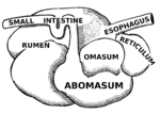
Ruminants have a fore-stomach with four chambers. These are the rumen
Rumen

The rumen, also known as a paunch, forms the larger part of the reticulorumen, which is the first chamber in the alimentary canal of ruminant animals....
, reticulum
Reticulum (anatomy)

The reticulum is the second chamber in the alimentary canal of a ruminant animal. Anatomically it is considered the smaller half of the reticulorumen along with the rumen....
, omasum
Omasum

The omasum, also known as the bible, the fardel, the manyplies and the psalterium, is the third compartment of the stomach in ruminants....
, and abomasum
Abomasum

The abomasum, also known as the maw, and the rennet-bag, is the fourth and final stomach compartment in ruminants. The normal anatomical location is along ventral midline....
. In the first two chambers, the rumen and the reticulum, the food is mixed with saliva and separates into layers of solid and liquid material. Solids clump together to form the cud (or bolus
Bolus

Bolus can refer to:...
). The cud is then regurgitated, chewed slowly to completely mix it with saliva and to break down the particle size. Fiber, especially cellulose
Cellulose

File:Cellulose Sessel.svgCellulose is an organic compound with the chemical formula , a polysaccharide consisting of a linear chain of several hundred to over ten thousand ? linked D-glucose units....
 and hemi-cellulose, is primarily broken down into the three volatile fatty acids
Volatile fatty acids

Volatile fatty acids are fatty acids with a carbon chain of six carbons or fewer.They can be created through fermentation in the intestine....
, acetic acid
Acetic acid

Acetic acid, CH3COOH, also known as ethanoic acid, is an organic acid which gives vinegar its sour taste and pungent smell. Pure, water-free acetic acid is a colourless liquid that absorbs water from the environment , and freezes at 16.7 Celsius to a colourless crystalline solid....
, propionic acid
Propionic acid

Propionic acid is a naturally-occurring carboxylic acid with chemical formula CarbonHydrogen3CH2COxygenOH. In the pure state, it is a colorless liquid with a pungent odor....
 and butyric acid
Butyric acid

Butyric acid , also known under the systematic name butanoic acid, is a carboxylic acid with the structural formula carbonhydrogen3CH2CH2-carboxyl group....
 in these chambers by microbes (bacteria
Bacteria

The Bacteria are a large group of unicellular microorganisms. Typically a few micrometres in length, bacteria have a wide range of shapes, ranging from spheres to rods and spirals....
, protozoa
Protozoa

Protozoan are microorganisms classified as unicellular eukaryotes. While there is no exact definition of the term "protozoan", most scientists use the word to refer to a unicellular heterotrophic protist, such as an amoeba or a ciliate....
, and fungi). Protein and non-structural carbohydrate (pectin
Pectin

Pectin is a structural heteropolysaccharide contained in the primary cell walls of terrestrial plants. It was first isolated and described in 1825 by Henri Braconnot....
, sugars, starches) are also fermented.

Even though the rumen and reticulum have different names they represent the same functional space as digesta can move back and forth between them. Together these chambers are called the reticulorumen. The degraded digesta, which is now in the lower liquid part of the reticulorumen, then passes into the next chamber, the omasum, where water and many of the inorganic mineral elements are absorbed into the blood stream. After this the digesta is moved to the last chamber, the abomasum. The abomasum is the direct equivalent of the monogastric stomach (for example that of the human or pig), and digesta is digested here in much the same way. Digesta is finally moved into the small intestine, where the digestion and absorption of nutrients occurs. Microbes produced in the reticulo-rumen are also digested in the small intestine. Fermentation continues in the large intestine in the same way as in the reticulorumen.

Almost all the glucose produced by the breaking down of cellulose and hemicellulose is used by microbes in the rumen, and as such ruminants usually absorb little glucose
Glucose

Glucose , a monosaccharide also known as grape sugar, blood sugar, or corn sugar, is a very important carbohydrate in biology....
 from the small intestine
Small intestine

In vertebrates, including mammals, reptiles, birds, and bony fish, the small intestine is the part of the gastrointestinal tract following the stomach, and is where the vast majority of digestion takes place....
. Rather, ruminants' requirement for glucose (for brain function and lactation if appropriate) is made by the liver from propionate, one of the volatile fatty acids made in the rumen .

Religious importance

In Abrahamic religions, a distinction between clean and unclean animals approximately falls according to whether the animal ruminates. The Law of Moses in the Bible
Bible

The Bible is the central religious text of Judaism and Christianity. The exact Books of the Bible is dependent on the religious traditions of specific denominations....
 allowed only the eating of animals that had split hooves and "that chew the cud", a stipulation preserved to this day in the Kashrut
Kashrut

Kashrut refers to Judaism Taboo food and drink. Food in accord with halakha is termed kosher in English language, from the Ashkenazi Hebrew pronunciation of the Hebrew language term kash?r , meaning "fit" ....
.

Other uses

The verb to ruminate has been extended metaphor
Metaphor

Metaphor is language that directly compares seemingly unrelated subjects. It is a figure of speech that compares two or more things without using the words "like" or "as." More generally, a metaphor describes a first subject as being or equal to a second object in some way....
ically to mean to thoughtfully ponder or to meditate
Meditation

Meditation is a mental discipline by which one attempts to get beyond the reflexive, "thinking" mind into a deeper state of relaxation or awareness....
 on some topic. Similarly, ideas may be chewed on or digested. Chew the (one's) cud is to reflect or meditate.

See also

  • Monogastric
    Monogastric

    A monogastric organism has a simple single chambered stomach, and is the alternate gastric complex to a four-chambered complex stomach known as a ruminant. Examples of monogastric animals include humans, pigs, dogs, and cats....
  • - Colorado State University