

Northern Sami

Encyclopedia

Sami people
The Sami people, also spelled Sámi, or Saami, are the arctic indigenous people inhabiting Sápmi, which today encompasses parts of far northern Sweden, Norway, Finland, the Kola Peninsula of Russia, and the border area between south and middle Sweden and Norway. The Sámi are Europe’s northernmost...
(Sámegiella or Davvisámegiella, formerly Davvisámi or Davvisaami; disapproved exonym Lappish or Lapp) is the most widely spoken of all Sami languages
Sami languages
Sami or Saami is a general name for a group of Uralic languages spoken by the Sami people in parts of northern Finland, Norway, Sweden and extreme northwestern Russia, in Northern Europe. Sami is frequently and erroneously believed to be a single language. Several names are used for the Sami...
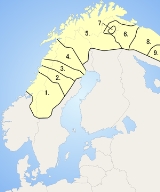
. The speaking area of Northern Sami covers the northern parts of Norway
Norway
Norway , officially the Kingdom of Norway, is a Nordic unitary constitutional monarchy whose territory comprises the western portion of the Scandinavian Peninsula, Jan Mayen, and the Arctic archipelago of Svalbard and Bouvet Island. Norway has a total area of and a population of about 4.9 million...
, Sweden
Sweden
Sweden , officially the Kingdom of Sweden , is a Nordic country on the Scandinavian Peninsula in Northern Europe. Sweden borders with Norway and Finland and is connected to Denmark by a bridge-tunnel across the Öresund....
and Finland
Finland
Finland , officially the Republic of Finland, is a Nordic country situated in the Fennoscandian region of Northern Europe. It is bordered by Sweden in the west, Norway in the north and Russia in the east, while Estonia lies to its south across the Gulf of Finland.Around 5.4 million people reside...
. The number of Northern Sami speakers is estimated to be somewhere between 15,000 and 25,000. About 2000 of these live in Finland and between 5000 and 6000 in Sweden.
History
Northern Sami was first described by Knud LeemKnud Leem
Knud Leem was a Norwegian priest and linguist. Knud Leem started the linguistic study of Sámi when he published a grammar book of it in 1748...
(En lappisk Grammatica efter den Dialect, som bruges af Field-Lapperne udi Porsanger-Fiorden) in 1748 and in dictionaries in 1752 and 1768. One of Leem's fellow grammaticians was Anders Porsanger
Anders Porsanger
Anders Porsanger was a Sami linguist from Olderfjorden in Porsanger. He is known for having worked with János Sajnovics in order to establish both the Sami and Hungarian languages when Sajnovics was in Vardø observing the Venus transit in 1769. Anders Porsanger went to a cathedral school in...
, who studied at the Trondheim Cathedral School and other schools, but who was unable to publish his work on Sami due to racist attitudes at the time. Unfortunately, the majority of his work has disappeared.
Roots
The roots of the current orthography for Northern Sami were laid by Rasmus Rask who, after discussions with Nils Vibe StockflethNils Vibe Stockfleth
Nils Joachim Christian Vibe Stockfleth was a Norwegian cleric who was instrumental in the first development of the written form of the Northern Sami language...
, published Ræsonneret lappisk sproglære efter den sprogart, som bruges af fjældlapperne i Porsangerfjorden i Finmarken. En omarbejdelse af Prof. Knud Leems Lappiske grammatica in 1832. Rask felt that the orthography should be based on the principle of one sound–one letter. All of the orthographies that have been used for Northern Sami trace their roots back to Rask's system, unlike the orthographies used for Lule
Lule Sami
Lule Sami is a Uralic, Sami language spoken in Lule Lappmark, i.e., around Luleå, Sweden and in the northern parts of Nordland county in Norway, especially Tysfjord municipality, where Lule Sami is an official language...
and Southern Sami
Southern Sami
Southern Sami is the southwestern-most of the Sami languages. It is a seriously endangered language; the last strongholds of this language are the municipalities of Snåsa and Hattfjelldal in Norway...
, which are mainly based on the orthographical conventions of Swedish
Swedish language
Swedish is a North Germanic language, spoken by approximately 10 million people, predominantly in Sweden and parts of Finland, especially along its coast and on the Åland islands. It is largely mutually intelligible with Norwegian and Danish...
and Norwegian
Norwegian language
Norwegian is a North Germanic language spoken primarily in Norway, where it is the official language. Together with Swedish and Danish, Norwegian forms a continuum of more or less mutually intelligible local and regional variants .These Scandinavian languages together with the Faroese language...
. Following in the tradition of Rask meant that diacritics were used with some consonants (č, đ, ŋ, š, ŧ and ž), which caused data-processing problems before Unicode
Unicode
Unicode is a computing industry standard for the consistent encoding, representation and handling of text expressed in most of the world's writing systems...
was introduced. Both Stockfleth and J.A. Friis went on to publish grammar books and dictionaries for Sami. It can be said that Northern Sami was better described than Norwegian was before Ivar Aasen
Ivar Aasen
Ivar Andreas Aasen was a Norwegian philologist, lexicographer, playwright and poet.-Background:...
published his grammar on Norwegian.
Rules
Northern Sami was and is still used in three separate countries, each of which used its own orthography for a number of years. Friis' orthography was used when work on translating the Bible into Northern Sami commenced, in the first Sami newspaper called Saǥai Muittalægje, and in the Finnemisjonens own newspaper NuorttanasteNuorttanaste
Nuorttanaste is a religious publication from Norway published in Northern Sámi. The first time it appeared in print was in 1898, when it was published once a month. Currently, the Evangelical Lutheran Free Church of Norway puts out eleven issues a year.- Editors-in-chief :* Gustav Lund...
. The groundwork for Northern Sami lexicography was laid by Konrad Nielsen
Konrad Nielsen
Konrad Hartvig Isak Rosenvinge Nielsen was a Norwegian philologist. He spent most of his career as a professor at the Royal Frederick University , as a lecturer, textbook writer, lexicographer and translator...
who used an orthography of his own creation in his dictionary Lappisk ordbok. Starting in 1948, the orthographies used in Norway and Sweden were combined into a single orthography entitled the Bergsland
Knut Bergsland
Knut Bergsland was a Norwegian linguist. Working as a professor at the University of Oslo from 1947 to 1981, he did groundbreaking research in Uralic and Eskimo–Aleut languages.-Career:...
-Ruong
Israel Ruong
Israel Ruong was a Swedish-Sámi linguist, politician and professor of Sámi languages and culture at the University of Uppsala in Sweden....
orthography. This orthography, however, was not greatly used in Norway. In addition, the authorities there instituted a policy that prohibited Sami from being used in practice. In Sweden, classes were taught in Sami in the Sami schools, as the policy of Lapp ska vara lapp (Sami should be a Sami) was applied to Sami reindeer herders with the intention of keeping them separated from larger society. In 1979, an official orthography for Northern Sami was adopted for use in Norway, Sweden and Finland.
Assimilation
The mass mobilization during the Alta controversyAlta controversy
The Alta controversy refers to a political controversy in Norway in the late 1970s and early 1980s concerning the construction of a hydroelectric power plant in the Alta river in Finnmark, Northern Norway.-Key events:...
as well as a more tolerant political environment caused a change to the Norwegian policy of assimilation during the last decades of the twentieth century.
In Norway, Northern Sami is currently an official language of two counties (Finnmark
Finnmark
or Finnmárku is a county in the extreme northeast of Norway. By land it borders Troms county to the west, Finland to the south and Russia to the east, and by water, the Norwegian Sea to the northwest, and the Barents Sea to the north and northeast.The county was formerly known as Finmarkens...
and Troms
Troms
or Romsa is a county in North Norway, bordering Finnmark to the northeast and Nordland in the southwest. To the south is Norrbotten Län in Sweden and further southeast is a shorter border with Lapland Province in Finland. To the west is the Norwegian Sea...
) and six municipalities (Kautokeino
Kautokeino
or Guovdageaidnu , is a municipality in Finnmark county, Norway. The administrative centre of the municipality is the village of Guovdageaidnu/Kautokeino...
, Karasjok
Karasjok
Kárášjohka or is a village and municipality in Finnmark county, Norway. The administrative centre of the municipality is the village of Karasjok.-Name:Karasjok is a Norwegianized form of the Sámi name Kárášjohka...
, Nesseby
Nesseby
Unjárga or Nesseby is a municipality in Finnmark county, Norway. The administrative centre of the municipality is the village of Varangerbotn....
, Tana, Porsanger
Porsanger
Porsanger or Porsáŋgu or Porsanki is a municipality in Finnmark county, Norway. The administrative centre of the municipality is the village of Lakselv...
and Gáivuotna (Kåfjord). Sami born before 1977 have never learned to write Sami according to the currently used orthography in school, so it is only in recent years that there have been Sami capable of writing their own language for various administrative positions.
Stress
Zero stress can be said to be a feature of conjunctionsConjunctions
Conjunctions, is a biannual American literary journal based at Bard College. It was founded in 1981 and is currently edited by Bradford Morrow....
, postpositions, particles
Grammatical particle
In grammar, a particle is a function word that does not belong to any of the inflected grammatical word classes . It is a catch-all term for a heterogeneous set of words and terms that lack a precise lexical definition...
, and monosyllabic pronouns.
Orthography
Northern Sami has a long orthographicOrthography
The orthography of a language specifies a standardized way of using a specific writing system to write the language. Where more than one writing system is used for a language, for example Kurdish, Uyghur, Serbian or Inuktitut, there can be more than one orthography...
history, which has witnessed no less than 9 different extended versions of the Latin alphabet
Latin alphabet
The Latin alphabet, also called the Roman alphabet, is the most recognized alphabet used in the world today. It evolved from a western variety of the Greek alphabet called the Cumaean alphabet, which was adopted and modified by the Etruscans who ruled early Rome...
. The most recent version was approved in 1979 and last modified in 1985:
| A a | Á á Á is a letter of the Czech, Faroese, Hungarian, Icelandic, Slovak and Sámi languages. This letter also appears in Dutch, Galician, Irish, Occitan, Portuguese, Spanish, Lakota, Navajo, and Vietnamese as a variant of the letter “a”. Some writers use á incorrectly to denote a quantity, often used on... |
B b | C c | Č č C Ĉ or ĉ is a consonant in Esperanto orthography, representing the sound .Esperanto orthography uses a diacritic for all four of its postalveolar consonants, as do the Latin-based Slavic alphabets... |
D d | Đ D with stroke Đ , formed from D with the addition of a bar or stroke through the letter. This is the same modification that was used to create eth , but eth is based on an insular variant of d while đ is based on its usual upright shape... đ |
E e | F f | G g |
|---|---|---|---|---|---|---|---|---|---|
| a | á | be | ce | če | de | đe | e | áf | ge |
| /ɑ/ | /a/ | /b/ | /ts/ | /tʃ/ | /d/ | /ð/ | /e/ | /f/ | /ɡ/ |
| H h | I i | J j | K k | L l | M m | N n | Ŋ ŋ | O o | P p |
| ho | i | je | ko | ál | ám | án | áŋ | o | pe |
| /h/ | /i/ | /j/ | /k/ | /l/ | /m/ | /n/ | /ŋ/ | /o/ | /p/ |
| R r | S s | Š š Š The grapheme Š, š is used in various contexts, usually denoting the voiceless postalveolar fricative. In the International Phonetic Alphabet this sound is denoted with , but the lowercase š is used in the Americanist phonetic notation, as well as in the Uralic Phonetic Alphabet.For use in computer... |
T t | Ŧ ŧ | U u | V v | Z z | Ž ž Ž The grapheme Ž is formed from Latin Z with the addition of caron . It is used in various contexts, usually denoting the voiced postalveolar fricative, a sound similar to English g in mirage, or Portuguese and French j... |
|
| ár | ás | áš | te | ŧe | u | ve | ez | ež | |
| /r/ | /s/ | /ʃ/ | /t/ | /θ/ | /u/ | /v/ | /dz/ | /dʒ/ |
An acute accent was placed over the corresponding Latin
Latin alphabet
The Latin alphabet, also called the Roman alphabet, is the most recognized alphabet used in the world today. It evolved from a western variety of the Greek alphabet called the Cumaean alphabet, which was adopted and modified by the Etruscans who ruled early Rome...
letter to represent the letters particular to Northern Sami (Áá Čč Đđ Ŋŋ Šš Ŧŧ Žž) when typing when there was no way of entering these letters correctly otherwise. These substitutions are still found in books printed after the common orthography was adopted due to system limitations when typing.
Until the official orthography currently in use was adopted in 1979, each country had its own, slightly different standard, so it is quite possible to come across older books that are difficult to understand for people unacquainted with the orthography:
(The children have come to school.)
The first sentence is from Antti Outakoski's Samekiela kielloahpa from 1950; the second one is how it would be written according to the current orthography.
Dialects
Northern Sami can be divided into four major dialect groups: Torne, East Finnmark, West Finnmark (written standard) and Sea Sami.Grammar
Northern Sami is an agglutinative, highly inflected language that shares many grammatical features with the other Uralic languagesUralic languages
The Uralic languages constitute a language family of some three dozen languages spoken by approximately 25 million people. The healthiest Uralic languages in terms of the number of native speakers are Hungarian, Finnish, Estonian, Mari and Udmurt...
. Sami has also developed considerably into the direction of fusional and inflected morphology, much like Estonian
Estonian language
Estonian is the official language of Estonia, spoken by about 1.1 million people in Estonia and tens of thousands in various émigré communities...
to which it is distantly related. Therefore, morphemes are marked not only by suffixes but also by morphophonological
Morphophonology
Morphophonology is a branch of linguistics which studies, in general, the interaction between morphological and phonetic processes. When a morpheme is attached to a word, it can alter the phonetic environments of other morphemes in that word. Morphophonemics attempts to describe this process...
modifications to the root. Of the various morphophonological alterations, the most important and complex is the system of consonant gradation
Consonant gradation
Consonant gradation is a type of consonant mutation, in which consonants alternate between various "grades". It is found in some Uralic languages such as Finnish, Estonian, Northern Sámi, and the Samoyed language Nganasan. In addition, it has been reconstructed for Proto-Germanic, the parent...
.
Cases
Northern Sami has 7 casesGrammatical case
In grammar, the case of a noun or pronoun is an inflectional form that indicates its grammatical function in a phrase, clause, or sentence. For example, a pronoun may play the role of subject , of direct object , or of possessor...
in the singular, although the genitive and accusative are identical, so some people might state that it only has 6 cases:
- Nominative
- Genitive
- Accusative
- Locative
- Illative
- Comitative
- Essive
The form taken by the essive (marker
Marker (linguistics)
In linguistics, a marker is a free or bound morpheme that indicates the grammatical function of the marked word, phrase, or sentence. In analytic languages and agglutinative languages, markers are generally easily distinguished. In fusional languages and polysynthetic languages, this is often not...
: -n) is the same in the singular
Grammatical number
In linguistics, grammatical number is a grammatical category of nouns, pronouns, and adjective and verb agreement that expresses count distinctions ....
and in the plural
Plural
In linguistics, plurality or [a] plural is a concept of quantity representing a value of more-than-one. Typically applied to nouns, a plural word or marker is used to distinguish a value other than the default quantity of a noun, which is typically one...
, i.e., mánnán (as a child/as children).
Pronouns
The personal pronouns have three numbers - singular, dualDual (grammatical number)
Dual is a grammatical number that some languages use in addition to singular and plural. When a noun or pronoun appears in dual form, it is interpreted as referring to precisely two of the entities identified by the noun or pronoun...
, and plural. The next two tables contain the personal pronouns in the nominative and genitive/accusative cases, respectively.
| Nominative | singular | dual | plural | English |
|---|---|---|---|---|
| 1st person nom | mun | moai | mii | I |
| 2nd person nom | don | doai | dii | you (thou) |
| 3rd person nom | son | soai | sii | he, she |
| Genitive/Accusative | singular | dual | plural | English |
|---|---|---|---|---|
| 1st person gen | mu | munno | min | my |
| 2nd person gen | du | dudno | din | your, yours |
| 3rd person gen | su | sudno | sin | his, her |
The next table demonstrates the declension of a personal pronoun he/she (no gender distinction) in various cases:
| Singular | Dual | Plural | |
|---|---|---|---|
| Nominative | son | soai | sii |
| Genitive-Accusative | su | sudno | sin |
| Locative | sus | sudnos | sis |
| Illative | sutnje | sudnuide | sidjiide |
| Comitative | suinna | sudnuin | singuin |
| Essive | sunin | sudnon | sinin |
Person
Northern Sami verbVerb
A verb, from the Latin verbum meaning word, is a word that in syntax conveys an action , or a state of being . In the usual description of English, the basic form, with or without the particle to, is the infinitive...
s conjugate for three grammatical person
Grammatical person
Grammatical person, in linguistics, is deictic reference to a participant in an event; such as the speaker, the addressee, or others. Grammatical person typically defines a language's set of personal pronouns...
s:
- first person
- second person
- third person
Mood
Northern Sami has 4 grammatical moodGrammatical mood
In linguistics, grammatical mood is a grammatical feature of verbs, used to signal modality. That is, it is the use of verbal inflections that allow speakers to express their attitude toward what they are saying...
s:
- indicative
- imperativeImperative moodThe imperative mood expresses commands or requests as a grammatical mood. These commands or requests urge the audience to act a certain way. It also may signal a prohibition, permission, or any other kind of exhortation.- Morphology :...
- conditionalConditional moodIn linguistics, the conditional mood is the inflectional form of the verb used in the independent clause of a conditional sentence to refer to a hypothetical state of affairs, or an uncertain event, that is contingent on another set of circumstances...
- potential
Grammatical number
Northern Sami verbVerb
A verb, from the Latin verbum meaning word, is a word that in syntax conveys an action , or a state of being . In the usual description of English, the basic form, with or without the particle to, is the infinitive...
s conjugate for three grammatical number
Grammatical number
In linguistics, grammatical number is a grammatical category of nouns, pronouns, and adjective and verb agreement that expresses count distinctions ....
s:
- singularGrammatical numberIn linguistics, grammatical number is a grammatical category of nouns, pronouns, and adjective and verb agreement that expresses count distinctions ....
- dual
- pluralPluralIn linguistics, plurality or [a] plural is a concept of quantity representing a value of more-than-one. Typically applied to nouns, a plural word or marker is used to distinguish a value other than the default quantity of a noun, which is typically one...
Tense
Northern Sami has 2 simple tensesGrammatical tense
A tense is a grammatical category that locates a situation in time, to indicate when the situation takes place.Bernard Comrie, Aspect, 1976:6:...
:
- pastPreteriteThe preterite is the grammatical tense expressing actions that took place or were completed in the past...
- non-pastGrammatical tenseA tense is a grammatical category that locates a situation in time, to indicate when the situation takes place.Bernard Comrie, Aspect, 1976:6:...
and 2 compound tenses:
- Present perfect
- Pluperfect
Negative verb
Northern Sami, like Finnish, the other Sami languages and Estonian, has a negative verbNegative verb
A negative verb is a type of auxiliary that is used to form the negative of a main verb. The main verb itself has no personal endings, while the negative verb takes the inflection...
that conjugates according to mood
Grammatical mood
In linguistics, grammatical mood is a grammatical feature of verbs, used to signal modality. That is, it is the use of verbal inflections that allow speakers to express their attitude toward what they are saying...
(indicative, imperative and optative), person
Grammatical person
Grammatical person, in linguistics, is deictic reference to a participant in an event; such as the speaker, the addressee, or others. Grammatical person typically defines a language's set of personal pronouns...
(1st, 2nd and 3rd) and number
Grammatical number
In linguistics, grammatical number is a grammatical category of nouns, pronouns, and adjective and verb agreement that expresses count distinctions ....
(singular, dual and plural).
| Ind. pres. | Imperative | Optative | Supinum? | |||||||||||||||
|---|---|---|---|---|---|---|---|---|---|---|---|---|---|---|---|---|---|---|
| sg. | du. | pl. | sg. | du. | pl. | sg. | du. | pl. | sg. | du. | pl. | |||||||
| 1 | in | ean | eat | 1 | - | - | - | 1 | allom | allu | allot | 1 | aman | amame | amamet | |||
| 2 | it | eahppi | ehpet | 2 | ale | alli | allet | 2 | ale | alli | allet | 2 | amat | amade | amadet | |||
| 3 | ii | eaba | eai | 3 | - | - | - | 3 | allos | alloska | alloset | 3 | amas | amaska | amaset | |||
The negative verb in Northern Sami does not conjugate according to tense
Grammatical tense
A tense is a grammatical category that locates a situation in time, to indicate when the situation takes place.Bernard Comrie, Aspect, 1976:6:...
.
External links
- Kimberli Mäkäräinen A Northern Sámi-English vocabulary (5211 words in Sámi as of 13 March 2007)
- Northern Sámi - Inari Sámi - Skolt Sámi - English dictionary (requires a password nowadays)
- Names of birds found in Sápmi in a number of languages, including Skolt Sámi and English. Search function only works with Finnish input though.
- OAHPA! Online interactive Sámi pedagogical program suite
- Sámi language technology project
- Sámi dictionary and terminology database
- Sámi proofing tools project
- Sátnemeahccái project for children
- Gradation described
- Wordlist with sound files
- Gulahalan, a course on North Sámi in Swedish (has sound files)
- Irja Seurujärvi-Kari talks in Northern Sámi
- Lexin picture themes - Northern Sámi
- Sami alphabet - Flash/Sound