

Southern Sami

Encyclopedia
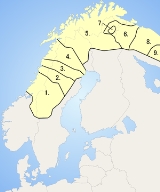
Southern Sami is the southwestern-most of the Sami languages
. It is a seriously endangered language; the last strongholds of this language are the municipalities of Snåsa
and Hattfjelldal
in Norway
. There are approximately 2000 people considered ethnically Southern Sami in Norway and Sweden, but only approximately 600 of them can fluently speak the language.
that has an official written language, but only a few books have been published for the language, one of which is a good-size Southern Sami–Norwegian dictionary.
Southern Sami uses the latin alphabet
:
A/a, B/b, D/d, E/e, F/f, G/g, H/h, I/i, (Ï/ï), J/j, K/k, L/l, M/m, N/n, O/o, P/p, R/r, S/s, T/t, U/u, V/v, Y/y, Æ/æ, Ø/ø, Å/å
An alternative orthography
replaces Æ/æ with Ä/ä and Ø/ø with Ö/ö. The variants Ä/ä, Ö/ö are used in Sweden
, Æ/æ, Ø/ø in Norway, in accordance with the usage in Swedish
and Norwegian
, based on computer or type writer availability. The Ï/ï represents a back version of I/i, many texts do not distinguish between the two.
C/c, Q/q, W/w, X/x, Z/z are used in words of foreign origin.
1The distinction between the vowels /i/ and /ɨ/ is normally not indicated in spelling: both of these sounds are written with the letter i. However, dictionaries and other linguistically precise sources use the character ï for the latter vowel.
2The letter æ is used in Norway, and ä in Sweden.
The non-high vowels e, ɛ, o and a contrast in length
: they may occur as both short and long. High vowels only occur as short.
The vowels may combine to form ten different diphthong
s:
in the declension and conjugation of words. Often there are three different vowels that alternate with each other in the paradigm of a single word, for example as follows:
The Umlaut is often rendered in a table,
On the other hand, Southern Sami is the only Sami language that does not have consonant gradation
. Hence consonants in the middle of words never alterate in Southern Sami, even though such alterations are frequent in other Sami languages. Compare, for instance, Southern Sami nomme 'name' : nommesne 'in the name' to Northern Sami
namma : namas, with the consonant gradation mm : m.
:
Southern Sámi is one of the few Sami languages
that still differentiate between the accusative and the genitive morphologically.
s conjugate for three grammatical person
s:
s conjugate for three grammatical number
s:
. In Southern Sami, the negative verb conjugates according to tense
(past and non-past), mood
(indicative and imperative), person
(1st, 2nd and 3rd) and number
(singular, dual and plural). This differs from some other the other Sami languages
, e.g., from Northern Sami
, which do not conjugate according to tense
.
, Southern Sami is an SOV language.
Sami languages
Sami or Saami is a general name for a group of Uralic languages spoken by the Sami people in parts of northern Finland, Norway, Sweden and extreme northwestern Russia, in Northern Europe. Sami is frequently and erroneously believed to be a single language. Several names are used for the Sami...
. It is a seriously endangered language; the last strongholds of this language are the municipalities of Snåsa
Snåsa
Snåsa is a municipality in Nord-Trøndelag county, Norway. It is part of the Innherred region. The administrative centre of the municipality is the village of Snåsa. Other villages include Agle and Jørstad....
and Hattfjelldal
Hattfjelldal
Hattfjelldal is a municipality in Nordland county, Norway. It is part of the Helgeland traditional region. The administrative centre of the municipality is the village of Hattfjelldal. Other villages include Grubben, Svenskvollen, and Varntresk...
in Norway
Norway
Norway , officially the Kingdom of Norway, is a Nordic unitary constitutional monarchy whose territory comprises the western portion of the Scandinavian Peninsula, Jan Mayen, and the Arctic archipelago of Svalbard and Bouvet Island. Norway has a total area of and a population of about 4.9 million...
. There are approximately 2000 people considered ethnically Southern Sami in Norway and Sweden, but only approximately 600 of them can fluently speak the language.
Writing system
Southern Sami is one of the six Sami languagesSami languages
Sami or Saami is a general name for a group of Uralic languages spoken by the Sami people in parts of northern Finland, Norway, Sweden and extreme northwestern Russia, in Northern Europe. Sami is frequently and erroneously believed to be a single language. Several names are used for the Sami...
that has an official written language, but only a few books have been published for the language, one of which is a good-size Southern Sami–Norwegian dictionary.
Southern Sami uses the latin alphabet
Latin alphabet
The Latin alphabet, also called the Roman alphabet, is the most recognized alphabet used in the world today. It evolved from a western variety of the Greek alphabet called the Cumaean alphabet, which was adopted and modified by the Etruscans who ruled early Rome...
:
A/a, B/b, D/d, E/e, F/f, G/g, H/h, I/i, (Ï/ï), J/j, K/k, L/l, M/m, N/n, O/o, P/p, R/r, S/s, T/t, U/u, V/v, Y/y, Æ/æ, Ø/ø, Å/å
An alternative orthography
Orthography
The orthography of a language specifies a standardized way of using a specific writing system to write the language. Where more than one writing system is used for a language, for example Kurdish, Uyghur, Serbian or Inuktitut, there can be more than one orthography...
replaces Æ/æ with Ä/ä and Ø/ø with Ö/ö. The variants Ä/ä, Ö/ö are used in Sweden
Sweden
Sweden , officially the Kingdom of Sweden , is a Nordic country on the Scandinavian Peninsula in Northern Europe. Sweden borders with Norway and Finland and is connected to Denmark by a bridge-tunnel across the Öresund....
, Æ/æ, Ø/ø in Norway, in accordance with the usage in Swedish
Swedish alphabet
Modern Swedish is written with a 29-letter Latin alphabet:Prior to the 13th edition of Svenska Akademiens ordlista in 2006, the letters and were collated together....
and Norwegian
Danish and Norwegian alphabet
The Danish and Norwegian alphabet is based upon the Latin alphabet and has consisted of the following 29 letters since 1917 and 1955 , although Danish did not officially recognize the W as a separate letter until 1980....
, based on computer or type writer availability. The Ï/ï represents a back version of I/i, many texts do not distinguish between the two.
C/c, Q/q, W/w, X/x, Z/z are used in words of foreign origin.
Phonology
Southern Sami has two dialects, the northern and the southern dialect. The phonological differences between the dialects are relatively small; the phonemic system of the northern dialect is explained below.Vowels
The vowel phonemes of the northern dialect are the following; orthographic counterparts are given in brackets:| front Front vowel A front vowel is a type of vowel sound used in some spoken languages. The defining characteristic of a front vowel is that the tongue is positioned as far in front as possible in the mouth without creating a constriction that would be classified as a consonant. Front vowels are sometimes also... |
central Central vowel A central vowel is a type of vowel sound used in some spoken languages. The defining characteristic of a central vowel is that the tongue is positioned halfway between a front vowel and a back vowel... |
back Back vowel A back vowel is a type of vowel sound used in spoken languages. The defining characteristic of a back vowel is that the tongue is positioned as far back as possible in the mouth without creating a constriction that would be classified as a consonant. Back vowels are sometimes also called dark... |
||||
|---|---|---|---|---|---|---|
| Unrounded | Rounded | Unrounded | Rounded | Unrounded | Rounded | |
| close Close vowel A close vowel is a type of vowel sound used in many spoken languages. The defining characteristic of a close vowel is that the tongue is positioned as close as possible to the roof of the mouth without creating a constriction that would be classified as a consonant.This term is prescribed by the... |
/i/ (i) | /y/ (y) | /ɨ/ (ï/i)1 | /ʉ/ (u) | /u/ (o) | |
| mid Mid vowel A mid vowel is a vowel sound used in some spoken languages. The defining characteristic of a mid vowel is that the tongue is positioned mid-way between an open vowel and a close vowel... |
/e/ (e) | /o/ (å) | ||||
| open Open vowel An open vowel is defined as a vowel sound in which the tongue is positioned as far as possible from the roof of the mouth. Open vowels are sometimes also called low vowels in reference to the low position of the tongue... |
/ɛ/ (æ/ä)2 | /ɑ/ (a) |
1The distinction between the vowels /i/ and /ɨ/ is normally not indicated in spelling: both of these sounds are written with the letter i. However, dictionaries and other linguistically precise sources use the character ï for the latter vowel.
2The letter æ is used in Norway, and ä in Sweden.
The non-high vowels e, ɛ, o and a contrast in length
Vowel length
In linguistics, vowel length is the perceived duration of a vowel sound. Often the chroneme, or the "longness", acts like a consonant, and may etymologically be one, such as in Australian English. While not distinctive in most dialects of English, vowel length is an important phonemic factor in...
: they may occur as both short and long. High vowels only occur as short.
The vowels may combine to form ten different diphthong
Diphthong
A diphthong , also known as a gliding vowel, refers to two adjacent vowel sounds occurring within the same syllable. Technically, a diphthong is a vowel with two different targets: That is, the tongue moves during the pronunciation of the vowel...
s:
| front Front vowel A front vowel is a type of vowel sound used in some spoken languages. The defining characteristic of a front vowel is that the tongue is positioned as far in front as possible in the mouth without creating a constriction that would be classified as a consonant. Front vowels are sometimes also... |
front Front vowel A front vowel is a type of vowel sound used in some spoken languages. The defining characteristic of a front vowel is that the tongue is positioned as far in front as possible in the mouth without creating a constriction that would be classified as a consonant. Front vowels are sometimes also... to back Back vowel A back vowel is a type of vowel sound used in spoken languages. The defining characteristic of a back vowel is that the tongue is positioned as far back as possible in the mouth without creating a constriction that would be classified as a consonant. Back vowels are sometimes also called dark... |
central Central vowel A central vowel is a type of vowel sound used in some spoken languages. The defining characteristic of a central vowel is that the tongue is positioned halfway between a front vowel and a back vowel... to back Back vowel A back vowel is a type of vowel sound used in spoken languages. The defining characteristic of a back vowel is that the tongue is positioned as far back as possible in the mouth without creating a constriction that would be classified as a consonant. Back vowels are sometimes also called dark... |
central Central vowel A central vowel is a type of vowel sound used in some spoken languages. The defining characteristic of a central vowel is that the tongue is positioned halfway between a front vowel and a back vowel... to front Front vowel A front vowel is a type of vowel sound used in some spoken languages. The defining characteristic of a front vowel is that the tongue is positioned as far in front as possible in the mouth without creating a constriction that would be classified as a consonant. Front vowels are sometimes also... |
back Back vowel A back vowel is a type of vowel sound used in spoken languages. The defining characteristic of a back vowel is that the tongue is positioned as far back as possible in the mouth without creating a constriction that would be classified as a consonant. Back vowels are sometimes also called dark... to front Front vowel A front vowel is a type of vowel sound used in some spoken languages. The defining characteristic of a front vowel is that the tongue is positioned as far in front as possible in the mouth without creating a constriction that would be classified as a consonant. Front vowels are sometimes also... |
back Back vowel A back vowel is a type of vowel sound used in spoken languages. The defining characteristic of a back vowel is that the tongue is positioned as far back as possible in the mouth without creating a constriction that would be classified as a consonant. Back vowels are sometimes also called dark... |
|
|---|---|---|---|---|---|---|
| close Close vowel A close vowel is a type of vowel sound used in many spoken languages. The defining characteristic of a close vowel is that the tongue is positioned as close as possible to the roof of the mouth without creating a constriction that would be classified as a consonant.This term is prescribed by the... to mid Mid vowel A mid vowel is a vowel sound used in some spoken languages. The defining characteristic of a mid vowel is that the tongue is positioned mid-way between an open vowel and a close vowel... |
/ie/ (ie) | /yo/ (yø/yö) | /ʉe/ (ue), /ɨe/ (ie/ïe) | /uo/ (oe) | ||
| close Close vowel A close vowel is a type of vowel sound used in many spoken languages. The defining characteristic of a close vowel is that the tongue is positioned as close as possible to the roof of the mouth without creating a constriction that would be classified as a consonant.This term is prescribed by the... to open Open vowel An open vowel is defined as a vowel sound in which the tongue is positioned as far as possible from the roof of the mouth. Open vowels are sometimes also called low vowels in reference to the low position of the tongue... |
/ʉa/ (ua) | |||||
| mid Close vowel A close vowel is a type of vowel sound used in many spoken languages. The defining characteristic of a close vowel is that the tongue is positioned as close as possible to the roof of the mouth without creating a constriction that would be classified as a consonant.This term is prescribed by the... |
/oe/ (øø/öö) | |||||
| mid Mid vowel A mid vowel is a vowel sound used in some spoken languages. The defining characteristic of a mid vowel is that the tongue is positioned mid-way between an open vowel and a close vowel... to open Open vowel An open vowel is defined as a vowel sound in which the tongue is positioned as far as possible from the roof of the mouth. Open vowels are sometimes also called low vowels in reference to the low position of the tongue... |
/eæ/ (ea) | /oæ/ (åe) | /oa/ (åa) |
Sound alterations
A typical feature of Southern Sami is the alternation of first-syllable vowels through UmlautI-mutation
I-mutation is an important type of sound change, more precisely a category of regressive metaphony, in which a back vowel is fronted, and/or a front vowel is raised, if the following syllable contains /i/, /ī/ or /j/ I-mutation (also known as umlaut, front mutation, i-umlaut, i/j-mutation or...
in the declension and conjugation of words. Often there are three different vowels that alternate with each other in the paradigm of a single word, for example as follows:
- ae ~ aa ~ ee: vaedtsedh 'to walk' : vaadtsam 'I walk' : veedtsim 'I walked'
- ue ~ ua ~ øø: vuelkedh 'to leave' : vualkam 'I leave' : vøølkim 'I left'
The Umlaut is often rendered in a table,
| 1 | 2 | 3 | 4 | 5 | 6 | 7 | context | gramm. form | |
|---|---|---|---|---|---|---|---|---|---|
| A | klihtie | jeptsie | buvrie | sjiellie | gaevlie | gåetie | njueslie | ie | nominative |
| B | klæhtan | japtsan | båvran | sjeallan | gaavlan | gåatan | njuaslan | a | illative |
| F | klihtine | jiptsine | buvrine | sjeelline | geevline | göötine | njöösline | e3 | comitative |
| meaning: | mountain shelf | idiot | pillar storehouse | trash | critic | house | bum | ||
| C | færhtjoe | bahtjoe | rånhtjoe | bearkoe | baarmoe | råafoe | oe | nominative | |
| E | fyrhtjese | bohtjese | ronhtjese | byörkese | båårmese | rååfese | e2 | illative | |
| meaning: | girl | ? | mountain ridge | meat | mountain side | shed |
On the other hand, Southern Sami is the only Sami language that does not have consonant gradation
Consonant gradation
Consonant gradation is a type of consonant mutation, in which consonants alternate between various "grades". It is found in some Uralic languages such as Finnish, Estonian, Northern Sámi, and the Samoyed language Nganasan. In addition, it has been reconstructed for Proto-Germanic, the parent...
. Hence consonants in the middle of words never alterate in Southern Sami, even though such alterations are frequent in other Sami languages. Compare, for instance, Southern Sami nomme 'name' : nommesne 'in the name' to Northern Sami
Northern Sami
Northern or North Sami is the most widely spoken of all Sami languages. The speaking area of Northern Sami covers the northern parts of Norway, Sweden and Finland...
namma : namas, with the consonant gradation mm : m.
Cases
Southern Sámi has 8 casesGrammatical case
In grammar, the case of a noun or pronoun is an inflectional form that indicates its grammatical function in a phrase, clause, or sentence. For example, a pronoun may play the role of subject , of direct object , or of possessor...
:
| Case | Singular ending | Plural Plural In linguistics, plurality or [a] plural is a concept of quantity representing a value of more-than-one. Typically applied to nouns, a plural word or marker is used to distinguish a value other than the default quantity of a noun, which is typically one... ending |
|---|---|---|
| Nominative | - | -h |
| Genitive Genitive case In grammar, genitive is the grammatical case that marks a noun as modifying another noun... |
-n | -i / -j |
| Accusative Accusative case The accusative case of a noun is the grammatical case used to mark the direct object of a transitive verb. The same case is used in many languages for the objects of prepositions... |
-m | -jte / -ite / -idie |
| Inessive | -sne / -snie | -ine / -jne / -inie |
| Elative Elative Elative has two slightly differing meanings in the grammar of two language groups:*Elative case, a grammatical case in, e.g., the Finno-Ugric languages*Elative , a category of comparison similar to the superlative in, e.g., the Semitic languages... |
-ste / -stie | -jste / -jstie |
| Illative | -n / -se / -sse | -jte / -ite / -idie |
| Comitative | -ine / -jne / -inie | -igujmie / -jgujmie |
| Essive | -ine / -jne / -inie | (no plural form) |
Southern Sámi is one of the few Sami languages
Sami languages
Sami or Saami is a general name for a group of Uralic languages spoken by the Sami people in parts of northern Finland, Norway, Sweden and extreme northwestern Russia, in Northern Europe. Sami is frequently and erroneously believed to be a single language. Several names are used for the Sami...
that still differentiate between the accusative and the genitive morphologically.
Person
Southern Sami verbVerb
A verb, from the Latin verbum meaning word, is a word that in syntax conveys an action , or a state of being . In the usual description of English, the basic form, with or without the particle to, is the infinitive...
s conjugate for three grammatical person
Grammatical person
Grammatical person, in linguistics, is deictic reference to a participant in an event; such as the speaker, the addressee, or others. Grammatical person typically defines a language's set of personal pronouns...
s:
- first person
- second person
- third person
Grammatical number
Southern Sami verbVerb
A verb, from the Latin verbum meaning word, is a word that in syntax conveys an action , or a state of being . In the usual description of English, the basic form, with or without the particle to, is the infinitive...
s conjugate for three grammatical number
Grammatical number
In linguistics, grammatical number is a grammatical category of nouns, pronouns, and adjective and verb agreement that expresses count distinctions ....
s:
- singularGrammatical numberIn linguistics, grammatical number is a grammatical category of nouns, pronouns, and adjective and verb agreement that expresses count distinctions ....
- dual
- pluralPluralIn linguistics, plurality or [a] plural is a concept of quantity representing a value of more-than-one. Typically applied to nouns, a plural word or marker is used to distinguish a value other than the default quantity of a noun, which is typically one...
Negative verb
Southern Sami, like Finnish, the other Sámi languages and Estonian, has a negative verbNegative verb
A negative verb is a type of auxiliary that is used to form the negative of a main verb. The main verb itself has no personal endings, while the negative verb takes the inflection...
. In Southern Sami, the negative verb conjugates according to tense
Grammatical tense
A tense is a grammatical category that locates a situation in time, to indicate when the situation takes place.Bernard Comrie, Aspect, 1976:6:...
(past and non-past), mood
Grammatical mood
In linguistics, grammatical mood is a grammatical feature of verbs, used to signal modality. That is, it is the use of verbal inflections that allow speakers to express their attitude toward what they are saying...
(indicative and imperative), person
Grammatical person
Grammatical person, in linguistics, is deictic reference to a participant in an event; such as the speaker, the addressee, or others. Grammatical person typically defines a language's set of personal pronouns...
(1st, 2nd and 3rd) and number
Grammatical number
In linguistics, grammatical number is a grammatical category of nouns, pronouns, and adjective and verb agreement that expresses count distinctions ....
(singular, dual and plural). This differs from some other the other Sami languages
Sami languages
Sami or Saami is a general name for a group of Uralic languages spoken by the Sami people in parts of northern Finland, Norway, Sweden and extreme northwestern Russia, in Northern Europe. Sami is frequently and erroneously believed to be a single language. Several names are used for the Sami...
, e.g., from Northern Sami
Northern Sami
Northern or North Sami is the most widely spoken of all Sami languages. The speaking area of Northern Sami covers the northern parts of Norway, Sweden and Finland...
, which do not conjugate according to tense
Grammatical tense
A tense is a grammatical category that locates a situation in time, to indicate when the situation takes place.Bernard Comrie, Aspect, 1976:6:...
.
| Non-past indicative | Past indicative | |||||
| Singular | Dual | Plural | Singular | Dual | Plural | |
| 1st |
im | ean | ibie | idtjim | idtjimen | idtjimh |
| 2nd |
ih | idien | idie | idtjih | idtjiden | idtjidh |
| 3rd |
ij | eakan | eah | idtji | idtjigan | idtjin |
| Non-past imperative | Past imperative | |||||
| Singular | Dual | Plural | Singular | Dual | Plural | |
| 1st |
aelliem | aellien | aellebe | ollem | ollen | ollebe |
| 2nd |
aellieh | aelleden | aellede | ollh | olleden | ollede |
| 3rd |
aellis | aellis | aellis | olles | olles | olles |
Syntax
Unlike the other Sami languagesSami languages
Sami or Saami is a general name for a group of Uralic languages spoken by the Sami people in parts of northern Finland, Norway, Sweden and extreme northwestern Russia, in Northern Europe. Sami is frequently and erroneously believed to be a single language. Several names are used for the Sami...
, Southern Sami is an SOV language.
External links
- Sámi lottit Names of birds found in Sápmi in a number of languages, including Skolt Sámi and English. Search function only works with Finnish input though.
- Southern Sámi grammar
- Southern Sámi analyzer
- Samien Sijte – Southern Sámi Museum and Cultural Center
- Sørsamisk forskning og undervisning – Universitetet i Tromsø