
|
|
|
|
Atlanta, Georgia
|
| |
|
| |
History On December 21, 1836 the Georgia General Assembly voted to build the Western and Atlantic Railroad to provide a trade route to the Midwest. Following the forced removal of the Cherokee Nation between 1838 and 1839 the newly depopulated area was opened for the construction of a railroad. The area around the eastern terminus to the line began to develop first. By 1842, the settlement had six buildings and 30 residents and the town was renamed "Marthasville". After a few renames, the Chief Engineer of the Georgia Railroad, J. Edgar Thomson, suggested that the area be renamed "Atlantica-Pacifica", which was quickly shortened to "Atlanta". The residents approved, and the town was incorporated as Atlanta on December 29, 1847.
As more railroads were constructed, the town experienced a small boom, reaching 2,500 in population.

Discussion
Ask a question about 'Atlanta, Georgia'
Start a new discussion about 'Atlanta, Georgia'
Answer questions from other users
|
Timeline
|
|
1864 American Civil War: Battle of Resaca - the battle begins with Union General Sherman fighting toward Atlanta.
1864 American Civil War: Battle of Peachtree Creek - Near Atlanta, Georgia, Confederate forces led by General John Bell Hood unsuccessfully attack Union troops under General William T. Sherman.
1864 American Civil War: Union forces led by General William T. Sherman launch an assault on Atlanta, Georgia.
1906 Race riots in Atlanta, Georgia. At least 27 people are killed and the black-owned business district is severely damaged.
1915 Emory College is rechartered as Emory University, and plans to move its main campus from Oxford, Georgia to Atlanta.
1915 Jewish American Leo Frank is lynched for the alleged murder of a 13-year-old girl in Atlanta, Georgia.
1939 The film version of ''Gone With The Wind'', starring Vivien Leigh, Clark Gable, Olivia DeHavilland and Leslie Howard, premieres at Loew's Grand Theater in Atlanta, Georgia.
1996 After takeoff from Miami, a fire started by improperly-handled oxygen canisters in the cargo hold of Atlanta-bound ValuJet Flight 592 causes the Douglas DC-9 to crash in the Florida Everglades, killing all 110 on board.
1996 The 1996 Summer Olympics in Atlanta, Georgia, United States, is opened by U.S. President Bill Clinton.
1998 Eric Robert Rudolph is charged with 6 bombings (including the 1996 Olympic bombing) in Atlanta, Georgia.
|

Encyclopedia
History On December 21, 1836 the Georgia General Assembly voted to build the Western and Atlantic Railroad to provide a trade route to the Midwest. Following the forced removal of the Cherokee Nation between 1838 and 1839 the newly depopulated area was opened for the construction of a railroad. The area around the eastern terminus to the line began to develop first. By 1842, the settlement had six buildings and 30 residents and the town was renamed "Marthasville". After a few renames, the Chief Engineer of the Georgia Railroad, J. Edgar Thomson, suggested that the area be renamed "Atlantica-Pacifica", which was quickly shortened to "Atlanta". The residents approved, and the town was incorporated as Atlanta on December 29, 1847.
As more railroads were constructed, the town experienced a small boom, reaching 2,500 in population. In 1848, the first mayor was elected, the first homicide occurred and the first jail was built. Sidewalks were constructed and a town marshal appointed. By 1854 another railroad connected Atlanta to LaGrange, and the town grew to 7,741 by 1860.
During the American Civil War, Atlanta served as an important railroad and military supply hub. In 1864, the city became the target of a major Union invasion. The area now covered by Atlanta was the scene of several battles, including the Battle of Peachtree Creek, the Battle of Atlanta, and the Battle of Ezra Church. On September 1, 1864, Confederate General John Bell Hood evacuated Atlanta after a four-month siege mounted by Union General William T. Sherman and ordered all public buildings and possible Confederate assets destroyed. The next day, Mayor James Calhoun surrendered the city, and on September 7 Sherman ordered the civilian population to evacuate. He then ordered Atlanta burned to the ground on November 11 in preparation for his march south, though he spared the city's churches and hospitals.
The rebuilding of the city — immortalized by the phoenix and motto "Resurgens" on the city seal — was gradual. From 1867 until 1888, U.S. Army soldiers occupied McPherson Barracks in southwest Atlanta to ensure Reconstruction era reforms. To help the newly freed slaves, the Federal Government's Bureau of Refugees, Freedmen and Abandoned Land [Freedmen's Bureau] worked in tandem with a number of freedmen's aid organizations, especially the American Missionary Association (A.M.A.). The A.M.A. established two well-respected black schools by 1866 (Storrs School and Summer Hill School) which became part of the Atlanta public schools in 1872. It also created the Washburn Orphanage to aid homeless children and launched the charter for Atlanta University in 1867, the first of several historically black colleges in Atlanta, in part to begin the training of black teachers. The First Congregational Church of Atlanta was begun as a collaboration between whites, especially Northerners of the A.M.A. and Atlanta's freedmen; today its congregation still celebrates their Reconstruction-era roots.
In 1868, Atlanta became the fifth city to serve as the state capital. Henry W. Grady, the editor of the Atlanta Constitution, promoted the city to investors as a city of the "New South", one built on a modern economy, less reliant on agriculture. In the 1880s Georgia School of Technology and Atlanta Hospital were founded.
As Atlanta grew, ethnic and racial tensions mounted. The Atlanta Race Riot of 1906 left at least 27 dead and over seventy injured. In 1913, Leo Frank, a Jewish supervisor at a factory in Atlanta was put on trial for raping and murdering a thirteen-year old white employee from a suburb of Atlanta, ultimately resulting in Frank's lynching.
On December 15, 1939 Atlanta hosted the premiere of Gone With the Wind, the movie based on Atlanta-born Margaret Mitchell's best-selling novel. Stars Clark Gable, Vivien Leigh, and Olivia de Haviland were in attendance. It was held at Loew's Grand Theatre, at Peachtree and Forsyth Streets, current site of the Georgia-Pacific building. According to the Atlanta Constitution, 300,000 people were on the streets on this ice-cold night. A rousing ovation greeted a group Confederate veterans who were guests of honor. A young Martin Luther King, Jr. sang in a boys' choir from his father's church, Ebenezer Baptist.
With the entry of the United States into World War II, soldiers from around the Southeastern United States went through Atlanta to train and later be discharged at Fort McPherson. War-related manufacturing such as the Bell Aircraft factory in the suburb of Marietta helped boost the city's population and economy. Shortly after the war, the Communicable Disease Center (CDC) was founded in Atlanta.
In the wake of the landmark U.S. Supreme Court decision Brown v. Board of Education, which helped usher in the Civil Rights Movement, racial tensions in Atlanta began to express themselves in acts of violence. On October 12, 1958, a Reform Jewish temple on Peachtree Street was bombed; the synagogue's rabbi, Jacob Rothschild, was an outspoken advocate of integration. A group of anti-Semitic white supremacists calling themselves the "Confederate Underground" claimed responsibility.
In the 1960s, Atlanta was a major organizing center of the Civil Rights Movement, with Dr. Martin Luther King and students from Atlanta's historically black colleges and universities playing major roles in the movement's leadership. Two of the most important civil rights organizations -- SCLC and SNCC -- had their national headquarters in Atlanta. In April 1960 black students published "AN APPEAL FOR HUMAN RIGHTS" condemning segregation and laying the justification for direct action against it. A wave of sit-ins followed resulting in almost 100 arrests. On October 19, 1960, sit-ins at the lunch counters of several Atlanta department stores led to the arrest of Dr. King and more than 50 students, drawing attention from the national media and from presidential candidate John F. Kennedy. Sit-ins and other forms of student-led protests against various forms of segregation at both commercial and public venues such as the City Hall cafeteria and Atlanta airport continued until passage of the Civil Rights Act of 1964.
Despite these incidents, Atlanta's political and business leaders labored to foster Atlanta's image as "the city too busy to hate". In 1961, Mayor Ivan Allen Jr. became one of the few Southern white mayors to support desegregation of Atlanta's public schools.
The city's progressive civil rights record, growing economy and existing population of blacks made it increasingly popular as a relocation destination for black Americans after 1970 in the New Great Migration. Blacks demonstrated growing political influence with election of the first African-American mayor in 1973. They became a majority in the city during the late 20th century but suburbanization, rising prices, a booming economy and new migrants have decreased their percentage in the city from a high of 66.8 percent in 1990 to about 54 percent in 2004. New immigrants such as Latinos and Asians are also altering city demographics, in addition to an influx of white residents. .
In 1990, Atlanta was selected as the site for the Centennial Olympic Games 1996 Summer Olympics. Following the announcement, Atlanta undertook several major construction projects to improve the city's parks, sports facilities, and transportation. Atlanta became the third American city to host the Summer Olympics, after St. Louis and Los Angeles. The games themselves were marred by numerous organizational inefficiencies as well as the Centennial Olympic Park bombing.
On March 14, 2008, at approximately 9:40 PM Eastern Daylight Time, a category EF2 tornado hit downtown Atlanta with winds up to 135 mph (217 kph). The tornado caused damage to Philips Arena, the Georgia Dome, Centennial Olympic Park, the CNN Center and the Georgia World Congress Center. It also damaged the nearby neighborhoods of Vine City to the west and Cabbagetown, and Fulton Bag and Cotton Mills to the east. While there were dozens of injuries, only one fatality was reported.[name="ajctornado">Eberly, Tim; Shea, Paul. "." Atlanta Journal and Constitution. March 15, 2008. Retrieved April 29, 2008.] City officials warned it could take months to clear the devastation left by the tornado.[name="cnn17mar08">Staff Writer. "." CNN. March 17, 2008. Retrieved April 29, 2008.]
Geography
TopographyAccording to the United States Census Bureau, the city has a total area of . of it is land and of it is water. The total area is 0.51% water. At about above mean sea level (the airport is ), Atlanta sits atop a ridge south of the Chattahoochee River. Atlanta has the highest average elevation of any major city east of Denver.
The Eastern Continental Divide line enters Atlanta from the south, proceeding to downtown. From downtown, the divide line runs eastward along DeKalb Avenue and the CSX rail lines through Decatur. Rainwater that falls on the south and east side runs eventually into the Atlantic Ocean while rainwater on the north and west side of the divide runs into the Gulf of Mexico.
The latter is via the Chattahoochee River, part of the ACF River Basin, and from which Atlanta and many of its neighbors draw most of their water. Being at the far northwestern edge of the city, much of the river's natural habitat is still preserved, in part by the Chattahoochee River National Recreation Area. Downstream however, excessive water use during droughts and pollution during floods has been a source of contention and legal battles with neighboring states Alabama and Florida.
ClimateAtlanta has a humid subtropical climate, (Cfa) according to the Köppen classification, with hot, humid summers and warm, but occassionally chilly winters by the standards of the United States. July highs average or above, and low average . Infrequently, temperatures can even exceed . The highest temperature recorded in the city is , reached in July, 1980. January is the coldest month, with an average high of , and low of . Atlanta's average low of 39, recorded at the airport, is affected by the urban heat island. Generally average lows are in the upper 20s and lower 30s in the north Georgia region. Warm fronts can bring springlike temperatures in the 60s and 70s in winter, and Arctic air masses can drop temperatures into the single digits as well. The coldest temperature ever recorded was in February 1899. A close second was , reached in January 1985. Atlanta's elevation keeps a more temperate climate then other southern cities of the same latitude due to its elevation being above sea level.
Like the rest of the southeastern U.S., Atlanta receives abundant rainfall, which is relatively evenly distributed throughout the year. Average annual rainfall is . An average year sees frost on 36 days; snowfall averages about annually. The heaviest single storm brought on January 23, 1940. Frequent ice storms can cause more problems than snow; the most severe such storm may have occurred on January 7, 1973.
In 2007, the American Lung Association ranked Atlanta as having the 13th highest level of particle pollution in the United States The combination of pollution and pollen levels, and uninsured citizens caused the Asthma and Allergy Foundation of America to name Atlanta as the worst American city for asthma sufferers to live in.
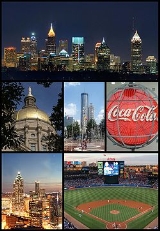
Cityscape Atlanta's skyline is punctuated with highrise and midrise buildings of modern and postmodern vintage. Its tallest landmark – the Bank of America Plaza – is the 29th-tallest building in the world at . It is also the tallest building in the United States outside of Chicago and New York City.
The city's highrises are clustered in three districts in the city — Downtown, Midtown, and Buckhead. (there are two more major suburban clusters, Perimeter Center to the north and Cumberland/Vinings to the northwest). The central business district, clustered around the hotel – one of the tallest buildings in Atlanta at the time of its completion in 1967 – also includes the newer 191 Peachtree Tower, Westin Peachtree Plaza, SunTrust Plaza, Georgia-Pacific Tower, and the buildings of Peachtree Center. Midtown Atlanta, farther north, developed rapidly after the completion of One Atlantic Center in 1987.
Businesses continue to move into the Midtown district. The district's newest tower, 1180 Peachtree, opened there in 2006 at a height of , and achieved a Leadership in Energy and Environmental Design (LEED) gold certification that year from the U.S. Green Building Council. Atlanta has been in the midst of a construction and retail boom, with over 60 new highrise or midrise buildings either proposed or under construction as of April 19, 2006. October 2005 marked the opening of Atlantic Station, a former brownfield steel plant site redeveloped into a mixed-use urban district. In early 2006, Mayor Franklin set in motion a plan to make the 14-block stretch of Peachtree Street in Midtown Atlanta (nicknamed "Midtown Mile") a street-level shopping destination envisioned to rival Beverly Hills' Rodeo Drive or Chicago's Magnificent Mile.
In spite of civic efforts such as the opening of Centennial Olympic Park in downtown in 1996, Atlanta ranks near last in area of park land per capita among cities of similar population density, with per thousand residents (36 m²/resident) in 2005. The city has a reputation, however, as a "city of trees" or a "city in a forest"; beyond the central Atlanta and Buckhead business districts, the skyline gives way to a sometimes dense canopy of woods that spreads into the suburbs. Founded in 1985, Trees Atlanta has planted and distributed over 68,000 shade trees.
The city's northern section, Buckhead, is consistently ranked as one of the most affluent communities in the United States. Since the opening of the intown segment of the Georgia 400 tollway, which linked the district to the city superhighway system in 1993, Buckhead has developed a dense commercial district, clustered around the high-end retail centers at Lenox Square and Phipps Plaza and including a growing number of office buildings and residential highrises, some in the 40+ story range. The Mansion on Peachtree, a 42 Story Luxury Hotel and Condominium tower will open in Early 2008 and the 50 story 3344 Peachtree/Sovereign, planned to reach , is due for completion in late 2007.
The edge cities clustered around Perimeter Mall and Cumberland Mall have distinct skylines of their own. The Concourse at Landmark Center, located near Perimeter Mall in Sandy Springs, includes a pair of buildings called the King and Queen that each measure in total height.
Architecture Unlike many other Southern cities such as Charleston, Savannah, and New Orleans, Atlanta chose not to retain its historic Old South architectural characteristics. Instead, Atlanta viewed itself as the leading city of a progressive "New South" and opted for expressive modern structures. The Architecture of Atlanta has seen works by most major U.S. firms and some of the more prominent architects of the 20th century, including Michael Graves, Richard Meier, Renzo Piano, and soon, Santiago Calatrava and David Chipperfield. Atlanta's most notable hometown architect may be John Portman whose creation of the atrium hotel beginning with the Hyatt Regency Atlanta (1967) made a significant mark on the hospitality sector. A graduate of Georgia Tech's College of Architecture, Portman's work reshaped downtown Atlanta with his designs for the Atlanta Merchandise Mart, Peachtree Center, the Westin Peachtree Plaza Hotel, and SunTrust Plaza.
Religion
There are over 1,000 places of worship within the city of Atlanta. Protestant Christian faiths are well represented in Atlanta, the city historically being a major center for traditional Southern denominations such as the Southern Baptist Convention, the United Methodist Church, and the Presbyterian Church (USA). There are a large number of "mega churches" in the area, especially in suburban areas, with congregations numbering in the thousands; Peachtree Presbyterian Church in Buckhead is the largest congregation of the Presbyterian Church (USA).
As the see of the Catholic Archdiocese of Atlanta, Atlanta serves as the metropolitan see for the Province of Atlanta. The archdiocesan cathedral is the Cathedral of Christ the King and the current archbishop is the Most Rev. Wilton D. Gregory. The Catholic population of metropolitan Atlanta and northern Georgia grew to 650,000 in 2006, boosted in recent years by Hispanic immigrants (especially in smaller Georgia communities) and migration from elsewhere in the U.S. As of 2007 the Archdiocese of Atlanta included 84 parishes. Also located in the metropolitan area are several Eastern Catholic parishes.
Atlanta is also the see of the Episcopal Diocese of Atlanta, which includes all of northern Georgia, much of middle Georgia and the Chattahoochee River valley of western Georgia. This Diocese is headquartered at the Cathedral of St Philip in Buckhead and is led by the Right Reverend J. Neil Alexander.
Atlanta serves as headquarters for several regional church bodies also. The Southeastern Synod of the Evangelical Lutheran Church in America, consisting of churches in Alabama, Georgia, Mississippi, and Tennessee, maintains offices in downtown Atlanta; ELCA parishes are numerous throughout the metro area. A smaller but influential group is the Southeast Conference, United Church of Christ, headquartered in Midtown and serving churches in the states of Alabama, Georgia, Mississippi, South Carolina, and central and eastern Tennessee. There are eight United Church of Christ congregations in the Atlanta metro area, one of which, First Congregational in the Sweet Auburn neighborhood, is noted for being the church with which former mayor Andrew Young is affiliated.
Traditional African-American denominations such as the National Baptist Convention and the African Methodist Episcopal Church are strongly represented in the area. These churches have several seminaries that form the Interdenominational Theological Center complex in the Atlanta University Center.
The city also hosts the Greek Orthodox Annunciation Cathedral, the see of Metropolis of Atlanta and its bishop, Alexios. There are at least eleven Orthodox parishes in Atlanta, including Greek, Russian, Carpatho-Russian, Orthodox Church in America, Antiochian, Serbian, Ukrainian and Romanian.
The headquarters for The Salvation Army's United States Southern Territory is located in Atlanta. The denomination has eight churches, numerous social service centers, and youth clubs located throughout the Atlanta area.
The city has a temple of The Church of Jesus Christ of Latter-Day Saints located in the suburb of Sandy Springs, Georgia. This temple was the first to be dedicated by former prophet of the church, Gordon B. Hinckley.
Metropolitan Atlanta is also home to a vibrant Jewish community estimated to include 120,000 individuals in 61,300 households. This study places Atlanta's Jewish population as the 11th largest in the United States, up from 17th largest in 1996. There is also an estimated 75,000 Muslims in the area and approximately 35 mosques. In addition, the greater Atlanta area is home to over 69,000 Asian Indians within approximately 39,300 households. Recently, two Hindu temples have been built in the southwest suburbs to meet the growing community needs.
Economy
One of seven American cities classified as Gamma world cities, Atlanta ranks third in the number of Fortune 500 companies headquartered within city boundaries, behind New York City and Houston. Several major national and international companies are headquartered in Atlanta or its nearby suburbs, including three Fortune 100 companies: The Coca-Cola Company, Home Depot, and United Parcel Service in adjacent Sandy Springs. The headquarters of AT&T Mobility (formerly Cingular Wireless), the largest mobile phone service provider in the United States, can be found a short distance inside the Perimeter beside Georgia State Route 400. Newell Rubbermaid is one of the most recent companies to relocate to the metro area; in October 2006, it announced plans to move its headquarters to Sandy Springs. Other headquarters for some major companies in Atlanta and around the metro area include Arby's, Chick-Fil-A, Earthlink, Equifax, Georgia-Pacific, Oxford Industries, Southern Company, SunTrust Banks, and Waffle House. Over 75% of the Fortune 1000 companies have a presence in the Atlanta area, and the region hosts offices of about 1,250 multinational corporations.
Delta Air Lines is the city's largest employer and the metro area's third largest. Delta operates the world's largest airline hub at Hartsfield-Jackson Atlanta International Airport and, together with the hub of competing carrier AirTran Airways, has helped make Hartsfield-Jackson the world's busiest airport, both in terms of passenger traffic and aircraft operations. The airport, since its construction in the 1950s, has served as a key engine of Atlanta's economic growth.
Atlanta has a sizable financial sector. SunTrust Banks, the seventh largest bank by asset holdings in the United States, has its home office on Peachtree Street in downtown. The Federal Reserve System has a district headquarters in Atlanta; the Federal Reserve Bank of Atlanta, which oversees much of the deep South, relocated from downtown to midtown in 2001. Wachovia announced plans in August 2006 to place its new credit-card division in Atlanta, and city, state and civic leaders harbor long-term hopes of having the city serve as the home of the secretariat of a future Free Trade Area of the Americas.
The auto manufacturing sector in metropolitan Atlanta has suffered setbacks recently, including the planned closure of the General Motors Doraville Assembly plant in 2008, and the shutdown of Ford Motor Company's Atlanta Assembly plant in Hapeville in 2006. Kia, however, has broken ground on a new assembly plant near West Point, Georgia.
The city is a major cable television programming center. Ted Turner began the Turner Broadcasting System media empire in Atlanta, where he bought a UHF station that eventually became WTBS. Turner established the headquarters of the Cable News Network at CNN Center, adjacent today to Centennial Olympic Park. As his company grew, its other channels – the Cartoon Network, Boomerang, TNT, Turner South, CNN International, CNN en Español, CNN Headline News, and CNN Airport Network – centered their operations in Atlanta as well (Turner South has since been sold). The Weather Channel, owned by Landmark Communications, has its offices in the nearby suburb of Marietta.
Cox Enterprises, a privately held company controlled by siblings Barbara Cox Anthony and Anne Cox Chambers, has substantial media holdings in and beyond Atlanta. Its Cox Communications division is the nation's third-largest cable television service provider; the company also publishes over a dozen daily newspapers in the United States, including The Atlanta Journal-Constitution. WSB – the flagship station of Cox Radio – was the first AM radio station in the South.
Atlanta is also home to the Centers for Disease Control and Prevention (CDC). Adjacent to Emory University, with a staff of nearly 15,000 (including 6,000 contractors and 840 Commissioned Corps officers) in 170 occupations, including: engineers, entomologists, epidemiologists, biologists, physicians, veterinarians, behavioral scientists, nurses, medical technologists, economists, health communicators, toxicologists, chemists, computer scientists, and statisticians. Headquartered in DeKalb County, CDC has 10 other offices throughout the United States and Puerto Rico. In addition, CDC staff are located in local health agencies, quarantine/border health offices at ports of entry, and 45 countries around the world. Originally established in 1946 as the Communicable Disease Center, its primary function was to combat malaria, the deep southeast being the heart of the U.S. malaria zone at the time.
Culture
Tourism Atlanta hosts a variety of museums on subjects ranging from history to fine arts, natural history, and beverages. The Martin Luther King, Jr. National Historic Site honors Atlanta's participation in the civil rights movement. Other history museums and attractions include the Atlanta History Center; the Atlanta Cyclorama and Civil War Museum (a huge painting and diorama in-the-round, with a rotating central audience platform, that depicts the Battle of Atlanta in the Civil War); the Carter Center and Presidential Library; historic house museum Rhodes Hall; and the Margaret Mitchell House and Museum.
The arts are represented by several theaters and museums, including the Fox Theatre. The Woodruff Arts Center is home to the Tony Award winning Alliance Theatre, Atlanta Symphony, and High Museum of Art | |