


B-52 Stratofortress

Encyclopedia
The Boeing B-52 Stratofortress is a long-range, subsonic
, jet-powered
strategic bomber
operated by the United States Air Force
(USAF) since the 1950s. The B-52 was designed and built by Boeing
, who have continued to provide maintainence and upgrades to the aircraft in service. Its Stratofortress name is rarely used outside of official contexts; it has been referred to by Air Force personnel as the BUFF (Big Ugly Fat/Flying Fucker/Fellow).
Beginning with the successful contract bid on 5 June 1946, the B-52 design evolved from a straight-wing aircraft powered by six turboprop
engines to the final prototype YB-52 with eight turbojet engines and swept wing
s. The Stratofortress took its maiden flight
in April 1952. Built to carry nuclear weapons for Cold War
-era deterrence missions, the B-52 Stratofortress replaced the Convair B-36
. Although a veteran of a number of wars, the Stratofortress has dropped only conventional munitions in combat. The B-52 carries up to 70000 pounds (31,751.5 kg) of weapons.
The B-52 has been in active service with the USAF since 1955. The bombers flew under the Strategic Air Command
(SAC) until it was disestablished in 1992 and its aircraft absorbed into the Air Combat Command
(ACC); in 2010 all B-52 Stratofortreses were transferred from the ACC to the new Air Force Global Strike Command (AFGSC). Superior performance at high subsonic speeds and relatively low operating costs have kept the B-52 in service despite the advent of later aircraft, including the Mach
3 North American XB-70 Valkyrie, the variable-geometry Rockwell B-1B Lancer, and the stealthy
Northrop Grumman B-2 Spirit. The B-52 marked its 50th anniversary of continuous service with its original operator in 2005.

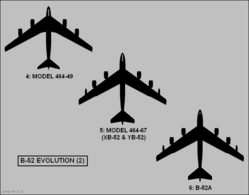 On 23 November 1945, Air Materiel Command
(AMC) issued desired performance characteristics for a new strategic bomber "capable of carrying out the strategic mission without dependence upon advanced and intermediate bases controlled by other countries". The aircraft was to have a crew of five or more turret gunners, and a six-man relief crew. It was required to cruise at 300 mph (240 knots, 480 km/h) at 34,000 feet (10,400 m) with a combat radius of 5,000 miles (4,300 nautical mile
, 8,000 km). The armament was to consist of an unspecified number of 20 mm cannon and 10,000 pounds
(4,500 kg) of bombs. On 13 February 1946, the Air Force issued bid invitations for these specifications, with Boeing, Consolidated Aircraft
, and Glenn L. Martin Company
submitting proposals.
On 5 June 1946, Boeing's Model 462, a straight-wing aircraft powered by six Wright T35
turboprop
s with a gross weight of 360,000 pounds (160,000 kg) and a combat radius of 3,110 miles (2,700 nmi
, 5,010 km), was declared the winner. On 28 June 1946, Boeing was issued a letter of contract for US$1.7 million to build a full-scale mock-up of the new XB-52 and do preliminary engineering and testing. However, by October 1946, the Air Force began to express concern about the sheer size of the new aircraft and its inability to meet the specified design requirements. In response, Boeing produced Model 464, a smaller four-engine version with a 230,000 pound (105,000 kg) gross weight, which was briefly deemed acceptable.
Subsequently, in November 1946, the Deputy Chief of Air Staff for Research and Development, General Curtis LeMay
, expressed the desire for a cruise speed of 400 miles per hour (345 kn, 645 km/h), to which Boeing responded with a 300,000 lb (140,000 kg) aircraft. In December 1946, Boeing was asked to change their design to a four-engine bomber with a top speed of 400 miles per hour, range of 12,000 miles (10,000 nmi, 19,000 km), and the ability to carry a nuclear weapon
; in total, the aircraft could weigh up to 480,000 pounds (220,000 kg). Boeing responded with two models powered by the T-35 turboprops. The Model 464-16 was a "nuclear only" bomber with a 10,000 pound (4,500 kg) payload, while the Model 464-17 was a general purpose bomber with a 9,000 pound (4,000 kg) payload. Due to the cost associated with purchasing two specialized aircraft, the Air Force selected Model 464-17 with the understanding that it could be adapted for nuclear strikes.
In June 1947, the military requirements were updated and the Model 464-17 met all of them except for the range. It was becoming obvious to the Air Force that, even with the updated performance, the XB-52 would be obsolete by the time it entered production and would offer little improvement over the Convair B-36
; as a result, the entire project was postponed for six months. During this time, Boeing continued to perfect the design which resulted in the Model 464-29 with a top speed of 455 miles per hour (395 kn, 730 km/h) and a 5,000-mile range. In September 1947, the Heavy Bombardment Committee was convened to ascertain performance requirements for a nuclear bomber. Formalized on 8 December 1947, these requirements called for a top speed of 500 miles per hour (440 kn, 800 km/h) and an 8,000 mile (7,000 nmi, 13,000 km) range, far beyond the capabilities of 464–29.
The outright cancellation of the Boeing contract on 11 December 1947 was staved off by a plea from its president William McPherson Allen
to the Secretary of the Air Force Stuart Symington
. Allen reasoned that the design was capable of being adapted to new aviation technology and more stringent requirements. In January 1948 Boeing was instructed to thoroughly explore recent technological innovations, including aerial refueling
and the flying wing
. Noting stability and control problems Northrop
was experiencing with their YB-35
and YB-49
flying wing bombers, Boeing insisted on a conventional aircraft, and in April 1948 presented a US$30 million (US$ today) proposal for design, construction, and testing of two Model 464-35 prototypes. The Model 464-35 design bore similarity to a later Tupolev
design that was built for the Soviet Union, the Tupolev Tu-95
Bear strategic bomber. Further revisions during 1948 resulted in an aircraft with a top speed of 513 miles per hour (445 kn, 825 km/h) at 35,000 feet (10,700 m), a range of 6,909 miles (6,005 nmi, 11,125 km), and a 280,000 pounds (125,000 kg) gross weight which included 10,000 pounds (4,500 kg) of bombs and 19,875 US gallons (75,225 L) of fuel.
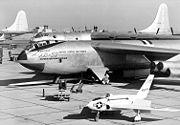
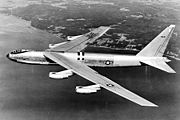 In May 1948, AMC asked Boeing to incorporate the previously discarded, but now more fuel-efficient, jet engine into the design. This resulted in Boeing developing yet another revision – in July 1948, Model 464-40 substituted Westinghouse J40
turbojets for the turboprops. The Boeing engineers took the Model 464-40 study to the Air Force Project Officer, and he was favorably impressed, especially since he had already been thinking along similar lines. Nevertheless, the government was still concerned about the high fuel consumption rate of the jet engines of the day, and directed that Boeing still use the turboprop-powered Model 464-35 as the basis for the XB-52. Although he agreed that turbojet propulsion was the future, General Howard A. Craig, Deputy Chief of Staff for Material, was not very keen on a jet-powered B-52, since he felt that the jet engine had still not progressed sufficiently to permit skipping an intermediate turboprop stage. However, Boeing was encouraged to continue with turbojet studies even though no commitment to jet propulsion could be expected.
On Thursday, 21 October 1948, Boeing engineers George S. Schairer
, Art Carlsen and Vaughn Blumenthal presented the design of a four-engine turboprop bomber to the Air Force chief of bomber development, Col. Pete Warden. Warden was disappointed by the projected aircraft and asked if the Boeing team could come up with a proposal for a four-engine turbojet bomber. Joined by Ed Wells, Boeing vice president of Engineering, the engineers worked that night in the Hotel Van Cleve redesigned Boeing's proposal as a four-engine turbojet bomber. On Friday, Col. Warden looked over the information and asked for a better design. Returning to the Hotel, the Boeing team was joined by Bob Withington and Maynard Pennell, two top Boeing engineers who were in town on other business.
By late Friday night, they had laid out what was essentially a new airplane. The new design (464–49) built upon the basic layout of the B-47 Stratojet with 35 degree swept wing
s, eight engines paired in four underwing pods
, and bicycle landing gear with wingtip outrigger wheels. A notable feature of the landing gear was the ability to pivot the main landing gear up to 20° from the aircraft centerline to increase safety during crosswind landing
s. After a trip to a hobby shop for supplies, Schairer set to work building a model. The rest of the team focused on weight and performance data. Wells, who was also a skilled artist, completed the aircraft drawings. On Sunday, a stenographer was hired to type a clean copy of the proposal. On Monday, Schairer presented Col. Warden with a neatly bound 33-page proposal and a 14-inch scale model. The aircraft was projected to exceed all design specifications.
Although the full-size mock-up inspection in April 1949 was generally favorable, range again became a concern since the J40s and early model J57s had excessive fuel consumption. Despite talk of another revision of specifications or even a full design competition among aircraft manufacturers, General LeMay, now in charge of Strategic Air Command, insisted that performance should not be compromised due to delays in engine development. In a final attempt to increase range, Boeing created the larger 464-67, stating that once in production, the range could be further increased in subsequent modifications. Following several direct interventions by LeMay, Boeing was awarded a production contract for 13 B-52As and 17 detachable reconnaissance pods on 14 February 1951. The last major design change, also at the insistence of General LeMay, was a switch from the B-47 style tandem seating to a more conventional side-by-side cockpit which increased the effectiveness of the copilot and reduced crew fatigue. Both XB-52 prototypes featured the original tandem seating arrangement with a framed bubble-type canopy.
on 15 April 1952 with "Tex" Johnston
as pilot. A 2 hour, 21-minute proving flight from Boeing Field
, King County
, near Seattle
, Washington to Larson AFB was undertaken with Boeing test pilot Alvin M. Johnston
and Air Force Lieutenant Colonel Guy M. Townsend
. The XB-52 followed on 2 October 1952. The thorough development, including 670 days in the wind tunnel
and 130 days of aerodynamic
and aeroelastic
testing, paid off with smooth flight testing. Encouraged, the Air Force increased its order to 282 B-52s.
said:
The B-52B was followed by progressively improved bomber and reconnaissance variants, culminating in the B-52G and B-52H. To allow rapid delivery, production lines were set up both at its main Seattle factory and at Boeing's Wichita
facility. More than 5,000 companies were involved in the massive production effort, with 41% of the airframe being built by subcontractors. The prototypes and all B-52A, B and C models (90 aircraft) were built at Seattle. Testing of aircraft built at Seattle caused problems due to jet noise, which led to the establishment of curfews for engine tests. Aircraft were thus ferried on their maiden flights to Larson Air Force Base
, 150 miles (241 km) away, where they were fully tested. As production of the B-47 came to an end, the Wichita factory was phased in for B-52D production, with Seattle responsible for 101 Ds and Wichita 62. Both plants continued to build the B-52E, with 42 built at Seattle and 58 at Wichita, and the B-52F (44 from Seattle and 45 from Wichita). For the B-52G, it was decided in 1957 to transfer all production to Wichita, which freed up Seattle for other tasks (in particular the production of airliners). Production ended in 1962 after 744 aircraft were built.
standoff nuclear missiles and ADM-20 Quail
decoys, an advanced electronic countermeasures
(ECM) suite, and upgrades to perform the all-weather, low-altitude (below 500 feet or 150 m) interdiction in the face of advancing missile air defenses. The switch to low-altitude flight was estimated to accelerate structural fatigue by at least a factor of eight, which required costly repairs to extend service life. The first program to counter structural fatigue
was the three-phase High Stress program in the early 1960s, which enrolled aircraft at 2,000 flying hours.
Follow-up programs addressing fatigue were conducted, such as a 2,000-hour service life extension to select airframes in 1966–1968, and the extensive Pacer Plank reskinning, completed in 1977. The wet wing
introduced on G and H models was even more susceptible to fatigue due to experiencing 60% more stress during flight than the old wing. The wings were modified by 1964 under ECP 1050. This was followed by a fuselage skin and longeron
replacement (ECP 1185) in 1966, and the B-52 Stability Augmentation and Flight Control program (ECP 1195) in 1967. Fuel leaks due to deteriorating Marman clamp
s continued to plague all variants of the B-52. To this end, the aircraft were subjected to Blue Band (1957), Hard Shell (1958), and finally QuickClip (1958) programs. The latter fitted safety straps which prevented catastrophic loss of fuel in case of clamp failure.
For a study for the U.S. Air Force in the mid-1970s, Boeing investigated replacing the engines, changing to a new wing, and other improvements to upgrade B-52G/H aircraft as an alternative to the B-1A, then in development. Boeing later suggested re-engining the B-52H fleet with the Rolls-Royce RB211 535E-4
. This would involve replacing the eight Pratt & Whitney TF33s (total thrust 8 × 17,000 lb) with four RB211s (total thrust 4 × 37,400 lb); which would increase range and reduce fuel consumption, at a cost of approximately US$2.56 billion for the whole fleet (71 aircraft at $36 million each). A Government Accountability Office
study concluded that Boeing's estimated savings of US$4.7 billion would not be realized and that it would cost US$1.3 billion over keeping the existing engines; citing significant up-front procurement and re-tooling expenditure, and the RB211's higher maintenance cost. The GAO report was subsequently disputed in a Defense Sciences Board report in 2003; the Air Force was urged to re-engine the aircraft without delay. Further, the DSB report stated the program would have significant savings, reduce greenhouse gas emissions, and increase aircraft range and endurance; in line with the conclusions of a separate Congress-funded study conducted in 2003. The re-engining has not been approved as of 2010.
In September 2006, the B-52 became one of the first US military aircraft to fly using alternative fuel. It took off from Edwards Air Force Base
with a 50/50 blend of Fischer-Tropsch process
(FT) synthetic fuel and conventional JP-8
jet fuel which was burned in two of the eight engines. On 15 December 2006, a B-52 took off from Edwards with the synthetic fuel powering all eight engines, the first time an Air Force aircraft was entirely powered by the blend. The seven hour flight was considered a success. This program is part of the Department of Defense
Assured Fuel Initiative, which aims to reduce crude oil usage and obtain half of its aviation fuel from alternative sources by 2016. On 8 August 2007, Air Force Secretary
Michael Wynne
certified the B-52H as fully approved to use the FT blend. With the success upon the B-52, the Air Force intends to certify every airframe in its inventory to use the fuel by 2011.
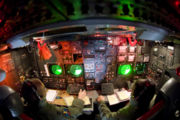 Ongoing problems with avionics systems were addressed in the Jolly Well program, completed in 1964, which improved components of the AN/ASQ-38 bombing navigational computer and the terrain computer. The MADREC (Malfunction Detection and Recording) upgrade fitted to most aircraft by 1965 could detect failures in avionics and weapons computer systems, and was essential in monitoring the Hound Dog missiles. The electronic countermeasures
capability of the B-52 was expanded with Rivet Rambler (1971) and Rivet Ace (1973).
To improve safe day and night operations at low altitude, the AN/ASQ-151 Electro-Optical Viewing System (EVS), which consisted of a Low Light Level Television (LLLTV) and a Forward looking infrared
(FLIR) system mounted in blisters under the noses of B-52Gs and Hs between 1972 and 1976. The navigational capabilities of the B-52 were later augmented with the addition of GPS in the 1980s. The IBM AP-101
, also used on the B-1B Lancer bomber and the Space Shuttle
, was the B-52's main computer.
In 2007 the LITENING targeting pod
was fitted, which increases the combat effectiveness of the aircraft during day, night and poor weather conditions in the attack of ground targets with a variety of standoff weapons, using laser
guidance under the guidance, a high resolution forward-looking infrared sensor (FLIR) and a CCD camera used to obtain target imagery. LITENING pods have been fitted to a wide variety of other US aircraft, such as the McDonnell Douglas F/A-18 Hornet, the General Dynamics F-16 Fighting Falcon and the McDonnell Douglas AV-8B Harrier II.
nuclear missiles was added to G and H models, starting in 1971. To further improve the B-52's offensive ability, Air Launched Cruise Missiles (ALCMs) were fitted. After testing of both the Air Force-backed Boeing AGM-86
and the Navy-backed General Dynamics AGM-109 Tomahawk
, the AGM-86B was selected for operation by the B-52 (and ultimately by the B-1 Lancer). A total of 194 B-52Gs and Hs were modified to carry AGM-86s, carrying 12 missiles on underwing pylons
, with 82 B-52Hs further modified to carry another eight missiles on a rotary launcher fitted in the aircraft's bomb-bay. To conform with the requirements of the SALT II Treaty
for cruise missile capable aircraft to be readily identified by reconnaissance satellites, the cruise missile armed B-52Gs were modified with a distinctive wing root
fairing. As all B-52Hs were assumed to be modified, no visual modification of these aircraft was required. In 1990, the stealthy AGM-129 ACM
cruise missile entered service; although intended to replace the AGM-86, a high cost and the Cold War's end led to only 450 being produced; unlike the AGM-86, no conventional (non-nuclear) version was built. The B-52 was to have been modified to utilize Northrop Grumman
's AGM-137 TSSAM
weapon; however, the missile was canceled due to development costs.
Those B-52Gs not converted as cruise missile carriers were subject to a series of modifications to improve their conventional bombing capability, being fitted with a new Integrated Conventional Stores Management System (ICSMS) and new underwing pylons which were able to be fitted with larger bombs or other stores than could be carried on the external pylons. 30 B-52s were further modified to carry up to 12 AGM-84 Harpoon anti-ship missile
s each, while 12 B-52Gs were fitted to carry the AGM-142 Have Nap
stand-off air-to-ground missile. When the B-52G was retired in 1994, an urgent scheme was launched to restore an interim Harpoon and Have nap capability (the Have Nap missile was only carried by the B-52, and allowed stand-off attacks on targets while maintaining a "man-in-the-loop" of the guidance system), the four aircraft being modified to carry Harpoon and four to carry Have Nap under the Rapid Eight program.
The Conventional Enhancement Modification (CEM) program gave the B-52H a more comprehensive conventional weapons capability, adding the modified underwing weapon pylons used by conventional-armed B-52Gs, Harpoon and Have Nap, and the capability to carry new-generation weapons including the Joint Direct Attack Munition
and Wind Corrected Munitions Dispenser
guided bombs, the AGM-154
glide bomb and the (later cancelled) AGM-158 JASSM
missile. The CEM program also introduced new radios, integrated Global Positioning System
into the aircraft's navigation system and replaced the under-nose FLIR with a more modern unit. Forty-seven B-52Hs were modified under the CEM program by 1996, with 19 more by the end of 1999.
Note: The original costs were in approximate 1955 United States dollars. Figures in tables noted with current have been adjusted for inflation.
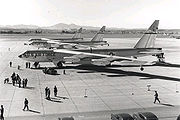 Although the B-52A was the first production variant, these aircraft were used only in testing. The first operational version was the B-52B that had been developed in parallel with the prototypes since 1951. First flying in December 1954, B-52B, AF Serial Number 52-8711, entered operational service with 93rd Heavy Bombardment Wing (93rd BW) at Castle Air Force Base
, California, on 29 June 1955. The wing became operational on 12 March 1956. The training for B-52 crews consisted of five weeks of ground school and four weeks of flying, accumulating 35 to 50 hours in the air. The new B-52Bs replaced operational B-36s on a one-to-one basis.
Early operations were problematic; in addition to supply problems, technical issues also struck. Ramps and taxiways deteriorated under the weight of the aircraft, while the fuel system was prone to leaks and icing, and bombing and fire control computers were unreliable. The two-story cockpit presented a unique climate control problem – the pilots' cockpit was heated by sunlight while the observer and the navigator on the bottom deck sat on the ice-cold floor. Thus, comfortable temperature setting for the pilots caused the other crew members to freeze, while comfortable temperature for the bottom crew caused the pilots to overheat. The J57 engines were still new and unreliable. Alternator
failure caused the first fatal B-52 crash in February 1956, which resulted in a brief grounding of the fleet. In July, fuel and hydraulic system problems again grounded the B-52s. To avoid maintenance problems, the Air Force set up "Sky Speed" teams of 50 maintenance contractors at each B-52 base. In addition to maintenance, the teams performed routine checkups which took one week per aircraft.
On 21 May 1956, a B-52B (52-0013) dropped a Mk-15 nuclear bomb
over the Bikini Atoll
in a test code-named Cherokee. It was the first air dropped thermonuclear weapon. From 24 to 25 November 1956, four B-52Bs of the 93rd BW and four B-52Cs of the 42nd BW flew nonstop around the perimeter of North America in Operation Quick Kick, which covered 15,530 miles (13,500 nmi, 25,000 km) in 31 hours, 30 minutes. SAC noted the flight time could have been reduced by 5 to 6 hours if the four inflight refuelings were done by fast jet-powered tanker aircraft rather than propeller-driven Boeing KC-97 Stratotankers. In a demonstration of the B-52's global reach, from 16 to 18 January 1957, three B-52Bs made a non-stop flight
around the world during Operation Power Flite
, during which 24,325 miles (21,145 nmi, 39,165 km) was covered in 45 hours 19 minutes (536.8 smph) with several in-flight refuelings by KC-97s. The 93rd Bomb Wing received the Mackay Trophy
for their accomplishment.
The B-52 set many records over the next few years. On 26 September 1958, a B-52D set a world speed record of 560.705 miles per hour (487 kn, 902 km/h) over a 10,000 kilometers (5,400 nmi, 6,210 mi) closed circuit without a payload. The same day, another B-52D established a world speed record of 597.675 miles per hour (519 kn, 962 km/h) over a 5,000 kilometer (2,700 nmi, 3,105 mi) closed circuit without a payload. On 14 December 1960, a B-52G set a world distance record by flying unrefueled for 10,078.84 miles (8,762 nmi, 16,227 km); the flight lasted 19 hours 44 minutes (510.75 mph). From 10 to 11 January 1962, a B-52H set a world distance record by flying unrefueled, surpassing the prior B-52 record set two years earlier, from Kadena Air Base
, Okinawa, Japan, to Torrejon Air Base
, Spain, which covered 12,532.28 miles (10,895 nmi, 20,177 km). The flight passed over Seattle, Fort Worth and the Azores.
Originally there were concerns about the lifespan of the fleet. Several projects beyond the B-52, the Convair B-58 Hustler and North American XB-70 Valkyrie, had either been aborted or proved disappointing in light of changing requirements, which left the older B-52 as the main bomber as opposed to the planned successive aircraft models. On 19 February 1965, General Curtis E. LeMay testified to Congress that the lack of a followup bomber project to the B-52 raised the danger that, "The B-52 is going to fall apart on us before we can get a replacement for it."
(SAC) intended for it to be used to deter and counteract the vast and modernizing Soviet military. As the Soviet Union increased its nuclear capabilities, destroying or "countering" the forces that would deliver nuclear strikes (bombers, missiles, etc.) became of great strategic importance. The Eisenhower administration endorsed this switch in focus; the President in 1954 expressing a preference for military targets over those of civilian ones, a principle reinforced in the Single Integrated Operation Plan (SIOP), a plan of action in the case of nuclear war breaking out.
Throughout the Cold War
, B-52s performed airborne alert patrols under code names such as Head Start, Chrome Dome
, Hard Head, Round Robin, and Giant Lance
. Bombers loitered at high altitude near points outside the Soviet Union to provide rapid first strike or retaliation capability in case of nuclear war. This was a part of the role of deterrence to the Soviet Union via the concept of Mutually Assured Destruction.
Due to the late 1950s era threat of surface-to-air missile
s (SAMs) that could threaten high-altitude aircraft, seen in practice in the 1960 U-2 incident, the intended use of B-52 was changed to serve as a low-level penetration bomber during a foreseen attack upon the Soviet Union, as terrain masking provided an effective method of avoiding radar and thus the threat of the SAMs.
Although never intended for the low-level role, the B-52's flexibility allowed it to outlast several intended successors as the nature of the air warfare environment changed. The B-52's large airframe with internal room allowed the addition of improved electronic countermeasures suites and other adaptions to be made over time. Other aircraft, such as the General Dynamics F-111 Aardvark, complemented the B-52 in roles the aircraft was not as capable in, such as missions involving high-speed, low-level penetration dashes.
The B-52's official name Stratofortress has been rarely used in informal circumstances; it has become common among personnel to refer to the aircraft as the BUFF (Big Ugly Fat Fucker).
. The first combat mission, Operation Arc Light
, was flown by B-52Fs on 18 June 1965, when 30 bombers of the 9th and 441st Bombardment Squadrons struck a communist stronghold near the Bến Cát District in South Vietnam. The first wave of bombers arrived too early at a designated rendezvous point, and while maneuvering to maintain station, two B-52s collided, which resulted in the loss of both bombers and eight crewmen. The remaining bombers, minus one more which turned back due to mechanical problems, continued on towards the target. Twenty-seven Stratofortresses dropped on a one-mile by two-mile target box from between 19,000 and 22,000 feet, a little more than 50 percent of the bombs falling within the target zone. The force returned to Andersen AFB except for one bomber with electrical problems that recovered to Clark AFB, the mission having lasted 13 hours. Post-strike assessment by teams of South Vietnamese troops with American advisors found evidence that the VC had departed the area before the raid, and it was suspected that infiltration of the south's forces may have tipped off the north because of the ARVN troops involved in the post-strike inspection.
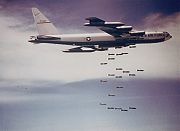 Beginning in late 1965, a number of B-52Ds underwent Big Belly modifications to increase bomb capacity for carpet bombing
s. While the external payload remained at 24× 500 pound (227 kg) or 750 pound (340 kg) bombs, the internal capacity increased from 27 to 84× 500 pound bombs or from 27 to 42× 750 pound bombs. The Big Belly modification created enough capacity for a total of 60,000 pounds (27,215 kg) in 108 bombs. Thus modified, B-52Ds could carry 22,000 pounds (9,980 kg) more than B-52Fs. Design to replace B-52Fs, modified B-52Ds entered combat in April 1966 flying from Andersen Air Force Base
, Guam
. Each bombing mission lasted 10 to 12 hours with an aerial refueling
by KC-135 Stratotanker
s. In spring 1967, the aircraft began flying from U Tapao Airfield in Thailand giving the aircraft the advantage of not requiring in-flight refueling.
On 22 November 1972, a B-52D (55-0110) from U-Tapao was hit by a surface-to-air missile
(SAM) while on a raid over Vinh
. The crew was forced to abandon the damaged aircraft over Thailand. This was the first B-52 to be destroyed by hostile fire in Vietnam. In total, 30 B-52s were lost during the war, which included 10 B-52s shot down over North Vietnam and five others being damaged and crashing in Laos or Thailand.
The zenith of B-52 attacks in Vietnam was Operation Linebacker II
(sometimes referred to as the Christmas Bombing) which consisted of waves of B-52s (mostly D models, but some Gs without jamming equipment and with a smaller bomb load). Over 12 days, B-52s flew 729 sortie
s and dropped 15,237 tons of bombs on Hanoi
, Haiphong
, and other targets. Originally 42 B-52s were committed to the war; however, numbers were frequently twice this figure. The B-52's usage had been highly important in the war, although their lack of precision weapons translated to limited deployment; American journalist and war correspondent Neil Sheehan
described their role in the war:
, B-52D tail gunner
s were credited with shooting down two MiG-21 "Fishbeds"
. On 18 December 1972, tail gunner SSgt
Samuel O. Turner's B-52 had just completed a bomb run for Operation Linebacker II
and was turning away when a North Vietnamese Air Force MiG-21
approached. The MiG and the B-52 locked onto one another. When the fighter drew within range, Turner fired his quad (four guns on one mounting) .50 caliber machine guns. The MiG exploded aft of the bomber, a victory confirmed by MSG Lewis E. Le Blance, the tail gunner in a nearby Stratofortress. Turner received a Silver Star
for his actions. His B-52, tail number 55-0676, is preserved on display with air-to-air kill markings at Fairchild AFB in Spokane
, Washington.
On 24 December 1972, during the same bombing campaign, the B-52 Diamond Lil was headed to bomb the Thái Nguyên railroad yards
when tail gunner A1C
Albert E. Moore spotted a fast-approaching MiG-21. Moore opened fire with his quad fifties at 4000 yards (3,657.6 m), and kept shooting until the fighter disappeared from his scope. TSG Clarence W. Chute, a tail gunner aboard another Stratofortress, watched the MiG catch fire and fall away. The Diamond Lil is preserved on display at the United States Air Force Academy
in Colorado
. Moore was the last recorded bomber
gunner to shoot down an enemy aircraft with machine guns in aerial combat.
Vietnamese sources have attributed a third air-to-air victory to a B-52, a MiG-21 shot down on 16 April 1972. These victories make the B-52 the largest aircraft to be credited with air-to-air kills. The last Arc Light
mission without fighter escort took place on 15 August 1973, as U.S. military action in Vietnam was wound down.
's B-52B "008
" which was eventually retired in 2004 at Edwards AFB
, California. Another of the remaining B Models, "005" is on display at the Wings Over the Rockies Air and Space Museum
in Denver, Colorado.
 A few time-expired E models were retired in 1967 and 1968, but the bulk (82) were retired between May 1969 and March 1970. Most F models were also retired between 1967 and 1973, but 23 survived as trainers until late 1978. The fleet of D models served much longer; eighty D models were extensively overhauled under the Pacer Plank program during the mid-1970s. Skinning on the lower wing and fuselage was replaced, and various structural components were renewed. The fleet of D models stayed largely intact until late 1978, when 37 not already upgraded Ds were retired. The remainder were retired between 1982 and 1983.
The remaining G and H models were used for nuclear standby ("alert") duty as part of the United States' nuclear triad
. This triad was the combination of nuclear-armed land-based missiles, submarine-based missiles and manned bombers. The B-1B Lancer
, intended to supplant the B-52, replaced only the older models and the supersonic FB-111
. In 1991, B-52s ceased continuous 24-hour SAC alert duty.
After the fall of the Soviet Union, the B-52Gs were destroyed per the terms of the Strategic Arms Reduction Treaty
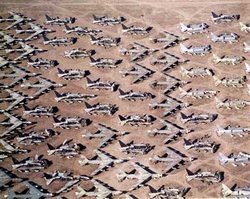
(START). The AMARC was tasked with eliminating 365 B-52 bombers, completion of this task was to be verified by Russia via satellite and first-person inspection at the AMARC facility. To place the aircraft permanently beyond restoration, the B-52s were cut up into pieces with a 13,000 lb guillotine. The dismembered aircraft were then left in place so their destruction could be confirmed by Russian reconnaissance satellites.
 B-52 strikes were an important part of Operation Desert Storm. With about 1,620 sorties flown, B-52s delivered 40% of the weapons dropped by coalition forces while suffering only one non-combat aircraft loss, with several receiving minor damage from enemy action.
Starting on 16 January 1991, a flight of B-52Gs flew from Barksdale AFB, Louisiana, refueled in the air en route, struck targets in Iraq, and returned home – a journey of 35 hours and 14,000 miles round trip. It set a record for longest-distance combat mission. B-52Gs operating from bases at Jeddah, Saudi Arabia; RAF Fairford in the United Kingdom; Moron AB, Spain; and the island of Diego Garcia
flew bombing missions over Iraq, initially at low altitude. After the first three nights, the B-52s moved to high-altitude missions instead, which reduced their effectiveness and psychological impact compared to the low altitude role initially played.
The conventional strikes were carried out by three bombers, which dropped up to 153 750-pound bombs over an area of 1.5 by. The bombings demoralized the defending Iraqi troops, many of whom surrendered in the wake of the strikes. In 1999, the science and technology magazine Popular Mechanics
described the B-52's role in the conflict: "The Buff's value was made clear during the Gulf War and Desert Fox. The B-52 turned out the lights in Baghdad"
From 2 to 3 September 1996, two B-52H struck Baghdad power stations and communications facilities with 13 AGM-86C conventional air-launched cruise missiles (CALCM) as part of Operation Desert Strike
, a 34-hour, 16,000-mile round trip mission from Andersen AFB, Guam
– the longest distance ever flown for a combat mission.
During the conflict several claims of Iraqi air-to-air successes were made, including an Iraqi pilot, Khudai Hijab, who allegedly fired a Vympel R-27R missile from his MIG-29 and damaged a B-52G on the opening night of the Gulf War. However, the United States Air Force disputes this claim, stating the bomber was actually hit by friendly fire, an AGM-88
High-speed, Anti-Radiation Missile (HARM) that homed on the fire-control radar of the B-52's tail gun; the jet was subsequently renamed "In HARM's Way". Shortly following this incident, General George Lee Butler
announced that the gunner position on B-52 crews was to be eliminated, and the gun turrets permanently deactivated, commencing on 1 October 1991.
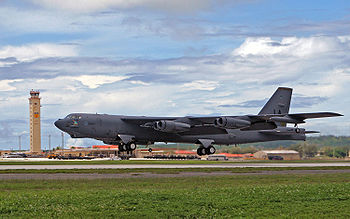 Since the mid-1990s, the B-52H has been the only variant remaining in military service; it is currently stationed at:
The B-52 contributed to Operation Enduring Freedom in 2001 (Afghanistan/Southwest Asia), providing the ability to loiter high above the battlefield and provide Close Air Support (CAS) through the use of precision guided munitions, a mission which previously would have been restricted to fighter and ground attack aircraft. B-52s also played a role in Operation Iraqi Freedom
, which commenced on 20 March 2003 (Iraq/Southwest Asia). On the night of 21 March 2003, B-52Hs launched at least one hundred AGM-86C CALCM
s at targets within Iraq.
In August 2007, a B-52H ferrying AGM-129 ACM
cruise missiles from Minot Air Force Base to Barksdale Air Force Base for dismantling was mistakenly loaded
with six missiles from which the nuclear warhead was not removed. The weapons did not leave USAF custody and were secured at Barksdale.
, 94 of the original 744 B-52 aircraft were still operational within the U.S. Air Force (85 Air Force and 9 Air Force Reserve. Four of 18 B-52Hs from Barksdale AFB that are currently being retired are in the "boneyard" of 309th AMARG at Davis-Monthan AFB as of 8 September 2008.
, Oklahoma
. Even while the Air Force works on its Next-Generation Bomber and 2037 Bomber
projects, it intends to keep the B-52H in service until 2045, more than 90 years after the B-52 entered service and an unprecedented length of service for a military aircraft.
The USAF continues to rely on the B-52 because it remains an effective and economical heavy bomber, particularly in the type of missions that have been conducted since the end of the Cold War against nations that have limited air defense capabilities. The B-52 has the capacity to "loiter" for extended periods over (or even well outside) the battlefield, and deliver precision
standoff and direct fire
munitions. It has been a valuable asset in supporting ground operations during conflicts such as Operation Iraqi Freedom. The B-52 had the highest mission capable rate
of the three types of heavy bombers operated by the USAF in 2001. The B-1 averaged a 53.7% ready rate, and the B-2 achieved 30.3%, while the B-52 averaged 80.5% during the 2000-2001 period.
Additionally, a proposed variant of the B-52H was the EB-52. This version would have modified and augmented 16 B-52H airframes with additional electronic jamming
capabilities. This new aircraft would have given the USAF an airborne jamming capability that it has lacked since retiring the EF-111 Raven. The program was canceled in 2005 following the removal of funds for the stand-off jammer. The program was revived in 2007 but funding was again cut in early 2009.
The B-52 went through several design changes and variants over its 10 years of production.
XB-52
YB-52
B-52A
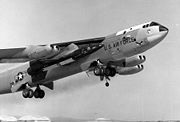 NB-52A
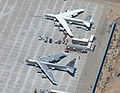 B-52B/RB-52B
The B-52B was the first version to enter service with the USAF on 29 June 1955 with the 93rd Bombardment Wing at Castle AFB in California. This version included minor changes to engines and avionics, enabling an extra 12,000 pounds of thrust to be produced using water injection. Temporary grounding of the aircraft after a crash in February 1956 and again the following July caused training delays, and at mid-year there were still no combat-ready B-52 crews.
NB-52B
B-52C
RB-52C
B-52D
B-52E
B-52F
 B-52G
B-52G
B-52H
XR-16A
Allocated to the reconnaissance variant of the B-52B but not used and the aircraft were designated RB-52B instead.


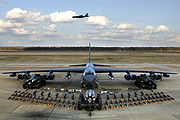
(1963), Dr. Strangelove or: How I Learned to Stop Worrying and Love the Bomb
(1964), and By Dawn's Early Light
(1990). It has also been featured in numerous novels, such as most of the early Patrick McLanahan novels by Dale Brown
, which feature one or more heavily modified B-52 bombers, nicknamed the "EB-52 Megafortress". A 1960s hairstyle, the beehive
, is also called a B-52 for its resemblance to the aircraft's distinct nose. The popular band The B-52's was subsequently named after this hairstyle.
Subsonic aircraft
A subsonic aircraft is an aircraft with a maximum speed less than the speed of sound ....
, jet-powered
Jet engine
A jet engine is a reaction engine that discharges a fast moving jet to generate thrust by jet propulsion and in accordance with Newton's laws of motion. This broad definition of jet engines includes turbojets, turbofans, rockets, ramjets, pulse jets...
strategic bomber
Strategic bomber
A strategic bomber is a heavy bomber aircraft designed to drop large amounts of ordnance onto a distant target for the purposes of debilitating an enemy's capacity to wage war. Unlike tactical bombers, which are used in the battle zone to attack troops and military equipment, strategic bombers are...
operated by the United States Air Force
United States Air Force
The United States Air Force is the aerial warfare service branch of the United States Armed Forces and one of the American uniformed services. Initially part of the United States Army, the USAF was formed as a separate branch of the military on September 18, 1947 under the National Security Act of...
(USAF) since the 1950s. The B-52 was designed and built by Boeing
Boeing
The Boeing Company is an American multinational aerospace and defense corporation, founded in 1916 by William E. Boeing in Seattle, Washington. Boeing has expanded over the years, merging with McDonnell Douglas in 1997. Boeing Corporate headquarters has been in Chicago, Illinois since 2001...
, who have continued to provide maintainence and upgrades to the aircraft in service. Its Stratofortress name is rarely used outside of official contexts; it has been referred to by Air Force personnel as the BUFF (Big Ugly Fat/Flying Fucker/Fellow).
Beginning with the successful contract bid on 5 June 1946, the B-52 design evolved from a straight-wing aircraft powered by six turboprop
Turboprop
A turboprop engine is a type of turbine engine which drives an aircraft propeller using a reduction gear.The gas turbine is designed specifically for this application, with almost all of its output being used to drive the propeller...
engines to the final prototype YB-52 with eight turbojet engines and swept wing
Swept wing
A swept wing is a wing planform favored for high subsonic jet speeds first investigated by Germany during the Second World War. Since the introduction of the MiG-15 and North American F-86 which demonstrated a decisive superiority over the slower first generation of straight-wing jet fighters...
s. The Stratofortress took its maiden flight
Maiden flight
The maiden flight of an aircraft is the first occasion on which an aircraft leaves the ground of its own accord. This is similar to a ship's maiden voyage....
in April 1952. Built to carry nuclear weapons for Cold War
Cold War
The Cold War was the continuing state from roughly 1946 to 1991 of political conflict, military tension, proxy wars, and economic competition between the Communist World—primarily the Soviet Union and its satellite states and allies—and the powers of the Western world, primarily the United States...
-era deterrence missions, the B-52 Stratofortress replaced the Convair B-36
Convair B-36
The Convair B-36 "Peacemaker" was a strategic bomber built by Convair and operated solely by the United States Air Force from 1949 to 1959. The B-36 was the largest mass-produced piston engine aircraft ever made. It had the longest wingspan of any combat aircraft ever built , although there have...
. Although a veteran of a number of wars, the Stratofortress has dropped only conventional munitions in combat. The B-52 carries up to 70000 pounds (31,751.5 kg) of weapons.
The B-52 has been in active service with the USAF since 1955. The bombers flew under the Strategic Air Command
Strategic Air Command
The Strategic Air Command was both a Major Command of the United States Air Force and a "specified command" of the United States Department of Defense. SAC was the operational establishment in charge of America's land-based strategic bomber aircraft and land-based intercontinental ballistic...
(SAC) until it was disestablished in 1992 and its aircraft absorbed into the Air Combat Command
Air Combat Command
Air Combat Command is a major command of the United States Air Force. ACC is one of ten major commands , reporting to Headquarters, United States Air Force ....
(ACC); in 2010 all B-52 Stratofortreses were transferred from the ACC to the new Air Force Global Strike Command (AFGSC). Superior performance at high subsonic speeds and relatively low operating costs have kept the B-52 in service despite the advent of later aircraft, including the Mach
Mach number
Mach number is the speed of an object moving through air, or any other fluid substance, divided by the speed of sound as it is in that substance for its particular physical conditions, including those of temperature and pressure...
3 North American XB-70 Valkyrie, the variable-geometry Rockwell B-1B Lancer, and the stealthy
Stealth aircraft
Stealth aircraft are aircraft that use stealth technology to avoid detection by employing a combination of features to interfere with radar as well as reduce visibility in the infrared, visual, audio, and radio frequency spectrum. Development of stealth technology likely began in Germany during...
Northrop Grumman B-2 Spirit. The B-52 marked its 50th anniversary of continuous service with its original operator in 2005.
Origins
Air Force Logistics Command
Air Force Logistics Command was a United States Air Force command. Its headquarters was located at Wright-Patterson Air Force Base, Ohio...
(AMC) issued desired performance characteristics for a new strategic bomber "capable of carrying out the strategic mission without dependence upon advanced and intermediate bases controlled by other countries". The aircraft was to have a crew of five or more turret gunners, and a six-man relief crew. It was required to cruise at 300 mph (240 knots, 480 km/h) at 34,000 feet (10,400 m) with a combat radius of 5,000 miles (4,300 nautical mile
Nautical mile
The nautical mile is a unit of length that is about one minute of arc of latitude along any meridian, but is approximately one minute of arc of longitude only at the equator...
, 8,000 km). The armament was to consist of an unspecified number of 20 mm cannon and 10,000 pounds
Pound (mass)
The pound or pound-mass is a unit of mass used in the Imperial, United States customary and other systems of measurement...
(4,500 kg) of bombs. On 13 February 1946, the Air Force issued bid invitations for these specifications, with Boeing, Consolidated Aircraft
Consolidated Aircraft
The Consolidated Aircraft Corporation was founded in 1923 by Reuben H. Fleet, the result of the Gallaudet Aircraft Company's liquidation and Fleet's purchase of designs from the Dayton-Wright Company as the subsidiary was being closed by its parent corporation, General Motors. Consolidated became...
, and Glenn L. Martin Company
Glenn L. Martin Company
The Glenn L. Martin Company was an American aircraft and aerospace manufacturing company that was founded by the aviation pioneer Glenn L. Martin. The Martin Company produced many important aircraft for the defense of the United States and its allies, especially during World War II and the Cold War...
submitting proposals.
On 5 June 1946, Boeing's Model 462, a straight-wing aircraft powered by six Wright T35
Lockheed J37
The Lockheed J37 was one of the first turbojet engines designed in the United States. It was not considered very important when it was first introduced in the 1930s and development was allowed to languish. By the time it was developed enough for production use, other engines, often...
turboprop
Turboprop
A turboprop engine is a type of turbine engine which drives an aircraft propeller using a reduction gear.The gas turbine is designed specifically for this application, with almost all of its output being used to drive the propeller...
s with a gross weight of 360,000 pounds (160,000 kg) and a combat radius of 3,110 miles (2,700 nmi
Nautical mile
The nautical mile is a unit of length that is about one minute of arc of latitude along any meridian, but is approximately one minute of arc of longitude only at the equator...
, 5,010 km), was declared the winner. On 28 June 1946, Boeing was issued a letter of contract for US$1.7 million to build a full-scale mock-up of the new XB-52 and do preliminary engineering and testing. However, by October 1946, the Air Force began to express concern about the sheer size of the new aircraft and its inability to meet the specified design requirements. In response, Boeing produced Model 464, a smaller four-engine version with a 230,000 pound (105,000 kg) gross weight, which was briefly deemed acceptable.
Subsequently, in November 1946, the Deputy Chief of Air Staff for Research and Development, General Curtis LeMay
Curtis LeMay
Curtis Emerson LeMay was a general in the United States Air Force and the vice presidential running mate of American Independent Party candidate George Wallace in 1968....
, expressed the desire for a cruise speed of 400 miles per hour (345 kn, 645 km/h), to which Boeing responded with a 300,000 lb (140,000 kg) aircraft. In December 1946, Boeing was asked to change their design to a four-engine bomber with a top speed of 400 miles per hour, range of 12,000 miles (10,000 nmi, 19,000 km), and the ability to carry a nuclear weapon
Nuclear weapon
A nuclear weapon is an explosive device that derives its destructive force from nuclear reactions, either fission or a combination of fission and fusion. Both reactions release vast quantities of energy from relatively small amounts of matter. The first fission bomb test released the same amount...
; in total, the aircraft could weigh up to 480,000 pounds (220,000 kg). Boeing responded with two models powered by the T-35 turboprops. The Model 464-16 was a "nuclear only" bomber with a 10,000 pound (4,500 kg) payload, while the Model 464-17 was a general purpose bomber with a 9,000 pound (4,000 kg) payload. Due to the cost associated with purchasing two specialized aircraft, the Air Force selected Model 464-17 with the understanding that it could be adapted for nuclear strikes.
In June 1947, the military requirements were updated and the Model 464-17 met all of them except for the range. It was becoming obvious to the Air Force that, even with the updated performance, the XB-52 would be obsolete by the time it entered production and would offer little improvement over the Convair B-36
Convair B-36
The Convair B-36 "Peacemaker" was a strategic bomber built by Convair and operated solely by the United States Air Force from 1949 to 1959. The B-36 was the largest mass-produced piston engine aircraft ever made. It had the longest wingspan of any combat aircraft ever built , although there have...
; as a result, the entire project was postponed for six months. During this time, Boeing continued to perfect the design which resulted in the Model 464-29 with a top speed of 455 miles per hour (395 kn, 730 km/h) and a 5,000-mile range. In September 1947, the Heavy Bombardment Committee was convened to ascertain performance requirements for a nuclear bomber. Formalized on 8 December 1947, these requirements called for a top speed of 500 miles per hour (440 kn, 800 km/h) and an 8,000 mile (7,000 nmi, 13,000 km) range, far beyond the capabilities of 464–29.
The outright cancellation of the Boeing contract on 11 December 1947 was staved off by a plea from its president William McPherson Allen
William McPherson Allen
William McPherson "Bill" Allen was a U.S. aircraft businessman. Born in Lolo, Montana, he attended the University of Montana, where he became a member of the Sigma Chi Fraternity...
to the Secretary of the Air Force Stuart Symington
Stuart Symington
William Stuart Symington was a businessman and political figure from Missouri. He served as the first Secretary of the Air Force from 1947 to 1950 and was a Democratic United States Senator from Missouri from 1953 to 1976.-Education and business career:...
. Allen reasoned that the design was capable of being adapted to new aviation technology and more stringent requirements. In January 1948 Boeing was instructed to thoroughly explore recent technological innovations, including aerial refueling
Aerial refueling
Aerial refueling, also called air refueling, in-flight refueling , air-to-air refueling or tanking, is the process of transferring fuel from one aircraft to another during flight....
and the flying wing
Flying wing
A flying wing is a tailless fixed-wing aircraft which has no definite fuselage, with most of the crew, payload and equipment being housed inside the main wing structure....
. Noting stability and control problems Northrop
Northrop Corporation
Northrop Corporation was a leading United States aircraft manufacturer from its formation in 1939 until its merger with Grumman to form Northrop Grumman in 1994. The company is known for its development of the flying wing design, although only a few of these have entered service.-History:Jack...
was experiencing with their YB-35
Northrop YB-35
The Northrop XB-35 and YB-35 were experimental heavy bomber aircraft developed for the United States Army Air Forces during and shortly after World War II by the Northrop Corporation. It used the radical and potentially very efficient flying wing design, in which the tail section and fuselage are...
and YB-49
Northrop YB-49
The Northrop YB-49 was a prototype jet-powered heavy bomber aircraft developed by Northrop shortly after World War II. Intended for service with the U.S. Air Force, the YB-49 featured a flying wing design...
flying wing bombers, Boeing insisted on a conventional aircraft, and in April 1948 presented a US$30 million (US$ today) proposal for design, construction, and testing of two Model 464-35 prototypes. The Model 464-35 design bore similarity to a later Tupolev
Tupolev
Tupolev is a Russian aerospace and defence company, headquartered in Basmanny District, Central Administrative Okrug, Moscow. Known officially as Public Stock Company Tupolev, it is the successor of the Tupolev OKB or Tupolev Design Bureau headed by the Soviet aerospace engineer A.N. Tupolev...
design that was built for the Soviet Union, the Tupolev Tu-95
Tupolev Tu-95
The Tupolev Tu-95 is a large, four-engine turboprop-powered strategic bomber and missile platform. First flown in 1952, the Tu-95 entered service with the former Soviet Union in 1956 and is expected to serve the Russian Air Force until at least 2040...
Bear strategic bomber. Further revisions during 1948 resulted in an aircraft with a top speed of 513 miles per hour (445 kn, 825 km/h) at 35,000 feet (10,700 m), a range of 6,909 miles (6,005 nmi, 11,125 km), and a 280,000 pounds (125,000 kg) gross weight which included 10,000 pounds (4,500 kg) of bombs and 19,875 US gallons (75,225 L) of fuel.
Design effort
Westinghouse J40
|-References:...
turbojets for the turboprops. The Boeing engineers took the Model 464-40 study to the Air Force Project Officer, and he was favorably impressed, especially since he had already been thinking along similar lines. Nevertheless, the government was still concerned about the high fuel consumption rate of the jet engines of the day, and directed that Boeing still use the turboprop-powered Model 464-35 as the basis for the XB-52. Although he agreed that turbojet propulsion was the future, General Howard A. Craig, Deputy Chief of Staff for Material, was not very keen on a jet-powered B-52, since he felt that the jet engine had still not progressed sufficiently to permit skipping an intermediate turboprop stage. However, Boeing was encouraged to continue with turbojet studies even though no commitment to jet propulsion could be expected.
On Thursday, 21 October 1948, Boeing engineers George S. Schairer
George S. Schairer
George S. Schairer was an aerodynamicst at Consolidated Aircraft and Boeing whose design innovations became standard on virtually all types of military and passenger jet planes.-Early life:...
, Art Carlsen and Vaughn Blumenthal presented the design of a four-engine turboprop bomber to the Air Force chief of bomber development, Col. Pete Warden. Warden was disappointed by the projected aircraft and asked if the Boeing team could come up with a proposal for a four-engine turbojet bomber. Joined by Ed Wells, Boeing vice president of Engineering, the engineers worked that night in the Hotel Van Cleve redesigned Boeing's proposal as a four-engine turbojet bomber. On Friday, Col. Warden looked over the information and asked for a better design. Returning to the Hotel, the Boeing team was joined by Bob Withington and Maynard Pennell, two top Boeing engineers who were in town on other business.
By late Friday night, they had laid out what was essentially a new airplane. The new design (464–49) built upon the basic layout of the B-47 Stratojet with 35 degree swept wing
Swept wing
A swept wing is a wing planform favored for high subsonic jet speeds first investigated by Germany during the Second World War. Since the introduction of the MiG-15 and North American F-86 which demonstrated a decisive superiority over the slower first generation of straight-wing jet fighters...
s, eight engines paired in four underwing pods
Nacelle
The nacelle is a cover housing that holds engines, fuel, or equipment on an aircraft. In some cases—for instance in the typical "Farman" type "pusher" aircraft, or the World War II-era P-38 Lightning—an aircraft's cockpit may also be housed in a nacelle, which essentially fills the...
, and bicycle landing gear with wingtip outrigger wheels. A notable feature of the landing gear was the ability to pivot the main landing gear up to 20° from the aircraft centerline to increase safety during crosswind landing
Crosswind landing
A crosswind landing is a landing maneuver in which a significant component of the prevailing wind is perpendicular to the runway center line.-Significance:Aircraft in flight are subject to the direction of the winds in which the aircraft is operating...
s. After a trip to a hobby shop for supplies, Schairer set to work building a model. The rest of the team focused on weight and performance data. Wells, who was also a skilled artist, completed the aircraft drawings. On Sunday, a stenographer was hired to type a clean copy of the proposal. On Monday, Schairer presented Col. Warden with a neatly bound 33-page proposal and a 14-inch scale model. The aircraft was projected to exceed all design specifications.
Although the full-size mock-up inspection in April 1949 was generally favorable, range again became a concern since the J40s and early model J57s had excessive fuel consumption. Despite talk of another revision of specifications or even a full design competition among aircraft manufacturers, General LeMay, now in charge of Strategic Air Command, insisted that performance should not be compromised due to delays in engine development. In a final attempt to increase range, Boeing created the larger 464-67, stating that once in production, the range could be further increased in subsequent modifications. Following several direct interventions by LeMay, Boeing was awarded a production contract for 13 B-52As and 17 detachable reconnaissance pods on 14 February 1951. The last major design change, also at the insistence of General LeMay, was a switch from the B-47 style tandem seating to a more conventional side-by-side cockpit which increased the effectiveness of the copilot and reduced crew fatigue. Both XB-52 prototypes featured the original tandem seating arrangement with a framed bubble-type canopy.
Pre-production
The YB-52, the second XB-52 modified with more operational equipment, first flewMaiden flight
The maiden flight of an aircraft is the first occasion on which an aircraft leaves the ground of its own accord. This is similar to a ship's maiden voyage....
on 15 April 1952 with "Tex" Johnston
Alvin M. Johnston
Alvin M. "Tex" Johnston was a American jet-age test pilot for Bell Aircraft and the Boeing Company.-Early years:...
as pilot. A 2 hour, 21-minute proving flight from Boeing Field
Boeing Field
Boeing Field, officially King County International Airport , is a two-runway airport owned and run by King County, Washington, USA. In promotional literature, the airport is frequently referred to as KCIA, but this is not the airport identifier. The airport has some passenger service, but is mostly...
, King County
King County, Washington
King County is a county located in the U.S. state of Washington. The population in the 2010 census was 1,931,249. King is the most populous county in Washington, and the 14th most populous in the United States....
, near Seattle
Seattle, Washington
Seattle is the county seat of King County, Washington. With 608,660 residents as of the 2010 Census, Seattle is the largest city in the Northwestern United States. The Seattle metropolitan area of about 3.4 million inhabitants is the 15th largest metropolitan area in the country...
, Washington to Larson AFB was undertaken with Boeing test pilot Alvin M. Johnston
Alvin M. Johnston
Alvin M. "Tex" Johnston was a American jet-age test pilot for Bell Aircraft and the Boeing Company.-Early years:...
and Air Force Lieutenant Colonel Guy M. Townsend
Guy M. Townsend
Guy Mannering Townsend III was a retired United States Air Force Brigadier General, test pilot, and combat veteran...
. The XB-52 followed on 2 October 1952. The thorough development, including 670 days in the wind tunnel
Wind tunnel
A wind tunnel is a research tool used in aerodynamic research to study the effects of air moving past solid objects.-Theory of operation:Wind tunnels were first proposed as a means of studying vehicles in free flight...
and 130 days of aerodynamic
Aerodynamics
Aerodynamics is a branch of dynamics concerned with studying the motion of air, particularly when it interacts with a moving object. Aerodynamics is a subfield of fluid dynamics and gas dynamics, with much theory shared between them. Aerodynamics is often used synonymously with gas dynamics, with...
and aeroelastic
Aeroelasticity
Aeroelasticity is the science which studies the interactions among inertial, elastic, and aerodynamic forces. It was defined by Arthur Collar in 1947 as "the study of the mutual interaction that takes place within the triangle of the inertial, elastic, and aerodynamic forces acting on structural...
testing, paid off with smooth flight testing. Encouraged, the Air Force increased its order to 282 B-52s.
Production and improvements
Only three of the 13 B-52As ordered were built. All were returned to Boeing, and used in their test program. On 9 June 1952, the February 1951 contract was updated to order the aircraft under new specifications. The final 10, the first aircraft to enter active service, were completed as B-52Bs. At the roll out ceremony on 18 March 1954, Air Force Chief of Staff General Nathan TwiningNathan Farragut Twining
Nathan Farragut Twining, KBE was a United States Air Force General, born in Monroe, Wisconsin. He was Chief of Staff of the United States Air Force from 1953 until 1957...
said:
The B-52B was followed by progressively improved bomber and reconnaissance variants, culminating in the B-52G and B-52H. To allow rapid delivery, production lines were set up both at its main Seattle factory and at Boeing's Wichita
Wichita, Kansas
Wichita is the largest city in the U.S. state of Kansas.As of the 2010 census, the city population was 382,368. Located in south-central Kansas on the Arkansas River, Wichita is the county seat of Sedgwick County and the principal city of the Wichita metropolitan area...
facility. More than 5,000 companies were involved in the massive production effort, with 41% of the airframe being built by subcontractors. The prototypes and all B-52A, B and C models (90 aircraft) were built at Seattle. Testing of aircraft built at Seattle caused problems due to jet noise, which led to the establishment of curfews for engine tests. Aircraft were thus ferried on their maiden flights to Larson Air Force Base
Larson Air Force Base
Larson Air Force Base is a closed United States Air Force base located five miles northwest of the central business district of Moses Lake, in Grant County, Washington. After its closure, the airport was operated as Grant County International Airport.-History:Larson Air Force Base was named in...
, 150 miles (241 km) away, where they were fully tested. As production of the B-47 came to an end, the Wichita factory was phased in for B-52D production, with Seattle responsible for 101 Ds and Wichita 62. Both plants continued to build the B-52E, with 42 built at Seattle and 58 at Wichita, and the B-52F (44 from Seattle and 45 from Wichita). For the B-52G, it was decided in 1957 to transfer all production to Wichita, which freed up Seattle for other tasks (in particular the production of airliners). Production ended in 1962 after 744 aircraft were built.
| B-52A | B-52B | B-52C | B-52D | B-52E | B-52F | B-52G | B-52H | |
| Fiscal Year | ||||||||
| FY 54 | 3 | |||||||
| FY 55 | 13 | |||||||
| FY 56 | 35 | 5 | 1 | |||||
| FY 57 | 2 | 30 | 92 | |||||
| FY 58 | 77 | 100 | 10 | |||||
| FY 59 | 79 | 50 | ||||||
| FY 60 | 106 | |||||||
| FY 61 | 37 | 20 | ||||||
| FY 62 | 68 | |||||||
| FY 63 | 14 |
Overview
In November 1959 SAC initiated the Big Four modification program (also known as Modification 1000) for all operational B-52s except early B models, intended to improve the aircraft's combat capabilities in the changing strategic environment. The program was completed by 1963. The four modifications were the ability to launch AGM-28 Hound DogAGM-28 Hound Dog
The North American Aviation Corporation AGM-28 Hound Dog was a supersonic, jet propelled, air-launched cruise missile. The Hound Dog missile was first given the designation B-77, then redesignated the GAM-77, and finally designated the AGM-28, permanently...
standoff nuclear missiles and ADM-20 Quail
ADM-20 Quail
The McDonnell ADM-20 Quail was a subsonic, jet powered, air-launched decoy cruise missile built by McDonnell Aircraft Corporation. The Quail was designed to be launched by the Boeing B-52 Stratofortress strategic bomber and its original Air Force designation was GAM-72 .-Development:In 1955 the...
decoys, an advanced electronic countermeasures
Electronic countermeasures
An electronic countermeasure is an electrical or electronic device designed to trick or deceive radar, sonar or other detection systems, like infrared or lasers. It may be used both offensively and defensively to deny targeting information to an enemy...
(ECM) suite, and upgrades to perform the all-weather, low-altitude (below 500 feet or 150 m) interdiction in the face of advancing missile air defenses. The switch to low-altitude flight was estimated to accelerate structural fatigue by at least a factor of eight, which required costly repairs to extend service life. The first program to counter structural fatigue
Fatigue (material)
'In materials science, fatigue is the progressive and localized structural damage that occurs when a material is subjected to cyclic loading. The nominal maximum stress values are less than the ultimate tensile stress limit, and may be below the yield stress limit of the material.Fatigue occurs...
was the three-phase High Stress program in the early 1960s, which enrolled aircraft at 2,000 flying hours.
Follow-up programs addressing fatigue were conducted, such as a 2,000-hour service life extension to select airframes in 1966–1968, and the extensive Pacer Plank reskinning, completed in 1977. The wet wing
Wet wing
A wet wing is an aerospace engineering technique where an aircraft's wing structure is sealed and used as a fuel tank. By eliminating the need for fuel bladders, aircraft can weigh less and the wing root bending moment caused by the lift generated by the wings in flight is decreased...
introduced on G and H models was even more susceptible to fatigue due to experiencing 60% more stress during flight than the old wing. The wings were modified by 1964 under ECP 1050. This was followed by a fuselage skin and longeron
Longeron
In aircraft construction, a longeron or stringer or stiffener is a thin strip of wood, metal or carbon fiber, to which the skin of the aircraft is fastened. In the fuselage, longerons are attached to formers and run the longitudinal direction of the aircraft...
replacement (ECP 1185) in 1966, and the B-52 Stability Augmentation and Flight Control program (ECP 1195) in 1967. Fuel leaks due to deteriorating Marman clamp
Marman clamp
A Marman clamp is a type of heavy-duty band clamp; it allows two flat cylindrical interfaces to be simply clamped together with a ring clamp. Also sometimes known as a "Marman ring"....
s continued to plague all variants of the B-52. To this end, the aircraft were subjected to Blue Band (1957), Hard Shell (1958), and finally QuickClip (1958) programs. The latter fitted safety straps which prevented catastrophic loss of fuel in case of clamp failure.
For a study for the U.S. Air Force in the mid-1970s, Boeing investigated replacing the engines, changing to a new wing, and other improvements to upgrade B-52G/H aircraft as an alternative to the B-1A, then in development. Boeing later suggested re-engining the B-52H fleet with the Rolls-Royce RB211 535E-4
Rolls-Royce RB211
The Rolls-Royce RB211 is a family of high-bypass turbofan engines made by Rolls-Royce plc and capable of generating 37,400 to 60,600 pounds-force thrust. Originally developed for the Lockheed L-1011 , it entered service in 1972 and was the only engine to power this aircraft type...
. This would involve replacing the eight Pratt & Whitney TF33s (total thrust 8 × 17,000 lb) with four RB211s (total thrust 4 × 37,400 lb); which would increase range and reduce fuel consumption, at a cost of approximately US$2.56 billion for the whole fleet (71 aircraft at $36 million each). A Government Accountability Office
Government Accountability Office
The Government Accountability Office is the audit, evaluation, and investigative arm of the United States Congress. It is located in the legislative branch of the United States government.-History:...
study concluded that Boeing's estimated savings of US$4.7 billion would not be realized and that it would cost US$1.3 billion over keeping the existing engines; citing significant up-front procurement and re-tooling expenditure, and the RB211's higher maintenance cost. The GAO report was subsequently disputed in a Defense Sciences Board report in 2003; the Air Force was urged to re-engine the aircraft without delay. Further, the DSB report stated the program would have significant savings, reduce greenhouse gas emissions, and increase aircraft range and endurance; in line with the conclusions of a separate Congress-funded study conducted in 2003. The re-engining has not been approved as of 2010.
In September 2006, the B-52 became one of the first US military aircraft to fly using alternative fuel. It took off from Edwards Air Force Base
Edwards Air Force Base
Edwards Air Force Base is a United States Air Force base located on the border of Kern County, Los Angeles County, and San Bernardino County, California, in the Antelope Valley. It is southwest of the central business district of North Edwards, California and due east of Rosamond.It is named in...
with a 50/50 blend of Fischer-Tropsch process
Fischer-Tropsch process
The Fischer–Tropsch process is a set of chemical reactions that convert a mixture of carbon monoxide and hydrogen into liquid hydrocarbons. The process, a key component of gas to liquids technology, produces a petroleum substitute, typically from coal, natural gas, or biomass for use as synthetic...
(FT) synthetic fuel and conventional JP-8
JP-8
JP-8, or JP8 is a jet fuel, specified and used widely by the US military. It is specified by MIL-DTL-83133 and British Defence Standard 91-87, and similar to commercial aviation's Jet-A....
jet fuel which was burned in two of the eight engines. On 15 December 2006, a B-52 took off from Edwards with the synthetic fuel powering all eight engines, the first time an Air Force aircraft was entirely powered by the blend. The seven hour flight was considered a success. This program is part of the Department of Defense
United States Department of Defense
The United States Department of Defense is the U.S...
Assured Fuel Initiative, which aims to reduce crude oil usage and obtain half of its aviation fuel from alternative sources by 2016. On 8 August 2007, Air Force Secretary
United States Secretary of the Air Force
The Secretary of the Air Force is the Head of the Department of the Air Force, a component organization within the Department of Defense of the United States of America. The Secretary of the Air Force is appointed from civilian life by the President, by and with the advice and consent of the Senate...
Michael Wynne
Michael Wynne
Michael W. Wynne is an American business executive and was the 21st United States Secretary of the Air Force. Secretary of Defense Robert Gates asked for and received his resignation Michael W. Wynne (born September 4, 1944) is an American business executive and was the 21st United States...
certified the B-52H as fully approved to use the FT blend. With the success upon the B-52, the Air Force intends to certify every airframe in its inventory to use the fuel by 2011.
Avionics
Electronic countermeasures
An electronic countermeasure is an electrical or electronic device designed to trick or deceive radar, sonar or other detection systems, like infrared or lasers. It may be used both offensively and defensively to deny targeting information to an enemy...
capability of the B-52 was expanded with Rivet Rambler (1971) and Rivet Ace (1973).
To improve safe day and night operations at low altitude, the AN/ASQ-151 Electro-Optical Viewing System (EVS), which consisted of a Low Light Level Television (LLLTV) and a Forward looking infrared
Forward looking infrared
Forward looking infrared cameras, typically used on military aircraft, use an imaging technology that senses infrared radiation.The sensors installed in forward looking infrared cameras, as well as those of other thermal imaging cameras, use detection of infrared radiation, typically emitted from a...
(FLIR) system mounted in blisters under the noses of B-52Gs and Hs between 1972 and 1976. The navigational capabilities of the B-52 were later augmented with the addition of GPS in the 1980s. The IBM AP-101
IBM AP-101
The IBM AP-101 is an avionics computer, used most notably in the U.S. Space Shuttle, but since also in the B-52 and B-1B bombers and the F-15 fighter, among others. When it was designed, it was a high-performance pipelined processor with core memory...
, also used on the B-1B Lancer bomber and the Space Shuttle
Space Shuttle
The Space Shuttle was a manned orbital rocket and spacecraft system operated by NASA on 135 missions from 1981 to 2011. The system combined rocket launch, orbital spacecraft, and re-entry spaceplane with modular add-ons...
, was the B-52's main computer.
In 2007 the LITENING targeting pod
LITENING targeting pod
The AN/AAQ-28 LITENING targeting pod is a precision targeting pod system currently operational with a wide variety of combat aircraft. LITENING significantly increases the combat effectiveness of the aircraft during day, night and under-the-weather conditions in the attack of ground and air...
was fitted, which increases the combat effectiveness of the aircraft during day, night and poor weather conditions in the attack of ground targets with a variety of standoff weapons, using laser
Laser
A laser is a device that emits light through a process of optical amplification based on the stimulated emission of photons. The term "laser" originated as an acronym for Light Amplification by Stimulated Emission of Radiation...
guidance under the guidance, a high resolution forward-looking infrared sensor (FLIR) and a CCD camera used to obtain target imagery. LITENING pods have been fitted to a wide variety of other US aircraft, such as the McDonnell Douglas F/A-18 Hornet, the General Dynamics F-16 Fighting Falcon and the McDonnell Douglas AV-8B Harrier II.
Weapons
The ability to carry up to 20 AGM-69 SRAMAGM-69 SRAM
The Boeing AGM-69 SRAM was a nuclear air-to-surface missile designed to replace the older AGM-28 Hound Dog stand-off missile....
nuclear missiles was added to G and H models, starting in 1971. To further improve the B-52's offensive ability, Air Launched Cruise Missiles (ALCMs) were fitted. After testing of both the Air Force-backed Boeing AGM-86
AGM-86 ALCM
The Boeing AGM-86 ALCM is a U.S. subsonic air-launched cruise missile built by Boeing Company and operated by the United States Air Force. The missiles were developed to increase the effectiveness and survivability of Boeing B-52H Stratofortress bombers...
and the Navy-backed General Dynamics AGM-109 Tomahawk
BGM-109 Tomahawk
The Tomahawk is a long-range, all-weather, subsonic cruise missile. Introduced by General Dynamics in the 1970s, it was designed as a medium- to long-range, low-altitude missile that could be launched from a surface platform. It has been improved several times and, by way of corporate divestitures...
, the AGM-86B was selected for operation by the B-52 (and ultimately by the B-1 Lancer). A total of 194 B-52Gs and Hs were modified to carry AGM-86s, carrying 12 missiles on underwing pylons
Hardpoint
A hardpoint, or weapon station, is any part of an airframe designed to carry an external load. This includes a point on the wing or fuselage of military aircraft where external ordnance, countermeasures, gun pods, targeting pods or drop tanks can be mounted.-Rail launchers:Large missiles and...
, with 82 B-52Hs further modified to carry another eight missiles on a rotary launcher fitted in the aircraft's bomb-bay. To conform with the requirements of the SALT II Treaty
Strategic Arms Limitation Talks
The Strategic Arms Limitation Treaty refers to two rounds of bilateral talks and corresponding international treaties involving the United States and the Soviet Union—the Cold War superpowers—on the issue of armament control. There were two rounds of talks and agreements: SALT I and SALT...
for cruise missile capable aircraft to be readily identified by reconnaissance satellites, the cruise missile armed B-52Gs were modified with a distinctive wing root
Wing root
The wing root is the part of the wing on a fixed-wing aircraft that is closest to the fuselage. On a simple monoplane configuration, this is usually easy to identify...
fairing. As all B-52Hs were assumed to be modified, no visual modification of these aircraft was required. In 1990, the stealthy AGM-129 ACM
AGM-129 ACM
* Missile of the same class** Ra'ad ** TAURUS KEPD 350 ** Storm Shadow -Notes:# Alleged violations of the Antideficiency Act in the Air Force’s procurement of advanced cruise missiles.FILE B-255831, Office of the General Counsel, United States General Accounting Office.# Union Calls for Strike by...
cruise missile entered service; although intended to replace the AGM-86, a high cost and the Cold War's end led to only 450 being produced; unlike the AGM-86, no conventional (non-nuclear) version was built. The B-52 was to have been modified to utilize Northrop Grumman
Northrop Grumman
Northrop Grumman Corporation is an American global aerospace and defense technology company formed by the 1994 purchase of Grumman by Northrop. The company was the fourth-largest defense contractor in the world as of 2010, and the largest builder of naval vessels. Northrop Grumman employs over...
's AGM-137 TSSAM
AGM-137 TSSAM
-Overview:The United States Air Force began developing the Tri-Service Standoff Attack Missile in 1986; the intent was to produce a family of stealthy missiles for the Air Force, Navy and United States Army which would be capable of long range, autonomous guidance, automatic target recognition,...
weapon; however, the missile was canceled due to development costs.
Those B-52Gs not converted as cruise missile carriers were subject to a series of modifications to improve their conventional bombing capability, being fitted with a new Integrated Conventional Stores Management System (ICSMS) and new underwing pylons which were able to be fitted with larger bombs or other stores than could be carried on the external pylons. 30 B-52s were further modified to carry up to 12 AGM-84 Harpoon anti-ship missile
Anti-ship missile
Anti-ship missiles are guided missiles that are designed for use against ships and large boats. Most anti-ship missiles are of the sea-skimming type, many use a combination of inertial guidance and radar homing...
s each, while 12 B-52Gs were fitted to carry the AGM-142 Have Nap
AGM-142 Have Nap
The Popeye is an air to ground missile developed and in use by Israel, of which several types have been developed for Israeli and export users. A substantially modified long range cruise missile variant of the Popeye Turbo is believed to be used to arm the Israeli submarine based nuclear forces...
stand-off air-to-ground missile. When the B-52G was retired in 1994, an urgent scheme was launched to restore an interim Harpoon and Have nap capability (the Have Nap missile was only carried by the B-52, and allowed stand-off attacks on targets while maintaining a "man-in-the-loop" of the guidance system), the four aircraft being modified to carry Harpoon and four to carry Have Nap under the Rapid Eight program.
The Conventional Enhancement Modification (CEM) program gave the B-52H a more comprehensive conventional weapons capability, adding the modified underwing weapon pylons used by conventional-armed B-52Gs, Harpoon and Have Nap, and the capability to carry new-generation weapons including the Joint Direct Attack Munition
Joint Direct Attack Munition
The Joint Direct Attack Munition is a guidance kit that converts unguided bombs, or "dumb bombs" into all-weather "smart" munitions. JDAM-equipped bombs are guided by an integrated inertial guidance system coupled to a Global Positioning System receiver, giving them a published range of up to...
and Wind Corrected Munitions Dispenser
Wind Corrected Munitions Dispenser
The Wind Corrected Munitions Dispenser system is a tail kit for use with the TMD family of cluster bombs to convert them to precision-guided weapons...
guided bombs, the AGM-154
AGM-154 Joint Standoff Weapon
The AGM-154 Joint Standoff Weapon is the product of a joint venture between the United States Navy and Air Force to deploy a standardized medium range precision guided weapon, especially for engagement of defended targets from outside the range of standard anti-aircraft defenses, thereby...
glide bomb and the (later cancelled) AGM-158 JASSM
AGM-158 JASSM
The AGM-158 JASSM is a low observable standoff cruise missile developed in the United States. It is a large, semi-stealthy long-range weapon of the class. The missile's development began in 1995, but a number of problems during testing delayed its introduction into service until 2009...
missile. The CEM program also introduced new radios, integrated Global Positioning System
Global Positioning System
The Global Positioning System is a space-based global navigation satellite system that provides location and time information in all weather, anywhere on or near the Earth, where there is an unobstructed line of sight to four or more GPS satellites...
into the aircraft's navigation system and replaced the under-nose FLIR with a more modern unit. Forty-seven B-52Hs were modified under the CEM program by 1996, with 19 more by the end of 1999.
Costs
| X/YB-52 | B-52A | B-52B | B-52C | B-52D | B-52E | B-52F | B-52G | B-52H | |
| Unit R&D Research and development The phrase research and development , according to the Organization for Economic Co-operation and Development, refers to "creative work undertaken on a systematic basis in order to increase the stock of knowledge, including knowledge of man, culture and society, and the use of this stock of... cost |
100 million (1955) million (current) |
||||||||
| Airframe | 26.433 M (1955) | 11.328 M (1955) | 5.359 M (1955) | 4.654 M (1955) | 3.700 M (1955) | 3.772 M (1955) | 5.352 M (1955) | 6.076 M (1955) | |
| Engines | 2.848 M (1955) | 2.547 M (1955) | 1.513 M (1955) | 1.291 M (1955) | 1.257 M (1955) | 1.787 M (1955) | 1.428 M (1955) | 1.640 M (1955) | |
| Electronics | 50,761 (1955) | 61,198 (1955) | 71,397 (1955) | 68,613 (1955) | 54,933 (1955) | 60,111 (1955) | 66,374 (1955) | 61,020 (1955) | |
| Armament and ordnance |
57,067 (1955) (current) |
494 K (1955) M (current) |
304 K (1955) M (current) |
566 K (1955) M (current) |
936 K (1955) M (current) |
866 K (1955) M (current) |
847 K (1955) M (current) |
1.508 M (1955) M (current) |
|
| Flyaway cost | 28.38 M (1955) M (current) |
14.43 M (1955) M (current) |
7.24 M (1955) M (current) |
6.58 M (1955) M (current) |
5.94 M (1955) M (current) |
6.48 M (1955) M (current) |
7.69 M (1955) M (current) |
9.29 M (1955) M (current) |
|
| Maintenance cost per flying hour |
925 (1955) (current) |
1,025 (1955) (current) |
1,025 (1955) (current) |
1,182 (1955) (current) |
Note: The original costs were in approximate 1955 United States dollars. Figures in tables noted with current have been adjusted for inflation.
Introduction
Castle Air Force Base
Castle Air Force Base is a former United States Air Force Strategic Air Command base located northeast of Atwater, northwest of Merced and about east southeast of San Francisco, California....
, California, on 29 June 1955. The wing became operational on 12 March 1956. The training for B-52 crews consisted of five weeks of ground school and four weeks of flying, accumulating 35 to 50 hours in the air. The new B-52Bs replaced operational B-36s on a one-to-one basis.
Early operations were problematic; in addition to supply problems, technical issues also struck. Ramps and taxiways deteriorated under the weight of the aircraft, while the fuel system was prone to leaks and icing, and bombing and fire control computers were unreliable. The two-story cockpit presented a unique climate control problem – the pilots' cockpit was heated by sunlight while the observer and the navigator on the bottom deck sat on the ice-cold floor. Thus, comfortable temperature setting for the pilots caused the other crew members to freeze, while comfortable temperature for the bottom crew caused the pilots to overheat. The J57 engines were still new and unreliable. Alternator
Alternator
An alternator is an electromechanical device that converts mechanical energy to electrical energy in the form of alternating current.Most alternators use a rotating magnetic field but linear alternators are occasionally used...
failure caused the first fatal B-52 crash in February 1956, which resulted in a brief grounding of the fleet. In July, fuel and hydraulic system problems again grounded the B-52s. To avoid maintenance problems, the Air Force set up "Sky Speed" teams of 50 maintenance contractors at each B-52 base. In addition to maintenance, the teams performed routine checkups which took one week per aircraft.
On 21 May 1956, a B-52B (52-0013) dropped a Mk-15 nuclear bomb
Mark 15 nuclear bomb
The Mark 15 nuclear bomb, or Mk-15, was a 1950s American thermonuclear bomb, the first relatively lightweight thermonuclear bomb created by the United States....
over the Bikini Atoll
Bikini Atoll
Bikini Atoll is an atoll, listed as a World Heritage Site, in the Micronesian Islands of the Pacific Ocean, part of Republic of the Marshall Islands....
in a test code-named Cherokee. It was the first air dropped thermonuclear weapon. From 24 to 25 November 1956, four B-52Bs of the 93rd BW and four B-52Cs of the 42nd BW flew nonstop around the perimeter of North America in Operation Quick Kick, which covered 15,530 miles (13,500 nmi, 25,000 km) in 31 hours, 30 minutes. SAC noted the flight time could have been reduced by 5 to 6 hours if the four inflight refuelings were done by fast jet-powered tanker aircraft rather than propeller-driven Boeing KC-97 Stratotankers. In a demonstration of the B-52's global reach, from 16 to 18 January 1957, three B-52Bs made a non-stop flight
Non-stop flight
A non-stop flight, especially in the aviation industry, refers to any flight by an aircraft which does not involve any intermediate stops. A "direct flight" is not the same as a "non-stop flight"...
around the world during Operation Power Flite
Operation Power Flite
Operation Power Flite was a United States Air Force mission in which three Boeing B-52 Stratofortresses became the first jet aircraft to circle the world nonstop, when they made the journey in January 1957 in 45 hours and 19 minutes, using in-flight refueling to stay aloft...
, during which 24,325 miles (21,145 nmi, 39,165 km) was covered in 45 hours 19 minutes (536.8 smph) with several in-flight refuelings by KC-97s. The 93rd Bomb Wing received the Mackay Trophy
MacKay trophy
The Mackay Trophy was established on 27 January 1911 by Clarence Hungerford Mackay, who was then head of the Postal Telegraph-Cable Company and the Commercial Cable Company. Originally, aviators could compete for the trophy annually under rules made each year or the War Department could award the...
for their accomplishment.
The B-52 set many records over the next few years. On 26 September 1958, a B-52D set a world speed record of 560.705 miles per hour (487 kn, 902 km/h) over a 10,000 kilometers (5,400 nmi, 6,210 mi) closed circuit without a payload. The same day, another B-52D established a world speed record of 597.675 miles per hour (519 kn, 962 km/h) over a 5,000 kilometer (2,700 nmi, 3,105 mi) closed circuit without a payload. On 14 December 1960, a B-52G set a world distance record by flying unrefueled for 10,078.84 miles (8,762 nmi, 16,227 km); the flight lasted 19 hours 44 minutes (510.75 mph). From 10 to 11 January 1962, a B-52H set a world distance record by flying unrefueled, surpassing the prior B-52 record set two years earlier, from Kadena Air Base
Kadena Air Base
, is a United States Air Force base in the towns of Kadena and Chatan and the city of Okinawa, in Okinawa Prefecture, Japan. Kadena Air Base is the hub of U.S. airpower in the Pacific, and home to the USAF's 18th Wing and a variety of associate units.-Units:The 18th Wing is the host unit at Kadena...
, Okinawa, Japan, to Torrejon Air Base
Torrejon Air Base
Madrid-Torrejón Airport is a commercial airport in Spain. It is a joint-use facility between the Spanish Ministry of Defence and the Ministry of Public Works. The civil part is dedicated primarily to executive and private aviation. The airport is located northeast of Madrid, west of Alcalá de...
, Spain, which covered 12,532.28 miles (10,895 nmi, 20,177 km). The flight passed over Seattle, Fort Worth and the Azores.
Originally there were concerns about the lifespan of the fleet. Several projects beyond the B-52, the Convair B-58 Hustler and North American XB-70 Valkyrie, had either been aborted or proved disappointing in light of changing requirements, which left the older B-52 as the main bomber as opposed to the planned successive aircraft models. On 19 February 1965, General Curtis E. LeMay testified to Congress that the lack of a followup bomber project to the B-52 raised the danger that, "The B-52 is going to fall apart on us before we can get a replacement for it."
Cold War
When the B-52 entered into service, the Strategic Air CommandStrategic Air Command
The Strategic Air Command was both a Major Command of the United States Air Force and a "specified command" of the United States Department of Defense. SAC was the operational establishment in charge of America's land-based strategic bomber aircraft and land-based intercontinental ballistic...
(SAC) intended for it to be used to deter and counteract the vast and modernizing Soviet military. As the Soviet Union increased its nuclear capabilities, destroying or "countering" the forces that would deliver nuclear strikes (bombers, missiles, etc.) became of great strategic importance. The Eisenhower administration endorsed this switch in focus; the President in 1954 expressing a preference for military targets over those of civilian ones, a principle reinforced in the Single Integrated Operation Plan (SIOP), a plan of action in the case of nuclear war breaking out.
Throughout the Cold War
Cold War
The Cold War was the continuing state from roughly 1946 to 1991 of political conflict, military tension, proxy wars, and economic competition between the Communist World—primarily the Soviet Union and its satellite states and allies—and the powers of the Western world, primarily the United States...
, B-52s performed airborne alert patrols under code names such as Head Start, Chrome Dome
Operation Chrome Dome
Operation Chrome Dome was one of several United States Air Force Cold-War era airborne global alert duties or programs in which B-52 Stratofortress strategic bomber aircraft armed with thermonuclear weapons were assigned targets in the Soviet Union on schedules guaranteeing that a substantial...
, Hard Head, Round Robin, and Giant Lance
Operation Giant Lance
Operation Giant Lance was a secret military operation by the United States that threatened a nuclear attack on the Soviet Union during the Cold War. On October 10, 1969, U.S...
. Bombers loitered at high altitude near points outside the Soviet Union to provide rapid first strike or retaliation capability in case of nuclear war. This was a part of the role of deterrence to the Soviet Union via the concept of Mutually Assured Destruction.
Due to the late 1950s era threat of surface-to-air missile
Surface-to-air missile
A surface-to-air missile or ground-to-air missile is a missile designed to be launched from the ground to destroy aircraft or other missiles...
s (SAMs) that could threaten high-altitude aircraft, seen in practice in the 1960 U-2 incident, the intended use of B-52 was changed to serve as a low-level penetration bomber during a foreseen attack upon the Soviet Union, as terrain masking provided an effective method of avoiding radar and thus the threat of the SAMs.
Although never intended for the low-level role, the B-52's flexibility allowed it to outlast several intended successors as the nature of the air warfare environment changed. The B-52's large airframe with internal room allowed the addition of improved electronic countermeasures suites and other adaptions to be made over time. Other aircraft, such as the General Dynamics F-111 Aardvark, complemented the B-52 in roles the aircraft was not as capable in, such as missions involving high-speed, low-level penetration dashes.
The B-52's official name Stratofortress has been rarely used in informal circumstances; it has become common among personnel to refer to the aircraft as the BUFF (Big Ugly Fat Fucker).
Vietnam War
With the escalating situation in Southeast Asia, 28 B-52Fs were fitted with external racks for 24x 750 pound (340 kg) bombs under project South Bay in June 1964; an additional 46 aircraft received similar modifications under project Sun Bath. In March 1965, the United States commenced Operation Rolling ThunderOperation Rolling Thunder
Operation Rolling Thunder was the title of a gradual and sustained US 2nd Air Division , US Navy, and Republic of Vietnam Air Force aerial bombardment campaign conducted against the Democratic Republic of Vietnam from 2 March 1965 until 1 November 1968, during the Vietnam War.The four objectives...
. The first combat mission, Operation Arc Light
Operation Arc Light
Operation Arc Light was the 1965 deployment of B-52D Stratofortresses as conventional bombers from bases in the US to Guam to support ground combat operations in Vietnam...
, was flown by B-52Fs on 18 June 1965, when 30 bombers of the 9th and 441st Bombardment Squadrons struck a communist stronghold near the Bến Cát District in South Vietnam. The first wave of bombers arrived too early at a designated rendezvous point, and while maneuvering to maintain station, two B-52s collided, which resulted in the loss of both bombers and eight crewmen. The remaining bombers, minus one more which turned back due to mechanical problems, continued on towards the target. Twenty-seven Stratofortresses dropped on a one-mile by two-mile target box from between 19,000 and 22,000 feet, a little more than 50 percent of the bombs falling within the target zone. The force returned to Andersen AFB except for one bomber with electrical problems that recovered to Clark AFB, the mission having lasted 13 hours. Post-strike assessment by teams of South Vietnamese troops with American advisors found evidence that the VC had departed the area before the raid, and it was suspected that infiltration of the south's forces may have tipped off the north because of the ARVN troops involved in the post-strike inspection.
Carpet bombing
Carpet bombing is a large aerial bombing done in a progressive manner to inflict damage in every part of a selected area of land. The phrase invokes the image of explosions completely covering an area, in the same way that a carpet covers a floor. Carpet bombing is usually achieved by dropping many...
s. While the external payload remained at 24× 500 pound (227 kg) or 750 pound (340 kg) bombs, the internal capacity increased from 27 to 84× 500 pound bombs or from 27 to 42× 750 pound bombs. The Big Belly modification created enough capacity for a total of 60,000 pounds (27,215 kg) in 108 bombs. Thus modified, B-52Ds could carry 22,000 pounds (9,980 kg) more than B-52Fs. Design to replace B-52Fs, modified B-52Ds entered combat in April 1966 flying from Andersen Air Force Base
Andersen Air Force Base
Andersen Air Force Base is a United States Air Force base located approximately northeast of Yigo in the United States territory of Guam....
, Guam
Guam
Guam is an organized, unincorporated territory of the United States located in the western Pacific Ocean. It is one of five U.S. territories with an established civilian government. Guam is listed as one of 16 Non-Self-Governing Territories by the Special Committee on Decolonization of the United...
. Each bombing mission lasted 10 to 12 hours with an aerial refueling
Aerial refueling
Aerial refueling, also called air refueling, in-flight refueling , air-to-air refueling or tanking, is the process of transferring fuel from one aircraft to another during flight....
by KC-135 Stratotanker
KC-135 Stratotanker
The Boeing KC-135 Stratotanker is an aerial refueling military aircraft. It and the Boeing 707 airliner were developed from the Boeing 367-80 prototype. The KC-135 was the US Air Force's first jet-powered refueling tanker and replaced the KC-97 Stratotanker...
s. In spring 1967, the aircraft began flying from U Tapao Airfield in Thailand giving the aircraft the advantage of not requiring in-flight refueling.
On 22 November 1972, a B-52D (55-0110) from U-Tapao was hit by a surface-to-air missile
Surface-to-air missile
A surface-to-air missile or ground-to-air missile is a missile designed to be launched from the ground to destroy aircraft or other missiles...
(SAM) while on a raid over Vinh
Vinh
Vinh is a city in Vietnam. It is located in the northern half of the country, and is the capital of Nghệ An Province. Politically, Vinh is a municipality within Nghệ An Province. On September 5th, 2008, it was upgraded from Grade-II city to Grade-I city, the fourth Grade-I city of Vietnam after...
. The crew was forced to abandon the damaged aircraft over Thailand. This was the first B-52 to be destroyed by hostile fire in Vietnam. In total, 30 B-52s were lost during the war, which included 10 B-52s shot down over North Vietnam and five others being damaged and crashing in Laos or Thailand.
The zenith of B-52 attacks in Vietnam was Operation Linebacker II
Operation Linebacker II
Operation Linebacker II was a US Seventh Air Force and US Navy Task Force 77 aerial bombing campaign, conducted against targets in the Democratic Republic of Vietnam during the final period of US involvement in the Vietnam War...
(sometimes referred to as the Christmas Bombing) which consisted of waves of B-52s (mostly D models, but some Gs without jamming equipment and with a smaller bomb load). Over 12 days, B-52s flew 729 sortie
Sortie
Sortie is a term for deployment or dispatch of one military unit, be it an aircraft, ship, or troops from a strongpoint. The sortie, whether by one or more aircraft or vessels, usually has a specific mission....
s and dropped 15,237 tons of bombs on Hanoi
Hanoi
Hanoi , is the capital of Vietnam and the country's second largest city. Its population in 2009 was estimated at 2.6 million for urban districts, 6.5 million for the metropolitan jurisdiction. From 1010 until 1802, it was the most important political centre of Vietnam...
, Haiphong
Haiphong
, also Haiphong, is the third most populous city in Vietnam. The name means, "coastal defence".-History:Hai Phong was originally founded by Lê Chân, the female general of a Vietnamese revolution against the Chinese led by the Trưng Sisters in the year 43 C.E.The area which is now known as Duong...
, and other targets. Originally 42 B-52s were committed to the war; however, numbers were frequently twice this figure. The B-52's usage had been highly important in the war, although their lack of precision weapons translated to limited deployment; American journalist and war correspondent Neil Sheehan
Neil Sheehan
Cornelius Mahoney "Neil" Sheehan is an American journalist. As a reporter for The New York Times in 1971, Sheehan obtained the classified Pentagon Papers from Daniel Ellsberg. His series in the Times revealed a secret U.S. Department of Defense history of the Vietnam War and resulted in government...
described their role in the war:
Air-to-air victories
During the Vietnam WarVietnam War
The Vietnam War was a Cold War-era military conflict that occurred in Vietnam, Laos, and Cambodia from 1 November 1955 to the fall of Saigon on 30 April 1975. This war followed the First Indochina War and was fought between North Vietnam, supported by its communist allies, and the government of...
, B-52D tail gunner
Tail gunner
A tail gunner or rear gunner is a crewman on a military aircraft who functions as a gunner defending against enemy fighter attacks from the rear, or "tail", of the plane. The tail gunner operates a flexible machine gun emplacement on either the top or tail end of the aircraft with a generally...
s were credited with shooting down two MiG-21 "Fishbeds"
Mikoyan-Gurevich MiG-21
The Mikoyan-Gurevich MiG-21 is a supersonic jet fighter aircraft, designed by the Mikoyan-Gurevich Design Bureau in the Soviet Union. It was popularly nicknamed "balalaika", from the aircraft's planform-view resemblance to the Russian stringed musical instrument or ołówek by Polish pilots due to...
. On 18 December 1972, tail gunner SSgt
Staff Sergeant
Staff sergeant is a rank of non-commissioned officer used in several countries.The origin of the name is that they were part of the staff of a British army regiment and paid at that level rather than as a member of a battalion or company.-Australia:...
Samuel O. Turner's B-52 had just completed a bomb run for Operation Linebacker II
Operation Linebacker II
Operation Linebacker II was a US Seventh Air Force and US Navy Task Force 77 aerial bombing campaign, conducted against targets in the Democratic Republic of Vietnam during the final period of US involvement in the Vietnam War...
and was turning away when a North Vietnamese Air Force MiG-21
Mikoyan-Gurevich MiG-21
The Mikoyan-Gurevich MiG-21 is a supersonic jet fighter aircraft, designed by the Mikoyan-Gurevich Design Bureau in the Soviet Union. It was popularly nicknamed "balalaika", from the aircraft's planform-view resemblance to the Russian stringed musical instrument or ołówek by Polish pilots due to...
approached. The MiG and the B-52 locked onto one another. When the fighter drew within range, Turner fired his quad (four guns on one mounting) .50 caliber machine guns. The MiG exploded aft of the bomber, a victory confirmed by MSG Lewis E. Le Blance, the tail gunner in a nearby Stratofortress. Turner received a Silver Star
Silver Star
The Silver Star is the third-highest combat military decoration that can be awarded to a member of any branch of the United States armed forces for valor in the face of the enemy....
for his actions. His B-52, tail number 55-0676, is preserved on display with air-to-air kill markings at Fairchild AFB in Spokane
Spokane
Spokane is a city in the U.S. state of Washington.Spokane may also refer to:*Spokane *Spokane River*Spokane, Missouri*Spokane Valley, Washington*Spokane County, Washington*Spokane-Coeur d'Alene-Paloos War*Spokane * USS Spokane...
, Washington.
On 24 December 1972, during the same bombing campaign, the B-52 Diamond Lil was headed to bomb the Thái Nguyên railroad yards
Rail yard
A rail yard, or railroad yard, is a complex series of railroad tracks for storing, sorting, or loading/unloading, railroad cars and/or locomotives. Railroad yards have many tracks in parallel for keeping rolling stock stored off the mainline, so that they do not obstruct the flow of traffic....
when tail gunner A1C
Airman First Class
Airman first class is the third enlisted rank in the United States Air Force, just above airman and below senior airman. The rank of airman first class is considered a junior enlisted rank, with the non-commissioned officers and senior non-commissioned officers above it.Airman first class is a...
Albert E. Moore spotted a fast-approaching MiG-21. Moore opened fire with his quad fifties at 4000 yards (3,657.6 m), and kept shooting until the fighter disappeared from his scope. TSG Clarence W. Chute, a tail gunner aboard another Stratofortress, watched the MiG catch fire and fall away. The Diamond Lil is preserved on display at the United States Air Force Academy
United States Air Force Academy
The United States Air Force Academy is an accredited college for the undergraduate education of officer candidates for the United States Air Force. Its campus is located immediately north of Colorado Springs in El Paso County, Colorado, United States...
in Colorado
Colorado
Colorado is a U.S. state that encompasses much of the Rocky Mountains as well as the northeastern portion of the Colorado Plateau and the western edge of the Great Plains...
. Moore was the last recorded bomber
Bomber
A bomber is a military aircraft designed to attack ground and sea targets, by dropping bombs on them, or – in recent years – by launching cruise missiles at them.-Classifications of bombers:...
gunner to shoot down an enemy aircraft with machine guns in aerial combat.
Vietnamese sources have attributed a third air-to-air victory to a B-52, a MiG-21 shot down on 16 April 1972. These victories make the B-52 the largest aircraft to be credited with air-to-air kills. The last Arc Light
Operation Arc Light
Operation Arc Light was the 1965 deployment of B-52D Stratofortresses as conventional bombers from bases in the US to Guam to support ground combat operations in Vietnam...
mission without fighter escort took place on 15 August 1973, as U.S. military action in Vietnam was wound down.
Post Vietnam service
B-52Bs reached the end of their structural service life by the mid-1960s and all were retired by June 1966, followed by the last of the B-52Cs on 29 September 1971; except for NASANASA
The National Aeronautics and Space Administration is the agency of the United States government that is responsible for the nation's civilian space program and for aeronautics and aerospace research...
's B-52B "008
Balls 8
Balls 8 was a NASA Boeing NB-52B mothership. It derives its nickname from its NASA tail number 52-008: leading zeroes plus the number 8. Among USAF personnel it is common practice to refer to aircraft whose tail number is a single number preceded by multiple zeros as "Balls" and the last number of...
" which was eventually retired in 2004 at Edwards AFB
Edwards Air Force Base
Edwards Air Force Base is a United States Air Force base located on the border of Kern County, Los Angeles County, and San Bernardino County, California, in the Antelope Valley. It is southwest of the central business district of North Edwards, California and due east of Rosamond.It is named in...
, California. Another of the remaining B Models, "005" is on display at the Wings Over the Rockies Air and Space Museum
Wings Over the Rockies Air and Space Museum
The Wings Over the Rockies Air and Space Museum is located on the former grounds of Lowry Air Force Base in Denver, Colorado. The museum, which opened in 1994, is housed in the Hangar #1 built in 1939. The museum preserves the history of Lowry AFB's operations from 1938 to 1994 in its...
in Denver, Colorado.
The remaining G and H models were used for nuclear standby ("alert") duty as part of the United States' nuclear triad
Nuclear triad
A nuclear triad refers to a nuclear arsenal which consists of three components, traditionally strategic bombers, ICBMs and SLBMs. The purpose of having a three-branched nuclear capability is to significantly reduce the possibility that an enemy could destroy all of a nation's nuclear forces in a...
. This triad was the combination of nuclear-armed land-based missiles, submarine-based missiles and manned bombers. The B-1B Lancer
B-1 Lancer
The Rockwell B-1 LancerThe name "Lancer" is only applied to the B-1B version, after the program was revived. is a four-engine variable-sweep wing strategic bomber used by the United States Air Force...
, intended to supplant the B-52, replaced only the older models and the supersonic FB-111
General Dynamics F-111
The General Dynamics F-111 "Aardvark" was a medium-range interdictor and tactical strike aircraft that also filled the roles of strategic bomber, reconnaissance, and electronic warfare in its various versions. Developed in the 1960s by General Dynamics, it first entered service in 1967 with the...
. In 1991, B-52s ceased continuous 24-hour SAC alert duty.
After the fall of the Soviet Union, the B-52Gs were destroyed per the terms of the Strategic Arms Reduction Treaty
START I
START was a bilateral treaty between the United States of America and the Union of Soviet Socialist Republics on the Reduction and Limitation of Strategic Offensive Arms. The treaty was signed on 31 July 1991 and entered into force on 5 December 1994...
(START). The AMARC was tasked with eliminating 365 B-52 bombers, completion of this task was to be verified by Russia via satellite and first-person inspection at the AMARC facility. To place the aircraft permanently beyond restoration, the B-52s were cut up into pieces with a 13,000 lb guillotine. The dismembered aircraft were then left in place so their destruction could be confirmed by Russian reconnaissance satellites.
Gulf War and later
Starting on 16 January 1991, a flight of B-52Gs flew from Barksdale AFB, Louisiana, refueled in the air en route, struck targets in Iraq, and returned home – a journey of 35 hours and 14,000 miles round trip. It set a record for longest-distance combat mission. B-52Gs operating from bases at Jeddah, Saudi Arabia; RAF Fairford in the United Kingdom; Moron AB, Spain; and the island of Diego Garcia
Diego Garcia
Diego Garcia is a tropical, footprint-shaped coral atoll located south of the equator in the central Indian Ocean at 7 degrees, 26 minutes south latitude. It is part of the British Indian Ocean Territory [BIOT] and is positioned at 72°23' east longitude....
flew bombing missions over Iraq, initially at low altitude. After the first three nights, the B-52s moved to high-altitude missions instead, which reduced their effectiveness and psychological impact compared to the low altitude role initially played.
The conventional strikes were carried out by three bombers, which dropped up to 153 750-pound bombs over an area of 1.5 by. The bombings demoralized the defending Iraqi troops, many of whom surrendered in the wake of the strikes. In 1999, the science and technology magazine Popular Mechanics
Popular Mechanics
Popular Mechanics is an American magazine first published January 11, 1902 by H. H. Windsor, and has been owned since 1958 by the Hearst Corporation...
described the B-52's role in the conflict: "The Buff's value was made clear during the Gulf War and Desert Fox. The B-52 turned out the lights in Baghdad"
From 2 to 3 September 1996, two B-52H struck Baghdad power stations and communications facilities with 13 AGM-86C conventional air-launched cruise missiles (CALCM) as part of Operation Desert Strike
Operation Desert Strike
The 1996 cruise missile strikes on Iraq occurred in September 1996 during the Kurdish Civil War. On August 31, 1996, the Iraqi military launched its biggest offensive since 1991 against the city of Irbil in Iraqi Kurdistan. This attack stoked American fears that Saddam intended to launch a...
, a 34-hour, 16,000-mile round trip mission from Andersen AFB, Guam
Guam
Guam is an organized, unincorporated territory of the United States located in the western Pacific Ocean. It is one of five U.S. territories with an established civilian government. Guam is listed as one of 16 Non-Self-Governing Territories by the Special Committee on Decolonization of the United...
– the longest distance ever flown for a combat mission.
During the conflict several claims of Iraqi air-to-air successes were made, including an Iraqi pilot, Khudai Hijab, who allegedly fired a Vympel R-27R missile from his MIG-29 and damaged a B-52G on the opening night of the Gulf War. However, the United States Air Force disputes this claim, stating the bomber was actually hit by friendly fire, an AGM-88
AGM-88 HARM
The AGM-88 High-speed Anti-Radiation Missile is a tactical, air-to-surface missile designed to home in on electronic transmissions coming from surface-to-air radar systems. It was originally developed by Texas Instruments as a replacement for the AGM-45 Shrike and AGM-78 Standard ARM system...
High-speed, Anti-Radiation Missile (HARM) that homed on the fire-control radar of the B-52's tail gun; the jet was subsequently renamed "In HARM's Way". Shortly following this incident, General George Lee Butler
George Lee Butler
General George Lee Butler was commander in chief, United States Strategic Command, and the last commander of Strategic Air Command.-Education:...
announced that the gunner position on B-52 crews was to be eliminated, and the gun turrets permanently deactivated, commencing on 1 October 1991.
- Minot AFBMinot Air Force BaseMinot Air Force Base is a U.S. Air Force installation in Ward County, North Dakota, north of the city of Minot. In the 2010 census, the base was counted as a CDP with a total population of 5,521....
, NDNorth DakotaNorth Dakota is a state located in the Midwestern region of the United States of America, along the Canadian border. The state is bordered by Canada to the north, Minnesota to the east, South Dakota to the south and Montana to the west. North Dakota is the 19th-largest state by area in the U.S....
– 5th Bomb Wing5th Bomb WingThe 5th Bomb Wing is a United States Air Force unit assigned to Air Force Global Strike Command's Eighth Air Force. It is stationed at Minot Air Force Base, North Dakota. The wing is also the host unit at Minot... - Barksdale AFBBarksdale Air Force BaseBarksdale Air Force Base is a United States Air Force base located approximately east-southeast of Bossier City, Louisiana.The host unit at Barksdale is the 2d Bomb Wing , the oldest Bomb Wing in the Air Force. It is assigned to the Air Force Global Strike Command's Eighth Air Force...
, LALouisianaLouisiana is a state located in the southern region of the United States of America. Its capital is Baton Rouge and largest city is New Orleans. Louisiana is the only state in the U.S. with political subdivisions termed parishes, which are local governments equivalent to counties...
– 2nd Bomb Wing & 917th Wing917th WingThe 917th Wing is an inactive wing of the United States Air Force. It was last based at Barksdale Air Force Base, Louisiana. It operated both the A-10 Thunderbolt II and the B-52 Stratofortress....
(Air Force Reserve CommandAir Force Reserve CommandThe Air Force Reserve Command is a major command of the U.S. Air Force with its headquarters at Robins AFB, Georgia.It stood up as a major command of the Air Force on 17 February 1997....
) - One B-52H is assigned to Edwards AFBEdwards Air Force BaseEdwards Air Force Base is a United States Air Force base located on the border of Kern County, Los Angeles County, and San Bernardino County, California, in the Antelope Valley. It is southwest of the central business district of North Edwards, California and due east of Rosamond.It is named in...
and is used by Air Force Material Command at the Air Force Flight Test Center. - An additional B-52H is controlled by NASA as part of the Heavy-lift Airborne Launch program.
The B-52 contributed to Operation Enduring Freedom in 2001 (Afghanistan/Southwest Asia), providing the ability to loiter high above the battlefield and provide Close Air Support (CAS) through the use of precision guided munitions, a mission which previously would have been restricted to fighter and ground attack aircraft. B-52s also played a role in Operation Iraqi Freedom
2003 invasion of Iraq
The 2003 invasion of Iraq , was the start of the conflict known as the Iraq War, or Operation Iraqi Freedom, in which a combined force of troops from the United States, the United Kingdom, Australia and Poland invaded Iraq and toppled the regime of Saddam Hussein in 21 days of major combat operations...
, which commenced on 20 March 2003 (Iraq/Southwest Asia). On the night of 21 March 2003, B-52Hs launched at least one hundred AGM-86C CALCM
AGM-86 ALCM
The Boeing AGM-86 ALCM is a U.S. subsonic air-launched cruise missile built by Boeing Company and operated by the United States Air Force. The missiles were developed to increase the effectiveness and survivability of Boeing B-52H Stratofortress bombers...
s at targets within Iraq.
In August 2007, a B-52H ferrying AGM-129 ACM
AGM-129 ACM
* Missile of the same class** Ra'ad ** TAURUS KEPD 350 ** Storm Shadow -Notes:# Alleged violations of the Antideficiency Act in the Air Force’s procurement of advanced cruise missiles.FILE B-255831, Office of the General Counsel, United States General Accounting Office.# Union Calls for Strike by...
cruise missiles from Minot Air Force Base to Barksdale Air Force Base for dismantling was mistakenly loaded
2007 United States Air Force nuclear weapons incident
The 2007 United States Air Force nuclear weapons incident occurred at Minot Air Force Base and Barksdale Air Force Base on August 29–30, 2007. Six AGM-129 ACM cruise missiles, each loaded with a W80-1 variable yield nuclear warhead, were reportedly mistakenly loaded on a United States Air...
with six missiles from which the nuclear warhead was not removed. The weapons did not leave USAF custody and were secured at Barksdale.
, 94 of the original 744 B-52 aircraft were still operational within the U.S. Air Force (85 Air Force and 9 Air Force Reserve. Four of 18 B-52Hs from Barksdale AFB that are currently being retired are in the "boneyard" of 309th AMARG at Davis-Monthan AFB as of 8 September 2008.
Continued service
B-52s are periodically refurbished at USAF maintenance depots such as Tinker Air Force BaseTinker Air Force Base
Tinker Air Force Base is a major U.S. Air Force base, with tenant U.S. Navy and other Department of Defense missions, located in the southeast Oklahoma City, Oklahoma area, directly south of the suburb of Midwest City, Oklahoma.-Overview:...
, Oklahoma
Oklahoma
Oklahoma is a state located in the South Central region of the United States of America. With an estimated 3,751,351 residents as of the 2010 census and a land area of 68,667 square miles , Oklahoma is the 28th most populous and 20th-largest state...
. Even while the Air Force works on its Next-Generation Bomber and 2037 Bomber
2037 Bomber
The 2037 Bomber is the unofficial name given to a heavy strategic bomber planned by the United States Air Force. It is projected to enter service in 2037 as a stealthy, supersonic, long-range, heavy-payload, possibly unmanned aircraft to potentially replace the B-52 Stratofortress, which entered...
projects, it intends to keep the B-52H in service until 2045, more than 90 years after the B-52 entered service and an unprecedented length of service for a military aircraft.
The USAF continues to rely on the B-52 because it remains an effective and economical heavy bomber, particularly in the type of missions that have been conducted since the end of the Cold War against nations that have limited air defense capabilities. The B-52 has the capacity to "loiter" for extended periods over (or even well outside) the battlefield, and deliver precision
Smart bomb
Smart bomb has several meanings:* In weapons, a smart bomb is a precision-guided munition* Smart Bomb Interactive, a video game development studio based in Salt Lake City, Utah...
standoff and direct fire
Direct fire
Direct fire refers to the launching of a projectile directly at a target on a relatively flat trajectory. The firing weapon must have a sighting device and an unobstructed line of sight to the target, which means no objects or friendly units can be between it and the target...
munitions. It has been a valuable asset in supporting ground operations during conflicts such as Operation Iraqi Freedom. The B-52 had the highest mission capable rate
Availability
In telecommunications and reliability theory, the term availability has the following meanings:* The degree to which a system, subsystem, or equipment is in a specified operable and committable state at the start of a mission, when the mission is called for at an unknown, i.e., a random, time...
of the three types of heavy bombers operated by the USAF in 2001. The B-1 averaged a 53.7% ready rate, and the B-2 achieved 30.3%, while the B-52 averaged 80.5% during the 2000-2001 period.
Additionally, a proposed variant of the B-52H was the EB-52. This version would have modified and augmented 16 B-52H airframes with additional electronic jamming
Electronic warfare
Electronic warfare refers to any action involving the use of the electromagnetic spectrum or directed energy to control the spectrum, attack an enemy, or impede enemy assaults via the spectrum. The purpose of electronic warfare is to deny the opponent the advantage of, and ensure friendly...
capabilities. This new aircraft would have given the USAF an airborne jamming capability that it has lacked since retiring the EF-111 Raven. The program was canceled in 2005 following the removal of funds for the stand-off jammer. The program was revived in 2007 but funding was again cut in early 2009.
Variants
| Variant | Produced | Entered Service |
|---|---|---|
| XB-52 | 2 (1 redesignated YB-52) | prototypes |
| B-52A | 3 | |
| NB-52A | 1 Modified B-52A | |
| B-52B | 50 | 29 June 1955 |
| RB-52B | 27 Modified B-52Bs | |
| NB-52B | 1 Modified B-52B | |
| B-52C | 35 | June 1956 |
| B-52D | 170 | December 1956 |
| B-52E | 100 | December 1957 |
| B-52F | 89 | June 1958 |
| B-52G | 193 | 13 February 1959 |
| B-52H | 102 | 9 May 1961 |
| Grand total | 744 production |
The B-52 went through several design changes and variants over its 10 years of production.
XB-52
- Two prototype aircraft with limited operational equipment, used for aerodynamic and handling tests
YB-52
- One XB-52 modified with some operational equipment and re-designated
B-52A
- Only three of the first production version, the B-52A, were built, all loaned to Boeing for flight testing. The first production B-52A differed from prototypes in having a redesigned forward fuselage. The bubble canopy and tandem seating was replaced by a side-by-side arrangement and a 21 inches (53.3 cm) nose extension accommodated more avionicsAvionicsAvionics are electronic systems used on aircraft, artificial satellites and spacecraft.Avionic systems include communications, navigation, the display and management of multiple systems and the hundreds of systems that are fitted to aircraft to meet individual roles...
and a new sixth crew member. In the rear fuselage, a tail turret with four 0.50 inch (12.7 mm) machine guns with a fire-control system, and a water injectionWater injection (engines)In internal combustion engines, water injection, also known as anti-detonant injection, is spraying water into the cylinder or incoming fuel-air mixture to cool the combustion chambers of the engine, allowing for greater compression ratios and largely eliminating the problem of engine knocking...
system to augment engine power with a 360 US gallon (1,363 L) water tank were added. The aircraft also carried a 1,000 US gallon (3,785 L) external fuel tank under each wing. The tanks damped wing flutter and also kept wingtips close to the ground for ease of maintenance.
- The last B-52A (serial 52-0003) was modified and redesignated NB-52A in 1959 to carry the North American X-15North American X-15The North American X-15 rocket-powered aircraft/spaceplane was part of the X-series of experimental aircraft, initiated with the Bell X-1, that were made for the USAAF/USAF, NACA/NASA, and the USN. The X-15 set speed and altitude records in the early 1960s, reaching the edge of outer space and...
. A pylon was fitted under the right wing between the fuselage and the inboard engines with a 6 feet x 8 feet (1.8 m x 2.4 m) section removed from the right wing flapFlap (aircraft)Flaps are normally hinged surfaces mounted on the trailing edges of the wings of a fixed-wing aircraft to reduce the speed an aircraft can be safely flown at and to increase the angle of descent for landing without increasing air speed. They shorten takeoff and landing distances as well as...
to fit the X-15 tail. Liquid oxygen and hydrogen peroxide tanks were installed in the bomb bays to fuel the X-15 before launch. Its first flight with the X-15 was on 19 March 1959, with the first launch on 8 June 1959. The NB-52A, named "The High and Mighty One" carried the X-15 on 93 of the program's 199 flights.
The B-52B was the first version to enter service with the USAF on 29 June 1955 with the 93rd Bombardment Wing at Castle AFB in California. This version included minor changes to engines and avionics, enabling an extra 12,000 pounds of thrust to be produced using water injection. Temporary grounding of the aircraft after a crash in February 1956 and again the following July caused training delays, and at mid-year there were still no combat-ready B-52 crews.
- Of the 50 B-52Bs built, 27 were capable of carrying a reconnaissance pod as RB-52Bs (the crew was increased to eight in these aircraft). The 300 pound (136 kg) pod contained radio receivers, a combination of K-36, K-38, and T-11 cameras, and two operators on downward-firing ejection seats. The pod required only four hours to install.
- Seven B-52Bs were brought to B-52C standard under Project Sunflower.
NB-52B
- The NB-52B was B-52B number 52-0008 converted to an X-15 launch platform. It subsequently flew as the "Balls 8Balls 8Balls 8 was a NASA Boeing NB-52B mothership. It derives its nickname from its NASA tail number 52-008: leading zeroes plus the number 8. Among USAF personnel it is common practice to refer to aircraft whose tail number is a single number preceded by multiple zeros as "Balls" and the last number of...
" in support of NASANASAThe National Aeronautics and Space Administration is the agency of the United States government that is responsible for the nation's civilian space program and for aeronautics and aerospace research...
research until 17 December 2004, making it the oldest flying B-52B. It was replaced by a modified B-52H.
B-52C
- The B-52C's fuel capacity (and range) was increased to 41,700 US gallons by adding larger 3000 US gallon underwing fuel tanks. The gross weight was increased by 30,000 pounds (13,605 kg) to 450,000 pounds. A new fire control system, the MD-9, was introduced on this model. The belly of the aircraft was painted with antiflash white paint, which was intended to reflect thermal radiation away after a nuclear detonation.
RB-52C
- The RB-52C was the designation initially given to B-52Cs fitted for reconnaissance duties in a similar manner to RB-52Bs. As all 35 B-52Cs could be fitted with the reconnaissance pod, the RB-52C designation was little used and was quickly abandoned.
B-52D
- The B-52D was a dedicated long-range bomber without a reconnaissance option. The Big Belly modifications allowed the B-52D to carry heavy loads of conventional bombs for carpet bombingCarpet bombingCarpet bombing is a large aerial bombing done in a progressive manner to inflict damage in every part of a selected area of land. The phrase invokes the image of explosions completely covering an area, in the same way that a carpet covers a floor. Carpet bombing is usually achieved by dropping many...
over Vietnam, while the Rivet Rambler modification added the Phase V ECM systems, which was better than the systems used on most later B-52s. Because of these upgrades and its long range capabilities, the D model was used more extensively in Vietnam than any other model. Aircraft assigned to Vietnam were painted in a camouflage colour scheme with black bellies to defeat searchlights.
B-52E
- The B-52E received an updated avionics and bombing navigational system, which was eventually debugged and included on following models.
- One E aircraft (AF Serial No. 56-0631) was modified as a testbed for various B-52 systems. Redesignated NB-52E, the aircraft was fitted with canardsCanard (aeronautics)In aeronautics, canard is an airframe configuration of fixed-wing aircraft in which the forward surface is smaller than the rearward, the former being known as the "canard", while the latter is the main wing...
and a Load Alleviation and Mode Stabilization system (LAMS) which reduced airframe fatigue from wind gusts during low level flight. In one test, the aircraft flew 10 knots (11.5 mph, 18.5 km/h) faster than the never exceed speed without damage because the canards eliminated 30% of vertical and 50% of horizontal vibrations caused by wind gusts.
B-52F
- This aircraft was given J57-P-43W engines with a larger capacity water injection system to provide greater thrust than previous models. This model had problems with fuel leaks which were eventually solved by several service modifications: Blue Band, Hard Shell, and QuickClip.
- The B-52G was proposed to extend the B-52's service life during delays in the B-58 HustlerB-58 HustlerThe Convair B-58 Hustler was the first operational supersonic jet bomber capable of Mach 2 flight. The aircraft was designed by Convair engineer Robert H. Widmer and developed for the United States Air Force for service in the Strategic Air Command during the 1960s...
program. At first, a radical redesign was envisioned with a completely new wing and Pratt & Whitney J75 engines. This was rejected to avoid slowdowns in production, although a large number of changes were implemented. The most significant of these was the brand-new "wet" wing with integral fuel tanks which considerably increased the fuel capacity; gross aircraft weight went up by 38,000 pounds (17,235 kg) compared with prior variants. In addition, a pair of 700 US gallon (2,650 L) external fuel tanks was fitted under the wings. In this model, the traditional aileronAileronAilerons are hinged flight control surfaces attached to the trailing edge of the wing of a fixed-wing aircraft. The ailerons are used to control the aircraft in roll, which results in a change in heading due to the tilting of the lift vector...
s were eliminated. Instead, spoilersSpoiler (aeronautics)In aeronautics, a spoiler is a device intended to reduce lift in an aircraft. Spoilers are plates on the top surface of a wing which can be extended upward into the airflow and spoil it. By doing so, the spoiler creates a carefully controlled stall over the portion of the wing behind it, greatly...
provided roll control. The tail fin was shortened by 8 feet (2.4 m), water injection system capacity was increased to 1,200 US gallons (4,540 L), and the nose radomeRadomeA radome is a structural, weatherproof enclosure that protects a microwave or radar antenna. The radome is constructed of material that minimally attenuates the electromagnetic signal transmitted or received by the antenna. In other words, the radome is transparent to radar or radio waves...
was enlarged. The tail gunner manning the 4 ×.50 caliber.50 BMGThe .50 Browning Machine Gun or 12.7×99mm NATO is a cartridge developed for the Browning .50 caliber machine gun in the late 1910s. Entering service officially in 1921, the round is based on a greatly scaled-up .30-06 cartridge...
machine guns (quad mounted in a remote controlled tail turret on the G-model, the guns were later removed from all operational aircraft) was relocated to the main cockpit and was provided with an ejection seat. Dubbed the "Battle Station" concept, the offensive crew (pilot and copilot on the upper deck and the two bombing navigation system operators on the lower deck) faced forward, while the defensive crew (tail gunner and ECM operator) on the upper deck faced aft. The B-52G entered service on 13 February 1959 (a day earlier, the last B-36 was retired, making SAC an all-jet bomber force). 193 B-52Gs were produced, making this the most produced B-52 variant. Nearly all B-52Gs were destroyed in compliance with the Strategic Arms Reduction TreatySTART ISTART was a bilateral treaty between the United States of America and the Union of Soviet Socialist Republics on the Reduction and Limitation of Strategic Offensive Arms. The treaty was signed on 31 July 1991 and entered into force on 5 December 1994...
of 1992; a few examples remain in museums and as static displays.
B-52H
- The B-52H had the same crew and structural changes as the B-52G. The most significant upgrade was the switch to TF33-P-3Pratt & Whitney JT3D|-See also:-External links:*...
turbofanTurbofanThe turbofan is a type of airbreathing jet engine that is widely used for aircraft propulsion. A turbofan combines two types of engines, the turbo portion which is a conventional gas turbine engine, and the fan, a propeller-like ducted fan...
engines which, despite the initial reliability problems (corrected by 1964 under the Hot Fan program), offered considerably better performance and fuel economy than the J57 turbojets. The ECM and avionics were updated, a new fire control system was fitted, and the rear defensive armament was changed from machine guns to a 20 mm M61 VulcanM61 VulcanThe M61 Vulcan is a hydraulically or pneumatically driven, six-barreled, air-cooled, electrically fired Gatling-style rotary cannon which fires 20 mm rounds at an extremely high rate. The M61 and its derivatives have been the principal cannon armament of United States military fixed-wing aircraft...
cannon (later removed in 1991–94). A provision was made for four GAM-87 Skybolt ballistic missileBallistic missileA ballistic missile is a missile that follows a sub-orbital ballistic flightpath with the objective of delivering one or more warheads to a predetermined target. The missile is only guided during the relatively brief initial powered phase of flight and its course is subsequently governed by the...
s. The aircraft's first flight occurred on 10 July 1960, and it entered service on 9 May 1961. This is the only variant still operational. A total of 744 B-52s were built. The last production aircraft, B-52H AF Serial No. 61-0040, left the factory on 26 October 1962.
XR-16A
Allocated to the reconnaissance variant of the B-52B but not used and the aircraft were designated RB-52B instead.
Operators
USA- NASANASAThe National Aeronautics and Space Administration is the agency of the United States government that is responsible for the nation's civilian space program and for aeronautics and aerospace research...
- United States Air ForceUnited States Air ForceThe United States Air Force is the aerial warfare service branch of the United States Armed Forces and one of the American uniformed services. Initially part of the United States Army, the USAF was formed as a separate branch of the military on September 18, 1947 under the National Security Act of...
- See List of B-52 Units of the United States Air Force for a detailed summary
Notable accidents
- On 10 January 1957, a B-52 returning to Loring Air Force BaseLoring Air Force BaseLoring Air Force Base is a former United States Air Force base that was under the operational control of the Strategic Air Command for most of its existence. In 1992, it was transferred to the newly-established Air Combat Command, and it was finally closed as an active Air Force installation in...
from a routine instrument training mission broke apart in midair and crashed near Morrell, New BrunswickMorrell, New BrunswickMorrell is a Canadian rural community in Victoria County, New Brunswick....
, killing eight of the nine crew on board. Co-pilot Captain Joseph L. Church parachuted to safety. The crash was believed to have been caused by overstressing the wings and/or airframe during an exercise designed to test the pilot's reflexes. This was the fourth crash involving a B-52 in 11 months. - On 11 February 1958, a B-52D crashed in South DakotaSouth DakotaSouth Dakota is a state located in the Midwestern region of the United States. It is named after the Lakota and Dakota Sioux American Indian tribes. Once a part of Dakota Territory, South Dakota became a state on November 2, 1889. The state has an area of and an estimated population of just over...
because of ice blocking the fuel system, leading to an uncommanded reduction in power to all eight engines. Three crew members were killed. - On 24 January 1961, a B-52G broke up in midair and crashed1961 Goldsboro B-52 crashThe 1961 Goldsboro B-52 crash refers to an accident that occurred near Goldsboro, North Carolina, on 24 January 1961 when a B-52 Stratofortress carrying two Mark 39 nuclear bombs broke up in mid-air, dropping its nuclear payload in the process.-Accident:...
after suffering a severe fuel loss, near Goldsboro, North CarolinaGoldsboro, North CarolinaGoldsboro is a city in Wayne County, North Carolina, United States. The population was 37,597 at the 2008 census estimate. It is the principal city of and is included in the Goldsboro, North Carolina Metropolitan Statistical Area. The nearby town of Waynesboro was founded in 1787 and Goldsboro was...
, dropping two nuclear bombs in the process without detonation. - On 14 March 1961, a B-52F from Mather AFB, carrying two nuclear weapons experienced an uncontrolled decompression that required it to descend to 10,000 feet to lower the cabin altitudeCabin pressurizationCabin pressurization is the pumping of compressed air into an aircraft cabin to maintain a safe and comfortable environment for crew and passengers when flying at altitude.-Need for cabin pressurization:...
. Increased fuel consumption at lower altitude, together with its inability to rendezvous with a tanker in time, caused the aircraft to run out of fuel. The aircrew ejected safely, while the unmanned bomber crashed1961 Yuba City B-52 crashThe 1961 Yuba City B-52 crash refers to an accident on March 14, 1961, at Yuba City, California. A B-52F-70-BW Stratofortress bomber, AF Serial No. 57-0166, c/n 464155, carrying two nuclear weapons, that had departed from Mather Air Force Base near Sacramento, experienced an uncontrolled...
15 miles (24.1 km) west of Yuba City, CaliforniaYuba City, CaliforniaYuba City is a Northern California city, founded in 1849. It is the county seat of Sutter County, California, United States. The population was 64,925 at the 2010 census....
. - On 24 January 1963, a B-52C on a training mission out of Westover Air Force Base, MassachusettsMassachusettsThe Commonwealth of Massachusetts is a state in the New England region of the northeastern United States of America. It is bordered by Rhode Island and Connecticut to the south, New York to the west, and Vermont and New Hampshire to the north; at its east lies the Atlantic Ocean. As of the 2010...
, lost its vertical stabilizerVertical stabilizerThe vertical stabilizers, vertical stabilisers, or fins, of aircraft, missiles or bombs are typically found on the aft end of the fuselage or body, and are intended to reduce aerodynamic side slip. It is analogical to a skeg on boats and ships.On aircraft, vertical stabilizers generally point upwards...
due to buffeting during low-level flight, and crashed on the west side1963 Elephant Mountain B-52 crashOn January 24, 1963 a USAF Boeing B-52C Stratofortress with nine crew members on board lost its vertical stabilizer due to buffeting stresses during turbulence at low altitude and crashed on Elephant Mountain in Piscataquis County, Maine, six miles from Greenville...
of Elephant MountainElephant Mountain (Piscataquis County, Maine)Elephant Mountain is a mountain located in Bowdoin College Grant West Piscataquis County, Maine.It is about southeast of Moosehead Lake, 2 miles southwest of Baker Mountain, and 5 miles west of White Cap Mountain.Elephant Mountain stands within the watershed of the Piscataquis River,...
near Greenville, MaineGreenville, MaineGreenville is a town in Piscataquis County, Maine, United States. The population was 1,623 at the 2000 census. The town is centered around the lower end of Moosehead Lake, the largest body of fresh water in the state. Greenville is the historic gateway to the north country and a center for...
. Of the nine crewmen aboard, two survived the crash. - On 13 January 1964, a B-52D carrying two nuclear bombs suffered a structural failure in flight that caused the tail section to shear off. Four crewmen ejected successfully before the aircraft crashed1964 Savage Mountain B-52 crashThe 1964 Savage Mountain B-52 crash was a U.S. military nuclear accident in which a Cold War bomber's vertical stabilizer broke off in winter storm turbulence...
near Cumberland, MarylandCumberland, MarylandCumberland is a city in the far western, Appalachian portion of Maryland, United States. It is the county seat of Allegany County, and the primary city of the Cumberland, MD-WV Metropolitan Statistical Area. At the 2010 census, the city had a population of 20,859, and the metropolitan area had a...
. Two crewmen subsequently perished on the ground because of hypothermiaHypothermiaHypothermia is a condition in which core temperature drops below the required temperature for normal metabolism and body functions which is defined as . Body temperature is usually maintained near a constant level of through biologic homeostasis or thermoregulation...
, while another, who was unable to eject, died in the aircraft; both weapons were recovered. This was one of several incidents caused by failure of the vertical stabilizer. - On 17 January 1966, a fatal collision occurred between a B-52G and a KC-135 StratotankerKC-135 StratotankerThe Boeing KC-135 Stratotanker is an aerial refueling military aircraft. It and the Boeing 707 airliner were developed from the Boeing 367-80 prototype. The KC-135 was the US Air Force's first jet-powered refueling tanker and replaced the KC-97 Stratotanker...
over PalomaresPalomares, AlmeríaPalomares is an agricultural, fishing and tourist village on the Mediterranean Sea in the Almería province of Andalusia, Spain. It is about 20 meters above sea level...
, Spain. The two unexploded B-28 FI 1.45-megaton-range nuclear bombsB28 nuclear bombThe B28, originally Mark 28, was a thermonuclear bomb carried by U.S. tactical fighter bombers and bomber aircraft. From 1962 to 1972 under the NATO nuclear weapons sharing program, American B28s also equipped six Europe-based Canadian CF-104 squadrons known as the RCAF Nuclear Strike Force...
on the B-52 were eventually recovered; the conventional explosives of two more bombs detonated on impact, with serious dispersion of both plutoniumPlutoniumPlutonium is a transuranic radioactive chemical element with the chemical symbol Pu and atomic number 94. It is an actinide metal of silvery-gray appearance that tarnishes when exposed to air, forming a dull coating when oxidized. The element normally exhibits six allotropes and four oxidation...
and uraniumUraniumUranium is a silvery-white metallic chemical element in the actinide series of the periodic table, with atomic number 92. It is assigned the chemical symbol U. A uranium atom has 92 protons and 92 electrons, of which 6 are valence electrons...
, but without triggering a nuclear explosion. After the crash, 1400 metric tons (3,086,471.7 lb) of contaminated soil was sent to the United States. In 2006, an agreement was made between the U.S. and Spain to investigate and clean the pollution still remaining as a result of the accident. - On 21 January 1968, a B-52G, with four nuclear bombs aboard as part of Operation Chrome DomeOperation Chrome DomeOperation Chrome Dome was one of several United States Air Force Cold-War era airborne global alert duties or programs in which B-52 Stratofortress strategic bomber aircraft armed with thermonuclear weapons were assigned targets in the Soviet Union on schedules guaranteeing that a substantial...
, crashed on the ice of the North Star BayNorth Star BayNorth Star Bay is a bay in Wolstenholme Fjord, Greenland.The bay was the site of a Cold War nuclear accident when a B-52 bomber carrying four thermonuclear bombs crashed, spreading contaminated material over the area. Thule Air Base is located at the edge of the bay....
while attempting an emergency landing at Thule Air BaseThule Air BaseThule Air Base or Thule Air Base/Pituffik Airport , is the United States Air Force's northernmost base, located north of the Arctic Circle and from the North Pole on the northwest side of the island of Greenland. It is approximately east of the North Magnetic Pole.-Overview:Thule Air Base is the...
, GreenlandGreenlandGreenland is an autonomous country within the Kingdom of Denmark, located between the Arctic and Atlantic Oceans, east of the Canadian Arctic Archipelago. Though physiographically a part of the continent of North America, Greenland has been politically and culturally associated with Europe for...
. The resulting fire caused extensive radioactive contamination, the cleanup (Project Crested Ice) lasted until September of that year. Following closely on the Palomares incident, the cleanup costs and political consequences proved too high to risk again, so SAC ended the airborne alert program the following day. - On 31 March 1972, a B-52D, AF Serial No. 56-0625, departed McCoy Air Force BaseMcCoy Air Force BaseWith McCoy's closure as an active air force installation in 1975, the site was redeveloped and is known today as Orlando International Airport, which carries the airport code MCO .- History :...
, Florida on a routine training mission. Assigned to the 306th Bombardment Wing, the unarmed aircraft sustained multiple engine failures and engine fires on engines No.7 and No.8 shortly after takeoff. The aircraft immediately attempted to return to the base, but crashed just short of Runway 18R in a residential area of Orlando, FloridaOrlando, FloridaOrlando is a city in the central region of the U.S. state of Florida. It is the county seat of Orange County, and the center of the Greater Orlando metropolitan area. According to the 2010 US Census, the city had a population of 238,300, making Orlando the 79th largest city in the United States...
, approximately 1 mile north of McCoy AFB, destroying or damaging eight homes. The flight crew of 7 airmen and 1 civilian on the ground were killed. - On 16 October 1984, a B-52G, AF Serial No. 57-6479, clipped its wing on Hunts MesaHunts MesaHunts Mesa is a rock formation located in Monument Valley, just south of the border between Utah and Arizona in the United States and just west of the border between Arizona's Navajo County and Apache County...
, an outcropping in Monument ValleyMonument ValleyMonument Valley is a region of the Colorado Plateau characterized by a cluster of vast sandstone buttes, the largest reaching above the valley floor. It is located on the northern border of Arizona with southern Utah , near the Four Corners area...
, Arizona, and crashed, sending a fireball high into the air. Two of the seven crew perished in the crash. - On 2 February 1991, Hulk 46, a B-52G assigned to the 4300 Provisional Bomb Wing, Diego Garcia, British Indian Ocean Territory (BIOT) crashed while returning from a bombing mission in Iraq during the Persian Gulf War. The crash was eventually blamed on a catastrophic failure of the aircraft's electrical system. Three of the six crew members on board were killed.
- On 24 June 1994, a B-52H, Czar 52, AF Serial No. 61-0026 crashed1994 Fairchild Air Force Base B-52 crashThe 1994 Fairchild Air Force Base B-52 crash occurred at Fairchild Air Force Base, Washington, United States on June 24, 1994 when the pilot of a Boeing B-52 Stratofortress, "Bud" Holland, flew the aircraft beyond its operational limits and lost control...
at Fairchild Air Force BaseFairchild Air Force BaseFairchild Air Force Base is a United States Air Force base located approximately southwest of Spokane, Washington.The host unit at Fairchild is the 92d Air Refueling Wing assigned to the Air Mobility Command's 15th Expeditionary Mobility Task Force...
, Washington, during practice for an airshow. All four crew members died in the accident. - On 21 July 2008, a B-52H, Raider 21, AF Serial No. 60-0053, deployed from Barksdale Air Force BaseBarksdale Air Force BaseBarksdale Air Force Base is a United States Air Force base located approximately east-southeast of Bossier City, Louisiana.The host unit at Barksdale is the 2d Bomb Wing , the oldest Bomb Wing in the Air Force. It is assigned to the Air Force Global Strike Command's Eighth Air Force...
, Louisiana to Andersen Air Force BaseAndersen Air Force BaseAndersen Air Force Base is a United States Air Force base located approximately northeast of Yigo in the United States territory of Guam....
, Guam crashed2008 Andersen Air Force Base B-52 crashThe 2008 Guam B-52 crash was a fatal crash of a United States Air Force B-52H Stratofortress on July 21, 2008. The aircraft, operating out of Andersen Air Force Base, crashed into the Pacific Ocean during a training flight approximately northwest of Apra Harbor, Guam. The training flight was to...
approximately 25 miles (40.2 km) off the coast of Guam. All six aviators were killed (five standard crewmembers and a flight surgeonFlight surgeonA flight surgeon is a military medical officer assigned to duties in the clinical field variously known as aviation medicine, aerospace medicine, or flight medicine...
).
Survivors
There are many B-52s still in use and others on static display at USAF bases and museums around the world.Specifications (B-52H)
Notable appearances in media
The B-52 has been featured in a number of major films, most notably: Bombers B-52 (1957), A Gathering of EaglesA Gathering of Eagles
A Gathering of Eagles is a 1963 film about the U.S. Air Force during the Cold War and the pressures of command. The plot is patterned after the World War II film Twelve O'Clock High, which producer-screenwriter Sy Bartlett also wrote, with elements also mirroring Above and Beyond and Toward the...
(1963), Dr. Strangelove or: How I Learned to Stop Worrying and Love the Bomb
Dr. Strangelove or: How I Learned to Stop Worrying and Love the Bomb
Dr. Strangelove or: How I Learned to Stop Worrying and Love the Bomb, commonly known as Dr. Strangelove, is a 1964 black comedy film which satirizes the nuclear scare. It was directed, produced, and co-written by Stanley Kubrick, starring Peter Sellers and George C. Scott, and featuring Sterling...
(1964), and By Dawn's Early Light
By Dawn's Early Light
By Dawn’s Early Light is an HBO Original Movie, aired in 1990 and set in 1991. It is based on the 1983 novel Trinity's Child, written by William Prochnau. The film is one of the last films to depict the events of a fictional World War III before the collapse of the Soviet Union and the end of the...
(1990). It has also been featured in numerous novels, such as most of the early Patrick McLanahan novels by Dale Brown
Dale Brown
Dale Brown is an American author and aviator, most famous for his aviation techno-thriller novels, with thirteen New York Times best sellers to his name.Brown was born in Buffalo, New York...
, which feature one or more heavily modified B-52 bombers, nicknamed the "EB-52 Megafortress". A 1960s hairstyle, the beehive
Beehive (hairstyle)
The Beehive is a woman's hairstyle that resembles a beehive; it is elegant and it is also known as the B-52, for its similarity to the bulbous nose of the B-52 Stratofortress bomber. It originated as one of a variety of elaborately teased and lacquered versions of "big hair" that developed from...
, is also called a B-52 for its resemblance to the aircraft's distinct nose. The popular band The B-52's was subsequently named after this hairstyle.