
See Also

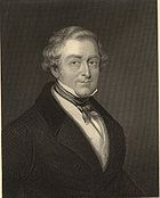
Robert Peel

Sir Robert Peel, 2nd Baronet was a Conservative Prime Minister of the United Kingdom Prime Minister of the United Kingdom

The Prime Minister of the United Kingdom of Great Britain and Northern Ireland [i] is in ... 

 from December 10, 1834 to April 8, 1835, and again from August 30, 1841 to June 29, 1846. He is best remembered as the originator of the modern concept of the police Police

Police forces are government organizations [i] charged with the responsibility of maintaining law [i] and ... 

 force while Home Secretary, for overseeing the formation of the Conservative Party out of the shattered Tory Tory

The term Tory applied to the Tory Party, the ancestor of the modern UK Conservative Party [i] ... 

 Party and for his repealing of the Corn Laws.

Discussions

  Discussion Features

   Ask a question about 'Robert Peel'

   Start a new discussion about 'Robert Peel'

   Answer questions about 'Robert Peel'

   'Robert Peel' discussion forum

Timeline

1788   Born

1835   Lord Melbourne William Lamb, 2nd Viscount Melbourne

William Lamb, 2nd Viscount Melbourne, PC [i] was a British [i] ... 

 succeeds Sir Robert Peel as British Prime Minister Prime Minister of the United Kingdom

The Prime Minister of the United Kingdom of Great Britain and Northern Ireland [i] is in ... 

.

1846   Under the leadership of British United Kingdom of Great Britain and Ireland

| align="center" colspan="2"| United Kingdom ofGreat Britain and Ireland ... 

 Prime Minister Prime minister

A prime minister is the most senior minister of a cabinet [i] in the executive [i] b ... 

 Robert Peel, the British Parliament Parliament

A parliament is a legislature [i], especially in those countries whose system of government is based on ... 

 repeals the Corn Laws, replacing the old Colonial Colonialism

See colony [i] and colonisation [i] for examples of colonialism which do not refer to Western colonialism. ... 

 mercantile trade system with Free Trade.

1850   Died


Quotations

I have read all that has been written by the gravest authorities on political economy on the subject of rent, wages, taxes, tithes.

Speech in the House of Commons (15 March, 1839).

       More Quotes >>


Encyclopedia

Sir Robert Peel, 2nd Baronet was a Conservative Prime Minister of the United Kingdom Prime Minister of the United Kingdom

The Prime Minister of the United Kingdom of Great Britain and Northern Ireland [i] is in... 

 from December 10, 1834 to April 8, 1835, and again from August 30, 1841 to June 29, 1846. He is best remembered as the originator of the modern concept of the police Police

Police forces are government organizations [i] charged with the responsibility of maintaining law [i] and ... 

 force while Home Secretary, for overseeing the formation of the Conservative Party out of the shattered Tory Tory

The term Tory applied to the Tory Party, the ancestor of the modern UK Conservative Party [i]... 

 Party and for his repealing of the Corn Laws.

Biography


Peel was born in the Lancashire Lancashire

Lancashire is a county [i] in North West [i] England [i], bounded ... 

 town of Bury Bury

Bury is a mill town on the northern side of Greater Manchester [i] in North West England [i], between Rochdale [i] ... 

 to the industrialist and Member of Parliament Sir Robert Peel Robert Peel

Sir Robert Peel, 2nd Baronet was a Conservative [i] Prime Minister of the United Kingdom [i]... 

. His father was one of the richest textile manufacturers of the early Industrial Revolution Industrial Revolution

The Industrial Revolution was the major technological [i], socioeconomic [i] a ... 

. Peel was educated first at Hipperholme Grammar School Hipperholme Grammar School

Hipperholme Grammar School is an independent grammar school [i] in Hipperholme [i], West Yorkshire [i], ... 

, then at Harrow School Harrow School

Harrow School, normally just known as Harrow, is one of the world's most famous schools.... 

 and finally Christ Church, Oxford Christ Church, Oxford

Christ Church, is one of the largest and wealthiest of the constituent college [i]s of the University of Oxford [i]... 

. He is also believed to have briefly attended Bury Grammar School Bury Grammar School

Bury Grammar School is an independent grammar school [i] in the town of Bury [i] in the English [i] ... 

.

Early political career

The young Peel entered politics at the young age of 21 as M.P. for the Irish rotten borough of Cashel City, Tipperary. With a scant twenty-four voters on the rolls, he was elected unopposed. More importantly, his sponsor for the election was Sir Arthur Wellesley Arthur Wellesley, 1st Duke of Wellington

Field Marshal [i] Arthur Wellesley, 1st Duke of Wellington, KG [i], GCB [i] ... 

, the future Duke of Wellington Duke of Wellington

The Dukedom of Wellington, derived from Wellington [i] in Somerset [i], is a heredi ... 

, with whom Peel's political career would be entwined for the next twenty-five years.

His maiden speech in the Commons British House of Commons

|align=left|
  • Parliament [i]

... 

 was a sensation, and was famously described by the Speaker Speaker of the British House of Commons

In the United Kingdom [i], the Speaker of the House of Commons is the presiding officer of the House of Commons [i]... 

 as "the best first speech since that of William Pitt William Pitt the Younger

William Pitt the Younger was a British [i] politician during the late eighteenth [i] ... 

".

For the next decade he occupied a series of relatively minor positions in the Tory Tory

The term Tory applied to the Tory Party, the ancestor of the modern UK Conservative Party [i]... 

 governments: Undersecretary for War, Chief Secretary for Ireland Ireland

Ireland is the third largest [i] island [i] in Europe [i]. ... 

, and chairman of the Bullion Committee . He also changed seats twice: first picking up another rotten borough, Chippenham, then becoming MP for Oxford University University of Oxford

The University of Oxford, located in the city of Oxford [i], England [i], is the oldest university [i]... 

 in 1817.

He later served as MP for Tamworth Tamworth

Tamworth is a historic town [i] and local government district [i] in Staffordshire [i] ... 

 from 1830 until his death. His home was Drayton Manor.

Home secretary

Peel was considered one of the rising stars of the Tory party, first entering the cabinet in 1822 as Home Secretary. As Home Secretary, he introduced a number of important reforms of British criminal law: most memorably establishing the Metropolitan Police Force . He also changed the Penal code reducing the number of crimes punishable by death Capital punishment

Capital punishment, or the death penalty, is the execution [i] of a convicted criminal by the ... 

. He reformed the gaol system, introducing payment for gaolers and education for the inmates.


He resigned as Home Secretary after the Prime Minister, Lord Liverpool, became incapacitated and was replaced by George Canning George Canning

George Canning was a British politician [i] who served as Foreign Secretary [i] ... 

. Canning favoured Catholic Emancipation Catholic Emancipation

Catholic Emancipation was a process in Great Britain [i] and Ireland [i] in the late 18th century [i] an ... 

, while Peel had been one of its most outspoken opponents. Canning himself died less than four months later and, after the brief premiership of Lord Goderich Frederick John Robinson, 1st Viscount Goderich

Frederick John Robinson, 1st Earl of Ripon PC [i], Frederick John ... 

, Peel returned to the post of Home Secretary under the premiership of his long-time ally the Duke of Wellington Duke of Wellington

The Dukedom of Wellington, derived from Wellington [i] in Somerset [i], is a heredi ... 

. During this time he was widely perceived as the number-two in the Tory Party, after Wellington himself.

However, the pressure on the new ministry from advocates of Catholic Emancipation was too great and an Emancipation Bill was passed the next year. Peel felt compelled to resign his seat at Oxford, as he had stood on a platform of opposition to Catholic Emancipation . He instead moved to another rotten borough, Westbury, retaining his Cabinet position.

Police Reform

It was at this point that he established Metropolitan Police Force Metropolitan Police Service

The Metropolitan Police Service is the Home Office [i] police force [i] responsible for Greater London [i] ... 

 for London London

London is the capital [i] city of England [i] and of the United Kingdom [i]. ... 

 based at Scotland Yard Scotland Yard

New Scotland Yard, often referred to simply as Scotland Yard or The Yard, is the headquarter... 

. The 1,000 constables employed were affectionately nicknamed 'Peelers' or 'Bobbies' . Although at first unpopular, they proved very successful in cutting crime in London, and by 1835 all cities in the UK were being directed to form their own police forces—see British Police Policing in the United Kingdom

The United Kingdom is a unitary [i] state, and police forces, generally speaking, are organised... 

. Known as the father of modern policing, his Peelian Principles defined the ethical requirements police officers must follow in order to be effective. His most memorable principle was, "the police are the public, and the public are the police."

  • The basic mission for which the police exist is to prevent crime and disorder.
  • The ability of the police to perform their duties is dependent upon public approval of police actions.
  • Police must secure the willing co-operation of the public in voluntary observance of the law to be able to secure and maintain the respect of the public.
  • The degree of co-operation of the public that can be secured diminishes proportionately to the necessity of the use of physical force.
  • Police seek and preserve public favour not by catering to public opinion but by constantly demonstrating absolute impartial service to the law.
  • Police use physical force to the extent necessary to secure observance of the law or to restore order only when the exercise of persuasion, advice and warning is found to be insufficient.
  • Police, at all times, should maintain a relationship with the public that gives reality to the historic tradition that the police are the public and the public are the police; the police being only members of *the public who are paid to give full-time attention to duties which are incumbent on every citizen in the interests of community welfare and existence.
  • Police should always direct their action strictly towards their functions and never appear to usurp the powers of the judiciary.
  • The test of police efficiency is the absence of crime and disorder, not the visible evidence of police action in dealing with it.

Whigs in power


The lower classes in England at that time, however, were clamoring for reform, and Catholic Emancipation was only one of the ideas in the air. The Tory ministry refused to bend on other issues and were swept out of office in 1830 in favour of the Whigs. The following few years were extremely turbulent, but eventually enough reforms were passed that King William IV William IV of the United Kingdom

William IV was King of the United Kingdom [i] and of Hanover [i] from 26 June [i] 1830 [i] un ... 

 felt confident enough invite the Tories again to form a ministry in succession to those of Lord Grey Charles Grey, 2nd Earl Grey

Charles Grey, 2nd Earl Grey, KG [i], PC [i], kno ... 

 and Lord Melbourne William Lamb, 2nd Viscount Melbourne

William Lamb, 2nd Viscount Melbourne, PC [i] was a British [i] ... 

 in 1834. Peel was selected as Prime Minister but was in Italy at the time, so Wellington acted as a caretaker for the three weeks until Peel's return.

First term as Prime Minister

This new Tory Ministry was a minority government, however, and depended on Whig goodwill for its continued existence. As his statement of policy at the general election of January 1835, Peel issued the Tamworth Manifesto. The issuing of this document is often seen as one of the most crucial points at which the Tories became the Conservative Party. In it he pledged that the Conservatives would endorse modest reform, but the Whigs instead formed a compact with Daniel O'Connell Daniel O'Connell

Daniel O'Connell, known as The Liberator or The Emancipator, was Ireland [i]'s predominant p ... 

's Irish Radical members to repeatedly defeat the government on various bills. Eventually Peel's ministry resigned out of frustration and the Whigs under Lord Melbourne returned to power. The only real achievement of Peel's first administration was a commission to review the governance of the Church of England Church of England

The Church of England is the officially established [i] Christian [i] church [i] ... 

. This ecclesiastical commission being the forerunner of the Church Commissioners.

Leader of the Opposition

In May 1839, he was offered another chance to form a government, this time by the new monarch, Queen Victoria Victoria of the United Kingdom

Victoria was the Queen [i] of the United Kingdom of Great Britain and Ireland [i] ... 

. However, this too would have been a minority government and Peel felt he needed a further sign of confidence from his Queen. Lord Melbourne had been Victoria's confidant for several years, and many of the higher posts in Victoria's household were held by the wives and female relatives of Whigs; there was some feeling that Victoria had allowed herself to be too closely associated with the Whig party. Peel therefore asked that some of this coterie be dismissed and replaced with their Conservative counterparts, provoking the so-called Bedchamber Crisis. Victoria refused to change her household, and despite pleadings from the Duke of Wellington, relied on assurances of support from Whig leaders. Peel refused to form a government, and the Whigs returned to power.

Second term as Prime Minister


Factory Act

Peel finally had a chance to head a majority government following the election of July 1841. His promise of modest reform was held to, and the second most famous bill of this ministry, while "reforming" in 21st century eyes, was in fact aimed at the reformers themselves, with their constituency among the new industrial rich. The Factory Act 1844 acted more against these industrialists than it did against the traditional stronghold of the Conservatives, the landed gentry Landed gentry

Landed gentry is a term traditionally applied in Britain to members of the upper class [i] with country... 

, by restricting the number of hours that children and women could work in a factory, and setting rudimentary safety standards for machinery. Interestingly, this was a continuation of his own father's work as an MP, as the elder Robert Peel was most noted for reform of working conditions during the first part of the 19th century.

In 1843 Peel was the target of a failed assassination attempt; a criminally-insane Scottish woodsman named Daniel M'Naghten stalked him for several days before accidentally killing Peel's personal secretary Edward Drummond instead.

Corn Laws and after


The most notable act of Peel's second ministry, however, was the one that would bring it down. This time Peel moved against the landholders by repealing the Corn Laws, which supported agricultural revenues by restricting grain imports. This radical break with Conservative protectionism was triggered by the Irish potato famine Irish Potato Famine (1845–1849)

The Great Famine or the Great Hunger , known more commonly outside of Ireland [i] as the Irish ... 

, though some modern historians have argued that the decision had already been made and that the famine merely being a convenient time to implement it.

At first sceptical of the extent of the problem, Peel reacted slowly to the famine. As realisation dawned, however, he hoped that ending the Corn Laws would free up more food for the Irish. Though he knew repealing the laws would mean the end of his ministry, Peel decided to do so. Yet many historians believe that Peel merely used the Irish Famine as an excuse to repeal the Corn Laws, having been an intellectual convert to free trade since the 1820s. Blake points out that if Peel was convinced that total repeal was necessary to stave of the famine, he should have enacted a bill that brought about immediate temporary repeal, not permanent repeal over a three-year period of gradual tapering off of duties. His own party failed to support the bill, but it passed with Whig and Radical support on 29 June 1846. A following bill was defeated as a direct consequence, however, and Peel resigned.


As an aside in reference to the Repeal of the Corn Laws, Peel did make some moves to subsidise the purchase of food for the Irish, but this attempt was small and had little tangible effect. To criticise Peel for acting too late in repealing the Corn Laws, or for not giving enough subsidies to the Irish, shows a misunderstanding of the historical context. In the age of laissez-faire, government and their taxes were small, and subsidies or direct economic interference were almost non-existent. That subsidies were actually given was very much out of character for the political times; Peel's sucessor, Lord John Russell John Russell, 1st Earl Russell

John Russell, 1st Earl Russell, KG [i], GCMG [i], ... 

, has received more criticism than Peel has on Irish policy. The repeal of the Corn Laws was more political than humanitarian. Peel's support for free trade could already be seen in his 1842 and 1845 budgets; it can be argued that the repeal of the Corn Laws was the next logical step towards a free-market economy. Whatever the intentions, in the end the repeal of the Corn Laws had little effect on the situation in Ireland.

The historian Boyd Hilton argues that Peel knew from 1844 that he was going to be deposed as Conservative leader -- many of his MPs had taken to voting against him. Hilton's hypothesis is that Peel, who had led a very Liberal ministry, wished to actually be deposed on a Liberal issue so that he might later lead a Peelite/Whig alliance.

Later career and death

He did retain a hard core of supporters however, known as Peelites, and at one point in 1849 was actively courted by the Whig/Radical coalition. He continued to stand on his conservative principles, however, and refused. Nevertheless, he was influential on several important issues, including the furtherance of British free trade with the repeal of the Navigation Acts. Peel was a member of the committee which controlled the House of Commons Library, and on 16 April 1850 was responsible for passing the motion that controlled its scope and collection policy for the rest of the century.

Peel was thrown from his horse while riding up Constitution Hill in London on 29 June 1850, and died three days later on July 2 at the age of 62. His Peelite followers, led by Lord Aberdeen George Hamilton-Gordon, 4th Earl of Aberdeen

George Hamilton Hamilton-Gordon, 4th Earl of Aberdeen, KG [i], KT [i] ... 

 and William Gladstone William Ewart Gladstone

William Ewart Gladstone was a British [i] Liberal Party [i] ... 

, went on to fuse with the Whigs as the Liberal Party.

Sir Robert Peel's governments


See also
  • Conservative Government 1834-1835 [i], for a complete list of officeholders in the gov ... 

  • Second Peel Ministry Second Peel ministry

    ... 


See also

M'Naghten's Case

External links

  • Biography of Sir Robert Peel on the website of 10 Downing Street 10 Downing Street

    10 Downing Street is the residence and office of the Prime Minister of the United Kingdom of Great Britain and Northern Ireland [i] ... 

  • Biography of Sir Robert Peel
  • Biography of Sir Robert Peel
  • An overview of the career of Sir Robert Peel

Offices Held