

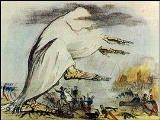
Miasma theory of disease

Encyclopedia
The miasma theory held that disease
s such as cholera
, chlamydia or the Black Death
were caused by a miasma (Μίασμα, ancient Greek: "pollution"), a noxious form of "bad air".
The miasma theory was accepted from ancient times in Europe, India and China. The theory was eventually displaced in the 19th century by the discovery of germs and the germ theory of disease
.
The idea of bad air also gave rise to the name malaria
through medieval Italian.
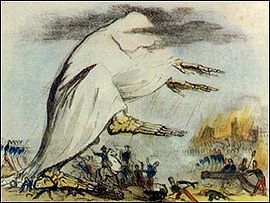 Miasma was considered to be a poisonous vapor or mist filled with particles from decomposed matter (miasmata) that caused illnesses. The Miasmatic position was that diseases were the product of environmental factors such as contaminated water, foul air, and poor hygienic conditions. Such infection was not passed between individuals but would affect individuals who resided within the particular locale that gave rise to such vapors. It was identifiable by its foul smell.
In India, there was also a miasma theory and the Indians take credit for being the first to put this miasma theory into clinical practice. The Indians invented paan, a gambir paste, that was believed to help prevent miasma, it was considered as the first antimiasmatic application. This gambir tree is found in Southern India and Sri Lanka.
In the 1st century AD, the Roman architectural writer Vitruvius
described the potential effects of miasma (Latin
nebula) from fetid swamplands when siting a city:
The miasmatic theory of disease remained popular in the Middle Ages
and a sense of effluvia contributed to Robert Boyle's Suspicions about the Hidden Realities of the Air
.
In the 1850s, miasma was used to explain the spread of cholera
in London
and in Paris
, partly justifying Haussmann's latter renovation of the French capital
. The disease was said to be preventable by cleansing and scouring of the body and items. Dr. William Farr
, the assistant commissioner for the 1851 London census, was an important supporter of the miasma theory. He believed that cholera was transmitted by air, and that there was a deadly concentration of miasmata near the River Thames
' banks. The wide acceptance of miasma theory during the cholera outbreaks overshadowed the partially correct theory brought forth by John Snow
that cholera was spread through water. This slowed the response to the major outbreaks in the Soho district of London and other areas. The Crimean War
nurse Florence Nightingale
(1820–1910), was a proponent of the theory and worked to make hospitals sanitary and fresh-smelling. It was stated in 'Notes on Nursing for the Labouring Classes' (1860) that Nightingale would "keep the air [the patient] breathes as pure as the external air."
Dr. Thomas Southwood Smith spent many years comparing the Miasmatic theory to Contagionism.
Florence Nightingale:
The current germ theory accounts for disease proliferation by both physical and non-physical contact.
The ancient Chinese thought that miasma was related to the environment of parts of Southern China. The miasma was thought to be caused by the heat, moisture and the dead air in the Southern Chinese mountains. They thought that insects’ waste polluted the air, the fog, water, and the virgin forest harboring a great environment for miasma to occur.
In the descriptions of ancient travelers, soldiers, or local officials (most of them are men of letters) of the phenomenon of miasma, fog, haze, dust, gas, or poison geological gassing were always mentioned. The miasma caused a lot of diseases such as the cold, influenza, heat strokes, malaria, or dysentery. In the medical history of China, malaria had been referred to by different names in different dynasty periods. Poisoning, psittacosis, and acclimatized were also called miasma in ancient China because they did not accurately understand the cause of the disease.
In Sui dynasty, doctor Tsao Yuan-fung mentioned miasma in his book (諸病源候論). He thought that miasma in Southern China is similar with typhoid fever in Northern China. However, in his opinion, miasma is different from malaria and dysentery. In his book, he discussed dysentery in another chapter, and malaria in a single chapter. And he also found that miasma caused different diseases, so he suggested that one should find apt and specific ways to resolve problems.
The knowing of the concept of miasma can be separated into several steps. First, before Western Jin Dynasty, the concept of miasma was gradually forming; at least, in Eastern Han Dynasty, there was no character of miasma. In Eastern Jin, large amounts of northern people moved toward south, miasma was recognized then in the group of men of letters or nobility. After Sui and Tang Dynasty, scholars-bureaucrats traveled and were sent to be the local officials recorded and investigated the miasma. As a result, the government became concern of the severe causes of the cause of miasma by sending doctors to the area of epidemic to research the disease and heal the patients. In Ming and Qing Dynasty, the edition of the local chronicles record the different miasma in different places.
The northern boundary of the distribution of miasma were at first Qinling Mountains and Huaihe River in Han Dynasty, then, Daba Mountains and Yangtze River in Sui and Tang Dynasty, and Nanling Mountains in Ming and Qing Dynasty. Nowadays, in 20th century, miasma occurs only in inland mountains in China.
However, Southern China was highly developed in Ming, Qing Dynasty. The environment changed rapidly, and after 19th century, western science and medical knowledge were introduced into China, and people knew how to distinguish and deal with the disease. The concept of miasma therefore fading out of throughout history from the progression of the medicine in China.
and other diseases were epidemic in places where the water was undrained and very foul-smelling. As sanitary reform’s engineering leader, London’s Edwin Chadwick
, put it, “all smell is disease.” The theory led to sanitation improvements, such as preventing the reflux of noxious air from sewers back into houses by separate drainage systems in the sanitation
designs, which incidentally led to decreased episodes of cholera
, and thus helped to support the theory.
The miasma theory was consistent with the observations that disease was associated with poor sanitation (and hence foul odours) and that sanitary improvements reduced disease; it was not consistent with the observations of microbiology
however, that led to the later germ theory of disease
. The introduction of medical bacteriology in the 1870s and 1880s rang miasma’s death knell, but the theory did not die without a struggle. It passed through a long stage of denial, hope for survival being sustained by sewer gas
, which was a major component of the miasma theory developed by Galen
and brought to prominence by the Great Stink. After all, sewers enclosed the refuse of the human bowel, evacuations that, medical science had discovered, could teem with typhoid, cholera
, and other microbes.
Even though later disproven by the influence of bacteria
and the discovery of viruses, the miasma theory helped make the connection between poor sanitation and disease. This caused public health reforms and encouraged cleanliness, which led to the legislation of the Parliament, which approved the Public Health Acts of 1848 and 1858 and the Local Government Act of 1858. The latter of these confers the power of instating investigations into the health and sanitary regulations of any town or place, upon the petition of residents or death rates exceeding the norm. Early medical and sanitary engineering reformers included Henry Austin, Joseph Bazalgette
, Edwin Chadwick
, Frank Forster, Thomas Hawksley
, William Haywood
, Henry Letheby
, Robert Rawlinson
, Sir John Simon and Thomas Wicksteed. These and later British regulatory improvements were reported in the United States as early as 1865.
Years later, the influence of these sanitary reforms on Britain was described by Sir Richard Rogers:
The prevalent belief and predominant fear of the southern region with its "poisonous air and gases" is evident in historical documents.
Similar topics and feelings toward the miasma-infected south are often reflected in early Chinese poetry and records. Most scholars of the time agreed that the geological environments in the south had a direct impact on the population composition and growth. Many historical records reflect that females were less prone to miasma infection, and mortality rates were much higher in the south, especially for the men. This directly influenced agriculture cultivation and the southern economy, as men were the engine of agriculture production. Zhou Qufei (周去非), a local magistrate from the Nan-Sung Dynasty described in his treatise, Representative Answers from the South (嶺外代答): "... The men are short and and tan, while the women were plumb and seldom came down with illness," and exclaimed at the populous female population in the GuangXi region.
This inherent environmental threat also prevented immigration from other regions. Hence, development in the damp and sultry south was much slower than in the north, where the dynasties' political power resided for much of early Chinese history.
following an epidemic in Soho
, central London
in 1854. Because of the miasmatic theory's predominance among Italian scientists, the discovery at the same year by Filippo Pacini
of the bacillus
that caused the disease was completely ignored, and the bacteria had to be rediscovered thirty years later by Robert Koch
.
At 1846, the Nuisances Removal and Diseases Prevention Act was passed to identify whether the transmission of Cholera
is by air or by water. The bill supported the Germ theory, and was used to encourage the owner to clean their dwelling and connect them to sewers.
Some years later in 1855, John Snow
made a testimony against the Amendment to this bill that regularize air pollution of some industries. He claimed that:
At the same year, William Farr
, who was then the major supporter of the Miasma Theory, issued a report to criticize the germ theory. Farr and the Committee wrote that:
The more formal experiments on the relationship between germ and disease was conducted by Louis Pasteur
between 1860 and 1864. He discovered the pathology of the puerperal fever
and the pyogenic vibrio in the blood, and suggest using boric acid
to kill these micro organisms before and after confinement.
By 1866, eight years after the death of John Snow, William Farr publicly acknowledged that the miasma theory on the transmission of cholera was wrong, by his statistics' justification on the death rate.
Disease
A disease is an abnormal condition affecting the body of an organism. It is often construed to be a medical condition associated with specific symptoms and signs. It may be caused by external factors, such as infectious disease, or it may be caused by internal dysfunctions, such as autoimmune...
s such as cholera
Cholera
Cholera is an infection of the small intestine that is caused by the bacterium Vibrio cholerae. The main symptoms are profuse watery diarrhea and vomiting. Transmission occurs primarily by drinking or eating water or food that has been contaminated by the diarrhea of an infected person or the feces...
, chlamydia or the Black Death
Black Death
The Black Death was one of the most devastating pandemics in human history, peaking in Europe between 1348 and 1350. Of several competing theories, the dominant explanation for the Black Death is the plague theory, which attributes the outbreak to the bacterium Yersinia pestis. Thought to have...
were caused by a miasma (Μίασμα, ancient Greek: "pollution"), a noxious form of "bad air".
The miasma theory was accepted from ancient times in Europe, India and China. The theory was eventually displaced in the 19th century by the discovery of germs and the germ theory of disease
Germ theory of disease
The germ theory of disease, also called the pathogenic theory of medicine, is a theory that proposes that microorganisms are the cause of many diseases...
.
Etymology
The word "miasma" comes from ancient Greek and means "pollution".The idea of bad air also gave rise to the name malaria
Malaria
Malaria is a mosquito-borne infectious disease of humans and other animals caused by eukaryotic protists of the genus Plasmodium. The disease results from the multiplication of Plasmodium parasites within red blood cells, causing symptoms that typically include fever and headache, in severe cases...
through medieval Italian.
Miasma in the West
In India, there was also a miasma theory and the Indians take credit for being the first to put this miasma theory into clinical practice. The Indians invented paan, a gambir paste, that was believed to help prevent miasma, it was considered as the first antimiasmatic application. This gambir tree is found in Southern India and Sri Lanka.
In the 1st century AD, the Roman architectural writer Vitruvius
Vitruvius
Marcus Vitruvius Pollio was a Roman writer, architect and engineer, active in the 1st century BC. He is best known as the author of the multi-volume work De Architectura ....
described the potential effects of miasma (Latin
Latin
Latin is an Italic language originally spoken in Latium and Ancient Rome. It, along with most European languages, is a descendant of the ancient Proto-Indo-European language. Although it is considered a dead language, a number of scholars and members of the Christian clergy speak it fluently, and...
nebula) from fetid swamplands when siting a city:
For when the morning breezes blow toward the town at sunrise, if they bring with them mist from marshes and, mingled with the mist, the poisonous breath of creatures of the marshes to be waftWaftWaft is a term meaning to carry along gently as through the air. The term is commonly used to describe scents that have diffused in to other parts of a room, or to describe smoke as being seen moving through the air...
ed into the bodies of the inhabitants, they will make the site unhealthy.
The miasmatic theory of disease remained popular in the Middle Ages
Middle Ages
The Middle Ages is a periodization of European history from the 5th century to the 15th century. The Middle Ages follows the fall of the Western Roman Empire in 476 and precedes the Early Modern Era. It is the middle period of a three-period division of Western history: Classic, Medieval and Modern...
and a sense of effluvia contributed to Robert Boyle's Suspicions about the Hidden Realities of the Air
Suspicions about the Hidden Realities of the Air
Suspicions about the Hidden Realities of the Air is a book on alchemy by 17th Century philosopher Robert Boyle. It was written in 1674 concerning ideas about the agency of the air in chemical reactions...
.
In the 1850s, miasma was used to explain the spread of cholera
Cholera
Cholera is an infection of the small intestine that is caused by the bacterium Vibrio cholerae. The main symptoms are profuse watery diarrhea and vomiting. Transmission occurs primarily by drinking or eating water or food that has been contaminated by the diarrhea of an infected person or the feces...
in London
London
London is the capital city of :England and the :United Kingdom, the largest metropolitan area in the United Kingdom, and the largest urban zone in the European Union by most measures. Located on the River Thames, London has been a major settlement for two millennia, its history going back to its...
and in Paris
Paris
Paris is the capital and largest city in France, situated on the river Seine, in northern France, at the heart of the Île-de-France region...
, partly justifying Haussmann's latter renovation of the French capital
Haussmann's renovation of Paris
Haussmann's Renovation of Paris, or the Haussmann Plan, was a modernization program of Paris commissioned by Napoléon III and led by the Seine prefect, Baron Georges-Eugène Haussmann, between 1853 and 1870...
. The disease was said to be preventable by cleansing and scouring of the body and items. Dr. William Farr
William Farr
William Farr was a nineteenth-century British epidemiologist, regarded as one of the founders of medical statistics.-Early life:He was born in Kenley, Shropshire, England to poor parents...
, the assistant commissioner for the 1851 London census, was an important supporter of the miasma theory. He believed that cholera was transmitted by air, and that there was a deadly concentration of miasmata near the River Thames
River Thames
The River Thames flows through southern England. It is the longest river entirely in England and the second longest in the United Kingdom. While it is best known because its lower reaches flow through central London, the river flows alongside several other towns and cities, including Oxford,...
' banks. The wide acceptance of miasma theory during the cholera outbreaks overshadowed the partially correct theory brought forth by John Snow
John Snow (physician)
John Snow was an English physician and a leader in the adoption of anaesthesia and medical hygiene. He is considered to be one of the fathers of epidemiology, because of his work in tracing the source of a cholera outbreak in Soho, England, in 1854.-Early life and education:Snow was born 15 March...
that cholera was spread through water. This slowed the response to the major outbreaks in the Soho district of London and other areas. The Crimean War
Crimean War
The Crimean War was a conflict fought between the Russian Empire and an alliance of the French Empire, the British Empire, the Ottoman Empire, and the Kingdom of Sardinia. The war was part of a long-running contest between the major European powers for influence over territories of the declining...
nurse Florence Nightingale
Florence Nightingale
Florence Nightingale OM, RRC was a celebrated English nurse, writer and statistician. She came to prominence for her pioneering work in nursing during the Crimean War, where she tended to wounded soldiers. She was dubbed "The Lady with the Lamp" after her habit of making rounds at night...
(1820–1910), was a proponent of the theory and worked to make hospitals sanitary and fresh-smelling. It was stated in 'Notes on Nursing for the Labouring Classes' (1860) that Nightingale would "keep the air [the patient] breathes as pure as the external air."
Contagionism versus Miasmatism
Throughout the 19th Century, the medical community was divided on the explanation for disease proliferation. On one side were the contagionists, believing disease was passed through physical contact, while others believed disease was present in the air in the form of Miasma, and thus could proliferate without physical contact. Two members of the latter group were Dr. Thomas S. Smith and Florence Nightingale.Dr. Thomas Southwood Smith spent many years comparing the Miasmatic theory to Contagionism.
Florence Nightingale:
The current germ theory accounts for disease proliferation by both physical and non-physical contact.
Miasma in China
In China, miasma is an old concept of illness, used extensively by ancient Chinese local chronicles and works of literature. Miasma has different names in Chinese culture. Most of the explanations of miasma refer to it as a kind of sickness, or poison gas.The ancient Chinese thought that miasma was related to the environment of parts of Southern China. The miasma was thought to be caused by the heat, moisture and the dead air in the Southern Chinese mountains. They thought that insects’ waste polluted the air, the fog, water, and the virgin forest harboring a great environment for miasma to occur.
In the descriptions of ancient travelers, soldiers, or local officials (most of them are men of letters) of the phenomenon of miasma, fog, haze, dust, gas, or poison geological gassing were always mentioned. The miasma caused a lot of diseases such as the cold, influenza, heat strokes, malaria, or dysentery. In the medical history of China, malaria had been referred to by different names in different dynasty periods. Poisoning, psittacosis, and acclimatized were also called miasma in ancient China because they did not accurately understand the cause of the disease.
In Sui dynasty, doctor Tsao Yuan-fung mentioned miasma in his book (諸病源候論). He thought that miasma in Southern China is similar with typhoid fever in Northern China. However, in his opinion, miasma is different from malaria and dysentery. In his book, he discussed dysentery in another chapter, and malaria in a single chapter. And he also found that miasma caused different diseases, so he suggested that one should find apt and specific ways to resolve problems.
The knowing of the concept of miasma can be separated into several steps. First, before Western Jin Dynasty, the concept of miasma was gradually forming; at least, in Eastern Han Dynasty, there was no character of miasma. In Eastern Jin, large amounts of northern people moved toward south, miasma was recognized then in the group of men of letters or nobility. After Sui and Tang Dynasty, scholars-bureaucrats traveled and were sent to be the local officials recorded and investigated the miasma. As a result, the government became concern of the severe causes of the cause of miasma by sending doctors to the area of epidemic to research the disease and heal the patients. In Ming and Qing Dynasty, the edition of the local chronicles record the different miasma in different places.
The northern boundary of the distribution of miasma were at first Qinling Mountains and Huaihe River in Han Dynasty, then, Daba Mountains and Yangtze River in Sui and Tang Dynasty, and Nanling Mountains in Ming and Qing Dynasty. Nowadays, in 20th century, miasma occurs only in inland mountains in China.
However, Southern China was highly developed in Ming, Qing Dynasty. The environment changed rapidly, and after 19th century, western science and medical knowledge were introduced into China, and people knew how to distinguish and deal with the disease. The concept of miasma therefore fading out of throughout history from the progression of the medicine in China.
The influence of miasma: sanitary engineering reforms in the West
The theory of miasma disease made sense to the English sanitary reformers of the mid-19th century. Miasma explained why choleraCholera
Cholera is an infection of the small intestine that is caused by the bacterium Vibrio cholerae. The main symptoms are profuse watery diarrhea and vomiting. Transmission occurs primarily by drinking or eating water or food that has been contaminated by the diarrhea of an infected person or the feces...
and other diseases were epidemic in places where the water was undrained and very foul-smelling. As sanitary reform’s engineering leader, London’s Edwin Chadwick
Edwin Chadwick
Sir Edwin Chadwick KCB was an English social reformer, noted for his work to reform the Poor Laws and improve sanitary conditions and public health...
, put it, “all smell is disease.” The theory led to sanitation improvements, such as preventing the reflux of noxious air from sewers back into houses by separate drainage systems in the sanitation
Sanitation
Sanitation is the hygienic means of promoting health through prevention of human contact with the hazards of wastes. Hazards can be either physical, microbiological, biological or chemical agents of disease. Wastes that can cause health problems are human and animal feces, solid wastes, domestic...
designs, which incidentally led to decreased episodes of cholera
Cholera
Cholera is an infection of the small intestine that is caused by the bacterium Vibrio cholerae. The main symptoms are profuse watery diarrhea and vomiting. Transmission occurs primarily by drinking or eating water or food that has been contaminated by the diarrhea of an infected person or the feces...
, and thus helped to support the theory.
The miasma theory was consistent with the observations that disease was associated with poor sanitation (and hence foul odours) and that sanitary improvements reduced disease; it was not consistent with the observations of microbiology
Microbiology
Microbiology is the study of microorganisms, which are defined as any microscopic organism that comprises either a single cell , cell clusters or no cell at all . This includes eukaryotes, such as fungi and protists, and prokaryotes...
however, that led to the later germ theory of disease
Germ theory of disease
The germ theory of disease, also called the pathogenic theory of medicine, is a theory that proposes that microorganisms are the cause of many diseases...
. The introduction of medical bacteriology in the 1870s and 1880s rang miasma’s death knell, but the theory did not die without a struggle. It passed through a long stage of denial, hope for survival being sustained by sewer gas
Sewer gas
Sewer gas is a complex mixture of toxic and non-toxic gases produced and collected in sewage systems by the decomposition of organic household or industrial wastes, typical components of Sewage....
, which was a major component of the miasma theory developed by Galen
Galen
Aelius Galenus or Claudius Galenus , better known as Galen of Pergamon , was a prominent Roman physician, surgeon and philosopher...
and brought to prominence by the Great Stink. After all, sewers enclosed the refuse of the human bowel, evacuations that, medical science had discovered, could teem with typhoid, cholera
Cholera
Cholera is an infection of the small intestine that is caused by the bacterium Vibrio cholerae. The main symptoms are profuse watery diarrhea and vomiting. Transmission occurs primarily by drinking or eating water or food that has been contaminated by the diarrhea of an infected person or the feces...
, and other microbes.
Even though later disproven by the influence of bacteria
Bacteria
Bacteria are a large domain of prokaryotic microorganisms. Typically a few micrometres in length, bacteria have a wide range of shapes, ranging from spheres to rods and spirals...
and the discovery of viruses, the miasma theory helped make the connection between poor sanitation and disease. This caused public health reforms and encouraged cleanliness, which led to the legislation of the Parliament, which approved the Public Health Acts of 1848 and 1858 and the Local Government Act of 1858. The latter of these confers the power of instating investigations into the health and sanitary regulations of any town or place, upon the petition of residents or death rates exceeding the norm. Early medical and sanitary engineering reformers included Henry Austin, Joseph Bazalgette
Joseph Bazalgette
Sir Joseph William Bazalgette, CB was an English civil engineer of the 19th century. As chief engineer of London's Metropolitan Board of Works his major achievement was the creation of a sewer network for central London which was instrumental in relieving the city from cholera epidemics, while...
, Edwin Chadwick
Edwin Chadwick
Sir Edwin Chadwick KCB was an English social reformer, noted for his work to reform the Poor Laws and improve sanitary conditions and public health...
, Frank Forster, Thomas Hawksley
Thomas Hawksley
Thomas Hawksley was an English civil engineer of the 19th century, particularly associated with water and gas engineering projects.The son of John Hawksley and Mary Whittle, and born in Arnold, near Nottingham on , Hawksley was largely self-taught from the age of 15 onwards, having at that point...
, William Haywood
William Haywood (engineer)
William J. Haywood was a surveyor and an engineer to the City of London Commissioners of Sewers. He was also known as an architect.- Personal life :...
, Henry Letheby
Henry Letheby
Henry Letheby , analytical chemist and public health officer, was born at Plymouth in 1816, and studied chemistry at the Royal Cornwall Polytechnic Society. In 1837 he commenced the study of medicine, and became the assistant of Jonathan Pereira. He graduated M.B...
, Robert Rawlinson
Robert Rawlinson
Sir Robert Rawlinson KCB was an English engineer and sanitarian.-Early life:He was born at Bristol. His father was a mason and builder at Chorley, Lancashire, and he himself began his engineering education by working in a stonemason's yard.-Career:In 1831, he obtained employment under Jesse...
, Sir John Simon and Thomas Wicksteed. These and later British regulatory improvements were reported in the United States as early as 1865.
Years later, the influence of these sanitary reforms on Britain was described by Sir Richard Rogers:
The influence of miasma: in southern China
The terrifying miasma diseases in the southern regions of China made it the primary location for relegating officials and sending criminals to exile since the Qing-Han Dynasty. Poet Han Yu (韓愈) of the Tang Dynasty, for example, wrote to his nephew who came to see him off after his banishment to the Chao Prefecture in his poem, En Route (左遷至藍關示姪孫湘):The prevalent belief and predominant fear of the southern region with its "poisonous air and gases" is evident in historical documents.
Similar topics and feelings toward the miasma-infected south are often reflected in early Chinese poetry and records. Most scholars of the time agreed that the geological environments in the south had a direct impact on the population composition and growth. Many historical records reflect that females were less prone to miasma infection, and mortality rates were much higher in the south, especially for the men. This directly influenced agriculture cultivation and the southern economy, as men were the engine of agriculture production. Zhou Qufei (周去非), a local magistrate from the Nan-Sung Dynasty described in his treatise, Representative Answers from the South (嶺外代答): "... The men are short and and tan, while the women were plumb and seldom came down with illness," and exclaimed at the populous female population in the GuangXi region.
This inherent environmental threat also prevented immigration from other regions. Hence, development in the damp and sultry south was much slower than in the north, where the dynasties' political power resided for much of early Chinese history.
From miasma to germ theory: the debates on Cholera
Although the connection between germ and disease was proposed quite early, it was not until late-1800s that the germ theory was generally accepted. The miasmatic theory was first disproved by John SnowJohn Snow (physician)
John Snow was an English physician and a leader in the adoption of anaesthesia and medical hygiene. He is considered to be one of the fathers of epidemiology, because of his work in tracing the source of a cholera outbreak in Soho, England, in 1854.-Early life and education:Snow was born 15 March...
following an epidemic in Soho
Soho
Soho is an area of the City of Westminster and part of the West End of London. Long established as an entertainment district, for much of the 20th century Soho had a reputation for sex shops as well as night life and film industry. Since the early 1980s, the area has undergone considerable...
, central London
London
London is the capital city of :England and the :United Kingdom, the largest metropolitan area in the United Kingdom, and the largest urban zone in the European Union by most measures. Located on the River Thames, London has been a major settlement for two millennia, its history going back to its...
in 1854. Because of the miasmatic theory's predominance among Italian scientists, the discovery at the same year by Filippo Pacini
Filippo Pacini
Filippo Pacini was an Italian anatomist, posthumously famous for isolating the cholera bacillus Vibrio cholerae in 1854, well before Robert Koch's more widely accepted discoveries thirty years later....
of the bacillus
Bacillus
Bacillus is a genus of Gram-positive, rod-shaped bacteria and a member of the division Firmicutes. Bacillus species can be obligate aerobes or facultative anaerobes, and test positive for the enzyme catalase. Ubiquitous in nature, Bacillus includes both free-living and pathogenic species...
that caused the disease was completely ignored, and the bacteria had to be rediscovered thirty years later by Robert Koch
Robert Koch
Heinrich Hermann Robert Koch was a German physician. He became famous for isolating Bacillus anthracis , the Tuberculosis bacillus and the Vibrio cholerae and for his development of Koch's postulates....
.
At 1846, the Nuisances Removal and Diseases Prevention Act was passed to identify whether the transmission of Cholera
Cholera
Cholera is an infection of the small intestine that is caused by the bacterium Vibrio cholerae. The main symptoms are profuse watery diarrhea and vomiting. Transmission occurs primarily by drinking or eating water or food that has been contaminated by the diarrhea of an infected person or the feces...
is by air or by water. The bill supported the Germ theory, and was used to encourage the owner to clean their dwelling and connect them to sewers.
Some years later in 1855, John Snow
John Snow (physician)
John Snow was an English physician and a leader in the adoption of anaesthesia and medical hygiene. He is considered to be one of the fathers of epidemiology, because of his work in tracing the source of a cholera outbreak in Soho, England, in 1854.-Early life and education:Snow was born 15 March...
made a testimony against the Amendment to this bill that regularize air pollution of some industries. He claimed that:
At the same year, William Farr
William Farr
William Farr was a nineteenth-century British epidemiologist, regarded as one of the founders of medical statistics.-Early life:He was born in Kenley, Shropshire, England to poor parents...
, who was then the major supporter of the Miasma Theory, issued a report to criticize the germ theory. Farr and the Committee wrote that:
The more formal experiments on the relationship between germ and disease was conducted by Louis Pasteur
Louis Pasteur
Louis Pasteur was a French chemist and microbiologist born in Dole. He is remembered for his remarkable breakthroughs in the causes and preventions of diseases. His discoveries reduced mortality from puerperal fever, and he created the first vaccine for rabies and anthrax. His experiments...
between 1860 and 1864. He discovered the pathology of the puerperal fever
Puerperal fever
Puerperal fever or childbed fever, is a bacterial infection contracted by women during childbirth or miscarriage. It can develop into puerperal sepsis, which is a serious form of septicaemia. If untreated, it is often fatal....
and the pyogenic vibrio in the blood, and suggest using boric acid
Boric acid
Boric acid, also called hydrogen borate or boracic acid or orthoboric acid or acidum boricum, is a weak acid of boron often used as an antiseptic, insecticide, flame retardant, as a neutron absorber, and as a precursor of other chemical compounds. It exists in the form of colorless crystals or a...
to kill these micro organisms before and after confinement.
By 1866, eight years after the death of John Snow, William Farr publicly acknowledged that the miasma theory on the transmission of cholera was wrong, by his statistics' justification on the death rate.
See also
- Night airNight Air"Night Air" is a song by British singer-songwriter Jamie Woon released as the lead single from his debut album, Mirrorwriting.-Background:Woon described finishing the song as one of the highlights of the album-making process:...
- PolizeiwissenschaftPolizeiwissenschaftPolizeiwissenschaft was a discipline born in the first third of the 18th century which lasted until the middle of the 19th century.Considered as the science of the internal order of the community, it was a comprehensive term, which included today's...
("Science of police") - Germ theory of diseaseGerm theory of diseaseThe germ theory of disease, also called the pathogenic theory of medicine, is a theory that proposes that microorganisms are the cause of many diseases...