
|
|
|
|
Bonaparte
|
| |
|
| |
The House of Bonaparte is an imperial and royal European dynasty. Founded by Napoleon I of France in 1804, a Corsican military leader who rose to notability out of the French Revolution, transforming the French Republic into the First French Empire within five years of his coup d'état. Napoleon turned the Grande Armée against every major European power and dominated continental Europe through a series of military victories. He inserted members of his family on the thrones of client states founding the dynasty.
Throughout its history, the dynasty, as well as being Emperors of the French, held various other titles and territories including; their ancestral nation the Kingdom of Italy, Kingdom of Spain, Kingdom of Westphalia, Kingdom of Holland and the Kingdom of Naples.

Discussion
Ask a question about 'Bonaparte'
Start a new discussion about 'Bonaparte'
Answer questions from other users
|
Recent Posts

Encyclopedia
The House of Bonaparte is an imperial and royal European dynasty. Founded by Napoleon I of France in 1804, a Corsican military leader who rose to notability out of the French Revolution, transforming the French Republic into the First French Empire within five years of his coup d'état. Napoleon turned the Grande Armée against every major European power and dominated continental Europe through a series of military victories. He inserted members of his family on the thrones of client states founding the dynasty.
Throughout its history, the dynasty, as well as being Emperors of the French, held various other titles and territories including; their ancestral nation the Kingdom of Italy, Kingdom of Spain, Kingdom of Westphalia, Kingdom of Holland and the Kingdom of Naples. The dynasty was in a position of power for around a decade until the Napoleonic Wars began to take their toll. Making very powerful enemies such as Austria, United Kingdom, Russia and Prussia, as well as royalist (particularly Bourbon) restorational movements in France, Spain, the Two Sicilies and Sardinia, the dynasty eventually collapsed under its own weight.
Between the years 1852 and 1870 there was a Second French Empire, again a member of the Bonaparte dynasty would rule; Napoleon III of France the son of Louis Bonaparte. However after tensions relating to Prussia, the dynasty was again ousted from the imperial throne. Since that time there has been a series of pretenders, supporters of the Bonaparte family's claim to the throne of France are known as Bonapartists. Current head Jean-Christophe Napoléon is ironically from a Bourbon mother.
Buonaparte family
The Buonaparte family were from minor Italian nobility who held most of their property in the hill town of San Miniato near Florence, Italy. The Buonapartes came from a Tuscan stock of Lombard origin.
After settling in Florence the family enjoyed a relationship with the then ruling Medici family. Jacopo Buonaparte was a friend and advisor to Medici Pope Clement VII. Jacopo was also a witness to and wrote an account of the sack of Rome (1527), which is one of the most important historical documents recounting that event. Two of Jacopo's nephews, Pier-Antonio Buonaparte and Giovanni Buonaparte, however, took part in the 1527 Medici rebellion, after which they were banished from Florence and later were restored by Alessandro de' Medici. Jacopo's brother Benedetto Bounaparte maintained political neutrality.
The family later broke in two branches: Buonaparte-Sarzana, Nobili di Sarzana had been compelled to leave Florence due to the defeat of the Ghibellines and later when Francesco Buonaparte came to Corsica in 16th century and the island was in Genoese possession.
The Buonaparte tomb lies in the Church of San Francesco in San Miniato.
Buonaparte arms
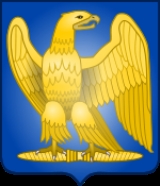
The arms of the Buonaparte family were: Gules two bends sinister between two mullets or. In 1804 Napoleon changed the arms to Azure an imperial eagle or. The change applied to all members of his family except for his brother Lucien, and the son of Jerome's first marriage.
Napoleon I
Napoleon is the most prominent name associated with the Bonaparte family because he conquered much of the Western world during the early part of the 19th century. He was elected as first consul of France on November 10, 1799 with the help of his brother, Lucien Bonaparte, and president of the Council of Five Hundred at Saint-Cloud. He was crowned Emperor of the French and ruled from 1804-1814, 1815.
Following his conquest of most of Western Europe, the first Napoleon made his elder brother Joseph (1768-1844) king first of Naples (1806-1808) and then of Spain (1808-1813), his third brother Louis (1778-1846) king of Holland (1806-1810) (subsequently forcing his abdication after his failure to subordinate Dutch interests to those of France) and his youngest brother Jerome Bonaparte (1784-1860) king of Westphalia, the short-lived realm created from some of the states of northwestern Germany (1807-1813).
Napoleon's son Napoleon François Charles Joseph (1811-1832) was created king of Rome (1811-1814) and was later styled Napoleon II by loyalists of the dynasty, though he only ruled for two weeks after his father's abdication. Charles Louis Napoléon (1808-1873), son of Louis Napoléon, was president of France in 1848-1852 and emperor in 1852-1870, reigning as Napoléon III; his son, Eugène Bonaparte (1856-1879), styled the Prince Imperial, died fighting the Zulus in Natal, South Africa. With his death, the family lost much of its remaining political appeal, though claimants continue to assert their right to the imperial title. A political movement for Corsican independence surfaced in the 1990s which included a Bonapartist restoration in its programme.
Crowns held by the family
King of Spain
The family tree
Carlo-Maria (Ajaccio 1746-Montpellier 1785) married Maria Letizia Ramolino (Ajaccio 1750 - Rome 1836) in 1764. He was a minor official in the local courts. They had eight children:
- Joseph Bonaparte (Corte 1768-Florence 1844), King of Naples and Spain, married Julie Clary, sister of Napoleon's childhood sweetheart, Désirée, who was to become the wife of General Jean-Baptiste Bernadotte, the later Charles XIV of Sweden.
- Napoléon (I) Bonaparte (1769-1821) Emperor
- Lucien Bonaparte (1775-1840)
- 2 daughters with first wife, Katherina Boyer
- Christine Charlotte Bonaparte (1795-1865)
- Victoire Gertrude Bonaparte (1797-1797)
- 10 children with second wife, Alexandrine von Bleschamps:
- Christine Charlotte Alexandrine Egypta Bonaparte (1798-1847)
- Charles Lucien Jules Laurent Bonaparte (1803-1857), ornithologist and politician married Princess Zénaïde Bonaparte (1801-1854)
- Laetitia Christine Bonaparte (1804-1871)
- Joseph Lucien Bonaparte (1806-1807)
- Jeanne Bonaparte (1807-1829)
- Paul Marie Bonaparte (1808-1827)
- Louis Lucien Bonaparte (1813-1891)
- Pierre Napoleon Bonaparte (1815-1881)
- Roland Bonaparte (1858-1924) married Marie Blanc
- Marie Bonaparte (1882-1962)
- Jeanne Bonaparte (1861-1910)
- Antoine Lucien Bonaparte (1816-1877)
- Alexandrine Marie Bonaparte (1818-1874)
- Constance Bonaparte (1823-1876)
- Maria-Anna Elisa Bonaparte (1777-1820), grand-duchess of Tuscany married Félix Bacciochi
- Louis Bonaparte, (1778 - 1846) married Hortense de Beauharnais, Napoleon's stepdaughter
- Maria Paola or Marie Pauline Bonaparte (1780-1825), married in 1797 to French general Charles Leclerc and later married Prince Borghese.
- Maria Annunziata Caroline Bonaparte (1782-1839) married Joachim Murat
- Jérôme Bonaparte (1784-1860), King of Westphalia
- 2 children from first marriage, to Betsy Patterson of Baltimore, including:
- Jérôme Napoleon Bonaparte (1805-1870), married Susan May Williams
- 2 sons:
- Jerome Napoleon Bonaparte II (1830-1893), married Caroline Le Roy Appleton Edgar
- Louise-Eugénie Bonaparte (1873-1923), married in 1896 Count Adam Carl von Moltke-Huitfeld (1864-1944)
- Jerome Napoleon Charles Bonaparte (1878-1945), married Blanche Pierce Stenbeigh: no children.
- Charles Joseph Bonaparte (1851-1921), U.S. Attorney General married Ellen Channing Day
- 3 children from second marriage, to Catharina of Württemberg, including:
- Jérôme Napoléon Charles Bonaparte (1814-1847)
- Mathilde Laetitia Wilhelmine Bonaparte (1820-1904), married Prince Anatole Demidoff di San Donato: no children
- Napoléon Joseph Charles Paul Bonaparte (1822-1891), called Plon-Plon married Princess Marie Clothilde of Savoy daughter of Victor Emmanuel II of Italy
- Napoléon Victor Jérôme Frédéric Bonaparte (1862-1926) married Princess Clémentine of Belgium
- Marie Clotilde Eugénie Alberte Laetitia Généviève Bonaparte (1912-1996)
- Louis Jérôme Victor Emmanuel Léopold Marie Bonaparte (1914-1997)
- Charles Marie Jérôme Victor Bonaparte (born 1950) married Princess Béatrice of Bourbon-Two Sicilies of the Bourbon family
- Caroline Marie Constance Bonaparte (born 1980)
- Jean-Christophe Louis Ferdinand Albéric Bonaparte (born 1986)
- Catherine Elisabeth Albérique Marie Bonaparte (born 1950)
- Laure Clémentine Geneviève Bonaparte (born 1952)
- Jérôme Xavier Marie Joseph Victor Bonaparte (born 1957)
- Napoléon Louis Joseph Jérôme Bonaparte (1864-1932) Russian general
- Marie Laetitia Eugénie Catherine Adélaïde Bonaparte (1866-1926)
Current descendants
The headship of the family is in dispute between Charles Napoléon, born 1950, great-great-grandson of Jérôme Bonaparte by his second marriage; and his son Jean-Christophe (born 1986) who was appointed heir in the will of his grandfather Prince Louis Napoléon. The only other male member of the family is the brother of Charles, Prince Jérôme, (born 1957), unmarried. There are no remaining descendants in male line from any other of Napoleon's brothers. There are, however, numerous descendants of Napoleon's illegitimate, but recognized son Walewski from his union with Marie, Countess Walewski. Of these include the Wattier family and its union with the Bonaparte family. The later descendents were the Peschongs and Herrs. A descendant of Napoleon's sister Caroline Bonaparte is actor Rene Auberjonois.
See also
|-
|-
|-
|-
|-
External links
|
| |
|
|