


Ocean liner

Encyclopedia
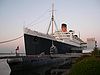
Passenger ship
A passenger ship is a ship whose primary function is to carry passengers. The category does not include cargo vessels which have accommodations for limited numbers of passengers, such as the ubiquitous twelve-passenger freighters once common on the seas in which the transport of passengers is...
designed to transport people from one seaport to another along regular long-distance maritime
Shipping
Shipping has multiple meanings. It can be a physical process of transporting commodities and merchandise goods and cargo, by land, air, and sea. It also can describe the movement of objects by ship.Land or "ground" shipping can be by train or by truck...
routes according to a schedule. Liners may also carry cargo or mail, and may sometimes be used for other purposes (e.g., for pleasure cruises or as troopship
Troopship
A troopship is a ship used to carry soldiers, either in peacetime or wartime...
s).
Cargo vessels running to a schedule are sometimes referred to as liners. The category does not include ferries
Ferry
A ferry is a form of transportation, usually a boat, but sometimes a ship, used to carry primarily passengers, and sometimes vehicles and cargo as well, across a body of water. Most ferries operate on regular, frequent, return services...
or other vessels engaged in short-sea trading, nor dedicated cruise ship
Cruise ship
A cruise ship or cruise liner is a passenger ship used for pleasure voyages, where the voyage itself and the ship's amenities are part of the experience, as well as the different destinations along the way...
s where the voyage itself, and not transportation, is the prime purpose of the trip. Nor does it include tramp steamer
Tramp steamer
A ship engaged in the tramp trade is one which does not have a fixed schedule or published ports of call. As opposed to freight liners, tramp ships trade on the spot market with no fixed schedule or itinerary/ports-of-call...
s, even those equipped to handle limited numbers of passengers. Some shipping companies refer to themselves as "lines" and their container ship
Container ship
Container ships are cargo ships that carry all of their load in truck-size intermodal containers, in a technique called containerization. They form a common means of commercial intermodal freight transport.-History:...
s, which often operate over set routes according to established schedules, as "liners".
Ocean liners are usually strongly built with a high freeboard
Freeboard (nautical)
In sailing and boating, freeboardmeans the distance from the waterline to the upper deck level, measured at the lowest point of sheer where water can enter the boat or ship...
to withstand rough seas and adverse conditions encountered in the open ocean, having large capacities for fuel, food and other consumables on long voyages.
Overview
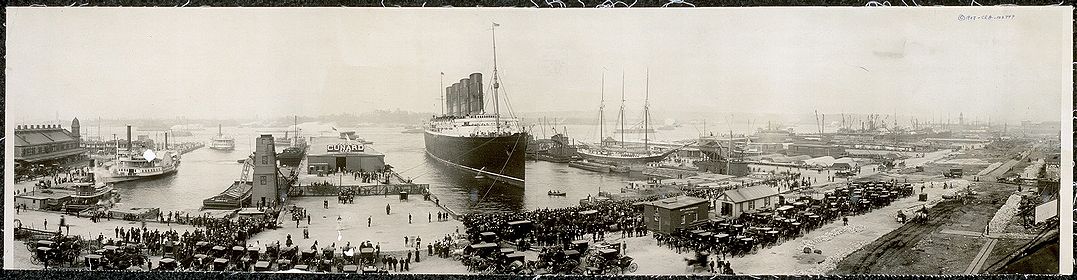
Airliner
An airliner is a large fixed-wing aircraft for transporting passengers and cargo. Such aircraft are operated by airlines. Although the definition of an airliner can vary from country to country, an airliner is typically defined as an aircraft intended for carrying multiple passengers in commercial...
s in the late 1960s. In addition to passengers, liners carried mail
Mail
Mail, or post, is a system for transporting letters and other tangible objects: written documents, typically enclosed in envelopes, and also small packages are delivered to destinations around the world. Anything sent through the postal system is called mail or post.In principle, a postal service...
and cargo. Ships contracted to carry British
United Kingdom
The United Kingdom of Great Britain and Northern IrelandIn the United Kingdom and Dependencies, other languages have been officially recognised as legitimate autochthonous languages under the European Charter for Regional or Minority Languages...
Royal Mail
Royal Mail
Royal Mail is the government-owned postal service in the United Kingdom. Royal Mail Holdings plc owns Royal Mail Group Limited, which in turn operates the brands Royal Mail and Parcelforce Worldwide...
used the designation RMS
Royal Mail Ship
Royal Mail Ship , usually seen in its abbreviated form RMS, a designation which dates back to 1840, is the ship prefix used for seagoing vessels that carry mail under contract by Royal Mail...
. Liners were also the preferred way to move gold and other high-value cargoes.
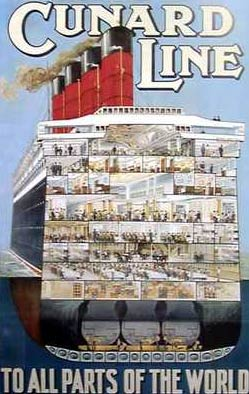
Europe
Europe is, by convention, one of the world's seven continents. Comprising the westernmost peninsula of Eurasia, Europe is generally 'divided' from Asia to its east by the watershed divides of the Ural and Caucasus Mountains, the Ural River, the Caspian and Black Seas, and the waterways connecting...
and North America
North America
North America is a continent wholly within the Northern Hemisphere and almost wholly within the Western Hemisphere. It is also considered a northern subcontinent of the Americas...
. It was on this route that the fastest, largest and most advanced liners travelled. But while in contemporary popular imagination the term "ocean liners" evokes these transatlantic superliner
Superliner (passenger ship)
A superliner is an ocean liner of over 10,000 gross tons. The term was coined in the late 19th century, when ocean liners were rapidly increasing in size and speed...
s, most ocean liners historically were mid-sized vessels which served as the common carriers of passengers and freight between nations and among mother countries and their colonies and dependencies in the pre-jet age
Jet age
The Jet Age is a period of history defined by the social change brought about by the advent of large aircraft powered by turbine engines. These aircraft are able to fly much higher, faster, and farther than older piston-powered propliners, making transcontinental and inter-continental travel...
. Such routes included Europe to African and Asian colonies, Europe to South America, and migrant traffic from Europe to North America in the 19th and first two decades of the 20th centuries, and to Canada and Australia after the Second World War.
Shipping lines are companies engaged in shipping passengers and cargo, often on established routes and schedules. Regular scheduled voyages on a set route are called "line voyages" and vessels (passenger or cargo) trading on these routes to a timetable are called liners. The alternative to liner trade is "tramping" whereby vessels are notified on an ad-hoc basis as to the availability of a cargo to be transported. (In older usage, "liner" also referred to ships of the line, that is, line-of-battle ships, but that usage is now rare.) The term "ocean liner" has come to be used interchangeably with "passenger liner", although it can refer to a cargo liner
Cargo liner
A Cargo liner is a type of merchant ship which carried general cargo and often passengers. They became common just after the middle of the nineteenth century, and eventually gave way to container ships and other more specialized carriers in the latter half of the twentieth...
or cargo-passenger liner.
The term ocean liner is usually used to refer to a ship that is constructed to a higher standard than a normal cruise ship
Cruise ship
A cruise ship or cruise liner is a passenger ship used for pleasure voyages, where the voyage itself and the ship's amenities are part of the experience, as well as the different destinations along the way...
, enabling it to cross oceans such as the Atlantic and Pacific with passengers embarked in inclement weather conditions. Characteristics of true ocean liners include heavier plating, robust scantling
Scantling
Scantling is a measurement of prescribed size, dimensions, or cross sectional areas. For comparison, see Form Factor: -Shipping:In shipbuilding, the scantling refers to the collective dimensions of the various parts, particularly the framing and structural supports. The word is most often used in...
s, great seaworthiness, high speed (around 30 knots) and accordingly very powerful propulsion (up to more than 200,000 hp), oblong hull, usually sharp bow
Bow (ship)
The bow is a nautical term that refers to the forward part of the hull of a ship or boat, the point that is most forward when the vessel is underway. Both of the adjectives fore and forward mean towards the bow...
, high freeboards, deep draught
Draft (hull)
The draft of a ship's hull is the vertical distance between the waterline and the bottom of the hull , with the thickness of the hull included; in the case of not being included the draft outline would be obtained...
, smooth shape of superstructure. To passengers, in one or two class layout, ocean liners offer traditional luxury in large public spaces (lounges) and moderate choice of entertainment on board.
However, the difference between ocean liners and cruise ships has blurred, beginning at the advent of the Jet Age
Jet age
The Jet Age is a period of history defined by the social change brought about by the advent of large aircraft powered by turbine engines. These aircraft are able to fly much higher, faster, and farther than older piston-powered propliners, making transcontinental and inter-continental travel...
where transoceanic ship service declined. In order for ocean liners to remain profitable, cruise lines have modified some of them to operate on cruise routes, such as Queen Elizabeth 2
RMS Queen Elizabeth 2
Queen Elizabeth 2, often referred to simply as the QE2, is an ocean liner that was operated by Cunard from 1969 to 2008. Following her retirement from cruising, she is now owned by Istithmar...
and SS France
SS France (1961)
SS France was a Compagnie Générale Transatlantique ocean liner, constructed by the Chantiers de l'Atlantique shipyard at Saint-Nazaire, France, and put into service in February 1962...
. Certain characteristics of older ocean liners made them unsuitable for cruising, such as high fuel consumption, deep draught preventing them from entering shallow ports, and cabins (often windowless) designed to maximize passenger numbers rather than comfort. The Italian Line
Italian Line
The Italian Line or Italia Line, also known as the Italia di Navigazione S.p.A., was a passenger shipping line that operated regular transatlantic services between Italy and the United States, and Italy and South America...
's Michelangelo
T/S Michelangelo
SS Michelangelo was an Italian ocean liner built in 1965 for Italian Line by Ansaldo Shipyards, Genoa. She was one of the last ships to be built primarily for liner service across the North Atlantic. Her sister ship was the SS Raffaello....
and Raffaello
T/S Raffaello
SS Raffaello was an Italian ocean liner built in 1965 for Italian Line by the Cantieri Riuniti dell'Adriatico, Monfalcone. She was one of the last ships to be built primarily for liner service across the North Atlantic. Her sister ship was the SS Michelangelo.-Design and construction:Italian Line...
, the last ocean liners to be built primarily for crossing the North Atlantic, could not be converted economically and had short careers.
Contemporary cruise ships built after the 1980s show characteristics of size and strength once reserved for ocean liners—some have undertaken regular scheduled transatlantic crossings. There have been nine or more newly-built cruise ships added every year since 2001, all at 100,000 tonnes or greater. The only comparable ocean liner to be completed in recent years has been Cunard Line
Cunard Line
Cunard Line is a British-American owned shipping company based at Carnival House in Southampton, England and operated by Carnival UK. It has been a leading operator of passenger ships on the North Atlantic for over a century...
's Queen Mary 2
RMS Queen Mary 2
RMS Queen Mary 2 is a transatlantic ocean liner. She was the first major ocean liner built since in 1969, the vessel she succeeded as flagship of the Cunard Line....
in 2004. Following the retirement of her running mate the Queen Elizabeth 2
RMS Queen Elizabeth 2
Queen Elizabeth 2, often referred to simply as the QE2, is an ocean liner that was operated by Cunard from 1969 to 2008. Following her retirement from cruising, she is now owned by Istithmar...
in November 2008, Queen Mary 2 is the only liner operating on transatlantic routes, though she also sees significant service on cruise routes.
The 19th century
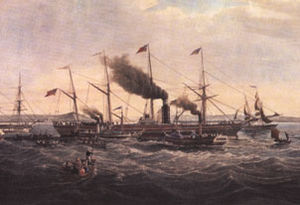
Black Ball Line (trans-Atlantic packet)
The Black Ball Line initially consisted of four packet ships, the Amity, Courier, Pacific and the James Monroe. All of these were running between Liverpool, England and New York City. This first scheduled trans-Atlantic service was founded in 1817...
, with a fleet of sailing ship
Sailing ship
The term sailing ship is now used to refer to any large wind-powered vessel. In technical terms, a ship was a sailing vessel with a specific rig of at least three masts, square rigged on all of them, making the sailing adjective redundant. In popular usage "ship" became associated with all large...
s, offered the first regular passenger service with emphasis on passenger comfort, from England
England
England is a country that is part of the United Kingdom. It shares land borders with Scotland to the north and Wales to the west; the Irish Sea is to the north west, the Celtic Sea to the south west, with the North Sea to the east and the English Channel to the south separating it from continental...
to the United States
United States
The United States of America is a federal constitutional republic comprising fifty states and a federal district...
. From the early 19th century, steam engine
Isambard Kingdom Brunel
Isambard Kingdom Brunel, FRS , was a British civil engineer who built bridges and dockyards including the construction of the first major British railway, the Great Western Railway; a series of steamships, including the first propeller-driven transatlantic steamship; and numerous important bridges...
s began to appear in ships, but initially they were inefficient and offered little advantage over sailing ship
Sailing ship
The term sailing ship is now used to refer to any large wind-powered vessel. In technical terms, a ship was a sailing vessel with a specific rig of at least three masts, square rigged on all of them, making the sailing adjective redundant. In popular usage "ship" became associated with all large...
s.
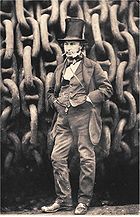
Clipper
A clipper was a very fast sailing ship of the 19th century that had three or more masts and a square rig. They were generally narrow for their length, could carry limited bulk freight, small by later 19th century standards, and had a large total sail area...
domination was challenged when the Great Western
SS Great Western
SS Great Western of 1838, was an oak-hulled paddle-wheel steamship; the first purpose-built for crossing the Atlantic and the initial unit of the Great Western Steamship Company. Designed by Isambard Kingdom Brunel, Great Western proved satisfactory in service and was the model for all successful...
, designed by railway engineer Isambard Kingdom Brunel
Isambard Kingdom Brunel
Isambard Kingdom Brunel, FRS , was a British civil engineer who built bridges and dockyards including the construction of the first major British railway, the Great Western Railway; a series of steamships, including the first propeller-driven transatlantic steamship; and numerous important bridges...
, began its first Atlantic service in 1837. It took 15 days to cross the Atlantic, as compared with two months by sail-powered ships. Unlike the clippers, steamers offered a consistent speed and the ability to keep to a schedule. The early steamships still had sails as well, though, as engines at this time had very inefficient consumption of fuel. Having sails enabled vessels like the Great Western to take advantage of favourable weather conditions and minimise fuel consumption.
In 1840 Cunard Line
Cunard Line
Cunard Line is a British-American owned shipping company based at Carnival House in Southampton, England and operated by Carnival UK. It has been a leading operator of passenger ships on the North Atlantic for over a century...
’s Britannia
RMS Britannia
The RMS Britannia was an ocean liner of the British and North American Royal Mail Steam Packet Company, later known as Cunard Steamship Company. She was launched on 5 February 1840, at the yard of Robert Duncan & Company in Greenock, Scotland...
began its first regular passenger and cargo service by a steamship, sailing from Liverpool to Boston.
Despite some advantages offered by the steamships, clippers remained dominant. In 1847, the Great Britain
SS Great Britain
SS Great Britain was an advanced passenger steamship designed by Isambard Kingdom Brunel for the Great Western Steamship Company's transatlantic service between Bristol and New York. While other ships had previously been built of iron or equipped with a screw propeller, Great Britain was the first...
became the first iron-hulled screw-driven ship to cross the Atlantic. More efficient propellers began to replace the paddle wheel
Paddle wheel
A paddle wheel is a waterwheel in which a number of scoops are set around the periphery of the wheel. It has several usages.* Very low lift water pumping, such as flooding paddy fields at no more than about height above the water source....
s used by earlier ocean liners.
.jpg)
White Star Line
The Oceanic Steam Navigation Company or White Star Line of Boston Packets, more commonly known as the White Star Line, was a prominent British shipping company, today most famous for its ill-fated vessel, the RMS Titanic, and the World War I loss of Titanics sister ship Britannic...
’s Oceanic
RMS Oceanic (1870)
RMS Oceanic was the White Star Line's first liner and an important turning point in passenger liner design.-Design and construction:Oceanic was built by Harland and Wolff in Belfast, and was launched on 27 August 1870, arriving in Liverpool for her maiden voyage on 26 February 1871...
set a new standard for ocean travel by having its first-class cabins amidships, with the added amenity of large portholes, electricity and running water. The size of ocean liners increased from 1880 to meet the needs of immigration to the United States and Australia.
The Umbria
RMS Umbria
RMS Umbria and her sister ship RMS Etruria were the last two Cunarders that were fitted with auxiliary sails. RMS Umbria was built by John Elder & Co at Glasgow, Scotland in 1884. The “Umbria” and her sister “Etruria” were record breakers. They were the largest liners then in service and they plied...
and her sister ship the Etruria
RMS Etruria
RMS Etruria and her sister ship RMS Umbria were the last two Cunarders that were fitted with auxiliary sails. RMS Etruria was built by John Elder & Co of Glasgow, Scotland in 1884. The Etruria and her sister Umbria, by the standards of the time, were record breakers. They were the largest liners...
were the last two liners of the period to be fitted with auxiliary sails. Umbria was built by John Elder & Co of Glasgow, Scotland in 1884. Umbria and Etruria were record breakers by the standards of the time. They were the largest liners then in service and they plied the Liverpool to New York route.
The Ophir
SS Ophir
The SS Ophir was a British steel twin-screw ocean liner owned by the Orient Steamship Co. of London, which was employed on the company's London/Aden/Colombo/Australia service from the 1890s until 1915 when she was requisitioned by the Admiralty and saw three years' service as an armed merchant...
was a 6814-ton steamship owned by the Orient Steamship Co, fitted with refrigeration equipment, which plied the Suez Canal route from England to Australia during the 1890s and the years leading to World War I, when she was converted to an armed merchant cruiser.
The 20th century
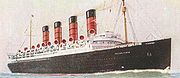
World War II
World War II, or the Second World War , was a global conflict lasting from 1939 to 1945, involving most of the world's nations—including all of the great powers—eventually forming two opposing military alliances: the Allies and the Axis...
is considered the "golden age" of ocean liners. Driven by strong demand created by European emigration to the Americas, international competition between passenger lines and a new emphasis on comfort, shipping companies built increasingly larger and faster ships.
Canadian Pacific Railway
Canadian Pacific Railway
The Canadian Pacific Railway , formerly also known as CP Rail between 1968 and 1996, is a historic Canadian Class I railway founded in 1881 and now operated by Canadian Pacific Railway Limited, which began operations as legal owner in a corporate restructuring in 2001...
became one of the largest transportation system in the world combining with ships and railways operating from Canada
Canada
Canada is a North American country consisting of ten provinces and three territories. Located in the northern part of the continent, it extends from the Atlantic Ocean in the east to the Pacific Ocean in the west, and northward into the Arctic Ocean...
. In 1891 CPR shipping division
CP Ships
CP Ships was a large Canadian container shipping company, prior to being taken over by Hapag Lloyd in late 2005. CP Ships had its head office in the City of Westminster in London and later in the City Place Gatwick development on the property of London Gatwick Airport in Crawley, West Sussex.The...
began its first Pacific operation. In 1903, CPR began its first Atlantic service because of rising migration of Europeans to western Canada
Western Canada
Western Canada, also referred to as the Western provinces and commonly as the West, is a region of Canada that includes the four provinces west of the province of Ontario.- Provinces :...
as the result of free land offered by the Canadian government.
Since the 1830s, passenger liners had unofficially been competing for the honour of making the fastest North Atlantic crossing. This honour came to be known as the Blue Riband
Blue Riband
The Blue Riband is an unofficial accolade given to the passenger liner crossing the Atlantic Ocean in regular service with the record highest speed. The term was borrowed from horse racing and was not widely used until after 1910. Under the unwritten rules, the record is based on average speed...
; in 1897 Germany took the award with a series of new ocean liners, starting with the Kaiser Wilhelm der Große
SS Kaiser Wilhelm der Große
The Kaiser Wilhelm der Grosse was a German transatlantic ocean liner named after Wilhelm I, German Emperor, the first ruler of united Germany. Constructed in Stettin for the North German Lloyd , she entered service in 1897 and was the first liner to have four funnels...
. In 1905, the British Cunard Line
Cunard Line
Cunard Line is a British-American owned shipping company based at Carnival House in Southampton, England and operated by Carnival UK. It has been a leading operator of passenger ships on the North Atlantic for over a century...
fitted its liner Carmania with steam turbines with which it outperformed its near-identical sister Caronia, powered by triple-expansion steam engines. At the time, these were the largest ships in the Cunard fleet, and the use of the different propulsion methods in otherwise similar ships allowed the company to evaluate the merits of both. The engines in Carmania were successful and, consequently, in 1907 Cunard introduced the much larger Lusitania
RMS Lusitania
RMS Lusitania was a British ocean liner designed by Leonard Peskett and built by John Brown and Company of Clydebank, Scotland. The ship entered passenger service with the Cunard Line on 26 August 1907 and continued on the line's heavily-traveled passenger service between Liverpool, England and New...
and Mauretania
RMS Mauretania (1906)
RMS Mauretania was an ocean liner designed by Leonard Peskett and built by Swan, Hunter & Wigham Richardson at Wallsend, Tyne and Wear for the British Cunard Line, and launched on 20 September 1906. At the time, she was the largest and fastest ship in the world. Mauretania became a favourite among...
, both powered by steam turbine
Steam turbine
A steam turbine is a mechanical device that extracts thermal energy from pressurized steam, and converts it into rotary motion. Its modern manifestation was invented by Sir Charles Parsons in 1884....
s. The Mauretania won the Blue Riband and held it for an astonishing 20 years.
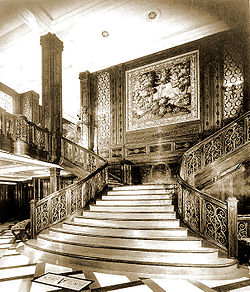
RMS Olympic
RMS Olympic was the lead ship of the Olympic-class ocean liners built for the White Star Line, which also included Titanic and Britannic...
, the first of a trio of 45,000 plus gross ton liners with the Titanic and Britannic
HMHS Britannic
HMHS Britannic was the third and largest of the White Star Line. She was the sister ship of and , and was intended to enter service as a transatlantic passenger liner. She was launched just before the start of the First World War and was laid up at her builders in Belfast for many months before...
. These ships were almost 15,000 tonnes larger and 100 feet (30.5 m) longer than the Lusitania and Mauretania. Like most other White Star Liners, these three ships were born of a special effort by the White Star Line to attract more immigrants by treating them with respect and making their crossings pleasurable.
Hamburg-America Line also ordered three giant ships, the Imperator
SS Imperator
SS Imperator was an ocean liner built for the Hamburg Amerikanische Packetfahrt Actien Gesellschaft launched in 1912. She was the first of a trio of successively larger Hamburg America ships that included and built by the line for transatlantic passenger service...
, Vaterland and Bismarck, all over 51,500 gross tons. Imperator was launched in 1912. Bismarck would be the largest ship in the world until 1935. These ships did little or no service with Hamburg-America before World War I. After the war, they were awarded as war reparations and given to British and American lines.
The surge in ocean liner size outpaced the shipping regulations. In 1912, the Titanic sank after hitting an iceberg, with more than 1,500 fatalities. A factor contributing to the high loss of life was that there were not enough lifeboat
Lifeboat (shipboard)
A lifeboat is a small, rigid or inflatable watercraft carried for emergency evacuation in the event of a disaster aboard ship. In the military, a lifeboat may be referred to as a whaleboat, dinghy, or gig. The ship's tenders of cruise ships often double as lifeboats. Recreational sailors sometimes...
s for everyone. After the Titanic disaster, the regulation was revised to require all ocean liners to carry enough lifeboats for all passengers and crew. In addition, the International Ice Patrol
International Ice Patrol
The International Ice Patrol is an organization with the purpose of monitoring the presence of icebergs in the Atlantic and Arctic Oceans and reporting their movements for safety purposes. It is operated by United States Coast Guard but is funded by the 13 nations interested in trans-Atlantic...
was established to monitor the busy north-Atlantic shipping lanes for icebergs.
Until the 1920s, most shipping lines relied heavily on emigration for passengers and they were hard hit when the US Congress introduced a bill to limit immigration into the United States
United States
The United States of America is a federal constitutional republic comprising fifty states and a federal district...
. As a result, many ships took on cruising
Cruising (maritime)
Cruising by boat is a lifestyle that involves living for extended time on a boat while traveling from place to place for pleasure. Cruising generally refers to trips of a few days or more, and can extend to round-the-world voyages.- History :...
, and the least expensive cabins were reconfigured from third-class to tourist-class. To make matters worse, the Great Depression
Great Depression
The Great Depression was a severe worldwide economic depression in the decade preceding World War II. The timing of the Great Depression varied across nations, but in most countries it started in about 1929 and lasted until the late 1930s or early 1940s...
put many shipping lines into bankruptcy.
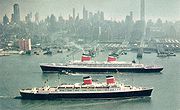
SS Bremen (1929)
The SS Bremen was a German-built ocean liner constructed for the Norddeutscher Lloyd line to work the transatlantic sea route. The Bremen was notable for her bulbous bow construction, high-speed engines, and low, streamlined profile. At the time of her construction, she and her sister ship were...
and Europa
SS Europa (1930)
The SS Europa was a German built ocean liner constructed for the Norddeutsche Lloyd line to work the transatlantic sea route...
beat the crossing record set by the Mauretania 20 years earlier with an average speed of almost 28 knots (55 km/h). The ships used bulbous bow
Bulbous bow
A bulbous bow is a protruding bulb at the bow of a ship just below the waterline. The bulb modifies the way the water flows around the hull, reducing drag and thus increasing speed, range, fuel efficiency, and stability...
s and steam turbines to reach these high speeds while maintaining economical operating costs. In 1933 the Italian
Italy
Italy , officially the Italian Republic languages]] under the European Charter for Regional or Minority Languages. In each of these, Italy's official name is as follows:;;;;;;;;), is a unitary parliamentary republic in South-Central Europe. To the north it borders France, Switzerland, Austria and...
51,100-ton ocean liner Rex
SS Rex
The SS Rex was an Italian ocean liner launched in 1931. It held the westbound Blue Riband between 1933 and 1935. Originally built for the Navigazione Generale Italiana as the SS Guglielmo Marconi, its state-ordered merger with the Lloyd Sabaudo line meant that the ship sailed for the newly created...
, with a time of four days and thirteen hours, captured the westbound Blue Riband, which she held for two years. In 1935 the French liner Normandie
SS Normandie
SS Normandie was an ocean liner built in Saint-Nazaire, France for the French Line Compagnie Générale Transatlantique. She entered service in 1935 as the largest and fastest passenger ship afloat; she is still the most powerful steam turbo-electric-propelled passenger ship ever built.Her novel...
used a revolutionary new hull design and powerful turbo-electric
Turbo-electric
A turbo-electric transmission uses electric generators to convert the mechanical energy of a turbine into electric energy and electric motors to convert it back into mechanical energy to power the driveshafts....
propulsion to take the Blue Riband from the Rex. Due to the poor economic conditions, the British government amalgamated Cunard Line and White Star Lines. The newly merged company countered with its liners Queen Mary
RMS Queen Mary
RMS Queen Mary is a retired ocean liner that sailed primarily in the North Atlantic Ocean from 1936 to 1967 for the Cunard Line...
and Queen Elizabeth
RMS Queen Elizabeth
RMS Queen Elizabeth was an ocean liner operated by the Cunard Line. Plying with her running mate Queen Mary as a luxury liner between Southampton, UK and New York City, USA via Cherbourg, France, she was also contracted for over twenty years to carry the Royal Mail as the second half of the two...
. The Queen Mary was to hold the Blue Riband in 1936-37 and from 1938-52.
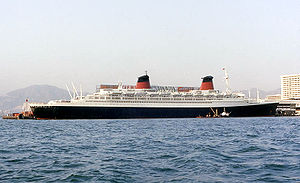
SS United States
SS United States is a luxury passenger liner built in 1952 for the United States Lines designed to capture the trans-Atlantic speed record....
, which in 1952 bested the records set by the Queen Mary to become the holder of the Blue Riband, a designation it retains to this day. Also significant was the 1961-built France
SS France (1961)
SS France was a Compagnie Générale Transatlantique ocean liner, constructed by the Chantiers de l'Atlantique shipyard at Saint-Nazaire, France, and put into service in February 1962...
(later renamed Norway) which held the record for the longest passenger ship from when she entered service in 1961 until the launch of Queen Mary 2
RMS Queen Mary 2
RMS Queen Mary 2 is a transatlantic ocean liner. She was the first major ocean liner built since in 1969, the vessel she succeeded as flagship of the Cunard Line....
in 2003. Australian government-sponsored immigration resulted in a busy trade between Europe and Australia, producing such notable ships as the Oriana
SS Oriana (1959)
SS Oriana was the last of the Orient Steam Navigation Company's ocean liners. She was built at Vickers-Armstrong, Barrow-in-Furness, Cumbria and launched on 3 November 1959 by Princess Alexandra...
and Canberra
SS Canberra
SS Canberra was an ocean liner, which later operated on cruises, in the P&O fleet from 1961 to 1997. She was built at the Harland and Wolff shipyard in Belfast, Northern Ireland at a cost of £17,000,000. The ship was named on 17 March 1958, after the federal capital of Australia, Canberra...
. These two, operating on the P&O
Peninsular and Oriental Steam Navigation Company
The Peninsular and Oriental Steam Navigation Company, which is usually known as P&O, is a British shipping and logistics company which dated from the early 19th century. Following its sale in March 2006 to Dubai Ports World for £3.9 billion, it became a subsidiary of DP World; however, the P&O...
-Orient Line service, were the largest, fastest and last liners built for the Australian route.
Decline of long-distance line voyages
Before World War II, aircraftAircraft
An aircraft is a vehicle that is able to fly by gaining support from the air, or, in general, the atmosphere of a planet. An aircraft counters the force of gravity by using either static lift or by using the dynamic lift of an airfoil, or in a few cases the downward thrust from jet engines.Although...
had not been a huge threat to ocean liners. Most pre-war aircraft were generally unreliable, vulnerable to bad weather, few had the range needed for transoceanic flights, and all were expensive and had a small passenger capacity. Although at that time some more advanced airliners appeared, like Douglas DC-3
Douglas DC-3
The Douglas DC-3 is an American fixed-wing propeller-driven aircraft whose speed and range revolutionized air transport in the 1930s and 1940s. Its lasting impact on the airline industry and World War II makes it one of the most significant transport aircraft ever made...
still in use today, they were not able to endanger the ocean liner's dominance. However, World War II
World War II
World War II, or the Second World War , was a global conflict lasting from 1939 to 1945, involving most of the world's nations—including all of the great powers—eventually forming two opposing military alliances: the Allies and the Axis...
accelerated the development of aircraft. Four-engined bombers such as the Avro Lancaster
Avro Lancaster
The Avro Lancaster is a British four-engined Second World War heavy bomber made initially by Avro for the Royal Air Force . It first saw active service in 1942, and together with the Handley Page Halifax it was one of the main heavy bombers of the RAF, the RCAF, and squadrons from other...
and Boeing B-29, with their long range and massive carrying capacity, were a natural prototype for a next-generation airliner
Airliner
An airliner is a large fixed-wing aircraft for transporting passengers and cargo. Such aircraft are operated by airlines. Although the definition of an airliner can vary from country to country, an airliner is typically defined as an aircraft intended for carrying multiple passengers in commercial...
. Jet aircraft
Jet aircraft
A jet aircraft is an aircraft propelled by jet engines. Jet aircraft generally fly much faster than propeller-powered aircraft and at higher altitudes – as high as . At these altitudes, jet engines achieve maximum efficiency over long distances. The engines in propeller-powered aircraft...
technology also accelerated after the development of jet aircraft for military use in World War II. In 1953, the De Havilland Comet
De Havilland Comet
The de Havilland DH 106 Comet was the world's first commercial jet airliner to reach production. Developed and manufactured by de Havilland at the Hatfield, Hertfordshire, United Kingdom headquarters, it first flew in 1949 and was a landmark in aeronautical design...
became the first commercial jet airliner; the Sud Aviation Caravelle
Sud Aviation Caravelle
The Sud Aviation SE 210 Caravelle was the first short/medium-range jet airliner produced by the French Sud Aviation firm starting in 1955 . The Caravelle was one of the more successful European first generation jetliners, selling throughout Europe and even penetrating the United States market, with...
, Boeing 707
Boeing 707
The Boeing 707 is a four-engine narrow-body commercial passenger jet airliner developed by Boeing in the early 1950s. Its name is most commonly pronounced as "Seven Oh Seven". The first airline to operate the 707 was Pan American World Airways, inaugurating the type's first commercial flight on...
and Douglas DC-8
Douglas DC-8
The Douglas DC-8 is a four-engined narrow-body passenger commercial jet airliner, manufactured from 1958 to 1972 by the Douglas Aircraft Company...
followed. The Michelangelo
T/S Michelangelo
SS Michelangelo was an Italian ocean liner built in 1965 for Italian Line by Ansaldo Shipyards, Genoa. She was one of the last ships to be built primarily for liner service across the North Atlantic. Her sister ship was the SS Raffaello....
and Raffaello
T/S Raffaello
SS Raffaello was an Italian ocean liner built in 1965 for Italian Line by the Cantieri Riuniti dell'Adriatico, Monfalcone. She was one of the last ships to be built primarily for liner service across the North Atlantic. Her sister ship was the SS Michelangelo.-Design and construction:Italian Line...
, built in 1962 and 1963 for the Italian Line
Italian Line
The Italian Line or Italia Line, also known as the Italia di Navigazione S.p.A., was a passenger shipping line that operated regular transatlantic services between Italy and the United States, and Italy and South America...
, were two of the last ocean liners to be built primarily for liner service across the North Atlantic while the concept of last British liner Queen Elizabeth 2 allowed also conversion to a cruise ship. In the late 1960s, airlines gradually took over the business formerly done by ships, and the first commercial flight of new Boeing 747
Boeing 747
The Boeing 747 is a wide-body commercial airliner and cargo transport, often referred to by its original nickname, Jumbo Jet, or Queen of the Skies. It is among the world's most recognizable aircraft, and was the first wide-body ever produced...
signed the definitive end of large-scale passenger-liner business.
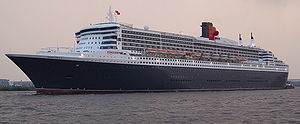
RMS Queen Mary
RMS Queen Mary is a retired ocean liner that sailed primarily in the North Atlantic Ocean from 1936 to 1967 for the Cunard Line...
were preserved as museums, floating hotels or for other purposes. After the retirement of Queen Elizabeth 2
RMS Queen Elizabeth 2
Queen Elizabeth 2, often referred to simply as the QE2, is an ocean liner that was operated by Cunard from 1969 to 2008. Following her retirement from cruising, she is now owned by Istithmar...
in 2008, the only ocean liner in service is Queen Mary 2, which replaced the line's Queen Elizabeth 2 on the transatlantic route, and is also used for cruises. Also, the Italian Liner
Italian Line
The Italian Line or Italia Line, also known as the Italia di Navigazione S.p.A., was a passenger shipping line that operated regular transatlantic services between Italy and the United States, and Italy and South America...
MS Augustus (1952)
MS Augustus (1952)
MS Augustus is a 27,090 GRT, luxurious ocean liner built in 1950 for Italian Line. She was the sister ship to MS Giulio Cesare that was launched in the same year. These two ships were built to the same design, with similar specifications. After the Augustus was sold to Hong Kong, she sailed under...
(renamed Phillipines) is moored in Manila
Manila
Manila is the capital of the Philippines. It is one of the sixteen cities forming Metro Manila.Manila is located on the eastern shores of Manila Bay and is bordered by Navotas and Caloocan to the north, Quezon City to the northeast, San Juan and Mandaluyong to the east, Makati on the southeast,...
as a tourist attraction, but sometimes sails on short "voyages to nowhere" on special occasions.
At war
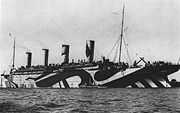
World War I
World War I , which was predominantly called the World War or the Great War from its occurrence until 1939, and the First World War or World War I thereafter, was a major war centred in Europe that began on 28 July 1914 and lasted until 11 November 1918...
. Large ocean liners such as the and were used as troopship
Troopship
A troopship is a ship used to carry soldiers, either in peacetime or wartime...
s and hospital ship
Hospital ship
A hospital ship is a ship designated for primary function as a floating medical treatment facility or hospital; most are operated by the military forces of various countries, as they are intended to be used in or near war zones....
s while smaller ocean liners were converted to armed merchant cruisers. The , sister to the and , never served on the liner trade for which she was built, instead entering war service as a hospital ship as soon as she was completed—she lasted a year before being sunk by a mine. Some other liners were converted to innocent-looking armed Q-ship
Q-ship
Q-ships, also known as Q-boats, Decoy Vessels, Special Service Ships, or Mystery Ships, were heavily armed merchant ships with concealed weaponry, designed to lure submarines into making surface attacks. This gave Q-ships the chance to open fire and sink them...
s to entrap submarine
Submarine
A submarine is a watercraft capable of independent operation below the surface of the water. It differs from a submersible, which has more limited underwater capability...
s. In 1915 the , still in service as a civilian passenger vessel, was torpedoed by a German U-boat
U-boat
U-boat is the anglicized version of the German word U-Boot , itself an abbreviation of Unterseeboot , and refers to military submarines operated by Germany, particularly in World War I and World War II...
with many casualties.
Ocean liners such as the and were used in World War II as troopships. The caught fire, capsized and sank in New York in 1942 while being converted for troop duty. The majority of the superliners of the 'twenties and 'thirties were victims of U-boats, mines
Naval mine
A naval mine is a self-contained explosive device placed in water to destroy surface ships or submarines. Unlike depth charges, mines are deposited and left to wait until they are triggered by the approach of, or contact with, an enemy vessel...
or enemy aircraft. The was attacked by German planes, then torpedoed by a U-boat when tugs tried to tow her to safety. She was the largest British ocean liner to sink during World War II
World War II
World War II, or the Second World War , was a global conflict lasting from 1939 to 1945, involving most of the world's nations—including all of the great powers—eventually forming two opposing military alliances: the Allies and the Axis...
. Germany's speed queen the in 1941 fell victim to an arsonist, believed to be a disgruntled crew member, and became a total loss. Italy's giants, the and the were respectively destroyed by the British RAF and the retreating German forces. The United States
United States
The United States of America is a federal constitutional republic comprising fifty states and a federal district...
lost the American President Lines
American President Lines
American President Lines Ltd. is the world's seventh-largest container transportation and shipping company, providing services to more than 140 countries through a network combining intermodal freight transport operations with IT and e-commerce...
vessel the when she steamed into an Allied mine in the South Pacific. No shipping line was untouched by World War II
World War II
World War II, or the Second World War , was a global conflict lasting from 1939 to 1945, involving most of the world's nations—including all of the great powers—eventually forming two opposing military alliances: the Allies and the Axis...
.
More recently, during the Falklands War
Falklands War
The Falklands War , also called the Falklands Conflict or Falklands Crisis, was fought in 1982 between Argentina and the United Kingdom over the disputed Falkland Islands and South Georgia and the South Sandwich Islands...
, three ships that were either active or former liners were requisitioned for war service by the British Government. The liners QE2
RMS Queen Elizabeth 2
Queen Elizabeth 2, often referred to simply as the QE2, is an ocean liner that was operated by Cunard from 1969 to 2008. Following her retirement from cruising, she is now owned by Istithmar...
and were requisitioned from Cunard and P&O to serve as troopships, carrying British Army
British Army
The British Army is the land warfare branch of Her Majesty's Armed Forces in the United Kingdom. It came into being with the unification of the Kingdom of England and Scotland into the Kingdom of Great Britain in 1707. The new British Army incorporated Regiments that had already existed in England...
personnel to Ascension Island
Ascension Island
Ascension Island is an isolated volcanic island in the equatorial waters of the South Atlantic Ocean, around from the coast of Africa and from the coast of South America, which is roughly midway between the horn of South America and Africa...
and the Falkland Islands
Falkland Islands
The Falkland Islands are an archipelago in the South Atlantic Ocean, located about from the coast of mainland South America. The archipelago consists of East Falkland, West Falkland and 776 lesser islands. The capital, Stanley, is on East Falkland...
to recover the Falklands from the invading Argentine
Argentina
Argentina , officially the Argentine Republic , is the second largest country in South America by land area, after Brazil. It is constituted as a federation of 23 provinces and an autonomous city, Buenos Aires...
forces. The P&O
Peninsular and Oriental Steam Navigation Company
The Peninsular and Oriental Steam Navigation Company, which is usually known as P&O, is a British shipping and logistics company which dated from the early 19th century. Following its sale in March 2006 to Dubai Ports World for £3.9 billion, it became a subsidiary of DP World; however, the P&O...
educational cruise ship and former British India Steam Navigation Company liner was requisitioned as a hospital ship and, after the war, served as a troopship until an airport
Airport
An airport is a location where aircraft such as fixed-wing aircraft, helicopters, and blimps take off and land. Aircraft may be stored or maintained at an airport...
was built at Stanley
Stanley, Falkland Islands
Stanley is the capital and only true cityin the Falkland Islands. It is located on the isle of East Falkland, on a north-facing slope in one of the wettest parts of the islands. At the 2006 census, the city had a population of 2,115...
that could handle trooping flights.
Famous and infamous

HMHS Britannic
HMHS Britannic was the third and largest of the White Star Line. She was the sister ship of and , and was intended to enter service as a transatlantic passenger liner. She was launched just before the start of the First World War and was laid up at her builders in Belfast for many months before...
, which had been converted into a hospital ship in 1915, sank in the Aegean Sea in 1916 after hitting a mine and remains the largest ocean liner on the sea bed.
In 1914 the Empress of Ireland sank in the Saint Lawrence River
Saint Lawrence River
The Saint Lawrence is a large river flowing approximately from southwest to northeast in the middle latitudes of North America, connecting the Great Lakes with the Atlantic Ocean. It is the primary drainage conveyor of the Great Lakes Basin...
with 1,012 lives lost. The Lusitania
RMS Lusitania
RMS Lusitania was a British ocean liner designed by Leonard Peskett and built by John Brown and Company of Clydebank, Scotland. The ship entered passenger service with the Cunard Line on 26 August 1907 and continued on the line's heavily-traveled passenger service between Liverpool, England and New...
was lost in 1915 to a German U-Boat
U-boat
U-boat is the anglicized version of the German word U-Boot , itself an abbreviation of Unterseeboot , and refers to military submarines operated by Germany, particularly in World War I and World War II...
during World War I while on passage from the United States to Britain. The Morro Castle
SS Morro Castle
The SS Morro Castle was a luxury cruise ship of the 1930s that was built for the Ward Line for runs between New York City and Havana, Cuba...
burned off the coast of New Jersey in 1934. The worst disasters were the loss of the Cunarder Lancastria
RMS Lancastria
The RMS Lancastria was a British Cunard liner sunk on 17 June 1940 during World War II with the loss of an estimated 4,000 plus lives. It is the worst single loss of life in British maritime history and the bloodiest single engagement for UK forces , in the whole conflict and claimed more lives...
in 1940 off Saint-Nazaire to German bombing while attempting to evacuate troops of the British Expeditionary Force
British Expeditionary Force (World War II)
The British Expeditionary Force was the British force in Europe from 1939–1940 during the Second World War. Commanded by General Lord Gort, the BEF constituted one-tenth of the defending Allied force....
from France, with the loss of more than 3,000 lives; the sinking of the Wilhelm Gustloff
Wilhelm Gustloff (ship)
The MV Wilhelm Gustloff was a German KdF flagship during 1937-1945, constructed by the Blohm & Voss shipyards. It sank after being torpedoed by the Soviet submarine on 30 January 1945....
with more than 9,000 lives lost, and the sinking of the Cap Arcona
SS Cap Arcona
The Cap Arcona was a large German luxury ocean liner, formerly of the Hamburg-South America line. It transported passengers between Germany and South America up until 1940 when it was taken over by the German Navy....
with more than 7,000 lives lost in the Baltic Sea
Baltic Sea
The Baltic Sea is a brackish mediterranean sea located in Northern Europe, from 53°N to 66°N latitude and from 20°E to 26°E longitude. It is bounded by the Scandinavian Peninsula, the mainland of Europe, and the Danish islands. It drains into the Kattegat by way of the Øresund, the Great Belt and...
in 1945. The Italian liner Andrea Doria
SS Andrea Doria
SS Andrea Doria[p] was an ocean liner for the Italian Line home ported in Genoa, Italy, most famous for its sinking in 1956, when 46 people died. Named after the 16th-century Genoese admiral Andrea Doria, the ship had a gross register tonnage of 29,100 and a capacity of about 1,200 passengers and...
sank after colliding with the Stockholm
MS Athena
MS Athena is a cruise ship owned and operated by Classic International Cruises. She was built in 1948 as the MS Stockholm by Götaverken in Gothenburg for the Swedish America Line...
in heavy fog in 1956, although equipped with radar
Radar
Radar is an object-detection system which uses radio waves to determine the range, altitude, direction, or speed of objects. It can be used to detect aircraft, ships, spacecraft, guided missiles, motor vehicles, weather formations, and terrain. The radar dish or antenna transmits pulses of radio...
.
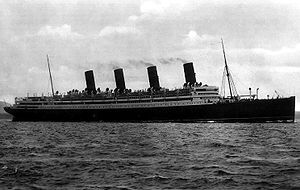
RMS Mauretania (1906)
RMS Mauretania was an ocean liner designed by Leonard Peskett and built by Swan, Hunter & Wigham Richardson at Wallsend, Tyne and Wear for the British Cunard Line, and launched on 20 September 1906. At the time, she was the largest and fastest ship in the world. Mauretania became a favourite among...
and Aquitania
RMS Aquitania
RMS Aquitania was a Cunard Line ocean liner designed by Leonard Peskett and built by John Brown & Company in Clydebank, Scotland. She was launched on 21 April 1913 and sailed on her maiden voyage to New York on 30 May 1914...
were considered the finest liners of their time, while the superliners like Normandie
SS Normandie
SS Normandie was an ocean liner built in Saint-Nazaire, France for the French Line Compagnie Générale Transatlantique. She entered service in 1935 as the largest and fastest passenger ship afloat; she is still the most powerful steam turbo-electric-propelled passenger ship ever built.Her novel...
and Queen Mary
RMS Queen Mary
RMS Queen Mary is a retired ocean liner that sailed primarily in the North Atlantic Ocean from 1936 to 1967 for the Cunard Line...
became symbols of national pride and important part of western civilization with influences in design, technology, popular culture and standards of international travel.
Of the great pre-war Ocean Liners, only the RMS Queen Mary
RMS Queen Mary
RMS Queen Mary is a retired ocean liner that sailed primarily in the North Atlantic Ocean from 1936 to 1967 for the Cunard Line...
survives, preserved as a hotel and museum in Long Beach, California, after being extensively gutted and converted after her retirement in 1967. Other significant ocean liners are the United States
SS United States
SS United States is a luxury passenger liner built in 1952 for the United States Lines designed to capture the trans-Atlantic speed record....
, currently laid up and moored in Philadelphia, the SS Great Britain
SS Great Britain
SS Great Britain was an advanced passenger steamship designed by Isambard Kingdom Brunel for the Great Western Steamship Company's transatlantic service between Bristol and New York. While other ships had previously been built of iron or equipped with a screw propeller, Great Britain was the first...
, Queen Elizabeth 2
RMS Queen Elizabeth 2
Queen Elizabeth 2, often referred to simply as the QE2, is an ocean liner that was operated by Cunard from 1969 to 2008. Following her retirement from cruising, she is now owned by Istithmar...
, to be converted to floating hotel in Dubai
Dubai
Dubai is a city and emirate in the United Arab Emirates . The emirate is located south of the Persian Gulf on the Arabian Peninsula and has the largest population with the second-largest land territory by area of all the emirates, after Abu Dhabi...
, and Rotterdam
SS Rotterdam
The fifth SS Rotterdam, known as "The Grande Dame", was launched by Queen Juliana in a gala ceremony on 13 September 1958, and completed the following summer. The Rotterdam was the last great Dutch "ship of state", employing the finest artisans from the Netherlands in her construction and fitting...
moored in Rotterdam
Rotterdam
Rotterdam is the second-largest city in the Netherlands and one of the largest ports in the world. Starting as a dam on the Rotte river, Rotterdam has grown into a major international commercial centre...
as museum/hotel.
See also
- List of cruise ships
- List of cruise lines
- List of ocean liners
- Transatlantic crossing
- Superliner (passenger ship)Superliner (passenger ship)A superliner is an ocean liner of over 10,000 gross tons. The term was coined in the late 19th century, when ocean liners were rapidly increasing in size and speed...
- Packet shipPacket shipA "packet ship" was originally a vessel employed to carry post office mail packets to and from British embassies, colonies and outposts. In sea transport, a packet service is a regular, scheduled service, carrying freight and passengers...
External links
- Historic Ocean Liners
- The Great Ocean Liners
- Cruise Line History: The Cruise Ship, Ocean Liner, Travel and Social History website
- http://www.encyclopedia-titanica.orgEncyclopedia TitanicaEncyclopedia TitanicaEncyclopedia Titanica is an online reference work containing extensive and constantly-updated information on the . The website, a nonprofit endeavor, is a database of passenger and crew biographies, deck plans, and articles submitted by historians or Titanic enthusiasts...
] (includes Ocean liner and Titanic discussions) - Gare Maritime : A Journey into the Golden Age of Travel
- 20th Century Ships
- Transatlantic Ocean Liners and Nationalism
- Monsters of the Sea: The Great Ocean Liners of Time
- Martin Cox and Peter Knego's "Maritime Matters"
- The Last Ocean Liners 1950s-1960s
- Kevin Tam's "Ships of State:The Great Atlantic Liners"
- "The Ocean Liner Virtual Museum"