

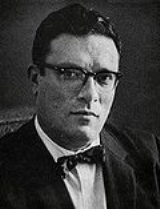
Isaac Asimov

Encyclopedia
Isaac Asimov (ˈ ; born Isaak Yudovich Ozimov, ; ; c. January 2, 1920 – April 6, 1992) was an American author and professor of biochemistry
at Boston University
, best known for his works of science fiction and for his popular science
books. Asimov was one of the most prolific writers of all time, having written or edited more than 500 books and an estimated 90,000 letters and postcard
s. His works have been published in all ten major categories of the Dewey Decimal System
(Although his only work in the 100s -- which covers philosophy and psychology -- was a foreword for The Humanist Way).
Isaac Asimov is widely considered a master of hard science fiction
and, along with Robert A. Heinlein
and Arthur C. Clarke
, he was considered one of the "Big Three" science fiction writers during his lifetime.
Asimov's most famous work is the Foundation Series
; his other major series are the Galactic Empire series
and the Robot series
, both of which he later tied into the same fictional universe as the Foundation Series to create a unified "future history
" for his stories much like those pioneered by Robert A. Heinlein and previously produced by Cordwainer Smith
and Poul Anderson
. He wrote many short stories, among them "Nightfall", which in 1964 was voted by the Science Fiction Writers of America the best short science fiction story of all time. Asimov wrote the Lucky Starr series
of juvenile science-fiction novels using the pen name Paul French.
The prolific Asimov also wrote mysteries
and fantasy
, as well as much non-fiction
. Most of his popular science books explain scientific concepts in a historical way, going as far back as possible to a time when the science in question was at its simplest stage. He often provides nationalities, birth dates, and death dates for the scientists he mentions, as well as etymologies
and pronunciation guides for technical terms. Examples include his Guide to Science
, the three volume set Understanding Physics
, Asimov's Chronology of Science and Discovery, as well as numerous works on astronomy
, mathematics
, the Bible, William Shakespeare's
works and chemistry
subjects.
Asimov was a long-time member and Vice President of Mensa International
, albeit reluctantly; he described some members of that organization as "brain-proud and aggressive about their IQs." He took more joy in being president of the American Humanist Association
. The asteroid
5020 Asimov
, a crater
on the planet Mars
, a Brooklyn, New York
elementary school, and one Isaac Asimov literary award are named in his honor.
in the Russian Soviet Federative Socialist Republic
(near the modern border with Belarus
) to Anna Rachel Berman Asimov and Judah Asimov, a family of Jewish miller
s. While his exact date of birth is uncertain, Asimov himself celebrated it on January 2.
The family name derives from озимые (ozimiye), a Russian word for winter grains in which his great-grandfather dealt, to which a patronymic
suffix was added. His name in Russian was originally Isaak Ozimov (Russian: Исаак Озимов); but he was later known in Russia as Ayzyek Azimov (Айзек Азимов), a Russian Cyrillic adaptation of the American English pronunciation. Asimov had two younger siblings; a sister, Marcia (born Manya, June 17, 1922-April 2, 2011), and a brother, Stanley (July 25, 1929-August 16, 1995).
His family emigrated to the United States when he was three years old. Since his parents always spoke Yiddish
and English with him, he never learned Russian. Growing up in Brooklyn
, New York City
, Asimov taught himself to read at the age of five and remained fluent in Yiddish as well as English. Asimov wrote of his father, "My father, for all his education as an Orthodox Jew, was not Orthodox in his heart", and "he didn't recite the myriad prayers prescribed for every action, and he never made any attempt to teach them to me."
His parents owned a succession of candy store
s, and everyone in the family was expected to work in them.
s at a young age. His father, as a matter of principle, forbade reading the pulps, as he considered them to be trash, but Asimov persuaded him that the science fiction magazines had "Science" in the title, so they were educational. Around the age of eleven, he began to write his own stories, and by age nineteen—after he discovered science fiction fandom
—he was selling stories to the science fiction magazines. John W. Campbell
, then editor of Astounding Science Fiction, had a strong formative influence on Asimov and eventually became a personal friend.
Asimov attended New York City Public Schools, including Boys High School
, in Brooklyn, New York. From there he went on to Seth Low Junior College originally as a Zoology
major but changed his subject to Chemistry
after his first semester for the disapproval of "dissecting an alley cat". From there, he went to Columbia University
for the remainder of his master's degree, from which he graduated in 1939, eventually returning to earn a PhD in biochemistry in 1948. In between, he spent three years during World War II
working as a civilian at the Philadelphia Navy Yard's Naval Air Experimental Station. After the war ended, he was drafted into the U.S. Army, serving for almost nine months before receiving an honorable discharge. In the course of his brief military career, he rose to the rank of corporal
on the basis of his typing skills, and narrowly avoided participating in the 1946 atomic bomb tests at Bikini Atoll
.
 After completing his doctorate, Asimov joined the faculty of the Boston University
School of Medicine, with which he remained associated thereafter. From 1958, this was in a non-teaching capacity, as he turned to writing full-time (his writing income had already exceeded his academic salary). Being tenure
d meant that he retained the title of associate professor, and in 1979 the university honored his writing by promoting him to full professor of biochemistry. Asimov's personal papers from 1965 onward are archived at the university's Mugar Memorial Library
, to which he donated them at the request of curator
Howard Gottlieb. The collection fills 464 boxes, or seventy-one meters of shelf space.
, where he lived for the rest of his life. He immediately began seeing Janet O. Jeppson, and married her two weeks after his divorce from Gertrude in 1973.
Asimov was a claustrophile: he enjoyed small, enclosed spaces. In the third volume of his autobiography, he recalls a childhood desire to own a magazine stand in a New York City Subway
station, within which he could enclose himself and listen to the rumble of passing trains while reading.
Asimov was afraid of flying
, only doing so twice in his entire life (once in the course of his work at the Naval Air Experimental Station, and once returning home from the army base in Oahu
in 1946)
He seldom traveled great distances, partly because his aversion to flying complicated the logistics of long-distance travel. This phobia influenced several of his fiction works, such as the Wendell Urth mystery stories and the Robot novels featuring Elijah Baley
. In his later years, he found he enjoyed traveling on cruise ship
s, and on several occasions he became part of the cruises' "entertainment", giving science-themed talks on ships such as the RMS Queen Elizabeth 2
.
Asimov was an able public speaker and was a frequent fixture at science fiction convention
s, where he was friendly and approachable. He patiently answered tens of thousands of questions and other mail with postcards, and was pleased to give autographs. He was of medium height, stocky, with mutton chop whiskers and a distinct Brooklyn accent. His physical dexterity was very poor. He never learned to swim or ride a bicycle; however, he did learn to drive a car after he moved to Boston. In his humor book Asimov Laughs Again, he describes Boston driving as "anarchy on wheels".
Asimov's wide interests included his participation in his later years in organizations devoted to the comic opera
s of Gilbert and Sullivan
and in The Wolfe Pack, a group of devotees of the Nero Wolfe
mysteries written by Rex Stout
. Many of his short stories mention or quote Gilbert and Sullivan. He was a prominent member of the Baker Street Irregulars
, the leading Sherlock Holmes
society. He was also a member of the all-male literary banqueting club the Trap Door Spiders
, which served as the basis of his fictional group of mystery solvers the Black Widowers
.
In 1984, the American Humanist Association
(AHA) named him the Humanist of the Year. From 1985 until his death in 1992, he served as president of the AHA, an honorary appointment; his successor was his friend and fellow writer Kurt Vonnegut
. He was also a close friend of Star Trek
creator Gene Roddenberry
, and earned a screen credit on Star Trek: The Motion Picture
for advice he gave during production (generally, confirming to Paramount Pictures
that Roddenberry's ideas were legitimate science-fictional extrapolation).
in December 1983. When he died in New York City on April 6, 1992, his brother Stanley reported heart and kidney failure
as the cause of death. He was survived by his second wife, Janet, and his children from his first marriage. Ten years after his death, Janet Asimov's edition of Asimov's autobiography, It's Been a Good Life
, revealed that the myocardial and renal complications were the result of an infection by HIV
, which he had contracted from a blood transfusion received during his bypass operation. Janet Asimov wrote in the epilogue of It's Been a Good Life that Asimov's doctors advised him against going public, warning that the anti-AIDS prejudice
would likely extend to his family members. Asimov's family considered disclosing his condition after his death, but the controversy that erupted when Arthur Ashe
announced his own HIV infection (also contracted from a blood transfusion during heart surgery) convinced them otherwise. Ten years later, after most of Asimov's doctors had died, Janet and Robyn Asimov agreed that the AIDS story should be made public.
 Asimov's career can be divided into several time periods. His early career, dominated by science fiction, began with short stories in 1939 and novels in 1950. This lasted until about 1958, all but ending after publication of The Naked Sun
. He began publishing nonfiction in 1952, co-authoring a college-level textbook called Biochemistry and Human Metabolism. Following the brief orbit of the first man-made satellite Sputnik I by the USSR in 1957, his production of nonfiction, particularly popular science
books, greatly increased, with a consequent drop in his science fiction output. Over the next quarter century, he wrote only four science fiction novels. Starting in 1982, the second half of his science fiction career began with the publication of Foundation's Edge
. From then until his death, Asimov published several more sequels and prequels to his existing novels, tying them together in a way he had not originally anticipated, making a unified series. There are, however, many inconsistencies in this unification, especially in his earlier stories.
Asimov believed that his most enduring contributions would be his "Three Laws of Robotics
" and the Foundation Series (see Yours, Isaac Asimov, p. 329). Furthermore, the Oxford English Dictionary
credits his science fiction for introducing the words positronic
(an entirely fictional technology), psychohistory
(which is also used for a different study
on historical motivations) and robotics
into the English language. Asimov coined the term robotics without suspecting that it might be an original word; at the time, he believed it was simply the natural analogue of words such as mechanics
and hydraulics
, but for robot
s. Unlike his word psychohistory, the word robotics continues in mainstream technical use with Asimov's original definition. Star Trek: The Next Generation
featured androids with "positronic brain
s" giving Asimov full credit for "inventing" this fictional technology. His fictional writings for space and time are similar to the writings of Brian W Aldiss, Poul Anderson
and Gregory Benford
.
s sold in his family's confectionery store in 1929. He came into contact with science fiction fandom
in the mid-1930s, particularly the circle that became the Futurians
. He began writing his first science fiction story, "Cosmic Corkscrew", in 1937, but failed to finish it until June 1938, when he was inspired to do so after a visit to the offices of Astounding Science Fiction. He finished "Cosmic Corkscrew" on June 19, and submitted the story in person to Astounding editor John W. Campbell
two days later. Campbell rejected "Cosmic Corkscrew", but encouraged Asimov to keep trying, and Asimov did so. Asimov sold his third story, "Marooned Off Vesta
", to Amazing Stories
magazine in October, and it appeared in the March 1939 issue. He continued to write and sometimes sell stories to the science fiction pulps.
In 1941, he published his 32nd story, "Nightfall", which has been described as one of "the most famous science-fiction stories of all time". In 1968 the Science Fiction Writers of America voted "Nightfall" the best science fiction short story ever written. In his short story collection Nightfall and Other Stories
he wrote, "The writing of 'Nightfall' was a watershed in my professional career ... I was suddenly taken seriously and the world of science fiction became aware that I existed. As the years passed, in fact, it became evident that I had written a 'classic'".
"Nightfall" is an archetypal example of social science fiction
, a term coined by Asimov to describe a new trend in the 1940s, led by authors including Asimov and Heinlein
, away from gadget
s and space opera
and toward speculation about the human condition
.
By 1941 Asimov had begun selling regularly to Astounding, which was then the field's leading magazine. From 1943 to 1949, all of his published science fiction appeared in Astounding.
In 1942 he published the first of his Foundation stories—later collected in the Foundation Trilogy: Foundation
(1951), Foundation and Empire
(1952), and Second Foundation
(1953)—which recount the collapse and rebirth of a vast interstellar empire
in a universe of the future. Taken together, they are his most famous work of science fiction, along with the Robot Series
. Many years later, due to pressure by fans on Asimov to write another, he continued the series with Foundation's Edge
(1982) and Foundation and Earth
(1986), and then went back to before the original trilogy with Prelude to Foundation
(1988) and Forward the Foundation
(1992). The series features his fictional science of Psychohistory
in which the future course of the history of large populations can be predicted.
His positronic robot stories—many of which were collected in I, Robot
(1950)—were begun at about the same time. They promulgated a set of rules of ethics
for robots (see Three Laws of Robotics
) and intelligent machines that greatly influenced other writers and thinkers in their treatment of the subject. Asimov notes in one of his biographical pieces that he was largely inspired by the almost relentless tendency of robots up to that time to fall consistently into a Frankenstein plot in which they destroyed their creator. One such robot story, a short titled "The Bicentennial Man
", was made into a film
starring Robin Williams
.
The 2004 film I, Robot
, starring Will Smith
, was based on a script by Jeff Vintar
entitled Hardwired, with Asimov's ideas incorporated later after acquiring the rights to the I, Robot title. It is not related to the I, Robot script by Harlan Ellison
, who collaborated with Asimov himself to create a version that captured the spirit of the original. Asimov is quoted as saying that Ellison's screenplay would lead to "the first really adult, complex, worthwhile science fiction movie ever made". The screenplay was published in book form in 1994, after hopes of seeing it in film form were becoming slim.
Besides movies, his Foundation
and Robot
stories have inspired other derivative works of science fiction literature, many by well-known and established authors such as Roger MacBride Allen
, Greg Bear
, Gregory Benford
and David Brin
. These appear to have been done with the blessing, and often at the request of, Asimov's widow Janet Asimov.
In 1948 he also wrote a spoof chemistry article
, "The Endochronic Properties of Resublimated Thiotimoline
". At the time, Asimov was preparing his own doctoral dissertation, and for the oral examination to follow that. Fearing a prejudicial reaction from his graduate school evaluation board at Columbia University
, Asimov asked his editor that it be released under a pseudonym, yet it appeared under his own name because of a mistake by the publisher. During his oral examination shortly thereafter, Asimov grew concerned at the scrutiny he received. At the end of the examination, one evaluator turned to him, smiling, and said "Mr. Asimov, tell us something about the thermodynamic properties of the compound thiotimoline". The stuttering Asimov was sent out of the room then. After a 20-minute or so wait, he was summoned back into the Examination Room and congratulated as "Dr. Asimov."
In 1949, the book publisher Doubleday's science fiction editor Walter I. Bradbury accepted Asimov's unpublished novelette
"Grow Old Along With Me" (40,000 words) for publication, but requested that it be extended to a full novel of 70,000 words. The book appeared under the Doubleday imprint in January 1950 with the title of Pebble in the Sky
. The Doubleday company went on to publish five more original science fiction novels by Asimov in the 1950s, along with the six juvenile Lucky Starr novels
, the latter under the pseudonym of "Paul French". Doubleday also published collections of Asimov's short stories, beginning with The Martian Way and Other Stories
in 1955. The early 1950s also saw the Gnome Press
company publishing one collection of Asimov's positronic robot stories as I, Robot
and his Foundation
stories and novelettes as the three books of the Foundation Trilogy. More positronic robot stories were republished in book form as The Rest of the Robots
.
When new science fiction magazines, notably Galaxy
magazine and The Magazine of Fantasy & Science Fiction
, appeared in the 1950s, Asimov began publishing short stories in them as well. He would later refer to the 1950s as his "golden decade". A number of these stories are included in his Best of
anthology, including "The Last Question
" (1956), on the ability of humankind to cope with and potentially reverse the process of entropy
. It was his personal favorite and considered by many to be equal to "Nightfall". Asimov wrote of it in 1973:
In December 1974, former Beatle Paul McCartney
approached Asimov and asked him if he could write the screenplay for a science-fiction movie musical. McCartney had a vague idea for the plot and a small scrap of dialogue; he wished to make a film about a rock band whose members discover they are being impersonated by a group of extraterrestrials. The band and their impostors would likely be played by McCartney's group Wings
, then at the height of their career. Intrigued by the idea, although he was not generally a fan of rock music, Asimov quickly produced a "treatment" or brief outline of the story. He adhered to McCartney's overall idea, producing a story he felt to be moving and dramatic. However, he did not make use of McCartney's brief scrap of dialogue, and probably as a consequence, McCartney rejected the story. The treatment now exists only in the Boston University archives.
Beginning in 1977, Asimov lent his name to Isaac Asimov's Science Fiction Magazine (now Asimov's Science Fiction
) and penned an editorial for each issue. There was also a short-lived Asimov's SF Adventure Magazine and a companion Asimov's Science Fiction Anthology reprint series, published as magazines (in the same manner as the stablemates Ellery Queen's Mystery Magazine's
and Alfred Hitchcock's Mystery Magazine's
"anthologies").
and 1982's Foundation's Edge
, two of which were mysteries). At the same time, he greatly increased his non-fiction production, writing mostly on science topics; the launch of Sputnik in 1957 engendered public concern over a "science gap", which Asimov's publishers were eager to fill with as much material as he could write.
Meanwhile, the monthly Magazine of Fantasy and Science Fiction invited him to continue his regular non-fiction column, begun in the now-folded bimonthly companion magazine Venture Science Fiction Magazine
, ostensibly dedicated to popular science
, but with Asimov having complete editorial freedom. The first of the F&SF columns appeared in November 1958, and they followed uninterrupted thereafter, with 399 entries, until Asimov's terminal illness. These columns, periodically collected into books by his principal publisher, Doubleday, helped make Asimov's reputation as a "Great Explainer" of science, and were referred to by him as his only pop-science writing in which he never had to assume complete ignorance of the subjects at hand on the part of his readers. The popularity of his first wide-ranging reference work, The Intelligent Man's Guide to Science
, also allowed him to give up most of his academic responsibilities and become essentially a full-time freelance writer.
Asimov wrote several essays on the social contentions of his time, including "Thinking About Thinking" and "Science: Knock Plastic" (1967).
The great variety of information covered in Asimov's writings once prompted Kurt Vonnegut
to ask, "How does it feel to know everything?" Asimov replied that he only knew how it felt to have the reputation of omniscience—"Uneasy". (See In Joy Still Felt, chapter 30.) In the introduction to his story collection Slow Learner
, Thomas Pynchon
admitted that he relied upon Asimov's science popularizations (and the Oxford English Dictionary
) to provide his knowledge of entropy
.
It is a mark of the friendship and respect accorded Asimov by Arthur C. Clarke
that the so-called "Asimov-Clarke Treaty of Park Avenue", put together as they shared a cab ride along Park Avenue
in New York, stated that Asimov was required to insist that Clarke was the best science fiction writer in the world (reserving second-best for himself), while Clarke was required to insist that Asimov was the best science writer in the world (reserving second-best for himself). Thus the dedication in Clarke's book Report on Planet Three (1972) reads:
"In accordance with the terms of the Clarke-Asimov treaty, the second-best science writer dedicates this book to the second-best science-fiction writer."
" in his 1941 story Liar!
, though he later remarked that he believed then that he was merely using an existing word, as he stated in Gold
("The Robot Chronicles"), though while acknowledging the Oxford Dictionary reference, he incorrectly states that the word was first printed about one third of the way down the first column of page 100, Astounding Science Fiction
, March 1942 printing of his short story Runaround
.
Asimov also coined the term Spome
in a paper entitled, “There’s No Place Like Spome” in Atmosphere in Space Cabins and Closed Environments, originally presented as a paper to the American Chemical Society on September 13, 1965. It refers to any system closed with respect to matter and open with respect to energy capable of sustaining human life indefinitely.
He published Asimov's Guide to the Bible
in two volumes—covering the Old Testament
in 1967 and the New Testament
in 1969— and then combined them into one 1,300-page volume in 1981. Complete with maps and tables, the guide goes through the books of the Bible in order, explaining the history of each one and the political influences that affected it, as well as biographical information about the important characters. His interest in literature manifested itself in several annotations of literary works, including Asimov's Guide to Shakespeare
(1970), Asimov's Annotated Paradise Lost (1974), and The Annotated Gulliver's Travels (1980).
Asimov was also a noted mystery author and a frequent contributor to Ellery Queen's Mystery Magazine. He began by writing science fiction mysteries such as his Wendell Urth stories but soon moved on to writing "pure" mysteries. He only published two full-length mystery novels but he wrote a fair number of stories about the Black Widowers, a group of men who met monthly for dinner, conversation, and a puzzle. He got the idea for the Widowers from his own association in a stag group called the Trap Door Spiders and all of the main characters (with the exception of the waiter, Henry, whom he admitted resembled Wodehouse's Jeeves) were modeled after his closest friends.
Toward the end of his life, Asimov published a series of collections of limericks
, mostly written by himself, starting with Lecherous Limericks
, which appeared in 1975. Limericks: Too Gross, whose title displays Asimov's love of pun
s, contains 144 limericks by Asimov and an equal number by John Ciardi
. He even created a slim volume of Sherlockian
limericks (and embarrassed one fan by autographing her copy with an impromptu limerick that rhymed 'Nancy' with 'romancy'). Asimov featured Yiddish humor in Azazel, The Two Centimeter Demon
. The two main characters, both Jewish, talk over dinner, or lunch, or breakfast, about anecdotes of "George" and his friend Azazel. Asimov's Treasury of Humor is both a working joke book and a treatise propounding his views on humor theory. According to Asimov, the most essential element of humor is an abrupt change in point of view, one that suddenly shifts focus from the important to the trivial, or from the sublime to the ridiculous.
Particularly in his later years, Asimov to some extent cultivated an image of himself as an amiable lecher. In 1971, as a response to the popularity of sexual guidebooks such as The Sensuous Woman
(by "J") and The Sensuous Man
(by "M"), Asimov published The Sensuous Dirty Old Man under the byline "Dr. 'A'" (although his full name was printed on the paperback edition, first published 1972).
Asimov published two volumes of autobiography: In Memory Yet Green
(1979) and In Joy Still Felt (1980). A third autobiography, I. Asimov: A Memoir, was published in April 1994. The epilogue was written by his widow Janet Asimov a decade after his death. It's Been a Good Life
(2002), edited by Janet, is a condensed version of his three autobiographies. He also published three volumes of retrospectives of his writing, Opus 100
(1969), Opus 200 (1979), and Opus 300 (1984).
In 1987, the Asimovs co-wrote How to Enjoy Writing: A Book of Aid and Comfort. In it they offer advice on how to maintain a positive attitude and stay productive when dealing with discouragement, distractions, rejection and thick-headed editors. The book includes many quotations, essays, anecdotes and husband-wife dialogues about the ups and downs of being an author.
Asimov and Star Trek
creator Gene Roddenberry
developed a unique relationship during Star Trek's initial launch in the late 1960s. Asimov wrote a critical essay on Star Trek's scientific accuracy for TV Guide
magazine. Roddenberry retorted respectfully with a personal letter explaining the limitations of accuracy when writing a weekly series. Asimov corrected himself with a follow-up essay to TV Guide claiming despite its inaccuracies, that Star Trek was a fresh and intellectually challenging science fiction television show. The two remained friends to the point where Asimov even served as an advisor on a number of Star Trek projects.
In 1973, Asimov published a proposal for calendar reform
, called the World Season Calendar. It divides the year into four seasons (named A–D) of 13 weeks (91 days) each. This allows days to be named, e.g., "D-73" instead of December 1. An extra Year Day is added for a total of 365 days.
, professor emeritus
of English
at the University of Kansas
wrote of I, Robot
:
Gunn observes that there are places where Asimov's style rises to the demands of the situation; he cites the climax of "Liar!" as an example. Sharply drawn characters occur at key junctures of his storylines: In addition to Susan Calvin
in "Liar!" and "Evidence", we find Arkady Darell
in Second Foundation
, Elijah Baley
in The Caves of Steel
and Hari Seldon
in the Foundation prequels. Asimov addresses this criticism at the beginning of his book Nemesis:
Some details of Asimov's imaginary future technology as he described in the 1940s and 1950s have not aged well. For example, he described powerful robots and computers from the distant future using punched card
s or punched tape
and engineers using slide rule
s. In one dramatic scene in Foundation and Empire
, a character gets the news by buying a paper at a vending machine
. Of course, this charge could be leveled at virtually any writer of science fiction and has little critical impact.
In addition, his stories also have occasional internal contradictions: names and dates given in The Foundation Series
do not always agree with one another, for example. Some such errors may plausibly be due to mistakes the characters make, since characters in Asimov stories are seldom fully informed about their own situations. Other contradictions resulted from the many years elapsed between the time Asimov began the Foundation series and when he resumed work on it; occasionally, advances in scientific knowledge forced him to revise his own fictional history.
Other than books by Gunn and Patrouch, there is a relative dearth of "literary" criticism on Asimov (particularly when compared to the sheer volume of his output). Cowart and Wymer's Dictionary of Literary Biography (1981) gives a possible reason:
In fairness, Gunn's and Patrouch's respective studies of Asimov both take the stand that a clear, direct prose style is still a style. Gunn's 1982 book goes into considerable depth commenting upon each of Asimov's novels published to that date. He does not praise all of Asimov's fiction (nor does Patrouch), but he does call some passages in The Caves of Steel
"reminiscent of Proust
." When discussing how that novel depicts night falling over futuristic New York City, Gunn says that Asimov's prose "need not be ashamed anywhere in literary society".
Although he prided himself on his unornamented prose style (for which he credited Clifford D. Simak
as an early influence), Asimov also enjoyed giving his longer stories complicated narrative structure
s, often by arranging chapters in non-chronological
ways. Some readers have been put off by this, complaining that the nonlinearity
is not worth the trouble and adversely affects the clarity of the story. For example, the first third of The Gods Themselves begins with Chapter 6, then backtracks to fill in earlier material. (John Campbell advised Asimov to begin his stories as late in the plot as possible. This advice helped Asimov create "Reason
", one of the early Robot stories. See In Memory Yet Green for details of that time period.) Patrouch found that the interwoven and nested flashbacks of The Currents of Space
did serious harm to that novel, to such an extent that only a "dyed-in-the-kyrt Asimov fan" could enjoy it. Asimov's tendency to contort his timelines is perhaps most apparent in his later novel Nemesis
, in which one group of characters live in the "present" and another group starts in the "past", beginning fifteen years earlier and gradually moving toward the time period of the first group.
In 2002, Donald Palumbo, an English professor at East Carolina University
, published Chaos Theory, Asimov's Foundations and Robots, and Herbert’s Dune: The Fractal
Aesthetic of Epic Science Fiction. This includes a review of Asimov's narrative structures that compares them with the scientific concepts of fractals and chaos
. Palumbo finds that though the traditional interests of literature (such as symbol
ism and characterization) are often somewhat lacking or even absent, a fascination with the Foundation
and Robot
metaseries remains. He determines that the purposeful complexities of the narrative build unusual symmetric and recursive structures to be perceived by the mind's eye. This volume contains some of the most scholarly and in-depth criticism of Asimov to date.
Asimov was also criticized for the general absence of sexuality
and of extraterrestrial life
in his science fiction. Asimov once explained that his reluctance to write about aliens came from an incident early in his career when Astoundings editor John Campbell
rejected one of his science fiction stories because the alien characters were portrayed as superior to the humans. He decided that, rather than write weak alien characters, he would not write about aliens at all. Nevertheless, in response to these criticisms he wrote The Gods Themselves
, which contains aliens, sex, and alien sex. The book won the Nebula Award for Best Novel
in 1972, and the Hugo Award for Best Novel
in 1973. Asimov said that of all his writings, he was most proud of the middle section of The Gods Themselves, the part that deals with those themes.
In the Hugo Award
-winning novella Gold
, Asimov describes an author clearly based on himself who has one of his books (The Gods Themselves
) adapted into a "compu-drama", essentially photo-realistic computer animation
. The director criticizes the fictionalized Asimov ("Gregory Laborian") for having an extremely nonvisual style making it difficult to adapt his work, and the author explains that he relies on ideas and dialogue rather than description to get his points across.
Gender and social issues
Others have criticized him for a lack of strong female characters in his early work. In his autobiographical writings, such as Gold
("Women and Science Fiction"), he acknowledges this and responds by pointing to inexperience. His later novels, written with more female characters but in essentially the same prose style as his early SF stories, brought this matter to a wider audience. For example, the August 25, 1985 Washington Post' s "Book World" section reports of Robots and Empire as follows:
It may be noted, however, that in fact The Naked Sun (1957) deals with social issues as a core part of its central setting and motivation, depicts genetic engineering in the guise of eugenics
as a fundamental part of that society, presents the reader with inverted arcologies where a single person is the focal point of the artificial environment as well as a hero who hails from a "normal" arcology
on Earth. Meanwhile, totally artificial birth, although not specifically cloning, is the aim of the leaders of the society, sexual want is the major driving force of the main female character (albeit veiled in 1950s sensibilities), and the entire story is used to make the point that too much order is ultimately a stagnant dead end to be avoided.
, and a rationalist. He did not oppose religious conviction in others, but he frequently railed against superstitious
and pseudoscientific
beliefs that tried to pass themselves off as genuine science. During his childhood, his father and mother observed Orthodox Jewish
traditions, though not as stringently as they had in Petrovichi
; they did not, however, force their beliefs upon young Isaac. Thus he grew up without strong religious influences, coming to believe that the Torah
represented Hebrew mythology in the same way that the Iliad
recorded Greek mythology
. As his books Treasury of Humor and Asimov Laughs Again record, Asimov was willing to tell jokes involving God, Satan
, the Garden of Eden
, Jerusalem, and other religious topics, expressing the viewpoint that a good joke can do more to provoke thought than hours of philosophical discussion.
For a brief while, his father worked in the local synagogue to enjoy the familiar surroundings and, as Isaac put it, "shine as a learned scholar" versed in the sacred writings. This scholarship was a seed for his later authorship and publication of Asimov's Guide to the Bible
, an analysis of the historic foundations for both Old and New Testaments. For many years, Asimov called himself an atheist
; however, he considered the term somewhat inadequate, as it described what he did not believe rather than what he did. Eventually, he described himself as a "humanist
" and considered that term more practical. He did however continue to identify himself as a non-observant Jew as stated in his introduction to Jack Dann
's anthology of Jewish science fiction, Wandering Stars
: "I attend no services and follow no ritual and have never undergone that curious puberty rite, the bar mitzvah. It doesn't matter. I am Jewish."
In his last volume of autobiography, Asimov wrote, "If I were not an atheist, I would believe in a God who would choose to save people on the basis of the totality of their lives and not the pattern of their words. I think he would prefer an honest and righteous atheist to a TV preacher whose every word is God, God, God, and whose every deed is foul, foul, foul." The same memoir states his belief that Hell
is "the drooling dream of a sadist
" crudely affixed to an all-merciful God; if even human governments were willing to curtail cruel and unusual punishments, wondered Asimov, why would punishment in the afterlife not be restricted to a limited term? Asimov rejected the idea that a human belief or action could merit infinite punishment. If an afterlife existed, he claimed, the longest and most severe punishment would be reserved for those who "slandered God by inventing Hell".
during the New Deal
, and thereafter remained a political liberal. He was a vocal opponent of the Vietnam War
in the 1960s and in a television interview during the early 1970s he publicly endorsed George McGovern
. He was unhappy about what he considered an "irrationalist" viewpoint taken by many radical political activists from the late 1960s and onwards. In his second volume of autobiography, In Joy Still Felt, Asimov recalled meeting the counterculture figure Abbie Hoffman
; Asimov's impression was that the 1960s' counterculture
heroes had ridden an emotional wave which, in the end, left them stranded in a "no-man's land of the spirit" from which he wondered if they would ever return.
He vehemently opposed Richard Nixon, considering him "a crook and a liar." He followed the unfolding events of Watergate day-to-day, and was pleased when the president was forced to resign. He was dismayed over the pardon extended to Nixon by his successor: "I was not impressed by the argument that it has spared the nation an ordeal. To my way of thinking, the ordeal was necessary to make certain it would never happen again."
, reflecting a perspective articulated by people from Thomas Malthus
through Paul R. Ehrlich
.
even after the Three Mile Island nuclear power plant incident damaged his relations with some of his fellow liberals. In a letter reprinted in Yours, Isaac Asimov, he states that although he would prefer living in "no danger whatsoever" than near a nuclear reactor, he would still prefer a home near a nuclear power plant than in a slum on Love Canal
or near "a Union Carbide
plant producing methyl isocyanate
" (referring to the Bhopal disaster
).
In the closing years of his life, Asimov blamed the deterioration of the quality of life that he perceived in New York City on the shrinking tax base caused by the middle-class flight
to the suburbs. His last non-fiction book, Our Angry Earth
(1991, co-written with his long-time friend science fiction author Frederik Pohl
), deals with elements of the environmental
crisis such as global warming
and the destruction of the ozone layer
.
. He paid tribute to The Lord of the Rings
in a "Black Widowers" story. (In his letter to Charlotte and Denis Plimmer, who had previously interviewed him for Daily Telegraph Magazine, Tolkien said that he enjoyed the science fiction of Isaac Asimov.)
He admired a number of his contemporaries, in particular fellow science-fiction author and science writer Arthur C. Clarke, with whom he entered into the lighthearted "Treaty of Park Avenue," which stipulated that Clarke was free to refer to himself as the best science fiction writer in the world (Asimov being second-best), provided he admitted that Asimov was the best science writer in the world (Clarke being second-best). He freely acknowledged a number of his fellow writers as superior to himself in talent, saying of Harlan Ellison, "He is (in my opinion) one of the best writers in the world, far more skilled at the art than I am."
, a Nobel Laureate in Economics, has stated that it was Asimov's concept of psychohistory that inspired him to become an economist.
John Jenkins, who has reviewed the vast majority of Asimov's written output, once observed:
(1969), Opus 200 (1979), and Opus 300 (1984), celebrating his writing; he did not choose to do this for his 400th book, however. Asimov's writings span all major categories of the Dewey Decimal Classification
except for Philosophy
. However, if his foreword for The Humanist Way is included, he has been published in all categories.
According to UNESCO
's Index Translationum database, Asimov is the world's 17th most-translated author, just behind Arthur Conan Doyle
and ahead of Pope John Paul II
.
There is an online exhibit displaying features, visuals, and descriptions of some of the over 600 books, games, audio recordings, videos, and wall charts included in the West Virginia University Libraries’ virtually complete Asimov Collection. Many first, rare, and autographed editions are in the Libraries’ Rare Book Room. Book jackets and autographs are presented online along with descriptions and images of children’s books, science fiction art, multimedia, and other materials in the collection.
For a listing of Asimov's books in chronological order within his future history, see the Foundation Series list of books.
Black Widowers
Other science books by Asimov
By Isaac Asimov
Biochemistry
Biochemistry, sometimes called biological chemistry, is the study of chemical processes in living organisms, including, but not limited to, living matter. Biochemistry governs all living organisms and living processes...
at Boston University
Boston University
Boston University is a private research university located in Boston, Massachusetts. With more than 4,000 faculty members and more than 31,000 students, Boston University is one of the largest private universities in the United States and one of Boston's largest employers...
, best known for his works of science fiction and for his popular science
Popular science
Popular science, sometimes called literature of science, is interpretation of science intended for a general audience. While science journalism focuses on recent scientific developments, popular science is broad-ranging, often written by scientists as well as journalists, and is presented in many...
books. Asimov was one of the most prolific writers of all time, having written or edited more than 500 books and an estimated 90,000 letters and postcard
Postcard
A postcard or post card is a rectangular piece of thick paper or thin cardboard intended for writing and mailing without an envelope....
s. His works have been published in all ten major categories of the Dewey Decimal System
Dewey Decimal Classification
Dewey Decimal Classification, is a proprietary system of library classification developed by Melvil Dewey in 1876.It has been greatly modified and expanded through 23 major revisions, the most recent in 2011...
(Although his only work in the 100s -- which covers philosophy and psychology -- was a foreword for The Humanist Way).
Isaac Asimov is widely considered a master of hard science fiction
Hard science fiction
Hard science fiction is a category of science fiction characterized by an emphasis on scientific or technical detail, or on scientific accuracy, or on both. The term was first used in print in 1957 by P. Schuyler Miller in a review of John W. Campbell, Jr.'s Islands of Space in Astounding Science...
and, along with Robert A. Heinlein
Robert A. Heinlein
Robert Anson Heinlein was an American science fiction writer. Often called the "dean of science fiction writers", he was one of the most influential and controversial authors of the genre. He set a standard for science and engineering plausibility and helped to raise the genre's standards of...
and Arthur C. Clarke
Arthur C. Clarke
Sir Arthur Charles Clarke, CBE, FRAS was a British science fiction author, inventor, and futurist, famous for his short stories and novels, among them 2001: A Space Odyssey, and as a host and commentator in the British television series Mysterious World. For many years, Robert A. Heinlein,...
, he was considered one of the "Big Three" science fiction writers during his lifetime.
Asimov's most famous work is the Foundation Series
The Foundation Series
The Foundation Series is a science fiction series by Isaac Asimov. There are seven volumes in the Foundation Series proper, which in its in-universe chronological order are: Prelude to Foundation, Forward the Foundation, Foundation, Foundation and Empire, Second Foundation, Foundation's Edge, and...
; his other major series are the Galactic Empire series
Isaac Asimov's Galactic Empire Series
The Galactic Empire Series is a science fiction series containing three novels and one short story by the American author Isaac Asimov...
and the Robot series
Isaac Asimov's Robot Series
Isaac Asimov's Robot Series is a series of short stories and novels by Isaac Asimov featuring positronic robots.- Short stories :Most of Asimov's robot short stories are set in the first age of positronic robotics and space exploration...
, both of which he later tied into the same fictional universe as the Foundation Series to create a unified "future history
Future history
A future history is a postulated history of the future and is used by authors in the subgenre of speculative fiction to construct a common background for fiction...
" for his stories much like those pioneered by Robert A. Heinlein and previously produced by Cordwainer Smith
Cordwainer Smith
Cordwainer Smith – pronounced CORDwainer – was the pseudonym used by American author Paul Myron Anthony Linebarger for his science fiction works. Linebarger was a noted East Asia scholar and expert in psychological warfare...
and Poul Anderson
Poul Anderson
Poul William Anderson was an American science fiction author who began his career during one of the Golden Ages of the genre and continued to write and remain popular into the 21st century. Anderson also authored several works of fantasy, historical novels, and a prodigious number of short stories...
. He wrote many short stories, among them "Nightfall", which in 1964 was voted by the Science Fiction Writers of America the best short science fiction story of all time. Asimov wrote the Lucky Starr series
Lucky Starr series
Lucky Starr is the hero of a series of science fiction books by Isaac Asimov, using the pen name "Paul French". Intended for juveniles, the books were written in the middle of the Cold War and the series shows traces of this, both in educational intent and in the nature of the social forces involved...
of juvenile science-fiction novels using the pen name Paul French.
The prolific Asimov also wrote mysteries
Mystery fiction
Mystery fiction is a loosely-defined term.1.It is often used as a synonym for detective fiction or crime fiction— in other words a novel or short story in which a detective investigates and solves a crime mystery. Sometimes mystery books are nonfiction...
and fantasy
Fantasy
Fantasy is a genre of fiction that commonly uses magic and other supernatural phenomena as a primary element of plot, theme, or setting. Many works within the genre take place in imaginary worlds where magic is common...
, as well as much non-fiction
Non-fiction
Non-fiction is the form of any narrative, account, or other communicative work whose assertions and descriptions are understood to be fact...
. Most of his popular science books explain scientific concepts in a historical way, going as far back as possible to a time when the science in question was at its simplest stage. He often provides nationalities, birth dates, and death dates for the scientists he mentions, as well as etymologies
Etymology
Etymology is the study of the history of words, their origins, and how their form and meaning have changed over time.For languages with a long written history, etymologists make use of texts in these languages and texts about the languages to gather knowledge about how words were used during...
and pronunciation guides for technical terms. Examples include his Guide to Science
The Intelligent Man's Guide to Science
The Intelligent Man's Guide to Science is a general guide to the sciences written by Isaac Asimov. It was first published in 1960 by Basic Books in two volumes, Physical Sciences and Biological Sciences, though some subsequent editions were published as single volumes...
, the three volume set Understanding Physics
Understanding Physics
Understanding Physics is a non-fiction book written by Isaac Asimov, originally published in 1966. It is considered to be a reader-friendly informational guide regarding the fields of physics and chemistry, written for lay people. It is one of several science guides by Asimov.The book is divided...
, Asimov's Chronology of Science and Discovery, as well as numerous works on astronomy
Astronomy
Astronomy is a natural science that deals with the study of celestial objects and phenomena that originate outside the atmosphere of Earth...
, mathematics
Mathematics
Mathematics is the study of quantity, space, structure, and change. Mathematicians seek out patterns and formulate new conjectures. Mathematicians resolve the truth or falsity of conjectures by mathematical proofs, which are arguments sufficient to convince other mathematicians of their validity...
, the Bible, William Shakespeare's
William Shakespeare
William Shakespeare was an English poet and playwright, widely regarded as the greatest writer in the English language and the world's pre-eminent dramatist. He is often called England's national poet and the "Bard of Avon"...
works and chemistry
Chemistry
Chemistry is the science of matter, especially its chemical reactions, but also its composition, structure and properties. Chemistry is concerned with atoms and their interactions with other atoms, and particularly with the properties of chemical bonds....
subjects.
Asimov was a long-time member and Vice President of Mensa International
Mensa International
Mensa is the largest and oldest high-IQ society in the world. It is a non-profit organization open to people who score at the 98th percentile or higher on a standardised, supervised IQ or other approved intelligence test...
, albeit reluctantly; he described some members of that organization as "brain-proud and aggressive about their IQs." He took more joy in being president of the American Humanist Association
American Humanist Association
The American Humanist Association is an educational organization in the United States that advances Humanism. "Humanism is a progressive philosophy of life that, without theism and other supernatural beliefs, affirms our ability and responsibility to lead ethical lives of personal fulfillment that...
. The asteroid
Asteroid
Asteroids are a class of small Solar System bodies in orbit around the Sun. They have also been called planetoids, especially the larger ones...
5020 Asimov
5020 Asimov
5020 Asimov is an asteroid discovered March 2, 1981 by Schelte J. Bus, who also discovered 4923 Clarke on the same day. It is named after Isaac Asimov, the prolific American science fiction author. On average, the asteroid has an apparent magnitude of 9.4....
, a crater
Asimov Crater
Asimov Crater is an impact crater in the Noachis quadrangle of Mars, located at 47.0° S and 355.05° W. It is 84.0 km in diameter and was named after Isaac Asimov , an American biochemist and writer....
on the planet Mars
Mars
Mars is the fourth planet from the Sun in the Solar System. The planet is named after the Roman god of war, Mars. It is often described as the "Red Planet", as the iron oxide prevalent on its surface gives it a reddish appearance...
, a Brooklyn, New York
Brooklyn
Brooklyn is the most populous of New York City's five boroughs, with nearly 2.6 million residents, and the second-largest in area. Since 1896, Brooklyn has had the same boundaries as Kings County, which is now the most populous county in New York State and the second-most densely populated...
elementary school, and one Isaac Asimov literary award are named in his honor.
Biography
Asimov was born sometime between October 4, 1919 and January 2, 1920 in PetrovichiPetrovichi
Petrovichi is a village in Shumyachsky District of Smolensk Oblast, Russia, located about 400 kilometers southwest of Moscow and 16 km east of the border between Belarus and Russia.It is the birthplace of Isaac Asimov...
in the Russian Soviet Federative Socialist Republic
Russian Soviet Federative Socialist Republic
The Russian Soviet Federative Socialist Republic , commonly referred to as Soviet Russia, Bolshevik Russia, or simply Russia, was the largest, most populous and economically developed republic in the former Soviet Union....
(near the modern border with Belarus
Belarus
Belarus , officially the Republic of Belarus, is a landlocked country in Eastern Europe, bordered clockwise by Russia to the northeast, Ukraine to the south, Poland to the west, and Lithuania and Latvia to the northwest. Its capital is Minsk; other major cities include Brest, Grodno , Gomel ,...
) to Anna Rachel Berman Asimov and Judah Asimov, a family of Jewish miller
Miller
A miller usually refers to a person who operates a mill, a machine to grind a cereal crop to make flour. Milling is among the oldest of human occupations. "Miller", "Milne" and other variants are common surnames, as are their equivalents in other languages around the world...
s. While his exact date of birth is uncertain, Asimov himself celebrated it on January 2.
The family name derives from озимые (ozimiye), a Russian word for winter grains in which his great-grandfather dealt, to which a patronymic
Patronymic
A patronym, or patronymic, is a component of a personal name based on the name of one's father, grandfather or an even earlier male ancestor. A component of a name based on the name of one's mother or a female ancestor is a matronymic. Each is a means of conveying lineage.In many areas patronyms...
suffix was added. His name in Russian was originally Isaak Ozimov (Russian: Исаак Озимов); but he was later known in Russia as Ayzyek Azimov (Айзек Азимов), a Russian Cyrillic adaptation of the American English pronunciation. Asimov had two younger siblings; a sister, Marcia (born Manya, June 17, 1922-April 2, 2011), and a brother, Stanley (July 25, 1929-August 16, 1995).
His family emigrated to the United States when he was three years old. Since his parents always spoke Yiddish
Yiddish language
Yiddish is a High German language of Ashkenazi Jewish origin, spoken throughout the world. It developed as a fusion of German dialects with Hebrew, Aramaic, Slavic languages and traces of Romance languages...
and English with him, he never learned Russian. Growing up in Brooklyn
Brooklyn
Brooklyn is the most populous of New York City's five boroughs, with nearly 2.6 million residents, and the second-largest in area. Since 1896, Brooklyn has had the same boundaries as Kings County, which is now the most populous county in New York State and the second-most densely populated...
, New York City
New York City
New York is the most populous city in the United States and the center of the New York Metropolitan Area, one of the most populous metropolitan areas in the world. New York exerts a significant impact upon global commerce, finance, media, art, fashion, research, technology, education, and...
, Asimov taught himself to read at the age of five and remained fluent in Yiddish as well as English. Asimov wrote of his father, "My father, for all his education as an Orthodox Jew, was not Orthodox in his heart", and "he didn't recite the myriad prayers prescribed for every action, and he never made any attempt to teach them to me."
His parents owned a succession of candy store
Candy store
A confectionery store sells confectionery and is usually targeted to children. Most confectionery stores are filled with an assortment of sweets far larger than a grocer or convenience store could accommodate...
s, and everyone in the family was expected to work in them.
Education and career
Asimov began reading science fiction pulp magazinePulp magazine
Pulp magazines , also collectively known as pulp fiction, refers to inexpensive fiction magazines published from 1896 through the 1950s. The typical pulp magazine was seven inches wide by ten inches high, half an inch thick, and 128 pages long...
s at a young age. His father, as a matter of principle, forbade reading the pulps, as he considered them to be trash, but Asimov persuaded him that the science fiction magazines had "Science" in the title, so they were educational. Around the age of eleven, he began to write his own stories, and by age nineteen—after he discovered science fiction fandom
Science fiction fandom
Science fiction fandom or SF fandom is a community or "fandom" of people actively interested in science fiction and fantasy and in contact with one another based upon that interest...
—he was selling stories to the science fiction magazines. John W. Campbell
John W. Campbell
John Wood Campbell, Jr. was an influential figure in American science fiction. As editor of Astounding Science Fiction , from late 1937 until his death, he is generally credited with shaping the so-called Golden Age of Science Fiction.Isaac Asimov called Campbell "the most powerful force in...
, then editor of Astounding Science Fiction, had a strong formative influence on Asimov and eventually became a personal friend.
Asimov attended New York City Public Schools, including Boys High School
Boys High School
Boys High School is an historic and architecturally notable public school building in the Bedford–Stuyvesant, neighborhood of Brooklyn, New York. It is regarded as "one of Brooklyn's finest buildings.-Architecture:...
, in Brooklyn, New York. From there he went on to Seth Low Junior College originally as a Zoology
Zoology
Zoology |zoölogy]]), is the branch of biology that relates to the animal kingdom, including the structure, embryology, evolution, classification, habits, and distribution of all animals, both living and extinct...
major but changed his subject to Chemistry
Chemistry
Chemistry is the science of matter, especially its chemical reactions, but also its composition, structure and properties. Chemistry is concerned with atoms and their interactions with other atoms, and particularly with the properties of chemical bonds....
after his first semester for the disapproval of "dissecting an alley cat". From there, he went to Columbia University
Columbia University
Columbia University in the City of New York is a private, Ivy League university in Manhattan, New York City. Columbia is the oldest institution of higher learning in the state of New York, the fifth oldest in the United States, and one of the country's nine Colonial Colleges founded before the...
for the remainder of his master's degree, from which he graduated in 1939, eventually returning to earn a PhD in biochemistry in 1948. In between, he spent three years during World War II
World War II
World War II, or the Second World War , was a global conflict lasting from 1939 to 1945, involving most of the world's nations—including all of the great powers—eventually forming two opposing military alliances: the Allies and the Axis...
working as a civilian at the Philadelphia Navy Yard's Naval Air Experimental Station. After the war ended, he was drafted into the U.S. Army, serving for almost nine months before receiving an honorable discharge. In the course of his brief military career, he rose to the rank of corporal
Corporal
Corporal is a rank in use in some form by most militaries and by some police forces or other uniformed organizations. It is usually equivalent to NATO Rank Code OR-4....
on the basis of his typing skills, and narrowly avoided participating in the 1946 atomic bomb tests at Bikini Atoll
Bikini Atoll
Bikini Atoll is an atoll, listed as a World Heritage Site, in the Micronesian Islands of the Pacific Ocean, part of Republic of the Marshall Islands....
.
Boston University
Boston University is a private research university located in Boston, Massachusetts. With more than 4,000 faculty members and more than 31,000 students, Boston University is one of the largest private universities in the United States and one of Boston's largest employers...
School of Medicine, with which he remained associated thereafter. From 1958, this was in a non-teaching capacity, as he turned to writing full-time (his writing income had already exceeded his academic salary). Being tenure
Tenure
Tenure commonly refers to life tenure in a job and specifically to a senior academic's contractual right not to have his or her position terminated without just cause.-19th century:...
d meant that he retained the title of associate professor, and in 1979 the university honored his writing by promoting him to full professor of biochemistry. Asimov's personal papers from 1965 onward are archived at the university's Mugar Memorial Library
Mugar Memorial Library
The Mugar Memorial Library is the primary library for study, teaching, and research in the humanities and social sciences for Boston University and Boston University Academy. It was opened in 1966. Stephen P. Mugar, an Armenian immigrant who was successful in the grocery business, provided the...
, to which he donated them at the request of curator
Curator
A curator is a manager or overseer. Traditionally, a curator or keeper of a cultural heritage institution is a content specialist responsible for an institution's collections and involved with the interpretation of heritage material...
Howard Gottlieb. The collection fills 464 boxes, or seventy-one meters of shelf space.
Personal life
Asimov married Gertrude Blugerman (1917, Canada–1990, Boston) on July 26, 1942. They had two children, David (b. 1951) and Robyn Joan (b. 1955). In 1970 they separated and Asimov moved back to New York, this time to ManhattanManhattan
Manhattan is the oldest and the most densely populated of the five boroughs of New York City. Located primarily on the island of Manhattan at the mouth of the Hudson River, the boundaries of the borough are identical to those of New York County, an original county of the state of New York...
, where he lived for the rest of his life. He immediately began seeing Janet O. Jeppson, and married her two weeks after his divorce from Gertrude in 1973.
Asimov was a claustrophile: he enjoyed small, enclosed spaces. In the third volume of his autobiography, he recalls a childhood desire to own a magazine stand in a New York City Subway
New York City Subway
The New York City Subway is a rapid transit system owned by the City of New York and leased to the New York City Transit Authority, a subsidiary agency of the Metropolitan Transportation Authority and also known as MTA New York City Transit...
station, within which he could enclose himself and listen to the rumble of passing trains while reading.
Asimov was afraid of flying
Fear of flying
A fear of flying is a fear of being on an airplane , or other flying vehicle, such as a helicopter, while in flight. It is also sometimes referred to as aerophobia, aviatophobia, aviophobia or pteromerhanophobia....
, only doing so twice in his entire life (once in the course of his work at the Naval Air Experimental Station, and once returning home from the army base in Oahu
Oahu
Oahu or Oahu , known as "The Gathering Place", is the third largest of the Hawaiian Islands and most populous of the islands in the U.S. state of Hawaii. The state capital Honolulu is located on the southeast coast...
in 1946)
He seldom traveled great distances, partly because his aversion to flying complicated the logistics of long-distance travel. This phobia influenced several of his fiction works, such as the Wendell Urth mystery stories and the Robot novels featuring Elijah Baley
Elijah Baley
Elijah Baley is a fictional character in Isaac Asimov's Robot series. He is the main character of the novels The Caves of Steel, The Naked Sun and The Robots of Dawn, and of the short story "Mirror Image". He is seen in flashbacks several times and talked about frequently in Robots and Empire,...
. In his later years, he found he enjoyed traveling on cruise ship
Cruise ship
A cruise ship or cruise liner is a passenger ship used for pleasure voyages, where the voyage itself and the ship's amenities are part of the experience, as well as the different destinations along the way...
s, and on several occasions he became part of the cruises' "entertainment", giving science-themed talks on ships such as the RMS Queen Elizabeth 2
RMS Queen Elizabeth 2
Queen Elizabeth 2, often referred to simply as the QE2, is an ocean liner that was operated by Cunard from 1969 to 2008. Following her retirement from cruising, she is now owned by Istithmar...
.
Asimov was an able public speaker and was a frequent fixture at science fiction convention
Science fiction convention
Science fiction conventions are gatherings of fans of various forms of speculative fiction including science fiction and fantasy. Historically, science fiction conventions had focused primarily on literature, but the purview of many extends to such other avenues of expression as movies and...
s, where he was friendly and approachable. He patiently answered tens of thousands of questions and other mail with postcards, and was pleased to give autographs. He was of medium height, stocky, with mutton chop whiskers and a distinct Brooklyn accent. His physical dexterity was very poor. He never learned to swim or ride a bicycle; however, he did learn to drive a car after he moved to Boston. In his humor book Asimov Laughs Again, he describes Boston driving as "anarchy on wheels".
Asimov's wide interests included his participation in his later years in organizations devoted to the comic opera
Comic opera
Comic opera denotes a sung dramatic work of a light or comic nature, usually with a happy ending.Forms of comic opera first developed in late 17th-century Italy. By the 1730s, a new operatic genre, opera buffa, emerged as an alternative to opera seria...
s of Gilbert and Sullivan
Gilbert and Sullivan
Gilbert and Sullivan refers to the Victorian-era theatrical partnership of the librettist W. S. Gilbert and the composer Arthur Sullivan . The two men collaborated on fourteen comic operas between 1871 and 1896, of which H.M.S...
and in The Wolfe Pack, a group of devotees of the Nero Wolfe
Nero Wolfe
Nero Wolfe is a fictional detective, created in 1934 by the American mystery writer Rex Stout. Wolfe's confidential assistant Archie Goodwin narrates the cases of the detective genius. Stout wrote 33 novels and 39 short stories from 1934 to 1974, with most of them set in New York City. Wolfe's...
mysteries written by Rex Stout
Rex Stout
Rex Todhunter Stout was an American writer noted for his detective fiction. Stout is best known as the creator of the larger-than-life fictional detective Nero Wolfe, described by reviewer Will Cuppy as "that Falstaff of detectives." Wolfe's assistant Archie Goodwin recorded the cases of the...
. Many of his short stories mention or quote Gilbert and Sullivan. He was a prominent member of the Baker Street Irregulars
Baker Street Irregulars
The Baker Street Irregulars are any of several different groups, all named after the original, from various Sherlock Holmes stories in which they are a gang of young street children whom Holmes often employs to aid his cases.- Original :...
, the leading Sherlock Holmes
Sherlock Holmes
Sherlock Holmes is a fictional detective created by Scottish author and physician Sir Arthur Conan Doyle. The fantastic London-based "consulting detective", Holmes is famous for his astute logical reasoning, his ability to take almost any disguise, and his use of forensic science skills to solve...
society. He was also a member of the all-male literary banqueting club the Trap Door Spiders
Trap Door Spiders
The Trap Door Spiders are a literary male-only eating, drinking, and arguing society in New York City, with a membership historically composed of notable science fiction personalities...
, which served as the basis of his fictional group of mystery solvers the Black Widowers
Black Widowers
The Black Widowers is a fictional men-only dining club created by Isaac Asimov for a series of sixty-six mystery stories which he started writing in 1971...
.
In 1984, the American Humanist Association
American Humanist Association
The American Humanist Association is an educational organization in the United States that advances Humanism. "Humanism is a progressive philosophy of life that, without theism and other supernatural beliefs, affirms our ability and responsibility to lead ethical lives of personal fulfillment that...
(AHA) named him the Humanist of the Year. From 1985 until his death in 1992, he served as president of the AHA, an honorary appointment; his successor was his friend and fellow writer Kurt Vonnegut
Kurt Vonnegut
Kurt Vonnegut, Jr. was a 20th century American writer. His works such as Cat's Cradle , Slaughterhouse-Five and Breakfast of Champions blend satire, gallows humor and science fiction. He was known for his humanist beliefs and was honorary president of the American Humanist Association.-Early...
. He was also a close friend of Star Trek
Star Trek
Star Trek is an American science fiction entertainment franchise created by Gene Roddenberry. The core of Star Trek is its six television series: The Original Series, The Animated Series, The Next Generation, Deep Space Nine, Voyager, and Enterprise...
creator Gene Roddenberry
Gene Roddenberry
Eugene Wesley "Gene" Roddenberry was an American television screenwriter, producer and futurist, best known for creating the American science fiction series Star Trek. Born in El Paso, Texas, Roddenberry grew up in Los Angeles, California where his father worked as a police officer...
, and earned a screen credit on Star Trek: The Motion Picture
Star Trek: The Motion Picture
Star Trek: The Motion Picture is a 1979 American science fiction film released by Paramount Pictures. It is the first film based on the Star Trek television series. The film is set in the twenty-third century, when a mysterious and immensely powerful alien cloud called V'Ger approaches the Earth,...
for advice he gave during production (generally, confirming to Paramount Pictures
Paramount Pictures
Paramount Pictures Corporation is an American film production and distribution company, located at 5555 Melrose Avenue in Hollywood. Founded in 1912 and currently owned by media conglomerate Viacom, it is America's oldest existing film studio; it is also the last major film studio still...
that Roddenberry's ideas were legitimate science-fictional extrapolation).
Illness and death
Asimov suffered a heart attack in 1977, and had triple bypass surgeryCoronary artery bypass surgery
Coronary artery bypass surgery, also coronary artery bypass graft surgery, and colloquially heart bypass or bypass surgery is a surgical procedure performed to relieve angina and reduce the risk of death from coronary artery disease...
in December 1983. When he died in New York City on April 6, 1992, his brother Stanley reported heart and kidney failure
Renal failure
Renal failure or kidney failure describes a medical condition in which the kidneys fail to adequately filter toxins and waste products from the blood...
as the cause of death. He was survived by his second wife, Janet, and his children from his first marriage. Ten years after his death, Janet Asimov's edition of Asimov's autobiography, It's Been a Good Life
It's Been a Good Life
It's Been a Good Life is a book edited by Janet Asimov. The book, published by Prometheus Books , is a collection of Isaac Asimov's diaries, personal letters, and a condensation of his three earlier autobiographies:...
, revealed that the myocardial and renal complications were the result of an infection by HIV
HIV
Human immunodeficiency virus is a lentivirus that causes acquired immunodeficiency syndrome , a condition in humans in which progressive failure of the immune system allows life-threatening opportunistic infections and cancers to thrive...
, which he had contracted from a blood transfusion received during his bypass operation. Janet Asimov wrote in the epilogue of It's Been a Good Life that Asimov's doctors advised him against going public, warning that the anti-AIDS prejudice
Discrimination against people with HIV/AIDS
Discrimination against people with HIV/AIDS is when someone is discriminated against, oppressed or otherwise treated unfairly for their real or perceived diagnosis as HIV-positive....
would likely extend to his family members. Asimov's family considered disclosing his condition after his death, but the controversy that erupted when Arthur Ashe
Arthur Ashe
Arthur Robert Ashe, Jr. was a professional tennis player, born and raised in Richmond, Virginia. During his career, he won three Grand Slam titles, putting him among the best ever from the United States...
announced his own HIV infection (also contracted from a blood transfusion during heart surgery) convinced them otherwise. Ten years later, after most of Asimov's doctors had died, Janet and Robyn Asimov agreed that the AIDS story should be made public.
Overview
The Naked Sun
The Naked Sun is an English language science fiction novel, the second in Isaac Asimov's Robot series.-Plot introduction:Like its famous predecessor, The Caves of Steel, it is a whodunit story, in addition to being science fiction...
. He began publishing nonfiction in 1952, co-authoring a college-level textbook called Biochemistry and Human Metabolism. Following the brief orbit of the first man-made satellite Sputnik I by the USSR in 1957, his production of nonfiction, particularly popular science
Popular science
Popular science, sometimes called literature of science, is interpretation of science intended for a general audience. While science journalism focuses on recent scientific developments, popular science is broad-ranging, often written by scientists as well as journalists, and is presented in many...
books, greatly increased, with a consequent drop in his science fiction output. Over the next quarter century, he wrote only four science fiction novels. Starting in 1982, the second half of his science fiction career began with the publication of Foundation's Edge
Foundation's Edge
Foundation's Edge is a science fiction novel by Isaac Asimov, the fourth book in the Foundation Series. It was written more than thirty years after the stories of the original Foundation trilogy, due to years of pressure by fans and editors on Asimov to write another, and, according to Asimov...
. From then until his death, Asimov published several more sequels and prequels to his existing novels, tying them together in a way he had not originally anticipated, making a unified series. There are, however, many inconsistencies in this unification, especially in his earlier stories.
Asimov believed that his most enduring contributions would be his "Three Laws of Robotics
Three Laws of Robotics
The Three Laws of Robotics are a set of rules devised by the science fiction author Isaac Asimov and later added to. The rules are introduced in his 1942 short story "Runaround", although they were foreshadowed in a few earlier stories...
" and the Foundation Series (see Yours, Isaac Asimov, p. 329). Furthermore, the Oxford English Dictionary
Oxford English Dictionary
The Oxford English Dictionary , published by the Oxford University Press, is the self-styled premier dictionary of the English language. Two fully bound print editions of the OED have been published under its current name, in 1928 and 1989. The first edition was published in twelve volumes , and...
credits his science fiction for introducing the words positronic
Positronic brain
A positronic brain is a fictional technological device, originally conceived by science fiction writer Isaac Asimov. Its role is to serve as a central computer for a robot, and, in some unspecified way, to provide it with a form of consciousness recognizable to humans...
(an entirely fictional technology), psychohistory
Psychohistory (fictional)
Psychohistory is a fictional science in Isaac Asimov's Foundation universe which combines history, sociology, and mathematical statistics to make general predictions about the future behavior of very large groups of people, such as the Galactic Empire...
(which is also used for a different study
Psychohistory
Psychohistory is the study of the psychological motivations of historical events. It attempts to combine the insights of psychotherapy with the research methodology of the social sciences to understand the emotional origin of the social and political behavior of groups and nations, past and present...
on historical motivations) and robotics
Robotics
Robotics is the branch of technology that deals with the design, construction, operation, structural disposition, manufacture and application of robots...
into the English language. Asimov coined the term robotics without suspecting that it might be an original word; at the time, he believed it was simply the natural analogue of words such as mechanics
Mechanics
Mechanics is the branch of physics concerned with the behavior of physical bodies when subjected to forces or displacements, and the subsequent effects of the bodies on their environment....
and hydraulics
Hydraulics
Hydraulics is a topic in applied science and engineering dealing with the mechanical properties of liquids. Fluid mechanics provides the theoretical foundation for hydraulics, which focuses on the engineering uses of fluid properties. In fluid power, hydraulics is used for the generation, control,...
, but for robot
Robot
A robot is a mechanical or virtual intelligent agent that can perform tasks automatically or with guidance, typically by remote control. In practice a robot is usually an electro-mechanical machine that is guided by computer and electronic programming. Robots can be autonomous, semi-autonomous or...
s. Unlike his word psychohistory, the word robotics continues in mainstream technical use with Asimov's original definition. Star Trek: The Next Generation
Star Trek: The Next Generation
Star Trek: The Next Generation is an American science fiction television series created by Gene Roddenberry as part of the Star Trek franchise. Roddenberry, Rick Berman, and Michael Piller served as executive producers at different times throughout the production...
featured androids with "positronic brain
Positronic brain
A positronic brain is a fictional technological device, originally conceived by science fiction writer Isaac Asimov. Its role is to serve as a central computer for a robot, and, in some unspecified way, to provide it with a form of consciousness recognizable to humans...
s" giving Asimov full credit for "inventing" this fictional technology. His fictional writings for space and time are similar to the writings of Brian W Aldiss, Poul Anderson
Poul Anderson
Poul William Anderson was an American science fiction author who began his career during one of the Golden Ages of the genre and continued to write and remain popular into the 21st century. Anderson also authored several works of fantasy, historical novels, and a prodigious number of short stories...
and Gregory Benford
Gregory Benford
Gregory Benford is an American science fiction author and astrophysicist who is on the faculty of the Department of Physics and Astronomy at the University of California, Irvine...
.
Science fiction
Asimov first began reading the science fiction pulp magazinePulp magazine
Pulp magazines , also collectively known as pulp fiction, refers to inexpensive fiction magazines published from 1896 through the 1950s. The typical pulp magazine was seven inches wide by ten inches high, half an inch thick, and 128 pages long...
s sold in his family's confectionery store in 1929. He came into contact with science fiction fandom
Science fiction fandom
Science fiction fandom or SF fandom is a community or "fandom" of people actively interested in science fiction and fantasy and in contact with one another based upon that interest...
in the mid-1930s, particularly the circle that became the Futurians
Futurians
The Futurians were a group of science fiction fans, many of whom became editors and writers as well. The Futurians were based in New York City and were a major force in the development of science fiction writing and science fiction fandom in the years 1937-1945.-Origins of the group:As described...
. He began writing his first science fiction story, "Cosmic Corkscrew", in 1937, but failed to finish it until June 1938, when he was inspired to do so after a visit to the offices of Astounding Science Fiction. He finished "Cosmic Corkscrew" on June 19, and submitted the story in person to Astounding editor John W. Campbell
John W. Campbell
John Wood Campbell, Jr. was an influential figure in American science fiction. As editor of Astounding Science Fiction , from late 1937 until his death, he is generally credited with shaping the so-called Golden Age of Science Fiction.Isaac Asimov called Campbell "the most powerful force in...
two days later. Campbell rejected "Cosmic Corkscrew", but encouraged Asimov to keep trying, and Asimov did so. Asimov sold his third story, "Marooned Off Vesta
Marooned Off Vesta
Marooned Off Vesta is a science fiction short story by Isaac Asimov. It was the third story written by Asimov, and the first to be published. Written in July 1938 when Asimov was 18, it was rejected by Astounding Science Fiction in August, then accepted in October by Amazing Stories, appearing in...
", to Amazing Stories
Amazing Stories
Amazing Stories was an American science fiction magazine launched in April 1926 by Hugo Gernsback's Experimenter Publishing. It was the first magazine devoted solely to science fiction...
magazine in October, and it appeared in the March 1939 issue. He continued to write and sometimes sell stories to the science fiction pulps.
In 1941, he published his 32nd story, "Nightfall", which has been described as one of "the most famous science-fiction stories of all time". In 1968 the Science Fiction Writers of America voted "Nightfall" the best science fiction short story ever written. In his short story collection Nightfall and Other Stories
Nightfall and Other Stories
Nightfall and Other Stories is a book collecting previously published science fiction short stories by Isaac Asimov. Asimov added a brief introduction to each story, explaining some aspect of the story's history and/or how it came to be written. The main criteria for inclusion were that they had...
he wrote, "The writing of 'Nightfall' was a watershed in my professional career ... I was suddenly taken seriously and the world of science fiction became aware that I existed. As the years passed, in fact, it became evident that I had written a 'classic'".
"Nightfall" is an archetypal example of social science fiction
Social science fiction
Social science fiction is a term used to describe a subgenre of science fiction concerned less with technology and space opera and more with sociological speculation about human society...
, a term coined by Asimov to describe a new trend in the 1940s, led by authors including Asimov and Heinlein
Robert A. Heinlein
Robert Anson Heinlein was an American science fiction writer. Often called the "dean of science fiction writers", he was one of the most influential and controversial authors of the genre. He set a standard for science and engineering plausibility and helped to raise the genre's standards of...
, away from gadget
Gadget
A gadget is a small technological object that has a particular function, but is often thought of as a novelty. Gadgets are invariably considered to be more unusually or cleverly designed than normal technological objects at the time of their invention...
s and space opera
Space opera
Space opera is a subgenre of science fiction that emphasizes romantic, often melodramatic adventure, set mainly or entirely in outer space, generally involving conflict between opponents possessing advanced technologies and abilities. The term has no relation to music and it is analogous to "soap...
and toward speculation about the human condition
Human condition
The human condition encompasses the experiences of being human in a social, cultural, and personal context. It can be described as the irreducible part of humanity that is inherent and not connected to gender, race, class, etc. — a search for purpose, sense of curiosity, the inevitability of...
.
By 1941 Asimov had begun selling regularly to Astounding, which was then the field's leading magazine. From 1943 to 1949, all of his published science fiction appeared in Astounding.
In 1942 he published the first of his Foundation stories—later collected in the Foundation Trilogy: Foundation
Foundation (novel)
Foundation is the first book in Isaac Asimov's Foundation Trilogy . Foundation is a collection of five short stories, which were first published together as a book by Gnome Press in 1951...
(1951), Foundation and Empire
Foundation and Empire
Foundation and Empire is a novel written by Isaac Asimov that was published by Gnome Press in 1952. It is the second book published in the Foundation Series, and the fourth in the in-universe chronology...
(1952), and Second Foundation
Second Foundation
Second Foundation is the third novel published of the Foundation series by Isaac Asimov, and the fifth in the in-universe chronology. It was first published in 1953 by Gnome Press....
(1953)—which recount the collapse and rebirth of a vast interstellar empire
Galactic Empire (Asimov)
In Isaac Asimov's Robot/Empire/Foundation series of novels, the Galactic Empire is an empire consisting of millions of planets settled by humans across the whole Milky Way Galaxy. Its symbol is the Spaceship and Sun logo.-Author's creation of the empire:...
in a universe of the future. Taken together, they are his most famous work of science fiction, along with the Robot Series
Isaac Asimov's Robot Series
Isaac Asimov's Robot Series is a series of short stories and novels by Isaac Asimov featuring positronic robots.- Short stories :Most of Asimov's robot short stories are set in the first age of positronic robotics and space exploration...
. Many years later, due to pressure by fans on Asimov to write another, he continued the series with Foundation's Edge
Foundation's Edge
Foundation's Edge is a science fiction novel by Isaac Asimov, the fourth book in the Foundation Series. It was written more than thirty years after the stories of the original Foundation trilogy, due to years of pressure by fans and editors on Asimov to write another, and, according to Asimov...
(1982) and Foundation and Earth
Foundation and Earth
Foundation and Earth is a Locus Award nominated science fiction novel by Isaac Asimov, the fifth novel of the Foundation series and chronologically the last in the series...
(1986), and then went back to before the original trilogy with Prelude to Foundation
Prelude to Foundation
Prelude to Foundation is a Locus Award nominated 1988 novel written by Isaac Asimov. It is one of two prequels to the Foundation Series. For the first time, Asimov chronicles the fictional life of Hari Seldon, the man who invented psychohistory and the intellectual hero of the series.-Plot...
(1988) and Forward the Foundation
Forward the Foundation
Forward the Foundation is a novel written by Isaac Asimov. It is the second of two prequels to the Foundation Series. It is written in much the same style as the original novel Foundation, a novel composed of chapters with long intervals in between...
(1992). The series features his fictional science of Psychohistory
Psychohistory (fictional)
Psychohistory is a fictional science in Isaac Asimov's Foundation universe which combines history, sociology, and mathematical statistics to make general predictions about the future behavior of very large groups of people, such as the Galactic Empire...
in which the future course of the history of large populations can be predicted.
His positronic robot stories—many of which were collected in I, Robot
I, Robot
I, Robot is a collection of nine science fiction short stories by Isaac Asimov, first published by Gnome Press in 1950 in an edition of 5,000 copies. The stories originally appeared in the American magazines Super Science Stories and Astounding Science Fiction between 1940 and 1950. The stories are...
(1950)—were begun at about the same time. They promulgated a set of rules of ethics
Ethics
Ethics, also known as moral philosophy, is a branch of philosophy that addresses questions about morality—that is, concepts such as good and evil, right and wrong, virtue and vice, justice and crime, etc.Major branches of ethics include:...
for robots (see Three Laws of Robotics
Three Laws of Robotics
The Three Laws of Robotics are a set of rules devised by the science fiction author Isaac Asimov and later added to. The rules are introduced in his 1942 short story "Runaround", although they were foreshadowed in a few earlier stories...
) and intelligent machines that greatly influenced other writers and thinkers in their treatment of the subject. Asimov notes in one of his biographical pieces that he was largely inspired by the almost relentless tendency of robots up to that time to fall consistently into a Frankenstein plot in which they destroyed their creator. One such robot story, a short titled "The Bicentennial Man
The Bicentennial Man
The Bicentennial Man is a novella in the Robot Series by Isaac Asimov. It was awarded the Hugo Award and the Nebula Award for best science fiction novelette of 1976....
", was made into a film
Bicentennial Man (film)
Bicentennial Man is a 1999 American drama and science fiction film starring Robin Williams and Sam Neill. Based on the novel The Positronic Man, co-written by Isaac Asimov and Robert Silverberg which is itself based on Asimov's original novella titled The Bicentennial Man, the plot explores issues...
starring Robin Williams
Robin Williams
Robin McLaurin Williams is an American actor and comedian. Rising to fame with his role as the alien Mork in the TV series Mork and Mindy, and later stand-up comedy work, Williams has performed in many feature films since 1980. He won the Academy Award for Best Supporting Actor for his performance...
.
The 2004 film I, Robot
I, Robot (film)
I, Robot is a 2004 science-fiction action film directed by Alex Proyas. The screenplay was written by Jeff Vintar, Akiva Goldsman and Hillary Seitz, and is very loosely based on Isaac Asimov's short-story collection of the same name. Will Smith stars in the lead role of the film as Detective Del...
, starring Will Smith
Will Smith
Willard Christopher "Will" Smith, Jr. , also known by his stage name The Fresh Prince, is an American actor, producer, and rapper. He has enjoyed success in television, film and music. In April 2007, Newsweek called him the most powerful actor in Hollywood...
, was based on a script by Jeff Vintar
Jeff Vintar
Jeff Vintar is an American screenwriter. He is best known for his original screenplay, Hardwired, which became the basis for I, Robot. He attended the University of Iowa's Writers' Workshop where he completed his thesis of short stories, including The Big Oops, Opportunity Community Goes to the...
entitled Hardwired, with Asimov's ideas incorporated later after acquiring the rights to the I, Robot title. It is not related to the I, Robot script by Harlan Ellison
Harlan Ellison
Harlan Jay Ellison is an American writer. His principal genre is speculative fiction.His published works include over 1,700 short stories, novellas, screenplays, teleplays, essays, a wide range of criticism covering literature, film, television, and print media...
, who collaborated with Asimov himself to create a version that captured the spirit of the original. Asimov is quoted as saying that Ellison's screenplay would lead to "the first really adult, complex, worthwhile science fiction movie ever made". The screenplay was published in book form in 1994, after hopes of seeing it in film form were becoming slim.
Besides movies, his Foundation
The Foundation Series
The Foundation Series is a science fiction series by Isaac Asimov. There are seven volumes in the Foundation Series proper, which in its in-universe chronological order are: Prelude to Foundation, Forward the Foundation, Foundation, Foundation and Empire, Second Foundation, Foundation's Edge, and...
and Robot
Isaac Asimov's Robot Series
Isaac Asimov's Robot Series is a series of short stories and novels by Isaac Asimov featuring positronic robots.- Short stories :Most of Asimov's robot short stories are set in the first age of positronic robotics and space exploration...
stories have inspired other derivative works of science fiction literature, many by well-known and established authors such as Roger MacBride Allen
Roger MacBride Allen
Roger MacBride Allen is an American science fiction author. He was born in Bridgeport, Connecticut and grew up in Washington, D.C., graduating from Boston University in 1979. His father is American historian and author Thomas B...
, Greg Bear
Greg Bear
Gregory Dale Bear is an American science fiction and mainstream author. His work has covered themes of galactic conflict , artificial universes , consciousness and cultural practices , and accelerated evolution...
, Gregory Benford
Gregory Benford
Gregory Benford is an American science fiction author and astrophysicist who is on the faculty of the Department of Physics and Astronomy at the University of California, Irvine...
and David Brin
David Brin
Glen David Brin, Ph.D. is an American scientist and award-winning author of science fiction. He has received the Hugo, Locus, Campbell and Nebula Awards.-Biography:...
. These appear to have been done with the blessing, and often at the request of, Asimov's widow Janet Asimov.
In 1948 he also wrote a spoof chemistry article
False document
A false document is a literary technique employed to create verisimilitude in a work of fiction. By inventing and inserting documents that appear to be factual, an author tries to create a sense of authenticity beyond the normal and expected suspension of disbelief for a work of art...
, "The Endochronic Properties of Resublimated Thiotimoline
Thiotimoline
Thiotimoline is a fictitious chemical compound conceived by science fiction author Isaac Asimov and first described in a spoof scientific paper titled "The Endochronic Properties of Resublimated Thiotimoline" in 1948...
". At the time, Asimov was preparing his own doctoral dissertation, and for the oral examination to follow that. Fearing a prejudicial reaction from his graduate school evaluation board at Columbia University
Columbia University
Columbia University in the City of New York is a private, Ivy League university in Manhattan, New York City. Columbia is the oldest institution of higher learning in the state of New York, the fifth oldest in the United States, and one of the country's nine Colonial Colleges founded before the...
, Asimov asked his editor that it be released under a pseudonym, yet it appeared under his own name because of a mistake by the publisher. During his oral examination shortly thereafter, Asimov grew concerned at the scrutiny he received. At the end of the examination, one evaluator turned to him, smiling, and said "Mr. Asimov, tell us something about the thermodynamic properties of the compound thiotimoline". The stuttering Asimov was sent out of the room then. After a 20-minute or so wait, he was summoned back into the Examination Room and congratulated as "Dr. Asimov."
In 1949, the book publisher Doubleday's science fiction editor Walter I. Bradbury accepted Asimov's unpublished novelette
Novelette
A novelette is a piece of short prose fiction. The distinction between a novelette and other literary forms is usually based upon word count, with a novelette being longer than a short story, but shorter than a novella...
"Grow Old Along With Me" (40,000 words) for publication, but requested that it be extended to a full novel of 70,000 words. The book appeared under the Doubleday imprint in January 1950 with the title of Pebble in the Sky
Pebble in the Sky
Pebble in the Sky is a science fiction novel by American writer Isaac Asimov, published in 1950. This work is his first novel — parts of the Foundation series had appeared from 1942 onwards, in magazines, but Foundation was not published in book form until 1951...
. The Doubleday company went on to publish five more original science fiction novels by Asimov in the 1950s, along with the six juvenile Lucky Starr novels
Lucky Starr series
Lucky Starr is the hero of a series of science fiction books by Isaac Asimov, using the pen name "Paul French". Intended for juveniles, the books were written in the middle of the Cold War and the series shows traces of this, both in educational intent and in the nature of the social forces involved...
, the latter under the pseudonym of "Paul French". Doubleday also published collections of Asimov's short stories, beginning with The Martian Way and Other Stories
The Martian Way and Other Stories
The Martian Way and Other Stories is a 1955 collection of four science fiction novellas previously published by Isaac Asimov in 1952 and 1954. Although single-author story collections generally sell poorly, The Martian Way and Other Stories did well enough that Doubleday science fiction editor...
in 1955. The early 1950s also saw the Gnome Press
Gnome Press
Gnome Press was an American small-press publishing company primarily known for publishing many science fiction classics.The company was founded in 1948 by Martin Greenberg and David A. Kyle. Many of Gnome's titles were reprinted in England by Boardman Books...
company publishing one collection of Asimov's positronic robot stories as I, Robot
I, Robot
I, Robot is a collection of nine science fiction short stories by Isaac Asimov, first published by Gnome Press in 1950 in an edition of 5,000 copies. The stories originally appeared in the American magazines Super Science Stories and Astounding Science Fiction between 1940 and 1950. The stories are...
and his Foundation
The Foundation Series
The Foundation Series is a science fiction series by Isaac Asimov. There are seven volumes in the Foundation Series proper, which in its in-universe chronological order are: Prelude to Foundation, Forward the Foundation, Foundation, Foundation and Empire, Second Foundation, Foundation's Edge, and...
stories and novelettes as the three books of the Foundation Trilogy. More positronic robot stories were republished in book form as The Rest of the Robots
The Rest of the Robots
The Rest of the Robots is a collection of eight short stories and two full-length novels by Isaac Asimov. The stories, centred on positronic robots, are all part of the Robot Series, most of which take place in the Foundation universe...
.
When new science fiction magazines, notably Galaxy
Galaxy Science Fiction
Galaxy Science Fiction was an American digest-size science fiction magazine, published from 1950 to 1980. It was founded by an Italian company, World Editions, which was looking to break in to the American market. World Editions hired as editor H. L...
magazine and The Magazine of Fantasy & Science Fiction
The Magazine of Fantasy & Science Fiction
The Magazine of Fantasy & Science Fiction is a digest-size American fantasy and science fiction magazine first published in 1949 by Mystery House and then by Fantasy House. Both were subsidiaries of Lawrence Spivak's Mercury Publications, which took over as publisher in 1958. Spilogale, Inc...
, appeared in the 1950s, Asimov began publishing short stories in them as well. He would later refer to the 1950s as his "golden decade". A number of these stories are included in his Best of
The Best of Isaac Asimov
The Best of Isaac Asimov is a collection of twelve science fiction short stories by Isaac Asimov. It begins with a short introduction giving various details on the stories, such as how they came to be written, or what significance merits their inclusion in a "best of" collection, as well as some...
anthology, including "The Last Question
The Last Question
"The Last Question" is a science fiction short story by Isaac Asimov. It first appeared in the November 1956 issue of Science Fiction Quarterly and was reprinted in the collections Nine Tomorrows , The Best of Isaac Asimov , Robot Dreams , the retrospective Opus 100 , and in Isaac Asimov: The...
" (1956), on the ability of humankind to cope with and potentially reverse the process of entropy
Entropy
Entropy is a thermodynamic property that can be used to determine the energy available for useful work in a thermodynamic process, such as in energy conversion devices, engines, or machines. Such devices can only be driven by convertible energy, and have a theoretical maximum efficiency when...
. It was his personal favorite and considered by many to be equal to "Nightfall". Asimov wrote of it in 1973:
In December 1974, former Beatle Paul McCartney
Paul McCartney
Sir James Paul McCartney, MBE, Hon RAM, FRCM is an English musician, singer-songwriter and composer. Formerly of The Beatles and Wings , McCartney is listed in Guinness World Records as the "most successful musician and composer in popular music history", with 60 gold discs and sales of 100...
approached Asimov and asked him if he could write the screenplay for a science-fiction movie musical. McCartney had a vague idea for the plot and a small scrap of dialogue; he wished to make a film about a rock band whose members discover they are being impersonated by a group of extraterrestrials. The band and their impostors would likely be played by McCartney's group Wings
Wings (band)
Wings were a British-American rock group formed in 1971 by Paul McCartney, Denny Laine and Linda McCartney that remained active until 1981....
, then at the height of their career. Intrigued by the idea, although he was not generally a fan of rock music, Asimov quickly produced a "treatment" or brief outline of the story. He adhered to McCartney's overall idea, producing a story he felt to be moving and dramatic. However, he did not make use of McCartney's brief scrap of dialogue, and probably as a consequence, McCartney rejected the story. The treatment now exists only in the Boston University archives.
Beginning in 1977, Asimov lent his name to Isaac Asimov's Science Fiction Magazine (now Asimov's Science Fiction
Asimov's Science Fiction
Asimov's Science Fiction is an American science fiction magazine which publishes science fiction and fantasy and perpetuates the name of author and biochemist Isaac Asimov...
) and penned an editorial for each issue. There was also a short-lived Asimov's SF Adventure Magazine and a companion Asimov's Science Fiction Anthology reprint series, published as magazines (in the same manner as the stablemates Ellery Queen's Mystery Magazine's
Ellery Queen's Mystery Magazine
Ellery Queen's Mystery Magazine is an American monthly digest size fiction magazine specializing in crime fiction, particularly detective fiction...
and Alfred Hitchcock's Mystery Magazine's
Alfred Hitchcock's Mystery Magazine
Alfred Hitchcock's Mystery Magazine is a monthly digest size fiction magazine specializing in crime and detective fiction. AHMM is named for Alfred Hitchcock, the famed director of suspense films and television.-History:...
"anthologies").
Popular science
During the late 1950s and 1960s, Asimov shifted gears somewhat, and substantially decreased his fiction output (he published only four adult novels between 1957's The Naked SunThe Naked Sun
The Naked Sun is an English language science fiction novel, the second in Isaac Asimov's Robot series.-Plot introduction:Like its famous predecessor, The Caves of Steel, it is a whodunit story, in addition to being science fiction...
and 1982's Foundation's Edge
Foundation's Edge
Foundation's Edge is a science fiction novel by Isaac Asimov, the fourth book in the Foundation Series. It was written more than thirty years after the stories of the original Foundation trilogy, due to years of pressure by fans and editors on Asimov to write another, and, according to Asimov...
, two of which were mysteries). At the same time, he greatly increased his non-fiction production, writing mostly on science topics; the launch of Sputnik in 1957 engendered public concern over a "science gap", which Asimov's publishers were eager to fill with as much material as he could write.
Meanwhile, the monthly Magazine of Fantasy and Science Fiction invited him to continue his regular non-fiction column, begun in the now-folded bimonthly companion magazine Venture Science Fiction Magazine
Venture Science Fiction Magazine
Venture Science Fiction was an American digest-size science fiction magazine, first published from 1957 to 1958, and revived for a brief run in 1969 and 1970. Ten issues were published of the 1950s version, with another six in the second run. It was founded in both instances as a companion to The...
, ostensibly dedicated to popular science
Popular science
Popular science, sometimes called literature of science, is interpretation of science intended for a general audience. While science journalism focuses on recent scientific developments, popular science is broad-ranging, often written by scientists as well as journalists, and is presented in many...
, but with Asimov having complete editorial freedom. The first of the F&SF columns appeared in November 1958, and they followed uninterrupted thereafter, with 399 entries, until Asimov's terminal illness. These columns, periodically collected into books by his principal publisher, Doubleday, helped make Asimov's reputation as a "Great Explainer" of science, and were referred to by him as his only pop-science writing in which he never had to assume complete ignorance of the subjects at hand on the part of his readers. The popularity of his first wide-ranging reference work, The Intelligent Man's Guide to Science
The Intelligent Man's Guide to Science
The Intelligent Man's Guide to Science is a general guide to the sciences written by Isaac Asimov. It was first published in 1960 by Basic Books in two volumes, Physical Sciences and Biological Sciences, though some subsequent editions were published as single volumes...
, also allowed him to give up most of his academic responsibilities and become essentially a full-time freelance writer.
Asimov wrote several essays on the social contentions of his time, including "Thinking About Thinking" and "Science: Knock Plastic" (1967).
The great variety of information covered in Asimov's writings once prompted Kurt Vonnegut
Kurt Vonnegut
Kurt Vonnegut, Jr. was a 20th century American writer. His works such as Cat's Cradle , Slaughterhouse-Five and Breakfast of Champions blend satire, gallows humor and science fiction. He was known for his humanist beliefs and was honorary president of the American Humanist Association.-Early...
to ask, "How does it feel to know everything?" Asimov replied that he only knew how it felt to have the reputation of omniscience—"Uneasy". (See In Joy Still Felt, chapter 30.) In the introduction to his story collection Slow Learner
Slow Learner
Slow Learner is the 1984 published collection of six early novellas by the American novelist Thomas Pynchon, originally published in various sources between 1959 and 1964.The book is also notable for its introduction, written by Pynchon...
, Thomas Pynchon
Thomas Pynchon
Thomas Ruggles Pynchon, Jr. is an American novelist. For his most praised novel, Gravity's Rainbow, Pynchon received the National Book Award, and is regularly cited as a contender for the Nobel Prize in Literature...
admitted that he relied upon Asimov's science popularizations (and the Oxford English Dictionary
Oxford English Dictionary
The Oxford English Dictionary , published by the Oxford University Press, is the self-styled premier dictionary of the English language. Two fully bound print editions of the OED have been published under its current name, in 1928 and 1989. The first edition was published in twelve volumes , and...
) to provide his knowledge of entropy
Entropy
Entropy is a thermodynamic property that can be used to determine the energy available for useful work in a thermodynamic process, such as in energy conversion devices, engines, or machines. Such devices can only be driven by convertible energy, and have a theoretical maximum efficiency when...
.
It is a mark of the friendship and respect accorded Asimov by Arthur C. Clarke
Arthur C. Clarke
Sir Arthur Charles Clarke, CBE, FRAS was a British science fiction author, inventor, and futurist, famous for his short stories and novels, among them 2001: A Space Odyssey, and as a host and commentator in the British television series Mysterious World. For many years, Robert A. Heinlein,...
that the so-called "Asimov-Clarke Treaty of Park Avenue", put together as they shared a cab ride along Park Avenue
Park Avenue (Manhattan)
Park Avenue is a wide boulevard that carries north and southbound traffic in New York City borough of Manhattan. Through most of its length, it runs parallel to Madison Avenue to the west and Lexington Avenue to the east....
in New York, stated that Asimov was required to insist that Clarke was the best science fiction writer in the world (reserving second-best for himself), while Clarke was required to insist that Asimov was the best science writer in the world (reserving second-best for himself). Thus the dedication in Clarke's book Report on Planet Three (1972) reads:
"In accordance with the terms of the Clarke-Asimov treaty, the second-best science writer dedicates this book to the second-best science-fiction writer."
Coined terms
Asimov coined the term "roboticsRobotics
Robotics is the branch of technology that deals with the design, construction, operation, structural disposition, manufacture and application of robots...
" in his 1941 story Liar!
Liar!
"Liar!" is a science fiction short story by American writer Isaac Asimov. It first appeared in the May 1941 issue of Astounding Science Fiction and was reprinted in the collections I, Robot and The Complete Robot . It was Asimov's third published positronic robot story...
, though he later remarked that he believed then that he was merely using an existing word, as he stated in Gold
Gold (Asimov)
Gold: The Final Science Fiction Collection is a collection of Isaac Asimov's stories and essays. The stories, which comprise its first half, are short pieces which had remained uncollected at the time of Asimov's death. As such, they have been criticized by some as inept or below par—what the...
("The Robot Chronicles"), though while acknowledging the Oxford Dictionary reference, he incorrectly states that the word was first printed about one third of the way down the first column of page 100, Astounding Science Fiction
Analog Science Fiction and Fact
Analog Science Fiction and Fact is an American science fiction magazine. As of 2011, it is the longest running continuously published magazine of that genre...
, March 1942 printing of his short story Runaround
Runaround
"Runaround" is a science fiction short story by Isaac Asimov, featuring his recurring characters Powell and Donovan. It was written in October 1941 and first published in the March 1942 issue of Astounding Science Fiction...
.
Asimov also coined the term Spome
Spome
A spome is any hypothetical system closed with respect to matter and open with respect to energy capable of sustaining human life indefinitely. The term was coined in 1966 by Isaac Asimov in a paper entitled "There’s No Place Like Spome", published in Atmosphere in Space Cabins and Closed...
in a paper entitled, “There’s No Place Like Spome” in Atmosphere in Space Cabins and Closed Environments, originally presented as a paper to the American Chemical Society on September 13, 1965. It refers to any system closed with respect to matter and open with respect to energy capable of sustaining human life indefinitely.
Other writings
In addition to his interest in science, Asimov was also greatly interested in history. Starting in the 1960s, he wrote 14 popular history books, most notably The Greeks: A Great Adventure (1965), The Roman Republic (1966), The Roman Empire (1967), The Egyptians (1967) and The Near East: 10,000 Years of History (1968).He published Asimov's Guide to the Bible
Asimov's Guide to the Bible
Asimov's Guide to the Bible is a work by Isaac Asimov that was first published in two volumes, covering the Old Testament in 1967 and the New Testament in 1969. He combined them into a single 1296-page volume in 1981...
in two volumes—covering the Old Testament
Old Testament
The Old Testament, of which Christians hold different views, is a Christian term for the religious writings of ancient Israel held sacred and inspired by Christians which overlaps with the 24-book canon of the Masoretic Text of Judaism...
in 1967 and the New Testament
New Testament
The New Testament is the second major division of the Christian biblical canon, the first such division being the much longer Old Testament....
in 1969— and then combined them into one 1,300-page volume in 1981. Complete with maps and tables, the guide goes through the books of the Bible in order, explaining the history of each one and the political influences that affected it, as well as biographical information about the important characters. His interest in literature manifested itself in several annotations of literary works, including Asimov's Guide to Shakespeare
Asimov's Guide to Shakespeare
Asimov's Guide to Shakespeare, by Isaac Asimov, vols I and II , ISBN 0-517-26825-6; Maps by the artist Rafael Palacios.This work gives a short guide to every Shakespeare play, and also his two epic poems...
(1970), Asimov's Annotated Paradise Lost (1974), and The Annotated Gulliver's Travels (1980).
Asimov was also a noted mystery author and a frequent contributor to Ellery Queen's Mystery Magazine. He began by writing science fiction mysteries such as his Wendell Urth stories but soon moved on to writing "pure" mysteries. He only published two full-length mystery novels but he wrote a fair number of stories about the Black Widowers, a group of men who met monthly for dinner, conversation, and a puzzle. He got the idea for the Widowers from his own association in a stag group called the Trap Door Spiders and all of the main characters (with the exception of the waiter, Henry, whom he admitted resembled Wodehouse's Jeeves) were modeled after his closest friends.
Toward the end of his life, Asimov published a series of collections of limericks
Limerick (poetry)
A limerick is a kind of a witty, humorous, or nonsense poem, especially one in five-line or meter with a strict rhyme scheme , which is sometimes obscene with humorous intent. The form can be found in England as of the early years of the 18th century...
, mostly written by himself, starting with Lecherous Limericks
Lecherous Limericks
Lecherous Limericks is the first of several compilations of dirty limericks by celebrated author Isaac Asimov . The book contains 100 limericks.The first of them is as follows:-Subsequent limerick books by Asimov:...
, which appeared in 1975. Limericks: Too Gross, whose title displays Asimov's love of pun
Pun
The pun, also called paronomasia, is a form of word play which suggests two or more meanings, by exploiting multiple meanings of words, or of similar-sounding words, for an intended humorous or rhetorical effect. These ambiguities can arise from the intentional use and abuse of homophonic,...
s, contains 144 limericks by Asimov and an equal number by John Ciardi
John Ciardi
John Anthony Ciardi was an American poet, translator, and etymologist. While primarily known as a poet, he also translated Dante's Divine Comedy, wrote several volumes of children's poetry, pursued etymology, contributed to the Saturday Review as a columnist and long-time poetry editor, and...
. He even created a slim volume of Sherlockian
Sherlock Holmes
Sherlock Holmes is a fictional detective created by Scottish author and physician Sir Arthur Conan Doyle. The fantastic London-based "consulting detective", Holmes is famous for his astute logical reasoning, his ability to take almost any disguise, and his use of forensic science skills to solve...
limericks (and embarrassed one fan by autographing her copy with an impromptu limerick that rhymed 'Nancy' with 'romancy'). Asimov featured Yiddish humor in Azazel, The Two Centimeter Demon
Azazel (Asimov)
Azazel is a character created by Isaac Asimov and featured in a series of fantasy short stories. Azazel is a two-centimeter-tall demon , named after the Biblical demon....
. The two main characters, both Jewish, talk over dinner, or lunch, or breakfast, about anecdotes of "George" and his friend Azazel. Asimov's Treasury of Humor is both a working joke book and a treatise propounding his views on humor theory. According to Asimov, the most essential element of humor is an abrupt change in point of view, one that suddenly shifts focus from the important to the trivial, or from the sublime to the ridiculous.
Particularly in his later years, Asimov to some extent cultivated an image of himself as an amiable lecher. In 1971, as a response to the popularity of sexual guidebooks such as The Sensuous Woman
The Sensuous Woman
The Sensuous Woman is a book by Joan Garrity. Published first during 1969 with the pseudonym "J", it is a detailed instruction manual concerning sexuality for women....
(by "J") and The Sensuous Man
The Sensuous Man
The Sensuous Man is a book written by an author known only as "M" . First published in 1971 by both L. Stuartand W. H. Allen,and again in 1982 by Dell Publishing, Murphy Books,...
(by "M"), Asimov published The Sensuous Dirty Old Man under the byline "Dr. 'A'" (although his full name was printed on the paperback edition, first published 1972).
Asimov published two volumes of autobiography: In Memory Yet Green
In Memory Yet Green
In Memory Yet Green, In Memory Yet Green: The Autobiography of Isaac Asimov, 1920-1954, is the first volume of Isaac Asimov's two-volume autobiography. It was published in 1979. This first volume covers the years 1920 to 1954, which lead up to the point just prior to Asimov becoming a full time...
(1979) and In Joy Still Felt (1980). A third autobiography, I. Asimov: A Memoir, was published in April 1994. The epilogue was written by his widow Janet Asimov a decade after his death. It's Been a Good Life
It's Been a Good Life
It's Been a Good Life is a book edited by Janet Asimov. The book, published by Prometheus Books , is a collection of Isaac Asimov's diaries, personal letters, and a condensation of his three earlier autobiographies:...
(2002), edited by Janet, is a condensed version of his three autobiographies. He also published three volumes of retrospectives of his writing, Opus 100
Opus 100
Opus 100 is Isaac Asimov's one hundredth book. It was published by Houghton Mifflin on 16 October 1969. Asimov chose to celebrate the publication of his hundredth book by writing about his previous 99 books, including excerpts from short stories and novels, as well as nonfiction articles and books...
(1969), Opus 200 (1979), and Opus 300 (1984).
In 1987, the Asimovs co-wrote How to Enjoy Writing: A Book of Aid and Comfort. In it they offer advice on how to maintain a positive attitude and stay productive when dealing with discouragement, distractions, rejection and thick-headed editors. The book includes many quotations, essays, anecdotes and husband-wife dialogues about the ups and downs of being an author.
Asimov and Star Trek
Star Trek
Star Trek is an American science fiction entertainment franchise created by Gene Roddenberry. The core of Star Trek is its six television series: The Original Series, The Animated Series, The Next Generation, Deep Space Nine, Voyager, and Enterprise...
creator Gene Roddenberry
Gene Roddenberry
Eugene Wesley "Gene" Roddenberry was an American television screenwriter, producer and futurist, best known for creating the American science fiction series Star Trek. Born in El Paso, Texas, Roddenberry grew up in Los Angeles, California where his father worked as a police officer...
developed a unique relationship during Star Trek's initial launch in the late 1960s. Asimov wrote a critical essay on Star Trek's scientific accuracy for TV Guide
TV Guide
TV Guide is a weekly American magazine with listings of TV shows.In addition to TV listings, the publication features television-related news, celebrity interviews, gossip and film reviews and crossword puzzles...
magazine. Roddenberry retorted respectfully with a personal letter explaining the limitations of accuracy when writing a weekly series. Asimov corrected himself with a follow-up essay to TV Guide claiming despite its inaccuracies, that Star Trek was a fresh and intellectually challenging science fiction television show. The two remained friends to the point where Asimov even served as an advisor on a number of Star Trek projects.
In 1973, Asimov published a proposal for calendar reform
Calendar reform
A calendar reform is any significant revision of a calendar system. The term sometimes is used instead for a proposal to switch to a different calendar.Most calendars have several rules which could be altered by reform:...
, called the World Season Calendar. It divides the year into four seasons (named A–D) of 13 weeks (91 days) each. This allows days to be named, e.g., "D-73" instead of December 1. An extra Year Day is added for a total of 365 days.
Awards
- 1957Thomas Alva Edison Foundation Award, for Building Blocks of the Universe
- 1960Howard W. Blakeslee Award from the American Heart AssociationAmerican Heart AssociationThe American Heart Association is a non-profit organization in the United States that fosters appropriate cardiac care in an effort to reduce disability and deaths caused by cardiovascular disease and stroke. It is headquartered in Dallas, Texas...
for The Living River - 1962Boston University'sBoston UniversityBoston University is a private research university located in Boston, Massachusetts. With more than 4,000 faculty members and more than 31,000 students, Boston University is one of the largest private universities in the United States and one of Boston's largest employers...
Publication Merit Award - 1963special Hugo AwardHugo AwardThe Hugo Awards are given annually for the best science fiction or fantasy works and achievements of the previous year. The award is named after Hugo Gernsback, the founder of the pioneering science fiction magazine Amazing Stories, and was officially named the Science Fiction Achievement Awards...
for "adding science to science fiction" for essays published in the Magazine of Fantasy and Science Fiction - 1963Fellow of the American Academy of Arts and SciencesAmerican Academy of Arts and SciencesThe American Academy of Arts and Sciences is an independent policy research center that conducts multidisciplinary studies of complex and emerging problems. The Academy’s elected members are leaders in the academic disciplines, the arts, business, and public affairs.James Bowdoin, John Adams, and...
- 1965James T. Grady Award of the American Chemical SocietyAmerican Chemical SocietyThe American Chemical Society is a scientific society based in the United States that supports scientific inquiry in the field of chemistry. Founded in 1876 at New York University, the ACS currently has more than 161,000 members at all degree-levels and in all fields of chemistry, chemical...
(now called the James T. Grady-James H. Stack Award for Interpreting ChemistryJames T. Grady-James H. Stack Award for Interpreting ChemistryThe James T. Grady-James H. Stack Award for Interpreting Chemistry for the Public is awarded on a yearly basis by the American Chemical Society. The Award recognizes outstanding reporting on chemistry, chemical engineering, and related chemical fields...
) - 1966Best All-time Novel Series Hugo Award for the Foundation series
- 1967Westinghouse Science Writing Award
- 1972Nebula Award for Best NovelNebula Award for Best NovelWinners of the Nebula Award for Best Novel, awarded by the Science Fiction and Fantasy Writers of America. The stated year is that of publication; awards are given in the following year.- Winners and other nominees :...
for The Gods ThemselvesThe Gods ThemselvesThe Gods Themselves is a 1972 science fiction novel written by Isaac Asimov. It won the Nebula Award for Best Novel in 1972, and the Hugo Award for Best Novel in 1973.... - 1973Hugo Award for Best NovelHugo Award for Best NovelThe Hugo Awards are given every year by the World Science Fiction Society for the best science fiction or fantasy works and achievements of the previous year. The award is named after Hugo Gernsback, the founder of the pioneering science fiction magazine Amazing Stories, and was once officially...
for The Gods Themselves - 1973Locus Award for Best Science Fiction NovelLocus Award for Best Science Fiction NovelWinners of the Locus Award for Best SF Novel, awarded by the Locus magazine. Awards presented in a given year are for works published in the previous calendar year....
for The Gods Themselves - 1977Hugo Award for Best NoveletteHugo Award for Best NoveletteThe Hugo Awards are given every year by the World Science Fiction Society for the best science fiction or fantasy works and achievements of the previous year. The award is named after Hugo Gernsback, the founder of the pioneering science fiction magazine Amazing Stories, and was once officially...
for The Bicentennial ManThe Bicentennial ManThe Bicentennial Man is a novella in the Robot Series by Isaac Asimov. It was awarded the Hugo Award and the Nebula Award for best science fiction novelette of 1976.... - 1977Nebula Award for Best NoveletteNebula Award for Best NoveletteWinners of the Nebula Award for best Novelette. The stated year is that of publication; awards are given in the following year. Winning titles are listed first, with other nominees listed below.-External links:* * *...
for The Bicentennial Man - 1981An asteroid, 5020 Asimov5020 Asimov5020 Asimov is an asteroid discovered March 2, 1981 by Schelte J. Bus, who also discovered 4923 Clarke on the same day. It is named after Isaac Asimov, the prolific American science fiction author. On average, the asteroid has an apparent magnitude of 9.4....
, was named in his honor - 1983Hugo Award for Best Novel for Foundation's Edge
- 1983Locus Award for Best Science Fiction Novel for Foundation's Edge
- 1987Nebula Grand Master award, a lifetime achievement award
- 1992Hugo Award for Best Novelette for Gold
- 1995Hugo Award for Best Non-Fiction Book for I. Asimov: A Memoir
- 1996A 1946 Retro-Hugo for Best Novel of 1945 was given at the 1996 WorldCon to The Mule, the 7th Foundation story, published in Astounding Science Fiction
- 1997Posthumous induction into the Science Fiction and Fantasy Hall of Fame
- 2009A crater on the planet Mars, Asimov, was named in his honor
- 14 honorary doctorate degrees from various universities
Characteristics
One of the most common impressions of Asimov's fiction work is that his writing style is extremely unornamented. In 1980, science fiction scholar James GunnJames Gunn (author)
- Further reading :James E. Gunn The Listeners, BenBella Books, ISBN 1-932100-12-1 -External links:*...
, professor emeritus
Emeritus
Emeritus is a post-positive adjective that is used to designate a retired professor, bishop, or other professional or as a title. The female equivalent emerita is also sometimes used.-History:...
of English
English studies
English studies is an academic discipline that includes the study of literatures written in the English language , English linguistics English studies is an academic discipline that includes the study of literatures written in the English language (including literatures from the U.K., U.S.,...
at the University of Kansas
University of Kansas
The University of Kansas is a public research university and the largest university in the state of Kansas. KU campuses are located in Lawrence, Wichita, Overland Park, and Kansas City, Kansas with the main campus being located in Lawrence on Mount Oread, the highest point in Lawrence. The...
wrote of I, Robot
I, Robot
I, Robot is a collection of nine science fiction short stories by Isaac Asimov, first published by Gnome Press in 1950 in an edition of 5,000 copies. The stories originally appeared in the American magazines Super Science Stories and Astounding Science Fiction between 1940 and 1950. The stories are...
:
Gunn observes that there are places where Asimov's style rises to the demands of the situation; he cites the climax of "Liar!" as an example. Sharply drawn characters occur at key junctures of his storylines: In addition to Susan Calvin
Susan Calvin
Dr. Susan Calvin is a fictional character from Isaac Asimov's Robot Series. She was the chief robopsychologist at US Robots and Mechanical Men, Inc., the major manufacturer of robots in the 21st century...
in "Liar!" and "Evidence", we find Arkady Darell
Arkady Darell
Arcadia "Arkady" Darell is a fictional character, part of Isaac Asimov's Foundation Series. She appears in Second Foundation...
in Second Foundation
Second Foundation
Second Foundation is the third novel published of the Foundation series by Isaac Asimov, and the fifth in the in-universe chronology. It was first published in 1953 by Gnome Press....
, Elijah Baley
Elijah Baley
Elijah Baley is a fictional character in Isaac Asimov's Robot series. He is the main character of the novels The Caves of Steel, The Naked Sun and The Robots of Dawn, and of the short story "Mirror Image". He is seen in flashbacks several times and talked about frequently in Robots and Empire,...
in The Caves of Steel
The Caves of Steel
The Caves of Steel is a novel by Isaac Asimov. It is essentially a detective story, and illustrates an idea Asimov advocated, that science fiction is a flavor that can be applied to any literary genre, rather than a limited genre itself. Specifically, in the book Asimov's Mysteries, he states that...
and Hari Seldon
Hari Seldon
Hari Seldon, a fictional character, is the intellectual hero of Isaac Asimov's Foundation Series. In his capacity as mathematics professor at Streeling University on Trantor, he developed psychohistory, allowing him to predict the future in probabilistic terms...
in the Foundation prequels. Asimov addresses this criticism at the beginning of his book Nemesis:
Some details of Asimov's imaginary future technology as he described in the 1940s and 1950s have not aged well. For example, he described powerful robots and computers from the distant future using punched card
Punched card
A punched card, punch card, IBM card, or Hollerith card is a piece of stiff paper that contains digital information represented by the presence or absence of holes in predefined positions...
s or punched tape
Punched tape
Punched tape or paper tape is an obsolete form of data storage, consisting of a long strip of paper in which holes are punched to store data...
and engineers using slide rule
Slide rule
The slide rule, also known colloquially as a slipstick, is a mechanical analog computer. The slide rule is used primarily for multiplication and division, and also for functions such as roots, logarithms and trigonometry, but is not normally used for addition or subtraction.Slide rules come in a...
s. In one dramatic scene in Foundation and Empire
Foundation and Empire
Foundation and Empire is a novel written by Isaac Asimov that was published by Gnome Press in 1952. It is the second book published in the Foundation Series, and the fourth in the in-universe chronology...
, a character gets the news by buying a paper at a vending machine
Vending machine
A vending machine is a machine which dispenses items such as snacks, beverages, alcohol, cigarettes, lottery tickets, consumer products and even gold and gems to customers automatically, after the customer inserts currency or credit into the machine....
. Of course, this charge could be leveled at virtually any writer of science fiction and has little critical impact.
In addition, his stories also have occasional internal contradictions: names and dates given in The Foundation Series
The Foundation Series
The Foundation Series is a science fiction series by Isaac Asimov. There are seven volumes in the Foundation Series proper, which in its in-universe chronological order are: Prelude to Foundation, Forward the Foundation, Foundation, Foundation and Empire, Second Foundation, Foundation's Edge, and...
do not always agree with one another, for example. Some such errors may plausibly be due to mistakes the characters make, since characters in Asimov stories are seldom fully informed about their own situations. Other contradictions resulted from the many years elapsed between the time Asimov began the Foundation series and when he resumed work on it; occasionally, advances in scientific knowledge forced him to revise his own fictional history.
Other than books by Gunn and Patrouch, there is a relative dearth of "literary" criticism on Asimov (particularly when compared to the sheer volume of his output). Cowart and Wymer's Dictionary of Literary Biography (1981) gives a possible reason:
In fairness, Gunn's and Patrouch's respective studies of Asimov both take the stand that a clear, direct prose style is still a style. Gunn's 1982 book goes into considerable depth commenting upon each of Asimov's novels published to that date. He does not praise all of Asimov's fiction (nor does Patrouch), but he does call some passages in The Caves of Steel
The Caves of Steel
The Caves of Steel is a novel by Isaac Asimov. It is essentially a detective story, and illustrates an idea Asimov advocated, that science fiction is a flavor that can be applied to any literary genre, rather than a limited genre itself. Specifically, in the book Asimov's Mysteries, he states that...
"reminiscent of Proust
Marcel Proust
Valentin Louis Georges Eugène Marcel Proust was a French novelist, critic, and essayist best known for his monumental À la recherche du temps perdu...
." When discussing how that novel depicts night falling over futuristic New York City, Gunn says that Asimov's prose "need not be ashamed anywhere in literary society".
Although he prided himself on his unornamented prose style (for which he credited Clifford D. Simak
Clifford D. Simak
Clifford Donald Simak was an American science fiction writer. He was honored by fans with three Hugo awards and by colleagues with one Nebula award and was named the third Grand Master by the Science Fiction and Fantasy Writers of America in 1977.-Biography:Clifford Donald Simak was born in...
as an early influence), Asimov also enjoyed giving his longer stories complicated narrative structure
Narrative structure
Narrative structure is generally described as the structural framework that underlies the order and manner in which a narrative is presented to a reader, listener, or viewer....
s, often by arranging chapters in non-chronological
Chronology
Chronology is the science of arranging events in their order of occurrence in time, such as the use of a timeline or sequence of events. It is also "the determination of the actual temporal sequence of past events".Chronology is part of periodization...
ways. Some readers have been put off by this, complaining that the nonlinearity
Nonlinear (arts)
Nonlinear narrative, disjointed narrative or disrupted narrative is a narrative technique, sometimes used in literature, film, hypertext websites and other narratives, wherein events are portrayed out of chronological order...
is not worth the trouble and adversely affects the clarity of the story. For example, the first third of The Gods Themselves begins with Chapter 6, then backtracks to fill in earlier material. (John Campbell advised Asimov to begin his stories as late in the plot as possible. This advice helped Asimov create "Reason
Reason (Asimov)
Reason is an science fiction short story by Isaac Asimov that was first published in the April 1941 issue of Astounding Science Fiction and collected in I, Robot , The Complete Robot , and Robot Visions...
", one of the early Robot stories. See In Memory Yet Green for details of that time period.) Patrouch found that the interwoven and nested flashbacks of The Currents of Space
The Currents of Space
The Currents of Space is a science fiction novel by the American writer Isaac Asimov. It is the second of three books labeled the Galactic Empire series, though it was the last of the three he wrote...
did serious harm to that novel, to such an extent that only a "dyed-in-the-kyrt Asimov fan" could enjoy it. Asimov's tendency to contort his timelines is perhaps most apparent in his later novel Nemesis
Nemesis (Asimov)
Nemesis is a science fiction novel by American writer Isaac Asimov. One of his later science fiction novels, it was published in 1989, only three years before his death...
, in which one group of characters live in the "present" and another group starts in the "past", beginning fifteen years earlier and gradually moving toward the time period of the first group.
In 2002, Donald Palumbo, an English professor at East Carolina University
East Carolina University
East Carolina University is a public, coeducational, engaged doctoral/research university located in Greenville, North Carolina, United States. Named East Carolina University by statute and commonly known as ECU or East Carolina, the university is the largest institution of higher learning in...
, published Chaos Theory, Asimov's Foundations and Robots, and Herbert’s Dune: The Fractal
Fractal
A fractal has been defined as "a rough or fragmented geometric shape that can be split into parts, each of which is a reduced-size copy of the whole," a property called self-similarity...
Aesthetic of Epic Science Fiction. This includes a review of Asimov's narrative structures that compares them with the scientific concepts of fractals and chaos
Chaos theory
Chaos theory is a field of study in mathematics, with applications in several disciplines including physics, economics, biology, and philosophy. Chaos theory studies the behavior of dynamical systems that are highly sensitive to initial conditions, an effect which is popularly referred to as the...
. Palumbo finds that though the traditional interests of literature (such as symbol
Symbol
A symbol is something which represents an idea, a physical entity or a process but is distinct from it. The purpose of a symbol is to communicate meaning. For example, a red octagon may be a symbol for "STOP". On a map, a picture of a tent might represent a campsite. Numerals are symbols for...
ism and characterization) are often somewhat lacking or even absent, a fascination with the Foundation
The Foundation Series
The Foundation Series is a science fiction series by Isaac Asimov. There are seven volumes in the Foundation Series proper, which in its in-universe chronological order are: Prelude to Foundation, Forward the Foundation, Foundation, Foundation and Empire, Second Foundation, Foundation's Edge, and...
and Robot
Isaac Asimov's Robot Series
Isaac Asimov's Robot Series is a series of short stories and novels by Isaac Asimov featuring positronic robots.- Short stories :Most of Asimov's robot short stories are set in the first age of positronic robotics and space exploration...
metaseries remains. He determines that the purposeful complexities of the narrative build unusual symmetric and recursive structures to be perceived by the mind's eye. This volume contains some of the most scholarly and in-depth criticism of Asimov to date.
Limitations
Alien lifeAsimov was also criticized for the general absence of sexuality
Human sexuality
Human sexuality is the awareness of gender differences, and the capacity to have erotic experiences and responses. Human sexuality can also be described as the way someone is sexually attracted to another person whether it is to opposite sexes , to the same sex , to either sexes , or not being...
and of extraterrestrial life
Extraterrestrial life
Extraterrestrial life is defined as life that does not originate from Earth...
in his science fiction. Asimov once explained that his reluctance to write about aliens came from an incident early in his career when Astoundings editor John Campbell
John W. Campbell
John Wood Campbell, Jr. was an influential figure in American science fiction. As editor of Astounding Science Fiction , from late 1937 until his death, he is generally credited with shaping the so-called Golden Age of Science Fiction.Isaac Asimov called Campbell "the most powerful force in...
rejected one of his science fiction stories because the alien characters were portrayed as superior to the humans. He decided that, rather than write weak alien characters, he would not write about aliens at all. Nevertheless, in response to these criticisms he wrote The Gods Themselves
The Gods Themselves
The Gods Themselves is a 1972 science fiction novel written by Isaac Asimov. It won the Nebula Award for Best Novel in 1972, and the Hugo Award for Best Novel in 1973....
, which contains aliens, sex, and alien sex. The book won the Nebula Award for Best Novel
Nebula Award for Best Novel
Winners of the Nebula Award for Best Novel, awarded by the Science Fiction and Fantasy Writers of America. The stated year is that of publication; awards are given in the following year.- Winners and other nominees :...
in 1972, and the Hugo Award for Best Novel
Hugo Award for Best Novel
The Hugo Awards are given every year by the World Science Fiction Society for the best science fiction or fantasy works and achievements of the previous year. The award is named after Hugo Gernsback, the founder of the pioneering science fiction magazine Amazing Stories, and was once officially...
in 1973. Asimov said that of all his writings, he was most proud of the middle section of The Gods Themselves, the part that deals with those themes.
In the Hugo Award
Hugo Award
The Hugo Awards are given annually for the best science fiction or fantasy works and achievements of the previous year. The award is named after Hugo Gernsback, the founder of the pioneering science fiction magazine Amazing Stories, and was officially named the Science Fiction Achievement Awards...
-winning novella Gold
Gold (Asimov short story)
Gold is a short story by Isaac Asimov, originally appearing in the September 1991 issue of Analog Science Fiction and Fact and collected in the eponymous volume Gold. It was one of the last short stories he wrote in his life, and is considered by some to be his last significant piece of writing...
, Asimov describes an author clearly based on himself who has one of his books (The Gods Themselves
The Gods Themselves
The Gods Themselves is a 1972 science fiction novel written by Isaac Asimov. It won the Nebula Award for Best Novel in 1972, and the Hugo Award for Best Novel in 1973....
) adapted into a "compu-drama", essentially photo-realistic computer animation
Computer animation
Computer animation is the process used for generating animated images by using computer graphics. The more general term computer generated imagery encompasses both static scenes and dynamic images, while computer animation only refers to moving images....
. The director criticizes the fictionalized Asimov ("Gregory Laborian") for having an extremely nonvisual style making it difficult to adapt his work, and the author explains that he relies on ideas and dialogue rather than description to get his points across.
Gender and social issues
Others have criticized him for a lack of strong female characters in his early work. In his autobiographical writings, such as Gold
Gold (Asimov)
Gold: The Final Science Fiction Collection is a collection of Isaac Asimov's stories and essays. The stories, which comprise its first half, are short pieces which had remained uncollected at the time of Asimov's death. As such, they have been criticized by some as inept or below par—what the...
("Women and Science Fiction"), he acknowledges this and responds by pointing to inexperience. His later novels, written with more female characters but in essentially the same prose style as his early SF stories, brought this matter to a wider audience. For example, the August 25, 1985 Washington Post
It may be noted, however, that in fact The Naked Sun (1957) deals with social issues as a core part of its central setting and motivation, depicts genetic engineering in the guise of eugenics
Eugenics
Eugenics is the "applied science or the bio-social movement which advocates the use of practices aimed at improving the genetic composition of a population", usually referring to human populations. The origins of the concept of eugenics began with certain interpretations of Mendelian inheritance,...
as a fundamental part of that society, presents the reader with inverted arcologies where a single person is the focal point of the artificial environment as well as a hero who hails from a "normal" arcology
Arcology
Arcology, a portmanteau of the words "architecture" and "ecology", is a set of architectural design principles aimed toward the design of enormous habitats of extremely high human population density. These largely hypothetical structures would contain a variety of residential, commercial, and...
on Earth. Meanwhile, totally artificial birth, although not specifically cloning, is the aim of the leaders of the society, sexual want is the major driving force of the main female character (albeit veiled in 1950s sensibilities), and the entire story is used to make the point that too much order is ultimately a stagnant dead end to be avoided.
Religion
Isaac Asimov was an atheist, a humanistHumanism
Humanism is an approach in study, philosophy, world view or practice that focuses on human values and concerns. In philosophy and social science, humanism is a perspective which affirms some notion of human nature, and is contrasted with anti-humanism....
, and a rationalist. He did not oppose religious conviction in others, but he frequently railed against superstitious
Superstition
Superstition is a belief in supernatural causality: that one event leads to the cause of another without any process in the physical world linking the two events....
and pseudoscientific
Pseudoscience
Pseudoscience is a claim, belief, or practice which is presented as scientific, but which does not adhere to a valid scientific method, lacks supporting evidence or plausibility, cannot be reliably tested, or otherwise lacks scientific status...
beliefs that tried to pass themselves off as genuine science. During his childhood, his father and mother observed Orthodox Jewish
Orthodox Judaism
Orthodox Judaism , is the approach to Judaism which adheres to the traditional interpretation and application of the laws and ethics of the Torah as legislated in the Talmudic texts by the Sanhedrin and subsequently developed and applied by the later authorities known as the Gaonim, Rishonim, and...
traditions, though not as stringently as they had in Petrovichi
Petrovichi
Petrovichi is a village in Shumyachsky District of Smolensk Oblast, Russia, located about 400 kilometers southwest of Moscow and 16 km east of the border between Belarus and Russia.It is the birthplace of Isaac Asimov...
; they did not, however, force their beliefs upon young Isaac. Thus he grew up without strong religious influences, coming to believe that the Torah
Torah
Torah- A scroll containing the first five books of the BibleThe Torah , is name given by Jews to the first five books of the bible—Genesis , Exodus , Leviticus , Numbers and Deuteronomy Torah- A scroll containing the first five books of the BibleThe Torah , is name given by Jews to the first five...
represented Hebrew mythology in the same way that the Iliad
Iliad
The Iliad is an epic poem in dactylic hexameters, traditionally attributed to Homer. Set during the Trojan War, the ten-year siege of the city of Troy by a coalition of Greek states, it tells of the battles and events during the weeks of a quarrel between King Agamemnon and the warrior Achilles...
recorded Greek mythology
Greek mythology
Greek mythology is the body of myths and legends belonging to the ancient Greeks, concerning their gods and heroes, the nature of the world, and the origins and significance of their own cult and ritual practices. They were a part of religion in ancient Greece...
. As his books Treasury of Humor and Asimov Laughs Again record, Asimov was willing to tell jokes involving God, Satan
Satan
Satan , "the opposer", is the title of various entities, both human and divine, who challenge the faith of humans in the Hebrew Bible...
, the Garden of Eden
Garden of Eden
The Garden of Eden is in the Bible's Book of Genesis as being the place where the first man, Adam, and his wife, Eve, lived after they were created by God. Literally, the Bible speaks about a garden in Eden...
, Jerusalem, and other religious topics, expressing the viewpoint that a good joke can do more to provoke thought than hours of philosophical discussion.
For a brief while, his father worked in the local synagogue to enjoy the familiar surroundings and, as Isaac put it, "shine as a learned scholar" versed in the sacred writings. This scholarship was a seed for his later authorship and publication of Asimov's Guide to the Bible
Asimov's Guide to the Bible
Asimov's Guide to the Bible is a work by Isaac Asimov that was first published in two volumes, covering the Old Testament in 1967 and the New Testament in 1969. He combined them into a single 1296-page volume in 1981...
, an analysis of the historic foundations for both Old and New Testaments. For many years, Asimov called himself an atheist
Atheism
Atheism is, in a broad sense, the rejection of belief in the existence of deities. In a narrower sense, atheism is specifically the position that there are no deities...
; however, he considered the term somewhat inadequate, as it described what he did not believe rather than what he did. Eventually, he described himself as a "humanist
Humanism
Humanism is an approach in study, philosophy, world view or practice that focuses on human values and concerns. In philosophy and social science, humanism is a perspective which affirms some notion of human nature, and is contrasted with anti-humanism....
" and considered that term more practical. He did however continue to identify himself as a non-observant Jew as stated in his introduction to Jack Dann
Jack Dann
Jack Dann is an American writer best known for his science fiction, an editor and a writing teacher, who has lived in Australia since 1994. He has published over seventy books, in the majority of cases as editor or co-editor of story anthologies in the science fiction, fantasy and horror genres...
's anthology of Jewish science fiction, Wandering Stars
Wandering Stars
Wandering Stars is an anthology of Jewish fantasy and science fiction, edited by Jack Dann, originally published by Harper & Row in 1974. It represented, according to the book cover, "the first time in science fiction that the Jew - and the richness of his themes and particular points of view --...
: "I attend no services and follow no ritual and have never undergone that curious puberty rite, the bar mitzvah. It doesn't matter. I am Jewish."
In his last volume of autobiography, Asimov wrote, "If I were not an atheist, I would believe in a God who would choose to save people on the basis of the totality of their lives and not the pattern of their words. I think he would prefer an honest and righteous atheist to a TV preacher whose every word is God, God, God, and whose every deed is foul, foul, foul." The same memoir states his belief that Hell
Hell
In many religious traditions, a hell is a place of suffering and punishment in the afterlife. Religions with a linear divine history often depict hells as endless. Religions with a cyclic history often depict a hell as an intermediary period between incarnations...
is "the drooling dream of a sadist
Sadism and masochism as medical terms
In psychiatry, the terms sadism and masochism describe a personality type characterized by the actor or actrix deriving pleasure and gratification from inflicting physical pain and humiliation ; and from suffering pain and humiliation upon the self ; such pleasure often is sexual, but not...
" crudely affixed to an all-merciful God; if even human governments were willing to curtail cruel and unusual punishments, wondered Asimov, why would punishment in the afterlife not be restricted to a limited term? Asimov rejected the idea that a human belief or action could merit infinite punishment. If an afterlife existed, he claimed, the longest and most severe punishment would be reserved for those who "slandered God by inventing Hell".
Politics
Asimov became a staunch supporter of the Democratic PartyDemocratic Party (United States)
The Democratic Party is one of two major contemporary political parties in the United States, along with the Republican Party. The party's socially liberal and progressive platform is largely considered center-left in the U.S. political spectrum. The party has the lengthiest record of continuous...
during the New Deal
New Deal
The New Deal was a series of economic programs implemented in the United States between 1933 and 1936. They were passed by the U.S. Congress during the first term of President Franklin D. Roosevelt. The programs were Roosevelt's responses to the Great Depression, and focused on what historians call...
, and thereafter remained a political liberal. He was a vocal opponent of the Vietnam War
Vietnam War
The Vietnam War was a Cold War-era military conflict that occurred in Vietnam, Laos, and Cambodia from 1 November 1955 to the fall of Saigon on 30 April 1975. This war followed the First Indochina War and was fought between North Vietnam, supported by its communist allies, and the government of...
in the 1960s and in a television interview during the early 1970s he publicly endorsed George McGovern
George McGovern
George Stanley McGovern is an historian, author, and former U.S. Representative, U.S. Senator, and the Democratic Party nominee in the 1972 presidential election....
. He was unhappy about what he considered an "irrationalist" viewpoint taken by many radical political activists from the late 1960s and onwards. In his second volume of autobiography, In Joy Still Felt, Asimov recalled meeting the counterculture figure Abbie Hoffman
Abbie Hoffman
Abbot Howard "Abbie" Hoffman was a political and social activist who co-founded the Youth International Party ....
; Asimov's impression was that the 1960s' counterculture
Counterculture of the 1960s
The counterculture of the 1960s refers to a cultural movement that mainly developed in the United States and spread throughout much of the western world between 1960 and 1973. The movement gained momentum during the U.S. government's extensive military intervention in Vietnam...
heroes had ridden an emotional wave which, in the end, left them stranded in a "no-man's land of the spirit" from which he wondered if they would ever return.
He vehemently opposed Richard Nixon, considering him "a crook and a liar." He followed the unfolding events of Watergate day-to-day, and was pleased when the president was forced to resign. He was dismayed over the pardon extended to Nixon by his successor: "I was not impressed by the argument that it has spared the nation an ordeal. To my way of thinking, the ordeal was necessary to make certain it would never happen again."
Social issues
Asimov considered himself a feminist even before Women's Liberation became a widespread movement; he joked that he wished women to be free "because I hate it when they charge". More seriously, he argued that the issue of women's rights was closely connected to that of population control. Furthermore, he believed that homosexuality must be considered a "moral right" on population grounds, as must all consenting adult sexual activity that does not lead to reproduction. He issued many appeals for population controlPopulation control
Human population control is the practice of artificially altering the rate of growth of a human population.Historically, human population control has been implemented by limiting the population's birth rate, usually by government mandate, and has been undertaken as a response to factors including...
, reflecting a perspective articulated by people from Thomas Malthus
Thomas Malthus
The Reverend Thomas Robert Malthus FRS was an English scholar, influential in political economy and demography. Malthus popularized the economic theory of rent....
through Paul R. Ehrlich
Paul R. Ehrlich
Paul Ralph Ehrlich is an American biologist and educator who is the Bing Professor of Population Studies in the department of Biological Sciences at Stanford University and president of Stanford's Center for Conservation Biology. By training he is an entomologist specializing in Lepidoptera , but...
.
Environmental issues
Asimov's defense of civil applications of nuclear powerNuclear power
Nuclear power is the use of sustained nuclear fission to generate heat and electricity. Nuclear power plants provide about 6% of the world's energy and 13–14% of the world's electricity, with the U.S., France, and Japan together accounting for about 50% of nuclear generated electricity...
even after the Three Mile Island nuclear power plant incident damaged his relations with some of his fellow liberals. In a letter reprinted in Yours, Isaac Asimov, he states that although he would prefer living in "no danger whatsoever" than near a nuclear reactor, he would still prefer a home near a nuclear power plant than in a slum on Love Canal
Love Canal
Love Canal was a neighborhood in Niagara Falls, New York, located in the white collar LaSalle section of the city. It officially covers 36 square blocks in the far southeastern corner of the city, along 99th Street and Read Avenue...
or near "a Union Carbide
Union Carbide
Union Carbide Corporation is a wholly owned subsidiary of The Dow Chemical Company. It currently employs more than 2,400 people. Union Carbide primarily produces chemicals and polymers that undergo one or more further conversions by customers before reaching consumers. Some are high-volume...
plant producing methyl isocyanate
Methyl isocyanate
Methyl isocyanate is an organic compound with the molecular formula CH3NCO. Synonyms are isocyanatomethane, methyl carbylamine, and MIC. Methyl isocyanate is an intermediate chemical in the production of carbamate pesticides . It has also been used in the production of rubbers and adhesives...
" (referring to the Bhopal disaster
Bhopal disaster
The Bhopal disaster also known as Bhopal Gas Tragedy was a gas leak incident in India, considered one of the world's worst industrial catastrophes. It occurred on the night of December 2–3, 1984 at the Union Carbide India Limited pesticide plant in Bhopal, Madhya Pradesh, India...
).
In the closing years of his life, Asimov blamed the deterioration of the quality of life that he perceived in New York City on the shrinking tax base caused by the middle-class flight
White flight
White flight has been a term that originated in the United States, starting in the mid-20th century, and applied to the large-scale migration of whites of various European ancestries from racially mixed urban regions to more racially homogeneous suburban or exurban regions. It was first seen as...
to the suburbs. His last non-fiction book, Our Angry Earth
Our Angry Earth
Our Angry Earth: A Ticking Ecological Bomb, is a non-fiction book and polemic against the effects humankind is having on the environment by the science fiction writers Isaac Asimov and Frederik Pohl....
(1991, co-written with his long-time friend science fiction author Frederik Pohl
Frederik Pohl
Frederik George Pohl, Jr. is an American science fiction writer, editor and fan, with a career spanning over seventy years — from his first published work, "Elegy to a Dead Planet: Luna" , to his most recent novel, All the Lives He Led .He won the National Book Award in 1980 for his novel Jem...
), deals with elements of the environmental
Environment (biophysical)
The biophysical environment is the combined modeling of the physical environment and the biological life forms within the environment, and includes all variables, parameters as well as conditions and modes inside the Earth's biosphere. The biophysical environment can be divided into two categories:...
crisis such as global warming
Global warming
Global warming refers to the rising average temperature of Earth's atmosphere and oceans and its projected continuation. In the last 100 years, Earth's average surface temperature increased by about with about two thirds of the increase occurring over just the last three decades...
and the destruction of the ozone layer
Ozone layer
The ozone layer is a layer in Earth's atmosphere which contains relatively high concentrations of ozone . This layer absorbs 97–99% of the Sun's high frequency ultraviolet light, which is potentially damaging to the life forms on Earth...
.
Other authors
Asimov stated, both in his autobiography and in several essays, that he enjoyed the writings of J. R. R. TolkienJ. R. R. Tolkien
John Ronald Reuel Tolkien, CBE was an English writer, poet, philologist, and university professor, best known as the author of the classic high fantasy works The Hobbit, The Lord of the Rings, and The Silmarillion.Tolkien was Rawlinson and Bosworth Professor of Anglo-Saxon at Pembroke College,...
. He paid tribute to The Lord of the Rings
The Lord of the Rings
The Lord of the Rings is a high fantasy epic written by English philologist and University of Oxford professor J. R. R. Tolkien. The story began as a sequel to Tolkien's earlier, less complex children's fantasy novel The Hobbit , but eventually developed into a much larger work. It was written in...
in a "Black Widowers" story. (In his letter to Charlotte and Denis Plimmer, who had previously interviewed him for Daily Telegraph Magazine, Tolkien said that he enjoyed the science fiction of Isaac Asimov.)
He admired a number of his contemporaries, in particular fellow science-fiction author and science writer Arthur C. Clarke, with whom he entered into the lighthearted "Treaty of Park Avenue," which stipulated that Clarke was free to refer to himself as the best science fiction writer in the world (Asimov being second-best), provided he admitted that Asimov was the best science writer in the world (Clarke being second-best). He freely acknowledged a number of his fellow writers as superior to himself in talent, saying of Harlan Ellison, "He is (in my opinion) one of the best writers in the world, far more skilled at the art than I am."
Influence
Paul KrugmanPaul Krugman
Paul Robin Krugman is an American economist, professor of Economics and International Affairs at the Woodrow Wilson School of Public and International Affairs at Princeton University, Centenary Professor at the London School of Economics, and an op-ed columnist for The New York Times...
, a Nobel Laureate in Economics, has stated that it was Asimov's concept of psychohistory that inspired him to become an economist.
John Jenkins, who has reviewed the vast majority of Asimov's written output, once observed:
Selected bibliography
Including all titles, charts, and edited collections, there are currently 515 items in Asimov's bibliography—not counting his individual short stories, individual essays, and criticism. For his 100th, 200th, and 300th books (based on his personal count), Asimov published Opus 100Opus 100
Opus 100 is Isaac Asimov's one hundredth book. It was published by Houghton Mifflin on 16 October 1969. Asimov chose to celebrate the publication of his hundredth book by writing about his previous 99 books, including excerpts from short stories and novels, as well as nonfiction articles and books...
(1969), Opus 200 (1979), and Opus 300 (1984), celebrating his writing; he did not choose to do this for his 400th book, however. Asimov's writings span all major categories of the Dewey Decimal Classification
Dewey Decimal Classification
Dewey Decimal Classification, is a proprietary system of library classification developed by Melvil Dewey in 1876.It has been greatly modified and expanded through 23 major revisions, the most recent in 2011...
except for Philosophy
Philosophy
Philosophy is the study of general and fundamental problems, such as those connected with existence, knowledge, values, reason, mind, and language. Philosophy is distinguished from other ways of addressing such problems by its critical, generally systematic approach and its reliance on rational...
. However, if his foreword for The Humanist Way is included, he has been published in all categories.
According to UNESCO
UNESCO
The United Nations Educational, Scientific and Cultural Organization is a specialized agency of the United Nations...
's Index Translationum database, Asimov is the world's 17th most-translated author, just behind Arthur Conan Doyle
Arthur Conan Doyle
Sir Arthur Ignatius Conan Doyle DL was a Scottish physician and writer, most noted for his stories about the detective Sherlock Holmes, generally considered a milestone in the field of crime fiction, and for the adventures of Professor Challenger...
and ahead of Pope John Paul II
Pope John Paul II
Blessed Pope John Paul II , born Karol Józef Wojtyła , reigned as Pope of the Catholic Church and Sovereign of Vatican City from 16 October 1978 until his death on 2 April 2005, at of age. His was the second-longest documented pontificate, which lasted ; only Pope Pius IX ...
.
There is an online exhibit displaying features, visuals, and descriptions of some of the over 600 books, games, audio recordings, videos, and wall charts included in the West Virginia University Libraries’ virtually complete Asimov Collection. Many first, rare, and autographed editions are in the Libraries’ Rare Book Room. Book jackets and autographs are presented online along with descriptions and images of children’s books, science fiction art, multimedia, and other materials in the collection.
For a listing of Asimov's books in chronological order within his future history, see the Foundation Series list of books.
"Greater Foundation" series
The Robot series was originally separate from the Foundation series. The Galactic Empire novels were originally published as independent stories. Later in life, Asimov synthesized them into a single coherent 'history' that appeared in the extension of the Foundation series.- The Robot series:
- (first Elijah BaleyElijah BaleyElijah Baley is a fictional character in Isaac Asimov's Robot series. He is the main character of the novels The Caves of Steel, The Naked Sun and The Robots of Dawn, and of the short story "Mirror Image". He is seen in flashbacks several times and talked about frequently in Robots and Empire,...
SF-crime novel) - (second Elijah Baley SF-crime novel)
- (third Elijah Baley SF-crime novel)
- (sequel to the Elijah Baley trilogy)
- (first Elijah Baley
- Galactic Empire novels:
- Original Foundation trilogy:
- , Published with the title 'The Man Who Upset the Universe' as a 35c Ace paperback, D-125, in about 1952
- Extended Foundation series:
- (last of the Foundation series)
- (occurs before "Foundation")
- (occurs after "Prelude to Foundation" and before "Foundation")
Lucky Starr series (as Paul French)
- David Starr, Space RangerDavid Starr, Space RangerDavid Starr, Space Ranger is the first novel in the Lucky Starr series, six juvenile science fiction novels by Isaac Asimov that originally appeared under the pseudonym Paul French. The novel was written between 10 June and 29 July 1951 and first published by Doubleday & Company in January 1952...
(1952) - Lucky Starr and the Pirates of the AsteroidsLucky Starr and the Pirates of the AsteroidsLucky Starr and the Pirates of the Asteroids is the second novel in the Lucky Starr series, six juvenile science fiction novels by Isaac Asimov that originally appeared under the pseudonym Paul French. The novel was first published by Doubleday & Company in November 1953.-Plot summary:A year has...
(1953) - Lucky Starr and the Oceans of VenusLucky Starr and the Oceans of VenusLucky Starr and the Oceans of Venus is the third novel in the Lucky Starr series, six juvenile science fiction novels by Isaac Asimov that originally appeared under the pseudonym Paul French. The novel was first published by Doubleday & Company in 1954...
(1954) - Lucky Starr and the Big Sun of MercuryLucky Starr and the Big Sun of MercuryLucky Starr and the Big Sun of Mercury is the fourth novel in the Lucky Starr series, six juvenile science fiction novels by Isaac Asimov that originally appeared under the pseudonym Paul French. The novel was first published by Doubleday & Company in March 1956...
(1956) - Lucky Starr and the Moons of JupiterLucky Starr and the Moons of JupiterLucky Starr and the Moons of Jupiter is the fifth novel in the Lucky Starr series, six juvenile science fiction novels by Isaac Asimov that originally appeared under the pseudonym Paul French. The novel was first published by Doubleday & Company in August 1957...
(1957) - Lucky Starr and the Rings of SaturnLucky Starr and the Rings of SaturnLucky Starr and the Rings of Saturn is the final novel in the Lucky Starr series, six juvenile science fiction novels by Isaac Asimov that originally appeared under the pseudonym Paul French. The novel was first published by Doubleday & Company in 1958...
(1958)
Norby Chronicles (with Janet Asimov)
- Norby, the Mixed-Up RobotNorby, the Mixed-Up RobotNorby The Mixed-Up Robot is the first book in the Norby series by Janet Asimov and Isaac Asimov. In it, Jefferson Wells and Norby stop Ing from taking over the Solar System with the help of Jeff's brother Fargo Wells, police officer Albany Jones, and Admiral Boris Yobo...
(1983) - Norby's Other Secret (1984)
- Norby and the Lost Princess (1985)
- Norby and the Invaders (1985)
- Norby and the Queen's Necklace (1986)
- Norby Finds a Villain (1987)
- Norby Down to Earth (1988)
- Norby and Yobo's Great Adventure (1989)
- Norby and the Oldest Dragon (1990)
- Norby and the Court Jester (1991)
Novels not part of a series
Novels marked with an asterisk * have minor connections to the Foundation series.- The End of EternityThe End of EternityThe End of Eternity by Isaac Asimov is a science fiction novel, with mystery and thriller elements, on the subjects of time travel and social engineering....
(1955) * - Fantastic VoyageFantastic VoyageFantastic Voyage is a 1966 science fiction film written by Harry Kleiner, based on a story by Otto Klement and Jerome Bixby.Bantam Books obtained the rights for a paperback novelization based on the screenplay and approached Isaac Asimov to write it....
(1966) (a novelization of the movie) - The Gods ThemselvesThe Gods ThemselvesThe Gods Themselves is a 1972 science fiction novel written by Isaac Asimov. It won the Nebula Award for Best Novel in 1972, and the Hugo Award for Best Novel in 1973....
(1972) - Fantastic Voyage II: Destination BrainFantastic Voyage II: Destination BrainFantastic Voyage II: Destination Brain is a 1987 science fiction novel by Isaac Asimov about a group of scientists that shrink to microscopic size in order to enter a human brain so that they can retrieve memories from a comatose colleague....
(1987) (not a sequel to Fantastic Voyage, but a similar, independent story) - NemesisNemesis (Asimov)Nemesis is a science fiction novel by American writer Isaac Asimov. One of his later science fiction novels, it was published in 1989, only three years before his death...
(1989) * - Nightfall (1990), with Robert SilverbergRobert SilverbergRobert Silverberg is an American author, best known for writing science fiction. He is a multiple nominee of the Hugo Award and a winner of the Nebula Award.-Early years:...
- The Ugly Little BoyThe Ugly Little Boy"The Ugly Little Boy" is a science fiction short story by Isaac Asimov. The story first appeared in the September 1958 issue of Galaxy Science Fiction under the title "Lastborn", and was reprinted under its current title in the 1959 collection Nine Tomorrows. The story deals with a Homo...
(1992), with Robert SilverbergRobert SilverbergRobert Silverberg is an American author, best known for writing science fiction. He is a multiple nominee of the Hugo Award and a winner of the Nebula Award.-Early years:...
(aka: Child of Time) - The Positronic ManThe Positronic ManThe Positronic Man is a novel co-written by Isaac Asimov and Robert Silverberg, based on Asimov's novella The Bicentennial Man....
(1993) *, with Robert SilverbergRobert SilverbergRobert Silverberg is an American author, best known for writing science fiction. He is a multiple nominee of the Hugo Award and a winner of the Nebula Award.-Early years:...
Novels
- The Death DealersThe Death DealersThe Death Dealers is a mystery novel by Isaac Asimov published in 1958 . It is about a university professor whose research student dies while conducting an experiment. The professor attempts to determine if the death was accidental or planned.-Plot summary:One Thursday afternoon, Prof...
(1958), republished as A Whiff of Death - Murder at the ABAMurder at the ABAMurder at the ABA is a mystery novel by Isaac Asimov, following the adventures of a writer and amateur detective named Darius Just . While attending a convention of the American Booksellers Association, Just discovers the dead body of a friend and protégé...
(1976), also published as Authorized Murder
Black WidowersBlack WidowersThe Black Widowers is a fictional men-only dining club created by Isaac Asimov for a series of sixty-six mystery stories which he started writing in 1971...
series
- Tales of the Black WidowersTales of the Black WidowersTales of the Black Widowers is a 1974 collection of mystery short stories written by American author Isaac Asimov.This book is the first of six books that describe mysteries solved by a private men's club known as the Black Widowers. It is a collection of short stories, and is a "straight" mystery...
(1974) - More Tales of the Black WidowersMore Tales of the Black WidowersMore Tales of the Black Widowers is a collection of mystery short stories by American author Isaac Asimov, featuring his fictional club of mystery solvers, the Black Widowers...
(1976) - Casebook of the Black WidowersCasebook of the Black WidowersCasebook of the Black Widowers is a collection of mystery short stories by American author Isaac Asimov, featuring his fictional club of mystery solvers, the Black Widowers. It was first published in hardcover by Doubleday in 1980, and in paperback by the Fawcett Crest imprint of Ballantine Books...
(1980) - Banquets of the Black WidowersBanquets of the Black WidowersBanquets of the Black Widowers is a collection of mystery short stories by science fiction author Isaac Asimov featuring his fictional club of mystery solvers, the Black Widowers...
(1984) - Puzzles of the Black WidowersPuzzles of the Black WidowersPuzzles of the Black Widowers is a collection of mystery short stories by American author Isaac Asimov, featuring his fictional club of mystery solvers, the Black Widowers. It was first published in hardcover by Doubleday in 1990, and in paperback by Bantam Books in 1991.This book is the fifth of...
(1990) - The Return of the Black WidowersThe Return of the Black WidowersThe Return of the Black Widowers is a collection of mystery short stories by science fiction author Isaac Asimov featuring his fictional club of mystery solvers, the Black Widowers. It was first published in hardcover by Carroll & Graf in November 2003....
(2003)
Other mysteries
- Asimov's MysteriesAsimov's MysteriesAsimov's Mysteries, published in 1968, is a collection of 14 short stories by Isaac Asimov, all of them science fiction mysteries...
(1968) - The Key Word and Other MysteriesThe Key Word and Other MysteriesThe Key Word and Other Mysteries is a collection of mystery short stories by American author Isaac Asimov, featuring his boy detective Larry. The book was illustrated by Rod Burke. It was first published in hardcover by Walker & Company in 1977, and in paperback by the Avon Books in 1979...
(1977) - The Union Club MysteriesThe Union Club MysteriesThe Union Club Mysteries is a collection of mystery short stories by American author Isaac Asimov featuring his fictional mystery solver Griswold...
(1983) - The Disappearing Man and Other MysteriesThe Disappearing Man and Other MysteriesThe Disappearing Man and Other Mysteries is a collection of mystery short stories by American author Isaac Asimov, featurning his boy detective Larry. The book was illustrated by Yoshi Miyake and was first published in hardcover by Walker & Company in 1985....
(1985) - The Best Mysteries of Isaac AsimovThe Best Mysteries of Isaac AsimovThe Best Mysteries of Isaac Asimov is a collection of mystery short stories by American author Isaac Asimov. It was first published in hardcover by Doubleday in 1986, and in paperback by the Fawcett Crest imprint of Ballantine Books in September 1987....
(1986)
Popular science
Collections of Asimov's essaysoriginally published as monthly columns in the Magazine of Fantasy and Science Fiction- Fact and FancyFact and FancyFact and Fancy is a collection of seventeen scientific essays by Isaac Asimov. It was the first of a series of books collecting essays from The Magazine of Fantasy and Science Fiction. Doubleday & Company first published it in March 1962...
(1962) - View from a HeightView from a heightView from a Height is a collection of seventeen scientific essays by Isaac Asimov. It was the second of a series of books collecting essays from The Magazine of Fantasy and Science Fiction. It was first published by Doubleday & Company in 1963....
(1963) - Adding a DimensionAdding a DimensionAdding a Dimension is a collection of seventeen scientific essays by Isaac Asimov. It was the third of a series of books collecting essays from The Magazine of Fantasy and Science Fiction...
(1964) - Of Time, Space, & Other Things (1965)
- From Earth to Heaven (1966)
- Science, Numbers and I (1968)
- The Solar System and BackThe Solar System and BackThe Solar System and Back is the seventh collection of Isaac Asimov's essays, reprinted from The Magazine of Fantasy & Science Fiction .-Contents:* "Nothing" * "The First Metal"...
(1970) - The Stars in Their Courses (1971)
- The Left Hand of the ElectronThe Left Hand of the ElectronThe Left Hand of the Electron is a collection of seventeen nonfiction science essays written by Isaac Asimov, first published by Doubleday & Company in 1972. It was the ninth of a series of books collecting essays from The Magazine of Fantasy and Science Fiction. They concern the effect of...
(1972) - The Tragedy of the MoonThe Tragedy of the MoonThe Tragedy of the Moon is a collection of seventeen nonfiction science essays written by Isaac Asimov. It was the tenth of a series of books collecting essays from The Magazine of Fantasy and Science Fiction, these being first published between March 1972 and July 1973...
(1973) - Of Matters Great & Small (1975)
- The Planet that Wasn't (1976)
- Quasar, Quasar, Burning BrightQuasar, Quasar, Burning BrightQuasar, Quasar, Burning Bright is the thirteenth collection of essays by Isaac Asimov reprinted from The Magazine of Fantasy & Science Fiction.-Contents:*"It's a Wonderful Town!" *"Surprise! Surprise!"...
(1977) - Road to Infinity (1979)
- The Sun Shines BrightThe Sun Shines Bright (book)The Sun Shines Bright is a collection of seventeen nonfiction science essays written by Isaac Asimov. It was the fifteenth of a series of books collecting essays from The Magazine of Fantasy and Science Fiction...
(1981) - Counting the EonsCounting the EonsCounting the Eons is a collection of seventeen nonfiction science essays written by Isaac Asimov. It was the sixteenth of a series of books collecting essays from The Magazine of Fantasy and Science Fiction, these being first published between August 1980 and December 1981...
(1983) - X Stands for UnknownX Stands for Unknown'X' Stands for Unknown is a collection of seventeen nonfiction science essays written by Isaac Asimov. It was the seventeenth of a series of books collecting essays from The Magazine of Fantasy and Science Fiction, these being first published between January 1982 and May 1983...
(1984) - The Subatomic MonsterThe Subatomic MonsterThe Subatomic Monster [1985] is a collection of 17 scientific essays by Isaac Asimov. These essays originally appeared in The Magazine of Fantasy and Science Fiction.*The properties of Chaos *Green, Green, Green is the Color .....
(1985) - Far as Human Eye Could SeeFar as Human Eye Could SeeFar as Human Eye Could See is the 19th collection of science essays by Isaac Asimov, short works which originally appeared in The Magazine of Fantasy and Science Fiction , these being first published between November 1984 and March 1986.-Contents::*Part One Physical Chemistry**1 Made, Not Found...
(1987) - The Relativity of WrongThe Relativity of WrongThe Relativity of Wrong is a 1988 essay collection by Isaac Asimov, which takes its title from the most ambitious essay it contains. Like most of the essays Asimov wrote for F&SF Magazine, each one in The Relativity of Wrong begins with an autobiographical anecdote which serves to set the mood...
(1988) - Out of the EverywhereOut of the EverywhereOut of the Everywhere is a collection of seventeen scientific essays by Isaac Asimov. It is the twenty-first of a series of books collecting essays from The Magazine of Fantasy and Science Fiction. It was first published by Doubleday & Company in May 1990...
(1990) - The Secret of the UniverseThe Secret of the UniverseThe Secret of the Universe [1991], is the twenty-second collection of science essays by Isaac Asimov, short works which originally appeared in The Magazine of Fantasy & Science Fiction .-Contents:* "The Cosmic Lens"...
(1990)
Other science books by Asimov
- The Chemicals of Life (1954) ISBN 9780451624185
- Inside the Atom (1956) ISBN 978-0-200-71444-0
- Only a TrillionOnly a TrillionOnly a Trillion is a collection of ten science essays and three scientific spoof articles by Isaac Asimov. It was the first collection of science essays published by Asimov. It was first published by Abelard-Schuman in 1957...
(1957) ISBN 978-0441631216 - Building Blocks of the Universe (1957; revised 1974) ISBN 0200710990 ISBN 978-0200710992
- The World of Carbon (1958) ISBN 978-0020913504
- The World of Nitrogen (1958) ISBN 978-0020914006
- Words of Science and the History Behind Them (1959) ISBN 978-0395065716
- The Clock We Live On (1959) ISBN 978-0200711005
- Asimov on Numbers (1959) ISBN 978-0517371459
- The Wellsprings of Life (1960) ISBN 978-0-451-03245-4
- Life and Energy (1962) ISBN 978-0380009428
- The Human Body: Its Structure and Operation (1963) ISBN 978-0451024305, ISBN 978-0451627070 (revised)
- The Human Brain: Its Capacities and Functions (1963) ISBN 978-0451628671
- Planets for Man (with Stephen H. Dole) (1964, reprinted by RANDRANDRAND Corporation is a nonprofit global policy think tank first formed to offer research and analysis to the United States armed forces by Douglas Aircraft Company. It is currently financed by the U.S. government and private endowment, corporations including the healthcare industry, universities...
2007) ISBN 978-0-8330-4226-2 http://www.rand.org/pubs/commercial_books/CB183-1/ - The Intelligent Man's Guide to ScienceThe Intelligent Man's Guide to ScienceThe Intelligent Man's Guide to Science is a general guide to the sciences written by Isaac Asimov. It was first published in 1960 by Basic Books in two volumes, Physical Sciences and Biological Sciences, though some subsequent editions were published as single volumes...
(1965)- The title varied with each of the four editions, the last being Asimov's New Guide to Science (1984) ISBN 978-0140172133
- The Universe: From Flat Earth to Quasar (1966) ISBN 9780380015962
- The Neutrino (1966) ASIN B002JK525W
- Is Anyone There? (1967), ISBN 0385084013 – where he used the term SpomeSpomeA spome is any hypothetical system closed with respect to matter and open with respect to energy capable of sustaining human life indefinitely. The term was coined in 1966 by Isaac Asimov in a paper entitled "There’s No Place Like Spome", published in Atmosphere in Space Cabins and Closed...
- PhotosynthesisPhotosynthesisPhotosynthesis is a chemical process that converts carbon dioxide into organic compounds, especially sugars, using the energy from sunlight. Photosynthesis occurs in plants, algae, and many species of bacteria, but not in archaea. Photosynthetic organisms are called photoautotrophs, since they can...
(1968) ISBN 978-0465057030 - Our World in Space (1974) ISBN 978-0821204344
- Please Explain (1975) ISBN 978-0440968047
- Asimov On Astronomy (1975) ISBN 978-0517279243
- Asimov On Physics (1976) ISBN 978-0385009584
- The Collapsing Universe (1977), ISBN 0-671-81738-8
- Extraterrestrial CivilizationsExtraterrestrial Civilizations (book)Extraterrestrial Civilizations is a book written by Isaac Asimov in 1979, wherein the probability of there being intelligent extraterrestrial civilizations within the Milky Way galaxy is estimated...
(1979) ISBN 978-0449900208 - Visions of the Universe with coauthor Kazuaki Iwasaki (1981) ISBN 978-0939540013
- Exploring the Earth and the CosmosExploring the Earth and the CosmosExploring the Earth and the Cosmos is a book written by Isaac Asimov in 1982....
(1982) ISBN 978-0517546673 - Understanding PhysicsUnderstanding PhysicsUnderstanding Physics is a non-fiction book written by Isaac Asimov, originally published in 1966. It is considered to be a reader-friendly informational guide regarding the fields of physics and chemistry, written for lay people. It is one of several science guides by Asimov.The book is divided...
(1988) [1966] ISBN 978-0880292511- Vol. I, Motion, Sound, and Heat ISBN 978-0451003294
- Vol. II, Light, Magnetism, and Electricity ISBN 978-0451619426
- Vol. III, The Electron, Proton, and Neutron ISBN 978-0451626349
- Asimov's Chronology of Science and Discovery (1989), second edition adds content thru 1993, ISBN 9780062701138
- Asimov's Chronology of the WorldAsimov's Chronology of the WorldThis book by Isaac Asimov explains in chronological order important events that happened in our world from the Big Bang until the end of World War II. Each chapter covers a certain time period...
(1991) ISBN 9780062700360 - Isaac Asimov's Guide to Earth and SpaceIsaac Asimov's Guide to Earth and SpaceGuide to Earth and Space is a non-fiction work by the well-known science fiction writer Isaac Asimov. The book differs somewhat in structure from typical literature by presenting its information in the form of answers to a series of questions, presumably posed by the reader...
(1991) ISBN 9780449220597 - Atom: Journey Across the Subatomic CosmosAtom: Journey Across the Subatomic CosmosAtom: Journey Across the Subatomic Cosmos is a non-fiction book by Isaac Asimov and published in 1992. In it, Asimov presents the atom and subatomic particles in a historical context, beginning with Democritus's original thought experiments and theory of atomism, and ending with then-current...
(1991) ISBN 9781439509005 - Mysteries of deep space: Quasars, Pulsars and Black Holes (1994) ISBN 9780836811339
- The Moon (2003), revised by Richard Hantula ISBN 978-1591021223
- The Sun (2003), revised by Richard Hantula ISBN 978-1591021223
- Jupiter (2004), revised by Richard Hantula ISBN 978-1591021230
- The Earth (2004), revised by Richard Hantula ISBN 978-1591021773
- Venus (2004), revised by Richard Hantula ISBN 978-0-8368-3877-0
Annotations
- Asimov's Annotated "Don JuanDon Juan (Byron)Don Juan is a satiric poem by Lord Byron, based on the legend of Don Juan, which Byron reverses, portraying Juan not as a womanizer but as someone easily seduced by women. It is a variation on the epic form. Byron himself called it an "Epic Satire"...
" - Asimov's Annotated "Paradise LostParadise LostParadise Lost is an epic poem in blank verse by the 17th-century English poet John Milton. It was originally published in 1667 in ten books, with a total of over ten thousand individual lines of verse...
" - Asimov's Annotated "Gilbert and SullivanGilbert and SullivanGilbert and Sullivan refers to the Victorian-era theatrical partnership of the librettist W. S. Gilbert and the composer Arthur Sullivan . The two men collaborated on fourteen comic operas between 1871 and 1896, of which H.M.S...
" - Asimov's The Annotated "Gulliver's TravelsGulliver's TravelsTravels into Several Remote Nations of the World, in Four Parts. By Lemuel Gulliver, First a Surgeon, and then a Captain of Several Ships, better known simply as Gulliver's Travels , is a novel by Anglo-Irish writer and clergyman Jonathan Swift that is both a satire on human nature and a parody of...
" - Familiar Poems, Annotated
Guides
- Asimov's Guide to the BibleAsimov's Guide to the BibleAsimov's Guide to the Bible is a work by Isaac Asimov that was first published in two volumes, covering the Old Testament in 1967 and the New Testament in 1969. He combined them into a single 1296-page volume in 1981...
, vols I and II (1981), ISBN 0-517-34582-X - Asimov's Guide to ShakespeareAsimov's Guide to ShakespeareAsimov's Guide to Shakespeare, by Isaac Asimov, vols I and II , ISBN 0-517-26825-6; Maps by the artist Rafael Palacios.This work gives a short guide to every Shakespeare play, and also his two epic poems...
, vols I and II (1970), ISBN 0-517-26825-6
Autobiography
- In Memory Yet Green: The Autobiography of Isaac Asimov, 1920–1954In Memory Yet GreenIn Memory Yet Green, In Memory Yet Green: The Autobiography of Isaac Asimov, 1920-1954, is the first volume of Isaac Asimov's two-volume autobiography. It was published in 1979. This first volume covers the years 1920 to 1954, which lead up to the point just prior to Asimov becoming a full time...
, (1979, Doubleday) - In Joy Still Felt: The Autobiography of Isaac Asimov, 1954–1978, (1980, Doubleday)
- I. Asimov: A Memoir, (1994, Doubleday)
- It's Been a Good LifeIt's Been a Good LifeIt's Been a Good Life is a book edited by Janet Asimov. The book, published by Prometheus Books , is a collection of Isaac Asimov's diaries, personal letters, and a condensation of his three earlier autobiographies:...
, (2002), condensation of Asimov's three volume biography by his widow, Janet Jeppson Asimov
- It's Been a Good Life
Other Nonfiction
- Opus 100Opus 100Opus 100 is Isaac Asimov's one hundredth book. It was published by Houghton Mifflin on 16 October 1969. Asimov chose to celebrate the publication of his hundredth book by writing about his previous 99 books, including excerpts from short stories and novels, as well as nonfiction articles and books...
(1969), ISBN 0-395-07351-0 - Isaac Asimov's Treasury of HumorIsaac Asimov's Treasury of HumorIsaac Asimov's Treasury of Humor is a book of "640 jokes, anecdotes, and limericks, complete with notes on how to tell them".Isaac Asimov was one of the most prolific writers in the past century, known for his many science fiction and non-fiction works. His 'guide' series is one of his scholarly...
(1971) - The Sensuous Dirty Old Man (1971), ISBN 0-451-07199-9
- Asimov's Biographical Encyclopedia of Science and TechnologyAsimov's Biographical Encyclopedia of Science and TechnologyAsimov's Biographical Encyclopedia of Science and Technology is a history of science by Isaac Asimov, written as the biographies of over 1500 scientists. Organized chronologically, beginning with Imhotep and concluding with Stephen Hawking , each biographical entry is numbered, allowing for easy...
(1972), ISBN 0-385-17771-2 - Lecherous LimericksLecherous LimericksLecherous Limericks is the first of several compilations of dirty limericks by celebrated author Isaac Asimov . The book contains 100 limericks.The first of them is as follows:-Subsequent limerick books by Asimov:...
(1976), ISBN 0-449-22841-X - More Lecherous Limericks (1976), ISBN 0-802-77102-5
- Still More Lecherous Limericks (1977), ISBN 0-802-77106-8
- Opus 200 (1979), ISBN 0-395-27625-X
- Our Federal Union (1975), ISBN 0-395-2283-3
- Isaac Asimov's Book of Facts (1979), ISBN 0-517-36111-6
- A Grossery of Limericks, with John Ciardi (1981), ISBN 0-393-33112-1
- The Roving Mind (1983) (collection of essays). New edition published by Prometheus BooksPrometheus BooksPrometheus Books is a publishing company founded in August 1969 by Paul Kurtz, who also founded the Council for Secular Humanism and co-founded the Committee for Skeptical Inquiry. He is currently the chairman of all three organizations. Prometheus Books publishes a range of books, including many...
, 1997, ISBN 1-573-92181-5 - Opus 300 (1984), ISBN 0-395-36108-7
- Limericks, Two Gross, with John Ciardi (1985), ISBN 0-393-04530-7
- Asimov Laughs Again (1992)
Selected Books by Dewey Decimal Category
- Hallucination Orbit: Psychology In Science Fiction, (000)
- Asimov's Guide to the Bible, (200)
- Why are the Rain Forests Vanishing?, (300)
- Words from History, (400)
- Realm of Numbers, (500)
- The Human Body: Its Structure and Operation, (600)
- Visions of the Universe, (700)
- The Do-It-Yourself Bestseller: A Workbook, (800)
- The Greeks: A Great Adventure, (900)
Television and film appearances
- "To Tell The TruthTo Tell the TruthTo Tell the Truth is an American television panel game show created by Bob Stewart and produced by Goodson-Todman Productions that has aired in various forms since 1956 both on networks and in syndication...
", CBS, approximately 1968, playing the "real" Isaac Asimov. Only one panel member guessed correctly, on the grounds that Asimov wore glasses and somebody writing so many books would have to wear glasses. - The Nature of ThingsThe Nature of ThingsThe Nature of Things is a Canadian television series of documentary programs. It debuted on the CBC on November 6, 1960. Many of the programs document nature and the effect that humans have on it. The program was one of the first to explore environmental issues, such as clear-cut logging...
1969 - "ABC NewsABC NewsABC News is the news gathering and broadcasting division of American broadcast television network ABC, a subsidiary of The Walt Disney Company...
" coverage of Apollo 11Apollo 11In early 1969, Bill Anders accepted a job with the National Space Council effective in August 1969 and announced his retirement as an astronaut. At that point Ken Mattingly was moved from the support crew into parallel training with Anders as backup Command Module Pilot in case Apollo 11 was...
, 1969, with Fred Pohl, interviewed by Rod SerlingRod SerlingRodman Edward "Rod" Serling was an American screenwriter, novelist, television producer, and narrator best known for his live television dramas of the 1950s and his science fiction anthology TV series, The Twilight Zone. Serling was active in politics, both on and off the screen and helped form... - "David FrostDavid FrostSir David Frost is a British broadcaster.David Frost may also refer to:*David Frost , South African golfer*David Frost , classical record producer*David Frost *Dave Frost, baseball pitcher...
" interview program, August 1969. This is the show in which Frost asked Asimov if he had ever tried to find God and, after some initial evasion, Asimov answered, "God is much more intelligent than I—let him try to find me." - The Dick Cavett ShowThe Dick Cavett ShowThe Dick Cavett Show has been the title of several talk shows hosted by Dick Cavett on various television networks, including:* ABC daytime ...
1970 - Target... Earth? 1980
- NBC TV, 1982 "Speaking Freely" interviewed by Edwin Newman 1982
- ARTS Network talk show hosted by Studs TerkelStuds TerkelLouis "Studs" Terkel was an American author, historian, actor, and broadcaster. He received the Pulitzer Prize for General Non-Fiction in 1985 for The Good War, and is best remembered for his oral histories of common Americans, and for hosting a long-running radio show in Chicago.-Early...
and Calvin TrillinCalvin TrillinCalvin Marshall Trillin is an American journalist, humorist, food writer, poet, memoirist and novelist.-Biography:Trillin attended public schools in Kansas City and went on to Yale University, where he served as chairman of the Yale Daily News and was a member of Scroll and Key before graduating...
, approximately 1982. Other guests included Harlan EllisonHarlan EllisonHarlan Jay Ellison is an American writer. His principal genre is speculative fiction.His published works include over 1,700 short stories, novellas, screenplays, teleplays, essays, a wide range of criticism covering literature, film, television, and print media...
and James GunnJames Gunn (author)- Further reading :James E. Gunn The Listeners, BenBella Books, ISBN 1-932100-12-1 -External links:*...
. - Oltre New York 1986
- Voyage to the Outer Planets and Beyond 1986
- Bill MoyersBill MoyersBill Moyers is an American journalist and public commentator. He served as White House Press Secretary in the United States President Lyndon B. Johnson Administration from 1965 to 1967. He worked as a news commentator on television for ten years. Moyers has had an extensive involvement with public...
interview 1988 - Stranieri in America 1988
Sources
- Asimov, Isaac. In Memory Yet Green (1979, ISBN 0-380-75432-0).
- In Joy Still Felt (1980, ISBN 0-380-53025-2).
- I. Asimov: A Memoir (1994). ISBN 0-385-41701-2 (hc), ISBN 0-553-56997-X (pb).
- Yours, Isaac Asimov (1996), edited by Stanley Asimov. ISBN 0-385-47624-8.
- It's Been a Good Life (2002), edited by Janet Asimov. ISBN 1-57392-968-9.
- Goldman, Stephen H., "Isaac Asimov", in Dictionary of Literary Biography, Vol. 8, Cowart and Wymer eds., (Gale Research, 1981), pp. 15–29.
- Gunn, James. "On Variations on a Robot", IASFMAsimov's Science FictionAsimov's Science Fiction is an American science fiction magazine which publishes science fiction and fantasy and perpetuates the name of author and biochemist Isaac Asimov...
, July 1980, pp. 56–81.
- Isaac Asimov: The Foundations of Science Fiction (1982). ISBN 0-19-503060-5.
- The Science of Science-Fiction Writing (2000). ISBN 1-57886-011-3.
External links
- Isaac Asimov Home Page
- Isaac Asimov Wikia Page that contains overview to some of his books {Work in Progress}
- Guardian Books "Author Page", with profile and links to further articles.
- Real-life robots obey Asimov's laws
- Isaac Asimov: A Prolific and Polymathic American Writer
- Isaac Asimov was Born 90 Years Ago Today by The Los Angeles Times, January 2, 2010
- P.S. 99: The Isaac Asimov School for Science and Literature
- Frederik PohlFrederik PohlFrederik George Pohl, Jr. is an American science fiction writer, editor and fan, with a career spanning over seventy years — from his first published work, "Elegy to a Dead Planet: Luna" , to his most recent novel, All the Lives He Led .He won the National Book Award in 1980 for his novel Jem...
on Asimov
By Isaac Asimov
- 15-Book Reading Order as Suggested by Asimov From "Author's Note" of "Prelude to Foundation" Doubleday 1988 hardcover edition (one work, the 1952 short story "Youth")