
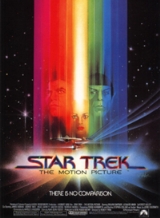
Star Trek: The Motion Picture is a 1979 American science fiction film released by
Paramount PicturesParamount Pictures Corporation is an American film production and distribution company, located at 5555 Melrose Avenue in Hollywood. Founded in 1912 and currently owned by media conglomerate Viacom, it is America's oldest existing film studio; it is also the last major film studio still...
. It is the first film based on the
Star TrekStar Trek is an American science fiction television series created by Gene Roddenberry, produced by Desilu Productions . Star Trek was telecast on NBC from September 8, 1966, through June 3, 1969...
television series. The film is set in the twenty-third century, when a mysterious and immensely powerful alien cloud called V'Ger approaches the Earth, destroying everything in its path. Admiral
James T. KirkJames Tiberius "Jim" Kirk is a character in the Star Trek media franchise. Kirk was first played by William Shatner as the principal lead character in the original Star Trek series. Shatner voiced Kirk in the animated Star Trek series and appeared in the first seven Star Trek movies...
(
William ShatnerWilliam Alan Shatner is a Canadian actor, musician, recording artist, and author. He gained worldwide fame and became a cultural icon for his portrayal of James T...
) assumes command of his old starship—the
USS EnterpriseThe USS Enterprise, NCC-1701, is a fictional starship in the Star Trek media franchise. The original Star Trek series depicts her crew's mission "to explore strange new worlds; to seek out new life and new civilizations; to boldly go where no man has gone before" under the command of Captain James...
—to lead it on a mission to save the planet and determine VGers origins.
When the original television series was cancelled in 1969, Star Trek creator
Gene RoddenberryEugene Wesley "Gene" Roddenberry was an American television screenwriter, producer and futurist, best known for creating the American science fiction series Star Trek. Born in El Paso, Texas, Roddenberry grew up in Los Angeles, California where his father worked as a police officer...
lobbied Paramount to continue the franchise through a film. The success of the series in syndication convinced the studio to begin work on a feature film in 1975. A series of writers attempted to craft a suitably epic script, but the attempts did not satisfy Paramount, so the studio scrapped the project in 1977. Paramount instead planned on returning the franchise to its roots with a new television series,
Star Trek: Phase IIStar Trek: Phase II was a planned television series based on the characters of Gene Roddenberry's Star Trek, which had run from 1966 to 1969. It was set to air in early 1978 on a proposed Paramount Television Service...
. The box office success of
Close Encounters of the Third KindClose Encounters of the Third Kind is a 1977 science fiction film written and directed by Steven Spielberg. The film stars Richard Dreyfuss, François Truffaut, Melinda Dillon, Teri Garr, Bob Balaban, and Cary Guffey...
convinced Paramount that science fiction films other than
Star WarsStar Wars Episode IV: A New Hope, originally released as Star Wars, is a 1977 American epic space opera film, written and directed by George Lucas. It is the first of six films released in the Star Wars saga: two subsequent films complete the original trilogy, while a prequel trilogy completes the...
could do well at the box office, so the studio cancelled production of Phase II and resumed its attempts at making a Star Trek film. In 1978, Paramount assembled the largest press conference held at the studio since the 1950s to announce that double Academy Award–winning director
Robert WiseRobert Earl Wise was an American sound effects editor, film editor, film producer and director...
would helm a $15 million film adaptation of the television series.
With the cancellation of the new television series, the writers rushed to adapt the planned pilot episode of Phase II, "In Thy Image," into a film script. Constant revisions to the story and shooting script continued, to the extent of hourly script updates on shooting dates. The Enterprise was modified inside and out; costume designer
Robert FletcherRobert Fletcher is a costume and set designer.Fletcher's first ambition was to become an archeologist. Before he graduated from Harvard University, however, he had become an aspiring actor...
provided new uniforms and production designer
Harold MichelsonHarold Michelson was an American production designer and art director. In addition, he worked as an illustrator and/or storyboard artist on numerous films from the 1940s through the 1990s.-Biography:...
fabricated new sets.
Jerry GoldsmithJerrald King Goldsmith was an American composer and conductor most known for his work in film and television scoring....
composed the score, beginning an association with Star Trek that would continue until 2002. When the original contractors for the optical effects proved unable to complete their tasks in time, effects supervisor
Douglas TrumbullDouglas Huntley Trumbull is an American film director, special effects supervisor, and inventor. He contributed to, or was responsible for, the special photographic effects of 2001: A Space Odyssey, Close Encounters of the Third Kind, Star Trek: The Motion Picture, Blade Runner and The Tree of...
was given carte blanche to meet the December 1979 release date. The film came together only days before the premiere; Wise took the just-completed film to its Washington, D.C., opening, but always felt that the theatrical version was a
rough cutIn filmmaking, the rough cut is the second of three stages of offline editing. The rough cut is the first stage in which the film begins to resemble its final product...
of the film he wanted to make.
Released in North America on December 7, 1979, Star Trek: The Motion Picture received mixed reviews from critics, many of whom criticized the film for its lack of action and over-reliance on special effects. The final production cost ballooned to approximately $46 million. The film earned $139 million worldwide, falling short of studio expectations but enough for Paramount to propose a cheaper sequel. Roddenberry was forced out of creative control for
Star Trek II: The Wrath of KhanStar Trek II: The Wrath of Khan is a 1982 American science fiction film released by Paramount Pictures. The film is the second feature based on the Star Trek science fiction franchise. The plot features James T...
. In 2001, Wise created a director's cut for a special DVD release of the film; a team remastered the audio, tightened and added scenes, and used new
computer-generated effectsComputer-generated imagery is the application of the field of computer graphics or, more specifically, 3D computer graphics to special effects in art, video games, films, television programs, commercials, simulators and simulation generally, and printed media...
to, he said, complete his vision.
Plot
A
StarfleetIn the fictional universe of Star Trek, Starfleet or the Federation Starfleet is the deep-space exploratory, peacekeeping and military service maintained by the United Federation of Planets . It is the principal means by which the Federation conducts its exploration, defense, diplomacy and research...
monitoring station detects an alien force, hidden in a massive cloud of energy, moving through space towards Earth. The cloud destroys three
KlingonKlingons are a fictional warrior race in the Star Trek universe.Klingons are recurring villains in the 1960s television show Star Trek: The Original Series, and have appeared in all five spin-off series and eight feature films...
warships and the monitoring station en route. On Earth, the starship
EnterpriseThe USS Enterprise, NCC-1701, is a fictional starship in the Star Trek media franchise. The original Star Trek series depicts her crew's mission "to explore strange new worlds; to seek out new life and new civilizations; to boldly go where no man has gone before" under the command of Captain James...
is undergoing a major refit; its former commander,
James T. KirkJames Tiberius "Jim" Kirk is a character in the Star Trek media franchise. Kirk was first played by William Shatner as the principal lead character in the original Star Trek series. Shatner voiced Kirk in the animated Star Trek series and appeared in the first seven Star Trek movies...
, has been promoted to Admiral and works in San Francisco as Chief of Starfleet Operations. Starfleet dispatches Enterprise to investigate the cloud entity as the ship is the only one in intercept range, requiring its new systems to be tested in transit.
Kirk takes command of the ship citing his experience, angering Captain Willard Decker, who had been overseeing the refit as its new commanding officer. Testing of Enterprises new systems goes poorly; two officers, including the science officer, are killed by a malfunctioning
transporterA transporter is a fictional teleportation machine used in the Star Trek universe. Transporters convert a person or object into an energy pattern , then "beam" it to a target, where it is reconverted into matter...
, and improperly calibrated engines almost destroy the ship. The tension between Kirk and Decker increases when the admiral demonstrates his unfamiliarity with Enterprise.
SpockSpock is a fictional character in the Star Trek media franchise. First portrayed by Leonard Nimoy in the original Star Trek series, Spock also appears in the animated Star Trek series, two episodes of Star Trek: The Next Generation, seven of the Star Trek feature films, and numerous Star Trek...
arrives as replacement science officer, explaining that while on his home world undergoing a ritual to purge all emotion, he felt a consciousness that he believes emanates from the cloud.
The Enterprise intercepts the energy cloud and is attacked by an alien vessel within. A probe appears on the bridge, attacks Spock and abducts the navigator, Ilia. She is replaced by a robotic doppelgänger, a probe sent by "V'Ger" to study the crew. Decker is distraught over the loss of Ilia, with whom he had a romantic history. He becomes troubled as he attempts to extract information from the doppelgänger, which has Ilia's memories and feelings buried within. Spock takes a spacewalk to the alien vessel's surface and attempts a telepathic mind meld with it. In doing so, he learns that the vessel is V'Ger itself, a living machine.
At the heart of the massive ship, V'Ger is revealed to be
Voyager 6The Voyager program is a U.S program that launched two unmanned space missions, scientific probes Voyager 1 and Voyager 2. They were launched in 1977 to take advantage of a favorable planetary alignment of the late 1970s...
, a 20th-century Earth space probe believed lost. The damaged probe was found by an alien race of living machines that interpreted its programming as instructions to learn all that can be learned, and return that information to its creator. The machines upgraded the probe to fulfill its mission, and on its journey the probe gathered so much knowledge that it achieved consciousness. Spock realizes that V'Ger lacks the ability to give itself a focus other than its original mission; having learned what it could on its journey home, it finds its existence empty and without purpose. Before transmitting all its information, V'Ger insists that the Creator come in person to finish the sequence. Realizing that the machine wants to merge with its creator, Decker offers himself to V'Ger; he merges with the Ilia probe and V'Ger, creating a new form of life that disappears into another dimension. With Earth saved, Kirk directs Enterprise out to space for future missions.
Cast

- William Shatner
William Alan Shatner is a Canadian actor, musician, recording artist, and author. He gained worldwide fame and became a cultural icon for his portrayal of James T...
as James T. KirkJames Tiberius "Jim" Kirk is a character in the Star Trek media franchise. Kirk was first played by William Shatner as the principal lead character in the original Star Trek series. Shatner voiced Kirk in the animated Star Trek series and appeared in the first seven Star Trek movies...
, the former captain of the USS Enterprise and an Admiral at Starfleet headquarters. When asked during a March 1978 press conference about what it would be like to reprise the role, Shatner said, "An actor brings to a role not only the concept of a character but his own basic personality, things that he is, and both [Leonard Nimoy] and myself have changed over the years, to a degree at any rate, and we will bring that degree of change inadvertently to the role we recreate."
- Leonard Nimoy
Leonard Simon Nimoy is an American actor, film director, poet, musician and photographer. Nimoy's most famous role is that of Spock in the original Star Trek series , multiple films, television and video game sequels....
as SpockSpock is a fictional character in the Star Trek media franchise. First portrayed by Leonard Nimoy in the original Star Trek series, Spock also appears in the animated Star Trek series, two episodes of Star Trek: The Next Generation, seven of the Star Trek feature films, and numerous Star Trek...
, the Enterprises half-VulcanVulcans, or sometimes Vulcanians, are an extraterrestrial humanoid species in the Star Trek universe who evolved on the planet Vulcan, and are noted for their attempt to live by reason and logic with no interference from emotion. They were the first extraterrestrial species in the Star Trek...
, half-human science officer. Nimoy had been dissatisfied with unpaid royalties from Star Trek and did not intend to reprise the role, so Spock was left out of the screenplay. Director Robert WiseRobert Earl Wise was an American sound effects editor, film editor, film producer and director...
, having been informed by his daughter and son-in-law that the film "would not be Star Trek" without Nimoy, sent Jeffrey KatzenbergJeffrey Katzenberg is an American film producer and CEO of DreamWorks Animation. He is perhaps most famous for his period as chairman of The Walt Disney Company's film division, and for producing DreamWorks animated films such as Shrek, Antz, The Prince of Egypt, The Road to El Dorado, Chicken...
to New York CityNew York is the most populous city in the United States and the center of the New York Metropolitan Area, one of the most populous metropolitan areas in the world. New York exerts a significant impact upon global commerce, finance, media, art, fashion, research, technology, education, and...
to meet Nimoy. Katzenberg gave Nimoy a check to make up for his lost royalties, and the actor attended the March 1978 press conference with the rest of the returning cast. Nimoy was dissatisfied with the script, and his meeting with Katzenberg led to an agreement that the final script would need Nimoy's approval. Despite the financial issues, Nimoy said he was comfortable with being identified as Spock because it had a positive impact on his fame.
- DeForest Kelley
Jackson DeForest Kelley was an American actor known for his iconic roles in Westerns and as Dr. Leonard "Bones" McCoy of the USS Enterprise in the television and film series Star Trek.-Early life:...
as Leonard McCoyLeonard "Bones" McCoy is a character in the Star Trek media franchise. First portrayed by DeForest Kelley in the original Star Trek series, McCoy also appears in the animated Star Trek series, seven Star Trek movies, the pilot episode of Star Trek: The Next Generation, and in numerous books,...
, the chief medical officer aboard the Enterprise. Kelley had reservations with the script, feeling that the characters and relationships from the series were not in place. Along with Shatner and Nimoy, Kelley lobbied for greater characterization, but their opinions were largely ignored.
- James Doohan
James Montgomery "Jimmy" Doohan was a Canadian character and voice actor best known for his role as Montgomery "Scotty" Scott in the television and film series Star Trek...
as Montgomery ScottMontgomery "Scotty" Scott is a Scottish engineer in the Star Trek media franchise. First portrayed by James Doohan in the original Star Trek series, Scotty also appears in the animated Star Trek series, seven Star Trek movies, the Star Trek: The Next Generation episode "Relics", and in numerous...
, the Enterprises chief engineer. Doohan created the distinctive Klingon vocabulary heard in the film. Linguist Marc OkrandMarc Okrand is an American linguist and is most notable as the creator of the Klingon language, which he speaks.-Biography:Okrand worked with Native American languages. He earned a bachelor's degree from the University of California, Santa Cruz in 1972...
later developed a fully realized Klingon languageThe Klingon language is the constructed language spoken by the fictional Klingons in the Star Trek universe....
based on the actor's made-up words.
- Walter Koenig
Walter Marvin Koenig is an American actor, writer, teacher and director, known for his roles as Pavel Chekov in Star Trek and Alfred Bester in Babylon 5. He wrote the script for the 2008 science fiction legal thriller InAlienable.-Early life:...
as Pavel ChekovPavel Andreievich Chekov is a Russian Starfleet officer in the Star Trek fictional universe. Walter Koenig portrayed Chekov in the original Star Trek series and first seven Star Trek films; Anton Yelchin portrayed the character in the 2009 film Star Trek.-Origin:Star Trek creator Gene Roddenberry...
, the Enterprises weapons officer. Koenig noted that the expected sense of camaraderie and euphoria at being assembled for screen tests at the start of the picture was nonexistent. "This may be Star Trek," he wrote, "but it isn't the old Star Trek." The actor was hopeful for the film, but admitted he was disappointed by his character's bit part.
- Nichelle Nichols
Nichelle Nichols is an American actress, singer and voice artist. She sang with Duke Ellington and Lionel Hampton before turning to acting...
as UhuraNyota Uhura is a character in Star Trek: The Original Series, Star Trek: The Animated Series, the first six Star Trek films, and the 2009 film Star Trek...
, the communications officer aboard the Enterprise. Nichols noted in her autobiography that she was one of the actors most opposed to the new uniforms added for the film because the drab, unisex look "wasn't Uhura".
- George Takei
George Hosato Takei Altman is an American actor, author, social activist and former civil politician. He is best known for his role in the television series Star Trek and its film spinoffs, in which he played Hikaru Sulu, helmsman of the...
as Hikaru SuluHikaru Sulu is a character in the Star Trek media franchise. First portrayed by George Takei in the original Star Trek series, Sulu also appears in the animated Star Trek series, the first six Star Trek movies, one episode of Star Trek: Voyager, and in numerous books, comics, and video games...
, the Enterprises helmsman. In his autobiographyTo the Stars: The Autobiography of George Takei, Star Trek's Mr. Sulu is an autobiography by actor George Takei, first published by Pocket Books in 1994. Takei describes his early childhood and the time his family spent in Japanese American internment, and experiences which shaped his motivation...
, Takei described the film's shooting schedule as "astonishingly luxurious", but noted that frequent script rewrites during production "usually favored Bill" [Shatner].
- Persis Khambatta
Persis Khambatta was an Indian model, actress and author. She was best known for her role as Lieutenant Ilia in the 1979 feature film Star Trek: The Motion Picture.-Early Life:...
as Ilia, the Deltan navigator of the Enterprise. Khambatta was originally cast in the role when The Motion Picture was a television pilot. She took the role even after Roddenberry warned her that she would have to shave her head completely for filming.
- Stephen Collins as Willard Decker, the new captain of the Enterprise. He is temporarily demoted to Commander and First Officer when Kirk takes command of the Enterprise. Collins was completely unfamiliar with the franchise, having never seen an episode of the series. Kelley's dressing room was next to Collins', and the older actor became his mentor for the production.
Other actors from the television series who returned included
Majel BarrettMajel Barrett-Roddenberry was an American actress and producer. She is perhaps best known for her role as Nurse Christine Chapel in the original Star Trek series, Lwaxana Troi on Star Trek: The Next Generation, and for being the voice of most onboard computer interfaces throughout the series...
as
Christine ChapelChristine Chapel is a fictional character in the original Star Trek series, and in some of the films based on it. She was played by the late Majel Barrett....
, a doctor aboard the Enterprise, and
Grace Lee WhitneyGrace Lee Whitney, also known as Ruth Whitney and Lee Whitney is an American actress and entertainer. She is best known for playing the role of Janice Rand on the Star Trek television series and subsequent films.-Early life:...
as
Janice RandYeoman Janice Rand, played by Grace Lee Whitney, is a character in Star Trek: The Original Series. She subsequently appears in several Star Trek films and in an episode of Star Trek: Voyager.-Depiction:...
, formerly one of Kirk's yeomen. David Gautreaux, who had been cast as Xon in the aborted second television series, cameos as Branch, the commander of the Epsilon 9 communications station.
Mark LenardMark Lenard was an American actor, primarily in television.-Biography:Lenard was born Leonard Rosenson in Chicago, Illinois, the son of a Russian Jewish immigrant, Abraham, and his wife, Bessie...
portrays the Klingon commander in the film's opening sequence; the actor also played Spock's father,
SarekSarek is a fictional character in the Star Trek media franchise. He is a Vulcan astrophysicist, the Vulcan ambassador to the United Federation of Planets, and father of Spock...
, in the television series and in later feature films.
Early development
The original
Star TrekStar Trek is an American science fiction television series created by Gene Roddenberry, produced by Desilu Productions . Star Trek was telecast on NBC from September 8, 1966, through June 3, 1969...
television series ran for three seasons from 1966 to 1969 on NBC. The show was never a hit with network executives, and the show's low
Nielsen ratingsNielsen ratings are the audience measurement systems developed by Nielsen Media Research, in an effort to determine the audience size and composition of television programming in the United States...
bolstered their concerns. When the show was cancelled, owner Paramount Studios hoped to recoup their production losses by selling the syndication rights to the show. The series went into reruns in the fall of 1972, and by the late 1970s had been sold in over 150 domestic and 60 international markets. The show developed a
cult followingA cult following is a group of fans who are highly dedicated to a specific area of pop culture. A film, book, band, or video game, among other things, will be said to have a cult following when it has a small but very passionate fan base...
, and rumors of reviving the franchise began.
Roddenberry had first proposed a Star Trek feature at the 1968
World Science Fiction ConventionWorldcon, or more formally The World Science Fiction Convention, is a science fiction convention held each year since 1939 . It is the annual convention of the World Science Fiction Society...
. The movie was to have been set before the television series, showing how the crew of the Enterprise met. The popularity of the syndicated Star Trek caused
Paramount PicturesParamount Pictures Corporation is an American film production and distribution company, located at 5555 Melrose Avenue in Hollywood. Founded in 1912 and currently owned by media conglomerate Viacom, it is America's oldest existing film studio; it is also the last major film studio still...
and Roddenberry to begin developing the film in May 1975. Roddenberry was allocated $3 to $5 million to develop a script. By June 30 he had produced what he considered an acceptable script, but studio executives disagreed. This first draft, The God Thing, featured a grounded Admiral Kirk assembling the old crew on the refitted Enterprise to clash with a godlike entity many miles across, hurtling towards Earth. The object turns out to be a super-advanced computer, the remains of a scheming race who were cast out of their dimension. Kirk wins out, the entity returns to its dimension, and the Enterprise crew resumes their voyages. The basic premise and scenes such as a transporter accident and Spock's Vulcan ritual were discarded, but later returned to the final script. The film was postponed until spring 1975 while Paramount fielded new scripts for Star Trek II (the working title) from acclaimed writers such as
Ray BradburyRay Douglas Bradbury is an American fantasy, horror, science fiction, and mystery writer. Best known for his dystopian novel Fahrenheit 451 and for the science fiction stories gathered together as The Martian Chronicles and The Illustrated Man , Bradbury is one of the most celebrated among 20th...
,
Theodore SturgeonTheodore Sturgeon was an American science fiction author.His most famous novel is More Than Human .-Biography:...
and
Harlan EllisonHarlan Jay Ellison is an American writer. His principal genre is speculative fiction.His published works include over 1,700 short stories, novellas, screenplays, teleplays, essays, a wide range of criticism covering literature, film, television, and print media...
. Ellison's story had a snake-like alien race tampering with Earth's history to create a kindred race; Kirk reunites with his old crew, but they are faced with the dilemma of killing off the reptilian race in Earth's prehistory just to maintain humanity's dominance. When Ellison presented his idea, an executive suggested Ellison read Chariots of the Gods? and include the
Maya civilizationThe Maya is a Mesoamerican civilization, noted for the only known fully developed written language of the pre-Columbian Americas, as well as for its art, architecture, and mathematical and astronomical systems. Initially established during the Pre-Classic period The Maya is a Mesoamerican...
into his story, which enraged the writer because he knew Mayans did not exist at the dawn of time. By October 1975
Robert SilverbergRobert Silverberg is an American author, best known for writing science fiction. He is a multiple nominee of the Hugo Award and a winner of the Nebula Award.-Early years:...
had been signed to work on the screenplay along with a second writer,
John D. F. BlackJohn D. F. Black is a scriptwriter, TV producer, and TV director. He has had a long and varied career in television, but he is best known for his work on the TV series Star Trek in 1966, and its sequel series, Star Trek: The Next Generation during the 1980s.Black was the associate producer for ten...
, whose treatment featured a
black holeA black hole is a region of spacetime from which nothing, not even light, can escape. The theory of general relativity predicts that a sufficiently compact mass will deform spacetime to form a black hole. Around a black hole there is a mathematically defined surface called an event horizon that...
that threatened to consume all of existence. Roddenberry teamed up with
Jon PovillJon Povill is an American scriptwriter and television producer. He wrote the first two drafts of the screenplay for Total Recall in the 1970s, and then took up a position on the attempted Star Trek: Phase II, becoming Story editor, and penning the episode "The Child", which would later be remade...
to write a new story that featured the Enterprise crew setting an altered universe right by time travel; like Black's idea, Paramount did not consider it epic enough.
The original Star Trek cast—who had agreed to appear in the new movie, with contracts as-yet unsigned pending script approval—grew anxious about the constant delays, and pragmatically accepted other acting offers while Roddenberry worked with Paramount. The studio decided to turn the project over to the television division, reasoning that since the roots of the franchise lay in television the writers would be able to develop the right script. A number of screenwriters offered up ideas that were summarily rejected. As Paramount executives' interest in the film began to wane, Roddenberry, backed by fan letters, applied pressure to the studio. In June 1976, Paramount assigned Jerry Isenberg, a young and active producer, to be executive producer of the project, with the budget expanded to $8 million. Povill was tasked with finding more writers to develop a script. His list included
Edward AnhaltEdward Anhalt was a noted screenwriter, producer, and documentary film-maker. After working as a journalist and documentary filmmaker for Pathé and CBS-TV he teamed with his wife Edna Anhalt, née Richards, during World War II to write pulp fiction...
,
James GoldmanJames Goldman was an American screenwriter and playwright, and the brother of screenwriter and novelist William Goldman.He was born in Chicago, Illinois, and grew up primarily in Highland Park, Illinois, a Chicago suburb...
,
Francis Ford CoppolaFrancis Ford Coppola is an American film director, producer and screenwriter. He is widely acclaimed as one of Hollywood's most innovative and influential film directors...
,
George LucasGeorge Walton Lucas, Jr. is an American film producer, screenwriter, and director, and entrepreneur. He is the founder, chairman and chief executive of Lucasfilm. He is best known as the creator of the space opera franchise Star Wars and the archaeologist-adventurer character Indiana Jones...
,
Ernest LehmanErnest Lehman was an American screenwriter. He received 6 Academy Award nominations during his screenwriting career...
, and
Robert BlochRobert Albert Bloch was a prolific American writer, primarily of crime, horror and science fiction. He is best known as the writer of Psycho, the basis for the film of the same name by Alfred Hitchcock...
. To cap off his list, Povill put as his last recommendation "Jon Povill—almost credit: Star Trek II story (with Gene Roddenberry). Will be a big shot some day. Should be hired now while he is cheap and humble." The end result was a compiled list of 34 names, none of whom were ever chosen to pen the script.
In October, British screenwriters
Chris BryantChris Bryant was an English screenwriter and occasional actor ....
and
Allan ScottAllan Scott, the alias of Allan Shiach, is a Scottish screenwriter and producer, nominated for BAFTA's Alexander Korda Award for Best British Film and a Genie Award for his 1997 film Regeneration...
wrote a 20 page treatment entitled Planet of the Titans, which executives
Barry DillerBarry Charles Diller is the Chairman and Senior Executive of IAC/InterActiveCorp and the media executive responsible for the creation of Fox Broadcasting Company and USA Broadcasting.-Early life:...
and
Michael EisnerMichael Dammann Eisner is an American businessman. He was the chief executive officer of The Walt Disney Company from 1984 until 2005.-Early life:...
liked. Bryant believed he earned the screenwriting assignment because his view of Kirk resembled what Roddenberry modeled him on; "one of
Horatio NelsonHoratio Nelson, 1st Viscount Nelson, 1st Duke of Bronté, KB was a flag officer famous for his service in the Royal Navy, particularly during the Napoleonic Wars. He was noted for his inspirational leadership and superb grasp of strategy and unconventional tactics, which resulted in a number of...
's captains in the South Pacific, six months away from home and three months away by communication". In the treatment, Kirk and his crew encounter beings they believe to be the mythical
TitansIn Greek mythology, the Titans were a race of powerful deities, descendants of Gaia and Uranus, that ruled during the legendary Golden Age....
and travel back millions of years in time, accidentally teaching early man to
make fireFire was an essential tool in early human cultural development and still important today. Many different techniques for making fire exist...
. Planet of the Titans also explored the concept of the
third eyeThe third eye is a mystical and esoteric concept referring in part to the ajna chakra in certain spiritual traditions. It is also spoken of as the gate that leads within to inner realms and spaces of higher consciousness...
. Povill wrote up a list of possible directors, including Coppola,
Steven SpielbergSteven Allan Spielberg KBE is an American film director, screenwriter, producer, video game designer, and studio entrepreneur. In a career of more than four decades, Spielberg's films have covered many themes and genres. Spielberg's early science-fiction and adventure films were seen as an...
, Lucas, and
Robert WiseRobert Earl Wise was an American sound effects editor, film editor, film producer and director...
, but all were busy at the time (or were not willing to work on the small script money budget).
Philip KaufmanPhilip Kaufman is an American film director and screenwriter. His movies have adapted novels of widely different types – from Milan Kundera’s The Unbearable Lightness of Being to Michael Crichton’s Rising Sun; from Tom Wolfe’s heroic epic The Right Stuff to the erotic writings of Anaïs Nin’s...
, having impressive science fiction credits, signed on to direct and was given a crash course in the series. Roddenberry screened ten episodes from the original series for Kaufman, including the most representative of the show and those he considered most popular: "The City on the Edge of Forever", "The Devil in the Dark", "Amok Time", "Journey to Babel", "Shore Leave", "The Trouble With Tribbles", "The Enemy Within", "The Corbomite Maneuver", "This Side of Paradise", and "A Piece of the Action". Early work was promising and by the fall of 1976 the project was building momentum. Fans organized a mail campaign that flooded the White House with 400,000 letters, influencing
Gerald FordGerald Rudolph "Jerry" Ford, Jr. was the 38th President of the United States, serving from 1974 to 1977, and the 40th Vice President of the United States serving from 1973 to 1974...
to rechristen the
Space ShuttleThe Space Shuttle was a manned orbital rocket and spacecraft system operated by NASA on 135 missions from 1981 to 2011. The system combined rocket launch, orbital spacecraft, and re-entry spaceplane with modular add-ons...
Constitution to
EnterpriseThe Space Shuttle Enterprise was the first Space Shuttle orbiter. It was built for NASA as part of the Space Shuttle program to perform test flights in the atmosphere. It was constructed without engines or a functional heat shield, and was therefore not capable of spaceflight...
. Bryant and Scott's proposal became the first accepted by the studio in October; Roddenberry immediately stopped work on other projects to refocus on Star Trek, and the screenwriters and Isenberg were swamped with grateful fan mail. The elation was short-lived; the first draft of the completed script was not finished until March 1, 1977, and pressure was mounting for Paramount to either begin production or cut its losses and cancel the project. Isenberg began scouting filming locations and hired designers and illustrators to complement the script. Dissatisfied with having everyone take a turn at rewriting the script, Bryant and Scott quit in April 1977. Kaufman reconceived the story with Spock as the captain of his own ship and featuring
Toshirō MifuneToshirō Mifune was a Japanese actor who appeared in almost 170 feature films. He is best known for his 16-film collaboration with filmmaker Akira Kurosawa, from 1948 to 1965, in works such as Rashomon, Seven Samurai, Throne of Blood, and Yojimbo...
as Spock's
KlingonKlingons are a fictional warrior race in the Star Trek universe.Klingons are recurring villains in the 1960s television show Star Trek: The Original Series, and have appeared in all five spin-off series and eight feature films...
nemesis, but Katzenberg informed the director in May that the film was cancelled.
Phase II and restart
Barry Diller had grown concerned by the direction Star Trek had taken in Planet of the Titans, and suggested to Roddenberry that it was time to take the franchise back to its roots as a television series. Diller planned on a new Star Trek series forming the cornerstone for
a new television networkThe Paramount Television Service was the name of a proposed but ultimately, unrealized "fourth television network" from the major American film studio, Paramount Pictures...
. Though Paramount was loath to abandon its work on the film, Roddenberry wanted to bring many of the production staff from the original series to work on the new show, titled
Star Trek: Phase IIStar Trek: Phase II was a planned television series based on the characters of Gene Roddenberry's Star Trek, which had run from 1966 to 1969. It was set to air in early 1978 on a proposed Paramount Television Service...
.
Producer Harold Livingston was assigned to find writers for new episodes, while Roddenberry prepared a writers' guide briefing the uninitiated on the franchise canon. To replace Spock, Roddenberry created a logical Vulcan prodigy named Xon. Since Xon was too young to fill the role of first officer, Roddenberry developed Commander William Decker, and later added Ilia. The new series' pilot episode "In Thy Image" was based on a two-page outline by Roddenberry about a NASA probe returning to Earth, having gained sentience.
Alan Dean FosterAlan Dean Foster is an American author of fantasy and science fiction. He currently resides in Prescott, Arizona, with his wife, and is also known for his novelizations of film scripts...
wrote a treatment for the pilot, which Livingston turned into a screenplay. When the script was presented to Michael Eisner, he declared it worthy of being told as a feature film. At the same time, the success of
Close Encounters of the Third KindClose Encounters of the Third Kind is a 1977 science fiction film written and directed by Steven Spielberg. The film stars Richard Dreyfuss, François Truffaut, Melinda Dillon, Teri Garr, Bob Balaban, and Cary Guffey...
showed Paramount that Star Wars success in the science fiction genre at the box office could repeat. On November 11, just two and a half weeks before production on Phase II was due to start, the studio announced that the television series had been cancelled in favor of a new feature film. Cast and crew who had been hired that Monday were laid off by Friday, and construction came to a halt. Production was moved to April 1978 so that the necessary scripts, sets, and wardrobe could be upgraded.
On March 28, 1978, Paramount assembled the largest press conference held at the studio since
Cecil B. DeMilleCecil Blount DeMille was an American film director and Academy Award-winning film producer in both silent and sound films. He was renowned for the flamboyance and showmanship of his movies...
announced he was making
The Ten CommandmentsThe Ten Commandments is a 1956 American epic film that dramatized the biblical story of the Exodus, in which the Hebrew-born Moses, an adopted Egyptian prince, becomes the deliverer of the Hebrew slaves. The film, released by Paramount Pictures in VistaVision on October 5, 1956, was directed by...
. Eisner announced that Academy-Award winning director Robert Wise would direct a film adaptation of the television series, titled Star Trek—The Motion Picture. The budget was projected at $15 million. Dennis Clark (
Comes a HorsemanComes a Horseman is a 1978 film starring James Caan, Jane Fonda, Jason Robards, and Richard Farnsworth.The movie, set in the American West of the 1940s, tells the story of two ranchers whose small operation is threatened both by economic hardship and the expansionist dreams of a local land baron...
) was invited to rewrite the script and to include Spock, but he disliked Roddenberry, who demanded sole credit. Livingston returned as writer, and although he also found Roddenberry unreasonable, Wise and Katzenberg convinced him to continue rewriting the script throughout production.
The writers began to adapt "In Thy Image" into a film script, but the script was not completed until four months after production commenced. Wise felt that the story was sound, but the action and visuals could be made more exciting. As the intended start of filming in late spring 1978 approached, it was clear a new start date was needed. Time was of the essence; Paramount was worried that their science fiction film would appear at the tail end of a cycle, now that every major studio had such a film in the works. Livingston described the writers' issue with the story, calling it "unworkable":
We had a marvelous antagonist, so omnipotent that for us to defeat it or even communicate with it, or have any kind of relationship with it, made the initial concept of the story false. Here's this gigantic machine that's a million years further advanced than we are. Now, how the hell can we possibly deal with this? On what level? As the story developed, everything worked until the very end. How do you resolve this thing? If humans can defeat this marvelous machine, it's really not so great, is it? Or if it really is great, will we like those humans who do defeat it? Should they defeat it? Who is the story's hero anyway? That was the problem. We experimented with all kinds of approaches...we didn't know what to do with the ending. We always ended up against a blank wall.
The script received constant input from the producers and from Shatner and Nimoy. The discussions led to repeated rewrites, right up to the day the pages were to be shot. At one point, scenes were being rewritten so often it became necessary to note on script pages the hour of the revision. Though changes were constant, the biggest push for alteration revolved around the ending. Much of the rewriting had to do with the relationships of Kirk and Spock, Decker and Ilia, and the Enterprise and Vger. A final draft of the third act was approved in late September 1978, but had it not been for a
PenthousePenthouse, a men's magazine founded by Bob Guccione, combines urban lifestyle articles and softcore pornographic pictorials that, in the 1990s, evolved into hardcore. Penthouse is owned by FriendFinder Network. formerly known as General Media, Inc. whose parent company was Penthouse International...
interview where NASA director
Robert JastrowRobert Jastrow was an American astronomer, physicist and cosmologist. He was a leading NASA scientist, populist author and futurist.- Biography :...
said that mechanical forms of life were likely, the ending may not have been approved at all.
Design
The first new sets (intended for Phase II) were constructed beginning July 25, 1977. The fabrication was supervised by
Joseph JenningsJoseph R. Jennings was an American art director. He was nominated for an Academy Award in the category Best Art Direction for the film Star Trek: The Motion Picture.-External links:...
, an art director involved in the original television series, special-effects expert Jim Rugg, and former Trek designer
Matt JefferiesWalter Matthew Jefferies — known as Matt Jeffries — was an aviation and mechanical artist, set designer and writer, best known for designing the original Starship Enterprise for the Star Trek television series....
, on loan as consultant from
Little House on the PrairieLittle House on the Prairie is an American Western drama television series, starring Michael Landon and Melissa Gilbert, about a family living on a farm in Walnut Grove, Minnesota, in the 1870s and 1880s. The show was an adaptation of Laura Ingalls Wilder's best-selling series of Little House books...
. When the television series was cancelled and plans for a film put into place, new sets were needed for the large
70 mm film format70mm film is a wide high-resolution film gauge, with higher resolution than standard 35mm motion picture film format. As used in camera, the film is wide. For projection, the original 65mm film is printed on film. The additional 5mm are for magnetic strips holding four of the six tracks of sound...
.
Wise asked
Harold MichelsonHarold Michelson was an American production designer and art director. In addition, he worked as an illustrator and/or storyboard artist on numerous films from the 1940s through the 1990s.-Biography:...
to be the film's production designer, and Michelson was put to work on finishing the incomplete Phase II sets. The designer began with the bridge, which had nearly been completed. Michelson first removed Chekov's new weapons station, a semicircular plastic bubble grafted onto one side of the bridge wall. The idea for Phase II was that Chekov would have looked out toward space while crosshairs in the bubble tracked targets. Wise instead wanted Chekov's station to face the Enterprises main viewer, a difficult request as the set was primarily circular. Production illustrator
Michael MinorMichael Minor was an illustrator and art director on Star Trek: The Original Series, Star Trek: The Motion Picture and Star Trek II: The Wrath of Khan....
created a new look for the station using a flat edge in the corner of the set.
The bridge ceiling was redesigned, with Michelson taking structural inspiration from a jet engine fan. Minor built a central bubble for the ceiling to give the bridge a human touch. Ostensibly, the bubble functioned as a piece of sophisticated equipment designed to inform the captain of the ship's attitude. Most of the bridge consoles, designed by Lee Cole, remained from the scrapped television series. Cole remained on the motion picture production and was responsible for much of the visual artwork created. To inform actors and series writers, Lee prepared a USS Enterprise Flight Manual as a continuity guide to control functions. It was necessary for all the main cast to be familiar with control sequences at their stations as each panel was activated by touch via heat-sensitive plates. The wattage of the light bulbs beneath the plastic console buttons were reduced from 25 watts to 6 watts after the generated heat began melting the controls. The seats were covered in girdle material, used because of its stretching capacity and ability to be easily dyed. For the science station, two consoles were rigged for hydraulic operation so that they could be rolled into the walls when not in use, but the system was disconnected when the crew discovered it would be easier to move them by hand.
Aside from control interfaces, the bridge set was populated with monitors looping animations. Each oval monitor was a rear-projection screen on which super 8 mm and 16 mm film sequences looped for each special effect. The production acquired 42 films for this purpose from an
Arlington, VirginiaArlington County is a county in the Commonwealth of Virginia. The land that became Arlington was originally donated by Virginia to the United States government to form part of the new federal capital district. On February 27, 1801, the United States Congress organized the area as a subdivision of...
-based company, STOMAR Enterprises. STOMAR's footage was exhausted only a few weeks into filming, and it became clear that new monitor films would be needed faster than an outside supplier could deliver them. Cole, Minor, and another production designer,
Rick SternbachRichard Michael Sternbach is an illustrator who is best known for his space illustrations and his work on the Star Trek television series.- Early years :...
, worked together with Povill to devise faster ways of shooting new footage. Cole and Povill rented an
oscilloscopeAn oscilloscope is a type of electronic test instrument that allows observation of constantly varying signal voltages, usually as a two-dimensional graph of one or more electrical potential differences using the vertical or 'Y' axis, plotted as a function of time,...
for a day and filmed its distortions. Other loops came from Long Beach Hospital, the University of California at San Diego, and experimental computer labs in New Mexico. In all, over two hundred pieces of monitor footage were created and catalogued into a seven-page listing.
The Enterprise engine room was redesigned while keeping consistent with the theory that the interior appearance had to match the corresponding area visible in exterior views of the starship. Michelson wanted the engine room to seem vast, a difficult effect to achieve on a small sound stage. To create the illusion of depth and long visible distances, the art department staff worked on designs that would utilize
forced perspectiveForced perspective is a technique that employs optical illusion to make an object appear farther away, closer, larger or smaller than it actually is. It is used primarily in photography, filmmaking and architecture...
; set designer Lewis Splittgerber considered the engine room the most difficult set to realize. On film the engine room appeared hundreds of feet long, but the set was actually only 40 feet (12.2 m) in length. To achieve the proper look, the floor slanted upward and narrowed, while very small actors of three, four, and five feet in height were used as extras to give the appearance of being far from the camera. For "down shots" of the engineering complex, floor paintings extended the length of the warp core several stories. J.C. Backings Company created these paintings; similar backings were used to extend the length of ship hallways and the
rec roomA recreation room is a room used for a variety of purposes, such as parties, games and other everyday or casual use. The term is common in the United States and Canada, but is less common in the United Kingdom where the preferred term is games room...
set.
Redesigning the Enterprise corridors was also Michelson's responsibility. Originally the corridors were of straight plywood construction reminiscent of the original series, which Roddenberry referred to as "Des Moines Holiday Inn Style". To move away from this hotel look, Michelson created a new bent and angular design. Roddenberry and Wise agreed with Michelson that in three hundred years, lighting did not need to be overhead, so they had the lighting radiate upward from the floor. Different lighting schemes were used to simulate different decks of the ship with the same length of corridor. Aluminum panels on the walls outside Kirk's and Ilia's quarters were covered with an orange
ultrasuedeUltrasuede is the trade name for a synthetic microfiber fabric invented in 1970 by Dr. Miyoshi Okamoto, a scientist working for Toray Industries. It was the world's first ultra-microfiber. Fabric content is 100% polyester. Ultrasuede feels like natural suede, but it is resistant to stains and...
to represent the living area of the ship.
The transporter had originally been developed for the television series as a matter of convenience; it would have been prohibitively expensive to show the Enterprise land on every new planet. For the redesign Michelson felt that the transporter should look and feel more powerful. He added a sealed control room that would protect operators from the powerful forces at work. The space between the transporter platform and the operators was filled with complex machinery, and cinematographer Richard Kline added eerie lighting to the set to create atmosphere.
After the redesign of the Enterprise sets was complete, Michelson turned his attention to creating the original sets needed for the film. The recreation deck occupied an entire soundstage, dwarfing the small room built for the planned television series; this was the largest interior in the film. The set was 24 feet (7.3 m) high, decorated with 107 pieces of custom-designed furniture, and packed with 300 people for filming. Below a large viewing screen on one end of the set was a series of art panels containing illustrations of previous ships bearing the name Enterprise. One of the ships was NASA's own Enterprise, added per Roddenberry's request:
Some fans have suggested that our new Enterprise should carry a plaque somewhere which commemorates the fact it was named after the first space shuttle launched from Earth in 1970s. This is an intriguing idea. It also has publicity advantages if properly released at the right time. It won't hurt NASA's feelings either. I'll leave it to you where you want it on the vessel.
Another large construction task was the Vger set, referred to by the production staff as "the Coliseum" or "the microwave wok". The set was designed and fabricated in four and a half weeks, and was filmable from all angles; parts of the set were designed to pull away for better camera access at the center. Throughout production Star Trek used eleven of Paramount's thirty-two sound stages, more than any other film done there at the time. To save money, construction coordinator Gene Kelley struck sets with his own crew immediately after filming, lest Paramount charge the production to have the sets dismantled. The final cost for constructing the sets ran at approximately $1.99 million, not counting additional costs for Phase II fabrication.
Props and models
Ralph McQuarrieRalph McQuarrie is a conceptual designer and illustrator who designed Star Wars , the original Battlestar Galactica , E.T. the Extra-Terrestrial and Cocoon, for which he won an Academy Award....
and
Ken AdamSir Kenneth Adam, OBE, born Klaus Hugo Adam , is a motion picture production designer most famous for his set designs for the James Bond films of the 1960s and 1970s.-Childhood in Germany:...
worked on the ship designs for Planet of the Titans. McQuarrie had to redesign the sets and models that were meant for the television series; the Enterprise, space dock, and orbital office were remade with greater details to look more impressive on the bigger movie screens. McQuarrie also redesigned the Enterprise with a flat hull, and though his models never appeared in the film they were later used for the
Star Trek: The Next GenerationStar Trek: The Next Generation is an American science fiction television series created by Gene Roddenberry as part of the Star Trek franchise. Roddenberry, Rick Berman, and Michael Piller served as executive producers at different times throughout the production...
episode "The Best of Both Worlds".
Art director Richard Taylor wanted to completely redesign the ship, abandoning Jeffries' television design, but Roddenberry insisted on the same shape. Instead, Taylor focused on the details, giving it a stylization he considered "almost
Art DecoArt deco , or deco, is an eclectic artistic and design style that began in Paris in the 1920s and flourished internationally throughout the 1930s, into the World War II era. The style influenced all areas of design, including architecture and interior design, industrial design, fashion and...
". Concept artist
Andrew ProbertAndrew Probert is an artist who is best known for designing the USS Enterprise for Star Trek: The Motion Picture and the Enterprise-D for Star Trek: The Next Generation....
helped with the redesign. Probert elaborated on Jenning's television movie model, making the Enterprises secondary hull wider, with angled struts supporting the nacelles (engine pylons) and an elaborate wiring system for the model's lights. In the television series, it had not been clear where the photon torpedoes were intended to have originated from, so Probert rectified this by designing multiple launcher designs at the base of the secondary hull for Taylor to choose from. Probert even added elements such as a separating saucer and landing pads that never made it to The Motion Picture or any other film featuring the model. While the hull surface was kept smooth, it was treated with a special paint finish that made its surface appear iridescent in certain lights. More windows were added than the previous design, and transparent images of the sets were inserted behind the windows so that when the camera approached the model it appeared that viewers could see something inside. As a joke, these images featured Probert, other production staff members, and
Mickey MouseMickey Mouse is a cartoon character created in 1928 by Walt Disney and Ub Iwerks at The Walt Disney Studio. Mickey is an anthropomorphic black mouse and typically wears red shorts, large yellow shoes, and white gloves...
.
Most of the models in The Motion Picture were created by Magicam, a Paramount subsidiary. The main Enterprise model was eight feet long, to a scale of 1/120th scale size, or 1 inches (2.5 cm) to 10 feet (3 m). It took 14 months and $150,000 to build. Instead of standard fiberglass used for older models, the new Enterprise was constructed with lightweight plastics, weighing 85 pounds (38.6 kg). The biggest design issue was making sure that the connective dorsal neck and twin warp nacelle struts were strong enough so that no part of the ship model would sag, bend, or quiver when the model was being moved. The completed model could be supported at one of five possible points as each photographic angle required. A second, 20-inch (50.8 cm) model of the ship was used for long shots. Magicam also produced the orbital dry dock seen during the Enterprises first appearance in the film. Measuring 4 ft x 10 ft x 6 ft (1.22 m x 3.05 m x 1.83 m), its 56 neon panels required 168,000 volts of electricity to operate, with a separate table to support the transformers; the final price for the dock setup was $200,000.

The creation of V'Ger caused problems for the entire production. The crew was dissatisfied with the original four-foot clay model, which looked like a modernized Nemo's
NautilusThe Nautilus is the fictional submarine featured in Jules Verne's novels Twenty Thousand Leagues Under the Sea and The Mysterious Island . Verne named the Nautilus after Robert Fulton's real-life submarine Nautilus...
submarine. Industrial designer
Syd MeadSydney Jay Mead, commonly Syd Mead, is a "visual futurist" and concept artist. He is best known for his designs for science-fiction films such as Blade Runner, Aliens and Tron...
was hired to visualize a new version of the mammoth craft. Mead created a machine that contained organic elements based on input from Wise, Roddenberry, and the effects leads. The final model was 68 feet (20.7 m) long, built from the rear forward so that the camera crews could shoot footage while the next sections were still being fabricated. The model was built out of a plethora of materials—wood, foam, macramé, styrofoam cups, incandescent, neon and strobe lights.
Dick Rubin handled the film's props, and set up a makeshift office in the corner of stage 9 throughout production. Rubin's philosophy as property master was that nearly every actor or extra ought to have something in their hands. As such, Rubin devised and fabricated approximately 350 props for the film, 55 of which were used in the San Francisco tram scene alone. Many of the props were updated designs of items previously seen in the television series, such as phasers and handheld communicators. The only prop that remained from the original television series was Uhura's wireless earpiece, which Nichols specifically requested on the first day of shooting (and all the production crew save those who had worked on the television show had forgotten about). The new phaser was entirely self-contained, with its own circuitry, batteries, and four blinking lights. The prop came with a hefty $4000 price tag; to save money, the lights were dropped, reducing the size of the phaser by a third. A total of 15 of the devices were made for the film. The communicators were radically altered, as by the 1970s the microminiaturization of electronics convinced Roddenberry that the bulky handheld devices of the television series were no longer believable. A wrist-based design was decided upon, with the provision that it look far different than the watch
Dick TracyDick Tracy is a comic strip featuring Dick Tracy, a hard-hitting, fast-shooting and intelligent police detective. Created by Chester Gould, the strip made its debut on October 4, 1931, in the Detroit Mirror. It was distributed by the Chicago Tribune New York News Syndicate...
had been using for decades previous. Two hundred communicators were fashioned, but only a few were the $3500 top models, used for close-ups of the device in action. Most of the props were made from plastic, as Rubin thought that in the future manmade materials would be used almost exclusively.
Costumes and makeup
Roddenberry firmly believed that throwaway clothes were the future of the industry, and this idea was incorporated into the costumes of The Motion Picture.
William Ware TheissWilliam Ware Theiss , also called Bill Theiss, was a costume designer for television and film....
, the designer who created the original television series costumes, was too busy to work on the film. Instead
Robert FletcherRobert Fletcher is a costume and set designer.Fletcher's first ambition was to become an archeologist. Before he graduated from Harvard University, however, he had become an aspiring actor...
, considered one of American theater's most successful costume and scenic designers, was selected to design the new uniforms, suits, and robes for the production. Fletcher eschewed manmade synthetics for natural materials, finding that these fabrics sewed better and lasted longer. As times had changed, the
Starfleet uniformsIn the fictional Star Trek universe enlisted personnel and officers in the United Earth Starfleet and, later, the United Federation of Planets' Starfleet wear a variety of uniforms.-Star Trek: The Original Series:...
, with their bright reds, blues, greens, and golds, had to be revised: the miniskirts worn by females on the show seemed exciting in the 1960s but would now be considered sexist. Wise deemed the original multicolored uniforms too garish, and Fletcher believed that the brightness of these old designs would work against believability when seen on the wide screen—the designer's first task was to create new, less conspicuous uniforms.
In the original series, divisions in ship assignments were denoted by shirt color; for the movie, these color codes were moved to small patches on each person's uniform. The Starfleet delta symbol, which previously indicated duty branches—command, science, medical, engineering, and so forth—was replaced with the command symbol for all branches, superimposed over a circle of color indicating area of service. The blue color of previous uniforms was discarded, for fear they might interfere with the blue screens used for optical effects. Three types of uniforms were fabricated: dress uniforms used for special occasions, Class A uniforms for regular duty, and Class B uniforms as an alternative. The Class A designs were double-stitched in
gabardineGabardine is a tough, tightly woven fabric used to make suits, overcoats, trousers, uniforms, windbreakers, and other garments. The fibre used to make the fabric is traditionally worsted wool, but may also be cotton, texturized polyester, or a blend. Gabardine is woven as a warp-faced steep or...
and featured gold braid designating rank. It was felt that the traditional four gold sleeve stripes for the captain's rank was too blatantly militaristic. Povill had to send out a memo to Fletcher with the modified stripe rank system, as the designer continued to get the 20th and 23rd centuries confused. Fletcher designed the Class B uniform as similar to evolved t-shirts, with shoulder boards used to indicate rank and service divisions. Each costume had the shoes built into the pant leg to further the futuristic look. An Italian shoemaker decorated by the Italian government for making
GucciThe House of Gucci, better known simply as Gucci , is an Italian fashion and leather goods label, part of the Gucci Group, which is owned by French company PPR...
shoes was tasked with creating the futuristic footwear. Combining the shoes and trousers was difficult, time-consuming, and expensive, as each shoe had to be sewn by hand after being fitted to each principal actor. There were difficulties in communication, as the shoemaker spoke limited English and occasionally confused shoe orders due to similar-sounding names.
JumpsuitJumpsuit originally referred to the utilitarian one-piece garments used by parachuters/skydivers, but has come to be used as a common term for any one-piece garment with sleeves and legs.-Use:...
s, serving a more utilitarian function, were the only costumes to have pockets, and were made with a heavyweight
spandexSpandex or elastane is a synthetic fibre known for its exceptional elasticity. It is strong, but less durable than natural Latex, its major non-synthetic competitor. It is a polyurethane-polyurea copolymer that was co-invented in 1959 by chemists C. L. Sandquist and Joseph Shivers at DuPont's...
that required a special needle to puncture the thick material. A variety of field jackets, leisure wear, and spacesuits were also created; as these parts had to be designed and completed before most of the actors' parts had been cast, many roles were filled by considering how well the actors would fit into existing costumes.
For the civilians of San Francisco, Fletcher decided on a greater freedom in dress. Much of the materials for these casual clothes were found in the old storerooms at Paramount, where a large amount of unused or forgotten silks, crepes, and leathers lay in storage. One bolt of material had been handpicked by Cecil DeMille in 1939, and was in perfect condition. The red, black, and gold brocade was woven with real gold and silver wrapped around silk thread; the resulting costume was used for a Betelgeusean ambassador and, at a price of $10,000 for the fabric alone, was the most expensive costume ever worn by a Hollywood extra. Fletcher also recycled
suedeSuede is a type of leather with a napped finish, commonly used for jackets, shoes, shirts, purses, furniture and other items. The term comes from the French "gants de Suède", which literally means "gloves of Sweden"....
s from The Ten Commandments for the Zaranite costumes. With the approval of Roddenberry, Fletcher fashioned complete backgrounds for the alien races seen in the Earth and recreation deck sequences, describing their appearances and the composition of their costumes.
Fred PhillipsFred Beauregard Phillips was a Hollywood makeup artist, best known for his early work at MGM Studios and later on the Star Trek TV series. At MGM he worked under Jack Dawn and William J. Tuttle. In 1980 Phillips was nominated for a Saturn Award for best makeup on the film Star Trek: The Motion...
, the original designer of Spock's Vulcan ears, served as The Motion Pictures makeup artist. He and his staff were responsible for fifty masks and makeup for the aliens seen in the film. The designs were developed by Phillips himself or else off Fletcher's sketches. In his long association with Star Trek Phillips produced his 2000th Spock ear during production of The Motion Picture. Each ear was made of latex and other ingredients blended together in a kitchen mixer, then baked for six hours. Though Phillips had saved the original television series casts used for making the appliances, Nimoy's ears had grown in the decade since and new molds had to be fabricated. While on the small screen the ears could be used up to four times, since nicks and tears did not show up on television, Phillips had to create around three pairs a day for Nimoy during filming. The upswept Vulcan eyebrows needed to be applied hair by hair for proper detail, and it took Nimoy more than two hours to prepare for filming—twice as long as it had for television.
Besides developing Vulcan ears and alien masks, Phillips and his assistant Charles Schram applied more routine makeup to the principal actors. Khambatta's head had to be freshly shaved each day, then given an application of makeup to reduce glare from the hot set lights. Khambatta had no qualms about shaving her head at first, but began worrying if her hair would grow back properly. Roddenberry proposed insuring Khambatta's hair after the actress voiced her concerns, believing the price of such insurance to be negligible. Roddenberry also saw other benefits to taking out a policy:
...Second, [the insurance] would have the advantage of reassuring [Khambatta] and making her feel more comfortable during her role. Third and finally, if the price does turn out to be negligible, John Rothwell, our publicist, assures me that we would probably get many times the cost back in publicity about the insurance.
The idea was ultimately scrapped, as it turned out such a guarantee would be highly expensive; the insurance company believed that there would be difficulty in proving that the hair grew back exactly the same as before. Instead, Khambatta visited the Georgette Klinger Skin Care Salon in Beverley Hills, where experts recommended that she receive six facials and scalp treatments during the course of production. The salon also prescribed a daily scalp treatment routine of cleansing bars, brilliantine lotion, conditioner, makeup remover, and cleansing lotion. The studio agreed these measures were necessary and footed the bill while Khambatta spent six months following the tedious instructions (her hair eventually regrew without issue, though she kept her shaven locks after production had ended.)
Technical consulting
In the decade between the end of the Star Trek television series and the film, many of the futuristic technologies that appeared on the show—electronic doors that open automatically, hypodermic injections, talking computers, weapons that stun rather than kill, and personal communication devices—had become a reality. Roddenberry had insisted that the technology aboard the Enterprise be grounded in established science and scientific theories. The Motion Picture likewise received technical consultation from
NASAThe National Aeronautics and Space Administration is the agency of the United States government that is responsible for the nation's civilian space program and for aeronautics and aerospace research...
, the
Jet Propulsion LaboratoryJet Propulsion Laboratory is a federally funded research and development center and NASA field center located in the San Gabriel Valley area of Los Angeles County, California, United States. The facility is headquartered in the city of Pasadena on the border of La Cañada Flintridge and Pasadena...
at California Institute of Technology, and the
Massachusetts Institute of TechnologyThe Massachusetts Institute of Technology is a private research university located in Cambridge, Massachusetts. MIT has five schools and one college, containing a total of 32 academic departments, with a strong emphasis on scientific and technological education and research.Founded in 1861 in...
, as well as individuals such as a former astronaut and the science fiction writer
Isaac AsimovIsaac Asimov was an American author and professor of biochemistry at Boston University, best known for his works of science fiction and for his popular science books. Asimov was one of the most prolific writers of all time, having written or edited more than 500 books and an estimated 90,000...
.
The greatest amount of technical advice for the production came from the
National Aeronautics and Space AdministrationThe National Aeronautics and Space Administration is the agency of the United States government that is responsible for the nation's civilian space program and for aeronautics and aerospace research...
(NASA), who provided Trek fan
Jesco von PuttkamerJesco Freiherr von Puttkamer is a German-American aerospace engineer and senior NASA manager from Leipzig.He belongs to a widely extended noble family, von Puttkamer...
as advisor to the film. Roddenberry had known Puttkamer since 1975, when they had been introduced by a mutual friend, the Assistant Director of Astronautics at the
Smithsonian InstitutionThe Smithsonian Institution is an educational and research institute and associated museum complex, administered and funded by the government of the United States and by funds from its endowment, contributions, and profits from its retail operations, concessions, licensing activities, and magazines...
. From 1976 until the completion of the film Puttkamer provided the writers, producer, and director with memos on everything technical in the script; the scientist reviewed every line in the script, and was unpaid for his assistance. "Science fiction films, including those of the recent past, have been woefully short of good science advice," he said. "Star Wars [is] really not science fiction. I loved it, but it's a fairy tale of princes and knights in another galaxy. The technology was improbable, the science impossible."
During the rewrite of the final scenes, the studio executives clashed with Roddenberry about the script's ending, believing that the concept of a living machine was too far-fetched. The executives consulted Asimov: if the writer decided a sentient machine was plausible, the ending could stay. Asimov loved the ending, but made one small suggestion; he felt that the use of the word "wormhole" was incorrect, and that the anomaly that the Enterprise found itself in would be more accurately called a "temporal tunnel".
Filming
Filming of The Motion Pictures first scene began on August 7, 1978. A few ad-libbed ceremonies were performed before the cameras rolled; Roddenberry gave Wise his baseball cap, emblazoned with "Enterprise" in gold lettering (the cap was a gift from the captain of the
nuclear carrier EnterpriseUSS Enterprise , formerly CVA-65, is the world's first nuclear-powered aircraft carrier and the eighth US naval vessel to bear the name. Like her predecessor of World War II fame, she is nicknamed the "Big E". At , she is the longest naval vessel in the world...
.) Wise and Roddenberry then cracked a special breakaway bottle of champagne on the bridge set (there was no liquid inside, as flying champagne would have damaged the readied set.) The scene planned was the chaotic mess aboard the Enterprise bridge as the crew readies the ship for space travel; Wise directed 15 takes into the late afternoon before he was content with the scene. The first day's shots used 1650 feet (502.9 m) of film; 420 feet (128 m) were considered "good", 1070 feet (326.1 m) were judged "no good", and 160 feet (48.8 m) were wasted; only one and one-eighth pages had been shot.
Alex Weldon was hired to be supervisor of special effects for the film. Weldon was planning on retiring after 42 years of effects work, but his wife urged him to take on Star Trek because she thought he did not have enough to do. When Weldon was hired, many of the effects had already been started or completed by Rugg; it was up to Weldon to complete more complex and higher-budgeted effects for the motion picture. The first step of preparation involved analyzing the script in terms of the number, duration, and type of effects. Before costs could be determined and Weldon could shop for necessary items, he and the other members of the special effects team worked out all possibilities for pulling off the effects in a convincing manner.
Richard H. KlineRichard Howard Kline, A.S.C. is an American cinematographer. The son of cinematographer Benjamin H. Kline, he joined Columbia Pictures at the age of 16 in 1943.-Credits:...
served as the film's cinematographer. Working from sketch artist Maurice Zuberano's concepts, Wise would judge if they were on the right track. Kline and Michelson would then discuss the look they wanted (along with Weldon, if effects were involved.) Each sequence was then storyboarded and left to Kline to execute. The cinematographer called his function to "interpret [the] preplanning and make it indelible on film. It's a way of everybody being on the same wavelength." Kline would recall that there was not a single "easy" shot to produce for the picture, as each scene required special consideration. The bridge, for example, was lit with a low density of light to make the console monitors display better. It was hard to frame shots so that reflections of the crew in monitors or light spilling through floor grilles were not seen in the final print.

While Kline was concerned with lighting, print quality, and color, Bonnie Prendergast, the script supervisor, took notes that would be written up after the company had finished for the day. Prendergast's role was to ensure continuity in wardrobe, actor position, and prop placement. Any changes in dialogue or ad-libbed lines were similarly written down. Assistant director Danny McCauley was responsible for collaborating with unit production manager Phil Rawlins to finalize shooting orders and assigning extras. Rawlins, McCauley, production manager Lindsley Parson Jr., and Katzenberg were all tasked with keeping things moving as fast as possible and keeping the budget under control; every hour on stage cost the production $4000.
The production was for most of the filming a closed set, with great measures taken to maintain the secrecy of the plot. Scripts were numbered and lists kept of who received each copy. The press was told nothing about the story and only a few production stills were allowed to be published. During construction one young visitor to a soundstage stole a copy of blueprints for the bridge set and sold duplicates of them to any fans who would pay him $75; Paramount reported the matter to the FBI, who turned the case over to the
Los Angeles Police DepartmentThe Los Angeles Police Department is the police department of the city of Los Angeles, California. With just under 10,000 officers and more than 3,000 civilian staff, covering an area of with a population of more than 4.1 million people, it is the third largest local law enforcement agency in...
. The police arrested, convicted, and fined the culprit $750; it was later discovered that the stolen plans were in fact not the final copies. Visitor's badges were created to keep track of guests, and due to the limited number were constantly checked out; among the visitors included friends of the cast and crew, the press, fan leaders, and actors such as
Clint EastwoodClinton "Clint" Eastwood, Jr. is an American film actor, director, producer, composer and politician. Eastwood first came to prominence as a supporting cast member in the TV series Rawhide...
,
Tony CurtisTony Curtis was an American film actor whose career spanned six decades, but had his greatest popularity during the 1950s and early 1960s. He acted in over 100 films in roles covering a wide range of genres, from light comedy to serious drama...
,
Robin WilliamsRobin McLaurin Williams is an American actor and comedian. Rising to fame with his role as the alien Mork in the TV series Mork and Mindy, and later stand-up comedy work, Williams has performed in many feature films since 1980. He won the Academy Award for Best Supporting Actor for his performance...
and
Mel BrooksMel Brooks is an American film director, screenwriter, composer, lyricist, comedian, actor and producer. He is best known as a creator of broad film farces and comic parodies. He began his career as a stand-up comic and as a writer for the early TV variety show Your Show of Shows...
. Security swept cars leaving the lots for stolen items; even the principal actors were not spared from this inconvenience.
By August 9, the production was already a full day behind schedule. Despite the delays, Wise refused to shoot more than 12 hours on set, feeling he lost his edge afterwards. The director was very patient on set; bets were placed on when he would finally lose his temper, but pool organizers returned the money when Wise never lost his cool. While the bridge scenes were shot early, trouble with filming the transporter room scene delayed further work. Crew working on the transporter platform found their footwear melting on the lighted grid while shooting tests. Issues with the wormhole sequences caused further delays. The footage for the scene was filmed two ways; first, at the standard 24 frames per second, and then at the faster 48 frames; the normal footage was a back-up if the slow-motion effect produced by the faster frame speed did not turned out as planned. The shoot dragged on so long that it became a running joke for cast members to try and top each other with wormhole-related puns. The scene was finally completed on August 24, while the transporter scenes were being filmed at the same time on the same soundstage.

The planet Vulcan setting was created using a mixture of on-location photography at Minerva Hot Springs in
Yellowstone National ParkYellowstone National Park, established by the U.S. Congress and signed into law by President Ulysses S. Grant on March 1, 1872, is a national park located primarily in the U.S. state of Wyoming, although it also extends into Montana and Idaho...
and set recreation. Yellowstone was selected after filming in Turkish ruins proved to be too expensive. Securing permission for filming the scenes was difficult in the middle of the summer tourist season, but the Parks Department acquiesced so long as the crew remained on the boardwalks to prevent damage to geological formations. Zuberano, who had helped select the site for the shoot, traveled to Yellowstone and returned with a number of photos. Minor also made a trip and returned to create a large painting depicting how the scene might look. In consultations with Michelson, the crew decided to use miniatures in the foreground to create the Vulcan temples, combined with the real hot springs in the background. In the film, the bottom third of the frames were composed of miniature stairs, rocks, bits of red glass and a Vulcan statue. The center of the frame contained Nimoy's shots and the park setting, while the final third of the frame was filled with a matte painting. On August 8, the day after production began at Paramount, an eleven-person second unit left for Yellowstone. The sequence took three days to shoot.
On returning to Paramount, the art department had to recreate parts of Yellowstone in a large "B tank", 110 by long. The tank was designed to be flooded with millions of gallons of water to represent large bodies of water. Minor set up miniatures on the tank's floor before construction and made sure that the shadows that fell on Spock at Yellowstone could be properly recreated. A plywood base was built on metal platforms to create stone silhouettes, reinforced with chicken wire. Polyurethane foam was sprayed over the framework under the supervision of the Los Angeles Fire Department. The bottom part of the statue miniature was represented by a 16 feet (4.9 m) high fiberglass foot. Weldon matched the effects filmed at Yellowstone using dry ice and steam machines. To recreate the appearance of the swirling eddies of water in the real Yellowstone, a combination of evaporated milk, white poster paint, and water was poured into the set's pools. The pressure of the steam channeled into the pools through hidden tubing causes enough movement in the whirlpools to duplicate the location footage. Due to the requirement that the sun be in a specific location for filming and that the environment be bright enough, production fell behind schedule when it was unseasonably cloudy for three days straight. Any further scenes to recreate Vulcan would be impossible, as the set was immediately torn down to serve as a parking lot for the remainder of the summer.
The computer console explosion that causes the transporter malfunction was simulated using
brillo padsBrillo Pad is a trade name for a scouring pad, used for cleaning dishes, and made from steel wool impregnated with soap. The concept was patented in 1913...
. Weldon hid steel wool inside the console and attached an
arc welderArc welding is a type of welding that uses a welding power supply to create an electric arc between an electrode and the base material to melt the metals at the welding point. They can use either direct or alternating current, and consumable or non-consumable electrodes...
to operate by remote control when the actor pulled a wire. The welder was designed to create a spark instead of actually welding, causing the steel wool to burn and make sparks; so effective was the setup that the cast members were continually startled by the flare-ups, resulting in additional takes. Various canisters and cargo containers appear to be suspended by
Anti-gravityAnti-gravity is the idea of creating a place or object that is free from the force of gravity. It does not refer to the lack of weight under gravity experienced in free fall or orbit, or to balancing the force of gravity with some other force, such as electromagnetism or aerodynamic lift...
throughout the film. These effects were executed by several of Weldon's assistants. The crew built a circular track that had the same shape as the corridor and suspended the antigravity prop on four very small wires that connected to the track. The wires were treated with a special acid which oxidized the metal; the reaction tarnished the wires to a dull gray that would not show up in the deep blue corridor lighting. Cargo boxes were made out of light balsa wood so that very fine wires could be used as support.
As August ended, production continued to slip farther behind schedule. Koenig learned that rather than being released in 14 days after his scenes were completed, his last day would be on October 26—eight weeks later than expected. The next bridge scenes to be filmed after the wormhole sequence, Enterprises approach to V'Ger and the machine's resulting attack, were postponed for two weeks so that the special effects for the scene could be planned and implemented, and the engine room scenes could be shot. Chekov's burns sustained in V'Ger's attack were difficult to film; though the incident took only minutes on film, Weldon spent hours preparing the effect. A piece of aluminum foil was placed around Koenig's arm, covered by a protective pad and then hidden by the uniform sleeve. Weldon prepared an ammonia and acetic acid solution that was touched to Koenig's sleeve, causing it to smoke. Difficulties resulted in the scene being shot ten times; it was especially uncomfortable for the actor, whose arm was slightly burned when some of the solution leaked through to his arm.
Khambatta also faced difficulties during filming. The actress' conservative Indian upbringing meant she would not appear nude as called for in the script during the Ilia probe's appearance. The producers got her to agree to wear a thin skin-colored body stocking, but she caught a cold as a result of the shower mist, created by dropping dry ice into warm water and funneling the vapors into the shower by a hidden tube. Khambatta had to leave the location repeatedly to avoid
hypercapniaHypercapnia or hypercapnea , also known as hypercarbia, is a condition where there is too much carbon dioxide in the blood...
. One scene required the Ilia probe to slice through a steel door in the sickbay; doors made out of paper, corrugated cardboard covered in aluminum foil, and cork were tested before the proper effect was reached. The illuminated button in the hollow of the probe's throat was a 12–volt light bulb that Khambatta could turn on and off via hidden wires; the bulb's heat eventually caused a slight burn.
The last week of production was fraught with issues. Red gel lights appeared orange upon reviewing the daily footage; the lights were faulty, and three people were nearly electrocuted. On January 26, 1979, the film finally wrapped after 125 days. The three leads (Shatner, Nimoy, and Kelley) delivered their final lines at 4:50 pm. Before the crew could go home, a final shot had to be filmed—the climactic fusing of Decker and V'Ger. The script prescribed a heavy emphasis on lighting, with spiraling and blinding white lights. Collins was covered in tiny dabs of cotton glued to his jacket; these highlights were designed to create a body halo. Helicopter lights, 4000–watt lamps and wind machines were used to create the effect of Decker's fusion with the living machine. The first attempts at filming the scene became a nightmare for the crew. The extreme lighting caused normally invisible dust particles in the air to be illuminated, creating the appearance that the actors were caught in a blizzard. During the retakes throughout the week the crew mopped and dusted the set constantly, and it required later technical work to completely eliminate the dust in the final print.
Two weeks later, the entire cast and crew joined with studio executives for a traditional wrap party. Four hundred people attended the gathering, which spilled over into two restaurants in Beverly Hills. While much of the crew readied for post-production, Wise and Roddenberry were grateful for the opportunity to take a short vacation from the motion picture before returning to work.
Post-production
While the cast departed to work on other projects, the post-production team was tasked with finalizing the film in time for a Christmas release; the resulting work would take twice as long as the filming process had taken. Editor Todd Ramsay and assistants spent principal photography syncing film and audio tracks. The resulting rough cuts were used to formulate plans for sound effects, music, and optical effects that would be added later.
Roddenberry also provided a large amount of input, sending memos to Ramsay via Wise with ideas for editing. Ramsay tried to cut as much unnecessary footage as he could as long as the film's character and story development were not damaged. One of Roddenberry's ideas was to have the Vulcans speak their own language. Because the original Vulcan scenes had been photographed with actors speaking English, the "language" needed to lip-sync with the actor's lines.
After the groundbreaking opticals of Star Wars, The Motion Pictures producers realized the film required similarly high-quality visuals. The first choice for director of special effects was
Douglas TrumbullDouglas Huntley Trumbull is an American film director, special effects supervisor, and inventor. He contributed to, or was responsible for, the special photographic effects of 2001: A Space Odyssey, Close Encounters of the Third Kind, Star Trek: The Motion Picture, Blade Runner and The Tree of...
, a film director who had worked on
2001: A Space Odyssey2001: A Space Odyssey is a 1968 epic science fiction film produced and directed by Stanley Kubrick, and co-written by Kubrick and Arthur C. Clarke, partially inspired by Clarke's short story The Sentinel...
. Trumbull declined the offer. At the time he was approached, Trumbull was busy on Close Encounters, and was tired of being ignored as a director and having to churn out special effects for someone else's production; after completing his effects work, he planned on launching his own feature using a new film process. The next choice,
John DykstraJohn Charles Dykstra, A.S.C. is an Academy Award-winning special effects supervisor and pioneer in the development of the use of computers in filmmaking.-Education and early career:...
, was similarly wrapped up in other projects. Post-production supervisor Paul Rabwin suggested Robert Abel's production company
Robert Abel and AssociatesRobert Abel and Associates was a pioneering production company specializing in TV commercials made with computer graphics. Robert Abel's company, RA&A was especially known for their art direction and won many Clio Awards....
might be up to the task. The scope and size of the effects grew after the television movie became The Motion Picture. Abel and Associates bid $4 million for doing the film's effects and Paramount accepted. As new effects were added, Abel increased their bid by $750,000, and Roddenberry suggested that the effects costs and schedules be reexamined.
Rumors surfaced about difficulties regarding the special effects. By a year into the production, millions of dollars had been spent, yet almost no usable footage had been created; Abel and Associates was not experienced in motion picture production and the steep learning curve worried the producers. Due to contract obligations, Trumbull served as a consultant to Abel and Associates, while effects artist Richard Yuricich acted as a liaison between Abel and Paramount. To speed up the work, Abel passed off miniature and matte painting tasks to Yuricich. Despite being relieved of nearly half the effects work, it became clear by early 1979 that Abel and Associates would not be able to complete the remainder on time. Creative differences grew between Abel and Associates and the Paramount production team, and by mid-February 1979 the two companies parted ways.
Trumbull, meanwhile, had completed Close Encounters, but his plan for a full feature had been cancelled by Paramount—a move some considered punishment for passing on Star Trek. With Trumbull now available, primary responsibility for The Motion Pictures optical effects passed on to him. The studio wasted $5 million and a year's worth of time with the change. In March the studio offered Trumbull virtual carte blanche if he could get the opticals work completed by December, the release date to which Paramount was financially committed (having accepted advances from exhibitors planning on a Christmas delivery). Trumbull was confident that he could get the work done without a loss of quality, and together with Yuricich the effects team rushed to finish. The effects budget climbed to $10 million.
Yuricich's previous work had been as Director of Photography for Photographic Effects on Close Encounters, and he and Trumbull reassembled the crew and equipment from the feature, adding more personnel and space. Time, not money, was the main issue; Trumbull had to deliver in nine months twice the effects as found in Star Wars or Close Encounters, which had taken years to complete. The Glencoe-based facilities the teams had used for Close Encounters were deemed insufficient, and a nearby facility was rented and outfitted with five more stages equipped with camera tracks and systems. Dykstra and his 60-person production house Apogee Company were subcontracted to Trumbull.

Trumbull and Dykstra found the Magicam models problematic. The Klingon cruiser's lighting was so dim that there was no way to make them bright enough on film. As Trumbull also felt the Enterprises lights were ill-suited for his needs, he rewired both models. He questioned that the Enterprise could be traveling years from any source of light and yet still be fully illuminated. Instead of having the ship completely dark save for viewports, Trumbull came up with a system of self-illumination; he pictured the ship as something like an oceanliner, "a grand lady of the seas at night". A similar method was used on the Klingon cruiser model, but he made it less well-lit to convey a different look than the clean visuals of the Federation—the cruiser was meant to evoke "an enemy submarine in World War II that's been out at sea for too long". The models were filmed in multiple passes and composited together in post-production; multiple passes with only the model's lighting running were added to the original pass for the final look. The Klingon cruiser sequence was developed to avoid an opening similar to Star Wars, with one model used for all three seen in the film.
While Dykstra's team handled the ships, the V'Ger cloud was developed by Trumbull. Trumbull wanted the cloud to have a specific shape to it—"it couldn't just be a blob of cotton," he said, "it had to have some shape that you could get camera angles on." A special camera support track was built that could pan and focus over a 40 by piece of art, with the light strobed to provide depth. While the team planned on compositing multiple passes to provide physical movement to the cloud shots, Trumbull felt that it detracted from the sense of scale, and so small animations were subtly introduced in the final product. The torpedo effects were simulated by shooting a laser through a piece of crystal mounted on a rotating rod after experiments with
Tesla coilA Tesla coil is a type of resonant transformer circuit invented by Nikola Tesla around 1891. It is used to produce high voltage, low current, high frequency alternating current electricity. Tesla coils produce higher current than the other source of high voltage discharges, electrostatic machines...
s proved insufficient. The same effect was recolored and used for the Klingons and the Enterprise; the aliens' torpedoes glowed red while the "good guys" had blue-colored weaponry. V'Ger's destruction of the ships was created using scanning lasers, with the multiple laser passes composited onto the moving model to create the final effect.
The scenes of Kirk and Scott approaching the Enterprise in drydock spanned two pages of script but took forty-five different shots—averaging one shot a day—for the travel pod containing Kirk to make its flight from the space office complex to the docking ring. Double shifts around the clock were required to finish the effect on time. For close shots of the pod traveling to the Enterprise, close-ups of Shatner and Doohan were composited into the model, while in long shots lookalike puppets were used.
Dykstra and Apogee created three models to stand in for the Epsilon 9 station. A 6 by model was used for distance shots, while an isolated 5 by panel was used for closer shots. The station control tower was replicated with rear-projection screens to add the people inside. A 2 ft model spaceman created for the shot was used in the drydock sequence and Spock's spacewalk. Unique destruction effects for the station had to be discarded due to time constraints. V'Ger itself was filmed in a hazy, smoky room, in part to convey depth and also to hide the parts of the ship still under construction. The multiple passes were largely based on guesswork, as every single available camera was in use and the effects had to be generated without the aid of a bluescreen.
Even after the change in effects companies, Yuricich continued to provide many of the matte paintings used in the film, having previously worked on The Day the Earth Stood Still, Ben Hur, North by Northwest and Logans Run. The paintings were combined with live action after a selected area of the frame was matted out; the blue Earth sky over Yellowstone, for example was replaced with a red-hued Vulcan landscape. More than 100 such paintings were used.
Despite being hired after the completion of nearly all the principal photography, Trumbull had an enormous amount of creative input on the film. The Spock spacewalk sequence, for example, was radically changed from the Abel version. The original plan was for Kirk to follow Spock in a spacesuit and come under attack from a mass of sensor-type organisms. Spock would save his friend, and the two would proceed through V'ger. Wise, Kline, and Abel had been unable to agree on how to photograph the sequence, and the result was a poorly designed and ungainly effect that Trumbull was convinced was disruptive to the plot and would have cost millions to fix. Instead, he recommended a stripped-down sequence that omitted Kirk entirely and would be simple and easy to shoot; Robert McCall, known for designing the original posters to 2001: A Space Odyssey, provided Trumbull with concept art to inform the new event.
Music
The score for Star Trek: The Motion Picture was written by
Jerry GoldsmithJerrald King Goldsmith was an American composer and conductor most known for his work in film and television scoring....
, who would later compose the scores for
Star Trek V: The Final FrontierStar Trek V: The Final Frontier is a 1989 American science fiction film released by Paramount Pictures. It is the fifth feature in the franchise and the penultimate to star the cast of the original Star Trek science fiction television series...
,
Star Trek: First ContactStar Trek: First Contact is the eighth feature film in the Star Trek science fiction franchise, released in November 1996, by Paramount Pictures. First Contact is the first film in the franchise to feature no cast members from the original Star Trek television series of the 1960s...
,
Star Trek: InsurrectionStar Trek: Insurrection is a 1998 American science fiction film directed by Jonathan Frakes, written by Michael Piller , and with music composed by Jerry Goldsmith. It is the ninth film in the Star Trek franchise, and the third to feature the cast from the television series Star Trek: The Next...
, and
Star Trek: NemesisStar Trek Nemesis is a 2002 science fiction film directed by Stuart Baird, written by John Logan , and with music composed by Jerry Goldsmith. It is the tenth feature film in the Star Trek franchise, and the fourth and final film to star the cast from the television series Star Trek: The Next...
, as well as the themes to the television series
Star Trek: The Next GenerationStar Trek: The Next Generation is an American science fiction television series created by Gene Roddenberry as part of the Star Trek franchise. Roddenberry, Rick Berman, and Michael Piller served as executive producers at different times throughout the production...
and
Star Trek: VoyagerStar Trek: Voyager is a science fiction television series set in the Star Trek universe. Set in the 24th century from the year 2371 through 2378, the series follows the adventures of the Starfleet vessel USS Voyager, which becomes stranded in the Delta Quadrant 70,000 light-years from Earth while...
. Gene Roddenberry had originally wanted Goldsmith to score Star Trek
's pilot episode, "The Cage", but the composer was unavailable. When Wise signed on to direct, Paramount asked the director if he had any objection to using Goldsmith. Wise, who had worked with the composer for
The Sand PebblesThe Sand Pebbles is a 1962 novel by American author Richard McKenna about a Yangtze River gunboat in 1926. It was serialized in the Saturday Evening Post for the three issues from November 17, 1962 through December 1, 1962. The author completed it in May, 1962, just in time to enter it in the 1963...
, replied "Hell, no. He's great!" Wise would later consider his work with Goldsmith one of the best relationships he ever had with a composer.
Goldsmith was influenced by the style of the romantic, sweeping
music of Star WarsThe music of Star Wars consists of the scores written for all six Star Wars films by composer John Williams from 1977 to 1983 for the Original Trilogy, and 1999 to 2005 for the Prequel Trilogy. It includes the Star Wars: The Clone Wars music written by Kevin Kiner...
. "When you stop and think about it, space is a very romantic thought. It is, to me, like the Old West, we’re up in the universe. It’s about discovery and new life [...] it’s really the basic premise of Star Trek," he said. Goldsmith's initial bombastic main theme reminded Ramsay and Wise of sailing ships. Unable to articulate what he felt was wrong with the piece, Wise recommended writing an entirely different piece. Although irked by the rejection, Goldsmith consented to re-work his initial ideas. The rewriting of the theme required changes to several sequences Goldsmith had scored without writing a main title piece. The approach of Kirk and Scott to the drydocked Enterprise by shuttle lasted a ponderous five minutes due to the effect shots coming in late and unedited, requiring Goldsmith to maintain interest with a revised and developed cue. Star Trek: The Motion Picture is the only Star Trek film to have a true overture, using "Ilia's Theme" in this role, most noticeably in the "Director's Edition" DVD release. Star Trek and
The Black HoleThe Black Hole is a 1979 American science fiction film directed by Gary Nelson for Walt Disney Productions. The film stars Maximilian Schell, Robert Forster, Joseph Bottoms, Yvette Mimieux, Anthony Perkins, and Ernest Borgnine, while the voices of the main robot characters are provided by Roddy...
would be the only feature films to use an overture from the end of 1979 until the year 2000 (with the movie
Dancer in the DarkDancer in the Dark is a 2000 Danish musical drama film directed by Lars von Trier and starring Icelandic singer Björk, Catherine Deneuve, David Morse, Cara Seymour, Peter Stormare, Siobhan Fallon Hogan, and Joel Grey...
).
Much of the recording equipment used to create the movie's intricately complicated sound effects was, at the time, extremely cutting edge. Among these pieces of equipment was the ADS (Advanced Digital Synthesizer) 11, manufactured by
Pasadena, CaliforniaPasadena is a city in Los Angeles County, California, United States. Although famous for hosting the annual Rose Bowl football game and Tournament of Roses Parade, Pasadena is the home to many scientific and cultural institutions, including the California Institute of Technology , the Jet...
custom synthesizer manufacturer
Con Brio, Inc.Con Brio, Inc. was a short-lived but influential synthesizer manufacturing company which, from 1978 to 1982, produced its most famous product, the ADS .- Early history and the ADS 100 :Con Brio was founded in Pasadena, California, around 1979 by Tim Ryan, Alan Danziger,...
The movie provided major publicity and was used to advertise the synthesizer, though no price was given. The film's soundtrack also provided a debut for the
Blaster BeamThe Blaster Beam is a concept electronic musical instrument consisting of a 12 to long metal beam strung with numerous tensed wires under which are mounted electric guitar pickups which can be moved to alter the sound produced. The instrument is played by striking or plucking the strings with...
, an electronic instrument 12 to 15 ft (3.7 to 4.6 m) long. It was created by musician
Craig HuxleyCraig Huxley is a Grammy nominee and Emmy Award-winning musician and producer who has been involved in a wide variety of entertainment-related projects since childhood. He began his career as a child actor, starring in hundreds of TV shows; perhaps his most notable roles were those of Captain...
, who played a small role in an episode of the original television series. The Blaster had steel wires connected to amplifiers fitted to the main piece of aluminum; the device was played with an artillery shell. Goldsmith heard it and immediately decided to use it for V'Ger's cues. An enormous pipe organ first plays the V'Ger theme on the Enterprises approach, a literal indication of the machine's power.
Goldsmith scored The Motion Picture over a period of three to four months, a relatively relaxed schedule compared to typical production, but time pressures resulted in Goldsmith bringing on colleagues to assist in the work.
Alexander CourageAlexander "Sandy" Mair Courage Jr. was an American orchestrator, arranger, and composer of music, primarily for television and film.-Biography:...
, composer of the original Star Trek theme, provided arrangements to accompany Kirk's log entries, while
Fred SteinerFred Steiner was an American composer, conductor, orchestrator, film historian and arranger for television, radio and film. Steiner wrote the theme music for The Rocky and Bullwinkle Show, Perry Mason and The Bullwinkle Show...
wrote the music to accompany the Enterprise achieving warp speed and first meeting V'Ger. The rush to finish the rest of the film impacted the score. The final recording session finished at 2:00 am on December 1, only five days before the film's release.
A soundtrack featuring the film's music was released in 1979 together with the film debut, and was one of Goldsmith's best-selling scores. Sony's
Legacy RecordingsLegacy Recordings is Sony Music Entertainment's catalog division. It was founded in 1990 by CBS Records under the leadership of Jerry Shulman, Richard Bauer, Gary Pacheco and Amy Herot to handle reissues of recordings from the vast catalogues of Columbia Records, Epic Records and associated...
released an expanded two-disc edition of the soundtrack on November 10, 1998. The album added an additional 21 minutes of music to supplement the original track list, and was resequenced to reflect the story line of the film. The first disc features the complete score, while the second disc contains "Inside Star Trek", a
spoken wordSpoken word is a form of poetry that often uses alliterated prose or verse and occasionally uses metered verse to express social commentary. Traditionally it is in the first person, is from the poet’s point of view and is themed in current events....
documentary from the 1970s.
The score to Star Trek: The Motion Picture went on to garner Goldsmith nominations for the Oscars,
Golden GlobeThe Golden Globe Award is an accolade bestowed by the 93 members of the Hollywood Foreign Press Association recognizing excellence in film and television, both domestic and foreign...
and Saturn awards. It is often regarded as one of the composer's greatest scores and was also one of the
American Film Institute'sThe American Film Institute is an independent non-profit organization created by the National Endowment for the Arts, which was established in 1967 when President Lyndon B. Johnson signed the National Foundation on the Arts and the Humanities Act...
250 nominated scores for their
top 25 American film scoresPart of the AFI 100 Years… series, AFI's 100 Years of Film Scores is a list of the top 25 film scores in American cinema. The list was unveiled by the American Film Institute in 2005.-The List:-External links:**...
.
Sound effects
Sound designer
Frank SerafineFrank Serafine is an award-winning American sound effects designer, sound supervisor, composer, and sound editor who created the sounds for hundreds of movies including Poltergeist II: The Other Side, Tron, Star Trek: The Motion Picture, and The Hunt for Red October which won an Academy Award for...
, a longtime Star Trek fan, was invited to create the sound effects for the picture. Given access to state-of-the-art audio equipment, Serafine saw the picture as the chance to modernize outdated motion picture sound techniques with digital technology. Owing to background noise such as camera operation, much of the ambient noise or dialogue captured on set was unusable; it was Serafine's job to create or recreate sounds to mix back into the scenes.
As all the sound elements such as dubbed lines or background noise came together, they were classified into three divisions: A Effects, B Effects, and C Effects. A Effects were synthesized or acoustic sounds that were important and integral to the picture—the sound of V'Ger's weapon, for example, or Spock's mind meld, as well as transporters, explosions, and the warp speed sound effect. B Effects consisted of minor sounds such as the clicks of switches, beeps, or chimes. C Effects were subliminal sounds that set moods—crowd chatter and ambient noise. All the elements were mixed as "predubs" to speed integration into the final sound mix.
When The Motion Picture was announced, many synthesizer artists submitted demo tapes to Paramount. Ramsay and Wise consulted and decided that the film should have a unique audio style; they were particularly concerned with avoiding sounds that had become pervasive and clichéd due to repetitious use in other science fiction movies. Events such as Enterprise bridge viewscreen activation were kept silent to provide a more comfortable atmosphere. In contrast, almost every action on the Klingon bridge made noise to reflect the aliens' harsh aesthetic. While much of the effects were created using digital synthesizers, acoustic recordings were used as well. The wormhole's sucking sounds were created by slowing down and reversing old Paramount stock footage of a cowboy fight, while the warp acceleration "stretch" sound was built on a slowed-down cymbal crash. The crew encountered difficulty in transferring the 0.25 inch (0.635 cm) tapes used for creating the sounds to the 35 mm film used for the final prints; while the film was to be released with
Dolby soundDolby Laboratories, Inc. , often shortened to Dolby Labs, is an American company specializing in audio noise reduction and audio encoding/compression.-History:...
, Serafine found it was easier to mix the sounds without regard to format and add the specific format after, during the later transfer to 35 mm.
Themes
According to author Duncan Barrett, Roddenberry had a decidedly negative view of religion that was reflected in the Star Trek television series episodes; in the episode "Who Mourns for Adonais?", for example, the god Apollo is revealed to be a fraud, an alien rather than a divine being from earth's past. In comparison religious scholar Ross Kraemer says that Roddenberry "pulled his punches" regarding religion and in the television show religion was not absent but highly private. Barrett suggests that with the Star Trek feature films this attitude of not addressing religious issues shifted.
In the television series little time was spent pondering the fate of the dead. In The Motion Picture, meanwhile, Decker is apparently killed in merging with V'Ger, but Kirk wonders if they have seen the creation of a new life form. Decker and Ilia are listed as "missing in action" rather than deceased, and the lighting and effects created as a result of the merge have been described as "quasimystical" and "pseudo-religious". The discussion of a new birth is framed in a reverential way. While V'Ger is a machine of near omnipotence, according to Robert Asa the film (along with its successor,
Star Trek V: The Final FrontierStar Trek V: The Final Frontier is a 1989 American science fiction film released by Paramount Pictures. It is the fifth feature in the franchise and the penultimate to star the cast of the original Star Trek science fiction television series...
) "implicitly protest[s] against classical
theismTheism, in the broadest sense, is the belief that at least one deity exists.In a more specific sense, theism refers to a doctrine concerning the nature of a monotheistic God and God's relationship to the universe....
".
Release
To coincide with the film's release,
Pocket BooksPocket Books is a division of Simon & Schuster that primarily publishes paperback books.- History :Pocket produced the first mass-market, pocket-sized paperback books in America in early 1939 and revolutionized the publishing industry...
published a novelization written by Roddenberry. The only Star Trek novel Roddenberry wrote, the book adds back story and elements that did not appear in the movie; for example, the novelization mentions that Willard Decker is the son of Commodore Matt Decker from the original series episode "The Doomsday Machine"—a plot element intended for the Phase II television series. In addition to the novel, Star Trek printed media included a coloring book, comic (published by
MarvelMarvel Worldwide, Inc., commonly referred to as Marvel Comics and formerly Marvel Publishing, Inc. and Marvel Comics Group, is an American company that publishes comic books and related media...
), and ship blueprints. Toys included action figures, ship models, and a variety of watches, phaser mockups and communicators.
McDonald'sMcDonald's Corporation is the world's largest chain of hamburger fast food restaurants, serving around 64 million customers daily in 119 countries. Headquartered in the United States, the company began in 1940 as a barbecue restaurant operated by the eponymous Richard and Maurice McDonald; in 1948...
sold specially designed Star Trek
Happy MealA "Happy Meal" is a meal specifically marketed at children, sold at the fast-food chain McDonald's since June 1979. A toy is typically included with the food, both of which are usually contained in a small box or paper bag with the McDonald's logo....
s. The marketing was part of a coordinated approach by Paramount and its parent conglomerate
Gulf+WesternGulf and Western Industries, Inc., for a number of years known as Gulf+Western, was an American conglomerate.- History :Gulf and Western's prosaic origins date to a manufacturer named Michigan Bumper Co. founded in 1934, though Charles Bluhdorn treated his 1958 takeover of what was then Michigan...
to create a sustained Star Trek product line. The Motion Picture novel started Pocket Books' Star Trek book franchise, which produced 18 consecutive bestsellers within a decade.
Owing to the rush to complete the film, The Motion Picture was never screened before test audiences, something Wise later regretted. The director carried the fresh print of the film to the world premiere, held at the K-B MacArthur Theater in
Washington, D.C.Washington, D.C., formally the District of Columbia and commonly referred to as Washington, "the District", or simply D.C., is the capital of the United States. On July 16, 1790, the United States Congress approved the creation of a permanent national capital as permitted by the U.S. Constitution....
Roddenberry, Wise, and the principal cast attended the function, which also served as an invitational benefit for the scholarship and youth education fund of the National Space Club. While thousands of fans were expected to attend, rain reduced fan turnout to around 300. The premiere was followed by a black-tie reception at the
National Air and Space MuseumThe National Air and Space Museum of the Smithsonian Institution holds the largest collection of historic aircraft and spacecraft in the world. It was established in 1976. Located in Washington, D.C., United States, it is a center for research into the history and science of aviation and...
. More than 500 people—consisting of the cast and crew, working members of the space community, and the few "hardcore
TrekkieA Trekkie or Trekker is a fan of the Star Trek franchise, or of specific television series or films within that franchise.-History:In 1967, science fiction editor Arthur W...
s" who could afford the $100 admission price—filled the museum. The film was the first major Hollywood adaptation of a television series that had been off the air for nearly a decade to retain its original principal cast.
The Motion Picture opened in North America on December 7, 1979, in 859 theaters and set a box office record for highest weekend gross, making $11,815,203 in its first weekend (generally considered to be a slow time for the movie business). The film beat the record set by Superman (1978), which had opened in a similar number of theaters but had been released in late December—a busier time. The Motion Picture earned $17 million within a week. At its widest domestic distribution, the film was shown in 1,002 theaters; it grossed $82,258,456 in the United States. Overall, the film grossed $139 million worldwide. The Motion Picture was nominated for three Academy Awards: Best Art Direction (
Harold MichelsonHarold Michelson was an American production designer and art director. In addition, he worked as an illustrator and/or storyboard artist on numerous films from the 1940s through the 1990s.-Biography:...
,
Joseph R. JenningsJoseph R. Jennings was an American art director. He was nominated for an Academy Award in the category Best Art Direction for the film Star Trek: The Motion Picture.-External links:...
,
Leon HarrisLeon Harris was an American art director. He was nominated for an Academy Award in the category Best Art Direction for the film Star Trek: The Motion Picture.-External links:...
,
John ValloneJohn Vallone was an American production designer and art director. He was nominated for an Academy Award in the category Best Art Direction for the film Star Trek: The Motion Picture. He died by drowning in a hot tub....
and
Linda DeScennaLinda DeScenna is an American set decorator. She has been nominated for five Academy Awards in the category Best Art Direction.-Selected filmography:DeScenna has been nominated for five Academy Awards for Best Art Direction:...
), Best Visual Effects, and Best Original Score.
In the United States, The Motion Picture sold the most tickets of any film in the franchise until 2009's Star Trek, but Paramount considered its gross disappointing compared to expectations and marketing. The film's budget had ballooned to $46 million, including costs incurred during Phase II production. The studio faulted Roddenberry's script rewrites and creative direction for the plodding pace and disappointing gross. While the performance of The Motion Picture convinced the studio to back a (cheaper) sequel, Roddenberry was forced out of its creative control.
Harve BennettHarve Bennett is an American television and film producer and screenwriter.-Early years:...
and
Nicholas MeyerNicholas Meyer is an American screenwriter, producer, director and novelist, known best for his best-selling novel The Seven-Per-Cent Solution, and for directing the films Time After Time, two of the Star Trek feature film series, and the 1983 television movie The Day After.Meyer graduated from...
would produce and direct
Star Trek II: The Wrath of KhanStar Trek II: The Wrath of Khan is a 1982 American science fiction film released by Paramount Pictures. The film is the second feature based on the Star Trek science fiction franchise. The plot features James T...
, which received better reviews and continued the franchise. With the successful revival of the Star Trek brand on the big screen setting an example, Hollywood increasingly turned to 1960s television series for material.
Critical response
The Motion Picture met with disappointing reviews from critics; a 2001 retrospective for the
BBCThe British Broadcasting Corporation is a British public service broadcaster. Its headquarters is at Broadcasting House in the City of Westminster, London. It is the largest broadcaster in the world, with about 23,000 staff...
described the film as a critical failure. Gary Arnold and Judith Martin of
The Washington PostThe Washington Post is Washington, D.C.'s largest newspaper and its oldest still-existing paper, founded in 1877. Located in the capital of the United States, The Post has a particular emphasis on national politics. D.C., Maryland, and Virginia editions are printed for daily circulation...
felt that the plot was too thin to support the length of the film, although Martin felt that compared to such science-fiction films as
2001: A Space Odyssey2001: A Space Odyssey is a 1968 epic science fiction film produced and directed by Stanley Kubrick, and co-written by Kubrick and Arthur C. Clarke, partially inspired by Clarke's short story The Sentinel...
,
Star WarsStar Wars Episode IV: A New Hope, originally released as Star Wars, is a 1977 American epic space opera film, written and directed by George Lucas. It is the first of six films released in the Star Wars saga: two subsequent films complete the original trilogy, while a prequel trilogy completes the...
, and
AlienAlien is a 1979 science fiction horror film directed by Ridley Scott and starring Tom Skerritt, Sigourney Weaver, Veronica Cartwright, Harry Dean Stanton, John Hurt, Ian Holm and Yaphet Kotto. The film's title refers to its primary antagonist: a highly aggressive extraterrestrial creature which...
, The Motion Pictures pretense was "slightly cleverer".
TimeTime is an American news magazine. A European edition is published from London. Time Europe covers the Middle East, Africa and, since 2003, Latin America. An Asian edition is based in Hong Kong...
s Harold Livingston wrote that the film consisted of spaceships that "take an unconscionable amount of time to get anywhere, and nothing of dramatic or human interest happens along the way". Livingston also lamented the lack of "boldly characterized" antagonists and battle scenes that made Star Wars fun; instead, viewers were presented with lots of talk, "much of it in impenetrable spaceflight jargon". David Denby said that the slow movement of ships through space was "no longer surprising and elegant" after films such as 2001: A Space Odyssey, and that much of the action consisted of the crew's reacting to things occurring on the viewscreen, which the New York Magazine critic considered to be "like watching someone else watch television".
VarietyVariety is an American weekly entertainment-trade magazine founded in New York City, New York, in 1905 by Sime Silverman. With the rise of the importance of the motion-picture industry, Daily Variety, a daily edition based in Los Angeles, California, was founded by Silverman in 1933. In 1998, the...
disagreed, calling the film "a search-and-destroy thriller that includes all of the ingredients the TV show's fans thrive on: the philosophical dilemma wrapped in a scenario of mind control, troubles with the space ship, the dependable and understanding Kirk, the ever-logical Spock, and suspenseful take with twist ending".
The characters and acting received a mixed reception. Stephen Godfrey of The Globe and Mail rated their performances highly: "time has cemented Leonard Nimoy's look of inscrutability as Mr. Spock [...] DeForest Kelley as Dr. McCoy is as feisty as ever, and James Doohan as Scotty still splutters about his engineering woes. At a basic level, their exchanges are those of an odd assortment of grumpy, middle-aged men bickering about office politics. They are a relief from the stars, and a delight." Godfrey's only concern was that the reunion of the old cast threatened to make casual viewers who had never seen Star Trek feel like uninvited guests. Martin considered the characters more likable than those in comparable science fiction films. Conversely, Arnold felt that the acting of the main cast (Shatner in particular) was poor; "Shatner portrays Kirk as such a supercilious old twit that one rather wishes he'd been left behind that desk", he wrote. "Shatner has perhaps the least impressive movie physique since Rod Steiger, and his acting style has begun to recall the worst of Richard Burton." Vincent Canby of
The New York TimesThe New York Times is an American daily newspaper founded and continuously published in New York City since 1851. The New York Times has won 106 Pulitzer Prizes, the most of any news organization...
wrote that the actors did not have much to do in the effects-driven film, and were "limited to the exchanging of meaningful glances or staring intently at television monitors, usually in disbelief". Stephen Collins and Persis Khambatta were more favorably received.
Gene SiskelEugene Kal "Gene" Siskel was an American film critic and journalist for the Chicago Tribune. Along with colleague Roger Ebert, he hosted the popular review show Siskel & Ebert At the Movies from 1975 until his death....
felt the film "teeter[ed] towards being a crashing bore" whenever Khambatta was not on screen, and Jack Kroll of
NewsweekNewsweek is an American weekly news magazine published in New York City. It is distributed throughout the United States and internationally. It is the second-largest news weekly magazine in the U.S., having trailed Time in circulation and advertising revenue for most of its existence...
felt that she had the most memorable entrance in the film. "[Khambatta] is sympathetic enough to make one hope she'll have a chance to show less skin and more hair in future films", Godfrey wrote.
Many critics felt that the special effects overshadowed other elements of the film. Canby stated that the film "owes more to [Trumbull, Dykstra and Michelson] than it does to the director, the writers or even the producer". Livingston felt that Trumbull and Dykstra's work on the film was not as impressive as on Star Wars and Close Encounters due to the limited amount of production time. Godfrey called the effects "stunning", but conceded that they threatened to overpower the story two-thirds of the way into the film. Kroll, Martin, and Arnold agreed that the effects were not able to carry the film or gloss over its other deficiencies; "I'm not sure that
Trumbull & Co. have succeeded in pulling the philosophic chestnuts of Roddenberry and his co-writers out of the fire," Arnold wrote.
Later assessments of the film have echoed these criticisms. The film holds a 47% "Rotten" rating on the
review aggregateA review aggregator is a system that collects reviews of products and services . This system stores the reviews and then uses them for purposes such as: creating a website for users to view the reviews, selling information to third parties about consumer tendencies and creating databases for...
website
Rotten TomatoesRotten Tomatoes is a website devoted to reviews, information, and news of films—widely known as a film review aggregator. Its name derives from the cliché of audiences throwing tomatoes and other vegetables at a poor stage performance...
, based on 32 critical reviews.
James BerardinelliJames Berardinelli is an American online film critic.-Personal life:Berardinelli was born in New Brunswick, New Jersey and spent his early childhood in Morristown, New Jersey. At the age of nine years, he relocated to the township of Cherry Hill, New Jersey...
, reviewing the film in 1996, felt that the pace dragged and the plot bore too close a resemblance to the original series episode "The Changeling", but considered the start and end of the film to be strong. Terry Lee Rioux, Kelley's biographer, noted that the film proved "that it was the character-driven play that made all the difference in Star Trek". The slow pacing, extended reaction shots, and the film's lack of action scenes led fans and critics to give the film a variety of nicknames, including The Slow Motion Picture, The Motion Sickness, and Where Nomad [the probe in "The Changeling"] Has Gone Before.
Home video
In 1983, an extended cut of the film was released on
videotapeA videotape is a recording of images and sounds on to magnetic tape as opposed to film stock or random access digital media. Videotapes are also used for storing scientific or medical data, such as the data produced by an electrocardiogram...
and premiered on the ABC television network. It added roughly 12 minutes to the film. The added footage was largely unfinished and cobbled together for the network premiere; Wise had never wanted the footage to be included in the final cut of the film.
Two members of Wise's production company, David C. Fein and Michael Matessino, approached Wise and Paramount and persuaded them to release a revised version of the film on video; Paramount released the updated Director's Edition of the film on
VHSThe Video Home System is a consumer-level analog recording videocassette standard developed by Victor Company of Japan ....
and
DVDA DVD is an optical disc storage media format, invented and developed by Philips, Sony, Toshiba, and Panasonic in 1995. DVDs offer higher storage capacity than Compact Discs while having the same dimensions....
in 2001. Wise, who had considered the theatrical presentation of the film a "rough cut", was given the opportunity to re-edit the film to be more consistent with his original vision. The production team used the original script, surviving sequence storyboards, memos, and the director's recollections. In addition to cuts in some sequences, 90 new and redesigned
computer-generated imagesComputer-generated imagery is the application of the field of computer graphics or, more specifically, 3D computer graphics to special effects in art, video games, films, television programs, commercials, simulators and simulation generally, and printed media...
were created. Care was taken that the effects meshed seamlessly with the old footage. The edition runs 136 minutes, about four minutes longer than the original release. Included among the special features are the deleted scenes which had been part of the television cut.
Aside from the effects, the soundtrack was remixed. Ambient noise such as the buzz of bridge controls were added to enhance certain scenes. Goldsmith had always suspected that some overly long cues could be shortened, so he made the cues repetitive. Although no new scenes were added, the
MPAAThe Motion Picture Association of America, Inc. , originally the Motion Picture Producers and Distributors of America , was founded in 1922 and is designed to advance the business interests of its members...
rated the revised edition "PG" in contrast to the "G" rating of the original release. Fein attributed the rating change to the more "intense" sound mix that made scenes such as the central part of V'Ger "more menacing".
The Director's Edition was better received by critics than the original theatrical release. The DVD Journal's Mark Bourne said that the Director's Edition showcased "a brisker, more attractive version of the movie" that was "as good as it might have been in 1979. Even better maybe." Complaints included the edition's 2.17:1
aspect ratioThe aspect ratio of a shape is the ratio of its longer dimension to its shorter dimension. It may be applied to two characteristic dimensions of a three-dimensional shape, such as the ratio of the longest and shortest axis, or for symmetrical objects that are described by just two measurements,...
, as opposed to the original 2.40:1
PanavisionPanavision is an American motion picture equipment company specializing in cameras and lenses, based in Woodland Hills, California. Formed by Robert Gottschalk as a small partnership to create anamorphic projection lenses during the widescreen boom in the 1950s, Panavision expanded its product...
. Jeremy Conrad of
IGNIGN is an entertainment website that focuses on video games, films, music and other media. IGN's main website comprises several specialty sites or "channels", each occupying a subdomain and covering a specific area of entertainment...
felt that despite the changes, the pacing might still be too slow for some viewers.
The film's original theatrical cut was released on
Blu-ray DiscBlu-ray Disc is an optical disc storage medium designed to supersede the DVD format. The plastic disc is 120 mm in diameter and 1.2 mm thick, the same size as DVDs and CDs. Blu-ray Discs contain 25 GB per layer, with dual layer discs being the norm for feature-length video discs...
in May 2009 to coincide with the new Star Trek feature, packaged with the five following features as the Star Trek: Original Motion Picture Collection. The Motion Picture was remastered in
1080p1080p is the shorthand identification for a set of HDTV high-definition video modes that are characterized by 1080 horizontal lines of resolution and progressive scan, meaning the image is not interlaced as is the case with the 1080i display standard....
high-definitionHigh-definition video or HD video refers to any video system of higher resolution than standard-definition video, and most commonly involves display resolutions of 1,280×720 pixels or 1,920×1,080 pixels...
from the 2000 DVD transfer. All six films in the set have 7.1
Dolby TrueHDDolby TrueHD is an advanced lossless multi-channel audio codec developed by Dolby Laboratories which is intended primarily for high-definition home-entertainment equipment such as Blu-ray Disc and HD DVD. It is the successor to the AC-3 Dolby Digital surround sound codec which was used as the...
audio. The disc features a new commentary track by Star Trek authors and contributors
Michael- Work in Star Trek :In the mid-1980s, he designed the look of animated computer displays for the Enterprise-A bridge in Star Trek IV: The Voyage Home. This led to a staff position on Star Trek: The Next Generation in 1987 as a scenic artist, adding detail to set designs and props...
and
Denise OkudaDenise Lynn Okuda is co-author of the Star Trek Encyclopedia, which Amazon.com says is the No. 1 reference book about Star Trek among the well over 100 non-fiction books published in this field...
,
Judith and Garfield Reeves-StevensJudith and Garfield Reeves-Stevens are a prolific husband and wife writing team, known mainly for their involvement with the Star Trek franchise. They have written several books both within and outside of Star Trek, and acted as executive story editors and co-producers on the fourth season of the...
, and
Daren DochtermanDaren R. Dochterman is an award-winning illustrator and set-designer for the silver screen. He illustrated for Get Smart, Rush Hour 3, Monster House, Poseidon, Sky High, and Master and Commander: The Far Side of the World, and is otherwise credited with The Chronicles of Riddick, The Terminal, Dr...
.
External links