
All Topics  
Ozone layer

 
Ozone Layer

   Email Print
   Bookmark   Link


Ozone layer


The ozone layer is a layer in Earth's atmosphere
Earth's atmosphere

The Earth's atmosphere is a layer of gases surrounding the planet Earth that is retained by the Earth's gravity. Dry air contains roughly 78.08% nitrogen, 20.95% oxygen, 0.93% argon, 0.038% Carbon dioxide in the Earth's atmosphere, and trace amounts of other gases....
 which contains relatively high concentrations of ozone
Ozone

Ozone or trioxygen is a triatomic molecule, consisting of three oxygen atoms. It is an allotrope of oxygen that is much less stable than the diatomic O2....
 (O3). This layer absorbs 93-99% of the sun
Sun

The Sun , a G V star, is the star at the center of the Solar System. The Earth and other matter orbit the Sun, which by itself accounts for about 98.6% of the Solar System's mass....
's high frequency ultraviolet light, which is potentially damaging to life on earth. Over 91% of the ozone in Earth's atmosphere is present here. It is mainly located in the lower portion of the stratosphere
Stratosphere

The stratosphere is the second major layer of Earth's atmosphere, just above the troposphere, and below the mesosphere. It is stratified in temperature, with warmer layers higher up and cooler layers farther down....
 from approximately 10 km to 50 km above Earth's surface, though the thickness varies seasonally and geographically.


Discussion
Ask a question about 'Ozone layer'
Start a new discussion about 'Ozone layer'
Answer questions from other users
Full Discussion Forum


Recent Posts


Encyclopedia


The ozone layer is a layer in Earth's atmosphere
Earth's atmosphere

The Earth's atmosphere is a layer of gases surrounding the planet Earth that is retained by the Earth's gravity. Dry air contains roughly 78.08% nitrogen, 20.95% oxygen, 0.93% argon, 0.038% Carbon dioxide in the Earth's atmosphere, and trace amounts of other gases....
 which contains relatively high concentrations of ozone
Ozone

Ozone or trioxygen is a triatomic molecule, consisting of three oxygen atoms. It is an allotrope of oxygen that is much less stable than the diatomic O2....
 (O3). This layer absorbs 93-99% of the sun
Sun

The Sun , a G V star, is the star at the center of the Solar System. The Earth and other matter orbit the Sun, which by itself accounts for about 98.6% of the Solar System's mass....
's high frequency ultraviolet light, which is potentially damaging to life on earth. Over 91% of the ozone in Earth's atmosphere is present here. It is mainly located in the lower portion of the stratosphere
Stratosphere

The stratosphere is the second major layer of Earth's atmosphere, just above the troposphere, and below the mesosphere. It is stratified in temperature, with warmer layers higher up and cooler layers farther down....
 from approximately 10 km to 50 km above Earth's surface, though the thickness varies seasonally and geographically. The ozone layer was discovered in 1913 by the French physicists Charles Fabry
Charles Fabry

Maurice Paul Auguste Charles Fabry was a French physicist.He and Henri Buisson discovered the ozone layer in 1913. In optics, he discovered an explanation for the phenomenon of interference fringes....
 and Henri Buisson
Henri Buisson

Henri Buisson was a France physicist.In 1913, he discovered together with Charles Fabry the ozone layer....
. Its properties were explored in detail by the British meteorologist G. M. B. Dobson, who developed a simple spectrophotometer
Spectrophotometry

In physics, spectrophotometry is the quantifiable study of electromagnetic spectrum. It is more specific than the general term electromagnetic spectroscopy in that spectrophotometry deals with Visible spectrum light, near-ultraviolet, and near-infrared....
 (the Dobsonmeter
Dobson spectrometer

The Dobson spectrometer, also known as the Dobson Ozone Spectrometer or the Dobson ozone spectrophotometer, is an instrument used to measure the amount of ozone in the atmosphere....
) that could be used to measure stratospheric ozone from the ground. Between 1928 and 1958 Dobson established a worldwide network of ozone monitoring stations which continues to operate today. The "Dobson unit
Dobson unit

The Dobson unit is a unit of measurement of Earth's atmosphere ozone, specifically ozone in the stratosphere ozone layer. One Dobson unit refers to a layer of ozone that would be 10 ?m thick under standard temperature and pressure....
", a convenient measure of the total amount of ozone in a column overhead, is named in his honor.

Origin of ozone

Ozone Cycle
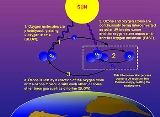
The photochemical mechanisms that give rise to the ozone layer were discovered by the British physicist Sidney Chapman in 1930. Ozone in the earth's stratosphere is created by ultraviolet light striking oxygen
Oxygen

Oxygen no O2 produced; 2) O2 produced, but absorbed in oceans & seabed rock; 3) O2 starts to gas out of the oceans, but is absorbed by land surfaces and formation of ozone layer; 4-5) O2 sinks filled and the gas accumulates]]...
 molecule
Molecule

In chemistry, a molecule is defined as a sufficiently stable, electric charge neutral group of at least two atoms in a definite arrangement held together by very strong chemical bonds....
s containing two oxygen atom
Atom

|-! bgcolor=gray | Properties|-||}The atom is a basic unit of matter consisting of a dense, central atomic nucleus surrounded by a electron cloud of electric charge electrons....
s (O2), splitting them into individual oxygen atoms (atomic oxygen); the atomic oxygen then combines with unbroken O2 to create ozone, O3. The ozone molecule is also unstable (although, in the stratosphere, long-lived) and when ultraviolet light hits ozone it splits into a molecule of O2 and an atom of atomic oxygen, a continuing process called the ozone-oxygen cycle
Ozone-oxygen cycle

The ozone-oxygen cycle is the process by which ozone is continually regenerated in Earth's stratosphere, all the while converting ultraviolet radiation into heat energy....
, thus creating an ozone layer in the stratosphere
Stratosphere

The stratosphere is the second major layer of Earth's atmosphere, just above the troposphere, and below the mesosphere. It is stratified in temperature, with warmer layers higher up and cooler layers farther down....
, the region from about 10 to 50 km (32,000 to 164,000 feet) above Earth's surface. About 90% of the ozone in our atmosphere is contained in the stratosphere. Ozone concentrations are greatest between about 20 and 40 km, where they range from about 2 to 8 parts per million. If all of the ozone were compressed to the pressure of the air at sea level, it would be only a few millimeters thick.

Ultraviolet light and ozone

Ozone Altitude Uv Graph
Although the concentration of the ozone in the ozone layer is very small, it is vitally important to life because it absorbs biologically harmful ultraviolet (UV) radiation emitted from the Sun. UV radiation is divided into three categories, based on its wavelength; these are referred to as UV-A (400-315 nm), UV-B (315-280 nm), and UV-C (280-100 nm). UV-C, which would be very harmful to humans, is entirely screened out by ozone at around 35 km altitude. UV-B radiation can be harmful to the skin and is the main cause of sunburn
SunBurn

SunBurn is a regional event held in Florida. Although SunBurn has its roots in the annual Burning Man festival in Nevada, it is not an official Burning Man event, because the organizers of SunBurn do not condone the direction that the Burning Man Organization has taken over the years....
; excessive exposure can also cause genetic damage, resulting in problems such as skin cancer
Skin cancer

Skin cancer is a malignant growth on the skin which can have many causes. The most common skin cancers are basal cell cancer, squamous cell cancer, and melanoma....
. The ozone layer is very effective at screening out UV-B; for radiation with a wavelength of 290 nm, the intensity at Earth's surface is 350 billion times weaker than at the top of the atmosphere. Nevertheless, some UV-B reaches the surface. Most UV-A reaches the surface; this radiation is significantly less harmful, although it can potentially cause genetic damage.

Ozone Solar Uv Absorb Dna Action

Distribution of ozone in the stratosphere


The thickness of the ozone layer—that is, the total amount of ozone in a column overhead—varies by a large factor worldwide, being in general smaller near the equator and larger as one moves towards the poles. It also varies with season, being in general thicker during the spring and thinner during the autumn in the northern hemisphere. The reasons for this latitude and seasonal dependence are complicated, involving atmospheric circulation patterns as well as solar intensity.

Since stratospheric ozone is produced by solar UV radiation, one might expect to find the highest ozone levels over the tropics and the lowest over polar regions. The same argument would lead one to expect the highest ozone levels in the summer and the lowest in the winter. The observed behavior is very different: most of the ozone is found in the mid-to-high latitudes of the northern and southern hemispheres, and the highest levels are found in the spring, not summer, and the lowest in the autumn, not winter in the northern hemisphere. During winter, the ozone layer actually increases in depth. This puzzle is explained by the prevailing stratospheric wind patterns, known as the Brewer-Dobson circulation
Brewer-Dobson circulation

Brewer-Dobson circulation is a Model of atmospheric circulation, proposed by Alan West Brewer in 1949 and Gordon Dobson in 1956, that attempts to explain why tropical air has less ozone than polar air, even though the tropical stratosphere is where most atmospheric ozone is produced....
. While most of the ozone is indeed created over the tropics, the stratospheric circulation then transports it poleward and downward to the lower stratosphere of the high latitudes. However in the southern hemisphere, owing to the ozone hole phenomenon, the lowest amounts of column ozone found anywhere in the world are over the Antarctic in the southern spring period of September and October.

Nimbus Ozone Brewer Dobson Circulation
The ozone layer is higher in altitude in the tropics, and lower in altitude in the extratropics, especially in the polar regions. This altitude variation of ozone results from the slow circulation that lifts the ozone-poor air out of the troposphere into the stratosphere. As this air slowly rises in the tropics, ozone is produced by the overhead sun which photolyzes oxygen molecules. As this slow circulation bends towards the mid-latitudes, it carries the ozone-rich air from the tropical middle stratosphere to the mid-and-high latitudes lower stratosphere. The high ozone concentrations at high latitudes are due to the accumulation of ozone at lower altitudes.

The Brewer-Dobson circulation moves very slowly. The time needed to lift an air parcel from the tropical tropopause near 16 km (50,000 ft) to 20 km is about 4-5 months (about per day). Even though ozone in the lower tropical stratosphere is produced at a very slow rate, the lifting circulation is so slow that ozone can build up to relatively high levels by the time it reaches 26 km.

Ozone amounts over the continental United States
United States

The United States of America is a Federal government constitutional republic comprising U.S. state and a federal district. The country is situated mostly in central North America, where its Contiguous United States and Washington, D.C., the Capital districts and territories, lie between the Pacific Ocean and Atlantic Oceans, Borders of the U...
 (25°N to 49°N) are highest in the northern spring (April and May). These ozone amounts fall over the course of the summer to their lowest amounts in October, and then rise again over the course of the winter. Again, wind transport of ozone is principally responsible for the seasonal evolution of these higher latitude ozone patterns.

The total column amount of ozone generally increases as we move from the tropics to higher latitudes in both hemispheres. However, the overall column amounts are greater in the northern hemisphere high latitudes than in the southern hemisphere high latitudes. In addition, while the highest amounts of column ozone over the Arctic occur in the northern spring (March-April), the opposite is true over the Antarctic, where the lowest amounts of column ozone occur in the southern spring (September-October). Indeed, the highest amounts of column ozone anywhere in the world are found over the Arctic region during the northern spring period of March and April. The amounts then decrease over the course of the northern summer. Meanwhile, the lowest amounts of column ozone anywhere in the world are found over the Antarctic in the southern spring period of September and October, owing to the ozone hole phenomenon.

Ozone depletion

Toms Global Ozone 65n 65s
The ozone layer can be depleted by free radical catalysts, including nitric oxide
Nitric oxide

Nitric oxide or nitrogen monoxide is a chemical compound with chemical formula NitrogenOxygen. This gas is an important signaling molecule in the body of mammals, including humans, and is an extremely important intermediate in the chemical industry....
 (NO), hydroxyl
Hydroxyl

Hydroxyl in chemistry stands for a molecule consisting of an oxygen atom and a hydrogen atom connected by a covalent bond. The neutral form is a hydroxyl Radical and the hydroxyl anion is called a hydroxide....
 (OH), atomic chlorine
Chlorine

Chlorine...
 (Cl), and atomic bromine
Bromine

Bromine , , meaning "stench " ), is a chemical element with the symbol Br and atomic number 35. A halogen element, bromine is a reddish-brown Volatility liquid at Standard conditions for temperature and pressure that is intermediate in reactivity between chlorine and iodine....
 (Br). While there are natural sources for all of these species, the concentrations of chlorine and bromine have increased markedly in recent years due to the release of large quantities of manmade organohalogen compounds, especially chlorofluorocarbons (CFCs) and bromofluorocarbons. These highly stable compounds are capable of surviving the rise to the stratosphere
Stratosphere

The stratosphere is the second major layer of Earth's atmosphere, just above the troposphere, and below the mesosphere. It is stratified in temperature, with warmer layers higher up and cooler layers farther down....
, where Cl and Br radicals
Radical (chemistry)

In chemistry, radicals are atoms, molecules or ions with unpaired electrons on an otherwise open shell configuration. These unpaired electrons are usually highly chemical reaction, so radicals are likely to take part in chemical reactions....
 are liberated by the action of ultraviolet light. Each radical is then free to initiate and catalyze a chain reaction capable of breaking down over 100,000 ozone molecules. The breakdown of ozone in the stratosphere results in the ozone molecules being unable to absorb ultraviolet radiation. Consequently, unabsorbed and dangerous ultraviolet-B radiation is able to reach the Earth’s surface. Ozone levels, over the northern hemisphere
Northern Hemisphere

The Northern Hemisphere is the half of a planet that is north of the equator?the word sphere literally means 'half sphere'. It is also that half of the celestial sphere north of the celestial equator....
, have been dropping by 4% per decade. Over approximately 5% of the Earth's surface, around the north and south poles, much larger (but seasonal) declines have been seen; these are the ozone holes.

Regulation

On January 23, 1978, Sweden
Sweden

Sweden , officially the Kingdom of Sweden , is a Nordic countries on the Scandinavian Peninsula in Northern Europe. Sweden has land borders with Norway to the west and Finland to the northeast, and it is connected to Denmark by the ?resund Bridge in the south....
 became the first nation to ban CFC-containing aerosol spray
Aerosol spray

Aerosol spray is a type of dispensing system which creates an Particulate mist of liquid particles. This is used with a spray can or bottle that contains a liquid under pressure....
s that are thought to damage the ozone layer. A few other countries, including the United States, Canada, and Norway, followed suit later that year, but the European Community rejected an analogous proposal. Even in the U.S., chlorofluorocarbons continued to be used in other applications, such as refrigeration and industrial cleaning, until after the discovery of the Antarctic ozone hole in 1985. After negotiation of an international treaty (the Montreal Protocol
Montreal Protocol

The Montreal Protocol on Substances That Deplete the Ozone Layer is an international treaty designed to protect the ozone layer by phasing out the production of a number of substances believed to be responsible for ozone depletion....
), CFC production was sharply limited beginning in 1987 and phased out completely by 1996.

On August 2, 2003, scientists announced that the depletion of the ozone layer may be slowing down due to the international ban on CFCs. Three satellites and three ground stations confirmed that the upper atmosphere ozone depletion rate has slowed down significantly during the past decade. The study was organized by the American Geophysical Union
American Geophysical Union

The American Geophysical Union is a nonprofit organization of geophysicists, consisting of over 50,000 members from over 135 countries. AGU's activities are focused on the organization and dissemination of scientific information in the interdisciplinary and international field of geophysics....
. Some breakdown can be expected to continue due to CFCs used by nations which have not banned them, and due to gases which are already in the stratosphere. CFCs have very long atmospheric lifetimes, ranging from 50 to over 100 years, so the final recovery of the ozone layer is expected to require several lifetimes.

Compounds containing C–H bonds have been designed to replace the function of CFC's (such as HCFC), since these compounds are more reactive and less likely to survive long enough in the atmosphere to reach the stratosphere where they could affect the ozone layer. However, while being less damaging than CFC's, HCFC's also have a significant negative impact on the ozone layer. HCFC's are therefore also being phased out.

Further reading

  • Seinfeld, John H.; Pandis, Spyros N (1998). Atmospheric Chemistry and Physics - From Air Pollution to Climate Change. John Wiley and Sons, Inc. ISBN 0-471-17816-0


External links

  • NASA. Studying Earth's Environment From Space. June 2000. (accessed April 14, 2005) http://www.ccpo.odu.edu/SEES/index.html.