


Lucky Starr series

Encyclopedia
Science fiction
Science fiction is a genre of fiction dealing with imaginary but more or less plausible content such as future settings, futuristic science and technology, space travel, aliens, and paranormal abilities...
books by Isaac Asimov
Isaac Asimov
Isaac Asimov was an American author and professor of biochemistry at Boston University, best known for his works of science fiction and for his popular science books. Asimov was one of the most prolific writers of all time, having written or edited more than 500 books and an estimated 90,000...
, using the pen name
Pen name
A pen name, nom de plume, or literary double, is a pseudonym adopted by an author. A pen name may be used to make the author's name more distinctive, to disguise his or her gender, to distance an author from some or all of his or her works, to protect the author from retribution for his or her...
"Paul French". Intended for juveniles, the books were written in the middle of the Cold War
Cold War
The Cold War was the continuing state from roughly 1946 to 1991 of political conflict, military tension, proxy wars, and economic competition between the Communist World—primarily the Soviet Union and its satellite states and allies—and the powers of the Western world, primarily the United States...
and the series shows traces of this, both in educational intent and in the nature of the social forces involved. The series is famous for introducing the "Force-Blade," which may have inspired the Lightsaber
Lightsaber
A lightsaber is a fictional weapon in the Star Wars universe, a "laser sword." It consists of a polished metal hilt which projects a blade of light about 1.33 metres long. The lightsaber is the signature weapon of the Jedi order and their Sith counterparts, both of whom can use them for close...
in the Star Wars
Star Wars
Star Wars is an American epic space opera film series created by George Lucas. The first film in the series was originally released on May 25, 1977, under the title Star Wars, by 20th Century Fox, and became a worldwide pop culture phenomenon, followed by two sequels, released at three-year...
films.
On 23 March 1951, Asimov met with his agent, Frederik Pohl
Frederik Pohl
Frederik George Pohl, Jr. is an American science fiction writer, editor and fan, with a career spanning over seventy years — from his first published work, "Elegy to a Dead Planet: Luna" , to his most recent novel, All the Lives He Led .He won the National Book Award in 1980 for his novel Jem...
, and Walter I. Bradbury, then the science fiction editor at Doubleday & Co., who had a proposal for him. Pohl and Bradbury wanted Asimov to write a juvenile science fiction novel that would serve as the basis for a television
Television
Television is a telecommunication medium for transmitting and receiving moving images that can be monochrome or colored, with accompanying sound...
series. Fearing that the novel would be adapted into the "uniformly awful" programming he saw flooding the television channels, he decided to publish it under the pseudonym "Paul French". Asimov began work on the novel, which he modeled closely on the Lone Ranger (the title was David Starr: Space Ranger) on 10 June. He completed it on 29 July, and it was published by Doubleday in January 1952. Although plans for the television series fell through, Asimov continued to write novels in the series, eventually producing six. A seventh, Lucky Starr and the Snows of Pluto, was planned, but abandoned when Asimov elected to devote himself to writing non-fiction almost exclusively. With no worries about being associated with an embarrassing televised version, Asimov decided to abandon the pretense that he was not the author (although the books continued to be published under the Paul French pseudonym). He brought the Three Laws of Robotics
Three Laws of Robotics
The Three Laws of Robotics are a set of rules devised by the science fiction author Isaac Asimov and later added to. The rules are introduced in his 1942 short story "Runaround", although they were foreshadowed in a few earlier stories...
into Lucky Starr and the Moons of Jupiter, which he wrote in his autobiography "was a dead giveaway to Paul French's identity for even the most casual reader".
Eventually, Asimov used his own name in later editions. Some cover pages bear his name only, while others credit "Isaac Asimov writing as Paul French".
Publishing history
- David Starr, Space RangerDavid Starr, Space RangerDavid Starr, Space Ranger is the first novel in the Lucky Starr series, six juvenile science fiction novels by Isaac Asimov that originally appeared under the pseudonym Paul French. The novel was written between 10 June and 29 July 1951 and first published by Doubleday & Company in January 1952...
(1952) - Lucky Starr and the Pirates of the AsteroidsLucky Starr and the Pirates of the AsteroidsLucky Starr and the Pirates of the Asteroids is the second novel in the Lucky Starr series, six juvenile science fiction novels by Isaac Asimov that originally appeared under the pseudonym Paul French. The novel was first published by Doubleday & Company in November 1953.-Plot summary:A year has...
(1953) - Lucky Starr and the Oceans of VenusLucky Starr and the Oceans of VenusLucky Starr and the Oceans of Venus is the third novel in the Lucky Starr series, six juvenile science fiction novels by Isaac Asimov that originally appeared under the pseudonym Paul French. The novel was first published by Doubleday & Company in 1954...
(1954) - Lucky Starr and the Big Sun of MercuryLucky Starr and the Big Sun of MercuryLucky Starr and the Big Sun of Mercury is the fourth novel in the Lucky Starr series, six juvenile science fiction novels by Isaac Asimov that originally appeared under the pseudonym Paul French. The novel was first published by Doubleday & Company in March 1956...
(1956) - Lucky Starr and the Moons of JupiterLucky Starr and the Moons of JupiterLucky Starr and the Moons of Jupiter is the fifth novel in the Lucky Starr series, six juvenile science fiction novels by Isaac Asimov that originally appeared under the pseudonym Paul French. The novel was first published by Doubleday & Company in August 1957...
(1957) - Lucky Starr and the Rings of SaturnLucky Starr and the Rings of SaturnLucky Starr and the Rings of Saturn is the final novel in the Lucky Starr series, six juvenile science fiction novels by Isaac Asimov that originally appeared under the pseudonym Paul French. The novel was first published by Doubleday & Company in 1958...
(1958)
Although the hero's given name was "David" (chosen in honor of his own son), Asimov felt this lacked vigour, and the later books used his nickname "Lucky".
These novels have a long and varied publishing history. They came out in hardcover with Doubleday in its first edition. Bantam was the latest, in 1993, to bring out the series in 3 volumes, publishing pairs of titles together. In 2001 the Science Fiction Book Club
Book of the Month Club
The Book of the Month Club is a United States mail-order book sales club that offers a new book each month to customers.The Book of the Month Club is part of a larger company that runs many book clubs in the United States and Canada. It was formerly the flagship club of Book-of-the-Month Club, Inc...
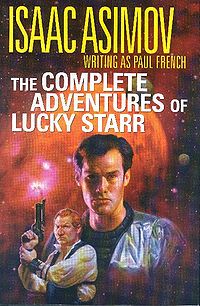
came out with all six novels at the same time in one volume under the title The Complete Adventures of Lucky Starr.
The British
United Kingdom
The United Kingdom of Great Britain and Northern IrelandIn the United Kingdom and Dependencies, other languages have been officially recognised as legitimate autochthonous languages under the European Charter for Regional or Minority Languages...
editions of all six novels omitted the prefixes altogether and were simply titled Space Ranger, Oceans of Venus, etc. The first book was translated to French in 1954 under the title Sur la planète rouge ("On the Red Planet") with the original pseudonym, Paul French. It was published in the famous "Anticipation" science fiction imprint of Fleuve noir. It was later adapted as a comic book
Comic book
A comic book or comicbook is a magazine made up of comics, narrative artwork in the form of separate panels that represent individual scenes, often accompanied by dialog as well as including...
twice, in 1975 and 1992.
Three books were also published in Dutch
Titles were, in order of the original American series:
- Een man alleen (orig. David Starr, Space Ranger), 1977
- Piraten van de asteroïden (Lucky Starr and the Pirates of the Asteroids), 1978
- De grote zon van Mercurius (Lucky Starr and the Big Sun of Mercury), 1978
Science content
Asimov wrote the series near the beginning of the Cold WarCold War
The Cold War was the continuing state from roughly 1946 to 1991 of political conflict, military tension, proxy wars, and economic competition between the Communist World—primarily the Soviet Union and its satellite states and allies—and the powers of the Western world, primarily the United States...
, when many concerned scientists, engineers and educators in the United States
United States
The United States of America is a federal constitutional republic comprising fifty states and a federal district...
felt that their country, and the group of nations they identified as the Free World
Free World
The Free World is a Cold War-era term often used to describe states not under the rule of the Soviet Union, its Eastern European allies, China, Vietnam, Cuba, and other communist nations. The term often referred to states such as the United States, Canada, and Western European states such as the...
, was falling behind the Communists and the Eastern Bloc
Eastern bloc
The term Eastern Bloc or Communist Bloc refers to the former communist states of Eastern and Central Europe, generally the Soviet Union and the countries of the Warsaw Pact...
in scientific research and engineering developments. In this context, it was important that the youth of the country be given a solid scientific start, and the adventures of David Starr were as a result rather didactic in nature, despite all the action involved.
He carefully introduced astronomical and physical concepts which the scientific knowledge of the time supported. In later editions, he added a preface pointing out that new scientific discoveries have rendered some locations and concepts obsolete: Mercury
Mercury (planet)
Mercury is the innermost and smallest planet in the Solar System, orbiting the Sun once every 87.969 Earth days. The orbit of Mercury has the highest eccentricity of all the Solar System planets, and it has the smallest axial tilt. It completes three rotations about its axis for every two orbits...
does not only present one side to the Sun, and Venus
Venus
Venus is the second planet from the Sun, orbiting it every 224.7 Earth days. The planet is named after Venus, the Roman goddess of love and beauty. After the Moon, it is the brightest natural object in the night sky, reaching an apparent magnitude of −4.6, bright enough to cast shadows...
is not covered by a global ocean, for example. The books offer more action scenes than Asimov's usual quota, but they are still filled with the scientific and sociological concerns Asimov used in all of his other fiction.
Further reading
- Fawcett 1982 ISBN 0-449-23461-4
- Science fiction Book club (6 in 1) ISBN 0-7394-1941-2
- Bantam (2 in 1) ISBN 0-553-29166-1