
|
|
|
|
Gene Roddenberry
|
| |
|
| |
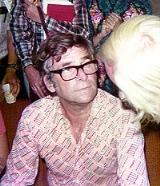
Eugene Wesley "Gene" Roddenberry (August 19, 1921 – October 24, 1991) was an American screenwriter and producer. He is arguably best known as the creator of Star Trek, an American sci-fi series known for its immense influence on popular culture.
Roddenberry was sometimes referred to as the "Great Bird of the Galaxy" in reference to his founding role in Star Trek. He was one of the first people to have his ashes "buried" in space.
Personal life Gene Roddenberry was born in El Paso, Texas, to Eugene Edward Roddenberry and Caroline Glen.

Discussion
Ask a question about 'Gene Roddenberry'
Start a new discussion about 'Gene Roddenberry'
Answer questions from other users
|
Encyclopedia
Eugene Wesley "Gene" Roddenberry (August 19, 1921 – October 24, 1991) was an American screenwriter and producer. He is arguably best known as the creator of Star Trek, an American sci-fi series known for its immense influence on popular culture.
Roddenberry was sometimes referred to as the "Great Bird of the Galaxy" in reference to his founding role in Star Trek. He was one of the first people to have his ashes "buried" in space.
Personal life Gene Roddenberry was born in El Paso, Texas, to Eugene Edward Roddenberry and Caroline Glen. He grew up in Los Angeles, California, where his father worked in the Los Angeles Police Department. He attended Berendo Junior High School (now Berendo Middle School). After graduating from Franklin High School, Roddenberry took classes in Police Studies at Los Angeles City College where he also became the head of the Police Club, acting as a liaison for the FBI). Roddenberry furthered his studies at Columbia University, the University of Miami, and the University of Southern California.
Roddenberry developed an interest in aeronautical engineering and soon obtained a pilot's license. He joined the U.S. Army Air Corps in 1941,and flew many combat B-17 Flying Fortress missions in the Pacific Theatre with the 394th Bomb Squadron (H) 5th Bomb Group who called themselves the "Bomber Barons." He was awarded the Distinguished Flying Cross and the Air Medal for his service.
After leaving military service, Roddenberry became a commercial pilot for Pan American World Airways. He received a Civil Aeronautics commendation for his rescue efforts following a June 1947 crash in the Syrian desert while on a flight to Istanbul from Karachi.
He eventually left Pan Am to pursue television writing in Hollywood. In order to provide for his family, he joined the Los Angeles Police Department on February 1, 1949, and was assigned LAPD badge number 6089. During his seven-year service with the LAPD, Roddenberry was promoted to police sergeant.
On June 7, 1956, he resigned from the police force to concentrate on his writing career full time. In his brief letter of resignation, Roddenberry wrote:
- "I find myself unable to support my family at present on anticipated police salary levels in a manner we consider necessary. Having spent slightly more than seven years on this job, during all of which fair treatment and enjoyable working conditions were received, this decision is made with considerable and genuine regret."
Family Roddenberry was married twice and had three children. His first marriage was to Eileen Rexroat, which lasted 27 years. They had two daughters, Darlene (1947-1995) and Dawn (1953-). During the 1960s, he was involved in extra-marital affairs with Nichelle Nichols and Majel Barrett (1932-2008). He divorced Rexroat and married Barrett in Japan in a traditional Shinto ceremony on August 6, 1969. They had one child together—his only son, Eugene Wesley, Jr. Roddenberry's marriage to Barrett lasted until his death in 1991.
Beliefs Although Roddenberry was raised as a Southern Baptist, he did not embrace the faith; he viewed religion as the cause of many wars and suffering in human history. Roddenberry considered himself a humanist and an agnostic.
Death and funeral Roddenberry died on October 24, 1991, of heart failure at the age of 70. In 1992, the lipstick-sized capsule carrying Roddenberry's ashes was placed on board the Space Shuttle Columbia on a STS-52 mission. In 1997, the capsule was sent into orbit; it eventually disintegrated in the atmosphere. In 2012, a spacecraft is planned to launch more of Roddenberry's ashes into deep space along with his late wife Majel's ashes..
Television and film career
While Roddenberry was in the LAPD, he wrote scripts, using the pen name Robert Wesley, for television series such as Highway Patrol and Have Gun, Will Travel. (One of the first-season episodes of the latter program, "Helen of Abajinian," won a Writers Guild of America Award.)
Norway Corporation Roddenberry's dissatisfaction with his work as a freelance writer for Have Gun, Will Travel and the difficulties he faced in adding anything substantial to his stories led him to produce his own television program. His first attempt, APO 923, was not picked up by the networks. In 1963, he formed a company called Norway Corporation, through which he produced The Lieutenant, a 1963-1964 NBC and MGM Television series about the United States Marine Corps that starred Gary Lockwood as Lieutenant William Rice. NBC refused to broadcast a series that dealt with racism in the military. Its first episode featured Nichelle Nichols, who later became Lt. Uhura in the original Star Trek series.
Star Trek Roddenberry developed his idea for Star Trek in 1964 when he thought of combining Buck Rogers and Flash Gordon. Star Trek was picked up by Desilu Studios when Roddenberry sold the premise as a "Wagon Train to the Stars." The original $500,000 pilot received only minor support from NBC and its production went over budget, but the network commissioned an unprecedented second pilot. The series, a Norway Corporation production, premiered on September 8, 1966, and ran for three seasons. Although it was canceled due to low ratings, the series gained wide popularity in syndication. In the third and final season of Star Trek, Roddenberry offered to demote himself to the position of line producer in a final attempt to rescue the show by giving it a desired time slot. He resigned when this was not approved and accepted a staff producer position with MGM.
After Star Trek His first project with the studio, Pretty Maids All in a Row, was a sexploitation film adapted from the novel written by Francis Pollini and directed by Roger Vadim. The cast included Rock Hudson, Angie Dickinson, Telly Savalas, and Roddy McDowall alongside Star Trek regulars James Doohan and William J. Campbell. It also featured Gretchen Burrell, the wife of country-rock pioneer Gram Parsons; a pictorial of her was published in an issue of Playboy Magazine at this approximate time. Despite Roddenberry's expectations, the film was not a success. His relationship with MGM studio was strained by this, although he did continue there until 1972.
Through the Norway Corporation, Roddenberry pitched pilots for four sci-fi TV series concepts, although none were developed as series: The Questor Tapes, Genesis II, Planet Earth, and Strange New World. He also co-wrote and was executive producer on the made-for-television movie, Spectre (1977), which was designed as a backdoor pilot.
Roddenberry feared that he would be unable to provide for his family, as he was unable to find work in the television and film industry and was facing the possible bankruptcy of Norway Corporation. He then heeded the advice of his friend and British sci-fi writer Arthur Charles Clarke and looked for steady employment on the college lecture circuit where contemporaries in similar predicaments (namely William Shatner and Timothy Leary) had both found success.
He amused the attendees of his lectures with anecdotes from the Star Trek set and spoke of his visions for the future. He showed the Star Trek Blooper Reels, a collection of outtakes from the original series. These blooper reels drew criticism and ire from Leonard Nimoy, who felt Roddenberry was exploiting them for money. Nimoy eventually sued Roddenberry and Paramount.
The matter would not be resolved until production began for Star Trek: The Motion Picture. Roddenberry also exhibited a black and white print of the unaired first series pilot, "The Cage," at several conventions.
New Star Trek projects Beginning in 1975, the go-ahead was given by Paramount for Roddenberry to develop a new Star Trek television series, with as many of the original cast to be included. It was originally called Phase II. This series would be the anchor show of a new network (the ancestor of UPN, which later became part of The CW Television Network), but plans by Paramount for this network were scrapped and the project was reworked into a feature film. The result, Star Trek: The Motion Picture, received a lukewarm critical response, but it performed well at the box office and saved Norway Corporation. As a result, several motion pictures and a new television series, Star Trek: The Next Generation, were created in the 1980s.
When it came time to produce the obligatory theatrical sequel, Roddenberry's story submission of a time-traveling Enterprise crew involved in the John F. Kennedy assassination was rejected. He was removed from direct involvement--effectively hobbling the power of Norway Corporation--and replaced by Harve Bennett. He continued, however, as executive consultant for the next four films: Star Trek II: The Wrath of Khan, Star Trek III: The Search for Spock, Star Trek IV: The Voyage Home, and Star Trek V: The Final Frontier. As consultant, Roddenberry was allowed to view and comment on all scripts and dailies emanating from the production, but the creative team was free to disregard Roddenberry's advice.
Roddenberry was deeply involved with creating and producing Star Trek: The Next Generation, although he only had full control over the show's first season. The WGA strike of 1988 prevented him from taking an active role in production of the second season, and forced him to hand control of the series to producer Maurice Hurley. While Roddenberry was free to resume work on the third season, his health was in serious decline, and over the course of the season, he gradually ceded control to Rick Berman and Michael Piller. Star Trek also spawned the television series Star Trek: Deep Space Nine, Star Trek: Voyager, and Star Trek: Enterprise.
Star Trek VI: The Undiscovered Country, the last film with the cast from the original Star Trek series, was dedicated to Roddenberry; he reportedly viewed an early version of the film a few days before his death.
In addition to his film and TV work, Roddenberry also wrote the novelization of Star Trek: The Motion Picture. It was published in 1979 and was the first of hundreds of Star Trek-based novels to be published by the Pocket Books unit of Simon & Schuster, whose parent company also owned Paramount Pictures Corporation. Because Alan Dean Foster wrote the original treatment of the Star Trek: The Motion Picture film, there was a rumor that Foster was the ghostwriter of the novel. This has been debunked by Foster on his personal website. (Foster, however, ghostwrote the novelization of George Lucas's Star Wars.) Roddenberry talked of writing a second Trek novel based on his rejected 1975 script of the JFK assassination plot, but he died before he was able to do so.
Controversy concerning Roddenberry Writers who worked for Star Trek have charged that ideas they developed were later passed off by Roddenberry as his own, or that he lied about their contributions and involvement to the show. Roddenberry was confronted by these writers, and he apologized to them; but according to his critics, he would continue the behavior.
Roddenberry is occasionally criticized for his treatment of movie and script royalties related to Star Trek: He alienated composer Alexander Courage by demanding 50 percent of the royalties which Courage received for the show's theme song whenever an episode of Star Trek was aired. Later, while cooperating with Stephen Whitfield for the latter's book The Making of Star Trek, Roddenberry demanded--and received--Whitfield's acquiescence for 50 percent of the book's royalties. As Roddenberry explained to Whitfield in 1968: "I had to get some money somewhere. I'm sure not going to get it from the profits of Star Trek."
Herbert Solow and Robert H. Justman observe that Whitfield never regretted his fifty-fifty deal with Roddenberry since it gave him "the opportunity to become the first chronicler of television's successful unsuccessful series."
In her autobiography Beyond Uhura, actress Nichelle Nichols, who played Uhura in the first Star Trek series, reported having had a love affair with Roddenberry. She felt that his strong and controversial effort to get her on the show had a lot to do with their relationship.
Roddenberry's life and work has been chronicled in several works. Star Trek Creator: The Authorized Biography of Gene Roddenberry, written by friend David Alexander, is a flattering portrayal of Roddenberry's life that was received favorably by most readers, obscuring many of the troubles Roddenberry encountered in his later years. Much more controversial was Inside Trek: My Secret Life with Star Trek Creator Gene Roddenberry, written by Susan Sackett, his close associate for 17 years. While she displays unwavering affection, respect and admiration for her employer, Sackett's account hardly makes him out to be a saint. Recounted in brutal detail are his elongated dry spells throughout the 1970s, his addiction to cocaine, impotence, inability to finish creative projects and mental and physical decline from roughly 1989 onward.
Despite his reduced management of Star Trek and the hobbled power of Norway Corporation near the end of his life, Roddenberry was respected enough that Paramount Pictures, owners of the various Star Trek series, agreed to his request that Star Trek: The Animated Series be stripped of its official recognition as canon by the studio. (In 2007, Star Trek's official site included the animated series to its library section.) According to the reference book, The Star Trek Chronology, Roddenberry also considered elements of the fifth and sixth Trek films to be apocryphal, though there was no indication that he wanted them removed from Trek canon.
Legacy After his death in 1991 in Santa Monica, California, Roddenberry's estate allowed for the creation of two long-running television series based on his previously unfilmed story ideas and concepts. Earth: Final Conflict and Andromeda were produced under the guidance of Majel Barrett-Roddenberry. A third Roddenberry storyline was adapted in 1995 as the short-lived comic book Gene Roddenberry's Lost Universe (later titled Gene Roddenberry's Xander in Lost Universe). Other projects were developed under the Roddenberry name but never made it to production stage, such as Gene Roddenberry's Starship, a computer-animated series proposed by Majel Barrett and John Semper for Mainframe Entertainment.
The asteroid 4659 Roddenberry and an impact crater on Mars are named in his honor.
On October 4, 2002, the El Paso Independent School District Planetarium was renamed the Gene Roddenberry Planetarium. Eugene W. Roddenberry Jr. cut the ribbon at the dedication ceremony.
One of the buildings on the Paramount studio lot on Melrose Boulevard is the Gene Roddenberry building that houses production and administrative offices.
On June 16, 2007, the Science Fiction Museum in Seattle, Washington inducted Gene Roddenberry into their Science Fiction Hall of Fame, along with director Ridley Scott, artist Ed Emshwiller, and author Gene Wolfe. The presentation was made by actor Wil Wheaton and the dedication was accepted on behalf of the Roddenberry Family by his son, Eugene W. Roddenberry Jr.
Relationships with others Patrick Stewart once said in an interview on Michael Parkinson's TV program that a reporter talked to Roddenberry about the choice of Stewart for the captain's role; the reporter said, "Look, it doesn't make sense. You got a bald actor playing this part. Surely, by the 24th century, they have found the cure for baldness." Roddenberry replied, "By the 24th century, no one will care."
Further reading
- Alexander, David. Star Trek Creator: The Authorized Biography of Gene Roddenberry.
- Engel, Joel. Gene Roddenberry: The Myth and the Man Behind Star Trek.
- Fern, Yvonne. Gene Roddenberry: The Last Conversation.
- Gross, Edward and Mark A. Altman. Great Birds of the Galaxy: Gene Roddenberry and the Creators of Star Trek.
- Sackett, Susan. Inside Trek: My Secret Life with Star Trek Creator Gene Roddenberry.
- Van Hise, James. The Man Who Created Star Trek: Gene Roddenberry.
Cast autobiographies
- Doohan, James and transcribed by Peter David. Beam Me Up, Scotty: Star Trek's "Scotty" in his own words. ISBN 0-671-52056-3.
- Koenig, Walter. Warped Factors: A Neurotic's Guide to the Universe. ISBN 0878339914.
- Nichols, Nichelle. Beyond Uhura: Star Trek and Other Memories. ISBN 1572970111. Published 1995.
- Nimoy, Leonard. I Am Not Spock. ISBN 9780890871171. Published 1977.
- Nimoy, Leonard. I Am Spock. ISBN 9780786861828. Published 1995.
- Shatner, William and transcribed by Chris Kreski. Star Trek Memories. HarperCollins. ISBN 0060177349; ISBN-13 978-0060177348. Published 1993.
- Shatner, William and transcribed by Chris Kreski. Star Trek Movie Memories. HarperCollins. ISBN 0-06-017617-2. Published 1994.
- Solow, Herbert F. and Robert H. Justman. Star Trek Memories. HarperCollins. ISBN 0-06-017734-9. Published 1993.
- Solow, Herbert F. and Robert H. Justman. Inside Star Trek: The Real Story. ISBN 0671896288. Published 1999.
- Takei, George. To The Stars: The Autobiography of George Takei: Star Trek's Mr Sulu. ISBN 0-671-89008-5. Published 1994.
- Whitney, Grace Lee and transcribed by Jim Denney. The Longest Trek: My Tour of the Galaxy. Foreword by Leonard Nimoy. ISBN 188495605X; ISBN-13 978-1884956058. Published 1998.
External links
Retrieved on 2008-01-24
-
-
-
-
- by Robert Bowman, Christian Research Journal, Fall 1991, pp. 20 ff.
-
-
- on Roddenberry's The Questor Tapes.
-
|
| |
|
|