

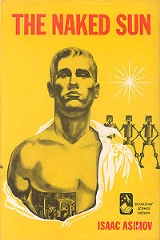
The Naked Sun

Encyclopedia
The Naked Sun is an English language science fiction novel, the second in Isaac Asimov
's Robot series
.
, it is a whodunit
story, in addition to being science fiction
. The book was first published in 1957 after being serialized in Astounding Science Fiction between October and December 1956.
The story arises from the murder of Rikaine Delmarre, a prominent "fetologist" (fetal scientist, responsible for the operation of the planetary birthing center reminiscent of those described in Aldous Huxley
's Brave New World
) of Solaria
, a planet politically hostile to Earth
. Elijah Baley
is called in to investigate, at the request of the Solarian government. He is again partnered with the humaniform robot
R. Daneel Olivaw
. Before leaving Earth, he is asked by Earth's government to assess the Solarian society for weaknesses.
The book focuses on the unusual traditions and culture of Solarian society. The planet has a rigidly controlled population
of twenty thousand, and robots outnumber human
s ten thousand to one. People are strictly taught from birth to despise personal contact. They live on huge estates, either alone or with their spouse only. Communication is done via holographic
telepresence
(called viewing, as opposed to in-person seeing). It is likely that the society is based on that in E. M. Forster
's 1909 short story "The Machine Stops
".
As shown in its predecessor novel, The Caves of Steel
, Earth also appears to have evolved an unusual society, in which people spend their entire lives in confined (or "cosy") underground interlinked cities, never venturing outside. Indeed, they become utterly panicked and terrified when exposed to the open air and the naked sun.
: "knowingly". He used this knowledge to cause the death of Rikaine at the hands of his wife Gladia, because Rikaine was opposed to his plans. Later on, he also managed to poison the Security Secretary using a pair of robots.
The key to this technique is that a robot cannot knowingly kill a human or knowingly allow a human to come to harm. But if the robot does not know that its actions will cause harm, then it will not be stopped by the Laws.
The future implication of this was pointed out by Elijah, that it can be extended to the point at which robots could be used to fight wars. (In the Asimov universe, this would otherwise be unthinkable, given the Three Laws.)
Leebig kills himself before he can be taken into custody, because of a very Solarian fear of human contact. The irony is that the "human" he was afraid of was Olivaw, a robot.
Despite knowledge of Gladia's guilt, Baley never discloses her role in the murder—in part because he feels sorry for her and believes that her breakdown was caused by the pressure of the Solarian way of life. He manages to have her sent to the Spacer capital planet of Aurora, where she can further her growth as a human being, something she could never do on Solaria.
After investigating the murder to a satisfactory conclusion, Baley returns to Earth a hero. The information he brings back is invaluable to the government, which was predicting the downfall of Spacer
societies; the similarities between the nature of Solarian society and Earth society in their closed natures suggests a fundamental flaw in the Terran society.
A more thorough description of the aftereffects can be found in the sequel to the Naked Sun, The Robots of Dawn
. We also discover the remote end-point of Solaria's odd development in Foundation and Earth
.
The Foundation series and the Spacer/Robot series seem originally to have been separate, though with some overlap of ideas. If the Galactic Empire is the far future, where have the robots gone? In Foundation's Edge
Asimov begins to supply the answer, expanded in the other sequels and prequels.
reviewer Floyd C. Gale praised the novel as "an interesting exercise in scientific detection."
, with Baley being portrayed by Paul Maxwell
and R. Daneel Olivaw by David Collings
. Broadcast on BBC2 on 18 February 1969, the story was dramatised by Robert Muller and directed by Rudolph Cartier
and the music and sound effects were created by Delia Derbyshire
of the BBC Radiophonic Workshop
.
Cast of BBC2 Adaptation:
The Naked Sun was one of six Asimov stories dramatised for the Out of the Unknown series. The others were The Dead Past, Sucker Bait, Satisfaction Guaranteed, Reason (as The Prophet) and Liar!
Although the episode was wiped by the BBC and no copy is known to exist, three of Delia Derbyshire
's sound sequences were published on a BBC record of sound effects Out of This World
, renamed as "Heat Haze", "Frozen Waste" and Icy Peak".
Isaac Asimov
Isaac Asimov was an American author and professor of biochemistry at Boston University, best known for his works of science fiction and for his popular science books. Asimov was one of the most prolific writers of all time, having written or edited more than 500 books and an estimated 90,000...
's Robot series
Isaac Asimov's Robot Series
Isaac Asimov's Robot Series is a series of short stories and novels by Isaac Asimov featuring positronic robots.- Short stories :Most of Asimov's robot short stories are set in the first age of positronic robotics and space exploration...
.
Plot introduction
Like its famous predecessor, The Caves of SteelThe Caves of Steel
The Caves of Steel is a novel by Isaac Asimov. It is essentially a detective story, and illustrates an idea Asimov advocated, that science fiction is a flavor that can be applied to any literary genre, rather than a limited genre itself. Specifically, in the book Asimov's Mysteries, he states that...
, it is a whodunit
Whodunit
A whodunit or whodunnit is a complex, plot-driven variety of the detective story in which the puzzle is the main feature of interest. The reader or viewer is provided with clues from which the identity of the perpetrator of the crime may be deduced before the solution is revealed in the final...
story, in addition to being science fiction
Science fiction
Science fiction is a genre of fiction dealing with imaginary but more or less plausible content such as future settings, futuristic science and technology, space travel, aliens, and paranormal abilities...
. The book was first published in 1957 after being serialized in Astounding Science Fiction between October and December 1956.
The story arises from the murder of Rikaine Delmarre, a prominent "fetologist" (fetal scientist, responsible for the operation of the planetary birthing center reminiscent of those described in Aldous Huxley
Aldous Huxley
Aldous Leonard Huxley was an English writer and one of the most prominent members of the famous Huxley family. Best known for his novels including Brave New World and a wide-ranging output of essays, Huxley also edited the magazine Oxford Poetry, and published short stories, poetry, travel...
's Brave New World
Brave New World
Brave New World is Aldous Huxley's fifth novel, written in 1931 and published in 1932. Set in London of AD 2540 , the novel anticipates developments in reproductive technology and sleep-learning that combine to change society. The future society is an embodiment of the ideals that form the basis of...
) of Solaria
Solaria
Solaria was a fictional human-inhabited planet in Isaac Asimov's Foundation and Robot series.It was the last of fifty Spacer worlds colonized by humans in a first wave of interstellar settlement. Occupied from approximately 4270 AD by inhabitants of the neighboring world Nexon originally for summer...
, a planet politically hostile to Earth
Earth
Earth is the third planet from the Sun, and the densest and fifth-largest of the eight planets in the Solar System. It is also the largest of the Solar System's four terrestrial planets...
. Elijah Baley
Elijah Baley
Elijah Baley is a fictional character in Isaac Asimov's Robot series. He is the main character of the novels The Caves of Steel, The Naked Sun and The Robots of Dawn, and of the short story "Mirror Image". He is seen in flashbacks several times and talked about frequently in Robots and Empire,...
is called in to investigate, at the request of the Solarian government. He is again partnered with the humaniform robot
Robot
A robot is a mechanical or virtual intelligent agent that can perform tasks automatically or with guidance, typically by remote control. In practice a robot is usually an electro-mechanical machine that is guided by computer and electronic programming. Robots can be autonomous, semi-autonomous or...
R. Daneel Olivaw
R. Daneel Olivaw
R. Daneel Olivaw is a fictional robot created by Isaac Asimov. The "R" initial in his name stands for "robot," a naming convention in Asimov's future society...
. Before leaving Earth, he is asked by Earth's government to assess the Solarian society for weaknesses.
The book focuses on the unusual traditions and culture of Solarian society. The planet has a rigidly controlled population
Population
A population is all the organisms that both belong to the same group or species and live in the same geographical area. The area that is used to define a sexual population is such that inter-breeding is possible between any pair within the area and more probable than cross-breeding with individuals...
of twenty thousand, and robots outnumber human
Human
Humans are the only living species in the Homo genus...
s ten thousand to one. People are strictly taught from birth to despise personal contact. They live on huge estates, either alone or with their spouse only. Communication is done via holographic
Holography
Holography is a technique that allows the light scattered from an object to be recorded and later reconstructed so that when an imaging system is placed in the reconstructed beam, an image of the object will be seen even when the object is no longer present...
telepresence
Telepresence
Telepresence refers to a set of technologies which allow a person to feel as if they were present, to give the appearance of being present, or to have an effect, via telerobotics, at a place other than their true location....
(called viewing, as opposed to in-person seeing). It is likely that the society is based on that in E. M. Forster
E. M. Forster
Edward Morgan Forster OM, CH was an English novelist, short story writer, essayist and librettist. He is known best for his ironic and well-plotted novels examining class difference and hypocrisy in early 20th-century British society...
's 1909 short story "The Machine Stops
The Machine Stops
"The Machine Stops" is a science fiction short story by E. M. Forster. After initial publication in The Oxford and Cambridge Review , the story was republished in Forster's The Eternal Moment and Other Stories in 1928...
".
As shown in its predecessor novel, The Caves of Steel
The Caves of Steel
The Caves of Steel is a novel by Isaac Asimov. It is essentially a detective story, and illustrates an idea Asimov advocated, that science fiction is a flavor that can be applied to any literary genre, rather than a limited genre itself. Specifically, in the book Asimov's Mysteries, he states that...
, Earth also appears to have evolved an unusual society, in which people spend their entire lives in confined (or "cosy") underground interlinked cities, never venturing outside. Indeed, they become utterly panicked and terrified when exposed to the open air and the naked sun.
Plot summary
Ultimately, we find out that Delmarre's neighbor and fellow roboticist Jothan Leebig was working on a way of subverting the robots' inability to kill humans. This was achieved by understanding a missing word in the Three Laws of RoboticsThree Laws of Robotics
The Three Laws of Robotics are a set of rules devised by the science fiction author Isaac Asimov and later added to. The rules are introduced in his 1942 short story "Runaround", although they were foreshadowed in a few earlier stories...
: "knowingly". He used this knowledge to cause the death of Rikaine at the hands of his wife Gladia, because Rikaine was opposed to his plans. Later on, he also managed to poison the Security Secretary using a pair of robots.
The key to this technique is that a robot cannot knowingly kill a human or knowingly allow a human to come to harm. But if the robot does not know that its actions will cause harm, then it will not be stopped by the Laws.
The future implication of this was pointed out by Elijah, that it can be extended to the point at which robots could be used to fight wars. (In the Asimov universe, this would otherwise be unthinkable, given the Three Laws.)
Leebig kills himself before he can be taken into custody, because of a very Solarian fear of human contact. The irony is that the "human" he was afraid of was Olivaw, a robot.
Despite knowledge of Gladia's guilt, Baley never discloses her role in the murder—in part because he feels sorry for her and believes that her breakdown was caused by the pressure of the Solarian way of life. He manages to have her sent to the Spacer capital planet of Aurora, where she can further her growth as a human being, something she could never do on Solaria.
After investigating the murder to a satisfactory conclusion, Baley returns to Earth a hero. The information he brings back is invaluable to the government, which was predicting the downfall of Spacer
Spacer (Asimov)
In Isaac Asimov's Foundation/Empire/Robot series, the Spacers were the first humans to emigrate to space. About a millennium thereafter, they severed political ties with Earth, and embraced low population growth and extreme longevity as a means for a high standard of living, in combination with...
societies; the similarities between the nature of Solarian society and Earth society in their closed natures suggests a fundamental flaw in the Terran society.
A more thorough description of the aftereffects can be found in the sequel to the Naked Sun, The Robots of Dawn
The Robots of Dawn
The Robots of Dawn is a "whodunit" science fiction novel by Isaac Asimov, first published in 1983. It is the third novel in Asimov's Robot series.It was nominated for both the Hugo and Locus Awards in 1984.- Plot summary :...
. We also discover the remote end-point of Solaria's odd development in Foundation and Earth
Foundation and Earth
Foundation and Earth is a Locus Award nominated science fiction novel by Isaac Asimov, the fifth novel of the Foundation series and chronologically the last in the series...
.
The Foundation series and the Spacer/Robot series seem originally to have been separate, though with some overlap of ideas. If the Galactic Empire is the far future, where have the robots gone? In Foundation's Edge
Foundation's Edge
Foundation's Edge is a science fiction novel by Isaac Asimov, the fourth book in the Foundation Series. It was written more than thirty years after the stories of the original Foundation trilogy, due to years of pressure by fans and editors on Asimov to write another, and, according to Asimov...
Asimov begins to supply the answer, expanded in the other sequels and prequels.
Reception
GalaxyGalaxy Science Fiction
Galaxy Science Fiction was an American digest-size science fiction magazine, published from 1950 to 1980. It was founded by an Italian company, World Editions, which was looking to break in to the American market. World Editions hired as editor H. L...
reviewer Floyd C. Gale praised the novel as "an interesting exercise in scientific detection."
Adaptation
The novel was adapted for television as an episode of the British anthology series Out of the UnknownOut of the Unknown
Out of the Unknown is a British television science fiction anthology drama series, produced by the BBC and broadcast on BBC2 in four series between 1965 and 1971. Each episode was an independent dramatisation of a separate science fiction short story...
, with Baley being portrayed by Paul Maxwell
Paul Maxwell
Paul Maxwell was a Canadian actor who worked mostly in British television and films, in which he was usually cast as an American...
and R. Daneel Olivaw by David Collings
David Collings
David Collings is a British actor. He has played many different roles on various television programmes, including the leading dramatic role in Fyodor Dostoyevsky's Crime and Punishment in 1964....
. Broadcast on BBC2 on 18 February 1969, the story was dramatised by Robert Muller and directed by Rudolph Cartier
Rudolph Cartier
Rudolph Cartier was an Austrian television director, filmmaker, screenwriter and producer who worked predominantly in British television, exclusively for the BBC...
and the music and sound effects were created by Delia Derbyshire
Delia Derbyshire
Delia Ann Derbyshire was an English musician and composer of electronic music and musique concrète. She is best known for her electronic realisation of Ron Grainer's theme music to the British science fiction television series Doctor Who and for her work with the BBC Radiophonic Workshop.-Early...
of the BBC Radiophonic Workshop
BBC Radiophonic Workshop
The BBC Radiophonic Workshop, one of the sound effects units of the BBC, was created in 1958 to produce effects and new music for radio, and was closed in March 1998, although much of its traditional work had already been outsourced by 1995. It was based in the BBC's Maida Vale Studios in Delaware...
.
Cast of BBC2 Adaptation:
- Paul Maxwell as Elijah Baley
- David Collings as R Daneel Olivaw
- Sheila Burrell as Under-Secretary Minnim
- Neil Hallett as Hannis Gruer
- Eric ChittyEric ChittyEric Stevenson Chitty was a speedway rider who won the London Riders' Championship in 1938.-Early days:...
as Dr Altim Thool - Ronald Leigh-HuntRonald Leigh-HuntRonald Leigh-Hunt was a British film and television actor.His father was a stockbroker and he attended the Italia Conti Academy. He began acting whilst serving in the army...
as Corwin Attlebish - John RobinsonJohn Robinson (actor)John Robinson was an English actor, who was particularly active in the theatre. Mostly cast in minor and supporting roles in film and television, he is best remembered for being the second actor to play the famous television science-fiction role of Professor Bernard Quatermass, in the 1955 BBC...
as Dr Anselmo Quemot - Frederick JaegerFrederick JaegerFrederick Jaeger was a German-born actor who found success working in British television.Jaeger was born in Berlin, but moved to England following Adolf Hitler's rise to power in Germany. He graduated from the Guildhall School of Music and Drama in 1948, and became a British citizen two years later...
as Jothan Leebig - Trisha NobleTrisha NoblePatricia Ann Ruth "Trisha" Noble is an Australian singer and actress.-Biography:Noble was born in Sydney, Australia. Her father was comedian and singer Buster Noble and her mother was the entertainer Helen De Paul....
as Gladia Delmarre - Paul StassinoPaul StassinoPhaedros Stassinos is a Greek-Cypriot actor whose international stage name is Paul Stassino.He was born in Cyprus but spent most of his acting career in Britain....
as Rikaine Delmarre - John Hicks as Bik
- David Cargill as Robot
- Raymond Hardy as Robot
- Roy Patrick as Robot
- John Scott MartinJohn Scott MartinJohn Scott Martin was an English actor born in Toxteth, Liverpool. He made many film, stage and television appearances, but one of his most famous, though unseen, roles was as a Dalek operator in the long-running BBC science fiction television series Doctor Who.Martin operated Daleks from 1965's...
as Robot - Gerald Taylor as Robot
The Naked Sun was one of six Asimov stories dramatised for the Out of the Unknown series. The others were The Dead Past, Sucker Bait, Satisfaction Guaranteed, Reason (as The Prophet) and Liar!
Although the episode was wiped by the BBC and no copy is known to exist, three of Delia Derbyshire
Delia Derbyshire
Delia Ann Derbyshire was an English musician and composer of electronic music and musique concrète. She is best known for her electronic realisation of Ron Grainer's theme music to the British science fiction television series Doctor Who and for her work with the BBC Radiophonic Workshop.-Early...
's sound sequences were published on a BBC record of sound effects Out of This World
Out of This World (Radiophonic album)
Out of This World is a 1976 compilation of atmospheric sounds and effects from the BBC Radiophonic Workshop. The album was divided into four sections , each representing a different theme: "Outer Space", "Magic and Fantasy", "Suspense and the Supernatural" and "The Elements".The album was produced...
, renamed as "Heat Haze", "Frozen Waste" and Icy Peak".