


Analog Science Fiction and Fact

Encyclopedia
Analog Science Fiction and Fact is an American science fiction magazine
. As of 2011, it is the longest running continuously published magazine of that genre. Initially published in 1930 in the United States as Astounding Stories as a pulp magazine
, it has undergone several name changes, primarily to Astounding Science-Fiction in 1938, and Analog Science Fact & Fiction in 1960. In November 1992, its logo changed to use the term "Fiction and Fact" rather than "Fact & Fiction".
It is in the library of the International Space Station
.
Spanning three incarnations since 1930, this is perhaps the most influential magazine in the history of the genre. It remains a fixture of the genre today. As “Astounding Science Fiction”, a new direction for both the magazine and the genre under editor John W. Campbell was established. His editorship influenced the careers of Isaac Asimov
and Robert Heinlein, and also introduced the dianetic theories of L. Ron Hubbard
in May 1950.
Analog frequently publishes new authors, including then-newcomers such as Orson Scott Card
and Joe Haldeman
in the 1970s, Harry Turtledove
, Timothy Zahn
, Greg Bear
, and Joseph H. Delaney
in the 1980s, and Paul Levinson
, Michael A. Burstein
, and Rajnar Vajra in the 1990s.
One of the major publications of what fans and historians call the Golden Age of Science Fiction
and afterward, it has published much-reprinted work by such major SF authors as E.E. Smith, Theodore Sturgeon
, Isaac Asimov
, Robert A. Heinlein
, A. E. van Vogt
, Lester del Rey
, and many others.
launched Amazing Stories
, the first science fiction magazine. Gernsback had been printing scientific fiction stories for some time in his hobbyist magazines, such as Modern Electrics
and Electrical Experimenter
, but decided that there was enough interest in the genre to justify a monthly magazine. Amazing was very successful, quickly reaching a circulation of over 100,000. William Clayton
, a successful and well-respected publisher of several pulp
titles, considered starting a competitive title in 1928: according to Harold Hersey, one of his editors at the time, Hersey had "discussed plans with Clayton to launch a pseudo-science fantasy sheet". Clayton was unconvinced. The following year, however, Clayton decided to launch a new magazine, mainly because the sheet on which the color covers of his magazines were printed had a space for one more cover. He suggested to Harry Bates
, a newly hired editor, that they start a magazine of period adventure stories. Bates proposed instead a science fiction pulp, to be titled Astounding Stories of Super Science, and Clayton agreed.
Astounding was initially published by Publisher's Fiscal Corporation, which became Clayton Magazines in March 1931. The first issue appeared in January 1930, with Bates as editor. Bates aimed for straightforward action-adventure stories, with scientific elements only present to provide minimal plausibility. Clayton paid much better rates than Amazing and Wonder Stories
—two cents a word on acceptance, rather than half a cent a word, on publication (or sometimes later)—and consequently Astounding attracted some of the better-known pulp writers, such as Murray Leinster
, Victor Rousseau
, and Jack Williamson
. In February 1931, the original name Astounding Stories of Super-Science was shortened to Astounding Stories.
The magazine was profitable, but the Depression
caused Clayton problems. Normally a publisher would pay a printer three months in arrears, but when a credit squeeze began in May 1931, it led to pressure to reduce this delay. The financial difficulties led Clayton to start alternating the publication of his magazines, and he switched Astounding to a bimonthly schedule with the June 1932 issue. Some printers bought the magazines which were indebted to them: Clayton decided to buy his printer to prevent this from happening. This proved a disastrous move. Clayton did not have the money to complete the transaction, and in October 1932 Clayton decided to cease publication of Astounding, with the expectation that the January 1933 issue would be the last one. As it turned out, there were enough stories in inventory, and enough paper, to publish one further issue, so the last Clayton Astounding was dated March 1933. In April Clayton went bankrupt, and sold his magazine titles; the buyer quickly resold the titles to Street & Smith
, a well-established publisher.
, which had begun in 1931 and was tremendously successful, with a circulation over 300,000; and Doc Savage
, which had been launched in March 1933. They gave the post of editor of Astounding to F. Orlin Tremaine
, an experienced editor who had been working for Clayton as the editor of Clues, and who had come to Street & Smith as part of the transfer of titles after Clayton's bankruptcy. Desmond Hall, who had also come from Clayton, was made assistant editor; because Tremaine was editor of Clue and Top-Notch, as well as Astounding, Hall did a lot of the editorial work, though Tremaine retained final control over the contents.
The first Street & Smith issue was dated October 1933; it was not until the third issue, in December 1933, that the editorial team was named on the masthead. Street & Smith had an excellent distribution network, and they were able to get Astoundings circulation up to an estimated 50,000 by the middle of 1934. The two main rival science fiction magazines of the day, Wonder Stories
and Amazing Stories, each had a circulation of about half that. Astounding was the leading science fiction magazine by the end of 1934; and it was also the largest, at 160 pages, and the cheapest, at 20 cents. Street & Smith's rates of one cent per word (sometimes more) on acceptance were not as good as the rates paid by Bates for the Clayton Astounding, but they were still better than those of the other magazines.
Hall left Astounding in 1934 to become editor of Street & Smith's new slick magazine, Mademoiselle
, and was replaced by R.V. Happel. Tremaine remained in control of story selection. Writer Frank Gruber
described Tremaine's editorial selection process in his book, The Pulp Jungle:
Gruber pointed out that stories in the middle might go many months before Tremaine read them; the result was erratic response times which sometimes stretched to over eighteen months.
Tremaine was promoted to assistant editorial director in 1937. His replacement as editor of Astounding (though not of Clues) was John W. Campbell, Jr.. Campbell had made his name in the early 1930s as a writer, publishing space opera under his own name, and more thoughtful stories under the pseudonym "Don A. Stuart". He started working for Street & Smith in October 1937, so his first editorial influence appeared in the issue dated December 1937. The March 1938 issue was the first that was fully his responsibility. In early 1938, Street & Smith abandoned its policy of having editors-in-chief, with the result that Tremaine was made redundant. He left on May 1, 1938, reducing Street & Smith's oversight of Campbell and giving him a freer rein.
One of Campbell's first acts was to change the title from Astounding Stories to Astounding Science-Fiction with the March 1938 issue. Campbell editorial policy was targeted at the more mature readers of science fiction, and he felt that "Astounding Stories" did not convey the right image. He intended to subsequently drop the "Astounding" part of the title as well, leaving the magazine titled Science Fiction, but in 1939 a new magazine with that title appeared. "Astounding" was retained, though thereafter it was often printed in a color that made it much less visible than the "Science-Fiction" part of the title. At the start of 1942 the price was increased, for the first time, to 25 cents; the magazine simultaneously switched to the larger bedsheet
format, but this did not last. Astounding returned to pulp-size in mid 1943 for six issues, and then became the first science fiction magazine to switch to digest size
in November 1943, increasing the number of pages to maintain the same total wordcount. The price remained at 25 cents through these changes in format.
The price increased again, to 35 cents, in August 1951. In the late 1950s it became apparent to Street & Smith that they were going to have to raise prices again. During 1959, Astounding was priced at 50 cents in some areas to find out what the impact would be on circulation. The results were apparently satisfactory, and the price was raised with the November 1959 issue. The following year Campbell finally achieved his goal of getting rid of the word "Astounding" in the magazine's title, changing it to Analog Science Fact/Science Fiction. The change began with the February 1960 issue, and was complete by October; for several issues both "Analog" and "Astounding" could be seen on the cover, with "Analog" becoming bolder and "Astounding" fading with each issue.
bought Street & Smith in August 1959, though the change was not reflected in Analogs masthead until February 1962. Analog was the only digest-sized magazine in Condé Nast's inventory—all the others were slicks, such as Vogue
and Vanity Fair
. All the advertisers in these magazines had plates made up to take advantage of this size, and Condé Nast changed Analog to the larger size from the March 1963 issue in order to conform. The front and back signature
s were changed to glossy paper, to carry both advertisements and scientific features. The change did not attract advertising support, however, and from the April 1965 issue Analog reverted to digest size once again. Circulation, which had been increasing before the change, was not harmed, and continued to increase while Analog was in slick format.
Campbell died suddenly in July 1971, but there was enough material in Analogs inventory to allow the remaining staff to put together issues for the rest of the year. Condé Nast had given the magazine very little attention, since it was both profitable and cheap to produce, but they were proud that it was the leading sf magazine. They asked Kay Tarrant, who had been Campbell's assistant, to help them find a replacement: she contacted several regular contributors to ask for suggestions. Several well-known writers turned down the job for various reasons: Poul Anderson did not want to leave California; neither did Jerry Pournelle, who also felt the salary was too small. Harry Harrison had discussed taking over with Campbell before Campbell's death, but did not want to live in New York. Frederik Pohl, Lester del Rey and Clifford Simak were also rumored to have been offered the job, though Simak denied it.
The Condé Nast vice president in charge of selecting the new editor decided to read both fiction and non-fiction writing samples from the applicants, since Analogs title included both "science fiction" and "science fact". He chose Ben Bova, afterwards telling Bova that his stories and articles "were the only ones I could understand". January 1972 was the first issue to credit Bova on the masthead.
Bova planned to stay for five years, to ensure a smooth transition after Campbell's sudden death; the salary was too low for him to consider remaining indefinitely. In 1975 he proposed a new magazine to Condé Nast management, to be titled Tomorrow Magazine; he wanted to publish articles about science and technology, leavened with some science fiction stories. Condé Nast were uninterested in the idea; and refused to assist Analog with marketing or promotions. Bova resigned in June 1978, having stayed for a little longer than he had planned, and recommended Stanley Schmidt
to succeed him. Schmidt's first issue was December 1978, though material purchased by Bova continued to appear for several months.
In 1980 Condé Nast sold Analog to Davis Publications. Analog had always been something of a misfit in Condé Nast's line up, which contained titles such as Mademoiselle
and Vogue
, and Davis was willing to put some effort into marketing Analog, so Schmidt regarded the change as likely to be beneficial.
Bova won the Hugo Award for Best Professional Editor
for 5 consecutive years, 1973 through 1978. (The award did not exist before 1973.)
Circulation dropped during the 1970s and 1980s, as newsstand sales fell away while subscriptions did not grow enough to compensate.
In 1981, Analog's schedule was changed to publication every four weeks, rather than monthly, so that there were thirteen issues a year, rather than twelve.
In 1992 Davis Publications sold the magazine to Dell Magazines
, who continue to publish it to this day. Dell Magazines was in turn acquired by Penny Publications
with headquarters in Norwalk
, Connecticut, US.
In 1996 Analog returned to a monthly schedule, and the following year reduced the schedule again, to eleven issues, combining July and August into a single issue. Starting in 2004, the number of issues was cut again, to ten, with January and February also being combined into one issue.
As of 2011, editor Schmidt has been nominated for the Hugo Award for Best Professional Editor for 26 consecutive years, 1980 through 2006, without winning. Through his tenure, Analog has been the best-selling English-language SF magazine in the world.
Each year, Analog conducts a readers' poll—called the Analytical Laboratory, or AnLab—to determine the favorite stories, articles and cover art published in the magazine in the previous year. Many recipients of the AnLab Award have gone on to receive the Hugo Award
.
Analogs circulation has fallen from a high of about 115,000 per month in 1983, to 28,319 in 2006. For 2007, Locus magazine reported that overall paid circulation fell 3.2% to 27,399. Of this quantity, subscriptions were 22,972 units.
Analog's editor Stanley Schmidt
announced that Analog began "preferring" accepting submissions in electronic form via a website "[e]ffective at 11 a.m. Eastern Standard Time on Tuesday, February 22", 2011, and indicated that full instructions were available at that url, but that "attachments to regular e-mail" would not be accepted, Analog thus increasing its bidirectional use of online rather than hardcopy print media such as self-addressed stamped envelope
s (SASE) in communications between Analog, its writers and other contributors, business partners and readers.
and similarly action-filled; the first issue showed a giant beetle attacking a man. The quality of the fiction was very low, and Bates would not accept any experimental stories, relying mostly on formulaic plots. In the eyes of Mike Ashley, a science fiction historian, Bates was "destroying the ideals of science fiction". One historically important story that almost appeared in Astounding was E.E. Smith's Triplanetary
, which Bates would have published had Astounding not folded in early 1933. However, the cover Wesso had painted for the story appeared on the March 1933 issue, the last to be published by Clayton.
, that frequently used sf ideas.
Early "thought variant" stories were not always very original or well executed. Ashley describes the first, Nat Schachner
's "Ancestral Voices", as "not amongst Schachner's best"; the second, "Colossus", by Donald Wandrei
, was not a new idea, but was energetically written. Over the succeeding issues it became apparent that Tremaine was genuinely willing to publish material that would have fallen foul of editorial taboos elsewhere. He serialized Charles Fort
's Lo!
, a non-fiction work about strange and inexplicable phenomena, in eight parts between April and November 1934, in an attempt to stimulate new ideas for stories. In fiction, 1934 was a banner year for the magazine: the best remembered story of the year is probably Jack Williamson
's The Legion of Space, which began serialization in April, but other notable stories include Murray Leinster
's "Sidewise in Time", which was the first sf story to use the idea of alternate history; "The Bright Illusion", by C.L. Moore
, and "Twilight", by John W. Campbell, writing as "Don A. Stuart". "Twilight", which was written in a more literary and poetic style than Campbell's earlier space opera
stories, was particularly influential, and Tremaine encouraged other writers to produce similar stories. One such was Raymond Z. Gallun
's "Old Faithful", which appeared in the December 1934 issue and was sufficiently popular that Gallun wrote a sequel, "Son of Old Faithful", published the following July.
Astoundings readership was more knowledgeable and more mature than the readers of the other magazines, and this was reflected in the cover artwork, by Howard V. Brown, which was less garish than at Wonder Stories
or Amazing Stories. The interior artwork, particularly by Elliot Dold, was also very impressive.
By the end of 1935, Astounding was the clear leader of the science fiction magazine field. Tremaine's policy of printing material that he liked without staying too strictly within the bounds of the genre led him to serialize H.P. Lovecraft
's novel At the Mountains of Madness in early 1936. He followed this with Lovecraft's "The Shadow Out of Time" in June 1936, though there were "protests from sf purists". Generally, however, Tremaine was unable to maintain the high standard he had set in the first couple of years, perhaps because his workload was high. Tremaine's slow responses to submissions discouraged new authors, although he could rely on regular contributors such as Jack Williamson, Murray Leinster, Raymond Gallun, Nat Schachner, and Frank Belknap Long. New writers who did appear during the latter half of Tremaine's tenure included Ross Rocklynne
, Nelson S. Bond
, and L. Sprague de Camp
, whose first appearance was in September 1937 with "The Isolinguals".
Campbell changed the approach to the magazine's cover art, hoping that more mature artwork would attract more adult readers and enable them to carry the magazine without embarrassment. Howard V. Brown had done almost every cover for the Street & Smith version of Astounding, and Campbell asked him to do an astronomically accurate picture of the Sun as seen from Mercury for the February 1938 issue. He also introduced Charles Schneeman
as a cover artist, starting with the May 1938 issue, and Hubert Rogers, whose first cover was for the February 1939 issue, and who quickly became a regular, painting all but four of the covers between September 1939 and August 1942.
Tremaine had printed some non-fiction articles during his tenure, with Campbell himself providing an 18-part series on the solar system between June 1936 and December 1937. Campbell instituted regular non-fiction pieces, with the goal of stimulating story ideas. The main contributors of these were R.S. Richardson
, L. Sprague de Camp
, and Willy Ley
.
, Clifford Simak
, Jack Williamson, L. Sprague de Camp, Henry Kuttner
, and C.L. Moore
, who became regulars in either Astounding or its sister magazine, Unknown
; and new writers who published their first stories in Astounding such as Lester del Rey
, Theodore Sturgeon
, Isaac Asimov
, A.E. van Vogt
and Robert Heinlein
.
Campbell wanted his writers to provide action and excitement, but he also wanted the stories to appeal to a readership that had matured over the first decade of the science fiction genre. He asked his writers to write stories that felt as though they could have been published as non-sf stories in a magazine of the future; a reader of the future would not need long explanations for the gadgets in their lives, and so Campbell asked his writers to find ways of naturally introducing technology to their stories.
The April 1938 issue saw both the first story by del Rey, "The Faithful", and de Camp's second sale, "Hyperpilosity". Jack Williamson's Legion of Time, described by author and editor Lin Carter
as "possibly the greatest single adventure story in science fiction history", began serialization in the following issue. De Camp contributed a non-fiction article, "Language for Time Travelers", in the July issue, which also contained Hubbard's first science fiction sale, "The Dangerous Dimension": Hubbard had been selling genre fiction
to the pulps for several years by that time. The same issue contained Clifford Simak's "Rule 18"; Simak had more or less abandoned science fiction within a year after breaking into the field in 1931, but he was drawn back by Campbell's editorial approach. The following issue featured one of Campbell's best known stories, "Who Goes There?", and included Kuttner's "The Disinherited"; Kuttner had been selling successfully to the other pulps for a couple of years, but this was his first story in Astounding. In October de Camp began a popular series about an intelligent bear named Johnny Black.
The market for science fiction expanded dramatically in the following year, with several new magazines launched, including Startling Stories
in January 1939, Unknown
in March (a fantasy companion to Astounding, also edited by Campbell), Fantastic Adventures
in May, and Planet Stories
in December. All of the competing magazines, including the two main pre-existing titles, Wonder Stories
and Amazing Stories
, were publishing space opera, stories of interplanetary adventure, or other well-worn ideas from the early days of the genre. Campbell's attempts to make science fiction more mature led to a natural division of the writers: those who were unable to write to his standards continued to sell to other magazines; while those who could sell to Campbell quickly focused their attention on Astounding and sold relatively little to the other magazines. The expansion of the market was also a benefit to Campbell because writers knew that if their submissions to Campbell were rejected they could resubmit those stories elsewhere; this freed them to try to write to his standards.
During 1939 Campbell's stable of writers was augmented by several new names who sold their first story to him that year. In July, the lead story was "Black Destroyer", the first story by van Vogt; the same issue also contained Asimov's "Trends", which was his first sale to Campbell, but only Asimov's second story to see print, though Asimov quickly became a regular in Astounding. The following month saw Heinlein's "Lifeline", and in September Campbell printed Sturgeon's "Ether Breather"; both of these were first sales. Because of the sudden appearance of these four major sf authors in the space of only three months, the July 1939 issue is sometimes regarded as inaugurating the golden age of science fiction, though this is not universally accepted. One of the most popular established authors of space opera, E.E. Smith
, reappeared in October, with the first installment of Gray Lensman
. This was a sequel to Galactic Patrol
, which had appeared in Astounding two years previously.
Heinlein rapidly became one of the most prolific contributors to Astounding, with three novels published in the next two years: If This Goes On—, Sixth Column
, and Methuselah's Children
, and half a dozen short stories. In September 1940 van Vogt's first novel, Slan, began serialization; the book was partly inspired by a challenge Campbell laid down to van Vogt that it was impossible to tell a superman story from the point of view of the superman. It proved to be one of the most popular stories Campbell published, and is an example of the way Campbell worked with his writers to feed them ideas and generate the material he wanted to buy. Isaac Asimov's "Robot" series began to take shape in 1941, with "Reason" and "Liar!" appearing in the April and May issues; as with "Slan", these stories were partly inspired by conversations with Campbell. The September 1941 issue included Asimov's short story "Nightfall", probably the most famous U.S. science fiction story ever written, and in November, Second Stage Lensman, the next novel in Smith's "Lensman" series, began serialization.
The following year saw the beginning of Asimov's "Foundation" stories, with "Foundation" appearing in May and "Bridle and Saddle" in June. Van Vogt's "Recruiting Station", in the March issue, was the first story in his "Weapon Shop" series, described by critic John Clute
as the most compelling of all van Vogt's work. Henry Kuttner and C.L. Moore began to appear regularly in Astounding, often under the pseudonym "Lewis Padgett", and more new writers appeared: Hal Clement, Raymond F. Jones, and George O. Smith, all of whom became regular contributors. The September 1942 issue contained del Rey's "Nerves", which was one of the few stories to be ranked top by every single reader who voted in the monthly "Analytical Laboratory" poll; it dealt with the aftermath of an explosion at an atomics plant.
After 1942, several of the regular contributors such as Heinlein, Asimov and Hubbard, who had joined the armed forces, appeared less frequently. Among those who remained, the key figures were van Vogt, Simak, Kuttner, Moore, and Leiber, all of whom were less oriented towards technology in their fiction than writers such as Asimov or Heinlein had been. This led to the appearance of more psychologically oriented fiction, such as van Vogt's World of Null-A, which was serialized in 1945. Kuttner and Moore contributed a humorous series about an inventor, Galloway Gallegher, who could only invent while drunk; but they were also capable of serious fiction. Campbell had asked them to write science fiction with the same freedom from constraints that he had allowed them in the fantasy work they were writing for Unknown, Street & Smith's fantasy title; the result was "Mimsy Were the Borogoves", which appeared in February 1943 and is now regarded as a classic. Leiber's Gather Darkness, serialized in 1943, was set in a world where scientific knowledge is hidden from the masses and presented as magic; as with Kuttner and Moore, he was simultaneously publishing fantasies in Unknown.
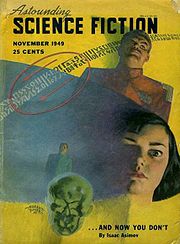 Campbell revealed a sly sense of humor in the November 1949 issue. He had always encouraged literary criticism by Astounding's readership, and in the November 1948 issue he published a letter to the editor by a reader named Richard A. Hoen that contained a detailed ranking of the contents of an issue one year in the future. Campbell went along with the joke and contracted stories from most of the authors mentioned in the letter that would follow the fan's imaginary story titles. One of the best-known stories from that issue is "Gulf"
, by Robert A. Heinlein
. Other stories and articles were written by a number of the most famous authors of the time: Isaac Asimov
, Theodore Sturgeon
, Lester del Rey
, A. E. van Vogt
, L. Sprague de Camp
, and the astronomer R. S. Richardson.
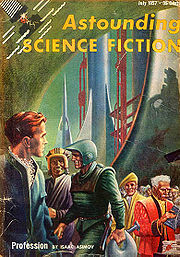 By 1950 Campbell's strong personality had led him into conflict with some of his leading writers, some of whom abandoned Astounding as a result. The launch of both The Magazine of Fantasy & Science Fiction
and Galaxy Science Fiction
in 1949 and 1950, respectively, marked the end of Astoundings dominance of science fiction; with many regarding Galaxy as the new leader of the field. In addition, Campbell's growing interest in pseudoscience
damaged his reputation in the field. Campbell was deeply involved with the launch of dianetics
, publishing Hubbard's first article on it in Astounding in May 1950, and promoting it heavily in the months beforehand, and later in the decade he championed psionics
and anti-gravity
devices.
The boom in paperback
originals meant that Astounding was no longer the only place to find top-quality science fiction.
Many historically important stories and articles continued to appear in the pages of Astounding during the 1950s. Tom Godwin
's "The Cold Equations
" - sometimes listed as one of the top dozen or so best science fiction short stories - was published in the August 1954 issue. It generated more response mail than any story the magazine had ever printed. Writer L. Ron Hubbard
published the first article on his Dianetics
concepts, which would soon expand into Scientology
, in the magazine in May 1950.
of the original magazine contents, in the sense that there was nothing in the British edition that had not previously appeared in the U.S. version, but that parts of the original contents were quite often omitted from the British version. This was particularly true up to October 1953, when the British edition was much slimmer than its American counterpart. For this reason the serials, editorials, factual articles and letter columns that were often the most appealing features of the American version were denied to British readers.
The material appearing in the British reprint was usually taken from the American issue dated three or four months earlier. However, this was never systematic, and cross-reference between U.S. and British editions is a complicated process. A further anomaly occurs because the covers of the British editions were almost always redrawn from the corresponding American edition, possibly for copyright
reasons. At first sight the covers often look the same, but closer inspection reveals subtle differences.
Like the American original, the British Reprint Edition underwent a gradual change of title from Astounding to Analog. However, due to the lag in contents and cover image, this process was completed a few months later - the first issue completely devoid of the Astounding logo was February 1961 rather than October 1960. The final British Reprint Edition of Analog appeared as the August 1963 issue with an announcement on the inside front cover that "... after 24 years of publication the British Edition ... ceases with this issue"; after this time the American version published by Condé Nast Publications
was imported directly into the UK.
In a minor change, in the November issue of 1946 the name of the magazine was changed from Astounding Science-Fiction to Astounding SCIENCE FICTION, with the hyphen missing and the last two words in large block letters. It would retain this logo until January, 1953.
The following table gives an overview. The name is a representation of the form displayed on the cover pages, including the capitalization.
Science fiction magazine
A science fiction magazine is a publication that offers primarily science fiction, either in a hard copy periodical format or on the Internet....
. As of 2011, it is the longest running continuously published magazine of that genre. Initially published in 1930 in the United States as Astounding Stories as a pulp magazine
Pulp magazine
Pulp magazines , also collectively known as pulp fiction, refers to inexpensive fiction magazines published from 1896 through the 1950s. The typical pulp magazine was seven inches wide by ten inches high, half an inch thick, and 128 pages long...
, it has undergone several name changes, primarily to Astounding Science-Fiction in 1938, and Analog Science Fact & Fiction in 1960. In November 1992, its logo changed to use the term "Fiction and Fact" rather than "Fact & Fiction".
It is in the library of the International Space Station
International Space Station
The International Space Station is a habitable, artificial satellite in low Earth orbit. The ISS follows the Salyut, Almaz, Cosmos, Skylab, and Mir space stations, as the 11th space station launched, not including the Genesis I and II prototypes...
.
Spanning three incarnations since 1930, this is perhaps the most influential magazine in the history of the genre. It remains a fixture of the genre today. As “Astounding Science Fiction”, a new direction for both the magazine and the genre under editor John W. Campbell was established. His editorship influenced the careers of Isaac Asimov
Isaac Asimov
Isaac Asimov was an American author and professor of biochemistry at Boston University, best known for his works of science fiction and for his popular science books. Asimov was one of the most prolific writers of all time, having written or edited more than 500 books and an estimated 90,000...
and Robert Heinlein, and also introduced the dianetic theories of L. Ron Hubbard
L. Ron Hubbard
Lafayette Ronald Hubbard , better known as L. Ron Hubbard , was an American pulp fiction author and religious leader who founded the Church of Scientology...
in May 1950.
Analog frequently publishes new authors, including then-newcomers such as Orson Scott Card
Orson Scott Card
Orson Scott Card is an American author, critic, public speaker, essayist, columnist, and political activist. He writes in several genres, but is primarily known for his science fiction. His novel Ender's Game and its sequel Speaker for the Dead both won Hugo and Nebula Awards, making Card the...
and Joe Haldeman
Joe Haldeman
Joe William Haldeman is an American science fiction author.-Life :Haldeman was born June 9, 1943 in Oklahoma City, Oklahoma. His family traveled and he lived in Puerto Rico, New Orleans, Washington, D.C., Bethesda, Maryland and Anchorage, Alaska as a child. Haldeman married Mary Gay Potter, known...
in the 1970s, Harry Turtledove
Harry Turtledove
Harry Norman Turtledove is an American novelist, who has produced works in several genres including alternate history, historical fiction, fantasy and science fiction.- Life :...
, Timothy Zahn
Timothy Zahn
Timothy Zahn is a writer of science fiction short stories and novels. His novella Cascade Point won the 1984 Hugo award. He is the author of nine Star Wars Expanded Universe novels, including seven novels featuring Grand Admiral Thrawn: the Thrawn Trilogy, the Hand of Thrawn duology, Outbound...
, Greg Bear
Greg Bear
Gregory Dale Bear is an American science fiction and mainstream author. His work has covered themes of galactic conflict , artificial universes , consciousness and cultural practices , and accelerated evolution...
, and Joseph H. Delaney
Joseph H. Delaney
Joseph Henry Delaney was a US lawyer and science fiction writer. He was first published rather late in life, 1982 when he was nearly fifty, and was most associated with Analog Science Fiction and Fact. He would go on to be nominated for the Hugo Award for Best Novella several times and win readers...
in the 1980s, and Paul Levinson
Paul Levinson
Paul Levinson is an American author and professor of communications and media studies at Fordham University in New York City. Levinson's novels, short fiction, and non-fiction works have been translated into twelve languages....
, Michael A. Burstein
Michael A. Burstein
Michael A. Burstein is an American writer of science fiction. He was born in New York City, and grew up in the neighborhood of Forest Hills in the borough of Queens. He attended Hunter College High School in Manhattan...
, and Rajnar Vajra in the 1990s.
One of the major publications of what fans and historians call the Golden Age of Science Fiction
Golden Age of Science Fiction
The first Golden Age of Science Fiction — often recognized as the period from the late 1930s through the 1950s — was an era during which the science fiction genre gained wide public attention and many classic science fiction stories were published...
and afterward, it has published much-reprinted work by such major SF authors as E.E. Smith, Theodore Sturgeon
Theodore Sturgeon
Theodore Sturgeon was an American science fiction author.His most famous novel is More Than Human .-Biography:...
, Isaac Asimov
Isaac Asimov
Isaac Asimov was an American author and professor of biochemistry at Boston University, best known for his works of science fiction and for his popular science books. Asimov was one of the most prolific writers of all time, having written or edited more than 500 books and an estimated 90,000...
, Robert A. Heinlein
Robert A. Heinlein
Robert Anson Heinlein was an American science fiction writer. Often called the "dean of science fiction writers", he was one of the most influential and controversial authors of the genre. He set a standard for science and engineering plausibility and helped to raise the genre's standards of...
, A. E. van Vogt
A. E. van Vogt
Alfred Elton van Vogt was a Canadian-born science fiction author regarded by some as one of the most popular and complex science fiction writers of the mid-twentieth century: the "Golden Age" of the genre....
, Lester del Rey
Lester del Rey
Lester del Rey was an American science fiction author and editor. Del Rey was the author of many of the Winston Science Fiction juvenile SF series, and the editor at Del Rey Books, the fantasy and science fiction branch of Ballantine Books, along with his fourth wife Judy-Lynn del Rey.-Birth...
, and many others.
Clayton
In 1926, Hugo GernsbackHugo Gernsback
Hugo Gernsback , born Hugo Gernsbacher, was a Luxembourgian American inventor, writer, editor, and magazine publisher, best remembered for publications that included the first science fiction magazine. His contributions to the genre as publisher were so significant that, along with H. G...
launched Amazing Stories
Amazing Stories
Amazing Stories was an American science fiction magazine launched in April 1926 by Hugo Gernsback's Experimenter Publishing. It was the first magazine devoted solely to science fiction...
, the first science fiction magazine. Gernsback had been printing scientific fiction stories for some time in his hobbyist magazines, such as Modern Electrics
Modern Electrics
Modern Electrics was a technical magazine for the amateur radio experimenter. It was created by Hugo Gernsback and began publication in April 1908. The magazine was initially intended to provide mail-order information for radio parts and to promote the amateur radio hobby, but it later became a...
and Electrical Experimenter
Electrical Experimenter
The Electrical Experimenter was a technical science magazine that was published monthly. It was first published in May 1913, as the successor to Modern Electrics, a combination of a magazine and mail-order catalog that had been published by Hugo Gernsback starting in 1908...
, but decided that there was enough interest in the genre to justify a monthly magazine. Amazing was very successful, quickly reaching a circulation of over 100,000. William Clayton
William Clayton (publisher)
William Clayton was a U.S. pulp magazine publisher. His company published Snappy Stories, a men's magazine which was launched in 1912. He published many western pulps, and in 1930 launched Astounding Stories, which is still being published as of 2011 under the title Analog Science Fiction and Fact....
, a successful and well-respected publisher of several pulp
Pulp magazine
Pulp magazines , also collectively known as pulp fiction, refers to inexpensive fiction magazines published from 1896 through the 1950s. The typical pulp magazine was seven inches wide by ten inches high, half an inch thick, and 128 pages long...
titles, considered starting a competitive title in 1928: according to Harold Hersey, one of his editors at the time, Hersey had "discussed plans with Clayton to launch a pseudo-science fantasy sheet". Clayton was unconvinced. The following year, however, Clayton decided to launch a new magazine, mainly because the sheet on which the color covers of his magazines were printed had a space for one more cover. He suggested to Harry Bates
Harry Bates (author)
Harry Bates was an American science fiction editor and writer. His 1940 short story "Farewell to the Master" was the basis of the well-known 1951 science fiction movie The Day the Earth Stood Still.-Biography:Harry Bates was born Hiram Gilmore Bates III on October 9, 1900 in Pittsburgh, Pennsylvania...
, a newly hired editor, that they start a magazine of period adventure stories. Bates proposed instead a science fiction pulp, to be titled Astounding Stories of Super Science, and Clayton agreed.
| Jan | Feb | Mar | Apr | May | Jun | Jul | Aug | Sep | Oct | Nov | Dec | |
|---|---|---|---|---|---|---|---|---|---|---|---|---|
| 1930 | 1/1 | 1/2 | 1/3 | 2/1 | 2/2 | 2/3 | 3/1 | 3/2 | 3/3 | 4/1 | 4/2 | 4/3 |
| 1931 | 5/1 | 5/2 | 5/3 | 6/1 | 6/2 | 6/3 | 7/1 | 7/2 | 7/3 | 8/1 | 8/2 | 8/3 |
| 1932 | 9/1 | 9/2 | 9/3 | 10/1 | 10/2 | 10/3 | 11/1 | 11/2 | ||||
| 1933 | 11/3 | 12/1 | 12/2 | 12/3 | 12/4 | |||||||
| 1934 | 12/5 | 12/6 | 13/1 | 13/2 | 13/3 | 13/4 | 13/5 | 13/6 | 14/1 | 14/2 | 14/3 | 14/4 |
| 1935 | 14/5 | 14/6 | 15/1 | 15/2 | 15/3 | 15/4 | 15/5 | 15/6 | 16/1 | 16/2 | 16/3 | 16/4 |
| 1936 | 16/5 | 16/6 | 17/1 | 17/2 | 17/3 | 17/4 | 17/5 | 17/6 | 18/1 | 18/2 | 18/3 | 18/4 |
| 1937 | 18/5 | 18/6 | 19/1 | 19/2 | 19/3 | 19/4 | 19/5 | 19/6 | 20/1 | 20/2 | 20/3 | 20/4 |
| 1938 | 20/5 | 20/6 | 21/1 | 21/2 | 21/3 | 21/4 | 21/5 | 21/6 | 22/1 | 22/2 | 22/3 | 22/4 |
| 1939 | 22/5 | 22/6 | 23/1 | 23/2 | 23/3 | 23/4 | 23/5 | 23/6 | 24/1 | 24/2 | 24/3 | 24/4 |
| Issues of Astounding Stories, showing volume/issue number. The colors identify the editors for each issue: |
||||||||||||
Wonder Stories
Wonder Stories was an early American science fiction magazine which was published under several titles from 1929 to 1955. It was founded by Hugo Gernsback in 1929 after he had lost control of his first science fiction magazine, Amazing Stories, when his media company Experimenter Publishing went...
—two cents a word on acceptance, rather than half a cent a word, on publication (or sometimes later)—and consequently Astounding attracted some of the better-known pulp writers, such as Murray Leinster
Murray Leinster
Murray Leinster was a nom de plume of William Fitzgerald Jenkins, an award-winning American writer of science fiction and alternate history...
, Victor Rousseau
Victor Rousseau
Victor Rousseau was a Belgian sculptor and medalist.- Life :Rousseau was of Walloon heritage and descended from a line of stonemasons. He began carving stone at age 11, working at the site of the Law Courts of Brussels, designed by architect Joseph Poelaert...
, and Jack Williamson
Jack Williamson
John Stewart Williamson , who wrote as Jack Williamson was a U.S. writer often referred to as the "Dean of Science Fiction" following the death in 1988 of Robert A...
. In February 1931, the original name Astounding Stories of Super-Science was shortened to Astounding Stories.
The magazine was profitable, but the Depression
Great Depression
The Great Depression was a severe worldwide economic depression in the decade preceding World War II. The timing of the Great Depression varied across nations, but in most countries it started in about 1929 and lasted until the late 1930s or early 1940s...
caused Clayton problems. Normally a publisher would pay a printer three months in arrears, but when a credit squeeze began in May 1931, it led to pressure to reduce this delay. The financial difficulties led Clayton to start alternating the publication of his magazines, and he switched Astounding to a bimonthly schedule with the June 1932 issue. Some printers bought the magazines which were indebted to them: Clayton decided to buy his printer to prevent this from happening. This proved a disastrous move. Clayton did not have the money to complete the transaction, and in October 1932 Clayton decided to cease publication of Astounding, with the expectation that the January 1933 issue would be the last one. As it turned out, there were enough stories in inventory, and enough paper, to publish one further issue, so the last Clayton Astounding was dated March 1933. In April Clayton went bankrupt, and sold his magazine titles; the buyer quickly resold the titles to Street & Smith
Street & Smith
Street & Smith or Street & Smith Publications, Inc. was a New York City publisher specializing in inexpensive paperbacks and magazines referred to as pulp fiction and dime novels. They also published comic books and sporting yearbooks...
, a well-established publisher.
Street & Smith
Science fiction was not an entirely new departure for Street & Smith. They already possessed two pulp titles that occasionally ventured into the field: The ShadowThe Shadow
The Shadow is a collection of serialized dramas, originally in pulp magazines, then on 1930s radio and then in a wide variety of media, that follow the exploits of the title character, a crime-fighting vigilante in the pulps, which carried over to the airwaves as a "wealthy, young man about town"...
, which had begun in 1931 and was tremendously successful, with a circulation over 300,000; and Doc Savage
Doc Savage
Doc Savage is a fictional character originally published in American pulp magazines during the 1930s and 1940s. He was created by publisher Henry W. Ralston and editor John L...
, which had been launched in March 1933. They gave the post of editor of Astounding to F. Orlin Tremaine
F. Orlin Tremaine
F. Orlin Tremaine was an American science fiction editor.Tremaine became the second editor of Astounding Science Fiction in 1933 following the magazine's purchase by Street and Smith when William Clayton went bankrupt. Tremaine remained editor until 1937, when he was succeeded by John W....
, an experienced editor who had been working for Clayton as the editor of Clues, and who had come to Street & Smith as part of the transfer of titles after Clayton's bankruptcy. Desmond Hall, who had also come from Clayton, was made assistant editor; because Tremaine was editor of Clue and Top-Notch, as well as Astounding, Hall did a lot of the editorial work, though Tremaine retained final control over the contents.
The first Street & Smith issue was dated October 1933; it was not until the third issue, in December 1933, that the editorial team was named on the masthead. Street & Smith had an excellent distribution network, and they were able to get Astoundings circulation up to an estimated 50,000 by the middle of 1934. The two main rival science fiction magazines of the day, Wonder Stories
Wonder Stories
Wonder Stories was an early American science fiction magazine which was published under several titles from 1929 to 1955. It was founded by Hugo Gernsback in 1929 after he had lost control of his first science fiction magazine, Amazing Stories, when his media company Experimenter Publishing went...
and Amazing Stories, each had a circulation of about half that. Astounding was the leading science fiction magazine by the end of 1934; and it was also the largest, at 160 pages, and the cheapest, at 20 cents. Street & Smith's rates of one cent per word (sometimes more) on acceptance were not as good as the rates paid by Bates for the Clayton Astounding, but they were still better than those of the other magazines.
Hall left Astounding in 1934 to become editor of Street & Smith's new slick magazine, Mademoiselle
Mademoiselle (magazine)
Mademoiselle was an influential women's magazine first published in 1935 by Street and Smith and later acquired by Condé Nast Publications....
, and was replaced by R.V. Happel. Tremaine remained in control of story selection. Writer Frank Gruber
Frank Gruber
Frank Gruber may refer to:*Frank Gruber , American writer*Frank Gruber , entrepreneur and new media journalist...
described Tremaine's editorial selection process in his book, The Pulp Jungle:
Gruber pointed out that stories in the middle might go many months before Tremaine read them; the result was erratic response times which sometimes stretched to over eighteen months.
Tremaine was promoted to assistant editorial director in 1937. His replacement as editor of Astounding (though not of Clues) was John W. Campbell, Jr.. Campbell had made his name in the early 1930s as a writer, publishing space opera under his own name, and more thoughtful stories under the pseudonym "Don A. Stuart". He started working for Street & Smith in October 1937, so his first editorial influence appeared in the issue dated December 1937. The March 1938 issue was the first that was fully his responsibility. In early 1938, Street & Smith abandoned its policy of having editors-in-chief, with the result that Tremaine was made redundant. He left on May 1, 1938, reducing Street & Smith's oversight of Campbell and giving him a freer rein.
One of Campbell's first acts was to change the title from Astounding Stories to Astounding Science-Fiction with the March 1938 issue. Campbell editorial policy was targeted at the more mature readers of science fiction, and he felt that "Astounding Stories" did not convey the right image. He intended to subsequently drop the "Astounding" part of the title as well, leaving the magazine titled Science Fiction, but in 1939 a new magazine with that title appeared. "Astounding" was retained, though thereafter it was often printed in a color that made it much less visible than the "Science-Fiction" part of the title. At the start of 1942 the price was increased, for the first time, to 25 cents; the magazine simultaneously switched to the larger bedsheet
Bedsheet
The bedsheet format was the size of many magazines published in the United States in the first third of the 20th century. Magazines in bedsheet format were roughly the size of Life but with square spines...
format, but this did not last. Astounding returned to pulp-size in mid 1943 for six issues, and then became the first science fiction magazine to switch to digest size
Digest size
Digest size is a magazine size, smaller than a conventional or "journal size" magazine but larger than a standard paperback book, approximately 5½ x 8¼ inches, but can also be 5⅜ x 8⅜ inches and 5½ x 7½ inches. These sizes have evolved from the printing press operation end...
in November 1943, increasing the number of pages to maintain the same total wordcount. The price remained at 25 cents through these changes in format.
The price increased again, to 35 cents, in August 1951. In the late 1950s it became apparent to Street & Smith that they were going to have to raise prices again. During 1959, Astounding was priced at 50 cents in some areas to find out what the impact would be on circulation. The results were apparently satisfactory, and the price was raised with the November 1959 issue. The following year Campbell finally achieved his goal of getting rid of the word "Astounding" in the magazine's title, changing it to Analog Science Fact/Science Fiction. The change began with the February 1960 issue, and was complete by October; for several issues both "Analog" and "Astounding" could be seen on the cover, with "Analog" becoming bolder and "Astounding" fading with each issue.
Condé Nast
Condé Nast PublicationsCondé Nast Publications
Condé Nast, a division of Advance Publications, is a magazine publisher. In the U.S., it produces 18 consumer magazines, including Architectural Digest, Bon Appétit, GQ, The New Yorker, Vanity Fair, and Vogue, as well as four business-to-business publications, 27 websites, and more than 50 apps...
bought Street & Smith in August 1959, though the change was not reflected in Analogs masthead until February 1962. Analog was the only digest-sized magazine in Condé Nast's inventory—all the others were slicks, such as Vogue
Vogue (magazine)
Vogue is a fashion and lifestyle magazine that is published monthly in 18 national and one regional edition by Condé Nast.-History:In 1892 Arthur Turnure founded Vogue as a weekly publication in the United States. When he died in 1909, Condé Montrose Nast picked up the magazine and slowly began...
and Vanity Fair
Vanity Fair (magazine)
Vanity Fair is a magazine of pop culture, fashion, and current affairs published by Condé Nast. The present Vanity Fair has been published since 1983 and there have been editions for four European countries as well as the U.S. edition. This revived the title which had ceased publication in 1935...
. All the advertisers in these magazines had plates made up to take advantage of this size, and Condé Nast changed Analog to the larger size from the March 1963 issue in order to conform. The front and back signature
Signature mark
A signature mark is a letter, number or combination of either or both, which is printed at the bottom of the first page, or leaf, of a signature or section...
s were changed to glossy paper, to carry both advertisements and scientific features. The change did not attract advertising support, however, and from the April 1965 issue Analog reverted to digest size once again. Circulation, which had been increasing before the change, was not harmed, and continued to increase while Analog was in slick format.
Campbell died suddenly in July 1971, but there was enough material in Analogs inventory to allow the remaining staff to put together issues for the rest of the year. Condé Nast had given the magazine very little attention, since it was both profitable and cheap to produce, but they were proud that it was the leading sf magazine. They asked Kay Tarrant, who had been Campbell's assistant, to help them find a replacement: she contacted several regular contributors to ask for suggestions. Several well-known writers turned down the job for various reasons: Poul Anderson did not want to leave California; neither did Jerry Pournelle, who also felt the salary was too small. Harry Harrison had discussed taking over with Campbell before Campbell's death, but did not want to live in New York. Frederik Pohl, Lester del Rey and Clifford Simak were also rumored to have been offered the job, though Simak denied it.
The Condé Nast vice president in charge of selecting the new editor decided to read both fiction and non-fiction writing samples from the applicants, since Analogs title included both "science fiction" and "science fact". He chose Ben Bova, afterwards telling Bova that his stories and articles "were the only ones I could understand". January 1972 was the first issue to credit Bova on the masthead.
Bova planned to stay for five years, to ensure a smooth transition after Campbell's sudden death; the salary was too low for him to consider remaining indefinitely. In 1975 he proposed a new magazine to Condé Nast management, to be titled Tomorrow Magazine; he wanted to publish articles about science and technology, leavened with some science fiction stories. Condé Nast were uninterested in the idea; and refused to assist Analog with marketing or promotions. Bova resigned in June 1978, having stayed for a little longer than he had planned, and recommended Stanley Schmidt
Stanley Schmidt
Stanley Albert Schmidt is an American science fiction author. Since 1978 he has been the editor of the SF magazine Analog Science Fiction and Fact.-Biography:...
to succeed him. Schmidt's first issue was December 1978, though material purchased by Bova continued to appear for several months.
In 1980 Condé Nast sold Analog to Davis Publications. Analog had always been something of a misfit in Condé Nast's line up, which contained titles such as Mademoiselle
Mademoiselle (magazine)
Mademoiselle was an influential women's magazine first published in 1935 by Street and Smith and later acquired by Condé Nast Publications....
and Vogue
Vogue (magazine)
Vogue is a fashion and lifestyle magazine that is published monthly in 18 national and one regional edition by Condé Nast.-History:In 1892 Arthur Turnure founded Vogue as a weekly publication in the United States. When he died in 1909, Condé Montrose Nast picked up the magazine and slowly began...
, and Davis was willing to put some effort into marketing Analog, so Schmidt regarded the change as likely to be beneficial.
Bova won the Hugo Award for Best Professional Editor
Hugo Award for Best Professional Editor
The Hugo Awards are given every year by the World Science Fiction Society for the best science fiction or fantasy works and achievements of the previous year. The award is named after Hugo Gernsback, the founder of the pioneering science fiction magazine Amazing Stories, and was once officially...
for 5 consecutive years, 1973 through 1978. (The award did not exist before 1973.)
Circulation dropped during the 1970s and 1980s, as newsstand sales fell away while subscriptions did not grow enough to compensate.
- In 1980 the overall circulation of 104,000 included 45,000 newsstand sales.
- In 1983 the overall circulation reached a peak of 115,000 per month.
In 1981, Analog's schedule was changed to publication every four weeks, rather than monthly, so that there were thirteen issues a year, rather than twelve.
In 1992 Davis Publications sold the magazine to Dell Magazines
Dell Magazines
Dell Magazines was a company founded by George T. Delacorte Jr. in 1921 as part of his Dell Publishing Co. Dell is today known for its many puzzle magazines, as well as fiction magazines such as Alfred Hitchcock's Mystery Magazine, Ellery Queen's Mystery Magazine, Asimov's Science Fiction, and...
, who continue to publish it to this day. Dell Magazines was in turn acquired by Penny Publications
Penny Publications
Penny Publications is a US magazine publisher, formed in 1996 as the joinder of Dell Magazines, founded 1921 by George T. Delacorte, Jr., which had been acquired by Crosstown Publications and Penny Press, founded 1973, which as Penny Publications, LLC was under the same ownership as Crosstown...
with headquarters in Norwalk
Norwalk, Connecticut
Norwalk is a city in Fairfield County, Connecticut, United States. According to the 2010 U.S. Census, the population of the city is 85,603, making Norwalk sixth in population in Connecticut, and third in Fairfield County...
, Connecticut, US.
- In 1990 the overall circulation of 83,000 included only 15,000 sales from newsstands.
In 1996 Analog returned to a monthly schedule, and the following year reduced the schedule again, to eleven issues, combining July and August into a single issue. Starting in 2004, the number of issues was cut again, to ten, with January and February also being combined into one issue.
As of 2011, editor Schmidt has been nominated for the Hugo Award for Best Professional Editor for 26 consecutive years, 1980 through 2006, without winning. Through his tenure, Analog has been the best-selling English-language SF magazine in the world.
Each year, Analog conducts a readers' poll—called the Analytical Laboratory, or AnLab—to determine the favorite stories, articles and cover art published in the magazine in the previous year. Many recipients of the AnLab Award have gone on to receive the Hugo Award
Hugo Award
The Hugo Awards are given annually for the best science fiction or fantasy works and achievements of the previous year. The award is named after Hugo Gernsback, the founder of the pioneering science fiction magazine Amazing Stories, and was officially named the Science Fiction Achievement Awards...
.
Analogs circulation has fallen from a high of about 115,000 per month in 1983, to 28,319 in 2006. For 2007, Locus magazine reported that overall paid circulation fell 3.2% to 27,399. Of this quantity, subscriptions were 22,972 units.
Analog's editor Stanley Schmidt
Stanley Schmidt
Stanley Albert Schmidt is an American science fiction author. Since 1978 he has been the editor of the SF magazine Analog Science Fiction and Fact.-Biography:...
announced that Analog began "preferring" accepting submissions in electronic form via a website "[e]ffective at 11 a.m. Eastern Standard Time on Tuesday, February 22", 2011, and indicated that full instructions were available at that url, but that "attachments to regular e-mail" would not be accepted, Analog thus increasing its bidirectional use of online rather than hardcopy print media such as self-addressed stamped envelope
Self-addressed stamped envelope
A self-addressed stamped envelope , stamped self-addressed envelope , or just self addressed envelope in the UK, is an envelope with the sender's name and address on it, with affixed paid postage and mailed to a company or private individual...
s (SASE) in communications between Analog, its writers and other contributors, business partners and readers.
Bates
The first incarnation of Astounding was an adventure-oriented magazine, with no interest in education through science. The covers were all painted by WessoHans Waldemar Wessolowski
Hans Waldemar Wessolowski was an artist best known for his many cover illustrations for early pulp magazines like Amazing Stories, Astounding Stories, and Clues...
and similarly action-filled; the first issue showed a giant beetle attacking a man. The quality of the fiction was very low, and Bates would not accept any experimental stories, relying mostly on formulaic plots. In the eyes of Mike Ashley, a science fiction historian, Bates was "destroying the ideals of science fiction". One historically important story that almost appeared in Astounding was E.E. Smith's Triplanetary
Triplanetary (novel)
Triplanetary is a science fiction novel and space opera by E. E. Smith. It was first serialized in the magazine Amazing Stories in 1934. After the Lensman series was published, Smith expanded and reworked the novel into the first of two Lensman prequels...
, which Bates would have published had Astounding not folded in early 1933. However, the cover Wesso had painted for the story appeared on the March 1933 issue, the last to be published by Clayton.
Tremaine
When Street & Smith acquired Astounding, they also planned to relaunch another Clayton pulp, Strange Tales, and acquired material for it before deciding not to proceed. These stories appeared in the first Street & Smith Astounding, dated October 1933. This issue and the next were unremarkable in quality, but with the December issue Tremaine published a statement of editorial policy, calling for "thought variant" stories which contained original ideas and did not simply reproduce adventure themes in an sf context. The policy was probably worked out between Tremain and Desmond Hall, his assistant editor, in an attempt to give Astounding a clear identity in the market that would distinguish it from both the existing science fiction magazines and the hero pulps, such as The ShadowThe Shadow
The Shadow is a collection of serialized dramas, originally in pulp magazines, then on 1930s radio and then in a wide variety of media, that follow the exploits of the title character, a crime-fighting vigilante in the pulps, which carried over to the airwaves as a "wealthy, young man about town"...
, that frequently used sf ideas.
Early "thought variant" stories were not always very original or well executed. Ashley describes the first, Nat Schachner
Nat Schachner
Nat Schachner , also appearing as "Nathan Schachner" and under other bylines, was an American author. His first published story was "The Tower of Evil," written in collaboration with Arthur Leo Zagat and appearing in the Summer 1930 issue of Wonder Stories Quarterly...
's "Ancestral Voices", as "not amongst Schachner's best"; the second, "Colossus", by Donald Wandrei
Donald Wandrei
Donald Albert Wandrei was an American science fiction, fantasy and weird fiction writer, poet and editor. He wrote as Donald Wandrei. He was the older brother of science fiction writer and artist Howard Wandrei...
, was not a new idea, but was energetically written. Over the succeeding issues it became apparent that Tremaine was genuinely willing to publish material that would have fallen foul of editorial taboos elsewhere. He serialized Charles Fort
Charles Fort
Charles Hoy Fort was an American writer and researcher into anomalous phenomena. Today, the terms Fortean and Forteana are used to characterize various such phenomena. Fort's books sold well and are still in print today.-Biography:Charles Hoy Fort was born in 1874 in Albany, New York, of Dutch...
's Lo!
Lo!
Lo! was the third published nonfiction work of the author Charles Fort . In it he details a wide range of unusual phenomena. In the final chapter of the book he proposes a new cosmology that the earth is stationary in space and surrounded by a solid shell which is "....
, a non-fiction work about strange and inexplicable phenomena, in eight parts between April and November 1934, in an attempt to stimulate new ideas for stories. In fiction, 1934 was a banner year for the magazine: the best remembered story of the year is probably Jack Williamson
Jack Williamson
John Stewart Williamson , who wrote as Jack Williamson was a U.S. writer often referred to as the "Dean of Science Fiction" following the death in 1988 of Robert A...
's The Legion of Space, which began serialization in April, but other notable stories include Murray Leinster
Murray Leinster
Murray Leinster was a nom de plume of William Fitzgerald Jenkins, an award-winning American writer of science fiction and alternate history...
's "Sidewise in Time", which was the first sf story to use the idea of alternate history; "The Bright Illusion", by C.L. Moore
C. L. Moore
Catherine Lucille Moore was an American science fiction and fantasy writer, as C. L. Moore. She was one of the first women to write in the genre, and paved the way for many other female writers in speculative fiction....
, and "Twilight", by John W. Campbell, writing as "Don A. Stuart". "Twilight", which was written in a more literary and poetic style than Campbell's earlier space opera
Space opera
Space opera is a subgenre of science fiction that emphasizes romantic, often melodramatic adventure, set mainly or entirely in outer space, generally involving conflict between opponents possessing advanced technologies and abilities. The term has no relation to music and it is analogous to "soap...
stories, was particularly influential, and Tremaine encouraged other writers to produce similar stories. One such was Raymond Z. Gallun
Raymond Z. Gallun
Raymond Zinke Gallun was an American science fiction writer.Gallun was born in Beaver Dam, Wisconsin...
's "Old Faithful", which appeared in the December 1934 issue and was sufficiently popular that Gallun wrote a sequel, "Son of Old Faithful", published the following July.
Astoundings readership was more knowledgeable and more mature than the readers of the other magazines, and this was reflected in the cover artwork, by Howard V. Brown, which was less garish than at Wonder Stories
Wonder Stories
Wonder Stories was an early American science fiction magazine which was published under several titles from 1929 to 1955. It was founded by Hugo Gernsback in 1929 after he had lost control of his first science fiction magazine, Amazing Stories, when his media company Experimenter Publishing went...
or Amazing Stories. The interior artwork, particularly by Elliot Dold, was also very impressive.
By the end of 1935, Astounding was the clear leader of the science fiction magazine field. Tremaine's policy of printing material that he liked without staying too strictly within the bounds of the genre led him to serialize H.P. Lovecraft
H. P. Lovecraft
Howard Phillips Lovecraft --often credited as H.P. Lovecraft — was an American author of horror, fantasy and science fiction, especially the subgenre known as weird fiction....
's novel At the Mountains of Madness in early 1936. He followed this with Lovecraft's "The Shadow Out of Time" in June 1936, though there were "protests from sf purists". Generally, however, Tremaine was unable to maintain the high standard he had set in the first couple of years, perhaps because his workload was high. Tremaine's slow responses to submissions discouraged new authors, although he could rely on regular contributors such as Jack Williamson, Murray Leinster, Raymond Gallun, Nat Schachner, and Frank Belknap Long. New writers who did appear during the latter half of Tremaine's tenure included Ross Rocklynne
Ross Rocklynne
Ross Rocklynne was the pen name used by Ross Louis Rocklin, an American science fiction author active in the Golden Age of Science Fiction....
, Nelson S. Bond
Nelson S. Bond
Nelson Slade Bond was an American author who wrote extensively for books, magazines, radio, television and the stage....
, and L. Sprague de Camp
L. Sprague de Camp
Lyon Sprague de Camp was an American author of science fiction and fantasy books, non-fiction and biography. In a writing career spanning 60 years, he wrote over 100 books, including novels and notable works of non-fiction, including biographies of other important fantasy authors...
, whose first appearance was in September 1937 with "The Isolinguals".
Campbell
Campbell was hired by Street & Smith in October 1937, and although he did not gain full editorial control of Astounding until the May 1938 issue, he was able to introduce some new features before then. In January 1938 he began to include a short description of stories in the next issue, titled "In Times To Come"; and in March he began "The Analytical Laboratory", which calculated average votes from readers and ranked the stories in order. The payment rate at the time was one cent a word, and Street & Smith agreed to let Campbell pay a bonus of an extra quarter cent a word to the writer whose story was voted top of the list.Campbell changed the approach to the magazine's cover art, hoping that more mature artwork would attract more adult readers and enable them to carry the magazine without embarrassment. Howard V. Brown had done almost every cover for the Street & Smith version of Astounding, and Campbell asked him to do an astronomically accurate picture of the Sun as seen from Mercury for the February 1938 issue. He also introduced Charles Schneeman
Charles Schneeman
Charles Schneeman was an American illustrator of science fiction.-Life:...
as a cover artist, starting with the May 1938 issue, and Hubert Rogers, whose first cover was for the February 1939 issue, and who quickly became a regular, painting all but four of the covers between September 1939 and August 1942.
Tremaine had printed some non-fiction articles during his tenure, with Campbell himself providing an 18-part series on the solar system between June 1936 and December 1937. Campbell instituted regular non-fiction pieces, with the goal of stimulating story ideas. The main contributors of these were R.S. Richardson
Robert S. Richardson
Robert Shirley Richardson was an American astronomer, born in Indiana. He also published science fiction using the pseudonym Philip Latham.-Bibliography:* The Xi Effect, 1950...
, L. Sprague de Camp
L. Sprague de Camp
Lyon Sprague de Camp was an American author of science fiction and fantasy books, non-fiction and biography. In a writing career spanning 60 years, he wrote over 100 books, including novels and notable works of non-fiction, including biographies of other important fantasy authors...
, and Willy Ley
Willy Ley
Willy Ley was a German-American science writer and space advocate who helped popularize rocketry and spaceflight in both Germany and the United States. The crater Ley on the far side of the Moon is named in his honor.-Life:...
.
Golden Age
The period from 1938 to 1946 is usually referred to as the "Golden Age" of science fiction, because of the immense influence Campbell's editorship had on the genre. Within less than two years of the start of his editorship he had published stories by many of the writers who would become central figures in science fiction: both existing writers, such as L. Ron HubbardL. Ron Hubbard
Lafayette Ronald Hubbard , better known as L. Ron Hubbard , was an American pulp fiction author and religious leader who founded the Church of Scientology...
, Clifford Simak
Clifford D. Simak
Clifford Donald Simak was an American science fiction writer. He was honored by fans with three Hugo awards and by colleagues with one Nebula award and was named the third Grand Master by the Science Fiction and Fantasy Writers of America in 1977.-Biography:Clifford Donald Simak was born in...
, Jack Williamson, L. Sprague de Camp, Henry Kuttner
Henry Kuttner
Henry Kuttner was an American author of science fiction, fantasy and horror.-Early life:Henry Kuttner was born in Los Angeles, California in 1915...
, and C.L. Moore
C. L. Moore
Catherine Lucille Moore was an American science fiction and fantasy writer, as C. L. Moore. She was one of the first women to write in the genre, and paved the way for many other female writers in speculative fiction....
, who became regulars in either Astounding or its sister magazine, Unknown
Unknown (magazine)
Unknown was an American pulp fantasy fiction magazine, published from 1939 to 1943 by Street & Smith, and edited by John W. Campbell. Unknown was a companion to Street & Smith's science fiction pulp, Astounding Science Fiction, which was also edited by Campbell at the time; many authors and...
; and new writers who published their first stories in Astounding such as Lester del Rey
Lester del Rey
Lester del Rey was an American science fiction author and editor. Del Rey was the author of many of the Winston Science Fiction juvenile SF series, and the editor at Del Rey Books, the fantasy and science fiction branch of Ballantine Books, along with his fourth wife Judy-Lynn del Rey.-Birth...
, Theodore Sturgeon
Theodore Sturgeon
Theodore Sturgeon was an American science fiction author.His most famous novel is More Than Human .-Biography:...
, Isaac Asimov
Isaac Asimov
Isaac Asimov was an American author and professor of biochemistry at Boston University, best known for his works of science fiction and for his popular science books. Asimov was one of the most prolific writers of all time, having written or edited more than 500 books and an estimated 90,000...
, A.E. van Vogt
A. E. van Vogt
Alfred Elton van Vogt was a Canadian-born science fiction author regarded by some as one of the most popular and complex science fiction writers of the mid-twentieth century: the "Golden Age" of the genre....
and Robert Heinlein
Robert A. Heinlein
Robert Anson Heinlein was an American science fiction writer. Often called the "dean of science fiction writers", he was one of the most influential and controversial authors of the genre. He set a standard for science and engineering plausibility and helped to raise the genre's standards of...
.
Campbell wanted his writers to provide action and excitement, but he also wanted the stories to appeal to a readership that had matured over the first decade of the science fiction genre. He asked his writers to write stories that felt as though they could have been published as non-sf stories in a magazine of the future; a reader of the future would not need long explanations for the gadgets in their lives, and so Campbell asked his writers to find ways of naturally introducing technology to their stories.
The April 1938 issue saw both the first story by del Rey, "The Faithful", and de Camp's second sale, "Hyperpilosity". Jack Williamson's Legion of Time, described by author and editor Lin Carter
Lin Carter
Linwood Vrooman Carter was an American author of science fiction and fantasy, as well as an editor and critic. He usually wrote as Lin Carter; known pseudonyms include H. P. Lowcraft and Grail Undwin.-Life:Carter was born in St. Petersburg, Florida...
as "possibly the greatest single adventure story in science fiction history", began serialization in the following issue. De Camp contributed a non-fiction article, "Language for Time Travelers", in the July issue, which also contained Hubbard's first science fiction sale, "The Dangerous Dimension": Hubbard had been selling genre fiction
Genre fiction
Genre fiction, also known as popular fiction, is a term for fictional works written with the intent of fitting into a specific literary genre in order to appeal to readers and fans already familiar with that genre....
to the pulps for several years by that time. The same issue contained Clifford Simak's "Rule 18"; Simak had more or less abandoned science fiction within a year after breaking into the field in 1931, but he was drawn back by Campbell's editorial approach. The following issue featured one of Campbell's best known stories, "Who Goes There?", and included Kuttner's "The Disinherited"; Kuttner had been selling successfully to the other pulps for a couple of years, but this was his first story in Astounding. In October de Camp began a popular series about an intelligent bear named Johnny Black.
The market for science fiction expanded dramatically in the following year, with several new magazines launched, including Startling Stories
Startling Stories
Startling Stories was an American pulp science fiction magazine, published from 1939 to 1955 by Standard Magazines. It was initially edited by Mort Weisinger, who was also the editor of Thrilling Wonder Stories, Standard's other science fiction title. Startling ran a lead novel in every issue;...
in January 1939, Unknown
Unknown (magazine)
Unknown was an American pulp fantasy fiction magazine, published from 1939 to 1943 by Street & Smith, and edited by John W. Campbell. Unknown was a companion to Street & Smith's science fiction pulp, Astounding Science Fiction, which was also edited by Campbell at the time; many authors and...
in March (a fantasy companion to Astounding, also edited by Campbell), Fantastic Adventures
Fantastic Adventures
Fantastic Adventures was an American pulp science fiction magazine, published from 1939 to 1953 by Ziff-Davis. It was initially edited by Ray Palmer, who was also the editor of Amazing Stories, Ziff-Davis's other science fiction title. The first nine issues were in bedsheet format, but in June 1940...
in May, and Planet Stories
Planet Stories
Planet Stories was an American pulp science fiction magazine, published by Fiction House between 1939 and 1955. It featured interplanetary adventures, both in space and on other planets, and was initially focused on a young readership. Malcolm Reiss was editor or editor-in-chief for all of its 71...
in December. All of the competing magazines, including the two main pre-existing titles, Wonder Stories
Wonder Stories
Wonder Stories was an early American science fiction magazine which was published under several titles from 1929 to 1955. It was founded by Hugo Gernsback in 1929 after he had lost control of his first science fiction magazine, Amazing Stories, when his media company Experimenter Publishing went...
and Amazing Stories
Amazing Stories
Amazing Stories was an American science fiction magazine launched in April 1926 by Hugo Gernsback's Experimenter Publishing. It was the first magazine devoted solely to science fiction...
, were publishing space opera, stories of interplanetary adventure, or other well-worn ideas from the early days of the genre. Campbell's attempts to make science fiction more mature led to a natural division of the writers: those who were unable to write to his standards continued to sell to other magazines; while those who could sell to Campbell quickly focused their attention on Astounding and sold relatively little to the other magazines. The expansion of the market was also a benefit to Campbell because writers knew that if their submissions to Campbell were rejected they could resubmit those stories elsewhere; this freed them to try to write to his standards.
During 1939 Campbell's stable of writers was augmented by several new names who sold their first story to him that year. In July, the lead story was "Black Destroyer", the first story by van Vogt; the same issue also contained Asimov's "Trends", which was his first sale to Campbell, but only Asimov's second story to see print, though Asimov quickly became a regular in Astounding. The following month saw Heinlein's "Lifeline", and in September Campbell printed Sturgeon's "Ether Breather"; both of these were first sales. Because of the sudden appearance of these four major sf authors in the space of only three months, the July 1939 issue is sometimes regarded as inaugurating the golden age of science fiction, though this is not universally accepted. One of the most popular established authors of space opera, E.E. Smith
E. E. Smith
Edward Elmer Smith, Ph.D., also, E. E. Smith, E. E. "Doc" Smith, Doc Smith, "Skylark" Smith, and Ted was a food engineer and early science fiction author who wrote the Lensman series and the Skylark series, among others...
, reappeared in October, with the first installment of Gray Lensman
Gray Lensman
Gray Lensman is a science fiction novel by author E. E. Smith. It was first published in book form in 1951 by Fantasy Press in an edition of 5,096 copies. The novel was originally serialized in the magazine Astounding in 1939....
. This was a sequel to Galactic Patrol
Galactic Patrol
The Galactic Patrol was an intergalactic organization in the Lensman science fiction series written by E. E. Smith. It was also the title of the third book in the series.-Overview:...
, which had appeared in Astounding two years previously.
Heinlein rapidly became one of the most prolific contributors to Astounding, with three novels published in the next two years: If This Goes On—, Sixth Column
Sixth Column
Sixth Column, also known under the title The Day After Tomorrow, is a science fiction novel by Robert A. Heinlein, based on a story by editor John W. Campbell, and set in a United States that has been conquered by the PanAsians, a combination of Chinese and Japanese...
, and Methuselah's Children
Methuselah's Children
Methuselah's Children is a science fiction novel by Robert A. Heinlein, originally serialized in Astounding Science Fiction in the July, August, and September 1941 issues. It was expanded into a full-length novel in 1958....
, and half a dozen short stories. In September 1940 van Vogt's first novel, Slan, began serialization; the book was partly inspired by a challenge Campbell laid down to van Vogt that it was impossible to tell a superman story from the point of view of the superman. It proved to be one of the most popular stories Campbell published, and is an example of the way Campbell worked with his writers to feed them ideas and generate the material he wanted to buy. Isaac Asimov's "Robot" series began to take shape in 1941, with "Reason" and "Liar!" appearing in the April and May issues; as with "Slan", these stories were partly inspired by conversations with Campbell. The September 1941 issue included Asimov's short story "Nightfall", probably the most famous U.S. science fiction story ever written, and in November, Second Stage Lensman, the next novel in Smith's "Lensman" series, began serialization.
The following year saw the beginning of Asimov's "Foundation" stories, with "Foundation" appearing in May and "Bridle and Saddle" in June. Van Vogt's "Recruiting Station", in the March issue, was the first story in his "Weapon Shop" series, described by critic John Clute
John Clute
John Frederick Clute is a Canadian born author and critic who has lived in Britain since 1969. He has been described as "an integral part of science fiction's history."...
as the most compelling of all van Vogt's work. Henry Kuttner and C.L. Moore began to appear regularly in Astounding, often under the pseudonym "Lewis Padgett", and more new writers appeared: Hal Clement, Raymond F. Jones, and George O. Smith, all of whom became regular contributors. The September 1942 issue contained del Rey's "Nerves", which was one of the few stories to be ranked top by every single reader who voted in the monthly "Analytical Laboratory" poll; it dealt with the aftermath of an explosion at an atomics plant.
After 1942, several of the regular contributors such as Heinlein, Asimov and Hubbard, who had joined the armed forces, appeared less frequently. Among those who remained, the key figures were van Vogt, Simak, Kuttner, Moore, and Leiber, all of whom were less oriented towards technology in their fiction than writers such as Asimov or Heinlein had been. This led to the appearance of more psychologically oriented fiction, such as van Vogt's World of Null-A, which was serialized in 1945. Kuttner and Moore contributed a humorous series about an inventor, Galloway Gallegher, who could only invent while drunk; but they were also capable of serious fiction. Campbell had asked them to write science fiction with the same freedom from constraints that he had allowed them in the fantasy work they were writing for Unknown, Street & Smith's fantasy title; the result was "Mimsy Were the Borogoves", which appeared in February 1943 and is now regarded as a classic. Leiber's Gather Darkness, serialized in 1943, was set in a world where scientific knowledge is hidden from the masses and presented as magic; as with Kuttner and Moore, he was simultaneously publishing fantasies in Unknown.
Post-war years
In the late 1940s, both Thrilling Wonder and Startling Stories began to publish much more mature fiction than they had during the war, and although Astounding was still the leading magazine in the field, it was no longer the only market for the writers who had been regularly selling to Campbell. However, it was still the case that many of the best new writers broke into print in Astounding rather than elsewhere. Arthur C. Clarke's first story, "Loophole", appeared in the April 1946 Astounding, and another British writer, Christopher Youd, began his career with "Christmas Tree" in February 1949. Youd would become much better known under his pseudonym "John Christopher". William Tenn's first sale, "Alexander the Bait", appeared in May 1946, and H. Beam Piper's "Time and Time Again" in the April 1947 issue was his first story. In addition to these newer writers, Campbell was still publishing strong material by the names that had become established during the war. Among the better known stories of this era are "Vintage Season", by C.L. Moore (under the pseudonym Lawrence O'Donnell); Jack Williamson's story "With Folded Hands"; The Players of Null-A, van Vogt's sequel to The World of Null-A; and the final book in E.E. Smith's "Lensman" series, Children of the Lens.Gulf (Heinlein)
Gulf is a novella by Robert A. Heinlein, originally published as a serial in the November and December 1949 issues of Astounding Science Fiction. It concerns a secret society of geniuses who act to protect humanity...
, by Robert A. Heinlein
Robert A. Heinlein
Robert Anson Heinlein was an American science fiction writer. Often called the "dean of science fiction writers", he was one of the most influential and controversial authors of the genre. He set a standard for science and engineering plausibility and helped to raise the genre's standards of...
. Other stories and articles were written by a number of the most famous authors of the time: Isaac Asimov
Isaac Asimov
Isaac Asimov was an American author and professor of biochemistry at Boston University, best known for his works of science fiction and for his popular science books. Asimov was one of the most prolific writers of all time, having written or edited more than 500 books and an estimated 90,000...
, Theodore Sturgeon
Theodore Sturgeon
Theodore Sturgeon was an American science fiction author.His most famous novel is More Than Human .-Biography:...
, Lester del Rey
Lester del Rey
Lester del Rey was an American science fiction author and editor. Del Rey was the author of many of the Winston Science Fiction juvenile SF series, and the editor at Del Rey Books, the fantasy and science fiction branch of Ballantine Books, along with his fourth wife Judy-Lynn del Rey.-Birth...
, A. E. van Vogt
A. E. van Vogt
Alfred Elton van Vogt was a Canadian-born science fiction author regarded by some as one of the most popular and complex science fiction writers of the mid-twentieth century: the "Golden Age" of the genre....
, L. Sprague de Camp
L. Sprague de Camp
Lyon Sprague de Camp was an American author of science fiction and fantasy books, non-fiction and biography. In a writing career spanning 60 years, he wrote over 100 books, including novels and notable works of non-fiction, including biographies of other important fantasy authors...
, and the astronomer R. S. Richardson.
1950s
The Magazine of Fantasy & Science Fiction
The Magazine of Fantasy & Science Fiction is a digest-size American fantasy and science fiction magazine first published in 1949 by Mystery House and then by Fantasy House. Both were subsidiaries of Lawrence Spivak's Mercury Publications, which took over as publisher in 1958. Spilogale, Inc...
and Galaxy Science Fiction
Galaxy Science Fiction
Galaxy Science Fiction was an American digest-size science fiction magazine, published from 1950 to 1980. It was founded by an Italian company, World Editions, which was looking to break in to the American market. World Editions hired as editor H. L...
in 1949 and 1950, respectively, marked the end of Astoundings dominance of science fiction; with many regarding Galaxy as the new leader of the field. In addition, Campbell's growing interest in pseudoscience
Pseudoscience
Pseudoscience is a claim, belief, or practice which is presented as scientific, but which does not adhere to a valid scientific method, lacks supporting evidence or plausibility, cannot be reliably tested, or otherwise lacks scientific status...
damaged his reputation in the field. Campbell was deeply involved with the launch of dianetics
Dianetics
Dianetics is a set of ideas and practices regarding the metaphysical relationship between the mind and body that was invented by the science fiction author L. Ron Hubbard and is practiced by followers of Scientology...
, publishing Hubbard's first article on it in Astounding in May 1950, and promoting it heavily in the months beforehand, and later in the decade he championed psionics
Psionics
Psionics refers to the practice, study, or psychic ability of using the mind to induce paranormal phenomena. Examples of this include telepathy, telekinesis, and other workings of the outside world through the psyche.-History and terminology:...
and anti-gravity
Anti-gravity
Anti-gravity is the idea of creating a place or object that is free from the force of gravity. It does not refer to the lack of weight under gravity experienced in free fall or orbit, or to balancing the force of gravity with some other force, such as electromagnetism or aerodynamic lift...
devices.
The boom in paperback
Paperback
Paperback, softback or softcover describe and refer to a book by the nature of its binding. The covers of such books are usually made of paper or paperboard, and are usually held together with glue rather than stitches or staples...
originals meant that Astounding was no longer the only place to find top-quality science fiction.
Many historically important stories and articles continued to appear in the pages of Astounding during the 1950s. Tom Godwin
Tom Godwin
Tom Godwin was an American science fiction author. Godwin published three novels and thirty short stories. His controversial hard SF short story "The Cold Equations" is a notable example of the mid-1950s science fiction genre.-Novels:...
's "The Cold Equations
The Cold Equations
"The Cold Equations" is a science fiction short story by Tom Godwin, first published in Astounding Magazine in 1954. In 1970, the Science Fiction Writers of America selected it as one of the best science fiction short stories published before 1965, and it was therefore included in The Science...
" - sometimes listed as one of the top dozen or so best science fiction short stories - was published in the August 1954 issue. It generated more response mail than any story the magazine had ever printed. Writer L. Ron Hubbard
L. Ron Hubbard
Lafayette Ronald Hubbard , better known as L. Ron Hubbard , was an American pulp fiction author and religious leader who founded the Church of Scientology...
published the first article on his Dianetics
Dianetics
Dianetics is a set of ideas and practices regarding the metaphysical relationship between the mind and body that was invented by the science fiction author L. Ron Hubbard and is practiced by followers of Scientology...
concepts, which would soon expand into Scientology
Scientology
Scientology is a body of beliefs and related practices created by science fiction and fantasy author L. Ron Hubbard , starting in 1952, as a successor to his earlier self-help system, Dianetics...
, in the magazine in May 1950.
Reputation
The magazine is known for focusing on the science and technology aspect of science fiction. Author George R.R. Martin described Analog as having "the reputation of being hard-nosed, steel-clad, scientifically rigorous, and perhaps a bit puritanical".Birth of Analog
Throughout his editorship of Astounding, Campbell felt the title of the magazine was too "sensational" or "juvenile" to reflect what it was actually doing. He addressed this as far back as 1946 by de-emphasizing the word "Astounding", printing it in narrow script above the bold words "SCIENCE FICTION". However, this was not enough, and he renamed the magazine Analog in 1960. Over the course of eight issues, from February to September 1960, the title logo was changed; the large initial "A" stayed the same while the letters "stounding" were faded down and the letters "nalog" faded up on top of them. Bibliographers often abbreviate the magazine as ASF, which can of course stand for either title. The word "and" was sometimes replaced in the logo by a pseudo-mathematical symbol comprising a horizontal right-pointing arrow piercing an inverted U-shape. The symbol, apparently invented by Campbell, was said to mean "analogous to."British reprint editions (1939-1963)
From August 1939 until August 1963, the version of ASF that was sold in the United Kingdom was quite different from the American original. These "British Reprint Editions", as they were known, were published by the Atlas Publishing and Distributing Company under license from Street and Smith. The material in the British editions was a subsetSubset
In mathematics, especially in set theory, a set A is a subset of a set B if A is "contained" inside B. A and B may coincide. The relationship of one set being a subset of another is called inclusion or sometimes containment...
of the original magazine contents, in the sense that there was nothing in the British edition that had not previously appeared in the U.S. version, but that parts of the original contents were quite often omitted from the British version. This was particularly true up to October 1953, when the British edition was much slimmer than its American counterpart. For this reason the serials, editorials, factual articles and letter columns that were often the most appealing features of the American version were denied to British readers.
The material appearing in the British reprint was usually taken from the American issue dated three or four months earlier. However, this was never systematic, and cross-reference between U.S. and British editions is a complicated process. A further anomaly occurs because the covers of the British editions were almost always redrawn from the corresponding American edition, possibly for copyright
Copyright
Copyright is a legal concept, enacted by most governments, giving the creator of an original work exclusive rights to it, usually for a limited time...
reasons. At first sight the covers often look the same, but closer inspection reveals subtle differences.
Like the American original, the British Reprint Edition underwent a gradual change of title from Astounding to Analog. However, due to the lag in contents and cover image, this process was completed a few months later - the first issue completely devoid of the Astounding logo was February 1961 rather than October 1960. The final British Reprint Edition of Analog appeared as the August 1963 issue with an announcement on the inside front cover that "... after 24 years of publication the British Edition ... ceases with this issue"; after this time the American version published by Condé Nast Publications
Condé Nast Publications
Condé Nast, a division of Advance Publications, is a magazine publisher. In the U.S., it produces 18 consumer magazines, including Architectural Digest, Bon Appétit, GQ, The New Yorker, Vanity Fair, and Vogue, as well as four business-to-business publications, 27 websites, and more than 50 apps...
was imported directly into the UK.
Editors
- Harry BatesHarry Bates (author)Harry Bates was an American science fiction editor and writer. His 1940 short story "Farewell to the Master" was the basis of the well-known 1951 science fiction movie The Day the Earth Stood Still.-Biography:Harry Bates was born Hiram Gilmore Bates III on October 9, 1900 in Pittsburgh, Pennsylvania...
, January 1930 – March 1933 - F. Orlin TremaineF. Orlin TremaineF. Orlin Tremaine was an American science fiction editor.Tremaine became the second editor of Astounding Science Fiction in 1933 following the magazine's purchase by Street and Smith when William Clayton went bankrupt. Tremaine remained editor until 1937, when he was succeeded by John W....
, October 1933 – October 1937 - John W. Campbell, Jr., October 1937 – December 1971 (his death)
- Ben BovaBen BovaBenjamin William Bova is an American science-fiction author and editor. He is the recipient of six Hugo Awards for Best Professional Editor for his work at Analog Science Fiction in the 1970's.-Personal life:...
, January 1972 – November 1978 - Stanley SchmidtStanley SchmidtStanley Albert Schmidt is an American science fiction author. Since 1978 he has been the editor of the SF magazine Analog Science Fiction and Fact.-Biography:...
, December 1978 to present
Timeline of name changes
Through the years, the magazine has seen a large number of name changes.In a minor change, in the November issue of 1946 the name of the magazine was changed from Astounding Science-Fiction to Astounding SCIENCE FICTION, with the hyphen missing and the last two words in large block letters. It would retain this logo until January, 1953.
The following table gives an overview. The name is a representation of the form displayed on the cover pages, including the capitalization.
| Years | Name | Editor |
|---|---|---|
| 1930 1931 |
ASTOUNDING STORIES OF SUPER-SCIENCE | Harry Bates |
| 1931 1932 |
ASTOUNDING STORIES | |
| 1933 | ASTOUNDING STORIES OF SUPER-SCIENCE | |
| 1933 – 1937 |
ASTOUNDING STORIES | F. Orlin Tremaine |
| 1937 1938 |
John W. Campbell, Jr. | |
| 1938 – 1941 |
ASTOUNDING SCIENCE-FICTION | |
| 1942 – 1946 |
ASTOUNDING Science•Fiction | |
| 1946 – 1960 |
Astounding SCIENCE FICTION | |
| 1960 | A |
|
| 1960 1961 |
Analog Science Fact fiction | |
| 1961 – 1965 |
analog SCIENCE FACT SCIENCE FICTION | |
| 1965 1966 |
analog SCIENCE FICTION SCIENCE FACT | |
| 1966 – 1971 |
analog SCIENCE FICTION/SCIENCE FACT | |
| 1972 – 1978 |
Ben Bova | |
| 1978 – 1991 |
Stanley Schmidt | |
| 1991 1992 |
analog SCIENCE FICTION & FACT | |
| 1992 – |
ANALOG SCIENCE FICTION AND FACT |
- During a transitional period, the word Analog was printed increasingly more prominently under the word Astounding, sharing the letter A.
- The pseudo-mathematical symbol is reportedly intended to stand for "analogous to", but the deeper meaning in this context is unclear.
- This name appears on a number of covers as a three-line stack, reading, from top to bottom: SCIENCE FICTION; analog; SCIENCE FACT.
Notable authors published in Analog
These include:- Kevin J. AndersonKevin J. AndersonKevin J. Anderson is an American science fiction author with over forty bestsellers. He has written spin-off novels for Star Wars, StarCraft, Titan A.E., and The X-Files, and with Brian Herbert is the co-author of the Dune prequels...
- Poul AndersonPoul AndersonPoul William Anderson was an American science fiction author who began his career during one of the Golden Ages of the genre and continued to write and remain popular into the 21st century. Anderson also authored several works of fantasy, historical novels, and a prodigious number of short stories...
- Catherine AsaroCatherine AsaroCatherine Asaro is an American science fiction and fantasy author. She is best known for her books about the Ruby Dynasty, called the Saga of the Skolian Empire.- Biography :...
- Isaac AsimovIsaac AsimovIsaac Asimov was an American author and professor of biochemistry at Boston University, best known for his works of science fiction and for his popular science books. Asimov was one of the most prolific writers of all time, having written or edited more than 500 books and an estimated 90,000...
- Greg BearGreg BearGregory Dale Bear is an American science fiction and mainstream author. His work has covered themes of galactic conflict , artificial universes , consciousness and cultural practices , and accelerated evolution...
- Gregory BenfordGregory BenfordGregory Benford is an American science fiction author and astrophysicist who is on the faculty of the Department of Physics and Astronomy at the University of California, Irvine...
- Alfred BesterAlfred BesterAlfred Bester was an American science fiction author, TV and radio scriptwriter, magazine editor and scripter for comic strips and comic books...
- Ben BovaBen BovaBenjamin William Bova is an American science-fiction author and editor. He is the recipient of six Hugo Awards for Best Professional Editor for his work at Analog Science Fiction in the 1970's.-Personal life:...
- Ray BradburyRay BradburyRay Douglas Bradbury is an American fantasy, horror, science fiction, and mystery writer. Best known for his dystopian novel Fahrenheit 451 and for the science fiction stories gathered together as The Martian Chronicles and The Illustrated Man , Bradbury is one of the most celebrated among 20th...
- David BrinDavid BrinGlen David Brin, Ph.D. is an American scientist and award-winning author of science fiction. He has received the Hugo, Locus, Campbell and Nebula Awards.-Biography:...
- Lois McMaster BujoldLois McMaster BujoldLois McMaster Bujold is an American author of science fiction and fantasy works. Bujold is one of the most acclaimed writers in her field, having won the prestigious Hugo Award for best novel four times, matching Robert A. Heinlein's record. Her novella The Mountains of Mourning won both the Hugo...
- Orson Scott CardOrson Scott CardOrson Scott Card is an American author, critic, public speaker, essayist, columnist, and political activist. He writes in several genres, but is primarily known for his science fiction. His novel Ender's Game and its sequel Speaker for the Dead both won Hugo and Nebula Awards, making Card the...
- Arthur C. ClarkeArthur C. ClarkeSir Arthur Charles Clarke, CBE, FRAS was a British science fiction author, inventor, and futurist, famous for his short stories and novels, among them 2001: A Space Odyssey, and as a host and commentator in the British television series Mysterious World. For many years, Robert A. Heinlein,...
- Hal ClementHal ClementHarry Clement Stubbs better known by the pen name Hal Clement, was an American science fiction writer and a leader of the hard science fiction subgenre.-Biography:...
- L. Sprague de CampL. Sprague de CampLyon Sprague de Camp was an American author of science fiction and fantasy books, non-fiction and biography. In a writing career spanning 60 years, he wrote over 100 books, including novels and notable works of non-fiction, including biographies of other important fantasy authors...
- L. Ron HubbardL. Ron HubbardLafayette Ronald Hubbard , better known as L. Ron Hubbard , was an American pulp fiction author and religious leader who founded the Church of Scientology...
- Lester del ReyLester del ReyLester del Rey was an American science fiction author and editor. Del Rey was the author of many of the Winston Science Fiction juvenile SF series, and the editor at Del Rey Books, the fantasy and science fiction branch of Ballantine Books, along with his fourth wife Judy-Lynn del Rey.-Birth...
- Philip K. DickPhilip K. DickPhilip Kindred Dick was an American novelist, short story writer and essayist whose published work is almost entirely in the science fiction genre. Dick explored sociological, political and metaphysical themes in novels dominated by monopolistic corporations, authoritarian governments and altered...
- Harlan EllisonHarlan EllisonHarlan Jay Ellison is an American writer. His principal genre is speculative fiction.His published works include over 1,700 short stories, novellas, screenplays, teleplays, essays, a wide range of criticism covering literature, film, television, and print media...
- Michael F. Flynn
- James GunnJames Gunn (author)- Further reading :James E. Gunn The Listeners, BenBella Books, ISBN 1-932100-12-1 -External links:*...
- Joe HaldemanJoe HaldemanJoe William Haldeman is an American science fiction author.-Life :Haldeman was born June 9, 1943 in Oklahoma City, Oklahoma. His family traveled and he lived in Puerto Rico, New Orleans, Washington, D.C., Bethesda, Maryland and Anchorage, Alaska as a child. Haldeman married Mary Gay Potter, known...
- Harry HarrisonHarry HarrisonHarry Harrison is an American science fiction author best known for his character the Stainless Steel Rat and the novel Make Room! Make Room! , the basis for the film Soylent Green...
- Robert A. HeinleinRobert A. HeinleinRobert Anson Heinlein was an American science fiction writer. Often called the "dean of science fiction writers", he was one of the most influential and controversial authors of the genre. He set a standard for science and engineering plausibility and helped to raise the genre's standards of...
- Frank HerbertFrank HerbertFranklin Patrick Herbert, Jr. was a critically acclaimed and commercially successful American science fiction author. Although a short story author, he is best known for his novels, most notably Dune and its five sequels...
- Damon KnightDamon KnightDamon Francis Knight was an American science fiction author, editor, critic and fan. His forte was short stories and he is widely acknowledged as having been a master of the genre.-Biography:...
- Fritz Leiber Jr.Fritz LeiberFritz Reuter Leiber, Jr. was an American writer of fantasy, horror and science fiction. He was also a poet, actor in theatre and films, playwright, expert chess player and a champion fencer. Possibly his greatest chess accomplishment was winning clear first in the 1958 Santa Monica Open.. With...
- Murray LeinsterMurray LeinsterMurray Leinster was a nom de plume of William Fitzgerald Jenkins, an award-winning American writer of science fiction and alternate history...
- Paul LevinsonPaul LevinsonPaul Levinson is an American author and professor of communications and media studies at Fordham University in New York City. Levinson's novels, short fiction, and non-fiction works have been translated into twelve languages....
- Anne McCaffreyAnne McCaffreyAnne Inez McCaffrey was an American-born Irish writer, best known for her Dragonriders of Pern series. Over the course of her 46 year career she won a Hugo Award and a Nebula Award...
- Elizabeth MoonElizabeth MoonElizabeth Moon is an American science fiction and fantasy author. Her novel The Speed of Dark won the 2003 Nebula Award.-Biography:...
- Larry NivenLarry NivenLaurence van Cott Niven / ˈlæri ˈnɪvən/ is an American science fiction author. His best-known work is Ringworld , which received Hugo, Locus, Ditmar, and Nebula awards. His work is primarily hard science fiction, using big science concepts and theoretical physics...
- Jay A. ParryJay A. ParryJay Atwell Parry is an American author. He writes in several genres, but is primarily known for his LDS non-fiction.-Early life:...
- Hayford PeirceHayford PeirceHayford Peirce is an American writer of science fiction, mysteries, and spy thrillers. He attended Phillips Exeter Academy and received his BA from Harvard College...
- H. Beam PiperH. Beam PiperHenry Beam Piper was an American science fiction author. He wrote many short stories and several novels. He is best known for his extensive Terro-Human Future History series of stories and a shorter series of "Paratime" alternate history tales.He wrote under the name H. Beam Piper...
- Frederik PohlFrederik PohlFrederik George Pohl, Jr. is an American science fiction writer, editor and fan, with a career spanning over seventy years — from his first published work, "Elegy to a Dead Planet: Luna" , to his most recent novel, All the Lives He Led .He won the National Book Award in 1980 for his novel Jem...
- Jerry PournelleJerry PournelleJerry Eugene Pournelle is an American science fiction writer, essayist and journalist who contributed for many years to the computer magazine Byte and has since 1998 been maintaining his own website/blog....
- Spider RobinsonSpider RobinsonSpider Robinson is an American-born Canadian Hugo and Nebula award winning science fiction author.- Biography :Born in the Bronx, New York City, Robinson attended Catholic high school, spending his junior year in a seminary, followed by two years in a Catholic college, and five years at the State...
- Robert J. SawyerRobert J. SawyerRobert James Sawyer is a Canadian science fiction writer. He has had 20 novels published, and his short fiction has appeared in Analog Science Fiction and Fact, Amazing Stories, On Spec, Nature, and many anthologies. Sawyer has won over forty awards for his fiction, including the Nebula Award ,...
- Robert SilverbergRobert SilverbergRobert Silverberg is an American author, best known for writing science fiction. He is a multiple nominee of the Hugo Award and a winner of the Nebula Award.-Early years:...
- Clifford D. SimakClifford D. SimakClifford Donald Simak was an American science fiction writer. He was honored by fans with three Hugo awards and by colleagues with one Nebula award and was named the third Grand Master by the Science Fiction and Fantasy Writers of America in 1977.-Biography:Clifford Donald Simak was born in...
- Allen M. Steele
- Jack VanceJack VanceJohn Holbrook Vance is an American mystery, fantasy and science fiction author. Most of his work has been published under the name Jack Vance. Vance has published 11 mysteries as John Holbrook Vance and 3 as Ellery Queen...
- A. E. van VogtA. E. van VogtAlfred Elton van Vogt was a Canadian-born science fiction author regarded by some as one of the most popular and complex science fiction writers of the mid-twentieth century: the "Golden Age" of the genre....
- Vernor VingeVernor VingeVernor Steffen Vinge is a retired San Diego State University Professor of Mathematics, computer scientist, and science fiction author. He is best known for his Hugo Award-winning novels and novellas A Fire Upon the Deep , A Deepness in the Sky , Rainbows End , Fast Times at Fairmont High ...
- Jack WilliamsonJack WilliamsonJohn Stewart Williamson , who wrote as Jack Williamson was a U.S. writer often referred to as the "Dean of Science Fiction" following the death in 1988 of Robert A...
External links
- Analog Science Fiction and Fact official web site
- Index (1930-1960)
- Index (1960-Present)
- Frederik PohlFrederik PohlFrederik George Pohl, Jr. is an American science fiction writer, editor and fan, with a career spanning over seventy years — from his first published work, "Elegy to a Dead Planet: Luna" , to his most recent novel, All the Lives He Led .He won the National Book Award in 1980 for his novel Jem...
on Astounding: Part One, Clayton Magazines, Part Two, Street & Smith, Part Three, The Campbell Years