

Bikini Atoll

Encyclopedia
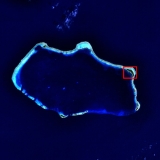
Bikini Atoll is an atoll
, listed as a World Heritage Site
, in the Micronesia
n Islands of the Pacific Ocean
, part of Republic of the Marshall Islands
.
It consists of 23 islands surrounding a deep 229.4 square miles (594.1 km²) central lagoon
at the northern end of the Ralik Chain
(approximately 87 kilometres (54.1 mi) northwest of Ailinginae Atoll
and 850 kilometres (528.2 mi) northwest of Majuro
), now universally significant to the world as follows:
Within Bikini Atoll, Bikini Island is the northeastern most and largest islet
, measuring 4 kilometres (2.5 mi) long. About twelve kilometres to the northwest is the islet of Aomen. As part of the Pacific Proving Grounds
it was the site of more than 20 nuclear weapons
tests
between 1946 and 1958.
The first Westerner to see the atoll, in the mid-1820s, was the Russian captain and explorer Otto von Kotzebue
, who named the atoll Eschscholtz Atoll after the Russian scientist Johann Friedrich von Eschscholtz
. The atoll, however, has always been called Bikini by the native Marshall Islanders, from Marshallese
"Pik" meaning "surface" and "Ni" meaning "coconut".
The name was popularized in the United States not only by nuclear bomb tests, but because the bikini
swimsuit was named after the island in 1946. The two-piece swimsuit was introduced within days of the first nuclear test on the atoll, when the name of the island was in the news. Introduced just weeks after the one-piece "Atome" was widely advertised as the "smallest bathing suit in the world", it was said that the bikini "split the atom".
colony of the Marshall Islands
in 1885. Along with the rest of the Marshalls, Bikini was captured by the Imperial Japanese Navy
in 1914 during World War I
and mandated to the Empire of Japan
by the League of Nations
in 1920. The Japanese administered the island under the South Pacific Mandate
, but mostly left local affairs in hands of traditional local leaders until the start of World War II
.
Following the end of World War II, Bikini came under the control of the United States
as part of the Trust Territory of the Pacific Islands
until the independence of the Marshall Islands in 1986.
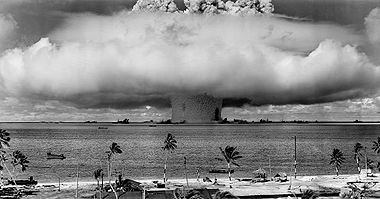 Between 1946 and 1958, twenty-three nuclear devices were detonated at Bikini Atoll, beginning with the Operation Crossroads
series in July 1946. Preceding the nuclear tests, the indigenous population was relocated to Rongerik Atoll
, though during the Castle Bravo
detonation in particular some members of the population were exposed to nuclear fallout (see Project 4.1
for a discussion of the health effects). For examination of the fallout
, several sounding rocket
s of the types Loki
and Asp
were launched at 11°35′N 165°20′E.
The March 1, 1954 detonation, codenamed Castle Bravo, was the first test of a practical hydrogen bomb. The largest nuclear explosion ever set off by the United States, it was much more powerful than predicted, and created widespread radioactive contamination
.
Among those contaminated were the 23 crew members of the Japanese fishing boat Daigo Fukuryū Maru
. The ensuing scandal in Japan was enormous, and ended up inspiring the 1954 film Godzilla
, in which the 1954 U.S. nuclear test awakens and mutates the monster, who then attacks Japan before finally being vanquished by Japanese ingenuity.
The Micronesia
n inhabitants, who numbered about 200 before the United States relocated them after World War II, ate fish, shellfish, bananas, and coconuts. A large majority of the Bikinians were moved to Kili Island
as part of their temporary homestead, but remain there today and receive compensation from the United States government for their survival.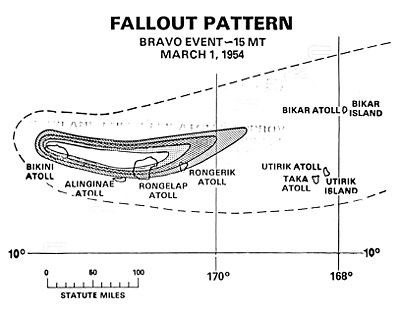 In 1968 the United States declared Bikini habitable and started bringing a small group of Bikinians back to their homes in the early 1970s as a test. In 1978, however, the islanders were removed again when strontium-90
in their bodies reached dangerous levels after a French team of scientists did additional tests on the island. It was not uncommon for women to experience faulty pregnancies, miscarriages, stillbirths, and damage to their offspring as a result of the nuclear testing on Bikini. The United States provided $150 million as a settlement for damages caused by the nuclear testing program.
Since the early 1980s the leaders of the Bikinian community have insisted that, because of what happened in the 1970s with the aborted return to their atoll, they want the entire island of Bikini excavated and the soil removed to a depth of about 15 inches (38.1 cm). Scientists involved with the Bikinians have stressed that while the excavation method would rid the island of the Cesium-137, the removal of the topsoil would severely damage the environment, turning it into a virtual wasteland of windswept sand. The Council, however, feeling a responsibility toward their people, has repeatedly contended that scraping Bikini is the only way to guarantee safe living conditions on the island for future generations.
Bikini Atoll was entered into the list of UNESCO
World Heritage site
s in August 2010.
after World War II by the United States Navy
. Today the Bikini Lagoon is still home to a large number of vessels from the United States and other countries. The dangers of the radioactivity and limited services in the area led to divers staying away from one of the most remarkable potential scuba diving
sites in the Pacific for many years. The dive spot has become popular among divers since 1996. However, oil prices severely curtailed diving operations to the point of being suspended from August 2008 through 2009, restricted to fully self-contained vessels by prior arrangement. The lagoon contains a larger amount of sea life than usual due to the lack of fishing, including shark
s, increasing the fascination with the spot as a diver's adventure spot. Food, including fish, is contaminated so tour boats must bring all their own supplies.
Shipwrecks in the lagoon include:
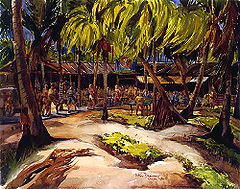
The Cross Spikes Club has been described as "the only bright spot" in the Operation Crossroads experience. The club, like all military facilities on the island, was abandoned or dismantled following the completion of Operation Crossroads.
(IAEA) Bikini Advisory Group determined in 1997 that "It is safe to walk on all of the islands ... although the residual radioactivity on islands in Bikini Atoll is still higher than on other atolls in the Marshall Islands, it is not hazardous to health at the levels measured ... The main radiation risk would be from the food: eating locally grown produce, such as fruit, could add significant radioactivity to the body...Eating coconut
s or breadfruit
from Bikini Island occasionally would be no cause for concern. Eating many over a long period of time without having taken remedial measures, however, might result in radiation doses higher than internationally agreed safety levels." IAEA estimated that living in the atoll and consuming local food will exceed 15 mSv
/year.
The dose received from background radiation on the island was found to be between 2.4 mSv/year and 4.5 mSv/year (the lower rate is the same as natural background radiation
), assuming that a diet of imported foods was available. It was because of these food risks that the group eventually did not recommend fully resettling the island.
A 2002 survey found partial recovery of the corals inside The Bravo Crater. Zoe Richards of the ARC Centre of Excellence for Coral Reef Studies and James Cook University
observed matrices of branching Porites
coral up to 8 meters high.
Atoll
An atoll is a coral island that encircles a lagoon partially or completely.- Usage :The word atoll comes from the Dhivehi word atholhu OED...
, listed as a World Heritage Site
World Heritage Site
A UNESCO World Heritage Site is a place that is listed by the UNESCO as of special cultural or physical significance...
, in the Micronesia
Micronesia
Micronesia is a subregion of Oceania, comprising thousands of small islands in the western Pacific Ocean. It is distinct from Melanesia to the south, and Polynesia to the east. The Philippines lie to the west, and Indonesia to the southwest....
n Islands of the Pacific Ocean
Pacific Ocean
The Pacific Ocean is the largest of the Earth's oceanic divisions. It extends from the Arctic in the north to the Southern Ocean in the south, bounded by Asia and Australia in the west, and the Americas in the east.At 165.2 million square kilometres in area, this largest division of the World...
, part of Republic of the Marshall Islands
Marshall Islands
The Republic of the Marshall Islands , , is a Micronesian nation of atolls and islands in the middle of the Pacific Ocean, just west of the International Date Line and just north of the Equator. As of July 2011 the population was 67,182...
.
It consists of 23 islands surrounding a deep 229.4 square miles (594.1 km²) central lagoon
Lagoon
A lagoon is a body of shallow sea water or brackish water separated from the sea by some form of barrier. The EU's habitat directive defines lagoons as "expanses of shallow coastal salt water, of varying salinity or water volume, wholly or partially separated from the sea by sand banks or shingle,...
at the northern end of the Ralik Chain
Ralik Chain
The Ralik Chain is a chain of islands within the island nation of the Marshall Islands. Ralik means "sunset". It lies just to the west of the country's other island chain, the Ratak Chain...
(approximately 87 kilometres (54.1 mi) northwest of Ailinginae Atoll
Ailinginae Atoll
Ailinginae Atoll is a coral atoll of 25 islands in the Pacific Ocean, on the northern end of the Ralik Chain of the Marshall Islands. Its total land area is only , but it encloses a lagoon of . It is located approximately west of Rongelap Atoll. The landscape is low-lying with only the top few...
and 850 kilometres (528.2 mi) northwest of Majuro
Majuro
Majuro , is a large coral atoll of 64 islands in the Pacific Ocean, and forms a legislative district of the Ratak Chain of the Marshall Islands. The atoll itself has a land area of and encloses a lagoon of...
), now universally significant to the world as follows:
Within Bikini Atoll, Bikini Island is the northeastern most and largest islet
Islet
An islet is a very small island.- Types :As suggested by its origin as islette, an Old French diminutive of "isle", use of the term implies small size, but little attention is given to drawing an upper limit on its applicability....
, measuring 4 kilometres (2.5 mi) long. About twelve kilometres to the northwest is the islet of Aomen. As part of the Pacific Proving Grounds
Pacific Proving Grounds
The Pacific Proving Grounds was the name used to describe a number of sites in the Marshall Islands and a few other sites in the Pacific Ocean, used by the United States to conduct nuclear testing at various times between 1946 and 1962...
it was the site of more than 20 nuclear weapons
Nuclear weapon design
Nuclear weapon designs are physical, chemical, and engineering arrangements that cause the physics package of a nuclear weapon to detonate. There are three basic design types...
tests
Nuclear testing
Nuclear weapons tests are experiments carried out to determine the effectiveness, yield and explosive capability of nuclear weapons. Throughout the twentieth century, most nations that have developed nuclear weapons have tested them...
between 1946 and 1958.
The first Westerner to see the atoll, in the mid-1820s, was the Russian captain and explorer Otto von Kotzebue
Otto von Kotzebue
Otto von Kotzebue was a Baltic German navigator in Russian service....
, who named the atoll Eschscholtz Atoll after the Russian scientist Johann Friedrich von Eschscholtz
Johann Friedrich von Eschscholtz
Johann Friedrich Eschscholtz was a Livonian physician, botanist, zoologist and entomologist.Eschscholtz was born in Dorpat , Governorate of Livonia in the Russian Empire...
. The atoll, however, has always been called Bikini by the native Marshall Islanders, from Marshallese
Marshallese language
The Marshallese language is a Malayo-Polynesian language of the Marshall Islands, and the principal language of the country...
"Pik" meaning "surface" and "Ni" meaning "coconut".
The name was popularized in the United States not only by nuclear bomb tests, but because the bikini
Bikini
The bikini is typically a women's two-piece swimsuit. One part of the attire covers the breasts and the other part covers the crotch and part of or the entire buttocks, leaving an uncovered area between the two. Merriam–Webster describes the bikini as "a woman's scanty two-piece bathing suit" or "a...
swimsuit was named after the island in 1946. The two-piece swimsuit was introduced within days of the first nuclear test on the atoll, when the name of the island was in the news. Introduced just weeks after the one-piece "Atome" was widely advertised as the "smallest bathing suit in the world", it was said that the bikini "split the atom".
History
Humans have inhabited the atoll for at least 2,000 years. Bikini was visited by only a dozen or so ships before the establishment of the GermanGermany
Germany , officially the Federal Republic of Germany , is a federal parliamentary republic in Europe. The country consists of 16 states while the capital and largest city is Berlin. Germany covers an area of 357,021 km2 and has a largely temperate seasonal climate...
colony of the Marshall Islands
Marshall Islands
The Republic of the Marshall Islands , , is a Micronesian nation of atolls and islands in the middle of the Pacific Ocean, just west of the International Date Line and just north of the Equator. As of July 2011 the population was 67,182...
in 1885. Along with the rest of the Marshalls, Bikini was captured by the Imperial Japanese Navy
Imperial Japanese Navy
The Imperial Japanese Navy was the navy of the Empire of Japan from 1869 until 1947, when it was dissolved following Japan's constitutional renunciation of the use of force as a means of settling international disputes...
in 1914 during World War I
World War I
World War I , which was predominantly called the World War or the Great War from its occurrence until 1939, and the First World War or World War I thereafter, was a major war centred in Europe that began on 28 July 1914 and lasted until 11 November 1918...
and mandated to the Empire of Japan
Empire of Japan
The Empire of Japan is the name of the state of Japan that existed from the Meiji Restoration on 3 January 1868 to the enactment of the post-World War II Constitution of...
by the League of Nations
League of Nations
The League of Nations was an intergovernmental organization founded as a result of the Paris Peace Conference that ended the First World War. It was the first permanent international organization whose principal mission was to maintain world peace...
in 1920. The Japanese administered the island under the South Pacific Mandate
South Pacific Mandate
The was the Japanese League of Nations mandate consisting of several groups of islands in the Pacific Ocean which came under the administration of Japan after the defeat of the German Empire in World War I.-Early history:Under the terms of the Anglo-Japanese Alliance, after the start of World...
, but mostly left local affairs in hands of traditional local leaders until the start of World War II
World War II
World War II, or the Second World War , was a global conflict lasting from 1939 to 1945, involving most of the world's nations—including all of the great powers—eventually forming two opposing military alliances: the Allies and the Axis...
.
Following the end of World War II, Bikini came under the control of the United States
United States
The United States of America is a federal constitutional republic comprising fifty states and a federal district...
as part of the Trust Territory of the Pacific Islands
Trust Territory of the Pacific Islands
The Trust Territory of the Pacific Islands was a United Nations trust territory in Micronesia administered by the United States from 1947 to 1986.-History:...
until the independence of the Marshall Islands in 1986.
Operation Crossroads
Operation Crossroads was a series of nuclear weapon tests conducted by the United States at Bikini Atoll in mid-1946. It was the first test of a nuclear weapon after the Trinity nuclear test in July 1945...
series in July 1946. Preceding the nuclear tests, the indigenous population was relocated to Rongerik Atoll
Rongerik Atoll
Rongerik Atoll or Rongdrik Atoll is a coral atoll of 17 islands in the Pacific Ocean, and is located in the Ralik Chain of the Marshall Islands, approximately east of Bikini Atoll. Its total land area is only , but it encloses a lagoon of .-History:Rongerik Atoll was claimed by the Empire of...
, though during the Castle Bravo
Castle Bravo
Castle Bravo was the code name given to the first U.S. test of a dry fuel thermonuclear hydrogen bomb device, detonated on March 1, 1954 at Bikini Atoll, Marshall Islands, as the first test of Operation Castle. Castle Bravo was the most powerful nuclear device ever detonated by the United States ,...
detonation in particular some members of the population were exposed to nuclear fallout (see Project 4.1
Project 4.1
Project 4.1 was the designation for a medical study conducted by the United States of those residents of the Marshall Islands exposed to radioactive fallout from the March 1, 1954 Castle Bravo nuclear test at Bikini Atoll, which had an unexpectedly large yield...
for a discussion of the health effects). For examination of the fallout
Fallout
Fallout or nuclear fallout is the residual radiation hazard from a nuclear explosion.Fallout may also refer to:*Fallout , a 1997 post-apocalyptic computer role-playing game released by Interplay Entertainment...
, several sounding rocket
Sounding rocket
A sounding rocket, sometimes called a research rocket, is an instrument-carrying rocket designed to take measurements and perform scientific experiments during its sub-orbital flight. The origin of the term comes from nautical vocabulary, where to sound is to throw a weighted line from a ship into...
s of the types Loki
Loki (rocket)
Loki, officially designated 76mm HEAA Rocket T220, was an American unguided anti-aircraft rocket based on the German Taifun. Like the Taifun, Loki never saw service in its original role, but later found widespread use as a sounding rocket...
and Asp
Asp (rocket)
Asp is the designation of an American sounding rocket. Between 1955 and 1962 these were used 30 times to study the explosion clouds of nuclear bombs....
were launched at 11°35′N 165°20′E.
The March 1, 1954 detonation, codenamed Castle Bravo, was the first test of a practical hydrogen bomb. The largest nuclear explosion ever set off by the United States, it was much more powerful than predicted, and created widespread radioactive contamination
Radioactive contamination
Radioactive contamination, also called radiological contamination, is radioactive substances on surfaces, or within solids, liquids or gases , where their presence is unintended or undesirable, or the process giving rise to their presence in such places...
.
Among those contaminated were the 23 crew members of the Japanese fishing boat Daigo Fukuryū Maru
Daigo Fukuryu Maru
was a Japanese tuna fishing boat, which was exposed to and contaminated by nuclear fallout from the United States' Castle Bravo thermonuclear device test on Bikini Atoll, on 1 March 1954....
. The ensuing scandal in Japan was enormous, and ended up inspiring the 1954 film Godzilla
Godzilla (1954 film)
is a 1954 Japanese science fiction film directed by Ishirō Honda and produced by Tomoyuki Tanaka. The film stars Akira Takarada, Momoko Kōchi, Akihiko Hirata and Takashi Shimura. The film tells the story of Godzilla, a giant monster mutated by nuclear radiation, who ravages Japan, bringing back the...
, in which the 1954 U.S. nuclear test awakens and mutates the monster, who then attacks Japan before finally being vanquished by Japanese ingenuity.
The Micronesia
Micronesia
Micronesia is a subregion of Oceania, comprising thousands of small islands in the western Pacific Ocean. It is distinct from Melanesia to the south, and Polynesia to the east. The Philippines lie to the west, and Indonesia to the southwest....
n inhabitants, who numbered about 200 before the United States relocated them after World War II, ate fish, shellfish, bananas, and coconuts. A large majority of the Bikinians were moved to Kili Island
Kili Island
Kili Island or Kili Atoll is a coral atoll located in the Pacific Ocean, and forms a legislative district of the Ralik Chain of the Marshall Islands. It is approximately southwest of Jaluit...
as part of their temporary homestead, but remain there today and receive compensation from the United States government for their survival.
Strontium-90
Strontium-90 is a radioactive isotope of strontium, with a half-life of 28.8 years.-Radioactivity:Natural strontium is nonradioactive and nontoxic, but 90Sr is a radioactivity hazard...
in their bodies reached dangerous levels after a French team of scientists did additional tests on the island. It was not uncommon for women to experience faulty pregnancies, miscarriages, stillbirths, and damage to their offspring as a result of the nuclear testing on Bikini. The United States provided $150 million as a settlement for damages caused by the nuclear testing program.
Since the early 1980s the leaders of the Bikinian community have insisted that, because of what happened in the 1970s with the aborted return to their atoll, they want the entire island of Bikini excavated and the soil removed to a depth of about 15 inches (38.1 cm). Scientists involved with the Bikinians have stressed that while the excavation method would rid the island of the Cesium-137, the removal of the topsoil would severely damage the environment, turning it into a virtual wasteland of windswept sand. The Council, however, feeling a responsibility toward their people, has repeatedly contended that scraping Bikini is the only way to guarantee safe living conditions on the island for future generations.
Bikini Atoll was entered into the list of UNESCO
UNESCO
The United Nations Educational, Scientific and Cultural Organization is a specialized agency of the United Nations...
World Heritage site
World Heritage Site
A UNESCO World Heritage Site is a place that is listed by the UNESCO as of special cultural or physical significance...
s in August 2010.
Bikini Lagoon
Prior to the explosion of the first atomic bomb on the island, the lagoon at Bikini was designated as a ship graveyardShip graveyard
A ship graveyard or ship cemetery is a location where the hulls of scrapped ships are left to decay and disintegrate, or left in reserve...
after World War II by the United States Navy
United States Navy
The United States Navy is the naval warfare service branch of the United States Armed Forces and one of the seven uniformed services of the United States. The U.S. Navy is the largest in the world; its battle fleet tonnage is greater than that of the next 13 largest navies combined. The U.S...
. Today the Bikini Lagoon is still home to a large number of vessels from the United States and other countries. The dangers of the radioactivity and limited services in the area led to divers staying away from one of the most remarkable potential scuba diving
Scuba diving
Scuba diving is a form of underwater diving in which a diver uses a scuba set to breathe underwater....
sites in the Pacific for many years. The dive spot has become popular among divers since 1996. However, oil prices severely curtailed diving operations to the point of being suspended from August 2008 through 2009, restricted to fully self-contained vessels by prior arrangement. The lagoon contains a larger amount of sea life than usual due to the lack of fishing, including shark
Shark
Sharks are a type of fish with a full cartilaginous skeleton and a highly streamlined body. The earliest known sharks date from more than 420 million years ago....
s, increasing the fascination with the spot as a diver's adventure spot. Food, including fish, is contaminated so tour boats must bring all their own supplies.
Shipwrecks in the lagoon include:
Cross Spikes Club
The Cross Spikes Club was an improvised bar and hangout created by servicemen on Bikini Island between June and September 1946 during the preparation for Operation Crossroads. The "club" was little more than a small open air building that served alcohol to servicemen and provided outdoor entertainment, including a ping pong table.The Cross Spikes Club has been described as "the only bright spot" in the Operation Crossroads experience. The club, like all military facilities on the island, was abandoned or dismantled following the completion of Operation Crossroads.
The island today
The special International Atomic Energy AgencyInternational Atomic Energy Agency
The International Atomic Energy Agency is an international organization that seeks to promote the peaceful use of nuclear energy, and to inhibit its use for any military purpose, including nuclear weapons. The IAEA was established as an autonomous organization on 29 July 1957...
(IAEA) Bikini Advisory Group determined in 1997 that "It is safe to walk on all of the islands ... although the residual radioactivity on islands in Bikini Atoll is still higher than on other atolls in the Marshall Islands, it is not hazardous to health at the levels measured ... The main radiation risk would be from the food: eating locally grown produce, such as fruit, could add significant radioactivity to the body...Eating coconut
Coconut
The coconut palm, Cocos nucifera, is a member of the family Arecaceae . It is the only accepted species in the genus Cocos. The term coconut can refer to the entire coconut palm, the seed, or the fruit, which is not a botanical nut. The spelling cocoanut is an old-fashioned form of the word...
s or breadfruit
Breadfruit
Breadfruit is a species of flowering tree in the mulberry family, Moraceae, growing throughout Southeast Asia and most Pacific Ocean islands...
from Bikini Island occasionally would be no cause for concern. Eating many over a long period of time without having taken remedial measures, however, might result in radiation doses higher than internationally agreed safety levels." IAEA estimated that living in the atoll and consuming local food will exceed 15 mSv
Sievert
The sievert is the International System of Units SI derived unit of dose equivalent radiation. It attempts to quantitatively evaluate the biological effects of ionizing radiation as opposed to just the absorbed dose of radiation energy, which is measured in gray...
/year.
The dose received from background radiation on the island was found to be between 2.4 mSv/year and 4.5 mSv/year (the lower rate is the same as natural background radiation
Background radiation
Background radiation is the ionizing radiation constantly present in the natural environment of the Earth, which is emitted by natural and artificial sources.-Overview:Both Natural and human-made background radiation varies by location....
), assuming that a diet of imported foods was available. It was because of these food risks that the group eventually did not recommend fully resettling the island.
A 2002 survey found partial recovery of the corals inside The Bravo Crater. Zoe Richards of the ARC Centre of Excellence for Coral Reef Studies and James Cook University
James Cook University
James Cook University is a public university based in Townsville, Queensland, Australia. The university has two Australian campuses, located in Townsville and Cairns respectively, and an international campus in Singapore. JCU is the second oldest university in Queensland—proclaimed in 1970—and the...
observed matrices of branching Porites
Porites
Porites is a genus of scleractinian coral which is characterised by a finger-like morphology. Members of this genus have widely spaced calices, a well-developed wall reticulum and are bilaterally symmetrical...
coral up to 8 meters high.
See also
- BikiniBikiniThe bikini is typically a women's two-piece swimsuit. One part of the attire covers the breasts and the other part covers the crotch and part of or the entire buttocks, leaving an uncovered area between the two. Merriam–Webster describes the bikini as "a woman's scanty two-piece bathing suit" or "a...
– a type of swimsuit named after the island - History of the bikiniHistory of the bikiniThe history of the bikini is a checkered one. Though the bikini shocked when it appeared on French beaches in 1947, its origins date back millennia. Depictions of bikini-like garments appear at the Chalcolithic site of Çatalhöyük, and two-piece bikini-like garments were worn by women for athletic...
- Daigo Fukuryū MaruDaigo Fukuryu Maruwas a Japanese tuna fishing boat, which was exposed to and contaminated by nuclear fallout from the United States' Castle Bravo thermonuclear device test on Bikini Atoll, on 1 March 1954....
- Flag of Bikini AtollFlag of Bikini AtollThe flag of Bikini Atoll, a member of the Marshall Islands, is a flag closely resembling the flag of the United States and was adopted in 1987. The flag is symbolic of the islanders' belief that a great debt is still owed by the United States to the people of Bikini because in 1954 the United...
- Operation CastleOperation CastleOperation Castle was a United States series of high-energy nuclear tests by Joint Task Force SEVEN at Bikini Atoll beginning in March 1954...
- Operation IvyOperation IvyOperation Ivy was the eighth series of American nuclear tests, coming after Tumbler-Snapper and before Upshot-Knothole. Its purpose was to help upgrade the U.S. arsenal of nuclear weapons in response to the Soviet nuclear weapons program...
External links
- A Short History of the People of Bikini Atoll
- What About Radiation on Bikini Atoll?
- Department of Energy Marshall Islands Program: Chronology of nuclear testing, relocation of islanders and results of radiation tests
- Annotated bibliography for Bikini Atoll from the Alsos Digital Library for Nuclear Issues
- Islanders Want The Truth About Bikini Nuclear Test
- Marshall Islands site
- Entry at Oceandots.com