

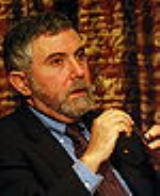
Paul Krugman

Encyclopedia
Paul Robin Krugman is an American economist
, professor of Economics and International Affairs at the Woodrow Wilson School of Public and International Affairs
at Princeton University
, Centenary Professor at the London School of Economics, and an op-ed
columnist
for The New York Times
. In 2008, Krugman won the Nobel Memorial Prize in Economic Sciences
for his contributions to New Trade Theory
and New Economic Geography
. According to the Nobel Prize Committee, the prize was given for Krugman's work explaining the patterns of international trade
and the geographic concentration of wealth, by examining the impact of economies of scale and of consumer preferences for diverse goods and services.
Krugman is known in academia for his work on international economics
(including trade theory, economic geography, and international finance), liquidity trap
s and currency crises. According to the IDEAS/RePEc
rankings, he is the 14th most widely cited economist in the world today.
, Krugman has written 20 books and has published over 200 scholarly articles in professional journals and edited volumes. He has also written more than 750 columns dealing with current economic and political issues for The New York Times. Krugman's International Economics: Theory and Policy, co-authored with Maurice Obstfeld
, is a standard college textbook on international economics.
He also writes on various topics ranging from income distribution
to international economics. Krugman considers himself a liberal, calling one of his books and his New York Times blog "The Conscience of a Liberal
". His commentary has attracted considerable criticism.
. He was born in Albany, NY, and grew up in Nassau County, New York
. He graduated from John F. Kennedy High School in Bellmore
. He is married to Robin Wells
, his second wife, a yoga instructor and academic economist who has collaborated on textbooks with Krugman. Krugman reports that he is a distant relative of conservative journalist David Frum
. He has described himself as a "Loner. Ordinarily shy. Shy with individuals." He currently lives with his wife in Princeton, New Jersey
.
According to Krugman, his interest in economics began with Isaac Asimov
's Foundation
novels, in which the social scientists of the future use "psychohistory
" to attempt to save civilization. Since "psychohistory" in Asimov's sense of the word does not exist, Krugman turned to economics, which he considered the next best thing.
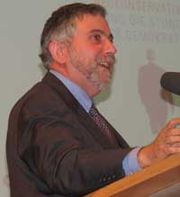 Krugman earned his B.A.
in economics from Yale University
summa cum laude in 1974 and his PhD
from the Massachusetts Institute of Technology
(MIT) in 1977. While at MIT he was part of a small group of MIT students sent to work for the Central Bank of Portugal for three months in summer 1976, in the chaotic aftermath of the Carnation Revolution
. From 1982 to 1983, he spent a year working at the Reagan
White House
as a staff member of the Council of Economic Advisers
. He taught at Yale University
, MIT, UC Berkeley, the London School of Economics
, and Stanford University
before joining Princeton University
in 2000 as professor of economics and international affairs. He is also currently a centenary professor at the London School of Economics, and a member of the Group of Thirty
international economic body. He has been a research associate at the National Bureau of Economic Research
since 1979. Most recently, Krugman was President of the Eastern Economic Association.
Paul Krugman has written extensively on international economics, including international trade
, economic geography
, and international finance
. The Research Papers in Economics
project ranked him as the 14th most influential economist in the world as of March 2011 based on his academic contributions. Krugman's International Economics: Theory and Policy, co-authored with Maurice Obstfeld
, is a standard college textbook
on international economics. Krugman also writes on economic topics for the general public, sometimes on international economic topics but also on income distribution
and public policy
.
The Nobel Prize Committee stated that Krugman's main contribution is his analysis of the impact of economies of scale, combined with the assumption that consumers appreciate diversity
, on international trade
and on the location of economic activity. The importance of spatial issues in economics has been enhanced by Krugman's ability to popularize this complicated theory with the help of easy-to-read books and state-of-the-art syntheses. "Krugman was beyond doubt the key player in 'placing geographical analysis squarely in the economic mainstream' ... and in conferring it the central role it now assumes."
In 1978, Krugman wrote The Theory of Interstellar Trade, a tongue-in-cheek essay on computing interest rates on goods in transit near the speed of light. He says he wrote it to cheer himself up when he was "an oppressed assistant professor".
and Hecksher-Ohlin model) emphasized trade based on the comparative advantage
of countries with very different characteristics, such as a country with a high agricultural productivity
trading agricultural products for industrial products from a country with a high industrial productivity. However, in the 20th century, an ever larger share of trade occurred between countries with very similar characteristics, which is difficult to explain by comparative advantage. Krugman's explanation of trade between similar countries was proposed in a 1979 paper in the Journal of International Economics
, and involves two key assumptions: that consumers prefer a diverse choice of brands, and that production favors economies of scale
. Consumers' preference for diversity explains the survival of different versions of cars like Volvo and BMW. But because of economies of scale, it is not profitable to spread the production of Volvo
s all over the world; instead, it is concentrated in a few factories and therefore in a few countries (or maybe just one). This logic explains how each country may specialize in producing a few brands of any given type of product, instead of specializing in different types of products.
Many models of international trade now follow Krugman's lead, incorporating economies of scale in production and a preference for diversity in consumption. This way of modeling trade has come to be called New Trade Theory
.
Krugman's theory also took into account transportation costs, a key feature in producing the "home market effect", which would later feature in his work on the new economic geography. The home market effect "states that, ceteris paribus
, the country with the larger demand for a good shall, at equilibrium, produce a more than proportionate share of that good and be a net exporter of it." The home market effect was an unexpected result, and Krugman initially questioned it, but ultimately concluded that the mathematics of the model were correct.
When there are economies of scale in production, it is possible that countries may become 'locked in
' to disadvantageous patterns of trade. Nonetheless, trade remains beneficial in general, even between similar countries, because it permits firms to save on costs by producing at a larger, more efficient scale, and because it increases the range of brands available and sharpens the competition between firms. Krugman has usually been supportive of free trade
and globalization
. He has also been critical of industrial policy
, which New Trade Theory suggests might offer nations rent-seeking advantages if "strategic industries" can be identified, saying it's not clear that such identification can be done accurately enough to matter.
. In Krugman's own words, the passage from NTT to NEG was "obvious in retrospect; but it certainly took me a while to see it. ... The only good news was that nobody else picked up that $100 bill lying on the sidewalk in the interim." This would become Krugman's most-cited academic paper: by early 2009, it had 857 citations, more than double his second-ranked paper. Krugman called the paper "the love of my life in academic work."
The "home market effect" that Krugman discovered in NTT also features in NEG, which interprets agglomeration
"as the outcome of the interaction of increasing returns, trade costs and factor price differences." If trade is largely shaped by economies of scale, as Krugman's trade theory argues, then those economic regions with most production will be more profitable and will therefore attract even more production. That is, NTT implies that instead of spreading out evenly around the world, production will tend to concentrate in a few countries, regions, or cities, which will become densely populated but will also have higher levels of income.
. As a graduate student, Krugman visited the Federal Reserve Board, where Stephen Salant and Dale Henderson were completing their discussion paper on speculative attacks in the gold market. Krugman adapted their model for the foreign exchange market, resulting in a 1979 paper on currency crises
in the Journal of Money, Credit, and Banking, which showed that fixed exchange rate
regimes are unlikely to end smoothly: instead, they end in a sudden speculative attack
. Krugman's paper is considered one of the main contributions to the 'first generation' of currency crisis
models, and it is his second-most-cited paper (457 citations as of early 2009).
In response to the global financial crisis of 2008, Krugman proposed, in an informal "mimeo" style of publication, an "international finance multiplier", to help explain the unexpected speed with which the global crisis had occurred. He argued that when, "highly leveraged financial institutions [HLIs], which do a lot of cross-border investment [....] lose heavily in one market [...] they find themselves undercapitalized, and have to sell off assets across the board. This drives down prices, putting pressure on the balance sheets of other HLIs, and so on." Such a rapid contagion had hitherto been considered unlikely because of "decoupling" in a globalized economy. He first announced that he was working on such a model on his blog, on October 5, 2008. Within days of its appearance, it was being discussed on some popular economics-oriented blogs.
The note was soon being cited in papers (draft and published) by other economists,
even though it had not itself been through ordinary peer review processes.
as a topic in economics. He recommended aggressive fiscal policy to counter Japan
's lost decade
in the 1990s, arguing that the country was mired in a Keynesian liquidity trap
. The debate he started at that time over liquidity traps and what policies best address them continues in the economics literature.
Krugman had argued in The Return of Depression Economics that Japan
was in a liquidity trap in the late 1990s, since the central bank
could not drop interest rates any lower to escape economic stagnation. The core of Krugman's policy proposal for addressing Japan's liquidity trap was inflation targeting
, which, he argued "most nearly approaches the usual goal of modern stabilization policy, which is to provide adequate demand in a clean, unobtrusive way that does not distort the allocation of resources." The proposal appeared first in a web posting on his academic site. This mimeo-draft was soon cited, but was also misread by some as repeating his earlier advice that Japan's best hope was in "turning on the printing presses", as recommended by Milton Friedman
, John Makin, and others.
Krugman has since drawn parallels between Japan's 'lost decade
' and the late 2000s recession
, arguing that expansionary fiscal policy is necessary as the major industrialized economies are mired in a liquidity trap. In response to economists who point out that the Japanese economy recovered despite not pursuing his policy prescriptions, Krugman maintains that it was an export-led boom that pulled Japan out of its economic slump in the late-90s, rather than reforms of the financial system.
, the sole recipient for 2008. This prize includes an award of about $1.4 million and was given to Krugman for his work associated with New Trade Theory
and the New Economic Geography. In the words of the prize committee, "By having integrated economies of scale into explicit general equilibrium
models, Paul Krugman has deepened our understanding of the determinants of trade and the location of economic activity."
in the "New Economy
" of the 1990s. He attributes the rise in income inequality in part to changes in technology, but principally to a change in political atmosphere which he attributes to Movement Conservatives.
In September 2003, Krugman published a collection of his columns under the title, The Great Unraveling
, about the Bush administration
's economic and foreign policies and the US economy in the early 2000s. His columns argued that the large deficits during that time were generated by the Bush administration as a result of decreasing taxes on the rich, increasing public spending, and fighting the Iraq war. Krugman wrote that these policies were unsustainable in the long run and would eventually generate a major economic crisis. The book was a best-seller.
In 2007, Krugman published The Conscience of a Liberal
, whose title references Barry Goldwater
's Conscience of a Conservative. It details the history of wealth and income gaps in the United States in the 20th century. The book describes how the gap between rich and poor declined greatly in middle of the century, and then widened in the last two decades to levels higher even than in the 1920s. Most economists (including Krugman) had regarded the late-20th century divergence as resulting largely from changes in technology and trade. In Conscience, Krugman argues that government policies played a much greater role than commonly thought both in reducing inequality in the 1930s through 1970s and in increasing it in the 1980s through the present, and criticizes the Bush administration for implementing policies that Krugman believes widened the gap between the rich and poor.
Krugman also argued that Republicans owed their electoral successes to their ability to exploit the race issue to win political dominance of the South. Krugman argues that Ronald Reagan
had used the "Southern Strategy
" to signal sympathy for racism without saying anything overtly racist, citing as an example Reagan's coining of the term "welfare queen
".
In his book, Krugman proposed a "new New Deal
", which included placing more emphasis on social and medical programs and less on national defense. Liberal journalist and author Michael Tomasky
argued that in The Conscience of a Liberal Krugman is committed "to accurate history even when some fudging might be in order for the sake of political expediency." In a review for The New York Times, Pulitzer prize
-winning historian David M. Kennedy
stated, "Like the rants of Rush Limbaugh
or the films of Michael Moore
, Krugman's shrill polemic may hearten the faithful, but it will do little to persuade the unconvinced".
In late 2008, Krugman published a substantial updating of an earlier work, entitled "The Return of Depression Economics and the Crisis of 2008". In the book, he discusses the failure of the United States regulatory system to keep pace with a financial system increasingly out-of-control, and the causes of and possible ways to contain the greatest financial crisis since the 1930s.
has noted that Krugman "has written on a wide range of topics, always combining one of the best prose styles in the profession with an ability to construct elegant, insightful and useful models." Neary added that "no discussion of his work could fail to mention his transition from Academic Superstar to Public Intellectual. Through his extensive writings, including a regular column for The New York Times
, monographs and textbooks at every level, and books on economics and current affairs for the general public ... he has probably done more than any other writer to explain economic principles to a wide audience." Krugman has been described as the most controversial economist in his generation and according to Michael Tomasky
since 1992 he has moved "from being a center-left scholar to being a liberal polemicist."
From the mid-1990s onwards, Krugman wrote for Fortune
(1997–99) and Slate
(1996–99), and then for The Harvard Business Review, Foreign Policy, The Economist
, Harper's
, and Washington Monthly. In this period Krugman critiqued various positions commonly taken on economic issues from across the political spectrum, from protectionism
and opposition to the World Trade Organization
on the left to supply side economics on the right.
During the 1992 presidential campaign
Krugman praised Bill Clinton
's economic plan in The New York Times, and Clinton's campaign used some of Krugman's work on income inequality. At the time, it was considered likely that Clinton would offer him a position in the new administration, but allegedly Krugman's volatility and outspokenness caused Clinton to look elsewhere. Krugman later said that he was "temperamentally unsuited for that kind of role. You have to be very good at people skills, biting your tongue when people say silly things." In a Fresh Dialogues interview, Krugman added, "you have to be reasonably organized...I can move into a pristine office and within three days it will look like a grenade went off."
In 1999, near the height of the dot com boom, The New York Times approached Krugman to write a bi-weekly column on "the vagaries of business and economics in an age of prosperity." His first columns in 2000 addressed business and economic issues, but as the 2000 US presidential campaign
progressed, Krugman increasingly focused on George W. Bush
's policy proposals. According to Krugman, this was partly due to "the silence of the media - those 'liberal media' conservatives complain about...." Krugman accused Bush of repeatedly misrepresenting his proposals, and criticized the proposals themselves. After Bush's election, and his perseverance with his proposed tax cut in the midst of the slump (which Krugman argued would do little to help the economy but substantially raise the fiscal deficit), Krugman's columns grew angrier and more focused on the administration. As Alan Blinder
put it in 2002, "There's been a kind of missionary
quality to his writing since then ... He's trying to stop something now, using the power of the pen." Partly as a result, Krugman's twice-weekly column on the Op-Ed page of The New York Times has made him, according to Nicholas Confessore
, "the most important political columnist in America... he is almost alone in analyzing the most important story in politics in recent years – the seamless melding of corporate, class, and political party interests at which the Bush administration excels." In an interview in late 2009, Krugman said his missionary zeal had changed in the post-Bush era and he described the Obama administration as "good guys but not as forceful as I'd like...When I argue with them in my column this is a serious discussion. We really are in effect speaking across the transom here." Krugman says he's more effective at driving change outside the administration than inside it, "now, I'm trying to make this progressive moment in American history a success. So that's where I'm pushing."
Krugman's columns have drawn criticism as well as praise. A 2003 article in The Economist
questioned Krugman's "growing tendency to attribute all the world's ills to George Bush
," citing critics who felt that "his relentless partisanship is getting in the way of his argument" and claiming errors of economic and political reasoning in his columns. Daniel Okrent
, a former The New York Times ombudsman
, in his farewell column, criticized Krugman for what he said was "the disturbing habit of shaping, slicing and selectively citing numbers in a fashion that pleases his acolytes but leaves him open to substantive assaults."
Krugman's New York Times blog is "The Conscience of a Liberal," devoted largely to economics and politics.
Five days after 9/11 terrorist attacks Krugman argued in his column that calamity was "partly self-inflicted" due to transfer of responsibility for airport security from government to airlines. His column provoked an angry response and The New York Times was flooded with complaints. According to Larissa MacFarquhar of The New Yorker
, while some people thought that he was too partisan to be a columnist for The New York Times, he was revered on the left. Similarly, on the 10th anniversary of the 9/11 on the United States Krugman again provoked a controversy by accusing on his New York Times blog former U.S. President George W. Bush and former New York City major Rudy Giuliani
of rushing "to cash in on the horror" after the attacks and describing the anniversary as "an occasion for shame".
article, Paul Krugman argued that it was a myth that the economic successes of the East Asian 'tigers' constituted an economic miracle. He argued that their rise was fueled by mobilizing resources and that their growth rates would inevitably slow. His article helped popularize the argument made by Lawrence Lau and Alwyn Young
, among others, that the growth of economies in East Asia
was not the result of new and original economic models, but rather from high capital investment and increasing labor force participation
, and that total factor productivity had not increased. Krugman argued that in the long term, only increasing total factor productivity
can lead to sustained economic growth
. Krugman's article was highly criticized in many Asian countries when it first appeared, and subsequent studies disputed some of Krugman's conclusions. However, it also stimulated a great deal of research, and may have caused the Singapore
government to provide incentives for technological progress.
During the 1997 Asian financial crisis, Krugman advocated currency controls as a way to mitigate the crisis. Writing in a Fortune magazine
article, he suggested exchange controls as "a solution so unfashionable, so stigmatized, that hardly anyone has dared suggest it." Malaysia was the only country that adopted such controls, and although the Malaysian government credited its rapid economic recovery on currency controls, the relationship is disputed. Krugman later stated that the controls might not have been necessary at the time they were applied, but that nevertheless "Malaysia has proved a point—namely, that controlling capital in a crisis is at least feasible." Krugman more recently pointed out that emergency capital controls have even been endorsed by the IMF, and are no longer considered radical policy.
, both before and after they were enacted. Krugman argued that the tax cuts enlarged the budget deficit without improving the economy, and that they enriched the wealthy – worsening income distribution
in the US. Krugman advocated lower interest rates (to promote spending on housing and other durable goods), and increased government spending on infrastructure, military, and unemployment benefits, arguing that these policies would have a larger stimulus effect, and unlike permanent tax cuts, would only temporarily increase the budget deficit.
In August 2005, after Alan Greenspan
expressed concern over housing markets, Krugman criticized Greenspan's earlier reluctance to regulate the mortgage and related financial markets, arguing that "[he's] like a man who suggests leaving the barn door ajar, and then – after the horse is gone – delivers a lecture on the importance of keeping your animals properly locked up."
Krugman has repeatedly expressed his view that Greenspan and Phil Gramm
are the two individuals most responsible for causing the subprime crisis. Krugman points to Greenspan and Gramm for the key roles they played in keeping derivatives
, financial markets, and investment banks unregulated, and to the Gramm-Leach-Bliley Act
, which repealed Great Depression
era safeguards that prevented commercial bank
s, investment banks and insurance
companies from merging.
Krugman has also been critical of some of the Obama administration's economic policies. He has criticized the Obama stimulus plan as being too small and inadequate given the size of the economy and the banking rescue plan as misdirected; Krugman wrote in The New York Times: "an overwhelming majority [of the American public] believes that the government is spending too much to help large financial institutions. This suggests that the administration's money-for-nothing financial policy will eventually deplete its political capital." In particular, he considered the Obama administration's actions to prop up the US financial system in 2009 to be impractical and unduly favorable to Wall Street bankers. In anticipation of President Obama's Job Summit in December 2009, Krugman said in a Fresh Dialogues interview, "This jobs summit can't be an empty exercise…he can't come out with a proposal for $10 or $20 Billion of stuff because people will view that as a joke. There has to be a significant job proposal…I have in mind something like $300 Billion."
Krugman has recently criticized China's exchange rate policy, which he believes to be a significant drag on global economic recovery from the Late-2000s recession, and he has advocated a "surcharge" on Chinese imports to the US in response. Jeremy Warner of The Daily Telegraph
accused Krugman of advocating a return to self-destructive protectionism
.
In April 2010, as the Senate began considering new financial regulations, Krugman argued that the regulations should not only regulate financial innovation, but also tax financial-industry profits and remuneration. He cited a paper by Andrei Shleifer
and Robert Vishny released the previous week, which concludes that most innovation was in fact about "providing investors with false substitutes for [traditional] assets like bank deposits," and once investors realize the sheer number of securities that are unsafe a "flight to safety" occurs which necessarily leads to "financial fragility."
In his June 28, 2010 column in The New York Times, in light of the recent G-20 Toronto Summit
, Krugman criticized world leaders for agreeing to halve deficits by 2013. Krugman claimed that these efforts could lead the global economy into the early stages of a "third depression" and leave "millions of lives blighted by the absence of jobs." He advocated instead the continued stimulus of economies to foster greater growth.
and a saltwater economist, and he has criticized the freshwater school on macroeconomics
. Though he applies New Keynesian theory in some of his work, he has also criticized it for lacking predictive power and for hewing to ideas like the Efficient Markets Hypothesis and Rational Expectations
. Since the 1990s, he has promoted the IS-LM model as invented by John Hicks
, pointing out its relative simplicity compared to New Keynesianism and continued currency in practical economic policy.
In the wake of the 2007-2009 financial crisis he has remarked that he is "gravitating towards a Keynes-Fisher
-Minsky
view of macroeconomics
." Post-Keynesian observers cite commonalities between Krugman's views and those of the Post-Keynesian school.
In recent academic work, he has collaborated with Gauti Eggertsson on a New Keynesian model of debt-overhang and debt-driven slumps. This theory argues that the "paradox of toil
", together with the paradox of flexibility, can exacerbate a liquidity trap
, reducing demand and employment.
He once famously quipped that, "If there were an Economist's Creed, it would surely contain the affirmations 'I understand the Principle of Comparative Advantage
' and 'I advocate Free Trade
'."
Although Krugman argues in the same article that, given the findings of New Trade Theory,
Krugman nevertheless declares in favor of free trade given the enormous political costs of actively engaging in strategic trade policy
(i.e. rent-seeking) and because there is no clear method for a government to discover which industries will ultimately yield positive returns. Furthermore, Krugman expressed in that article that the phenomena of increasing returns (of which strategic trade policy depends) by no means disproves the underlying truth behind comparative advantage.
means in Europe." In a 2009 Newsweek
article, Evan Thomas
described Krugman as having "all the credentials of a ranking member of the East coast liberal
establishment" but also as someone who is anti-establishment, a "scourge of the Bush administration," and a critic of the Obama administration. In 1996, Newsweek
Michael Hirsh
remarked "Say this for Krugman: though an unabashed liberal ... he's ideologically colorblind. He savages the supply-siders of the Reagan-Bush era with the same glee as he does the 'strategic traders' of the Clinton administration."
Krugman has advocated free markets in contexts where they are often viewed as controversial. He has written against rent control
in favor of supply and demand,
likened the opposition against free trade and globalization to the opposition against evolution via natural selection
,
opposed farm subsidies
,
argued that sweatshop
s are preferable to unemployment, dismissed the case for living wage
s, argued against mandates, subsidies, and tax breaks for ethanol
, questioned NASA's manned space flights, and has written against U.S. zoning laws and European labor market regulation.
Krugman also once wrote in defense of Glenn Loury
, a conservative black economist, that Loury, in defiance of many African-American political leaders, had clearly seen and articulated that "the problems facing African-Americans had changed. The biggest barrier to progress was no longer active racism of whites but internal social problems of the black community."
when the latter was appointed chairman of the Council of Economic Advisers
and chief economic advisor to President Ronald Reagan
. He later wrote in an autobiographical essay, "It was, in a way, strange for me to be part of the Reagan Administration. I was then and still am an unabashed defender of the welfare state
, which I regard as the most decent social arrangement yet devised." Krugman found the time "thrilling, then disillusioning". He did not fit into the Washington political environment, and was not tempted to stay on.
among those he considers at fault for the Late-2000s financial crisis
, he has also praised the former British
Prime Minister
, whom he described as "more impressive than any US politician" after a three-hour conversation with him. Krugman asserted that Brown "defined the character of the worldwide financial rescue effort" and urged British voters not to support the opposition Conservative Party
in the 2010 General Election, arguing their Party Leader David Cameron
"has had little to offer other than to raise the red flag of fiscal panic."
noted that Krugman's critics argue that "his relentless partisanship is getting in the way of his argument". The Economist also wrote that the vast majority of Krugman's columns feature attacks on Republicans
and almost none criticize Democrats
, making him "a sort of ivory-tower folk-hero of the American left
—a thinking person's Michael Moore
"
Libertarian conservative and federal appeals court judge
Richard Posner
called Krugman "an unabashed Democratic partisan who often goes overboard in his hatred of the Republicans."
Liberal journalist and author Michael Tomasky
in The New York Review of Books
stated "Many liberals would name Paul Krugman of The New York Times as perhaps the most consistent and courageous—and unapologetic—liberal partisan in American journalism." New York Magazine called Krugman "the leading exponent of a kind of liberal purism", while liberal historian Michael Kazin
has opined that Krugman’s account of the right
succumbed to the Marxist flaw of false consciousness.
Larry Summers
has stated Krugman has a tendency to favor more extreme policy recommendations because "it’s much more interesting than agreement when you’re involved in commenting on rather than making policy."
According to Harvard professor of economics Robert Barro
, Krugman "has never done any work in Keynesian macroeconomics" and makes arguments that are politically convenient for him. Nobel laureate Edward Prescott has charged that Krugman "doesn't command respect in the profession", as "no respectable macroeconomist" believes that economic stimulus works.
) that offered Enron
executives briefings on economic and political issues. He resigned from the panel in the fall of 1999 to comply with The New York Times
rules regarding conflicts of interest, when he accepted the Times offer to become an op-ed columnist. Krugman later stated that he was paid $37,500 (not $50,000 as often reported - his early resignation cost him part of his fee), and that, for consulting that required him to spend four days in Houston
, the fee was "rather low compared with my usual rates", which were around $20,000 for a one-hour speech. He also stated that the advisory panel "had no function that I was aware of", and that he later interpreted his role as being "just another brick in the wall" Enron used to build an image.
When the story of Enron's corporate scandals
broke two years later, Krugman was accused of unethical journalism, specifically of having a conflict of interest. Some of his critics claimed that "The Ascent of E-man," an article Krugman wrote for Fortune
magazine about the rise of the market as illustrated by Enron's energy trading, was biased by Krugman's earlier consulting work for them. Krugman later argued that "The Ascent of E-Man" was in character, writing "I have always been a free-market Keynesian: I like free markets, but I want some government supervision to correct market failures and ensure stability." Krugman noted his previous relationship with Enron in that article and in other articles he wrote on the company. Krugman was one of the first to argue that deregulation of the California energy market had led to market manipulation by energy companies.
Economist
An economist is a professional in the social science discipline of economics. The individual may also study, develop, and apply theories and concepts from economics and write about economic policy...
, professor of Economics and International Affairs at the Woodrow Wilson School of Public and International Affairs
Woodrow Wilson School of Public and International Affairs
The Woodrow Wilson School of Public and International Affairs is a professional public policy school at Princeton University. The school has granted undergraduate A.B. degrees since 1930 and graduate degrees since 1948...
at Princeton University
Princeton University
Princeton University is a private research university located in Princeton, New Jersey, United States. The school is one of the eight universities of the Ivy League, and is one of the nine Colonial Colleges founded before the American Revolution....
, Centenary Professor at the London School of Economics, and an op-ed
Op-ed
An op-ed, abbreviated from opposite the editorial page , is a newspaper article that expresses the opinions of a named writer who is usually unaffiliated with the newspaper's editorial board...
columnist
Columnist
A columnist is a journalist who writes for publication in a series, creating an article that usually offers commentary and opinions. Columns appear in newspapers, magazines and other publications, including blogs....
for The New York Times
The New York Times
The New York Times is an American daily newspaper founded and continuously published in New York City since 1851. The New York Times has won 106 Pulitzer Prizes, the most of any news organization...
. In 2008, Krugman won the Nobel Memorial Prize in Economic Sciences
Nobel Memorial Prize in Economic Sciences
The Nobel Memorial Prize in Economic Sciences, commonly referred to as the Nobel Prize in Economics, but officially the Sveriges Riksbank Prize in Economic Sciences in Memory of Alfred Nobel , is an award for outstanding contributions to the field of economics, generally regarded as one of the...
for his contributions to New Trade Theory
New Trade Theory
New Trade Theory is a collection of economic models in international trade which focuses on the role of increasing returns to scale and network effects, which were developed in the late 1970s and early 1980s....
and New Economic Geography
Economic geography
Economic geography is the study of the location, distribution and spatial organization of economic activities across the world. The subject matter investigated is strongly influenced by the researcher's methodological approach. Neoclassical location theorists, following in the tradition of Alfred...
. According to the Nobel Prize Committee, the prize was given for Krugman's work explaining the patterns of international trade
International trade
International trade is the exchange of capital, goods, and services across international borders or territories. In most countries, such trade represents a significant share of gross domestic product...
and the geographic concentration of wealth, by examining the impact of economies of scale and of consumer preferences for diverse goods and services.
Krugman is known in academia for his work on international economics
International economics
International economics is concerned with the effects upon economic activity of international differences in productive resources and consumer preferences and the institutions that affect them...
(including trade theory, economic geography, and international finance), liquidity trap
Liquidity trap
A liquidity trap is a situation described in Keynesian economics in which injections of cash into an economy by a central bank fail to lower interest rates and hence to stimulate economic growth. A liquidity trap is caused when people hoard cash because they expect an adverse event such as...
s and currency crises. According to the IDEAS/RePEc
Research Papers in Economics
Research Papers in Economics is a collaborative effort of hundreds of volunteers in 57 countries to enhance the dissemination of research in economics. The heart of the project is a decentralized database of working papers, preprints, journal articles and software components. The project started...
rankings, he is the 14th most widely cited economist in the world today.
, Krugman has written 20 books and has published over 200 scholarly articles in professional journals and edited volumes. He has also written more than 750 columns dealing with current economic and political issues for The New York Times. Krugman's International Economics: Theory and Policy, co-authored with Maurice Obstfeld
Maurice Obstfeld
Maurice Moses "Maury" Obstfeld is a professor of economics at the University of California, Berkeley.He is well known for his work in international economics. He is among the most influential economists in the world according to IDEAS/RePEc....
, is a standard college textbook on international economics.
He also writes on various topics ranging from income distribution
Income distribution
In economics, income distribution is how a nation’s total economy is distributed amongst its population.Income distribution has always been a central concern of economic theory and economic policy...
to international economics. Krugman considers himself a liberal, calling one of his books and his New York Times blog "The Conscience of a Liberal
The Conscience of a Liberal
The Conscience of a Liberal is a book written by economist Paul Krugman. It was 24th on the New York Times Best Seller list in November 2007. The title was used originally in Senator Paul Wellstone's book of the same name in 2001...
". His commentary has attracted considerable criticism.
Personal life
Krugman is the son of David and Anita Krugman and the grandson of Jewish immigrants from Brest-LitovskBrest, Belarus
Brest , formerly also Brest-on-the-Bug and Brest-Litovsk , is a city in Belarus at the border with Poland opposite the city of Terespol, where the Bug River and Mukhavets rivers meet...
. He was born in Albany, NY, and grew up in Nassau County, New York
Nassau County, New York
Nassau County is a suburban county on Long Island, east of New York City in the U.S. state of New York, within the New York Metropolitan Area. As of the 2010 census, the population was 1,339,532...
. He graduated from John F. Kennedy High School in Bellmore
The Bellmores, New York
Bellmore is a hamlet in Nassau County, New York, United States. The population according to the 2010 census was 16,218...
. He is married to Robin Wells
Robin Wells Krugman
Robin Wells is a former research Professor of Economics at Princeton University, and the wife of economist Paul Krugman. Having obtained a Ph.D. in economics from the University of California, Berkeley, she obtained a post-doctoral fellowship at MIT, after which she held teaching positions at the...
, his second wife, a yoga instructor and academic economist who has collaborated on textbooks with Krugman. Krugman reports that he is a distant relative of conservative journalist David Frum
David Frum
David J. Frum is a Canadian American journalist active in both the United States and Canadian political arenas. A former economic speechwriter for President George W. Bush, he is also the author of the first "insider" book about the Bush presidency...
. He has described himself as a "Loner. Ordinarily shy. Shy with individuals." He currently lives with his wife in Princeton, New Jersey
Princeton, New Jersey
Princeton is a community located in Mercer County, New Jersey, United States. It is best known as the location of Princeton University, which has been sited in the community since 1756...
.
According to Krugman, his interest in economics began with Isaac Asimov
Isaac Asimov
Isaac Asimov was an American author and professor of biochemistry at Boston University, best known for his works of science fiction and for his popular science books. Asimov was one of the most prolific writers of all time, having written or edited more than 500 books and an estimated 90,000...
's Foundation
The Foundation Series
The Foundation Series is a science fiction series by Isaac Asimov. There are seven volumes in the Foundation Series proper, which in its in-universe chronological order are: Prelude to Foundation, Forward the Foundation, Foundation, Foundation and Empire, Second Foundation, Foundation's Edge, and...
novels, in which the social scientists of the future use "psychohistory
Psychohistory (fictional)
Psychohistory is a fictional science in Isaac Asimov's Foundation universe which combines history, sociology, and mathematical statistics to make general predictions about the future behavior of very large groups of people, such as the Galactic Empire...
" to attempt to save civilization. Since "psychohistory" in Asimov's sense of the word does not exist, Krugman turned to economics, which he considered the next best thing.
Academic career
Bachelor of Arts
A Bachelor of Arts , from the Latin artium baccalaureus, is a bachelor's degree awarded for an undergraduate course or program in either the liberal arts, the sciences, or both...
in economics from Yale University
Yale University
Yale University is a private, Ivy League university located in New Haven, Connecticut, United States. Founded in 1701 in the Colony of Connecticut, the university is the third-oldest institution of higher education in the United States...
summa cum laude in 1974 and his PhD
Doctor of Philosophy
Doctor of Philosophy, abbreviated as Ph.D., PhD, D.Phil., or DPhil , in English-speaking countries, is a postgraduate academic degree awarded by universities...
from the Massachusetts Institute of Technology
Massachusetts Institute of Technology
The Massachusetts Institute of Technology is a private research university located in Cambridge, Massachusetts. MIT has five schools and one college, containing a total of 32 academic departments, with a strong emphasis on scientific and technological education and research.Founded in 1861 in...
(MIT) in 1977. While at MIT he was part of a small group of MIT students sent to work for the Central Bank of Portugal for three months in summer 1976, in the chaotic aftermath of the Carnation Revolution
Carnation Revolution
The Carnation Revolution , also referred to as the 25 de Abril , was a military coup started on 25 April 1974, in Lisbon, Portugal, coupled with an unanticipated and extensive campaign of civil resistance...
. From 1982 to 1983, he spent a year working at the Reagan
Ronald Reagan
Ronald Wilson Reagan was the 40th President of the United States , the 33rd Governor of California and, prior to that, a radio, film and television actor....
White House
White House
The White House is the official residence and principal workplace of the president of the United States. Located at 1600 Pennsylvania Avenue NW in Washington, D.C., the house was designed by Irish-born James Hoban, and built between 1792 and 1800 of white-painted Aquia sandstone in the Neoclassical...
as a staff member of the Council of Economic Advisers
Council of Economic Advisers
The Council of Economic Advisers is an agency within the Executive Office of the President that advises the President of the United States on economic policy...
. He taught at Yale University
Yale University
Yale University is a private, Ivy League university located in New Haven, Connecticut, United States. Founded in 1701 in the Colony of Connecticut, the university is the third-oldest institution of higher education in the United States...
, MIT, UC Berkeley, the London School of Economics
London School of Economics
The London School of Economics and Political Science is a public research university specialised in the social sciences located in London, United Kingdom, and a constituent college of the federal University of London...
, and Stanford University
Stanford University
The Leland Stanford Junior University, commonly referred to as Stanford University or Stanford, is a private research university on an campus located near Palo Alto, California. It is situated in the northwestern Santa Clara Valley on the San Francisco Peninsula, approximately northwest of San...
before joining Princeton University
Princeton University
Princeton University is a private research university located in Princeton, New Jersey, United States. The school is one of the eight universities of the Ivy League, and is one of the nine Colonial Colleges founded before the American Revolution....
in 2000 as professor of economics and international affairs. He is also currently a centenary professor at the London School of Economics, and a member of the Group of Thirty
Group of Thirty
The Group of Thirty, often abbreviated to G30, is an international body of leading financiers and academics which aims to deepen understanding of economic and financial issues and to examine consequences of decisions made in the public and private sectors related to these issues...
international economic body. He has been a research associate at the National Bureau of Economic Research
National Bureau of Economic Research
The National Bureau of Economic Research is an American private nonprofit research organization "committed to undertaking and disseminating unbiased economic research among public policymakers, business professionals, and the academic community." The NBER is well known for providing start and end...
since 1979. Most recently, Krugman was President of the Eastern Economic Association.
Paul Krugman has written extensively on international economics, including international trade
International trade
International trade is the exchange of capital, goods, and services across international borders or territories. In most countries, such trade represents a significant share of gross domestic product...
, economic geography
Economic geography
Economic geography is the study of the location, distribution and spatial organization of economic activities across the world. The subject matter investigated is strongly influenced by the researcher's methodological approach. Neoclassical location theorists, following in the tradition of Alfred...
, and international finance
International finance
International finance is the branch of economics that studies the dynamics of exchange rates, foreign investment, global financial system, and how these affect international trade. It also studies international projects, international investments and capital flows, and trade deficits. It includes...
. The Research Papers in Economics
Research Papers in Economics
Research Papers in Economics is a collaborative effort of hundreds of volunteers in 57 countries to enhance the dissemination of research in economics. The heart of the project is a decentralized database of working papers, preprints, journal articles and software components. The project started...
project ranked him as the 14th most influential economist in the world as of March 2011 based on his academic contributions. Krugman's International Economics: Theory and Policy, co-authored with Maurice Obstfeld
Maurice Obstfeld
Maurice Moses "Maury" Obstfeld is a professor of economics at the University of California, Berkeley.He is well known for his work in international economics. He is among the most influential economists in the world according to IDEAS/RePEc....
, is a standard college textbook
Textbook
A textbook or coursebook is a manual of instruction in any branch of study. Textbooks are produced according to the demands of educational institutions...
on international economics. Krugman also writes on economic topics for the general public, sometimes on international economic topics but also on income distribution
Income distribution
In economics, income distribution is how a nation’s total economy is distributed amongst its population.Income distribution has always been a central concern of economic theory and economic policy...
and public policy
Public policy
Public policy as government action is generally the principled guide to action taken by the administrative or executive branches of the state with regard to a class of issues in a manner consistent with law and institutional customs. In general, the foundation is the pertinent national and...
.
The Nobel Prize Committee stated that Krugman's main contribution is his analysis of the impact of economies of scale, combined with the assumption that consumers appreciate diversity
Diversity (business)
The "business case for diversity" stems from the progression of the models of diversity within the workplace since the 1960's. The original model for diversity was situated around affirmative action drawing strength from the law and a need to comply with equal employment opportunity objectives...
, on international trade
International trade
International trade is the exchange of capital, goods, and services across international borders or territories. In most countries, such trade represents a significant share of gross domestic product...
and on the location of economic activity. The importance of spatial issues in economics has been enhanced by Krugman's ability to popularize this complicated theory with the help of easy-to-read books and state-of-the-art syntheses. "Krugman was beyond doubt the key player in 'placing geographical analysis squarely in the economic mainstream' ... and in conferring it the central role it now assumes."
In 1978, Krugman wrote The Theory of Interstellar Trade, a tongue-in-cheek essay on computing interest rates on goods in transit near the speed of light. He says he wrote it to cheer himself up when he was "an oppressed assistant professor".
New trade theory
Prior to Krugman's work, trade theory (see David RicardoDavid Ricardo
David Ricardo was an English political economist, often credited with systematising economics, and was one of the most influential of the classical economists, along with Thomas Malthus, Adam Smith, and John Stuart Mill. He was also a member of Parliament, businessman, financier and speculator,...
and Hecksher-Ohlin model) emphasized trade based on the comparative advantage
Comparative advantage
In economics, the law of comparative advantage says that two countries will both gain from trade if, in the absence of trade, they have different relative costs for producing the same goods...
of countries with very different characteristics, such as a country with a high agricultural productivity
Productivity
Productivity is a measure of the efficiency of production. Productivity is a ratio of what is produced to what is required to produce it. Usually this ratio is in the form of an average, expressing the total output divided by the total input...
trading agricultural products for industrial products from a country with a high industrial productivity. However, in the 20th century, an ever larger share of trade occurred between countries with very similar characteristics, which is difficult to explain by comparative advantage. Krugman's explanation of trade between similar countries was proposed in a 1979 paper in the Journal of International Economics
Journal of International Economics
The Journal of International Economics is a peer-reviewed academic journal in the field of economics. The journal publishes articles on both theoretical and empirical aspects of international economics...
, and involves two key assumptions: that consumers prefer a diverse choice of brands, and that production favors economies of scale
Economies of scale
Economies of scale, in microeconomics, refers to the cost advantages that an enterprise obtains due to expansion. There are factors that cause a producer’s average cost per unit to fall as the scale of output is increased. "Economies of scale" is a long run concept and refers to reductions in unit...
. Consumers' preference for diversity explains the survival of different versions of cars like Volvo and BMW. But because of economies of scale, it is not profitable to spread the production of Volvo
Volvo
AB Volvo is a Swedish builder of commercial vehicles, including trucks, buses and construction equipment. Volvo also supplies marine and industrial drive systems, aerospace components and financial services...
s all over the world; instead, it is concentrated in a few factories and therefore in a few countries (or maybe just one). This logic explains how each country may specialize in producing a few brands of any given type of product, instead of specializing in different types of products.
Many models of international trade now follow Krugman's lead, incorporating economies of scale in production and a preference for diversity in consumption. This way of modeling trade has come to be called New Trade Theory
New Trade Theory
New Trade Theory is a collection of economic models in international trade which focuses on the role of increasing returns to scale and network effects, which were developed in the late 1970s and early 1980s....
.
Krugman's theory also took into account transportation costs, a key feature in producing the "home market effect", which would later feature in his work on the new economic geography. The home market effect "states that, ceteris paribus
Ceteris paribus
or is a Latin phrase, literally translated as "with other things the same," or "all other things being equal or held constant." It is an example of an ablative absolute and is commonly rendered in English as "all other things being equal." A prediction, or a statement about causal or logical...
, the country with the larger demand for a good shall, at equilibrium, produce a more than proportionate share of that good and be a net exporter of it." The home market effect was an unexpected result, and Krugman initially questioned it, but ultimately concluded that the mathematics of the model were correct.
When there are economies of scale in production, it is possible that countries may become 'locked in
Vendor lock-in
In economics, vendor lock-in, also known as proprietary lock-in or customer lock-in, makes a customer dependent on a vendor for products and services, unable to use another vendor without substantial switching costs...
' to disadvantageous patterns of trade. Nonetheless, trade remains beneficial in general, even between similar countries, because it permits firms to save on costs by producing at a larger, more efficient scale, and because it increases the range of brands available and sharpens the competition between firms. Krugman has usually been supportive of free trade
Free trade
Under a free trade policy, prices emerge from supply and demand, and are the sole determinant of resource allocation. 'Free' trade differs from other forms of trade policy where the allocation of goods and services among trading countries are determined by price strategies that may differ from...
and globalization
Globalization
Globalization refers to the increasingly global relationships of culture, people and economic activity. Most often, it refers to economics: the global distribution of the production of goods and services, through reduction of barriers to international trade such as tariffs, export fees, and import...
. He has also been critical of industrial policy
Industrial policy
The Industrial Policy plan of a nation, sometimes shortened IP, "denotes a nation's declared, official, total strategic effort to influence sectoral development and, thus, national industry portfolio." These interventionist measures comprise "policies that stimulate specific activities and promote...
, which New Trade Theory suggests might offer nations rent-seeking advantages if "strategic industries" can be identified, saying it's not clear that such identification can be done accurately enough to matter.
New economic geography
It took an interval of eleven years, but ultimately Krugman's work on New Trade Theory (NTT) converged to what is usually called the "new economic geography" (NEG), which Krugman began to develop in a seminal 1991 paper in the Journal of Political EconomyJournal of Political Economy
The Journal of Political Economy is an academic journal run by economists at the University of Chicago and published every two months by the University of Chicago Press. The journal publishes articles in both theoretical economics and empirical economics...
. In Krugman's own words, the passage from NTT to NEG was "obvious in retrospect; but it certainly took me a while to see it. ... The only good news was that nobody else picked up that $100 bill lying on the sidewalk in the interim." This would become Krugman's most-cited academic paper: by early 2009, it had 857 citations, more than double his second-ranked paper. Krugman called the paper "the love of my life in academic work."
The "home market effect" that Krugman discovered in NTT also features in NEG, which interprets agglomeration
Economies of agglomeration
The term economies of agglomeration is used in urban economics to describe the benefits that firms obtain when locating near each other . This concept relates to the idea of economies of scale and network effects...
"as the outcome of the interaction of increasing returns, trade costs and factor price differences." If trade is largely shaped by economies of scale, as Krugman's trade theory argues, then those economic regions with most production will be more profitable and will therefore attract even more production. That is, NTT implies that instead of spreading out evenly around the world, production will tend to concentrate in a few countries, regions, or cities, which will become densely populated but will also have higher levels of income.
International finance
Krugman has also been influential in the field of international financeInternational finance
International finance is the branch of economics that studies the dynamics of exchange rates, foreign investment, global financial system, and how these affect international trade. It also studies international projects, international investments and capital flows, and trade deficits. It includes...
. As a graduate student, Krugman visited the Federal Reserve Board, where Stephen Salant and Dale Henderson were completing their discussion paper on speculative attacks in the gold market. Krugman adapted their model for the foreign exchange market, resulting in a 1979 paper on currency crises
Currency crisis
A currency crisis, which is also called a balance-of-payments crisis, is a sudden devaluation of a currency caused by chronic balance-of-payments deficits which usually ends in a speculative attack in the foreign exchange market. It occurs when the value of a currency changes quickly, undermining...
in the Journal of Money, Credit, and Banking, which showed that fixed exchange rate
Fixed exchange rate
A fixed exchange rate, sometimes called a pegged exchange rate, is a type of exchange rate regime wherein a currency's value is matched to the value of another single currency or to a basket of other currencies, or to another measure of value, such as gold.A fixed exchange rate is usually used to...
regimes are unlikely to end smoothly: instead, they end in a sudden speculative attack
Speculative attack
A speculative attack is a term used by economists to denote a precipitous acquisition of something by previously inactive speculators. The first model of a speculative attack was contained in a 1975 discussion paper on the gold market by Stephen Salant and Dale Henderson at the Federal Reserve Board...
. Krugman's paper is considered one of the main contributions to the 'first generation' of currency crisis
Currency crisis
A currency crisis, which is also called a balance-of-payments crisis, is a sudden devaluation of a currency caused by chronic balance-of-payments deficits which usually ends in a speculative attack in the foreign exchange market. It occurs when the value of a currency changes quickly, undermining...
models, and it is his second-most-cited paper (457 citations as of early 2009).
In response to the global financial crisis of 2008, Krugman proposed, in an informal "mimeo" style of publication, an "international finance multiplier", to help explain the unexpected speed with which the global crisis had occurred. He argued that when, "highly leveraged financial institutions [HLIs], which do a lot of cross-border investment [....] lose heavily in one market [...] they find themselves undercapitalized, and have to sell off assets across the board. This drives down prices, putting pressure on the balance sheets of other HLIs, and so on." Such a rapid contagion had hitherto been considered unlikely because of "decoupling" in a globalized economy. He first announced that he was working on such a model on his blog, on October 5, 2008. Within days of its appearance, it was being discussed on some popular economics-oriented blogs.
The note was soon being cited in papers (draft and published) by other economists,
even though it had not itself been through ordinary peer review processes.
Macroeconomics and fiscal policy
Krugman has done much to revive discussion of the liquidity trapLiquidity trap
A liquidity trap is a situation described in Keynesian economics in which injections of cash into an economy by a central bank fail to lower interest rates and hence to stimulate economic growth. A liquidity trap is caused when people hoard cash because they expect an adverse event such as...
as a topic in economics. He recommended aggressive fiscal policy to counter Japan
Japan
Japan is an island nation in East Asia. Located in the Pacific Ocean, it lies to the east of the Sea of Japan, China, North Korea, South Korea and Russia, stretching from the Sea of Okhotsk in the north to the East China Sea and Taiwan in the south...
's lost decade
Lost Decade (Japan)
The is the time after the Japanese asset price bubble's collapse within the Japanese economy, which occurred gradually rather than catastrophically...
in the 1990s, arguing that the country was mired in a Keynesian liquidity trap
Liquidity trap
A liquidity trap is a situation described in Keynesian economics in which injections of cash into an economy by a central bank fail to lower interest rates and hence to stimulate economic growth. A liquidity trap is caused when people hoard cash because they expect an adverse event such as...
. The debate he started at that time over liquidity traps and what policies best address them continues in the economics literature.
Krugman had argued in The Return of Depression Economics that Japan
Japan
Japan is an island nation in East Asia. Located in the Pacific Ocean, it lies to the east of the Sea of Japan, China, North Korea, South Korea and Russia, stretching from the Sea of Okhotsk in the north to the East China Sea and Taiwan in the south...
was in a liquidity trap in the late 1990s, since the central bank
Central bank
A central bank, reserve bank, or monetary authority is a public institution that usually issues the currency, regulates the money supply, and controls the interest rates in a country. Central banks often also oversee the commercial banking system of their respective countries...
could not drop interest rates any lower to escape economic stagnation. The core of Krugman's policy proposal for addressing Japan's liquidity trap was inflation targeting
Inflation targeting
Inflation targeting is an economic policy in which a central bank estimates and makes public a projected, or "target", inflation rate and then attempts to steer actual inflation towards the target through the use of interest rate changes and other monetary tools.Because interest rates and the...
, which, he argued "most nearly approaches the usual goal of modern stabilization policy, which is to provide adequate demand in a clean, unobtrusive way that does not distort the allocation of resources." The proposal appeared first in a web posting on his academic site. This mimeo-draft was soon cited, but was also misread by some as repeating his earlier advice that Japan's best hope was in "turning on the printing presses", as recommended by Milton Friedman
Milton Friedman
Milton Friedman was an American economist, statistician, academic, and author who taught at the University of Chicago for more than three decades...
, John Makin, and others.
Krugman has since drawn parallels between Japan's 'lost decade
Lost Decade (Japan)
The is the time after the Japanese asset price bubble's collapse within the Japanese economy, which occurred gradually rather than catastrophically...
' and the late 2000s recession
Late 2000s recession
The late-2000s recession, sometimes referred to as the Great Recession or Lesser Depression or Long Recession, is a severe ongoing global economic problem that began in December 2007 and took a particularly sharp downward turn in September 2008. The Great Recession has affected the entire world...
, arguing that expansionary fiscal policy is necessary as the major industrialized economies are mired in a liquidity trap. In response to economists who point out that the Japanese economy recovered despite not pursuing his policy prescriptions, Krugman maintains that it was an export-led boom that pulled Japan out of its economic slump in the late-90s, rather than reforms of the financial system.
Nobel Memorial Prize
Krugman was awarded the Nobel Memorial Prize in Economic SciencesNobel Memorial Prize in Economic Sciences
The Nobel Memorial Prize in Economic Sciences, commonly referred to as the Nobel Prize in Economics, but officially the Sveriges Riksbank Prize in Economic Sciences in Memory of Alfred Nobel , is an award for outstanding contributions to the field of economics, generally regarded as one of the...
, the sole recipient for 2008. This prize includes an award of about $1.4 million and was given to Krugman for his work associated with New Trade Theory
New Trade Theory
New Trade Theory is a collection of economic models in international trade which focuses on the role of increasing returns to scale and network effects, which were developed in the late 1970s and early 1980s....
and the New Economic Geography. In the words of the prize committee, "By having integrated economies of scale into explicit general equilibrium
General equilibrium
General equilibrium theory is a branch of theoretical economics. It seeks to explain the behavior of supply, demand and prices in a whole economy with several or many interacting markets, by seeking to prove that a set of prices exists that will result in an overall equilibrium, hence general...
models, Paul Krugman has deepened our understanding of the determinants of trade and the location of economic activity."
Awards
- 1991, American Economic AssociationAmerican Economic AssociationThe American Economic Association, or AEA, is a learned society in the field of economics, headquartered in Nashville, Tennessee. It publishes one of the most prestigious academic journals in economics: the American Economic Review...
, John Bates Clark MedalJohn Bates Clark MedalThe John Bates Clark Medal is awarded by the American Economic Association to "that American economist under the age of forty who is adjudged to have made a significant contribution to economic thought and knowledge"...
. Since it was awarded to only one person, once every two years (prior to 2009), The Economist has described the Clark Medal as 'slightly harder to get than a Nobel prize'. - 1992, Fellow of the American Academy of Arts and SciencesAmerican Academy of Arts and SciencesThe American Academy of Arts and Sciences is an independent policy research center that conducts multidisciplinary studies of complex and emerging problems. The Academy’s elected members are leaders in the academic disciplines, the arts, business, and public affairs.James Bowdoin, John Adams, and...
(AAAS). - 1995, Adam Smith Award of the National Association for Business EconomicsNational Association for Business EconomicsThe National Association for Business Economics is the largest international association of applied economists, strategists, academics, and policy-makers committed to the application of economics. Founded in 1959, it is one of the member organizations of the Allied Social Sciences Association...
- 1998, Doctor honoris causa in Economics awarded by Free University of BerlinFree University of BerlinFreie Universität Berlin is one of the leading and most prestigious research universities in Germany and continental Europe. It distinguishes itself through its modern and international character. It is the largest of the four universities in Berlin. Research at the university is focused on the...
Freie Universität Berlin in Germany - 2000, H.C. Recktenwald Prize in Economics, awarded by University of Erlangen-Nuremberg in Germany.
- 2002, Editor and Publisher, Columnist of the Year.
- 2004, Fundación Príncipe de Asturias (Spain), Prince of Asturias AwardsPrince of Asturias AwardsThe Prince of Asturias Awards are a series of annual prizes awarded in Spain by the Prince of Asturias Foundation to individuals, entities or organizations from around the world who make notable achievements in the sciences, humanities, and public affairs....
in Social Sciences. - 2004, Doctor of Humane Letters honoris causa, Haverford CollegeHaverford CollegeHaverford College is a private, coeducational liberal arts college located in Haverford, Pennsylvania, United States, a suburb of Philadelphia...
- 2008, Nobel Memorial Prize in Economics (formally The Sveriges Riksbank Prize in Economic Sciences in Memory of Alfred Nobel) for Krugman's contributions to New Trade TheoryNew Trade TheoryNew Trade Theory is a collection of economic models in international trade which focuses on the role of increasing returns to scale and network effects, which were developed in the late 1970s and early 1980s....
. He became the twelfth John Bates Clark MedalJohn Bates Clark MedalThe John Bates Clark Medal is awarded by the American Economic Association to "that American economist under the age of forty who is adjudged to have made a significant contribution to economic thought and knowledge"...
winner to be awarded the Nobel Memorial Prize.
Author
In the 1990s, besides academic books and textbooks, Krugman increasingly began writing books for a general audience on issues he considered important for public policy. In The Age of Diminished Expectations (1990), he wrote in particular about the increasing US income inequalityIncome inequality in the United States
Income inequality in the United States of America refers to the extent to which income is distributed in an uneven manner in the US. Data from the United States Department of Commerce, CBO, and Internal Revenue Service indicate that income inequality among households has been increasing...
in the "New Economy
New Economy
The New Economy is a term to describe the result of the transition from a manufacturing-based economy to a service-based economy. This particular use of the term was popular during the Dot-com bubble of the late 1990s...
" of the 1990s. He attributes the rise in income inequality in part to changes in technology, but principally to a change in political atmosphere which he attributes to Movement Conservatives.
In September 2003, Krugman published a collection of his columns under the title, The Great Unraveling
The Great Unraveling
The Great Unraveling: Losing Our Way in the New Century is a book by Paul Krugman, consisting of a collection of his columns for the New York Times . The collected columns were concerned mainly with the US economy in the early 2000s, and about the economic and foreign policies of the George W...
, about the Bush administration
George W. Bush administration
The presidency of George W. Bush began on January 20, 2001, when he was inaugurated as the 43rd President of the United States of America. The oldest son of former president George H. W. Bush, George W...
's economic and foreign policies and the US economy in the early 2000s. His columns argued that the large deficits during that time were generated by the Bush administration as a result of decreasing taxes on the rich, increasing public spending, and fighting the Iraq war. Krugman wrote that these policies were unsustainable in the long run and would eventually generate a major economic crisis. The book was a best-seller.
In 2007, Krugman published The Conscience of a Liberal
The Conscience of a Liberal
The Conscience of a Liberal is a book written by economist Paul Krugman. It was 24th on the New York Times Best Seller list in November 2007. The title was used originally in Senator Paul Wellstone's book of the same name in 2001...
, whose title references Barry Goldwater
Barry Goldwater
Barry Morris Goldwater was a five-term United States Senator from Arizona and the Republican Party's nominee for President in the 1964 election. An articulate and charismatic figure during the first half of the 1960s, he was known as "Mr...
's Conscience of a Conservative. It details the history of wealth and income gaps in the United States in the 20th century. The book describes how the gap between rich and poor declined greatly in middle of the century, and then widened in the last two decades to levels higher even than in the 1920s. Most economists (including Krugman) had regarded the late-20th century divergence as resulting largely from changes in technology and trade. In Conscience, Krugman argues that government policies played a much greater role than commonly thought both in reducing inequality in the 1930s through 1970s and in increasing it in the 1980s through the present, and criticizes the Bush administration for implementing policies that Krugman believes widened the gap between the rich and poor.
Krugman also argued that Republicans owed their electoral successes to their ability to exploit the race issue to win political dominance of the South. Krugman argues that Ronald Reagan
Ronald Reagan
Ronald Wilson Reagan was the 40th President of the United States , the 33rd Governor of California and, prior to that, a radio, film and television actor....
had used the "Southern Strategy
Southern strategy
In American politics, the Southern strategy refers to the Republican Party strategy of winning elections in Southern states by exploiting anti-African American racism and fears of lawlessness among Southern white voters and appealing to fears of growing federal power in social and economic matters...
" to signal sympathy for racism without saying anything overtly racist, citing as an example Reagan's coining of the term "welfare queen
Welfare queen
A welfare queen is a pejorative phrase used in the United States to describe people who are accused of collecting excessive welfare payments through fraud or manipulation. Reporting on welfare fraud began during the early 1960s, appearing in general interest magazines such as Readers Digest...
".
In his book, Krugman proposed a "new New Deal
New Deal
The New Deal was a series of economic programs implemented in the United States between 1933 and 1936. They were passed by the U.S. Congress during the first term of President Franklin D. Roosevelt. The programs were Roosevelt's responses to the Great Depression, and focused on what historians call...
", which included placing more emphasis on social and medical programs and less on national defense. Liberal journalist and author Michael Tomasky
Michael Tomasky
Michael Tomasky is a liberal American columnist, journalist and author. He is the editor in chief of Democracy, a special correspondent for Newsweek / The Daily Beast, a contributing editor for The American Prospect, and a contributor to The New York Review of Books.-Biography:Tomasky was born...
argued that in The Conscience of a Liberal Krugman is committed "to accurate history even when some fudging might be in order for the sake of political expediency." In a review for The New York Times, Pulitzer prize
Pulitzer Prize
The Pulitzer Prize is a U.S. award for achievements in newspaper and online journalism, literature and musical composition. It was established by American publisher Joseph Pulitzer and is administered by Columbia University in New York City...
-winning historian David M. Kennedy
David M. Kennedy (historian)
David M. Kennedy is an American Pulitzer Prize-winning historian specializing in American history. He is the Donald J. McLachlan Professor of History at Stanford University and the Director of the Bill Lane Center for the American West...
stated, "Like the rants of Rush Limbaugh
Rush Limbaugh
Rush Hudson Limbaugh III is an American radio talk show host, conservative political commentator, and an opinion leader in American conservatism. He hosts The Rush Limbaugh Show which is aired throughout the U.S. on Premiere Radio Networks and is the highest-rated talk-radio program in the United...
or the films of Michael Moore
Michael Moore
Michael Francis Moore is an American filmmaker, author, social critic and activist. He is the director and producer of Fahrenheit 9/11, which is the highest-grossing documentary of all time. His films Bowling for Columbine and Sicko also place in the top ten highest-grossing documentaries...
, Krugman's shrill polemic may hearten the faithful, but it will do little to persuade the unconvinced".
In late 2008, Krugman published a substantial updating of an earlier work, entitled "The Return of Depression Economics and the Crisis of 2008". In the book, he discusses the failure of the United States regulatory system to keep pace with a financial system increasingly out-of-control, and the causes of and possible ways to contain the greatest financial crisis since the 1930s.
Academic books (authored or coauthored)
- The Spatial Economy – Cities, Regions and International Trade (July 1999), with Masahisa FujitaMasahisa Fujitais a Japanese economist and professor at Kyoto university, who has studied regional science and Urban Economics and International Trade, Spatial Economy .Fujita majored in urban planning as an undergraduate at Kyoto University...
and Anthony VenablesAnthony VenablesAnthony J. Venables, CBE, born April 25, 1953, is a British economist and the BP Professor of Economics at the University of Oxford.Venables is known as one of the pioneers of New Economic Geography...
. MIT Press, ISBN 0-262-06204-6 - The Self Organizing Economy (February 1996), ISBN 1-55786-698-8
- EMU and the Regions (December 1995), with Guillermo de la Dehesa. ISBN 1-56708-038-3
- Development, Geography, and Economic Theory (Ohlin Lectures) (September 1995), ISBN 0-262-11203-5
- Foreign Direct Investment in the United States (3rd Edition) (February 1995), with Edward M. Graham. ISBN 0-88132-204-0
- World Savings Shortage (September 1994), ISBN 0-88132-161-3
- What Do We Need to Know About the International Monetary System? (Essays in International Finance, No 190 July 1993) ISBN 0-88165-097-8
- Currencies and Crises (June 1992), ISBN 0-262-11165-9
- Geography and Trade (Gaston Eyskens Lecture Series) (August 1991), ISBN 0-262-11159-4
- The Risks Facing the World Economy (July 1991), with Guillermo de la Dehesa and Charles Taylor. ISBN 1-56708-073-1
- Has the Adjustment Process Worked? (Policy Analyses in International Economics, 34) (June 1991), ISBN 0-88132-116-8
- Rethinking International Trade (April 1990), ISBN 0-262-11148-9
- Trade Policy and Market Structure (March 1989), with Elhanan Helpman. ISBN 0-262-08182-2
- Exchange-Rate Instability (Lionel Robbins Lectures) (November 1988), ISBN 0-262-11140-3
- Adjustment in the World Economy (August 1987) ISBN 1-56708-023-5
- Market Structure and Foreign Trade: Increasing Returns, Imperfect Competition, and the International Economy (May 1985), with Elhanan Helpman. ISBN 0-262-08150-4
Academic books (edited or coedited)
- Currency Crises (National Bureau of Economic Research Conference Report) (September 2000), ISBN 0-226-45462-2
- Trade with Japan : Has the Door Opened Wider? (National Bureau of Economic Research Project Report) (March 1995), ISBN 0-226-45459-2
- Empirical Studies of Strategic Trade Policy (National Bureau of Economic Research Project Report) (April 1994), co-edited with Alasdair Smith. ISBN 0-226-45460-6
- Exchange Rate Targets and Currency Bands (October 1991), co-edited with Marcus Miller. ISBN 0-521-41533-0
- Strategic Trade Policy and the New International Economics (January 1986), ISBN 0-262-11112-8
Economics textbooks
- Economics: European Edition (Spring 2007), with Robin Wells and Kathryn Graddy. ISBN 0-7167-9956-1
- Macroeconomics (February 2006), with Robin Wells. ISBN 0-7167-6763-5
- Economics, first edition (December 2005), with Robin Wells. ISBN 1-57259-150-1
- Economics, second edition (2009), with Robin Wells. ISBN 0-7167-7158-6
- Microeconomics (March 2004), with Robin Wells. ISBN 0-7167-5997-7
- International Economics: Theory and Policy, with Maurice Obstfeld. 7th Edition (2006), ISBN 0-321-29383-5; 1st Edition (1998), ISBN 0-673-52186-9
Books for a general audience
- The Return of Depression Economics and the Crisis of 2008 (December 2008) ISBN 0-393-07101-4
- An updated version of his previous work.
- The Conscience of a LiberalThe Conscience of a LiberalThe Conscience of a Liberal is a book written by economist Paul Krugman. It was 24th on the New York Times Best Seller list in November 2007. The title was used originally in Senator Paul Wellstone's book of the same name in 2001...
(October 2007) ISBN 0-393-06069-1 - The Great Unraveling: Losing Our Way in the New CenturyThe Great UnravelingThe Great Unraveling: Losing Our Way in the New Century is a book by Paul Krugman, consisting of a collection of his columns for the New York Times . The collected columns were concerned mainly with the US economy in the early 2000s, and about the economic and foreign policies of the George W...
(September 2003) ISBN 0-393-05850-6- A book of his The New York Times columns, many deal with the economic policies of the Bush administration or the economy in general.
- Fuzzy Math: The Essential Guide to the Bush Tax Plan (May 4, 2001) ISBN 0-393-05062-9
- The Return of Depression Economics (May 1999) ISBN 0-393-04839-X
- Considers the long economic stagnation of Japan through the 1990s, the Asian financial crisis, and problems in Latin America.
- The Return of Depression Economics and the Crisis of 2008 (December 2008) ISBN 0-393-07101-4
- The Accidental Theorist and Other Dispatches from the Dismal Science (May 1998) ISBN 0-393-04638-9
- Essay collection, primarily from Krugman's writing for Slate.
- Pop Internationalism (March 1996) ISBN 0-262-11210-8
- Essay collection, covering largely the same ground as Peddling Prosperity.
- Peddling Prosperity: Economic Sense and Nonsense in an Age of Diminished ExpectationsPeddling ProsperityPeddling prosperity: economic sense and nonsense in the age of diminished expectation is a book by Nobel laureate and New York Times columnist Paul Krugman, first published in 1994 by W. W. Norton & Company. Shortly after its publication Newsweek called it "the best primer around on recent U.S...
(April 1995) ISBN 0-393-31292-5- History of economic thought from the first rumblings of revolt against Keynesian economicsKeynesian economicsKeynesian economics is a school of macroeconomic thought based on the ideas of 20th-century English economist John Maynard Keynes.Keynesian economics argues that private sector decisions sometimes lead to inefficient macroeconomic outcomes and, therefore, advocates active policy responses by the...
to the present, for the layman.
- History of economic thought from the first rumblings of revolt against Keynesian economics
- The Age of Diminished Expectations: U.S. Economic Policy in the 1990s (1990) ISBN 0-262-11156-X
- A "briefing book" on the major policy issues around the economy.
- Revised and Updated, January 1994, ISBN 0-262-61092-2
- Third Edition, August 1997, ISBN 0-262-11224-8
Selected academic articles
- (1998) 'It's Baaack: Japan's Slump and the Return of the Liquidity Trap' Brookings Papers on Economic Activity 1998, pp. 137–205.
- (1996) 'Are currency crises self-fulfilling?' NBER Macroeconomics Annual 11, pp. 345–78.
- (1995)
- (1991) 'Increasing returns and economic geography'. Journal of Political Economy 99, pp. 483–99.
- (1991)
- (1991) 'History versus expectations'. Quarterly Journal of Economics 106 (2), pp. 651–67.
- (1981) 'Intra-industry specialization and the gains from trade'. Journal of Political Economy 89, pp. 959–73.
- (1980) 'Scale economies, product differentiation, and the pattern of trade'. American Economic Review 70, pp. 950–59.
- (1979) 'A model of balance-of-payments crises'. Journal of Money, Credit, and Banking 11, pp. 311–25.
- (1979) 'Increasing returns, monopolistic competition, and international trade'. Journal of International Economics 9, pp. 469–79.
Commentator
In the summer preceding his Nobel Prize, Krugman was voted one of the world's top public intellectuals by half a million participants in an online poll conducted by Foreign Policy. Since then, economist J. Peter NearyJ. Peter Neary
J. Peter Neary FBA is an economist specialising in international trade. He is Professor of Economics at Oxford University, and a Professorial Fellow of Merton College, Oxford as well as Associate Member of Nuffield College, Oxford. He was previously Professor of Political Economy at University...
has noted that Krugman "has written on a wide range of topics, always combining one of the best prose styles in the profession with an ability to construct elegant, insightful and useful models." Neary added that "no discussion of his work could fail to mention his transition from Academic Superstar to Public Intellectual. Through his extensive writings, including a regular column for The New York Times
The New York Times
The New York Times is an American daily newspaper founded and continuously published in New York City since 1851. The New York Times has won 106 Pulitzer Prizes, the most of any news organization...
, monographs and textbooks at every level, and books on economics and current affairs for the general public ... he has probably done more than any other writer to explain economic principles to a wide audience." Krugman has been described as the most controversial economist in his generation and according to Michael Tomasky
Michael Tomasky
Michael Tomasky is a liberal American columnist, journalist and author. He is the editor in chief of Democracy, a special correspondent for Newsweek / The Daily Beast, a contributing editor for The American Prospect, and a contributor to The New York Review of Books.-Biography:Tomasky was born...
since 1992 he has moved "from being a center-left scholar to being a liberal polemicist."
From the mid-1990s onwards, Krugman wrote for Fortune
Fortune (magazine)
Fortune is a global business magazine published by Time Inc. Founded by Henry Luce in 1930, the publishing business, consisting of Time, Life, Fortune, and Sports Illustrated, grew to become Time Warner. In turn, AOL grew as it acquired Time Warner in 2000 when Time Warner was the world's largest...
(1997–99) and Slate
Slate (magazine)
Slate is a US-based English language online current affairs and culture magazine created in 1996 by former New Republic editor Michael Kinsley, initially under the ownership of Microsoft as part of MSN. On 21 December 2004 it was purchased by the Washington Post Company...
(1996–99), and then for The Harvard Business Review, Foreign Policy, The Economist
The Economist
The Economist is an English-language weekly news and international affairs publication owned by The Economist Newspaper Ltd. and edited in offices in the City of Westminster, London, England. Continuous publication began under founder James Wilson in September 1843...
, Harper's
Harper's Magazine
Harper's Magazine is a monthly magazine of literature, politics, culture, finance, and the arts, with a generally left-wing perspective. It is the second-oldest continuously published monthly magazine in the U.S. . The current editor is Ellen Rosenbush, who replaced Roger Hodge in January 2010...
, and Washington Monthly. In this period Krugman critiqued various positions commonly taken on economic issues from across the political spectrum, from protectionism
Protectionism
Protectionism is the economic policy of restraining trade between states through methods such as tariffs on imported goods, restrictive quotas, and a variety of other government regulations designed to allow "fair competition" between imports and goods and services produced domestically.This...
and opposition to the World Trade Organization
World Trade Organization
The World Trade Organization is an organization that intends to supervise and liberalize international trade. The organization officially commenced on January 1, 1995 under the Marrakech Agreement, replacing the General Agreement on Tariffs and Trade , which commenced in 1948...
on the left to supply side economics on the right.
During the 1992 presidential campaign
United States presidential election, 1992
The United States presidential election of 1992 had three major candidates: Incumbent Republican President George Bush; Democratic Arkansas Governor Bill Clinton, and independent Texas businessman Ross Perot....
Krugman praised Bill Clinton
Bill Clinton
William Jefferson "Bill" Clinton is an American politician who served as the 42nd President of the United States from 1993 to 2001. Inaugurated at age 46, he was the third-youngest president. He took office at the end of the Cold War, and was the first president of the baby boomer generation...
's economic plan in The New York Times, and Clinton's campaign used some of Krugman's work on income inequality. At the time, it was considered likely that Clinton would offer him a position in the new administration, but allegedly Krugman's volatility and outspokenness caused Clinton to look elsewhere. Krugman later said that he was "temperamentally unsuited for that kind of role. You have to be very good at people skills, biting your tongue when people say silly things." In a Fresh Dialogues interview, Krugman added, "you have to be reasonably organized...I can move into a pristine office and within three days it will look like a grenade went off."
In 1999, near the height of the dot com boom, The New York Times approached Krugman to write a bi-weekly column on "the vagaries of business and economics in an age of prosperity." His first columns in 2000 addressed business and economic issues, but as the 2000 US presidential campaign
United States presidential election, 2000
The United States presidential election of 2000 was a contest between Republican candidate George W. Bush, then-governor of Texas and son of former president George H. W. Bush , and Democratic candidate Al Gore, then-Vice President....
progressed, Krugman increasingly focused on George W. Bush
George W. Bush
George Walker Bush is an American politician who served as the 43rd President of the United States, from 2001 to 2009. Before that, he was the 46th Governor of Texas, having served from 1995 to 2000....
's policy proposals. According to Krugman, this was partly due to "the silence of the media - those 'liberal media' conservatives complain about...." Krugman accused Bush of repeatedly misrepresenting his proposals, and criticized the proposals themselves. After Bush's election, and his perseverance with his proposed tax cut in the midst of the slump (which Krugman argued would do little to help the economy but substantially raise the fiscal deficit), Krugman's columns grew angrier and more focused on the administration. As Alan Blinder
Alan Blinder
Alan Stuart Blinder is an American economist. He serves at Princeton University as the Gordon S. Rentschler Memorial Professor of Economics and Public Affairs in the Economics Department, Vice Chairman of The Observatory Group, and as co-director of Princeton’s Center for Economic Policy Studies,...
put it in 2002, "There's been a kind of missionary
Missionary
A missionary is a member of a religious group sent into an area to do evangelism or ministries of service, such as education, literacy, social justice, health care and economic development. The word "mission" originates from 1598 when the Jesuits sent members abroad, derived from the Latin...
quality to his writing since then ... He's trying to stop something now, using the power of the pen." Partly as a result, Krugman's twice-weekly column on the Op-Ed page of The New York Times has made him, according to Nicholas Confessore
Nicholas Confessore
Nicholas Confessore is a reporter on the Metropolitan Desk of The New York Times covering Albany. He was previously an editor at The Washington Monthly and a staff writer for The American Prospect...
, "the most important political columnist in America... he is almost alone in analyzing the most important story in politics in recent years – the seamless melding of corporate, class, and political party interests at which the Bush administration excels." In an interview in late 2009, Krugman said his missionary zeal had changed in the post-Bush era and he described the Obama administration as "good guys but not as forceful as I'd like...When I argue with them in my column this is a serious discussion. We really are in effect speaking across the transom here." Krugman says he's more effective at driving change outside the administration than inside it, "now, I'm trying to make this progressive moment in American history a success. So that's where I'm pushing."
Krugman's columns have drawn criticism as well as praise. A 2003 article in The Economist
The Economist
The Economist is an English-language weekly news and international affairs publication owned by The Economist Newspaper Ltd. and edited in offices in the City of Westminster, London, England. Continuous publication began under founder James Wilson in September 1843...
questioned Krugman's "growing tendency to attribute all the world's ills to George Bush
George W. Bush
George Walker Bush is an American politician who served as the 43rd President of the United States, from 2001 to 2009. Before that, he was the 46th Governor of Texas, having served from 1995 to 2000....
," citing critics who felt that "his relentless partisanship is getting in the way of his argument" and claiming errors of economic and political reasoning in his columns. Daniel Okrent
Daniel Okrent
Daniel Okrent is an American writer and editor. He is best known for having served as the first public editor of The New York Times newspaper, for inventing Rotisserie League Baseball, and for writing several books, most recently Last Call: The Rise and Fall of Prohibition.-Education and...
, a former The New York Times ombudsman
Ombudsman
An ombudsman is a person who acts as a trusted intermediary between an organization and some internal or external constituency while representing not only but mostly the broad scope of constituent interests...
, in his farewell column, criticized Krugman for what he said was "the disturbing habit of shaping, slicing and selectively citing numbers in a fashion that pleases his acolytes but leaves him open to substantive assaults."
Krugman's New York Times blog is "The Conscience of a Liberal," devoted largely to economics and politics.
Five days after 9/11 terrorist attacks Krugman argued in his column that calamity was "partly self-inflicted" due to transfer of responsibility for airport security from government to airlines. His column provoked an angry response and The New York Times was flooded with complaints. According to Larissa MacFarquhar of The New Yorker
The New Yorker
The New Yorker is an American magazine of reportage, commentary, criticism, essays, fiction, satire, cartoons and poetry published by Condé Nast...
, while some people thought that he was too partisan to be a columnist for The New York Times, he was revered on the left. Similarly, on the 10th anniversary of the 9/11 on the United States Krugman again provoked a controversy by accusing on his New York Times blog former U.S. President George W. Bush and former New York City major Rudy Giuliani
Rudy Giuliani
Rudolph William Louis "Rudy" Giuliani KBE is an American lawyer, businessman, and politician from New York. He served as Mayor of New York City from 1994 to 2001....
of rushing "to cash in on the horror" after the attacks and describing the anniversary as "an occasion for shame".
East Asian growth
In a 1994 Foreign AffairsForeign Affairs
Foreign Affairs is an American magazine and website on international relations and U.S. foreign policy published since 1922 by the Council on Foreign Relations six times annually...
article, Paul Krugman argued that it was a myth that the economic successes of the East Asian 'tigers' constituted an economic miracle. He argued that their rise was fueled by mobilizing resources and that their growth rates would inevitably slow. His article helped popularize the argument made by Lawrence Lau and Alwyn Young
Alwyn Young
Alwyn Young is a professor of economics and the Leili & Johannes Huth Fellow at the London School of Economics and Political Science. He held a named chair at the University of Chicago and was on the faculty at Boston University and the MIT Sloan School of Management before joining the LSE faculty...
, among others, that the growth of economies in East Asia
East Asia
East Asia or Eastern Asia is a subregion of Asia that can be defined in either geographical or cultural terms...
was not the result of new and original economic models, but rather from high capital investment and increasing labor force participation
Labor force
In economics, a labor force or labour force is a region's combined civilian workforce, including both the employed and unemployed.Normally, the labor force of a country consists of everyone of working age In economics, a labor force or labour force is a region's combined civilian workforce,...
, and that total factor productivity had not increased. Krugman argued that in the long term, only increasing total factor productivity
Total factor productivity
In economics, total-factor productivity is a variable which accounts for effects in total output not caused by inputs. If all inputs are accounted for, then total factor productivity can be taken as a measure of an economy’s long-term technological change or technological dynamism.If all inputs...
can lead to sustained economic growth
Economic growth
In economics, economic growth is defined as the increasing capacity of the economy to satisfy the wants of goods and services of the members of society. Economic growth is enabled by increases in productivity, which lowers the inputs for a given amount of output. Lowered costs increase demand...
. Krugman's article was highly criticized in many Asian countries when it first appeared, and subsequent studies disputed some of Krugman's conclusions. However, it also stimulated a great deal of research, and may have caused the Singapore
Singapore
Singapore , officially the Republic of Singapore, is a Southeast Asian city-state off the southern tip of the Malay Peninsula, north of the equator. An island country made up of 63 islands, it is separated from Malaysia by the Straits of Johor to its north and from Indonesia's Riau Islands by the...
government to provide incentives for technological progress.
During the 1997 Asian financial crisis, Krugman advocated currency controls as a way to mitigate the crisis. Writing in a Fortune magazine
Fortune (magazine)
Fortune is a global business magazine published by Time Inc. Founded by Henry Luce in 1930, the publishing business, consisting of Time, Life, Fortune, and Sports Illustrated, grew to become Time Warner. In turn, AOL grew as it acquired Time Warner in 2000 when Time Warner was the world's largest...
article, he suggested exchange controls as "a solution so unfashionable, so stigmatized, that hardly anyone has dared suggest it." Malaysia was the only country that adopted such controls, and although the Malaysian government credited its rapid economic recovery on currency controls, the relationship is disputed. Krugman later stated that the controls might not have been necessary at the time they were applied, but that nevertheless "Malaysia has proved a point—namely, that controlling capital in a crisis is at least feasible." Krugman more recently pointed out that emergency capital controls have even been endorsed by the IMF, and are no longer considered radical policy.
U.S. economic policies
In the early 2000s, Krugman repeatedly criticized the Bush tax cutsJobs and Growth Tax Relief Reconciliation Act of 2003
The Jobs and Growth Tax Relief Reconciliation Act of 2003 , was passed by the United States Congress on May 23, 2003 and signed into law by President George W. Bush on May 28, 2003...
, both before and after they were enacted. Krugman argued that the tax cuts enlarged the budget deficit without improving the economy, and that they enriched the wealthy – worsening income distribution
Income distribution
In economics, income distribution is how a nation’s total economy is distributed amongst its population.Income distribution has always been a central concern of economic theory and economic policy...
in the US. Krugman advocated lower interest rates (to promote spending on housing and other durable goods), and increased government spending on infrastructure, military, and unemployment benefits, arguing that these policies would have a larger stimulus effect, and unlike permanent tax cuts, would only temporarily increase the budget deficit.
In August 2005, after Alan Greenspan
Alan Greenspan
Alan Greenspan is an American economist who served as Chairman of the Federal Reserve of the United States from 1987 to 2006. He currently works as a private advisor and provides consulting for firms through his company, Greenspan Associates LLC...
expressed concern over housing markets, Krugman criticized Greenspan's earlier reluctance to regulate the mortgage and related financial markets, arguing that "[he's] like a man who suggests leaving the barn door ajar, and then – after the horse is gone – delivers a lecture on the importance of keeping your animals properly locked up."
Krugman has repeatedly expressed his view that Greenspan and Phil Gramm
Phil Gramm
William Philip "Phil" Gramm is an American economist and politician, who has served as a Democratic Congressman , a Republican Congressman and a Republican Senator from Texas...
are the two individuals most responsible for causing the subprime crisis. Krugman points to Greenspan and Gramm for the key roles they played in keeping derivatives
Derivative (finance)
A derivative instrument is a contract between two parties that specifies conditions—in particular, dates and the resulting values of the underlying variables—under which payments, or payoffs, are to be made between the parties.Under U.S...
, financial markets, and investment banks unregulated, and to the Gramm-Leach-Bliley Act
Gramm-Leach-Bliley Act
The Gramm–Leach–Bliley Act , also known as the Financial Services Modernization Act of 1999, is an act of the 106th United States Congress...
, which repealed Great Depression
Great Depression
The Great Depression was a severe worldwide economic depression in the decade preceding World War II. The timing of the Great Depression varied across nations, but in most countries it started in about 1929 and lasted until the late 1930s or early 1940s...
era safeguards that prevented commercial bank
Commercial bank
After the implementation of the Glass–Steagall Act, the U.S. Congress required that banks engage only in banking activities, whereas investment banks were limited to capital market activities. As the two no longer have to be under separate ownership under U.S...
s, investment banks and insurance
Insurance
In law and economics, insurance is a form of risk management primarily used to hedge against the risk of a contingent, uncertain loss. Insurance is defined as the equitable transfer of the risk of a loss, from one entity to another, in exchange for payment. An insurer is a company selling the...
companies from merging.
Krugman has also been critical of some of the Obama administration's economic policies. He has criticized the Obama stimulus plan as being too small and inadequate given the size of the economy and the banking rescue plan as misdirected; Krugman wrote in The New York Times: "an overwhelming majority [of the American public] believes that the government is spending too much to help large financial institutions. This suggests that the administration's money-for-nothing financial policy will eventually deplete its political capital." In particular, he considered the Obama administration's actions to prop up the US financial system in 2009 to be impractical and unduly favorable to Wall Street bankers. In anticipation of President Obama's Job Summit in December 2009, Krugman said in a Fresh Dialogues interview, "This jobs summit can't be an empty exercise…he can't come out with a proposal for $10 or $20 Billion of stuff because people will view that as a joke. There has to be a significant job proposal…I have in mind something like $300 Billion."
Krugman has recently criticized China's exchange rate policy, which he believes to be a significant drag on global economic recovery from the Late-2000s recession, and he has advocated a "surcharge" on Chinese imports to the US in response. Jeremy Warner of The Daily Telegraph
The Daily Telegraph
The Daily Telegraph is a daily morning broadsheet newspaper distributed throughout the United Kingdom and internationally. The newspaper was founded by Arthur B...
accused Krugman of advocating a return to self-destructive protectionism
Protectionism
Protectionism is the economic policy of restraining trade between states through methods such as tariffs on imported goods, restrictive quotas, and a variety of other government regulations designed to allow "fair competition" between imports and goods and services produced domestically.This...
.
In April 2010, as the Senate began considering new financial regulations, Krugman argued that the regulations should not only regulate financial innovation, but also tax financial-industry profits and remuneration. He cited a paper by Andrei Shleifer
Andrei Shleifer
Andrei Shleifer is a Russian American economist. From its inauguration in 1992 until it was shut down in 1997, Shleifer served as project director of the Harvard Institute for International Developments Russian aid project...
and Robert Vishny released the previous week, which concludes that most innovation was in fact about "providing investors with false substitutes for [traditional] assets like bank deposits," and once investors realize the sheer number of securities that are unsafe a "flight to safety" occurs which necessarily leads to "financial fragility."
In his June 28, 2010 column in The New York Times, in light of the recent G-20 Toronto Summit
2010 G-20 Toronto summit
The 2010 G-20 Toronto summit was the fourth meeting of the G-20 heads of government, in discussion of the global financial system and the world economy, which took place at the Metro Toronto Convention Centre in Toronto, Ontario, Canada, during June 26–27, 2010...
, Krugman criticized world leaders for agreeing to halve deficits by 2013. Krugman claimed that these efforts could lead the global economy into the early stages of a "third depression" and leave "millions of lives blighted by the absence of jobs." He advocated instead the continued stimulus of economies to foster greater growth.
Economic views
Krugman identifies as a KeynesianKeynesian economics
Keynesian economics is a school of macroeconomic thought based on the ideas of 20th-century English economist John Maynard Keynes.Keynesian economics argues that private sector decisions sometimes lead to inefficient macroeconomic outcomes and, therefore, advocates active policy responses by the...
and a saltwater economist, and he has criticized the freshwater school on macroeconomics
Macroeconomics
Macroeconomics is a branch of economics dealing with the performance, structure, behavior, and decision-making of the whole economy. This includes a national, regional, or global economy...
. Though he applies New Keynesian theory in some of his work, he has also criticized it for lacking predictive power and for hewing to ideas like the Efficient Markets Hypothesis and Rational Expectations
Rational expectations
Rational expectations is a hypothesis in economics which states that agents' predictions of the future value of economically relevant variables are not systematically wrong in that all errors are random. An alternative formulation is that rational expectations are model-consistent expectations, in...
. Since the 1990s, he has promoted the IS-LM model as invented by John Hicks
John Hicks
Sir John Richard Hicks was a British economist and one of the most important and influential economists of the twentieth century. The most familiar of his many contributions in the field of economics were his statement of consumer demand theory in microeconomics, and the IS/LM model , which...
, pointing out its relative simplicity compared to New Keynesianism and continued currency in practical economic policy.
In the wake of the 2007-2009 financial crisis he has remarked that he is "gravitating towards a Keynes-Fisher
Irving Fisher
Irving Fisher was an American economist, inventor, and health campaigner, and one of the earliest American neoclassical economists, though his later work on debt deflation often regarded as belonging instead to the Post-Keynesian school.Fisher made important contributions to utility theory and...
-Minsky
Hyman Minsky
Hyman Philip Minsky was an American economist and professor of economics at Washington University in St. Louis. His research attempted to provide an understanding and explanation of the characteristics of financial crises...
view of macroeconomics
Macroeconomics
Macroeconomics is a branch of economics dealing with the performance, structure, behavior, and decision-making of the whole economy. This includes a national, regional, or global economy...
." Post-Keynesian observers cite commonalities between Krugman's views and those of the Post-Keynesian school.
In recent academic work, he has collaborated with Gauti Eggertsson on a New Keynesian model of debt-overhang and debt-driven slumps. This theory argues that the "paradox of toil
Paradox of toil
The paradox of toil is the economic hypothesis that employment will continue to shrink when "the short-term nominal interest rate is zero and there aredeflationary pressures and output contraction"...
", together with the paradox of flexibility, can exacerbate a liquidity trap
Liquidity trap
A liquidity trap is a situation described in Keynesian economics in which injections of cash into an economy by a central bank fail to lower interest rates and hence to stimulate economic growth. A liquidity trap is caused when people hoard cash because they expect an adverse event such as...
, reducing demand and employment.
Free trade
Krugman's views on free trade have provoked considerable ire from the anti-globalism movement.He once famously quipped that, "If there were an Economist's Creed, it would surely contain the affirmations 'I understand the Principle of Comparative Advantage
Comparative advantage
In economics, the law of comparative advantage says that two countries will both gain from trade if, in the absence of trade, they have different relative costs for producing the same goods...
' and 'I advocate Free Trade
Free trade
Under a free trade policy, prices emerge from supply and demand, and are the sole determinant of resource allocation. 'Free' trade differs from other forms of trade policy where the allocation of goods and services among trading countries are determined by price strategies that may differ from...
'."
Although Krugman argues in the same article that, given the findings of New Trade Theory,
- ... free trade is not passé, but it is an idea that has irretrievably lost its innocence. Its status has shifted from optimum to reasonable rule of thumb...it can never again be asserted as the policy that economic theory tells us is always right.
Krugman nevertheless declares in favor of free trade given the enormous political costs of actively engaging in strategic trade policy
Strategic trade theory
Strategic trade theory describes the policy certain countries adopt in order to affect the outcome of strategic interactions between firms in an international oligopoly, an industry dominated by a small number of firms...
(i.e. rent-seeking) and because there is no clear method for a government to discover which industries will ultimately yield positive returns. Furthermore, Krugman expressed in that article that the phenomena of increasing returns (of which strategic trade policy depends) by no means disproves the underlying truth behind comparative advantage.
Political views
Krugman describes himself as liberal, and has explained that he views the term "liberal" in the American context to mean "more or less what social democraticSocial democracy
Social democracy is a political ideology of the center-left on the political spectrum. Social democracy is officially a form of evolutionary reformist socialism. It supports class collaboration as the course to achieve socialism...
means in Europe." In a 2009 Newsweek
Newsweek
Newsweek is an American weekly news magazine published in New York City. It is distributed throughout the United States and internationally. It is the second-largest news weekly magazine in the U.S., having trailed Time in circulation and advertising revenue for most of its existence...
article, Evan Thomas
Evan Thomas
Evan Welling Thomas III is an American journalist and author. He currently teaches journalism at Princeton University.-Life and career:Thomas was born in Huntington, New York and was raised in Cold Spring Harbor, New York...
described Krugman as having "all the credentials of a ranking member of the East coast liberal
East Coast liberal
The term East Coast liberal is a pejorative stereotype encountered in American political culture.The image associated with East-Coast liberalism is that of a white-collar young urban professional, usually a white male and Protestant, who is college-educated and cosmopolitan.Traditionally, East...
establishment" but also as someone who is anti-establishment, a "scourge of the Bush administration," and a critic of the Obama administration. In 1996, Newsweek
Newsweek
Newsweek is an American weekly news magazine published in New York City. It is distributed throughout the United States and internationally. It is the second-largest news weekly magazine in the U.S., having trailed Time in circulation and advertising revenue for most of its existence...
Michael Hirsh
Michael Hirsh (journalist)
Michael Hirsh is the former Foreign Editor and chief diplomatic correspondent for Newsweek. He is currently a senior editor in the magazine's Washington bureau. He was a member of JournoList...
remarked "Say this for Krugman: though an unabashed liberal ... he's ideologically colorblind. He savages the supply-siders of the Reagan-Bush era with the same glee as he does the 'strategic traders' of the Clinton administration."
Krugman has advocated free markets in contexts where they are often viewed as controversial. He has written against rent control
Rent control
Rent control refers to laws or ordinances that set price controls on the renting of residential housing. It functions as a price ceiling.Rent control exists in approximately 40 countries around the world...
in favor of supply and demand,
likened the opposition against free trade and globalization to the opposition against evolution via natural selection
Natural selection
Natural selection is the nonrandom process by which biologic traits become either more or less common in a population as a function of differential reproduction of their bearers. It is a key mechanism of evolution....
,
opposed farm subsidies
Agricultural subsidy
An agricultural subsidy is a governmental subsidy paid to farmers and agribusinesses to supplement their income, manage the supply of agricultural commodities, and influence the cost and supply of such commodities...
,
argued that sweatshop
Sweatshop
Sweatshop is a negatively connoted term for any working environment considered to be unacceptably difficult or dangerous. Sweatshop workers often work long hours for very low pay, regardless of laws mandating overtime pay or a minimum wage. Child labour laws may be violated. Sweatshops may have...
s are preferable to unemployment, dismissed the case for living wage
Living wage
In public policy, a living wage is the minimum hourly income necessary for a worker to meet basic needs . These needs include shelter and other incidentals such as clothing and nutrition...
s, argued against mandates, subsidies, and tax breaks for ethanol
Ethanol fuel
Ethanol fuel is ethanol , the same type of alcohol found in alcoholic beverages. It is most often used as a motor fuel, mainly as a biofuel additive for gasoline. World ethanol production for transport fuel tripled between 2000 and 2007 from 17 billion to more than 52 billion litres...
, questioned NASA's manned space flights, and has written against U.S. zoning laws and European labor market regulation.
U.S. race relations
Krugman has repeatedly criticized the Republican Party leadership for what he sees as a strategic (but largely tacit) reliance on racial divisions. In his Conscience of a Liberal, he wroteKrugman also once wrote in defense of Glenn Loury
Glenn Loury
Glenn Cartman Loury is an American academic and author. He is the Merton P. Stoltz Professor of the Social Sciences and Professor of Economics at Brown University.- Early years :...
, a conservative black economist, that Loury, in defiance of many African-American political leaders, had clearly seen and articulated that "the problems facing African-Americans had changed. The biggest barrier to progress was no longer active racism of whites but internal social problems of the black community."
On working in the Reagan administration
Krugman worked for Martin FeldsteinMartin Feldstein
Martin Stuart "Marty" Feldstein is an economist. He is currently the George F. Baker Professor of Economics at Harvard University, and the president emeritus of the National Bureau of Economic Research . He served as President and Chief Executive Officer of the NBER from 1978 through 2008...
when the latter was appointed chairman of the Council of Economic Advisers
Council of Economic Advisers
The Council of Economic Advisers is an agency within the Executive Office of the President that advises the President of the United States on economic policy...
and chief economic advisor to President Ronald Reagan
Ronald Reagan
Ronald Wilson Reagan was the 40th President of the United States , the 33rd Governor of California and, prior to that, a radio, film and television actor....
. He later wrote in an autobiographical essay, "It was, in a way, strange for me to be part of the Reagan Administration. I was then and still am an unabashed defender of the welfare state
Welfare state
A welfare state is a "concept of government in which the state plays a key role in the protection and promotion of the economic and social well-being of its citizens. It is based on the principles of equality of opportunity, equitable distribution of wealth, and public responsibility for those...
, which I regard as the most decent social arrangement yet devised." Krugman found the time "thrilling, then disillusioning". He did not fit into the Washington political environment, and was not tempted to stay on.
On Gordon Brown vs David Cameron
Although Krugman includes Gordon BrownGordon Brown
James Gordon Brown is a British Labour Party politician who was the Prime Minister of the United Kingdom and Leader of the Labour Party from 2007 until 2010. He previously served as Chancellor of the Exchequer in the Labour Government from 1997 to 2007...
among those he considers at fault for the Late-2000s financial crisis
Late-2000s financial crisis
The late-2000s financial crisis is considered by many economists to be the worst financial crisis since the Great Depression of the 1930s...
, he has also praised the former British
British people
The British are citizens of the United Kingdom, of the Isle of Man, any of the Channel Islands, or of any of the British overseas territories, and their descendants...
Prime Minister
Prime minister
A prime minister is the most senior minister of cabinet in the executive branch of government in a parliamentary system. In many systems, the prime minister selects and may dismiss other members of the cabinet, and allocates posts to members within the government. In most systems, the prime...
, whom he described as "more impressive than any US politician" after a three-hour conversation with him. Krugman asserted that Brown "defined the character of the worldwide financial rescue effort" and urged British voters not to support the opposition Conservative Party
Conservative Party (UK)
The Conservative Party, formally the Conservative and Unionist Party, is a centre-right political party in the United Kingdom that adheres to the philosophies of conservatism and British unionism. It is the largest political party in the UK, and is currently the largest single party in the House...
in the 2010 General Election, arguing their Party Leader David Cameron
David Cameron
David William Donald Cameron is the current Prime Minister of the United Kingdom, First Lord of the Treasury, Minister for the Civil Service and Leader of the Conservative Party. Cameron represents Witney as its Member of Parliament ....
"has had little to offer other than to raise the red flag of fiscal panic."
Partisanship
In a 2003 article, The EconomistThe Economist
The Economist is an English-language weekly news and international affairs publication owned by The Economist Newspaper Ltd. and edited in offices in the City of Westminster, London, England. Continuous publication began under founder James Wilson in September 1843...
noted that Krugman's critics argue that "his relentless partisanship is getting in the way of his argument". The Economist also wrote that the vast majority of Krugman's columns feature attacks on Republicans
Republican Party (United States)
The Republican Party is one of the two major contemporary political parties in the United States, along with the Democratic Party. Founded by anti-slavery expansion activists in 1854, it is often called the GOP . The party's platform generally reflects American conservatism in the U.S...
and almost none criticize Democrats
Democratic Party (United States)
The Democratic Party is one of two major contemporary political parties in the United States, along with the Republican Party. The party's socially liberal and progressive platform is largely considered center-left in the U.S. political spectrum. The party has the lengthiest record of continuous...
, making him "a sort of ivory-tower folk-hero of the American left
Left-wing politics
In politics, Left, left-wing and leftist generally refer to support for social change to create a more egalitarian society...
—a thinking person's Michael Moore
Michael Moore
Michael Francis Moore is an American filmmaker, author, social critic and activist. He is the director and producer of Fahrenheit 9/11, which is the highest-grossing documentary of all time. His films Bowling for Columbine and Sicko also place in the top ten highest-grossing documentaries...
"
Libertarian conservative and federal appeals court judge
United States Court of Appeals for the Seventh Circuit
The United States Court of Appeals for the Seventh Circuit is a federal court with appellate jurisdiction over the courts in the following districts:* Central District of Illinois* Northern District of Illinois...
Richard Posner
Richard Posner
Richard Allen Posner is an American jurist, legal theorist, and economist who is currently a judge on the United States Court of Appeals for the Seventh Circuit in Chicago and a Senior Lecturer at the University of Chicago Law School...
called Krugman "an unabashed Democratic partisan who often goes overboard in his hatred of the Republicans."
Liberal journalist and author Michael Tomasky
Michael Tomasky
Michael Tomasky is a liberal American columnist, journalist and author. He is the editor in chief of Democracy, a special correspondent for Newsweek / The Daily Beast, a contributing editor for The American Prospect, and a contributor to The New York Review of Books.-Biography:Tomasky was born...
in The New York Review of Books
The New York Review of Books
The New York Review of Books is a fortnightly magazine with articles on literature, culture and current affairs. Published in New York City, it takes as its point of departure that the discussion of important books is itself an indispensable literary activity...
stated "Many liberals would name Paul Krugman of The New York Times as perhaps the most consistent and courageous—and unapologetic—liberal partisan in American journalism." New York Magazine called Krugman "the leading exponent of a kind of liberal purism", while liberal historian Michael Kazin
Michael Kazin
Michael Kazin is a professor of history at Georgetown University. He is co-editor of Dissent magazine. See his website: http://michaelkazin.com- Early life :...
has opined that Krugman’s account of the right
Right-wing politics
In politics, Right, right-wing and rightist generally refer to support for a hierarchical society justified on the basis of an appeal to natural law or tradition. To varying degrees, the Right rejects the egalitarian objectives of left-wing politics, claiming that the imposition of equality is...
succumbed to the Marxist flaw of false consciousness.
Economics and policy recommendations
Economist and former United States Secretary of the TreasuryUnited States Secretary of the Treasury
The Secretary of the Treasury of the United States is the head of the United States Department of the Treasury, which is concerned with financial and monetary matters, and, until 2003, also with some issues of national security and defense. This position in the Federal Government of the United...
Larry Summers
Lawrence Summers
Lawrence Henry Summers is an American economist. He served as the 71st United States Secretary of the Treasury from 1999 to 2001 under President Bill Clinton. He was Director of the White House United States National Economic Council for President Barack Obama until November 2010.Summers is the...
has stated Krugman has a tendency to favor more extreme policy recommendations because "it’s much more interesting than agreement when you’re involved in commenting on rather than making policy."
According to Harvard professor of economics Robert Barro
Robert Barro
Robert Joseph Barro is an American classical macroeconomist and the Paul M. Warburg Professor of Economics at Harvard University. The Research Papers in Economics project ranked him as the 4th most influential economist in the world as of August 2011 based on his academic contributions...
, Krugman "has never done any work in Keynesian macroeconomics" and makes arguments that are politically convenient for him. Nobel laureate Edward Prescott has charged that Krugman "doesn't command respect in the profession", as "no respectable macroeconomist" believes that economic stimulus works.
Enron
In early 1999, Krugman served on an advisory panel (including Larry Lindsey and Robert ZoellickRobert Zoellick
Robert Bruce Zoellick is the eleventh president of the World Bank, a position he has held since July 1, 2007. He was previously a managing director of Goldman Sachs, United States Deputy Secretary of State and U.S. Trade Representative, from February 7, 2001 until February 22, 2005.President...
) that offered Enron
Enron
Enron Corporation was an American energy, commodities, and services company based in Houston, Texas. Before its bankruptcy on December 2, 2001, Enron employed approximately 22,000 staff and was one of the world's leading electricity, natural gas, communications, and pulp and paper companies, with...
executives briefings on economic and political issues. He resigned from the panel in the fall of 1999 to comply with The New York Times
The New York Times
The New York Times is an American daily newspaper founded and continuously published in New York City since 1851. The New York Times has won 106 Pulitzer Prizes, the most of any news organization...
rules regarding conflicts of interest, when he accepted the Times offer to become an op-ed columnist. Krugman later stated that he was paid $37,500 (not $50,000 as often reported - his early resignation cost him part of his fee), and that, for consulting that required him to spend four days in Houston
Houston, Texas
Houston is the fourth-largest city in the United States, and the largest city in the state of Texas. According to the 2010 U.S. Census, the city had a population of 2.1 million people within an area of . Houston is the seat of Harris County and the economic center of , which is the ...
, the fee was "rather low compared with my usual rates", which were around $20,000 for a one-hour speech. He also stated that the advisory panel "had no function that I was aware of", and that he later interpreted his role as being "just another brick in the wall" Enron used to build an image.
When the story of Enron's corporate scandals
Enron scandal
The Enron scandal, revealed in October 2001, eventually led to the bankruptcy of the Enron Corporation, an American energy company based in Houston, Texas, and the dissolution of Arthur Andersen, which was one of the five largest audit and accountancy partnerships in the world...
broke two years later, Krugman was accused of unethical journalism, specifically of having a conflict of interest. Some of his critics claimed that "The Ascent of E-man," an article Krugman wrote for Fortune
Fortune (magazine)
Fortune is a global business magazine published by Time Inc. Founded by Henry Luce in 1930, the publishing business, consisting of Time, Life, Fortune, and Sports Illustrated, grew to become Time Warner. In turn, AOL grew as it acquired Time Warner in 2000 when Time Warner was the world's largest...
magazine about the rise of the market as illustrated by Enron's energy trading, was biased by Krugman's earlier consulting work for them. Krugman later argued that "The Ascent of E-Man" was in character, writing "I have always been a free-market Keynesian: I like free markets, but I want some government supervision to correct market failures and ensure stability." Krugman noted his previous relationship with Enron in that article and in other articles he wrote on the company. Krugman was one of the first to argue that deregulation of the California energy market had led to market manipulation by energy companies.
See also
- Capitol Hill Baby-Sitting Co-op, popularized in Krugman's book, Peddling Prosperity
- List of economists
- List of Jewish Nobel laureates
- List of newspaper columnists
External links
- Paul Krugman uFollow page with an index of his columns and posts
- Profile and column archive at The New York Times
- KrugmanOnline.com features books by Paul Krugman, a custom search engine, and aggregated content from the web.
- The Unofficial Paul Krugman Archive contains nearly all his pre-Times Select articles
- Paul Krugman (MIT) archives of his Slate and Fortune columns plus other writings 1996-2000
- The Increasing Returns Revolution in Trade and Geography 2008 lecture at NobelPrize.org
- Profile and Papers at Research Papers in EconomicsResearch Papers in EconomicsResearch Papers in Economics is a collaborative effort of hundreds of volunteers in 57 countries to enhance the dissemination of research in economics. The heart of the project is a decentralized database of working papers, preprints, journal articles and software components. The project started...
/RePEc - Publications at the National Bureau of Economic ResearchNational Bureau of Economic ResearchThe National Bureau of Economic Research is an American private nonprofit research organization "committed to undertaking and disseminating unbiased economic research among public policymakers, business professionals, and the academic community." The NBER is well known for providing start and end...
- Video: Open Mind Interview, 2002: Part One, 2002,Part Two
- Audio: The New Class War In America featuring Amy GoodmanAmy GoodmanAmy Goodman is an American progressive broadcast journalist, syndicated columnist, investigative reporter and author. Goodman is the host of Democracy Now!, an independent global news program broadcast daily on radio, television and the internet.-Early life:Goodman was born in Bay Shore, New York...
, Paul Krugman, Greg PalastGreg PalastGregory Allyn Palast is a New York Times-bestselling author and a freelance journalist for the British Broadcasting Corporation as well as the British newspaper The Observer. His work frequently focuses on corporate malfeasance but has also been known to work with labor unions and consumer...
and Randi RhodesRandi RhodesRandi Rhodes is an American progressive talk radio personality, formerly featured on Air America Radio and Nova M Radio and now on Premiere Radio Networks. Her eponymous program, The Randi Rhodes Show, airs live Monday through Friday from 3 pm to 6 pm Eastern Time.-Early life:Rhodes was born in...
recorded on June 13, 2006 at The New York Society for Ethical Culture, mp3 format, Video: alternate - Video: Paul Krugman speaks at the World Affairs Council - September 2007
- Video: The Conscience of a Liberal (November 3, 2007) - lecture from Mr. Krugman's 2007 book tour.
- Video of debate/discussion with Paul Krugman and Mario CuomoMario CuomoMario Matthew Cuomo served as the 52nd Governor of New York from 1983 to 1994, and is the father of Andrew Cuomo, the current governor of New York.-Early life:...
on Bloggingheads.tvBloggingheads.tvBloggingheads.tv is a political, world events, philosophy, and science video blog discussion site in which the participants take part in an active back and forth conversation via webcam which is then broadcast online to viewers... - How Paul Krugman Found Politics, Larissa MacFarquhar, The New YorkerThe New YorkerThe New Yorker is an American magazine of reportage, commentary, criticism, essays, fiction, satire, cartoons and poetry published by Condé Nast...
, March 1, 2010 - Paul Krugman's video interview on Big Think