


Mechanics

Encyclopedia
Mechanics is the branch of physics
concerned with the behavior of physical bodies
when subjected to force
s or displacements
, and the subsequent effects of the bodies on their environment.
The discipline has its roots in several ancient civilizations (see History of classical mechanics
and Timeline of classical mechanics
). During the early modern period
, scientists such as Galileo, Kepler
, and especially Newton
, laid the foundation for what is now known as classical mechanics
.
It is a branch of classical physics that deals with the particles that are moving either with less velocity or that are at rest.
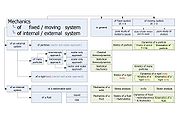
The system of study of mechanics is shown in the table below:
from quantum mechanics
.
Historically, classical mechanics came first, while quantum mechanics is a comparatively recent invention. Classical mechanics originated with Isaac Newton
's Laws of motion
in Principia Mathematica, while quantum mechanics didn't appear until 1900. Both are commonly held to constitute the most certain knowledge that exists about physical nature. Classical mechanics has especially often been viewed as a model for other so-called exact science
s. Essential in this respect is the relentless use of mathematics
in theories, as well as the decisive role played by experiment
in generating and testing them.
Quantum
mechanics is of a wider scope, as it encompasses classical mechanics as a sub-discipline which applies under certain restricted circumstances. According to the correspondence principle
, there is no contradiction or conflict between the two subjects, each simply pertains to specific situations. The correspondence principle states that the behavior of systems described by quantum theories reproduces classical physics in the limit of large quantum numbers. Quantum mechanics has superseded classical mechanics at the foundational level and is indispensable for the explanation and prediction of processes at molecular and (sub)atomic level. However, for macroscopic processes classical mechanics is able to solve problems which are unmanageably difficult in quantum mechanics and hence remains useful and well used.
Modern descriptions of such behavior begin with a careful definition of such quantities as displacement (distance moved), time, velocity, acceleration, mass, and force. Until about 400 years ago, however, motion was explained from a very different point of view. For example, following the ideas of Greek philosopher and scientist Aristotle, scientists reasoned that a cannonball falls down because its natural position is in the earth; the sun, the moon, and the stars travel in circles around the earth because it is the nature of heavenly objects to travel in perfect circles.
The Italian physicist and astronomer Galileo brought together the ideas of other great thinkers of his time and began to analyze motion in terms of distance traveled from some starting position and the time that it took. He showed that the speed of falling objects increases steadily during the time of their fall. This acceleration is the same for heavy objects as for light ones, provided air friction (air resistance) is discounted. The English mathematician and physicist Sir Isaac Newton improved this analysis by defining force and mass and relating these to acceleration. For objects traveling at speeds close to the speed of light, Newton’s laws were superseded by Albert Einstein’s theory of relativity. For atomic and subatomic particles, Newton’s laws were superseded by quantum theory. For everyday phenomena, however, Newton’s three laws of motion remain the cornerstone of dynamics, which is the study of what causes motion.
and special
theories of relativity
have expanded the scope of mechanics beyond the mechanics of Newton
and Galileo, and made fundamental corrections to them, that become significant and even dominant as speeds of material objects approach the speed of light
, which cannot be exceeded.
For example,
In Newtonian Mechanics, Newton's laws of motion
,
F=ma
whereas in Einsteinian Mechanics and Lorentz Transformations, which were first discovered by Hendrik Lorentz
,
F=γma
where γ is the Lorentz Factor
.
.
in the 6th century. A central problem was that of projectile motion
, which was discussed by Hipparchus and Philoponus. This led to the development of the theory of impetus
by 14th century French Jean Buridan
, which developed into the modern theories of inertia
, velocity
, acceleration
and momentum
. This work and others was developed in 14th century England by the Oxford Calculators
such as Thomas Bradwardine
, who studied and formulated various laws regarding falling bodies.
On the question of a body subject to a constant (uniform) force, the 12th century Jewish-Arab Nathanel
(Iraqi, of Baghdad) stated that constant force imparts constant acceleration, while the main properties are uniformly accelerated motion (as of falling bodies) was worked out by the 14th century Oxford Calculators.
and Isaac Newton
. Galileo's final statement of his mechanics, particularly of falling bodies, is his Two New Sciences
(1638). Newton's 1687 Philosophiæ Naturalis Principia Mathematica provided a detailed mathematical account of mechanics, using the newly developed mathematics of calculus
and providing the basis of Newtonian mechanics.
There is some dispute over priority of various ideas: Newton's Principia is certainly the seminal work and has been tremendously influential, and the systematic mathematics therein did not and could not have been stated earlier because calculus had not been developed. However, many of the ideas, particularly as pertain to inertia (impetus) and falling bodies had been developed and stated by earlier researchers, both the then-recent Galileo and the less-known medieval predecessors. Precise credit is at times difficult or contentious because scientific language and standards of proof changed, so whether medieval statements are equivalent to modern statements or sufficient proof, or instead similar to modern statements and hypotheses is often debatable.
of Einstein
, and quantum mechanics
, both developed in the 20th century based in part on earlier 19th century ideas.
needs to stand for a wide assortment of objects, including particles, projectiles, spacecraft
, star
s, parts of machinery
, parts of solids, parts of fluids (gases and liquids), etc.
Other distinctions between the various sub-disciplines of mechanics, concern the nature of the bodies being described. Particles are bodies with little (known) internal structure, treated as mathematical points in classical mechanics. Rigid bodies have size and shape, but retain a simplicity close to that of the particle, adding just a few so-called degrees of freedom
, such as orientation in space.
Otherwise, bodies may be semi-rigid, i.e. elastic
, or non-rigid, i.e. fluid
. These subjects have both classical and quantum divisions of study.
For instance, the motion of a spacecraft, regarding its orbit
and attitude (rotation
), is described by the relativistic theory of classical mechanics, while the analogous movements of an atomic nucleus
are described by quantum mechanics.
Note that there is also the "theory of fields" which constitutes a separate discipline in physics, formally treated as distinct from mechanics, whether classical fields
or quantum fields
. But in actual practice, subjects belonging to mechanics and fields are closely interwoven. Thus, for instance, forces that act on particles are frequently derived from fields (electromagnetic
or gravitational), and particles generate fields by acting as sources. In fact, in quantum mechanics, particles themselves are fields, as described theoretically by the wave function.
:
Physics
Physics is a natural science that involves the study of matter and its motion through spacetime, along with related concepts such as energy and force. More broadly, it is the general analysis of nature, conducted in order to understand how the universe behaves.Physics is one of the oldest academic...
concerned with the behavior of physical bodies
Physical body
In physics, a physical body or physical object is a collection of masses, taken to be one...
when subjected to force
Force
In physics, a force is any influence that causes an object to undergo a change in speed, a change in direction, or a change in shape. In other words, a force is that which can cause an object with mass to change its velocity , i.e., to accelerate, or which can cause a flexible object to deform...
s or displacements
Displacement (vector)
A displacement is the shortest distance from the initial to the final position of a point P. Thus, it is the length of an imaginary straight path, typically distinct from the path actually travelled by P...
, and the subsequent effects of the bodies on their environment.
The discipline has its roots in several ancient civilizations (see History of classical mechanics
History of classical mechanics
This article deals with the history of classical mechanics.- Antiquity :The ancient Greek philosophers, Aristotle in particular, were among the first to propose that abstract principles govern nature...
and Timeline of classical mechanics
Timeline of classical mechanics
-Early history:* 300s BC - Aristotle founds the system of Aristotelian physics* 260 BC - Archimedes mathematically works out the principle of the lever and discovers the principle of buoyancy...
). During the early modern period
Early modern period
In history, the early modern period of modern history follows the late Middle Ages. Although the chronological limits of the period are open to debate, the timeframe spans the period after the late portion of the Middle Ages through the beginning of the Age of Revolutions...
, scientists such as Galileo, Kepler
Johannes Kepler
Johannes Kepler was a German mathematician, astronomer and astrologer. A key figure in the 17th century scientific revolution, he is best known for his eponymous laws of planetary motion, codified by later astronomers, based on his works Astronomia nova, Harmonices Mundi, and Epitome of Copernican...
, and especially Newton
Isaac Newton
Sir Isaac Newton PRS was an English physicist, mathematician, astronomer, natural philosopher, alchemist, and theologian, who has been "considered by many to be the greatest and most influential scientist who ever lived."...
, laid the foundation for what is now known as classical mechanics
Classical mechanics
In physics, classical mechanics is one of the two major sub-fields of mechanics, which is concerned with the set of physical laws describing the motion of bodies under the action of a system of forces...
.
It is a branch of classical physics that deals with the particles that are moving either with less velocity or that are at rest.
The system of study of mechanics is shown in the table below:
Classical versus quantum
The major division of the mechanics discipline separates classical mechanicsClassical mechanics
In physics, classical mechanics is one of the two major sub-fields of mechanics, which is concerned with the set of physical laws describing the motion of bodies under the action of a system of forces...
from quantum mechanics
Quantum mechanics
Quantum mechanics, also known as quantum physics or quantum theory, is a branch of physics providing a mathematical description of much of the dual particle-like and wave-like behavior and interactions of energy and matter. It departs from classical mechanics primarily at the atomic and subatomic...
.
Historically, classical mechanics came first, while quantum mechanics is a comparatively recent invention. Classical mechanics originated with Isaac Newton
Isaac Newton
Sir Isaac Newton PRS was an English physicist, mathematician, astronomer, natural philosopher, alchemist, and theologian, who has been "considered by many to be the greatest and most influential scientist who ever lived."...
's Laws of motion
Newton's laws of motion
Newton's laws of motion are three physical laws that form the basis for classical mechanics. They describe the relationship between the forces acting on a body and its motion due to those forces...
in Principia Mathematica, while quantum mechanics didn't appear until 1900. Both are commonly held to constitute the most certain knowledge that exists about physical nature. Classical mechanics has especially often been viewed as a model for other so-called exact science
Exact science
An exact science is any field of science capable of accurate quantitative expression or precise predictions and rigorous methods of testing hypotheses, especially reproducible experiments involving quantifiable predictions and measurements...
s. Essential in this respect is the relentless use of mathematics
Mathematics
Mathematics is the study of quantity, space, structure, and change. Mathematicians seek out patterns and formulate new conjectures. Mathematicians resolve the truth or falsity of conjectures by mathematical proofs, which are arguments sufficient to convince other mathematicians of their validity...
in theories, as well as the decisive role played by experiment
Experiment
An experiment is a methodical procedure carried out with the goal of verifying, falsifying, or establishing the validity of a hypothesis. Experiments vary greatly in their goal and scale, but always rely on repeatable procedure and logical analysis of the results...
in generating and testing them.
Quantum
Quantum
In physics, a quantum is the minimum amount of any physical entity involved in an interaction. Behind this, one finds the fundamental notion that a physical property may be "quantized," referred to as "the hypothesis of quantization". This means that the magnitude can take on only certain discrete...
mechanics is of a wider scope, as it encompasses classical mechanics as a sub-discipline which applies under certain restricted circumstances. According to the correspondence principle
Correspondence principle
In physics, the correspondence principle states that the behavior of systems described by the theory of quantum mechanics reproduces classical physics in the limit of large quantum numbers....
, there is no contradiction or conflict between the two subjects, each simply pertains to specific situations. The correspondence principle states that the behavior of systems described by quantum theories reproduces classical physics in the limit of large quantum numbers. Quantum mechanics has superseded classical mechanics at the foundational level and is indispensable for the explanation and prediction of processes at molecular and (sub)atomic level. However, for macroscopic processes classical mechanics is able to solve problems which are unmanageably difficult in quantum mechanics and hence remains useful and well used.
Modern descriptions of such behavior begin with a careful definition of such quantities as displacement (distance moved), time, velocity, acceleration, mass, and force. Until about 400 years ago, however, motion was explained from a very different point of view. For example, following the ideas of Greek philosopher and scientist Aristotle, scientists reasoned that a cannonball falls down because its natural position is in the earth; the sun, the moon, and the stars travel in circles around the earth because it is the nature of heavenly objects to travel in perfect circles.
The Italian physicist and astronomer Galileo brought together the ideas of other great thinkers of his time and began to analyze motion in terms of distance traveled from some starting position and the time that it took. He showed that the speed of falling objects increases steadily during the time of their fall. This acceleration is the same for heavy objects as for light ones, provided air friction (air resistance) is discounted. The English mathematician and physicist Sir Isaac Newton improved this analysis by defining force and mass and relating these to acceleration. For objects traveling at speeds close to the speed of light, Newton’s laws were superseded by Albert Einstein’s theory of relativity. For atomic and subatomic particles, Newton’s laws were superseded by quantum theory. For everyday phenomena, however, Newton’s three laws of motion remain the cornerstone of dynamics, which is the study of what causes motion.
Einsteinian versus Newtonian
Analogous to the quantum versus classical reformation, Einstein's generalGeneral relativity
General relativity or the general theory of relativity is the geometric theory of gravitation published by Albert Einstein in 1916. It is the current description of gravitation in modern physics...
and special
Special relativity
Special relativity is the physical theory of measurement in an inertial frame of reference proposed in 1905 by Albert Einstein in the paper "On the Electrodynamics of Moving Bodies".It generalizes Galileo's...
theories of relativity
Theory of relativity
The theory of relativity, or simply relativity, encompasses two theories of Albert Einstein: special relativity and general relativity. However, the word relativity is sometimes used in reference to Galilean invariance....
have expanded the scope of mechanics beyond the mechanics of Newton
Isaac Newton
Sir Isaac Newton PRS was an English physicist, mathematician, astronomer, natural philosopher, alchemist, and theologian, who has been "considered by many to be the greatest and most influential scientist who ever lived."...
and Galileo, and made fundamental corrections to them, that become significant and even dominant as speeds of material objects approach the speed of light
Speed of light
The speed of light in vacuum, usually denoted by c, is a physical constant important in many areas of physics. Its value is 299,792,458 metres per second, a figure that is exact since the length of the metre is defined from this constant and the international standard for time...
, which cannot be exceeded.
For example,
In Newtonian Mechanics, Newton's laws of motion
Newton's laws of motion
Newton's laws of motion are three physical laws that form the basis for classical mechanics. They describe the relationship between the forces acting on a body and its motion due to those forces...
,
F=ma
whereas in Einsteinian Mechanics and Lorentz Transformations, which were first discovered by Hendrik Lorentz
Hendrik Lorentz
Hendrik Antoon Lorentz was a Dutch physicist who shared the 1902 Nobel Prize in Physics with Pieter Zeeman for the discovery and theoretical explanation of the Zeeman effect...
,
F=γma
where γ is the Lorentz Factor
Lorentz factor
The Lorentz factor or Lorentz term appears in several equations in special relativity, including time dilation, length contraction, and the relativistic mass formula. Because of its ubiquity, physicists generally represent it with the shorthand symbol γ . It gets its name from its earlier...
Einsteinian vs. Quantum
Relativistic corrections are also needed for quantum mechanics, although General relativity has not been integrated; the two theories remain incompatible, a hurdle which must be overcome in developing the Theory of EverythingTheory of everything
A theory of everything is a putative theory of theoretical physics that fully explains and links together all known physical phenomena, and predicts the outcome of any experiment that could be carried out in principle....
.
History
Antiquity
The main theory of mechanics in antiquity was Aristotelian mechanics. A later developer in this tradition was HipparchusHipparchus
Hipparchus, the common Latinization of the Greek Hipparkhos, can mean:* Hipparchus, the ancient Greek astronomer** Hipparchic cycle, an astronomical cycle he created** Hipparchus , a lunar crater named in his honour...
.
Medieval age
In the Middle Ages, Aristotle's theories were criticized and modified by a number of figures, beginning with John PhiloponusJohn Philoponus
John Philoponus , also known as John the Grammarian or John of Alexandria, was a Christian and Aristotelian commentator and the author of a considerable number of philosophical treatises and theological works...
in the 6th century. A central problem was that of projectile motion
Projectile motion
The motion in which a body is thrown or projected is called Projectile motion.The path followed by a projectile is called its trajectory, which is directly influenced by gravity....
, which was discussed by Hipparchus and Philoponus. This led to the development of the theory of impetus
Theory of impetus
The theory of impetus was an auxiliary or secondary theory of Aristotelian dynamics, put forth initially to explain projectile motion against gravity...
by 14th century French Jean Buridan
Jean Buridan
Jean Buridan was a French priest who sowed the seeds of the Copernican revolution in Europe. Although he was one of the most famous and influential philosophers of the late Middle Ages, he is today among the least well known...
, which developed into the modern theories of inertia
Inertia
Inertia is the resistance of any physical object to a change in its state of motion or rest, or the tendency of an object to resist any change in its motion. It is proportional to an object's mass. The principle of inertia is one of the fundamental principles of classical physics which are used to...
, velocity
Velocity
In physics, velocity is speed in a given direction. Speed describes only how fast an object is moving, whereas velocity gives both the speed and direction of the object's motion. To have a constant velocity, an object must have a constant speed and motion in a constant direction. Constant ...
, acceleration
Acceleration
In physics, acceleration is the rate of change of velocity with time. In one dimension, acceleration is the rate at which something speeds up or slows down. However, since velocity is a vector, acceleration describes the rate of change of both the magnitude and the direction of velocity. ...
and momentum
Momentum
In classical mechanics, linear momentum or translational momentum is the product of the mass and velocity of an object...
. This work and others was developed in 14th century England by the Oxford Calculators
Oxford Calculators
The Oxford Calculators were a group of 14th-century thinkers, almost all associated with Merton College, Oxford, who took a strikingly logico-mathematical approach to philosophical problems....
such as Thomas Bradwardine
Thomas Bradwardine
Thomas Bradwardine was an English scholar, scientist, courtier and, very briefly, Archbishop of Canterbury. As a celebrated scholastic philosopher and doctor of theology, he is often called Doctor Profundus, .-Life:He was born either at Hartfield in Sussex or at Chichester, where his family were...
, who studied and formulated various laws regarding falling bodies.
On the question of a body subject to a constant (uniform) force, the 12th century Jewish-Arab Nathanel
Hibat Allah Abu'l-Barakat al-Baghdaadi
Abu'l-Barakāt Hibat Allah ibn Malkā al-Baghdādī was an Islamic philosopher and physician of Jewish-Arab descent from Baghdad, Iraq. Abu'l-Barakāt, an older contemporary and father-in-law of Maimonides, was originally known by his Hebrew birth name Nathanel before his conversion from Judaism to...
(Iraqi, of Baghdad) stated that constant force imparts constant acceleration, while the main properties are uniformly accelerated motion (as of falling bodies) was worked out by the 14th century Oxford Calculators.
Early modern age
Two central figures in the early modern age are Galileo GalileiGalileo Galilei
Galileo Galilei , was an Italian physicist, mathematician, astronomer, and philosopher who played a major role in the Scientific Revolution. His achievements include improvements to the telescope and consequent astronomical observations and support for Copernicanism...
and Isaac Newton
Isaac Newton
Sir Isaac Newton PRS was an English physicist, mathematician, astronomer, natural philosopher, alchemist, and theologian, who has been "considered by many to be the greatest and most influential scientist who ever lived."...
. Galileo's final statement of his mechanics, particularly of falling bodies, is his Two New Sciences
Two New Sciences
The Discourses and Mathematical Demonstrations Relating to Two New Sciences was Galileo's final book and a sort of scientific testament covering much of his work in physics over the preceding thirty years.After his Dialogue Concerning the Two Chief World Systems, the Roman Inquisition had banned...
(1638). Newton's 1687 Philosophiæ Naturalis Principia Mathematica provided a detailed mathematical account of mechanics, using the newly developed mathematics of calculus
Calculus
Calculus is a branch of mathematics focused on limits, functions, derivatives, integrals, and infinite series. This subject constitutes a major part of modern mathematics education. It has two major branches, differential calculus and integral calculus, which are related by the fundamental theorem...
and providing the basis of Newtonian mechanics.
There is some dispute over priority of various ideas: Newton's Principia is certainly the seminal work and has been tremendously influential, and the systematic mathematics therein did not and could not have been stated earlier because calculus had not been developed. However, many of the ideas, particularly as pertain to inertia (impetus) and falling bodies had been developed and stated by earlier researchers, both the then-recent Galileo and the less-known medieval predecessors. Precise credit is at times difficult or contentious because scientific language and standards of proof changed, so whether medieval statements are equivalent to modern statements or sufficient proof, or instead similar to modern statements and hypotheses is often debatable.
Modern age
Two main modern developments in mechanics are general relativityGeneral relativity
General relativity or the general theory of relativity is the geometric theory of gravitation published by Albert Einstein in 1916. It is the current description of gravitation in modern physics...
of Einstein
Albert Einstein
Albert Einstein was a German-born theoretical physicist who developed the theory of general relativity, effecting a revolution in physics. For this achievement, Einstein is often regarded as the father of modern physics and one of the most prolific intellects in human history...
, and quantum mechanics
Quantum mechanics
Quantum mechanics, also known as quantum physics or quantum theory, is a branch of physics providing a mathematical description of much of the dual particle-like and wave-like behavior and interactions of energy and matter. It departs from classical mechanics primarily at the atomic and subatomic...
, both developed in the 20th century based in part on earlier 19th century ideas.
Types of mechanical bodies
Thus the often-used term bodyPhysical body
In physics, a physical body or physical object is a collection of masses, taken to be one...
needs to stand for a wide assortment of objects, including particles, projectiles, spacecraft
Spacecraft
A spacecraft or spaceship is a craft or machine designed for spaceflight. Spacecraft are used for a variety of purposes, including communications, earth observation, meteorology, navigation, planetary exploration and transportation of humans and cargo....
, star
Star
A star is a massive, luminous sphere of plasma held together by gravity. At the end of its lifetime, a star can also contain a proportion of degenerate matter. The nearest star to Earth is the Sun, which is the source of most of the energy on Earth...
s, parts of machinery
Mechanical engineering
Mechanical engineering is a discipline of engineering that applies the principles of physics and materials science for analysis, design, manufacturing, and maintenance of mechanical systems. It is the branch of engineering that involves the production and usage of heat and mechanical power for the...
, parts of solids, parts of fluids (gases and liquids), etc.
Other distinctions between the various sub-disciplines of mechanics, concern the nature of the bodies being described. Particles are bodies with little (known) internal structure, treated as mathematical points in classical mechanics. Rigid bodies have size and shape, but retain a simplicity close to that of the particle, adding just a few so-called degrees of freedom
Degrees of freedom (physics and chemistry)
A degree of freedom is an independent physical parameter, often called a dimension, in the formal description of the state of a physical system...
, such as orientation in space.
Otherwise, bodies may be semi-rigid, i.e. elastic
Elasticity (physics)
In physics, elasticity is the physical property of a material that returns to its original shape after the stress that made it deform or distort is removed. The relative amount of deformation is called the strain....
, or non-rigid, i.e. fluid
Fluid
In physics, a fluid is a substance that continually deforms under an applied shear stress. Fluids are a subset of the phases of matter and include liquids, gases, plasmas and, to some extent, plastic solids....
. These subjects have both classical and quantum divisions of study.
For instance, the motion of a spacecraft, regarding its orbit
Orbit
In physics, an orbit is the gravitationally curved path of an object around a point in space, for example the orbit of a planet around the center of a star system, such as the Solar System...
and attitude (rotation
Rotation
A rotation is a circular movement of an object around a center of rotation. A three-dimensional object rotates always around an imaginary line called a rotation axis. If the axis is within the body, and passes through its center of mass the body is said to rotate upon itself, or spin. A rotation...
), is described by the relativistic theory of classical mechanics, while the analogous movements of an atomic nucleus
Atomic nucleus
The nucleus is the very dense region consisting of protons and neutrons at the center of an atom. It was discovered in 1911, as a result of Ernest Rutherford's interpretation of the famous 1909 Rutherford experiment performed by Hans Geiger and Ernest Marsden, under the direction of Rutherford. The...
are described by quantum mechanics.
Sub-disciplines in mechanics
The following are two lists of various subjects that are studied in mechanics.Note that there is also the "theory of fields" which constitutes a separate discipline in physics, formally treated as distinct from mechanics, whether classical fields
Classical field theory
A classical field theory is a physical theory that describes the study of how one or more physical fields interact with matter. The word 'classical' is used in contrast to those field theories that incorporate quantum mechanics ....
or quantum fields
Quantum field theory
Quantum field theory provides a theoretical framework for constructing quantum mechanical models of systems classically parametrized by an infinite number of dynamical degrees of freedom, that is, fields and many-body systems. It is the natural and quantitative language of particle physics and...
. But in actual practice, subjects belonging to mechanics and fields are closely interwoven. Thus, for instance, forces that act on particles are frequently derived from fields (electromagnetic
Electromagnetism
Electromagnetism is one of the four fundamental interactions in nature. The other three are the strong interaction, the weak interaction and gravitation...
or gravitational), and particles generate fields by acting as sources. In fact, in quantum mechanics, particles themselves are fields, as described theoretically by the wave function.
Classical mechanics
The following are described as forming Classical mechanics:- Newtonian mechanics, the original theory of motion (kinematicsKinematicsKinematics is the branch of classical mechanics that describes the motion of bodies and systems without consideration of the forces that cause the motion....
) and forces (dynamicsAnalytical dynamicsIn classical mechanics, analytical dynamics, or more briefly dynamics, is concerned about the relationship between motion of bodies and its causes, namely the forces acting on the bodies and the properties of the bodies...
) - Hamiltonian mechanicsHamiltonian mechanicsHamiltonian mechanics is a reformulation of classical mechanics that was introduced in 1833 by Irish mathematician William Rowan Hamilton.It arose from Lagrangian mechanics, a previous reformulation of classical mechanics introduced by Joseph Louis Lagrange in 1788, but can be formulated without...
, a theoretical formalismFormalism (mathematics)In foundations of mathematics, philosophy of mathematics, and philosophy of logic, formalism is a theory that holds that statements of mathematics and logic can be thought of as statements about the consequences of certain string manipulation rules....
, based on the principle of conservation of energy - Lagrangian mechanicsLagrangian mechanicsLagrangian mechanics is a re-formulation of classical mechanics that combines conservation of momentum with conservation of energy. It was introduced by the Italian-French mathematician Joseph-Louis Lagrange in 1788....
, another theoretical formalism, based on the principle of the least action - Celestial mechanicsCelestial mechanicsCelestial mechanics is the branch of astronomy that deals with the motions of celestial objects. The field applies principles of physics, historically classical mechanics, to astronomical objects such as stars and planets to produce ephemeris data. Orbital mechanics is a subfield which focuses on...
, the motion of bodies in space: planets, comets, stars, galaxies, etc. - AstrodynamicsAstrodynamicsOrbital mechanics or astrodynamics is the application of ballistics and celestial mechanics to the practical problems concerning the motion of rockets and other spacecraft. The motion of these objects is usually calculated from Newton's laws of motion and Newton's law of universal gravitation. It...
, spacecraft navigationNavigationNavigation is the process of monitoring and controlling the movement of a craft or vehicle from one place to another. It is also the term of art used for the specialized knowledge used by navigators to perform navigation tasks...
, etc. - Solid mechanicsSolid mechanicsSolid mechanics is the branch of mechanics, physics, and mathematics that concerns the behavior of solid matter under external actions . It is part of a broader study known as continuum mechanics. One of the most common practical applications of solid mechanics is the Euler-Bernoulli beam equation...
, elasticityElasticity (physics)In physics, elasticity is the physical property of a material that returns to its original shape after the stress that made it deform or distort is removed. The relative amount of deformation is called the strain....
, the properties of deformable bodies. - Fracture mechanicsFracture mechanicsFracture mechanics is the field of mechanics concerned with the study of the propagation of cracks in materials. It uses methods of analytical solid mechanics to calculate the driving force on a crack and those of experimental solid mechanics to characterize the material's resistance to fracture.In...
- AcousticsAcousticsAcoustics is the interdisciplinary science that deals with the study of all mechanical waves in gases, liquids, and solids including vibration, sound, ultrasound and infrasound. A scientist who works in the field of acoustics is an acoustician while someone working in the field of acoustics...
, soundSoundSound is a mechanical wave that is an oscillation of pressure transmitted through a solid, liquid, or gas, composed of frequencies within the range of hearing and of a level sufficiently strong to be heard, or the sensation stimulated in organs of hearing by such vibrations.-Propagation of...
( = density variation propagation) in solids, fluids and gases. - StaticsStaticsStatics is the branch of mechanics concerned with the analysis of loads on physical systems in static equilibrium, that is, in a state where the relative positions of subsystems do not vary over time, or where components and structures are at a constant velocity...
, semi-rigid bodies in mechanical equilibriumMechanical equilibriumA standard definition of static equilibrium is:This is a strict definition, and often the term "static equilibrium" is used in a more relaxed manner interchangeably with "mechanical equilibrium", as defined next.... - Fluid mechanicsFluid mechanicsFluid mechanics is the study of fluids and the forces on them. Fluid mechanics can be divided into fluid statics, the study of fluids at rest; fluid kinematics, the study of fluids in motion; and fluid dynamics, the study of the effect of forces on fluid motion...
, the motion of fluids - Soil mechanicsSoil mechanicsSoil mechanics is a branch of engineering mechanics that describes the behavior of soils. It differs from fluid mechanics and solid mechanics in the sense that soils consist of a heterogeneous mixture of fluids and particles but soil may also contain organic solids, liquids, and gasses and other...
, mechanical behavior of soils - Continuum mechanicsContinuum mechanicsContinuum mechanics is a branch of mechanics that deals with the analysis of the kinematics and the mechanical behavior of materials modelled as a continuous mass rather than as discrete particles...
, mechanics of continua (both solid and fluid) - HydraulicsHydraulicsHydraulics is a topic in applied science and engineering dealing with the mechanical properties of liquids. Fluid mechanics provides the theoretical foundation for hydraulics, which focuses on the engineering uses of fluid properties. In fluid power, hydraulics is used for the generation, control,...
, mechanical properties of liquids - Fluid staticsFluid staticsFluid statics is the science of fluids at rest, and is a sub-field within fluid mechanics. The term usually refers to the mathematical treatment of the subject. It embraces the study of the conditions under which fluids are at rest in stable equilibrium...
, liquids in equilibrium - Applied mechanics, or Engineering mechanicsApplied mechanicsApplied mechanics is a branch of the physical sciences and the practical application of mechanics. Applied mechanics examines the response of bodies or systems of bodies to external forces...
- BiomechanicsBiomechanicsBiomechanics is the application of mechanical principles to biological systems, such as humans, animals, plants, organs, and cells. Perhaps one of the best definitions was provided by Herbert Hatze in 1974: "Biomechanics is the study of the structure and function of biological systems by means of...
, solids, fluids, etc. in biology - BiophysicsBiophysicsBiophysics is an interdisciplinary science that uses the methods of physical science to study biological systems. Studies included under the branches of biophysics span all levels of biological organization, from the molecular scale to whole organisms and ecosystems...
, physical processes in living organisms - Statistical mechanicsStatistical mechanicsStatistical mechanics or statistical thermodynamicsThe terms statistical mechanics and statistical thermodynamics are used interchangeably...
, assemblies of particles too large to be described in a deterministic way - Relativistic or EinsteinianAlbert EinsteinAlbert Einstein was a German-born theoretical physicist who developed the theory of general relativity, effecting a revolution in physics. For this achievement, Einstein is often regarded as the father of modern physics and one of the most prolific intellects in human history...
mechanics, universal gravitationGravitationGravitation, or gravity, is a natural phenomenon by which physical bodies attract with a force proportional to their mass. Gravitation is most familiar as the agent that gives weight to objects with mass and causes them to fall to the ground when dropped...
Quantum mechanics
The following are categorized as being part of Quantum mechanicsQuantum mechanics
Quantum mechanics, also known as quantum physics or quantum theory, is a branch of physics providing a mathematical description of much of the dual particle-like and wave-like behavior and interactions of energy and matter. It departs from classical mechanics primarily at the atomic and subatomic...
:
- Particle physicsParticle physicsParticle physics is a branch of physics that studies the existence and interactions of particles that are the constituents of what is usually referred to as matter or radiation. In current understanding, particles are excitations of quantum fields and interact following their dynamics...
, the motion, structure, and reactions of particles - Nuclear physicsNuclear physicsNuclear physics is the field of physics that studies the building blocks and interactions of atomic nuclei. The most commonly known applications of nuclear physics are nuclear power generation and nuclear weapons technology, but the research has provided application in many fields, including those...
, the motion, structure, and reactions of nuclei - Condensed matter physicsCondensed matter physicsCondensed matter physics deals with the physical properties of condensed phases of matter. These properties appear when a number of atoms at the supramolecular and macromolecular scale interact strongly and adhere to each other or are otherwise highly concentrated in a system. The most familiar...
, quantum gases, solids, liquids, etc. - Quantum statistical mechanicsQuantum statistical mechanicsQuantum statistical mechanics is the study of statistical ensembles of quantum mechanical systems. A statistical ensemble is described by a density operator S, which is a non-negative, self-adjoint, trace-class operator of trace 1 on the Hilbert space H describing the quantum system. This can be...
, large assemblies of particles
Professional organizations
- Applied Mechanics DivisionApplied Mechanics DivisionThe Applied Mechanics Division is a division in the American Society of Mechanical Engineers . The AMD was founded in 1927, with Stephen Timoshenko being the first chair. The current AMD membership is over 5000, out of about 90,000 members of the ASME...
, American Society of Mechanical EngineersAmerican Society of Mechanical EngineersThe American Society of Mechanical Engineers is a professional body, specifically an engineering society, focused on mechanical engineering.... - Fluid Dynamics Division, American Physical SocietyAmerican Physical SocietyThe American Physical Society is the world's second largest organization of physicists, behind the Deutsche Physikalische Gesellschaft. The Society publishes more than a dozen scientific journals, including the world renowned Physical Review and Physical Review Letters, and organizes more than 20...
- Institution of Mechanical Engineers is the United Kingdom's qualifying body for Mechanical Engineers and has been the home of Mechanical Engineers for over 150 years.
- International Union of Theoretical and Applied Mechanics
See also
- Analytical mechanicsAnalytical mechanicsAnalytical mechanics is a term used for a refined, mathematical form of classical mechanics, constructed from the 18th century onwards as a formulation of the subject as founded by Isaac Newton. Often the term vectorial mechanics is applied to the form based on Newton's work, to contrast it with...
- Applied mechanicsApplied mechanicsApplied mechanics is a branch of the physical sciences and the practical application of mechanics. Applied mechanics examines the response of bodies or systems of bodies to external forces...
- DynamicsDynamical systemA dynamical system is a concept in mathematics where a fixed rule describes the time dependence of a point in a geometrical space. Examples include the mathematical models that describe the swinging of a clock pendulum, the flow of water in a pipe, and the number of fish each springtime in a...
- EngineeringEngineeringEngineering is the discipline, art, skill and profession of acquiring and applying scientific, mathematical, economic, social, and practical knowledge, in order to design and build structures, machines, devices, systems, materials and processes that safely realize improvements to the lives of...
- Index of engineering science and mechanics articles
- KinematicsKinematicsKinematics is the branch of classical mechanics that describes the motion of bodies and systems without consideration of the forces that cause the motion....
- KineticsKinetics (physics)In physics and engineering, kinetics is a term for the branch of classical mechanics that is concerned with the relationship between the motion of bodies and its causes, namely forces and torques...
- StaticsStaticsStatics is the branch of mechanics concerned with the analysis of loads on physical systems in static equilibrium, that is, in a state where the relative positions of subsystems do not vary over time, or where components and structures are at a constant velocity...
- Wiesen Test of Mechanical Aptitude (WTMA)Wiesen Test of Mechanical Aptitude (WTMA)The Wiesen Test of Mechanical Aptitude is a 30 minute, sixty-question test used to measure mechanical aptitude. It is used for employment testing of job applicants and to help select vocational education students....
External links
- iMechanica: the web of mechanics and mechanicians
- Mechanics Blog by a Purdue University Professor
- The Mechanics program at Virginia Tech
- Physclips: Mechanics with animations and video clips from the University of New South Wales
- U.S. National Committee on Theoretical and Applied Mechanics
- Interactive learning resources for teaching Mechanics
- The Archimedes Project