


Irish poetry

Encyclopedia
Irish language
Irish , also known as Irish Gaelic, is a Goidelic language of the Indo-European language family, originating in Ireland and historically spoken by the Irish people. Irish is now spoken as a first language by a minority of Irish people, as well as being a second language of a larger proportion of...
and the other in English
English language
English is a West Germanic language that arose in the Anglo-Saxon kingdoms of England and spread into what was to become south-east Scotland under the influence of the Anglian medieval kingdom of Northumbria...
. The complex interplay between these two traditions, and between both of them and other poetries in English, has produced a body of work that is both rich in variety and difficult to categorise.
The earliest surviving poems in Irish date back to the 6th century, while the first known poems in English from Ireland date to the 14th century. Although some cross-fertilization between the two language traditions has always happened, the final emergence of an English-language poetry that had absorbed themes and models from Irish did not appear until the 19th century. This culminated in the work of the poets of the Celtic Revival
Celtic Revival
Celtic Revival covers a variety of movements and trends, mostly in the 19th and 20th centuries, which drew on the traditions of Celtic literature and Celtic art, or in fact more often what art historians call Insular art...
at the end of the 19th and beginning of the 20th century.
Towards the last quarter of the century, modern Irish poetry has tended to a wide range of diversity, from the poets of the Northern school to writers influenced by the modernist
Modernism
Modernism, in its broadest definition, is modern thought, character, or practice. More specifically, the term describes the modernist movement, its set of cultural tendencies and array of associated cultural movements, originally arising from wide-scale and far-reaching changes to Western society...
tradition and those facing the new questions posed by an increasingly urban and cosmopolitan society.
Early Irish poetry
Poetry in Irish represents the oldest vernacularVernacular literature
Vernacular literature is literature written in the vernacular—the speech of the "common people".In the European tradition, this effectively means literature not written in Latin...
poetry in Europe. The earliest examples date from the 6th century, and are generally short lyrics
Lyrics
Lyrics are a set of words that make up a song. The writer of lyrics is a lyricist or lyrist. The meaning of lyrics can either be explicit or implicit. Some lyrics are abstract, almost unintelligible, and, in such cases, their explication emphasizes form, articulation, meter, and symmetry of...
on themes from religion
Religion
Religion is a collection of cultural systems, belief systems, and worldviews that establishes symbols that relate humanity to spirituality and, sometimes, to moral values. Many religions have narratives, symbols, traditions and sacred histories that are intended to give meaning to life or to...
or the world of nature. They were frequently written by their scribe
Scribe
A scribe is a person who writes books or documents by hand as a profession and helps the city keep track of its records. The profession, previously found in all literate cultures in some form, lost most of its importance and status with the advent of printing...
authors in the margins of the illuminated manuscript
Illuminated manuscript
An illuminated manuscript is a manuscript in which the text is supplemented by the addition of decoration, such as decorated initials, borders and miniature illustrations...
s that they were copying. The best known example is Pangur Bán
Pangur Bán
"Pangur Bán" is an Old Irish poem, written about the 9th century at or around Reichenau Abbey. It was written by an Irish monk, and is about his cat. Pangur Bán, "white fuller", is the cat's name. Although the poem is anonymous, it bears similarities to the poetry of Sedulius Scottus, prompting...
.
It was practical for poems to be short because the Irish recognized that it was necessary to use any means necessary to make the poems lasting in their oral culture. To accomplish such a feat as well as they have, they used complicated rhyme schemes that would render a poem nonsensical if any of the key words were changed from the original version.
In an oral culture, Irish poetry had many uses. A poem could be used to immortalize both the poet and the subject of the poem, as oftentimes wealthy kings would commission poets to create a piece about them. Such poems would be passed on to descendants so they would remember the great deeds of past generations. Kings would also commission poets to write poems of advertisement, speaking of the king's greatness and worthiness, to attract young men to be warriors on behalf of his kingdom. Oral poetry, because it was in the vernacular, was often used for entertainment purposes. Poems that were entertaining could also be informative, teaching people lessons or offering them wisdom of experience for dealing with situations they would encounter in their everyday lives. Finally, poems, especially those featured in the sagas, were thought to be an instrument of the supernatural, that certain poems could enchant people or objects.
Another source of early Irish poetry is the poems in the tales and sagas, such as the Táin Bó Cúailnge
Táin Bó Cúailnge
is a legendary tale from early Irish literature, often considered an epic, although it is written primarily in prose rather than verse. It tells of a war against Ulster by the Connacht queen Medb and her husband Ailill, who intend to steal the stud bull Donn Cuailnge, opposed only by the teenage...
. Unlike many other European epic cycles, the Irish sagas were written in prose
Prose
Prose is the most typical form of written language, applying ordinary grammatical structure and natural flow of speech rather than rhythmic structure...
, with verse
Poetry
Poetry is a form of literary art in which language is used for its aesthetic and evocative qualities in addition to, or in lieu of, its apparent meaning...
interpolations at moments of heightened tension or emotion. Although usually surviving in recensions dating from the later medieval period, these sagas and especially the poetic sections, are linguistically archaic, and afford the reader a glimpse of pre-Christian Ireland.
See also Chief Ollam of Ireland
Chief Ollam of Ireland
The Ollamh Érenn or Chief Ollam of Ireland was a professional title of Gaelic Ireland.-Background:An ollam was a poet or bard of literature and history. Each chief or tuath had its own ollam...
Medieval/Early modern
Caste
Caste is an elaborate and complex social system that combines elements of endogamy, occupation, culture, social class, tribal affiliation and political power. It should not be confused with race or social class, e.g. members of different castes in one society may belong to the same race, as in India...
of highly trained, learned poets. The bards were steeped in the history and traditions of clan
Clan
A clan is a group of people united by actual or perceived kinship and descent. Even if lineage details are unknown, clan members may be organized around a founding member or apical ancestor. The kinship-based bonds may be symbolical, whereby the clan shares a "stipulated" common ancestor that is a...
and country, as well as in the technical requirements of a verse technique that was syllabic
Syllabic verse
Syllabic verse is a poetic form having a fixed number of syllables per line regardless of the number of stresses that are present. It is common in languages that are syllable-timed, such as Japanese or modern French or Finnish — as opposed to stress-timed languages such as English, in which...
and used assonance
Assonance
Assonance is the repetition of vowel sounds to create internal rhyming within phrases or sentences, and together with alliteration and consonance serves as one of the building blocks of verse. For example, in the phrase "Do you like blue?", the is repeated within the sentence and is...
, half rhyme
Half rhyme
Half rhyme or slant rhyme, sometimes called sprung, near rhyme, oblique rhyme, off rhyme or imperfect rhyme, is consonance on the final consonants of the words involved . Many half/slant rhymes are also eye rhymes.Half/slant rhyme is widely used in Irish, Scottish, Welsh, and Icelandic verse...
and alliteration
Alliteration
In language, alliteration refers to the repetition of a particular sound in the first syllables of Three or more words or phrases. Alliteration has historically developed largely through poetry, in which it more narrowly refers to the repetition of a consonant in any syllables that, according to...
. As officials of the court of king or chieftain, they performed a number of official roles. They were chronicle
Chronicle
Generally a chronicle is a historical account of facts and events ranged in chronological order, as in a time line. Typically, equal weight is given for historically important events and local events, the purpose being the recording of events that occurred, seen from the perspective of the...
rs and satirists
Satire
Satire is primarily a literary genre or form, although in practice it can also be found in the graphic and performing arts. In satire, vices, follies, abuses, and shortcomings are held up to ridicule, ideally with the intent of shaming individuals, and society itself, into improvement...
whose job it was to praise their employers and damn those who crossed them. It was believed that a well-aimed bardic satire, glam dicin, could raise boils on the face of its target. However, much of their work would not strike the modern reader as being poetry at all, consisting as it does of extended genealogies and almost journalistic accounts of the deeds of their lords and ancestors.
The Metrical Dindshenchas, or Lore of Places, is probably the major surviving monument of Irish bardic verse. It is a great onomastic anthology of naming legends of significant places in the Irish landscape and comprises about 176 poems in total. The earliest of these date from the 11th century, and were probably originally compiled on a provincial basis. As a national compilation, the Metrical Dindshenchas has come down to us in two different recensions. Knowledge of the real or putative history of local places formed an important part of the education of the elite in ancient Ireland, so the Dindshenchas was probably a kind of textbook in origin.
Verse tales of Fionn and the Fianna, sometimes known as Ossian
Ossian
Ossian is the narrator and supposed author of a cycle of poems which the Scottish poet James Macpherson claimed to have translated from ancient sources in the Scots Gaelic. He is based on Oisín, son of Finn or Fionn mac Cumhaill, anglicised to Finn McCool, a character from Irish mythology...
ic poetry, were extremely common in Ireland and Scotland throughout this period. They represent a move from earlier prose tales with verse interludes to stories told completely in verse. There is also a notable shift in tone, with the Fionn poems being much closer to the Romance
Romance (genre)
As a literary genre of high culture, romance or chivalric romance is a style of heroic prose and verse narrative that was popular in the aristocratic circles of High Medieval and Early Modern Europe. They were fantastic stories about marvel-filled adventures, often of a knight errant portrayed as...
tradition as opposed to the epic nature of the sagas. The Fionn poems form one of the key Celt
Celt
The Celts were a diverse group of tribal societies in Iron Age and Roman-era Europe who spoke Celtic languages.The earliest archaeological culture commonly accepted as Celtic, or rather Proto-Celtic, was the central European Hallstatt culture , named for the rich grave finds in Hallstatt, Austria....
ic sources for the Arthurian
King Arthur
King Arthur is a legendary British leader of the late 5th and early 6th centuries, who, according to Medieval histories and romances, led the defence of Britain against Saxon invaders in the early 6th century. The details of Arthur's story are mainly composed of folklore and literary invention, and...
legends.
British Library Manuscript, Harley 913, is a group of poems written in Ireland in the early 14th century. They are usually called the Kildare Poems
Kildare Poems
The Kildare Poems are a group of sixteen poems written in an Irish dialect of Middle English and dated to the mid-14th century. Together with a second, shorter set of poems in the so-called Loscombe Manuscript, they constitute the first and most important linguistic document of the early...
because of their association with that county. Both poems and manuscript have strong Franciscan
Franciscan
Most Franciscans are members of Roman Catholic religious orders founded by Saint Francis of Assisi. Besides Roman Catholic communities, there are also Old Catholic, Anglican, Lutheran, ecumenical and Non-denominational Franciscan communities....
associations and are full of ideas from the wider Western Europe
Western Europe
Western Europe is a loose term for the collection of countries in the western most region of the European continents, though this definition is context-dependent and carries cultural and political connotations. One definition describes Western Europe as a geographic entity—the region lying in the...
an Christian
Christian
A Christian is a person who adheres to Christianity, an Abrahamic, monotheistic religion based on the life and teachings of Jesus of Nazareth as recorded in the Canonical gospels and the letters of the New Testament...
tradition. They also represent the early stages of the second tradition of Irish poetry, that of poetry in the English language, as they were written in Middle English
Middle English
Middle English is the stage in the history of the English language during the High and Late Middle Ages, or roughly during the four centuries between the late 11th and the late 15th century....
.
During the Elizabethan reconquest, two of the most significant English poets of the time saw service in the Irish colonies. Sir Walter Raleigh
Walter Raleigh
Sir Walter Raleigh was an English aristocrat, writer, poet, soldier, courtier, spy, and explorer. He is also well known for popularising tobacco in England....
had little impact on the course of Irish literature, but the time spent in Munster
Munster
Munster is one of the Provinces of Ireland situated in the south of Ireland. In Ancient Ireland, it was one of the fifths ruled by a "king of over-kings" . Following the Norman invasion of Ireland, the ancient kingdoms were shired into a number of counties for administrative and judicial purposes...
by Edmund Spenser
Edmund Spenser
Edmund Spenser was an English poet best known for The Faerie Queene, an epic poem and fantastical allegory celebrating the Tudor dynasty and Elizabeth I. He is recognised as one of the premier craftsmen of Modern English verse in its infancy, and one of the greatest poets in the English...
was to have serious consequences both for his own writings and for the future course of cultural development in Ireland.
Spenser's relationship with Ireland was somewhat ambiguous. On the one hand, an idealised Munster landscape forms the backdrop for much of the action for his masterpiece, The Faerie Queen. On the other, he condemned Ireland and everything Irish as barbaric in his prose polemic A View of the Present State of Ireland.
In A View, he describes the Irish bards as being,
Given that the bards depended on aristocratic support to survive, and that this power and patronage was shifting towards the new English rulers, this thorough condemnation of their moral values may well have contributed to their demise as a caste.
Gaelic poetry in the 17th century
For historical context see Early Modern Ireland 1536-1691The Battle of Kinsale in 1601 saw the defeat of Hugh O'Neill, despite his alliance with the Spanish, and the ultimate victory in the Elizabethan conquest of Ireland came with his surrender to crown authority in 1603. In consequence, the system of education and patronage that underpinned the professional bardic schools came under pressure, and the hereditary poets eventually engaged in a spat - the Contention of the bards
Contention of the bards
The Contention of the Bards was a literary controversy of early 17th century Gaelic Ireland, lasting from 1616 to 1624 , in which the principal bardic poets of the country wrote polemical verses against each other and in support of their respective patrons.There were thirty contributions to the...
- that marked the end of their ancient influence. During the early 17th century a new Gaelic poetry took root, one that sought inspiration in the margins of a dispossessed Irish-speaking society. The language of this poetry is today called Early Modern Irish. Although some 17th century poets continued to enjoy a degree of patronage, many, if not most, of them were part-time writers who also worked on the land, as teachers, and anywhere that they could earn their keep. Their poetry also changed, with a move away from the syllabic verse
Syllabic verse
Syllabic verse is a poetic form having a fixed number of syllables per line regardless of the number of stresses that are present. It is common in languages that are syllable-timed, such as Japanese or modern French or Finnish — as opposed to stress-timed languages such as English, in which...
of the schools to accentual
Accentual verse
Accentual verse has a fixed number of stresses per line or stanza regardless of the number of syllables that are present. It is common in languages that are stress-timed, such as English—as opposed to syllabic verse, which is common in syllable-timed languages, such as French.- Children's poetry...
metres, reflecting the oral poetry of the bardic period. A good deal of the poetry of this period deals with political and historical themes that reflect the poets' sense of a world lost. In 1616 to 1624 was the Contention of the bards
Contention of the bards
The Contention of the Bards was a literary controversy of early 17th century Gaelic Ireland, lasting from 1616 to 1624 , in which the principal bardic poets of the country wrote polemical verses against each other and in support of their respective patrons.There were thirty contributions to the...
.
The poets adapted to the new English dominated order in several ways. Some of them continued to find patronage among the Gaelic Irish and Old English
Old English (Ireland)
The Old English were the descendants of the settlers who came to Ireland from Wales, Normandy, and England after the Norman invasion of Ireland in 1169–71. Many of the Old English became assimilated into Irish society over the centuries...
aristocracy. Some of the English landowners settled in Ireland after the Plantations of Ireland
Plantations of Ireland
Plantations in 16th and 17th century Ireland were the confiscation of land by the English crown and the colonisation of this land with settlers from England and the Scottish Lowlands....
also patronised Irish poets, for instance George Carew
George Carew, 1st Earl of Totnes
George Carew, 1st Earl of Totnes , known as Sir George Carew between 1586 and 1605 and as The Lord Carew between 1605 and 1626, served under Queen Elizabeth I during the Tudor conquest of Ireland and was appointed President of Munster. -Early career:Carew was the son of Dr...
and Roger Boyle
Roger Boyle, 1st Earl of Orrery
Roger Boyle redirects here. For others of this name, see Roger Boyle Roger Boyle, 1st Earl of Orrery was a British soldier, statesman and dramatist. He was the third surviving son of Richard Boyle, 1st Earl of Cork and Richard's second wife, Catherine Fenton. He was created Baron of Broghill on...
. Other members of hereditary bardic families sent their sons to the new Irish College
Irish College
Irish Colleges is the collective name used for approximately 34 centres of education for Irish Catholic clergy and lay people opened on continental Europe in the 16th, 17th and 18th centuries. The Colleges were set up to educate Roman Catholics from Ireland in their own religion following the...
s that had been set up in Catholic Europe for the education of Irish Catholics, who were not permitted to found schools or Universities at home. Much of the Irish poetry of the 17th century was therefore composed by Catholic clerics and Irish society fell increasingly under Counter reformation influences. By mid century, the subordination of the native Catholic upper classes in Ireland boiled over in the Irish Rebellion of 1641
Irish Rebellion of 1641
The Irish Rebellion of 1641 began as an attempted coup d'état by Irish Catholic gentry, who tried to seize control of the English administration in Ireland to force concessions for the Catholics living under English rule...
. Many Irish language poets wrote highly politicised poetry in support of the Irish Catholics organised in Confederate Ireland
Confederate Ireland
Confederate Ireland refers to the period of Irish self-government between the Rebellion of 1641 and the Cromwellian conquest of Ireland in 1649. During this time, two-thirds of Ireland was governed by the Irish Catholic Confederation, also known as the "Confederation of Kilkenny"...
. For instance, the cleric poet Pádraigín Haicéad wrote, Éirigh mo Dhúiche le Dia ("Arise my Country with God") in support of the rebellion, which advised that
- Caithfidh fir Éireann uile
- o haicme go haonduine...
- gliec na timcheall no tuitim
("All Irishmen from one person to all people must unite or fall")
Another of Haicéad's poems Muscail do mhisneach a Banbha ("Gather your courage oh Ireland") in 1647 encouraged the Irish Catholic war effort in the Irish Confederate Wars
Irish Confederate Wars
This article is concerned with the military history of Ireland from 1641-53. For the political context of this conflict, see Confederate Ireland....
. It expressed the opinion that Catholics should not tolerate Protestantism
Protestantism
Protestantism is one of the three major groupings within Christianity. It is a movement that began in Germany in the early 16th century as a reaction against medieval Roman Catholic doctrines and practices, especially in regards to salvation, justification, and ecclesiology.The doctrines of the...
in Ireland,
- Creideamh Chríost le creideamh Lúiteir...
- ladgadh gris i sneachta sud
(The religion of Christ with the religion of Luther
Martin Luther
Martin Luther was a German priest, professor of theology and iconic figure of the Protestant Reformation. He strongly disputed the claim that freedom from God's punishment for sin could be purchased with money. He confronted indulgence salesman Johann Tetzel with his Ninety-Five Theses in 1517...
is like ashes in the snow")
Following the defeat of the Irish Catholics in the Cromwellian conquest of Ireland
Cromwellian conquest of Ireland
The Cromwellian conquest of Ireland refers to the conquest of Ireland by the forces of the English Parliament, led by Oliver Cromwell during the Wars of the Three Kingdoms. Cromwell landed in Ireland with his New Model Army on behalf of England's Rump Parliament in 1649...
1649–53, and the destruction of the old Irish landed classes, many poets wrote mourning the fallen order or lamenting the destruction and repression of the Cromwellian conquest. The anonymous poem an Siogai Romanach went,
- Ag so an cogadh do chriochnaigh Éire
- s do chuir na milte ag iarri dearca...
- Do rith plaig is gorta in aonacht
("This was the war that finished Ireland and put thousands begging, plague and famine ran together")
Another poem by Éamonn an Dúna is a strange mixture of Irish, French and English,
- Le execution bhíos súil an cheidir
- costas buinte na chuine ag an ndeanach
(The first thing a man expects is execution, the last that costs be awarded against him [in court]")
- Transport transplant, mo mheabhair ar Bhéarla
- A toryRappareeRapparees were Irish guerrilla fighters who operated on the Jacobite side during the 1690s Williamite war in Ireland. Subsequently the name was also given to bandits and highwaymen in Ireland - many former guerrillas having turned to crime after the war was over...
, hack him, hang him, a rebel, - a rogue, a thief a priest, a papist
After this period, the poets lost most of their patrons and protectors. In the subsequent Williamite war in Ireland
Williamite war in Ireland
The Williamite War in Ireland—also called the Jacobite War in Ireland, the Williamite-Jacobite War in Ireland and in Irish as Cogadh an Dá Rí —was a conflict between Catholic King James II and Protestant King William of Orange over who would be King of England, Scotland and Ireland...
Catholic Jacobites
Jacobitism
Jacobitism was the political movement in Britain dedicated to the restoration of the Stuart kings to the thrones of England, Scotland, later the Kingdom of Great Britain, and the Kingdom of Ireland...
tried to recover their position by supporting James II. Dáibhi Ó Bruadair wrote many poems in praise of the Jacobite war effort and in particular of his hero, Patrick Sarsfield. The poets viewed the war as revenge against the Protestant settlers who had come to dominate Ireland, as the following poem extract makes clear,
- "You Popish rogue", ni leomhaid a labhairt sinn
- acht "Cromwellian dog" is focal faire againn
- no " cia sud thall" go teann gan eagla
- "Mise Tadhg" geadh teinn an t-agallamh
("You Popish rogue" is not spoken, but "Cromwellian dog" is our watchword, "Who goes there" does not provoke fear, "I am Tadhg" [an Irishman] is the answer given") From Diarmuid Mac Carthaigh, Céad buidhe re Dia ("A hundred victories with God").
The Jacobite's defeat in the War, and in particular James II
James II of England
James II & VII was King of England and King of Ireland as James II and King of Scotland as James VII, from 6 February 1685. He was the last Catholic monarch to reign over the Kingdoms of England, Scotland, and Ireland...
's ignominious flight after the Battle of the Boyne
Battle of the Boyne
The Battle of the Boyne was fought in 1690 between two rival claimants of the English, Scottish and Irish thronesthe Catholic King James and the Protestant King William across the River Boyne near Drogheda on the east coast of Ireland...
, gave rise to the following derisive verse,
- Séamus an cháca, a chaill Éireann,
- lena leathbhróg ghallda is a leathbhróg Ghaelach
("James the shit has lost Ireland, with his one shoe English and one shoe Irish")
The main poets of this period include Dáibhí Ó Bruadair
Dáibhí Ó Bruadair
Dáibhí Ó Bruadair was one of the most significant Irish language poets of the 17th century. He lived through a momentous time in Irish history and his work serves as testimony to the death of the old Irish cultural and political order and the decline in respect for the once honoured and feared...
, (1625?–1698), Piaras Feiritéar
Piaras Feiritéar
Piaras Feiritéar was an Irish poet.Feiritéar was a Norman-Irish lord of Baile an Fheirtéaraigh in Corca Dhuibhne. Although best known as a poet, it was his role as a leader of the nascent Catholic Irish community of Norman- and Gaelic- Irish origin which ultimately lead to his execution in...
(1600?–1653) and Aogán Ó Rathaille
Aogán Ó Rathaille
Aodhagán Ó Rathaille, also spelt Aogán Ó Rathaille or Anglicised as Egan O'Rahilly , was an Irish language poet. He is credited with creating the first fully developed Aisling poem.-Early life:...
(1675–1729). Ó Rathaille belongs as much to the 18th as the 17th century and his work, including the introduction of the aisling
Aisling
The aisling , or vision poem, is a poetic genre that developed during the late 17th and 18th centuries in Irish language poetry...
genre, marks something of a transition to a post Battle of the Boyne
Battle of the Boyne
The Battle of the Boyne was fought in 1690 between two rival claimants of the English, Scottish and Irish thronesthe Catholic King James and the Protestant King William across the River Boyne near Drogheda on the east coast of Ireland...
Ireland.
The 18th century
The 18th Century perhaps marks the point at which the two language traditions reach equal weight of importance. In Swift, the English tradition has its first writer of genius. Poetry in Irish now reflects the passing of the old Gaelic order and the patronage on which the poets depended for their livelihoods. This, then, is a period of transition writ large.Gaelic songs: The end of an order
As the old native aristocracy suffered military and political defeat and, in many cases, exile, the world order that had supported the bardic poets disappeared. In these circumstances, it is hardly surprising that much Irish language poetry and song of this period laments these changes and the poet's plight. However, being practical professionals, the poets were not above writing poems in praise of the new English lords in the hope of finding a continuity of court patronage. This was not generally a successful tactic, and Gaelic poets tended to be folk poets until the Gaelic revival that began towards the end of the 19th century. However, many of the poems and songs written during this period of apparent decline live on and are still recited and sung today. The end of old ways, a feature of the bardic laments of the 18th century, is also to be found in the early 19th century poem Caoine Cill Chais (The Lament for Kilcash). In this verse the anonymous poet laments that the castle of Cill Chais stands empty, its woods are cut down and its old splendours departed. (Flood and Flood 1999:85-93):Cúirt An Mheán Oíche
Cúirt An Mheán Oíche (The Midnight Court) by Brian MerrimanBrian Merriman
Brian Merriman or in Irish Brian Mac Giolla Meidhre was an Irish language poet and teacher. His single surviving work of substance, the 1000-line long Cúirt An Mheán Oíche is widely regarded as the greatest comic poem in the history of Irish literature.-Merriman's life:Merriman appears to have...
(1747–1805) is something of an oddity in 18th century Irish poetry in Irish. Merriman was a teacher of mathematics who lived and worked in the Munster counties of Clare
County Clare
-History:There was a Neolithic civilisation in the Clare area — the name of the peoples is unknown, but the Prehistoric peoples left evidence behind in the form of ancient dolmen; single-chamber megalithic tombs, usually consisting of three or more upright stones...
and Limerick
County Limerick
It is thought that humans had established themselves in the Lough Gur area of the county as early as 3000 BC, while megalithic remains found at Duntryleague date back further to 3500 BC...
. Cúirt An Mheán Oíche, effectively his only poetic work, was written around 1780. The poem begins by using the conventions of the Aisling
Aisling
The aisling , or vision poem, is a poetic genre that developed during the late 17th and 18th centuries in Irish language poetry...
, or vision poem, in which the poet is out walking when he has a vision of a woman from the other world. Typically, this woman is Ireland and the poem will lament her lot and/or call on her 'sons' to rebel against foreign tyranny.
In Merriman's hands, the convention is made to take an unusual twist. The woman drags the poet to the court of the fairy queen Aoibheal. There follows a court case in which a young woman calls on Aoibheal to take action against the young men of Ireland for their refusal to marry. She is answered by an old man who first laments the infidelity
Infidelity
In many intimate relationships in many cultures there is usually an express or implied expectation of exclusivity, especially in sexual matters. Infidelity most commonly refers to a breach of the expectation of sexual exclusivity.Infidelity can occur in relation to physical intimacy and/or...
of his own young wife and the dissolute lifestyles of young women in general. He then calls on the queen to end the institution of marriage
Marriage
Marriage is a social union or legal contract between people that creates kinship. It is an institution in which interpersonal relationships, usually intimate and sexual, are acknowledged in a variety of ways, depending on the culture or subculture in which it is found...
completely and to replace it with a system of free love
Free love
The term free love has been used to describe a social movement that rejects marriage, which is seen as a form of social bondage. The Free Love movement’s initial goal was to separate the state from sexual matters such as marriage, birth control, and adultery...
. The young woman returns to mock the old man's inability to satisfy his young wife's needs and to call for an end to the celibacy among the clergy so as to widen the pool of prospective mates. Finally, Aoibheal rules that all men must mate by the age of 21, that older men who fail to satisfy women must be punished, that sex must be applauded, not condemned, and that priests will soon be free to marry. To his dismay, the poet discovers that he is to be the first to suffer the consequences of this new law, but then awakens to find it was just a nightmare. In its frank treatment of sexuality and of clerical celibacy
Clerical celibacy
Clerical celibacy is the discipline by which some or all members of the clergy in certain religions are required to be unmarried. Since these religions consider deliberate sexual thoughts, feelings, and behavior outside of marriage to be sinful, clerical celibacy also requires abstension from these...
, Cúirt An Mheán Oíche is a unique document in the history of Irish poetry in either language.
Swift and Goldsmith
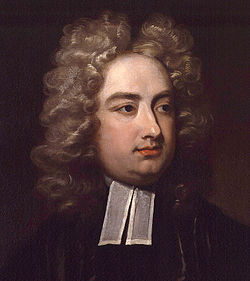
Jonathan Swift
Jonathan Swift was an Irish satirist, essayist, political pamphleteer , poet and cleric who became Dean of St...
(1667–1745), Irish literature in English found its first writer of real genius. Although best known for prose works like Gulliver's Travels
Gulliver's Travels
Travels into Several Remote Nations of the World, in Four Parts. By Lemuel Gulliver, First a Surgeon, and then a Captain of Several Ships, better known simply as Gulliver's Travels , is a novel by Anglo-Irish writer and clergyman Jonathan Swift that is both a satire on human nature and a parody of...
and A Tale of a Tub
A Tale of a Tub
A Tale of a Tub was the first major work written by Jonathan Swift, composed between 1694 and 1697 and published in 1704. It is arguably his most difficult satire, and perhaps his most masterly...
, Swift was a poet of considerable talent. Technically close to his English contemporaries Pope
Alexander Pope
Alexander Pope was an 18th-century English poet, best known for his satirical verse and for his translation of Homer. He is the third-most frequently quoted writer in The Oxford Dictionary of Quotations, after Shakespeare and Tennyson...
and Dryden
John Dryden
John Dryden was an influential English poet, literary critic, translator, and playwright who dominated the literary life of Restoration England to such a point that the period came to be known in literary circles as the Age of Dryden.Walter Scott called him "Glorious John." He was made Poet...
, Swift's poetry evinces the same tone of savage satire, and horror of the human body and its functions that characterises much of his prose. Interestingly, Swift also published translations of poems from the Irish.
Oliver Goldsmith
Oliver Goldsmith
Oliver Goldsmith was an Irish writer, poet and physician known for his novel The Vicar of Wakefield , his pastoral poem The Deserted Village , and his plays The Good-Natur'd Man and She Stoops to Conquer...
(1730?–1774) started his literary career as a hack writer
Hack writer
Hack writer is a colloquial and usually pejorative term used to refer to a writer who is paid to write low-quality, rushed articles or books "to order", often with a short deadline. In a fiction-writing context, the term is used to describe writers who are paid to churn out sensational,...
in London, writing on any subject that would pay enough to keep his creditors at bay. He came to belong to the circle of Samuel Johnson
Samuel Johnson
Samuel Johnson , often referred to as Dr. Johnson, was an English author who made lasting contributions to English literature as a poet, essayist, moralist, literary critic, biographer, editor and lexicographer...
, Edmund Burke
Edmund Burke
Edmund Burke PC was an Irish statesman, author, orator, political theorist and philosopher who, after moving to England, served for many years in the House of Commons of Great Britain as a member of the Whig party....
and Sir Joshua Reynolds. His reputation depends mainly on a novel, The Vicar of Wakefield
The Vicar of Wakefield
The Vicar of Wakefield is a novel by Irish author Oliver Goldsmith. It was written in 1761 and 1762, and published in 1766, and was one of the most popular and widely read 18th-century novels among Victorians...
, a play, She Stoops to Conquer
She Stoops to Conquer
She Stoops to Conquer is a comedy by the Irish author Oliver Goldsmith, son of an Anglo-Irish vicar, first performed in London in 1773. The play is a great favourite for study by English literature and theatre classes in Britain and the United States. It is one of the few plays from the 18th...
, and two long poems, The Traveller and The Deserted Village. The last of these may be the first and best poem by an Irish poet in the English pastoral
Pastoral
The adjective pastoral refers to the lifestyle of pastoralists, such as shepherds herding livestock around open areas of land according to seasons and the changing availability of water and pasturage. It also refers to a genre in literature, art or music that depicts such shepherd life in an...
tradition. It has been variously interpreted as a lament for the death of Irish village life under British rule and a protest at the effects of agricultural reform on the English rural landscape.
Weaver Poets and Vernacular Writing
Local cultural differences in areas such as north and east Ulster produced minor, and often only loosely associated, vernacular movements which do not readily fit into the categories of Irish or English literature. For example, the Ulster Weaver PoetsWeaver Poets
Weaver Poets, Rhyming Weaver Poets and Ulster Weaver Poets were a collective group of poets belonging to an artistic movement who were both influenced by and contemporaries of Robert Burns and the Romantic movement.-Origins:...
wrote in an Ulster Scots dialect.
Working class or popular in nature, remaining examples are mostly limited to publication in self-published privately-subscribed limited print runs, newspapers, journals of the time.
The promotion of standard English in education gradually reduced the visibility and influence of such movements. In addition, the polarising effects of the politics of the use of English and Irish language traditions also limited academic and public interest until the studies of John Hewitt from the 1950s onwards. Further impetus was given by more generalised exploration of non-"Irish" and non-"English" cultural identities in the latter decades of the 20th Century.
The 19th century
During the course of the 19th century, political and economic factors resulted in the decline of the Irish language and the concurrent rise of English as the main language of Ireland. This fact is reflected in the poetry of the period.Paradoxically, as soon as English became the dominant language of Irish poetry, the poets began to mine the Irish-language heritage as a source of themes and techniques. J. J. Callanan (1795–1829) was born in Cork and died at a young age in Lisbon. Unlike many other more visibly nationalist poets who would follow later, he knew Irish well, and several of his poems are loose versions of Irish originals. Although extremely close to Irish materials, he was also profoundly influenced by Byron and his peers; possibly his finest poem, the title work of The Recluse of Inchidony and Other Poems (1829), was written in Spenserian stanzas that were clearly inspired by Childe Harold's Pilgrimage. Probably the most renowned Irish poet to write in English in a recognisably Irish fashion in the first half of the 19th century was Thomas Moore
Thomas Moore
Thomas Moore was an Irish poet, singer, songwriter, and entertainer, now best remembered for the lyrics of The Minstrel Boy and The Last Rose of Summer. He was responsible, with John Murray, for burning Lord Byron's memoirs after his death...
(1779–1852), although he had no knowledge of, and little respect for, the Irish language. He attended Trinity College Dublin at the same time as the revolutionary Robert Emmet, who was executed in 1803. Moore's most enduring work, Irish Melodies, was popular with English audiences. The poems are, perhaps, somewhat overloaded with harps, bards and minstrels of Erin to suit modern tastes, but they did open up the possibility of a distinctive Irish English-language poetic tradition and served as an exemplar for Irish poets to come. In 1842, Charles Gavan Duffy
Charles Gavan Duffy
Additional Reading*, Allen & Unwin, 1973.*John Mitchel, A Cause Too Many, Aidan Hegarty, Camlane Press.*Thomas Davis, The Thinker and Teacher, Arthur Griffith, M.H. Gill & Son 1922....
(1816–1903), Thomas Davis
Thomas Osborne Davis (Irish politician)
Thomas Osborne Davis was a revolutionary Irish writer who was the chief organizer and poet of the Young Ireland movement.-Early life:...
, (1814–1845), and John Blake Dillon
John Blake Dillon
John Blake Dillon was an Irish writer and Politician who was one of the founding members of the Young Ireland movement....
(1816–1866) founded The Nation
The Nation (Irish newspaper)
The Nation was an Irish nationalist weekly newspaper, published in the 19th century. The Nation was printed first at 12 Trinity Street, Dublin, on 15 October 1842, until 6 January 1844...
to agitate for reform of British rule. The group of politicians and writers associated with The Nation came to be known as the Young Irelanders. The magazine published verse, including work by Duffy and Davis, whose A Nation Once Again is still popular among Irish Nationalists. However, the most significant poet associated with The Nation was undoubtedly James Clarence Mangan
James Clarence Mangan
James Clarence Mangan, born James Mangan was an Irish poet.-Early life:Mangan was the son of a former hedge school teacher who took over a grocery business and eventually became bankrupt....
(1803–1849). Mangan was a true poète maudit
Poète maudit
A poète maudit is a poet living a life outside or against society. Abuse of drugs and alcohol, insanity, crime, violence, and in general any societal sin, often resulting in an early death are typical elements of the biography of a poète maudit....
, who threw himself into the role of bard, and even included translations of bardic poems in his publications.
Another poet who supported the Young Irelanders, although not directly connected with them, was Samuel Ferguson
Samuel Ferguson
Sir Samuel Ferguson was an Irish poet, barrister, antiquarian, artist and public servant. Perhaps the most important Ulster-Scot poet of the 19th century, because of his interest in Irish mythology and early Irish history he can be seen as a forerunner of William Butler Yeats and the other poets...
(1810–1886). Ferguson once wrote: 'my ambition (is) to raise the native elements of Irish history to a dignified level.' To this end, he wrote many verse retellings of the Old Irish sagas. He also wrote a moving elegy to Thomas Davis. Ferguson, who believed that Ireland's political fate ultimately lay within the Union, brought a new scholarly exactitude to the study and translation of Irish texts. William Allingham
William Allingham
William Allingham was an Irish man of letters and a poet.-Biography:He was born in Ballyshannon, County Donegal, Ireland and was the son of the manager of a local bank who was of English descent...
(1824–1889) was another important Unionist figure in Irish poetry. Born and bred in Ballyshannon, Donegal, he spent most of his working life in England and was associated with the Pre-Raphaelite movement, and a close friend of Tennyson. His Day and Night Songs was illustrated by Dante Gabriel Rossetti
Dante Gabriel Rossetti
Dante Gabriel Rossetti was an English poet, illustrator, painter and translator. He founded the Pre-Raphaelite Brotherhood in 1848 with William Holman Hunt and John Everett Millais, and was later to be the main inspiration for a second generation of artists and writers influenced by the movement,...
and Millais. His most important work is the long poem, Laurence Bloomfield in Ireland (1864), a realist narrative which wittily and movingly deals with the land agitation in Ireland during the period. He was also known for his work as a collector of folk ballads in both Ireland and England.
Ferguson's research opened the way for many of the achievements of the Celtic Revival, especially those of Yeats
Yeats
W. B. Yeats was an Irish poet and playwright.Yeats may also refer to:* Yeats ,* Yeats , an impact crater on Mercury* Yeats , an Irish thoroughbred racehorse-See also:...
and Douglas Hyde
Douglas Hyde
Douglas Hyde , known as An Craoibhín Aoibhinn , was an Irish scholar of the Irish language who served as the first President of Ireland from 1938 to 1945...
, but this narrative of Irish poetry which leads to the Revival as culmination can also be deceptive and occlude important poetry, such as the work of James Henry
James Henry (poet)
James Henry was an Irish classical scholar and poet.-Life:He was born in Dublin the son of a woollen draper, Robert Henry, and his wife Kathleen Elder. He was educated by Unitarian schoolmasters and then at Trinity College, Dublin...
(1798–1876), medical doctor, Virgil scholar and poet. His large body of work was completely overlooked until Christopher Ricks included him in two anthologies, and eventually edited a selection of his poetry. Various in his means, cosmopolitan in his range and possessed of an acute wit, Henry shows the negative force of nationalism in Irish criticism: his omission from standard accounts and anthologies for over 100 years can only be due to his blithe disregard of the matter of Ireland. 'Irish poetry', James's example suggests, does not always have to be about Ireland.
Folk songs and poems
During the 19th century, poetry in Irish became essentially a folk art. One of the few well-known figures from this period was Antoine Ó Raifteiri (Anthony Raftery)Antoine Ó Raifteiri
Antoine Ó Raifteiri was an Irish language poet who is often called the last of the wandering bards.-Biography:...
(1784–1835), who is known as the last of the wandering bards. His Mise Raifteiri an file is still learned by heart in some Irish schools. In addition, this was one of the great periods for the composition of folk songs in both languages, and the majority of the traditional singer's repertoire is typically made up of 19th century songs.
The Celtic revival
Probably the most significant poetic movement of the second half of the 19th century was French Symbolism. This movement inevitably influenced Irish writers, not least Oscar WildeOscar Wilde
Oscar Fingal O'Flahertie Wills Wilde was an Irish writer and poet. After writing in different forms throughout the 1880s, he became one of London's most popular playwrights in the early 1890s...
(1845–1900). Although Wilde is best known for his plays, fiction, and The Ballad of Reading Gaol
The Ballad of Reading Gaol
The Ballad of Reading Gaol is a poem by Oscar Wilde, written in exile either in Berneval or in Dieppe, France, after his release from Reading Gaol on or about 19 May 1897. Wilde had been incarcerated in Reading, after being convicted of homosexual offences in 1895 and sentenced to two years' hard...
, he also wrote poetry in a symbolist vein and was the first Irish writer to experiment with prose poetry
Prose poetry
Prose poetry is poetry written in prose instead of using verse but preserving poetic qualities such as heightened imagery and emotional effects.-Characteristics:Prose poetry can be considered either primarily poetry or prose, or a separate genre altogether...
. However, the overtly cosmopolitan Wilde was not to have much influence on the future course of Irish writing. W. B. Yeats (1865–1939) was much more influential in the long run. Yeats, too, was influenced by his French contemporaries but consciously focused on an identifiably Irish content. As such, he was responsible for the establishment of the literary movement known as the Celtic Revival
Celtic Revival
Celtic Revival covers a variety of movements and trends, mostly in the 19th and 20th centuries, which drew on the traditions of Celtic literature and Celtic art, or in fact more often what art historians call Insular art...
. He won the Nobel Prize in Literature
Nobel Prize in Literature
Since 1901, the Nobel Prize in Literature has been awarded annually to an author from any country who has, in the words from the will of Alfred Nobel, produced "in the field of literature the most outstanding work in an ideal direction"...
in 1923. Apart from Yeats, much of the impetus for the Celtic Revival came from the work of scholarly translators who were aiding in the discovery of both the ancient sagas and Ossianic poetry and the more recent folk song tradition in Irish. One of the most significant of these was Douglas Hyde
Douglas Hyde
Douglas Hyde , known as An Craoibhín Aoibhinn , was an Irish scholar of the Irish language who served as the first President of Ireland from 1938 to 1945...
(1860–1949), later the first President of Ireland
President of Ireland
The President of Ireland is the head of state of Ireland. The President is usually directly elected by the people for seven years, and can be elected for a maximum of two terms. The presidency is largely a ceremonial office, but the President does exercise certain limited powers with absolute...
, whose Love Songs of Connacht was widely admired.
Yeats and modernism
In the 1910s, Yeats became acquainted with the work of James JoyceJames Joyce
James Augustine Aloysius Joyce was an Irish novelist and poet, considered to be one of the most influential writers in the modernist avant-garde of the early 20th century...
, and worked closely with Ezra Pound
Ezra Pound
Ezra Weston Loomis Pound was an American expatriate poet and critic and a major figure in the early modernist movement in poetry...
, who served as his personal secretary for a time. Through Pound, Yeats also became familiar with the work of a range of prominent modernist
Modernist poetry
Modernist poetry refers to poetry written between 1890 and 1950 in the tradition of modernist literature in the English language, but the dates of the term depend upon a number of factors, including the nation of origin, the particular school in question, and the biases of the critic setting the...
poets. He undoubtedly learned from these contacts, and from his 1916
1916 in poetry
-- Closing lines of "Easter 1916" by William Butler Yeats, first published this yearNationality words link to articles with information on the nation's poetry or literature .-Events:...
book Responsibilities and Other Poems
Responsibilities and Other Poems
-Publication history:Responsibilities and a Play was printed and published by Yeat's sister, Elizabeth Corbet Yeats, at the Cuala Press in 1914. 400 copies were published....
onwards his work, while not entirely meriting the label modernist, became much more hard-edged than it had been.
A second group of early 20th century Irish poets worth noting are those associated with the Easter Rising
Easter Rising
The Easter Rising was an insurrection staged in Ireland during Easter Week, 1916. The Rising was mounted by Irish republicans with the aims of ending British rule in Ireland and establishing the Irish Republic at a time when the British Empire was heavily engaged in the First World War...
of 1916. Three of the Republican leadership, Patrick Pearse
Patrick Pearse
Patrick Henry Pearse was an Irish teacher, barrister, poet, writer, nationalist and political activist who was one of the leaders of the Easter Rising in 1916...
(1879–1916), Joseph Mary Plunkett
Joseph Mary Plunkett
Joseph Mary Plunkett was an Irish nationalist, poet, journalist, and a leader of the 1916 Easter Rising.-Background:...
(1879–1916) and Thomas MacDonagh
Thomas MacDonagh
Thomas MacDonagh was an Irish nationalist, poet, playwright, and a leader of the 1916 Easter Rising.-Early life:MacDonagh was born in Cloughjordan, County Tipperary...
(1878–1916), were noted poets. Although much of the verse written by them is predictably Catholic
Catholic
The word catholic comes from the Greek phrase , meaning "on the whole," "according to the whole" or "in general", and is a combination of the Greek words meaning "about" and meaning "whole"...
and Nationalist in outlook, they were competent writers and their work is of considerable historical interest. Pearse, in particular, shows the influence of his contact with the work of Walt Whitman
Walt Whitman
Walter "Walt" Whitman was an American poet, essayist and journalist. A humanist, he was a part of the transition between transcendentalism and realism, incorporating both views in his works. Whitman is among the most influential poets in the American canon, often called the father of free verse...
. Individual from these groups is the Boyne Valley "peasant poet" Francis Ledwidge
Francis Ledwidge
Francis Edward Ledwidge was an Irish war poet from County Meath. Sometimes known as the "poet of the blackbirds", he was killed in action at the Battle of Passchendaele during World War I.-Early life:...
, killed in 1917 in World War I
World War I
World War I , which was predominantly called the World War or the Great War from its occurrence until 1939, and the First World War or World War I thereafter, was a major war centred in Europe that began on 28 July 1914 and lasted until 11 November 1918...
.
However, it was to be Yeats' earlier Celtic mode that was to be most influential. Amongst the most prominent followers of the early Yeats were Padraic Colum
Padraic Colum
Padraic Colum was an Irish poet, novelist, dramatist, biographer, playwright, children's author and collector of folklore. He was one of the leading figures of the Celtic Revival.-Early life:...
(1881–1972), F. R. Higgins
F. R. Higgins
Frederick Robert Higgins was an Irish poet and theatre director.-Early years:Higgins was born on the west coast of Ireland in Foxford, which is located in County Mayo...
(1896–1941), and Austin Clarke
Austin Clarke (poet)
thumb|300px|Austin Clarke Bridge in [[Templeogue]]Austin Clarke was one of the leading Irish poets of the generation after W. B. Yeats. He also wrote plays, novels and memoirs...
(1896–1974). In the 1950s, Clarke, returning to poetry after a long absence, turned to a much more personal style and wrote many satires on Irish society and religious practices. Irish poetic Modernism took its lead not from Yeats but from Joyce. The 1930s saw the emergence of a generation of writers who engaged in experimental writing as a matter of course. The best known of these is Samuel Beckett
Samuel Beckett
Samuel Barclay Beckett was an Irish avant-garde novelist, playwright, theatre director, and poet. He wrote both in English and French. His work offers a bleak, tragicomic outlook on human nature, often coupled with black comedy and gallows humour.Beckett is widely regarded as among the most...
(1906–1989), who won the Nobel Prize in Literature in 1969. Beckett's poetry, while not inconsiderable, is not what he is best known for. The most significant of the second generation Modernist Irish poets who first published in the 1920s and 1930s include Brian Coffey
Brian Coffey
Brian Coffey was an Irish poet and publisher. His work was informed by his Catholicism and by his background in science and philosophy, and his connection to surrealism. For these reasons, he is seen as being closer to an intellectual European Catholic tradition than to mainstream Irish Catholic...
(1905–1995), Denis Devlin
Denis Devlin
Denis Devlin was, along with Samuel Beckett and Brian Coffey, one of the generation of Irish modernist poets to emerge at the end of the 1920s. He was also a career diplomat.-Early life and studies:...
(1908–1959), Thomas MacGreevy
Thomas MacGreevy
Thomas MacGreevy was a pivotal figure in the history of Irish literary modernism. A poet, he was also director of the National Gallery of Ireland from 1950 to 1963 and served on the first Irish Arts Council .-Early life:MacGreevy was born in County Kerry, the son of a policeman and a primary...
(1893–1967), Blanaid Salkeld
Blanaid Salkeld
Blanaid Salkeld was an Irish poet, dramatist, and actor, whose well-known literary salon was attended by, among others, Patrick Kavanagh and Flann O'Brien...
(1880–1959), and Mary Devenport O'Neill
Mary Devenport O'Neill
Mary Devenport O'Neill was an Irish poet and dramatist and a friend and colleague of W. B. Yeats, George Russell,and Austin Clarke....
(1879–1967). Coffey's two late long poems Advent (1975) and Death of Hektor (1982) are perhaps his most important works; the latter deals with the theme of nuclear apocalypse through motifs from Greek mythology. Of this group, Devlin is the least experimental; his friendship with Allen Tate while working at the Irish embassy in Washington is one index of the traditional tendencies of his verse. Long poems such as 'Lough Derg' (1946) and 'The Heavenly Foreigner' (written in the late 1940s and early '50s) explore ideas of Catholicism and Europe in a densely imagistic and occasionally obscure style.
While Yeats and his followers wrote about an essentially aristocratic Gaelic Ireland, the reality was that the actual Irish Free State
Irish Free State
The Irish Free State was the state established as a Dominion on 6 December 1922 under the Anglo-Irish Treaty, signed by the British government and Irish representatives exactly twelve months beforehand...
of the 1930s and 1940s was a society of small farmers and shopkeepers. Inevitably, a generation of poets who rebelled against the example of Yeats, but who were not Modernist by inclination, emerged from this environment. Patrick Kavanagh
Patrick Kavanagh
Patrick Kavanagh was an Irish poet and novelist. Regarded as one of the foremost poets of the 20th century, his best known works include the novel Tarry Flynn and the poems Raglan Road and The Great Hunger...
(1904–1967), who came from a small farm, wrote about the narrowness and frustrations of rural life. John Hewitt (1907–1987), whom many consider to be the founding father of Northern Irish
Northern Ireland
Northern Ireland is one of the four countries of the United Kingdom. Situated in the north-east of the island of Ireland, it shares a border with the Republic of Ireland to the south and west...
poetry, also came from a rural background but lived in Belfast and was amongst the first Irish poets to write of the sense of alienation that many at this time felt from both their original rural and new urban homes. Louis MacNeice
Louis MacNeice
Frederick Louis MacNeice CBE was an Irish poet and playwright. He was part of the generation of "thirties poets" which included W. H. Auden, Stephen Spender and Cecil Day-Lewis; nicknamed "MacSpaunday" as a group — a name invented by Roy Campbell, in his Talking Bronco...
(1907–1963), another Northern Irish poet, was associated with the left-wing politics of Michael Roberts
Michael Roberts (writer)
Michael Roberts , originally named William Edward Roberts, was an English poet, writer, critic and broadcaster, who made his living as a teacher.-Life:...
's anthology New Signatures but was much less political a poet than W. H. Auden
W. H. Auden
Wystan Hugh Auden , who published as W. H. Auden, was an Anglo-American poet,The first definition of "Anglo-American" in the OED is: "Of, belonging to, or involving both England and America." See also the definition "English in origin or birth, American by settlement or citizenship" in See also...
or Stephen Spender
Stephen Spender
Sir Stephen Harold Spender CBE was an English poet, novelist and essayist who concentrated on themes of social injustice and the class struggle in his work...
, for example. MacNeice's poetry was informed by his immediate interests and surroundings and is more social than political. In the South, the Republic of Ireland, a post-modernist generation of poets and writers emerged from the late 1950s onwards. Prominent among these writers were the poets Antony Cronin, Pearse Hutchinson, John Jordan, Thomas Kinsella and John Montague, most of whom were based in Dublin in the 1960s and 1970s. In Dublin a number of new literary magazines were founded in the 1960s; Poetry Ireland
Poetry Ireland
Poetry Ireland is an organisation for poets and poetry, in both Irish and English, in the island of Ireland. It is a public body that receives support from The Arts Council of Ireland and The Arts Council of Northern Ireland. It was founded in 1978 by John F. Deane and is based in Proud's Lane,...
, Arena, The Lace Curtain, and in the 1970s, Cyphers.
Poetry in Irish
With the foundation of the Irish Free State it became official government policy to promote and protect the Irish language. Although not particularly successful, this policy did help bring about a revival in Irish-language literature. Specifically, the establishment in 1926 of An GúmAn Gúm
An Gúm was an Irish state company tasked with the publication of Irish literature, especially educational materials.The agency is now part of Foras na Gaeilge. Its mission statement is "To produce publications and resources in support of Irish-medium education and of the use of Irish in general."...
("The Project"), a Government sponsored publisher, created an outlet both for original works in Irish and for translations into the language.
Since then, a number of Irish-language poets have come to prominence. These include Máirtín Ó Direáin
Máirtín Ó Direáin
Máirtín Ó Direáin born in Sruthán on Inismór in the Aran Islands was an Irish language poet.The son of a small-farmer, Máirtín Ó Direáin spoke only Irish until his mid-teens. He worked as a civil servant from 1928 until 1975...
(1910–1988), Seán Ó Ríordáin
Seán Ó Ríordáin
-Life:He was born in Baile Mhúirne, County Cork, the eldest of three children of Seán Ó Ríordáin of Baile Mhúirne and Mairéad Ní Loineacháin of Cúil Ealta....
(1916–1977), Máire Mhac an tSaoi
Máire Mhac an tSaoi
-Background:Mhac an tSaoi was born as Máire MacEntee in Dublin in 1922. Her father, Seán MacEntee, a native of Belfast, was a founding member of Fianna Fáil, a long-serving TD and Tánaiste in the Dáil and a participant in the Easter Rising of 1916. Her mother, County Tipperary-born Margaret Browne...
(born 1922), Michael Hartnett
Michael Hartnett
Michael Hartnett was an Irish poet who wrote in both English and Irish. He was one of the most significant voices in late 20th century Irish writing and has been called "Munster's de facto poet laureate"....
(born 1941), Gabriel Rosenstock
Gabriel Rosenstock
Gabriel Rosenstock is an Irish poet, haiku writer, translator and author. He was born in Kilfinane, County Limerick in 1949. He currently resides in Dublin.-Biography:...
(born 1949), and Nuala Ní Dhomhnaill
Nuala Ní Dhomhnaill
Nuala Ní Dhomhnaill is an Irish poet.Born in Lancashire, England in 1952, of Irish parents, she moved to Ireland at the age of 5, and was brought up in the Dingle Gaeltacht and in Nenagh, County Tipperary. Her uncle is Monsignor Pádraig Ó Fiannachta of An Daingean, the leading authority alive on...
(born 1952). While all these poets are influenced by the Irish poetic tradition, they have also shown the ability to assimilate influences from poetries in other languages. The dramatist and actor Micheál MacLiammóir
Micheál MacLiammóir
Micheál Mac Liammóir , born Alfred Willmore, was an English-born Irish actor, dramatist, impresario, writer, poet and painter. Mac Liammóir was born to a Protestant family living in the Kensal Green neighbourhood of London....
(1899–1978) included many poetic verses he wrote in the Irish-language in his works.
The Northern School
The Northern Irish poets have already been mentioned in connection with John Hewitt. Of course, there were others of some importance too, including Robert GreacenRobert Greacen
Robert Greacen was an Irish poet and member of Aosdána. Born in Derry, Ireland, on 24 October 1920, he was educated at Methodist College Belfast and Trinity College Dublin...
(1920–2008), who along Valentin Iremonger edited an important anthology, Contemporary Irish Poetry in 1949. Greacen was born in Derry, lived in Belfast in his youth and then in London during the 1950s, 60s and 70s. He won the Irish Times Prize for Poetry in 1995 for his Collected Poems, after he returned to live in Dublin when he was elected a member of Aosdana. Other poets of note from this time include Roy McFadden
Roy McFadden
-External links:* http://www.pgil-eirdata.org/html/pgil_datasets/authors/Mc/McFadden,R/life.htm* http://www.kennys.ie/categories/irishwriters/mcfaddenroy.php* http://www.sarahferris.co.uk/pages/roymcfadden.htm* http://www.jstor.org/pss/29735944...
(1921–1999), a friend for many years of Greacen. Another Northern poet of note is Padraic Fiacc
Padraic Fiacc
Padraic Fiacc is an Irish poet, and member of Aosdána, the exclusive Irish Arts Academy.- Biographical information :...
(1924- ), who was born in Belfast, but lived in America during his youth. In the 1960s, and coincident with the rise of the Troubles
The Troubles
The Troubles was a period of ethno-political conflict in Northern Ireland which spilled over at various times into England, the Republic of Ireland, and mainland Europe. The duration of the Troubles is conventionally dated from the late 1960s and considered by many to have ended with the Belfast...
in the province, a number of Ulster
Ulster
Ulster is one of the four provinces of Ireland, located in the north of the island. In ancient Ireland, it was one of the fifths ruled by a "king of over-kings" . Following the Norman invasion of Ireland, the ancient kingdoms were shired into a number of counties for administrative and judicial...
poets began to receive critical and public notice. Prominent amongst these were John Montague
John Montague (poet)
John Montague is an Irish poet. He was born in New York and brought up in Tyrone. He has published a number of volumes of poetry, two collections of short stories and two volumes of memoir. He is one of the best known Irish contemporary poets...
(born 1929), Michael Longley
Michael Longley
Michael Longley, CBE is a Northern Irish poet from Belfast.-Life and career:Longley was educated at the Royal Belfast Academical Institution and subsequently read Classics at Trinity College, Dublin, where he edited Icarus...
(born 1939), Derek Mahon (born 1941), Seamus Heaney
Seamus Heaney
Seamus Heaney is an Irish poet, writer and lecturer. He lives in Dublin. Heaney has received the Nobel Prize in Literature , the Golden Wreath of Poetry , T. S. Eliot Prize and two Whitbread prizes...
(born 1939), and Paul Muldoon
Paul Muldoon
Paul Muldoon is an Irish poet. He has published over thirty collections and won a Pulitzer Prize for Poetry and the T. S. Eliot Prize. He held the post of Oxford Professor of Poetry from 1999 - 2004. At Princeton University he is both the Howard G. B. Clark ’21 Professor in the Humanities and...
(born 1951).
Heaney is probably the best-known of these poets. He won the Nobel Prize in Literature
Nobel Prize in Literature
Since 1901, the Nobel Prize in Literature has been awarded annually to an author from any country who has, in the words from the will of Alfred Nobel, produced "in the field of literature the most outstanding work in an ideal direction"...
in 1995, and has served as Boylston Professor of Rhetoric and Oratory and Emerson Poet in Residence at Harvard
Harvard University
Harvard University is a private Ivy League university located in Cambridge, Massachusetts, United States, established in 1636 by the Massachusetts legislature. Harvard is the oldest institution of higher learning in the United States and the first corporation chartered in the country...
, and as Professor of Poetry at Oxford
University of Oxford
The University of Oxford is a university located in Oxford, United Kingdom. It is the second-oldest surviving university in the world and the oldest in the English-speaking world. Although its exact date of foundation is unclear, there is evidence of teaching as far back as 1096...
. Derek Mahon was born in Belfast and worked as a journalist, editor, and screenwriter while publishing his first books. His slim output should not obscure the high quality of his work, which is influenced by modernist writers such as Samuel Beckett
Samuel Beckett
Samuel Barclay Beckett was an Irish avant-garde novelist, playwright, theatre director, and poet. He wrote both in English and French. His work offers a bleak, tragicomic outlook on human nature, often coupled with black comedy and gallows humour.Beckett is widely regarded as among the most...
.
Muldoon is Howard G. B. Clark '21 Professor in the Humanities at Princeton University
Princeton University
Princeton University is a private research university located in Princeton, New Jersey, United States. The school is one of the eight universities of the Ivy League, and is one of the nine Colonial Colleges founded before the American Revolution....
. In 1999 he was also elected Professor of Poetry at the University of Oxford. Some critics find that these poets share some formal traits (including an interest in traditional poetic forms) as well as a willingness to engage with the difficult political situation in Northern Ireland. Others (such as the Dublin poet Thomas Kinsella
Thomas Kinsella
Thomas Kinsella is an Irish poet, translator, editor, and publisher.-Early life and work:Kinsella was born in Lucan, County Dublin. He spent much of his childhood with relatives in rural Ireland. He was educated in the Irish language at the Model School, Inchicore and the O'Connell Christian...
) have found the whole idea of a Northern school to be more hype than reality, though this view is not widely held.
Experiment
In the late 1960s, two young Irish poets, Michael SmithMichael Smith (poet)
Michael Smith is an Irish poet, author and translator.A member of Aosdána, the Irish National Academy of Artists, Michael Smith was the first Writer in-Residence to be appointed by University College, Dublin and is an Honorary Fellow of UCD. He is a poet who has given a lifetime of service to the...
(b. 1942) and Trevor Joyce
Trevor Joyce
Trevor Joyce is an Irish poet, born in Dublin.He co-founded New Writers' Press in Dublin in 1967 and was a founding editor of NWP's The Lace Curtain; A Magazine of Poetry and Criticism in 1968....
(b. 1947) founded the New Writers Press
New Writers Press
New Writers Press is an Irish small press that specialises in poetry publishing. The press was founded in 1967 by the poets Michael Smith and Trevor Joyce and Smith's wife Irene in response to what they felt to be the stagnant state of Irish poetry at the time....
publishing house and a journal called The Lace Curtain
The Lace Curtain
The Lace Curtain was an occasional literary magazine founded and edited by Michael Smith and Trevor Joyce under their New Writers Press imprint...
. Initially this was to publish their own work and that of some like-minded friends (including Paul Durcan, Michael Hartnett and Gerry Smyth), and later to promote the work of neglected Irish modernists like Brian Coffey
Brian Coffey
Brian Coffey was an Irish poet and publisher. His work was informed by his Catholicism and by his background in science and philosophy, and his connection to surrealism. For these reasons, he is seen as being closer to an intellectual European Catholic tradition than to mainstream Irish Catholic...
and Denis Devlin
Denis Devlin
Denis Devlin was, along with Samuel Beckett and Brian Coffey, one of the generation of Irish modernist poets to emerge at the end of the 1920s. He was also a career diplomat.-Early life and studies:...
. Both Joyce and Smith have published considerable bodies of poetry in their own right. Among the other poets published by the New Writers Press were Geoffrey Squires
Geoffrey Squires
Geoffrey Squires is an Irish poet who works in what might loosely be termed the modernist tradition.-Early life:While born in Derry, he grew up in County Donegal, Republic of Ireland...
(born 1942), whose early work was influenced by Charles Olson
Charles Olson
Charles Olson , was a second generation American modernist poet who was a link between earlier figures such as Ezra Pound and William Carlos Williams and the New American poets, which includes the New York School, the Black Mountain School, the Beat poets, and the San Francisco Renaissance...
, and Augustus Young
Augustus Young
For the U.S. Representative from Vermont, see Augustus Young .Augustus Young is an Irish poet.-Biography:Young worked in London as an epidemiologist and adviser to health authorities, and now lives in France...
(born 1943), who admired Pound and who has translated older Irish poetry, as well as work from Latin America and poems by Bertolt Brecht
Bertolt Brecht
Bertolt Brecht was a German poet, playwright, and theatre director.An influential theatre practitioner of the 20th century, Brecht made equally significant contributions to dramaturgy and theatrical production, the latter particularly through the seismic impact of the tours undertaken by the...
. Younger poets who write what might be called experimental poetry include Maurice Scully
Maurice Scully
Maurice Scully is an Irish poet who works in the modernist tradition. Scully was born in Dublin & educated at Trinity College.Scully's books include Love Poems & Others , 5 Freedoms of Movement , Steps , Livelihood , Sonata, , Tig and Humming...
(born 1952), and Randolph Healy
Randolph Healy
Randolph Healy is an Irish poet and publisher.Healy was born in Scotland and moved to Dublin at the age of 18 months. After leaving school at the age of 14 to work in a number of jobs, he returned to full-time education and graduated in mathematical sciences from Trinity College, Dublin. He now...
(born 1956). Many of these poets along with many younger experimentalists have performed their work at the annual SoundEye Festival
SoundEye Festival
The SoundEye Festival of the Arts of the Word is an annual festival dedicated to poetry and other artistic practices predicated on the power of word and text. It is held in Cork City, taking up the best part of a week in late-June to mid-July...
in Cork, which has been recognised as an important event not just for Irish poetry, but for innovative work internationally.
Outsiders
In addition to these two loose groupings, a number of prominent Irish poets of the second half of the 20th century could be described as outsiders, although these poets could also be considered leaders of a mainstream tradition in the Republic which was critically eclipsed by the Ulster-centric focus of American and British-based Irish Studies academics and the prejudices of others who are gender study specialists. These include Thomas KinsellaThomas Kinsella
Thomas Kinsella is an Irish poet, translator, editor, and publisher.-Early life and work:Kinsella was born in Lucan, County Dublin. He spent much of his childhood with relatives in rural Ireland. He was educated in the Irish language at the Model School, Inchicore and the O'Connell Christian...
(born 1928), whose early work was influenced by Auden. Kinsella's later work exhibits the influence of Pound in its looser metrical structure and use of image
Image
An image is an artifact, for example a two-dimensional picture, that has a similar appearance to some subject—usually a physical object or a person.-Characteristics:...
ry but is deeply personal in manner and matter. He is Professor of English at Temple University, Philadelphia. Kinsella also edited the poetry of Austin Clarke, who, in his later work at least, could also be included with the outsiders in Irish poetry.
John Jordan
John Jordan (poet)
John Jordan was an Irish poet born in Dublin on 8 April 1930. He was educated at Synge Street CBS, University College, Dublin and Pembroke College, Oxford. In his teens he acted on the stage of the Gate Theatre, Dublin, before winning a Scholarship in English and French to Oxford University from...
(1930–1988) was an Irish poet born in Dublin on 8 April 1930. He was educated at Synge Street CBS, University College, Dublin (U.C.D.) and Pembroke College, Oxford. In his teens he acted on the stage of the Gate Theatre, Dublin, before winning a Scholarship in English and French to Oxford University from U.C.D. In the mid-1950s he returned to U.C.D. as a lecturer in English and taught there until the end of the 1960s. He was a celebrated literary critic from the late 1950s until his death in June, 1988 in Cardiff, Wales, where he had participated in the Merriman Summer School.
He was also a short-story writer, a poet and a broadcaster. In 1962 he re-founded and edited the literary magazine Poetry Ireland
Poetry Ireland
Poetry Ireland is an organisation for poets and poetry, in both Irish and English, in the island of Ireland. It is a public body that receives support from The Arts Council of Ireland and The Arts Council of Northern Ireland. It was founded in 1978 by John F. Deane and is based in Proud's Lane,...
. In this journal, he introduced a number of poets who were to become quite famous later, including Paul Durcan
Paul Durcan
Paul Durcan is a contemporary Irish poet.-Early life:Durcan grew up in Dublin and in Turlough, County Mayo. His father, John, was a barrister and circuit court judge; father and son had a difficult and formal relationship. Durcan enjoyed a warmer and more natural relationship with his mother,...
, Michael Hartnett
Michael Hartnett
Michael Hartnett was an Irish poet who wrote in both English and Irish. He was one of the most significant voices in late 20th century Irish writing and has been called "Munster's de facto poet laureate"....
and Seamus Heaney
Seamus Heaney
Seamus Heaney is an Irish poet, writer and lecturer. He lives in Dublin. Heaney has received the Nobel Prize in Literature , the Golden Wreath of Poetry , T. S. Eliot Prize and two Whitbread prizes...
. This first series of Poetry Ireland lasted until 1968–69. In 1981 he became the first editor of the new magazine published by the Poetry Ireland
Poetry Ireland
Poetry Ireland is an organisation for poets and poetry, in both Irish and English, in the island of Ireland. It is a public body that receives support from The Arts Council of Ireland and The Arts Council of Northern Ireland. It was founded in 1978 by John F. Deane and is based in Proud's Lane,...
, called Poetry Ireland Review
Poetry Ireland Review
Poetry Ireland Review is a journal of Irish poetry published quarterly by Poetry Ireland, the national Irish poetry organization.Poetry Ireland Review publishes the work of both emerging and established Irish and international poets. In line with keeping the journal fresh, vibrant and progressive...
. His Collected Poems (Dedalus Press) and Collected Stories (Poolbeg Press) were edited by his literary executor, Hugh McFadden
Hugh McFadden
Hugh McFadden is an Irish poet, literary editor, executor and freelance journalist.-Early life:McFadden was born in Derry, Northern Ireland, where he lived briefly, and then moved to County Donegal, Republic of Ireland, before moving to Dublin...
, and published in Dublin in 1991. His Selected Prose, Crystal Clear, also edited by McFadden, was published by Lilliput Press in Dublin in 2006. Jordan's Selected Poems, edited with an Introduction by Hugh McFadden, was published in February 2008 by Dedalus Press.
Basil Payne
Basil Payne
- Life and work :Payne was educated at Synge Street CBS and University College Dublin. In the 1960s he held many poetry readings in Dublin, and in 1964 he won a Guinness International poetry prize, followed by another Guinness International prize in 1966...
(1923) was born in Dublin on June 23, 1923. Like John Jordan, he was educated at Synge Street CBS and University College, Dublin. In the 1960´s he held many poetry readings in Dublin, and in 1964 he won a Guinness International poetry prize, followed by another Guinness International prize in 1966. From 1972 to 1978 he lectured in literature at several universities in the USA, and in 1975 he received the Governor's Special Citation for unique contribution to the Arts in New Jersey. His published work amounts to three slim volumes, and numerous inclusions in anthologies of Irish poetry. According to the website run by his son, a more voluminous work, Dark and Light Fantastic, remains unpublished.
Michael Hartnett (1941–1999) was unusual amongst Irish poets in that he was equally fluent in both Irish and English. As well as original work in both languages, including haiku in English, he published translations in English of bardic poetry and of the Tao Te Ching
Tao Te Ching
The Tao Te Ching, Dao De Jing, or Daodejing , also simply referred to as the Laozi, whose authorship has been attributed to Laozi, is a Chinese classic text...
. In his 1975 book A Farewell to English he declared his intention to write only in Irish in the future, describing English as 'the perfect language to sell pigs in'. A number of volumes in Irish followed: Adharca Broic (1978), An Phurgóid (1983) and Do Nuala: Foighne Chrainn (1984). In 1984 he returned to Dublin to live in the suburb of Inchicore. The following year marked his return to English with the publication of Inchicore Haiku, a book that deals with the turbulent events in his personal life over the previous few years. This was followed by a number of books in English including A Necklace of Wrens (1987), Poems to Younger Women (1989) and The Killing of Dreams (1992). He died in Dublin in 1999, aged 58.
Eoghan Ó Tuairisc
Eoghan Ó Tuairisc
Eoghan Ó Tuairisc was an Irish poet and writer.-Life:He was a native of Ballinasloe, County Galway and was educated at Garbally College. His entered St. Patrick’s Teacher Training College, Drumcondra in 1939, graduating with a Diploma in Education in 1945...
(Eugene Watters) (1919–1982) was another bilingual poet. His The Weekend of Dermot and Grace (1964) is one of the most interesting Irish long poems of the second half of the 20th century and one of the few examples of the application of the lessons of T. S. Eliot
T. S. Eliot
Thomas Stearns "T. S." Eliot OM was a playwright, literary critic, and arguably the most important English-language poet of the 20th century. Although he was born an American he moved to the United Kingdom in 1914 and was naturalised as a British subject in 1927 at age 39.The poem that made his...
's The Waste Land
The Waste Land
The Waste Land[A] is a 434-line[B] modernist poem by T. S. Eliot published in 1922. It has been called "one of the most important poems of the 20th century." Despite the poem's obscurity—its shifts between satire and prophecy, its abrupt and unannounced changes of speaker, location and time, its...
in any work by an Irish poet. Patrick Galvin
Patrick Galvin
Patrick Galvin was an Irish poet, singer, playwright, and prose and screen writer born in Cork's inner city.-Biography:Galvin was born in Cork in 1927 at a time of great political transition in Ireland...
(born 1927) worked mainly with the ballad tradition and his poetry displays his left-wing politics. He has also written several volumes of memoirs, one of which, Song for a Raggy Boy
Song For a Raggy Boy
Song For a Raggy Boy is a 2003 film directed by Aisling Walsh. It is based on the book of the same name by Patrick Galvin and is based on true events.-Plot:...
, has been made into a film. Cathal Ó Searcaigh
Cathal Ó Searcaigh
Cathal Ó Searcaigh is an Irish poet who writes in the Irish language .Ó Searcaigh was born in Gort a' Choirce, a town in the Gaeltacht region of Donegal, and lives at the foot of Mount Errigal...
(born 1956) writes exclusively in Irish. Many of his poems are candidly homoerotic
Homoeroticism
Homoeroticism refers to the erotic attraction between members of the same sex, either male–male or female–female , most especially as it is depicted or manifested in the visual arts and literature. It can also be found in performative forms; from theatre to the theatricality of uniformed movements...
in their subject matter. He has also written plays, such as Oíche Ghealaí ("Moonlit Night"), whose homosexual
Homosexuality
Homosexuality is romantic or sexual attraction or behavior between members of the same sex or gender. As a sexual orientation, homosexuality refers to "an enduring pattern of or disposition to experience sexual, affectional, or romantic attractions" primarily or exclusively to people of the same...
content created controversy when it opened in Letterkenny
Letterkenny
Letterkenny , with a population of 17,568, is the largest town in County Donegal, part of the Province of Ulster in Ireland. The town is located on the River Swilly...
in 2001.
Rita Ann Higgins
Rita Ann Higgins
-Life:A native of Ballybrit, Galway, Higgins was one of thirteen children in a working-class household. She married in 1973 but following the birth of her second child in 1977, contracted Tuberculosis, forcing her to spend an extended period in a sanatorium,...
is another poet who fits this title of "Outsider" Higgins is an unconventional poet who refuses to be confined to any particular framework. Having left school as a teenager Higgins became interested in poetry after being confined to hospital with T.B. Her poetry confronts social injustices and is a powerful voice within modern Irish poetry.
Other poets mentioned further on in the sections on women poets and Irish poetry in the 21st century would deserve a prominence equal to the poets mentioned here.
Women poets
The second half of the century also saw the emergence of a number of women poets of note. Two of the most successful of these are Eavan BolandEavan Boland
-Biography:Boland's father, Frederick Boland, was a career diplomat and her mother, Frances Kelly, was a noted post-expressionist painter. She was born in Dublin in 1944. At the age of six, Boland's father was appointed Irish Ambassador to the United Kingdom; the family followed him to London,...
(born 1944) and Eiléan Ní Chuilleanáin
Eiléan Ní Chuilleanáin
Eiléan Ní Chuilleanáin is an Irish poet born in Cork .-Life:Eiléan Ní Chuilleanáin is the daughter of Eilís Dillon and Professor Cormac Ó Cuilleanáin. She was educated at University College Cork and The University of Oxford. She lives in Dublin with her husband Macdara Woods, and they have one...
(born 1942). Boland has written widely on specifically feminist themes and on the difficulties faced by women poets in a male-dominated literary world. She is professor of English at Stanford University
Stanford University
The Leland Stanford Junior University, commonly referred to as Stanford University or Stanford, is a private research university on an campus located near Palo Alto, California. It is situated in the northwestern Santa Clara Valley on the San Francisco Peninsula, approximately northwest of San...
. Ní Chuilleanáin's poetry resists easy summaries and shows her interest variously in explorations of the sacred, women's experience, and Reformation history. She has also translated poetry from a number of languages. Ní Chuilleanáin is a Fellow of Trinity College Dublin where she is an associate professor of English Literature. Other women poets of note are; Vona Groarke
Vona Groarke
Vona Groarke is an Irish poet.Groarke was born in Edgeworthstown in the Irish midlands in 1964, and attended Trinity College, Dublin, and University College, Cork...
; Kerry Hardie; Medbh McGuckian
Medbh McGuckian
Medbh McGuckian is a poet from Northern Ireland.-Biography:She was born the third of six children as Maeve McCaughan to Hugh and Margaret McCaughan in North Belfast. Her father was a school headmaster and her mother an influential art and music enthusiast...
; Paula Meehan
Paula Meehan
Paula Meehan is an Irish poet and playwright. Born in Dublin in 1955, Meehan studied at Trinity College, Dublin,and at Eastern Washington University.-Biography:...
; and Nuala Ní Dhomhnaill
Nuala Ní Dhomhnaill
Nuala Ní Dhomhnaill is an Irish poet.Born in Lancashire, England in 1952, of Irish parents, she moved to Ireland at the age of 5, and was brought up in the Dingle Gaeltacht and in Nenagh, County Tipperary. Her uncle is Monsignor Pádraig Ó Fiannachta of An Daingean, the leading authority alive on...
, whose first language is Irish, but whose work has been translated into English.
Irish poetry today
Irish poetry in the 21st Century is undergoing development as radical as the 1960s. Increased globalisation has led to a younger generation of poets seeking influences and precursors as varied as post-war Polish poets and Contemporary Americans. An explosion of talent and publishing has been one of the consequences of free secondary school education introduced in the 1960s, allowing many southern poets (e.g. Thomas McCarthyThomas McCarthy (poet)
Thomas McCarthy is an Irish poet, novelist, and critic, born in Cappoquin, Co. Waterford, Ireland. He attended University College Cork where he was part of a resurgence of literary activity under the inspiration of John Montague...
, John Ennis, Dennis O’Driscoll, Nuala Ní Dhomhnaill
Nuala Ní Dhomhnaill
Nuala Ní Dhomhnaill is an Irish poet.Born in Lancashire, England in 1952, of Irish parents, she moved to Ireland at the age of 5, and was brought up in the Dingle Gaeltacht and in Nenagh, County Tipperary. Her uncle is Monsignor Pádraig Ó Fiannachta of An Daingean, the leading authority alive on...
) to come to wider notice.
Among the significant Irish poets to have emerged in recent years are: Pat Boran
Pat Boran
Pat Boran is an Irish poet. Born in Portlaoise, Boran has lived in Dublin for a number of years. He is the publisher of the Dedalus Press which specialises in contemporary poetry from Ireland, and international poetry in English-language translation, and was until 2007 Programme Director of the...
, Mairéad Byrne
Mairéad Byrne
Mairéad Byrne is an Irish poet who emigrated to the United States in 1994. Author of four poetry collections, and other works, she is an associate professor of poetry and poetics at Rhode Island School of Design....
, Ciarán Carson
Ciaran Carson
Ciaran Gerard Carson is a Belfast, Northern Ireland-born poet and novelist.-Early years:Ciaran Carson was born in Belfast into an Irish-speaking family...
, Patrick Chapman
Patrick Chapman
Patrick Chapman is an Irish poet, writer and screenwriter, born in 1968. His poetry collections include:* Jazztown, * The New Pornography Patrick Chapman is an Irish poet, writer and screenwriter, born in 1968. His poetry collections include:* Jazztown, (Raven Arts Press, 1991)* The New Pornography...
, Harry Clifton
Harry Clifton
Harry Clifton is an Irish poet. He was born in Dublin, but has lived in Africa and Asia, as well as more recently in continental Europe...
, Tony Curtis
Tony Curtis (Irish poet)
Tony Curtis is an Irish poet.Curtis was born in Dublin, and educated at the University of Essex and at Trinity College, Dublin. In 1993 he won the Poetry Ireland/Friends Provident National Poetry Competition...
, Padraig J. Daly
Pádraig J. Daly
Pádraig J. Daly is a contemporary Irish poet.Pádraig J. Daly was born near Dungarvan, County Waterford and is now working as an Augustinian priest in Dublin serving as Parish Priest in Ballyboden...
, Gerald Dawe
Gerald Dawe
Gerald Dawe is a Northern Irish writer and poet.-Early life:Gerald Dawe was born in Belfast, Northern Ireland and grew up with his mother, sister and grandmother. He attended Orangefield Boys School across the city in East Belfast, a leading progressive liberal state school...
, Greg Delanty
Greg Delanty
Greg Delanty is an Irish poet. He is artist-in-residence at St. Michael's College, and current President of the Association of Literary Scholars, Critics, and Writers....
, Séan Dunne
Seán Dunne (poet)
- Career :Dunne edited several anthologies, beginning with "The Poets of Munster" and finishing with the "Ireland Anthology" which was completed posthumously by George O'Brien and his partner Trish Edelstein. He released 3 collections of poems...
, Paul Durcan
Paul Durcan
Paul Durcan is a contemporary Irish poet.-Early life:Durcan grew up in Dublin and in Turlough, County Mayo. His father, John, was a barrister and circuit court judge; father and son had a difficult and formal relationship. Durcan enjoyed a warmer and more natural relationship with his mother,...
, Eamon Grennan
Eamon Grennan
Eamon Grennan is an Irish poet born in Dublin. He has lived in the United States, except for brief periods, since 1964. He was the Dexter M. Ferry, Jr. Professor of English at Vassar College until his retirement in 2004....
, Vona Groarke
Vona Groarke
Vona Groarke is an Irish poet.Groarke was born in Edgeworthstown in the Irish midlands in 1964, and attended Trinity College, Dublin, and University College, Cork...
, Kerry Hardie, Randolph Healy
Randolph Healy
Randolph Healy is an Irish poet and publisher.Healy was born in Scotland and moved to Dublin at the age of 18 months. After leaving school at the age of 14 to work in a number of jobs, he returned to full-time education and graduated in mathematical sciences from Trinity College, Dublin. He now...
, Seamus Heaney
Seamus Heaney
Seamus Heaney is an Irish poet, writer and lecturer. He lives in Dublin. Heaney has received the Nobel Prize in Literature , the Golden Wreath of Poetry , T. S. Eliot Prize and two Whitbread prizes...
, John Hughes, Pat Ingoldsby, Trevor Joyce
Trevor Joyce
Trevor Joyce is an Irish poet, born in Dublin.He co-founded New Writers' Press in Dublin in 1967 and was a founding editor of NWP's The Lace Curtain; A Magazine of Poetry and Criticism in 1968....
, Brendan Kennelly
Brendan Kennelly
Brendan Kennelly is a popular Irish poet and novelist. He was Professor of Modern Literature at Trinity College Dublin until 2005. He is now retired and occasionally tours the USA as university lecturer.-Early life:...
, Derek Mahon, Thomas McCarthy
Thomas McCarthy (poet)
Thomas McCarthy is an Irish poet, novelist, and critic, born in Cappoquin, Co. Waterford, Ireland. He attended University College Cork where he was part of a resurgence of literary activity under the inspiration of John Montague...
, Hugh McFadden
Hugh McFadden
Hugh McFadden is an Irish poet, literary editor, executor and freelance journalist.-Early life:McFadden was born in Derry, Northern Ireland, where he lived briefly, and then moved to County Donegal, Republic of Ireland, before moving to Dublin...
, Paula Meehan
Paula Meehan
Paula Meehan is an Irish poet and playwright. Born in Dublin in 1955, Meehan studied at Trinity College, Dublin,and at Eastern Washington University.-Biography:...
, Billy Mills
Billy Mills
William Mervin Mills or "Billy" Mills, also known as Makata Taka Hela , is the second Native American to win an Olympic gold medal....
, Sinéad Morrissey
Sinead Morrissey
Sinéad Morrissey is a poet from Northern Ireland.-Life:Raised in Belfast, she was educated at Trinity College, Dublin, where she took BA and PhD degrees, and won the Patrick Kavanagh Poetry Award in 1990...
, Paul Muldoon
Paul Muldoon
Paul Muldoon is an Irish poet. He has published over thirty collections and won a Pulitzer Prize for Poetry and the T. S. Eliot Prize. He held the post of Oxford Professor of Poetry from 1999 - 2004. At Princeton University he is both the Howard G. B. Clark ’21 Professor in the Humanities and...
, Gerry Murphy
Gerry Murphy (poet)
Gerry Murphy is an Irish poet.-Life & work:Gerry Murphy was born in Cork City in 1952. His work is witty, openly intellectual and often satirical and is "highly, self-consciously literary"...
, Bernard O'Donoghue
Bernard O'Donoghue
Bernard O'Donoghue is a noted contemporary Irish poet and academic.Born in Cullen, County Cork, Ireland, he moved to Manchester, England when he was 16, where he attended St Bede's College. He has lived in Oxford, England since 1965...
, Conor O'Callaghan
Conor O'Callaghan
Conor O'Callaghan is an Irish poet, born in Newry in 1968. He has published three collections of poetry: The History of Rain , Seatown , and Fiction...
, Caitriona O'Reilly
Caitriona O'Reilly
Caitríona O'Reilly is an Irish poet and critic. She took BA and PhD degrees in Archaeology and English at Trinity College, Dublin, and was awarded the Rooney Prize for Irish Literature for her poetry collection, The Nowhere Birds ; she has also held the Harper-Wood Studentship from St John's...
, Justin Quinn
Justin Quinn
Justin Quinn is an Irish poet and critic, born in Dublin in 1968. He received a doctorate from Trinity College, Dublin, where his contemporaries included poets Caitriona O'Reilly and Sinéad Morrissey, and now lives with his wife and sons in Prague...
, Maurice Riordan
Maurice Riordan
Maurice Riordan is an Irish poet, translator, and editor. Born in Lisgoold, County Cork, Riordan has published three collections of poetry: A Word from the Loki , a largely London-based collection which was a Poetry Book Society Choice and shortlisted for the T. S...
, Maurice Scully
Maurice Scully
Maurice Scully is an Irish poet who works in the modernist tradition. Scully was born in Dublin & educated at Trinity College.Scully's books include Love Poems & Others , 5 Freedoms of Movement , Steps , Livelihood , Sonata, , Tig and Humming...
, Michael Smith
Michael Smith (poet)
Michael Smith is an Irish poet, author and translator.A member of Aosdána, the Irish National Academy of Artists, Michael Smith was the first Writer in-Residence to be appointed by University College, Dublin and is an Honorary Fellow of UCD. He is a poet who has given a lifetime of service to the...
, Geoffrey Squires
Geoffrey Squires
Geoffrey Squires is an Irish poet who works in what might loosely be termed the modernist tradition.-Early life:While born in Derry, he grew up in County Donegal, Republic of Ireland...
, William Wall
William Wall
William "Bill" Wall is an Irish novelist, poet and short story writer. He was born in Cork City in 1955, but grew up in the coastal village of Whitegate. He received his secondary education at the Christian Brothers School in Midleton. He progressed to University College Cork where he graduated in...
, Catherine Walsh
Catherine Walsh (poet)
Catherine Walsh is an Irish poet. She was born in Dublin, and grew up there and in rural Wexford. She is the founder and co-editor of hardPressed Poetry with Billy Mills...
.
While academic attention has remained, perhaps disproportionately, focused on poetry from Northern Ireland, several of the younger generation of Irish poets (William Wall
William Wall
William "Bill" Wall is an Irish novelist, poet and short story writer. He was born in Cork City in 1955, but grew up in the coastal village of Whitegate. He received his secondary education at the Christian Brothers School in Midleton. He progressed to University College Cork where he graduated in...
, Justin Quinn, Caitriona O'Reilly) have proved perceptive and independent critics of the contemporary scene.
Sources
- The Irish domain of poetryinternational.org A selection of many of the better contemporary practitioners
- Early poetry in Irish and English, ucc.ie.
- Swift, library.utoronto.ca.
- Cuirt an Mheán Oíche, showhouse.com.
- Goldsmith poems, library.utoronto.ca.
- More Goldsmith poems, theotherpages.org.
- Mangan, irishcultureandcustoms.com
- Moore, library.utoronto.ca.
- Ferguson, poetry-archive.com.
- Wilde, ucc.ie.
- Plunkett, josephmaryplunkett.com
- SoundEye, soundeye.org.
- A checklist of New Writers' Press publications compiled by Trevor Joyce
- The Arts Council, artscouncil.ie.
- Poetry Ireland, poetryireland.ie.
- General biographical information, irishwriters-online.com.
Further reading
- Nicholas Canny, Making Ireland British, 1580-1650 New ed. (Oxford: Oxford University Press, 2003)
- John Flood & Phil Flood, Kilcash:1190-1801 (Dublin, Geography Publications 1999)
- Padraig Lenihan, Confederate Catholics at War (Cork: Cork University Press, 2000)
- Eamonn o Cairdha, Ireland and the Jacobite Cause, 1685-1766: A fatal attachment (Dublin: Four Courts Press, 2004)
- Keith Tuma, Anthology of Twentieth-Century British and Irish Poetry (New York: Oxford University Press, 2001)
- John Hewitt (ed), Rhyming Weavers: And Other Country Poets of Antrim and Down (Belfast: Blackstaff Press,2004)
- William Wall, "Riding Against the Lizard - Towards a Poetics of Anger" (Three Monkeys Online)
External links
- Wake Forest University Press, premier publisher of Irish poetry in North America
- Poetry Forum for Northern Ireland,
- SHOP contemporary poetry publishers
- Then Go Beyond the Reach of Road: An Evening with Poet Peter Fallon Poetry reading at Boston University, video, March 30, 2009
- http://bill.celt.dias.ie/vol4/browseatsources.php?letter=A#ATS7714
- http://www.podcasts.ie/featured-writers