
All Topics  
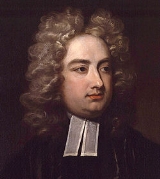
Jonathan Swift

 
Jonathan Swift

   Email Print
   Bookmark   Link


Jonathan Swift


Jonathan Swift (30 November 1667 – 19 October 1745) was an Anglo-Irish
Anglo-Irish

"Anglo-Irish" was a term used historically to describe a privileged social class in Ireland, whose members were the descendants and successors of the Protestant Ascendancy, mostly belonging to the Anglicanism Church of Ireland, which was the established church of Ireland until 1871, or to a lesser extent one of the English Dissenters churches...
 satirist
Satire

Satire is often strictly defined as a literary genre; although, in practice, it is also found in the graphic arts and performing arts. In satire, human or individual vices, follies, abuses, or shortcomings are held up to censure by means of ridicule, derision, burlesque, irony, or other methods, ideally with the intent to bring about improv...
, essay
Essay

An essay is usually a short piece of writing. It is often written from an author's personal Perspective . Essays can be literary criticism, political manifestos, learned arguments, observations of daily life, recollections, and reflections of the author....
ist, political pamphleteer
Pamphleteer

A pamphleteer is a historical term for someone who creates or distributes pamphlets. Pamphlets were used to broadcast the writer's opinions on an issue, for example, in order to get people to vote for their favorite politician or to articulate a particular political ideology....
 (first for Whigs then for the Tories
Tories (political faction)

The Tories were a loose political grouping which existed in the Kingdom of England, the Kingdom of Great Britain and later the United Kingdom, having their roots in the 17th century....
), poet and cleric who became Dean
Dean (religion)

A dean, in a church context, is a cleric holding certain positions of authority within a religious hierarchy. The title is used mainly in the Anglican Communion and the Catholic Church....
 of St. Patrick's
St. Patrick's Cathedral, Dublin

Saint Patrick's Cathedral in Dublin, formally known as The National Cathedral and Collegiate Church of Saint Patrick, Dublin or in the Irish language as ?rd Eaglais Naomh P?draig, founded in 1191, is the larger of Dublin's two Church of Ireland cathedrals, and the largest church in Ireland....
, Dublin.

He is remembered for works such as Gulliver's Travels
Gulliver's Travels

Gulliver's Travels , officially Travels into Several Remote Nations of the World, in Four Parts. By Lemuel Gulliver, First a Surgeon, and then a Captain of several Ships, is a novel by Jonathan Swift that is both a satire on human nature and a parody of the "travellers' tales" literary sub-genre....
, A Modest Proposal
A Modest Proposal

A Modest Proposal: For Preventing the Children of Poor People in Ireland from Being a Burden to Their Parents or Country, and for Making Them Beneficial to the Public, commonly referred to as A Modest Proposal, is a Juvenalian satire satire essay written and published anonymously by Jonathan Swift in 1729....
, A Journal to Stella
A Journal to Stella

A Journal to Stella is a work by Jonathan Swift first partly published List of works published posthumously in 1766.It consists of 65 letters to his friend, Esther Johnson....
, Drapier's Letters, The Battle of the Books
The Battle of the Books

The Battle of the Books is the name of a short satire written by Jonathan Swift and published as part of the prolegomenon to his A Tale of a Tub in 1704....
, An Argument Against Abolishing Christianity
An Argument Against Abolishing Christianity

An Argument to Prove that the Abolishing of Christianity in England May, as Things Now Stand Today, be Attended with Some Inconveniences, and Perhaps not Produce Those Many Good Effects Proposed Thereby, commonly referred to as An Argument Against Abolishing Christianity, is an essay by Jonathan Swift defending Christianity, and...
, and A Tale of a Tub
A Tale of a Tub

A Tale of a Tub was the first major work written by Jonathan Swift, composed between 1694 and 1697 and published in 1704. It is arguably his most difficult satire, and perhaps his most masterly....
. Swift is probably the foremost prose satirist in the English language
English language

English is a West Germanic language that originated in Anglo-Saxon England and has lingua franca status in many parts of the world as a result of the military, economic, scientific, political and cultural influence of the British Empire in the 18th, 19th and early 20th centuries and that of the United States from the mid 20th century onwa...
, and is less well known for his poetry
Poetry

Poetry is a form of literature art in which language is used for its aesthetics and evocative qualities in addition to, or in lieu of, its apparent meaning ....
. Swift originally published all of his works under pseudonym
Pseudonym

A pseudonym, , is a fictitious alternative to a person's legal name. In some cases, pseudonyms are adopted because it is part of a cultural or organizational tradition, as in the case of Religious names used by members of some religious orders and "cadre names" used by Communist party leaders such as Leon Trotsky and Joseph Stalin....
s — such as Lemuel Gulliver
Lemuel Gulliver

Lemuel Gulliver is the protagonist of the novel Gulliver's Travels, created by Jonathan Swift in 1726 in literature....
, Isaac Bickerstaff
Isaac Bickerstaff

Isaac Bickerstaff Esq was a pseudonym used by Jonathan Swift as part of a hoax to predict the death of then famous Almanac?maker, astrologer, and quack John Partridge ....
, M.B.


Discussion
Ask a question about 'Jonathan Swift'
Start a new discussion about 'Jonathan Swift'
Answer questions from other users
Full Discussion Forum


Recent Posts


Quotations


Tis very warm weather when ones in bed.

Journal to Stella (November 8, 1710)

Ambition often puts men upon doing the meanest offices; so climbing is performed in the same posture with creeping.

Books, the children of the brain.

A Tale of a Tub, Sec. 1 (1704)

Censure is the tax a man pays to the public for being eminent.

Censure is the tax a man pays to the public for being eminent.

Every man desires to live long, but no man would be old.


Encyclopedia


Jonathan Swift (30 November 1667 – 19 October 1745) was an Anglo-Irish
Anglo-Irish

"Anglo-Irish" was a term used historically to describe a privileged social class in Ireland, whose members were the descendants and successors of the Protestant Ascendancy, mostly belonging to the Anglicanism Church of Ireland, which was the established church of Ireland until 1871, or to a lesser extent one of the English Dissenters churches...
 satirist
Satire

Satire is often strictly defined as a literary genre; although, in practice, it is also found in the graphic arts and performing arts. In satire, human or individual vices, follies, abuses, or shortcomings are held up to censure by means of ridicule, derision, burlesque, irony, or other methods, ideally with the intent to bring about improv...
, essay
Essay

An essay is usually a short piece of writing. It is often written from an author's personal Perspective . Essays can be literary criticism, political manifestos, learned arguments, observations of daily life, recollections, and reflections of the author....
ist, political pamphleteer
Pamphleteer

A pamphleteer is a historical term for someone who creates or distributes pamphlets. Pamphlets were used to broadcast the writer's opinions on an issue, for example, in order to get people to vote for their favorite politician or to articulate a particular political ideology....
 (first for Whigs then for the Tories
Tories (political faction)

The Tories were a loose political grouping which existed in the Kingdom of England, the Kingdom of Great Britain and later the United Kingdom, having their roots in the 17th century....
), poet and cleric who became Dean
Dean (religion)

A dean, in a church context, is a cleric holding certain positions of authority within a religious hierarchy. The title is used mainly in the Anglican Communion and the Catholic Church....
 of St. Patrick's
St. Patrick's Cathedral, Dublin

Saint Patrick's Cathedral in Dublin, formally known as The National Cathedral and Collegiate Church of Saint Patrick, Dublin or in the Irish language as ?rd Eaglais Naomh P?draig, founded in 1191, is the larger of Dublin's two Church of Ireland cathedrals, and the largest church in Ireland....
, Dublin.

He is remembered for works such as Gulliver's Travels
Gulliver's Travels

Gulliver's Travels , officially Travels into Several Remote Nations of the World, in Four Parts. By Lemuel Gulliver, First a Surgeon, and then a Captain of several Ships, is a novel by Jonathan Swift that is both a satire on human nature and a parody of the "travellers' tales" literary sub-genre....
, A Modest Proposal
A Modest Proposal

A Modest Proposal: For Preventing the Children of Poor People in Ireland from Being a Burden to Their Parents or Country, and for Making Them Beneficial to the Public, commonly referred to as A Modest Proposal, is a Juvenalian satire satire essay written and published anonymously by Jonathan Swift in 1729....
, A Journal to Stella
A Journal to Stella

A Journal to Stella is a work by Jonathan Swift first partly published List of works published posthumously in 1766.It consists of 65 letters to his friend, Esther Johnson....
, Drapier's Letters, The Battle of the Books
The Battle of the Books

The Battle of the Books is the name of a short satire written by Jonathan Swift and published as part of the prolegomenon to his A Tale of a Tub in 1704....
, An Argument Against Abolishing Christianity
An Argument Against Abolishing Christianity

An Argument to Prove that the Abolishing of Christianity in England May, as Things Now Stand Today, be Attended with Some Inconveniences, and Perhaps not Produce Those Many Good Effects Proposed Thereby, commonly referred to as An Argument Against Abolishing Christianity, is an essay by Jonathan Swift defending Christianity, and...
, and A Tale of a Tub
A Tale of a Tub

A Tale of a Tub was the first major work written by Jonathan Swift, composed between 1694 and 1697 and published in 1704. It is arguably his most difficult satire, and perhaps his most masterly....
. Swift is probably the foremost prose satirist in the English language
English language

English is a West Germanic language that originated in Anglo-Saxon England and has lingua franca status in many parts of the world as a result of the military, economic, scientific, political and cultural influence of the British Empire in the 18th, 19th and early 20th centuries and that of the United States from the mid 20th century onwa...
, and is less well known for his poetry
Poetry

Poetry is a form of literature art in which language is used for its aesthetics and evocative qualities in addition to, or in lieu of, its apparent meaning ....
. Swift originally published all of his works under pseudonym
Pseudonym

A pseudonym, , is a fictitious alternative to a person's legal name. In some cases, pseudonyms are adopted because it is part of a cultural or organizational tradition, as in the case of Religious names used by members of some religious orders and "cadre names" used by Communist party leaders such as Leon Trotsky and Joseph Stalin....
s — such as Lemuel Gulliver
Lemuel Gulliver

Lemuel Gulliver is the protagonist of the novel Gulliver's Travels, created by Jonathan Swift in 1726 in literature....
, Isaac Bickerstaff
Isaac Bickerstaff

Isaac Bickerstaff Esq was a pseudonym used by Jonathan Swift as part of a hoax to predict the death of then famous Almanac?maker, astrologer, and quack John Partridge ....
, M.B. Drapier — or anonymously. He is also known for being a master of two styles of satire: the Horatian
Horace

This article is about the Roman poet Horace. For other uses, see Horace .Quintus Horatius Flaccus, , known in the English language world as Horace, was the leading Roman Empire Lyric poetry during the time of Augustus....
 and Juvenalian
Juvenal

The Satires are a collection of satire poems by the Latin author Juvenal written in the late 1st and early 2nd centuries A.D.Juvenal is credited with sixteen known poems divided among five scroll; all are in the Roman genre of Satire, which, at its most basic in the time of the author, comprised a wide-ranging discussion of society and soc...
 styles.

Biography


Youth

Jonathan Swift was born at No. 7, Hoey's Court, Dublin
Dublin

Dublin is both the largest city and capital of Republic of Ireland. It is located near the midpoint of Ireland's east coast, at the mouth of the River Liffey and at the centre of the Dublin Region....
, and was the second child and only son of Jonathan Swift (a second cousin of John Dryden
John Dryden

John Dryden was an influential English poet, literary critic, translator, and playwright who dominated the literary life of English Restoration to such a point that the period came to be known in literary circles as the Age of Dryden....
) and wife Abigail Erick (or Herrick), paternal grandson of Thomas Swift and wife Elizabeth Dryden, daughter of Nicholas Dryden (brother of Sir Erasmus Dryden, 1st Baronet Dryden) and wife Mary Emyley. His father was Irish born and his mother was born in England. Swift arrived seven months after his father's untimely death. Most of the facts of Swift's early life are obscure, confused and sometimes contradictory. It is widely believed that his mother returned to England when Jonathan was still very young, then leaving him to be raised by his father's family. His uncle Godwin took primary responsibility for the young Jonathan, sending him with one of his cousins to Kilkenny College
Kilkenny College

Kilkenny College or KCK is a co-educational secondary school located in Kilkenny, in the South-East of Ireland. It is a private school which caters for both boarders and day students....
 (also attended by the philosopher George Berkeley
George Berkeley

George Berkeley , also known as Bishop Berkeley, was an Irish people philosopher. His primary philosophical achievement was the advancement of a theory he called "immaterialism" ....
).

Swift Young
In 1682 he attended Dublin University (Trinity College, Dublin
Trinity College, Dublin

Trinity College, Dublin , corporately designated as the Provost, Fellows and Scholars of the College of the Holy and Undivided Trinity of Queen Elizabeth near Dublin, was founded in 1592 by Queen Elizabeth I of England as the "mother of a university", and is the only constituent residential college of the University of Dublin....
), receiving his B.A.
Bachelor of Arts

Bachelor of Arts , from the Latin language Artium Baccalaureus, is an Undergraduate education bachelor's degree awarded for either a course or a program in either the liberal arts, the sciences or both....
 in 1686. Swift was studying for his Master's degree
Master's degree

A master's degree provides a mastery or high-order overview of a specific field of study or area of profession. Within the area studied, graduates possess advanced knowledge of a specialized body of theory and applied topics; high order skills in analysis, Critical thinking and/or professional application; and the ability to problem solving a...
 when political troubles in Ireland surrounding the Glorious Revolution
Glorious Revolution

The Glorious Revolution, also called the Revolution of 1688, was the overthrow of British monarchy James II of England in 1688 by a union of Parliament of England with an invading army led by the Dutch Republic stadtholder William III of England , who as a result ascended the English throne as William III of England....
 forced him to leave for England in 1688, where his mother helped him get a position as secretary and personal assistant of Sir William Temple
William Temple (British politician)

Sir William Temple, 1st Baronet , statesman and essayist, son of Sir John Temple .Born in London, and educated at Emmanuel College, Cambridge, he travelled across Europe, and was for some time a member of the Irish Parliament, employed on various diplomatic missions....
 at Moor Park, Farnham
Moor Park, Farnham

Moor Park, Farnham, Surrey, England is a Grade II listed house set in some of grounds. It was formerly known as Compton Hall. The present house dates from 1630 but has been substantially altered, particularly in 1750 and 1800....
. Temple was an English diplomat who, having arranged the Triple Alliance of 1668
Triple Alliance of 1668

The Triple Alliance of England, Sweden, and the Dutch Republic was formed to halt the expansion of Louis XIV of France's France in the War of Devolution....
, retired from public service to his country estate to tend his gardens and write his memoirs. Growing into confidence with his employer, Swift "was often trusted with matters of great importance." Within three years of their acquaintance, Temple had introduced his secretary to William III
William III of England

William III was a Prince of Orange by birth. From 1672 onwards, he governed as List_of_stadtholders_for_the_Low_Countries_provinces William III of Orange over Holland, Zeeland, Utrecht, Guelders, and Overijssel of the Dutch Republic....
, and sent him to London to urge the King to consent to a bill for triennial Parliaments.

When Swift took up his residence at Moor Park, he met Esther Johnson
Esther Johnson

Esther Johnson was the England friend of Jonathan Swift, known as "Stella".Newfoundland-born author Trudy J. Morgan-Cole wrote a novel in 2006 detailing fictionalized portions of the Swift/Johnson friendship in The Violent Friendship of Esther Johnson....
, then 8 years old, the fatherless daughter of one of the household servants. Swift acted as her tutor and mentor, giving her the nickname "Stella" and the two maintained a close, but ambiguous relationship for the rest of Esther's life.

Swift left Temple in 1690 for Ireland because of his health, but returned to Moor Park the following year. The illness, fits of vertigo or giddiness — now known to be Ménière's disease
Ménière's disease

M?ni?re's disease is a disorder of the inner ear that can affect Hearing and balance. It is characterized by episodes of dizziness and tinnitus and progressive hearing loss, usually in one ear....
 — would continue to plague Swift throughout his life. During this second stay with Temple, Swift received his M.A. from Hertford College, Oxford
University of Oxford

The University of Oxford , located in the city of Oxford, Oxfordshire, England, is the List of oldest universities in continuous operation in the English-speaking world....
 in 1692. Then, apparently despairing of gaining a better position through Temple's patronage, Swift left Moor Park to become an ordained priest in the Established Church of Ireland
Church of Ireland

The Church of Ireland is an autonomous province of the Anglican Communion, operating across the island of Ireland. Like other Anglican churches, it considers itself to be both Catholicism and Protestant Reformation....
 and in 1694 he was appointed to the prebend
Prebendary

A prebendary is a post connected to an Anglicanism or Roman Catholic Church cathedral or collegiate church and is a type of canon . Prebendaries have a role in the administration of the cathedral....
 of Kilroot in the Diocese of Connor
Diocese of Connor

The Diocese of Connor, Territory of Dalriada, was established in the Synod of Rathbreasail in AD 1111. The diocese itself was erected in A.D. 480....
, with his parish located at Kilroot
Kilroot

Kilroot is a small village in County Antrim, Northern Ireland, on the eastern outskirts of Carrickfergus, east of Belfast on the north shore of Belfast Lough....
, near Carrickfergus
Carrickfergus

Carrickfergus is a large town in County Antrim, Northern Ireland. It had a population of 27,201 people recorded in the United Kingdom Census 2001....
 in County Antrim
County Antrim

County Antrim is one of six Counties of Northern Ireland that form Northern Ireland, and one of nine counties that historically and geographically constitute the Province of Ulster....
.

Swift appears to have been miserable in his new position, being isolated in a small, remote community far from the centres of power and influence. While at Kilroot, however, Swift may well have become romantically involved with Jane Waring. A letter from him survives, offering to remain if she would marry him and promising to leave and never return to Ireland if she refused. She presumably refused, because Swift left his post and returned to England and Temple's service at Moor Park in 1696, and he remained there until Temple's death. There he was employed in helping to prepare Temple's memoirs and correspondence for publication. During this time Swift wrote The Battle of the Books
The Battle of the Books

The Battle of the Books is the name of a short satire written by Jonathan Swift and published as part of the prolegomenon to his A Tale of a Tub in 1704....
, a satire responding to critics of Temple's Essay upon Ancient and Modern Learning (1690). Battle was however not published until 1704.

On January 27 1699 Temple died. Swift stayed on briefly in England to complete the editing of Temple's memoirs, and perhaps in the hope that recognition of his work might earn him a suitable position in England. However, Swift's work made enemies of some of Temple's family and friends who objected to indiscretions included in the memoirs. His next move was to approach King William
William III of England

William III was a Prince of Orange by birth. From 1672 onwards, he governed as List_of_stadtholders_for_the_Low_Countries_provinces William III of Orange over Holland, Zeeland, Utrecht, Guelders, and Overijssel of the Dutch Republic....
 directly, based on his imagined connection through Temple and a belief that he had been promised a position. This failed so miserably that he accepted the lesser post of secretary and chaplain to the Earl of Berkeley
Baron Berkeley

The title Baron Berkeley has been created twice in the Peerage of England, both times by Hereditary peer#Writs of summons. It was first granted to Sir Thomas de Berkeley in 1295, but the title of that creation became extinct at the death of the fifth Baron, when no heirs to the barony remained....
, one of the Lords Justices of Ireland. However, when he reached Ireland he found that the secretaryship had already been given to another. But he soon obtained the living of Laracor, Agher, and Rathbeggan, and the prebend of Dunlavin in St. Patrick's
St. Patrick's Cathedral, Dublin

Saint Patrick's Cathedral in Dublin, formally known as The National Cathedral and Collegiate Church of Saint Patrick, Dublin or in the Irish language as ?rd Eaglais Naomh P?draig, founded in 1191, is the larger of Dublin's two Church of Ireland cathedrals, and the largest church in Ireland....
 Cathedral, Dublin.

At Laracor, a mile or two from Trim, County Meath
Trim, County Meath

Trim is the traditional county town of County Meath in Republic of Ireland, although the county town is now Navan. The town was recorded in the 2006 census to have a population of 6,870....
, and twenty miles (32 km) from Dublin, Swift ministered to a congregation of about fifteen people, and had abundant leisure for cultivating his garden, making a canal (after the Dutch fashion of Moor Park), planting willows, and rebuilding the vicarage. As chaplain to Lord Berkeley, he spent much of his time in Dublin and traveled to London frequently over the next ten years. In 1701, Swift published, anonymously, a political pamphlet, A Discourse on the Contests and Dissentions in Athens and Rome.

Writer

Swift Works
In February 1702, Swift received his Doctor of Divinity degree from Trinity College, Dublin
Trinity College, Dublin

Trinity College, Dublin , corporately designated as the Provost, Fellows and Scholars of the College of the Holy and Undivided Trinity of Queen Elizabeth near Dublin, was founded in 1592 by Queen Elizabeth I of England as the "mother of a university", and is the only constituent residential college of the University of Dublin....
. That spring he traveled to England and returned to Ireland in October, accompanied by Esther Johnson
Esther Johnson

Esther Johnson was the England friend of Jonathan Swift, known as "Stella".Newfoundland-born author Trudy J. Morgan-Cole wrote a novel in 2006 detailing fictionalized portions of the Swift/Johnson friendship in The Violent Friendship of Esther Johnson....
 — now twenty years old — and his friend Rebecca Dingley, another member of William Temple's household. There is a great mystery and controversy over Swift's relationship with Esther Johnson
Esther Johnson

Esther Johnson was the England friend of Jonathan Swift, known as "Stella".Newfoundland-born author Trudy J. Morgan-Cole wrote a novel in 2006 detailing fictionalized portions of the Swift/Johnson friendship in The Violent Friendship of Esther Johnson....
 nicknamed "Stella". Many hold that they were secretly married in 1716.

During his visits to England in these years Swift published A Tale of a Tub
A Tale of a Tub

A Tale of a Tub was the first major work written by Jonathan Swift, composed between 1694 and 1697 and published in 1704. It is arguably his most difficult satire, and perhaps his most masterly....
 and The Battle of the Books
The Battle of the Books

The Battle of the Books is the name of a short satire written by Jonathan Swift and published as part of the prolegomenon to his A Tale of a Tub in 1704....
 (1704) and began to gain a reputation as a writer. This led to close, lifelong friendships with Alexander Pope
Alexander Pope

Alexander Pope is generally regarded as the greatest England poet of the eighteenth century, best known for his satirical verse and for his translation of Homer....
, John Gay
John Gay

John Gay was an English people poet and dramatist. He is best remembered for The Beggar's Opera , set to music by Johann Christoph Pepusch....
, and John Arbuthnot
John Arbuthnot

John Arbuthnot, often known simply as Dr. Arbuthnot, , was a physician, satire and polymath in London. He is best remembered for his contributions to mathematics, his membership in the Scriblerus Club , and for inventing the figure of John Bull....
, forming the core of the Martinus Scriblerus Club
Scriblerus Club

The Scriblerus Club was an informal group of friends that included Jonathan Swift, Alexander Pope, John Gay, John Arbuthnot, Henry St John, 1st Viscount Bolingbroke and Thomas Parnell....
 (founded in 1713).

Swift became increasingly active politically in these years. From 1707 to 1709 and again in 1710, Swift was in London, unsuccessfully urging upon the Whig
British Whig Party

The Whigs are often described as one of two political party in Kingdom of England and later the United Kingdom from the late 17th to the mid-19th centuries....
 administration of Lord Godolphin the claims of the Irish clergy to the First-Fruits and Twentieths
Queen Anne's Bounty

Queen Anne's Bounty was a fund established in 1704 for the augmentation of the incomes of the poorer clergy, the amount of which for distribution in 1890 was Pound sterling176,896; it was the revenue from a tax on the Church prior to the Protestant Reformation, and which after that was appropriated by the Crown....
 ("Queen Anne's Bounty"), which brought in about £2500 a year, already granted to their brethren in England. He found the opposition Tory
Tory

In the political tradition of some List of countries where English is an official language, the term Tory may refer to a variety of Political party and creeds since it was originally used in the late 17th century to describe opponents to the Whig Party ....
 leadership more sympathetic to his cause and Swift was recruited to support their cause as editor of the Examiner when they came to power in 1710. In 1711, Swift published the political pamphlet "The Conduct of the Allies," attacking the Whig government for its inability to end the prolonged war with France. The incoming Tory government conducted secret (and illegal) negotiations with France, resulting in the Treaty of Utrecht
Treaty of Utrecht

The Treaty of Utrecht that established the Peace of Utrecht, rather than a single document, comprises a series of individual peace treaty signed in the Dutch Republic city of Utrecht in March and April 1713....
 (1713) ending the War of the Spanish Succession
War of the Spanish Succession

War of the Spanish Succession was a war fought in 1701-1714, in which several European powers combined to stop a possible unification of the Kingdoms of Spain and France under a single Bourbon monarch, upsetting the European Balance of power in international relations....
.

Swift was part of the inner circle of the Tory government, and often acted as mediator between Henry St. John
Henry St John, 1st Viscount Bolingbroke

Henry St John, 1st Viscount Bolingbroke , was an English politician and philosopher. He identified predominantly with the Tories , of which he was a prominent member for many years....
 (Viscount Bolingbroke) the secretary of state for foreign affairs (1710–15) and Robert Harley
Robert Harley, 1st Earl of Oxford and Mortimer

Robert Harley, 1st Earl of Oxford and Earl Mortimer , was an British politician and statesman of the late Stuart dynasty and early Georgian era periods....
 (Earl of Oxford) lord treasurer and prime minister (1711–1714). Swift recorded his experiences and thoughts during this difficult time in a long series of letters to Esther Johnson, later collected and published as The Journal to Stella. The animosity between the two Tory leaders eventually led to the dismissal of Harley in 1714. With the death of Queen Anne
Anne of Great Britain

Anne became Queen of England, Queen of Scots and Kingdom of Ireland on 8 March 1702, succeeding her brother-in-law, William III of England. Her Roman Catholic father, James II of England, was Glorious Revolution in 1688/9; her brother-in-law and her sister then became joint monarchs as William III & II and Mary II of England, the only such c...
 and ascension of George I
George I of Great Britain

George I was List of British Monarchs#House of Hanover and King of Ireland from 1 August 1714 until his death, and ruler of Electorate of Hanover in the Holy Roman Empire from 1698....
 that year, the Whigs returned to power and the Tory leaders were tried for treason for conducting secret negotiations with France.

Also during these years in London, Swift became acquainted with the Vanhomrigh family and became involved with one of the daughters, Esther
Esther Vanhomrigh

Esther Vanhomrigh , an Ireland woman of Dutch descent, was a longterm lover and correspondent of Jonathan Swift. Swift's letters to her were published after her death....
, yet another fatherless young woman and an ambiguous relationship to confuse Swift's biographers. Swift furnished Esther with the nickname "Vanessa" and she features as one of the main characters in his poem Cadenus and Vanessa. The poem and their correspondence suggests that Esther was infatuated with Swift, that he may have reciprocated her affections, only to regret it and then try to break it off. Esther followed Swift to Ireland in 1714, where there appears to have been a confrontation, possibly involving Esther Johnson. Esther Vanhomrigh died in 1728 at the age of 35. Another lady with whom he had a close but less intense relationship, was Anne Long
Anne Long (c.1681-1711)

Anne Long , was born at Draycot Cerne, Wiltshire, one of six children of James Long and his wife, Susanna, n?e Strangways. A celebrated beauty, she was the granddaughter of Sir James Long, 2nd Baronet, and of another leading civil war politician, Giles Strangways ....
, a toast of the Kit-Cat Club
Kit-Cat Club

The Kit-Cat Club was an early 18th century England club in London with strong political and literary associations, committed to the furtherance of British Whig Party objectives, meeting at the Trumpet tavern in London, and at Water Oakley in the Berkshire countryside....
.

Maturity

Before the fall of the Tory government, Swift hoped that his services would be rewarded with a church appointment in England. However, Queen Anne appeared to have taken a dislike to Swift and thwarted these efforts. The best position his friends could secure for him was the Deanery of St. Patrick's, Dublin. With the return of the Whigs, Swift's best move was to leave England and he returned to Ireland in disappointment, a virtual exile, to live "like a rat in a hole".

Once in Ireland, however, Swift began to turn his pamphleteering skills in support of Irish causes, producing some of his most memorable works: Proposal for Universal Use of Irish Manufacture (1720), Drapier's Letters (1724), and A Modest Proposal (1729), earning him the status of an Irish patriot.

Also during these years, he began writing his masterpiece, Travels into Several Remote Nations of the World, in Four Parts, by Lemuel Gulliver, first a surgeon, and then a captain of several ships, better known as Gulliver's Travels
Gulliver's Travels

Gulliver's Travels , officially Travels into Several Remote Nations of the World, in Four Parts. By Lemuel Gulliver, First a Surgeon, and then a Captain of several Ships, is a novel by Jonathan Swift that is both a satire on human nature and a parody of the "travellers' tales" literary sub-genre....
. Much of the material reflects his political experiences of the preceding decade. For instance, the episode when the giant Gulliver puts out the Lilliputian palace fire by urinating on it can be seen as a metaphor for the Tories' illegal peace treaty; having done a good thing in an unfortunate manner. In 1726 he paid a long-deferred visit to London, taking with him the manuscript of Gulliver's Travels
Gulliver's Travels

Gulliver's Travels , officially Travels into Several Remote Nations of the World, in Four Parts. By Lemuel Gulliver, First a Surgeon, and then a Captain of several Ships, is a novel by Jonathan Swift that is both a satire on human nature and a parody of the "travellers' tales" literary sub-genre....
. During his visit he stayed with his old friends, Alexander Pope
Alexander Pope

Alexander Pope is generally regarded as the greatest England poet of the eighteenth century, best known for his satirical verse and for his translation of Homer....
, John Arbuthnot
John Arbuthnot

John Arbuthnot, often known simply as Dr. Arbuthnot, , was a physician, satire and polymath in London. He is best remembered for his contributions to mathematics, his membership in the Scriblerus Club , and for inventing the figure of John Bull....
, and John Gay
John Gay

John Gay was an English people poet and dramatist. He is best remembered for The Beggar's Opera , set to music by Johann Christoph Pepusch....
, who helped him arrange for the anonymous publication of his book. First published in November 1726, it was an immediate hit, with a total of three printings that year and another in early 1727. French, German, and Dutch translations appeared in 1727 and pirated copies were printed in Ireland.

Swift returned to England one more time in 1727 and stayed with Alexander Pope once again. The visit was cut short when he received word that Esther Johnson was dying and Swift rushed back home to be with her. On 28 January 1728, Esther Johnson died, though he prayed at her bedside, even composing prayers for her comfort. Swift could not bear to be present at the end, but on the night of her death he began to write his The Death of Mrs. Johnson. He was too ill to attend the funeral at St. Patrick's. Many years later, a lock of hair, assumed to be Esther Johnson's, was found in his desk, wrapped in a paper bearing the words, "Only a woman's hair."

Death became a frequent feature in Swift's life from this point. In 1731 he wrote Verses on the Death of Dr. Swift, his own obituary published in 1739. In 1732, his good friend and collaborator John Gay
John Gay

John Gay was an English people poet and dramatist. He is best remembered for The Beggar's Opera , set to music by Johann Christoph Pepusch....
 died. In 1735, John Arbuthnot, another friend from his days in London, died. In 1738 Swift began to show signs of illness and in 1742 he appears to have suffered a stroke, losing the ability to speak and realizing his worst fears of becoming mentally disabled. ("I shall be like that tree," he once said, "I shall die at the top.") In order to protect him from unscrupulous hangers on, who had begun to prey on the great man, his closest companions had him declared of "unsound mind and memory." However, it was long believed by many that Swift was really insane at this point. In his book Literature and Western Man, author J.B. Priestley even cites the final chapters of Gulliver's Travels as proof of Swift's approaching "insanity".

In part VIII of his series, The Story of Civilization
The Story of Civilization

The Story of Civilization by Will Durant and Ariel Durant is an eleven-volume set of books. It was written over a lifetime, and it totals two million words across nearly 10,000 pages....
, Will Durant
Will Durant

William James Durant was a prolific United States writer, historian, and philosopher. He is best known for the 11-volume The Story of Civilization, written in collaboration with his wife Ariel Durant and published between 1935 and 1975....
 describes the final years of Swift's life as such:

"Definite symptoms of madness appeared in 1738. In 1741 guardians were appointed to take care of his affairs and watch lest in his outbursts of violence he should do himself harm. In 1742 he suffered great pain from the inflammation of his left eye, which swelled to the size of an egg; five attendants had to restrain him from tearing out his eye. He went a whole year without uttering a word."


In 1744, Alexander Pope died. Then, on October 19, 1745, Swift died. After being laid out in public view for the people of Dublin to pay their last respects, he was buried in his own cathedral by Esther Johnson's side, in accordance with his wishes. The bulk of his fortune (twelve thousand pounds) was left to found a hospital for the mentally ill, originally known as St. Patrick’s Hospital for Imbeciles, which opened in 1757, and which still exists as a psychiatric hospital.

Epitaph

Text extracted from the introduction to The Journal to Stella by George A. Aitken and from other sources)


Jonathan Swift wrote his own epitaph:

Hic depositum est Corpus
IONATHAN SWIFT S.T.D.
Huyus Ecclesiæ Cathedralis
Decani,
Ubi sæva Indignatio
Ulterius
Cor lacerare nequit,
Abi Viator
Et imitare, si poteris,
Strenuum pro virili
Libertatis Vindicatorem.


Obiit 19 Die Mensis Octobris
A.D. 1745 Anno Ætatis 78.


which William Butler Yeats
William Butler Yeats

File:William Butler Yeat by George Charles Beresford.jpgWilliam Butler Yeats was an Irish people poet and dramatist and one of the foremost figures of 20th century in literature....
 translated from the Latin as:

Swift has sailed into his rest.
Savage indignation there
cannot lacerate his breast.
Imitate him if you dare,
world-besotted traveller.
He served human liberty.


Works

Swift was a prolific writer, notable for his satires. The most recent collection of his prose works (Herbert Davis, ed. Basil Blackwell, 1965-) comprises fourteen volumes. A recent edition of his complete poetry (Pat Rodges, ed. Penguin, 1983) is 953 pages long. One edition of his correspondence (David Woolley, ed. P. Lang, 1999) fills three volumes.

Major prose works

Jonathan Swift   Project Gutenberg Etext 18250
Swift's first major prose play, A Tale of a Tub
A Tale of a Tub

A Tale of a Tub was the first major work written by Jonathan Swift, composed between 1694 and 1697 and published in 1704. It is arguably his most difficult satire, and perhaps his most masterly....
, demonstrates many of the themes and stylistic techniques he would employ in his later work. It is at once wildly playful and funny while being pointed and harshly critical of its targets. In its main thread, the Tale recounts the exploits of three sons, representing the main threads of Christianity, who receive a bequest from their father of a coat each, with the added instructions to make no alterations whatsoever. However, the sons soon find that their coats have fallen out of current fashion and begin to look for loopholes in their father's will which will allow them to make the needed alterations. As each finds his own means of getting around their father's admonition, they struggle with each other for power and dominance. Inserted into this story, in alternating chapters, Swift includes a series of whimsical "digressions" on various subjects.

In 1690, Sir William Temple, Swift's patron, published An Essay upon Ancient and Modern Learning a defense of classical writing (see Quarrel of the Ancients and the Moderns
Quarrel of the Ancients and the Moderns

The quarrel of the Ancients and the Moderns was a literature and artistic quarrel that heated up in the early 1690s and shook the Acad?mie fran?aise....
) holding up the Epistles of Phalaris as an example. William Wotton
William Wotton

William Wotton , was an England scholar, chiefly remembered for his remarkable abilities in learning languages and for his involvement in the Quarrel of the Ancients and the Moderns....
 responded to Temple with Reflections upon Ancient and Modern Learning (1694) showing that the Epistles were a later forgery. A response by the supporters of the Ancients was then made by Charles Boyle
Charles Boyle, 4th Earl of Orrery

Charles Boyle, 4th Earl of Orrery Order of the Thistle Privy Council of Great Britain Fellow of the Royal Society was an England nobleman, the second son of Roger Boyle, 2nd Earl of Orrery....
 (later the 4th Earl of Orrery and father of Swift's first biographer). A further retort on the Modern side came from Richard Bentley
Richard Bentley

Richard Bentley was an England theologian, Classics and critic....
, one of the pre-eminent scholars of the day, in his essay Dissertation upon the Epistles of Phalaris (1699). However, the final words on the topic belong to Swift in his Battle of the Books (1697, published 1704) in which he makes a humorous defense on behalf of Temple and the cause of the Ancients.

In 1708, a cobbler named John Partridge
John Partridge (astrologer)

John Partridge was an England astrologer. He was also the author and publisher of a number of astrological almanacs and books....
 published a popular almanac
Almanac

An almanac is an annual publication containing tabular information in a particular field or fields often arranged according to the calendar. Astronomy data and various statistics are also found in almanacs, such as the times of the rising and setting of the sun and moon, eclipses, hours of full tide, stated festivals of church es, terms of...
 of astrological predictions. Because Partridge falsely determined the deaths of several church officials, Swift attacked Partridge in Predictions For The Ensuing Year by Isaac Bickerstaff
Isaac Bickerstaff

Isaac Bickerstaff Esq was a pseudonym used by Jonathan Swift as part of a hoax to predict the death of then famous Almanac?maker, astrologer, and quack John Partridge ....
, a parody predicting that Partridge would die on March 29th. Swift followed up with a pamphlet issued on March 30th claiming that Partridge had in fact died, which was widely believed despite Partridge's statements to the contrary.

Drapier's Letters (1724) was a series of pamphlets against the monopoly
Monopoly

In economics, a monopoly exists when a specific individual or enterprise has sufficient control over a particular product or service to determine significantly the terms on which other individuals shall have access to it....
 granted by the English government to William Wood
William Wood (Mintmaster)

William Wood was a hardware manufacturer who was given a contract as a Moneyer to strike an issue of Irish coinage from 1722 to 1724. He was also famous for the 'Rosa Americana' coins of British America, which were also struck in the same period....
 to provide the Irish with copper
Copper

Copper is a chemical element with the symbol Cu and atomic number 29.It is a ductile metal with very high thermal and electrical conductivity....
 coinage. It was widely believed that Wood would need to flood Ireland with debased coinage in order make a profit. In these "letters" Swift posed as a shop-keeper--a draper--in order to criticize the plan. Swift's writing was so effective in undermining opinion in the project that a reward was offered by the government to anyone disclosing the true identity of the author. Though hardly a secret (on returning to Dublin after one of his trips to England, Swift was greeted with a banner, "Welcome Home, Drapier") no one turned Swift in. The government eventually resorted to hiring none other than Sir Isaac Newton
Isaac Newton

Sir Isaac Newton, Fellow of the Royal Society was an English people physicist, mathematician, Astronomy, Natural philosophy, Alchemy, and Theology and one of the the 100 in human history....
 to certify the soundness of Wood's coinage to counter Swift's accusations. In "Verses on the Death of Dr. Swift" (1739) Swift recalled this as one of his best achievements.

Gulliver's Travels
Gulliver's Travels

Gulliver's Travels , officially Travels into Several Remote Nations of the World, in Four Parts. By Lemuel Gulliver, First a Surgeon, and then a Captain of several Ships, is a novel by Jonathan Swift that is both a satire on human nature and a parody of the "travellers' tales" literary sub-genre....
, which Swift wrote a large portion of in Woodbrook House, County Laois was first published in 1726, and is regarded as his masterpiece. As with his other writings, the Travels was published under a pseudonym, the fictional Lemuel Gulliver, a ship's surgeon and later a sea captain. Some of the correspondence between printer Benj. Motte and Gulliver's also-fictional cousin negotiating the book's publication has survived. Though it has often been mistakenly thought of and published in bowdlerized form as a children's book, it is a great and sophisticated satire of human nature based on Swift's experience of his times. Gulliver's Travels is an anatomy of human nature, a sardonic looking-glass, often criticized for its apparent misanthropy. It asks its readers to refute it, to deny that it has not adequately characterized human nature and society. Each of the four books--recounting four voyages to mostly-fictional exotic lands--has a different theme, but all are attempts to deflate human pride. Critics hail the work as a satiric reflection on the failings of Enlightenment modernism.

In 1729, he published A Modest Proposal
A Modest Proposal

A Modest Proposal: For Preventing the Children of Poor People in Ireland from Being a Burden to Their Parents or Country, and for Making Them Beneficial to the Public, commonly referred to as A Modest Proposal, is a Juvenalian satire satire essay written and published anonymously by Jonathan Swift in 1729....
 for Preventing the Children of Poor People in Ireland Being a Burden to Their Parents or Country, and for Making Them Beneficial to the Public,
a satire
Satire

Satire is often strictly defined as a literary genre; although, in practice, it is also found in the graphic arts and performing arts. In satire, human or individual vices, follies, abuses, or shortcomings are held up to censure by means of ridicule, derision, burlesque, irony, or other methods, ideally with the intent to bring about improv...
 in which the narrator, with intentionally grotesque logic, recommends that Ireland's poor escape their poverty by selling their children as food to the rich: ”I have been assured by a very knowing American of my acquaintance in London, that a young healthy child well nursed is at a year old a most delicious, nourishing, and wholesome food...” Following the satirical form, he introduces the reforms he is actually suggesting by deriding them:
Therefore let no man talk to me of other expedients...taxing our absentees...using [nothing] except what is of our own growth and manufacture...rejecting...foreign luxury...introducing a vein of parsimony, prudence and temperance...learning to love our country...quitting our animosities and factions...teaching landlords to have at least one degree of mercy towards their tenants....Therefore I repeat, let no man talk to me of these and the like expedients, 'till he hath at least some glympse of hope, that there will ever be some hearty and sincere attempt to put them into practice.


According to other sources, Richard Steele uses the personae of Isaac Bickerstaff and was the one who wrote about the "death" of John Partridge and published it in The Spectator, not Jonathan Swift.*

Essays, tracts, pamphlets, periodicals

  • "A Meditation upon a Broomstick" (1703–1710): Full text:
  • "A Critical Essay upon the Faculties of the Mind" (1707–1711)
  • The Bickerstaff-Partridge Papers (1708–1709): Full text:
  • "An Argument Against Abolishing Christianity
    An Argument Against Abolishing Christianity

    An Argument to Prove that the Abolishing of Christianity in England May, as Things Now Stand Today, be Attended with Some Inconveniences, and Perhaps not Produce Those Many Good Effects Proposed Thereby, commonly referred to as An Argument Against Abolishing Christianity, is an essay by Jonathan Swift defending Christianity, and...
    " (1708–1711): Full text:
  • The Intelligencer (with Thomas Sheridan
    Thomas Sheridan

    Thomas Sheridan was an Irish stage actor, an educator, and a major proponent of the elocution. He received his M.A. in 1743 from Trinity College in Dublin, and was the godson of Jonathan Swift....
    ) (1710-????): Text:
  • The Examiner (1710): Texts: ,
  • "A Proposal for Correcting, Improving and Ascertaining the English Tongue" (1712): Full texts: ,
  • "On the Conduct of the Allies" (1713)
  • "Hints Toward an Essay on Conversation" (1713): Full text:
  • "A Letter to a Young Gentleman, Lately Entered into Holy Orders" (1720)
  • "A Letter of Advice to a Young Poet" (1721): Full text:
  • Drapier's Letters (1724, 1725): Full text:
  • "Bon Mots de Stella" (1726): a curiously irrelevant appendix to "Gulliver's Travels"
  • "A Modest Proposal
    A Modest Proposal

    A Modest Proposal: For Preventing the Children of Poor People in Ireland from Being a Burden to Their Parents or Country, and for Making Them Beneficial to the Public, commonly referred to as A Modest Proposal, is a Juvenalian satire satire essay written and published anonymously by Jonathan Swift in 1729....
    ", perhaps the most notable satire in English, suggesting that the Irish should engage in cannibalism. (Written in 1729)
  • "An Essay on the Fates of Clergymen": Full text:
  • "A Treatise on Good Manners and Good Breeding": Full text:


Poems

  • "Ode to the Athenian Society" 1692 (first published work)
  • Poems of Jonathan Swift, D.D. Texts at Project Gutenberg: ,
  • "Baucis and Philemon" (1706–1709): Full text:
  • "A Description of the Morning" (1709): Full annotated text: ; Another text:
  • "A Description of a City Shower" (1710): Full text:
  • "Cadenus and Vanessa" (1713): Full text:
  • "Phillis, or, the Progress of Love" (1719): Full text:
  • Stella's birthday poems:
    • 1719. Full annotated text:
    • 1720. Full text:
    • 1727. Full text:
  • "The Progress of Beauty" (1719–1720): Full text:
  • "The Progress of Poetry" (1720): Full text:
  • "A Satirical Elegy on the Death of a Late Famous General" (1722): Full text:
  • "To Quilca, a Country House not in Good Repair" (1725): Full text:
  • "Advice to the Grub Street Verse-writers" (1726): Full text:
  • "The Furniture of a Woman's Mind" (1727)
  • "On a Very Old Glass" (1728): Full text:
  • "A Pastoral Dialogue" (1729): Full text:
  • "The Grand Question debated Whether Hamilton's Bawn should be turned into a Barrack or a Malt House" (1729): Full text:
  • "On Stephen Duck, the Thresher and Favourite Poet" (1730): Full text:
  • "Death and Daphne" (1730): Full text:
  • "The Place of the Damn'd" (1731):
  • "A Beautiful Young Nymph Going to Bed" (1731): Full annotated text: ; Another text:
  • "Strephon and Chloe" (1731): Full annotated text: ; Another text:
  • "Helter Skelter" (1731): Full text:
  • "Cassinus and Peter: A Tragical Elegy" (1731): Full annotated text:
  • "The Day of Judgment" (1731):
  • "Verses on the Death of Dr. Swift, D.S.P.D." (1731–1732): Full annotated texts: , ; Non-annotated text
  • "An Epistle To A Lady" (1732): Full text:
  • "The Beasts' Confession to the Priest" (1732): Full annotated text:
  • "The Lady's Dressing Room" (1732): Full annotated text:
  • "On Poetry: A Rhapsody" (1733)
  • "The Puppet Show" Full text:
  • "The Logicians Refuted" Full text:


Correspondence, personal writings


  • "When I Come to Be Old" — Swift's resolutions. (1699): Full text:
  • The Journal to Stella (1710–1713): Full text (presented as daily entries): ; Extracts: ;
  • Letters:
    • Selected Letters:
    • To Oxford and Pope:
  • 'The Correspondence of Jonathan Swift, D.D'. Edited by David Woolley. In four volumes, plus index volume. Frankfurt am Main ; New York : P. Lang, c1999-c2007.


Sermons, prayers


  • Three Sermons and Three Prayers. Full text: ,
  • Three Sermons: I. on mutual subjection. II. on conscience. III. on the trinity. Text:
  • Writings on Religion and the Church. Text at Project Gutenberg: ,
  • "The First He Wrote Oct. 17, 1727." Full text:
  • "The Second Prayer Was Written Nov. 6, 1727." Full text:


Miscellany

  • Directions to Servants (1731) Extracts:
  • A Complete Collection of Genteel and Ingenious Conversation
    A Complete Collection of Genteel and Ingenious Conversation

    A Complete Collection of genteel and ingenious Conversation, according to the most polite mode and method now used at Court, and in the best Companies of England, commonly known as A Complete Collection of Genteel and Ingenious Conversation is a book by Jonathan Swift offering an ironic and satirical commentary on the perceived...
     (1738)
  • "Thoughts on Various Subjects." Full text:
  • Historical Writings:
  • Swift Quotations: — many choice, well-documented Swift quotations here
  • Swift quotes at Bartleby: — 59 quotations, with notes


Legacy


John Ruskin
John Ruskin

John Ruskin was a British art critic and social thought, also remembered as an author, poet and artist. His essays on art and architecture were extremely influential in the Victorian era and Edwardian period eras....
 named him as one of the three people in history who were the most influential for him.

Biographical sources


  • Samuel Johnson's "Life of Swift": . From his Lives of the Poets.
  • William Makepeace Thackeray's influential vitriolic biography: . From his English Humourists of The Eighteenth Century.
  • Bullitt, John M. Jonathan Swift and the Anatomy of Satire: A Study of Satiric Technique, 1953, Cambridge: Harvard U P,
  • Jae Num Lee "Swift and Scatological Satire", 1971, University of New Mexico Press, ISBN 0826301967
  • Lee, Jae Num. "Scatology in Continental Satirical Writings from Aristophanes to Rabelais" and "English Scatological Writings from Skelton to Pope." Swift and Scatological Satire. Albuquerque: U of New Mexico P, 1971. 7–22; 23–53.
  • Susan Gubar "" Signs, Vol. 3, No. 2 (Winter, 1977), pp. 380–394
  • Many other sources are listed .


External links


  • of A Modest Proposal
    A Modest Proposal

    A Modest Proposal: For Preventing the Children of Poor People in Ireland from Being a Burden to Their Parents or Country, and for Making Them Beneficial to the Public, commonly referred to as A Modest Proposal, is a Juvenalian satire satire essay written and published anonymously by Jonathan Swift in 1729....
     from


E-texts of Swift's works

  • at
  • at