
All Topics  
Easter Rising

 
Easter Rising

   Email Print
   Bookmark   Link


Easter Rising


The Easter Rising was a rebellion staged in Ireland
Ireland

Ireland is the List of islands by area in Europe, and the twentieth-largest island in the world. It lies to the north-west of continental Europe and is surrounded by hundreds of islands and islet....
 during Easter Week
Easter Week

Easter Week or Bright Week is the period of seven days from Easter Sunday through the Saturday following....
, 1916. The Rising was an attempt by militant Irish republicans
Irish Republicanism

Irish republicanism is an ideology based on the Irish nationalist belief that all of Ireland should be a single independent republic.In 1801, under the Act of Union 1800, the Kingdoms of Great Britain and Ireland merged to form the United Kingdom of Great Britain and Ireland....
 to win independence from Britain
United Kingdom of Great Britain and Ireland

The United Kingdom of Great Britain and Ireland was the formal name and the state form of the United Kingdom from 1 January 1801 until 12 April 1927....
. It was the most significant uprising in Ireland since the rebellion of 1798
Irish Rebellion of 1798

The Irish Rebellion of 1798 , or 1798 rebellion as it is known locally, was an uprising in 1798, lasting several months, against United Kingdom and its subject Kingdom of Ireland....
.

Organised by the Irish Republican Brotherhood
Irish Republican Brotherhood

The Irish Republican Brotherhood was a secret oath-bound fraternal organisation dedicated to the establishment of an "independent democratic Republic" in the mid nineteenth and early twentieth centuries....
, the Rising lasted from Easter Monday 24 April to 30 April 1916. Members of the Irish Volunteers
Irish Volunteers

The Irish Volunteers was a military organisation established in 1913 by Irish nationalism. Its declared primary aim was "to secure and maintain the rights and liberties common to the whole people of Ireland", in other words, the safeguarding of Irish Home Rule Bill....
, led by schoolteacher
Teacher

In education, a teacher is a person who teaches. A teacher who teaches an individual student may also be described as a personal tutor.The role of teacher is often formal and ongoing, carried out by way of Occupation or Profession at a school or other place of formal education....
 and barrister
Barrister

A barrister is a lawyer found in many common law jurisdictions that employ a split profession in relation to legal representation. In split professions, the other type of lawyer is the solicitor....
 Patrick Pearse
Patrick Pearse

Patrick Henry Pearse was a teacher, barrister, Irish poetry, writer, nationalist and political activist who was one of the leaders of the Easter Rising in 1916....
, joined by the smaller Irish Citizen Army
Irish Citizen Army

The Irish Citizen Army , or ICA, was a small group of trained trade union volunteers established in Dublin for the defense of worker?s demonstrations from the police....
 of James Connolly
James Connolly

James Connolly was an Ireland socialist leader. He was born in the Cowgate area of Edinburgh, Scotland, to Irish immigrant parents. He left school for working life at the age of 11, but despite this he would become one of the leading Marxist theorists of his day....
, along with 200 members of Cumann na mBan
Cumann na mBan

Cumann na mBan is an Irish republican women's paramilitary organisation formed in Dublin on April 1914 as an auxiliary of the Irish Volunteers ....
, seized key locations in Dublin
Dublin

Dublin is both the largest city and capital of Republic of Ireland. It is located near the midpoint of Ireland's east coast, at the mouth of the River Liffey and at the centre of the Dublin Region....
 and proclaimed an Irish Republic
Irish Republic

The Irish Republic was a Declaration of independence independent state of Ireland proclaimed in the Easter Rising in 1916 and established in 1919 by First D?il....
 independent of Britain.


Discussion
Ask a question about 'Easter Rising'
Start a new discussion about 'Easter Rising'
Answer questions from other users
Full Discussion Forum


Encyclopedia


The Easter Rising was a rebellion staged in Ireland
Ireland

Ireland is the List of islands by area in Europe, and the twentieth-largest island in the world. It lies to the north-west of continental Europe and is surrounded by hundreds of islands and islet....
 during Easter Week
Easter Week

Easter Week or Bright Week is the period of seven days from Easter Sunday through the Saturday following....
, 1916. The Rising was an attempt by militant Irish republicans
Irish Republicanism

Irish republicanism is an ideology based on the Irish nationalist belief that all of Ireland should be a single independent republic.In 1801, under the Act of Union 1800, the Kingdoms of Great Britain and Ireland merged to form the United Kingdom of Great Britain and Ireland....
 to win independence from Britain
United Kingdom of Great Britain and Ireland

The United Kingdom of Great Britain and Ireland was the formal name and the state form of the United Kingdom from 1 January 1801 until 12 April 1927....
. It was the most significant uprising in Ireland since the rebellion of 1798
Irish Rebellion of 1798

The Irish Rebellion of 1798 , or 1798 rebellion as it is known locally, was an uprising in 1798, lasting several months, against United Kingdom and its subject Kingdom of Ireland....
.

Organised by the Irish Republican Brotherhood
Irish Republican Brotherhood

The Irish Republican Brotherhood was a secret oath-bound fraternal organisation dedicated to the establishment of an "independent democratic Republic" in the mid nineteenth and early twentieth centuries....
, the Rising lasted from Easter Monday 24 April to 30 April 1916. Members of the Irish Volunteers
Irish Volunteers

The Irish Volunteers was a military organisation established in 1913 by Irish nationalism. Its declared primary aim was "to secure and maintain the rights and liberties common to the whole people of Ireland", in other words, the safeguarding of Irish Home Rule Bill....
, led by schoolteacher
Teacher

In education, a teacher is a person who teaches. A teacher who teaches an individual student may also be described as a personal tutor.The role of teacher is often formal and ongoing, carried out by way of Occupation or Profession at a school or other place of formal education....
 and barrister
Barrister

A barrister is a lawyer found in many common law jurisdictions that employ a split profession in relation to legal representation. In split professions, the other type of lawyer is the solicitor....
 Patrick Pearse
Patrick Pearse

Patrick Henry Pearse was a teacher, barrister, Irish poetry, writer, nationalist and political activist who was one of the leaders of the Easter Rising in 1916....
, joined by the smaller Irish Citizen Army
Irish Citizen Army

The Irish Citizen Army , or ICA, was a small group of trained trade union volunteers established in Dublin for the defense of worker?s demonstrations from the police....
 of James Connolly
James Connolly

James Connolly was an Ireland socialist leader. He was born in the Cowgate area of Edinburgh, Scotland, to Irish immigrant parents. He left school for working life at the age of 11, but despite this he would become one of the leading Marxist theorists of his day....
, along with 200 members of Cumann na mBan
Cumann na mBan

Cumann na mBan is an Irish republican women's paramilitary organisation formed in Dublin on April 1914 as an auxiliary of the Irish Volunteers ....
, seized key locations in Dublin
Dublin

Dublin is both the largest city and capital of Republic of Ireland. It is located near the midpoint of Ireland's east coast, at the mouth of the River Liffey and at the centre of the Dublin Region....
 and proclaimed an Irish Republic
Irish Republic

The Irish Republic was a Declaration of independence independent state of Ireland proclaimed in the Easter Rising in 1916 and established in 1919 by First D?il....
 independent of Britain. There were some actions in other parts of Ireland but, except for the attack on the RIC barracks at Ashbourne, County Meath
Ashbourne, County Meath

Ashbourne is a sizeable commuter town in County Meath, Republic of Ireland about 20 km from Dublin on the N2 road Roads in Ireland....
, they were minor.

The Rising was suppressed after seven days of fighting, and its leaders were court-martialled and executed, but it succeeded in bringing physical force republicanism
Physical force Irish republicanism

Physical force Irish republicanism is a term used to describe the recurring appearance of non-parliamentary violent insurrection in Ireland between 1798 and the present....
 back to the forefront of Irish politics. In the 1918 General Election
United Kingdom general election, 1918

The United Kingdom general election of 1918 was the first to be held after the Representation of the People Act 1918, which meant it was the first United Kingdom general election in which women could vote....
, the last all-island election held in Ireland, to the British Parliament, Republicans won 73 seats out of 105, on a policy of abstentionism
Abstentionism

Abstentionism is standing for election to a deliberative assembly while refusing to take up any seats won or otherwise participate in the assembly's business....
 from Westminster
Parliament of the United Kingdom

The Parliament of the United Kingdom of Great Britain and Northern Ireland is the supreme legislature in the United Kingdom and British overseas territories....
 and Irish independence. This came less than two years after the Rising. In January 1919, the elected members of Sinn Féin
Sinn Féin

Sinn F?in is a political party in Ireland. The current party, led by Gerry Adams, was formed following a split in January 1970 and traces its origins back to the original Sinn F?in party formed in 1905....
 who were not still in prison at the time, including survivors of the Rising, convened the First Dáil
First Dáil

The First D?il was D?il ?ireann as it convened from 1919–1921. In 1919 candidates who had been elected in the Westminster elections of 1918 refused to recognise the Parliament of the United Kingdom and instead assembled as a unicameral, revolutionary parliament called "D?il ?ireann"....
 and established the Irish Republic
Irish Republic

The Irish Republic was a Declaration of independence independent state of Ireland proclaimed in the Easter Rising in 1916 and established in 1919 by First D?il....
. The British Government refused to accept the legitimacy of the newly declared nation, leading to the Irish War of Independence
Irish War of Independence

The Irish War of Independence from January 1919 to July 1921 was a guerrilla warfare mounted against the United Kingdom of Great Britain and Ireland in Ireland by the Irish Republican Army ....
.

Background

Since the Act of Union 1800
Act of Union 1800

The phrase Act of Union 1800 is used to describe two complementary Acts whose official United Kingdom titles are the Union with Ireland Act 1800 , an Act of the Parliament of Great Britain, and the Act of Union 1800 ,...
 that joined Ireland
Kingdom of Ireland

The Kingdom of Ireland was the name given to the Irish state from 1541, by the Crown of Ireland Act 1542 of the Parliament of Ireland. It was based on the contested legitimacy of the right of conquest....
 and Great Britain
Kingdom of Great Britain

The Kingdom of Great Britain, also known as the United Kingdom of Great Britain, was a country in North-West Europe, in existence from 1707 to 1801....
 to form the United Kingdom of Great Britain and Ireland
United Kingdom of Great Britain and Ireland

The United Kingdom of Great Britain and Ireland was the formal name and the state form of the United Kingdom from 1 January 1801 until 12 April 1927....
, opposition to the union had taken two forms: parliamentary
Parliament of the United Kingdom

The Parliament of the United Kingdom of Great Britain and Northern Ireland is the supreme legislature in the United Kingdom and British overseas territories....
 constitutionalism
Constitution of the United Kingdom

The constitution of the United Kingdom is the set of laws and principles under which the United Kingdom is governed.The UK has no single constitutional document comparable to those of other nations, such as the Constitution of the United States....
 and physical force
Physical force Irish republicanism

Physical force Irish republicanism is a term used to describe the recurring appearance of non-parliamentary violent insurrection in Ireland between 1798 and the present....
.

Daniel O’Connell, who founded the Repeal Association
Repeal Association

The Repeal Association was an Irish mass membership political movement set up by Daniel O'Connell to campaign for a repeal of the Act of Union 1800 of 1800 between Great Britain and Ireland....
 in 1840, pursued repeal of the Act in the British House of Commons
British House of Commons

The House of Commons is the lower house of the Parliament of the United Kingdom, which also comprises the British monarchy and the House of Lords ....
 and through mass meetings. The Young Ireland
Young Ireland

Young Ireland was a political, cultural and social movement, which was to revolutionise the way that Irish nationalism was perceived as a political force in Irish society....
ers were active members of the repeal movement, but broke with O’Connell in 1846 and established the Irish Confederation
Irish Confederation

The Irish Confederation was an Irish nationalist independence movement, established on 13 January 1847 by members of the Young Ireland movement who had seceded from Daniel O'Connell's Repeal Association....
, and its leaders, William Smith O'Brien
William Smith O'Brien

William Smith O'Brien was an Irish nationalism and Member of Parliament and leader of the Young Ireland movement....
, Thomas Francis Meagher
Thomas Francis Meagher

Thomas Francis Meagher was an Irish nationalist, a Union Army general during the American Civil War, and American politician. In his younger years he was an Irish revolutionary, fighting for Ireland's independence from British rule....
 and John Blake Dillon
John Blake Dillon

John Blake Dillon was an Ireland writer and Politician who was one of the founding members of the Young Ireland movement.John Blake Dillon was born in the town of Ballaghaderreen, on the border of Co....
, led the Young Irelander Rebellion of 1848
Young Irelander Rebellion of 1848

The Young Irelander Rebellion was a failed uprising of the Young Ireland political movement, which took place on July 29, 1848 in the village of Ballingarry, County Tipperary, Ireland....
. The Fenian
Fenian

The Fenians, both the Fenian Brotherhood and Irish Republican Brotherhood, were fraternal organisations dedicated to the establishment of an independent Irish Republic in the nineteenth and early twentieth century....
s staged another revolt
Fenian Rising

The Fenian Rising of 1867 was a rebellion against United Kingdom rule in Ireland, organised by the Fenian Brotherhood.After the suppression of the Irish People newspaper, disaffection among Irish radical nationalists had continued to smoulder, and during the latter part of 1866 Irish Republican Brotherhood leader James Stephens endeav...
 in 1867. Though defeated, they continued as a secret
Secret society

Secret society is a term used to describe a variety of organizations. Although the exact meaning of the term is disputed, several of the definitions advanced indicate a degree of secrecy and secret knowledge, which might include denying membership or knowledge of the group, negative consequences for acknowledging one's membership, strong ties...
, oath
Oath

An oath is either a promise or a statement of fact calling upon something or someone that the oath maker considers sacred, usually God, as a witness to the binding nature of the promise or the truth of the statement of fact....
-bound society. In 1873, a Fenian convention was held in Dublin
Dublin

Dublin is both the largest city and capital of Republic of Ireland. It is located near the midpoint of Ireland's east coast, at the mouth of the River Liffey and at the centre of the Dublin Region....
, and adopted the name Irish Republican Brotherhood
Irish Republican Brotherhood

The Irish Republican Brotherhood was a secret oath-bound fraternal organisation dedicated to the establishment of an "independent democratic Republic" in the mid nineteenth and early twentieth centuries....
, and a constitution. It passed two resolutions: that the central committee of the IRB constituted itself to act as the government of the Irish Republic
Irish Republic

The Irish Republic was a Declaration of independence independent state of Ireland proclaimed in the Easter Rising in 1916 and established in 1919 by First D?il....
, and that the Head Centre (chairman) of the IRB would be President of the Republic, until such time as the Irish people freely elected its own government.

The Home Rule League
Home Rule League

The Home Rule League, sometimes called the Home Rule Party, was a political party which campaigned for home rule for the island of Ireland from 1873 to 1882, when it was replaced by the Irish Parliamentary Party....
 and Charles Stewart Parnell
Charles Stewart Parnell

Charles Stewart Parnell was an Irish people Church of Ireland landowner, Irish Nationalism politician, Irish Land League agitator, Irish Home Rule bills Member of Parliament in the Palace of Westminster of the United Kingdom of Great Britain and Ireland and founder and leader of the Irish Parliamentary Party....
’s Irish Parliamentary Party
Irish Parliamentary Party

The Irish Parliamentary Party was formed in 1882 by Charles Stewart Parnell, the leader of the Nationalist Party , replacing the Home Rule League, as official parliamentary party for Irish nationalist Members of Parliament elected to the House of Commons of the United Kingdom at Palace of Westminster within the United Kingdom of Great Brit...
 succeeded in having a large number of members elected to Westminster
Parliament of the United Kingdom

The Parliament of the United Kingdom of Great Britain and Northern Ireland is the supreme legislature in the United Kingdom and British overseas territories....
 where, through the tactic of obstructionism
Obstructionism

Obstructionism or policy of obstruction denotes the deliberate interference with the progress of a legislation by various means such as filibustering or slow walking which may depend on the respective parliamentary procedures....
 and by virtue of holding the balance of power
Balance of power (parliament)

In parliamentary politics, the term balance of power sometimes describes the pragmatic mechanism exercised by a minor political party or other grouping whose guaranteed support may enable an otherwise minority government to obtain and hold office....
, they succeeded in having three Home Rule
Home rule

Home rule refers to a demand that constituent parts of a state be given greater self-governance within the greater administrative purview of the central government....
 bills introduced. Parnell's objectives, however, went beyond that of limited Home Rule. This became clear when in a speech in January 1885, he said "No man has a right to fix the boundary of a march of a nation..." The First Home Rule Bill
Irish Government Bill 1886

The First Home Rule Bill was the first major attempt made by a United Kingdom parliament to enact a law creating home rule for part of the United Kingdom of Great Britain and Ireland....
 of 1886 was defeated in the House of Commons. The Second Home Rule Bill
Irish Government Bill 1893

The Irish Government Bill, 1893 was the second attempt made by William E. Gladstone, as Prime Minister of the United Kingdom, to enact a system of home rule for Ireland....
 of 1893 was passed by the Commons but rejected by the House of Lords
House of Lords

The House of Lords is the second house of the Parliament of the United Kingdom and is also commonly referred to as "the Lords". The Parliament comprises the British monarchy, the British House of Commons , and the Lords....
. The Third Home Rule Bill
Home Rule Act 1914

The Home Rule Act of 1914, also known as the Third Home Rule Act , and formally known as the Government of Ireland Act 1914 , was a United Kingdom Act of Parliament intended to provide self-governance for Ireland within the United Kingdom of Great Britain and Ireland....
 of 1912 was again rejected by the Lords, but under the Parliament Act 1911
Parliament Act 1911

The Parliament Act 1911 was an Act of Parliament of the Parliament of the United Kingdom of Great Britain and Ireland .This Act is to be construed as one with the Parliament Act 1949....
 (passed by H. H. Asquith
H. H. Asquith

Herbert Henry Asquith, 1st Earl of Oxford and Asquith, Order of the Garter, Privy Council of the United Kingdom, Queen's Counsel served as the Liberal Party Prime Minister of the United Kingdom from 1908 to 1916....
 with the support of John Redmond
John Redmond

John Edward Redmond was an Irish nationalism politician, barrister, Member of Parliament in the British House of Commons of the United Kingdom of Great Britain and Ireland and leader of the Irish Parliamentary Party from 1900 to 1918....
 who became IPP leader on the death of Parnell) would become law after two years. Redmond, unlike Parnell, saw Home Rule as an end in itself.

Ulster Unionists
Unionism in Ireland

Unionism in Ireland is an ideology that favours the maintenance or strengthening of the political and cultural ties between Ireland and Great Britain....
, led by Sir Edward Carson
Edward Carson, Baron Carson

Edward Henry Carson, Baron Carson, Her Majesty's Most Honourable Privy Council, Knight Bachelor, Queen's Counsel was a leader of the Ulster Unionist Party....
, and both the Tories
Conservative Party (UK)

The Conservative and Unionist Party, more commonly known as the Conservative Party, is a conservative political party in the United Kingdom....
 and Lords
House of Lords

The House of Lords is the second house of the Parliament of the United Kingdom and is also commonly referred to as "the Lords". The Parliament comprises the British monarchy, the British House of Commons , and the Lords....
 were opposed to home rule, seeing it as a threat to their interests. The Unionists formed the Ulster Volunteer Force on 13 January 1913, prepared to violently resist the imposition of home rule, and threats of force were made by Conservative leader Andrew Bonar Law
Andrew Bonar Law

Andrew Bonar Law was a Canada-born United Kingdom Conservative Party statesman and Prime Minister of the United Kingdom. He is the only British Prime Minister to have been born outside the British Isles....
 and other members of his party. This led to the formation of the Irish Volunteers
Irish Volunteers

The Irish Volunteers was a military organisation established in 1913 by Irish nationalism. Its declared primary aim was "to secure and maintain the rights and liberties common to the whole people of Ireland", in other words, the safeguarding of Irish Home Rule Bill....
, a force dedicated to defending home rule, on 25 November 1913. The Home Rule Act received Royal Assent
Royal Assent

The granting of Royal Assent is the formal method by which a constitutional monarchy completes the legislative process of lawmaking by formally assenting to an Act of Parliament....
 on 18 September 1914, but excluded an as yet undefined area in the Province of Ulster. The Bill was then suspended until after the World War
World War I

World War I, or the First World War , was a global military conflict which involved the Great powers, organized into two opposing military alliances: the Allies of World War I and the Central Powers....
, which had broken out a month previously, causing the Irish Volunteers to split, a majority called the National Volunteers
National Volunteers

The National Volunteers was the name taken by the majority of the Irish Volunteers that sided with Irish Parliamentary Party leader John Redmond after the group split in the wake of the question of the Volunteers' role in World War I....
 supporting the Allied
Allies of World War I

File:Map Europe alliances 1914-en.svgThe Entente Powers were the countries at war with the Central Powers during World War I. The main allies were the Russian Empire, French Third Republic, the British Empire, Kingdom of Italy , the Empire of Japan, and the United States....
 and British war effort. Meanwhile, the IRB, reorganised by determined men such as Thomas Clarke, and Seán MacDermott, continued to plan, not for limited home rule under the British Crown
British monarchy

The Monarchy of the United Kingdom is the constitutional monarchy of the United Kingdom and its British overseas territory.The present monarch, Queen Elizabeth II of the United Kingdom, has reigned since 6 February 1952....
, but for an independent Irish Republic.

Planning the Rising

Plans for the Easter Rising began within days of the August declaration of the war against Germany. The Supreme Council of the IRB held a meeting in 25 Parnell Square and, under the old dictum that "England's difficulty is Ireland's opportunity", decided to take action sometime before the conclusion of the war. The Council made three decisions: to establish a military council, seek whatever help possible from Germany, and secure control of the Volunteers.

Irish Ten Shilling Coin (obverse)
Although the overall ambition of the IRB was the establishment of an independent Irish Republic, it was not necessarily through a single act of rebellion that this was to be achieved. Historian Eoin Neeson suggests that a plan involving a military victory was never a consideration, allowing that the leaders considered there would be some military success. The IRB set out three objectives for the Rising: First, declare an Irish Republic, second, revitalise the spirit of the people and arouse separatist national fervour, and thirdly, claim a place at the post war peace conference.

To this end, the IRB's treasurer, Tom Clarke
Tom Clarke (Irish republican)

Thomas James Clarke was an Ireland revolutionary leader and arguably the person most responsible for the 1916 Easter Rising....
, formed a Military Council to plan the rising, initially consisting of Patrick Pearse
Patrick Pearse

Patrick Henry Pearse was a teacher, barrister, Irish poetry, writer, nationalist and political activist who was one of the leaders of the Easter Rising in 1916....
, Eamonn Ceannt
Éamonn Ceannt

?amonn Ceannt...
, and Joseph Plunkett, with himself and Seán Mac Diarmada added shortly thereafter. All of these were members of the IRB, and all but Clarke were members of the Irish Volunteers.

The second objective of the IRB was at this stage already well advanced. The IRB had infiltrated a number of social organisations, including the Gaelic Athletic Association
Gaelic Athletic Association

The Gaelic Athletic Association is an amateur Irish and international cultural and sporting organisation mainly focused on promoting Gaelic games: the traditional Ireland sports of hurling, camogie, Gaelic football, Gaelic handball and rounders....
, the Gaelic League, Sinn Féin
Sinn Féin

Sinn F?in is a political party in Ireland. The current party, led by Gerry Adams, was formed following a split in January 1970 and traces its origins back to the original Sinn F?in party formed in 1905....
, trade unions, and later the Irish Citizen Army
Irish Citizen Army

The Irish Citizen Army , or ICA, was a small group of trained trade union volunteers established in Dublin for the defense of worker?s demonstrations from the police....
. Through these organisations they wanted to provide the drive for nationalism, separatism and ultimately change.

Since its inception in 1913, the Volunteers, whose formation was instigated by the IRB precisely for the purpose of staging a rising, was increasingly coming under the control of that organisation, as IRB members worked to promote one another to officer rank whenever possible; hence by 1916 a large proportion of the Volunteer leadership were devoted republicans. A notable exception was their founder and Chief-of-Staff Eoin MacNeill
Eoin MacNeill

Eoin MacNeill was an Ireland scholar, nationalist, revolutionary and politician. He was a co-founder of the Gaelic League, to preserve Irish language and culture, going on to establish the Irish Volunteers prompted and encouraged by the Irish Republican Brotherhood, and becoming Chief-of-Staff....
 who at the time was unaware of the IRB's intentions. MacNeill planned to use the Volunteers as a bargaining tool with Britain following World War I.

Negotiations were opened with the German High Command, represented by Count Bethmann-Hollweg
Theobald von Bethmann-Hollweg

Theobald von Bethmann-Hollweg was a German politician and statesman who served as Chancellor of the German Empire from 1909 to 1917....
, Count Rudolph Nadolny and Captain Heydal in Germany. The IRB was represented by Joseph Plunkett (who travelled to Berlin in 1915) in addition to his father, Count Plunkett. Roger Casement
Roger Casement

Roger David Casement , , was an Ireland patriot, poet, revolutionary and Irish nationalism. He was a United Kingdom consul by profession famous for his reports and activities against human rights abuses in the Congo Free State and Peru, but better known for his dealings with Germany before Ireland's Easter Rising in 1916....
, who had been in Germany since 1914, negotiated separately as the representative of the Volunteers. Casement was never a member of the IRB, and was kept unaware of the degree that the IRB had infiltrated the Volunteers. Casement's aims were to form an brigade of Irish POWs in German camps who would be released in order to fight against England on this side of Ireland, as well as to secure a shipment of weapons from Germany for the under-equipped Volunteers. The former proved unsuccessful, and while he did manage to secure a shipment of rifles, the German aid was less than he had hoped.

In America also there were negotiations taking place with the German Ambassador in Washington, D.C.
Washington, D.C.

Washington, D.C. , formally the District of Columbia and commonly referred to as Washington, the District, or simply D.C., is the Capital of the United States, founded on July 16, 1790....
, Count Johann Heinrich von Bernsdorff
Johann Heinrich von Bernstorff

Johann Heinrich Graf von Bernstorff was the Germany ambassador to the United States and Mexico from 1908 to 1917. He was a central figure in wartime espionage and was involved in a number of sabotage acts and plots to hamper the Allies in World War I....
, and first secetary, Wolf von Igel. John Devoy
John Devoy

John Devoy was an Ireland rebel leader and exile....
, leader of Clan na Gael
Clan na Gael

For the Celtic Rock band formerly known as Clan na Gael, see Seven Nations.The Clan na Gael was an Irish republicanism organization in the United States in the late 19th and early 20th centuries....
, was also involved in these negotiations, which were to continue through 1914, 1915 and 1916. From these negotiations the IRB received the agreement from the German government that if the Irish could establish their status as a nation “deprived of lawful statehood,” then Germany would afford them a hearing at the post-war peace conference.

James Connolly
James Connolly

James Connolly was an Ireland socialist leader. He was born in the Cowgate area of Edinburgh, Scotland, to Irish immigrant parents. He left school for working life at the age of 11, but despite this he would become one of the leading Marxist theorists of his day....
, head of the Irish Citizen Army
Irish Citizen Army

The Irish Citizen Army , or ICA, was a small group of trained trade union volunteers established in Dublin for the defense of worker?s demonstrations from the police....
 (ICA), a group of armed socialist trade union
Trade union

A trade union or labor union is an organization run by and for workers who have banded together to achieve common goals in key areas such as wages, hours, and working conditions....
 men and women, were completely unaware of the IRB's plans, and threatened to initiate a rebellion on their own if other parties refused to act. As the ICA was barely 200 strong, any action they might take would have been in the nature of a forlorn hope
Forlorn hope

Forlorn hope is a military term that comes from the Dutch language verloren hoop, literally "lost heap", and adapted as "lost troop". The Dutch word hoop is not cognate with English hope: this is an example of false folk etymology....
. Though if they had decided to go it alone, the IRB and the Volunteers would possibly have come to their aid. Thus the IRB leaders met with Connolly in January 1916 and convinced him to join forces with them. They agreed to act together the following Easter and made Connolly the sixth member of the Military Committee (Thomas MacDonagh
Thomas MacDonagh

Thomas MacDonagh was an Irish nationalist, poet, playwright, and a leader of the 1916 Easter Rising....
 would later become the seventh and final member).

In an effort to thwart informers and, indeed, the Volunteers' own leadership, Pearse issued orders in early April for three days of "parades and manoeuvres" by the Volunteers for Easter Sunday (which he had the authority to do, as Director of Organization). The idea was that the republicans within the organization (particularly IRB members) would know exactly what this meant, while men such as MacNeill and the British authorities in Dublin Castle
Dublin Castle

Dublin Castle off Dame Street, Dublin, Republic of Ireland, is a major Republic of Ireland governmental complex, formerly the fortified seat of United Kingdom of Great Britain and Ireland rule in Ireland until 1922....
 would take it at face value. However, MacNeill got wind of what was afoot and threatened to "do everything possible short of phoning Dublin Castle" to prevent the rising.

MacNeill was briefly convinced to go along with some sort of action when Mac Diarmada revealed to him that a shipment of German arms was about to land in County Kerry
County Kerry

County Kerry is a southwestern county in Republic of Ireland. Informally referred to as The Kingdom, it forms part of the provinces of Ireland of Munster....
, planned by the IRB in conjunction with Roger Casement
Roger Casement

Roger David Casement , , was an Ireland patriot, poet, revolutionary and Irish nationalism. He was a United Kingdom consul by profession famous for his reports and activities against human rights abuses in the Congo Free State and Peru, but better known for his dealings with Germany before Ireland's Easter Rising in 1916....
; he was certain that the authorities discovery of such a shipment would inevitably lead to suppression of the Volunteers, thus the Volunteers were justified in taking defensive action (including the originally planned maneuvers). Casement, disappointed with the level of support offered by the Germans, returned to Ireland on a German U-boat
U-boat

U-boat is the anglicized#Loanwords version of the German language word , itself an abbreviation of Unterseeboot , and refers to military submarines operated by Germany, particularly in World War I and World War II....
 and was captured upon landing at Banna Strand
Banna Strand

Banna Strand, also known as Banna Beach, is situated in Tralee Bay. It is an Atlantic Ocean beach extending from Ballyheigue Beach at the Blackrock in the North to Barrow Beach at its southern edge, located in County Kerry....
 in Tralee Bay. The arms shipment, aboard the German ship Aud
Aud (ship)

Aud was the pseudonym of a Germany ship, Libau, that carried arms to Ireland as part of the preparation for the Easter Rising in Ireland in 1916....
 — disguised as a Norwegian fishing trawler—had been scuttled after interception by the British navy, as the local Volunteers had failed to rendezvous with it.

The following day, MacNeill reverted to his original position when he found out that the ship carrying the arms had been scuttled. With the support of other leaders of like mind, notably Bulmer Hobson
Bulmer Hobson

John Bulmer Hobson was a leading member of the Irish Volunteers and the Irish Republican Brotherhood before the Easter Rising in 1916. Though he was a member of the organisation that planned the Rising, he was opposed to it being carried out, and attempted to prevent it....
 and The O'Rahilly
The O'Rahilly

Michael Joseph O'Rahilly , self-described as The O'Rahilly was an Ireland nationalist who took part in the Easter Rising, during which he was killed in the fighting....
, he issued a countermand to all Volunteers, canceling all actions for Sunday. This only succeeded in putting the rising off for a day, although it greatly reduced the number of Volunteers who turned out.

British Naval Intelligence
Naval Intelligence Division

The Naval Intelligence Division was the intelligence arm of the United Kingdom Admiralty before the establishment of a unified Defence Staff in 1965....
 had been aware of the arms shipment, Casement's return and the Easter date for the rising through radio messages between Germany and its embassy in the United States that were intercepted by the Navy and deciphered in Room 40
Room 40

In the history of cryptography, Room 40 was the room in the Admiralty most identified with the British cryptography effort during World War I cryptography....
 of the Admiralty. The information was passed to the Under-Secretary for Ireland, Sir Matthew Nathan
Matthew Nathan

Lieutenant-Colonel Sir Matthew Nathan, Order of St Michael and St George was a United Kingdom soldier and civil servant, who variously served as the Governor of Sierra Leone, Gold Coast , Hong Kong, KwaZulu-Natal Province and Queensland....
, on 17 April, but without revealing its source, and Nathan was doubtful about its accuracy. When news reached Dublin of the capture of the Aud and the arrest of Casement, Nathan conferred with the Lord Lieutenant
Lord Lieutenant of Ireland

The Lord Lieutenant of Ireland , also known as the Judiciar in the early mediaeval period and as the Lord Deputy of Ireland as late as the 17th century, was the King's representative and head of the Irish executive during the Lordship of Ireland , the Kingdom of Ireland and the United Kingdom of Great Britain and Ireland ....
, Lord Wimborne. Nathan proposed to raid Liberty Hall
Liberty Hall

Liberty Hall , in Dublin, Ireland is the headquarters of the SIPTU . It was formerly the List of tallest structures in Ireland#Buildings at 59 m High , and is currently the tallest in Dublin but only the seventh tallest in Ireland....
, headquarters of the Citizen Army, and Volunteer properties at Father Matthew Park and at Kimmage
Kimmage

Kimmage is a small suburb on the Southside of Dublin near to Harold's Cross, Rathfarnham, Greenhills, Templeogue, Terenure and Crumlin, Dublin....
, but Wimborne was insisting on wholesale arrests of the leaders. It was decided to postpone action until after Easter Monday and in the meantime Nathan telegraphed the Chief Secretary
Chief Secretary for Ireland

The Chief Secretary was the key office-holder of state in the United Kingdom administration in Ireland. Towards the end of Crown rule in Ireland, he operated in a manner similar to that of the Prime Minister in the English and later British Parliament....
, Augustine Birrell, in London seeking his approval. By the time Birrell cabled his reply authorising the action, at noon on Monday 24 April 1916, the Rising had already begun.

The Rising


Easter Monday

The Volunteers' Dublin division was organized into four battalions. As a result of the countermanding order all of them saw a far smaller turnout than originally planned. The 1st battalion under Commandant Ned Daly mustered at Blackhall Street, numbering about 250 men. They were to occupy the Four Courts
Four Courts

The Four Courts in Dublin is the Republic of Ireland's main courts building. The Four Courts are the location of the Supreme Court , High Court , Central Criminal Court and Dublin Circuit Court....
 and areas to the northwest to guard against attack from the west, principally from the Royal and Marlborough Barracks; the exception was D Company, 1st Battalion, a company of 12 men led by Captain Seán Heuston
Sean Heuston

Se?n Heuston, , born Jack Heuston, and sometimes referred to as J. J. Heuston, was an Irish rebel and member of Fianna ?ireann who took part in the Easter Rising of 1916....
, who were to occupy the Mendicity Institution, across the river from the Four Courts. The 2nd battalion comprised about 200 men under Commandant Thomas MacDonagh
Thomas MacDonagh

Thomas MacDonagh was an Irish nationalist, poet, playwright, and a leader of the 1916 Easter Rising....
 who gathered at St. Stephen's Green
St. Stephen's Green

St Stephen's Green }} is an inner-city public park in Dublin, Ireland. The park is within the city centre, adjoining the nearby shopping area of the same name, which is located on Grafton Street, Dublin....
 with orders to take Jacob's Biscuit Factory, south of the city centre, and a smaller number of men who gathered at Fairview
Fairview, Dublin

Fairview is a formerly coastal district on the Northside of Dublin, Republic of Ireland, in the jurisdiction of Dublin City Council. Much of the area forms Fairview Park, on land reclaimed from the sea....
, in the northeast, and who were later directed to the General Post Office. In the southeast Commandant Éamon de Valera
Éamon de Valera

?amon de Valera was one of the dominant political figures in 20th century Ireland. His political career spanned over half a century, from 1917 to 1973; he served multiple terms as head of government and head of state, and is credited with a leading role in the authorship of the present-day Constitution of Ireland....
 commanded about 130 men of the 3rd battalion who would take Boland's Bakery and a number of surrounding buildings to cover Beggars Bush Barracks and the main road and railway from Kingstown (now Dún Laoghaire
Dún Laoghaire

D?n Laoghaire is a suburban seaside town and county town of County of Dun Laoghaire-Rathdown, Republic of Ireland.The town is situated some 12 kilometres south of Dublin city centre, and is a major port of entry from Great Britain....
) harbour. Commandant Éamonn Ceannt
Éamonn Ceannt

?amonn Ceannt...
's 4th battalion, numbering about 100 men, mustered at Emerald Square in Dolphin's Barn; They were to occupy the workhouse
Workhouse

A workhouse, was a place where people who were unable to support themselves could go to live and work. The Oxford Dictionary's earliest reference to a workhouse dates to 1652 in Exeter....
 known as the South Dublin Union to the southwest and defend against attack from the Curragh
Curragh Camp

The Curragh Camp is an army base and military college located in The Curragh, County Kildare, Ireland. It is the main training centre for the Irish Army....
. A joint force of about 400 Volunteers and Citizen Army gathered at Liberty Hall
Liberty Hall

Liberty Hall , in Dublin, Ireland is the headquarters of the SIPTU . It was formerly the List of tallest structures in Ireland#Buildings at 59 m High , and is currently the tallest in Dublin but only the seventh tallest in Ireland....
 under the command of Commandant James Connolly
James Connolly

James Connolly was an Ireland socialist leader. He was born in the Cowgate area of Edinburgh, Scotland, to Irish immigrant parents. He left school for working life at the age of 11, but despite this he would become one of the leading Marxist theorists of his day....
. Of these, about 100 men and women of the Citizen Army under Commandant Michael Mallin
Michael Mallin

Michael Mallin was an Ireland rebel and socialist who took an active role in the 1916 Easter Rising.Born in Dublin, Ireland, Mallin was second in command of the Irish Citizen Army under James Connolly and commanded the garrison at St....
 were sent to occupy St. Stephen's Green
St. Stephen's Green

St Stephen's Green }} is an inner-city public park in Dublin, Ireland. The park is within the city centre, adjoining the nearby shopping area of the same name, which is located on Grafton Street, Dublin....
, and a small detachment of the Citizen Army under Captain Seán Connolly were directed to seize the area around the City Hall
City Hall, Dublin

The City Hall, Dublin , originally the Royal Exchange, is a civic building in Dublin, Ireland. It was built between 1769 and 1779 to the designs of architect Thomas Cooley and is a notable example of 18th century architecture in the city....
, next to Dublin Castle
Dublin Castle

Dublin Castle off Dame Street, Dublin, Republic of Ireland, is a major Republic of Ireland governmental complex, formerly the fortified seat of United Kingdom of Great Britain and Ireland rule in Ireland until 1922....
, including the offices of the Daily Express
Daily Express (Dublin)

The Daily Express of Dublin was an Ireland newspaper published from 1851 until June 1921, and then continued for registration purposes until 1960....
. The remainder was to occupy the General Post Office
General Post Office (Dublin)

The 'General Post Office' in Dublin is the headquarters of the Irish postal service An Post, and Dublin's principal post office. Sited in the centre of the city's main thoroughfare O'Connell Street, it is one of Ireland's most famous buildings and was the last of the great georgian architecture public buildings to be erected in the...
. This was the headquarters battalion, and as well as Connolly it included four other members of the Military Council: Patrick Pearse
Patrick Pearse

Patrick Henry Pearse was a teacher, barrister, Irish poetry, writer, nationalist and political activist who was one of the leaders of the Easter Rising in 1916....
, President and Commander-in-Chief
Commander-in-Chief

A commander-in-chief is the commander of a nation's military forces or significant element of those forces. In the latter case, the force element may be defined as those forces within a particular region or those forces which are associated by function....
, Tom Clarke
Tom Clarke (Irish republican)

Thomas James Clarke was an Ireland revolutionary leader and arguably the person most responsible for the 1916 Easter Rising....
, Seán Mac Dermott and Joseph Plunkett
Joseph Mary Plunkett

Joseph Mary Plunkett was an Ireland nationalist, poet, journalist, and leader of the 1916 Easter Rising. His father, George Noble Plunkett, was a papal count and curator of the National Museum of Ireland....
.

At midday a small team of Volunteers and Fianna members attacked the Magazine Fort in the Phoenix Park
Phoenix Park

The Phoenix Park is the largest enclosed urban public park in Europe located 3 km to the north west of Dublin city centre in Ireland. It measures , with a walled circumference of 16 km that contains large areas of grassland and tree-lined avenues....
 and disarmed the guards, with the intent to seize weapons and blow up the building as a signal that the rising had begun. They set explosives but failed to obtain any arms. The explosion was not loud enough to be heard in the city. At the same time the Volunteer and Citizen Army forces throughout the city moved to occupy and secure their positions. Seán Connolly's unit made an assault on Dublin Castle
Dublin Castle

Dublin Castle off Dame Street, Dublin, Republic of Ireland, is a major Republic of Ireland governmental complex, formerly the fortified seat of United Kingdom of Great Britain and Ireland rule in Ireland until 1922....
, shooting dead a police sentry and overpowering the soldiers in the guardroom, but did not press home the attack. The Under-secretary, Sir Matthew Nathan
Matthew Nathan

Lieutenant-Colonel Sir Matthew Nathan, Order of St Michael and St George was a United Kingdom soldier and civil servant, who variously served as the Governor of Sierra Leone, Gold Coast , Hong Kong, KwaZulu-Natal Province and Queensland....
, who was in his office with Colonel Ivor Price, the Military Intelligence Officer, and A. H. Norway, head of the Post Office, was alerted by the shots and helped close the castle gates. The rebels occupied the Dublin City Hall and adjacent buildings. Mallin's detachment, which was joined by Constance Markiewicz (Countess Markiewicz), occupied St. Stephen's Green
St. Stephen's Green

St Stephen's Green }} is an inner-city public park in Dublin, Ireland. The park is within the city centre, adjoining the nearby shopping area of the same name, which is located on Grafton Street, Dublin....
, digging trenches and commandeering vehicles to build barricades. They took several buildings, including the Royal College of Surgeons
Royal College of Surgeons in Ireland

The Royal College of Surgeons in Ireland , is a Dublin-based medical institution, situated on St. Stephen's Green. The college is one of the five Recognised Colleges of the National University of Ireland....
, but did not make an attempt on the Shelbourne Hotel
Shelbourne Hotel

The Shelbourne Hotel is a famous hotel situated in a landmark building on the north side of St Stephen's Green, in Dublin, Ireland. Currently operated by Marriott International, the hotel has 265 rooms in total and reopened in March 2006 after undergoing an eighteen-month refurbishment....
, a tall building overlooking the park. Daly's men, erecting barricades at the Four Courts, were the first to see action. A troop of the 5th and 12th Lancers, part of the 6th Cavalry Reserve Regiment, was escorting an ammunition convoy along the north Quays when it came under fire from the rebels. Unable to break through, they took refuge in nearby buildings. The headquarters battalion, led by Connolly, marched the short distance to O'Connell Street. They charged the GPO, expelled customers and staff, and took a number of British soldiers prisoner. Two flags were hoisted on the flag poles on either end of the GPO roof: the tricolour
Flag of Ireland

The Flag of Ireland is the national flag of Republic of Ireland , also known as the tricolour, and is a vertical tricolour of green , white, and orange ....
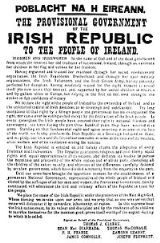
 at the right corner at Henry Street and a green flag with the inscription 'Irish Republic' at the left corner at Princess Street. A short time later, Pearse read the Proclamation of the Republic outside the GPO.

The Commander-in-Chief of the British Army in Ireland, General Lovick Friend
Lovick Friend

Major General Sir Lovick Bransby Friend Order of the British Empire, Order of the Bath, Her Majesty's Most Honourable Privy Council was a British Army major general and cricketer....
, was on leave in England. When the insurrection began the Officer Commanding the Dublin Garrison, Colonel Kennard, could not be located. His adjutant, Col. H. V. Cowan, telephoned Marlborough Barracks and asked for a detachment of troops to be sent to Sackville Street (O'Connell Street) to investigate the situation at the GPO. He then telephoned Portobello, Richmond and the Royal Barracks and ordered them to send troops to relieve Dublin Castle. Finally, he contacted the Curragh and asked for reinforcements to be sent to Dublin. A troop of the 6th Reserve Cavalry Regiment
Cavalry regiments of the British Army

There are currently nine regular cavalry regiments of the British Army, with two tank regiments provided by the Royal Tank Regiment, traditionally classed alongside the cavalry, for a total of eleven regiments....
, dispatched from Marlborough Barracks, proceeded down O'Connell Street. As it passed Nelson's Pillar
Nelson's Pillar

The Nelson Pillar , known generally in Dublin as Nelson's Pillar or simply The Pillar, was a large granite pillar topped by a statue of Horatio Nelson, 1st Viscount Nelson, located in the centre of O'Connell Street in Dublin....
, level with the GPO, the rebels opened fire, killing three cavalrymen and two horses and fatally wounding a fourth man. The cavalrymen retreated and were withdrawn to barracks. This action is often referred to, inaccurately, as the "Charge of the Lancers."

A piquet from the 3rd (Reserve) Battalion, Royal Irish Regiment (RIR), approaching the city from Richmond Barracks, encountered an outpost of Éamonn Ceannt's force under Section-Commander John Joyce in Mount Brown, at the north-western corner of the South Dublin Union. A party of twenty men under Lieutenant George Malone was ordered to march on to Dublin Castle. They proceeded a short distance with rifles sloped and unloaded before coming under fire, losing three men in the first volley, then broke into a tan-yard opposite. Malone's jaw was shattered by a bullet as he went in. The Commanding Officer, Lieutenant-Colonel R. L. Owens, brought up the remainder of his men from Richmond Barracks. A company with a Lewis Gun
Lewis Gun

The Lewis Gun is a pre-World War I era light machine gun of American design that was perfected and most widely used by the forces of the British Empire....
 was sent to the Royal Hospital (not then a hospital but the British military headquarters), overlooking the Union. The main body took up positions along the east and south walls of the Union, occupying houses and a block of flats
Apartment

An apartment is a self-contained House unit that occupies only part of a Apartment building. Apartments may be owned or rented .A common alternative term for apartment is flat....
, then opened fire on the rebel positions, forcing Joyce and his men to retreat across open ground. A party led by Lieut. Alan Ramsey broke open a small door next to the Rialto gate, but Ramsey was shot and killed, and the attack was repulsed. A second wave led by Capt. Warmington charged the door but Warmington, too, was killed. The remaining troops, trying to break in further along the wall, were enfiladed from Jameson's
Jameson Irish Whiskey

Jameson is a single-distillery Irish whiskey. The brand is today owned by the French beverage conglomerate Pernod Ricard. Unlike other blends where several whiskeys from either other distilleries or the open market are combined together to reduce costs, the Jameson distilling tradition has always insisted upon producing every component of the...
 distillery in Marrowbone Lane
Marrowbone Lane

Marrowbone Lane is a street in Dublin, known for the fierce fighting that took place on it during the Easter Rising of 1916. The distillery on this street was used as a strongpoint by a force of more than a hundred rebels under the command of Eamonn Ceannt, which also held the nearby South Dublin Union....
. Eventually the superior numbers and firepower of the British were decisive; they forced their way inside and the small rebel force in the tin huts at the eastern end of the Union surrendered.

Tuesday to Saturday


British forces initially put their efforts into securing the approaches to Dublin Castle and isolating the rebel headquarters, which they believed was in Liberty Hall
Liberty Hall

Liberty Hall , in Dublin, Ireland is the headquarters of the SIPTU . It was formerly the List of tallest structures in Ireland#Buildings at 59 m High , and is currently the tallest in Dublin but only the seventh tallest in Ireland....
. The British commander, Brigadier-General Lowe, worked slowly, unsure of the size of the force he was up against, and with only 1,269 troops in the city when he arrived from the Curragh Camp
Curragh Camp

The Curragh Camp is an army base and military college located in The Curragh, County Kildare, Ireland. It is the main training centre for the Irish Army....
 in the early hours of Tuesday 25 April. City Hall was taken on Tuesday morning. The rebel position at St Stephen's Green, held by the Citizen Army under Michael Mallin
Michael Mallin

Michael Mallin was an Ireland rebel and socialist who took an active role in the 1916 Easter Rising.Born in Dublin, Ireland, Mallin was second in command of the Irish Citizen Army under James Connolly and commanded the garrison at St....
, was made untenable after the British placed snipers and machine guns in the Shelbourne Hotel
Shelbourne Hotel

The Shelbourne Hotel is a famous hotel situated in a landmark building on the north side of St Stephen's Green, in Dublin, Ireland. Currently operated by Marriott International, the hotel has 265 rooms in total and reopened in March 2006 after undergoing an eighteen-month refurbishment....
 and surrounding buildings. As a result, Mallin's men retreated to the Royal College of Surgeons
Royal College of Surgeons in Ireland

The Royal College of Surgeons in Ireland , is a Dublin-based medical institution, situated on St. Stephen's Green. The college is one of the five Recognised Colleges of the National University of Ireland....
 building. British firepower was provided by field artillery summoned from their garrison at Athlone
Athlone

Athlone is a town that lies on the River Shannon near the southern extremity of Lough Ree, Republic of Ireland....
 which they positioned on the northside of the city at Phibsboro
Phibsboro

Phibsborough , often spelled Phibsboro, is a district of Dublin in Republic of Ireland. It is located in the Dublin 7 Dublin postal districts on the northside of the city....
ugh and at Trinity College
Trinity College, Dublin

Trinity College, Dublin , corporately designated as the Provost, Fellows and Scholars of the College of the Holy and Undivided Trinity of Queen Elizabeth near Dublin, was founded in 1592 by Queen Elizabeth I of England as the "mother of a university", and is the only constituent residential college of the University of Dublin....
, and by the patrol vessel Helga, which sailed upriver from Kingstown. Lord Wimborne, the Lord Lieutenant, declared martial law
Martial law

Martial law is the system of rules that takes effect when the military takes control of the normal administration of justice.Martial law is sometimes imposed during wars or occupied territory in the absence of any other civil government....
 on Tuesday evening. On Wednesday, 26 April, the guns at Trinity College and Helga shelled Liberty Hall, and the Trinity College guns then began firing at rebel positions in O'Connell Street.

Reinforcements were sent to Dublin from England, and disembarked at Kingstown on the morning of 26 April. Heavy fighting occurred at the rebel-held positions around the Grand Canal
Grand Canal of Ireland

The Grand Canal is the southernmost of a pair of canals that connect Dublin, in the east of the country, with the River Shannon in the west, the two canals nearly encircling Dublin's inner city....
 as these troops advanced towards Dublin. The Sherwood Foresters
Sherwood Foresters

The Sherwood Foresters was formed during the Childers Reforms in 1881 from the amalgamation of the 45th Regiment of Foot and the 95th Regiment of Foot....
 were repeatedly caught in a cross-fire trying to cross the canal at Mount Street. Seventeen Volunteers were able to severely disrupt the British advance, killing or wounding 240 men. The rebel position at the South Dublin Union (site of the present day St. James's Hospital
St. James's Hospital

St. James's Hospital is the largest university teaching hospital in Dublin. Its academic partner is the University of Dublin. The Teaching Centre was opened in 1994 and it incorporates the clinical departments of the Medical School, Unit for Dietetics and Nutrition, the Nursing School, Postgraduate Centre and the library of the Faculty of...
), further west along the canal, also inflicted heavy losses on British troops trying to advance towards Dublin Castle. Cathal Brugha
Cathal Brugha

Cathal Brugha was an Ireland revolutionary and politician, active in the Easter Rising, Irish War of Independence, and the Irish Civil War and was the first Ceann Comhairle of D?il ?ireann....
, a rebel officer, distinguished himself in this action and was badly wounded.

The headquarters garrison, after days of shelling, were forced to abandon their headquarters when fire caused by the shells spread to the GPO. They tunnelled through the walls of the neighbouring buildings in order to evacuate the Post Office without coming under fire and took up a new position in 16 Moore Street
Moore Street

Moore Street is a street in central Dublin, which intersects Henry Street . It is notable as the location of Dublin's oldest food market, Moore Street Market....
. On Saturday 29 April, from this new headquarters, after realizing that they could not break out of this position without further loss of civilian life, Pearse issued an order for all companies to surrender. Pearce surrendered unconditionally
Unconditional surrender

Unconditional surrender is a surrender without conditions, except for those provided by international law. Announcing that only unconditional surrender is acceptable puts psychological pressure on a weaker adversary....
 to Brigadier-General Lowe. The surrender document read:

The Rising outside Dublin

Generalpostofficedublin 20060803 Kaihsutai
Irish Volunteer units turned out for the Rising in several places outside of Dublin, but due to Eoin MacNeill's countermanding order, most of them returned home without fighting. In addition, due to the interception of the German arms aboard the Aud, the provincial Volunteer units were very poorly armed.

At Ashbourne, County Meath
Ashbourne, County Meath

Ashbourne is a sizeable commuter town in County Meath, Republic of Ireland about 20 km from Dublin on the N2 road Roads in Ireland....
, the North County Dublin
County Dublin

County Dublin , or more correctly today the Dublin Region , is the area that contains the city of Dublin, the Capital of Republic of Ireland as well as the largest city on the island of Ireland; and the modern counties of County of Dun Laoghaire-Rathdown, County of Fingal and County of South Dublin....
 Volunteers (also known as the Fingal Volunteers), led by Thomas Ashe
Thomas Ashe

Thomas Patrick Ashe born in Lispole, County Kerry, Ireland, a teacher, was a member of the Gaelic League, the Irish Republican Brotherhood and a founding member of the Irish Volunteers....
 and his second in command Richard Mulcahy
Richard Mulcahy

Richard James Mulcahy was an Politics of the Republic of Ireland, army general and commander in chief, leader of Fine Gael and Cabinet Minister....
, attacked the RIC barracks. Reinforcements came from Slane
Slane

Slane is a village in County Meath, in Republic of Ireland. The village stands on a steep hillside on the left bank of the River Boyne at the intersection of the N2 road and the N51 road, Ireland ....
 and after a five-hour battle, the Volunteers captured over 90 prisoners. There were 8–10 RIC deaths and two Volunteer fatalities, John Crennigan and Thomas Rafferty. The action pre-figured the guerrilla tactics of the Irish Republican Army
Irish Republican Army

The Irish Republican Army was an Irish republican revolutionary military organisation descended from the Irish Volunteers, established 25 November 1913 and who in April 1916 staged the Easter Rising....
 in the Irish War of Independence
Irish War of Independence

The Irish War of Independence from January 1919 to July 1921 was a guerrilla warfare mounted against the United Kingdom of Great Britain and Ireland in Ireland by the Irish Republican Army ....
 from 1919 to 1921. Elsewhere in the east, Seán MacEntee
Seán MacEntee

Se?n MacEntee was a senior Republic of Ireland politician. In a career that spanned over forty years as a Fianna F?il Teachta D?la, MacEntee was one of the most important figures in post-independence Ireland....
 and County Louth
County Louth

County Louth is a county on the east coast of Ireland, on the border with Northern Ireland. The county town is Dundalk.County Louth is affectionately called "the Wee County" being the smallest county in Ireland having a total area of only 821sq kilometres ....
 Volunteers killed a policeman and a prison guard. In County Wexford
County Wexford

County Wexford is a maritime county in the southeast of Republic of Ireland, in the province of Leinster. It takes its name from the principal town, Wexford, founded by Vikings and named by them 'Waesfjord', meaning 'inlet or bay of the mud-flats' in the Old Norse language....
, the Volunteers took over Enniscorthy
Enniscorthy

Enniscorthy is the second-largest town in County Wexford, Republic of Ireland . With a history going back to 465 in Ireland, Enniscorthy is one of the longest continuously-occupied sites in Ireland....
 from Tuesday until Friday, before symbolically surrendering to the British Army at Vinegar Hill – site of a famous battle
Battle of Vinegar Hill

The Battle of Vinegar Hill was an engagement during the Irish Rebellion of 1798 on 21 June 1798 between forces of the British Crown and United Irishmen when over 15,000 British soldiers launched an attack on Vinegar Hill outside Enniscorthy, Co....
 during the Irish Rebellion of 1798
Irish Rebellion of 1798

The Irish Rebellion of 1798 , or 1798 rebellion as it is known locally, was an uprising in 1798, lasting several months, against United Kingdom and its subject Kingdom of Ireland....
.

In the west, Liam Mellows
Liam Mellows

Liam Mellows , often spelled 'Liam Mellowes', was an Ireland Nationalist and Sinn F?in politician. Born in England, Mellows grew up in County Wexford in Ireland....
 led 600-700 Volunteers in abortive attacks on several police stations, at Oranmore
Oranmore

Oranmore is a suburban village in County Galway on the outskirts of Galway city in Republic of Ireland. With its major housing developments, Oranmore is rapidly becoming a part of Galway's commuter or suburban belt....
 and Clarinbridge
Clarinbridge

Clarinbridge is a small village, approximately a 15-minute drive south of Galway, Ireland in the Diocese of Kilmacduagh. It is on the mouth of the Clarin at the end of Dunkellin Bay, which is the easternmost part of Galway Bay....
 in County Galway
County Galway

County Galway is located on the west coast of Ireland. It is in the Provinces of Ireland of Connacht. The county takes its name from the city of Galway....
. There was also a skirmish at Carnmore
Carnmore

Carnmore is located at the southern end of the parish of Claregalway, approximately east of Galway city in County Galway, Ireland. Carnmore lies within the Gaeltacht although the vast majority of residents there use English as their first language....
 in which two RIC men were killed. However his men were poorly-armed, with only 25 rifles and 300 shotguns, many of them being equipped only with pikes
Pike (weapon)

A pike is a pole weapon, a very long thrusting spear used two-handed and used extensively by infantry both for attacks on enemy foot soldiers and as a counter-measure against cavalry assaults....
. Towards the end of the week, Mellows' followers were increasingly poorly-fed and heard that large British reinforcements were being sent westwards. In addition, the British warship, HMS Gloucester
HMS Gloucester (1909)

HMS Gloucester was a Town class cruiser light cruiser of the Royal Navy launched on 28 October 1909 from the yards of William Beardmore and Company....
 arrived in Galway Bay
Galway Bay

Galway Bay is a large Headlands and bays / sea loch on the west coast of Ireland, between County Galway in the Provinces of Ireland of Connacht to the north and the Burren in County Clare in the province of Munster to the south....
 and shelled the fields around Athenry
Athenry

Athenry is a town in County Galway, Republic of Ireland. It lies 25 km to the east of Galway city, and is also famous for the song "The Fields of Athenry." One of the attractions of the town is its medieval castle....
 where the rebels were based. On 29 April the Volunteers, judging the situation to be hopeless, dispersed from the town of Athenry. Many of these Volunteers were arrested in the period following the rising, while others, including Mellows had to go "on the run" to escape. By the time British reinforcements arrived in the west, the rising there had already disintegrated.

In the north, several Volunteer companies were mobilised in County Tyrone
County Tyrone

County Tyrone is the second largest of the nine Irish county of Ulster and the largest of the six counties of Northern Ireland. It has an area of 3,155 square kilometres ....
 and 132 men on the Falls Road in Belfast
Belfast

Belfast is the capital city of Northern Ireland and the seat of Devolution#United Kingdom Northern Ireland Executive and legislative Northern Ireland Assembly in Northern Ireland....
.

In the south, around 1,000 Volunteers mustered in Cork
Cork (city)

Cork is the second largest city in the Republic of Ireland and the Ireland third most populous city after Dublin and Belfast. It is the principal city and administrative centre of County Cork and the largest city in the Provinces of Ireland of Munster....
, under Tomás Mac Curtain
Tomás Mac Curtain

Tom?s Mac Curtain was a Sinn F?in Lord Mayor of Cork, Ireland. He was elected in January 1920.He was born at Ballyknockane in the Parish of Mourne Abbey in March 1884....
 on Easter Sunday, but they dispersed after receiving several contradictory orders from the Volunteer leadership in Dublin.

Casualties

The British Army reported casualties of 116 dead, 368 wounded and 9 missing. 16 policemen died and 29 were wounded. Irish casualties were 318 dead and 2,217 wounded. The Volunteers and ICA recorded 64 killed in action, but otherwise Irish casualties were not divided into rebels and civilians.

Aftermath

General Maxwell
John Maxwell (British Army officer)

General Sir John Grenfell Maxwell Order of the Bath, Order of St Michael and St George, Royal Victorian Order, Distinguished Service Order was a British Army officer and colonial governor....
 quickly signalled his intention “to arrest all dangerous Sinn Feiners,” including “those who have taken an active part in the movement although not in the present rebellion,” reflecting the popular belief that Sinn Féin
Sinn Féin

Sinn F?in is a political party in Ireland. The current party, led by Gerry Adams, was formed following a split in January 1970 and traces its origins back to the original Sinn F?in party formed in 1905....
, a separatist organisation that was neither militant nor republican, was behind the Rising.

A total of 3,430 men and 79 women were arrested, although most were subsequently released. In attempting to arrest members of the Kent family in County Cork
County Cork

County Cork is the most southerly and the largest of the modern counties of Republic of Ireland. Cork is nicknamed "The Rebel County", as a result of the support of the townsmen of Cork in 1491 for Perkin Warbeck, a pretender to the throne of England during the Wars of the Roses....
 on 2 May, a Head Constable was shot dead in a gun battle. Richard Kent was also killed, and Thomas
Thomas Kent

Thomas Kent was an Ireland nationalist executed following a gunfight with the Royal Irish Constabulary on 22 April 1916....
 and William Kent were arrested.

In a series of courts martial beginning on 2 May, ninety people were sentenced to death. Fifteen of those (including all seven signatories of the Proclamation) had their sentences confirmed by Maxwell and were executed by firing squad between 3 May and 12 May (among them the seriously-wounded Connolly, shot while tied to a chair due to a shattered ankle). Not all of those executed were leaders: Willie Pearse
Willie Pearse

William "Willie" Pearse was an Ireland republican executed for his part in the Easter Rising. He was a younger brother of Patrick Pearse, a leader of the rising....
 described himself as "a personal attaché to my brother, Patrick Pearse"; John MacBride
John MacBride

Major John MacBride was an Ireland Irish republicanism executed for his leading role in the 1916 Easter Rising....
 had not even been aware of the Rising until it began, but had fought against the British in the Boer War
Second Boer War

The Second Boer War , commonly referred to as The Boer War and also known as the South African War , the Anglo-Boer War and in Afrikaans as the Boereoorlog or Tweede Vryheidsoorlog , was fought from 11 October 1899 until 31 May 1902, between the British Empire and the two independent Boer republics of the Orange Fre...
 fifteen years before; Thomas Kent
Thomas Kent

Thomas Kent was an Ireland nationalist executed following a gunfight with the Royal Irish Constabulary on 22 April 1916....
 did not come out at all—he was executed for the killing of a police officer during the raid on his house the week after the Rising. The most prominent leader to escape execution was Eamon de Valera
Éamon de Valera

?amon de Valera was one of the dominant political figures in 20th century Ireland. His political career spanned over half a century, from 1917 to 1973; he served multiple terms as head of government and head of state, and is credited with a leading role in the authorship of the present-day Constitution of Ireland....
, Commandant of the 3rd Battalion.

A Royal Commission
Royal Commission

In states that are Commonwealth Realms a Royal Commission is a major government public inquiry into an issue. They have been held in states such as the United Kingdom, Canada, Australia, New Zealand and Saudi Arabia....
 was set up to enquire into the causes of the Rising. It began hearings on 18 May under the chairmanship of Lord Hardinge of Penshurst
Charles Hardinge, 1st Baron Hardinge of Penshurst

Charles Hardinge, 1st Baron Hardinge of Penshurst Order of the Garter Order of the Bath Order of the Star of India Order of St Michael and St George Order of the Indian Empire Royal Victorian Order Imperial Service Order Privy Council of the United Kingdom was a British diplomat and statesman who served as Viceroy of India from 1910 to 1916...
. The Commission heard evidence from Sir Matthew Nathan, Augustine Birrell, Lord Wimborne, Sir Neville Chamberlain
Neville Francis Fitzgerald Chamberlain

Sir Neville Francis Fitzgerald Chamberlain Knight Commander of the Order of the Bath Knight Commander of the Royal Victorian Order King's Police Medal was a British Army officer, and later Inspector-General of the Royal Irish Constabulary who resigned in the aftermath of the 1916 Easter Rising in Ireland....
 (Inspector-General of the Royal Irish Constabulary
Royal Irish Constabulary

The armed Royal Irish Constabulary was Ireland's major police force for most of the nineteenth and the early twentieth centuries. A separate civic police force, the unarmed Dublin Metropolitan Police controlled the capital....
), General Lovick Friend
Lovick Friend

Major General Sir Lovick Bransby Friend Order of the British Empire, Order of the Bath, Her Majesty's Most Honourable Privy Council was a British Army major general and cricketer....
, Major Ivor Price of Military Intelligence and others. The report, published on 26 June, was critical of the Dublin administration, saying that "Ireland for several years had been administered on the principle that it was safer and more expedient to leave the law in abeyance if collision with any faction of the Irish people could thereby be avoided." Birrell and Nathan had resigned immediately after the Rising. Wimborne had also reluctantly resigned, but was re-appointed, and Chamberlain resigned soon after.

1,480 men were interned in England and Wales under Regulation 14B of the Defence of the Realm Act 1914
Defence of the Realm Act 1914

The Defence of the Realm Act was passed in the United Kingdom of Great Britain and Ireland on 8 August 1914, during the early weeks of World War I....
, many of whom, like Arthur Griffith
Arthur Griffith

Arthur Griffith was the founder and third leader of Sinn F?in. He served as President of D?il ?ireann from January to August 1922, and was head of the Irish delegation at the negotiations in London that produced the Anglo-Irish Treaty of 1921....
, had little or nothing to do with the affair. Camps such as Frongoch internment camp
Frongoch internment camp

Frongoch internment camp at Frongoch in Merionethshire, Wales was a makeshift place of imprisonment during the First World War. Until 1916 it housed German prisoners of war in an abandoned distillery and crude huts, but in the wake of the 1916 Easter Rising in Dublin, Ireland, the German prisoners were moved and it was used as a place of int...
 became “Universities of Revolution” where future leaders like Michael Collins
Michael Collins (Irish leader)

Michael John Collins was an Ireland revolutionary leadership, Minister for Finance and Member of Parliament for South Cork in the First D?il of 1919, Director of Military intelligence for the Irish Republican Army, and member of the Irish delegation during the Anglo-Irish Treaty negotiations....
, Terence McSwiney and J. J. O’Connell began to plan the coming struggle for independence. Roger Casement
Roger Casement

Roger David Casement , , was an Ireland patriot, poet, revolutionary and Irish nationalism. He was a United Kingdom consul by profession famous for his reports and activities against human rights abuses in the Congo Free State and Peru, but better known for his dealings with Germany before Ireland's Easter Rising in 1916....
 was tried in London for high treason
High treason

High treason is criminal disloyalty to one's country. Participating in a war against one's country, attempting to overthrow its government, spying on its military, its diplomats, or its secret services for a hostile and foreign power, or attempting to kill its head of state are perhaps the best-known examples of high treason....
 and hanged
Hanging

Hanging is the lethal suspension of a person by a ligature. The Oxford English Dictionary states that hanging in this sense is "specifically to put to death by suspension by the neck", although it formerly also referred to crucifixion and death by impalement in which the body would remain "hanging"....
 at Pentonville Prison
Pentonville (HM Prison)

HM Prison Pentonville is a Prison security categories in the United Kingdom men's prison, operated by Her Majesty's Prison Service. Pentonville Prison is not actually within Pentonville itself, but is located further north, on the Caledonian Road in the Barnsbury area of the London Borough of Islington, in inner London-North London, England....
 on 3 August.

According to Peter Berresford Ellis it has become firmly set in people’s minds that the Dublin people jeered the prisoners as they were led off to imprisonment, and that this description of how Dublin viewed the insurrection has almost become written in stone. He suggests that it was certainly a view that the imperial propaganda of the time wanted to impress on everyone, and that newspapers were unlikely to publish anything to the contrary.

Examples cited by Berresford Ellis include, Dorothy Macardle, writing in her The Irish Republic, "The people had not risen. Some had cursed the insurgents." Thomas M. Coffey in Agony at Easter: The 1916 Irish Uprising writes, "The defeated insurgents quickly learnt how most Dubliners still felt about their rebellion when a raucous crowd came pouring out of the side streets to accost them ... The flood of insults was so fierce and vitriolic it hit the marching prisoners with an almost physical impact."

According to Berresford Ellis this perspective became less tenable when a long obscure eyewitness account of the period resurfaced in 1991. Canadian journalist and writer, Frederick Arthur McKenzie, was one of the best-known and reputable war correspondents of his day according to Berresford Ellis. He was one of two Canadian journalists who arrived in Dublin with the English reinforcements sent to put down the insurrection. McKenzie had no sympathy for the Irish ‘rebels’ and German sympathizers, as he perceived them, and was no anti-imperialist.

McKenzie published The Irish Rebellion: What happened and Why, with C. Arthur Pearson in London in 1916, he notes, "I have read many accounts of public feeling in Dublin in these days. They are all agreed that the open and strong sympathy of the mass of the population was with the British troops. That this was in the better parts of the city, I have no doubt, but certainly what I myself saw in the poorer districts did not confirm this. It rather indicated that there was a vast amount of sympathy with the rebels, particularly after the rebels were defeated." Berresford Ellis then cites a passage by McKenzie describing how he watched as people were waving and cheering as a regiment approached, and that he commented to his companion they were cheering the soldiers. Noticing then that they were escorting Irish prisoners, he realised that they were actually cheering the rebels. The rebels he says were walking in military formation and were loudly and triumphantly singing a rebel song. McKenzie reports speaking to a group of men and women at street corners, "shure, we cheer them" said a woman, "why wouldn’t we? Aren't they our own flesh and blood." Dressed in khaki McKenzie was mistaken for a British soldier as he went about Dublin back streets were people cursed him openly, and "cursed all like me strangers in their city." J.W Rowath, a British officer had a comparable experience to McKenzie and observed that "crowds of men and women greeted us with raised fists and curses."

Brian Barton & Micheal Foy cite Frank Robbins of the Irish Citizen Army who records seeing a group of Dubliners gathered to cheer the prisoners while being marched into Richmond barracks. They also report de Valera’s surrendered Boland’s mill, were crowds lined the pavement in Grand Canal Street and Hogan Place and pleaded with the insurgents to take shelter in their houses rather than surrender. Foy and Barton concluded "Public attitudes locally were not uniformly hostile in an area which the police had come to regard as increasingly militant in the months before the Rising. Some of the British soldiers who fought there noted a strong antipathy towards them." At the South Dublin Union, Major de Courcy Wheeler noted that there was no hostility from the people towards the insurgents: "It was perfectly plain that all their admiration was for the heroes who had surrendered."

This account flatly contradicts most of the contemporary accounts, says Berresford Ellis. This is a view shared by Michael Foy and Brian Barton also highlighting expressions of sympathy from the people who watched the prisoners being marched away. Quoting the diary of John Clarke a shopkeeper who writes "Thus ends the last attempt for poor old Ireland. What noble fellows. The cream of the land. None of your corner-boy class."

Foy and Barton felt the contradictions could be modified by other factors. They examined the routes which the British soldiers took the prisoners. Michael Mallin’s column of prisoners they say were marched two miles to Richmond barracks through a "strongly loyalist and Protestant artisan class district." It was from this district that the Royal Dublin Fusiliers and other Irish regiments of the British army drew their recruits. It was around Richmond barracks they say, lived people who were economically dependent on the military. Another aspect they raise was the degree of hostility from Dublin women whose sons were serving in the army in France. They note that some priests at Church Street rebuked the insurgent prisoners and wounded. However the generally accepted account of the population of Dublin being uniformly hostile to the surrendered insurgents is one of the myths repeated so often as to become 'history.'

Berresford Ellis concludes that it has becomes clear that the insurrection of 1916 needs more considered research and analysis before we can be certain that it is "assessed in its rightful historical context." The assertion that it was an unpopular rising by a small band who were jeered and insulted on their defeat as they were led off into captivity is just one of "the myths that have been propagated."

A meeting called by Count Plunkett on 19 April 1917 led to the formation of a broad political movement under the banner of Sinn Féin which was formalised at the Sinn Féin Ard Fheis
Ard Fheis

An Ardfheis or Ard Fheis is an annual convention or special convention, usually of a political party. It is an Irish language and Scottish Gaelic language word, which can be translated loosely as "high festival"....
 of 25 October 1917. The Conscription Crisis of 1918 further intensified public support for Sinn Féin before the general elections
Irish (UK) general election, 1918

The Irish general election of 1918 was that part of the United Kingdom general election, 1918 that took place in Ireland. It is seen as a key moment in modern History of Ireland....
 to the British Parliament on 14 December 1918, which resulted in a landslide victory for Sinn Féin, whose MP
Member of Parliament

A Member of Parliament, or MP, is a representative of the voters to a parliament. In many countries the term applies specifically to members of the lower house, as upper houses often have a unique title, such as senate, and thus also have unique titles for its members, such as senators....
s gathered in Dublin on 21 January 1919 to form Dáil Éireann
First Dáil

The First D?il was D?il ?ireann as it convened from 1919–1921. In 1919 candidates who had been elected in the Westminster elections of 1918 refused to recognise the Parliament of the United Kingdom and instead assembled as a unicameral, revolutionary parliament called "D?il ?ireann"....
 and adopt the Declaration of Independence
Declaration of Independence (Ireland)

The Declaration of Independence was a document adopted by D?il ?ireann , the revolutionary parliament of the self-proclaimed Irish Republic, at its first meeting in the Mansion House, Dublin, Dublin, on 21 January 1919....
.

Legacy of the Rising

Gpo Easter Rising Plaque
Some survivors of the Rising went on to become leaders of the independent Irish state and those who died were venerated by many as martyr
Martyr

The term martyr is most commonly used today to describe an individual who sacrifices his or her life in order to further a cause or belief for many....
s. Their graves in Arbour Hill military prison in Dublin became a national monument and the text of the Proclamation was taught in schools. An annual commemoration, in the form of a military parade, was held each year on Easter Sunday, culminating in a huge national celebration on the 50th anniversary in 1966.

With the outbreak of the Troubles
The Troubles

The Troubles was a period of ethno-political conflict in Northern Ireland which spilled over at various times into England, the Republic of Ireland and Continental Europe....
 in Northern Ireland
Northern Ireland

conventional_long_name = Northern Ireland|native_name= Tuaisceart ?ireannNorlin Airlann|motto =|image_map = Europe location N-IRL2.png...
, government, academics and the media began to revise the country’s militant past, and particularly the Easter Rising. The coalition government
Government of the 20th Dáil

The 20th D?il was elected at the Irish general election, 1973 on 28 February 1973 and first met on 14 March when the 14th Government of Ireland was appointed....
 of 1973—1977, in particular the Minister for Posts and Telegraphs
Minister for Posts and Telegraphs (Ireland)

The Minister for Posts and Telegraphs was a senior post in the government of the Irish Free State and the Politics of the Republic of Ireland from 1924 to 1984, when the post and the department was abolished....
, Conor Cruise O'Brien
Conor Cruise O'Brien

Conor Cruise O'Brien was an Ireland politician, writer and academic. Although his opinion on the role of Britain in Nothern Ireland changed over the course of the 1970s and 1980s, he continued throughout his life to acknowlege values of, as he saw, two irreconcilable traditions....
, began to promote the view that the violence of 1916 was essentially no different to the violence then taking place in the streets of Belfast and Derry. Cruise O'Brien and others asserted that the Rising was doomed to military defeat from the outset, and that it failed to account for the determination of Ulster Unionists
Unionism in Ireland

Unionism in Ireland is an ideology that favours the maintenance or strengthening of the political and cultural ties between Ireland and Great Britain....
 to remain in the United Kingdom
United Kingdom of Great Britain and Ireland

The United Kingdom of Great Britain and Ireland was the formal name and the state form of the United Kingdom from 1 January 1801 until 12 April 1927....
. "Revisionist" historians began to write of it in terms of a "blood sacrifice." While the Rising and its leaders continued to be venerated by Irish republicans – including members and supporters of the IRA and Sinn Féin
Sinn Féin

Sinn F?in is a political party in Ireland. The current party, led by Gerry Adams, was formed following a split in January 1970 and traces its origins back to the original Sinn F?in party formed in 1905....
 – with murals in republican areas of Belfast and other towns celebrating the actions of Pearse and his comrades, and a number of parades held annually in remembrance of the Rising, the Irish government discontinued its annual parade in Dublin in the early 1970s, and in 1976 it took the unprecedented step of proscribing (under the Offences against the State Act
Offences against the State Acts 1939-1998

The Offences Against the State Act 1939-1998 form a series of laws passed by the Oireachtas relating to the suppression of terrorism....
) a 1916 commemoration ceremony at the GPO organised by Sinn Féin and the Republican commemoration Committee. A Labour Party
Labour Party (Ireland)

The Labour Party is a democratic socialist and social democratic political party in the Republic of Ireland. Founded by James Connolly in 1912 as the political wing of the Irish Congress of Trades Unions, it claims to be the country's oldest continuous political party....
 TD
Teachta Dála

A Teachta D?la is a member of D?il ?ireann, the lower chamber of the Oireachtas of Republic of Ireland. The official translation of Teachta D?la is Deputy to the D?il, a more literal translation is...
, David Thornley, embarrassed the government (of which Labour was a member) by appearing on the platform at the ceremony, along with Máire Comerford
Maire Comerford

M?ire Comerford was an Irish republicanism from County Wexford who witnessed central events in 1916-23 and remained a committed supporter of Cumann na mBan until her death....
, a survivor of the Rising, and Fiona Plunkett, sister of Joseph Plunkett. This culminated in the complete ignoring of the seventy fifth anniversary of the Rising in 1991 by the State. With the advent of a Provisional IRA ceasefire and the beginning of what became known as the Peace Process
Northern Ireland peace process

When discussing the history of Northern Ireland, the "peace process" is generally considered to cover the events leading up to the 1994 Provisional Irish Republican Army ceasefire, the end of most of the violence of the Troubles, the Belfast Agreement, and subsequent political developments....
 during the 1990s, the official view of the Rising became more positive and in 1996 an eightieth anniversary commemoration at the Garden of Remembrance
Garden of Remembrance (Dublin)

The Garden of Remembrance is a memorial garden in Dublin dedicated to the memory of "all those who gave their lives in the cause of Irish Freedom"....
 in Dublin was attended by the Taoiseach
Taoiseach

The Taoiseach The Taoiseach is appointed by the President of Ireland upon the nomination of D?il ?ireann , and must, while he remains in office, retain the support of a majority in the D?il....
 and leader of Fine Gael
Fine Gael

Fine Gael ? The United Ireland Party, shortened to Fine Gael is the second largest political party in the Republic of Ireland. It claims a membership of 30,000, and is the largest parliamentary opposition party in the Oireachtas, the Irish parliament....
, John Bruton
John Bruton

John Gerard Bruton served as the ninth Taoiseach of Republic of Ireland. A minister under two Taoiseach, Liam Cosgrave and Garret FitzGerald, Bruton held a number of the top posts in Government of Ireland, including Minister for Finance , and Minister for Enterprise, Trade and Employment ....
. In 2005 the Taoiseach, Bertie Ahern
Bertie Ahern

Patrick Bartholomew "Bertie" Ahern is an Republic of Ireland politician who served as Taoiseach of Republic of Ireland from 26 June 1997 to 7 May 2008....
, announced the government’s intention to resume the military parade past the GPO from Easter 2006, and to form a committee to plan centenary celebrations in 2016.

90th Anniversary of the 1916 Rising

The 90th anniversary of the 1916 Easter Rising was commemorated by a military parade held in Dublin on Easter Sunday, 16 April 2006. The President of Ireland
President of Ireland

The President of Ireland is the head of state of Republic of Ireland. The President is usually directly elected by the people for seven years, and can be elected for a maximum of two terms....
 (Mary McAleese
Mary McAleese

Mary Patricia McAleese is the President_of_Ireland#List_of_Presidents_of_Ireland and current President of Ireland. She is Ireland's second female president and the world's first woman to succeed another woman as an elected head of state....
), the Lord Mayor of Dublin, the Taoiseach
Taoiseach

The Taoiseach The Taoiseach is appointed by the President of Ireland upon the nomination of D?il ?ireann , and must, while he remains in office, retain the support of a majority in the D?il....
 (Bertie Ahern
Bertie Ahern

Patrick Bartholomew "Bertie" Ahern is an Republic of Ireland politician who served as Taoiseach of Republic of Ireland from 26 June 1997 to 7 May 2008....
), members of the Irish Government
Irish Government

The Government of Ireland is the Cabinet that exercises executive authority in Republic of Ireland. The Government is headed by a prime minister called the Taoiseach, and a deputy prime minister called the T?naiste....
 and other invited guests reviewed the parade as it passed the General Post Office
General Post Office (Dublin)

The 'General Post Office' in Dublin is the headquarters of the Irish postal service An Post, and Dublin's principal post office. Sited in the centre of the city's main thoroughfare O'Connell Street, it is one of Ireland's most famous buildings and was the last of the great georgian architecture public buildings to be erected in the...
, headquarters of the Rising. The parade comprised some 2,500 personnel from the Irish Defence Forces
Irish Defence Forces

The Irish Defence Forces encompass the army, navy, air force and reserve forces of Republic of Ireland. Their official title in Irish language is ?glaigh na h?ireann; the more literal translation F?rsa? Cosanta na h?ireann is also attested in Irish-language literature....
 (representing the Army, Air Corps, Naval Service, Irish Army Reserve and Naval Reserve), the Garda Síochána
Garda Síochána

is the police of the Republic of Ireland.The force is headed by the Commissioner who is appointed by the Irish Government. Its headquarters are located in the Phoenix Park in Dublin....
, Irish United Nations Veterans Association and members of the Organisation of National Ex-Servicemen and Women. The parade started at Dublin Castle
Dublin Castle

Dublin Castle off Dame Street, Dublin, Republic of Ireland, is a major Republic of Ireland governmental complex, formerly the fortified seat of United Kingdom of Great Britain and Ireland rule in Ireland until 1922....
 and proceeded via Dame Street
Dame Street

Dame Street is a large thoroughfare in Dublin, Republic of Ireland. The street is the location of many banks such as AIB, Ulster Bank and the Central Bank and Financial Services Authority of Ireland....
 and College Green
College Green

File:Trinity college front arch.jpgCollege Green , previously called Hoggen Green, is a three-sided "square" in the centre of Dublin. On its northern side is a building known today as the Bank of Ireland which until 1800 was Irish Houses of Parliament....
 to the GPO
GPO

GPO can refer to:*General Post Office**General Post Office **General Post Office **General Post Office **General Post Office, Melbourne, Victoria, Australia...
, where a wreath was laid by the President. Earlier Ahern laid a wreath in Kilmainham Jail where the leaders of the rising were executed. The Taoiseach said the ceremonies were 'about discharging one generation's debt of honour to another.' The wreath-laying was attended by 92-year-old Father Joseph Mallin (son of ICA leader Michael Mallin), the only surviving child of the executed rebels, who was flown in from Hong Kong by the Irish Government for the event. This was the first official commemoration held in Dublin since the early 1970s.

Bibliography

  • Bell, J. Bowyer, The Secret Army: The IRA ISBN 1-85371-813-0
  • Caulfield, Max, The Easter Rebellion, Dublin 1916 ISBN 1-57098-042-X
  • Coogan, Tim Pat
    Tim Pat Coogan

    Timothy Patrick Coogan is an Ireland historical writer, broadcaster and newspaper columnist.Coogan is the son of an Old IRA Volunteer of the 1919-1922 period and a former student of the Christian Brothers in Dun Laoghaire and Blackrock College in Dublin....
    , 1916: The Easter Rising ISBN 0-304-35902-5
  • Coogan, Tim Pat
    Tim Pat Coogan

    Timothy Patrick Coogan is an Ireland historical writer, broadcaster and newspaper columnist.Coogan is the son of an Old IRA Volunteer of the 1919-1922 period and a former student of the Christian Brothers in Dun Laoghaire and Blackrock College in Dublin....
    , The IRA (Fully Revised & Updated), HarperCollins, London, 2000, ISBN 0 00 653155 5
  • De Rosa, Peter. Rebels: The Irish Rising of 1916. Fawcett Columbine, New York. 1990. ISBN 0-449-90682-5
  • Foy, Michael and Barton, Brian, The Easter Rising ISBN 0-7509-2616-3
  • Greaves, C. Desmond
    C. Desmond Greaves

    Charles Desmond Greaves was an Ireland Activism and historian. He wrote a number of books on History of Ireland from a Marxism point of view....
    , The Life and Times of James Connolly
  • Kee, Robert
    Robert Kee

    Robert Kee CBE is a British broadcaster, journalist and writer, known for his historical works on World War II and Ireland....
    , The Green Flag ISBN 0-14-029165-2
  • Kostick, Conor
    Conor Kostick

    Conor Kostick was a designer for the world's first live action role-playing game, Treasure Trap. He lives in Dublin where he teaches medieval history at Trinity College, Dublin....
     & Collins, Lorcan, The Easter Rising, A Guide to Dublin in 1916 ISBN 0-86278-638-X
  • Lyons, F.S.L., Ireland Since the Famine ISBN 0-00-633200-5
  • Martin, F.X. (ed.), Leaders and Men of the Easter Rising, Dublin 1916
  • Macardle, Dorothy
    Dorothy Macardle

    Dorothy Macardle was an Ireland author and historian. Her book, The Irish Republic , is one of the most frequently cited narrative accounts of the Anglo-Irish War and its aftermath....
    , The Irish Republic
  • McNally, Michael and Dennis, Peter, Easter Rising 1916: Birth of the Irish Republic (2007), Osprey Publishing, ISBN 9781846030673
  • Murphy, John A., Ireland In the Twentieth Century
  • Neeson, Eoin, Myths from Easter 1916, Aubane Historical Society, Cork, 2007, ISBN 978 1 903497 34 0
  • Ó Broin, Leon, Dublin Castle & the 1916 Rising, Sidgwick & Jackson, 1970
  • Purdon, Edward, The 1916 Rising
  • Townshend, Charles, Easter 1916: The Irish Rebellion
  • The Memoirs of John M. Regan, a Catholic Officer in the RIC and RUC, 1909–48, Joost Augusteijn, editor, Witnessed Rising, ISBN 978-1-84682-069-4.
  • Clayton, Xander: AUD, Plymouth 2007.
  • Eberspächer, Cord/Wiechmann, Gerhard: "Erfolg Revolution kann Krieg entscheiden". Der Einsatz von S.M.H. LIBAU im irischen Osteraufstand 1916 ("Success revolution may decide war". The use of S.M.H. LIBAU in the Irish Easter rising 1916), in: Schiff & Zeit, Nr. 67, Frühjahr 2008, S. 2-16.


External links

  • National Library of Ireland
    National Library of Ireland

    The National Library of Ireland is a national library located in Dublin, Republic of Ireland, in a building designed by Thomas Newenham Deane. The Minister for Arts, Sport and Tourism is the member of the Irish Government responsible for the library....
  • , by Garret FitzGerald
    Garret FitzGerald

    Garret FitzGerald was the seventh Taoiseach of Republic of Ireland, serving two terms in office . FitzGerald was elected to Seanad ?ireann in 1965 and was subsequently elected to D?il ?ireann as a Fine Gael Teachta D?la in 1969....
  • from The Irish Times
    The Irish Times

    The Irish Times is an Irish daily broadsheet news paper launched in the late 1850s. The current editor is Geraldine Kennedy, who succeeded Conor Brady in 2002....
  • from RTÉ
    RTE

    RTE may mean any of:...
     (Irish public television)
  • a ten-painting suite acquired by An Post
    An Post

    An Post is the State-owned provider of mail services in Republic of Ireland. An Post provides a universal postal service to all parts of the country as a member of the Universal Postal Union....
     for permanent display at the General Post Office (Dublin)
    General Post Office (Dublin)

    The 'General Post Office' in Dublin is the headquarters of the Irish postal service An Post, and Dublin's principal post office. Sited in the centre of the city's main thoroughfare O'Connell Street, it is one of Ireland's most famous buildings and was the last of the great georgian architecture public buildings to be erected in the...


See also

  • "Easter, 1916
    Easter, 1916

    Easter, 1916 is a poem by W. B. Yeats describing the poet's ambivalent emotions regarding the events of the Easter Rising staged in Ireland against British rule on Easter Monday, April 24, 1916....
    ", a poem by William Butler Yeats
    William Butler Yeats

    File:William Butler Yeat by George Charles Beresford.jpgWilliam Butler Yeats was an Irish people poet and dramatist and one of the foremost figures of 20th century in literature....
  • Ballymun flats
    Ballymun Flats

    The Ballymun Flats tower block complex in Ballymun, Dublin is scheduled for excavation.The Ballymun Flats were built in the 1960s to accommodate the rising population, and particularly to accommodate former residents of inner-city areas which were being cleared in the process of 1960s 'urban slum clearances'....