


Seamus Heaney

Encyclopedia
Seamus Heaney is an Irish poet, writer and lecturer. He lives in Dublin. Heaney has received the Nobel Prize in Literature
(1995), the Golden Wreath of Poetry (2001), T. S. Eliot Prize
(2006) and two Whitbread prizes (1996 and 1999). He was both the Harvard and the Oxford Professor of Poetry and was made a Commandeur
de l'Ordre des Arts et Lettres
in 1996.
and Toomebridge in Northern Ireland
; he was the first of nine children. In 1953, his family moved to Bellaghy
, a few miles away, which is now the family home. His father, Patrick Heaney, a local of Castledawson, was the eighth child of ten born to James and Sarah Heaney. Patrick was a farmer but his real commitment was to cattle-dealing, to which he was introduced by the uncles who had cared for him after the early death of his own parents. Heaney's mother came from the McCann family, whose uncles and relations were employed in the local linen mill
and whose aunt had worked as a maid for the mill owner's family. The poet has commented on the fact that his parentage thus contains both the Ireland of the cattle-herding Gaelic past and the Ulster of the Industrial Revolution; he considers this to have been a significant tension in his background.
Heaney initially attended Anahorish Primary School and when he was twelve-years-old, he won a scholarship to St. Columb's College
, a Catholic boarding school situated in Derry
. Heaney's brother, Christopher, was killed in a road accident at the age of four while Heaney was studying at St. Columb's. The poems Mid-Term Break and The Blackbird of Glanmore
focus on the death of Christopher.
 In 1957, Heaney travelled to Belfast to study English Language and Literature at the Queen's University of Belfast
. During his time in Belfast he found a copy of Ted Hughes
' Lupercal, which spurred him to write poetry. "Suddenly, the matter of contemporary poetry was the material of my own life" he has said. He graduated in 1961 with a First Class Honours degree. During teacher training at St Joseph's Teacher Training College in Belfast (now merged with St Mary's, University College
), Heaney went on a placement to St Thomas' secondary Intermediate School in west Belfast. The headmaster of this school was the writer Michael McLaverty
from County Monaghan
, who introduced Heaney to the poetry of Patrick Kavanagh
. With McLaverty's mentorship, Heaney first started to publish poetry, beginning in 1962. Hillal describes how McLaverty was like a foster father to the younger Belfast poet. In the introduction to McLaverty's Collected works, Heaney summarised the poet's contribution and influence: "His voice was modestly pitched, he never sought the limelight, yet for all that, his place in our literature is secure." Heaney's poem Fosterage, in the sequence Singing School from North (1975) is dedicated to him.
In 1963, Heaney became a lecturer at St Joseph's and in the spring of 1963, after contributing various articles to local magazines, he came to the attention of Philip Hobsbaum
, then an English lecturer at Queen's University. Hobsbaum was to set up a Belfast Group of local young poets (to mirror the success he had with the London group) and this would bring Heaney into contact with other Belfast poets such as Derek Mahon and Michael Longley
. In August 1965 he married Marie Devlin, a school teacher and native of Ardboe
, County Tyrone
. (Devlin is a writer herself and, in 1994, published Over Nine Waves, a collection of traditional Irish myths and legends.) Heaney's first book, Eleven Poems, was published in November 1965 for the Queen's University Festival. In 1967, Faber and Faber
published his first major volume, called Death of a Naturalist. This collection met with much critical acclaim and went on to win several awards, the Gregory Award for Young Writers and the Geoffrey Faber Prize. Also in 1966, he was appointed as a lecturer in Modern English Literature at Queen's University Belfast and his first son, Michael, was born. A second son, Christopher, was born in 1968. That same year, with Michael Longley
, Heaney took part in a reading tour called Room to Rhyme, which led to much exposure for the poet's work. In 1969, his second major volume, Door into the Dark, was published.
After a spell as guest lecturer at the University of California, Berkeley
, he returned to Queen's University in 1971. In 1972, Heaney left his lectureship at Belfast and moved to Dublin in the Republic of Ireland
, working as a teacher at Carysfort College. In 1972, Wintering Out was published, and over the next few years Heaney began to give readings throughout Ireland, Britain, and the United States. In 1975, Heaney published his fourth volume, North. He became Head of English at Carysfort College in Dublin in 1976. His next volume, Field Work, was published in 1979. Selected Poems 1965-1975 and Preoccupations: Selected Prose 1968-1978 were published in 1980. When the Republic of Ireland established Aosdána
, the national Irish Arts Council, in 1981, Heaney was among those elected into its first group (he was subsequently elected a Saoi
, one of its five elders and its highest honor, in 1997). Also in 1981, he left Carysfort to become visiting professor at Harvard University
. He was awarded two honorary doctorates, from Queen's University and from Fordham University
in New York City (1982). At the Fordham commencement ceremony in 1982, Heaney delivered the commencement address in a 46-stanza poem entitled Verses for a Fordham Commencement. As he was born and educated in Northern Ireland
, Heaney has felt the need to emphasise that he is Irish and not British. Following the success of the Field Day Theatre Company
's production of Brian Friel
's Translations
, Heaney joined the company's expanded Board of Directors in 1981, when the company's founders Brian Friel and Stephen Rea
decided to make the company a permanent group. In 1984 his mother, Margaret Kathleen Heaney, died.
 Heaney was Boylston Professor of Rhetoric and Oratory at Harvard University
(formerly Visiting Professor) 1985-1997 and Ralph Waldo Emerson Poet in Residence at Harvard 1998-2006. In 1986, Heaney received a Litt.D. from Bates College
. His father, Patrick, died soon after publication of the 1987 volume, The Haw Lantern. In 1988, a collection of critical essays called The Government of the Tongue was published.
In 1989, Heaney was elected Professor of Poetry at the University of Oxford
, which he held for a five-year term to 1994. The chair does not require residence in Oxford, and throughout this period he was dividing his time between Ireland and America. He also continued to give public readings; so well attended and keenly anticipated were these events that those who queued for tickets with such enthusiasm have sometimes been dubbed "Heaneyboppers", suggesting an almost teenybopper
fanaticism on the part of his supporters. In 1993 Heaney guest-edited The Mays Anthology, a collection of new writing from students at the University of Oxford
and University of Cambridge
.
In 1990, The Cure at Troy, a play based on Sophocles'
Philoctetes
, was published to much acclaim, followed by Seeing Things in 1991.
Heaney was awarded the Nobel Prize in Literature
in 1995 for what the Nobel committee described as "works of lyrical beauty and ethical depth, which exalt everyday miracles and the living past". He was on holiday in Greece
with his wife when the news broke and no one, not even journalists or his own children, could find him until he appeared at Dublin Airport
two days later, though an Irish television camera traced him to Kalamata
. Asked how it felt having his name to the Irish Nobel pantheon featuring William Butler Yeats
, George Bernard Shaw
and Samuel Beckett
, Heaney responded: "It's like being a little foothill at the bottom of a mountain range. You hope you just live up to it. It's extraordinary." He and Marie were immediately whisked straight from the airport to Áras an Uachtaráin
for champagne with President
Mary Robinson
.
Heaney's 1996 collection The Spirit Level won the Whitbread Book of the Year Award
and repeated the success with the release of Beowulf: A New Translation.
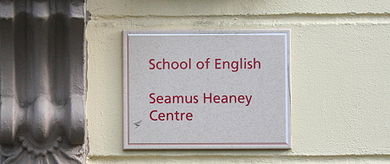
and delivered a public lecture on "The Guttural Muse". In 2003, the Seamus Heaney Centre for Poetry was opened at Queen's University Belfast. It houses the Heaney Media Archive, a record of Heaney's entire oeuvre, along with a full catalogue of his radio and television presentations. That same year Heaney, decided to lodge a substantial portion of his literary archive at Emory University
, as a memorial to the work of William M. Chace, the university’s recently retired president.The Emory papers represented the largest repository of Heaney's work (1964-2003), donated to build their large existing archive from Irish writers including Yeats
, Paul Muldoon
, Ciaran Carson
, Michael Longley
and other members of the The Belfast Group
.
In 2003, when asked if there was any figure in popular culture who aroused interest in poetry and lyrics, Heaney praised rap artist Eminem
, saying "He has created a sense of what is possible. He has sent a voltage around a generation. He has done this not just through his subversive attitude but also his verbal energy." Heaney was named an Honorary Patron of the University Philosophical Society, Trinity College, Dublin
and was elected an Honorary Fellow of the Royal Society of Literature
(1991)He composed the poem "Beacons of Bealtaine
" for the 2004 EU Enlargement
. The poem was read by Heaney at a ceremony for the twenty-five leaders of the enlarged European Union
arranged by the Irish EU presidency
.
Heaney suffered a stroke
from which he recovered in August 2006, but cancelled all public engagements for several months. He was in County Donegal
at the time on the occasion of the 75th birthday of Anne Friel, playwright Brian Friel
's wife. He read the works of Henning Mankell
, Donna Leon
and Robert Harris
while in hospital.
Heaney's District and Circle
won the 2006 T. S. Eliot Prize
. He became artist of honour in Østermarie
, Denmark in 2008 and the Seamus Heaney Stræde (street) was named after him. In 2009, Heaney was presented with an Honorary-Life Membership award from the UCD Law Society, in recognition of his remarkable role as a literary figure. Stepping Stones: Interviews with Seamus Heaney by Dennis O'Driscoll was published by Faber & Faber in 2008 and has been described as the nearest thing to an autobiography of the poet. Heaney was awarded the David Cohen Prize
for Literature in 2009. He spoke at the West Belfast Festival 2010
in celebration of his mentor, the poet and novelist Michael MacLaverty
, who had helped Heaney to first publish his poetry.
In 2010, he was awarded the Forward Prize for the Best Collection for Human Chain (Faber 2010), one of the only major poetry prizes he had not previously won, despite being twice short-listed."Seamus Heaney wins £10k Forward poetry prize for Human Chain" 6 October 2010 Guardian"Human Chain by Seamus Heaney" Guardian article 22 August 2010 In October 2010 the collection, a Poetry Book Society
Choice, was shortlisted for the T.S. Eliot Prize, to be announced on 24 January 2011. The book, published 44 years after his first, was inspired in part by his stroke in 2006 which left him "babyish" and "on the brink". Poet and Forward judge Ruth Padel
described the work as "a collection of painful, honest, and delicately weighted poems...a wonderful and humane achievement". Writer Colm Tóibín
notes that Human Chain "his best single volume for many years, and one that contains some of the best poems he has written... is a book of shades and memories, of things whispered, of journeys into the underworld, of elegies and translations, of echoes and silences."
In 2011, Heaney was named one of "Britain's top 300 intellectuals" by The Observer
.
 Robert Lowell
called him "the most important Irish poet since Yeats
" and many others have echoed the sentiment that he is "the greatest poet of our age".Guardian article Seamus Heaney deserves a lot more than £40,000 19 March 2009. Retrieved 2010-04-19. His books make up two-thirds of the sales of living poets in the UK.BBC News Magazine "Faces of the week", 19 January 2007
Heaney's work often deals with the local surroundings in Ireland, particularly in Northern Ireland, where he was born. Speaking of his early life and education, he commented "I learned that my local County Derry experience, which I had considered archaic and irrelevant to 'the modern world' was to be trusted. They taught me that trust and helped me to articulate it." Death of a Naturalist (1966) and Door into the Dark (1969) mostly focus on the detail of rural, parochial life. Allusions to sectarian difference, widespread in Northern Ireland through his lifetime, can be found in his poems. His books Wintering Out (1973) and North (1975) seek to interweave commentary on 'The Troubles' with a historical context and wider human experience.Profile at the Poetry Foundation Whilst some critics have accused Heaney of being "an apologist and a mythologizer" of the violence, Blake Morrison
suggests the poet "has written poems directly about the Troubles as well as elegies for friends and acquaintances who have died in them; he has tried to discover a historical framework in which to interpret the current unrest; and he has taken on the mantle of public spokesman, someone looked to for comment and guidance... Yet he has also shown signs of deeply resenting this role, defending the right of poets to be private and apolitical, and questioning the extent to which poetry, however 'committed,' can influence the course of history." Shaun O'Connell in the New Boston Review notes that "those who see Seamus Heaney as a symbol of hope in a troubled land are not, of course, wrong to do so, though they may be missing much of the undercutting complexities of his poetry, the backwash of ironies which make him as bleak as he is bright." O'Connell notes in his Boston Review critique of Station Island: "Again and again Heaney pulls back from political purposes; despite its emblems of savagery, Station Island lends no rhetorical comfort to Republicanism. Politic about politics, Station Island is less about a united Ireland than about a poet seeking religious and aesthetic unity". Heaney is described by critic Terry Eagleton
as "an enlightened cosmopolitan liberal", refusing to be drawn. Eagleton suggests: "When the political is introduced... it is only in the context of what Heaney will or will not say." Reflections on what Heaney identifies as "tribal conflict", favour the description of people's lives and their voices, drawing out the 'psychic landscape'. His collections often recall the assassination of his family members and close friends, lynchings and bombings. Colm Tóibín
wrote, "throughout his career there have been poems of simple evocation and description. His refusal to sum up or offer meaning is part of his tact".
 Heaney published “Requiem for the Croppies
” on the 50th anniversary of the 1916 Easter Rising
, a poem that commemorates the Irish rebels of 1798. He has read the poem to both Catholic and Protestant audiences in Ireland. He commented "To read ‘'Requiem for the Croppies'’ wasn’t to say ‘up the IRA
’ or anything. It was silence-breaking rather than rabble-rousing.” He stated “You don’t have to love it. You just have to permit it.” He turned down the offer of laureateship
partly for political reasons, commenting "I’ve nothing against the Queen personally: I had lunch at the Palace
once upon a time". He stated that his "cultural starting point" was "off centre". His most commonly cited political statement came in 1982 when he objected to being included in an anthology of British poetry, despite being of Northern Irish birth. He has lived in the Republic of Ireland since 1972 and claimed his Irish rather than British nationality, responding
“Be advised my passport’s green.
No glass of ours was ever raised
to toast the Queen.”
He is concerned as a poet and a translator, with the English language itself, as it is spoken in Ireland but also as spoken elsewhere and in other times; the Anglo-Saxon
influences in his work and study are strong. Critic W. S. Di Piero
noted "Whatever the occasion, childhood, farm life, politics and culture in Northern Ireland, other poets past and present, Heaney strikes time and again at the taproot of language, examining its genetic structures, trying to discover how it has served, in all its changes, as a culture bearer, a world to contain imaginations, at once a rhetorical weapon and nutriment of spirit. He writes of these matters with rare discrimination and resourcefulness, and a winning impatience with received wisdom." Heaney's first translation came with the Irish lyric poem "Buile Suibhne", published as Sweeney Astray: A Version from the Irish (1984), a character and connection taken up in Station Island (1984). Heaney's prize-winning translation of Beowulf
(Farrar, Straus & Giroux, 2000, Whitbread Book of the Year Award) was seen as ground-breaking in its use of modern language melded with the original Anglo-Saxon 'music'. His works of drama includes The Cure at Troy: A Version of Sophocles' Philoctetes (1991). Heaney's 2004 play The Burial at Thebes
makes parallels between Creon
with the foreign policies of the Bush administration.
Heaney's engagement with poetry as a necessary engine for cultural and personal change, is reflected in his prose works The Redress of Poetry (1995) and Finders Keepers: Selected Prose, 1971-2001 (2002). "When a poem rhymes," Heaney wrote, "when a form generates itself, when a metre provokes consciousness into new postures, it is already on the side of life. When a rhyme surprises and extends the fixed relations between words, that in itself protests against necessity. When language does more than enough, as it does in all achieved poetry, it opts for the condition of overlife, and rebels at limit." He expands: "The vision of reality which poetry offers should be transformative, more than just a printout of the given circumstances of its time and place".
Heaney's work is used extensively on school syllabi internationally, including the anthologies The Rattle Bag (1982) and The School Bag (1987) (both edited with Ted Hughes
). Originally entitled The Faber Book of Verse for Younger People on the Faber contract, Hughes and Heaney decided the The Rattle Bags main purpose was to offer enjoyment to the reader: "Arbitrary riches". Heaney commented "the book in our heads was something closer to The Fancy Free Poetry Supplement". It included work that they would have liked to encountered sooner as well as nonsense rhymes, ballad-type poems, riddles, folk songs and rhythmical jingles. Much familiar canonical work was not included, since they took it for granted that their audience would know the standard fare. Fifteen years later The School Bag aimed at something different. The foreword stated that they wanted "less of a carnival, more like a checklist." It included poems in English, Irish, Welsh, Scots and Scots Gaelic, together with work reflecting the African-American experience."Bags of enlightenment" article by Seamus Heaney in The Guardian 25 October 2003
Nobel Prize in Literature
Since 1901, the Nobel Prize in Literature has been awarded annually to an author from any country who has, in the words from the will of Alfred Nobel, produced "in the field of literature the most outstanding work in an ideal direction"...
(1995), the Golden Wreath of Poetry (2001), T. S. Eliot Prize
T. S. Eliot Prize
The T. S. Eliot Prize for Poetry is awarded by the Poetry Book Society to "the best collection of new verse in English first published in the UK or the Republic of Ireland" in any particular year. The Prize was inaugurated in 1993 in celebration of the Poetry Book Society's 40th birthday and in...
(2006) and two Whitbread prizes (1996 and 1999). He was both the Harvard and the Oxford Professor of Poetry and was made a Commandeur
Commandeur
Commandeur is a title in French and Dutch , usually rendered in English as Commander, with different uses. The literal meaning is he who commands, parallel to Commandant. In most senses the German equivalent is Kommandeur....
de l'Ordre des Arts et Lettres
Ordre des Arts et des Lettres
The Ordre des Arts et des Lettres is an Order of France, established on 2 May 1957 by the Minister of Culture, and confirmed as part of the Ordre national du Mérite by President Charles de Gaulle in 1963...
in 1996.
Early life
Heaney was born on 13 April 1939 at the family farmhouse called Mossbawn, between CastledawsonCastledawson
Castledawson is a village in County Londonderry, Northern Ireland. It is mostly within the townland of Shanemullagh , about four miles from the north-western shore of Lough Neagh, and close to the market town of Magherafelt...
and Toomebridge in Northern Ireland
Northern Ireland
Northern Ireland is one of the four countries of the United Kingdom. Situated in the north-east of the island of Ireland, it shares a border with the Republic of Ireland to the south and west...
; he was the first of nine children. In 1953, his family moved to Bellaghy
Bellaghy
Bellaghy , is a village in County Londonderry, Northern Ireland. It lies north west of Lough Neagh and about 5 miles north of Magherafelt. At the centre of the village lies the junction of three main roads leading to Magherafelt, Portglenone and Toome. It had a population of 1,063 people in the...
, a few miles away, which is now the family home. His father, Patrick Heaney, a local of Castledawson, was the eighth child of ten born to James and Sarah Heaney. Patrick was a farmer but his real commitment was to cattle-dealing, to which he was introduced by the uncles who had cared for him after the early death of his own parents. Heaney's mother came from the McCann family, whose uncles and relations were employed in the local linen mill
Linen
Linen is a textile made from the fibers of the flax plant, Linum usitatissimum. Linen is labor-intensive to manufacture, but when it is made into garments, it is valued for its exceptional coolness and freshness in hot weather....
and whose aunt had worked as a maid for the mill owner's family. The poet has commented on the fact that his parentage thus contains both the Ireland of the cattle-herding Gaelic past and the Ulster of the Industrial Revolution; he considers this to have been a significant tension in his background.
Heaney initially attended Anahorish Primary School and when he was twelve-years-old, he won a scholarship to St. Columb's College
St. Columb's College
St. Columb's College is a Roman Catholic boys' grammar school in Derry, Northern Ireland and, since 2008, a specialist school in Mathematics and Computing...
, a Catholic boarding school situated in Derry
Derry
Derry or Londonderry is the second-biggest city in Northern Ireland and the fourth-biggest city on the island of Ireland. The name Derry is an anglicisation of the Irish name Doire or Doire Cholmcille meaning "oak-wood of Colmcille"...
. Heaney's brother, Christopher, was killed in a road accident at the age of four while Heaney was studying at St. Columb's. The poems Mid-Term Break and The Blackbird of Glanmore
District and Circle
District and Circle is a collection of poems written by Irish Nobel laureate Seamus Heaney. It was published in 2006 forty years after his debut, Death of a Naturalist, and was awarded the 2006 T. S. Eliot Prize...
focus on the death of Christopher.
1957-1984
Queen's University of Belfast
Queen's University Belfast is a public research university in Belfast, Northern Ireland. The university's official title, per its charter, is the Queen's University of Belfast. It is often referred to simply as Queen's, or by the abbreviation QUB...
. During his time in Belfast he found a copy of Ted Hughes
Ted Hughes
Edward James Hughes OM , more commonly known as Ted Hughes, was an English poet and children's writer. Critics routinely rank him as one of the best poets of his generation. Hughes was British Poet Laureate from 1984 until his death.Hughes was married to American poet Sylvia Plath, from 1956 until...
' Lupercal, which spurred him to write poetry. "Suddenly, the matter of contemporary poetry was the material of my own life" he has said. He graduated in 1961 with a First Class Honours degree. During teacher training at St Joseph's Teacher Training College in Belfast (now merged with St Mary's, University College
St. Mary's University College (Belfast)
St Mary's University College was established in 1985, but can directly trace its existence to 1900 and the foundation of St Mary's Training College, which focused mainly on the training of women as teachers...
), Heaney went on a placement to St Thomas' secondary Intermediate School in west Belfast. The headmaster of this school was the writer Michael McLaverty
Michael MacLaverty
Michael McLaverty was an Irish writer of novels and short stories.-Background:Michael McLaverty was born in County Monaghan and then moved as a child to the Beechmount area of Belfast He attended St Gall's School and then went to College and became a school teacher. Michael McLaverty worked as a...
from County Monaghan
County Monaghan
County Monaghan is a county in Ireland. It is part of the Border Region and is also located in the province of Ulster. It is named after the town of Monaghan. Monaghan County Council is the local authority for the county...
, who introduced Heaney to the poetry of Patrick Kavanagh
Patrick Kavanagh
Patrick Kavanagh was an Irish poet and novelist. Regarded as one of the foremost poets of the 20th century, his best known works include the novel Tarry Flynn and the poems Raglan Road and The Great Hunger...
. With McLaverty's mentorship, Heaney first started to publish poetry, beginning in 1962. Hillal describes how McLaverty was like a foster father to the younger Belfast poet. In the introduction to McLaverty's Collected works, Heaney summarised the poet's contribution and influence: "His voice was modestly pitched, he never sought the limelight, yet for all that, his place in our literature is secure." Heaney's poem Fosterage, in the sequence Singing School from North (1975) is dedicated to him.
In 1963, Heaney became a lecturer at St Joseph's and in the spring of 1963, after contributing various articles to local magazines, he came to the attention of Philip Hobsbaum
Philip Hobsbaum
Philip Dennis Hobsbaum was a British teacher, poet and critic.-Life:Hobsbaum was born into a Polish Jewish family in London, and brought up in Bradford, in Yorkshire. He read English at Downing College, Cambridge, where he was taught and heavily influenced by F. R. Leavis...
, then an English lecturer at Queen's University. Hobsbaum was to set up a Belfast Group of local young poets (to mirror the success he had with the London group) and this would bring Heaney into contact with other Belfast poets such as Derek Mahon and Michael Longley
Michael Longley
Michael Longley, CBE is a Northern Irish poet from Belfast.-Life and career:Longley was educated at the Royal Belfast Academical Institution and subsequently read Classics at Trinity College, Dublin, where he edited Icarus...
. In August 1965 he married Marie Devlin, a school teacher and native of Ardboe
Ardboe
Ardboe is a small village in the north east of County Tyrone, Northern Ireland. It is near the western shore of Lough Neagh and lies within the Cookstown District Council area...
, County Tyrone
County Tyrone
Historically Tyrone stretched as far north as Lough Foyle, and comprised part of modern day County Londonderry east of the River Foyle. The majority of County Londonderry was carved out of Tyrone between 1610-1620 when that land went to the Guilds of London to set up profit making schemes based on...
. (Devlin is a writer herself and, in 1994, published Over Nine Waves, a collection of traditional Irish myths and legends.) Heaney's first book, Eleven Poems, was published in November 1965 for the Queen's University Festival. In 1967, Faber and Faber
Faber and Faber
Faber and Faber Limited, often abbreviated to Faber, is an independent publishing house in the UK, notable in particular for publishing a great deal of poetry and for its former editor T. S. Eliot. Faber has a rich tradition of publishing a wide range of fiction, non fiction, drama, film and music...
published his first major volume, called Death of a Naturalist. This collection met with much critical acclaim and went on to win several awards, the Gregory Award for Young Writers and the Geoffrey Faber Prize. Also in 1966, he was appointed as a lecturer in Modern English Literature at Queen's University Belfast and his first son, Michael, was born. A second son, Christopher, was born in 1968. That same year, with Michael Longley
Michael Longley
Michael Longley, CBE is a Northern Irish poet from Belfast.-Life and career:Longley was educated at the Royal Belfast Academical Institution and subsequently read Classics at Trinity College, Dublin, where he edited Icarus...
, Heaney took part in a reading tour called Room to Rhyme, which led to much exposure for the poet's work. In 1969, his second major volume, Door into the Dark, was published.
After a spell as guest lecturer at the University of California, Berkeley
University of California, Berkeley
The University of California, Berkeley , is a teaching and research university established in 1868 and located in Berkeley, California, USA...
, he returned to Queen's University in 1971. In 1972, Heaney left his lectureship at Belfast and moved to Dublin in the Republic of Ireland
Republic of Ireland
Ireland , described as the Republic of Ireland , is a sovereign state in Europe occupying approximately five-sixths of the island of the same name. Its capital is Dublin. Ireland, which had a population of 4.58 million in 2011, is a constitutional republic governed as a parliamentary democracy,...
, working as a teacher at Carysfort College. In 1972, Wintering Out was published, and over the next few years Heaney began to give readings throughout Ireland, Britain, and the United States. In 1975, Heaney published his fourth volume, North. He became Head of English at Carysfort College in Dublin in 1976. His next volume, Field Work, was published in 1979. Selected Poems 1965-1975 and Preoccupations: Selected Prose 1968-1978 were published in 1980. When the Republic of Ireland established Aosdána
Aosdána
Aosdána is an Irish association of Artists. It was created in 1981 on the initiative of a group of writers and with support from the Arts Council of Ireland. Membership, which is by invitation from current members, is limited to 250 individuals; before 2005 it was limited to 200...
, the national Irish Arts Council, in 1981, Heaney was among those elected into its first group (he was subsequently elected a Saoi
Saoi
Saoi , is the highest honour that members of Aosdána, an association of people in Ireland who have achieved distinction in the arts, can bestow upon a fellow member...
, one of its five elders and its highest honor, in 1997). Also in 1981, he left Carysfort to become visiting professor at Harvard University
Harvard University
Harvard University is a private Ivy League university located in Cambridge, Massachusetts, United States, established in 1636 by the Massachusetts legislature. Harvard is the oldest institution of higher learning in the United States and the first corporation chartered in the country...
. He was awarded two honorary doctorates, from Queen's University and from Fordham University
Fordham University
Fordham University is a private, nonprofit, coeducational research university in the United States, with three campuses in and around New York City. It was founded by the Roman Catholic Diocese of New York in 1841 as St...
in New York City (1982). At the Fordham commencement ceremony in 1982, Heaney delivered the commencement address in a 46-stanza poem entitled Verses for a Fordham Commencement. As he was born and educated in Northern Ireland
Northern Ireland
Northern Ireland is one of the four countries of the United Kingdom. Situated in the north-east of the island of Ireland, it shares a border with the Republic of Ireland to the south and west...
, Heaney has felt the need to emphasise that he is Irish and not British. Following the success of the Field Day Theatre Company
Field Day Theatre Company
The Field Day Theatre Company began as an artistic collaboration between playwright Brian Friel and actor Stephen Rea. In 1980, the duo set out to launch a production of Friel's recently completed play, Translations. They decided to rehearse and premiere the play in Derry with the hope of...
's production of Brian Friel
Brian Friel
Brian Friel is an Irish dramatist, author and director of the Field Day Theatre Company. He is considered to be the greatest living English-language dramatist, hailed by the English-speaking world as an "Irish Chekhov" and "the universally accented voice of Ireland"...
's Translations
Translations
Translations is a three-act play by Irish playwright Brian Friel written in 1980. It is set in Baile Beag , a small village at the heart of 19th century agricultural Ireland...
, Heaney joined the company's expanded Board of Directors in 1981, when the company's founders Brian Friel and Stephen Rea
Stephen Rea
Stephen Rea is an Irish film and stage actor. Rea has appeared in high profile films such as V for Vendetta, Michael Collins, Interview with the Vampire and Breakfast on Pluto...
decided to make the company a permanent group. In 1984 his mother, Margaret Kathleen Heaney, died.
1985-2000
Harvard University
Harvard University is a private Ivy League university located in Cambridge, Massachusetts, United States, established in 1636 by the Massachusetts legislature. Harvard is the oldest institution of higher learning in the United States and the first corporation chartered in the country...
(formerly Visiting Professor) 1985-1997 and Ralph Waldo Emerson Poet in Residence at Harvard 1998-2006. In 1986, Heaney received a Litt.D. from Bates College
Bates College
Bates College is a highly selective, private liberal arts college located in Lewiston, Maine, in the United States. and was most recently ranked 21st in the nation in the 2011 US News Best Liberal Arts Colleges rankings. The college was founded in 1855 by abolitionists...
. His father, Patrick, died soon after publication of the 1987 volume, The Haw Lantern. In 1988, a collection of critical essays called The Government of the Tongue was published.
In 1989, Heaney was elected Professor of Poetry at the University of Oxford
University of Oxford
The University of Oxford is a university located in Oxford, United Kingdom. It is the second-oldest surviving university in the world and the oldest in the English-speaking world. Although its exact date of foundation is unclear, there is evidence of teaching as far back as 1096...
, which he held for a five-year term to 1994. The chair does not require residence in Oxford, and throughout this period he was dividing his time between Ireland and America. He also continued to give public readings; so well attended and keenly anticipated were these events that those who queued for tickets with such enthusiasm have sometimes been dubbed "Heaneyboppers", suggesting an almost teenybopper
Teenybopper
The term teenybopper was invented by marketing professionals and psychologists, later becoming a subculture of its own. The term describes a young teenager, particularly a girl, who follows adolescent trends in music, fashion and culture. The term was introduced in the 1950s to refer to teenagers...
fanaticism on the part of his supporters. In 1993 Heaney guest-edited The Mays Anthology, a collection of new writing from students at the University of Oxford
University of Oxford
The University of Oxford is a university located in Oxford, United Kingdom. It is the second-oldest surviving university in the world and the oldest in the English-speaking world. Although its exact date of foundation is unclear, there is evidence of teaching as far back as 1096...
and University of Cambridge
University of Cambridge
The University of Cambridge is a public research university located in Cambridge, United Kingdom. It is the second-oldest university in both the United Kingdom and the English-speaking world , and the seventh-oldest globally...
.
In 1990, The Cure at Troy, a play based on Sophocles'
Sophocles
Sophocles is one of three ancient Greek tragedians whose plays have survived. His first plays were written later than those of Aeschylus, and earlier than or contemporary with those of Euripides...
Philoctetes
Philoctetes (Sophocles)
Philoctetes is a play by Sophocles . The play was written during the Peloponnesian War. It was first performed at the Festival of Dionysus in 409 BC, where it won first prize. The story takes place during the Trojan War...
, was published to much acclaim, followed by Seeing Things in 1991.
Heaney was awarded the Nobel Prize in Literature
Nobel Prize in Literature
Since 1901, the Nobel Prize in Literature has been awarded annually to an author from any country who has, in the words from the will of Alfred Nobel, produced "in the field of literature the most outstanding work in an ideal direction"...
in 1995 for what the Nobel committee described as "works of lyrical beauty and ethical depth, which exalt everyday miracles and the living past". He was on holiday in Greece
Greece
Greece , officially the Hellenic Republic , and historically Hellas or the Republic of Greece in English, is a country in southeastern Europe....
with his wife when the news broke and no one, not even journalists or his own children, could find him until he appeared at Dublin Airport
Dublin Airport
Dublin Airport, , is operated by the Dublin Airport Authority. Located in Collinstown, in the Fingal part of County Dublin, 18.4 million passengers passed through the airport in 2010, making it the busiest airport in the Republic of Ireland, followed by Cork and Shannon...
two days later, though an Irish television camera traced him to Kalamata
Kalamata
Kalamata is the second-largest city of the Peloponnese in southern Greece. The capital and chief port of the Messenia prefecture, it lies along the Nedon River at the head of the Messenian Gulf...
. Asked how it felt having his name to the Irish Nobel pantheon featuring William Butler Yeats
William Butler Yeats
William Butler Yeats was an Irish poet and playwright, and one of the foremost figures of 20th century literature. A pillar of both the Irish and British literary establishments, in his later years he served as an Irish Senator for two terms...
, George Bernard Shaw
George Bernard Shaw
George Bernard Shaw was an Irish playwright and a co-founder of the London School of Economics. Although his first profitable writing was music and literary criticism, in which capacity he wrote many highly articulate pieces of journalism, his main talent was for drama, and he wrote more than 60...
and Samuel Beckett
Samuel Beckett
Samuel Barclay Beckett was an Irish avant-garde novelist, playwright, theatre director, and poet. He wrote both in English and French. His work offers a bleak, tragicomic outlook on human nature, often coupled with black comedy and gallows humour.Beckett is widely regarded as among the most...
, Heaney responded: "It's like being a little foothill at the bottom of a mountain range. You hope you just live up to it. It's extraordinary." He and Marie were immediately whisked straight from the airport to Áras an Uachtaráin
Áras an Uachtaráin
Áras an Uachtaráin , formerly the Viceregal Lodge, is the official residence of the President of Ireland. It is located in the Phoenix Park on the northside of Dublin.-Origins:...
for champagne with President
President of Ireland
The President of Ireland is the head of state of Ireland. The President is usually directly elected by the people for seven years, and can be elected for a maximum of two terms. The presidency is largely a ceremonial office, but the President does exercise certain limited powers with absolute...
Mary Robinson
Mary Robinson
Mary Therese Winifred Robinson served as the seventh, and first female, President of Ireland from 1990 to 1997, and the United Nations High Commissioner for Human Rights, from 1997 to 2002. She first rose to prominence as an academic, barrister, campaigner and member of the Irish Senate...
.
Heaney's 1996 collection The Spirit Level won the Whitbread Book of the Year Award
Costa Book Awards
The Costa Book Awards are a series of literary awards given to books by authors based in Great Britain and Ireland. They were known as the Whitbread Book Awards until 2005, after which Costa Coffee, a subsidiary of Whitbread, took over sponsorship....
and repeated the success with the release of Beowulf: A New Translation.
2000s
In 2000, Heaney was awarded an honorary doctorate and delivered the commencement address at the University of Pennsylvania. In 2002, Heaney was awarded an honorary doctorate from Rhodes UniversityRhodes University
Rhodes University is a public research university located in Grahamstown in the Eastern Cape Province of South Africa, established in 1904. It is the province’s oldest university, and is one of the four universities in the province...
and delivered a public lecture on "The Guttural Muse". In 2003, the Seamus Heaney Centre for Poetry was opened at Queen's University Belfast. It houses the Heaney Media Archive, a record of Heaney's entire oeuvre, along with a full catalogue of his radio and television presentations. That same year Heaney, decided to lodge a substantial portion of his literary archive at Emory University
Emory University
Emory University is a private research university in metropolitan Atlanta, located in the Druid Hills section of unincorporated DeKalb County, Georgia, United States. The university was founded as Emory College in 1836 in Oxford, Georgia by a small group of Methodists and was named in honor of...
, as a memorial to the work of William M. Chace, the university’s recently retired president.The Emory papers represented the largest repository of Heaney's work (1964-2003), donated to build their large existing archive from Irish writers including Yeats
Yeats
W. B. Yeats was an Irish poet and playwright.Yeats may also refer to:* Yeats ,* Yeats , an impact crater on Mercury* Yeats , an Irish thoroughbred racehorse-See also:...
, Paul Muldoon
Paul Muldoon
Paul Muldoon is an Irish poet. He has published over thirty collections and won a Pulitzer Prize for Poetry and the T. S. Eliot Prize. He held the post of Oxford Professor of Poetry from 1999 - 2004. At Princeton University he is both the Howard G. B. Clark ’21 Professor in the Humanities and...
, Ciaran Carson
Ciaran Carson
Ciaran Gerard Carson is a Belfast, Northern Ireland-born poet and novelist.-Early years:Ciaran Carson was born in Belfast into an Irish-speaking family...
, Michael Longley
Michael Longley
Michael Longley, CBE is a Northern Irish poet from Belfast.-Life and career:Longley was educated at the Royal Belfast Academical Institution and subsequently read Classics at Trinity College, Dublin, where he edited Icarus...
and other members of the The Belfast Group
The Belfast Group
The Belfast Group was a poets' workshop which was organized by Philip Hobsbaum when he moved to Belfast in October 1963 to lecture in English at Queen's University....
.
In 2003, when asked if there was any figure in popular culture who aroused interest in poetry and lyrics, Heaney praised rap artist Eminem
Eminem
Marshall Bruce Mathers III , better known by his stage name Eminem or his alter ego Slim Shady, is an American rapper, record producer, songwriter and actor. Eminem's popularity brought his group project, D12, to mainstream recognition...
, saying "He has created a sense of what is possible. He has sent a voltage around a generation. He has done this not just through his subversive attitude but also his verbal energy." Heaney was named an Honorary Patron of the University Philosophical Society, Trinity College, Dublin
Trinity College, Dublin
Trinity College, Dublin , formally known as the College of the Holy and Undivided Trinity of Queen Elizabeth near Dublin, was founded in 1592 by letters patent from Queen Elizabeth I as the "mother of a university", Extracts from Letters Patent of Elizabeth I, 1592: "...we...found and...
and was elected an Honorary Fellow of the Royal Society of Literature
Royal Society of Literature
The Royal Society of Literature is the "senior literary organisation in Britain". It was founded in 1820 by George IV, in order to "reward literary merit and excite literary talent". The Society's first president was Thomas Burgess, who later became the Bishop of Salisbury...
(1991)He composed the poem "Beacons of Bealtaine
Beacons of Bealtaine
Beacons of Bealtaine is a poem by Irish poet Seamus Heaney which was composed for the EU Enlargement on May 1, 2004. "Bealtaine" is a Gaelic holiday celebrated on this day, marking the beginning of summer....
" for the 2004 EU Enlargement
Enlargement of the European Union
The Enlargement of the European Union is the process of expanding the European Union through the accession of new member states. This process began with the Inner Six, who founded the European Coal and Steel Community in 1952...
. The poem was read by Heaney at a ceremony for the twenty-five leaders of the enlarged European Union
European Union
The European Union is an economic and political union of 27 independent member states which are located primarily in Europe. The EU traces its origins from the European Coal and Steel Community and the European Economic Community , formed by six countries in 1958...
arranged by the Irish EU presidency
Presidency of the Council of the European Union
The Presidency of the Council of the European Union is the responsibility for the functioning of the Council of the European Union that rotates between the member states of the European Union every six months. The presidency is not a single president but rather the task is undertaken by a national...
.
Heaney suffered a stroke
Stroke
A stroke, previously known medically as a cerebrovascular accident , is the rapidly developing loss of brain function due to disturbance in the blood supply to the brain. This can be due to ischemia caused by blockage , or a hemorrhage...
from which he recovered in August 2006, but cancelled all public engagements for several months. He was in County Donegal
County Donegal
County Donegal is a county in Ireland. It is part of the Border Region and is also located in the province of Ulster. It is named after the town of Donegal. Donegal County Council is the local authority for the county...
at the time on the occasion of the 75th birthday of Anne Friel, playwright Brian Friel
Brian Friel
Brian Friel is an Irish dramatist, author and director of the Field Day Theatre Company. He is considered to be the greatest living English-language dramatist, hailed by the English-speaking world as an "Irish Chekhov" and "the universally accented voice of Ireland"...
's wife. He read the works of Henning Mankell
Henning Mankell
Henning Mankell is a Swedish crime writer, children's author, leftist activist and dramatist, best known for a series of mystery novels starring his most famous creation, Inspector Kurt Wallander.-Life and career:...
, Donna Leon
Donna Leon
Donna Leon is the American author of a series of crime novels set in Venice and featuring the fictional hero Commissario Guido Brunetti.Leon has lived in Venice for over 25 years...
and Robert Harris
Robert Harris (novelist)
Robert Dennis Harris is an English novelist. He is a former journalist and BBC television reporter.-Early life:Born in Nottingham, Harris spent his childhood in a small rented house on a Nottingham council estate. His ambition to become a writer arose at an early age, from visits to the local...
while in hospital.
Heaney's District and Circle
District and Circle
District and Circle is a collection of poems written by Irish Nobel laureate Seamus Heaney. It was published in 2006 forty years after his debut, Death of a Naturalist, and was awarded the 2006 T. S. Eliot Prize...
won the 2006 T. S. Eliot Prize
T. S. Eliot Prize
The T. S. Eliot Prize for Poetry is awarded by the Poetry Book Society to "the best collection of new verse in English first published in the UK or the Republic of Ireland" in any particular year. The Prize was inaugurated in 1993 in celebration of the Poetry Book Society's 40th birthday and in...
. He became artist of honour in Østermarie
Østermarie
Østermarie is a village on the Danish island of Bornholm, west of Svaneke. Founded ca. 1880, its old church, now a ruin, dates back to the 12th century. The population as of 1 January 2011 is 485.-History:...
, Denmark in 2008 and the Seamus Heaney Stræde (street) was named after him. In 2009, Heaney was presented with an Honorary-Life Membership award from the UCD Law Society, in recognition of his remarkable role as a literary figure. Stepping Stones: Interviews with Seamus Heaney by Dennis O'Driscoll was published by Faber & Faber in 2008 and has been described as the nearest thing to an autobiography of the poet. Heaney was awarded the David Cohen Prize
David Cohen Prize
The David Cohen Prize for Literature is a biennial British literary award given to a writer, novelist, short-story writer, poet, essayist or dramatist in recognition of an entire body of work, written in the English language. The prize is funded by the John S. Cohen Foundation and administered by...
for Literature in 2009. He spoke at the West Belfast Festival 2010
Feile an Phobail
Féile an Phobail , also known as the West Belfast Festival is a community arts organisation known for its August Féile . The organisation is prominent for its promotion of Irish and international culture...
in celebration of his mentor, the poet and novelist Michael MacLaverty
Michael MacLaverty
Michael McLaverty was an Irish writer of novels and short stories.-Background:Michael McLaverty was born in County Monaghan and then moved as a child to the Beechmount area of Belfast He attended St Gall's School and then went to College and became a school teacher. Michael McLaverty worked as a...
, who had helped Heaney to first publish his poetry.
In 2010, he was awarded the Forward Prize for the Best Collection for Human Chain (Faber 2010), one of the only major poetry prizes he had not previously won, despite being twice short-listed."Seamus Heaney wins £10k Forward poetry prize for Human Chain" 6 October 2010 Guardian"Human Chain by Seamus Heaney" Guardian article 22 August 2010 In October 2010 the collection, a Poetry Book Society
Poetry Book Society
The Poetry Book Society was founded by T. S. Eliot and friends in 1953. Each quarter the Society selects one recently published collection of poetry for its members. The Society also publishes the quarterly poetry journal Bulletin, and it administers the competition for the annual T. S. Eliot Prize...
Choice, was shortlisted for the T.S. Eliot Prize, to be announced on 24 January 2011. The book, published 44 years after his first, was inspired in part by his stroke in 2006 which left him "babyish" and "on the brink". Poet and Forward judge Ruth Padel
Ruth Padel
Ruth Sophia Padel is a British poet, Fellow of the Royal Society of Literature and Zoological Society of London. She also writes non-fiction and more recently fiction, broadcasts on wildlife, poetry and literature for BBC Radio 3 and 4, and is Writer in Residence at The Environment Institute,...
described the work as "a collection of painful, honest, and delicately weighted poems...a wonderful and humane achievement". Writer Colm Tóibín
Colm Tóibín
Colm Tóibín is a multi-award-winning Irish novelist, short story writer, essayist, playwright, journalist, critic, and, most recently, poet.Tóibín is Leonard Milberg Lecturer in Irish Letters at Princeton University in New Jersey and succeeded Martin Amis as professor of creative writing at the...
notes that Human Chain "his best single volume for many years, and one that contains some of the best poems he has written... is a book of shades and memories, of things whispered, of journeys into the underworld, of elegies and translations, of echoes and silences."
In 2011, Heaney was named one of "Britain's top 300 intellectuals" by The Observer
The Observer
The Observer is a British newspaper, published on Sundays. In the same place on the political spectrum as its daily sister paper The Guardian, which acquired it in 1993, it takes a liberal or social democratic line on most issues. It is the world's oldest Sunday newspaper.-Origins:The first issue,...
.
Work
Robert Lowell
Robert Traill Spence Lowell IV was an American poet, considered the founder of the confessional poetry movement. He was appointed the sixth Poet Laureate Consultant in Poetry to the Library of Congress where he served from 1947 until 1948...
called him "the most important Irish poet since Yeats
William Butler Yeats
William Butler Yeats was an Irish poet and playwright, and one of the foremost figures of 20th century literature. A pillar of both the Irish and British literary establishments, in his later years he served as an Irish Senator for two terms...
" and many others have echoed the sentiment that he is "the greatest poet of our age".Guardian article Seamus Heaney deserves a lot more than £40,000 19 March 2009. Retrieved 2010-04-19. His books make up two-thirds of the sales of living poets in the UK.BBC News Magazine "Faces of the week", 19 January 2007
Heaney's work often deals with the local surroundings in Ireland, particularly in Northern Ireland, where he was born. Speaking of his early life and education, he commented "I learned that my local County Derry experience, which I had considered archaic and irrelevant to 'the modern world' was to be trusted. They taught me that trust and helped me to articulate it." Death of a Naturalist (1966) and Door into the Dark (1969) mostly focus on the detail of rural, parochial life. Allusions to sectarian difference, widespread in Northern Ireland through his lifetime, can be found in his poems. His books Wintering Out (1973) and North (1975) seek to interweave commentary on 'The Troubles' with a historical context and wider human experience.Profile at the Poetry Foundation Whilst some critics have accused Heaney of being "an apologist and a mythologizer" of the violence, Blake Morrison
Blake Morrison
Philip Blake Morrison is a British poet and author who has published in a wide range of fiction and non-fiction genres. His greatest success came with the publication of his memoirs And When Did You Last See Your Father? which won the J. R. Ackerley Prize for Autobiography. He has also written a...
suggests the poet "has written poems directly about the Troubles as well as elegies for friends and acquaintances who have died in them; he has tried to discover a historical framework in which to interpret the current unrest; and he has taken on the mantle of public spokesman, someone looked to for comment and guidance... Yet he has also shown signs of deeply resenting this role, defending the right of poets to be private and apolitical, and questioning the extent to which poetry, however 'committed,' can influence the course of history." Shaun O'Connell in the New Boston Review notes that "those who see Seamus Heaney as a symbol of hope in a troubled land are not, of course, wrong to do so, though they may be missing much of the undercutting complexities of his poetry, the backwash of ironies which make him as bleak as he is bright." O'Connell notes in his Boston Review critique of Station Island: "Again and again Heaney pulls back from political purposes; despite its emblems of savagery, Station Island lends no rhetorical comfort to Republicanism. Politic about politics, Station Island is less about a united Ireland than about a poet seeking religious and aesthetic unity". Heaney is described by critic Terry Eagleton
Terry Eagleton
Terence Francis Eagleton FBA is a British literary theorist and critic, who is regarded as one of Britain's most influential living literary critics...
as "an enlightened cosmopolitan liberal", refusing to be drawn. Eagleton suggests: "When the political is introduced... it is only in the context of what Heaney will or will not say." Reflections on what Heaney identifies as "tribal conflict", favour the description of people's lives and their voices, drawing out the 'psychic landscape'. His collections often recall the assassination of his family members and close friends, lynchings and bombings. Colm Tóibín
Colm Tóibín
Colm Tóibín is a multi-award-winning Irish novelist, short story writer, essayist, playwright, journalist, critic, and, most recently, poet.Tóibín is Leonard Milberg Lecturer in Irish Letters at Princeton University in New Jersey and succeeded Martin Amis as professor of creative writing at the...
wrote, "throughout his career there have been poems of simple evocation and description. His refusal to sum up or offer meaning is part of his tact".
Croppy
Croppy was a nickname given to Irish rebels during the period of the 1798 rebellion.- Origin :The name "croppy" derives from Ireland in the 1790s as a reference to people with closely cropped hair, a fashion which was associated with the anti-wig French revolutionaries of the period...
” on the 50th anniversary of the 1916 Easter Rising
Easter Rising
The Easter Rising was an insurrection staged in Ireland during Easter Week, 1916. The Rising was mounted by Irish republicans with the aims of ending British rule in Ireland and establishing the Irish Republic at a time when the British Empire was heavily engaged in the First World War...
, a poem that commemorates the Irish rebels of 1798. He has read the poem to both Catholic and Protestant audiences in Ireland. He commented "To read ‘'Requiem for the Croppies'’ wasn’t to say ‘up the IRA
Irish Republican Army
The Irish Republican Army was an Irish republican revolutionary military organisation. It was descended from the Irish Volunteers, an organisation established on 25 November 1913 that staged the Easter Rising in April 1916...
’ or anything. It was silence-breaking rather than rabble-rousing.” He stated “You don’t have to love it. You just have to permit it.” He turned down the offer of laureateship
Poet Laureate of the United Kingdom
The Poet Laureate of the United Kingdom, also referred to as the Poet Laureate, is the Poet Laureate appointed by the monarch of the United Kingdom on the advice of the Prime Minister...
partly for political reasons, commenting "I’ve nothing against the Queen personally: I had lunch at the Palace
Buckingham Palace
Buckingham Palace, in London, is the principal residence and office of the British monarch. Located in the City of Westminster, the palace is a setting for state occasions and royal hospitality...
once upon a time". He stated that his "cultural starting point" was "off centre". His most commonly cited political statement came in 1982 when he objected to being included in an anthology of British poetry, despite being of Northern Irish birth. He has lived in the Republic of Ireland since 1972 and claimed his Irish rather than British nationality, responding
“Be advised my passport’s green.
No glass of ours was ever raised
to toast the Queen.”
He is concerned as a poet and a translator, with the English language itself, as it is spoken in Ireland but also as spoken elsewhere and in other times; the Anglo-Saxon
Old English language
Old English or Anglo-Saxon is an early form of the English language that was spoken and written by the Anglo-Saxons and their descendants in parts of what are now England and southeastern Scotland between at least the mid-5th century and the mid-12th century...
influences in his work and study are strong. Critic W. S. Di Piero
W. S. Di Piero
William S. Di Piero is an American poet, translator, and essayist.-Life:He grew up in an Italian working class neighborhood. He attended St. Joseph's College in Philadelphia and received a Master's degree from San Francisco State University in 1971.He taught at Louisiana State University, and...
noted "Whatever the occasion, childhood, farm life, politics and culture in Northern Ireland, other poets past and present, Heaney strikes time and again at the taproot of language, examining its genetic structures, trying to discover how it has served, in all its changes, as a culture bearer, a world to contain imaginations, at once a rhetorical weapon and nutriment of spirit. He writes of these matters with rare discrimination and resourcefulness, and a winning impatience with received wisdom." Heaney's first translation came with the Irish lyric poem "Buile Suibhne", published as Sweeney Astray: A Version from the Irish (1984), a character and connection taken up in Station Island (1984). Heaney's prize-winning translation of Beowulf
Beowulf
Beowulf , but modern scholars agree in naming it after the hero whose life is its subject." of an Old English heroic epic poem consisting of 3182 alliterative long lines, set in Scandinavia, commonly cited as one of the most important works of Anglo-Saxon literature.It survives in a single...
(Farrar, Straus & Giroux, 2000, Whitbread Book of the Year Award) was seen as ground-breaking in its use of modern language melded with the original Anglo-Saxon 'music'. His works of drama includes The Cure at Troy: A Version of Sophocles' Philoctetes (1991). Heaney's 2004 play The Burial at Thebes
The Burial at Thebes
The Burial at Thebes is a play by Irish Nobel laureate Seamus Heaney, based on the fifth century BC tragedy Antigone by Sophocles. It is also an opera by Dominique Le Gendre...
makes parallels between Creon
Creon
Creon is a figure in Greek mythology best known as the ruler of Thebes in the legend of Oedipus. He had two children with his wife, Eurydice: Megareus and Haemon...
with the foreign policies of the Bush administration.
Heaney's engagement with poetry as a necessary engine for cultural and personal change, is reflected in his prose works The Redress of Poetry (1995) and Finders Keepers: Selected Prose, 1971-2001 (2002). "When a poem rhymes," Heaney wrote, "when a form generates itself, when a metre provokes consciousness into new postures, it is already on the side of life. When a rhyme surprises and extends the fixed relations between words, that in itself protests against necessity. When language does more than enough, as it does in all achieved poetry, it opts for the condition of overlife, and rebels at limit." He expands: "The vision of reality which poetry offers should be transformative, more than just a printout of the given circumstances of its time and place".
Heaney's work is used extensively on school syllabi internationally, including the anthologies The Rattle Bag (1982) and The School Bag (1987) (both edited with Ted Hughes
Ted Hughes
Edward James Hughes OM , more commonly known as Ted Hughes, was an English poet and children's writer. Critics routinely rank him as one of the best poets of his generation. Hughes was British Poet Laureate from 1984 until his death.Hughes was married to American poet Sylvia Plath, from 1956 until...
). Originally entitled The Faber Book of Verse for Younger People on the Faber contract, Hughes and Heaney decided the The Rattle Bags main purpose was to offer enjoyment to the reader: "Arbitrary riches". Heaney commented "the book in our heads was something closer to The Fancy Free Poetry Supplement". It included work that they would have liked to encountered sooner as well as nonsense rhymes, ballad-type poems, riddles, folk songs and rhythmical jingles. Much familiar canonical work was not included, since they took it for granted that their audience would know the standard fare. Fifteen years later The School Bag aimed at something different. The foreword stated that they wanted "less of a carnival, more like a checklist." It included poems in English, Irish, Welsh, Scots and Scots Gaelic, together with work reflecting the African-American experience."Bags of enlightenment" article by Seamus Heaney in The Guardian 25 October 2003
Poetry: main collections
- 19661966 in poetryNationality words link to articles with information on the nation's poetry or literature .-Events:* Raymond Souster founds the League of Canadian Poets...
: Death of a NaturalistDeath of a NaturalistDeath of a Naturalist is a collection of poems written by Irish Nobel winner Seamus Heaney. The collection was Heaney's second major published volume, and includes ideas which he had presented at meetings of The Belfast Group...
, Faber & Faber - 19691969 in poetryNationality words link to articles with information on the nation's poetry or literature .-Events:* FIELD magazine founded at Oberlin College...
: Door into the DarkDoor into the DarkDoor into the Dark is a collection of poems written by Irish Nobel laureate Seamus Heaney. Poems include Requiem for the Croppies, Thatcher and The Wife's Tale. Heaney has been recorded reading this collection on the Seamus Heaney Collected Poems album.-External links:*...
, Faber & Faber - 19721972 in poetryNationality words link to articles with information on the nation's poetry or literature .-Events:* John Betjeman becomes Poet Laureate...
: Wintering OutWintering OutWintering Out is a collection of poems written by Irish Nobel laureate Seamus Heaney.In Northern Ireland, the phrase "to winter out" means "to see through and survive a crisis". Some critics contend that this volume of poetry is representative of Heaney's desire to ride out the Troubles and hope...
, Faber & Faber - 19751975 in poetryNationality words link to articles with information on the nation's poetry or literature .-Events:* With the 1974, fall of the dictatorship in Greece, poets, authors and intellectuals who had fled after the coup of 1967 returned, and this year many began publishing in that country.* Brick Books, a...
: StationsStations (Heaney)Stations is a collection of poems written by Seamus Heaney, published in 1975.This particular collection presents a style of writing which was then new to Heaney, known as "verse paragraphs" or prose poems...
, Ulsterman - 19751975 in poetryNationality words link to articles with information on the nation's poetry or literature .-Events:* With the 1974, fall of the dictatorship in Greece, poets, authors and intellectuals who had fled after the coup of 1967 returned, and this year many began publishing in that country.* Brick Books, a...
: NorthNorth (poetry)North is a collection of poems written by Irish Nobel laureate Seamus Heaney. It was the first of his works that directly dealt with the troubles experienced in Ireland through the 1960s and 70s. In particular, he uses parallels with past events to explain the problems of Irish society...
, Faber & Faber - 19791979 in poetryNationality words link to articles with information on the nation's poetry or literature .-Events:* The Kenyon Review is restarted by Kenyon College 10 years after the original publication was closed....
: Field WorkField Work (Heaney)Field Work is a collection of poems written by Irish Nobel laureate Seamus Heaney."Fieldwork" was written during a time when Heaney was away from his family, due to work. One of his poem's in "Fieldwork" is called "The Skunk" and in it he writes about his wife who, by using an extended metaphor,...
, Faber & Faber - 19841984 in poetryNationality words link to articles with information on the nation's poetry or literature .-Events:*December 19 - Philip Larkin turns down the British Poet Laureateship, and Ted Hughes becomes Poet Laureate....
: Station Island, Faber & Faber - 19871987 in poetryNationality words link to articles with information on the nation's poetry or literature .-Events:* Charles Bukowski, fictionalised as alter ego Henry Chinaski, becomes the subject of the film Barfly starring Mickey Rourke....
: The Haw LanternThe Haw LanternThe Haw Lantern is a collection of poems written by Irish Nobel laureate Seamus Heaney. It has a theme of loss and deals with the death of his mother, who died in 1984.Here is an interpretation of some of the poems featured in the collection:...
, Faber & Faber - 19911991 in poetryNationality words link to articles with information on the nation's poetry or literature .-Events:* Forward Poetry Prize created...
: Seeing ThingsSeeing Things (poetry)Seeing Things is the ninth collection of poems by Irish poet and Nobel laureate Seamus Heaney, published in 1991. Heaney draws inspiration from the visions of afterlife in Virgil and Dante Alighieri in order to come to terms with the death of his father, Patrick, in 1986...
, Faber & Faber - 19961996 in poetryNationality words link to articles with information on the nation's poetry or literature .-Events:* National Poetry Month was established by the Academy of American Poets in April 1996 as way to increase awareness and appreciation of poetry in the United States.* The movie Dead Man, written and...
: The Spirit Level, Faber & Faber - 20012001 in poetryNationality words link to articles with information on the nation's poetry or literature .-Events:* Immediately after the September 11, 2001 terrorist attacks, W. H...
: Electric LightElectric Light (poetry)Electric Light is a collection of poems written by Irish Nobel laureate Seamus Heaney which explores childhood, nature, and poetry itself....
, Faber & Faber - 20062006 in poetryNationality words link to articles with information on the nation's poetry or literature .-Events:* French public notary Patrick Huet unveils Pieces of Hope to the Echo of the World in Lyon...
: District and CircleDistrict and CircleDistrict and Circle is a collection of poems written by Irish Nobel laureate Seamus Heaney. It was published in 2006 forty years after his debut, Death of a Naturalist, and was awarded the 2006 T. S. Eliot Prize...
, Faber & Faber - 20102010 in poetryNationality words link to articles with information on the nation's poetry or literature .-Events:* January 19 - For the first time since 1949, an anonymous black-clad man, known as the Poe Toaster, failed to show up at the tomb of Edgar Allan Poe at the Westminster Hall and Burying Ground, early...
: Human ChainHuman Chain (poetry)Human Chain is the twelfth collection of poems written by Irish Nobel laureate Seamus Heaney. It won the Forward Poetry Prize Best Collection 2010 award and the Irish Times Poetry Now Award for 2011. This was Heaney's second Irish Times Poetry Now Award, previously winning in 2007 for District and...
, Faber & Faber
Poetry: collected editions
- 19801980 in poetryNationality words link to articles with information on the nation's poetry or literature .-Events:* Mark Jarman and Robert McDowell started the small magazine The Reaper to promote narrative and formal poetry....
: Selected Poems 1965-1975, Faber & Faber - 19901990 in poetryNationality words link to articles with information on the nation's poetry or literature .-Events:* Allen Ginsberg crowned "Majelis King" in Prague on May Day...
: New Selected Poems 1966-1987New Selected Poems 1966-1987New Selected Poems 1966-1987 is a collection of poems from Irish Nobel laureate Seamus Heaney published in 1990 by Faber and Faber...
, Faber & Faber - 19981998 in poetryNationality words link to articles with information on the nation's poetry or literature .-Events:* Samizdat poetry magazine founded in Chicago .* Skanky Possum poetry magazine founded in Austin, Texas....
: Opened Ground: Poems 1966-1996, Faber & Faber
Prose: main collections
- 19801980 in literatureThe year 1980 in literature involved some significant events and new books.-Events:*Marguerite Yourcenar becomes the first woman to be elected to the Académie française....
: Preoccupations: Selected Prose 1968-1978, Faber & Faber - 19881988 in literatureThe year 1988 in literature involved some significant events and new books.-New books:*Margaret Atwood - Cat's Eye*J.G. Ballard - Memories of the Space Age*Iain M...
: The Government of the Tongue, Faber & Faber - 19951995 in literatureThe year 1995 in literature involved some significant events and new books.-Events:*The Dylan Thomas Centre in Swansea is opened by Jimmy Carter....
: The Redress of Poetry: Oxford Lectures, Faber & Faber - 20022002 in literatureThe year 2002 in literature involved some significant events and new books.-Events:*March 16: Authorities in Saudi Arabia arrested and jailed poet Abdul Mohsen Musalam and fired a newspaper editor following the publication of Musalam's poem The Corrupt on Earth that criticized the state's Islamic...
: Finders Keepers: Selected Prose 1971-2001, Faber & Faber
Plays
- 19901990 in literatureThe year 1990 in literature involved some significant events and new books.-Events:*J. K. Rowling gets the idea for Harry Potter while on a train ride from Manchester to London. She says "I was staring out the window, and the idea for Harry just came. He appeared in my mind's eye, very fully formed...
: The Cure at TroyThe Cure at TroyThe Cure at Troy is an adaptation by Seamus Heaney of Sophocles' play Philoctetes. The adaption is well known for its lines "History says, Don't hope / On this side of the grave, / But then, once in a lifetime / The longed-for tidal wave / Of justice can rise up / And hope and history rhyme."...
A version of Sophocles' Philoctetes, Field Day - 20042004 in literatureThe year 2004 in literature involved some significant events and new books.-Events:* Canada Reads selects Guy Vanderhaeghe's The Last Crossing to be read across the nation....
: The Burial at ThebesThe Burial at ThebesThe Burial at Thebes is a play by Irish Nobel laureate Seamus Heaney, based on the fifth century BC tragedy Antigone by Sophocles. It is also an opera by Dominique Le Gendre...
A version of Sophocles' Antigone, Faber & Faber
Translations
- 1983: Sweeney Astray: A version from the IrishSweeney AstraySweeney Astray: A Version from the Irish is a version of the Irish poem Buile Shuibhne written by Seamus Heaney and published in 1983. It is based on an earlier translation by J.G. O'Keeffe...
, Field Day - 1992: Sweeney's FlightSweeney's FlightSweeney's Flight is a portfolio of American photographer Rachel Giese's work, inspired by, and accompanied by extracts from, Irish Nobel laureate Seamus Heaney's Sweeney Astray....
(with Rachel Giese, photographer), Faber & Faber - 1993: The Midnight Verdict: Translations from the Irish of Brian MerrimanBrian MerrimanBrian Merriman or in Irish Brian Mac Giolla Meidhre was an Irish language poet and teacher. His single surviving work of substance, the 1000-line long Cúirt An Mheán Oíche is widely regarded as the greatest comic poem in the history of Irish literature.-Merriman's life:Merriman appears to have...
and from the MetamorphosesMetamorphoses (poem)Metamorphoses is a Latin narrative poem in fifteen books by the Roman poet Ovid describing the history of the world from its creation to the deification of Julius Caesar within a loose mythico-historical framework. Completed in AD 8, it is recognized as a masterpiece of Golden Age Latin literature...
of OvidOvidPublius Ovidius Naso , known as Ovid in the English-speaking world, was a Roman poet who is best known as the author of the three major collections of erotic poetry: Heroides, Amores, and Ars Amatoria...
, Gallery Press - 1995: LamentsLaments (Treny)The Laments are a series of nineteen threnodies by Jan Kochanowski.Written in Polish and published in 1580, they are a highlight of Polish Renaissance literature, and one of Kochanowski's signal achievements.-Composition:Jan Kochanowski was the greatest Polish poet and the greatest Slavic poet...
, a cycle of Polish Renaissance elegies by Jan KochanowskiJan KochanowskiJan Kochanowski was a Polish Renaissance poet who established poetic patterns that would become integral to Polish literary language.He is commonly regarded as the greatest Polish poet before Adam Mickiewicz, and the greatest Slavic poet, prior to the 19th century.-Life:Kochanowski was born at...
, translated with Stanisław Barańczak, Faber & Faber - 1999: BeowulfBeowulfBeowulf , but modern scholars agree in naming it after the hero whose life is its subject." of an Old English heroic epic poem consisting of 3182 alliterative long lines, set in Scandinavia, commonly cited as one of the most important works of Anglo-Saxon literature.It survives in a single...
, Faber & Faber - 1999: Diary of One Who Vanished, a song cycle by Leoš JanáčekLeoš JanácekLeoš Janáček was a Czech composer, musical theorist, folklorist, publicist and teacher. He was inspired by Moravian and all Slavic folk music to create an original, modern musical style. Until 1895 he devoted himself mainly to folkloristic research and his early musical output was influenced by...
of poems by Ozef Kalda, Faber & Faber - 2002: Hallaig, Sorley MacLean Trust
- 2002: Arion, a poem by Alexander Pushkin, translated from the Russian, with a note by Olga Carlisle, Arion Press
- 2004: The Testament of CresseidThe Testament of CresseidThe Testament of Cresseid is a narrative poem written by the Scottish makar Robert Henryson. It imagines a tragic fate for Cressida in the medieval story of Troilus and Criseyde which was left untold in Geoffrey Chaucer's version. The poem also features graphically-realised portraits of the...
, Enitharmon Press - 2004: Columcille The Scribe, The Royal Irish Academy
- 2009: The Testament of Cresseid & Seven Fables, Faber & Faber
Limited editions and booklets (poetry and prose)
- 1965: Eleven Poems, Queen's University
- 1968: The Island People, BBC
- 1968: Room to Rhyme, Arts Council N.I.
- 1969: A Lough Neagh Sequence, Phoenix
- 1970: Night Drive, Gilbertson
- 1970: A Boy Driving His Father to Confession, Sceptre Press
- 1973: Explorations, BBC
- 1975: Stations, Ulsterman Publications
- 1975: Bog Poems, Rainbow Press
- 1975: The Fire i' the Flint, Oxford University Press
- 1976: Four Poems, Crannog Press
- 1977: Glanmore Sonnets, Editions Monika Beck
- 1977: In Their Element, Arts Council N.I.
- 1978: Robert Lowell: A Memorial Address and an Elegy, Faber & Faber
- 1978: The Makings of a Music, University of Liverpool
- 1978: After Summer, Gallery Press
- 1979: Hedge School, Janus Press
- 1979: Ugolino, Carpenter Press
- 1979: Gravities, Charlotte Press
- 1979: A Family Album, Byron Press
- 1980: Toome, National College of Art and Design
- 1981: Sweeney Praises the Trees, Henry Pearson
- 1982: A Personal Selection, Ulster Museum
- 1982: Poems and a Memoir, Limited Editions Club
- 1983: An Open Letter, Field Day
- 1983: Among Schoolchildren, Queen's University
- 1984: Verses for a Fordham Commencement, Nadja Press
- 1984: Hailstones, Gallery Press
- 1985: From the Republic of Conscience, Amnesty International
- 1985: Place and Displacement, Dove Cottage
- 1985: Towards a Collaboration, Arts Council N.I.
- 1986: Clearances, Cornamona Press
- 1988: Readings in Contemporary Poetry, DIA Art Foundation
- 1988: The Sounds of Rain, Emory University
- 1989: An Upstairs Outlook, Linen Hall Library
- 1989: The Place of Writing, Emory University
- 1990: The Tree Clock, Linen Hall Library
- 1991: Squarings, Hieroglyph Editions
- 1992: Dylan the Durable, Bennington College
- 1992: The Gravel Walks, Lenoir Rhyne College
- 1992: The Golden Bough, Bonnefant Press
- 1993: Keeping Going, Bow and Arrow Press
- 1993: Joy or Night, University of Swansea
- 1994: Extending the Alphabet, Memorial University of Newfoundland
- 1994: Speranza in Reading, University of Tasmania
- 1995: Oscar Wilde Dedication, Westminster Abbey
- 1995: Charles Montgomery Monteith, All Souls College
- 1995: Crediting Poetry: The Nobel Lecture, Gallery Press
- 1997: Poet to Blacksmith, Pim Witteveen
- 1998: Commencement Address, UNC Chapel Hill
- 1998: Audenesque, Maeght
- 1999: The Light of the Leaves, Bonnefant Press
- 2001: Something to Write Home About, Flying Fox
- 2002: Hope and History, Rhodes University
- 2002: Ecologues in Extremis, Royal Irish Academy
- 2002: A Keen for the Coins, Lenoir Rhyne College
- 2003: Squarings, Arion Press
- 2004: Anything can Happen, Town House Publishers
- 2005: The Door Stands Open, Irish Writers Centre
- 2005: A Shiver, Clutag PressClutag PressThe Clutag Press was established in 2000 as a venture by Andrew McNeillie to issue Clutag Poetry Leaflets, by established and emerging poets. In 2004, it received backing from The Christopher Tower Fund...
- 2007: The Riverbank Field, Gallery Press
- 2008: Articulations, Royal Irish Academy
- 2008: One on a Side, Robert Frost Foundation
- 2009: Spelling It Out, Gallery Press
Critical studies of Heaney
- 1993: The Poetry of Seamus Heaney ed. by Elmer Andrews, ISBN 0-231-11926-7
- 1993: Seamus Heaney: The Making of the Poet by Michael Parker, ISBN 0-333-47181-4
- 1995: Critical essays on Seamus Heaney ed. by Robert F. Garratt, ISBN 0-7838-0004-5
- 1998: The Poetry of Seamus Heaney: A Critical Study by Neil Corcoran, ISBN 0-571-17747-6
- 2000: Seamus Heaney by Helen VendlerHelen VendlerHelen Hennessy Vendler is a leading American critic of poetry.-Life and career:Vendler has written books on Emily Dickinson, W. B. Yeats, Wallace Stevens, John Keats, and Seamus Heaney. She has been a professor of English at Harvard University since 1984; between 1981 and 1984 she taught...
, ISBN 0-674-00205-9, Harvard University Press - 2003: Seamus Heaney and the Place of Writing by Eugene O'Brien, University Press of Florida, ISBN 0-8130-2582-6
- 2004: Seamus Heaney Searches for Answers by Eugene O'Brien, Pluto Press: London, ISBN 0 7453 1734 0
- 2007: Seamus Heaney and the Emblems of Hope by Karen Marguerite Moloney, ISBN 978-0-8262-1744-8
- 2007: Seamus Heaney: Creating Irelands of the Mind by Eugene O'Brien, Liffey Press, Dublin, ISBN 1-904148-02-6
- 2009: The Cambridge Companion to Seamus Heaney edited by Bernard O'Donoghue
- 2010: Poetry and Peace: Michael Longley, Seamus Heaney, and Northern Ireland by Richard Rankin Russell ISBN 978-0-268-04031-4
- 2010: Defending Poetry: Art and Ethics in Joseph Brodsky, Seamus Heaney, and Geoffrey Hill by David-Antoine Williams
- 2010: “Working Nation(s): Seamus Heaney’s ‘Digging’ and the Work Ethic in Post-Colonial and Minority Writing”, by Ivan Cañadas,
- 2011: "Seamus Heaney and Beowulf," by M.J. Toswell, in: Cahier Calin: Makers of the Middle Ages. Essays in Honor of William Calin, ed. Richard Utz and Elizabeth Emery (Kalamazoo, MI: Studies in Medievalism, 2011), pp. 18–22.
Selected discography
- 2003 The Poet & The PiperThe Poet & The PiperThe Poet & The Piper is a studio album by poet Seamus Heaney and piper Liam O'Flynn, recorded in 2003 and released in the same year. The album is made up of instrumental tracks and spoken poetry, both often mixed together. The recording features traditional and contemporary music, lyrics and poetry...
- Seamus Heaney & Liam O'FlynnLiam O'FlynnLiam O'Flynn is a master uilleann piper and prominent Irish folk musician. In addition to an impressive solo career and his work with the Irish traditional group Planxty, O'Flynn has recorded with many prominent international musical artists, including Mark Knopfler, the Everly Brothers, Enya,...
. - 2009 Collected Poems - Recording of Heaney reading all of his collected poems.
Major prizes and honours
- 1966 Eric Gregory AwardEric Gregory AwardThe Eric Gregory Award is given by the Society of Authors to British poets under 30 on submission. The awards are up to a sum value of £24000 annually....
- 1967 Cholmondeley AwardCholmondeley AwardThe Cholmondeley Award is an annual award for poetry given by the Society of Authors in the United Kingdom. Awards honour distinguished poets, from a fund endowed by the late Dowager Marchioness of Cholmondeley in 1966...
- 1968 Geoffrey Faber Memorial PrizeGeoffrey Faber Memorial PrizeThe Geoffrey Faber Memorial Prize is a British literary prize established in 1963 in tribute to Geoffrey Faber, founder and first Chairman publisher Faber & Faber...
- 1975 EM Forster Award
- 1975 Duff Cooper Memorial Prize
- 1995 Nobel Prize for Literature
- 1996 Commandeur de l'Ordre des Arts et des LettresOrdre des Arts et des LettresThe Ordre des Arts et des Lettres is an Order of France, established on 2 May 1957 by the Minister of Culture, and confirmed as part of the Ordre national du Mérite by President Charles de Gaulle in 1963...
- 2001 Golden Wreath of Poetry, the main international award given by Struga Poetry EveningsStruga Poetry EveningsStruga Poetry Evenings is an international poetry festival held annually in Struga, Republic of Macedonia. During the several decades of its existence, the Festival has awarded its most prestigious award, the Golden Wreath, to some of the most notable international poets, including: Mahmoud...
to a world renowned living poet for life achievement in the field of poetry - 2006 T S Eliot Prize for District and CircleDistrict and CircleDistrict and Circle is a collection of poems written by Irish Nobel laureate Seamus Heaney. It was published in 2006 forty years after his debut, Death of a Naturalist, and was awarded the 2006 T. S. Eliot Prize...
- 2007 Poetry Now AwardPoetry Now AwardThe Poetry Now Award is an annual literary prize presented for the best single volume of poetry by an Irish poet. The €5,000 award is presented during the annual Dún Laoghaire-Rathdown Poetry Now international poetry festival. The festival began in 1996 and the first Poetry Now Award was bestowed...
for District and CircleDistrict and CircleDistrict and Circle is a collection of poems written by Irish Nobel laureate Seamus Heaney. It was published in 2006 forty years after his debut, Death of a Naturalist, and was awarded the 2006 T. S. Eliot Prize... - 2009 David Cohen Prize for Literature
- 2011 Poetry Now AwardPoetry Now AwardThe Poetry Now Award is an annual literary prize presented for the best single volume of poetry by an Irish poet. The €5,000 award is presented during the annual Dún Laoghaire-Rathdown Poetry Now international poetry festival. The festival began in 1996 and the first Poetry Now Award was bestowed...
for Human ChainHuman Chain (poetry)Human Chain is the twelfth collection of poems written by Irish Nobel laureate Seamus Heaney. It won the Forward Poetry Prize Best Collection 2010 award and the Irish Times Poetry Now Award for 2011. This was Heaney's second Irish Times Poetry Now Award, previously winning in 2007 for District and... - 2011 Griffin Poetry PrizeGriffin Poetry PrizeThe Griffin Poetry Prize is Canada's most generous poetry award. It was founded in 2000 by businessman and philanthropist Scott Griffin. The awards go to one Canadian and one international poet who writes in the English language....
for Human ChainHuman Chain (poetry)Human Chain is the twelfth collection of poems written by Irish Nobel laureate Seamus Heaney. It won the Forward Poetry Prize Best Collection 2010 award and the Irish Times Poetry Now Award for 2011. This was Heaney's second Irish Times Poetry Now Award, previously winning in 2007 for District and... - 2011 Bob Hughes Lifetime Achievement AwardIrish Book AwardsThe Irish Book Awards is an annual Irish literary award given to books and authors in various categories. It is the only literary award supported by all-Irish bookstores. First awarded in 2006, they grew out of the Hughes & Hughes bookstore's Irish Novel of the Year Prize which was inaugurated in...
See also
- List of people on stamps of Ireland
- Faber and FaberFaber and FaberFaber and Faber Limited, often abbreviated to Faber, is an independent publishing house in the UK, notable in particular for publishing a great deal of poetry and for its former editor T. S. Eliot. Faber has a rich tradition of publishing a wide range of fiction, non fiction, drama, film and music...
(Heaney's U.K. publisher)
External links
- Profile and poems at the Poetry foundation. Retrieved 2011-1-1
- Profile and poems written and audio at the Poetry Archive. Retrieved 2011-1-1
- Profile and poems at Academy for American Poets. Retrieved 2011-1-1
- Nobel acceptance speech. Retrieved 2011-1-1. Retrieved 2011-1-1
- Lannan Foundation reading and conversation with Dennis O'Driscoll, 1 October 2003. (Audio / video (40 mins). Prose transcript. Retrieved 2011-1-1
- Seamus Heaney reading at the launch of Archipelago magazine in the Bodleian Library, Oxford. 9 October 2007. (11 mins, audio). Retrieved 2011-1-1
- Seamus Heaney reads "Deor" from The Word Exchange: Anglo-Saxon Poems in Translation. Written and audio. Retrieved 2011-1-1
- 15 October 200'“ History and the homeland” video from The New YorkerThe New YorkerThe New Yorker is an American magazine of reportage, commentary, criticism, essays, fiction, satire, cartoons and poetry published by Condé Nast...
. The New Yorker’s poetry editor, Paul MuldoonPaul MuldoonPaul Muldoon is an Irish poet. He has published over thirty collections and won a Pulitzer Prize for Poetry and the T. S. Eliot Prize. He held the post of Oxford Professor of Poetry from 1999 - 2004. At Princeton University he is both the Howard G. B. Clark ’21 Professor in the Humanities and...
, interviews Heaney. (1 hr). Retrieved 2011-1-1 - Portraits of Heaney National Portrait Gallery, London
- Seamus Heaney Beowulf Papers at Queens University Belfast
- Griffin Poetry Prize biography of Seamus Heaney, including video clip of reading from Human Chain