

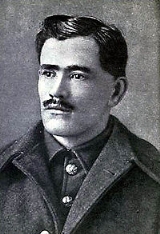
Francis Ledwidge

Encyclopedia
Francis Edward Ledwidge (19 August 1887 31 July 1917) was an Irish
war poet
from County Meath
. Sometimes known as the "poet of the blackbirds", he was killed in action at the Battle of Passchendaele during World War I
.
, in Ireland, the eighth of nine children in a poverty-stricken family. His parents, Patrick Ledwidge (the Ledwidge family, from Shropshire
, was granted land in Meath after the Norman invasion) and wife Anne Lynch (1853–1926), believed in giving their children the best education they could afford. But when Francis was only five his father Patrick died prematurely, which forced his wife and the children out to work at an early age. Francis left the local national school aged thirteen, and while he continued to self-educate himself, he worked at what work he could find, as farm hand, road mender and supervisor of roads, as copper
miner (sacked for organising a strike having been a trade union activist since 1906) and shop assistant. Appointed secretary of the Slane branch of the Meath Labour Union (1913–14) he had aspirations of permanent white-collar work. His politics were nationalist as well as left-wing.
Independent reflecting his passion for the Boyne Valley. While working as a road labourer he won the patronage of the writer, Lord Dunsany
, after he wrote to him in 1912, enclosing copybooks of his early work. Dunsany, a man of letters already well-known in Dublin and London literary and dramatic circles, and whose own start in publishing had been with a few poems, promoted him in Dublin and introduced him to W.B. Yeats
with whom he became acquainted.
Dunsany supported Ledwidge with money and literary advice for some years, providing him with access to and a workspace in Dunsany Castle's Library where he met the Irish writer Katharine Tynan
, corresponding with her regularly. Dunsany later prepared his first collection of poetry Songs of the Fields, which successfully appealed to the expectations of the Irish Literary Revival
and its social taste for rural poetry.
(1914), a nationalist force sworn to defend the introduction of Home Rule for Ireland, by force if need be.
On the outbreak of World War I
in August 1914, and on account of Ireland's involvement
in the war, the Irish Volunteers split into two factions, the National Volunteers
who supported John Redmond
’s appeal to join Irish regiments in support of the Allied
war cause and those who did not. Francis was originally of the latter party. Nevertheless, having defended this position strongly at a local authority meeting, he enlisted (24 October 1914) in Lord Dunsany’s regiment, joining 5th battalion Royal Inniskilling Fusiliers
, part of the 10th (Irish) Division. This was against the urgings of Dunsany who opposed his enlistment and had offered him a stipend to support him if he stayed away from the war. Some have speculated that he went to war because his sweetheart Ellie Vaughey had found a new lover, John O'Neill, whom she later married, but Ledwidge himself wrote, and forcefully, that he could not stand aside while others sought to defend Ireland's freedom.
. In 1915, he saw action at Suvla Bay
in the Dardanelles
, where he suffered severe rheumatism
. Having survived huge losses sustained by his company in the Battle of Gallipoli
, he became ill after a back injury on a tough mountain journey in Serbia
(December 1915), a locale which inspired a number of poems.
Ledwidge was dismayed by the news of the Easter Rising
, and was court-martial
led and demoted for overstaying his home leave and being drunk in uniform (May 1916). He gained and lost stripes over a period in Derry
(he was a corporal when the introduction to his first book was written), and then, returned to the front, received back his lance corporal's stripe one last time in January 1917 when posted to the Western Front
, joining 1st Battalion, Royal Inniskilling Fusiliers, part of 29th Division.
 Ledwidge continued to write when feasible throughout the war years, though he lost much work, for example, in atrocious weather in Serbia. He sent much of his output to Lord Dunsany, himself moving on war assignments, as well as to readers among family, friends and literary contacts.
On 31 July 1917, a group from Ledwidge's battalion of the Royal Inniskilling Fusiliers were road-laying in preparation for an assault during the Third Battle of Ypres, near the village of Boezinge
, northwest of Ieper (Ypres
). While Ledwidge was drinking tea in a mud hole with his comrades, a random shell exploded alongside, killing the poet and five others. A chaplain who knew him, Father Devas, arrived soon after, and recorded "Ledwidge killed, blown to bits."
The poems Ledwidge wrote on active service revealed his pride at being a soldier, as he believed, in the service of Ireland. He wondered whether he would find a soldier's death. The dead were buried at Carrefour de Rose, and later re-interred in the nearby Artillery Wood Military Cemetery, Boezinge, (where the Welsh poet Hedd Wyn
, killed on the same day, is also buried). A stone tablet commemorates him in the Island of Ireland Peace Park
, Messines
, Belgium. His work as “peasant poet” and “soldier poet”, once a standard part of the Irish school curriculum, faded from view for many decades of the 20th century. Its intensity, coupled with a revived interest in his period, has restored it to life.
series, and remained a correspondent for the remainder of Ledwidge's life. A second volume, Songs of Peace was in preparation when Ledwidge died; patron and friend Lord Dunsany wrote the introduction while both were in Derry in September 1916.
Following the war, Dunsany arranged for more of Ledwidge's work to be published, first in a third and final new volume, Last Songs, and then later in an anthology in 1919; he commented on the work with words such as:
Some of Ledwidge's poetry was put to music by the British Composer and song-writer Michael Head
, most notably in the very well received song cycle published in 1920, "Over the rim of the moon". This includes the well-known song, "The Ships of Arcady".

- From a personal letter.
- Lament for Thomas MacDonagh
Ireland
Ireland is an island to the northwest of continental Europe. It is the third-largest island in Europe and the twentieth-largest island on Earth...
war poet
War poet
A War poet is a poet writing in time of and on the subject of war. The term, which is applied especially to those in military service during World War I, was documented as early as 1848 in reference to German revolutionary poet, Georg Herwegh.-Crimean War:...
from County Meath
County Meath
County Meath is a county in Ireland. It is part of the Mid-East Region and is also located in the province of Leinster. It is named after the ancient Kingdom of Mide . Meath County Council is the local authority for the county...
. Sometimes known as the "poet of the blackbirds", he was killed in action at the Battle of Passchendaele during World War I
World War I
World War I , which was predominantly called the World War or the Great War from its occurrence until 1939, and the First World War or World War I thereafter, was a major war centred in Europe that began on 28 July 1914 and lasted until 11 November 1918...
.
Early life
Ledwidge was born at Janeville, SlaneSlane
Slane is a village in County Meath, in Ireland. The village stands on a steep hillside on the left bank of the River Boyne at the intersection of the N2 and the N51 . In 2006 Slane's population was 1,099, having grown from 823 in 2002. The population of the village and the surrounding rural area...
, in Ireland, the eighth of nine children in a poverty-stricken family. His parents, Patrick Ledwidge (the Ledwidge family, from Shropshire
Shropshire
Shropshire is a county in the West Midlands region of England. For Eurostat purposes, the county is a NUTS 3 region and is one of four counties or unitary districts that comprise the "Shropshire and Staffordshire" NUTS 2 region. It borders Wales to the west...
, was granted land in Meath after the Norman invasion) and wife Anne Lynch (1853–1926), believed in giving their children the best education they could afford. But when Francis was only five his father Patrick died prematurely, which forced his wife and the children out to work at an early age. Francis left the local national school aged thirteen, and while he continued to self-educate himself, he worked at what work he could find, as farm hand, road mender and supervisor of roads, as copper
Copper
Copper is a chemical element with the symbol Cu and atomic number 29. It is a ductile metal with very high thermal and electrical conductivity. Pure copper is soft and malleable; an exposed surface has a reddish-orange tarnish...
miner (sacked for organising a strike having been a trade union activist since 1906) and shop assistant. Appointed secretary of the Slane branch of the Meath Labour Union (1913–14) he had aspirations of permanent white-collar work. His politics were nationalist as well as left-wing.
Young poet
Strongly built, with striking brown eyes and a sensuous face, Ledwidge was a keen poet writing where ever he could – sometimes even on gates or fence posts. From the age of fourteen his works were published in his local newspaper, the DroghedaDrogheda
Drogheda is an industrial and port town in County Louth on the east coast of Ireland, 56 km north of Dublin. It is the last bridging point on the River Boyne before it enters the Irish Sea....
Independent reflecting his passion for the Boyne Valley. While working as a road labourer he won the patronage of the writer, Lord Dunsany
Edward Plunkett, 18th Baron Dunsany
Edward John Moreton Drax Plunkett, 18th Baron of Dunsany was an Irish writer and dramatist, notable for his work, mostly in fantasy, published under the name Lord Dunsany...
, after he wrote to him in 1912, enclosing copybooks of his early work. Dunsany, a man of letters already well-known in Dublin and London literary and dramatic circles, and whose own start in publishing had been with a few poems, promoted him in Dublin and introduced him to W.B. Yeats
William Butler Yeats
William Butler Yeats was an Irish poet and playwright, and one of the foremost figures of 20th century literature. A pillar of both the Irish and British literary establishments, in his later years he served as an Irish Senator for two terms...
with whom he became acquainted.
Dunsany supported Ledwidge with money and literary advice for some years, providing him with access to and a workspace in Dunsany Castle's Library where he met the Irish writer Katharine Tynan
Katharine Tynan
Katharine Tynan was an Irish-born writer, known mainly for her novels and poetry. After her marriage in 1898 to the writer and barrister Henry Albert Hinkson she usually wrote under the name Katharine Tynan Hinkson...
, corresponding with her regularly. Dunsany later prepared his first collection of poetry Songs of the Fields, which successfully appealed to the expectations of the Irish Literary Revival
Celtic Revival
Celtic Revival covers a variety of movements and trends, mostly in the 19th and 20th centuries, which drew on the traditions of Celtic literature and Celtic art, or in fact more often what art historians call Insular art...
and its social taste for rural poetry.
Home Rule and World War I
Ledwidge was a keen patriot and nationalist. His efforts to found a branch of the Gaelic League in Slane were thwarted by members of the local council. The area organiser encouraged him to continue his struggle, but Francis gave up. He did manage to act as a founding member with his brother Joseph of the Slane Branch of the Irish VolunteersIrish Volunteers
The Irish Volunteers was a military organisation established in 1913 by Irish nationalists. It was ostensibly formed in response to the formation of the Ulster Volunteers in 1912, and its declared primary aim was "to secure and maintain the rights and liberties common to the whole people of Ireland"...
(1914), a nationalist force sworn to defend the introduction of Home Rule for Ireland, by force if need be.
On the outbreak of World War I
World War I
World War I , which was predominantly called the World War or the Great War from its occurrence until 1939, and the First World War or World War I thereafter, was a major war centred in Europe that began on 28 July 1914 and lasted until 11 November 1918...
in August 1914, and on account of Ireland's involvement
Ireland and World War I
During World War I , Ireland was part of the United Kingdom of Great Britain and Ireland, which entered the war in August 1914 as one of the Entente Powers, along with France and Russia, when it declared war to halt the military expansion of the Central Powers, consisting of the German Empire, the...
in the war, the Irish Volunteers split into two factions, the National Volunteers
National Volunteers
The National Volunteers was the name taken by the majority of the Irish Volunteers that sided with Irish Parliamentary Party leader John Redmond after the movement split over the question of the Volunteers' role in World War I.-Origins:...
who supported John Redmond
John Redmond
John Edward Redmond was an Irish nationalist politician, barrister, MP in the House of Commons of the United Kingdom of Great Britain and Ireland and leader of the Irish Parliamentary Party from 1900 to 1918...
’s appeal to join Irish regiments in support of the Allied
Allies of World War I
The Entente Powers were the countries at war with the Central Powers during World War I. The members of the Triple Entente were the United Kingdom, France, and the Russian Empire; Italy entered the war on their side in 1915...
war cause and those who did not. Francis was originally of the latter party. Nevertheless, having defended this position strongly at a local authority meeting, he enlisted (24 October 1914) in Lord Dunsany’s regiment, joining 5th battalion Royal Inniskilling Fusiliers
Royal Inniskilling Fusiliers
The Royal Inniskilling Fusiliers was a Irish infantry regiment of the British Army formed in 1881 by the amalgamation of the 27th Regiment of Foot and the 108th Regiment of Foot...
, part of the 10th (Irish) Division. This was against the urgings of Dunsany who opposed his enlistment and had offered him a stipend to support him if he stayed away from the war. Some have speculated that he went to war because his sweetheart Ellie Vaughey had found a new lover, John O'Neill, whom she later married, but Ledwidge himself wrote, and forcefully, that he could not stand aside while others sought to defend Ireland's freedom.
Poetry and war
Ledwidge seems to have fitted into Army life well, and rapidly achieved promotion to lance corporalLance Corporal
Lance corporal is a military rank, used by many armed forces worldwide, and also by some police forces and other uniformed organizations. It is below the rank of corporal, and is typically the lowest non-commissioned officer, usually equivalent to the NATO Rank Grade OR-3.- Etymology :The presumed...
. In 1915, he saw action at Suvla Bay
Landing at Suvla Bay
The landing at Suvla Bay was an amphibious landing made at Suvla on the Aegean coast of Gallipoli peninsula in the Ottoman Empire as part of the August Offensive, the final British attempt to break the deadlock of the Battle of Gallipoli...
in the Dardanelles
Battle of the Dardanelles
Battle of the Dardanelles may refer to:During the Ottoman-Venetian War of 1645–1669:*Battle of the Dardanelles *Battle of the Dardanelles *Battle of the Dardanelles *Battle of the Dardanelles During other conflicts:...
, where he suffered severe rheumatism
Rheumatism
Rheumatism or rheumatic disorder is a non-specific term for medical problems affecting the joints and connective tissue. The study of, and therapeutic interventions in, such disorders is called rheumatology.-Terminology:...
. Having survived huge losses sustained by his company in the Battle of Gallipoli
Battle of Gallipoli
The Gallipoli Campaign, also known as the Dardanelles Campaign or the Battle of Gallipoli, took place at the peninsula of Gallipoli in the Ottoman Empire between 25 April 1915 and 9 January 1916, during the First World War...
, he became ill after a back injury on a tough mountain journey in Serbia
Macedonian front (World War I)
The Macedonian Front resulted from an attempt by the Allied Powers to aid Serbia, in the autumn of 1915, against the combined attack of Germany, Austria-Hungary and Bulgaria. The expedition came too late and in insufficient force to prevent the fall of Serbia, and was complicated by the internal...
(December 1915), a locale which inspired a number of poems.
Ledwidge was dismayed by the news of the Easter Rising
Easter Rising
The Easter Rising was an insurrection staged in Ireland during Easter Week, 1916. The Rising was mounted by Irish republicans with the aims of ending British rule in Ireland and establishing the Irish Republic at a time when the British Empire was heavily engaged in the First World War...
, and was court-martial
Court-martial
A court-martial is a military court. A court-martial is empowered to determine the guilt of members of the armed forces subject to military law, and, if the defendant is found guilty, to decide upon punishment.Most militaries maintain a court-martial system to try cases in which a breach of...
led and demoted for overstaying his home leave and being drunk in uniform (May 1916). He gained and lost stripes over a period in Derry
Derry
Derry or Londonderry is the second-biggest city in Northern Ireland and the fourth-biggest city on the island of Ireland. The name Derry is an anglicisation of the Irish name Doire or Doire Cholmcille meaning "oak-wood of Colmcille"...
(he was a corporal when the introduction to his first book was written), and then, returned to the front, received back his lance corporal's stripe one last time in January 1917 when posted to the Western Front
Western Front (World War I)
Following the outbreak of World War I in 1914, the German Army opened the Western Front by first invading Luxembourg and Belgium, then gaining military control of important industrial regions in France. The tide of the advance was dramatically turned with the Battle of the Marne...
, joining 1st Battalion, Royal Inniskilling Fusiliers, part of 29th Division.
On 31 July 1917, a group from Ledwidge's battalion of the Royal Inniskilling Fusiliers were road-laying in preparation for an assault during the Third Battle of Ypres, near the village of Boezinge
Boezinge
Boezinge is a village north of the city of Ypres in West Flanders, Belgium, on the N369 road in the direction of Diksmuide.Artillery Wood Cemetery, near the village, is a First World War cemetery. It is the location of the grave of Hedd Wyn, the 1917 National Eisteddfod-winning Welsh poet, and of...
, northwest of Ieper (Ypres
Ypres
Ypres is a Belgian municipality located in the Flemish province of West Flanders. The municipality comprises the city of Ypres and the villages of Boezinge, Brielen, Dikkebus, Elverdinge, Hollebeke, Sint-Jan, Vlamertinge, Voormezele, Zillebeke, and Zuidschote...
). While Ledwidge was drinking tea in a mud hole with his comrades, a random shell exploded alongside, killing the poet and five others. A chaplain who knew him, Father Devas, arrived soon after, and recorded "Ledwidge killed, blown to bits."
The poems Ledwidge wrote on active service revealed his pride at being a soldier, as he believed, in the service of Ireland. He wondered whether he would find a soldier's death. The dead were buried at Carrefour de Rose, and later re-interred in the nearby Artillery Wood Military Cemetery, Boezinge, (where the Welsh poet Hedd Wyn
Hedd Wyn
Hedd Wyn was a Welsh language poet who was killed during the Battle of Passchendaele in World War I. He was posthumously awarded the bard's chair at the 1917 National Eisteddfod...
, killed on the same day, is also buried). A stone tablet commemorates him in the Island of Ireland Peace Park
Island of Ireland Peace Park
The Island of Ireland Peace Park and its surrounding park , also called the Irish Peace Park or Irish Peace Tower in Messines, near Ypres in Flanders, Belgium, is a war memorial to the soldiers of the island of Ireland who died, were wounded or are missing from World War I, during Ireland's...
, Messines
Messines
Messines may refer to:* Mesen, a village in Belgium**Battle of Messines, World War I,* Messines, Quebec* HMCS Messines, one of twelve Battle class naval trawlers used by the Royal Canadian Navy* Messines, Queensland...
, Belgium. His work as “peasant poet” and “soldier poet”, once a standard part of the Irish school curriculum, faded from view for many decades of the 20th century. Its intensity, coupled with a revived interest in his period, has restored it to life.
Publications and reception
Much of Ledwidge's work was published in newspapers and journals in Ireland and the UK. The only work published in book form during Ledwidge's lifetime was the original Songs of the Fields (1915), which was very well received. The critic Edward Marsh printed three of the poems in the Georgian PoetryGeorgian Poetry
Georgian Poetry was the title of a series of anthologies showcasing the work of a school of English poetry that established itself during the early years of the reign of King George V of the United Kingdom....
series, and remained a correspondent for the remainder of Ledwidge's life. A second volume, Songs of Peace was in preparation when Ledwidge died; patron and friend Lord Dunsany wrote the introduction while both were in Derry in September 1916.
Following the war, Dunsany arranged for more of Ledwidge's work to be published, first in a third and final new volume, Last Songs, and then later in an anthology in 1919; he commented on the work with words such as:
"[I was] astonished by the brilliance of that eye and that had looked at the fields of Meath and seen there all the simple birds and flowers, with a vividness which made those pages like a magnifying glass, through which one looked at familiar things for the first time."
Some of Ledwidge's poetry was put to music by the British Composer and song-writer Michael Head
Michael Head
Michael Head was a British composer, pianist, organist and singer who left some enduring works still popular today...
, most notably in the very well received song cycle published in 1920, "Over the rim of the moon". This includes the well-known song, "The Ships of Arcady".
- Later collections:
- Alice Curtayne: ‘’The complete poems of Francis Ledwidge’’ (1974) who also wrote a comprehensive biography of the poet, including some previously unpublished work
- Liam O'Meara: ‘’The poems of Francis Ledwidge’’ (1997), (ISBN 1 870 49147 5), including some previously unpublished work
- Ulick O’Connor (introduction by): ‘’The best of Francis Ledwidge’’, The Inchicore Ledwidge Society, Risposte Books (2004), ISBN 1 901 59610 9
- Hubert Dunn:‘’The Minstrel Boy’’, (2006) some more poems released in a commemorative volume
- Dermot Bolger: In 1992 long-time Ledwidge admirer, Dublin poet Dermot Bolger, published a Selected Poems of Francis Ledwidge. This was re-issued by New Island Books in 2007 under the title "A Ledwidge Treasury", with an introduction by Seamus Heaney and an afterword by Dermot Bolger. In 2007 Bolger's play about the life of Ledwidge, "Walking the Road", (New Island Books, 2007) was staged in Dublin and in the Town Hall Theatre, IeperYpresYpres is a Belgian municipality located in the Flemish province of West Flanders. The municipality comprises the city of Ypres and the villages of Boezinge, Brielen, Dikkebus, Elverdinge, Hollebeke, Sint-Jan, Vlamertinge, Voormezele, Zillebeke, and Zuidschote...
, close where Ledwidge died. It was commissioned to mark the 90th anniversary of his death. In 1998 Bolger and the poet's nephew, Joseph Ledwidge, were invited by the 'In Flanders Fields Museum' to unveil a monument on the spot where Ledwidge was killed.
Works
- Songs of the Fields (1915) Full text at Internet ArchiveInternet ArchiveThe Internet Archive is a non-profit digital library with the stated mission of "universal access to all knowledge". It offers permanent storage and access to collections of digitized materials, including websites, music, moving images, and nearly 3 million public domain books. The Internet Archive...
- Songs of Peace (1917)
- Last Songs (1918) Full text at Internet Archive
- The complete poems of Francis Ledwidge; with introductions by Lord Dunsany (1919) Full text at Internet Archive
Quotes
Oh what a pleasant world 'twould be,
How easy we'd step thro' it,
If all the fools who meant no harm,
Could manage not to do it!
- From a personal letter.
He shall not hear the bitternBitternBitterns are a classification of birds in the heron family, Ardeidae, a family of wading birds. Species named bitterns tend to be the shorter-necked, often more secretive members of this family...
cry
in the wild sky, where he is lain,
Nor voices of the sweeter birds
Above the wailing of the rain
Nor shall he know when the loud March blows
Thro' slanting snows her fanfare shrill,
Blowing to flame the golden cup
Of many an upset daffodil.
But when the dark cow leaves the moor
And pastures poor with greedy weeds
Perhaps he'll hear her low at morn
Lifting her horn in pleasant meads.
- Lament for Thomas MacDonagh
Thomas MacDonagh
Thomas MacDonagh was an Irish nationalist, poet, playwright, and a leader of the 1916 Easter Rising.-Early life:MacDonagh was born in Cloughjordan, County Tipperary...
Documentary film
- Ledwidge was the subject of an RTÉRTÉ OneRTÉ One is the flagship television channel of Raidió Teilifís Éireann , and it is the most popular and most watched television channel in Ireland. It was launched as Telefís Éireann on 31 December 1961, it was renamed RTÉ Television in 1966, and it was renamed as RTÉ One upon the launch of RTÉ...
documentary entitled Behind the Closed Eye, first broadcast on January 18, 1973. It won awards for Best Story and Best Implementation Documentary at the Golden Prague International Television Festival.
External links
- FrancisLedwidge.com
- Fermanagh Herald, 31 Jan 2007, Books, Michael Breslin
- Obit. by Prof. Lewis Chase in The Cornhill Magazine 1917 pp 696–704 Includes autobiographical letter by Ledwidge to Chase dated June 6, 1917.
Full text at Internet ArchiveInternet ArchiveThe Internet Archive is a non-profit digital library with the stated mission of "universal access to all knowledge". It offers permanent storage and access to collections of digitized materials, including websites, music, moving images, and nearly 3 million public domain books. The Internet Archive...
. - Department of the Taoiseach: Irish Soldiers in the First World War
- Ledwidge household census forms 1901 & 1911 Note that his age is incorrectly given as 20 in 1911.