


The Waste Land

Encyclopedia
The Waste Land[A] is a 434-line[B] modernist
poem by T. S. Eliot
published in 1922. It has been called "one of the most important poems of the 20th century." Despite the poem's obscurity—its shifts between satire
and prophecy
, its abrupt and unannounced changes of speaker
, location and time, its elegiac
but intimidating summoning up of a vast and dissonant range of cultures and literatures—the poem has become a familiar touchstone
of modern literature
. Among its famous phrases are "April is the cruellest month" (its first line); "I will show you fear in a handful of dust"; and (its last line) the mantra
in the Sanskrit
language "Shantih shantih shantih
."[C]
dated 9 May 1921, Eliot wrote that he had "a long poem in mind and partly on paper which I am wishful to finish."
Richard Aldington
, in his memoirs, relates that "a year or so" before Eliot read him the manuscript draft of The Waste Land in London
, Eliot visited him in the country. While walking through a graveyard, they started discussing Thomas Gray
's Elegy Written in a Country Churchyard
. Aldington writes: "I was surprised to find that Eliot admired something so popular, and then went on to say that if a contemporary poet, conscious of his limitations as Gray evidently was, would concentrate all his gifts on one such poem he might achieve a similar success."
Eliot, having been diagnosed with some form of nervous disorder, had been recommended rest, and applied for three months' leave from the bank where he was employed; the reason stated on his staff card was "nervous breakdown
". He and his first wife, Vivienne Haigh-Wood Eliot
, travelled to the coastal resort of Margate
for a period of convalescence. While there, Eliot worked on the poem, and possibly showed an early version to Ezra Pound
when, after a brief return to London, the Eliots travelled to Paris
in November 1921 and were guests of Pound. Eliot was en route to Lausanne
, Switzerland
, for treatment by Doctor Roger Vittoz, who had been recommended to him by Ottoline Morrell; Vivien was to stay at a sanatorium
just outside Paris. In Lausanne, Eliot produced a 19-page version of the poem. He returned from Lausanne in early January 1922. Pound then made detailed editorial comments and significant cuts to the manuscript. Eliot would later dedicate the poem to Pound.
.
It was not until April 1968 that the existence and whereabouts of the manuscript drafts were made known to Valerie Eliot
, the poet's second wife and widow. In 1971, Faber and Faber
published a "facsimile and transcript" of the original drafts, edited and annotated by Valerie Eliot. The full poem prior to the Pound editorial changes is contained in the facsimile.
The now famous opening lines of the poem—'April is the cruellest month, breeding / Lilacs out of the dead land, ...'—did not appear until the top of the second page of the typescript. The first page of the typescript contained 54 lines in the sort of street voice that we hear again at the end of the second section, A Game of Chess
. This page appears to have been lightly crossed out in pencil by Eliot himself.
Although there are several signs of similar adjustments made by Eliot, and a number of significant comments by Vivien, the most significant editorial input is clearly that of Pound, who recommended many cuts to the poem.
'The typist home at teatime' section was originally in entirely regular stanzas of iambic pentameter
, with a rhyme scheme of abab—the same form as Gray's Elegy, which was in Eliot's thoughts around this time. Pound's note against this section of the draft is "verse not interesting enough as verse to warrant so much of it". In the end, the regularity of the four-line stanzas was abandoned.
At the beginning of 'The Fire Sermon' in one version, there was a lengthy section in heroic couplet
s, in imitation of Alexander Pope
's The Rape of the Lock
. It described one lady Fresca (who appeared in the earlier poem "Gerontion"). As Richard Ellmann
describes it, "Instead of making her toilet like Pope's Belinda, Fresca is going to it, like Joyce
's Bloom
." The lines read:
Ellmann notes "Pound warned Eliot that since Pope had done the couplets better, and Joyce the defecation, there was no point in another round."
Pound also excised some shorter poems that Eliot wanted to insert between the five sections. One of these, that Eliot had entitled 'Dirge', begins
At the request of Eliot's wife, Vivien, a line in the A Game of Chess section was removed from the poem: "And we shall play a game of chess/The ivory
men make company between us / Pressing lidless eyes and waiting for a knock upon the door". This section is apparently based on their marital life, and she may have felt these lines too revealing. However, the "ivory men" line may have meant something to Eliot: in 1960, thirteen years after Vivien's death, he inserted the line in a copy made for sale to aid the London Library
, of which he was President at the time; it fetched £2,800. Rupert Hart-Davis
had requested the original manuscript for the auction, but Eliot had lost it long ago (though it was found in America years later).
In a late December 1921 letter to Eliot to celebrate the "birth" of the poem, Pound wrote a bawdy poem of 48 lines titled "Sage Homme" in which he identified Eliot as the mother of the poem but compared himself to the midwife. The first lines are:
of the New York publishing firm of Boni and Liveright was in Paris for a number of meetings with Ezra Pound. At a dinner on 3 January 1922 (see 1922 in poetry
), he made offers for works by Pound, James Joyce
(Ulysses
) and Eliot. Eliot was to get a royalty of 15% for a book version of the poem planned for autumn publication.
To maximize his income and reach a broader audience, Eliot also sought a deal with magazines. Being the London correspondent for The Dial
magazine and a college friend of its co-owner and co-editor, Scofield Thayer
, the Dial was an ideal choice. Even though the Dial offered $150 (£34) for the poem (25% more than its standard rate) Eliot was offended that a year's work would be valued so low, especially since another contributor was found to have been given exceptional compensation for a short story. The deal with the Dial almost fell through (other magazines considered were the Little Review and Vanity Fair) but with Pound's efforts eventually a deal was worked out where, in addition to the $150, Eliot would be awarded the Dial magazine's second annual prize for outstanding service to letters. The prize carried an award of $2,000 (£450).
In New York in the late summer (with John Quinn, a lawyer and literary patron, representing Eliot's interests) Boni and Liveright made an agreement with The Dial where the magazine would be the first to publish the poem in the US by agreeing to purchase 350 copies of the book at discount from Boni and Liveright. Boni and Liveright would use the publicity of the award of the Dials prize to Eliot to increase their initial sales.
The poem was first published in the UK, without the author's notes, in the first issue (October 1922) of The Criterion
, a literary magazine started and edited by Eliot. The first appearance of the poem in the US was in the November 1922 issue of The Dial
magazine (actually published in late October). In December 1922, the poem was published in the US in book form by Boni and Liveright, the first publication to print the notes. In September 1923, the Hogarth Press
, a private press
run by Eliot's friends Leonard
and Virginia Woolf
, published the first UK book edition of The Waste Land in an edition of about 450 copies, the type handset by Virginia Woolf.
The publication history of The Waste Land (as well as other pieces of Eliot's poetry and prose) has been documented by Donald Gallup.
Eliot, whose 1922 salary at Lloyds Bank was £500 ($2,215) made approximately £630 ($2,800) with the Dial, Boni and Liveright and Hogarth Press publications.[F]
' novel Our Mutual Friend
, in which the widow Betty Higden says of her adopted foundling son Sloppy, "You mightn't think it, but Sloppy is a beautiful reader of a newspaper. He do the Police in different voices." This would help the reader to understand that, while there are many different voices (speakers) in the poem, some critics believe there is only one central consciousness. What was lost by the rejection of this title Eliot might have felt compelled to restore by commenting on the commonalities of his characters in his note about Tiresias
.
In the end, the title Eliot chose was The Waste Land. In his first note to the poem he attributes the title to Jessie L. Weston's book on the Grail legend, From Ritual to Romance
. The allusion is to the wounding of the Fisher King
and the subsequent sterility of his lands. To restore the King and make his lands fertile again the Grail questor must ask "What ails you?" A poem strikingly similar in theme and language called Waste Land, written by Madison Cawein, was published in 1913.
The poem's title is often mistakenly given as "Waste Land" (as used by Weston) or "Wasteland", omitting the definite article
. However, in a letter to Ezra Pound
, Eliot politely insisted that the title begin with "The".
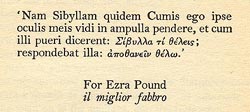 The poem is preceded by a Latin
and Greek
epigraph
from The Satyricon
of Petronius
. In English
, it reads: "I saw with my own eyes the Sibyl
of Cumae
hanging in a jar, and when the boys said to her, Sibyl, what do you want? she replied I want to die."
Following the epigraph is a dedication (added in a 1925 republication) that reads "For Ezra Pound
: il miglior fabbro" Here Eliot is both quoting line 117 of Canto XXVI of Dante
's Purgatorio
, the second cantica of The Divine Comedy
, where Dante defines the troubadour Arnaut Daniel
as "the best smith of the mother tongue" and also Pound's title of chapter 2 of his The Spirit of Romance (1910) where he translated the phrase as "the better craftsman." This dedication was originally written in ink by Eliot in the 1922 Boni & Liveright paperback edition of the poem presented to Pound; it was subsequently included in future editions.
The five parts of The Waste Land are titled:
The text of the poem is followed by several pages of notes, purporting to explain his metaphors, references, and allusions. Some of these notes are helpful in interpreting the poem, but some are arguably even more puzzling, and many of the most opaque passages are left unannotated. The notes were added after Eliot's publisher requested something longer to justify printing The Waste Land in a separate book.[G]
There is some question as to whether Eliot originally intended The Waste Land to be a collection of individual poems (additional poems were supplied to Pound for his comments on including them) or to be considered one poem with five sections.
The structure of the poem is also meant to loosely follow the vegetation myth and Holy Grail
folklore surrounding the Fisher King
story as outlined by Jessie Weston
in her book From Ritual to Romance
(1920). Weston's book was so central to the structure of the poem that it was the first text that Eliot cited in his "Notes on the Waste Land."
. This interest dates back at least as far as The Love Song of J. Alfred Prufrock
. Of course, "The Waste Land" is not a single monologue like "Prufrock." Instead, it is made up of a wild variety of voices (sometimes in monologue, dialogue, or with more than two characters speaking).
The style of the poem overall is marked by the hundreds of allusions and quotations from other texts (classic and obscure; "high-brow" and "low-brow") that Eliot peppered throughout the poem. In addition to the many "high-brow" references and/or quotes from poets like Baudelaire, Shakespeare, Ovid
, and Homer
, Eliot also included a couple of references to "low-brow" genres. A good example of this is Eliot's quote from the 1912 popular song "The Shakespearian Rag" by lyricists Herman Ruby and Gene Buck. There were also a number of low-brow references in the opening section of Eliot's original manuscript (when the poem was entitled "He Do The Policeman in Different Voices"), but they were removed from the final draft after Eliot cut this original opening section.
"The Waste Land" is notable for its seemingly disjointed structure, indicative of the Modernist style of James Joyce
's Ulysses
(which Eliot cited as an influence and which he read the same year that he was writing "The Waste Land"). In the Modernist style, Eliot jumps from one voice or image to another without clearly delineating these shifts for the reader. He also includes phrases from multiple foreign languages (Latin, Greek, Italian, German, French and Sanskrit), indicative of Pound's influence.
, Sophocles
, Petronius
, Virgil
, Ovid
, Saint Augustine of Hippo
, Dante Alighieri
, William Shakespeare
, Edmund Spenser
, Gérard de Nerval
, Thomas Kyd
, Geoffrey Chaucer
, Thomas Middleton
, John Webster
, Joseph Conrad
, John Milton
, Andrew Marvell
, Charles Baudelaire
, Richard Wagner
, Oliver Goldsmith
, Hermann Hesse
, Aldous Huxley
, Paul Verlaine
, Walt Whitman
and Bram Stoker
. Eliot also makes extensive use of Scriptural writings including the Bible
, the Book of Common Prayer
, the Hindu Brihadaranyaka Upanishad
, and the Buddha
's Fire Sermon
, and of cultural and anthropological
studies such as Sir James Frazer
's The Golden Bough
and Jessie Weston
's From Ritual to Romance
(particularly its study of the Wasteland
motif in Celtic mythology
). Eliot wrote in the original head note that "Not only the title, but the plan and a good deal of the incidental symbolism of the poem were suggested by Miss Jessie L Weston"[H], but - thirty years later - recanted the generous nod to Weston in the poem's notes, expressing his regret at "having sent so many enquirers off on a wild goose chase.". The symbols Eliot employed, in addition to the Waste Land, include the Fisher King
, the Tarot
Deck, the Perilous Chapel, and the Grail Quest.
Annotated versions
Recordings
Modernist poetry in English
Modernist poetry in English is generally considered to have emerged in the early years of the 20th century with the appearance of the Imagists. In common with many other modernists, these poets wrote in reaction to the perceived excesses of Victorian poetry, with its emphasis on traditional...
poem by T. S. Eliot
T. S. Eliot
Thomas Stearns "T. S." Eliot OM was a playwright, literary critic, and arguably the most important English-language poet of the 20th century. Although he was born an American he moved to the United Kingdom in 1914 and was naturalised as a British subject in 1927 at age 39.The poem that made his...
published in 1922. It has been called "one of the most important poems of the 20th century." Despite the poem's obscurity—its shifts between satire
Satire
Satire is primarily a literary genre or form, although in practice it can also be found in the graphic and performing arts. In satire, vices, follies, abuses, and shortcomings are held up to ridicule, ideally with the intent of shaming individuals, and society itself, into improvement...
and prophecy
Prophecy
Prophecy is a process in which one or more messages that have been communicated to a prophet are then communicated to others. Such messages typically involve divine inspiration, interpretation, or revelation of conditioned events to come as well as testimonies or repeated revelations that the...
, its abrupt and unannounced changes of speaker
Narrator
A narrator is, within any story , the fictional or non-fictional, personal or impersonal entity who tells the story to the audience. When the narrator is also a character within the story, he or she is sometimes known as the viewpoint character. The narrator is one of three entities responsible for...
, location and time, its elegiac
Elegiac
Elegiac refers either to those compositions that are like elegies or to a specific poetic meter used in Classical elegies. The Classical elegiac meter has two lines, making it a couplet: a line of dactylic hexameter, followed by a line of dactylic pentameter...
but intimidating summoning up of a vast and dissonant range of cultures and literatures—the poem has become a familiar touchstone
Touchstone (metaphor)
As a metaphor, a touchstone refers to any physical or intellectual measure by which the validity or merit of a concept can be tested. It is similar in use to an acid test, litmus test in politics, and a shibboleth.-Touchstone in literature:...
of modern literature
History of modern literature
The history of literature in the Modern period in Europe begins with the Age of Enlightenment and the conclusion of the Baroque period in the 18th century, succeeding the Renaissance and Early Modern periods....
. Among its famous phrases are "April is the cruellest month" (its first line); "I will show you fear in a handful of dust"; and (its last line) the mantra
Mantra
A mantra is a sound, syllable, word, or group of words that is considered capable of "creating transformation"...
in the Sanskrit
Sanskrit
Sanskrit , is a historical Indo-Aryan language and the primary liturgical language of Hinduism, Jainism and Buddhism.Buddhism: besides Pali, see Buddhist Hybrid Sanskrit Today, it is listed as one of the 22 scheduled languages of India and is an official language of the state of Uttarakhand...
language "Shantih shantih shantih
Shanti Mantra
The Shanti Mantras or "Peace Mantras" are Hindu prayers for Peace from the Vedas.Generally they are recited at the beginning and end of religious rituals and discourses....
."[C]
Writing
Eliot probably worked on what was to become The Waste Land for several years preceding its first publication in 1922. In a letter to New York lawyer and patron of modernism John QuinnJohn Quinn (collector)
John Quinn was a second generation Irish-American corporate lawyer in New York, who for a time was an important patron of major figures of post-impressionism and literary modernism, and collector in particular of original manuscripts.- Life :...
dated 9 May 1921, Eliot wrote that he had "a long poem in mind and partly on paper which I am wishful to finish."
Richard Aldington
Richard Aldington
Richard Aldington , born Edward Godfree Aldington, was an English writer and poet.Aldington was best known for his World War I poetry, the 1929 novel, Death of a Hero, and the controversy arising from his 1955 Lawrence of Arabia: A Biographical Inquiry...
, in his memoirs, relates that "a year or so" before Eliot read him the manuscript draft of The Waste Land in London
London
London is the capital city of :England and the :United Kingdom, the largest metropolitan area in the United Kingdom, and the largest urban zone in the European Union by most measures. Located on the River Thames, London has been a major settlement for two millennia, its history going back to its...
, Eliot visited him in the country. While walking through a graveyard, they started discussing Thomas Gray
Thomas Gray
Thomas Gray was a poet, letter-writer, classical scholar and professor at Cambridge University.-Early life and education:...
's Elegy Written in a Country Churchyard
Elegy Written in a Country Churchyard
Elegy Written in a Country Churchyard is a poem by Thomas Gray, completed in 1750 and first published in 1751. The poem’s origins are unknown, but it was partly inspired by Gray’s thoughts following the death of the poet Richard West in 1742. Originally titled Stanza's Wrote in a Country...
. Aldington writes: "I was surprised to find that Eliot admired something so popular, and then went on to say that if a contemporary poet, conscious of his limitations as Gray evidently was, would concentrate all his gifts on one such poem he might achieve a similar success."
Eliot, having been diagnosed with some form of nervous disorder, had been recommended rest, and applied for three months' leave from the bank where he was employed; the reason stated on his staff card was "nervous breakdown
Mental breakdown
Mental breakdown is a non-medical term used to describe an acute, time-limited phase of a specific disorder that presents primarily with features of depression or anxiety.-Definition:...
". He and his first wife, Vivienne Haigh-Wood Eliot
Vivienne Haigh-Wood Eliot
Vivienne Haigh-Wood Eliot was an English governess and writer who became notable as the first wife of the American poet, T.S. Eliot . Her legacy, and the extent to which she influenced Eliot's work, has been the subject of much debate...
, travelled to the coastal resort of Margate
Margate
-Demography:As of the 2001 UK census, Margate had a population of 40,386.The ethnicity of the town was 97.1% white, 1.0% mixed race, 0.5% black, 0.8% Asian, 0.6% Chinese or other ethnicity....
for a period of convalescence. While there, Eliot worked on the poem, and possibly showed an early version to Ezra Pound
Ezra Pound
Ezra Weston Loomis Pound was an American expatriate poet and critic and a major figure in the early modernist movement in poetry...
when, after a brief return to London, the Eliots travelled to Paris
Paris
Paris is the capital and largest city in France, situated on the river Seine, in northern France, at the heart of the Île-de-France region...
in November 1921 and were guests of Pound. Eliot was en route to Lausanne
Lausanne
Lausanne is a city in Romandy, the French-speaking part of Switzerland, and is the capital of the canton of Vaud. The seat of the district of Lausanne, the city is situated on the shores of Lake Geneva . It faces the French town of Évian-les-Bains, with the Jura mountains to its north-west...
, Switzerland
Switzerland
Switzerland name of one of the Swiss cantons. ; ; ; or ), in its full name the Swiss Confederation , is a federal republic consisting of 26 cantons, with Bern as the seat of the federal authorities. The country is situated in Western Europe,Or Central Europe depending on the definition....
, for treatment by Doctor Roger Vittoz, who had been recommended to him by Ottoline Morrell; Vivien was to stay at a sanatorium
Sanatorium
A sanatorium is a medical facility for long-term illness, most typically associated with treatment of tuberculosis before antibiotics...
just outside Paris. In Lausanne, Eliot produced a 19-page version of the poem. He returned from Lausanne in early January 1922. Pound then made detailed editorial comments and significant cuts to the manuscript. Eliot would later dedicate the poem to Pound.
Manuscript drafts
Eliot sent the manuscript drafts of the poem to John Quinn in October 1922; they reached Quinn in New York in January 1923.[D] Upon Quinn's death they were inherited by his sister, Julia Anderson. Years later, in the early 1950s, Mrs Anderson's daughter, Mary Conroy, found the documents in storage. In 1958 she sold them privately to the New York Public LibraryNew York Public Library
The New York Public Library is the largest public library in North America and is one of the United States' most significant research libraries...
.
It was not until April 1968 that the existence and whereabouts of the manuscript drafts were made known to Valerie Eliot
Valerie Eliot
Valerie Eliot née Esmé Valerie Fletcher is the surviving widow and second wife of the Nobel prize-winning poet, T. S. Eliot...
, the poet's second wife and widow. In 1971, Faber and Faber
Faber and Faber
Faber and Faber Limited, often abbreviated to Faber, is an independent publishing house in the UK, notable in particular for publishing a great deal of poetry and for its former editor T. S. Eliot. Faber has a rich tradition of publishing a wide range of fiction, non fiction, drama, film and music...
published a "facsimile and transcript" of the original drafts, edited and annotated by Valerie Eliot. The full poem prior to the Pound editorial changes is contained in the facsimile.
Editing
The drafts of the poem reveal that it originally contained almost twice as much material as the final published version. The significant cuts are in part due to Ezra Pound's suggested changes, although Eliot himself is also responsible for removing large sections.The now famous opening lines of the poem—'April is the cruellest month, breeding / Lilacs out of the dead land, ...'—did not appear until the top of the second page of the typescript. The first page of the typescript contained 54 lines in the sort of street voice that we hear again at the end of the second section, A Game of Chess
Chess
Chess is a two-player board game played on a chessboard, a square-checkered board with 64 squares arranged in an eight-by-eight grid. It is one of the world's most popular games, played by millions of people worldwide at home, in clubs, online, by correspondence, and in tournaments.Each player...
. This page appears to have been lightly crossed out in pencil by Eliot himself.
Although there are several signs of similar adjustments made by Eliot, and a number of significant comments by Vivien, the most significant editorial input is clearly that of Pound, who recommended many cuts to the poem.
'The typist home at teatime' section was originally in entirely regular stanzas of iambic pentameter
Iambic pentameter
Iambic pentameter is a commonly used metrical line in traditional verse and verse drama. The term describes the particular rhythm that the words establish in that line. That rhythm is measured in small groups of syllables; these small groups of syllables are called "feet"...
, with a rhyme scheme of abab—the same form as Gray's Elegy, which was in Eliot's thoughts around this time. Pound's note against this section of the draft is "verse not interesting enough as verse to warrant so much of it". In the end, the regularity of the four-line stanzas was abandoned.
At the beginning of 'The Fire Sermon' in one version, there was a lengthy section in heroic couplet
Heroic couplet
A heroic couplet is a traditional form for English poetry, commonly used for epic and narrative poetry; it refers to poems constructed from a sequence of rhyming pairs of iambic pentameter lines. The rhyme is always masculine. Use of the heroic couplet was first pioneered by Geoffrey Chaucer in...
s, in imitation of Alexander Pope
Alexander Pope
Alexander Pope was an 18th-century English poet, best known for his satirical verse and for his translation of Homer. He is the third-most frequently quoted writer in The Oxford Dictionary of Quotations, after Shakespeare and Tennyson...
's The Rape of the Lock
The Rape of the Lock
The Rape of the Lock is a mock-heroic narrative poem written by Alexander Pope, first published anonymously in Lintot's Miscellany in May 1712 in two cantos , but then revised, expanded and reissued under Pope's name on March 2, 1714, in a much-expanded 5-canto version...
. It described one lady Fresca (who appeared in the earlier poem "Gerontion"). As Richard Ellmann
Richard Ellmann
Richard David Ellmann was a prominent American literary critic and biographer of the Irish writers James Joyce, Oscar Wilde, and William Butler Yeats...
describes it, "Instead of making her toilet like Pope's Belinda, Fresca is going to it, like Joyce
James Joyce
James Augustine Aloysius Joyce was an Irish novelist and poet, considered to be one of the most influential writers in the modernist avant-garde of the early 20th century...
's Bloom
Leopold Bloom
Leopold Bloom is the fictional protagonist and hero of James Joyce's Ulysses. His peregrinations and encounters in Dublin on 16 June 1904 mirror, on a more mundane and intimate scale, those of Ulysses/Odysseus in The Odyssey....
." The lines read:
- Leaving the bubbling beverage to cool,
- Fresca slips softly to the needful stool,
- Where the pathetic tale of RichardsonSamuel RichardsonSamuel Richardson was an 18th-century English writer and printer. He is best known for his three epistolary novels: Pamela: Or, Virtue Rewarded , Clarissa: Or the History of a Young Lady and The History of Sir Charles Grandison...
- Eases her labour till the deed is done . . .
Ellmann notes "Pound warned Eliot that since Pope had done the couplets better, and Joyce the defecation, there was no point in another round."
Pound also excised some shorter poems that Eliot wanted to insert between the five sections. One of these, that Eliot had entitled 'Dirge', begins
- Full fathom five your Bleistein lies[I]
- Under the flatfish and the squids.
- Graves' DiseaseGraves' diseaseGraves' disease is an autoimmune disease where the thyroid is overactive, producing an excessive amount of thyroid hormones...
in a dead Jew's eyes! - Where the crabs have eat the lids
- . . .
At the request of Eliot's wife, Vivien, a line in the A Game of Chess section was removed from the poem: "And we shall play a game of chess/The ivory
Ivory
Ivory is a term for dentine, which constitutes the bulk of the teeth and tusks of animals, when used as a material for art or manufacturing. Ivory has been important since ancient times for making a range of items, from ivory carvings to false teeth, fans, dominoes, joint tubes, piano keys and...
men make company between us / Pressing lidless eyes and waiting for a knock upon the door". This section is apparently based on their marital life, and she may have felt these lines too revealing. However, the "ivory men" line may have meant something to Eliot: in 1960, thirteen years after Vivien's death, he inserted the line in a copy made for sale to aid the London Library
London Library
The London Library is the world's largest independent lending library, and the UK's leading literary institution. It is located in the City of Westminster, London, England, United Kingdom....
, of which he was President at the time; it fetched £2,800. Rupert Hart-Davis
Rupert Hart-Davis
Sir Rupert Charles Hart-Davis was an English publisher, editor and man of letters. He founded the publishing company Rupert Hart-Davis Ltd...
had requested the original manuscript for the auction, but Eliot had lost it long ago (though it was found in America years later).
In a late December 1921 letter to Eliot to celebrate the "birth" of the poem, Pound wrote a bawdy poem of 48 lines titled "Sage Homme" in which he identified Eliot as the mother of the poem but compared himself to the midwife. The first lines are:
- These are the poems of Eliot
- By the Uranian Muse begot;
- A Man their Mother was,
- A Muse their Sire.
- How did the printed Infancies result
- From Nuptials thus doubly difficult?
- If you must needs enquire
- Know diligent Reader
- That on each Occasion
- Ezra performed the Caesarean Operation.
Publishing history
Before the editing had even begun Eliot found a publisher.[E] Horace LiverightHorace Liveright
Horace Brisbin Liveright was an American publisher and stage producer. With Albert Boni, he founded the Modern Library and Boni & Liveright publishers. He published books from numerous influential American and British authors...
of the New York publishing firm of Boni and Liveright was in Paris for a number of meetings with Ezra Pound. At a dinner on 3 January 1922 (see 1922 in poetry
1922 in poetry
— Opening lines from The Waste Land by T. S. Eliot, first published this yearNationality words link to articles with information on the nation's poetry or literature .-Events:* Pulitzer Prize for Poetry established...
), he made offers for works by Pound, James Joyce
James Joyce
James Augustine Aloysius Joyce was an Irish novelist and poet, considered to be one of the most influential writers in the modernist avant-garde of the early 20th century...
(Ulysses
Ulysses (novel)
Ulysses is a novel by the Irish author James Joyce. It was first serialised in parts in the American journal The Little Review from March 1918 to December 1920, and then published in its entirety by Sylvia Beach on 2 February 1922, in Paris. One of the most important works of Modernist literature,...
) and Eliot. Eliot was to get a royalty of 15% for a book version of the poem planned for autumn publication.
To maximize his income and reach a broader audience, Eliot also sought a deal with magazines. Being the London correspondent for The Dial
The Dial
The Dial was an American magazine published intermittently from 1840 to 1929. In its first form, from 1840 to 1844, it served as the chief publication of the Transcendentalists. In the 1880s it was revived as a political magazine...
magazine and a college friend of its co-owner and co-editor, Scofield Thayer
Scofield Thayer
Scofield Thayer was an American poet and publisher, best known for his art collection, now at the Metropolitan Museum of Art and as a publisher and editor of the literary magazine The Dial during the 1920s.-Life and career:...
, the Dial was an ideal choice. Even though the Dial offered $150 (£34) for the poem (25% more than its standard rate) Eliot was offended that a year's work would be valued so low, especially since another contributor was found to have been given exceptional compensation for a short story. The deal with the Dial almost fell through (other magazines considered were the Little Review and Vanity Fair) but with Pound's efforts eventually a deal was worked out where, in addition to the $150, Eliot would be awarded the Dial magazine's second annual prize for outstanding service to letters. The prize carried an award of $2,000 (£450).
In New York in the late summer (with John Quinn, a lawyer and literary patron, representing Eliot's interests) Boni and Liveright made an agreement with The Dial where the magazine would be the first to publish the poem in the US by agreeing to purchase 350 copies of the book at discount from Boni and Liveright. Boni and Liveright would use the publicity of the award of the Dials prize to Eliot to increase their initial sales.
The poem was first published in the UK, without the author's notes, in the first issue (October 1922) of The Criterion
The Criterion (magazine)
The Criterion was a British literary magazine published from October 1922 to January 1939. The Criterion was, for most of its run, a quarterly journal, although for a period in 1927-28 it was published monthly. It was created by the poet, dramatist, and literary critic T. S...
, a literary magazine started and edited by Eliot. The first appearance of the poem in the US was in the November 1922 issue of The Dial
The Dial
The Dial was an American magazine published intermittently from 1840 to 1929. In its first form, from 1840 to 1844, it served as the chief publication of the Transcendentalists. In the 1880s it was revived as a political magazine...
magazine (actually published in late October). In December 1922, the poem was published in the US in book form by Boni and Liveright, the first publication to print the notes. In September 1923, the Hogarth Press
Hogarth Press
The Hogarth Press was founded in 1917 by Leonard Woolf and Virginia Woolf. It was named after their house in Richmond, in which they began hand-printing books....
, a private press
Private press
Private press is a term used in the field of book collecting to describe a printing press operated as an artistic or craft-based endeavor, rather than as a purely commercial venture...
run by Eliot's friends Leonard
Leonard Woolf
Leonard Sidney Woolf was an English political theorist, author, publisher and civil servant, and husband of author Virginia Woolf.-Early life:...
and Virginia Woolf
Virginia Woolf
Adeline Virginia Woolf was an English author, essayist, publisher, and writer of short stories, regarded as one of the foremost modernist literary figures of the twentieth century....
, published the first UK book edition of The Waste Land in an edition of about 450 copies, the type handset by Virginia Woolf.
The publication history of The Waste Land (as well as other pieces of Eliot's poetry and prose) has been documented by Donald Gallup.
Eliot, whose 1922 salary at Lloyds Bank was £500 ($2,215) made approximately £630 ($2,800) with the Dial, Boni and Liveright and Hogarth Press publications.[F]
Title
Eliot originally considered titling the poem He do the Police in Different Voices. In the version of the poem Eliot brought back from Switzerland, the first two sections of the poem—'The Burial of the Dead' and 'A Game of Chess'—appeared under this title. This strange phrase is taken from Charles DickensCharles Dickens
Charles John Huffam Dickens was an English novelist, generally considered the greatest of the Victorian period. Dickens enjoyed a wider popularity and fame than had any previous author during his lifetime, and he remains popular, having been responsible for some of English literature's most iconic...
' novel Our Mutual Friend
Our Mutual Friend
Our Mutual Friend is the last novel completed by Charles Dickens and is one of his most sophisticated works, combining psychological insight with social analysis. It centres on, in the words of critic J. Hillis Miller, "money, money, money, and what money can make of life" but is also about human...
, in which the widow Betty Higden says of her adopted foundling son Sloppy, "You mightn't think it, but Sloppy is a beautiful reader of a newspaper. He do the Police in different voices." This would help the reader to understand that, while there are many different voices (speakers) in the poem, some critics believe there is only one central consciousness. What was lost by the rejection of this title Eliot might have felt compelled to restore by commenting on the commonalities of his characters in his note about Tiresias
Tiresias
In Greek mythology, Tiresias was a blind prophet of Thebes, famous for clairvoyance and for being transformed into a woman for seven years. He was the son of the shepherd Everes and the nymph Chariclo; Tiresias participated fully in seven generations at Thebes, beginning as advisor to Cadmus...
.
In the end, the title Eliot chose was The Waste Land. In his first note to the poem he attributes the title to Jessie L. Weston's book on the Grail legend, From Ritual to Romance
From Ritual to Romance
From Ritual to Romance is a 1920 book written by Jessie L. Weston. The work is notable for being mentioned by T. S. Eliot in the notes to his poem, The Waste Land:...
. The allusion is to the wounding of the Fisher King
Fisher King
The Fisher King, or the Wounded King, figures in Arthurian legend as the latest in a line charged with keeping the Holy Grail. Versions of his story vary widely, but he is always wounded in the legs or groin, and incapable of moving on his own...
and the subsequent sterility of his lands. To restore the King and make his lands fertile again the Grail questor must ask "What ails you?" A poem strikingly similar in theme and language called Waste Land, written by Madison Cawein, was published in 1913.
The poem's title is often mistakenly given as "Waste Land" (as used by Weston) or "Wasteland", omitting the definite article
Definite Article
Definite Article is the title of British comedian Eddie Izzard's 1996 performance released on VHS. It was recorded on different nights at the Shaftesbury Theatre...
. However, in a letter to Ezra Pound
Ezra Pound
Ezra Weston Loomis Pound was an American expatriate poet and critic and a major figure in the early modernist movement in poetry...
, Eliot politely insisted that the title begin with "The".
Structure
Latin
Latin is an Italic language originally spoken in Latium and Ancient Rome. It, along with most European languages, is a descendant of the ancient Proto-Indo-European language. Although it is considered a dead language, a number of scholars and members of the Christian clergy speak it fluently, and...
and Greek
Greek language
Greek is an independent branch of the Indo-European family of languages. Native to the southern Balkans, it has the longest documented history of any Indo-European language, spanning 34 centuries of written records. Its writing system has been the Greek alphabet for the majority of its history;...
epigraph
Epigraph (literature)
In literature, an epigraph is a phrase, quotation, or poem that is set at the beginning of a document or component. The epigraph may serve as a preface, as a summary, as a counter-example, or to link the work to a wider literary canon, either to invite comparison or to enlist a conventional...
from The Satyricon
Satyricon
Satyricon is a Latin work of fiction in a mixture of prose and poetry. It is believed to have been written by Gaius Petronius, though the manuscript tradition identifies the author as a certain Titus Petronius...
of Petronius
Petronius
Gaius Petronius Arbiter was a Roman courtier during the reign of Nero. He is generally believed to be the author of the Satyricon, a satirical novel believed to have been written during the Neronian age.-Life:...
. In English
English language
English is a West Germanic language that arose in the Anglo-Saxon kingdoms of England and spread into what was to become south-east Scotland under the influence of the Anglian medieval kingdom of Northumbria...
, it reads: "I saw with my own eyes the Sibyl
Cumaean Sibyl
The ageless Cumaean Sibyl was the priestess presiding over the Apollonian oracle at Cumae, a Greek colony located near Naples, Italy.The word sibyl comes from the ancient Greek word sibylla, meaning prophetess. There were many Sibyls in different locations throughout the ancient world...
of Cumae
Cumae
Cumae is an ancient Greek settlement lying to the northwest of Naples in the Italian region of Campania. Cumae was the first Greek colony on the mainland of Italy , and the seat of the Cumaean Sibyl...
hanging in a jar, and when the boys said to her, Sibyl, what do you want? she replied I want to die."
Following the epigraph is a dedication (added in a 1925 republication) that reads "For Ezra Pound
Ezra Pound
Ezra Weston Loomis Pound was an American expatriate poet and critic and a major figure in the early modernist movement in poetry...
: il miglior fabbro" Here Eliot is both quoting line 117 of Canto XXVI of Dante
Dante Alighieri
Durante degli Alighieri, mononymously referred to as Dante , was an Italian poet, prose writer, literary theorist, moral philosopher, and political thinker. He is best known for the monumental epic poem La commedia, later named La divina commedia ...
's Purgatorio
Purgatorio
Purgatorio is the second part of Dante's Divine Comedy, following the Inferno, and preceding the Paradiso. The poem was written in the early 14th century. It is an allegory telling of the climb of Dante up the Mount of Purgatory, guided by the Roman poet Virgil...
, the second cantica of The Divine Comedy
The Divine Comedy
The Divine Comedy is an epic poem written by Dante Alighieri between 1308 and his death in 1321. It is widely considered the preeminent work of Italian literature, and is seen as one of the greatest works of world literature...
, where Dante defines the troubadour Arnaut Daniel
Arnaut Daniel
Arnaut Daniel de Riberac was an Occitan troubadour of the 12th century, praised by Dante as "il miglior fabbro" and called "Grand Master of Love" by Petrarch...
as "the best smith of the mother tongue" and also Pound's title of chapter 2 of his The Spirit of Romance (1910) where he translated the phrase as "the better craftsman." This dedication was originally written in ink by Eliot in the 1922 Boni & Liveright paperback edition of the poem presented to Pound; it was subsequently included in future editions.
The five parts of The Waste Land are titled:
- The Burial of the Dead
- A Game of Chess
- The Fire Sermon
- Death by Water
- What the Thunder Said
The text of the poem is followed by several pages of notes, purporting to explain his metaphors, references, and allusions. Some of these notes are helpful in interpreting the poem, but some are arguably even more puzzling, and many of the most opaque passages are left unannotated. The notes were added after Eliot's publisher requested something longer to justify printing The Waste Land in a separate book.[G]
There is some question as to whether Eliot originally intended The Waste Land to be a collection of individual poems (additional poems were supplied to Pound for his comments on including them) or to be considered one poem with five sections.
The structure of the poem is also meant to loosely follow the vegetation myth and Holy Grail
Holy Grail
The Holy Grail is a sacred object figuring in literature and certain Christian traditions, most often identified with the dish, plate, or cup used by Jesus at the Last Supper and said to possess miraculous powers...
folklore surrounding the Fisher King
Fisher King
The Fisher King, or the Wounded King, figures in Arthurian legend as the latest in a line charged with keeping the Holy Grail. Versions of his story vary widely, but he is always wounded in the legs or groin, and incapable of moving on his own...
story as outlined by Jessie Weston
Jessie Weston
Jessie Laidlay Weston was an independent scholar and folklorist, working mainly on mediaeval Arthurian texts.Her best-known work is From Ritual to Romance ; this book is now available as an online text, as are others of hers...
in her book From Ritual to Romance
From Ritual to Romance
From Ritual to Romance is a 1920 book written by Jessie L. Weston. The work is notable for being mentioned by T. S. Eliot in the notes to his poem, The Waste Land:...
(1920). Weston's book was so central to the structure of the poem that it was the first text that Eliot cited in his "Notes on the Waste Land."
Style
The style of the work in part grows out of Eliot's interest in exploring the possibilities of dramatic monologueDramatic monologue
M. H. Abrams notes the following three features of the dramatic monologue as it applies to poetry:-Types of monologues:One of the most important influences on the development of the dramatic monologue is the Romantic poets...
. This interest dates back at least as far as The Love Song of J. Alfred Prufrock
The Love Song of J. Alfred Prufrock
The Love Song of J. Alfred Prufrock, commonly known as Prufrock, is a poem by T. S. Eliot, begun in February 1910 and published in Chicago in June 1915. Described as a "drama of literary anguish," it presents a stream of consciousness in the form of a dramatic monologue, and marked the beginning of...
. Of course, "The Waste Land" is not a single monologue like "Prufrock." Instead, it is made up of a wild variety of voices (sometimes in monologue, dialogue, or with more than two characters speaking).
The style of the poem overall is marked by the hundreds of allusions and quotations from other texts (classic and obscure; "high-brow" and "low-brow") that Eliot peppered throughout the poem. In addition to the many "high-brow" references and/or quotes from poets like Baudelaire, Shakespeare, Ovid
Ovid
Publius Ovidius Naso , known as Ovid in the English-speaking world, was a Roman poet who is best known as the author of the three major collections of erotic poetry: Heroides, Amores, and Ars Amatoria...
, and Homer
Homer
In the Western classical tradition Homer , is the author of the Iliad and the Odyssey, and is revered as the greatest ancient Greek epic poet. These epics lie at the beginning of the Western canon of literature, and have had an enormous influence on the history of literature.When he lived is...
, Eliot also included a couple of references to "low-brow" genres. A good example of this is Eliot's quote from the 1912 popular song "The Shakespearian Rag" by lyricists Herman Ruby and Gene Buck. There were also a number of low-brow references in the opening section of Eliot's original manuscript (when the poem was entitled "He Do The Policeman in Different Voices"), but they were removed from the final draft after Eliot cut this original opening section.
"The Waste Land" is notable for its seemingly disjointed structure, indicative of the Modernist style of James Joyce
James Joyce
James Augustine Aloysius Joyce was an Irish novelist and poet, considered to be one of the most influential writers in the modernist avant-garde of the early 20th century...
's Ulysses
Ulysses
Ulysses is derived from Ulixes, the Latin name for Odysseus, a character in ancient Greek literature. For more on the name Ulysses, see Ulysses .Ulysses may also refer to:- Literature and film :...
(which Eliot cited as an influence and which he read the same year that he was writing "The Waste Land"). In the Modernist style, Eliot jumps from one voice or image to another without clearly delineating these shifts for the reader. He also includes phrases from multiple foreign languages (Latin, Greek, Italian, German, French and Sanskrit), indicative of Pound's influence.
Sources
Sources from which Eliot quotes or to which he alludes include the works of: HomerHomer
In the Western classical tradition Homer , is the author of the Iliad and the Odyssey, and is revered as the greatest ancient Greek epic poet. These epics lie at the beginning of the Western canon of literature, and have had an enormous influence on the history of literature.When he lived is...
, Sophocles
Sophocles
Sophocles is one of three ancient Greek tragedians whose plays have survived. His first plays were written later than those of Aeschylus, and earlier than or contemporary with those of Euripides...
, Petronius
Petronius
Gaius Petronius Arbiter was a Roman courtier during the reign of Nero. He is generally believed to be the author of the Satyricon, a satirical novel believed to have been written during the Neronian age.-Life:...
, Virgil
Virgil
Publius Vergilius Maro, usually called Virgil or Vergil in English , was an ancient Roman poet of the Augustan period. He is known for three major works of Latin literature, the Eclogues , the Georgics, and the epic Aeneid...
, Ovid
Ovid
Publius Ovidius Naso , known as Ovid in the English-speaking world, was a Roman poet who is best known as the author of the three major collections of erotic poetry: Heroides, Amores, and Ars Amatoria...
, Saint Augustine of Hippo
Augustine of Hippo
Augustine of Hippo , also known as Augustine, St. Augustine, St. Austin, St. Augoustinos, Blessed Augustine, or St. Augustine the Blessed, was Bishop of Hippo Regius . He was a Latin-speaking philosopher and theologian who lived in the Roman Africa Province...
, Dante Alighieri
Dante Alighieri
Durante degli Alighieri, mononymously referred to as Dante , was an Italian poet, prose writer, literary theorist, moral philosopher, and political thinker. He is best known for the monumental epic poem La commedia, later named La divina commedia ...
, William Shakespeare
William Shakespeare
William Shakespeare was an English poet and playwright, widely regarded as the greatest writer in the English language and the world's pre-eminent dramatist. He is often called England's national poet and the "Bard of Avon"...
, Edmund Spenser
Edmund Spenser
Edmund Spenser was an English poet best known for The Faerie Queene, an epic poem and fantastical allegory celebrating the Tudor dynasty and Elizabeth I. He is recognised as one of the premier craftsmen of Modern English verse in its infancy, and one of the greatest poets in the English...
, Gérard de Nerval
Gérard de Nerval
Gérard de Nerval was the nom-de-plume of the French poet, essayist and translator Gérard Labrunie, one of the most essentially Romantic French poets.- Biography :...
, Thomas Kyd
Thomas Kyd
Thomas Kyd was an English dramatist, the author of The Spanish Tragedy, and one of the most important figures in the development of Elizabethan drama....
, Geoffrey Chaucer
Geoffrey Chaucer
Geoffrey Chaucer , known as the Father of English literature, is widely considered the greatest English poet of the Middle Ages and was the first poet to have been buried in Poet's Corner of Westminster Abbey...
, Thomas Middleton
Thomas Middleton
Thomas Middleton was an English Jacobean playwright and poet. Middleton stands with John Fletcher and Ben Jonson as among the most successful and prolific of playwrights who wrote their best plays during the Jacobean period. He was one of the few Renaissance dramatists to achieve equal success in...
, John Webster
John Webster
John Webster was an English Jacobean dramatist best known for his tragedies The White Devil and The Duchess of Malfi, which are often regarded as masterpieces of the early 17th-century English stage. He was a contemporary of William Shakespeare.- Biography :Webster's life is obscure, and the dates...
, Joseph Conrad
Joseph Conrad
Joseph Conrad was a Polish-born English novelist.Conrad is regarded as one of the great novelists in English, although he did not speak the language fluently until he was in his twenties...
, John Milton
John Milton
John Milton was an English poet, polemicist, a scholarly man of letters, and a civil servant for the Commonwealth of England under Oliver Cromwell...
, Andrew Marvell
Andrew Marvell
Andrew Marvell was an English metaphysical poet, Parliamentarian, and the son of a Church of England clergyman . As a metaphysical poet, he is associated with John Donne and George Herbert...
, Charles Baudelaire
Charles Baudelaire
Charles Baudelaire was a French poet who produced notable work as an essayist, art critic, and pioneering translator of Edgar Allan Poe. His most famous work, Les Fleurs du mal expresses the changing nature of beauty in modern, industrializing Paris during the nineteenth century...
, Richard Wagner
Richard Wagner
Wilhelm Richard Wagner was a German composer, conductor, theatre director, philosopher, music theorist, poet, essayist and writer primarily known for his operas...
, Oliver Goldsmith
Oliver Goldsmith
Oliver Goldsmith was an Irish writer, poet and physician known for his novel The Vicar of Wakefield , his pastoral poem The Deserted Village , and his plays The Good-Natur'd Man and She Stoops to Conquer...
, Hermann Hesse
Hermann Hesse
Hermann Hesse was a German-Swiss poet, novelist, and painter. In 1946, he received the Nobel Prize in Literature...
, Aldous Huxley
Aldous Huxley
Aldous Leonard Huxley was an English writer and one of the most prominent members of the famous Huxley family. Best known for his novels including Brave New World and a wide-ranging output of essays, Huxley also edited the magazine Oxford Poetry, and published short stories, poetry, travel...
, Paul Verlaine
Paul Verlaine
Paul-Marie Verlaine was a French poet associated with the Symbolist movement. He is considered one of the greatest representatives of the fin de siècle in international and French poetry.-Early life:...
, Walt Whitman
Walt Whitman
Walter "Walt" Whitman was an American poet, essayist and journalist. A humanist, he was a part of the transition between transcendentalism and realism, incorporating both views in his works. Whitman is among the most influential poets in the American canon, often called the father of free verse...
and Bram Stoker
Bram Stoker
Abraham "Bram" Stoker was an Irish novelist and short story writer, best known today for his 1897 Gothic novel Dracula...
. Eliot also makes extensive use of Scriptural writings including the Bible
Bible
The Bible refers to any one of the collections of the primary religious texts of Judaism and Christianity. There is no common version of the Bible, as the individual books , their contents and their order vary among denominations...
, the Book of Common Prayer
Book of Common Prayer
The Book of Common Prayer is the short title of a number of related prayer books used in the Anglican Communion, as well as by the Continuing Anglican, "Anglican realignment" and other Anglican churches. The original book, published in 1549 , in the reign of Edward VI, was a product of the English...
, the Hindu Brihadaranyaka Upanishad
Brihadaranyaka Upanishad
The Upanishad is one of the older, "primary" Upanishads. It is contained within the Shatapatha Brahmana, and its status as an independent Upanishad may be considered a secondary extraction of a portion of the Brahmana text. This makes it one of the oldest texts of the Upanishad corpus...
, and the Buddha
Gautama Buddha
Siddhārtha Gautama was a spiritual teacher from the Indian subcontinent, on whose teachings Buddhism was founded. In most Buddhist traditions, he is regarded as the Supreme Buddha Siddhārtha Gautama (Sanskrit: सिद्धार्थ गौतम; Pali: Siddhattha Gotama) was a spiritual teacher from the Indian...
's Fire Sermon
Fire Sermon
The Ādittapariyāya Sutta or, more simply, Āditta Sutta is a discourse from the Pali Canon, popularly known as the Fire Sermon...
, and of cultural and anthropological
Anthropology
Anthropology is the study of humanity. It has origins in the humanities, the natural sciences, and the social sciences. The term "anthropology" is from the Greek anthrōpos , "man", understood to mean mankind or humanity, and -logia , "discourse" or "study", and was first used in 1501 by German...
studies such as Sir James Frazer
James Frazer
Sir James George Frazer , was a Scottish social anthropologist influential in the early stages of the modern studies of mythology and comparative religion...
's The Golden Bough
The Golden Bough
The Golden Bough: A Study in Magic and Religion is a wide-ranging, comparative study of mythology and religion, written by Scottish anthropologist Sir James George Frazer . It first was published in two volumes in 1890; the third edition, published 1906–15, comprised twelve volumes...
and Jessie Weston
Jessie Weston
Jessie Laidlay Weston was an independent scholar and folklorist, working mainly on mediaeval Arthurian texts.Her best-known work is From Ritual to Romance ; this book is now available as an online text, as are others of hers...
's From Ritual to Romance
From Ritual to Romance
From Ritual to Romance is a 1920 book written by Jessie L. Weston. The work is notable for being mentioned by T. S. Eliot in the notes to his poem, The Waste Land:...
(particularly its study of the Wasteland
Wasteland (mythology)
The Wasteland is a Celtic motif that ties the barrenness of a land with a curse that must be lifted by a hero. It occurs in Irish mythology and French Grail romances, and hints of it may be found in the Welsh Mabinogion....
motif in Celtic mythology
Celtic mythology
Celtic mythology is the mythology of Celtic polytheism, apparently the religion of the Iron Age Celts. Like other Iron Age Europeans, the early Celts maintained a polytheistic mythology and religious structure...
). Eliot wrote in the original head note that "Not only the title, but the plan and a good deal of the incidental symbolism of the poem were suggested by Miss Jessie L Weston"[H], but - thirty years later - recanted the generous nod to Weston in the poem's notes, expressing his regret at "having sent so many enquirers off on a wild goose chase.". The symbols Eliot employed, in addition to the Waste Land, include the Fisher King
Fisher King
The Fisher King, or the Wounded King, figures in Arthurian legend as the latest in a line charged with keeping the Holy Grail. Versions of his story vary widely, but he is always wounded in the legs or groin, and incapable of moving on his own...
, the Tarot
Tarot
The tarot |trionfi]] and later as tarocchi, tarock, and others) is a pack of cards , used from the mid-15th century in various parts of Europe to play a group of card games such as Italian tarocchini and French tarot...
Deck, the Perilous Chapel, and the Grail Quest.
Cited works
- Eliot, T.S. (1961) "The Frontiers of Criticism" in On Poetry and Poets. New York: Noonday Press.
- Eliot, T. S. (1971) The Waste Land: A Facsimile and Transcript of the Original Drafts Including the Annotations of Ezra Pound Edited and with an Introduction by Valerie Eliot, Harcourt Brace & Company, ISBN 0-15-694870-2
- Eliot, T. S. (1988) The Letters of T. S. Eliot, vol. 1. Harcourt, Brace Jovanovich
- Eliot, T. S. (1986) "The Frontiers of Criticism" in On Poetry and Poets London: Faber and Faber Ltd., London ISBN 0-571-08983-6
- Officer, Lawrence H. (2008) "Dollar-Pound Exchange Rate From 1791", MeasuringWorth.com
- Weidmann, Dirk. And I Tiresias have foresuffered all: More Than Allusions to Ovid in T.S.Eliot's The Waste Land?. In: LITERATURA 51 (3), 2009, pp. 98–108.
- Williamson, Samuel H. (2007) "Five Ways to Compute the Relative Value of a U.S. Dollar Amount, 1790 - 2006," MeasuringWorth.Com
Primary sources
- The Waste Land: A Facsimile and Transcript of the Original Drafts Including the Annotations of Ezra Pound by T. S. Eliot, annotated and edited by Valerie Eliot. (Faber and Faber, 1971) ISBN 0-571-09635-2 (Paberback ISBN 0-571-11503-9)
External links
Poem itselfAnnotated versions
- Critical essay on The Waste Land @ the Yale Modernism Lab
- Exploring "The Waste Land"
- Hypertext version of The Waste Land with sources
Recordings
- Audio of T.S. Eliot reading the poem
- Free audiobook from LibriVox
- BBC audio file. Discussion of The Waste Land and Eliot on BBC Radio 4BBC Radio 4BBC Radio 4 is a British domestic radio station, operated and owned by the BBC, that broadcasts a wide variety of spoken-word programmes, including news, drama, comedy, science and history. It replaced the BBC Home Service in 1967. The station controller is currently Gwyneth Williams, and the...
's programme In our time.