
| |
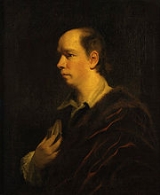
Oliver Goldsmith (10 November 1730 or 1728 – 4 April 1774) was an Anglo-Irish writer, poet, and physician known for his novel The Vicar of Wakefield (1766), his pastoral poem The Deserted Village (1770) (written in memory of his brother), and his plays The Good-Natur'd Man (1768) and She Stoops to Conquer (1771, first performed in 1773).

Discussion
Ask a question about 'Oliver Goldsmith'
Start a new discussion about 'Oliver Goldsmith'
Answer questions from other users
|
Quotations
A book may be very amusing with numerous errors, or it may be very dull without a single absurdity.
Preface
A man he was to all the country dear,And passing rich with forty pounds a year.
Line 141
A modest woman, dressed out in all her finery, is the most tremendous object of the whole creation.
Act II
A nightcap decked his brows instead of bay,A cap by night — a stocking all the day!
Description of an Author's Bedchamber (1760)
All his faults are such that one loves him still the better for them.
Act I
And, ev'n while fashion's brightest arts decoy,The heart distrusting asks, if this be joy.
Line 263

Encyclopedia
Oliver Goldsmith (10 November 1730 or 1728 – 4 April 1774) was an Anglo-Irish writer, poet, and physician known for his novel The Vicar of Wakefield (1766), his pastoral poem The Deserted Village (1770) (written in memory of his brother), and his plays The Good-Natur'd Man (1768) and She Stoops to Conquer (1771, first performed in 1773). (He is also thought to have written the classic children's tale, The History of Little Goody Two-Shoes, giving the world that familiar phrase.)
Biography
Goldsmith's birth date and year are not known with certainty. According to the Library of Congress authority file, he told a biographer that he was born on November 29, 1731, or perhaps in 1730. Other sources have indicated November 10th, on any year from 1727 to 1731. November 10, 1730, is now the most commonly accepted birth date.
Neither is the location of his birthplace certain. He was born either in the townland of Pallas, near Ballymahon, County Longford, Ireland, where his father was the Anglican curate of the parish of Forgney, or at the residence of his maternal grandparents, at the Smith Hill House in the diocese of Elphin, County Roscommon where his grandfather Oliver Jones was a clergyman and master of the Elphin diocesan school. When he was two years old, Goldsmith's father was appointed the rector of the parish of "Kilkenny West" in County Westmeath. The family moved to the parsonage at Lissoy, between Athlone and Ballymahon, and continued to live there until his father's death in 1747.
In 1744 Goldsmith went up to Trinity College, Dublin. Neglecting his studies in theology and law, he fell to the bottom of his class. His tutor was Theaker Wilder. He was graduated in 1749 as a Bachelor of Arts, but without the discipline or distinction that might have gained him entry to a profession in the church or the law; his education seemed to have given him mainly a taste for fine clothes, playing cards, singing Irish airs and playing the flute. He lived for a short time with his mother, tried various professions without success, studied medicine desultorily at the University of Edinburgh and the University of Leiden, and set out on a walking tour of Flanders, France, Switzerland and northern Italy, living by his wits (busking with his flute).
Image:JoshuaReynoldsParty.jpg|A literary party at Sir Joshua Reynolds - 1781. The painting shows the friends of Reynolds - many of whom were members of "The Club" - use cursor to identify. |180px|thumb
poly 133 343 124 287 159 224 189 228 195 291 222 311 209 343 209 354 243 362 292 466 250 463 Dr Johnson - Dictionary writer
poly 76 224 84 255 43 302 62 400 123 423 121 361 137 344 122 290 111 234 96 225 Boswell - Biographer
poly 190 276 208 240 229 228 247 238 250 258 286 319 282 323 223 323 220 301 200 295 Sir Joshua Reynolds - Host
poly 308 317 311 270 328 261 316 246 320 228 343 227 357 240 377 274 366 284 352 311 319 324 David Garrick - actor
poly 252 406 313 343 341 343 366 280 383 273 372 251 378 222 409 228 414 280 420 292 390 300 374 360 359 437 306 418 313 391 272 415 Edmund Burke - statesman
rect 418 220 452 287 Pasqual Paoli - Corsican independent
poly 455 238 484 253 505 303 495 363 501 377 491 443 429 439 423 375 466 352 Charles Burney - music historian
poly 501 279 546 237 567 239 572 308 560 326 537 316 530 300 502 289 Thomas Warton - poet laureate
poly 572 453 591 446 572 373 603 351 562 325 592 288 573 260 573 248 591 243 615 254 637 280 655 334 705 396 656 419 625 382 609 391 613 453 Oliver Goldsmith - writer
rect 450 86 584 188 prob.The Infant Academy 1782
rect 286 87 376 191 unknown painting
circle 100 141 20 An unknown portrait
poly 503 192 511 176 532 176 534 200 553 219 554 234 541 236 525 261 506 261 511 220 515 215 servant - poss. Dr Johnson's hier
rect 12 10 702 500 Use button to enlarge or use hyperlinks
desc bottom-left
He settled in London in 1756, where he briefly held various jobs, including apothecary's assistant and usher of a school. Perennially in debt and addicted to gambling, Goldsmith produced a massive output as a hack writer for the publishers of London, but his few painstaking works earned him the company of Samuel Johnson, with whom he was a founding member of "The Club". The combination of his literary work and his dissolute lifestyle led Horace Walpole to give him the epithet inspired idiot. During this period he used the pseudonym "James Willington" (the name of a fellow student at Trinity) to publish his 1758 translation of the autobiography of the Huguenot Jean Marteilhe.
Goldsmith was described by contemporaries as prone to envy, a congenial but impetuous and disorganized personality who once planned but failed to emigrate to America because he missed his ship.
His premature death in 1774 may have been partly due to his own misdiagnosis of his kidney infection. Goldsmith was buried in Temple Church. The inscription reads; "HERE LIES/OLIVER GOLDSMITH". There is a monument to him in the center of Ballymahon, also in Westminster Abbey with an epitaph written by Samuel Johnson.
Works
The Deserted Village In the poem "The Deserted Village" (1770), Goldsmith revisits Auburn, a village of which he had fond memories, and marks the depopulation brought about through the emigration of its peasant community and the influx of monopolising riches. He mourns over the state of a society where "wealth accumulates and men decay". Using images pertaining to the land in his poem, he gives to his readers a sense of what it was like to live in the countryside during modernization and how it has destroyed the land the former inhabitants worked so hard to maintain.
At the time in which this poem was written, it was true that the labouring class was in a dire situation. Changes in land ownership led to shortages in labour, and poverty became a common problem. Small farmers were forced out of the countryside. Alongside this problem came the new zest for luxuries and possessions. Poets became enamoured by each situation, and accordingly much poetry of the time uses the labouring class and the growth of the luxury as a key theme. Thus, it is equally possible that Oliver Goldsmith’s Deserted Village is a critique of luxury, or alternatively, an engagement with the realities of labouring-class poverty.
In the book's dedication to Joshua Reynolds, Goldsmith attempts to convey his reasons for writing a poem about the depopulation of the countryside. He is sure that the poetic community will disagree with his picture of the countryside as a poor place of misfortune, desolation and poverty and thus justifies it here. He writes:
"I know you will object (and indeed several of our best and wisest friend concur in the opinion) that the depopulation it deplores is no where to be seen, and the disorders it laments are only to be found in the poet’s own imagination. To this I can scarce make any other answer than that I sincerely believe what I have written; that I have taken all possible pains, in my country excursions, for these four or five years past, to be certain of what I allege, and that all my views and enquiries have led me to believe those miseries real, which I here attempt to display."
This assertion indicates Goldsmith’s attachment to the people of the countryside; he believes it is vital that their lives are portrayed truthfully and lucidly, perhaps without the typical frills of pastoral poetry. However, in the same letter, Goldsmith goes on to write,
"In regretting the depopulation of the country, I inveigh against the increase of our luxuries.. For twenty of thirty years past, it has been the fashion to consider luxury as one of the greatest national advantages... Still however, I...continue to think those luxuries prejudicial to states, by which so many vices are introduced, and so many kingdoms have been undone."
This second and perhaps, more strongly worded argument indicates that Goldsmith is further angered by the effect of the luxury on Britain at this time. He finishes the letter on this note, and does not return to the situation of the labouring class, and this emphasises his strength of feeling on this matter.
According to James Boswell it was Dr. Johnson who wrote the last four lines of the poem.
Goldsmith's grand-nephew, also named Oliver, wrote a response to his uncle's poem entitled The Rising Village, in which he details the rise of communities in Acadia (now Nova Scotia and New Brunswick, Canada). The response to his uncle seems to suggest that the peasants who couldn't survive in The Deserted Village would have found opportunities in the new world. The Rising Village was published in 1825. It has become a staple of the Canadian literary canon and has been heavily anthologized. (See, for example, Canadian Poetry: From the Beginnings Through the First World War, edited by Carole Gerson and Gwendolyn Davies. Toronto: McClelland and Stewart, 1994.)
The Hermit
Goldsmith wrote this romantic ballad of precisely 160 lines in 1765. The hero and heroine are Edwin, a youth without wealth or power, and Angelina, the daughter of a lord "beside the Tyne." Angelina spurns many wooers, but refuses to make plain her love for young Edwin. "Quite dejected with my scorn," Edwin disappears and becomes a hermit. One day, Angelina turns up at his cell in boy's clothes and, not recognizing him, tells him her story. Edwin then reveals his true identity, and the lovers never part again. The poem is notable for its interesting portrayal of a hermit, who is fond of the natural world and his wilderness solitude but maintains a gentle, sympathetic demeanor toward other people. In keeping with eremitical tradition, however, Edwin the Hermit claims to "spurn the [opposite] sex." This poem appears under the title of "A Ballad" sung by the character of Mr. Burchell in Chapter 8 of Goldsmith's novel, The Vicar of Wakefield.
The Citizen of the World
In 1760, Goldsmith began to publish a series of letters in the Public Ledger under the title The Citizen of the World. Purportedly written by a Chinese traveler in England named Lien Chi, they used this fictional outsider's perspective to comment ironically and at times moralistically on British society and manners.
The ironic poem, An Elegy on the Death of a Mad Dog was published in 1766.
Memorials Concerning Oliver Goldsmith There is a school named after him in London called the Oliver Goldsmith Primary School.
In the play "Marx In Soho" by Howard Zinn, Marx makes a reference to The Deserted Village.
A statue of him stands at the Front Arch of Trinity College, Dublin.
His name has been given to a new lecture theater and student accommodation on the Trinity College campus, "Goldsmith Hall".
Somerset Maugham used the last line from An Elegy On The Death Of A Mad Dog in his novel The Painted Veil (1925). The character Walter Fane's last words are The dog it was that died.
Auburn, Alabama and Auburn University were named for the first line in Goldsmith's poem: "Sweet Auburn, loveliest village on the plain." Auburn is still referred to as the 'loveliest village on the plains.'
External links
|