
All Topics  
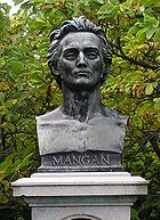
James Clarence Mangan

 
James Clarence Mangan

   Email Print
   Bookmark   Link


James Clarence Mangan


James Clarence Mangan, born James Mangan (1 May 1803, Dublin
Dublin

Dublin is both the largest city and capital of Republic of Ireland. It is located near the midpoint of Ireland's east coast, at the mouth of the River Liffey and at the centre of the Dublin Region....
 - 20 June 1849) was an Irish poet
Irish poetry

The history of Irish poetry includes the poetries of two languages, one in Irish language and the other in English language. The complex interplay between these two traditions, and between both of them and other poetries in English, has produced a body of work that is both rich in variety and difficult to categorise....
.
an was the son of a former hedge school teacher who took over a grocery business and eventually became bankrupt.

Born in Dublin
Dublin

Dublin is both the largest city and capital of Republic of Ireland. It is located near the midpoint of Ireland's east coast, at the mouth of the River Liffey and at the centre of the Dublin Region....
, he was educated at a Jesuit school where he learned the rudiments of Latin, Spanish, French, and Italian. He attended three different schools until the age of fifteen.


Discussion
Ask a question about 'James Clarence Mangan'
Start a new discussion about 'James Clarence Mangan'
Answer questions from other users
Full Discussion Forum


Encyclopedia


James Clarence Mangan, born James Mangan (1 May 1803, Dublin
Dublin

Dublin is both the largest city and capital of Republic of Ireland. It is located near the midpoint of Ireland's east coast, at the mouth of the River Liffey and at the centre of the Dublin Region....
 - 20 June 1849) was an Irish poet
Irish poetry

The history of Irish poetry includes the poetries of two languages, one in Irish language and the other in English language. The complex interplay between these two traditions, and between both of them and other poetries in English, has produced a body of work that is both rich in variety and difficult to categorise....
.

Early life

Mangan was the son of a former hedge school teacher who took over a grocery business and eventually became bankrupt.

Born in Dublin
Dublin

Dublin is both the largest city and capital of Republic of Ireland. It is located near the midpoint of Ireland's east coast, at the mouth of the River Liffey and at the centre of the Dublin Region....
, he was educated at a Jesuit school where he learned the rudiments of Latin, Spanish, French, and Italian. He attended three different schools until the age of fifteen. Obliged to find a job in order to support his family, he became a lawyer's clerk, and was later an employee of the Ordnance Survey
Ordnance Survey

Ordnance Survey is an executive agency of the United Kingdom government. It is the national mapping agency for Great Britain, and one of the world's largest producers of maps....
 and an assistant in the Library
Trinity College Library, Dublin

The Trinity College Library, the centrally-administered library of Trinity College, Dublin, University of Dublin, is the largest library in Ireland....
 of Trinity College, Dublin
Trinity College, Dublin

Trinity College, Dublin , corporately designated as the Provost, Fellows and Scholars of the College of the Holy and Undivided Trinity of Queen Elizabeth near Dublin, was founded in 1592 by Queen Elizabeth I of England as the "mother of a university", and is the only constituent residential college of the University of Dublin....
.

Literary career

Mangan began submitting verses to various Dublin publications, the first being published in 1818. From 1820 onwards he adopted the middle name Clarence. In 1830 he began producing translations from German, a language he had taught himself.Of interest are his translations of Goethe. From 1834 his contributions began appearing in the Dublin University Magazine
Dublin University Magazine

The Dublin University Magazine was an independent literary cultural and political magazine published in Dublin from 1833 to 1882. It started out as a magazine of political commentary but increasingly became devoted to literature....
. His translations from the German were generally free interpretations rather than strict transliterations. In 1840 he began producing translations from Turkish, Persian, Arabic, and Irish.

Although his early poetry was often apolitical, after the Great Famine he began writing poems with a strong nationalist bent, including influential works such as My Dark Rosaleen or Róisín Dubh
Róisín Dubh (song)

R?is?n Dubh, meaning "Little Black Rose", written in the 16th century, is one of Ireland's most famous political songs. It is based on an older love-lyric in which referred to the poet's beloved rather than, as here, being a metaphor for Ireland....
 and A Vision of Connaught
Connacht

Connacht is the western Provinces of Ireland of Ireland, comprising counties County Galway, County Leitrim, County Mayo, County Roscommon, County Sligo....
 in the Thirteenth Century
. Mangan was a lonely and difficult man who suffered from mood swings, depression and irrational fears, and became a heavy drinker. His appearance was eccentric, and later in life he was often seen wearing a long cloak, green spectacles and a blond wig. In 1849, weakened by poverty, alcoholism
Alcoholism

Alcoholism is a term with multiple and sometimes conflicting definitions to describe the detrimental effects of alcohol intake.In common and historic usage, alcoholism refers to any condition that results in the continued consumption of alcoholic beverages despite health problems and negative social consequences....
 and malnutrition, he succumbed to cholera
Cholera

Cholera, sometimes known as Asiatic or epidemic cholera, is an infectious gastroenteritis caused by enterotoxin-producing strains of the bacterium Vibrio cholerae....
, aged 46, and was buried in Glasnevin Cemetery
Glasnevin Cemetery

Glasnevin Cemetery , also known as Prospect Cemetery, is the main Catholic cemetery in Dublin, the capital of Republic of Ireland. It first opened in 1832....
.

James Joyce
James Joyce

James Augustine Aloysius Joyce was an Ireland expatriate author of the 20th century. He is best known for his landmark novel Ulysses and its controversial successor Finnegans Wake , as well as the short story collection Dubliners and the semi-autobiographical novel A Portrait of the Artist as a Young Man ....
 wrote a significant essay on Mangan, and also used his name in his works. The significance, it is said, lies in part in Joyce's reluctance to acknowledge influence from the Irish literary tradition: he was otherwise chary of adopting any artistic predecessors.

He was addicted to opium and alcohol and was friends with fellow Irish Nationalists, Thomas Osborne Davis
Thomas Osborne Davis (Irish politician)

Thomas Osborne Davis was a revolutionary Ireland writer who was the chief organizer and poet of the Young Ireland movement....
 and John Mitchel
John Mitchel

John Mitchel was an Ireland Irish nationalism activist, solicitor and political journalist. Born in Camnish, near Dungiven, County Londonderry, Ireland he became a leading Member of both Young Ireland and the Irish Confederation....
. Mitchel even wrote a biography after Mangan's death.

His poems were published in The Nation (Irish newspaper)
The Nation (Irish newspaper)

The Nation was an Irish nationalist weekly newspaper, published in the 19th century. The Nation was printed first at 12 Trinity Street, Dublin, on 15 October 1842, until 6 January 1844....
, a Nationalist newspaper first published in October 1842. Yeats
William Butler Yeats

File:William Butler Yeat by George Charles Beresford.jpgWilliam Butler Yeats was an Irish people poet and dramatist and one of the foremost figures of 20th century in literature....
 considered Mangan one of the best Irish poets, along with Thomas Osborne Davis and Samuel Ferguson
Samuel Ferguson

Sir Samuel Ferguson was an Irish poetry, barrister, antiquarian, artist and public servant. Perhaps the most important Ulster-Scot poet of the 19th century, because of his interest in Irish mythology and early History of Ireland he can be seen as a forerunner of William Butler Yeats and the other poets of the Celtic Twilight....
, claiming, "To the soul of Clarence Mangan was tied the burning ribbon of Genius."

His most famous poems include Dark Rosaleen, Siberia, Nameless One, A Vision of Connaught in the Thirteenth Century, The Funerals, To the Ruins of Donegal Castle, Pleasant Prospects for the Land-eaters and Woman of Three Cows. He also wrote a brief autobiography on the advice of his friend, Father C. P. Meehan
Father C. P. Meehan

Father Charles Patrick Meehan , an Irish-Catholic priest, was friend and confessor to Irish poet James Clarence Mangan and encouraged him to write his autobiography....
, which ends cutoff mid-sentence. He must have been writing in the last months of his life since he mentions his narrative poem of the Italian Gasparo Bandollo which was published in the Dublin University Magazine in May 1849. A sensationally discovered continuation of the autobiography appeared in the Dublin journal Metre in 2001, but was later discovered to be a fake.

Among the contemporary Irish writers he has influenced are Thomas Kinsella
Thomas Kinsella

Thomas Kinsella is an Irish poetry, translator, editor, and publisher....
, Michael Smith
Michael Smith (poet)

Michael Smith is an Irish people poet, author and translator. He was one of the founders of New Writers Press in Dublin . He is possibly most noted for his works on James Clarence Mangan, as well as his Spanish language to English language poetry translations....
, James McCabe (author of the hoax autobiography) and David Wheatley
David Wheatley

David Wheatley is an Ireland poet and critic. He studied at Trinity College, Dublin where he edited Icarus . Wheatley is the author of three volumes of poetry with Gallery Press, as well as several chapbooks....
, author of a sonnet sequence on Mangan. He is also cited by the song writer Shane MacGowan
Shane MacGowan

Shane Patrick Lysaght MacGowan is an Irish people musician and singer best known as the original singer and songwriter of The Pogues. His voice has been described by Jools Holland as a voice that touches the heart and soul....
 as an inspiration, both for his work and his lifestyle.

Private papers of Mangan are held in the National Library of Ireland
National Library of Ireland

The National Library of Ireland is a national library located in Dublin, Republic of Ireland, in a building designed by Thomas Newenham Deane. The Minister for Arts, Sport and Tourism is the member of the Irish Government responsible for the library....
, the Royal Irish Academy
Royal Irish Academy

The Royal Irish Academy , based in Dublin, is an Ireland, independent, academic body that promotes study and excellence in the sciences, humanities and social sciences....
, and the archives of Trinity College, Dublin
Trinity College, Dublin

Trinity College, Dublin , corporately designated as the Provost, Fellows and Scholars of the College of the Holy and Undivided Trinity of Queen Elizabeth near Dublin, was founded in 1592 by Queen Elizabeth I of England as the "mother of a university", and is the only constituent residential college of the University of Dublin....
.

Bibliography

James Clarence Mangan: Selected Writings ISBN 978-1900621922

External links