
|
|
|
|
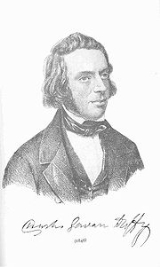
Charles Gavan Duffy
|
| |
|
| |
Sir Charles Gavan Duffy, KCMG (12 April 1816 – 9 February 1903) Irish nationalist and Australian colonial politician, was the 8th Premier of Victoria and one of the most colourful figures in Victorian political history. Duffy was born in Dublin Street, Monaghan Town, County Monaghan, Ireland, the son of a Catholic shopkeeper. Both his parents died while he was still a child and his uncle, Fr James Duffy who was the Roman Catholic Parish Priest of Castleblayney, became his guardian for a number of years.
as educated at St Malachy's College in Belfast and admitted to the Irish bar in 1845.
Even before being admitted to the bar, Duffy was active on the Irish land question, and in that connection in 1842 he became an ally of James Godkin.
In 1842 he married Emily McLaughlin, Emily died in 1845.

Discussion
Ask a question about 'Charles Gavan Duffy'
Start a new discussion about 'Charles Gavan Duffy'
Answer questions from other users
|
Recent Posts

Encyclopedia
Sir Charles Gavan Duffy, KCMG (12 April 1816 – 9 February 1903) Irish nationalist and Australian colonial politician, was the 8th Premier of Victoria and one of the most colourful figures in Victorian political history. Duffy was born in Dublin Street, Monaghan Town, County Monaghan, Ireland, the son of a Catholic shopkeeper. Both his parents died while he was still a child and his uncle, Fr James Duffy who was the Roman Catholic Parish Priest of Castleblayney, became his guardian for a number of years.
Background
He was educated at St Malachy's College in Belfast and admitted to the Irish bar in 1845.
Even before being admitted to the bar, Duffy was active on the Irish land question, and in that connection in 1842 he became an ally of James Godkin.
In 1842 he married Emily McLaughlin, Emily died in 1845. He married Susan Hughes in 1846, with whom he had six children.
Duffy became a leading figure in Irish literary circles. He edited Ballad Poetry of Ireland (1843) and other works on Irish literature.
Charles Gavan Duffy was one of the founders of The Nation and became its first editor; the two others were Thomas Osborne Davis, and John Blake Dillon. All three were members of Daniel O'Connell's Repeal Association, and would later become to be known as Young Ireland. This paper, under Duffy, transformed from a literary voice into a 'rebellious organization'. As a result of The Nation's support of Repeal Duffy as Proprietor was arrested and convicted of seditious conspiracy in relation to the Monster Meeting planned for Clontarf, just outside Dublin, but was released after an appeal to the House of Lords.
In August 1850 Duffy formed the Tenant Right League to bring about reforms in the Irish land system and protects tenants' rights.
In 1852 Duffy was elected to the House of Commons for New Ross. In 1856, despairing of the prospects for Irish independence, he resigned from the House of Commons and emigrated with his family to Australia.
Main article: Young Irelander Rebellion of 1848
Main article: Young Ireland
Emigrates to Australia
After being feted in Sydney and Melbourne Duffy settled in Victoria. In early colonial Victoria, Duffy, with his political and literary reputation, was an exotic and romantic figure, particularly for the colony's large Irish community. For this reason he was feared and hated by many in the English and Scottish Protestant establishment, especially when he indicated his intention of entering Victorian politics.
A public appeal was held to enable him to buy the freehold property necessary to stand for the colonial parliament. He was immediately elected to the Legislative Assembly for Villiers and Heytesbury in the Western District in 1856. A Melbourne Punch cartoon depicted Duffy entering parliament as a bog Irishman carrying a shillelagh atop the parliamentary benches.(Punch, 4 December 1856, p. 141. Also see O'Brien, Shenangians, p. xi.)He later sat for Dalhousie and for North Gippsland.
With the collapse of the Victorian Government's Haines Ministry, during 1857, unexpectedly another Irish Catholic, John O'Shanassy, became Premier and Duffy his second-in-charge. Duffy was Commissioner for Public Works and was President of the Board of Land and Works and Commissioner for Crown Lands and Survey. Nothing like this had occurred anywhere in the British Empire, with Irish catholics serving as Cabinet Ministers and the Melbourne based Protestants 'were not prepared to counternance so startling a novelty.'(McCaughey, Victoria's Colonial Governors,p. 75; also O'Brien) Melbourne Punch cartoons linked Duffy and O'Shanassy with images of the French Revolution in an attempt to undermine their Ministry, during 1858-59. One famous Punch image 'Citizens John and Charles' showed the pair as French revolutionaries holding the skull and cross bone flag of the Victorian Republic. (Punch, 7 January 1859, p. 5; also see O'Brien)The O'Shanassy Ministry was defeated at the 1859 election and a new government formed. (O'Brien)
Like other radicals, he regarded unlocking the colony's lands from the grip of the squatter class as his main priority, but his 1862 lands bill was amended into ineffectiveness by the Legislative Council. The historian Don Garden writes: "Unfortunately Duffy's dreams were on a higher plane than his practical skills as a legislator and the morals of those opposed to him."
Premier of Victoria
In 1871 Duffy led the opposition to Premier James McCulloch's plan to introduce a land tax, on the grounds that it unfairly penalised small farmers. When McCulloch's government was defeated on this issue, Duffy became Premier and Chief Secretary (June 1871 to June 1872). Victoria's finances were in a poor state and he was forced to introduce a tariff bill to provide government revenue, despite his adherence to British free trade principles.
An Irish Catholic Premier was very unpopular with the Protestant majority in the colony, and Duffy was accused of favouring Catholics in government appointments. in June 1872 his government was defeated in the Assembly on a confidence motion allegedly motivated by sectarianism. He resigned the leadership of the liberal party to Graham Berry.
Later political career
When Berry became Premier in 1877 he made Duffy Speaker of the Legislative Assembly, a post he held without much enthusiasm until 1880, when he quit politics and retired to the south of France. Duffy remained interested in both the politics of his adoptive country and of Ireland. From his exile in France, Duffy was an enthusiastic supporter of the Melbourne Celtic Club, which aimed to promote Irish Home Rule and Irish culture. His sons also became members of the club.
He was knighted in 1873 and made KCMG in 1877. He married for a third time in Paris in 1881, to Louise Hall, and had four more children in his 70s. One of his sons, John Gavan Duffy, was a Victorian politician between 1874 and 1904. Another, Frank Gavan Duffy, was Chief Justice of the High Court of Australia 1931 - 1935.
Yet another son, George Gavan Duffy (born 1882) was an Irish politician and later (from 1936) a judge of the Irish High Court, becoming its President from 1946 until his death in 1951.
His grandson, Charles Leonard Gavan Duffy, was a judge on the Supreme Court of Victoria, Australia.
Sir Charles Gavan Duffy died in Nice in 1903, aged 86.
(Note: Both Charles and Frank Gavan Duffy are sometimes referred to as though their surname was Gavan Duffy. There is no doubt that the family surname was Duffy, but the family tradition of giving all males the middle name Gavan has led to some confusion about this.)
External links
|
| |
|
|