


Arthur Sullivan

Encyclopedia
Royal Victorian Order
The Royal Victorian Order is a dynastic order of knighthood and a house order of chivalry recognising distinguished personal service to the order's Sovereign, the reigning monarch of the Commonwealth realms, any members of her family, or any of her viceroys...
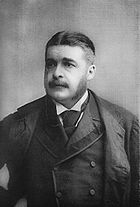
(13 May 1842 – 22 November 1900) was an English composer of Irish and Italian ancestry. He is best known for his series of 14 operatic
Comic opera
Comic opera denotes a sung dramatic work of a light or comic nature, usually with a happy ending.Forms of comic opera first developed in late 17th-century Italy. By the 1730s, a new operatic genre, opera buffa, emerged as an alternative to opera seria...
collaborations
Gilbert and Sullivan
Gilbert and Sullivan refers to the Victorian-era theatrical partnership of the librettist W. S. Gilbert and the composer Arthur Sullivan . The two men collaborated on fourteen comic operas between 1871 and 1896, of which H.M.S...
with the dramatist W. S. Gilbert
W. S. Gilbert
Sir William Schwenck Gilbert was an English dramatist, librettist, poet and illustrator best known for his fourteen comic operas produced in collaboration with the composer Sir Arthur Sullivan, of which the most famous include H.M.S...
, including such enduring works as H.M.S. Pinafore
H.M.S. Pinafore
H.M.S. Pinafore; or, The Lass That Loved a Sailor is a comic opera in two acts, with music by Arthur Sullivan and a libretto by W. S. Gilbert. It opened at the Opera Comique in London, England, on 25 May 1878 and ran for 571 performances, which was the second-longest run of any musical...
, The Pirates of Penzance
The Pirates of Penzance
The Pirates of Penzance; or, The Slave of Duty is a comic opera in two acts, with music by Arthur Sullivan and libretto by W. S. Gilbert. The opera's official premiere was at the Fifth Avenue Theatre in New York City on 31 December 1879, where the show was well received by both audiences...
and The Mikado
The Mikado
The Mikado; or, The Town of Titipu is a comic opera in two acts, with music by Arthur Sullivan and libretto by W. S. Gilbert, their ninth of fourteen operatic collaborations...
. Sullivan composed 23 operas, 13 major orchestral works, eight choral works and oratorios, two ballets, incidental music
Incidental music
Incidental music is music in a play, television program, radio program, video game, film or some other form not primarily musical. The term is less frequently applied to film music, with such music being referred to instead as the "film score" or "soundtrack"....
to several plays, and numerous hymns and other church pieces, songs, and piano and chamber pieces. The best known of his hymns and songs include "Onward Christian Soldiers" and "The Lost Chord
The Lost Chord
"The Lost Chord" is a song composed by Arthur Sullivan in 1877 at the bedside of his brother Fred during Fred's last illness. The manuscript is dated 13 January 1877; Fred Sullivan died five days later...
".
The son of a military bandmaster, Sullivan composed his first anthem at age eight. He was selected as soloist in the boys' choir of the Chapel Royal
Chapel Royal
A Chapel Royal is a body of priests and singers who serve the spiritual needs of their sovereign wherever they are called upon to do so.-Austria:...
. The Reverend Thomas Helmore
Thomas Helmore
Thomas Helmore was a choirmaster, writer about singing and author and editor of hymns and carols.Helmore's father was a congregationalist minister...
, the choirmaster, encouraged Sullivan and arranged for the publication and performance of his early compositions. In 1856, the Royal Academy of Music
Royal Academy of Music
The Royal Academy of Music in London, England, is a conservatoire, Britain's oldest degree-granting music school and a constituent college of the University of London since 1999. The Academy was founded by Lord Burghersh in 1822 with the help and ideas of the French harpist and composer Nicolas...
awarded the first Mendelssohn Scholarship
Mendelssohn Scholarship
The Mendelssohn Scholarship refers to two scholarships awarded in Germany and in the United Kingdom. Both commemorate the composer, Felix Mendelssohn, and are awarded to promising young musicians to enable them to continue their development.-History:...
to the 14-year-old Sullivan, allowing him to study first at the Academy and then in Germany, at the Leipzig Conservatoire
Felix Mendelssohn College of Music and Theatre
The University of Music and Theatre "Felix Mendelssohn Bartholdy" Leipzig is a public university in Leipzig . Founded in 1843 by Felix Mendelssohn as the Conservatory of Music, it is the oldest university school of music in Germany....
. His graduation piece was a suite of incidental music
Incidental music
Incidental music is music in a play, television program, radio program, video game, film or some other form not primarily musical. The term is less frequently applied to film music, with such music being referred to instead as the "film score" or "soundtrack"....
to Shakespeare's
William Shakespeare
William Shakespeare was an English poet and playwright, widely regarded as the greatest writer in the English language and the world's pre-eminent dramatist. He is often called England's national poet and the "Bard of Avon"...
The Tempest
The Tempest (Sullivan)
The Tempest incidental music, Op. 1, is a set of movements for Shakespeare's play composed by Arthur Sullivan in 1861 and expanded in 1862. This was Sullivan's first major piece of composition, and its success quickly brought him to the attention of the musical establishment in...
. When it was performed in London in 1862, it was an immediate sensation. Sullivan began his composing career with a series of ambitious works, interspersed with hymns, parlour ballads and other light pieces. Among his best received early pieces were a ballet, L'Île Enchantée
L'Île Enchantée
L'Île Enchantée is an 1864 ballet by Arthur Sullivan written as a divertissement at the end of Vincenzo Bellini's La Sonnambula at Covent Garden. It was choreographed by H...
(1864), and his Irish Symphony
Symphony in E, Irish
The Symphony in E, first performed on March 10, 1866, was the only symphony composed by Arthur Sullivan. It is frequently called the 'Irish' Symphony.There are four movements:*Andante – Allegro, ma non troppo vivace*Andante espressivo*Allegretto...
, Cello Concerto
Cello Concerto (Sullivan)
The Cello Concerto in D major is Arthur Sullivan’s only concerto. It was premièred on 24 November 1866 at the Crystal Palace with August Manns conducting and was one of Sullivan's earliest major works.There are three movements:*Allegro moderato...
and Overture in C (In Memoriam)
Overture In C (In Memoriam)
The Overture in C, "In Memoriam", by Arthur Sullivan, premiered on 30 October 1866 at the Norwich Festival, in honour of his father, who died just before composition began. The piece was written early in Sullivan's career, before he began to work with his famous collaborator, W. S. Gilbert, on...
(all in 1866). From 1861 to 1872, he supplemented his income by working as a church organist and as a music teacher.
In 1866, Sullivan composed his first one-act comic opera
Comic opera
Comic opera denotes a sung dramatic work of a light or comic nature, usually with a happy ending.Forms of comic opera first developed in late 17th-century Italy. By the 1730s, a new operatic genre, opera buffa, emerged as an alternative to opera seria...
, Cox and Box
Cox and Box
Cox and Box; or, The Long-Lost Brothers, is a one-act comic opera with a libretto by F. C. Burnand and music by Arthur Sullivan, based on the 1847 farce Box and Cox by John Maddison Morton. It was Sullivan's first successful comic opera. The story concerns a landlord who lets a room to two...
, which is still widely performed. His most successful orchestral work, the Overture di Ballo
Overture di Ballo
The Overture di Ballo is a concert overture by Arthur Sullivan. Its first performance was in August 1870 at the Birmingham Triennial Festival, conducted by the composer. It predates all his work with W. S...
, premiered in 1870, and the next year he published a song cycle
Song cycle
A song cycle is a group of songs designed to be performed in a sequence as a single entity. As a rule, all of the songs are by the same composer and often use words from the same poet or lyricist. Unification can be achieved by a narrative or a persona common to the songs, or even, as in Schumann's...
, among other works. Sullivan's talent and native charm earned him many friends in musical and social circles, including Queen Victoria's son Alfred, Duke of Edinburgh
Alfred, Duke of Saxe-Coburg and Gotha
Alfred, Duke of Saxe-Coburg and Gotha was the third Duke of Saxe-Coburg and Gotha, and reigned from 1893 to 1900. He was also a member of the British Royal Family, the second son and fourth child of Queen Victoria and Prince Albert of Saxe-Coburg and Gotha...
. Also in 1871, Sullivan wrote his first opera with W. S. Gilbert, Thespis
Thespis (opera)
Thespis, or The Gods Grown Old, is an operatic extravaganza that was the first collaboration between dramatist W. S. Gilbert and composer Arthur Sullivan. No musical score of Thespis was ever published, and most of the music has been lost...
. The two then went their separate ways, and Sullivan produced his Festival Te Deum
Festival Te Deum
The Festival Te Deum is the popular name for an 1872 composition by Arthur Sullivan, written to celebrate the recovery of Albert Edward, Prince of Wales from typhoid fever...
(1872), an oratorio, The Light of the World
The Light of the World (Sullivan)
The Light of the World is an oratorio composed in 1873 by Arthur Sullivan. Sullivan wrote the libretto with the assistance of George Grove, based on the New Testament. The story of the oratorio narrates the whole life of Christ, focusing on his deeds on Earth as preacher, healer and prophet...
(1873), and other pieces, including incidental music for West End theatre
West End theatre
West End theatre is a popular term for mainstream professional theatre staged in the large theatres of London's 'Theatreland', the West End. Along with New York's Broadway theatre, West End theatre is usually considered to represent the highest level of commercial theatre in the English speaking...
productions of several Shakespeare plays. He also had conducting and academic appointments. In 1875, however, producer Richard D'Oyly Carte
Richard D'Oyly Carte
Richard D'Oyly Carte was an English talent agent, theatrical impresario, composer and hotelier during the latter half of the Victorian era...
reunited Gilbert and Sullivan to create a one-act piece, Trial by Jury
Trial by Jury
Trial by Jury is a comic opera in one act, with music by Arthur Sullivan and libretto by W. S. Gilbert. It was first produced on 25 March 1875, at London's Royalty Theatre, where it initially ran for 131 performances and was considered a hit, receiving critical praise and outrunning its...
, which became a surprise hit. Their 1878 opera H.M.S. Pinafore
H.M.S. Pinafore
H.M.S. Pinafore; or, The Lass That Loved a Sailor is a comic opera in two acts, with music by Arthur Sullivan and a libretto by W. S. Gilbert. It opened at the Opera Comique in London, England, on 25 May 1878 and ran for 571 performances, which was the second-longest run of any musical...
became an international sensation, as did The Pirates of Penzance
The Pirates of Penzance
The Pirates of Penzance; or, The Slave of Duty is a comic opera in two acts, with music by Arthur Sullivan and libretto by W. S. Gilbert. The opera's official premiere was at the Fifth Avenue Theatre in New York City on 31 December 1879, where the show was well received by both audiences...
(1879) and Patience
Patience (opera)
Patience; or, Bunthorne's Bride, is a comic opera in two acts with music by Arthur Sullivan and libretto by W. S. Gilbert. First performed at the Opera Comique, London, on 23 April 1881, it moved to the 1,292-seat Savoy Theatre on 10 October 1881, where it was the first theatrical production in the...
(1881).
Carte used his profits from the Gilbert and Sullivan partnership to build the Savoy Theatre
Savoy Theatre
The Savoy Theatre is a West End theatre located in the Strand in the City of Westminster, London, England. The theatre opened on 10 October 1881 and was built by Richard D'Oyly Carte on the site of the old Savoy Palace as a showcase for the popular series of comic operas of Gilbert and Sullivan,...
in 1881, and their joint works then became known as the Savoy operas. Later hits in the series were Iolanthe
Iolanthe
Iolanthe; or, The Peer and the Peri is a comic opera with music by Arthur Sullivan and libretto by W. S. Gilbert. It is one of the Savoy operas and is the seventh collaboration of the fourteen between Gilbert and Sullivan....
(1882), The Mikado
The Mikado
The Mikado; or, The Town of Titipu is a comic opera in two acts, with music by Arthur Sullivan and libretto by W. S. Gilbert, their ninth of fourteen operatic collaborations...
(1885), The Yeomen of the Guard
The Yeomen of the Guard
The Yeomen of the Guard; or, The Merryman and His Maid, is a Savoy Opera, with music by Arthur Sullivan and libretto by W. S. Gilbert. It premiered at the Savoy Theatre on 3 October 1888, and ran for 423 performances...
(1888) and The Gondoliers
The Gondoliers
The Gondoliers; or, The King of Barataria is a Savoy Opera, with music by Arthur Sullivan and libretto by W. S. Gilbert. It premiered at the Savoy Theatre on 7 December 1889 and ran for a very successful 554 performances , closing on 30 June 1891...
(1889). Sullivan was knight
Knight
A knight was a member of a class of lower nobility in the High Middle Ages.By the Late Middle Ages, the rank had become associated with the ideals of chivalry, a code of conduct for the perfect courtly Christian warrior....
ed for his contributions to music in 1883. His infrequent serious pieces during the 1880s included two oratorios, The Martyr of Antioch
The Martyr of Antioch
The Martyr of Antioch is an oratorio by the English composer Arthur Sullivan. It was first performed on 15 October 1880 at the triennial Leeds Music Festival, having been composed specifically for that event...
(1880) and The Golden Legend (1886), his most popular choral work. Sullivan's only serious opera, Ivanhoe
Ivanhoe (opera)
Ivanhoe is a romantic opera in three acts based on the novel by Sir Walter Scott, with music by Sir Arthur Sullivan and a libretto by Julian Sturgis. It premiered at the Royal English Opera House on 31 January 1891 for a consecutive run of 155 performances, unheard of for a grand opera...
, though initially highly successful in 1891, was little-heard after that. Gilbert broke from Sullivan in 1890, quarrelling over expenses at the Savoy. They reunited in the 1890s for two more operas, but those did not achieve popularity. Sullivan continued to compose comic operas with other librettists and a number of other major and minor works throughout the decade. After the death of his brother Fred
Fred Sullivan
Frederic Sullivan was an English actor and singer. He is best remembered as the creator of the role of the Learned Judge in Gilbert and Sullivan's Trial by Jury, providing a model for the comic roles in the later Savoy Operas composed by his brother Arthur Sullivan.By 1870, Sullivan had abandoned...
in 1877, Sullivan supported Fred's widow and children financially for the rest of his life, effectively adopting his nephew Bertie
Herbert Sullivan
Herbert Thomas Sullivan was the nephew, heir and biographer of the British composer Arthur Sullivan. After his uncle's death, Sullivan became active in charitable work...
. Sullivan died at the age of 58, regarded as the finest British composer of the 19th century. His comic opera style served as a model for the generations of musical theatre
Musical theatre
Musical theatre is a form of theatre combining songs, spoken dialogue, acting, and dance. The emotional content of the piece – humor, pathos, love, anger – as well as the story itself, is communicated through the words, music, movement and technical aspects of the entertainment as an...
composers that followed, and his music is still frequently performed, recorded and pastiched.
Beginnings
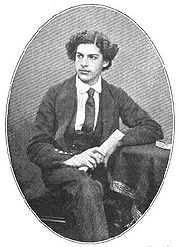
Sullivan was born in LambethLambeth
Lambeth is a district of south London, England, and part of the London Borough of Lambeth. It is situated southeast of Charing Cross.-Toponymy:...
, London. His parents were Thomas Sullivan (1805–1866), a military bandmaster, clarinettist and music teacher born in Ireland and raised in Chelsea
Chelsea, London
Chelsea is an area of West London, England, bounded to the south by the River Thames, where its frontage runs from Chelsea Bridge along the Chelsea Embankment, Cheyne Walk, Lots Road and Chelsea Harbour. Its eastern boundary was once defined by the River Westbourne, which is now in a pipe above...
, London, and Mary Clementina (née Coghlan, 1811–1882), English born, of Irish and Italian descent. Thomas Sullivan was based from 1845 to 1857 at the Royal Military Academy Sandhurst
Royal Military Academy Sandhurst
The Royal Military Academy Sandhurst , commonly known simply as Sandhurst, is a British Army officer initial training centre located in Sandhurst, Berkshire, England...
, where he was the bandmaster. Young Sullivan became proficient with many of the instruments in the band and had composed an anthem
Anthem
The term anthem means either a specific form of Anglican church music , or more generally, a song of celebration, usually acting as a symbol for a distinct group of people, as in the term "national anthem" or "sports anthem".-Etymology:The word is derived from the Greek via Old English , a word...
, "By the waters of Babylon", by the age of eight. He later recalled:
Despite the boy's obvious musical talent, Thomas Sullivan knew the disappointments and insecurity of a musical career, and discouraged him from pursuing it. While studying at a private school in Bayswater
Bayswater
Bayswater is an area of west London in the City of Westminster and the Royal Borough of Kensington and Chelsea to the west . It is a built-up district located 3 miles west-north-west of Charing Cross, bordering the north of Hyde Park over Kensington Gardens and having a population density of...
, Sullivan, then aged 11, persuaded his parents and the headmaster, William Gordon Plees, to allow him to apply for membership in the choir of the Chapel Royal
Chapel Royal
A Chapel Royal is a body of priests and singers who serve the spiritual needs of their sovereign wherever they are called upon to do so.-Austria:...
. Despite concerns that Sullivan at nearly 12 years of age was too old to give much service as a treble
Boy soprano
A boy soprano is a young male singer with an unchanged voice in the soprano range. Although a treble, or choirboy, may also be considered to be a boy soprano, the more colloquial term boy soprano is generally only used for boys who sing, perform, or record as soloists, and who may not necessarily...
before his voice broke, he was accepted and soon became a soloist and, by 1856, was promoted to "first boy". Even at this age, Sullivan's health was delicate, and he was easily fatigued.
Sullivan flourished under the training of the Reverend Thomas Helmore
Thomas Helmore
Thomas Helmore was a choirmaster, writer about singing and author and editor of hymns and carols.Helmore's father was a congregationalist minister...
, master of the choristers, and began to compose anthems and songs. Helmore encouraged the young Sullivan's composing talent and arranged for one of his pieces, "O Israel", to be published in 1855, Sullivan's first published work. Helmore also enlisted Sullivan's assistance in creating harmonisations for a volume of The Hymnal Noted and arranged for Sullivan's compositions to be performed; one of the boy's anthems was given at the Chapel Royal in St James's Palace under the direction of Sir George Smart
George Thomas Smart
Sir George Thomas Smart was an English musician.Smart was born in London, his father being a music-seller. He was a choir-boy at the Chapel Royal, and was educated in music, becoming an expert violinist, organist, teacher of singing and conductor...
.
Mendelssohn scholar
Royal Academy of Music
The Royal Academy of Music in London, England, is a conservatoire, Britain's oldest degree-granting music school and a constituent college of the University of London since 1999. The Academy was founded by Lord Burghersh in 1822 with the help and ideas of the French harpist and composer Nicolas...
awarded the first Mendelssohn Scholarship
Mendelssohn Scholarship
The Mendelssohn Scholarship refers to two scholarships awarded in Germany and in the United Kingdom. Both commemorate the composer, Felix Mendelssohn, and are awarded to promising young musicians to enable them to continue their development.-History:...
to the 14-year-old Sullivan, granting him a year's training at the academy. His principal teacher there was John Goss, whose own teacher, Thomas Attwood
Thomas Attwood (composer)
Thomas Attwood was an English composer and organist.The son of a musician in the royal band, Attwood was born in London. At the age of nine he became a chorister in the Chapel Royal. In 1783 he was sent to study abroad at the expense of the Prince of Wales , who had been favourably impressed by...
, had been a pupil of Mozart
Wolfgang Amadeus Mozart
Wolfgang Amadeus Mozart , baptismal name Johannes Chrysostomus Wolfgangus Theophilus Mozart , was a prolific and influential composer of the Classical era. He composed over 600 works, many acknowledged as pinnacles of symphonic, concertante, chamber, piano, operatic, and choral music...
. He studied piano with the head of the academy, William Sterndale Bennett
William Sterndale Bennett
Sir William Sterndale Bennett was an English composer. He ranks as the most distinguished English composer of the Romantic school-Biography:...
. During this year at the Royal Academy, Sullivan continued to sing solos with the Chapel Royal, which provided a small amount of spending money.
Sullivan's scholarship was extended to a second year, and in 1858 in what the biographer Arthur Jacobs
Arthur Jacobs
Arthur David Jacobs was an English music critic, musicologist, teacher, librettist and translator. Among his many books, two of the best known are his Penguin Dictionary of Music, which was reprinted in several editions between 1958 and 1996, and his biography of Arthur Sullivan, which was praised...
calls an "extraordinary gesture of confidence" the scholarship committee extended his grant for a third year so that he could study in Germany, at the Leipzig Conservatoire
Felix Mendelssohn College of Music and Theatre
The University of Music and Theatre "Felix Mendelssohn Bartholdy" Leipzig is a public university in Leipzig . Founded in 1843 by Felix Mendelssohn as the Conservatory of Music, it is the oldest university school of music in Germany....
. While there, Sullivan studied composition with Julius Rietz
Julius Rietz
August Wilhelm Julius Rietz was a German composer, conductor and cellist. He was a teacher among whose students were Woldemar Bargiel, Salomon Jadassohn and Arthur Sullivan. He also edited many works by Felix Mendelssohn for publication.-Biography:He studied the cello under Schmidt, Bernhard...
, counterpoint with Moritz Hauptmann
Moritz Hauptmann
Moritz Hauptmann , was a German music theorist, teacher and composer.Hauptmann was born in Dresden, and studied violin under Scholz, piano under Franz Lanska, composition under Grosse and Francesco Morlacchi,...
and Ernst Richter and the piano with Louis Plaidy
Louis Plaidy
Louis Plaidy was a celebrated German piano pedagogue and compiler of books of technical music studies....
and Ignaz Moscheles
Ignaz Moscheles
Ignaz Moscheles was a Bohemian composer and piano virtuoso, whose career after his early years was based initially in London, and later at Leipzig, where he succeeded his friend and sometime pupil Felix Mendelssohn as head of the Conservatoire.-Sources:Much of what we know about Moscheles's life...
. He was trained in Mendelssohn's
Felix Mendelssohn
Jakob Ludwig Felix Mendelssohn Barthóldy , use the form 'Mendelssohn' and not 'Mendelssohn Bartholdy'. The Grove Dictionary of Music and Musicians gives ' Felix Mendelssohn' as the entry, with 'Mendelssohn' used in the body text...
ideas and techniques but was also exposed to a variety of musical styles, including Schubert
Franz Schubert
Franz Peter Schubert was an Austrian composer.Although he died at an early age, Schubert was tremendously prolific. He wrote some 600 Lieder, nine symphonies , liturgical music, operas, some incidental music, and a large body of chamber and solo piano music...
, Verdi, Bach
Johann Sebastian Bach
Johann Sebastian Bach was a German composer, organist, harpsichordist, violist, and violinist whose sacred and secular works for choir, orchestra, and solo instruments drew together the strands of the Baroque period and brought it to its ultimate maturity...
, and Wagner
Richard Wagner
Wilhelm Richard Wagner was a German composer, conductor, theatre director, philosopher, music theorist, poet, essayist and writer primarily known for his operas...
. Visiting a synagogue
Synagogue
A synagogue is a Jewish house of prayer. This use of the Greek term synagogue originates in the Septuagint where it sometimes translates the Hebrew word for assembly, kahal...
, he was so struck by some of the cadences and progressions of the music that thirty years later he could recall them for use in his serious opera, Ivanhoe
Ivanhoe (opera)
Ivanhoe is a romantic opera in three acts based on the novel by Sir Walter Scott, with music by Sir Arthur Sullivan and a libretto by Julian Sturgis. It premiered at the Royal English Opera House on 31 January 1891 for a consecutive run of 155 performances, unheard of for a grand opera...
. Originally intended to spend a year in Leipzig, Sullivan stayed there for three years.
During his years in Germany, Sullivan became friendly with the composer Franz Liszt
Franz Liszt
Franz Liszt ; ), was a 19th-century Hungarian composer, pianist, conductor, and teacher.Liszt became renowned in Europe during the nineteenth century for his virtuosic skill as a pianist. He was said by his contemporaries to have been the most technically advanced pianist of his age...
, the singer and later impresario Carl Rosa, and the violinist Joseph Joachim
Joseph Joachim
Joseph Joachim was a Hungarian violinist, conductor, composer and teacher. A close collaborator of Johannes Brahms, he is widely regarded as one of the most significant violinists of the 19th century.-Origins:...
. For his last year at Leipzig, his father scraped together the money for living expenses, and the conservatoire assisted by waiving its fees. Sullivan credited his Leipzig period with tremendous musical growth. His graduation piece, completed in 1861, was a set of incidental music
Incidental music
Incidental music is music in a play, television program, radio program, video game, film or some other form not primarily musical. The term is less frequently applied to film music, with such music being referred to instead as the "film score" or "soundtrack"....
to Shakespeare's
William Shakespeare
William Shakespeare was an English poet and playwright, widely regarded as the greatest writer in the English language and the world's pre-eminent dramatist. He is often called England's national poet and the "Bard of Avon"...
The Tempest
The Tempest (Sullivan)
The Tempest incidental music, Op. 1, is a set of movements for Shakespeare's play composed by Arthur Sullivan in 1861 and expanded in 1862. This was Sullivan's first major piece of composition, and its success quickly brought him to the attention of the musical establishment in...
. Revised and expanded, it was performed at the Crystal Palace
The Crystal Palace
The Crystal Palace was a cast-iron and glass building originally erected in Hyde Park, London, England, to house the Great Exhibition of 1851. More than 14,000 exhibitors from around the world gathered in the Palace's of exhibition space to display examples of the latest technology developed in...
in 1862, a year after his return to London, and was an immediate sensation. He began building a reputation as England's most promising young composer.
Rising composer
Sullivan embarked on his composing career with a series of ambitious works, interspersed with hymns, parlour songs and other light pieces in a more commercial vein. His compositions were not enough to support him financially, and from 1861 to 1872 he supplemented his income by working as a church organist, which he enjoyed, and as a music teacher, which he hated and gave up as soon as he could. Sullivan had an early chance to compose several pieces for royalty, in connection with the wedding of the Prince of WalesEdward VII of the United Kingdom
Edward VII was King of the United Kingdom and the British Dominions and Emperor of India from 22 January 1901 until his death in 1910...
in 1863.
Sullivan's long association with works for the voice began with The Masque at Kenilworth
The Masque at Kenilworth
Kenilworth, A Masque of the Days of Queen Elizabeth , is a cantata with music by Arthur Sullivan and words by Henry Fothergill Chorley that premiered at the Birmingham Festival on 8 September 1864.In 1575, Queen Elizabeth visited Robert Dudley at Kenilworth Castle, where he presented her with...
(Birmingham Festival, 1864). During a spell as organist at Covent Garden
Royal Opera House
The Royal Opera House is an opera house and major performing arts venue in Covent Garden, central London. The large building is often referred to as simply "Covent Garden", after a previous use of the site of the opera house's original construction in 1732. It is the home of The Royal Opera, The...
, he composed his first ballet, L'Île Enchantée
L'Île Enchantée
L'Île Enchantée is an 1864 ballet by Arthur Sullivan written as a divertissement at the end of Vincenzo Bellini's La Sonnambula at Covent Garden. It was choreographed by H...
(1864), and had his first experience of opera, which was directed there by Michael Costa
Michael Costa (conductor)
Sir Michael Andrew Angus Costa was an Italian-born conductor and composer who achieved success in England.-Biography:He was born in Naples as Michaele Andrea Agniello Costa, to a family, according to some, of Sephardic stock...
. In 1866, he premiered his Irish Symphony
Symphony in E, Irish
The Symphony in E, first performed on March 10, 1866, was the only symphony composed by Arthur Sullivan. It is frequently called the 'Irish' Symphony.There are four movements:*Andante – Allegro, ma non troppo vivace*Andante espressivo*Allegretto...
and Cello Concerto
Cello Concerto (Sullivan)
The Cello Concerto in D major is Arthur Sullivan’s only concerto. It was premièred on 24 November 1866 at the Crystal Palace with August Manns conducting and was one of Sullivan's earliest major works.There are three movements:*Allegro moderato...
, his only works in each such genre. In the same year, his Overture in C (In Memoriam)
Overture In C (In Memoriam)
The Overture in C, "In Memoriam", by Arthur Sullivan, premiered on 30 October 1866 at the Norwich Festival, in honour of his father, who died just before composition began. The piece was written early in Sullivan's career, before he began to work with his famous collaborator, W. S. Gilbert, on...
, commemorating the recent death of his father, was a commission from the Norwich Festival
Norfolk and Norwich Festival
Norfolk & Norwich Festival is an arts organisation based in Norwich, England which is primarily responsible for the eponymous international arts festival held in annually every May, with events also held throughout the wider county of Norfolk....
. During his lifetime, it achieved considerable popularity. In 1867, his overture Marmion was premiered by the Philharmonic Society
Royal Philharmonic Society
The Royal Philharmonic Society is a British music society, formed in 1813. It was originally formed in London to promote performances of instrumental music there. Many distinguished composers and performers have taken part in its concerts...
. The Times
The Times
The Times is a British daily national newspaper, first published in London in 1785 under the title The Daily Universal Register . The Times and its sister paper The Sunday Times are published by Times Newspapers Limited, a subsidiary since 1981 of News International...
called it "another step in advance on the part of the only composer of any remarkable promise that just at present we can boast."
In the autumn of 1867, Sullivan travelled with George Grove
George Grove
Sir George Grove, CB was an English writer on music, known as the founding editor of Grove's Dictionary of Music and Musicians....
to Vienna, in search of neglected manuscript scores by Schubert
Franz Schubert
Franz Peter Schubert was an Austrian composer.Although he died at an early age, Schubert was tremendously prolific. He wrote some 600 Lieder, nine symphonies , liturgical music, operas, some incidental music, and a large body of chamber and solo piano music...
. They found and copied several and were particularly excited about their final discovery, which Grove described thus: "I found, at the bottom of the cupboard and in its farthest corner, a bundle of music books two feet high, carefully tied round, and black with the undisturbed dust of nearly half-a-century. … There were the part books of the whole of the music in Rosamunde
Rosamunde
Rosamunde can refer to:* The German name for the Beer Barrel Polka* Music by Franz Schubert:**Rosamunde incidental music**Rosamunde String Quartet **Impromptu in B flat major, Op. 142 No. 3...
, tied up after the second performance, in December 1823, and probably never disturbed since. Dr. Schneider [curator] must have been amused at our excitement ... at any rate, he kindly overlooked it, and gave us permission to ... copy what we wanted."
Sullivan's first attempt at opera, The Sapphire Necklace
The Sapphire Necklace
The Sapphire Necklace, or the False Heiress , was the first opera composed by Arthur Sullivan...
(1863–64) to a libretto by Henry F. Chorley
Henry Fothergill Chorley
Henry Fothergill Chorley was an English literary, art and music critic and editor. He was also an author of novels, drama, poetry and lyrics....
, was not produced and is now lost, except for the overture and two songs from the work, which were separately published. His first surviving opera, Cox and Box
Cox and Box
Cox and Box; or, The Long-Lost Brothers, is a one-act comic opera with a libretto by F. C. Burnand and music by Arthur Sullivan, based on the 1847 farce Box and Cox by John Maddison Morton. It was Sullivan's first successful comic opera. The story concerns a landlord who lets a room to two...
(1866), was originally written for a private performance. It then received charity performances in London and Manchester, and was later produced at the Gallery of Illustration, where it ran for an extraordinary 264 performances. W. S. Gilbert
W. S. Gilbert
Sir William Schwenck Gilbert was an English dramatist, librettist, poet and illustrator best known for his fourteen comic operas produced in collaboration with the composer Sir Arthur Sullivan, of which the most famous include H.M.S...
, writing in Fun
Fun (magazine)
Fun was a Victorian weekly magazine, first published on 21 September 1861. The magazine was founded by the actor and playwright H. J. Byron in competition with Punch magazine.-Description:...
magazine, pronounced the score superior to F. C. Burnand's libretto. The first Sullivan-Burnand collaboration led to a commission by Thomas German Reed
Thomas German Reed
Thomas German Reed was an English composer and theatrical manager best known for creating the German Reed Entertainments, a genre of musical plays that made theatre-going respectable at a time when the stage was considered disreputable...
for a two-act opera, The Contrabandista
The Contrabandista
The Contrabandista, or The Law of the Ladrones, is a two-act comic opera by Arthur Sullivan and F. C. Burnand. It premiered at St. George's Hall, in London, on 18 December 1867 under the management of Thomas German Reed, for a run of 72 performances. There were brief revivals in Manchester in 1874...
(1867; revised and expanded as The Chieftain
The Chieftain
The Chieftain is a two-act comic opera by Arthur Sullivan and F. C. Burnand based on their 1867 opera, The Contrabandista. It consists of substantially the same first act as the 1867 work with a completely new second act...
in 1894), but it did not do as well. Sullivan wrote a group of seven part song
Part song
A part song is a form of choral music which consists of a secular song which has been written or arranged for several vocal parts, commonly SATB choir, but also for an all-male or all-female ensemble...
s in 1868, the best-known of which is "The Long Day Closes
The Long Day Closes (song)
The Long Day Closes is a part song by Henry Fothergill Chorley and Arthur Sullivan published in 1868. This song is one of seven part songs that Sullivan published that year, and it became Sullivan's best-known part song. Sullivan wrote most of his twenty part songs prior to the beginning of his...
". Sullivan's last major work of the 1860s was a short oratorio
Oratorio
An oratorio is a large musical composition including an orchestra, a choir, and soloists. Like an opera, an oratorio includes the use of a choir, soloists, an ensemble, various distinguishable characters, and arias...
, The Prodigal Son
The Prodigal Son (Sullivan)
The Prodigal Son is an oratorio by Arthur Sullivan with text taken from the parable of the same name in the Gospel of Luke. It features chorus with Soprano, Contralto, Tenor and Bass solos...
, premiered in Worcester Cathedral
Worcester Cathedral
Worcester Cathedral is an Anglican cathedral in Worcester, England; situated on a bank overlooking the River Severn. It is the seat of the Anglican Bishop of Worcester. Its official name is The Cathedral Church of Christ and the Blessed Mary the Virgin of Worcester...
as part of the 1869 Three Choirs Festival
Three Choirs Festival
The Three Choirs Festival is a music festival held each August alternately at the cathedrals of the Three Counties and originally featuring their three choirs, which remain central to the week-long programme...
to much praise.
1870s; first collaborations with Gilbert
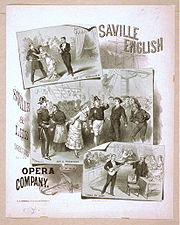
Overture di Ballo
The Overture di Ballo is a concert overture by Arthur Sullivan. Its first performance was in August 1870 at the Birmingham Triennial Festival, conducted by the composer. It predates all his work with W. S...
, was composed for the Birmingham Festival
Birmingham Triennial Music Festival
The Birmingham Triennial Musical Festival, in Birmingham, England, founded in 1784, was the longest-running classical music festival of its kind. Its last performance was in 1912.-History:...
in 1870. 1871 was a busy year for Sullivan. He published his only song cycle
Song cycle
A song cycle is a group of songs designed to be performed in a sequence as a single entity. As a rule, all of the songs are by the same composer and often use words from the same poet or lyricist. Unification can be achieved by a narrative or a persona common to the songs, or even, as in Schumann's...
, The Window; or, The Songs of the Wrens
The Window (song cycle)
The Window; or, The Songs of the Wrens is a song cycle by Arthur Sullivan with words by Alfred, Lord Tennyson. Written in 1867–70, it was eventually published in 1871...
(1871), to words by Tennyson
Alfred Tennyson, 1st Baron Tennyson
Alfred Tennyson, 1st Baron Tennyson, FRS was Poet Laureate of the United Kingdom during much of Queen Victoria's reign and remains one of the most popular poets in the English language....
. In the same year, he wrote the first of a series of suites of incidental music for West End theatre
West End theatre
West End theatre is a popular term for mainstream professional theatre staged in the large theatres of London's 'Theatreland', the West End. Along with New York's Broadway theatre, West End theatre is usually considered to represent the highest level of commercial theatre in the English speaking...
productions of Shakespeare
William Shakespeare
William Shakespeare was an English poet and playwright, widely regarded as the greatest writer in the English language and the world's pre-eminent dramatist. He is often called England's national poet and the "Bard of Avon"...
plays. Still in 1871, Sullivan composed a dramatic cantata
Cantata
A cantata is a vocal composition with an instrumental accompaniment, typically in several movements, often involving a choir....
, On Shore and Sea
On Shore and Sea
On Shore and Sea is a "dramatic cantata" composed by Arthur Sullivan, with words by Tom Taylor. Sullivan completed this work to open the Royal Albert Hall, and it was performed at the opening of the London International Exhibition of art and industry, May 1, 1871. The concert featured works...
, for the opening of the London International Exhibition and the hymn
Hymn
A hymn is a type of song, usually religious, specifically written for the purpose of praise, adoration or prayer, and typically addressed to a deity or deities, or to a prominent figure or personification...
Onward, Christian Soldiers
Onward, Christian Soldiers
"Onward, Christian Soldiers" is a 19th century English hymn. The words were written by Sabine Baring-Gould in 1865, and the music was composed by Arthur Sullivan in 1871. Sullivan named the tune "St. Gertrude," after the wife of his friend Ernest Clay Ker Seymer, at whose country home he composed...
, with words by Sabine Baring-Gould
Sabine Baring-Gould
The Reverend Sabine Baring-Gould was an English hagiographer, antiquarian, novelist and eclectic scholar. His bibliography consists of more than 1240 publications, though this list continues to grow. His family home, Lew Trenchard Manor near Okehampton, Devon, has been preserved as he had it...
. The Salvation Army
Salvation Army
The Salvation Army is a Protestant Christian church known for its thrift stores and charity work. It is an international movement that currently works in over a hundred countries....
adopted the latter as its favoured processional
Processional hymn
A processional hymn is a chant, hymn or other music sung during the Procession, usually at the start of a Christian service although occasionally during the service itself. The procession usually contains members of the clergy and the choir walking behind the processional cross...
, and it became Sullivan's most enduring hymn.
At the end of 1871, the impresario John Hollingshead
John Hollingshead
John Hollingshead was an English theatrical impresario, journalist and writer during the latter half of the 19th century. He is best remembered as the first manager of the Gaiety Theatre, London...
commissioned Sullivan to work with W. S. Gilbert to create the burlesque-style comic opera Thespis
Thespis (opera)
Thespis, or The Gods Grown Old, is an operatic extravaganza that was the first collaboration between dramatist W. S. Gilbert and composer Arthur Sullivan. No musical score of Thespis was ever published, and most of the music has been lost...
for the Gaiety Theatre
Gaiety Theatre, London
The Gaiety Theatre, London was a West End theatre in London, located on Aldwych at the eastern end of the Strand. The theatre was established as the Strand Musick Hall , in 1864 on the former site of the Lyceum Theatre. It was rebuilt several times, but closed from the beginning of World War II...
. Conceived as a Christmas entertainment, it ran through to Easter 1872, a good run for such a piece. After Thespis, Gilbert and Sullivan went their separate ways until they collaborated on three parlour ballads in late 1874 and early 1875.
Sullivan's large-scale works of the early 1870s were the Festival Te Deum
Festival Te Deum
The Festival Te Deum is the popular name for an 1872 composition by Arthur Sullivan, written to celebrate the recovery of Albert Edward, Prince of Wales from typhoid fever...
(Crystal Palace, 1872); and the oratorio, The Light of the World
The Light of the World (Sullivan)
The Light of the World is an oratorio composed in 1873 by Arthur Sullivan. Sullivan wrote the libretto with the assistance of George Grove, based on the New Testament. The story of the oratorio narrates the whole life of Christ, focusing on his deeds on Earth as preacher, healer and prophet...
(Birmingham Festival, 1873). He provided suites of incidental music for a production of The Merry Wives of Windsor
The Merry Wives of Windsor
The Merry Wives of Windsor is a comedy by William Shakespeare, first published in 1602, though believed to have been written prior to 1597. It features the fat knight Sir John Falstaff, and is Shakespeare's only play to deal exclusively with contemporary Elizabethan era English middle class life...
at the Gaiety in 1874 and Henry VIII
Henry VIII (play)
The Famous History of the Life of King Henry the Eight is a history play by William Shakespeare and John Fletcher, based on the life of Henry VIII of England. An alternative title, All is True, is recorded in contemporary documents, the title Henry VIII not appearing until the play's publication...
at the Theatre Royal, Manchester in 1877. He continued to compose hymns throughout the decade. In 1873, Sullivan contributed two songs to Burnand's Christmas "drawing room extravaganza", The Miller and His Man.
In 1875, the manager of the Royalty Theatre
Royalty Theatre
The Royalty Theatre was a small London theatre situated at 73 Dean Street, Soho and opened on 25 May 1840 as Miss Kelly's Theatre and Dramatic School and finally closed to the public in 1938. The architect was Samuel Beazley, a resident in Soho Square, who also designed St James's Theatre, among...
, Richard D'Oyly Carte
Richard D'Oyly Carte
Richard D'Oyly Carte was an English talent agent, theatrical impresario, composer and hotelier during the latter half of the Victorian era...
, needed a short piece to fill out a bill with Offenbach
Jacques Offenbach
Jacques Offenbach was a Prussian-born French composer, cellist and impresario. He is remembered for his nearly 100 operettas of the 1850s–1870s and his uncompleted opera The Tales of Hoffmann. He was a powerful influence on later composers of the operetta genre, particularly Johann Strauss, Jr....
's La Périchole
La Périchole
La Périchole is an opéra bouffe in three acts by Jacques Offenbach. Henri Meilhac and Ludovic Halévy wrote the French-language libretto based on the 1829 one act play Le carrosse du Saint-Sacrement by Prosper Mérimée, which was revived on 13 March 1850 at the Théâtre-Français...
. Carte had conducted Sullivan's Cox and Box. Remembering Thespis, Carte reunited Gilbert and Sullivan
Gilbert and Sullivan
Gilbert and Sullivan refers to the Victorian-era theatrical partnership of the librettist W. S. Gilbert and the composer Arthur Sullivan . The two men collaborated on fourteen comic operas between 1871 and 1896, of which H.M.S...
, and the result was the one-act comic opera
Comic opera
Comic opera denotes a sung dramatic work of a light or comic nature, usually with a happy ending.Forms of comic opera first developed in late 17th-century Italy. By the 1730s, a new operatic genre, opera buffa, emerged as an alternative to opera seria...
Trial by Jury
Trial by Jury
Trial by Jury is a comic opera in one act, with music by Arthur Sullivan and libretto by W. S. Gilbert. It was first produced on 25 March 1875, at London's Royalty Theatre, where it initially ran for 131 performances and was considered a hit, receiving critical praise and outrunning its...
. Trial, starring Sullivan's brother Fred as the Learned Judge, became a surprise hit, earning glowing praise from the critics and playing for 300 performances over its first few seasons. The Daily Telegraph commented that the piece illustrated the composer's "great capacity for dramatic writing of the lighter class", and other reviews emphasised the felicitous combination of Gilbert's words and Sullivan's music. One wrote, "it seems, as in the great Wagnerian operas, as though poem and music had proceeded simultaneously from one and the same brain." Soon after the opening of Trial, Sullivan wrote The Zoo
The Zoo
The Zoo is a one-act comic opera, with music by Arthur Sullivan and a libretto by B. C. Stephenson, writing under the pen name of Bolton Rowe. It premiered on 5 June 1875 at the St. James's Theatre in London , concluding its run five weeks later, on 9 July 1875, at the Haymarket Theatre...
, another one-act comic opera, with a libretto by B. C. Stephenson
B. C. Stephenson
Benjamin Charles Stephenson or B. C. Stephenson was an English dramatist, lyricist and librettist. After beginning a career in the civil service, he started to write for the theatre, using the pen name "Bolton Rowe". He was author or co-author of several long-running shows of the Victorian theatre...
. But the latter work had only a few short runs, and for the next 15 years, Sullivan's sole operatic collaborator was Gilbert; the two created an additional 12 operas together.
Sullivan also turned out more than 80 popular songs and parlour ballads, most of them written before the end of the 1870s. His first popular song was "Orpheus with his Lute" (1866), and a well-received part song
Part song
A part song is a form of choral music which consists of a secular song which has been written or arranged for several vocal parts, commonly SATB choir, but also for an all-male or all-female ensemble...
was "Oh! hush thee, my babie" (1867). The best known of his songs is "The Lost Chord
The Lost Chord
"The Lost Chord" is a song composed by Arthur Sullivan in 1877 at the bedside of his brother Fred during Fred's last illness. The manuscript is dated 13 January 1877; Fred Sullivan died five days later...
" (1877, lyrics by Adelaide Anne Procter
Adelaide Anne Procter
Adelaide Anne Procter was an English poet and philanthropist. She worked on behalf of a number of causes, most prominently on behalf of unemployed women and the homeless, and was actively involved with feminist groups and journals. Procter never married, and some of her poetry has prompted...
), written in sorrow at the death of his brother Frederic. The sheet music for his best received songs sold in large numbers, and were an important part of his income; many of them were adapted as dance pieces.
In this decade, Sullivan's conducting appointments included the Glasgow
Glasgow
Glasgow is the largest city in Scotland and third most populous in the United Kingdom. The city is situated on the River Clyde in the country's west central lowlands...
Choral Union concerts, 1875–77 and the Royal Aquarium
Royal Aquarium
The Royal Aquarium and Winter Garden was a Westminster, London place of amusement opened in 1876. The building was demolished in 1903. It was located immediately to the west of Westminster Abbey on Tothill Street. The building was designed by Alfred Bedborough in a highly ornamental style faced...
, London, 1876. In addition to his appointment as Professor of Composition at the Royal Academy of Music, of which he was a Fellow, he was appointed as the first Principal of the National Training School for Music in 1876. He accepted the latter post reluctantly, fearing that discharging the duties thoroughly would leave too little time for composing. In this he was correct, as his successor Hubert Parry
Hubert Parry
Sir Charles Hubert Hastings Parry, 1st Baronet was an English composer, teacher and historian of music.Parry's first major works appeared in 1880. As a composer he is best known for the choral song "Jerusalem", the coronation anthem "I was glad" and the hymn tune "Repton", which sets the words...
also discovered. Sullivan was not effective in the post, and resigned in 1881.
Sullivan's next collaboration with Gilbert, The Sorcerer
The Sorcerer
The Sorcerer is a two-act comic opera, with a libretto by W. S. Gilbert and music by Arthur Sullivan. It was the British duo's third operatic collaboration. The plot of The Sorcerer is based on a Christmas story, An Elixir of Love, that Gilbert wrote for The Graphic magazine in 1876...
(1877), ran for 178 performances, a success by the standards of the day, but H.M.S. Pinafore
H.M.S. Pinafore
H.M.S. Pinafore; or, The Lass That Loved a Sailor is a comic opera in two acts, with music by Arthur Sullivan and a libretto by W. S. Gilbert. It opened at the Opera Comique in London, England, on 25 May 1878 and ran for 571 performances, which was the second-longest run of any musical...
(1878), which followed it, turned Gilbert and Sullivan into an international phenomenon. Pinafore ran for 571 performances in London, and more than 100 unauthorised productions were quickly mounted in America alone. Among other favourable reviews, The Times noted that the opera was an early attempt at the establishment of a "national musical stage" ... free from risqué French "improprieties" and without the "aid" of Italian and German musical models. The Times and several of the other papers agreed, however, that while the piece was entertaining, Sullivan was capable of higher art, and frivolous light opera would hold him back. This criticism would follow Sullivan throughout his career. Pinafore was followed by The Pirates of Penzance
The Pirates of Penzance
The Pirates of Penzance; or, The Slave of Duty is a comic opera in two acts, with music by Arthur Sullivan and libretto by W. S. Gilbert. The opera's official premiere was at the Fifth Avenue Theatre in New York City on 31 December 1879, where the show was well received by both audiences...
in 1879, another international success, which opened in New York and then ran in London for 363 performances.
Early 1880s
In 1880, Sullivan was appointed director of the triennial Leeds Music FestivalLeeds Festival (classical music)
The Leeds Festival was a classical music festival which took place between 1858 and 1985 in Leeds, West Yorkshire, England.The first festival celebrated the opening of Leeds Town Hall by Queen Victoria on 7 September 1858...
. For his first festival he was commissioned to write a sacred choral work. He chose Henry Hart Milman
Henry Hart Milman
The Very Reverend Henry Hart Milman was an English historian and ecclesiastic.He was born in London, the third son of Sir Francis Milman, 1st Baronet, physician to King George III . Educated at Eton and at Brasenose College, Oxford, his university career was brilliant...
's 1822 dramatic poem based on the life and death of Saint Margaret the Virgin for its basis. Gilbert adapted the libretto for Sullivan, abridging it, rearranging sections, reassigning lines, and making a few additions of his own. The Martyr of Antioch
The Martyr of Antioch
The Martyr of Antioch is an oratorio by the English composer Arthur Sullivan. It was first performed on 15 October 1880 at the triennial Leeds Music Festival, having been composed specifically for that event...
premiered in October 1880. Sullivan was not a showy conductor, and some thought him dull and old fashioned on the podium, but his composition had an enthusiastic reception and was frequently revived. A grateful Sullivan presented his collaborator with an engraved silver cup inscribed "W.S. Gilbert from his friend Arthur Sullivan."
After the run of The Pirates of Penzance, Carte opened the next Gilbert and Sullivan piece, Patience, in April 1881 at London's Opera Comique
Opera Comique
The Opera Comique was a 19th-century theatre constructed in Westminster, London, between Wych Street and Holywell Street with entrances on the East Strand. It opened in 1870 and was demolished in 1902, to make way for the construction of the Aldwych and Kingsway...
, where their past three operas had played. In October, Patience transferred to the new, larger, state-of-the-art Savoy Theatre
Savoy Theatre
The Savoy Theatre is a West End theatre located in the Strand in the City of Westminster, London, England. The theatre opened on 10 October 1881 and was built by Richard D'Oyly Carte on the site of the old Savoy Palace as a showcase for the popular series of comic operas of Gilbert and Sullivan,...
, built with the profits of the previous Gilbert and Sullivan works. The rest of the partnership's collaborations were produced at the Savoy, as a result of which they are widely known as the "Savoy Opera
Savoy opera
The Savoy Operas denote a style of comic opera that developed in Victorian England in the late 19th century, with W. S. Gilbert and Arthur Sullivan as the original and most successful practitioners. The name is derived from the Savoy Theatre, which impresario Richard D'Oyly Carte built to house...
s". Iolanthe
Iolanthe
Iolanthe; or, The Peer and the Peri is a comic opera with music by Arthur Sullivan and libretto by W. S. Gilbert. It is one of the Savoy operas and is the seventh collaboration of the fourteen between Gilbert and Sullivan....
(1882), Gilbert and Sullivan's fourth hit in a row, was the first of the operas to premiere at the new theatre. Sullivan, despite the financial security of writing for the Savoy, increasingly viewed his work with Gilbert as unimportant, beneath his skills, and also repetitious. After Iolanthe, Sullivan had not intended to write a new work with Gilbert, but he suffered a serious financial loss when his broker went bankrupt in November 1882. Therefore, he concluded that his financial needs required him to continue writing Savoy operas. In February 1883, he signed a five-year agreement with Gilbert and Carte, requiring him to produce a new comic opera on six months' notice.
On 22 May 1883, Sullivan was knight
British honours system
The British honours system is a means of rewarding individuals' personal bravery, achievement, or service to the United Kingdom and the British Overseas Territories...
ed by Queen Victoria
Victoria of the United Kingdom
Victoria was the monarch of the United Kingdom of Great Britain and Ireland from 20 June 1837 until her death. From 1 May 1876, she used the additional title of Empress of India....
. Although the operas with Gilbert had earned him the broadest fame, the honour was conferred for his services to serious music. The musical establishment, and many critics, believed that this should put an end to his career as a composer of comic opera – that a musical knight should not stoop below oratorio or grand opera
Grand Opera
Grand opera is a genre of 19th-century opera generally in four or five acts, characterised by large-scale casts and orchestras, and lavish and spectacular design and stage effects, normally with plots based on or around dramatic historic events...
. Having just signed the five-year agreement, Sullivan suddenly felt trapped. In mid-December, he bade farewell to his sister-in-law Charlotte, Fred's widow, who emigrated with her young family to America. Sullivan's oldest nephew, Herbert
Herbert Sullivan
Herbert Thomas Sullivan was the nephew, heir and biographer of the British composer Arthur Sullivan. After his uncle's death, Sullivan became active in charitable work...
, stayed behind in England as his uncle's ward. The next opera, Princess Ida
Princess Ida
Princess Ida; or, Castle Adamant is a comic opera with music by Arthur Sullivan and libretto by W. S. Gilbert. It was their eighth operatic collaboration of fourteen. Princess Ida opened at the Savoy Theatre on January 5, 1884, for a run of 246 performances...
(1884, the duo's only three-act, blank verse
Blank verse
Blank verse is poetry written in unrhymed iambic pentameter. It has been described as "probably the most common and influential form that English poetry has taken since the sixteenth century" and Paul Fussell has claimed that "about three-quarters of all English poetry is in blank verse."The first...
work), had a noticeably shorter run than its four predecessors, although Sullivan's score was praised. With box office receipts lagging in March 1884, Carte gave the six months' notice for a new opera required under the partnership contract. Sullivan's close friend, the composer Frederic Clay
Frederic Clay
Frederic Emes Clay was an English composer known principally for his music written for the stage. Clay, a great friend of Arthur Sullivan's, wrote four comic operas with W. S...
, had suffered a serious stroke in early December 1883 that effectively ended his career at the age of 45. Sullivan, reflecting on this, on his own longstanding kidney problems, and on his desire to devote himself to more serious music, replied to Carte, "[I]t is impossible for me to do another piece of the character of those already written by Gilbert and myself."
Gilbert had already started work on a new opera involving a plot in which people fell in love against their wills after taking a magic lozenge. The composer wrote, on 1 April 1884 that he had "come to the end of my tether" with the operas: "I have been continually keeping down the music in order that not one [syllable] should be lost. ... I should like to set a story of human interest & probability where the humorous words would come in a humorous (not serious) situation, & where, if the situation were a tender or dramatic one the words would be of similar character." In a lengthy exchange of correspondence, Sullivan pronounced Gilbert's plot sketch (particularly the "lozenge" element) unacceptably mechanical, and too similar in both its grotesque "elements of topsyturveydom" and in actual plot to their earlier work, especially The Sorcerer, and repeatedly requested that Gilbert find a new subject. The impasse was finally resolved on 8 May when Gilbert proposed a plot that did not depend on any supernatural device. The result was Gilbert and Sullivan's most successful work, The Mikado
The Mikado
The Mikado; or, The Town of Titipu is a comic opera in two acts, with music by Arthur Sullivan and libretto by W. S. Gilbert, their ninth of fourteen operatic collaborations...
(1885). The piece ran for 672 performances, which was the second-longest run for any work of musical theatre, and one of the longest runs of any theatre piece, up to that time.
Later 1880s
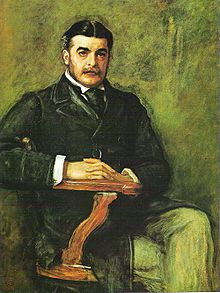
Henry Wadsworth Longfellow
Henry Wadsworth Longfellow was an American poet and educator whose works include "Paul Revere's Ride", The Song of Hiawatha, and Evangeline...
's poem of the same name. Apart from the comic operas, this proved to be Sullivan's best received full-length work. It was given hundreds of performances during his lifetime, and at one point he declared a moratorium on its presentation, fearing that it would become over-exposed Only Handel
George Frideric Handel
George Frideric Handel was a German-British Baroque composer, famous for his operas, oratorios, anthems and organ concertos. Handel was born in 1685, in a family indifferent to music...
's Messiah
Messiah (Handel)
Messiah is an English-language oratorio composed in 1741 by George Frideric Handel, with a scriptural text compiled by Charles Jennens from the King James Bible and the Book of Common Prayer. It was first performed in Dublin on 13 April 1742, and received its London premiere nearly a year later...
was performed more often in Britain in the 1880s and 90s. It remained in the repertory until about the 1920s, but since then it has been seldom performed, although it received its first professional recording in 2001. The musical scholar and conductor David Russell Hulme
David Russell Hulme
David Russell Hulme is a Welsh conductor and musicologist known for his research and publications on the music of Sir Arthur Sullivan, the Victorian era composer who, with Sir W. S...
writes that the work influenced Elgar
Edward Elgar
Sir Edward William Elgar, 1st Baronet OM, GCVO was an English composer, many of whose works have entered the British and international classical concert repertoire. Among his best-known compositions are orchestral works including the Enigma Variations, the Pomp and Circumstance Marches, concertos...
and Walton
William Walton
Sir William Turner Walton OM was an English composer. During a sixty-year career, he wrote music in several classical genres and styles, from film scores to opera...
.
Ruddigore
Ruddigore
Ruddigore; or, The Witch's Curse, originally called Ruddygore, is a comic opera in two acts, with music by Arthur Sullivan and libretto by W. S. Gilbert. It is one of the Savoy Operas and the tenth of fourteen comic operas written together by Gilbert and Sullivan...
followed The Mikado at the Savoy in 1887. It ran profitably for nine months but was disappointing compared with most of the earlier Savoy operas. For their next piece, Gilbert submitted another version of the magic lozenge plot; Sullivan immediately rejected it. Gilbert finally proposed a comparatively serious opera, to which Sullivan agreed. Although it was not a grand opera, The Yeomen of the Guard
The Yeomen of the Guard
The Yeomen of the Guard; or, The Merryman and His Maid, is a Savoy Opera, with music by Arthur Sullivan and libretto by W. S. Gilbert. It premiered at the Savoy Theatre on 3 October 1888, and ran for 423 performances...
(1888) provided him with the opportunity to compose his most ambitious stage work to date. As early as 1883, Sullivan had been under pressure from the musical establishment to write a grand opera. In 1885, he told an interviewer, ""The opera of the future is a compromise [among the French, German and Italian schools] – a sort of eclectic school, a selection of the merits of each one. I myself will make an attempt to produce a grand opera of this new school. ... Yes, it will be an historical work, and it is the dream of my life.” After The Yeomen of the Guard opened, Sullivan turned once again to Shakespeare, composing incidental music for Henry Irving
Henry Irving
Sir Henry Irving , born John Henry Brodribb, was an English stage actor in the Victorian era, known as an actor-manager because he took complete responsibility for season after season at the Lyceum Theatre, establishing himself and his company as...
's production of Macbeth
Macbeth
The Tragedy of Macbeth is a play by William Shakespeare about a regicide and its aftermath. It is Shakespeare's shortest tragedy and is believed to have been written sometime between 1603 and 1607...
(1888).
Sullivan wished to produce further serious works with Gilbert. He had collaborated with no other librettist since 1875. But Gilbert felt that the reaction to The Yeomen of the Guard had "not been so convincing as to warrant us in assuming that the public want something more earnest still." He proposed instead that Sullivan should go ahead with his plan to write a grand opera, but should continue also to compose comic works for the Savoy. Sullivan was not immediately persuaded. He replied, "I have lost the liking for writing comic opera, and entertain very grave doubts as to my power of doing it." Nevertheless, a compromise was reached: Sullivan commissioned a grand opera libretto from Julian Sturgis
Julian Sturgis
Julian Russell Sturgis was an American-born novelist, poet, librettist and lyricist who lived and worked in Britain nearly all of his life. He played football as an amateur for the Wanderers F.C...
(who was recommended by Gilbert), while suggesting to Gilbert that he revive an old idea for an opera set in colourful Venice
Venice
Venice is a city in northern Italy which is renowned for the beauty of its setting, its architecture and its artworks. It is the capital of the Veneto region...
. The comic opera was completed first: The Gondoliers
The Gondoliers
The Gondoliers; or, The King of Barataria is a Savoy Opera, with music by Arthur Sullivan and libretto by W. S. Gilbert. It premiered at the Savoy Theatre on 7 December 1889 and ran for a very successful 554 performances , closing on 30 June 1891...
(1889) was a piece described by Hughes as a pinnacle of Sullivan's achievement. It was the last great Gilbert and Sullivan success.
1890s
The relationship between Gilbert and Sullivan suffered its most serious breach in April 1890, during the run of The Gondoliers, when Gilbert objected to Carte's financial accounts for the production, including a charge to the partnership for the cost of new carpeting for the Savoy Theatre lobby. Gilbert believed that this was a maintenance expense that should be charged to Carte alone. Carte was building a new theatre to present Sullivan's forthcoming grand opera, and Sullivan sided with Carte, going so far as to testify erroneously as to certain old debts. Gilbert took legal action against Carte and Sullivan and vowed to write no more for the Savoy, and so the partnership came to an acrimonious end. Sullivan wrote to Gilbert in September 1890 that he was "physically and mentally ill over this wretched business. I have not yet got over the shock of seeing our names coupled ... in hostile antagonism over a few miserable pounds".Sullivan's only grand opera, Ivanhoe
Ivanhoe (opera)
Ivanhoe is a romantic opera in three acts based on the novel by Sir Walter Scott, with music by Sir Arthur Sullivan and a libretto by Julian Sturgis. It premiered at the Royal English Opera House on 31 January 1891 for a consecutive run of 155 performances, unheard of for a grand opera...
, based on Walter Scott
Walter Scott
Sir Walter Scott, 1st Baronet was a Scottish historical novelist, playwright, and poet, popular throughout much of the world during his time....
's novel
Ivanhoe
Ivanhoe is a historical fiction novel by Sir Walter Scott in 1819, and set in 12th-century England. Ivanhoe is sometimes credited for increasing interest in Romanticism and Medievalism; John Henry Newman claimed Scott "had first turned men's minds in the direction of the middle ages," while...
, opened at Carte's new Royal English Opera House on 31 January 1891. Sullivan completed the score too late to meet Carte's planned production date, and costs mounted as the producer had to pay performers, crew and others, while the theatre sat empty. Sullivan was required to pay Carte a contractual penalty of £3,000 for his delay. The production lasted for 155 consecutive performances, an unprecedented run for a serious opera, and earned good notices for its music. Afterwards, Carte was unable to fill the new opera house with other opera productions, however, and Ivanhoe was blamed for the failure of the opera house. The opera passed into obscurity after a touring revival in 1894–95. The episode was, as the critic Herman Klein
Herman Klein
Herman Klein was an English music critic, author and teacher of singing. Klein's famous brothers included Charles and Manuel Klein...
observed, "the strangest comingling of success and failure ever chronicled in the history of British lyric enterprise!" Sullivan did not seriously consider writing grand opera again. Later in 1891, Sullivan composed music for Tennyson's The Foresters
The Foresters
The Foresters or, Robin Hood and Maid Marian is a play written by Alfred Tennyson and first produced in New York in 1892. A set of incidental music in nine movements was composed for the play by Arthur Sullivan....
, which ran well at Daly's Theatre in New York in 1892, but failed in London the following year.

Haddon Hall (opera)
Haddon Hall is an English light opera with music by Arthur Sullivan and a libretto by Sydney Grundy. It premiered at the Savoy Theatre on September 24, 1892 for a modestly successful run of 204 performances...
(1892), with a libretto by Sydney Grundy
Sydney Grundy
Sydney Grundy was an English dramatist. Most of his works were adaptations of European plays, and many became successful enough to tour throughout the English-speaking world...
based loosely on the historical elopement of Dorothy Vernon with John Manners. Although still comic, the tone and style of the work was considerably more serious and romantic than most of the operas with Gilbert. It enjoyed a modest popularity, running for 204 performances, and earned critical praise. In 1895, Sullivan once more provided incidental music for the Lyceum, this time for J. Comyns Carr
J. Comyns Carr
Joseph William Comyns Carr was an English drama and art critic, gallery director, author, poet, playwright and theatre manager....
's King Arthur.
The partnership with Gilbert had been so profitable that, after the financial failure of the Royal English Opera House, Carte and his wife sought to reunite the author and composer, eventually succeeding with the help of Tom Chappell
Chappell & Co.
Chappell & Co. was an English company that published music and manufactured pianos.-History:It was founded in 1810 by Samuel Chappell in partnership with music professors Francis Tatton Latour and Johann Baptist Cramer. Cramer was also a well-known London composer, teacher and pianist...
, their music publisher. Their next opera, Utopia Limited (1893), ran for 245 performances, barely covering the expenses of the lavish production. Sullivan came to disapprove of the leading lady, Nancy McIntosh
Nancy McIntosh
Nancy McIntosh was an American-born singer and actress who performed mostly on the London stage. Her father was a member of the notorious South Fork Fishing and Hunting Club, which had been blamed in connection with the 1889 Johnstown Flood that resulted in the loss of over 2,200 lives in...
, and refused to write another piece featuring her, while Gilbert insisted that she must appear in his next opera. Instead, Sullivan teamed up again with his old partner, F. C. Burnand. The Chieftain
The Chieftain
The Chieftain is a two-act comic opera by Arthur Sullivan and F. C. Burnand based on their 1867 opera, The Contrabandista. It consists of substantially the same first act as the 1867 work with a completely new second act...
(1894), a heavily revised version of their earlier two-act opera, The Contrabandista, flopped. Gilbert and Sullivan reunited one more time, after McIntosh announced her retirement from the stage, for The Grand Duke
The Grand Duke
The Grand Duke; or, The Statutory Duel, is the final Savoy Opera written by librettist W. S. Gilbert and composer Arthur Sullivan, their fourteenth and last opera together. It premiered at the Savoy Theatre on March 7, 1896, and ran for 123 performances...
(1896). This also failed, and Sullivan never worked with Gilbert again, although their operas continued to be revived with success at the Savoy.
In May 1897, Sullivan's full-length ballet, Victoria and Merrie England
Victoria and Merrie England
Victoria and Merrie England is an 1897 ballet by Arthur Sullivan, written to commemorate Queen Victoria's Diamond Jubilee – a remarkable sixty years on the throne. The ballet became very popular and ran for nearly six months.-Background:...
, opened at the Alhambra Theatre
Alhambra Theatre
The Alhambra was a popular theatre and music hall located on the east side of Leicester Square, in the West End of London. It was built originally as The Royal Panopticon of Science and Arts opening on 18 March 1854. It was closed after two years and reopened as the Alhambra. The building was...
to celebrate the Queen's Diamond Jubilee
Diamond Jubilee
A Diamond Jubilee is a celebration held to mark a 60th anniversary in the case of a person or a 75th anniversary in the case of an event.- Thailand :...
. The work's seven scenes celebrate English history and culture, with the Victorian period as the grand finale. Its six-month run was considered a great achievement. The Beauty Stone
The Beauty Stone
The Beauty Stone is an opera, billed as a "romantic musical drama" in three acts, composed by Arthur Sullivan to a libretto by Arthur Wing Pinero and J. Comyns Carr. The medieval Faustian story concerns an ugly, crippled girl, who dreams of being beautiful and meeting a handsome prince. The Devil...
(1898), with a libretto by Arthur Wing Pinero
Arthur Wing Pinero
Sir Arthur Wing Pinero was an English actor and later an important dramatist and stage director.-Biography:...
and J. Comyns Carr was based on mediaeval morality play
Morality play
The morality play is a genre of Medieval and early Tudor theatrical entertainment. In their own time, these plays were known as "interludes", a broader term given to dramas with or without a moral theme. Morality plays are a type of allegory in which the protagonist is met by personifications of...
s. The collaboration did not go particularly well: Sullivan wrote that Pinero and Comyns Carr were "gifted and brilliant men, with no experience in writing for music", and, when he asked for alterations to improve the structure, they refused. Sullivan's score, moreover, was too serious for the Savoy audiences' tastes. The opera was both a critical failure and did not attract a following, running for only seven weeks.
In 1899, to benefit "the wives and children of soldiers and sailors" on active service in the Boer War, Sullivan composed the music of a jingoistic song, "The Absent-Minded Beggar
The Absent-Minded Beggar
"The Absent-Minded Beggar" is an 1899 poem by Rudyard Kipling, set to music by Sir Arthur Sullivan and often accompanied by an illustration by Richard Caton Woodville. The song was written as part of an appeal by the Daily Mail to raise money for soldiers fighting in the South African War and...
", to a text by Rudyard Kipling
Rudyard Kipling
Joseph Rudyard Kipling was an English poet, short-story writer, and novelist chiefly remembered for his celebration of British imperialism, tales and poems of British soldiers in India, and his tales for children. Kipling received the 1907 Nobel Prize for Literature...
, which became an instant sensation and raised an unprecedented £250,000 from performances and the sale of sheet music and related merchandise. In The Rose of Persia
The Rose of Persia
The Rose of Persia; or, The Story-Teller and the Slave, is a two-act comic opera, with music by Arthur Sullivan and a libretto by Basil Hood. It premiered at the Savoy Theatre on 29 November 1899, closing on 28 June 1900 after a profitable run of 211 performances...
(1899), Sullivan returned to his comic roots, writing to a libretto by Basil Hood
Basil Hood
Basil Willett Charles Hood was a British librettist and lyricist, perhaps best known for writing the libretti of half a dozen Savoy Operas and for his English adaptations of operettas, including The Merry Widow. He embarked on a career in the British army, writing theatrical pieces in his spare...
that combined an exotic Arabian Nights setting with plot elements of The Mikado
The Mikado
The Mikado; or, The Town of Titipu is a comic opera in two acts, with music by Arthur Sullivan and libretto by W. S. Gilbert, their ninth of fourteen operatic collaborations...
. Sullivan's tuneful score was well received, and the opera proved to be his most successful full-length collaboration apart from those with Gilbert. Another opera with Hood, The Emerald Isle
The Emerald Isle
The Emerald Isle; or, The Caves of Carrig-Cleena, is a two-act comic opera, with music by Arthur Sullivan and Edward German, and a libretto by Basil Hood. It premiered at the Savoy Theatre on 27 April 1901, closing on 9 November 1901 after a run of 205 performances...
, quickly went into preparation, but Sullivan died before it could be completed.
Death, honours and legacy
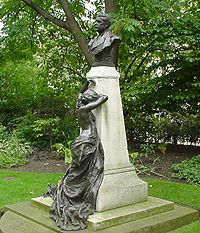
Edward German
Sir Edward German was an English musician and composer of Welsh descent, best remembered for his extensive output of incidental music for the stage and as a successor to Arthur Sullivan in the field of English comic opera.As a youth, German played the violin and led the town orchestra, also...
and produced in 1901. His Te Deum Laudamus
Te Deum Laudamus (Sullivan)
Arthur Sullivan's Te Deum Laudamus—A Thanksgiving for Victory, usually known as the Boer War Te Deum, is a choral work composed by Sullivan in the last few months of his life. It was commissioned on behalf of Dean and Chapter of London's St...
, written to commemorate the end of the Boer War, was performed posthumously.
A monument in the composer's memory featuring a weeping Muse
Muse
The Muses in Greek mythology, poetry, and literature, are the goddesses who inspire the creation of literature and the arts. They were considered the source of the knowledge, related orally for centuries in the ancient culture, that was contained in poetic lyrics and myths...
was erected in the Victoria Embankment
Victoria Embankment
The Victoria Embankment is part of the Thames Embankment, a road and river walk along the north bank of the River Thames in London. Victoria Embankment extends from the City of Westminster into the City of London.-Construction:...
Gardens in London and is inscribed with Gilbert's words from The Yeomen of the Guard
The Yeomen of the Guard
The Yeomen of the Guard; or, The Merryman and His Maid, is a Savoy Opera, with music by Arthur Sullivan and libretto by W. S. Gilbert. It premiered at the Savoy Theatre on 3 October 1888, and ran for 423 performances...
: "Is life a boon? If so, it must befall that Death, whene'er he call, must call too soon". Sullivan wished to be buried in Brompton Cemetery
Brompton Cemetery
Brompton Cemetery is located near Earl's Court in South West London, England . It is managed by The Royal Parks and is one of the Magnificent Seven...
with his parents and brother, but by order of the Queen he was buried in St. Paul's Cathedral. In addition to his knighthood, honours awarded to Sullivan in his lifetime included Doctor in Music, honoris causa, by the Universities of Cambridge
University of Cambridge
The University of Cambridge is a public research university located in Cambridge, United Kingdom. It is the second-oldest university in both the United Kingdom and the English-speaking world , and the seventh-oldest globally...
(1876) and Oxford
University of Oxford
The University of Oxford is a university located in Oxford, United Kingdom. It is the second-oldest surviving university in the world and the oldest in the English-speaking world. Although its exact date of foundation is unclear, there is evidence of teaching as far back as 1096...
(1879); Chevalier, Légion d'honneur
Légion d'honneur
The Legion of Honour, or in full the National Order of the Legion of Honour is a French order established by Napoleon Bonaparte, First Consul of the Consulat which succeeded to the First Republic, on 19 May 1802...
, France (1878); The Order of the Medjidieh
Medjidie
Medjidie or Mejidie is the name of a military and knightly order of the Ottoman Empire. The Order was instituted in 1851 by Sultan Abdülmecid I.-Order of the Medjidie:...
conferred by the Sultan of Turkey
Ottoman Empire
The Ottoman EmpireIt was usually referred to as the "Ottoman Empire", the "Turkish Empire", the "Ottoman Caliphate" or more commonly "Turkey" by its contemporaries...
(1888); and appointment as a Member of the Fourth Class of the Royal Victorian Order
Royal Victorian Order
The Royal Victorian Order is a dynastic order of knighthood and a house order of chivalry recognising distinguished personal service to the order's Sovereign, the reigning monarch of the Commonwealth realms, any members of her family, or any of her viceroys...
(MVO) on 30 June 1897.
In all, Sullivan's artistic output included 23 operas, 13 major orchestral works, eight choral works and oratorios, two ballets, one song cycle, incidental music
Incidental music
Incidental music is music in a play, television program, radio program, video game, film or some other form not primarily musical. The term is less frequently applied to film music, with such music being referred to instead as the "film score" or "soundtrack"....
to several plays, numerous hymns and other church pieces, and a large body of songs, parlour ballads, part songs, carols, and piano and chamber pieces. Sullivan's operas have often been adapted, first in the 19th century as dance pieces and in foreign adaptations of the operas themselves. Since then, his music has been made into ballets (see Pineapple Poll
Pineapple Poll
Pineapple Poll is a Gilbert and Sullivan-inspired comic ballet, created by choreographer John Cranko with arranger Sir Charles Mackerras. Pineapple Poll is based on "The Bumboat Woman's Story", one of W. S. Gilbert's Bab Ballads, written in 1870. The Gilbert and Sullivan opera H.M.S. Pinafore was...
(1951) and Pirates of Penzance - The Ballet!
Pirates of Penzance - The Ballet!
Pirates of Penzance – The Ballet! is a comic ballet adapted from Gilbert and Sullivan's Savoy Opera The Pirates of Penzance. The plot remains the same as for the opera, and the music is arrangements of music by Arthur Sullivan.The work was created for the Queensland Ballet...
(1991)) and musicals (The Swing Mikado
The Swing Mikado
The Swing Mikado is an operetta in two acts with music arranged by Gentry Warden, based on Gilbert and Sullivan's comic opera, The Mikado. It was first staged by an all-black company in Chicago in 1938, transferring to Broadway, and featured a setting transposed from Japan to a tropical island...
(1938), The Hot Mikado
The Hot Mikado (1939 production)
The Hot Mikado was a 1939 musical theatre adaptation of Gilbert and Sullivan's The Mikado with an African-American cast. Mike Todd originally produced it after the Federal Theatre Project turned down his offer to manage the WPA production of The Swing Mikado .The Hot Mikado was jazzier than The...
(1939) and Hot Mikado
Hot Mikado
Hot Mikado is a musical comedy, based on Gilbert and Sullivan's The Mikado, adapted by David H. Bell and Rob Bowman...
(1986), Hollywood Pinafore
Hollywood Pinafore
Hollywood Pinafore, or The Lad Who Loved a Salary is a musical comedy in two acts by George S. Kaufman, with music by Arthur Sullivan, based on Gilbert and Sullivan's H.M.S. Pinafore. It opened on Broadway at the Alvin Theatre on May 31, 1945, and closed on July 14, 1945 after 52 performances...
(1945), The Black Mikado
The Black Mikado
The Black Mikado is a musical comedy, based on Gilbert and Sullivan's The Mikado, adapted by Janos Bajtala, George Larnyoh and Eddie Quansah from W. S. Gilbert's original 1885 libretto and Arthur Sullivan's score. The show premiered on 24 April 1975 at the Cambridge Theatre in London, where it ran...
(1975), etc.). They are not only frequently performed, but also frequently parodied
Parody
A parody , in current usage, is an imitative work created to mock, comment on, or trivialise an original work, its subject, author, style, or some other target, by means of humorous, satiric or ironic imitation...
, pastiche
Pastiche
A pastiche is a literary or other artistic genre or technique that is a "hodge-podge" or imitation. The word is also a linguistic term used to describe an early stage in the development of a pidgin language.-Hodge-podge:...
d, quoted and imitated in comedy routines, film, television, advertising and other popular media
Cultural influence of Gilbert and Sullivan
In the past 125 years, Gilbert and Sullivan have pervasively influenced popular culture in the English-speaking world. Lines and quotations from the Gilbert and Sullivan operas have become part of the English language, such as "short, sharp shock", "What never? Well, hardly ever!", "let the...
. His legacy, apart from writing the Savoy operas and his other works, is felt perhaps most strongly today through his influence on the American and British musical theatre
Musical theatre
Musical theatre is a form of theatre combining songs, spoken dialogue, acting, and dance. The emotional content of the piece – humor, pathos, love, anger – as well as the story itself, is communicated through the words, music, movement and technical aspects of the entertainment as an...
. The innovations in content and form of the works that he and Gilbert developed directly influenced the development of the modern musical throughout the 20th century. In addition, biographies and scholarly articles and analyses continue to be written about Sullivan's life and work.
Romantic life
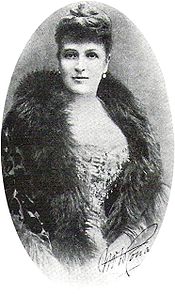
John Scott Russell
John Scott Russell was a Scottish naval engineer who built the Great Eastern in collaboration with Isambard Kingdom Brunel, and made the discovery that gave birth to the modern study of solitons.-Personal life:John Scott Russell was born John Russell on 9 May 1808 in Parkhead, Glasgow, the son of...
. Sullivan was a frequent visitor at the Scott Russell home in the mid-1860s, and by 1865 the affair was in full bloom. Rachel's parents did not approve of a possible union to a young composer with uncertain financial prospects, but the two continued to see each other covertly. At some point in 1868, Sullivan started a simultaneous (and secret) affair with Rachel's sister Louise (1841–1878). Both relationships had ceased by early 1869.
Sullivan's longest love affair was with the American socialite, Mary Frances ("Fanny") Ronalds
Fanny Ronalds
Mary Frances "Fanny" Ronalds , was an American socialite and amateur singer who is best known for her long affair with the composer Arthur Sullivan in London in the last decades of the nineteenth century....
née Carter, a woman three years Sullivan's senior, who had two children. He met her in Paris around 1867, and the affair began in earnest soon after she moved to London permanently in 1871. A contemporary account described Fanny Ronalds this way: "Her face was perfectly divine in its loveliness, her features small and exquisitely regular. Her hair was a dark shade of brown – châtain foncé [deep chestnut] – and very abundant ... a lovely woman, with the most generous smile one could possibly imagine, and the most beautiful teeth." Sullivan called her "the best amateur singer in London". She often performed Sullivan's songs at her famous Sunday soirees. She became particularly associated with "The Lost Chord", singing it both in private and in public, often with Sullivan accompanying her. When Sullivan died, he left her the autograph manuscript of that song, along with other bequests.
Ronalds was separated from her American husband, but she was never divorced. Social conventions of the time compelled Sullivan and Ronalds to keep their relationship private. In his diary, he would refer to her as "Mrs. Ronalds" when he saw her in a public setting, but "L. W." (for "Little Woman") or "D. H." (possibly "Dear Heart") when they were alone together, often with a number in parentheses indicating the number of sexual acts completed. It is thought that Ronalds was pregnant on at least two occasions, and she apparently procured an abortion
Abortion
Abortion is defined as the termination of pregnancy by the removal or expulsion from the uterus of a fetus or embryo prior to viability. An abortion can occur spontaneously, in which case it is usually called a miscarriage, or it can be purposely induced...
in 1882 and again in 1884. Sullivan had a roving eye, and his diary records the occasional quarrel when Ronalds discovered his other liaisons, but he always returned to her. She was a constant companion up to the time of Sullivan's death, but around 1889 or 1890, the sexual relationship seems to have ended. He started to refer to her in the diary as "Auntie", and the tick marks indicating sexual activity were no longer there, although similar notation continued to be used for his relationships with other women who have not been identified, and who were always referred to by their initials.
In 1896, Sullivan proposed marriage to the 20-year-old Violet Beddington, but she refused him.
Leisure and family life
Sullivan loved to spend time in France (both in Paris and the south of France), where his friends ranged from Princess Marie-Amélie of Orleans to the composer Claude DebussyClaude Debussy
Claude-Achille Debussy was a French composer. Along with Maurice Ravel, he was one of the most prominent figures working within the field of impressionist music, though he himself intensely disliked the term when applied to his compositions...
, and where the casinos enabled him to indulge his passion for gambling. He enjoyed hosting private entertainments at his home, often featuring famous singers and well-known actors. In 1865 he joined the Freemasons
Freemasonry
Freemasonry is a fraternal organisation that arose from obscure origins in the late 16th to early 17th century. Freemasonry now exists in various forms all over the world, with a membership estimated at around six million, including approximately 150,000 under the jurisdictions of the Grand Lodge...
and was the masonic national Grand Organist in 1887 during Queen Victoria
Victoria of the United Kingdom
Victoria was the monarch of the United Kingdom of Great Britain and Ireland from 20 June 1837 until her death. From 1 May 1876, she used the additional title of Empress of India....
's Golden Jubilee. Sullivan's talent and native charm gained him the friendship of many not only in the musical establishment, such as Liszt, Grove, Chorley, and Herman Klein, but also in society circles, such as Alfred, Duke of Edinburgh
Alfred, Duke of Saxe-Coburg and Gotha
Alfred, Duke of Saxe-Coburg and Gotha was the third Duke of Saxe-Coburg and Gotha, and reigned from 1893 to 1900. He was also a member of the British Royal Family, the second son and fourth child of Queen Victoria and Prince Albert of Saxe-Coburg and Gotha...
. Sullivan enjoyed playing tennis although, according to George Grossmith
George Grossmith
George Grossmith was an English comedian, writer, composer, actor, and singer. His performing career spanned more than four decades...
, "I have seen some bad lawn-tennis players in my time, but I never saw anyone so bad as Arthur Sullivan".
Sullivan was devoted to his parents, particularly his mother, with whom he corresponded regularly when away from London, until her death in 1882. Henry Lytton
Henry Lytton
Sir Henry Lytton was an English actor and singer who was the leading exponent of the comic patter-baritone roles in Gilbert and Sullivan operas in the early part of the twentieth century...
wrote, "I believe there was never a more affectionate tie than that which existed between [Sullivan] and his mother, a very witty old lady, and one who took an exceptional pride in her son's accomplishments. Sullivan was also very fond of his brother Fred, whose acting career he assisted whenever possible, and of Fred's children. When Fred died at the age of 39, he left his pregnant wife, Charlotte, with seven children under the age of 14. After Fred's death, Arthur visited the family often and became guardian to all of the children.
In 1883, Charlotte and six of her children emigrated to Los Angeles, California
Los Angeles, California
Los Angeles , with a population at the 2010 United States Census of 3,792,621, is the most populous city in California, USA and the second most populous in the United States, after New York City. It has an area of , and is located in Southern California...
, leaving the oldest boy, "Bertie"
Herbert Sullivan
Herbert Thomas Sullivan was the nephew, heir and biographer of the British composer Arthur Sullivan. After his uncle's death, Sullivan became active in charitable work...
, in Sullivan's sole care. Despite his reservations about the move to America, Sullivan paid all the costs and continued to give substantial financial support to the family. Only a year after moving to Los Angeles, in January 1885, Charlotte died, leaving the six children to be raised mostly by her brother and the older girls. From June to August 1885, after The Mikado
The Mikado
The Mikado; or, The Town of Titipu is a comic opera in two acts, with music by Arthur Sullivan and libretto by W. S. Gilbert, their ninth of fourteen operatic collaborations...
premiered, Sullivan visited the family in Los Angeles and took them on a sightseeing trip of the American west. He continued, throughout the rest of his life, and in his will, to take good care of Fred's children, continuing to correspond with them and to be concerned with their education, marriages and financial affairs. Bertie stayed with his uncle Arthur for the rest of the composer's life.
Three of Sullivan's cousins, the daughters of his uncle John Thomas Sullivan, performed with D'Oyly Carte: Rose, Jane ("Jennie") and Kate Sullivan, the first two of whom used the stage surname Hervey. Kate was a chorister who defected to the Comedy Opera Company's rival production of H.M.S. Pinafore where she had the opportunity to play Josephine in 1879. Jennie was a D'Oyly Carte chorister for fourteen years. Rose took principal roles in many of the companion pieces that played with the Savoy operas.
Method and text setting

In composing the Savoy operas, Sullivan wrote the vocal lines of the musical numbers first, and these were given to the actors. He, or an assistant, improvised a piano accompaniment at the early rehearsals; he wrote the orchestrations later, after he had seen what Gilbert's stage business would be. He left the overtures until last and often delegated their composition, based on his outlines, to his assistants often incorporating his suggestions or corrections. Those Sullivan wrote himself include Thespis, Iolanthe, Princess Ida, The Yeomen of the Guard, The Gondoliers, The Grand Duke and probably Utopia Limited. Most of the overtures are structured as a potpourri
Potpourri (music)
Potpourri or Pot-Pourri is a kind of musical form structured as ABCDEF..., the same as medley or, sometimes, fantasia. It is often used in light, easy-going and popular types of music....
of tunes from the operas in three sections: fast, slow and fast. Those for Iolanthe and The Yeomen of the Guard are written in a modified sonata form
Sonata form
Sonata form is a large-scale musical structure used widely since the middle of the 18th century . While it is typically used in the first movement of multi-movement pieces, it is sometimes used in subsequent movements as well—particularly the final movement...
. The overtures from the Gilbert and Sullivan operas remain popular, and there are many recordings of them. Sullivan invariably conducted the operas on their opening nights.
In 1957, a review in The Times gave this rationale for "the continued vitality of the Savoy operas":
- "[T]hey were never really contemporary in their idiom. ... Gilbert and Sullivan's [world was] an artificial world, with a neatly controlled and shapely precision. ... For this, each partner has his share of credit. The neat articulation of incredibilities in Gilbert's plots is perfectly matched by his language.... [Of] equal importance ... Gilbert's lyrics almost invariably take on extra point and sparkle when set to Sullivan's music. ... Sullivan's tunes, in these operas, also exist in a make-believe world of their own. ... [He is] a delicate wit, whose airs have a precision, a neatness, a grace, and a flowing melody".
Melody and rhythm
The Musical Times noted that Sullivan's tunes, at least in the comic operas, appeal to the professional as much as to the layman: his continental contemporaries such as Debussy, Leoncavallo and Saint-Saëns held the Savoy operas in high regard. Hughes writes, "When Sullivan wrote what we call 'a good tune' it was nearly always 'good music' as well. Outside the ranks of the giants there are few other composers of whom the same could be said." Sullivan told Lawrence that his melodies sprang from rhythm, although some of his themes may have been prompted by his chosen instrumentation or his harmonic techniques.In the comic operas, where many numbers were in verse-plus-refrain form, Sullivan frequently was required to produce two climaxes in the melodic line. Hughes instances "If you go in" (Iolanthe) as a good example. In Hughes's view, though most of the tunes in the Savoy operas are good ones, Sullivan rarely reached the same class of excellence elsewhere when he had no librettist to feed his imagination. Even so, on those occasions when Gilbert wrote in unvaried metre, Sullivan often followed suit and produced phrases of simple repetition, such as "Love is a plaintive song" (Patience) and "A man who would woo a fair maid" (The Yeomen of the Guard).
Sullivan's deliberate echoes of other composers are covered below under "Musical Quotations", but other echoes may not have been conscious: Hughes cites the concluding bars of "Tell a tale of cock and bull" from The Yeomen of the Guard as an example of Handel's influence, and another critic, Edward Greenfield
Edward Greenfield
Edward Greenfield is an English music critic and broadcaster. He joined the Manchester Guardian in 1953, working as a lobby correspondent in the House of Commons. He has been a record critic for the newspaper since 1955, a music critic since 1964, and was chief music critic from 1977 until his...
, found a theme in the slow movement of the Irish symphony "an outrageous crib" from Schubert's Unfinished.
Harmony and counterpoint
HarmonySullivan was trained in the classical style, and contemporary music did not greatly attract him. Harmonically his early works used the conventional formulae of Auber
Daniel Auber
Daniel François Esprit Auber was a French composer.-Biography:The son of a Paris print-seller, Auber was born in Caen in Normandy. Though his father expected him to continue in the print-selling business, he also allowed his son to learn how to play several musical instruments...
, Donizetti, Balfe
Michael William Balfe
Michael William Balfe was an Irish composer, best-remembered for his opera The Bohemian Girl.After a short career as a violinist, Balfe pursued an operatic singing career, while he began to compose. In a career spanning more than 40 years, he composed 38 operas, almost 250 songs and other works...
and Schubert. Later he drew on Gounod and Bizet. Mendelssohn
Felix Mendelssohn
Jakob Ludwig Felix Mendelssohn Barthóldy , use the form 'Mendelssohn' and not 'Mendelssohn Bartholdy'. The Grove Dictionary of Music and Musicians gives ' Felix Mendelssohn' as the entry, with 'Mendelssohn' used in the body text...
's influence, conspicuous in early works, appears intermittently in later ones. As a contemporary writer observed, Sullivan draws on these various influences while remaining recognisably himself.
In general, Sullivan preferred to write in major
Major and minor
In Western music, the adjectives major and minor can describe a musical composition, movement, section, scale, key, chord, or interval.Major and minor are frequently referred to in the titles of classical compositions, especially in reference to the key of a piece.-Intervals and chords:With regard...
keys. In the Savoy operas, there are only eleven substantial numbers wholly in a minor key (less than 5% of the musical numbers), and even in his serious works the major prevails. Examples of Sullivan's rare excursions into minor keys include the long E minor melody in the first movement of the Irish Symphony
Symphony in E, Irish
The Symphony in E, first performed on March 10, 1866, was the only symphony composed by Arthur Sullivan. It is frequently called the 'Irish' Symphony.There are four movements:*Andante – Allegro, ma non troppo vivace*Andante espressivo*Allegretto...
, "Go away, madam" in the Act I finale of Iolanthe (echoing Verdi and Beethoven) and the funeral march in the Act I finale of The Yeomen of the Guard.
Both Hughes and Jacobs in Grove's Dictionary of Music and Musicians
Grove Dictionary of Music and Musicians
The New Grove Dictionary of Music and Musicians is an encyclopedic dictionary of music and musicians. Along with the German-language Musik in Geschichte und Gegenwart, it is the largest single reference work on Western music. The dictionary has gone through several editions since the 19th century...
comment adversely on Sullivan's over-use of tonic pedals
Pedal point
In tonal music, a pedal point is a sustained tone, typically in the bass, during which at least one foreign, i.e., dissonant harmony is sounded in the other parts. A pedal point sometimes functions as a "non-chord tone", placing it in the categories alongside suspensions, retardations, and passing...
, usually in the bass, which Hughes attributes to "lack of enterprise or even downright laziness". Another Sullivan trademark criticised by Hughes is the excessive use of the chord of the augmented fourth at moments of pathos. In his serious works, Sullivan attempted to avoid harmonic devices associated with the Savoy operas, with the result, according to Hughes, that The Golden Legend is a "hotch-potch of harmonic styles". The same writer comments that harmonic contrast in the Savoy works is enhanced by Sullivan's characteristic modulation between keys, as in "Expressive glances" (Princess Ida), where he smoothly negotiates E major, C sharp minor and C major, or "Then one of us will be a queen" (The Gondoliers), where he writes in F major, D flat major and D minor.
Though generally conservative in his harmony, Sullivan was happy on occasion to use chords traditionally considered technically incorrect. When reproached for using consecutive fifths
Perfect fifth
In classical music from Western culture, a fifth is a musical interval encompassing five staff positions , and the perfect fifth is a fifth spanning seven semitones, or in meantone, four diatonic semitones and three chromatic semitones...
in Cox and Box, he replied "if 5ths turn up it doesn't matter, so long as there is no offence to the ear." In the field of harmony, Hughes writes, Sullivan remained an eclectic: "He had easily recognisable habits but his style never achieved individuality".
Counterpoint
Despite his thorough academic contrapuntal training in London and Leipzig, as well as his experience as a church organist, Sullivan rarely composed fugues. Hughes cites examples from the Epilogue to The Golden Legend and Victoria and Merrie England
Victoria and Merrie England
Victoria and Merrie England is an 1897 ballet by Arthur Sullivan, written to commemorate Queen Victoria's Diamond Jubilee – a remarkable sixty years on the throne. The ballet became very popular and ran for nearly six months.-Background:...
. In the Savoy operas, fugal style is reserved for making fun of legal solemnity in Trial by Jury and Iolanthe (it is the Lord Chancellor's leitmotif in the latter). Less formal counterpoint is employed in numbers such as "Brightly Dawns our Wedding Day" (The Mikado) and "When the Buds are Blossoming" (Ruddigore).
Sullivan's best known contrapuntal device was "the simultaneous presentation of two or more distinct melodies previously heard independently". He was not the first composer to combine themes in this way, but it became a characteristic feature of the Gilbert and Sullivan operas. Sometimes the melodies were for solo voices, as in "Once more the face I loved so well" (The Zoo), and "I am so proud" (The Mikado), which combines three melodic lines; other examples are in choruses, where typically a graceful tune for the ladies is combined with a robust one for the men. Examples include "When the Foeman bares his steel" (The Pirates of Penzance), "Gaily tripping" (H.M.S. Pinafore), "In a doleful train" (Patience), "Welcome, gentry" (Ruddigore), and "Night has spread her pall once more" (The Yeomen of the Guard). At other times, notably in "How beautifully blue the sky" (The Pirates of Penzance), one theme is given to the chorus and the other to solo voices.
Orchestration
Gervase Hughes concludes his chapter on Sullivan's orchestration: "in this vitally important sector of the composer's art he deserves to rank as a master." Sullivan was a competent player of at least four orchestral instruments (flute, clarinet, trumpet and trombone) and a technically highly skilled orchestrator. Though sometimes inclined to indulge in grandiosity when writing for a full symphony orchestra, he was adept in using smaller forces to the maximum effect. Percy Young writes that orchestral players generally like playing Sullivan's music: "Sullivan never asked his players to do what was either uncongenial or impracticable."Sullivan's orchestra for the Savoy Operas was typical of any other pit orchestra of his era: 2 flute
Flute
The flute is a musical instrument of the woodwind family. Unlike woodwind instruments with reeds, a flute is an aerophone or reedless wind instrument that produces its sound from the flow of air across an opening...
s (+ piccolo
Piccolo
The piccolo is a half-size flute, and a member of the woodwind family of musical instruments. The piccolo has the same fingerings as its larger sibling, the standard transverse flute, but the sound it produces is an octave higher than written...
), oboe
Oboe
The oboe is a double reed musical instrument of the woodwind family. In English, prior to 1770, the instrument was called "hautbois" , "hoboy", or "French hoboy". The spelling "oboe" was adopted into English ca...
, 2 clarinet
Clarinet
The clarinet is a musical instrument of woodwind type. The name derives from adding the suffix -et to the Italian word clarino , as the first clarinets had a strident tone similar to that of a trumpet. The instrument has an approximately cylindrical bore, and uses a single reed...
s, bassoon
Bassoon
The bassoon is a woodwind instrument in the double reed family that typically plays music written in the bass and tenor registers, and occasionally higher. Appearing in its modern form in the 19th century, the bassoon figures prominently in orchestral, concert band and chamber music literature...
, 2 horns, 2 cornet
Cornet
The cornet is a brass instrument very similar to the trumpet, distinguished by its conical bore, compact shape, and mellower tone quality. The most common cornet is a transposing instrument in B. It is not related to the renaissance and early baroque cornett or cornetto.-History:The cornet was...
s, 2 trombone
Trombone
The trombone is a musical instrument in the brass family. Like all brass instruments, sound is produced when the player’s vibrating lips cause the air column inside the instrument to vibrate...
s, timpani
Timpani
Timpani, or kettledrums, are musical instruments in the percussion family. A type of drum, they consist of a skin called a head stretched over a large bowl traditionally made of copper. They are played by striking the head with a specialized drum stick called a timpani stick or timpani mallet...
, percussion
Percussion instrument
A percussion instrument is any object which produces a sound when hit with an implement or when it is shaken, rubbed, scraped, or otherwise acted upon in a way that sets the object into vibration...
and strings. According to Geoffrey Toye
Geoffrey Toye
Edward Geoffrey Toye , better known as Geoffrey Toye, was an English conductor, composer and opera producer....
, the number of players in the Savoy orchestra was originally 31. Sullivan argued hard for an increase in the pit orchestra's size, and starting with The Yeomen of the Guard, the orchestra was augmented with a second bassoon and a bass trombone. Sullivan generally orchestrated each score at almost the last moment, noting that the accompaniment for an opera had to wait until he saw the staging, so that he could judge how heavily or lightly to orchestrate each part of the music. For his large-scale orchestral pieces, Sullivan added a second oboe part, sometimes double bassoon and bass clarinet
Bass clarinet
The bass clarinet is a musical instrument of the clarinet family. Like the more common soprano B clarinet, it is usually pitched in B , but it plays notes an octave below the soprano B clarinet...
, more horns, trumpet
Trumpet
The trumpet is the musical instrument with the highest register in the brass family. Trumpets are among the oldest musical instruments, dating back to at least 1500 BCE. They are played by blowing air through closed lips, producing a "buzzing" sound which starts a standing wave vibration in the air...
s, tuba
Tuba
The tuba is the largest and lowest-pitched brass instrument. Sound is produced by vibrating or "buzzing" the lips into a large cupped mouthpiece. It is one of the most recent additions to the modern symphony orchestra, first appearing in the mid-19th century, when it largely replaced the...
, and sometimes an organ and/or a harp
Harp
The harp is a multi-stringed instrument which has the plane of its strings positioned perpendicularly to the soundboard. Organologically, it is in the general category of chordophones and has its own sub category . All harps have a neck, resonator and strings...
. Many of these pieces used very large orchestras.
One of the most recognisable features in Sullivan's orchestration is his woodwind scoring. Hughes especially notes Sullivan's clarinet writing, exploiting all registers and colours of the instrument, and his particular fondness for oboe solos. For instance, the Irish Symphony contains two long solo oboe passages in succession, and in the Savoy operas there are many shorter examples. In the operas, and also in concert works, another characteristic Sullivan touch is his fondness for pizzicato
Pizzicato
Pizzicato is a playing technique that involves plucking the strings of a string instrument. The exact technique varies somewhat depending on the type of stringed instrument....
passages for all the string sections. Most of the operas have at least one number that Hughes calls "virtually a pizzicato ostinato
Ostinato
In music, an ostinato is a motif or phrase, which is persistently repeated in the same musical voice. An ostinato is always a succession of equal sounds, wherein each note always has the same weight or stress. The repeating idea may be a rhythmic pattern, part of a tune, or a complete melody in...
"; he instances "Kind sir, you cannot have the heart" (The Gondoliers), "Free from his fetters grim" (The Yeomen of the Guard) and "In vain to us you plead" (Iolanthe).
Musical quotations and parodies
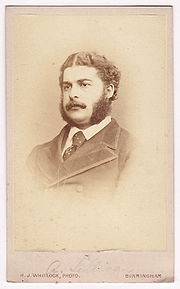
Franz Schubert
Franz Peter Schubert was an Austrian composer.Although he died at an early age, Schubert was tremendously prolific. He wrote some 600 Lieder, nine symphonies , liturgical music, operas, some incidental music, and a large body of chamber and solo piano music...
, Donizetti
Gaetano Donizetti
Domenico Gaetano Maria Donizetti was an Italian composer from Bergamo, Lombardy. His best-known works are the operas L'elisir d'amore , Lucia di Lammermoor , and Don Pasquale , all in Italian, and the French operas La favorite and La fille du régiment...
, Bellini
Vincenzo Bellini
Vincenzo Salvatore Carmelo Francesco Bellini was an Italian opera composer. His greatest works are I Capuleti ed i Montecchi , La sonnambula , Norma , Beatrice di Tenda , and I puritani...
, Gounod
Charles Gounod
Charles-François Gounod was a French composer, known for his Ave Maria as well as his operas Faust and Roméo et Juliette.-Biography:...
and Mendelssohn
Felix Mendelssohn
Jakob Ludwig Felix Mendelssohn Barthóldy , use the form 'Mendelssohn' and not 'Mendelssohn Bartholdy'. The Grove Dictionary of Music and Musicians gives ' Felix Mendelssohn' as the entry, with 'Mendelssohn' used in the body text...
. He also liked to evoke familiar musical styles, such as his madrigals
Madrigal (music)
A madrigal is a secular vocal music composition, usually a partsong, of the Renaissance and early Baroque eras. Traditionally, polyphonic madrigals are unaccompanied; the number of voices varies from two to eight, and most frequently from three to six....
in The Mikado, Ruddigore and The Yeomen of the Guard, glee
Glee (music)
A glee is an English type of part song spanning the late baroque, classical and early romantic periods. It is usually scored for at least three voices, and generally intended to be sung unaccompanied. Glees often consist of a number of short, musically contrasted movements and their texts can be...
s in H.M.S. Pinafore and The Mikado and gavotte
Gavotte
The gavotte originated as a French folk dance, taking its name from the Gavot people of the Pays de Gap region of Dauphiné, where the dance originated. It is notated in 4/4 or 2/2 time and is of moderate tempo...
s in Ruddigore and The Gondoliers. In The Sorcerer, there is a country dance and folksy duet between the men and women's chorus in "If you'll marry me". In Ruddigore, the sailor character dances a hornpipe, while in The Mikado, Sullivan quotes a Japanese war song in "Miya Sama". Sullivan's 1882 trip to Egypt inspired musical styles in his later opera, The Rose of Persia. Of the sextette "I hear the soft note" in Patience, Sullivan said to the singers, "I think you will like this. It is Dr. Arne
Michael Arne
Michael Arne was an English composer, harpsichordist, organist, singer, and actor. He was the son of composer Thomas Arne and lauded soprano Cecilia Young, the latter of which belonged to the famous Young family of musicians of the seventeenth and eighteenth centuries...
and Purcell
Henry Purcell
Henry Purcell – 21 November 1695), was an English organist and Baroque composer of secular and sacred music. Although Purcell incorporated Italian and French stylistic elements into his compositions, his legacy was a uniquely English form of Baroque music...
at their best."
In early pieces, in addition to his reflection of Mendelssohn (for example in his incidental music for The Tempest), Sullivan imitated Auber
Daniel Auber
Daniel François Esprit Auber was a French composer.-Biography:The son of a Paris print-seller, Auber was born in Caen in Normandy. Though his father expected him to continue in the print-selling business, he also allowed his son to learn how to play several musical instruments...
in his Henry VIII music and Gounod in The Light of the World. In his comic operas, Sullivan followed Offenbach
Jacques Offenbach
Jacques Offenbach was a Prussian-born French composer, cellist and impresario. He is remembered for his nearly 100 operettas of the 1850s–1870s and his uncompleted opera The Tales of Hoffmann. He was a powerful influence on later composers of the operetta genre, particularly Johann Strauss, Jr....
's lead in parodying the idioms of French and Italian opera, such as those of Donizetti, Verdi
Giuseppe Verdi
Giuseppe Fortunino Francesco Verdi was an Italian Romantic composer, mainly of opera. He was one of the most influential composers of the 19th century...
and Bellini. His music also shows the influence of Handel
George Frideric Handel
George Frideric Handel was a German-British Baroque composer, famous for his operas, oratorios, anthems and organ concertos. Handel was born in 1685, in a family indifferent to music...
, Schubert and, conspicuously in the fairy music in Iolanthe, Mendelssohn. The then-popular composer Michael Balfe
Michael William Balfe
Michael William Balfe was an Irish composer, best-remembered for his opera The Bohemian Girl.After a short career as a violinist, Balfe pursued an operatic singing career, while he began to compose. In a career spanning more than 40 years, he composed 38 operas, almost 250 songs and other works...
is parodied in The Sorcerer and The Pirates of Penzance, and "Twenty Love Sick Maidens" imitates William Vincent Wallace
William Vincent Wallace
William Vincent Wallace was an Irish composer and musician.-Early life:Wallace was born at Colbeck Street, Waterford, Ireland. Both parents were Irish, his father, of County Mayo, was a regimental bandmaster....
's "Alas Those Chimes" from Maritana
Maritana
Maritana is a grand opera in three acts composed by William Vincent Wallace, with a libretto by Edward Fitzball . The opera is based on the play Don César de Bazan by Adolphe d'Ennery and Philippe François Pinel Dumanoir , which was also the source material for Jules Massenet's opéra comique Don...
. The sextet "A Nice Dilemma" in Trial by Jury parodies "D'un pensiero" in Bellini's La sonnambula
La sonnambula
La sonnambula is an opera semiseria in two acts, with music in the bel canto tradition by Vincenzo Bellini to an Italian libretto by Felice Romani, based on a scenario for a ballet-pantomime by Eugène Scribe and Jean-Pierre Aumer called La somnambule, ou L'arrivée d'un nouveau seigneur.The first...
.
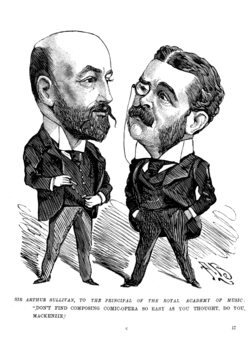
Il trovatore
Il trovatore is an opera in four acts by Giuseppe Verdi to an Italian libretto by Salvadore Cammarano, based on the play El Trovador by Antonio García Gutiérrez. Cammarano died in mid-1852 before completing the libretto...
and Rigoletto
Rigoletto
Rigoletto is an opera in three acts by Giuseppe Verdi. The Italian libretto was written by Francesco Maria Piave based on the play Le roi s'amuse by Victor Hugo. It was first performed at La Fenice in Venice on March 11, 1851...
, and the octet, "Farewell, my own," evokes the ensemble "Mag der Himmel euch vergeben" in Flotow's
Friedrich von Flotow
Friedrich Adolf Ferdinand, Freiherr von Flotow was a German composer. He is chiefly remembered for his opera Martha, which was popular in the 19th century....
Martha
Martha (opera)
Martha, oder Der Markt zu Richmond is a 'romantic comic' opera in four acts by Friedrich von Flotow, set to a German libretto by Friedrich Wilhelm Riese and based on a story by Jules-Henri Vernoy de Saint-Georges....
and such concerted numbers as the sextet in Donizetti's Lucia di Lammermoor
Lucia di Lammermoor
Lucia di Lammermoor is a dramma tragico in three acts by Gaetano Donizetti. Salvadore Cammarano wrote the Italian language libretto loosely based upon Sir Walter Scott's historical novel The Bride of Lammermoor....
. The mock-jingoistic "He is an Englishman" in H.M.S. Pinafore and choral passages in The Zoo satirise patriotic British tunes auch as Arne's "Rule, Britannia!
Rule, Britannia!
"Rule, Britannia!" is a British patriotic song, originating from the poem "Rule, Britannia" by James Thomson and set to music by Thomas Arne in 1740...
". The chorus "With catlike tread" from Pirates is an imitation of Verdi's "Anvil Chorus
Anvil Chorus
The Anvil Chorus is the English term for the Coro di zingari , a piece of music from Act 2, Scene 1 of Giuseppe Verdi's Il trovatore which depicts Spanish Gypsies striking their anvils at dawn – hence its English name – and singing the praises of hard work, good wine, and their Gypsy...
" from Il trovatore
Il trovatore
Il trovatore is an opera in four acts by Giuseppe Verdi to an Italian libretto by Salvadore Cammarano, based on the play El Trovador by Antonio García Gutiérrez. Cammarano died in mid-1852 before completing the libretto...
.
In Princess Ida, there is a strong Handelian flavour to Arac's song in Act III ("This helmet, I suppose"), and the Act II quartet "The world is but a broken toy" has been called "Gounodesque". Florian's statement in "Gently, Gently": "In this college, useful knowledge/Everywhere one finds" is a quotation from Chopin's Waltz No. 5 in A-flat Major (Op. 42). In The Gondoliers, there are the Spanish cachucha
Cachuca
Cachucha is a Spanish solo dance in 3/4 to 3/8 of the time similar to Bolero. Cachucha is danced to an Andalusian national song with castanet accompaniment.- Etymology :From Spanish cachucha, small boat...
, the Italian saltarello
Saltarello
The saltarello was a lively, merry dance first mentioned in Naples during the 13th century. The music survives, but no early instructions for the actual dance are known. It was played in a fast triple meter and is named for its peculiar leaping step, after the Italian verb saltare .-History:The...
and tarantella
Tarantella
The term tarantella groups a number of different southern Italian couple folk dances characterized by a fast upbeat tempo, usually in 6/8 time , accompanied by tambourines. It is among the most recognized of traditional Italian music. The specific dance name varies with every region, for instance...
, and the Venetian barcarolle
Barcarolle
A barcarole is a folk song sung by Venetian gondoliers, or a piece of music composed in that style...
. Hughes compares "Here is a case unprecedented" from The Gondoliers to the Act II quintet from Bizet
Georges Bizet
Georges Bizet formally Alexandre César Léopold Bizet, was a French composer, mainly of operas. In a career cut short by his early death, he achieved few successes before his final work, Carmen, became one of the most popular and frequently performed works in the entire opera repertory.During a...
's Carmen
Carmen
Carmen is a French opéra comique by Georges Bizet. The libretto is by Henri Meilhac and Ludovic Halévy, based on the novella of the same title by Prosper Mérimée, first published in 1845, itself possibly influenced by the narrative poem The Gypsies by Alexander Pushkin...
. In "A more humane Mikado", when the Mikado mentions "Bach
Johann Sebastian Bach
Johann Sebastian Bach was a German composer, organist, harpsichordist, violist, and violinist whose sacred and secular works for choir, orchestra, and solo instruments drew together the strands of the Baroque period and brought it to its ultimate maturity...
interwoven with Spohr
Louis Spohr
Louis Spohr was a German composer, violinist and conductor. Born Ludewig Spohr, he is usually known by the French form of his name. Described by Dorothy Mayer as "The Forgotten Master", Spohr was once as famous as Beethoven. As a violinist, his virtuoso playing was admired by Queen Victoria...
and Beethoven
Ludwig van Beethoven
Ludwig van Beethoven was a German composer and pianist. A crucial figure in the transition between the Classical and Romantic eras in Western art music, he remains one of the most famous and influential composers of all time.Born in Bonn, then the capital of the Electorate of Cologne and part of...
", the clarinet and bassoon quote the fugue subject of Bach's Fantasia and Fugue in G minor
Great Fantasia and Fugue in G minor, BWV 542
The Great Fantasia and Fugue in G minor, BWV 542, is an organ prelude and fugue by Johann Sebastian Bach. It acquired that name to distinguish it from the earlier Little Fugue in G minor, which is shorter...
. The Golden Legend shows the influence of Liszt
Franz Liszt
Franz Liszt ; ), was a 19th-century Hungarian composer, pianist, conductor, and teacher.Liszt became renowned in Europe during the nineteenth century for his virtuosic skill as a pianist. He was said by his contemporaries to have been the most technically advanced pianist of his age...
and Wagner.
Sullivan frequently gives groups or locations their own characters and motifs. Hughes points to the striking difference between the male chorus of rustics in The Sorcerer and the eponymous gondoliers, and between the fairies in Iolanthe and the undergraduates in Princess Ida. H.M.S Pinafore retains "a nautical tang throughout", and in The Yeomen of the Guard the Tower of London is evoked continually by its own motif. This use of Wagnerian leitmotif technique is repeated and developed further in Ivanhoe.
Reputation and criticism
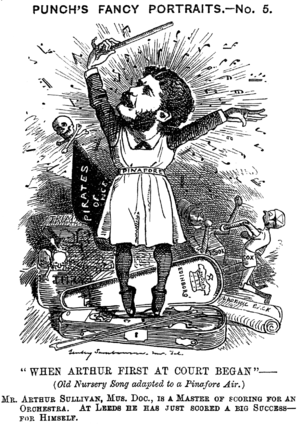 |
| Cartoon from Punch Punch (magazine) Punch, or the London Charivari was a British weekly magazine of humour and satire established in 1841 by Henry Mayhew and engraver Ebenezer Landells. Historically, it was most influential in the 1840s and 50s, when it helped to coin the term "cartoon" in its modern sense as a humorous illustration... in 1880. It was premature in declaring Sullivan's knighthood, but was accompanied by a parody Parody A parody , in current usage, is an imitative work created to mock, comment on, or trivialise an original work, its subject, author, style, or some other target, by means of humorous, satiric or ironic imitation... version of "When I, good friends" from Trial by Jury Trial by Jury Trial by Jury is a comic opera in one act, with music by Arthur Sullivan and libretto by W. S. Gilbert. It was first produced on 25 March 1875, at London's Royalty Theatre, where it initially ran for 131 performances and was considered a hit, receiving critical praise and outrunning its... that summarised Sullivan's career to that date: |
| "A HUMOROUS KNIGHT." |
| ["It is reported that after the Leeds Festival Dr. Sullivan will be knighted." Having read this in a column of gossip, a be-nighted Contributor, who has "the Judge's Song" on the brain, suggests the following verse, adapted to probabilities.] |
|
Early reception
Sullivan's critical reputation has undergone extreme changes since he first came to prominence in the 1860s. At first, critics were struck by his potential, and he was hailed as the long-awaited great English composer. His incidental music to The Tempest received an acclaimed premiere at the Crystal PalaceThe Crystal Palace
The Crystal Palace was a cast-iron and glass building originally erected in Hyde Park, London, England, to house the Great Exhibition of 1851. More than 14,000 exhibitors from around the world gathered in the Palace's of exhibition space to display examples of the latest technology developed in...
just before Sullivan's 20th birthday in April 1862. The Athenaeum
Athenaeum (magazine)
The Athenaeum was a literary magazine published in London from 1828 to 1921. It had a reputation for publishing the very best writers of the age....
wrote:
His Irish Symphony of 1866 won similarly enthusiastic praise, but as Arthur Jacobs
Arthur Jacobs
Arthur David Jacobs was an English music critic, musicologist, teacher, librettist and translator. Among his many books, two of the best known are his Penguin Dictionary of Music, which was reprinted in several editions between 1958 and 1996, and his biography of Arthur Sullivan, which was praised...
notes, "The first rapturous outburst of enthusiasm for Sullivan as an orchestral composer did not last." A comment typical of those that followed him throughout his career was that "Sullivan's unquestionable talent should make him doubly careful not to mistake popular applause for artistic appreciation."
When Sullivan turned to comic opera with Gilbert, the serious critics began to express disapproval. The critic Peter Gammond writes of "misapprehensions and prejudices, delivered to our door by the Victorian firm Musical Snobs Ltd. … frivolity and high spirits were sincerely seen as elements that could not be exhibited by anyone who was to be admitted to the sanctified society of Art." For example, in 1877 The Figaro wrote that Sullivan "has all the ability to make him a great composer, but he wilfully throws his opportunity away. ... He possesses all the natural ability to have given us an English opera, and, instead, he affords us a little more-or-less excellent fooling. Few critics denied the excellence of Sullivan's theatre scores; The Theatre wrote that "Iolanthe sustains Dr Sullivan's reputation as the most spontaneous, fertile, and scholarly composer of comic opera this country has ever produced." However, comic opera, no matter how skilfully crafted, was viewed as an intrinsically lower form of art than oratorio. The Athenaeum's review of The Martyr of Antioch declared, "[I]t is an advantage to have the composer of H.M.S. Pinafore occupying himself with a worthier form of art.
Knighthood and later years
Sullivan's knighthood in 1883 gave the serious music critics further ammunition. The Musical Review of that year wrote:Even Sullivan's friend George Grove wrote: "Surely the time has come when so able and experienced a master of voice, orchestra, and stage effect – master, too, of so much genuine sentiment – may apply his gifts to a serious opera on some subject of abiding human or natural interest." Sullivan finally redeemed himself in critical eyes with The Golden Legend in 1886 . The Observer
The Observer
The Observer is a British newspaper, published on Sundays. In the same place on the political spectrum as its daily sister paper The Guardian, which acquired it in 1993, it takes a liberal or social democratic line on most issues. It is the world's oldest Sunday newspaper.-Origins:The first issue,...
hailed it as a "triumph of English art".. The World called it "one of the greatest creations we have had for many years. Original, bold, inspired, grand in conception, in execution, in treatment, it is a composition which will make an "epoch" and which will carry the name of its composer higher on the wings of fame and glory. ... The effect of the public performance was unprecedented."
Hopes for a new departure were evident in the Daily Telegraphs review of The Yeomen of the Guard (1888), Sullivan's most serious opera to that point: "[T]he music follows the book to a higher plane, and we have a genuine English opera, forerunner of many others, let us hope, and possibly significant of an advance towards a national lyric stage." Sullivan's only wholly serious opera, Ivanhoe (1891), received generally favourable reviews, although J. A. Fuller Maitland
John Alexander Fuller Maitland
John Alexander Fuller Maitland was an influential British music critic and scholar from the 1880s to the 1920s. He encouraged the rediscovery of English music of the 16th and 17th centuries, particularly Henry Purcell's music and English virginal music...
, in The Times, expressed reservations, writing that the opera's "best portions rise so far above anything else that Sir Arthur Sullivan has given to the world, and have such force and dignity, that it is not difficult to forget the drawbacks which may be found in the want of interest in much of the choral writing, and the brevity of the concerted solo parts." Sullivan's 1898 ballet Victoria and Merrie England
Victoria and Merrie England
Victoria and Merrie England is an 1897 ballet by Arthur Sullivan, written to commemorate Queen Victoria's Diamond Jubilee – a remarkable sixty years on the throne. The ballet became very popular and ran for nearly six months.-Background:...
was one of several late pieces that won praise from most critics:
Although the more solemn members of the musical establishment could not forgive Sullivan for writing music that was both comic and accessible, he was, nevertheless, "the nation's de facto composer laureate".
Posthumous reputation
In the decade after his death, Sullivan's reputation sank considerably. In 1901, Fuller Maitland took issue with the generally laudatory tone of most of the obituaries: "Is there anywhere a case quite parallel to that of Sir Arthur Sullivan, who began his career with a work which at once stamped him as a genius, and to the height of which he only rarely attained throughout life? ... It is because such great natural gifts – gifts greater, perhaps, than fell to any English musician since ... Purcell – were so very seldom employed in work worthy of them. ... [H]ow can the composer of "Onward Christian Soldiers" and "The Absent-Minded Beggar" claim a place in the hierarchy of music among the men who would face death rather than smirch their singing robes for the sake of a fleeting popularity?" Edward ElgarEdward Elgar
Sir Edward William Elgar, 1st Baronet OM, GCVO was an English composer, many of whose works have entered the British and international classical concert repertoire. Among his best-known compositions are orchestral works including the Enigma Variations, the Pomp and Circumstance Marches, concertos...
, to whom Sullivan had been particularly kind, rose to Sullivan's defence, branding Fuller Maitland's obituary "the shady side of musical criticism ... that foul unforgettable episode."
Fuller Maitland's followers, including Ernest Walker, also dismissed Sullivan as "merely the idle singer of an empty evening". As late as 1966, Frank Howes, music critic of The Times
The Times
The Times is a British daily national newspaper, first published in London in 1785 under the title The Daily Universal Register . The Times and its sister paper The Sunday Times are published by Times Newspapers Limited, a subsidiary since 1981 of News International...
condemned Sullivan for a "lack of sustained effort ... a fundamental lack of seriousness towards his art [and] inability to perceive the smugness, the sentimentality and banality of the Mendelssohnian detritus … to remain content with the flattest and most obvious rhythms, this yielding to a fatal facility, that excludes Sullivan from the ranks of the good composers."
Thomas F. Dunhill wrote a chapter entitled "Mainly in Defence" in his 1928 book, Sullivan's Comic Operas because Sullivan's "music has suffered in an extraordinary degree from the vigorous attacks which have been made upon it in professional circles. These attacks have succeeded in surrounding the composer with a kind of barricade of prejudice which must be swept away before justice can be done to his genius." Sir Henry Wood
Henry Wood
Henry Wood was a British conductor.Henry Wood may also refer to:* Henry C. Wood , American Civil War Medal of Honor recipient* Henry Wood , English cricketer...
continued to perform Sullivan's serious music, but it was not until the 1960s that Sullivan's music other than the Savoy operas began to be widely revived and reassessed. In 1960 Gervase Hughes
Gervase Hughes
Gervase Alfred Booth Hughes was an English composer, conductor and writer on music. From 1926 to 1933, Hughes pursued a career as a conductor and chorus master, principally at the British National Opera Company, and also co-produced Shakespeare plays...
published the first full-length book about Sullivan's music "which, while taking note of his weaknesses (which are many) and not hesitating to castigate his lapses from good taste (which were comparatively rare) [attempted] to view them in perspective against the wider background of his sound musicianship." The work of the Sir Arthur Sullivan Society, founded in 1977; books about Sullivan by musicians such as Percy Young (1971) and Arthur Jacobs (1986); and a number of recordings have contributed to the re-evaluation of Sullivan's music.
The Symphony in E had its first professional recording in 1968, and a considerable number of Sullivan's non-Gilbert works have since been recorded, including the overtures and the Shakespeare incidental music, ballet music, the cello concerto, solo piano and chamber music, his cantatas, Ivanhoe and some of his non-Gilbert comic operas. Scholarly critical editions of Sullivan's works have been published. In a 2000 article in The Musical Times, Nigel Burton wrote:
Recordings
In 1888, Thomas EdisonThomas Edison
Thomas Alva Edison was an American inventor and businessman. He developed many devices that greatly influenced life around the world, including the phonograph, the motion picture camera, and a long-lasting, practical electric light bulb. In addition, he created the world’s first industrial...
sent his "Perfected" Phonograph to George Gouraud
George Edward Gouraud
Colonel George Edward Gouraud was an American Civil War recipient of the Medal of Honor who later became famous for introducing the new Edison Phonograph cylinder audio recording technology to England in 1888.-Biography:...
in London, England, and on 14 August 1888, Gouraud introduced the phonograph to London in a press conference, including the playing of a piano and cornet recording of Sullivan's "The Lost Chord
The Lost Chord
"The Lost Chord" is a song composed by Arthur Sullivan in 1877 at the bedside of his brother Fred during Fred's last illness. The manuscript is dated 13 January 1877; Fred Sullivan died five days later...
", one of the first recordings of music ever made. A series of parties followed, introducing the phonograph to members of society at the so-called "Little Menlo" in London. Sullivan was invited to one of these on 5 October 1888. After dinner, he recorded a speech to be sent to Edison, saying, in part:
These recordings were discovered in the Edison Library in New Jersey in the 1950s:
The first commercial recordings of Sullivan's music, beginning in 1898, were of individual numbers from the Savoy operas. In 1917, the Gramophone Company
Gramophone Company
The Gramophone Company, based in the United Kingdom, was one of the early recording companies, and was the parent organization for the famous "His Master's Voice" label...
(also known as HMV
HMV
His Master's Voice is a trademark in the music business, and for many years was the name of a large record label. The name was coined in 1899 as the title of a painting of the dog Nipper listening to a wind-up gramophone...
) produced the first album of a complete musical score of a Gilbert and Sullivan opera, The Mikado, followed by recordings of eight more of the operas. Electrical recordings of the complete musical scores of most of the operas were then issued by the Gramophone Company and Victor Talking Machine Company
Victor Talking Machine Company
The Victor Talking Machine Company was an American corporation, the leading American producer of phonographs and phonograph records and one of the leading phonograph companies in the world at the time. It was headquartered in Camden, New Jersey....
beginning in the late 1920s. These recordings were supervised by Rupert D'Oyly Carte
Rupert D'Oyly Carte
Rupert D'Oyly Carte was an English hotelier, theatre owner and impresario, best known as proprietor of the D'Oyly Carte Opera Company and Savoy Hotel from 1913 to 1948....
. The D'Oyly Carte Opera Company continued to produce recordings until 1979. Between 1988 and 2003, after the company was revived, it recorded seven of the operas.
Other recordings have been made by opera companies such as Gilbert and Sullivan for All
Gilbert and Sullivan for All
Gilbert and Sullivan for All was a touring concert and opera company, formed in 1963 by D'Oyly Carte Opera Company performers Thomas Round and Donald Adams and Norman Meadmore, and which exclusively performed the works of Gilbert and Sullivan, usually in concert, but sometimes giving full...
, English National Opera
English National Opera
English National Opera is an opera company based in London, resident at the London Coliseum in St. Martin's Lane. It is one of the two principal opera companies in London, along with the Royal Opera, Covent Garden...
and Australian Opera
Opera Australia
Opera Australia is the principal opera company in Australia. Based in Sydney, its performance season at the Sydney Opera House runs for approximately eight months of the year, with the remainder of its time spent in the The Arts Centre in Melbourne...
. Ad hoc companies of operatic singers conducted by Sir Malcolm Sargent
Malcolm Sargent
Sir Harold Malcolm Watts Sargent was an English conductor, organist and composer widely regarded as Britain's leading conductor of choral works...
in the 1950s and 60s and Sir Charles Mackerras
Charles Mackerras
Sir Alan Charles Maclaurin Mackerras, AC, CH, CBE was an Australian conductor. He was an authority on the operas of Janáček and Mozart, and the comic operas of Gilbert and Sullivan...
in the 1990s have made audio sets of several Savoy operas, and in the 1980s Alexander Faris
Alexander Faris
Alexander "Sandy" Faris is an Irish composer, conductor and writer, known for his television theme tunes. He has composed and recorded many operas and musicals, and has composed film scores and orchestral works.-Life and career:...
conducted video recordings of most of the operas with casts including show-business stars as well as professional singers. The long-running Broadway
Broadway theatre
Broadway theatre, commonly called simply Broadway, refers to theatrical performances presented in one of the 40 professional theatres with 500 or more seats located in the Theatre District centered along Broadway, and in Lincoln Center, in Manhattan in New York City...
production of The Pirates of Penzance presented by Joseph Papp
Joseph Papp
Joseph Papp was an American theatrical producer and director. Papp established The Public Theater in what had been the Astor Library Building in downtown New York . "The Public," as it is known, has many small theatres within it...
, re-orchestrated with synthesisers replacing the strings, was put on record in 1981. Since 1994, the International Gilbert and Sullivan Festival
International Gilbert and Sullivan Festival
The International Gilbert and Sullivan Festival is held every summer at the Opera House in Buxton, Derbyshire, England. The three-week Festival of Gilbert and Sullivan performances and fringe events attracts thousands of visitors, including performers, supporters, and G&S enthusiasts from all...
has released numerous professional and amateur CDs and videos of its productions and other Sullivan recordings.
Sullivan's non-Savoy works were infrequently recorded until more recent decades. A few of his songs were put on disc in the early years of the 20th century, including versions of "The Lost Chord" by Enrico Caruso and Clara Butt
Clara Butt
Dame Clara Ellen Butt DBE , sometimes called Clara Butt-Rumford after her marriage, was an English contralto with a remarkably imposing voice and a surprisingly agile singing technique. Her main career was as a recitalist and concert singer.-Early life and career:Clara Butt was born in Southwick,...
. The first of many recordings of the Overture di Ballo was made in the 1940s. Sullivan's Irish symphony was first recorded in 1968 under Sir Charles Groves
Charles Groves
Sir Charles Barnard Groves CBE was an English conductor. He was known for the breadth of his repertoire and for encouraging contemporary composers and young conductors....
. Since then, much of Sullivan's serious music and his operas without Gilbert have been recorded. The first recording of the cello concerto was by Julian Lloyd Webber
Julian Lloyd Webber
Julian Lloyd Webber is a British solo cellist who has been described as the "doyen of British cellists".-Early life:Julian Lloyd Webber is the second son of the composer William Lloyd Webber and his wife Jean Johnstone . He is the younger brother of the composer Andrew Lloyd Webber...
in 1986. Ivanhoe was recorded under the conductor David Lloyd-Jones
David Lloyd-Jones
David Matthias Lloyd-Jones is a British conductor who has specialised in British and Russian music. He is also an editor and translator, especially of Russian operas.- Biography :...
in 2009, and The Golden Legend was recorded under Ronald Corp
Ronald Corp
Ronald Corp is a composer, conductor, and Church of England priest. He is founder and Artistic Director of the New London Orchestra and the New London Children's Choir. Corp is Musical Director of the London Chorus, a position he took up in 1994, and is also Musical Director of the Highgate Choral...
in 2001. Mackerras's Sullivan ballet score, Pineapple Poll
Pineapple Poll
Pineapple Poll is a Gilbert and Sullivan-inspired comic ballet, created by choreographer John Cranko with arranger Sir Charles Mackerras. Pineapple Poll is based on "The Bumboat Woman's Story", one of W. S. Gilbert's Bab Ballads, written in 1870. The Gilbert and Sullivan opera H.M.S. Pinafore was...
, has received many recordings since its premiere in 1951, four of them conducted by Mackerras.
See also
- List of musical compositions by Arthur Sullivan
- People associated with Gilbert and Sullivan
External links
- Extensive list of links to Sullivan works and materials at the Gilbert and Sullivan Archive
- Obituary notices in The Times
- Detailed 1879 article about Sullivan
- Gilbert and Sullivan Discography
- "Sir Arthur Sullivan Buried in St. Paul's" The New York Times, November 28, 1900, p. 9
- "The Other Side of Sullivan", lecture by Robin WilsonRobin Wilson (mathematician)Robin James Wilson is a professor in the Department of Mathematics at the Open University, a Stipendiary Lecturer at Pembroke College, Oxford and, , Professor of Geometry at Gresham College, London, where he has also been a visiting professor...
on the non-operatic musical output of Sullivan, given at Gresham CollegeGresham CollegeGresham College is an institution of higher learning located at Barnard's Inn Hall off Holborn in central London, England. It was founded in 1597 under the will of Sir Thomas Gresham and today it hosts over 140 free public lectures every year within the City of London.-History:Sir Thomas Gresham,...
, 11 June 2008. - Sir Arthur Sullivan Society