


The Crystal Palace

Encyclopedia
The Crystal Palace was a cast-iron
and glass building originally erected in Hyde Park, London
, England, to house the Great Exhibition
of 1851. More than 14,000 exhibitors from around the world gathered in the Palace's 990000 square feet (91,974 m²) of exhibition space to display examples of the latest technology developed in the Industrial Revolution
. Designed by Joseph Paxton
, the Great Exhibition building was 1851 feet (564 m) long, with an interior height of 128 feet (39 m).
After the exhibition, the building was moved to a new park in Penge Common next to an affluent area of London called Sydenham Hill
, a suburb full of large villas. The Crystal Palace was enlarged and stood in the area from 1854 to 1936, when it was destroyed by fire. It attracted many thousands of visitors from all levels of society. The name Crystal Palace (the satirical magazine Punch usually gets the credit for coining the phrase) was later used to denote this area of south London
and the park that surrounds the site, home of the Crystal Palace National Sports Centre
.
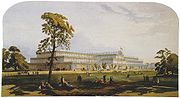
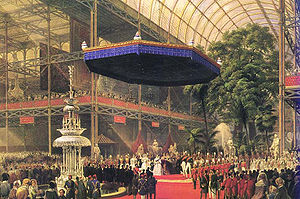 The huge, modular wood, glass and iron structure at the top of Sydenham Hill
was originally erected in Hyde Park
in London to house The Great Exhibition of 1851, showcasing the products of many countries throughout the world.
The Crystal Palace's creator, Joseph Paxton
, received a knighthood in recognition of his work. Paxton had been the head gardener at Chatsworth House
. There he had experimented with glass and iron in the creation of large greenhouse
s, and had seen something of their strength and durability, knowledge that he applied to the plans for the Great Exhibition building. Planners had been looking for strength, durability, simplicity of construction and speed—and this they got from Paxton's ideas. The project was engineered by Sir William Cubitt
.
Full-size, living elm trees in the park were enclosed within the central exhibition hall near the 27 feet (8 m) tall Crystal Fountain. Sparrows became a nuisance; Queen Victoria
mentioned this problem to the Duke of Wellington
, who offered the famous solution, "Sparrowhawks, Ma'am".
The Crystal Palace was built by about 5,000 navvies
(up to 2,000 on site at once).
The ironwork contractors were Sir Charles Fox
's Fox and Henderson. The 900,000 square feet (84,000 m²) of glass were provided by the Chance Brothers
glassworks in Smethwick
, Birmingham. They were the only glassworks capable of fulfilling such a large order and had to bring in labour from France to meet it in time.
The final dimensions were 1848 feet (563.3 m) long by 456 feet (139 m) wide. The building was 135 feet (41.1 m) high, with 772784 square feet (71,794 m²) on the ground floor alone.
The Crystal Palace had the first major installation of public toilets, the Retiring Rooms, in which sanitary engineer
George Jennings
installed his "Monkey Closet" flushing lavatory (initially just for men, but later catering to women). During the exhibition, 827,280 visitors paid one penny each to use them. This is often given as the origin of the British euphemism
"to spend a penny", although John Maskelyne
's penny lock
for pay toilet
s (used from 1855) is a commonly cited alternative origin. The euphemism did not appear in print until the 1940s.
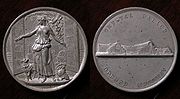
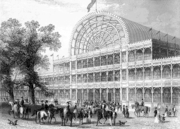 The life of the Great Exhibition was limited to six months, after which, something had to be done with the building. Against the wishes of Parliamentary
opponents, the edifice was erected on a property named Penge Place that had been excised from Penge Common
atop Sydenham Hill.
The building constructed in 1854 on Sydenham Hill, while incorporating most of the constructional parts of the Hyde Park building, was so completely different in form as to be properly considered a quite different structure – a 'Beaux-arts' form in glass and metal. It was modified and enlarged so much that it extended beyond the boundary of Penge Place, which was also the boundary between Surrey
and Kent
. Within two years, Queen Victoria
again performed an opening ceremony
. The new site hosted concerts, exhibits, and public entertainment. The new site was also the location of one of Charles Spurgeon
's famous sermons, without amplification, before a crowd of 23,654 people on 7 October 1857. The reconstruction was recorded for posterity by Philip Henry Delamotte
, and his photographs were widely disseminated in his published works.
Several localities claim to be the area to which the building was relocated. The street address of the Crystal Palace was Sydenham S.E (SE26 after 1917), but the actual building and parklands were in Penge. At the time of relocation most of the buildings were in the borough of Croydon
, as were the majority of grounds. In 1899, the county boundary was moved, transferring the entire site to Penge Urban District
in Kent. The site is now within the Crystal Palace Ward of the London Borough of Bromley
.
Two railway stations
were opened to serve the permanent exhibition: Crystal Palace High Level
(an impressive building by Edward Barry
), from which a subway under the Parade led directly to the entrance, and Crystal Palace Low Level station off Anerley Road. The Low Level Station is still in use as Crystal Palace railway station
. The only remains of the High Level Station is the subway under the Parade with its Italian
mosaic
roofing which is a Grade II listed building.
The South Gate is served by Penge West Railway Station
. For some time this station was on an atmospheric railway
. This is often confused with a 550-metre pneumatic passenger railway which was exhibited at the Crystal Palace in 1864, which was known as the Crystal Palace pneumatic railway
.
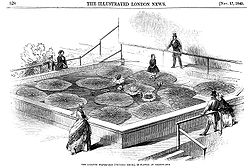
 Joseph Paxton was first and foremost a gardener, and his layout of gardens, fountain
s, terrace
s and cascades left no doubt as to his ability. One thing he did have a problem with was water supply. Such was his enthusiasm that thousands of gallons of water were needed in order to feed the myriad fountains and cascades which abounded in the Crystal Palace park. The two main jets were 250 feet (76 m) high.
Initially, water tower
s were constructed, but the weight of water in the raised tanks caused them to collapse. Isambard Kingdom Brunel
was consulted and came up with the plans for two mighty water towers, one at the north and the other at the south end of the building. Each supported a tremendous load of water, which was gathered from three reservoirs, at either end of and in the middle of the park.
Two years later, the grand fountains and cascades were opened, again in the presence of the Queen, who got wet when a gust of wind swept mists of spray over the Royal carriage.
held that people should not be encouraged to work at the Palace or drive on Sunday, and that if people wanted to visit, then their employers should give them time off during the working week. However, the Palace was open on Sundays by May 1861, when 40,000 visitors came.
In 1871 the world's first cat show
, organised by Harrison Weir
, was held at The Crystal Palace.
By the 1890s the Palace's popularity and state of repair had deteriorated; the appearance of stalls and booths had made it a more downmarket attraction.
A colourful description of a visit to the Crystal Palace was described in John Davidson's
poem 'The Crystal Palace' published in 1909.
Robert Baden-Powell first noticed the interest of girls in Scouting
while attending a Boy Scout
meeting at Crystal Palace in 1909. This observation would later lead to the formation of Girl Guides, then Girl Scouts.
In 1911, the Festival of Empire
was held at the building to mark the coronation
of George V
and Queen Mary
.
costs became unsustainable, and in 1911 bankruptcy was declared. In 1913 the Earl of Plymouth
purchased it, to save it from developers. A public subscription quickly re-purchased it for the nation.
During the First World War, it was used as a naval training establishment under the name of HMS Victory VI, informally known as HMS Crystal Palace. More than 125,000 men from the Royal Naval Division, Royal Naval Volunteer Reserve and Royal Naval Air Service
were trained for war at Victory VI. At the cessation of hostilities it was re-opened as the first Imperial War Museum
, but traffic remained light.
In the 1920s, a board of trustees was set up under the guidance of manager Sir Henry Buckland. He is said to have been a firm but fair man, who had a great love for the Crystal Palace, and soon set about restoring the deteriorating building. The restoration not only brought visitors back, but also meant that the Palace started to make a small profit once more. Buckland and his staff also worked on improving the fountains and gardens, including the Thursday evening displays of fireworks
by Brocks. On 15–20 October 1934 the Pageant of Labour
was held at the Crystal Palace.
. Within hours the Palace was destroyed: the glow was visible across eight counties. That night, Buckland was walking his dog near the palace, with his daughter (Crystal Buckland, named for the palace) when they noticed a red glow within. Inside, he found two of his employees fighting a small office fire, that had started after an explosion in the women's cloakroom
. Realising that it was a serious fire, they called the Penge fire brigade. But, even though 89 fire engines and over 400 firemen arrived they were unable to extinguish it. (The fire spread quickly in the high winds that night, because it could consume the dry old timber flooring, and the huge quantity of flammable materials in the building.) Buckland said, “In a few hours we have seen the end of the Crystal Palace. Yet it will live in the memories not only of Englishmen, but the whole world”. 100,000 people came to Sydenham Hill to watch the blaze, among them Winston Churchill
, who said, "This is the end of an age".
Just as in 1866, when the north transept burnt down, the building was not adequately insured to cover the cost of rebuilding (at least two million pounds).
The South Tower had been used for tests by television pioneer John Logie Baird
for his mechanical television experiments, and much of his work was destroyed in the fire.
The north one was demolished with explosives in 1941. No reason was given for its removal, although it was rumoured that this was to elimate a landmark for WWII German aircraft, but Luftwaffe
bombers actually navigated their way to Central London by tracking the River Thames rather than landmarks.
The Crystal Palace grounds were also used as a manufacturing base for aircraft radar screens and other hi-tech equipment of the time. This remained secret until well after the war.
With the Palace's destruction, the High Level Branch station fell into disuse, and was finally shut down in 1954. After the war, the site was used for a number of purposes. Between 1953 and 1973 an auto racing
circuit operated on the site, some supported by the Greater London Council
. The noise was unpopular with nearby residents and racing hours were soon regulated under a high court judgment.
Cast iron
Cast iron is derived from pig iron, and while it usually refers to gray iron, it also identifies a large group of ferrous alloys which solidify with a eutectic. The color of a fractured surface can be used to identify an alloy. White cast iron is named after its white surface when fractured, due...
and glass building originally erected in Hyde Park, London
Hyde Park, London
Hyde Park is one of the largest parks in central London, United Kingdom, and one of the Royal Parks of London, famous for its Speakers' Corner.The park is divided in two by the Serpentine...
, England, to house the Great Exhibition
The Great Exhibition
The Great Exhibition of the Works of Industry of all Nations or The Great Exhibition, sometimes referred to as the Crystal Palace Exhibition in reference to the temporary structure in which it was held, was an international exhibition that took place in Hyde Park, London, from 1 May to 15 October...
of 1851. More than 14,000 exhibitors from around the world gathered in the Palace's 990000 square feet (91,974 m²) of exhibition space to display examples of the latest technology developed in the Industrial Revolution
Industrial Revolution
The Industrial Revolution was a period from the 18th to the 19th century where major changes in agriculture, manufacturing, mining, transportation, and technology had a profound effect on the social, economic and cultural conditions of the times...
. Designed by Joseph Paxton
Joseph Paxton
Sir Joseph Paxton was an English gardener and architect, best known for designing The Crystal Palace.-Early life:...
, the Great Exhibition building was 1851 feet (564 m) long, with an interior height of 128 feet (39 m).
After the exhibition, the building was moved to a new park in Penge Common next to an affluent area of London called Sydenham Hill
Sydenham Hill
For other uses of 'Sydenham', see Sydenham .Sydenham Hill is a hill or ridge and a locality in South-East London and the name of a road which runs along the northern eastern part of the ridge and forms the boundary between the London Borough of Southwark and the London Borough of Lewisham. The...
, a suburb full of large villas. The Crystal Palace was enlarged and stood in the area from 1854 to 1936, when it was destroyed by fire. It attracted many thousands of visitors from all levels of society. The name Crystal Palace (the satirical magazine Punch usually gets the credit for coining the phrase) was later used to denote this area of south London
Crystal Palace, London
Crystal Palace is a residential area in south London, England named from the former local landmark, The Crystal Palace, which occupied the area from 1854 to 1936. The area is located approximately 8 miles south east of Charing Cross, and offers impressive views over the capital...
and the park that surrounds the site, home of the Crystal Palace National Sports Centre
Crystal Palace National Sports Centre
The National Sports Centre at Crystal Palace in south London, England is a large sports centre and athletics stadium. It was opened in 1964 in Crystal Palace Park, close to the site of the former Crystal Palace, in the former parkland and also usurping part of the former grand prix circuit.It was...
.
Original Hyde Park building
Sydenham Hill
For other uses of 'Sydenham', see Sydenham .Sydenham Hill is a hill or ridge and a locality in South-East London and the name of a road which runs along the northern eastern part of the ridge and forms the boundary between the London Borough of Southwark and the London Borough of Lewisham. The...
was originally erected in Hyde Park
Hyde Park, London
Hyde Park is one of the largest parks in central London, United Kingdom, and one of the Royal Parks of London, famous for its Speakers' Corner.The park is divided in two by the Serpentine...
in London to house The Great Exhibition of 1851, showcasing the products of many countries throughout the world.
The Crystal Palace's creator, Joseph Paxton
Joseph Paxton
Sir Joseph Paxton was an English gardener and architect, best known for designing The Crystal Palace.-Early life:...
, received a knighthood in recognition of his work. Paxton had been the head gardener at Chatsworth House
Chatsworth House
Chatsworth House is a stately home in North Derbyshire, England, northeast of Bakewell and west of Chesterfield . It is the seat of the Duke of Devonshire, and has been home to his family, the Cavendish family, since Bess of Hardwick settled at Chatsworth in 1549.Standing on the east bank of the...
. There he had experimented with glass and iron in the creation of large greenhouse
Greenhouse
A greenhouse is a building in which plants are grown. These structures range in size from small sheds to very large buildings...
s, and had seen something of their strength and durability, knowledge that he applied to the plans for the Great Exhibition building. Planners had been looking for strength, durability, simplicity of construction and speed—and this they got from Paxton's ideas. The project was engineered by Sir William Cubitt
William Cubitt
Sir William Cubitt was an eminent English civil engineer and millwright. Born in Norfolk, England, he was employed in many of the great engineering undertakings of his time. He invented a type of windmill sail and the prison treadwheel, and was employed as chief engineer, at Ransomes of Ipswich,...
.
Full-size, living elm trees in the park were enclosed within the central exhibition hall near the 27 feet (8 m) tall Crystal Fountain. Sparrows became a nuisance; Queen Victoria
Victoria of the United Kingdom
Victoria was the monarch of the United Kingdom of Great Britain and Ireland from 20 June 1837 until her death. From 1 May 1876, she used the additional title of Empress of India....
mentioned this problem to the Duke of Wellington
Arthur Wellesley, 1st Duke of Wellington
Field Marshal Arthur Wellesley, 1st Duke of Wellington, KG, GCB, GCH, PC, FRS , was an Irish-born British soldier and statesman, and one of the leading military and political figures of the 19th century...
, who offered the famous solution, "Sparrowhawks, Ma'am".
The Crystal Palace was built by about 5,000 navvies
Navvy
Navvy is a shorter form of navigator or navigational engineer and is particularly applied to describe the manual labourers working on major civil engineering projects...
(up to 2,000 on site at once).
The ironwork contractors were Sir Charles Fox
Sir Charles Fox
Sir Charles Fox was an English civil engineer and contractor. His work focused on railways, railway stations and bridges.-Biography:...
's Fox and Henderson. The 900,000 square feet (84,000 m²) of glass were provided by the Chance Brothers
Chance Brothers
Chance Brothers and Company was a glassworks originally based in Spon Lane, Smethwick, West Midlands , in England. It was a leading glass manufacturer and a pioneer of British glassmaking technology....
glassworks in Smethwick
Smethwick
Smethwick is a town in the Metropolitan Borough of Sandwell, in the West Midlands of England. It is situated on the edge of the city of Birmingham, within the historic boundaries of Staffordshire, Worcestershire and Warwickshire....
, Birmingham. They were the only glassworks capable of fulfilling such a large order and had to bring in labour from France to meet it in time.
The final dimensions were 1848 feet (563.3 m) long by 456 feet (139 m) wide. The building was 135 feet (41.1 m) high, with 772784 square feet (71,794 m²) on the ground floor alone.
The Crystal Palace had the first major installation of public toilets, the Retiring Rooms, in which sanitary engineer
Sanitary engineering
Sanitary engineering is the application of engineering methods to improve sanitation of human communities, primarily by providing the removal and disposal of human waste, and in addition to the supply of safe potable water. Initially in the mid 19th century, the discipline concentrated on the...
George Jennings
George Jennings
George Jennings was an English sanitary engineer and plumber who invented the first public toilets.Josiah George Jennings was born on 10 November 1810 in Eling, at the edge of the New Forest in Hampshire. He was the eldest of seven children of Jonas Joseph Jennings and Mary Dimmock...
installed his "Monkey Closet" flushing lavatory (initially just for men, but later catering to women). During the exhibition, 827,280 visitors paid one penny each to use them. This is often given as the origin of the British euphemism
Euphemism
A euphemism is the substitution of a mild, inoffensive, relatively uncontroversial phrase for another more frank expression that might offend or otherwise suggest something unpleasant to the audience...
"to spend a penny", although John Maskelyne
John Nevil Maskelyne
John Nevil Maskelyne was an English stage magician and inventor of the pay toilet, along with many other Victorian-era devices. His door lock for London toilets required the insertion of a penny coin to operate it, hence the euphemism to "spend a penny".-Biography:Maskelyne was born in Cheltenham,...
's penny lock
Lock (device)
A lock is a mechanical or electronic fastening device that is released by a physical object or secret information , or combination of more than one of these....
for pay toilet
Pay toilet
A pay toilet is a public toilet that requires money payment of any individual to use. It may be street furniture or be inside a building, e.g. a mall, department store, railway station, restaurant, etc. The reason for charging money for using toilets usually is for the maintenance of the...
s (used from 1855) is a commonly cited alternative origin. The euphemism did not appear in print until the 1940s.
Relocation
Parliament of the United Kingdom
The Parliament of the United Kingdom of Great Britain and Northern Ireland is the supreme legislative body in the United Kingdom, British Crown dependencies and British overseas territories, located in London...
opponents, the edifice was erected on a property named Penge Place that had been excised from Penge Common
Penge Common
Penge Common was an area of north east Surrey and north west Kent which now forms part of London, England; covering most of Penge, all of Anerley, and parts of surrounding suburbs including South Norwood...
atop Sydenham Hill.
The building constructed in 1854 on Sydenham Hill, while incorporating most of the constructional parts of the Hyde Park building, was so completely different in form as to be properly considered a quite different structure – a 'Beaux-arts' form in glass and metal. It was modified and enlarged so much that it extended beyond the boundary of Penge Place, which was also the boundary between Surrey
Surrey
Surrey is a county in the South East of England and is one of the Home Counties. The county borders Greater London, Kent, East Sussex, West Sussex, Hampshire and Berkshire. The historic county town is Guildford. Surrey County Council sits at Kingston upon Thames, although this has been part of...
and Kent
Kent
Kent is a county in southeast England, and is one of the home counties. It borders East Sussex, Surrey and Greater London and has a defined boundary with Essex in the middle of the Thames Estuary. The ceremonial county boundaries of Kent include the shire county of Kent and the unitary borough of...
. Within two years, Queen Victoria
Victoria of the United Kingdom
Victoria was the monarch of the United Kingdom of Great Britain and Ireland from 20 June 1837 until her death. From 1 May 1876, she used the additional title of Empress of India....
again performed an opening ceremony
Ceremony
A ceremony is an event of ritual significance, performed on a special occasion. The word may be of Etruscan origin.-Ceremonial occasions:A ceremony may mark a rite of passage in a human life, marking the significance of, for example:* birth...
. The new site hosted concerts, exhibits, and public entertainment. The new site was also the location of one of Charles Spurgeon
Charles Spurgeon
Charles Haddon Spurgeon was a large British Particular Baptist preacher who remains highly influential among Christians of different denominations, among whom he is still known as the "Prince of Preachers"...
's famous sermons, without amplification, before a crowd of 23,654 people on 7 October 1857. The reconstruction was recorded for posterity by Philip Henry Delamotte
Philip Henry Delamotte
Philip Henry Delamotte was a British photographer and illustrator.Delamotte was born at Sandhurst Military Academy, the son of Mary and William Alfred Delamotte. Philip Delamotte became an artist and was famous for his photographic images of The Crystal Palace of 1851. He eventually became...
, and his photographs were widely disseminated in his published works.
Several localities claim to be the area to which the building was relocated. The street address of the Crystal Palace was Sydenham S.E (SE26 after 1917), but the actual building and parklands were in Penge. At the time of relocation most of the buildings were in the borough of Croydon
Croydon
Croydon is a town in South London, England, located within the London Borough of Croydon to which it gives its name. It is situated south of Charing Cross...
, as were the majority of grounds. In 1899, the county boundary was moved, transferring the entire site to Penge Urban District
Penge Urban District
Penge was a civil parish and a local government district located to the southeast of London, England. It included the settlements of Penge, Anerley and part of Crystal Palace...
in Kent. The site is now within the Crystal Palace Ward of the London Borough of Bromley
London Borough of Bromley
The London Borough of Bromley is a London borough of south east London, England and forms part of Outer London. The principal town in the borough is Bromley.-Geography:...
.
Two railway stations
Train station
A train station, also called a railroad station or railway station and often shortened to just station,"Station" is commonly understood to mean "train station" unless otherwise qualified. This is evident from dictionary entries e.g...
were opened to serve the permanent exhibition: Crystal Palace High Level
Crystal Palace (High Level) railway station
Crystal Palace railway station was a station in the London Borough of Southwark in south London. It was one of two stations built to serve the site of the 1851 exhibition building, the so-called Crystal Palace, when it was moved from Hyde Park to Sydenham Hill after 1851.-History:The Crystal...
(an impressive building by Edward Barry
Edward Middleton Barry
Edward Middleton Barry was an English architect of the 19th century.-Biography:Edward Barry was the third son of Sir Charles Barry, born in his father's house, 27 Foley Place, London. In infancy he was delicate, and was placed under the care of a confidential servant at Blackheath...
), from which a subway under the Parade led directly to the entrance, and Crystal Palace Low Level station off Anerley Road. The Low Level Station is still in use as Crystal Palace railway station
Crystal Palace railway station
Crystal Palace railway station is in the London Borough of Bromley in south London. It is located in the Anerley area between the town centres of Crystal Palace and Penge...
. The only remains of the High Level Station is the subway under the Parade with its Italian
Italy
Italy , officially the Italian Republic languages]] under the European Charter for Regional or Minority Languages. In each of these, Italy's official name is as follows:;;;;;;;;), is a unitary parliamentary republic in South-Central Europe. To the north it borders France, Switzerland, Austria and...
mosaic
Mosaic
Mosaic is the art of creating images with an assemblage of small pieces of colored glass, stone, or other materials. It may be a technique of decorative art, an aspect of interior decoration, or of cultural and spiritual significance as in a cathedral...
roofing which is a Grade II listed building.
The South Gate is served by Penge West Railway Station
Penge West railway station
Penge West railway station is in the London Borough of Bromley in south London. The station is operated by London Overground, with London Overground and Southern trains serving the station. First Capital Connect and some Southern services pass through the station. It is located in Travelcard Zone...
. For some time this station was on an atmospheric railway
Atmospheric railway
An atmospheric railway uses air pressure to provide power for propulsion. In one plan a pneumatic tube is laid between the rails, with a piston running in it suspended from the train through a sealable slot in the top of the tube. Alternatively, the whole tunnel may be the pneumatic tube with the...
. This is often confused with a 550-metre pneumatic passenger railway which was exhibited at the Crystal Palace in 1864, which was known as the Crystal Palace pneumatic railway
Crystal Palace pneumatic railway
The Crystal Palace pneumatic railway was an experimental atmospheric railway constructed near Crystal Palace Park in South London c.1864.-History:...
.
Water features
Fountain
A fountain is a piece of architecture which pours water into a basin or jets it into the air either to supply drinking water or for decorative or dramatic effect....
s, terrace
Terrace (gardening)
In gardening, a terrace is an element where a raised flat paved or gravelled section overlooks a prospect. A raised terrace keeps a house dry and provides a transition between the hard materials of the architecture and softer ones of the garden.-History:...
s and cascades left no doubt as to his ability. One thing he did have a problem with was water supply. Such was his enthusiasm that thousands of gallons of water were needed in order to feed the myriad fountains and cascades which abounded in the Crystal Palace park. The two main jets were 250 feet (76 m) high.
Initially, water tower
Water tower
A water tower or elevated water tower is a large elevated drinking water storage container constructed to hold a water supply at a height sufficient to pressurize a water distribution system....
s were constructed, but the weight of water in the raised tanks caused them to collapse. Isambard Kingdom Brunel
Isambard Kingdom Brunel
Isambard Kingdom Brunel, FRS , was a British civil engineer who built bridges and dockyards including the construction of the first major British railway, the Great Western Railway; a series of steamships, including the first propeller-driven transatlantic steamship; and numerous important bridges...
was consulted and came up with the plans for two mighty water towers, one at the north and the other at the south end of the building. Each supported a tremendous load of water, which was gathered from three reservoirs, at either end of and in the middle of the park.
Two years later, the grand fountains and cascades were opened, again in the presence of the Queen, who got wet when a gust of wind swept mists of spray over the Royal carriage.
Later years
While the original palace cost £150,000 (£ as of ), the relocation to Sydenham cost £1,300,000—(£ as of ), burdening the company with a debt it never repaid, partly because admission fees were depressed by the inability to cater for Sunday visitors: many people worked every day except the Sabbath, when the Palace had always been closed. The Lord's Day Observance SocietyLord's Day Observance Society
Day One Christian Ministries is a Christian organisation based in the United Kingdom that lobbies for no work on Sunday, the day that many Christians celebrate as the Sabbath, a day of rest — a position based on the fourth of the Ten Commandments.Originally founded in 1831 as the Lord's Day...
held that people should not be encouraged to work at the Palace or drive on Sunday, and that if people wanted to visit, then their employers should give them time off during the working week. However, the Palace was open on Sundays by May 1861, when 40,000 visitors came.
In 1871 the world's first cat show
Cat show
A cat show is a judged event where the owners of cats compete to win titles in various cat registering organizations by entering their cats to be judged after a breed standard. Both pedigreed and companion cats are admissible, although the rules differ from organization to organization...
, organised by Harrison Weir
Harrison Weir
Harrison William Weir , known as "The Father of the Cat Fancy", was an English gentleman and artist.He organized the first cat show in England, at The Crystal Palace, London, in July 1871. He and his brother, John Jenner Weir, both served as judges in the show...
, was held at The Crystal Palace.
By the 1890s the Palace's popularity and state of repair had deteriorated; the appearance of stalls and booths had made it a more downmarket attraction.
A colourful description of a visit to the Crystal Palace was described in John Davidson's
John Davidson (poet)
John Davidson was a Scottish poet, playwright and novelist, best known for his ballads. He also did translations from French and German...
poem 'The Crystal Palace' published in 1909.
Robert Baden-Powell first noticed the interest of girls in Scouting
Scouting
Scouting, also known as the Scout Movement, is a worldwide youth movement with the stated aim of supporting young people in their physical, mental and spiritual development, that they may play constructive roles in society....
while attending a Boy Scout
Boy Scout
A Scout is a boy or a girl, usually 11 to 18 years of age, participating in the worldwide Scouting movement. Because of the large age and development span, many Scouting associations have split this age group into a junior and a senior section...
meeting at Crystal Palace in 1909. This observation would later lead to the formation of Girl Guides, then Girl Scouts.
In 1911, the Festival of Empire
Festival of Empire
The Festival of Empire or Festival of the Empire was held at The Crystal Palace in London in 1911, to celebrate the coronation of King George V...
was held at the building to mark the coronation
Coronation of the British monarch
The coronation of the British monarch is a ceremony in which the monarch of the United Kingdom is formally crowned and invested with regalia...
of George V
George V of the United Kingdom
George V was King of the United Kingdom and the British Dominions, and Emperor of India, from 6 May 1910 through the First World War until his death in 1936....
and Queen Mary
Mary of Teck
Mary of Teck was the queen consort of the United Kingdom and the British Dominions, and Empress of India, as the wife of King-Emperor George V....
.
Decline
In the years after the Festival of Empire the building fell into disrepair, as the huge debt and maintenanceCorrective maintenance
Corrective maintenance can be defined as a maintenance task performed to identify, isolate, and rectify a fault so that the failed equipment, machine, or system can be restored to an operational condition within the tolerances or limits established for in-service operations...
costs became unsustainable, and in 1911 bankruptcy was declared. In 1913 the Earl of Plymouth
Robert Windsor-Clive, 1st Earl of Plymouth
Robert George Windsor-Clive, 1st Earl of Plymouth GBE, CB, PC , known as The Lord Windsor between 1869 and 1905, was a British nobleman and Conservative politician.-Background:...
purchased it, to save it from developers. A public subscription quickly re-purchased it for the nation.
During the First World War, it was used as a naval training establishment under the name of HMS Victory VI, informally known as HMS Crystal Palace. More than 125,000 men from the Royal Naval Division, Royal Naval Volunteer Reserve and Royal Naval Air Service
Royal Naval Air Service
The Royal Naval Air Service or RNAS was the air arm of the Royal Navy until near the end of the First World War, when it merged with the British Army's Royal Flying Corps to form a new service , the Royal Air Force...
were trained for war at Victory VI. At the cessation of hostilities it was re-opened as the first Imperial War Museum
Imperial War Museum
Imperial War Museum is a British national museum organisation with branches at five locations in England, three of which are in London. The museum was founded during the First World War in 1917 and intended as a record of the war effort and sacrifice of Britain and her Empire...
, but traffic remained light.
In the 1920s, a board of trustees was set up under the guidance of manager Sir Henry Buckland. He is said to have been a firm but fair man, who had a great love for the Crystal Palace, and soon set about restoring the deteriorating building. The restoration not only brought visitors back, but also meant that the Palace started to make a small profit once more. Buckland and his staff also worked on improving the fountains and gardens, including the Thursday evening displays of fireworks
Fireworks
Fireworks are a class of explosive pyrotechnic devices used for aesthetic and entertainment purposes. The most common use of a firework is as part of a fireworks display. A fireworks event is a display of the effects produced by firework devices...
by Brocks. On 15–20 October 1934 the Pageant of Labour
Pageant of Labour
The Pageant of Labour was a large-scale musical and dramatic show held at The Crystal Palace, London, England, on 15–20 October 1934. With words by Matthew Anderson and music by Alan Bush, it celebrated the history of the British labour movement, and like most pageants of the era was a...
was held at the Crystal Palace.
Destruction by fire
On 30 November 1936 came the final catastrophe – fireConflagration
A conflagration or a blaze is an uncontrolled burning that threatens human life, health, or property. A conflagration can be accidentally begun, naturally caused , or intentionally created . Arson can be accomplished for the purpose of sabotage or diversion, and also can be the consequence of...
. Within hours the Palace was destroyed: the glow was visible across eight counties. That night, Buckland was walking his dog near the palace, with his daughter (Crystal Buckland, named for the palace) when they noticed a red glow within. Inside, he found two of his employees fighting a small office fire, that had started after an explosion in the women's cloakroom
Cloakroom
A cloakroom, or sometimes coatroom, is a room for people to hang their cloaks. They are typically found inside large buildings, such as gymnasiums, schools, churches or meeting halls....
. Realising that it was a serious fire, they called the Penge fire brigade. But, even though 89 fire engines and over 400 firemen arrived they were unable to extinguish it. (The fire spread quickly in the high winds that night, because it could consume the dry old timber flooring, and the huge quantity of flammable materials in the building.) Buckland said, “In a few hours we have seen the end of the Crystal Palace. Yet it will live in the memories not only of Englishmen, but the whole world”. 100,000 people came to Sydenham Hill to watch the blaze, among them Winston Churchill
Winston Churchill
Sir Winston Leonard Spencer-Churchill, was a predominantly Conservative British politician and statesman known for his leadership of the United Kingdom during the Second World War. He is widely regarded as one of the greatest wartime leaders of the century and served as Prime Minister twice...
, who said, "This is the end of an age".
Just as in 1866, when the north transept burnt down, the building was not adequately insured to cover the cost of rebuilding (at least two million pounds).
The South Tower had been used for tests by television pioneer John Logie Baird
John Logie Baird
John Logie Baird FRSE was a Scottish engineer and inventor of the world's first practical, publicly demonstrated television system, and also the world's first fully electronic colour television tube...
for his mechanical television experiments, and much of his work was destroyed in the fire.
Activity since the fire
All that was left standing after the 1936 fire were the two water towers. In a November 2011 interview with the Crystal Palace Museum the true story of the towers was revealed . The south tower to the right of the Crystal Palace entrance was taken down shortly after the fire, as the damage sustained had undermined its integrity and presented a major risk to houses nearby.The north one was demolished with explosives in 1941. No reason was given for its removal, although it was rumoured that this was to elimate a landmark for WWII German aircraft, but Luftwaffe
Luftwaffe
Luftwaffe is a generic German term for an air force. It is also the official name for two of the four historic German air forces, the Wehrmacht air arm founded in 1935 and disbanded in 1946; and the current Bundeswehr air arm founded in 1956....
bombers actually navigated their way to Central London by tracking the River Thames rather than landmarks.
The Crystal Palace grounds were also used as a manufacturing base for aircraft radar screens and other hi-tech equipment of the time. This remained secret until well after the war.
With the Palace's destruction, the High Level Branch station fell into disuse, and was finally shut down in 1954. After the war, the site was used for a number of purposes. Between 1953 and 1973 an auto racing
Auto racing
Auto racing is a motorsport involving the racing of cars for competition. It is one of the world's most watched televised sports.-The beginning of racing:...
circuit operated on the site, some supported by the Greater London Council
Greater London Council
The Greater London Council was the top-tier local government administrative body for Greater London from 1965 to 1986. It replaced the earlier London County Council which had covered a much smaller area...
. The noise was unpopular with nearby residents and racing hours were soon regulated under a high court judgment.
Future
Over the years, numerous proposals for the former site of the palace have not come to fruition. Currently there are several plans.- Plans by the London Development Agency to spend £67.5 million to refurbish the site, including new homes and a regional sports centre were approved after Public Inquiry in December 2010. Before approval was announced the LDA withdrew from taking on management of the park and funding the project.
- A private consortium announced plans to rebuild the Crystal Palace and its use to house galleries, a snow slope, a music auditorium, leisure facilities and a hotel.
- Crystal Palace Football Club announced, on 20 January 2011, plans to move to the site. Initial proposals include a 40,000 capacity stadium on the site of the athletics stadium and a new athletics track north of the National Sports Centre.
See also
- List of buildings and structures – See for other famous or notable buildings
- Crystal Palace pneumatic railwayCrystal Palace pneumatic railwayThe Crystal Palace pneumatic railway was an experimental atmospheric railway constructed near Crystal Palace Park in South London c.1864.-History:...
- Glass PavilionGlass PavilionThe Glass Pavilion, built in 1914 and designed by Bruno Taut, was a prismatic glass dome structure at the Cologne Deutscher Werkbund Exhibition. The structure was a brightly colored landmark of the exhibition, and was constructed using concrete and glass. The concrete structure had inlaid colored...
- Crystal Palace F.C.Crystal Palace F.C.Crystal Palace Football Club are an English Football league club based in South Norwood, London. The team plays its home matches at Selhurst Park, where they have been based since 1924. The club currently competes in the second tier of English Football, The Championship.Crystal Palace was formed in...
- a football club named after the site - Alexandra PalaceAlexandra PalaceAlexandra Palace is a building in North London, England. It stands in Alexandra Park, in an area between Hornsey, Muswell Hill and Wood Green...
- InfomartInfomartThe Infomart is one of the largest buildings in Dallas, Texas . It was the world’s first and only information processing marketing center.- History :...
a building in Dallas, Texas modelled after the Crystal Palace
Further reading
- John McKean, "Crystal Palace: Joseph Paxton & Charles Fox", Phaidon Press, London, 1994
- Dickinson's Comprehensive Pictures of the Great Exhibition of 1851, Dickinson Brothers, London, 1854.
- Kate Colquhoun – A Thing in Disguise: The Visionary Life of Joseph Paxton (Fourth Estate, 2003) ISBN 0-00-714353-2
- George F Chadwick – Works of Sir Joseph Paxton (Architectural Press, 1961) ISBN 0-85139-721-2
- Ian Leith: "Delamotte's Crystal Palace", London, 2005
- Jan Piggott: "Palace of the People", London, 2004
- John McKean “The Invisible Column of The Crystal Palace” in 'La Colonne – nouvelle histoire de la construction', ed Roberto Gargiani, Lausanne (Suisse), 2008 ISBN 978-2-88074-714-5
External links
- Historic images of Crystal Palace, dating back to the 1850s Taken by Philip Delamotte but now held by the National Monuments RecordNational Monuments RecordThe National Monuments Record is the public archive of English Heritage, located in the National Monuments Record Centre on Fire Fly Avenue in Swindon, formerly the Swindon Works, next door to the National Trust HQ....
, the public archive of English HeritageEnglish HeritageEnglish Heritage . is an executive non-departmental public body of the British Government sponsored by the Department for Culture, Media and Sport...
. - Crystal Palace Museum
- Crystal Palace Park – map of the park as was until recently
- The Crystal Palace, sources from www.victorianlondon.org
- Eddie Richardson's page on Sir Joseph Paxton – includes photographs including Victorian maps showing the palace
- http://www.ric.edu/rpotter/cryspal.htmlRussell PotterRussell PotterRussell A. Potter is an American writer and college professor. His work encompasses Hip hop culture, popular music, and the history of British exploration of the Arctic in the nineteenth century...
's Crystal Palace Page, with information on the Baird Television studios] - Crystal Palace – at Citizendium; includes images.
- A 3D computer model of the Crystal Palace with images and animation
- History of The Crystal Palace
- The destruction of The Crystal Palace @ Ward's Book of Days
- 1936 Crystal Palace Fire – London Fire Journal
- Park hosts Crystal Palace replica – BBC News 31 May 2008