


Princess Ida

Encyclopedia
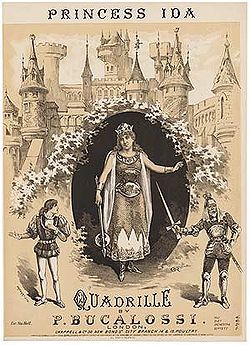
Comic opera
Comic opera denotes a sung dramatic work of a light or comic nature, usually with a happy ending.Forms of comic opera first developed in late 17th-century Italy. By the 1730s, a new operatic genre, opera buffa, emerged as an alternative to opera seria...
with music by Arthur Sullivan
Arthur Sullivan
Sir Arthur Seymour Sullivan MVO was an English composer of Irish and Italian ancestry. He is best known for his series of 14 operatic collaborations with the dramatist W. S. Gilbert, including such enduring works as H.M.S. Pinafore, The Pirates of Penzance and The Mikado...
and libretto
Libretto
A libretto is the text used in an extended musical work such as an opera, operetta, masque, oratorio, cantata, or musical. The term "libretto" is also sometimes used to refer to the text of major liturgical works, such as mass, requiem, and sacred cantata, or even the story line of a...
by W. S. Gilbert
W. S. Gilbert
Sir William Schwenck Gilbert was an English dramatist, librettist, poet and illustrator best known for his fourteen comic operas produced in collaboration with the composer Sir Arthur Sullivan, of which the most famous include H.M.S...
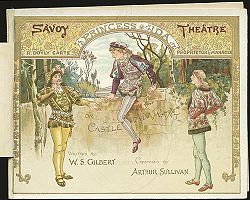
. It was their eighth operatic collaboration of fourteen. Princess Ida opened at the Savoy Theatre
Savoy Theatre
The Savoy Theatre is a West End theatre located in the Strand in the City of Westminster, London, England. The theatre opened on 10 October 1881 and was built by Richard D'Oyly Carte on the site of the old Savoy Palace as a showcase for the popular series of comic operas of Gilbert and Sullivan,...
on January 5, 1884, for a run of 246 performances. The piece concerns a princess who founds a women's university and teaches that women are superior to men and should rule in their stead. The prince to whom she had been married in infancy sneaks into the university, together with two friends, with the aim of collecting his bride. They disguise themselves as women students but are discovered, and all soon face a literal war between the sexes.
The opera satirizes feminism
Feminism
Feminism is a collection of movements aimed at defining, establishing, and defending equal political, economic, and social rights and equal opportunities for women. Its concepts overlap with those of women's rights...
, women's education
Women's college
Women's colleges in higher education are undergraduate, bachelor's degree-granting institutions, often liberal arts colleges, whose student populations are composed exclusively or almost exclusively of women...
, and Darwinian
Charles Darwin
Charles Robert Darwin FRS was an English naturalist. He established that all species of life have descended over time from common ancestry, and proposed the scientific theory that this branching pattern of evolution resulted from a process that he called natural selection.He published his theory...
evolution
Evolution
Evolution is any change across successive generations in the heritable characteristics of biological populations. Evolutionary processes give rise to diversity at every level of biological organisation, including species, individual organisms and molecules such as DNA and proteins.Life on Earth...
, which were controversial topics in conservative Victorian
Victorian era
The Victorian era of British history was the period of Queen Victoria's reign from 20 June 1837 until her death on 22 January 1901. It was a long period of peace, prosperity, refined sensibilities and national self-confidence...
England
England
England is a country that is part of the United Kingdom. It shares land borders with Scotland to the north and Wales to the west; the Irish Sea is to the north west, the Celtic Sea to the south west, with the North Sea to the east and the English Channel to the south separating it from continental...
. Princess Ida is based on a narrative poem by Alfred Tennyson
Alfred Tennyson, 1st Baron Tennyson
Alfred Tennyson, 1st Baron Tennyson, FRS was Poet Laureate of the United Kingdom during much of Queen Victoria's reign and remains one of the most popular poets in the English language....
called The Princess
The Princess (poem)
The Princess is a serio-comic blank verse narrative poem, written by Alfred Tennyson, published in 1847. Tennyson was Poet Laureate of the United Kingdom from 1850 to 1892 and remains one of the most popular English poets....
(1847), and Gilbert had written a farcical musical play
The Princess (play)
The Princess is a blank verse farcical play, in five scenes with music, by W. S. Gilbert which adapts and parodies Alfred Lord Tennyson's humorous 1847 narrative poem, The Princess: A Medley. It was first produced at the Olympic Theatre in London on 8 January 1870.Gilbert called the piece "a...
, based on the poem, in 1870. He lifted much of the dialogue of Princess Ida directly from his 1870 farce. It is the only Gilbert and Sullivan
Gilbert and Sullivan
Gilbert and Sullivan refers to the Victorian-era theatrical partnership of the librettist W. S. Gilbert and the composer Arthur Sullivan . The two men collaborated on fourteen comic operas between 1871 and 1896, of which H.M.S...
opera in three acts and the only one with dialogue in blank verse
Blank verse
Blank verse is poetry written in unrhymed iambic pentameter. It has been described as "probably the most common and influential form that English poetry has taken since the sixteenth century" and Paul Fussell has claimed that "about three-quarters of all English poetry is in blank verse."The first...
.
By Savoy Opera
Savoy opera
The Savoy Operas denote a style of comic opera that developed in Victorian England in the late 19th century, with W. S. Gilbert and Arthur Sullivan as the original and most successful practitioners. The name is derived from the Savoy Theatre, which impresario Richard D'Oyly Carte built to house...
standards, Princess Ida was not considered a success due, in part, to a particularly hot summer in London in 1884, and it was not revived in London until 1919. Nevertheless, the piece is performed regularly today by both professional and amateur companies, although not as frequently as the most popular of the Savoy operas.
Genesis
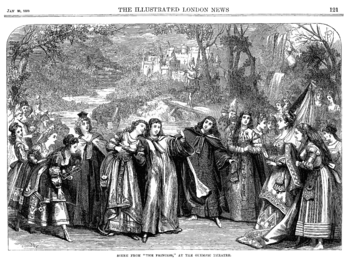
Alfred Tennyson, 1st Baron Tennyson
Alfred Tennyson, 1st Baron Tennyson, FRS was Poet Laureate of the United Kingdom during much of Queen Victoria's reign and remains one of the most popular poets in the English language....
's serio-comic narrative poem of 1847, The Princess: A Medley
The Princess (poem)
The Princess is a serio-comic blank verse narrative poem, written by Alfred Tennyson, published in 1847. Tennyson was Poet Laureate of the United Kingdom from 1850 to 1892 and remains one of the most popular English poets....
. Gilbert had written a blank verse
Blank verse
Blank verse is poetry written in unrhymed iambic pentameter. It has been described as "probably the most common and influential form that English poetry has taken since the sixteenth century" and Paul Fussell has claimed that "about three-quarters of all English poetry is in blank verse."The first...
musical farce burlesquing the same material in 1870 called The Princess
The Princess (play)
The Princess is a blank verse farcical play, in five scenes with music, by W. S. Gilbert which adapts and parodies Alfred Lord Tennyson's humorous 1847 narrative poem, The Princess: A Medley. It was first produced at the Olympic Theatre in London on 8 January 1870.Gilbert called the piece "a...
. He reused a good deal of the dialogue from this earlier play in the libretto of Princess Ida. He also retained Tennyson's blank verse style and the basic story line about a heroic princess who runs a women's college and the prince who loves her. He and his two friends infiltrate the college disguised as female students. Gilbert had to write entirely new lyrics for Princess Ida, since the lyrics to his 1870 farce were written to previously existing music by Jacques Offenbach
Jacques Offenbach
Jacques Offenbach was a Prussian-born French composer, cellist and impresario. He is remembered for his nearly 100 operettas of the 1850s–1870s and his uncompleted opera The Tales of Hoffmann. He was a powerful influence on later composers of the operetta genre, particularly Johann Strauss, Jr....
, Rossini and others.
Tennyson's poem was written, in part, in response to the founding of Queen's College, London
Queen's College, London
Queen's College is an independent school for girls aged 11–18. It is located in central London at numbers 43-49, Harley Street. Founded in 1848 by F. D. Maurice, Professor of English Literature and History at King's College London along with a committee of patrons, the College was the first...
, the first college of women's higher education, in 1847. When Gilbert wrote The Princess in 1870, women's higher education was still an innovative, even radical concept. Girton College, one of the constituent colleges of the University of Cambridge
University of Cambridge
The University of Cambridge is a public research university located in Cambridge, United Kingdom. It is the second-oldest university in both the United Kingdom and the English-speaking world , and the seventh-oldest globally...
, was established in 1869. However, by the time Gilbert and Sullivan collaborated on Princess Ida in 1883, a women's college was a more established concept. Westfield College
Westfield College
Westfield College was a small college situated in Kidderpore Avenue, Hampstead, London, and was a constituent college of the University of London from 1882 to 1989. The college originally admitted only women as students and became coeducational in 1964. In 1989, Westfield College merged with Queen...
, the University of London
University of London
-20th century:Shortly after 6 Burlington Gardens was vacated, the University went through a period of rapid expansion. Bedford College, Royal Holloway and the London School of Economics all joined in 1900, Regent's Park College, which had affiliated in 1841 became an official divinity school of the...
's first women's college, had opened in 1882. Thus, women's higher education was in the news in London, and Westfield is cited as a model for Gilbert's Castle Adamant.
Increasingly viewing his work with Gilbert as unimportant, beneath his skills, and repetitious, Sullivan had intended to resign from the partnership with Gilbert and Richard D'Oyly Carte
Richard D'Oyly Carte
Richard D'Oyly Carte was an English talent agent, theatrical impresario, composer and hotelier during the latter half of the Victorian era...
after Iolanthe
Iolanthe
Iolanthe; or, The Peer and the Peri is a comic opera with music by Arthur Sullivan and libretto by W. S. Gilbert. It is one of the Savoy operas and is the seventh collaboration of the fourteen between Gilbert and Sullivan....
, but after a recent financial loss, he concluded that his financial needs required him to continue writing Savoy operas. Therefore, in February 1883, with Iolanthe still playing strongly at the Savoy Theatre, Gilbert and Sullivan signed a new five-year partnership agreement to create new operas for Carte upon six months' notice. He also gave his consent to Gilbert to continue with the adaptation of The Princess as the basis for their next opera. Later that spring, Sullivan was knight
British honours system
The British honours system is a means of rewarding individuals' personal bravery, achievement, or service to the United Kingdom and the British Overseas Territories...
ed by Queen Victoria
Victoria of the United Kingdom
Victoria was the monarch of the United Kingdom of Great Britain and Ireland from 20 June 1837 until her death. From 1 May 1876, she used the additional title of Empress of India....
and the honour was announced in May at the opening of the Royal College of Music
Royal College of Music
The Royal College of Music is a conservatoire founded by Royal Charter in 1882, located in South Kensington, London, England.-Background:The first director was Sir George Grove and he was followed by Sir Hubert Parry...
. Although it was the operas with Gilbert that had earned him the broadest fame, the honour was conferred for his services to serious music. The musical establishment, and many critics, believed that Sullivan's knighthood should put an end to his career as a composer of comic opera — that a musical knight should not stoop below oratorio
Oratorio
An oratorio is a large musical composition including an orchestra, a choir, and soloists. Like an opera, an oratorio includes the use of a choir, soloists, an ensemble, various distinguishable characters, and arias...
or grand opera
Grand Opera
Grand opera is a genre of 19th-century opera generally in four or five acts, characterised by large-scale casts and orchestras, and lavish and spectacular design and stage effects, normally with plots based on or around dramatic historic events...
. Having just signed the five-year agreement, Sullivan suddenly felt trapped.
By the end of July 1883, Gilbert and Sullivan were revising drafts of the libretto for Ida. Sullivan finished some of the composition by early September when he had to begin preparations for his conducting duties at the triennial Leeds Festival, held in October. In late October, Sullivan turned his attentions back to Ida, and rehearsals began in November. Gilbert was also producing his one-act drama, Comedy and Tragedy, and keeping an eye on a revival of his Pygmalion and Galatea at the Lyceum Theatre by Mary Anderson
Mary Anderson
Mary Anderson may refer to:*Mary Anderson *Mary Anderson *Mary Anderson *Mary Anderson *Mary Anderson...
's company. In mid-December, Sullivan bade farewell to his sister-in-law Charlotte, the widow of his brother Fred
Fred Sullivan
Frederic Sullivan was an English actor and singer. He is best remembered as the creator of the role of the Learned Judge in Gilbert and Sullivan's Trial by Jury, providing a model for the comic roles in the later Savoy Operas composed by his brother Arthur Sullivan.By 1870, Sullivan had abandoned...
, who departed with her young family to America, never to return. Sullivan's oldest nephew, Herbert
Herbert Sullivan
Herbert Thomas Sullivan was the nephew, heir and biographer of the British composer Arthur Sullivan. After his uncle's death, Sullivan became active in charitable work...
, stayed behind in England as his uncle's ward, and Sullivan threw himself into the task of orchestrating the score of Princess Ida. As he had done with Iolanthe, Sullivan wrote the overture
Overture
Overture in music is the term originally applied to the instrumental introduction to an opera...
himself, rather than assigning it to an assistant as he did in the case of most of his operas.
Production

Soprano
A soprano is a voice type with a vocal range from approximately middle C to "high A" in choral music, or to "soprano C" or higher in operatic music. In four-part chorale style harmony, the soprano takes the highest part, which usually encompasses the melody...
title role requires a more dramatic voice than the earlier works. The American star Lillian Russell
Lillian Russell
Lillian Russell was an American actress and singer. She became one of the most famous actresses and singers of the late 19th century and early 20th century, known for her beauty and style, as well as for her voice and stage presence.Russell was born in Iowa but raised in Chicago...
was engaged to create the title role of Princess Ida, but Gilbert did not believe that she was dedicated enough, and when she missed a rehearsal, she was dismissed. The D'Oyly Carte Opera Company's usual female lead, Leonora Braham
Leonora Braham
Leonora Braham , born Leonora Lucy Abraham, was an English opera singer and actress primarily known as the creator of principal soprano roles in the Gilbert and Sullivan comic operas....
, a light lyric soprano
Lyric soprano
A lyric soprano is a type of operatic soprano that has a warm quality with a bright, full timbre which can be heard over an orchestra. The lyric soprano voice generally has a higher tessitura than a soubrette and usually plays ingenues and other sympathetic characters in opera. Lyric sopranos have...
, nevertheless moved up from the part of Lady Psyche to assume the title role. Rosina Brandram
Rosina Brandram
Rosina Brandram was an English opera singer and actress primarily known for creating many of the contralto roles in the Savoy operas with the D'Oyly Carte Opera Company....
got her big break when Alice Barnett
Alice Barnett
Alice Barnett was an English singer and actress, best known for her performances in contralto roles of the Gilbert and Sullivan operas with the D'Oyly Carte Opera Company....
became ill and left the company for a time, taking the role of Lady Blanche and becoming the company's principal contralto
Contralto
Contralto is the deepest female classical singing voice, with the lowest tessitura, falling between tenor and mezzo-soprano. It typically ranges between the F below middle C to the second G above middle C , although at the extremes some voices can reach the E below middle C or the second B above...
.
The previous Savoy opera, Iolanthe, closed after 398 performances on 1 January 1884, the same day that Sullivan composed the last of the musical numbers for Ida. Despite grueling rehearsals over the next few days, and suffering from exhaustion, Sullivan conducted the opening performance on 5 January 1884 and collapsed from exhaustion immediately afterwards. The reviewer for the Sunday Times wrote that the score of Ida was "the best in every way that Sir Arthur Sullivan has produced, apart from his serious works.... Humour is almost as strong a point with Sir Arthur... as with his clever collaborator...." The humour of the piece also drew the comment that Gilbert and Sullivan's work "has the great merit of putting everyone in a good temper." The praise for Sullivan's effort was unanimous, though Gilbert's work received some mixed notices.
Aftermath
Sullivan's close friend, composer Frederic ClayFrederic Clay
Frederic Emes Clay was an English composer known principally for his music written for the stage. Clay, a great friend of Arthur Sullivan's, wrote four comic operas with W. S...
, had suffered a serious stroke
Stroke
A stroke, previously known medically as a cerebrovascular accident , is the rapidly developing loss of brain function due to disturbance in the blood supply to the brain. This can be due to ischemia caused by blockage , or a hemorrhage...
in early December 1883 that ended his career. Sullivan, reflecting on this, his own precarious health, and his desire to devote himself to more serious music, informed Richard D'Oyly Carte on 29 January 1884 that he had determined "not to write any more 'Savoy' pieces." Sullivan fled the London winter to convalesce in Monte Carlo
Monte Carlo
Monte Carlo is an administrative area of the Principality of Monaco....
as seven provincial tours (one with a 17 year old Henry Lytton
Henry Lytton
Sir Henry Lytton was an English actor and singer who was the leading exponent of the comic patter-baritone roles in Gilbert and Sullivan operas in the early part of the twentieth century...
in the chorus) and the U.S. production of Ida set out.
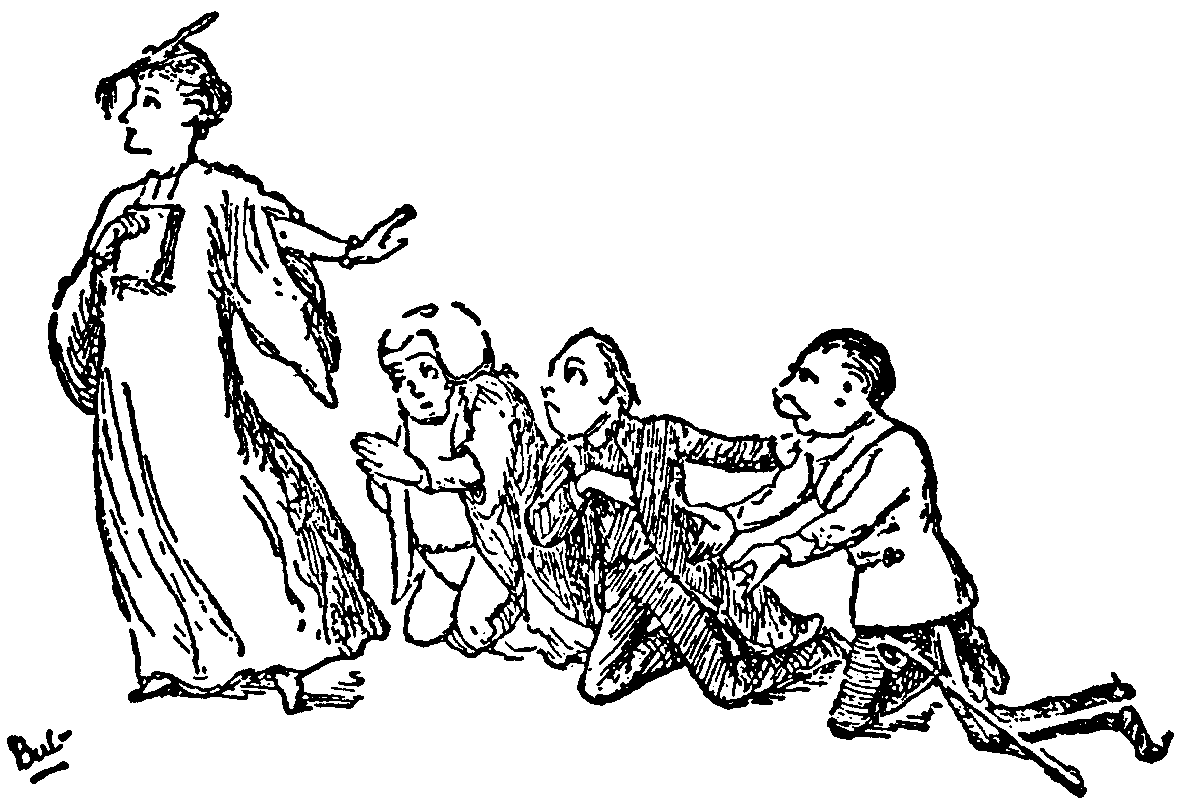
Gilbert was much hurt, but Sullivan insisted that he could not set the "lozenge plot." In addition to the "improbability" of it, it was too similar to the plot of their 1877 opera, The Sorcerer
The Sorcerer
The Sorcerer is a two-act comic opera, with a libretto by W. S. Gilbert and music by Arthur Sullivan. It was the British duo's third operatic collaboration. The plot of The Sorcerer is based on a Christmas story, An Elixir of Love, that Gilbert wrote for The Graphic magazine in 1876...
, and was too complex a plot. Sullivan returned to London, and, as April wore on, Gilbert tried to rewrite his plot, but he could not satisfy Sullivan. The parties were at a stalemate, and Gilbert wrote, "And so ends a musical & literary association of seven years' standing – an association of exceptional reputation – an association unequalled in its monetary results, and hitherto undisturbed by a single jarring or discordant element." However, by 8 May 1884, Gilbert was ready to back down, writing, "...am I to understand that if I construct another plot in which no supernatural element occurs, you will undertake to set it? ... a consistent plot, free from anachronisms, constructed in perfect good faith & to the best of my ability." The stalemate was broken, and on 20 May, Gilbert sent Sullivan a sketch of the plot to The Mikado
The Mikado
The Mikado; or, The Town of Titipu is a comic opera in two acts, with music by Arthur Sullivan and libretto by W. S. Gilbert, their ninth of fourteen operatic collaborations...
.
A particularly hot summer in London did not help ticket sales for Princess Ida and forced Carte to close the theatre during the heat of August. The piece ran for a comparatively short 246 performances, and for the first time since 1877, the opera closed before the next Savoy opera was ready to open. Princess Ida was not revived in London until 1919.
Musical and textual analysis
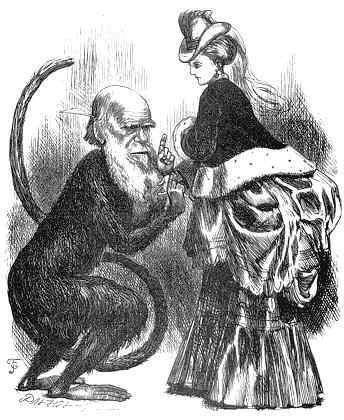
Feminism
Feminism is a collection of movements aimed at defining, establishing, and defending equal political, economic, and social rights and equal opportunities for women. Its concepts overlap with those of women's rights...
, women's education
Women's college
Women's colleges in higher education are undergraduate, bachelor's degree-granting institutions, often liberal arts colleges, whose student populations are composed exclusively or almost exclusively of women...
, and Darwinian
Charles Darwin
Charles Robert Darwin FRS was an English naturalist. He established that all species of life have descended over time from common ancestry, and proposed the scientific theory that this branching pattern of evolution resulted from a process that he called natural selection.He published his theory...
evolution
Evolution
Evolution is any change across successive generations in the heritable characteristics of biological populations. Evolutionary processes give rise to diversity at every level of biological organisation, including species, individual organisms and molecules such as DNA and proteins.Life on Earth...
, all of which were controversial topics in conservative Victorian
Victorian era
The Victorian era of British history was the period of Queen Victoria's reign from 20 June 1837 until her death on 22 January 1901. It was a long period of peace, prosperity, refined sensibilities and national self-confidence...
England
England
England is a country that is part of the United Kingdom. It shares land borders with Scotland to the north and Wales to the west; the Irish Sea is to the north west, the Celtic Sea to the south west, with the North Sea to the east and the English Channel to the south separating it from continental...
. In the 15 years between the time that Gilbert wrote The Princess and the premiere of Princess Ida, the movement for women's education had gained momentum in Britain, with the founding of Girton College (1869) and Newnham College
Newnham College, Cambridge
Newnham College is a women-only constituent college of the University of Cambridge, England.The college was founded in 1871 by Henry Sidgwick, and was the second Cambridge college to admit women after Girton College...
(1871) at the University of Cambridge
University of Cambridge
The University of Cambridge is a public research university located in Cambridge, United Kingdom. It is the second-oldest university in both the United Kingdom and the English-speaking world , and the seventh-oldest globally...
; and Somerville
Somerville College, Oxford
Somerville College is one of the constituent colleges of the University of Oxford in England, and was one of the first women's colleges to be founded there...
(1878) and Lady Margaret Hall (1878) at the University of Oxford
University of Oxford
The University of Oxford is a university located in Oxford, United Kingdom. It is the second-oldest surviving university in the world and the oldest in the English-speaking world. Although its exact date of foundation is unclear, there is evidence of teaching as far back as 1096...
. Westfield College
Westfield College
Westfield College was a small college situated in Kidderpore Avenue, Hampstead, London, and was a constituent college of the University of London from 1882 to 1989. The college originally admitted only women as students and became coeducational in 1964. In 1989, Westfield College merged with Queen...
in Hampstead
Hampstead
Hampstead is an area of London, England, north-west of Charing Cross. Part of the London Borough of Camden in Inner London, it is known for its intellectual, liberal, artistic, musical and literary associations and for Hampstead Heath, a large, hilly expanse of parkland...
, the University of London
University of London
-20th century:Shortly after 6 Burlington Gardens was vacated, the University went through a period of rapid expansion. Bedford College, Royal Holloway and the London School of Economics all joined in 1900, Regent's Park College, which had affiliated in 1841 became an official divinity school of the...
's first women's college, opened in 1882.
As in Patience
Patience (opera)
Patience; or, Bunthorne's Bride, is a comic opera in two acts with music by Arthur Sullivan and libretto by W. S. Gilbert. First performed at the Opera Comique, London, on 23 April 1881, it moved to the 1,292-seat Savoy Theatre on 10 October 1881, where it was the first theatrical production in the...
and Iolanthe
Iolanthe
Iolanthe; or, The Peer and the Peri is a comic opera with music by Arthur Sullivan and libretto by W. S. Gilbert. It is one of the Savoy operas and is the seventh collaboration of the fourteen between Gilbert and Sullivan....
, the two previous Gilbert and Sullivan operas, Princess Ida concerns the war between the sexes. In Patience, the aesthetic-crazed women are contrasted with vain military men; in Iolanthe, the vague and flighty fairies (women) are pitted against the ineffective, dim-witted peers (men); and in Ida, overly serious students and professors at a women's university (women) defy a marriage-by-force ultimatum by a militaristic king and his testosterone-laden court (men). Princess Ida is one of several Gilbert plays, including The Wicked World
The Wicked World
The Wicked World is a blank verse play by W. S. Gilbert in three acts. It opened at the Haymarket Theatre on 1873 and ran for a successful 145 performances, closing on 1873...
, Broken Hearts
Broken Hearts
Broken Hearts is a blank verse play by W. S. Gilbert in three acts styled "An entirely original fairy play". It opened at the Royal Court Theatre in London on 9 December 1875, running for three months, and toured the provinces in 1876...
, Fallen Fairies
Fallen Fairies
Fallen Fairies; or, The Wicked World, is a two-act comic opera, with a libretto by W. S. Gilbert and music by Edward German. Premiering at London's Savoy Theatre on December 15, 1909, it failed miserably, closing after just 50 performances...
, and Iolanthe
Iolanthe
Iolanthe; or, The Peer and the Peri is a comic opera with music by Arthur Sullivan and libretto by W. S. Gilbert. It is one of the Savoy operas and is the seventh collaboration of the fourteen between Gilbert and Sullivan....
, where the introduction of males into a tranquil world of women brings "mortal love" that wreaks havoc with the status quo. Stedman calls this a "Gilbertian invasion plot".
Sullivan's score is majestic, and a sequence of songs in Act II, sometimes known as the "string of pearls", is particularly well loved. Sullivan used chromatic and scalar passages and key modulations throughout the score, and commenters have called the Act II quartet "The World Is But a Broken Toy" one of Sullivan's "most beautiful, plaintive melodies." It has also been called "Gounodesque". Although Gilbert's libretto contains many funny lines, the iambic pentameter
Iambic pentameter
Iambic pentameter is a commonly used metrical line in traditional verse and verse drama. The term describes the particular rhythm that the words establish in that line. That rhythm is measured in small groups of syllables; these small groups of syllables are called "feet"...
and three-act structure tend to make Ida more difficult to stage effectively than some of the other Savoy Operas. In addition, modern audiences sometimes find the libretto's dated portrayal of sex roles, and the awkward resolution of the opera, unsatisfying. It is also curious, after the string of successes that the partnership had experienced with George Grossmith
George Grossmith
George Grossmith was an English comedian, writer, composer, actor, and singer. His performing career spanned more than four decades...
, Richard Temple
Richard Temple
Richard Barker Cobb Temple was an English opera singer, actor and stage director, best known for his performances in the famous series of Gilbert and Sullivan comic operas....
, and Rutland Barrington
Rutland Barrington
Rutland Barrington was an English singer, actor, comedian, and Edwardian musical comedy star. Best remembered for originating the lyric baritone roles in the Gilbert and Sullivan operas from 1877 to 1896, his performing career spanned more than four decades...
in starring roles, to choose a theme that relegated them to comparatively minor roles.
Roles

- King Hildebrand (bass-baritoneBass-baritoneA bass-baritone is a high-lying bass or low-lying "classical" baritone voice type which shares certain qualities with the true baritone voice. The term arose in the late 19th century to describe the particular type of voice required to sing three Wagnerian roles: the Dutchman in Der fliegende...
) - Hilarion, King Hildebrand's Son (tenorTenorThe tenor is a type of male singing voice and is the highest male voice within the modal register. The typical tenor voice lies between C3, the C one octave below middle C, to the A above middle C in choral music, and up to high C in solo work. The low extreme for tenors is roughly B2...
) - Cyril, Hilarion's Friend (tenorTenorThe tenor is a type of male singing voice and is the highest male voice within the modal register. The typical tenor voice lies between C3, the C one octave below middle C, to the A above middle C in choral music, and up to high C in solo work. The low extreme for tenors is roughly B2...
) - Florian, Hilarion's Friend (lyric baritoneBaritoneBaritone is a type of male singing voice that lies between the bass and tenor voices. It is the most common male voice. Originally from the Greek , meaning deep sounding, music for this voice is typically written in the range from the second F below middle C to the F above middle C Baritone (or...
) - King Gama (comic baritoneBaritoneBaritone is a type of male singing voice that lies between the bass and tenor voices. It is the most common male voice. Originally from the Greek , meaning deep sounding, music for this voice is typically written in the range from the second F below middle C to the F above middle C Baritone (or...
) - Arac, King Gama's Son (bass-baritoneBass-baritoneA bass-baritone is a high-lying bass or low-lying "classical" baritone voice type which shares certain qualities with the true baritone voice. The term arose in the late 19th century to describe the particular type of voice required to sing three Wagnerian roles: the Dutchman in Der fliegende...
) - Guron, King Gama's Son (bass-baritoneBass-baritoneA bass-baritone is a high-lying bass or low-lying "classical" baritone voice type which shares certain qualities with the true baritone voice. The term arose in the late 19th century to describe the particular type of voice required to sing three Wagnerian roles: the Dutchman in Der fliegende...
) - Scynthius, King Gama's Son (bassBass (voice type)A bass is a type of male singing voice and possesses the lowest vocal range of all voice types. According to The New Grove Dictionary of Opera, a bass is typically classified as having a range extending from around the second E below middle C to the E above middle C...
) - Princess Ida, King Gama's Daughter (sopranoSopranoA soprano is a voice type with a vocal range from approximately middle C to "high A" in choral music, or to "soprano C" or higher in operatic music. In four-part chorale style harmony, the soprano takes the highest part, which usually encompasses the melody...
) - Lady Blanche, Professor of Abstract Science (contraltoContraltoContralto is the deepest female classical singing voice, with the lowest tessitura, falling between tenor and mezzo-soprano. It typically ranges between the F below middle C to the second G above middle C , although at the extremes some voices can reach the E below middle C or the second B above...
) - Lady Psyche, Professor of Humanities (sopranoSopranoA soprano is a voice type with a vocal range from approximately middle C to "high A" in choral music, or to "soprano C" or higher in operatic music. In four-part chorale style harmony, the soprano takes the highest part, which usually encompasses the melody...
) - Melissa, Lady Blanche's Daughter (mezzo-sopranoMezzo-sopranoA mezzo-soprano is a type of classical female singing voice whose range lies between the soprano and the contralto singing voices, usually extending from the A below middle C to the A two octaves above...
) - Sacharissa, Girl Graduate (sopranoSopranoA soprano is a voice type with a vocal range from approximately middle C to "high A" in choral music, or to "soprano C" or higher in operatic music. In four-part chorale style harmony, the soprano takes the highest part, which usually encompasses the melody...
) - Chloe, Girl Graduate (speaking role/chorus)
- Ada, Girl Graduate (speaking role/chorus)
- Chorus of Soldiers, Courtiers, "Girl Graduates", "Daughters of the Plough", etc.
Act I
Courtier
A courtier is a person who is often in attendance at the court of a king or other royal personage. Historically the court was the centre of government as well as the residence of the monarch, and social and political life were often completely mixed together...
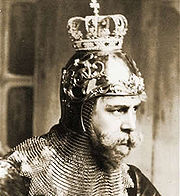
s wait expectantly for the arrival of King Gama and his daughter Princess Ida, who was betrothed in infancy to Hildebrand's son, Prince Hilarion (Search throughout the panorama). Hildebrand promises to wage war against Gama if the Princess should fail to appear (Now hearken to my strict command), while Hilarion, who is in love with Ida, although he has not seen her since he was two years old, wonders how she may have changed over the ensuing twenty years (Ida was a twelvemonth-old).
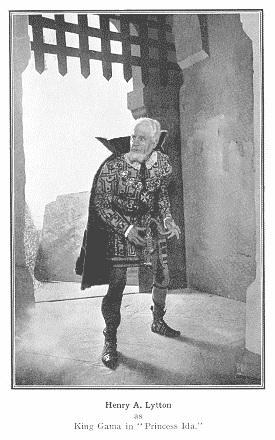
Ida's war-like (and dull) brothers Arac, Guron and Scynthius, arrive at Hildebrand's palace (We are warriors three) preceding their father. King Gama enters, explains his misanthropy
Misanthropy
Misanthropy is generalized dislike, distrust, disgust, contempt or hatred of the human species or human nature. A misanthrope, or misanthropist is someone who holds such views or feelings...
(If you give me your attention I will tell you what I am), and promptly displays it by insulting Hildebrand and his son. He then announces that Princess Ida has forsworn men and founded a women's university at Castle Adamant, one of his many country houses. The two Kings advise Hilarion to go to Castle Adamant to claim Ida, and that if she refuses him, Hildebrand will storm the castle (Pr'haps if you address the lady). But Hilarion plans to use romantic means, rather than force, to gain the princess's love. He explains that nature has "armed" him and his friends, the courtiers Cyril and Florian, to win this "war" (Expressive glances will be our lances). The three set off to Castle Adamant, while King Gama and his sons are to remain at Hildebrand's palace as hostages (For a month to dwell in a dungeon cell).
Act II
Empyrean
Empyrean, from the Medieval Latin empyreus, an adaptation of the Ancient Greek ἔμπυρος empyrus "in or on the fire ", properly Empyrean Heaven, is the place in the highest heaven, which in ancient cosmologies was supposed to be occupied by the element of fire .-Use in literature:The Empyrean was...
heights). One of the Professors, Lady Blanche, doles out the punishments for the day, for "offences" that include bringing chessmen to the university — "men with whom you give each other mate" — and for sketching a double-perambulator. Princess Ida arrives (Minerva
Minerva
Minerva was the Roman goddess whom Romans from the 2nd century BC onwards equated with the Greek goddess Athena. She was the virgin goddess of poetry, medicine, wisdom, commerce, weaving, crafts, magic...
! Oh hear me) and delivers a stern lecture, stating that women's brains are larger than men's, and predicting that woman shall conquer man, but that once having conquered, woman will treat man better than he has treated her. Lady Blanche resents the Princess and predicts that one day she will replace her as head of the university (Come mighty must, a song often cut from the D'Oyly Carte productions).
Charles Darwin
Charles Robert Darwin FRS was an English naturalist. He established that all species of life have descended over time from common ancestry, and proposed the scientific theory that this branching pattern of evolution resulted from a process that he called natural selection.He published his theory...
"Man, sprung from an Ape, is Ape at heart" (A lady fair of lineage high).

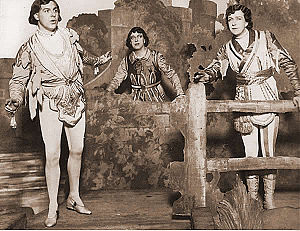
During lunch (Merrily rings the luncheon bell), Cyril gets tipsy and inadvertently gives away his friends' identity by singing a bawdy song (Would you know the kind of maid). In the ensuing confusion, Princess Ida falls into a stream, and Hilarion rescues her (Oh joy, our chief is saved). Despite her rescue, Ida condemns Hilarion and his friends to death. Hilarion counters that without her love to live for, he welcomes death (Whom thou hast chained). King Hildebrand and his soldiers arrive, with Ida's brothers in chains. He reminds her that she is bound by contract to marry Hilarion and gives her until the following afternoon to comply (Some years ago) or incur the guilt of fratricide
Fratricide
Fratricide is the act of a person killing his or her brother....
. The defiant Ida replies that, although Hilarion saved her life and is fair, strong, and tall, she would rather die than be his bride (To yield at once to such a foe).
Act III
Princess Ida reviews her student troops' readiness to meet Hildebrand's soldiers in battle, but the terrified girls admit that they are afraid of fighting (Death to the invader!). Princess Ida is disgusted by their lack of courage and vows that, if necessary, she will fight Hildebrand's army alone (I built upon a rock). Her father, King Gama, arrives with a message that Hildebrand prefers not to go to war against women. He reveals that Hildebrand has been torturing him by treating him in luxury and giving him nothing to complain about (Whene'er I spoke sarcastic joke). He suggests that, instead of subjecting her women to all-out war, she pit her three strong, brave brothers against Hilarion and his friends, with Ida's hand to depend on the outcome. Ida is insulted to be "a stake for fighting men" but realises that she has no alternative.Hildebrand's forces enter, together with Gama and his three sons (When anger spreads his wing). Hilarion, Cyril, and Florian are still in their women's robes, and King Gama and his sons ridicule them. In preparation for battle, Gama's sons shed their heavy armour, saying that it is too uncomfortable for combat (This helmet I suppose). The fight ensues, with Hilarion, Cyril, and Florian defeating Gama's sons (It is our duty plain).
-
-
- If you enlist all women in your cause,
- And make them all abjure tyrannic Man,
- The obvious question then arises, "How
- Is this Posterity to be provided?"
-
Princess Ida admits, "I never thought of that!" Hilarion makes an emotional appeal, urging her to give Man one chance, while Cyril observes that if she grows tired of the Prince, she can return to Castle Adamant. Lady Psyche says that she, too, will return if Cyril does not behave himself, but Melissa swears that she will not return under any circumstances. Finally, Ida admits that she has been wrong, and declares that indeed she loves Hilarion, ending with a quotation directly from the Tennyson poem. All celebrate, (With joy abiding).
Musical numbers
- Overture (includes "We are warriors three" and "Minerva! oh, hear me")
Act I
- 1. "Search throughout the panorama" (Florian and Chorus)
- 2. "Now hearken to my strict command" (Hildebrand and Chorus)
- 3. "Today we meet" (Hilarion)
- 4. "From the distant panorama" (Chorus)
- 5. "We are warriors three" (Arac, Guron, Scynthius, and Chorus)
- 6. "If you give me your attention" (Gama)
- 7. Finale Act I (Gama, Hildebrand, Cyril, Hilarion, Florian, and Chorus)
- "P'raps if you Address the Lady"
- "Expressive glances"
- "For a month to dwell in a dungeon cell"
Act II
- 8. "Towards the empyrean heights" (Lady Psyche, Melissa, Sacharissa, and Chorus of Girls)
- 9. "Mighty maiden with a mission" (Chorus of Girls)
- 10. "Minerva! oh, hear me!" ... "Oh, goddess wise" (Princess)
- 10a."And thus to Empyrean Heights" (Princess and Chorus)
- 11. "Come, mighty Must" (Lady Blanche)1
- 12. "Gently, gently" (Cyril, Hilarion, and Florian)
- 13. "I am a maiden, cold and stately" (Cyril, Hilarion, and Florian)
- 14. "The world is but a broken toy" (Princess, Cyril, Hilarion, and Florian)
- 15. "A lady fair, of lineage high" (Psyche with Cyril, Hilarion, and Florian)2
- 16. "The woman of the wisest wit" (Psyche, Melissa, Cyril, Hilarion, and Florian)
- 17. "Now wouldn't you like to rule the roast" (Melissa and Blanche)3
- 18. "Merrily ring the luncheon bell" (Blanche, Cyril, and Chorus of Girls)
- 19. "Would you know the kind of maid?" (Cyril)
- 20. Finale Act II (Princess, Hildebrand, Melissa, Psyche, Blanche, Cyril, Hilarion, Florian, Arac, Guron, Scynthius, and Chorus)
- "Oh, joy! our chief is saved"
- "Whom thou hast chained must wear his chain"
- "Walls and fences scaling"
- "Some years ago, no doubt you know"
- "We may remark, though nothing can dismay us"
- "To yield at once to such a foe with shame were rife"
1 Starting in the 1920s, the D'Oyly Carte Opera Company
D'Oyly Carte Opera Company
The D'Oyly Carte Opera Company was a professional light opera company that staged Gilbert and Sullivan's Savoy operas. The company performed nearly year-round in the UK and sometimes toured in Europe, North America and elsewhere, from the 1870s until it closed in 1982. It was revived in 1988 and...
traditionally deleted this song.
2As musical director, Harry Norris
Harry Norris (conductor)
Harry Norris was a New Zealand-born conductor best remembered as musical director of the D'Oyly Carte Opera Company between 1919 and 1929. After leaving that company, Norris emigrated to Canada to teach but returned to retire in England in the 1960s.-Life and career:Norris was born in...
was responsible for adding prominent horn parts to the accompaniment to "A Lady Fair". They were expunged by Malcolm Sargent
Malcolm Sargent
Sir Harold Malcolm Watts Sargent was an English conductor, organist and composer widely regarded as Britain's leading conductor of choral works...
but subsequently restored by Royston Nash
Royston Nash
Royston Hulbert Nash is an English-born conductor, best known as a music director of the D'Oyly Carte Opera Company, who is now living in the U.S.-Life and career:...
in the 1970s. These are customarily referred to as the ‘Norris’ horn parts, though they may have been written by Geoffrey Toye
Geoffrey Toye
Edward Geoffrey Toye , better known as Geoffrey Toye, was an English conductor, composer and opera producer....
.
3 The first line of this song is often erroneously sung as "Now wouldn't you like to rule the roost" instead of "roast" (rhymes with "clear the coast" in the next couplet). This typographical error appeared in early vocal scores and still appears in a current Chappell
Chappell
Chappell may refer to:Places:* Chappell, Nebraska* Chappell on the moon* Mount Chappell Island, Tasmania, Australia* North West Mount Chappell Islet, Tasmania, AustraliaPeople:* The Chappell family of Australian cricketers:...
vocal score edition, although some scores have corrected it.
Act III
- 21. "Death to the invader" (Melissa and Chorus of Girls)
- 22. "Whene'er I spoke" (King Gama with Chorus of Girls)4
- 23. "I built upon a rock" (Princess)
- 24. "When anger spreads his wing" (Chorus of Girls and Soldiers)
- 25. "This helmet, I suppose" (Arac with Guron, Scynthius, and Chorus)
- 26. Chorus during the fight, "This is our duty plain" (Chorus)
- 27. "With joy abiding" [Reprise of "Expressive glances"] (Ensemble)
4 In the original production, No. 22 followed No. 23. The present order first appeared in vocal scores published after the first London revival in 1919.
Gilbert claimed that "If you give me your attention" was a satiric self-reference, saying: "I thought it my duty to live up to my reputation". Tom Lehrer
Tom Lehrer
Thomas Andrew "Tom" Lehrer is an American singer-songwriter, satirist, pianist, mathematician and polymath. He has lectured on mathematics and musical theater...
performs a parody of the same song called "The Professor's Song". Music from the overture of Ida is heard in Mickey, Donald, Goofy: The Three Musketeers
Mickey, Donald, Goofy: The Three Musketeers
Mickey · Donald · Goofy: The Three Musketeers is a direct-to-video animated film adaptation of the novel The Three Musketeers by Alexandre Dumas, père. As the title suggests, it features Mickey Mouse, Donald Duck, and Goofy as the three musketeers...
.
Versions of the text
Princess Ida was not revived in London during the authors' lifetimes, and there were no substantive changes to the text after the premiere. The one alteration was purely cosmetic: the first act had originally been called a "Prologue." It was re-designated Act I, with a consequent renumbering of the remaining acts.At around the time of the first London revival, in 1919, there were changes to the running order of Act III. As written originally, the sequence of Act III is as follows:

- "Death to the invader"
- Princess Ida addresses the girls and then dismisses them
- "I built upon a rock" (Princess)
- The girls re-enter, shortly followed by King Gama
- "When e'er I spoke sarcastic joke" (King Gama, Ladies' Chorus)
- Dialogue in which the Princess agrees to let her brothers fight for her
- "When anger spreads his wing" (Double chorus)
- Dialogue preceding the fight
- "This helmet, I suppose" (Arac, Guron, Scynthius, Chorus)
- "This is our duty plain" (Chorus during the fight)
- Dialogue and finale
As re-ordered in the 1920s, the running order is as follows:
- "Death to the invader"
- Princess Ida addresses the girls and then dismisses them
- The girls re-enter, shortly followed by King Gama
- "When e'er I spoke sarcastic joke" (King Gama, Ladies' Chorus)
- Dialogue in which the Princess agrees to let her brothers fight for her
- "I built upon a rock" (Princess)
- "When anger spreads his wing" (Double chorus)
- "This helmet, I suppose" (Arac, Guron, Scynthius, Chorus)
- Dialogue preceding the fight
- "This is our duty plain" (Chorus during the fight)
- Dialogue and finale
The Chappell vocal score was re-issued to conform to this revised order.
The other significant change is that, at some point in the 1920s, it became traditional to delete Lady Blanche's Act II song, "Come, mighty must" (although it continued to be printed in the vocal score). The song is included in the 1924 D'Oyly Carte recording, but on none of the three recordings the Company made after that (1932, 1955, 1965).
History of Productions
Princess Ida was not as successful as the Gilbert and Sullivan operas that had preceded it. In the midst of the unusually hot summer of 1884, Richard D'Oyly Carte closed the Savoy Theatre for a month, starting in mid-August. The opera had been running for seven months, a short period by the partnership's past standards. The opera re-opened for just three weeks, starting in mid-September, before giving way to a revival of The SorcererThe Sorcerer
The Sorcerer is a two-act comic opera, with a libretto by W. S. Gilbert and music by Arthur Sullivan. It was the British duo's third operatic collaboration. The plot of The Sorcerer is based on a Christmas story, An Elixir of Love, that Gilbert wrote for The Graphic magazine in 1876...
(revised) and Trial by Jury
Trial by Jury
Trial by Jury is a comic opera in one act, with music by Arthur Sullivan and libretto by W. S. Gilbert. It was first produced on 25 March 1875, at London's Royalty Theatre, where it initially ran for 131 performances and was considered a hit, receiving critical praise and outrunning its...
.
Melbourne
Melbourne is the capital and most populous city in the state of Victoria, and the second most populous city in Australia. The Melbourne City Centre is the hub of the greater metropolitan area and the Census statistical division—of which "Melbourne" is the common name. As of June 2009, the greater...
, produced by J. C. Williamson
J. C. Williamson
James Cassius Williamson was an American actor and later Australia's foremost theatrical manager, founding J. C. Williamson Ltd....
.
Provincial tours of Princess Ida began in early 1884 and ended by mid-1885. The opera was revived on tour in December 1895, remaining in the touring repertory through 1896. It re-appeared in late 1897 or early 1898, and from then on was never out of the D'Oyly Carte touring repertory through the early years of the twentieth century. The first London revival, however, did not come until 30 December 1919. From then on, it was included in every D'Oyly Carte touring season until the company disbanded at the outbreak of war in 1939.
During World War II
World War II
World War II, or the Second World War , was a global conflict lasting from 1939 to 1945, involving most of the world's nations—including all of the great powers—eventually forming two opposing military alliances: the Allies and the Axis...
, the Company played a smaller repertory. The scenery and costumes for Princess Ida, which were in storage, were destroyed by enemy action over the winter of 1940–41. A new production was mounted at the Savoy Theatre on 27 September 1954. A guest artist, opera singer Victoria Sladen, was engaged to sing the title role for the London season. For the 1954 revival, the Act II line "And the niggers they'll be bleaching by and by," was changed to "And they'll practice what they're preaching by and by," to accommodate the sensibilities of modern audiences, following similar changes in other Gilbert and Sullivan works.
After the 1954 revival, Princess Ida was an irregular presence in the D'Oyly Carte repertory. While it never went unperformed more than two or three seasons at a time, it was usually performed only in London and a few other major cities. The demands of the title role were considered unusual by Gilbert and Sullivan standards, and often the Company brought in guest artists to play it. The Company's final performances of the opera were in February–April 1977. The Company's reduced repertory in its final five seasons did not accommodate it.
Other professional companies have produced Princess Ida, including American Savoyards
American Savoyards
American Savoyards was an Off-Broadway and touring repertory theatre company that produced light operas, principally the works of Gilbert and Sullivan, in New York City between 1948 and 1967.-Beginnings:...
in the 1950s and 1960s, Light Opera of Manhattan
Light Opera of Manhattan
Light Opera of Manhattan, known as LOOM, was an Off-Broadway repertory theatre company that produced light operas, including the works of Gilbert and Sullivan and European and American operettas, 52 weeks per year, in New York City between 1968 and 1989....
in the 1970s and 1980s, New York Gilbert and Sullivan Players
New York Gilbert and Sullivan Players
New York Gilbert and Sullivan Players is a professional repertory theatre company, based in New York City that has specialized in the comic operas of Gilbert and Sullivan for over 35 years...
since the 1980s, Ohio Light Opera
Ohio Light Opera
The Ohio Light Opera is a professional opera company based in Wooster, Ohio that performs the light opera repertory, including Gilbert and Sullivan, American, British and continental operettas, and other musical theatre works, especially of the late 19th and early 20th centuries...
(which recorded the piece in 2000), the Gilbert and Sullivan Opera Company at the International Gilbert and Sullivan Festival
International Gilbert and Sullivan Festival
The International Gilbert and Sullivan Festival is held every summer at the Opera House in Buxton, Derbyshire, England. The three-week Festival of Gilbert and Sullivan performances and fringe events attracts thousands of visitors, including performers, supporters, and G&S enthusiasts from all...
in 2003 and 2009, and others.
The following table shows the history of the D'Oyly Carte productions in Gilbert's lifetime:
| Theatre | Opening Date | Closing Date | Perfs. | Details |
|---|---|---|---|---|
| Savoy Theatre | January 5, 1884 | August 15, 1884 | 246 | First run |
| September 15, 1884 | October 9, 1884 | |||
| Fifth Avenue Theatre Fifth Avenue Theatre Fifth Avenue Theatre was a Broadway theatre in New York City in the United States located at 31 West 28th Street and Broadway. It was demolished in 1939.... , New York |
February 11, 1884 | March 22, 1884 | 48 | Authorised American productions |
| Fifth Avenue Theatre, New York | November 22, 1887 | 3 wks |
Historical casting
The following tables show the casts of the principal original productions and D'Oyly Carte Opera Company touring repertory at various times through to the company's 1982 closure.| Role | Savoy Theatre 1884 | Fifth Avenue 1884 | Fifth Avenue 1887 |
D'Oyly Carte 1910 Tour!!D'Oyly Carte 1920 Tour |
|
|---|---|---|---|---|---|
| King Hildebrand | Rutland Barrington Rutland Barrington Rutland Barrington was an English singer, actor, comedian, and Edwardian musical comedy star. Best remembered for originating the lyric baritone roles in the Gilbert and Sullivan operas from 1877 to 1896, his performing career spanned more than four decades... |
Sgr Brocolini Signor Brocolini John Clark, better known as Signor Brocolini , was an Irish-born American operatic singer remembered for creating the role of the Pirate King in the original New York City production of The Pirates of Penzance by Gilbert and Sullivan, in 1879-80... |
Sgr Brocolini Signor Brocolini John Clark, better known as Signor Brocolini , was an Irish-born American operatic singer remembered for creating the role of the Pirate King in the original New York City production of The Pirates of Penzance by Gilbert and Sullivan, in 1879-80... |
Fred Billington Fred Billington Fred Billington was an English singer and actor, best known for his performances in baritone roles of the Savoy Operas with the D'Oyly Carte Opera Company... |
Leo Sheffield Leo Sheffield Leo Sheffield was an English singer and actor best known for his performances in baritone roles of the Savoy Operas with the D'Oyly Carte Opera Company.... |
| Hilarion | Henry Bracy Henry Bracy Henry Bracy was a Welsh tenor who is notable as the creator of the role of Prince Hilarion in the Gilbert and Sullivan comic opera Princess Ida. Bracy was often a lead tenor within the operettas in which he appeared. He was married to actress Clara T. Bracy, the sister of Lydia Thompson... |
Wallace Macreery | Courtice Pounds Courtice Pounds Charles Courtice Pounds , better known by the stage name Courtice Pounds, was an English singer and actor known for his performances in the tenor roles of the Savoy Operas with the D'Oyly Carte Opera Company and his later roles in Shakespeare plays and Edwardian musical comedies.As a young member... |
Henry Herbert | Arthur Lucas |
| Cyril | Durward Lely Durward Lely Durward Lely was a Scottish opera singer primarily known as the creator of five tenor roles in Gilbert and Sullivan's comic operas, including Nanki-Poo in The Mikado.... |
W. S. Rising | Phil Branson | Strafford Moss | Derek Oldham Derek Oldham Derek Oldham was an English singer and actor, best known for his performances in the tenor roles of the Savoy Operas with the D'Oyly Carte Opera Company.... |
| Florian | Charles Ryley | Charles F. Long | Stuart Harold | Leicester Tunks | Sydney Granville Sydney Granville Sydney Granville was an English singer and actor, best known for his performances in the Savoy Operas with the D'Oyly Carte Opera Company.... |
| King Gama | George Grossmith George Grossmith George Grossmith was an English comedian, writer, composer, actor, and singer. His performing career spanned more than four decades... |
J. H. Ryley J. H. Ryley John Handford Ryley, was an English singer and actor, best known for his performances in the comic baritone roles of the Savoy Operas with the D'Oyly Carte Opera Company, particularly in America... |
J. W. Herbert | Henry Lytton Henry Lytton Sir Henry Lytton was an English actor and singer who was the leading exponent of the comic patter-baritone roles in Gilbert and Sullivan operas in the early part of the twentieth century... |
Henry Lytton Henry Lytton Sir Henry Lytton was an English actor and singer who was the leading exponent of the comic patter-baritone roles in Gilbert and Sullivan operas in the early part of the twentieth century... |
| Arac | Richard Temple | W. Ainsley Scott | Joseph Fay | Sydney Granville Sydney Granville Sydney Granville was an English singer and actor, best known for his performances in the Savoy Operas with the D'Oyly Carte Opera Company.... |
Frederick Hobbs Frederick Hobbs (singer) Frederick Hobbs was a New Zealand-born singer, actor and theatre manager. After performing as a concert singer in New Zealand and Australia and in opera and musicals in Britain, he joined the D'Oyly Carte Opera Company in 1914. There he played the baritone and bass-baritone roles of the Gilbert... |
| Guron | Warwick Gray | James Earley | N. S. Burnham | Fred Hewett | Joe Ruff |
| Scynthius | William Lugg William Lugg William Lugg was a British actor and singer of the late Victorian and Edwardian eras. He had a long stage career beginning with roles in several Gilbert and Sullivan operas and continuing for over four decades in drama, comedy and musical theatre... |
E. J. Conley | L. W. Raymond | George Sinclair | George Sinclair |
| Princess Ida | Leonora Braham Leonora Braham Leonora Braham , born Leonora Lucy Abraham, was an English opera singer and actress primarily known as the creator of principal soprano roles in the Gilbert and Sullivan comic operas.... |
Cora S. Tanner | Geraldine Ulmar Geraldine Ulmar Geraldine Ulmar was an American singer and actress, best known for her performances in soprano roles of the Gilbert and Sullivan operas with the D'Oyly Carte Opera Company.-Life and career:... |
Marjorie Stone | Sylvia Cecil Sylvia Cecil Sylvia Cecil was an English singer and actress. She began her career in the Gilbert and Sullivan operas with the D'Oyly Carte Opera Company. She soon moved on to musical comedy, including the musicals of Ivor Novello and Noël Coward, as well as variety and radio. Her career spanned at least... |
| Lady Blanche | Rosina Brandram Rosina Brandram Rosina Brandram was an English opera singer and actress primarily known for creating many of the contralto roles in the Savoy operas with the D'Oyly Carte Opera Company.... |
Genevieve Reynolds | Alice Carle | Bertha Lewis Bertha Lewis Bertha Lewis was an English opera singer and actress primarily known for her work as principal contralto in the Gilbert & Sullivan comic operas with the D'Oyly Carte Opera Company.-Early life and career:... |
Bertha Lewis Bertha Lewis Bertha Lewis was an English opera singer and actress primarily known for her work as principal contralto in the Gilbert & Sullivan comic operas with the D'Oyly Carte Opera Company.-Early life and career:... |
| Lady Psyche | Kate Chard | Florence Bemister | Helen Lamont | Mabel Graham | Gladys Sinclair |
| Melissa | Jessie Bond Jessie Bond Jessie Bond was an English singer and actress best known for creating the mezzo-soprano soubrette roles in the Gilbert and Sullivan comic operas. She spent twenty years on the stage, the bulk of them with the D'Oyly Carte Opera Company.Musical from an early age, Bond began a concert singing... |
Hattie Delaro | Agnes Stone | Beatrice Boarer | Nellie Briercliffe Nellie Briercliffe Nellie Briercliffe was an English singer and actress best known for her performances in the mezzo-soprano roles of the Savoy Operas with the D'Oyly Carte Opera Company.... |
| Sacharissa | Sybil Grey Sybil Grey Sybil Grey was a British opera singer during the Victorian era best known for creating a series of minor roles in productions by the D'Oyly Carte Opera Company, including roles in several of the famous Gilbert and Sullivan operas, between 1880 to 1888... |
Eva Barrington | Edith Jennesse | Myfanwy Newell | Nancy Ray |
| Chloe | Miss Heathcote | Eily Coghlan | Miss Branson | Anna Bethell Anna Bethell Anna Bethell was an English actress, singer and stage director. She is best known for her performances in the Gilbert and Sullivan operas with the D'Oyly Carte Opera Company. After playing other small mezzo-soprano parts, she played the role of Mrs. Partlett in The Sorcerer for many years. She... |
Winifred Downing |
| Ada | Miss Twyman | Clara Primrose | Miss McCann | Ethel Gledhill | Nell Raymond |
| Role | D'Oyly Carte 1929 Tour | D'Oyly Carte 1939 Tour |
Savoy Theatre 1954!!D'Oyly Carte 1965 Tour!!Savoy Theatre 1975 |
||
|---|---|---|---|---|---|
| King Hildebrand | Joseph Griffin | Sydney Granville Sydney Granville Sydney Granville was an English singer and actor, best known for his performances in the Savoy Operas with the D'Oyly Carte Opera Company.... |
Fisher Morgan Fisher Morgan Thomas Fisher Morgan was a Welsh singer and actor best remembered as a principal bass-baritone with the D'Oyly Carte Opera Company during the 1950s.... |
Kenneth Sandford Kenneth Sandford Kenneth Sandford was an English singer and actor, best known for his performances in baritone roles of the Savoy Operas of Gilbert and Sullivan.... |
Kenneth Sandford Kenneth Sandford Kenneth Sandford was an English singer and actor, best known for his performances in baritone roles of the Savoy Operas of Gilbert and Sullivan.... |
| Hilarion | Derek Oldham Derek Oldham Derek Oldham was an English singer and actor, best known for his performances in the tenor roles of the Savoy Operas with the D'Oyly Carte Opera Company.... |
John Dudley | Thomas Round Thomas Round Thomas Round is a retired English opera singer and actor, best known for his performances in the tenor roles of the Savoy Operas and in grand opera.... |
Philip Potter Philip Potter Philip Potter is a retired English singer and actor, best known for his performances in the tenor roles of the Savoy Operas with the D'Oyly Carte Opera Company.-Early life and career:Philip White Potter was born in Leicester... |
Colin Wright |
| Cyril | Charles Goulding Charles Goulding Charles Goulding was an English operatic tenor best known for his performances with the D'Oyly Carte Opera Company in the Gilbert and Sullivan repertory.-Early years:... |
John Dean John Dean (singer) John Dean was an English singer and actor, best known for his performances in the tenor roles of the Savoy Operas with the D'Oyly Carte Opera Company.-Life and career:... |
Leonard Osborn Leonard Osborn Leonard Osborn was an English opera singer, best known for his portrayal of the tenor roles in the Savoy Operas with the D'Oyly Carte Opera Company. An accomplished actor and dancer, he later became a stage director for the company.-Life and career:Leonard Alfred George Osborn was born in... |
David Palmer | Ralph Mason |
| Florian | Leslie Rands Leslie Rands Leslie Rands was an English opera singer, best known for his performances in baritone roles of the Savoy Operas with the D'Oyly Carte Opera Company. He married D'Oyly Carte soprano Marjorie Eyre in 1926.-Life and career:... |
Leslie Rands Leslie Rands Leslie Rands was an English opera singer, best known for his performances in baritone roles of the Savoy Operas with the D'Oyly Carte Opera Company. He married D'Oyly Carte soprano Marjorie Eyre in 1926.-Life and career:... |
Jeffrey Skitch Jeffrey Skitch Jeffrey Ralph Skitch is a retired teacher, actor and operatic baritone best known for his performances and recordings with the D'Oyly Carte Opera Company from 1952 to 1965.... |
Alan Styler Alan Styler Alan Styler was an English opera singer, best known for his performances in baritone roles of the Savoy Operas with the D'Oyly Carte Opera Company. He married former D'Oyly Carte chorister Vera Ryan.-Life and career:... |
Thomas Lawlor |
| King Gama | Henry Lytton Henry Lytton Sir Henry Lytton was an English actor and singer who was the leading exponent of the comic patter-baritone roles in Gilbert and Sullivan operas in the early part of the twentieth century... |
Martyn Green Martyn Green William Martyn-Green , better known as Martyn Green, was an English actor and singer. He is best known for his work as principal comedian in the Gilbert & Sullivan comic operas, which he performed and recorded with the D'Oyly Carte Opera Company and other troupes.After army service in World War I,... |
Peter Pratt Peter Pratt Peter Pratt was an English actor and singer who is best remembered for his comic roles in the Gilbert and Sullivan comic operas.... |
John Reed John Reed (actor) John Lamb Reed, OBE was an English actor, dancer and singer, known for his nimble performances in the principal comic roles of the Savoy Operas, particularly with the D'Oyly Carte Opera Company... |
John Reed John Reed (actor) John Lamb Reed, OBE was an English actor, dancer and singer, known for his nimble performances in the principal comic roles of the Savoy Operas, particularly with the D'Oyly Carte Opera Company... |
| Arac | Darrell Fancourt Darrell Fancourt Darrell Fancourt was an English bass-baritone, known for his performances and recordings of the Savoy Operas.... |
Darrell Fancourt Darrell Fancourt Darrell Fancourt was an English bass-baritone, known for his performances and recordings of the Savoy Operas.... |
Donald Adams Donald Adams Charles Donald Adams was an English opera singer and actor, best known for his performances in bass-baritone roles of the Savoy Operas with the D'Oyly Carte Opera Company and his own company, Gilbert and Sullivan for All.Adams began his career with the BBC Repertory Company in 1944... |
Donald Adams Donald Adams Charles Donald Adams was an English opera singer and actor, best known for his performances in bass-baritone roles of the Savoy Operas with the D'Oyly Carte Opera Company and his own company, Gilbert and Sullivan for All.Adams began his career with the BBC Repertory Company in 1944... |
John Ayldon John Ayldon John Ayldon is an English opera singer, best known for his performances in bass-baritone roles of the Savoy Operas with the D'Oyly Carte Opera Company.-Life and career:... |
| Guron | Richard Walker Richard Walker (singer) Richard Walker, was an English opera singer and actor, best known for his performances in the baritone roles of the Savoy Operas with the D'Oyly Carte Opera Company. Between 1932 and 1939 Walker was married to D'Oyly Carte chorister Ena Martin... |
Richard Walker Richard Walker (singer) Richard Walker, was an English opera singer and actor, best known for his performances in the baritone roles of the Savoy Operas with the D'Oyly Carte Opera Company. Between 1932 and 1939 Walker was married to D'Oyly Carte chorister Ena Martin... |
John Banks | Anthony Raffell | Michael Rayner |
| Scynthius | L. Radley Flynn L. Radley Flynn L. Radley "Rad" Flynn was an English singer and actor, best known for his performances in bass roles of the Savoy Operas with the D'Oyly Carte Opera Company. He married D'Oyly Carte contralto Ella Halman in 1940.... |
L. Radley Flynn L. Radley Flynn L. Radley "Rad" Flynn was an English singer and actor, best known for his performances in bass roles of the Savoy Operas with the D'Oyly Carte Opera Company. He married D'Oyly Carte contralto Ella Halman in 1940.... |
Trevor Hills | George Cook | Jon Ellison |
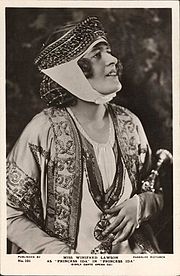
| Princess Ida | Winifred Lawson Winifred Lawson Winifred Lawson was an opera and concert singer in the first half of the 20th century. She is best remembered for her performances in the soprano roles in the Gilbert and Sullivan operas as a member of the D'Oyly Carte Opera Company.-Life and career:Lawson was born in Wolverhampton, England... |
Helen Roberts Helen Roberts Helen Florence Roberts , later known by her married name, Betty Walker, was an English singer and actress, best known for her performances in soprano roles of the Savoy Operas with the D'Oyly Carte Opera Company.... |
Victoria Sladen | Ann Hood | Valerie Masterson Valerie Masterson Margaret Valerie Masterson , is a retired English opera singer, a lecturer and Vice-President of British Youth Opera. After study in Italy, she began to sing opera in Europe... |
| Lady Blanche | Bertha Lewis Bertha Lewis Bertha Lewis was an English opera singer and actress primarily known for her work as principal contralto in the Gilbert & Sullivan comic operas with the D'Oyly Carte Opera Company.-Early life and career:... |
Evelyn Gardiner | Ann Drummond-Grant Ann Drummond-Grant Ann Drummond-Grant was a British singer and actress, best known for her performances in contralto roles of the Gilbert and Sullivan operas with the D'Oyly Carte Opera Company.Drummond-Grant began her career as a soprano... |
Christene Palmer | Lyndsie Holland |
| Lady Psyche | Sybil Gordon Sybil Gordon Sybil Gordon was a British singer. She is best remembered for her performances in Gilbert and Sullivan roles with the D'Oyly Carte Opera Company from 1926 to 1931. Gordon started out as a concert singer. After her career with the D'Oyly Carte company, she moved to Canada, where she broadcast on... |
Margery Abbott | Muriel Harding | Valerie Masterson Valerie Masterson Margaret Valerie Masterson , is a retired English opera singer, a lecturer and Vice-President of British Youth Opera. After study in Italy, she began to sing opera in Europe... |
Julia Goss Julia Goss Julia Goss , is an English singer and actress best known for her performances in the principal soprano roles of the Gilbert and Sullivan operas with the D'Oyly Carte Opera Company... |
| Melissa | Nellie Briercliffe Nellie Briercliffe Nellie Briercliffe was an English singer and actress best known for her performances in the mezzo-soprano roles of the Savoy Operas with the D'Oyly Carte Opera Company.... |
Marjorie Eyre Marjorie Eyre Marjorie Eyre was an English opera singer, best known for her performances in the soprano and mezzo-soprano roles of the Savoy Operas with the D'Oyly Carte Opera Company... |
Beryl Dixon | Pauline Wales Pauline Wales Pauline Wales is an English singer and actress best known for her performances in the mezzo-soprano roles of the Gilbert and Sullivan operas with the D'Oyly Carte Opera Company.-Life and career:... |
Pauline Wales Pauline Wales Pauline Wales is an English singer and actress best known for her performances in the mezzo-soprano roles of the Gilbert and Sullivan operas with the D'Oyly Carte Opera Company.-Life and career:... |
| Sacharissa | Nancy Ray | Maysie Dean | Cynthia Morey | Anne Sessions | Anne Egglestone |
| Chloe | Beatrice Elburn | Ivy Sanders | Margaret Dobson | Jennifer Marks | Marjorie Williams |
| Ada | Nancy Hughes | Marjorie Flinn | Maureen Melvin | Elizabeth Mynett | Rosalind Griffiths |
Recordings
Princess Ida has received fewer professional recordings than most of the Gilbert and Sullivan operas. The D'Oyly Carte Opera Company recorded the piece four times, in 1924, 1932, 1955 and 1965, but the later two recordings have not been as well received as the earlier two. The BBC broadcast the piece in 1966 and 1989, but the recordings are unavailable. The 1982 Brent Walker Productions video is considered to be one of the weakest of the series. Ohio Light OperaOhio Light Opera
The Ohio Light Opera is a professional opera company based in Wooster, Ohio that performs the light opera repertory, including Gilbert and Sullivan, American, British and continental operettas, and other musical theatre works, especially of the late 19th and early 20th centuries...
recorded the opera in 2000.
The International Gilbert and Sullivan Festival
International Gilbert and Sullivan Festival
The International Gilbert and Sullivan Festival is held every summer at the Opera House in Buxton, Derbyshire, England. The three-week Festival of Gilbert and Sullivan performances and fringe events attracts thousands of visitors, including performers, supporters, and G&S enthusiasts from all...
offers various video recordings of the opera, including its excellent 2003 professional G&S Opera Company video.
- 1924 D'Oyly Carte – Conductors: Harry NorrisHarry Norris (conductor)Harry Norris was a New Zealand-born conductor best remembered as musical director of the D'Oyly Carte Opera Company between 1919 and 1929. After leaving that company, Norris emigrated to Canada to teach but returned to retire in England in the 1960s.-Life and career:Norris was born in...
and George W. Byng - 1932 D'Oyly Carte – Conductor: Malcolm SargentMalcolm SargentSir Harold Malcolm Watts Sargent was an English conductor, organist and composer widely regarded as Britain's leading conductor of choral works...
- 1955 D'Oyly Carte – Conductor: Isidore GodfreyIsidore GodfreyIsidore Godfrey was musical director of the D'Oyly Carte Opera Company for 39 years, from 1929 to 1968...
- 1965 D'Oyly Carte – Royal Philharmonic Orchestra, Conductor: Sir Malcolm Sargent
- 1982 Brent Walker Productions (video) – Ambrosian Opera Chorus, London Symphony Orchestra, Conductor: Alexander FarisAlexander FarisAlexander "Sandy" Faris is an Irish composer, conductor and writer, known for his television theme tunes. He has composed and recorded many operas and musicals, and has composed film scores and orchestral works.-Life and career:...
; Stage Director: Terry Gilbert - 2000 Ohio Light Opera – Conductor: J. Lynn Thompson
External links
- Princess Ida at The Gilbert & Sullivan Archive
- Princess Ida at The Gilbert & Sullivan Discography
- 1912 libretto, with illustrations by W. Russell Flint, at the Internet Archive
- Biographies of the people listed in the historical casting chart
- http://math.boisestate.edu/GaS/other_gilbert/html/princess_home.htmlGilbert's 1870 play, The PrincessThe Princess (play)The Princess is a blank verse farcical play, in five scenes with music, by W. S. Gilbert which adapts and parodies Alfred Lord Tennyson's humorous 1847 narrative poem, The Princess: A Medley. It was first produced at the Olympic Theatre in London on 8 January 1870.Gilbert called the piece "a...
] - Bab illustrations of lyrics from Princess Ida
- Photos and information about the 1954 production of Ida
- D'Oyly Carte Prompt Books at The Victoria and Albert Museum