


Savoy opera

Encyclopedia
Comic opera
Comic opera denotes a sung dramatic work of a light or comic nature, usually with a happy ending.Forms of comic opera first developed in late 17th-century Italy. By the 1730s, a new operatic genre, opera buffa, emerged as an alternative to opera seria...
that developed in Victorian England in the late 19th century, with W. S. Gilbert
W. S. Gilbert
Sir William Schwenck Gilbert was an English dramatist, librettist, poet and illustrator best known for his fourteen comic operas produced in collaboration with the composer Sir Arthur Sullivan, of which the most famous include H.M.S...
and Arthur Sullivan
Arthur Sullivan
Sir Arthur Seymour Sullivan MVO was an English composer of Irish and Italian ancestry. He is best known for his series of 14 operatic collaborations with the dramatist W. S. Gilbert, including such enduring works as H.M.S. Pinafore, The Pirates of Penzance and The Mikado...
as the original and most successful practitioners. The name is derived from the Savoy Theatre
Savoy Theatre
The Savoy Theatre is a West End theatre located in the Strand in the City of Westminster, London, England. The theatre opened on 10 October 1881 and was built by Richard D'Oyly Carte on the site of the old Savoy Palace as a showcase for the popular series of comic operas of Gilbert and Sullivan,...
, which impresario Richard D'Oyly Carte
Richard D'Oyly Carte
Richard D'Oyly Carte was an English talent agent, theatrical impresario, composer and hotelier during the latter half of the Victorian era...
built to house the Gilbert and Sullivan
Gilbert and Sullivan
Gilbert and Sullivan refers to the Victorian-era theatrical partnership of the librettist W. S. Gilbert and the composer Arthur Sullivan . The two men collaborated on fourteen comic operas between 1871 and 1896, of which H.M.S...
pieces, and later, those by other composer–librettist teams. The great bulk of the non-G&S Savoy Operas either failed to achieve a foothold in the standard repertory, or have faded over the years, leaving the term "Savoy Opera" as practically synonymous with Gilbert and Sullivan. The Savoy operas (in both senses) were seminal influences on the creation of the modern musical
Musical theatre
Musical theatre is a form of theatre combining songs, spoken dialogue, acting, and dance. The emotional content of the piece – humor, pathos, love, anger – as well as the story itself, is communicated through the words, music, movement and technical aspects of the entertainment as an...
.
Gilbert, Sullivan, Carte and other Victorian era
Victorian era
The Victorian era of British history was the period of Queen Victoria's reign from 20 June 1837 until her death on 22 January 1901. It was a long period of peace, prosperity, refined sensibilities and national self-confidence...
British composers, librettists and producers, as well as the contemporary British press and literature, called works of this kind "comic operas" to distinguish their content and style from that of the often risqué continental European operetta
Operetta
Operetta is a genre of light opera, light in terms both of music and subject matter. It is also closely related, in English-language works, to forms of musical theatre.-Origins:...
s that they wished to displace. Most of the published literature on Gilbert and Sullivan since that time refers to these works as "Savoy Operas", "comic operas", or both. However, the Penguin Opera Guides and many other general music dictionaries and encyclopedias classify the Gilbert and Sullivan works as operettas.
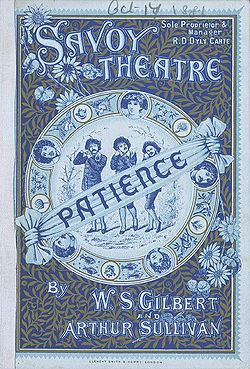
Patience (1881) was the first opera to appear at the Savoy Theatre, and thus, in a strict sense, the first true "Savoy Opera", although the term "Savoy Opera" has, for over a century, included the complete set of thirteen operas that Gilbert and Sullivan wrote for Richard D'Oyly Carte:
- Trial by JuryTrial by JuryTrial by Jury is a comic opera in one act, with music by Arthur Sullivan and libretto by W. S. Gilbert. It was first produced on 25 March 1875, at London's Royalty Theatre, where it initially ran for 131 performances and was considered a hit, receiving critical praise and outrunning its...
(1875) - The SorcererThe SorcererThe Sorcerer is a two-act comic opera, with a libretto by W. S. Gilbert and music by Arthur Sullivan. It was the British duo's third operatic collaboration. The plot of The Sorcerer is based on a Christmas story, An Elixir of Love, that Gilbert wrote for The Graphic magazine in 1876...
(1877) - H.M.S. PinaforeH.M.S. PinaforeH.M.S. Pinafore; or, The Lass That Loved a Sailor is a comic opera in two acts, with music by Arthur Sullivan and a libretto by W. S. Gilbert. It opened at the Opera Comique in London, England, on 25 May 1878 and ran for 571 performances, which was the second-longest run of any musical...
, or The Lass that Loved a Sailor (1878) - The Pirates of PenzanceThe Pirates of PenzanceThe Pirates of Penzance; or, The Slave of Duty is a comic opera in two acts, with music by Arthur Sullivan and libretto by W. S. Gilbert. The opera's official premiere was at the Fifth Avenue Theatre in New York City on 31 December 1879, where the show was well received by both audiences...
, or The Slave of Duty (1880) - Patience, or Bunthorne's Bride (1881)
- IolantheIolantheIolanthe; or, The Peer and the Peri is a comic opera with music by Arthur Sullivan and libretto by W. S. Gilbert. It is one of the Savoy operas and is the seventh collaboration of the fourteen between Gilbert and Sullivan....
, or The Peer and the Peri (1882) - Princess IdaPrincess IdaPrincess Ida; or, Castle Adamant is a comic opera with music by Arthur Sullivan and libretto by W. S. Gilbert. It was their eighth operatic collaboration of fourteen. Princess Ida opened at the Savoy Theatre on January 5, 1884, for a run of 246 performances...
, or Castle Adamant (1884) - The MikadoThe MikadoThe Mikado; or, The Town of Titipu is a comic opera in two acts, with music by Arthur Sullivan and libretto by W. S. Gilbert, their ninth of fourteen operatic collaborations...
, or The Town of Titipu (1885) - RuddigoreRuddigoreRuddigore; or, The Witch's Curse, originally called Ruddygore, is a comic opera in two acts, with music by Arthur Sullivan and libretto by W. S. Gilbert. It is one of the Savoy Operas and the tenth of fourteen comic operas written together by Gilbert and Sullivan...
, or The Witch's Curse (1887) - The Yeomen of the GuardThe Yeomen of the GuardThe Yeomen of the Guard; or, The Merryman and His Maid, is a Savoy Opera, with music by Arthur Sullivan and libretto by W. S. Gilbert. It premiered at the Savoy Theatre on 3 October 1888, and ran for 423 performances...
, or The Merryman and his Maid (1888) - The GondoliersThe GondoliersThe Gondoliers; or, The King of Barataria is a Savoy Opera, with music by Arthur Sullivan and libretto by W. S. Gilbert. It premiered at the Savoy Theatre on 7 December 1889 and ran for a very successful 554 performances , closing on 30 June 1891...
, or The King of Barataria (1889) - Utopia Limited, or The Flowers of Progress (1893)
- The Grand DukeThe Grand DukeThe Grand Duke; or, The Statutory Duel, is the final Savoy Opera written by librettist W. S. Gilbert and composer Arthur Sullivan, their fourteenth and last opera together. It premiered at the Savoy Theatre on March 7, 1896, and ran for 123 performances...
, or The Statutory Duel (1896)

Other definitions
During the years when the Gilbert and SullivanGilbert and Sullivan
Gilbert and Sullivan refers to the Victorian-era theatrical partnership of the librettist W. S. Gilbert and the composer Arthur Sullivan . The two men collaborated on fourteen comic operas between 1871 and 1896, of which H.M.S...
(“G&S”) operas were being written, Richard D'Oyly Carte
Richard D'Oyly Carte
Richard D'Oyly Carte was an English talent agent, theatrical impresario, composer and hotelier during the latter half of the Victorian era...
produced operas by other composer–librettist teams, either as curtain raisers
Curtain raiser (drama)
A curtain raiser is a performance, stage act, show, actor or performer that opens a show for the main attraction. The term is derived from the act of raising the stage curtain...
to the G&S pieces, or to fill the theatre when no G&S piece was available. To their contemporaries, the term "Savoy Opera" referred to any opera that appeared at that theatre, regardless of who wrote it.
Aside from curtain raisers (which are listed in the second table below), the G&S operas were the only works produced at the Savoy Theatre
Savoy Theatre
The Savoy Theatre is a West End theatre located in the Strand in the City of Westminster, London, England. The theatre opened on 10 October 1881 and was built by Richard D'Oyly Carte on the site of the old Savoy Palace as a showcase for the popular series of comic operas of Gilbert and Sullivan,...
from the date it opened (10 October 1881) until The Gondoliers
The Gondoliers
The Gondoliers; or, The King of Barataria is a Savoy Opera, with music by Arthur Sullivan and libretto by W. S. Gilbert. It premiered at the Savoy Theatre on 7 December 1889 and ran for a very successful 554 performances , closing on 30 June 1891...
closed on 20 June 1891. Over the next decade, there were only two new G&S pieces (Utopia Limited and The Grand Duke
The Grand Duke
The Grand Duke; or, The Statutory Duel, is the final Savoy Opera written by librettist W. S. Gilbert and composer Arthur Sullivan, their fourteenth and last opera together. It premiered at the Savoy Theatre on March 7, 1896, and ran for 123 performances...
), both of which had comparatively brief runs. To fill the gap, Carte mounted G&S revivals, Sullivan operas with different librettists, and works by other composer–librettist teams. Richard D'Oyly Carte died on April 3, 1901. If the nexus of Carte and the Savoy Theatre
Savoy Theatre
The Savoy Theatre is a West End theatre located in the Strand in the City of Westminster, London, England. The theatre opened on 10 October 1881 and was built by Richard D'Oyly Carte on the site of the old Savoy Palace as a showcase for the popular series of comic operas of Gilbert and Sullivan,...
is used to define "Savoy Opera," then the last new Savoy Opera was The Rose of Persia
The Rose of Persia
The Rose of Persia; or, The Story-Teller and the Slave, is a two-act comic opera, with music by Arthur Sullivan and a libretto by Basil Hood. It premiered at the Savoy Theatre on 29 November 1899, closing on 28 June 1900 after a profitable run of 211 performances...
(music by Sullivan, libretto by Basil Hood
Basil Hood
Basil Willett Charles Hood was a British librettist and lyricist, perhaps best known for writing the libretti of half a dozen Savoy Operas and for his English adaptations of operettas, including The Merry Widow. He embarked on a career in the British army, writing theatrical pieces in his spare...
), which ran from 28 November 1899–28 June 1900.
After Carte's death, his wife Helen Carte assumed management of the theatre. She continued to produce new pieces in the G&S style, along with G&S revivals. Counting the pieces that Mrs. D'Oyly Carte and the D'Oyly Carte Opera Company
D'Oyly Carte Opera Company
The D'Oyly Carte Opera Company was a professional light opera company that staged Gilbert and Sullivan's Savoy operas. The company performed nearly year-round in the UK and sometimes toured in Europe, North America and elsewhere, from the 1870s until it closed in 1982. It was revived in 1988 and...
produced, the last Savoy Opera was A Princess of Kensington
A Princess of Kensington
A Princess of Kensington is an English comic opera in two acts by Edward German to a libretto by Basil Hood, produced by William Greet. The first performance was at the Savoy Theatre, London, on 22 January 1903 and ran for 115 performances....
(music by Edward German
Edward German
Sir Edward German was an English musician and composer of Welsh descent, best remembered for his extensive output of incidental music for the stage and as a successor to Arthur Sullivan in the field of English comic opera.As a youth, German played the violin and led the town orchestra, also...
, libretto by Basil Hood
Basil Hood
Basil Willett Charles Hood was a British librettist and lyricist, perhaps best known for writing the libretti of half a dozen Savoy Operas and for his English adaptations of operettas, including The Merry Widow. He embarked on a career in the British army, writing theatrical pieces in his spare...
), which ran for four months in early 1903. This is the point that Cyril Rollins and R. John Witts adopt as the end of the Savoy Operas. After A Princess of Kensington, Mrs. D'Oyly Carte relinquished control of the theatre until December 8, 1906, when she produced two seasons of G&S revivals in repertory, with Gilbert returning to direct.
In March 1909, Charles H. Workman
Charles H. Workman
Charles H. Workman was a singer and actor best known as a successor to George Grossmith in the comic baritone roles in Gilbert and Sullivan operas. He was sometimes credited as C. Herbert Workman or C. H...
assumed control of the theatre, producing three new pieces, including one by Gilbert himself, Fallen Fairies
Fallen Fairies
Fallen Fairies; or, The Wicked World, is a two-act comic opera, with a libretto by W. S. Gilbert and music by Edward German. Premiering at London's Savoy Theatre on December 15, 1909, it failed miserably, closing after just 50 performances...
(music by Edward German
Edward German
Sir Edward German was an English musician and composer of Welsh descent, best remembered for his extensive output of incidental music for the stage and as a successor to Arthur Sullivan in the field of English comic opera.As a youth, German played the violin and led the town orchestra, also...
). The last of these Workman-produced works came in early 1910, Two Merry Monarchs
Two Merry Monarchs
Two Merry Monarchs is an Edwardian musical comedy in two acts with a book by Arthur Anderson and George Levy, lyrics by Anderson and Hartley Carrick, and music by Orlando Morgan. It opened at the Savoy Theatre in London on 10 March 1910, under the management of C. H. Workman, and ran there for 43...
, by Arthur Anderson
Arthur Anderson (dramatist)
Arthur Anderson was an English dramatist and lyricist, who is best known for his libretti for Edwardian musical comedies.-Biography:...
, George Levy, and Hartley Carrick, with music by Orlando Morgan
Orlando Morgan
Robert Orlando Morgan was an English music teacher, composer and musicologist. He is best remembered as an influential teacher at the Guildhall School of Music in London, where he taught for 64 years, from 1887 to 1951, as Professor of Pianoforte and Composition...
. The contemporary press referred to these works as "Savoy Operas", and S. J. Adair Fitz-Gerald regarded Workman's pieces as the last Savoy Operas.
Fitz-Gerald wrote his book, The Story of the Savoy Opera, in 1924, when these other pieces were still within living memory. But over time, all of the works produced at the Savoy by composers and librettists other than Gilbert and Sullivan
Gilbert and Sullivan
Gilbert and Sullivan refers to the Victorian-era theatrical partnership of the librettist W. S. Gilbert and the composer Arthur Sullivan . The two men collaborated on fourteen comic operas between 1871 and 1896, of which H.M.S...
were largely forgotten. The term "Savoy Opera" came to be synonymous with the thirteen extant works of Gilbert and Sullivan. The first collaboration of Gilbert and Sullivan—the 1871 opera Thespis—was not a Savoy Opera under any of the definitions mentioned to this point, as Richard D'Oyly Carte did not produce it, nor was it ever performed at the Savoy Theatre. Given its lack of a D'Oyly Carte or Savoy connection, Thespis has a tenuous claim to be a "Savoy Opera." However, Rollins & Witts include it in their compendium of the Savoy Operas, as does Geoffrey Smith.
Complete list
The following table shows all of the full-length operas that could be considered "Savoy Operas" under any of the definitions mentioned above. Only first runs are shown. Curtain-raisers and afterpieces that played with the Savoy Operas are included in the next table below.| Title | Librettist(s) | Composer(s) | Theatre | Opening Date | Closing Date | Perf's. |
|---|---|---|---|---|---|---|
| Thespis | W. S. Gilbert W. S. Gilbert Sir William Schwenck Gilbert was an English dramatist, librettist, poet and illustrator best known for his fourteen comic operas produced in collaboration with the composer Sir Arthur Sullivan, of which the most famous include H.M.S... |
Arthur Sullivan Arthur Sullivan Sir Arthur Seymour Sullivan MVO was an English composer of Irish and Italian ancestry. He is best known for his series of 14 operatic collaborations with the dramatist W. S. Gilbert, including such enduring works as H.M.S. Pinafore, The Pirates of Penzance and The Mikado... |
Gaiety Gaiety Theatre, London The Gaiety Theatre, London was a West End theatre in London, located on Aldwych at the eastern end of the Strand. The theatre was established as the Strand Musick Hall , in 1864 on the former site of the Lyceum Theatre. It was rebuilt several times, but closed from the beginning of World War II... |
26 Dec. 1871 | 8 Mar. 1872 | 64 |
| Trial by Jury Trial by Jury Trial by Jury is a comic opera in one act, with music by Arthur Sullivan and libretto by W. S. Gilbert. It was first produced on 25 March 1875, at London's Royalty Theatre, where it initially ran for 131 performances and was considered a hit, receiving critical praise and outrunning its... |
W. S. Gilbert W. S. Gilbert Sir William Schwenck Gilbert was an English dramatist, librettist, poet and illustrator best known for his fourteen comic operas produced in collaboration with the composer Sir Arthur Sullivan, of which the most famous include H.M.S... |
Arthur Sullivan Arthur Sullivan Sir Arthur Seymour Sullivan MVO was an English composer of Irish and Italian ancestry. He is best known for his series of 14 operatic collaborations with the dramatist W. S. Gilbert, including such enduring works as H.M.S. Pinafore, The Pirates of Penzance and The Mikado... |
Royalty | 25 Mar. 1875 | 18 Dec. 1875 | 131 |
| The Sorcerer The Sorcerer The Sorcerer is a two-act comic opera, with a libretto by W. S. Gilbert and music by Arthur Sullivan. It was the British duo's third operatic collaboration. The plot of The Sorcerer is based on a Christmas story, An Elixir of Love, that Gilbert wrote for The Graphic magazine in 1876... |
W. S. Gilbert W. S. Gilbert Sir William Schwenck Gilbert was an English dramatist, librettist, poet and illustrator best known for his fourteen comic operas produced in collaboration with the composer Sir Arthur Sullivan, of which the most famous include H.M.S... |
Arthur Sullivan Arthur Sullivan Sir Arthur Seymour Sullivan MVO was an English composer of Irish and Italian ancestry. He is best known for his series of 14 operatic collaborations with the dramatist W. S. Gilbert, including such enduring works as H.M.S. Pinafore, The Pirates of Penzance and The Mikado... |
Opera Comique | 17 Nov. 1877 | 24 May 1878 | 178 |
| H.M.S. Pinafore H.M.S. Pinafore H.M.S. Pinafore; or, The Lass That Loved a Sailor is a comic opera in two acts, with music by Arthur Sullivan and a libretto by W. S. Gilbert. It opened at the Opera Comique in London, England, on 25 May 1878 and ran for 571 performances, which was the second-longest run of any musical... |
W. S. Gilbert W. S. Gilbert Sir William Schwenck Gilbert was an English dramatist, librettist, poet and illustrator best known for his fourteen comic operas produced in collaboration with the composer Sir Arthur Sullivan, of which the most famous include H.M.S... |
Arthur Sullivan Arthur Sullivan Sir Arthur Seymour Sullivan MVO was an English composer of Irish and Italian ancestry. He is best known for his series of 14 operatic collaborations with the dramatist W. S. Gilbert, including such enduring works as H.M.S. Pinafore, The Pirates of Penzance and The Mikado... |
Opera Comique | 25 May 1878 | 20 Feb. 1880 | 571 |
| The Pirates of Penzance The Pirates of Penzance The Pirates of Penzance; or, The Slave of Duty is a comic opera in two acts, with music by Arthur Sullivan and libretto by W. S. Gilbert. The opera's official premiere was at the Fifth Avenue Theatre in New York City on 31 December 1879, where the show was well received by both audiences... |
W. S. Gilbert W. S. Gilbert Sir William Schwenck Gilbert was an English dramatist, librettist, poet and illustrator best known for his fourteen comic operas produced in collaboration with the composer Sir Arthur Sullivan, of which the most famous include H.M.S... |
Arthur Sullivan Arthur Sullivan Sir Arthur Seymour Sullivan MVO was an English composer of Irish and Italian ancestry. He is best known for his series of 14 operatic collaborations with the dramatist W. S. Gilbert, including such enduring works as H.M.S. Pinafore, The Pirates of Penzance and The Mikado... |
Bijou, Paignton | 30 Dec. 1879 | 30 Dec. 1879 | 1 |
| Fifth Avenue, NY | 31 Dec. 1879 | 5 June 1879 | 100 | |||
| Opera Comique | 3 Apr. 1880 | 2 Apr. 1881 | 363 | |||
| Patience | W. S. Gilbert W. S. Gilbert Sir William Schwenck Gilbert was an English dramatist, librettist, poet and illustrator best known for his fourteen comic operas produced in collaboration with the composer Sir Arthur Sullivan, of which the most famous include H.M.S... |
Arthur Sullivan Arthur Sullivan Sir Arthur Seymour Sullivan MVO was an English composer of Irish and Italian ancestry. He is best known for his series of 14 operatic collaborations with the dramatist W. S. Gilbert, including such enduring works as H.M.S. Pinafore, The Pirates of Penzance and The Mikado... |
Opera Comique | 23 Apr. 1881 | 8 Oct. 1881 | 170 |
| Savoy | 10 Oct. 1881 | 22 Nov. 1882 | 408 | |||
| Iolanthe Iolanthe Iolanthe; or, The Peer and the Peri is a comic opera with music by Arthur Sullivan and libretto by W. S. Gilbert. It is one of the Savoy operas and is the seventh collaboration of the fourteen between Gilbert and Sullivan.... |
W. S. Gilbert W. S. Gilbert Sir William Schwenck Gilbert was an English dramatist, librettist, poet and illustrator best known for his fourteen comic operas produced in collaboration with the composer Sir Arthur Sullivan, of which the most famous include H.M.S... |
Arthur Sullivan Arthur Sullivan Sir Arthur Seymour Sullivan MVO was an English composer of Irish and Italian ancestry. He is best known for his series of 14 operatic collaborations with the dramatist W. S. Gilbert, including such enduring works as H.M.S. Pinafore, The Pirates of Penzance and The Mikado... |
Savoy | 25 Nov. 1882 | 1 Jan. 1884 | 398 |
| Princess Ida Princess Ida Princess Ida; or, Castle Adamant is a comic opera with music by Arthur Sullivan and libretto by W. S. Gilbert. It was their eighth operatic collaboration of fourteen. Princess Ida opened at the Savoy Theatre on January 5, 1884, for a run of 246 performances... |
W. S. Gilbert W. S. Gilbert Sir William Schwenck Gilbert was an English dramatist, librettist, poet and illustrator best known for his fourteen comic operas produced in collaboration with the composer Sir Arthur Sullivan, of which the most famous include H.M.S... |
Arthur Sullivan Arthur Sullivan Sir Arthur Seymour Sullivan MVO was an English composer of Irish and Italian ancestry. He is best known for his series of 14 operatic collaborations with the dramatist W. S. Gilbert, including such enduring works as H.M.S. Pinafore, The Pirates of Penzance and The Mikado... |
Savoy | 5 Jan. 1884 | 9 Oct. 1884 | 246 |
| The Mikado The Mikado The Mikado; or, The Town of Titipu is a comic opera in two acts, with music by Arthur Sullivan and libretto by W. S. Gilbert, their ninth of fourteen operatic collaborations... |
W. S. Gilbert W. S. Gilbert Sir William Schwenck Gilbert was an English dramatist, librettist, poet and illustrator best known for his fourteen comic operas produced in collaboration with the composer Sir Arthur Sullivan, of which the most famous include H.M.S... |
Arthur Sullivan Arthur Sullivan Sir Arthur Seymour Sullivan MVO was an English composer of Irish and Italian ancestry. He is best known for his series of 14 operatic collaborations with the dramatist W. S. Gilbert, including such enduring works as H.M.S. Pinafore, The Pirates of Penzance and The Mikado... |
Savoy | 14 Mar. 1885 | 19 Jan. 1887 | 672 |
| Ruddygore | W. S. Gilbert W. S. Gilbert Sir William Schwenck Gilbert was an English dramatist, librettist, poet and illustrator best known for his fourteen comic operas produced in collaboration with the composer Sir Arthur Sullivan, of which the most famous include H.M.S... |
Arthur Sullivan Arthur Sullivan Sir Arthur Seymour Sullivan MVO was an English composer of Irish and Italian ancestry. He is best known for his series of 14 operatic collaborations with the dramatist W. S. Gilbert, including such enduring works as H.M.S. Pinafore, The Pirates of Penzance and The Mikado... |
Savoy | 22 Jan. 1887 | 5 Nov. 1887 | 288 |
| The Yeomen of the Guard The Yeomen of the Guard The Yeomen of the Guard; or, The Merryman and His Maid, is a Savoy Opera, with music by Arthur Sullivan and libretto by W. S. Gilbert. It premiered at the Savoy Theatre on 3 October 1888, and ran for 423 performances... |
W. S. Gilbert W. S. Gilbert Sir William Schwenck Gilbert was an English dramatist, librettist, poet and illustrator best known for his fourteen comic operas produced in collaboration with the composer Sir Arthur Sullivan, of which the most famous include H.M.S... |
Arthur Sullivan Arthur Sullivan Sir Arthur Seymour Sullivan MVO was an English composer of Irish and Italian ancestry. He is best known for his series of 14 operatic collaborations with the dramatist W. S. Gilbert, including such enduring works as H.M.S. Pinafore, The Pirates of Penzance and The Mikado... |
Savoy | 3 Oct. 1888 | 30 Nov. 1889 | 423 |
| The Gondoliers The Gondoliers The Gondoliers; or, The King of Barataria is a Savoy Opera, with music by Arthur Sullivan and libretto by W. S. Gilbert. It premiered at the Savoy Theatre on 7 December 1889 and ran for a very successful 554 performances , closing on 30 June 1891... |
W. S. Gilbert W. S. Gilbert Sir William Schwenck Gilbert was an English dramatist, librettist, poet and illustrator best known for his fourteen comic operas produced in collaboration with the composer Sir Arthur Sullivan, of which the most famous include H.M.S... |
Arthur Sullivan Arthur Sullivan Sir Arthur Seymour Sullivan MVO was an English composer of Irish and Italian ancestry. He is best known for his series of 14 operatic collaborations with the dramatist W. S. Gilbert, including such enduring works as H.M.S. Pinafore, The Pirates of Penzance and The Mikado... |
Savoy | 7 Dec. 1889 | 20 June 1891 | 554 |
| The Nautch Girl The Nautch Girl thumb|right|250px|Solomon , with Gilbert and Sullivan irate at his success at the SavoyThe Nautch Girl, or, The Rajah of Chutneypore is a comic opera in two acts, with a book by George Dance, lyrics by Dance and Frank Desprez and music by Edward Solomon... |
George Dance George Dance (dramatist) George Dance was an English lyricist and librettist in the 1890s and an important theatrical manager at the beginning of the 20th century.... & Frank Desprez Frank Desprez Frank Desprez was an English playwright, essayist, and poet. He wrote more than twenty pieces for the theatre, as well as numerous shorter works, including his famous poem, Lasca.-Life and career:... |
Edward Solomon Edward Solomon Edward Solomon was a prolific English composer, as well as a conductor, orchestrator and pianist. Though he died before his fortieth birthday, he wrote dozens of works produced for the stage, including several for the D'Oyly Carte Opera Company, such as The Nautch Girl, among others.-Early... |
Savoy | 30 June 1891 | 16 Jan. 1892 | 200 |
| The Vicar of Bray The Vicar of Bray (opera) The Vicar of Bray is a comic opera by Edward Solomon with a libretto by Sydney Grundy which opened at the Globe Theatre, in London, on 22 July 1882, for a run of only 69 performances. The public was not amused at a clergyman's being made the subject of ridicule, and the opera was regarded by some... |
Sydney Grundy Sydney Grundy Sydney Grundy was an English dramatist. Most of his works were adaptations of European plays, and many became successful enough to tour throughout the English-speaking world... |
Edward Solomon Edward Solomon Edward Solomon was a prolific English composer, as well as a conductor, orchestrator and pianist. Though he died before his fortieth birthday, he wrote dozens of works produced for the stage, including several for the D'Oyly Carte Opera Company, such as The Nautch Girl, among others.-Early... |
Savoy | 28 Jan. 1892 | 18 June 1892 | 143 |
| Haddon Hall Haddon Hall (opera) Haddon Hall is an English light opera with music by Arthur Sullivan and a libretto by Sydney Grundy. It premiered at the Savoy Theatre on September 24, 1892 for a modestly successful run of 204 performances... |
Sydney Grundy Sydney Grundy Sydney Grundy was an English dramatist. Most of his works were adaptations of European plays, and many became successful enough to tour throughout the English-speaking world... |
Arthur Sullivan Arthur Sullivan Sir Arthur Seymour Sullivan MVO was an English composer of Irish and Italian ancestry. He is best known for his series of 14 operatic collaborations with the dramatist W. S. Gilbert, including such enduring works as H.M.S. Pinafore, The Pirates of Penzance and The Mikado... |
Savoy | 24 Sep. 1892 | 15 Apr. 1893 | 204 |
| Jane Annie Jane Annie Jane Annie, or The Good Conduct Prize is an opera written in 1893 by J. M. Barrie and Arthur Conan Doyle, with music by Ernest Ford, a conductor and occasional composer.... |
J. M. Barrie J. M. Barrie Sir James Matthew Barrie, 1st Baronet, OM was a Scottish author and dramatist, best remembered today as the creator of Peter Pan. The child of a family of small-town weavers, he was educated in Scotland. He moved to London, where he developed a career as a novelist and playwright... & Arthur Conan Doyle Arthur Conan Doyle Sir Arthur Ignatius Conan Doyle DL was a Scottish physician and writer, most noted for his stories about the detective Sherlock Holmes, generally considered a milestone in the field of crime fiction, and for the adventures of Professor Challenger... |
Ernest Ford Ernest Ford Ernest A. Claire Ford was an English composer of operas and ballet music and a conductor.-Life and career:Ford was born in Warminster, Wiltshire, England, the son of the vestry clerk and organist there. From 1868-73, he sang in the chorus at Salisbury Cathedral... |
Savoy | 13 May 1893 | 1 July 1893 | 50 |
| Utopia Limited | W. S. Gilbert W. S. Gilbert Sir William Schwenck Gilbert was an English dramatist, librettist, poet and illustrator best known for his fourteen comic operas produced in collaboration with the composer Sir Arthur Sullivan, of which the most famous include H.M.S... |
Arthur Sullivan Arthur Sullivan Sir Arthur Seymour Sullivan MVO was an English composer of Irish and Italian ancestry. He is best known for his series of 14 operatic collaborations with the dramatist W. S. Gilbert, including such enduring works as H.M.S. Pinafore, The Pirates of Penzance and The Mikado... |
Savoy | 7 Oct. 1893 | 9 June 1894 | 245 |
| Mirette Mirette (opera) Mirette is an opéra comique in three acts composed by André Messager, first produced at the Savoy Theatre, London, on 3 July 1894.Mirette exists in two distinct versions. The first version of the libretto was written in French by Michel Carré but this was never performed. English lyrics were... |
Harry Greenbank Harry Greenbank Harry Greenbank was an English author and dramatist best known for contributing lyrics to the successful series musicals produced at Daly's Theatre by George Edwardes in the 1890s.-Life and career:... & Fred E. Weatherly (revised by Adrian Ross Adrian Ross For the NFL player see Adrian Ross Arthur Reed Ropes , better known under the pseudonym Adrian Ross, was a prolific writer of lyrics, contributing songs to more than sixty British musical comedies in the late 19th and early 20th centuries... ) |
André Messager André Messager André Charles Prosper Messager , was a French composer, organist, pianist, conductor and administrator. His stage compositions included ballets and 30 opéra comiques and operettas, among which Véronique, had lasting success, with Les p'tites Michu and Monsieur Beaucaire also enjoying international... |
Savoy | 3 July 1893 | 11 Aug. 1894 | 41 |
| 6 Oct. 1894 | 6 Dec. 1894 | 61 | ||||
| The Chieftain The Chieftain The Chieftain is a two-act comic opera by Arthur Sullivan and F. C. Burnand based on their 1867 opera, The Contrabandista. It consists of substantially the same first act as the 1867 work with a completely new second act... |
F. C. Burnand Francis Burnand Sir Francis Cowley Burnand , often credited as F. C. Burnand, was an English comic writer and dramatist.... |
Arthur Sullivan Arthur Sullivan Sir Arthur Seymour Sullivan MVO was an English composer of Irish and Italian ancestry. He is best known for his series of 14 operatic collaborations with the dramatist W. S. Gilbert, including such enduring works as H.M.S. Pinafore, The Pirates of Penzance and The Mikado... |
Savoy | 12 Dec. 1894 | 16 Mar. 1895 | 97 |
| The Grand Duke The Grand Duke The Grand Duke; or, The Statutory Duel, is the final Savoy Opera written by librettist W. S. Gilbert and composer Arthur Sullivan, their fourteenth and last opera together. It premiered at the Savoy Theatre on March 7, 1896, and ran for 123 performances... |
W. S. Gilbert W. S. Gilbert Sir William Schwenck Gilbert was an English dramatist, librettist, poet and illustrator best known for his fourteen comic operas produced in collaboration with the composer Sir Arthur Sullivan, of which the most famous include H.M.S... |
Arthur Sullivan Arthur Sullivan Sir Arthur Seymour Sullivan MVO was an English composer of Irish and Italian ancestry. He is best known for his series of 14 operatic collaborations with the dramatist W. S. Gilbert, including such enduring works as H.M.S. Pinafore, The Pirates of Penzance and The Mikado... |
Savoy | 7 Mar. 1896 | 10 July 1896 | 123 |
| His Majesty | F. C. Burnand Francis Burnand Sir Francis Cowley Burnand , often credited as F. C. Burnand, was an English comic writer and dramatist.... , R. C. Lehmann R. C. Lehmann Rudolph Chambers "R.C." Lehmann was an English writer and Liberal Party politician who sat in the House of Commons from 1906 to 1910. As a writer he was best known for three decades in which he was a major contributor to Punch as well as founding editor of Granta magazine.Lehmann was born in... , & Adrian Ross Adrian Ross For the NFL player see Adrian Ross Arthur Reed Ropes , better known under the pseudonym Adrian Ross, was a prolific writer of lyrics, contributing songs to more than sixty British musical comedies in the late 19th and early 20th centuries... |
Alexander Mackenzie Alexander Mackenzie (musician) Sir Alexander Campbell Mackenzie KCVO was a Scottish composer, conductor and teacher best known for his oratorios, violin and piano pieces, Scottish folk music and works for the stage.... |
Savoy | 20 Feb. 1897 | 24 Apr. 1897 | 61 |
| The Grand Duchess of Gerolstein La Grande-Duchesse de Gérolstein La Grande-Duchesse de Gérolstein is an opéra bouffe , in three acts and four tableaux by Jacques Offenbach to an original French libretto by Henri Meilhac and Ludovic Halévy... |
Charles H. Brookfield & Adrian Ross Adrian Ross For the NFL player see Adrian Ross Arthur Reed Ropes , better known under the pseudonym Adrian Ross, was a prolific writer of lyrics, contributing songs to more than sixty British musical comedies in the late 19th and early 20th centuries... |
Jacques Offenbach Jacques Offenbach Jacques Offenbach was a Prussian-born French composer, cellist and impresario. He is remembered for his nearly 100 operettas of the 1850s–1870s and his uncompleted opera The Tales of Hoffmann. He was a powerful influence on later composers of the operetta genre, particularly Johann Strauss, Jr.... |
Savoy | 4 Dec. 1897 | 12 Mar. 1898 | 104 |
| The Beauty Stone The Beauty Stone The Beauty Stone is an opera, billed as a "romantic musical drama" in three acts, composed by Arthur Sullivan to a libretto by Arthur Wing Pinero and J. Comyns Carr. The medieval Faustian story concerns an ugly, crippled girl, who dreams of being beautiful and meeting a handsome prince. The Devil... |
A. W. Pinero & J. Comyns Carr J. Comyns Carr Joseph William Comyns Carr was an English drama and art critic, gallery director, author, poet, playwright and theatre manager.... |
Arthur Sullivan Arthur Sullivan Sir Arthur Seymour Sullivan MVO was an English composer of Irish and Italian ancestry. He is best known for his series of 14 operatic collaborations with the dramatist W. S. Gilbert, including such enduring works as H.M.S. Pinafore, The Pirates of Penzance and The Mikado... |
Savoy | 28 May 1898 | 16 July 1898 | 50 |
| The Lucky Star The Lucky Star The Lucky Star is an English comic opera, in three acts, composed by Ivan Caryll, with dialogue by Charles H. Brookfield and lyrics by Adrian Ross and Aubrey Hopwood... |
Charles H. Brookfield, Adrian Ross Adrian Ross For the NFL player see Adrian Ross Arthur Reed Ropes , better known under the pseudonym Adrian Ross, was a prolific writer of lyrics, contributing songs to more than sixty British musical comedies in the late 19th and early 20th centuries... , & Aubrey Hopwood |
Ivan Caryll Ivan Caryll Félix Marie Henri Tilkin , better known by his pen name Ivan Caryll, was a Belgian composer of operettas and Edwardian musical comedies in the English language... |
Savoy | 7 Jan. 1899 | 31 May 1899 | 143 |
| The Rose of Persia The Rose of Persia The Rose of Persia; or, The Story-Teller and the Slave, is a two-act comic opera, with music by Arthur Sullivan and a libretto by Basil Hood. It premiered at the Savoy Theatre on 29 November 1899, closing on 28 June 1900 after a profitable run of 211 performances... |
Basil Hood Basil Hood Basil Willett Charles Hood was a British librettist and lyricist, perhaps best known for writing the libretti of half a dozen Savoy Operas and for his English adaptations of operettas, including The Merry Widow. He embarked on a career in the British army, writing theatrical pieces in his spare... |
Arthur Sullivan Arthur Sullivan Sir Arthur Seymour Sullivan MVO was an English composer of Irish and Italian ancestry. He is best known for his series of 14 operatic collaborations with the dramatist W. S. Gilbert, including such enduring works as H.M.S. Pinafore, The Pirates of Penzance and The Mikado... |
Savoy | 29 Nov. 1899 | 28 June 1900 | 213 |
| The Emerald Isle The Emerald Isle The Emerald Isle; or, The Caves of Carrig-Cleena, is a two-act comic opera, with music by Arthur Sullivan and Edward German, and a libretto by Basil Hood. It premiered at the Savoy Theatre on 27 April 1901, closing on 9 November 1901 after a run of 205 performances... |
Basil Hood Basil Hood Basil Willett Charles Hood was a British librettist and lyricist, perhaps best known for writing the libretti of half a dozen Savoy Operas and for his English adaptations of operettas, including The Merry Widow. He embarked on a career in the British army, writing theatrical pieces in his spare... |
Arthur Sullivan Arthur Sullivan Sir Arthur Seymour Sullivan MVO was an English composer of Irish and Italian ancestry. He is best known for his series of 14 operatic collaborations with the dramatist W. S. Gilbert, including such enduring works as H.M.S. Pinafore, The Pirates of Penzance and The Mikado... & Edward German Edward German Sir Edward German was an English musician and composer of Welsh descent, best remembered for his extensive output of incidental music for the stage and as a successor to Arthur Sullivan in the field of English comic opera.As a youth, German played the violin and led the town orchestra, also... |
Savoy | 27 Apr. 1901 | 9 Nov. 1901 | 205 |
| Ib and Little Christina Ib and Little Christina Ib and Little Christina refers to two theatrical adaptations by Basil Hood of the 1855 fairy tale by Hans Andersen of the same name.The first was a play styled "A Picture in 3 Parts", with incidental music by Arthur Bruhns and was first produced at the Prince of Wales Theatre, opening on 15 May... |
Basil Hood Basil Hood Basil Willett Charles Hood was a British librettist and lyricist, perhaps best known for writing the libretti of half a dozen Savoy Operas and for his English adaptations of operettas, including The Merry Widow. He embarked on a career in the British army, writing theatrical pieces in his spare... |
Franco Leoni Franco Leoni Franco Leoni was an Italian opera composer. After training in Milan, he made most of his career in England, composing for Covent Garden and West End theatres. He is best known for the opera L'Oracolo, written for Covent Garden but taken up successfully by the Metropolitan Opera in New York... |
Savoy | 14 Nov. 1901 | 29 Nov. 1901 | 16 |
| The Willow Pattern The Willow Pattern The Willow Pattern is a one-act comic opera with a libretto by Basil Hood and music by Cecil Cook. It was first performed at the Savoy Theatre on 14 November 1901, running for a total of 110 performances. It toured thereafter.... |
Basil Hood Basil Hood Basil Willett Charles Hood was a British librettist and lyricist, perhaps best known for writing the libretti of half a dozen Savoy Operas and for his English adaptations of operettas, including The Merry Widow. He embarked on a career in the British army, writing theatrical pieces in his spare... |
Cecil Cook | ||||
| Merrie England Merrie England (opera) Merrie England is an English comic opera in two acts by Edward German to a libretto by Basil Hood. The patriotic story concerns love and rivalries at the court of Queen Elizabeth I, who is portrayed as jealous of the affection of Sir Walter Raleigh for Bessie Throckmorton. Its sunny depiction of... |
Basil Hood Basil Hood Basil Willett Charles Hood was a British librettist and lyricist, perhaps best known for writing the libretti of half a dozen Savoy Operas and for his English adaptations of operettas, including The Merry Widow. He embarked on a career in the British army, writing theatrical pieces in his spare... |
Edward German Edward German Sir Edward German was an English musician and composer of Welsh descent, best remembered for his extensive output of incidental music for the stage and as a successor to Arthur Sullivan in the field of English comic opera.As a youth, German played the violin and led the town orchestra, also... |
Savoy | 2 Apr. 1902 | 30 July 1902 | 120 |
| 24 Nov. 1902 | 17 Jan. 1903 | 56 | ||||
| A Princess of Kensington A Princess of Kensington A Princess of Kensington is an English comic opera in two acts by Edward German to a libretto by Basil Hood, produced by William Greet. The first performance was at the Savoy Theatre, London, on 22 January 1903 and ran for 115 performances.... |
Basil Hood Basil Hood Basil Willett Charles Hood was a British librettist and lyricist, perhaps best known for writing the libretti of half a dozen Savoy Operas and for his English adaptations of operettas, including The Merry Widow. He embarked on a career in the British army, writing theatrical pieces in his spare... |
Edward German Edward German Sir Edward German was an English musician and composer of Welsh descent, best remembered for his extensive output of incidental music for the stage and as a successor to Arthur Sullivan in the field of English comic opera.As a youth, German played the violin and led the town orchestra, also... |
Savoy | 22 Jan. 1903 | 16 May 1903 | 115 |
| The Mountaineers The Mountaineers (opera) The Mountaineers is an English "romantic comic opera" in three acts with a libretto by Australian-born Guy Eden and Reginald Somerville , lyrics by Eden and music by Somerville. It opened at the Savoy Theatre in London on 29 September 1909, under the management of C. H. Workman, and ran for a... |
Guy Eden | Reginald Somerville Reginald Somerville Reginald Somerville was an English actor and composer. He is known for writing many drawing-room ballads such as "God Sends the Night", "Yestereve", "Zaida: A Song of the Desert" and "The Lark and the Nightingale", as well as a handful of operas.-Biography:Somerville received musical training... |
Savoy | 29 Sep. 1909 | 27 Nov. 1909 | 61 |
| Fallen Fairies Fallen Fairies Fallen Fairies; or, The Wicked World, is a two-act comic opera, with a libretto by W. S. Gilbert and music by Edward German. Premiering at London's Savoy Theatre on December 15, 1909, it failed miserably, closing after just 50 performances... |
W. S. Gilbert W. S. Gilbert Sir William Schwenck Gilbert was an English dramatist, librettist, poet and illustrator best known for his fourteen comic operas produced in collaboration with the composer Sir Arthur Sullivan, of which the most famous include H.M.S... |
Edward German Edward German Sir Edward German was an English musician and composer of Welsh descent, best remembered for his extensive output of incidental music for the stage and as a successor to Arthur Sullivan in the field of English comic opera.As a youth, German played the violin and led the town orchestra, also... |
Savoy | 15 Dec. 1909 | 29 Jan. 1910 | 51 |
| Two Merry Monarchs Two Merry Monarchs Two Merry Monarchs is an Edwardian musical comedy in two acts with a book by Arthur Anderson and George Levy, lyrics by Anderson and Hartley Carrick, and music by Orlando Morgan. It opened at the Savoy Theatre in London on 10 March 1910, under the management of C. H. Workman, and ran there for 43... |
Arthur Anderson, George Levy, & Hartley Carrick | Orlando Morgan Orlando Morgan Robert Orlando Morgan was an English music teacher, composer and musicologist. He is best remembered as an influential teacher at the Guildhall School of Music in London, where he taught for 64 years, from 1887 to 1951, as Professor of Pianoforte and Composition... |
Savoy | 10 Mar. 1910 | 23 Apr. 1910 | 43 |
Companion pieces
The fashion in the late Victorian eraVictorian era
The Victorian era of British history was the period of Queen Victoria's reign from 20 June 1837 until her death on 22 January 1901. It was a long period of peace, prosperity, refined sensibilities and national self-confidence...
and Edwardian era was to present long evenings in the theatre, and so full-length pieces were often presented together with companion pieces. During the original runs of the Savoy Operas, each full-length work was normally accompanied by one or two short companion pieces. A piece that began the performance was called a curtain raiser
Curtain raiser (drama)
A curtain raiser is a performance, stage act, show, actor or performer that opens a show for the main attraction. The term is derived from the act of raising the stage curtain...
, and one that ended the performance was called an afterpiece. W. J. MacQueen-Pope
W. J. MacQueen-Pope
Walter James MacQueen-Pope was an English theatre historian and publicist. From a theatrical family which could be traced back to contemporaries of Shakespeare, he was in management for the first part of his career, but switched to publicity, in which field he became well-known...
commented, concerning the curtain raisers:
- This was a one-act play, seen only by the early comers. It would play to empty boxes, half-empty upper circle, to a gradually filling stalls and dress circle, but to an attentive, grateful and appreciative pit and gallery. Often these plays were little gems. They deserved much better treatment than they got, but those who saw them delighted in them. ... [They] served to give young actors and actresses a chance to win their spurs ... the stalls and the boxes lost much by missing the curtain-raiser, but to them dinner was more important.
The following table lists the known companion pieces that appeared at the Opera Comique or the Savoy Theatre during the original runs and principal revivals of the Savoy Operas through 1909. There may have been more such pieces that have not yet been identified. In a number of cases, the exact opening and closing dates are not known. Date ranges overlap, since it was common to rotate two or more companion pieces at performances during the same period to be played with the main piece.
Many of these pieces also played elsewhere (and often on tour by D'Oyly Carte touring companies). Only the runs at the Opera Comique and the Savoy are shown here.
| Title | Librettist(s) | Composer(s) | Theatre | Opening Date | Closing Date | Played With |
|---|---|---|---|---|---|---|
| Dora's Dream Dora's Dream Dora's Dream is a one-act operetta, with music composed by Alfred Cellier and a libretto by Arthur Cecil.The piece was first performed at the Royal Gallery of Illustration on 3 July 1873, with Fanny Holland and Arthur Cecil starring in the two roles... |
Arthur Cecil Arthur Cecil Arthur Cecil Blunt, better known as Arthur Cecil was an English actor, comedian, playwright and theatre manager. He is probably best remembered for playing the role of Box in the long-running production of Cox and Box, by Arthur Sullivan and F. C... |
Alfred Cellier Alfred Cellier Alfred Cellier was an English composer, orchestrator and conductor.In addition to conducting and music directing the original productions of several of the most famous Gilbert and Sullivan works and writing the overtures to some of them, Cellier conducted at many theatres in London, New York and... |
Opera Comique | 17 Nov. 1877 | 7 Feb. 1878 |
The Sorcerer The Sorcerer The Sorcerer is a two-act comic opera, with a libretto by W. S. Gilbert and music by Arthur Sullivan. It was the British duo's third operatic collaboration. The plot of The Sorcerer is based on a Christmas story, An Elixir of Love, that Gilbert wrote for The Graphic magazine in 1876... |
| The Spectre Knight The Spectre Knight The Spectre Knight is a one-act "fanciful operetta" with a libretto by James Albery and music by Alfred Cellier. It was first performed on 9 February 1878 at the Opera Comique by the Comedy Opera Company as a companion piece to The Sorcerer... |
James Albery James Albery James Albery was an English dramatist.-Life and career:Albery was born in London. On leaving school Albery entered an architect's office, and started to write plays. His farce A Pretty Piece of Chiselling was given its first production by the Ingoldsby Club in 1864... |
Alfred Cellier Alfred Cellier Alfred Cellier was an English composer, orchestrator and conductor.In addition to conducting and music directing the original productions of several of the most famous Gilbert and Sullivan works and writing the overtures to some of them, Cellier conducted at many theatres in London, New York and... |
Opera Comique | 9 Feb. 1878 | 23 Mar. 1878 | The Sorcerer The Sorcerer The Sorcerer is a two-act comic opera, with a libretto by W. S. Gilbert and music by Arthur Sullivan. It was the British duo's third operatic collaboration. The plot of The Sorcerer is based on a Christmas story, An Elixir of Love, that Gilbert wrote for The Graphic magazine in 1876... |
| 28 May 1878 | 10 Aug. 1878 | Pinafore H.M.S. Pinafore H.M.S. Pinafore; or, The Lass That Loved a Sailor is a comic opera in two acts, with music by Arthur Sullivan and a libretto by W. S. Gilbert. It opened at the Opera Comique in London, England, on 25 May 1878 and ran for 571 performances, which was the second-longest run of any musical... |
||||
| Trial by Jury Trial by Jury Trial by Jury is a comic opera in one act, with music by Arthur Sullivan and libretto by W. S. Gilbert. It was first produced on 25 March 1875, at London's Royalty Theatre, where it initially ran for 131 performances and was considered a hit, receiving critical praise and outrunning its... |
W. S. Gilbert W. S. Gilbert Sir William Schwenck Gilbert was an English dramatist, librettist, poet and illustrator best known for his fourteen comic operas produced in collaboration with the composer Sir Arthur Sullivan, of which the most famous include H.M.S... |
Arthur Sullivan Arthur Sullivan Sir Arthur Seymour Sullivan MVO was an English composer of Irish and Italian ancestry. He is best known for his series of 14 operatic collaborations with the dramatist W. S. Gilbert, including such enduring works as H.M.S. Pinafore, The Pirates of Penzance and The Mikado... |
Opera Comique & Savoy | 23 Mar. 1878 | 24 May 1878 | The Sorcerer The Sorcerer The Sorcerer is a two-act comic opera, with a libretto by W. S. Gilbert and music by Arthur Sullivan. It was the British duo's third operatic collaboration. The plot of The Sorcerer is based on a Christmas story, An Elixir of Love, that Gilbert wrote for The Graphic magazine in 1876... |
| 11 Oct. 1884 | 12 Mar. 1885 | |||||
| 22 Sept. 1898 | 31 Dec. 1898 | |||||
| 6 June 1899 | 25 Nov. 1899 | Pinafore H.M.S. Pinafore H.M.S. Pinafore; or, The Lass That Loved a Sailor is a comic opera in two acts, with music by Arthur Sullivan and a libretto by W. S. Gilbert. It opened at the Opera Comique in London, England, on 25 May 1878 and ran for 571 performances, which was the second-longest run of any musical... |
||||
| Beauties on the Beach | George Grossmith George Grossmith George Grossmith was an English comedian, writer, composer, actor, and singer. His performing career spanned more than four decades... |
George Grossmith George Grossmith George Grossmith was an English comedian, writer, composer, actor, and singer. His performing career spanned more than four decades... |
Opera Comique | 25 May 1878 | 5 Aug. 1878 | Pinafore H.M.S. Pinafore H.M.S. Pinafore; or, The Lass That Loved a Sailor is a comic opera in two acts, with music by Arthur Sullivan and a libretto by W. S. Gilbert. It opened at the Opera Comique in London, England, on 25 May 1878 and ran for 571 performances, which was the second-longest run of any musical... |
| 14 Oct. 1878 | 5 Dec. 1878 |
|||||
| A Silver Wedding | George Grossmith George Grossmith George Grossmith was an English comedian, writer, composer, actor, and singer. His performing career spanned more than four decades... |
George Grossmith George Grossmith George Grossmith was an English comedian, writer, composer, actor, and singer. His performing career spanned more than four decades... |
Opera Comique | part of 1878 | Pinafore H.M.S. Pinafore H.M.S. Pinafore; or, The Lass That Loved a Sailor is a comic opera in two acts, with music by Arthur Sullivan and a libretto by W. S. Gilbert. It opened at the Opera Comique in London, England, on 25 May 1878 and ran for 571 performances, which was the second-longest run of any musical... |
|
| Five Hamlets | George Grossmith George Grossmith George Grossmith was an English comedian, writer, composer, actor, and singer. His performing career spanned more than four decades... |
George Grossmith George Grossmith George Grossmith was an English comedian, writer, composer, actor, and singer. His performing career spanned more than four decades... |
Opera Comique | ? 1878 | 12 Oct. 1878 | Pinafore H.M.S. Pinafore H.M.S. Pinafore; or, The Lass That Loved a Sailor is a comic opera in two acts, with music by Arthur Sullivan and a libretto by W. S. Gilbert. It opened at the Opera Comique in London, England, on 25 May 1878 and ran for 571 performances, which was the second-longest run of any musical... |
| Cups and Saucers Cups and Saucers Cups and Saucers is a one-act "satirical musical sketch" written and composed by George Grossmith. It was first produced in 1876 on tour as a vehicle for Grossmith and Florence Marryat, as part of Entre Nous, their series of piano sketches... |
George Grossmith George Grossmith George Grossmith was an English comedian, writer, composer, actor, and singer. His performing career spanned more than four decades... |
George Grossmith George Grossmith George Grossmith was an English comedian, writer, composer, actor, and singer. His performing career spanned more than four decades... |
Opera Comique | 5 Aug. 1878 |
20 Feb. 1880 | Pinafore H.M.S. Pinafore H.M.S. Pinafore; or, The Lass That Loved a Sailor is a comic opera in two acts, with music by Arthur Sullivan and a libretto by W. S. Gilbert. It opened at the Opera Comique in London, England, on 25 May 1878 and ran for 571 performances, which was the second-longest run of any musical... |
| After All! After All! After All! is a one-act comic opera with a libretto by Frank Desprez and music by Alfred Cellier. It was first performed at the Savoy Theatre under the management of Richard D'Oyly Carte, along with H.M.S... |
Frank Desprez Frank Desprez Frank Desprez was an English playwright, essayist, and poet. He wrote more than twenty pieces for the theatre, as well as numerous shorter works, including his famous poem, Lasca.-Life and career:... |
Alfred Cellier Alfred Cellier Alfred Cellier was an English composer, orchestrator and conductor.In addition to conducting and music directing the original productions of several of the most famous Gilbert and Sullivan works and writing the overtures to some of them, Cellier conducted at many theatres in London, New York and... |
Opera Comique | 16 Dec. 1878 |
20 Feb. 1880 | Cups and Saucers Cups and Saucers Cups and Saucers is a one-act "satirical musical sketch" written and composed by George Grossmith. It was first produced in 1876 on tour as a vehicle for Grossmith and Florence Marryat, as part of Entre Nous, their series of piano sketches... |
| ? Feb. 1880 | 20 Mar. 1880 | Children's Pinafore | ||||
| Savoy | 23 Nov. 1895 | 4 Mar. 1896 | Mikado The Mikado The Mikado; or, The Town of Titipu is a comic opera in two acts, with music by Arthur Sullivan and libretto by W. S. Gilbert, their ninth of fourteen operatic collaborations... & Grand Duke The Grand Duke The Grand Duke; or, The Statutory Duel, is the final Savoy Opera written by librettist W. S. Gilbert and composer Arthur Sullivan, their fourteenth and last opera together. It premiered at the Savoy Theatre on March 7, 1896, and ran for 123 performances... |
|||
| 4 Apr. 1896 | 8 Aug. 1896 | |||||
| 7 May 1897 | 16 June 1897 | Yeomen The Yeomen of the Guard The Yeomen of the Guard; or, The Merryman and His Maid, is a Savoy Opera, with music by Arthur Sullivan and libretto by W. S. Gilbert. It premiered at the Savoy Theatre on 3 October 1888, and ran for 423 performances... |
||||
| In the Sulks In the Sulks In the Sulks is a one-act comic opera with a libretto by Frank Desprez and music by Alfred Cellier. It was first performed at the Opera Comique on 21 February 1880; revived 3 April 1880 to 2 April 1881 as a curtain raiser to The Pirates of Penzance, and again from 23 or 25 April to 2 May 1881 and... |
Frank Desprez Frank Desprez Frank Desprez was an English playwright, essayist, and poet. He wrote more than twenty pieces for the theatre, as well as numerous shorter works, including his famous poem, Lasca.-Life and career:... |
Alfred Cellier Alfred Cellier Alfred Cellier was an English composer, orchestrator and conductor.In addition to conducting and music directing the original productions of several of the most famous Gilbert and Sullivan works and writing the overtures to some of them, Cellier conducted at many theatres in London, New York and... |
Opera Comique | 21 Feb. 1880 | ? | Pirates The Pirates of Penzance The Pirates of Penzance; or, The Slave of Duty is a comic opera in two acts, with music by Arthur Sullivan and libretto by W. S. Gilbert. The opera's official premiere was at the Fifth Avenue Theatre in New York City on 31 December 1879, where the show was well received by both audiences... |
| 21 Feb. 1880 | 20 Mar. 1880 | Children's Pinafore | ||||
| 3 Apr. 1880 | 2 Apr. 1881 | Pirates The Pirates of Penzance The Pirates of Penzance; or, The Slave of Duty is a comic opera in two acts, with music by Arthur Sullivan and libretto by W. S. Gilbert. The opera's official premiere was at the Fifth Avenue Theatre in New York City on 31 December 1879, where the show was well received by both audiences... |
||||
| 23 Apr. 1881 |
2 May 1881 | Patience Patience (opera) Patience; or, Bunthorne's Bride, is a comic opera in two acts with music by Arthur Sullivan and libretto by W. S. Gilbert. First performed at the Opera Comique, London, on 23 April 1881, it moved to the 1,292-seat Savoy Theatre on 10 October 1881, where it was the first theatrical production in the... |
||||
| Savoy | 11 Oct. 1881 | 14 Oct. 1881 | ||||
| Uncle Samuel Uncle Samuel Uncle Samuel is a one-act comic opera with a libretto by Arthur Law and music by George Grossmith. It was first produced at the Opera Comique on 3 May 1881 to 8 October 1881, as companion piece to Patience. The piece also toured from December 1887 to June 1888 as a companion piece to H.M.S... |
Arthur Law Arthur Law William Arthur Law , better known as Arthur Law, was an English playwright, actor and scenic designer.-Life and career:... |
George Grossmith George Grossmith George Grossmith was an English comedian, writer, composer, actor, and singer. His performing career spanned more than four decades... |
Opera Comique | 3 May 1881 | 8 Oct. 1881 | Patience Patience (opera) Patience; or, Bunthorne's Bride, is a comic opera in two acts with music by Arthur Sullivan and libretto by W. S. Gilbert. First performed at the Opera Comique, London, on 23 April 1881, it moved to the 1,292-seat Savoy Theatre on 10 October 1881, where it was the first theatrical production in the... |
| Mock Turtles Mock Turtles (opera) Mock Turtles is a one-act comic opera with a libretto by Frank Desprez and music by Eaton Faning. It was first produced at the Savoy Theatre on 11 October 1881 as a curtain raiser to Patience, then from 26 November 1882 to 30 March 1883 with Iolanthe. The piece also toured from December 1881... |
Frank Desprez Frank Desprez Frank Desprez was an English playwright, essayist, and poet. He wrote more than twenty pieces for the theatre, as well as numerous shorter works, including his famous poem, Lasca.-Life and career:... |
Eaton Faning Eaton Faning Joseph Eaton Faning , known as Eaton Faning, was an English composer and teacher. The son of a music teacher, he became the organist of a church at the age of twelve. He attended the Royal Academy of Music, where his teachers included Arthur Sullivan. He was an outstanding student, winning many... |
Savoy | 11 Oct. 1881 | 22 Nov. 1882 | Patience Patience (opera) Patience; or, Bunthorne's Bride, is a comic opera in two acts with music by Arthur Sullivan and libretto by W. S. Gilbert. First performed at the Opera Comique, London, on 23 April 1881, it moved to the 1,292-seat Savoy Theatre on 10 October 1881, where it was the first theatrical production in the... |
| 25 Nov. 1882 | 30 Mar. 1883 | Iolanthe Iolanthe Iolanthe; or, The Peer and the Peri is a comic opera with music by Arthur Sullivan and libretto by W. S. Gilbert. It is one of the Savoy operas and is the seventh collaboration of the fourteen between Gilbert and Sullivan.... |
||||
| A Private Wire A Private Wire A Private Wire is a one-act musical "vaudeville" operetta with a libretto by Frank Desprez and Arnold Felix and music by Percy Reeve. It was first produced at the Savoy Theatre on 31 March 1883 to 1 January 1884 as a companion piece to Gilbert and Sullivan's Iolanthe... |
Frank Desprez Frank Desprez Frank Desprez was an English playwright, essayist, and poet. He wrote more than twenty pieces for the theatre, as well as numerous shorter works, including his famous poem, Lasca.-Life and career:... |
Percy Reeve Percy Reeve Percy Reeve was an English composer and music critic. Reeve wrote several successful operettas, often as companion pieces to longer works, as well as music for other theatrical pieces and serious music during the last two decades of the 19th century... |
Savoy | 31Mar. 1883 | 1 Jan. 1884 | Iolanthe Iolanthe Iolanthe; or, The Peer and the Peri is a comic opera with music by Arthur Sullivan and libretto by W. S. Gilbert. It is one of the Savoy operas and is the seventh collaboration of the fourteen between Gilbert and Sullivan.... |
| The Carp The Carp (opera) The Carp is a one-act comic opera with a libretto by Frank Desprez and music by Alfred Cellier. It was first produced at the Savoy Theatre from 13 February 1886 to 19 January 1887, as a companion piece to The Mikado. It was then revived as companion to Ruddigore from 21 February 1887 to 5... |
Frank Desprez Frank Desprez Frank Desprez was an English playwright, essayist, and poet. He wrote more than twenty pieces for the theatre, as well as numerous shorter works, including his famous poem, Lasca.-Life and career:... & Arnold Felix |
Alfred Cellier Alfred Cellier Alfred Cellier was an English composer, orchestrator and conductor.In addition to conducting and music directing the original productions of several of the most famous Gilbert and Sullivan works and writing the overtures to some of them, Cellier conducted at many theatres in London, New York and... |
Savoy | 13 Feb. 1886 | 19 Jan. 1887 | Mikado The Mikado The Mikado; or, The Town of Titipu is a comic opera in two acts, with music by Arthur Sullivan and libretto by W. S. Gilbert, their ninth of fourteen operatic collaborations... |
| 21 Feb. 1887 | 5 Nov. 1887 | Ruddigore Ruddigore Ruddigore; or, The Witch's Curse, originally called Ruddygore, is a comic opera in two acts, with music by Arthur Sullivan and libretto by W. S. Gilbert. It is one of the Savoy Operas and the tenth of fourteen comic operas written together by Gilbert and Sullivan... |
||||
| Mrs. Jarramie's Genie Mrs. Jarramie's Genie Mrs. Jarramie's Genie is a one-act comic opera with a libretto by Frank Desprez and music by Alfred Cellier and François Cellier. The piece was first presented at the Savoy Theatre on 14 February 1888, as a curtain raiser to the revival of H.M.S. Pinafore... |
Frank Desprez Frank Desprez Frank Desprez was an English playwright, essayist, and poet. He wrote more than twenty pieces for the theatre, as well as numerous shorter works, including his famous poem, Lasca.-Life and career:... |
Alfred Cellier Alfred Cellier Alfred Cellier was an English composer, orchestrator and conductor.In addition to conducting and music directing the original productions of several of the most famous Gilbert and Sullivan works and writing the overtures to some of them, Cellier conducted at many theatres in London, New York and... & François Cellier François Cellier François Arsène Cellier , often called Frank, was an English conductor and composer. He is best known for his tenure as music director and conductor of the D'Oyly Carte Opera Company during the original runs and early revivals of the Savoy operas.-Life and career:Cellier was born in South Hackney,... |
Savoy | 14 Feb. 1888 | ? Nov. 1889 | Pinafore H.M.S. Pinafore H.M.S. Pinafore; or, The Lass That Loved a Sailor is a comic opera in two acts, with music by Arthur Sullivan and a libretto by W. S. Gilbert. It opened at the Opera Comique in London, England, on 25 May 1878 and ran for 571 performances, which was the second-longest run of any musical... , Pirates The Pirates of Penzance The Pirates of Penzance; or, The Slave of Duty is a comic opera in two acts, with music by Arthur Sullivan and libretto by W. S. Gilbert. The opera's official premiere was at the Fifth Avenue Theatre in New York City on 31 December 1879, where the show was well received by both audiences... , Mikado The Mikado The Mikado; or, The Town of Titipu is a comic opera in two acts, with music by Arthur Sullivan and libretto by W. S. Gilbert, their ninth of fourteen operatic collaborations... , Yeomen The Yeomen of the Guard The Yeomen of the Guard; or, The Merryman and His Maid, is a Savoy Opera, with music by Arthur Sullivan and libretto by W. S. Gilbert. It premiered at the Savoy Theatre on 3 October 1888, and ran for 423 performances... |
| Captain Billy Captain Billy Captain Billy is a one-act comic opera with a libretto by Harry Greenbank and music by François Cellier. It was first performed at the Savoy Theatre on 24 September 1891 until 16 January 1892, as a curtain raiser to The Nautch Girl, and from 1 February 1892 to 18 June 1892, as a curtain raiser to... |
Harry Greenbank Harry Greenbank Harry Greenbank was an English author and dramatist best known for contributing lyrics to the successful series musicals produced at Daly's Theatre by George Edwardes in the 1890s.-Life and career:... |
François Cellier François Cellier François Arsène Cellier , often called Frank, was an English conductor and composer. He is best known for his tenure as music director and conductor of the D'Oyly Carte Opera Company during the original runs and early revivals of the Savoy operas.-Life and career:Cellier was born in South Hackney,... |
Savoy | 24 Sep. 1891 | 16 Jan. 1892 | Nautch Girl The Nautch Girl thumb|right|250px|Solomon , with Gilbert and Sullivan irate at his success at the SavoyThe Nautch Girl, or, The Rajah of Chutneypore is a comic opera in two acts, with a book by George Dance, lyrics by Dance and Frank Desprez and music by Edward Solomon... |
| 1 Feb. 1892 | 18 June 1892 | Vicar of Bray The Vicar of Bray (opera) The Vicar of Bray is a comic opera by Edward Solomon with a libretto by Sydney Grundy which opened at the Globe Theatre, in London, on 22 July 1882, for a run of only 69 performances. The public was not amused at a clergyman's being made the subject of ridicule, and the opera was regarded by some... |
||||
| Mr. Jericho Mr. Jericho Mr. Jericho is a comic opera in one act with words by Harry Greenbank and music by Ernest Ford.The work was first performed at the Savoy Theatre, London, on 18 March 1893 as a curtain raiser to Arthur Sullivan's Haddon Hall in March and April 1893, and to Ford's Jane Annie in June and July 1893,... |
Harry Greenbank Harry Greenbank Harry Greenbank was an English author and dramatist best known for contributing lyrics to the successful series musicals produced at Daly's Theatre by George Edwardes in the 1890s.-Life and career:... |
Ernest Ford Ernest Ford Ernest A. Claire Ford was an English composer of operas and ballet music and a conductor.-Life and career:Ford was born in Warminster, Wiltshire, England, the son of the vestry clerk and organist there. From 1868-73, he sang in the chorus at Salisbury Cathedral... |
Savoy | 18 Mar. 1893 | 15 Apr. 1893 | Haddon Hall Haddon Hall (opera) Haddon Hall is an English light opera with music by Arthur Sullivan and a libretto by Sydney Grundy. It premiered at the Savoy Theatre on September 24, 1892 for a modestly successful run of 204 performances... |
| 3 June 1893 | 1 July 1893 | Jane Annie Jane Annie Jane Annie, or The Good Conduct Prize is an opera written in 1893 by J. M. Barrie and Arthur Conan Doyle, with music by Ernest Ford, a conductor and occasional composer.... |
||||
| Quite an Adventure Quite an Adventure Quite an Adventure is a one-act comic opera by Edward Solomon with a libretto by Frank Desprez. The farcical plot concerns a house-guest who mistakes his hostess's husband for an intruder.... |
Frank Desprez Frank Desprez Frank Desprez was an English playwright, essayist, and poet. He wrote more than twenty pieces for the theatre, as well as numerous shorter works, including his famous poem, Lasca.-Life and career:... |
Edward Solomon Edward Solomon Edward Solomon was a prolific English composer, as well as a conductor, orchestrator and pianist. Though he died before his fortieth birthday, he wrote dozens of works produced for the stage, including several for the D'Oyly Carte Opera Company, such as The Nautch Girl, among others.-Early... |
Savoy | 15 Dec. 1894 | 29 Dec. 1894 | The Chieftain The Chieftain The Chieftain is a two-act comic opera by Arthur Sullivan and F. C. Burnand based on their 1867 opera, The Contrabandista. It consists of substantially the same first act as the 1867 work with a completely new second act... |
| Cox & Box | F. C. Burnand | Arthur Sullivan Arthur Sullivan Sir Arthur Seymour Sullivan MVO was an English composer of Irish and Italian ancestry. He is best known for his series of 14 operatic collaborations with the dramatist W. S. Gilbert, including such enduring works as H.M.S. Pinafore, The Pirates of Penzance and The Mikado... |
Savoy | 31 Dec. 1894 | 16 Mar. 1895 | The Chieftain The Chieftain The Chieftain is a two-act comic opera by Arthur Sullivan and F. C. Burnand based on their 1867 opera, The Contrabandista. It consists of substantially the same first act as the 1867 work with a completely new second act... |
| Weather or No Weather or No Weather or No is a one-act comic opera, styled a "musical duologue", by Bertram Luard-Selby with a libretto by Adrian Ross and William Beach... |
Adrian Ross Adrian Ross For the NFL player see Adrian Ross Arthur Reed Ropes , better known under the pseudonym Adrian Ross, was a prolific writer of lyrics, contributing songs to more than sixty British musical comedies in the late 19th and early 20th centuries... & William Beach |
Bertram Luard-Selby Bertram Luard-Selby Bertram Luard-Selby was an English composer and cathedral organist. As an organist, he served in Salisbury Cathedral and Rochester Cathedral. As a composer, he wrote prolifically for the church, the concert-hall and the theatre.-Life and works:Luard-Selby was born at The Mote, Ightham, Kent... |
Savoy | 10 Aug. 1896 | 17 Feb. 1897 | The Mikado The Mikado The Mikado; or, The Town of Titipu is a comic opera in two acts, with music by Arthur Sullivan and libretto by W. S. Gilbert, their ninth of fourteen operatic collaborations... |
| 2 Mar. 1897 | 24 Apr. 1897 | His Majesty | ||||
| Old Sarah Old Sarah Old Sarah is a one-act comic opera composed by François Cellier with a libretto by Harry Greenbank.The piece was first produced at the Savoy Theatre from 17 June to 31 July 1897 and from 16 August to 20 November 1897 as a companion piece to The Yeomen of the Guard, from 10 December 1897 to 12 March... |
Harry Greenbank Harry Greenbank Harry Greenbank was an English author and dramatist best known for contributing lyrics to the successful series musicals produced at Daly's Theatre by George Edwardes in the 1890s.-Life and career:... |
François Cellier François Cellier François Arsène Cellier , often called Frank, was an English conductor and composer. He is best known for his tenure as music director and conductor of the D'Oyly Carte Opera Company during the original runs and early revivals of the Savoy operas.-Life and career:Cellier was born in South Hackney,... |
Savoy | 17 June 1897 | 31 July 1897 | Yeomen The Yeomen of the Guard The Yeomen of the Guard; or, The Merryman and His Maid, is a Savoy Opera, with music by Arthur Sullivan and libretto by W. S. Gilbert. It premiered at the Savoy Theatre on 3 October 1888, and ran for 423 performances... |
| 16 Aug. 1897 | 20 Nov. 1897 | |||||
| 10 Dec. 1897 | 12 Mar. 1898 | The Grand Duchess of Gerolstein La Grande-Duchesse de Gérolstein La Grande-Duchesse de Gérolstein is an opéra bouffe , in three acts and four tableaux by Jacques Offenbach to an original French libretto by Henri Meilhac and Ludovic Halévy... |
||||
| 22 Mar. 1898 |
21 May 1898 | Gondoliers The Gondoliers The Gondoliers; or, The King of Barataria is a Savoy Opera, with music by Arthur Sullivan and libretto by W. S. Gilbert. It premiered at the Savoy Theatre on 7 December 1889 and ran for a very successful 554 performances , closing on 30 June 1891... |
||||
| Pretty Polly | Basil Hood Basil Hood Basil Willett Charles Hood was a British librettist and lyricist, perhaps best known for writing the libretti of half a dozen Savoy Operas and for his English adaptations of operettas, including The Merry Widow. He embarked on a career in the British army, writing theatrical pieces in his spare... |
François Cellier François Cellier François Arsène Cellier , often called Frank, was an English conductor and composer. He is best known for his tenure as music director and conductor of the D'Oyly Carte Opera Company during the original runs and early revivals of the Savoy operas.-Life and career:Cellier was born in South Hackney,... |
Savoy | 19 May 1900 | 28 June 1900 | Rose of Persia The Rose of Persia The Rose of Persia; or, The Story-Teller and the Slave, is a two-act comic opera, with music by Arthur Sullivan and a libretto by Basil Hood. It premiered at the Savoy Theatre on 29 November 1899, closing on 28 June 1900 after a profitable run of 211 performances... |
| 8 Dec. 1900 | 20 Apr. 1901 | Patience Patience (opera) Patience; or, Bunthorne's Bride, is a comic opera in two acts with music by Arthur Sullivan and libretto by W. S. Gilbert. First performed at the Opera Comique, London, on 23 April 1881, it moved to the 1,292-seat Savoy Theatre on 10 October 1881, where it was the first theatrical production in the... |
||||
| The Outpost The Outpost (opera) The Outpost is an opera or operetta by composer Hamilton Clarke with a libretto by A. O'D. Bartholeyns. The story is an adaptation of the Singspiel Der vierjährige Posten by Theodor Körner with music by Franz Schubert.... |
Albert O'Donnell Bartholeyns Albert O'Donnell Bartholeyns Albert O'Donnell Bartholeyns , sometimes known as A. O'Donnell Bartholeyns, was an English journalist, hospital administrator, and translator of plays.-Biography:... |
Hamilton Clarke Hamilton Clarke James Hamilton Siree Clarke , better known as Hamilton Clarke, was an English conductor, composer and organist... |
Savoy | 2 July 1900 | 3 Nov. 1900 | Pirates The Pirates of Penzance The Pirates of Penzance; or, The Slave of Duty is a comic opera in two acts, with music by Arthur Sullivan and libretto by W. S. Gilbert. The opera's official premiere was at the Fifth Avenue Theatre in New York City on 31 December 1879, where the show was well received by both audiences... |
| 8 Nov. 1900 |
7 Dec. 1900 | Patience Patience (opera) Patience; or, Bunthorne's Bride, is a comic opera in two acts with music by Arthur Sullivan and libretto by W. S. Gilbert. First performed at the Opera Comique, London, on 23 April 1881, it moved to the 1,292-seat Savoy Theatre on 10 October 1881, where it was the first theatrical production in the... |
||||
| The Willow Pattern The Willow Pattern The Willow Pattern is a one-act comic opera with a libretto by Basil Hood and music by Cecil Cook. It was first performed at the Savoy Theatre on 14 November 1901, running for a total of 110 performances. It toured thereafter.... |
Basil Hood Basil Hood Basil Willett Charles Hood was a British librettist and lyricist, perhaps best known for writing the libretti of half a dozen Savoy Operas and for his English adaptations of operettas, including The Merry Widow. He embarked on a career in the British army, writing theatrical pieces in his spare... |
Cecil Cook | Savoy | 14 Nov. 1901 | 29 Nov. 1901 | Ib and Little Christina Ib and Little Christina Ib and Little Christina refers to two theatrical adaptations by Basil Hood of the 1855 fairy tale by Hans Andersen of the same name.The first was a play styled "A Picture in 3 Parts", with incidental music by Arthur Bruhns and was first produced at the Prince of Wales Theatre, opening on 15 May... |
| (revised version) | 9 Dec. 1901 | 29 Mar. 1902 | Iolanthe Iolanthe Iolanthe; or, The Peer and the Peri is a comic opera with music by Arthur Sullivan and libretto by W. S. Gilbert. It is one of the Savoy operas and is the seventh collaboration of the fourteen between Gilbert and Sullivan.... |
|||
| A Welsh Sunset A Welsh Sunset A Welsh Sunset is a one-act comic opera composed by Philip Michael Faraday, with a libretto by Frederick Fenn. It was produced at the Savoy Theatre from 15 July 1908 and played with revivals of H.M.S. Pinafore and The Pirates of Penzance until 17 October 1908, and from 2 December 1908 until 24... |
Frederick Fenn | Philip Michael Faraday Philip Michael Faraday Philip Michael Faraday was an English lawyer, surveyor, composer, organist and theatrical producer. He composed one of the last Savoy operas, staged several long-running shows in the West End of London, and wrote a book about local taxation that was for many years the standard work on the subject... |
Savoy | 15 July 1908 | 17 Oct. 1908 | Pinafore H.M.S. Pinafore H.M.S. Pinafore; or, The Lass That Loved a Sailor is a comic opera in two acts, with music by Arthur Sullivan and a libretto by W. S. Gilbert. It opened at the Opera Comique in London, England, on 25 May 1878 and ran for 571 performances, which was the second-longest run of any musical... & Pirates The Pirates of Penzance The Pirates of Penzance; or, The Slave of Duty is a comic opera in two acts, with music by Arthur Sullivan and libretto by W. S. Gilbert. The opera's official premiere was at the Fifth Avenue Theatre in New York City on 31 December 1879, where the show was well received by both audiences... |
| 2 Dec. 1908 | 24 Feb. 1909 | |||||
External links
- The Gilbert and Sullivan Archive
- Information about curtain raisers and companion pieces at The Gilbert and Sullivan Archive
- The Gilbert and Sullivan Discography
- Gilbert & Sullivan 101, with essays, bibliography, related links, etc.
- Savoynet - an email-based G&S listserv
- Who Was Who in the D'Oyly Carte
- Memories of the D'Oyly Carte website
- Reviews of the operas