

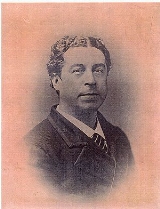
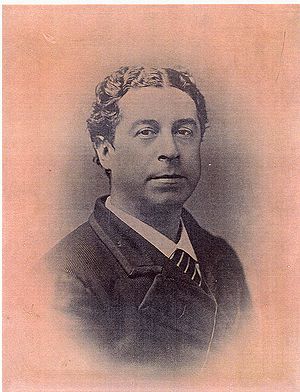
Fred Sullivan

Encyclopedia
English people
The English are a nation and ethnic group native to England, who speak English. The English identity is of early mediaeval origin, when they were known in Old English as the Anglecynn. England is now a country of the United Kingdom, and the majority of English people in England are British Citizens...
actor
Actor
An actor is a person who acts in a dramatic production and who works in film, television, theatre, or radio in that capacity...
and singer. He is best remembered as the creator of the role of the Learned Judge in Gilbert and Sullivan
Gilbert and Sullivan
Gilbert and Sullivan refers to the Victorian-era theatrical partnership of the librettist W. S. Gilbert and the composer Arthur Sullivan . The two men collaborated on fourteen comic operas between 1871 and 1896, of which H.M.S...
's Trial by Jury
Trial by Jury
Trial by Jury is a comic opera in one act, with music by Arthur Sullivan and libretto by W. S. Gilbert. It was first produced on 25 March 1875, at London's Royalty Theatre, where it initially ran for 131 performances and was considered a hit, receiving critical praise and outrunning its...
, providing a model for the comic roles in the later Savoy Opera
Savoy opera
The Savoy Operas denote a style of comic opera that developed in Victorian England in the late 19th century, with W. S. Gilbert and Arthur Sullivan as the original and most successful practitioners. The name is derived from the Savoy Theatre, which impresario Richard D'Oyly Carte built to house...
s composed by his brother Arthur Sullivan
Arthur Sullivan
Sir Arthur Seymour Sullivan MVO was an English composer of Irish and Italian ancestry. He is best known for his series of 14 operatic collaborations with the dramatist W. S. Gilbert, including such enduring works as H.M.S. Pinafore, The Pirates of Penzance and The Mikado...
.
By 1870, Sullivan had abandoned architecture for a career on stage. In 1871, he first performed the role of Mr. Cox in a revival of his brother's first comic opera
Comic opera
Comic opera denotes a sung dramatic work of a light or comic nature, usually with a happy ending.Forms of comic opera first developed in late 17th-century Italy. By the 1730s, a new operatic genre, opera buffa, emerged as an alternative to opera seria...
, Cox and Box
Cox and Box
Cox and Box; or, The Long-Lost Brothers, is a one-act comic opera with a libretto by F. C. Burnand and music by Arthur Sullivan, based on the 1847 farce Box and Cox by John Maddison Morton. It was Sullivan's first successful comic opera. The story concerns a landlord who lets a room to two...
, and later that year created the role of Apollo
Apollo
Apollo is one of the most important and complex of the Olympian deities in Greek and Roman mythology...
in the first Gilbert and Sullivan opera, Thespis
Thespis (opera)
Thespis, or The Gods Grown Old, is an operatic extravaganza that was the first collaboration between dramatist W. S. Gilbert and composer Arthur Sullivan. No musical score of Thespis was ever published, and most of the music has been lost...
. He then remained with the Gaiety Theatre
Gaiety Theatre, London
The Gaiety Theatre, London was a West End theatre in London, located on Aldwych at the eastern end of the Strand. The theatre was established as the Strand Musick Hall , in 1864 on the former site of the Lyceum Theatre. It was rebuilt several times, but closed from the beginning of World War II...
company, playing in Jacques Offenbach
Jacques Offenbach
Jacques Offenbach was a Prussian-born French composer, cellist and impresario. He is remembered for his nearly 100 operettas of the 1850s–1870s and his uncompleted opera The Tales of Hoffmann. He was a powerful influence on later composers of the operetta genre, particularly Johann Strauss, Jr....
pieces, among others. In 1874 he played in comic opera
Comic opera
Comic opera denotes a sung dramatic work of a light or comic nature, usually with a happy ending.Forms of comic opera first developed in late 17th-century Italy. By the 1730s, a new operatic genre, opera buffa, emerged as an alternative to opera seria...
s on tour and in other London theatres.
In 1875, he created the role of the Learned Judge in Trial by Jury, also playing in the accompanying Offenbach piece, La Périchole
La Périchole
La Périchole is an opéra bouffe in three acts by Jacques Offenbach. Henri Meilhac and Ludovic Halévy wrote the French-language libretto based on the 1829 one act play Le carrosse du Saint-Sacrement by Prosper Mérimée, which was revived on 13 March 1850 at the Théâtre-Français...
, and earning enthusiastic reviews. He then toured in Trial, and French operetta
Operetta
Operetta is a genre of light opera, light in terms both of music and subject matter. It is also closely related, in English-language works, to forms of musical theatre.-Origins:...
s, returning to London for the revival of Trial. By early 1876, Sullivan's health was deteriorating, and he was forced to stop performing in October 1876. He died in January 1877, leaving a pregnant widow and seven young children. Arthur Sullivan's enduring song, "The Lost Chord
The Lost Chord
"The Lost Chord" is a song composed by Arthur Sullivan in 1877 at the bedside of his brother Fred during Fred's last illness. The manuscript is dated 13 January 1877; Fred Sullivan died five days later...
", was composed at Fred's bedside. After Fred's death, Arthur became guardian to the children and helped support Fred's family for the rest of his life even after they moved to California against his wishes. He left the bulk of his estate to Fred's children.
Early life and career
Born in LambethLambeth
Lambeth is a district of south London, England, and part of the London Borough of Lambeth. It is situated southeast of Charing Cross.-Toponymy:...
, England, Sullivan was the elder brother of composer Arthur Sullivan
Arthur Sullivan
Sir Arthur Seymour Sullivan MVO was an English composer of Irish and Italian ancestry. He is best known for his series of 14 operatic collaborations with the dramatist W. S. Gilbert, including such enduring works as H.M.S. Pinafore, The Pirates of Penzance and The Mikado...
. His father, Thomas Sullivan (1805–1866), was a military bandmaster and music teacher born in Ireland, who was educated in Chelsea, London
Chelsea, London
Chelsea is an area of West London, England, bounded to the south by the River Thames, where its frontage runs from Chelsea Bridge along the Chelsea Embankment, Cheyne Walk, Lots Road and Chelsea Harbour. Its eastern boundary was once defined by the River Westbourne, which is now in a pipe above...
and was based for some years at the Royal Military Academy Sandhurst
Royal Military Academy Sandhurst
The Royal Military Academy Sandhurst , commonly known simply as Sandhurst, is a British Army officer initial training centre located in Sandhurst, Berkshire, England...
. His mother Mary Clementina (née Coghlan, 1811–1882) was English, of Irish and Italian descent. He trained as an architectural draftsman
Technical drawing
Technical drawing, also known as drafting or draughting, is the act and discipline of composing plans that visually communicate how something functions or has to be constructed.Drafting is the language of industry....
but soon decided on a career as a performer. Later, he quipped, "I still draw large houses." According to Leslie Ayre, Fred sometimes accompanied Arthur to the Chapel Royal and "amuse[d] the boys with comic songs".

Robert Reece
Robert Reece was a British comic playwright and librettist active in the Victorian era. He wrote many successful musical burlesques, comic operas, farces and adaptations from the French, including the English-language adaptation of the operetta Les cloches de Corneville, which became the...
, Whittington Junior, and his Sensation Cat, at the New Royalty Theatre
Royalty Theatre
The Royalty Theatre was a small London theatre situated at 73 Dean Street, Soho and opened on 25 May 1840 as Miss Kelly's Theatre and Dramatic School and finally closed to the public in 1938. The architect was Samuel Beazley, a resident in Soho Square, who also designed St James's Theatre, among...
in 1870, and as Smart in the accompanying farce Rendezvous. The next year, at the Alhambra Theatre
Alhambra Theatre
The Alhambra was a popular theatre and music hall located on the east side of Leicester Square, in the West End of London. It was built originally as The Royal Panopticon of Science and Arts opening on 18 March 1854. It was closed after two years and reopened as the Alhambra. The building was...
, he took the role of Mr. Cox in a revival of his brother Arthur Sullivan's first comic opera
Comic opera
Comic opera denotes a sung dramatic work of a light or comic nature, usually with a happy ending.Forms of comic opera first developed in late 17th-century Italy. By the 1730s, a new operatic genre, opera buffa, emerged as an alternative to opera seria...
, Cox and Box
Cox and Box
Cox and Box; or, The Long-Lost Brothers, is a one-act comic opera with a libretto by F. C. Burnand and music by Arthur Sullivan, based on the 1847 farce Box and Cox by John Maddison Morton. It was Sullivan's first successful comic opera. The story concerns a landlord who lets a room to two...
, with a libretto by F. C. Burnand. Later in 1871, he ran a provincial touring company, playing Cox, with Richard Temple as Bouncer and Richard D'Oyly Carte
Richard D'Oyly Carte
Richard D'Oyly Carte was an English talent agent, theatrical impresario, composer and hotelier during the latter half of the Victorian era...
conducting. The other works played by "Sullivan's Operetta Company" that summer were two Offenbach
Jacques Offenbach
Jacques Offenbach was a Prussian-born French composer, cellist and impresario. He is remembered for his nearly 100 operettas of the 1850s–1870s and his uncompleted opera The Tales of Hoffmann. He was a powerful influence on later composers of the operetta genre, particularly Johann Strauss, Jr....
adaptations, Rose of Auvergne (with Sullivan as Pierre) and Breaking the Spell, in which Selina Dolaro
Selina Dolaro
Selina Dolaro was an English singer, actress, theatre manager and writer. During a career in operetta and other forms of musical theatre, she managed several of her own opera companies and raised four children as a single mother...
starred.
Sullivan created the role of Apollo
Apollo
Apollo is one of the most important and complex of the Olympian deities in Greek and Roman mythology...
in his brother's first operatic collaboration with W. S. Gilbert
Gilbert and Sullivan
Gilbert and Sullivan refers to the Victorian-era theatrical partnership of the librettist W. S. Gilbert and the composer Arthur Sullivan . The two men collaborated on fourteen comic operas between 1871 and 1896, of which H.M.S...
, Thespis
Thespis (opera)
Thespis, or The Gods Grown Old, is an operatic extravaganza that was the first collaboration between dramatist W. S. Gilbert and composer Arthur Sullivan. No musical score of Thespis was ever published, and most of the music has been lost...
, at the Gaiety Theatre
Gaiety Theatre, London
The Gaiety Theatre, London was a West End theatre in London, located on Aldwych at the eastern end of the Strand. The theatre was established as the Strand Musick Hall , in 1864 on the former site of the Lyceum Theatre. It was rebuilt several times, but closed from the beginning of World War II...
, which ran from December 1871 until March 1872. During this run, he also starred in the companion pieces Dearer than Life by H. J. Byron and Ganymede and Galatea, among other works. He continued to appear at the Gaiety Theatre in 1872 and 1873, playing Patachon in Jacques Offenbach
Jacques Offenbach
Jacques Offenbach was a Prussian-born French composer, cellist and impresario. He is remembered for his nearly 100 operettas of the 1850s–1870s and his uncompleted opera The Tales of Hoffmann. He was a powerful influence on later composers of the operetta genre, particularly Johann Strauss, Jr....
's Les deux aveugles
Les deux aveugles
Les deux aveugles is a one-act bouffonerie musicale, in the style of an operetta, by Jacques Offenbach to a French libretto by Jules Moinaux...
(1872) and in The Magic Fife, a translation of another Offenbach operetta (1873). He moved to the Holborn Empire Theatre
Weston's Music Hall
Weston's Music Hall was a music hall and theatre that opened on 16 November 1857 at 242-245 High Holborn. In 1906, the theatre became known as the Holborn Empire.-Early years:...
by early 1874.
After performances in the spring at Crystal Palace
The Crystal Palace
The Crystal Palace was a cast-iron and glass building originally erected in Hyde Park, London, England, to house the Great Exhibition of 1851. More than 14,000 exhibitors from around the world gathered in the Palace's of exhibition space to display examples of the latest technology developed in...
with his own operetta company, Sullivan took his company on tour, in the summer of 1874, appearing in his brother's two collaborations with Burnand, Cox and Box and The Contrabandista
The Contrabandista
The Contrabandista, or The Law of the Ladrones, is a two-act comic opera by Arthur Sullivan and F. C. Burnand. It premiered at St. George's Hall, in London, on 18 December 1867 under the management of Thomas German Reed, for a run of 72 performances. There were brief revivals in Manchester in 1874...
, together with a version of Franz von Suppé
Franz von Suppé
Franz von Suppé or Francesco Suppé Demelli was an Austrian composer of light operas who was born in what is now Croatia during the time his father was working in this outpost of the Austro-Hungarian Empire...
's Die schöne Galathee
Die schöne Galathee
Die schöne Galathee is an operetta in two acts by Franz von Suppé to a German libretto by the composer and 'Poly Henrion' ....
, adapted as a burlesque of Gilbert's play, Pygmalion and Galatea, in which Sullivan played Midas "the pseudo art patron". He again played Cox in Cox and Box at the Gaiety Theatre beginning in September 1874. At this time, he met and became firm friends with George Grossmith
George Grossmith
George Grossmith was an English comedian, writer, composer, actor, and singer. His performing career spanned more than four decades...
, before Grossmith had met Sullivan's brother. Later in 1874, he appeared at the Opera Comique
Opera Comique
The Opera Comique was a 19th-century theatre constructed in Westminster, London, between Wych Street and Holywell Street with entrances on the East Strand. It opened in 1870 and was demolished in 1902, to make way for the construction of the Aldwych and Kingsway...
as Mercury in Ixion Rewheel'd, an opéra bouffe
Opéra bouffe
Opéra bouffe is a genre of late 19th-century French operetta, closely associated with Jacques Offenbach, who produced many of them at the Théâtre des Bouffes-Parisiens that gave its name to the form....
extravaganza
Extravaganza
An extravaganza is a literary or musical work characterized by freedom of style and structure and usually containing elements of burlesque, pantomime, music hall and parody. It sometimes also has elements of cabaret, circus, revue, variety, vaudeville and mime...
by F. C. Burnand, with music selected by W. C. Levey, and at the Holborn Amphitheatre as the impoverished and henpecked Duke of Rodomont, in Melusine the Enchantress by G. M. Layton and Hervé
Hervé (composer)
Hervé , real name Louis Auguste Florimond Ronger, was a French singer, composer, librettist, conductor and scene painter, whom Ernest Newman, following Reynaldo Hahn, credited with inventing the genre of operetta in Paris.-Life:Hervé was born in Houdain near Arras...
. In the autumn of that year, he and Carte were both concerned in presenting a touring production of Lecocq's La fille de Madame Angot
La fille de Madame Angot
La fille de Madame Angot is an opéra comique in three acts by Charles Lecocq. The French text was by Clairville, Paul Siraudin and Victor Koning.-Performance history:...
, for which Sullivan was credited as "secretary", but in which he did not perform.
Trial by Jury and death

Royalty Theatre
The Royalty Theatre was a small London theatre situated at 73 Dean Street, Soho and opened on 25 May 1840 as Miss Kelly's Theatre and Dramatic School and finally closed to the public in 1938. The architect was Samuel Beazley, a resident in Soho Square, who also designed St James's Theatre, among...
, opening on 30 January 1875 in the role of Don Andres, the British Viceroy, in Offenbach's La Périchole
La Périchole
La Périchole is an opéra bouffe in three acts by Jacques Offenbach. Henri Meilhac and Ludovic Halévy wrote the French-language libretto based on the 1829 one act play Le carrosse du Saint-Sacrement by Prosper Mérimée, which was revived on 13 March 1850 at the Théâtre-Français...
. Richard D'Oyly Carte
Richard D'Oyly Carte
Richard D'Oyly Carte was an English talent agent, theatrical impresario, composer and hotelier during the latter half of the Victorian era...
was manager of the theatre for Dolaro, and when one of La Péricholes companion pieces proved weak, Carte asked Gilbert to collaborate with Arthur Sullivan to write a one-act piece, Trial by Jury
Trial by Jury
Trial by Jury is a comic opera in one act, with music by Arthur Sullivan and libretto by W. S. Gilbert. It was first produced on 25 March 1875, at London's Royalty Theatre, where it initially ran for 131 performances and was considered a hit, receiving critical praise and outrunning its...
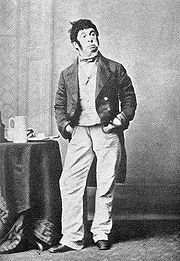
, for the theatre. Gilbert and Sullivan wrote the role of the Learned Judge for Fred Sullivan, and Trial by Jury opened at the Royalty 25 March 1875. Fred also continued to play Don Andres. Sullivan was made up for the role of the Learned Judge to look like the Lord Chief Justice, Sir Alexander Cockburn
Sir Alexander Cockburn, 12th Baronet
Sir Alexander James Edmund Cockburn, 12th Baronet Q.C. was a Scottish lawyer, politician and judge. A notorious womaniser and socialite, as Lord Chief Justice he heard some of the leading causes célèbres of the 19th century.-Life:Cockburn was born in Alţâna, in what is now Romania and was then...
. The first-night critics reserved especial praise for his performance: "The greatest 'hit' was made by Mr. F. Sullivan, whose blending of official dignity, condescension, and, at the right moment, extravagant humour, made the character of the Judge stand out with all requisite prominence, and added much to the interest of the piece." The Times
The Times
The Times is a British daily national newspaper, first published in London in 1785 under the title The Daily Universal Register . The Times and its sister paper The Sunday Times are published by Times Newspapers Limited, a subsidiary since 1981 of News International...
concurred: "Mr. F. Sullivan's impersonation of the learned and impressionable Judge deserves a special word of praise for its quiet and natural humour." Sullivan's performance was the hit of the show. F. C. Burnand wrote of him: "Fred Sullivan, Arthur's brother, was one of the most naturally comic little men I ever came across. He, too, was a first-rate practical musician. ... As he was the most absurd person, so was he the very kindliest. The brothers were devoted to each other".
After the Royalty closed for the summer in June 1875, Fred Sullivan toured in with Dolaro's company, performing in operettas, playing the Viceroy in La Périchole and Pomponnet in Lecocq’s La fille de Madame Angot
La fille de Madame Angot
La fille de Madame Angot is an opéra comique in three acts by Charles Lecocq. The French text was by Clairville, Paul Siraudin and Victor Koning.-Performance history:...
, as well as the Judge in Trial. He was back at the Royalty Theatre when it reopened for the autumn season, again playing the Judge, and continued in the role when the show opened at the Opera Comique
Opera Comique
The Opera Comique was a 19th-century theatre constructed in Westminster, London, between Wych Street and Holywell Street with entrances on the East Strand. It opened in 1870 and was demolished in 1902, to make way for the construction of the Aldwych and Kingsway...
beginning in January 1876, except when he played the role in a few matinee performances at the Gaiety Theatre. In March 1876, W. S. Penley
W. S. Penley
William Sydney Penley was an English actor, singer and comedian best remembered as producer and star of the phenomenally successful 1892 Brandon Thomas farce, Charley's Aunt and as the Reverend Robert Spalding in many productions of The Private Secretary.-Life and career:Penley was born at...
replaced Sullivan as the Judge for several performances when Sullivan was too ill to play the role because of his worsening tuberculosis. Sullivan was, however, able to resume the role until the production closed in May. From May to October, Emily Soldene
Emily Soldene
Emily Soldene was an English singer, actress, director, theatre manager, novelist and journalist of the late Victorian era and the Edwardian period...
's company played Trial on tour with Sullivan as the Judge, but at the end of the tour his declining health forced him to retire.
Sullivan died of liver disease
Liver disease
Liver disease is a broad term describing any single number of diseases affecting the liver.-Diseases:* Hepatitis, inflammation of the liver, caused mainly by various viruses but also by some poisons , autoimmunity or hereditary conditions...
and tuberculosis
Tuberculosis
Tuberculosis, MTB, or TB is a common, and in many cases lethal, infectious disease caused by various strains of mycobacteria, usually Mycobacterium tuberculosis. Tuberculosis usually attacks the lungs but can also affect other parts of the body...
in Fulham
Fulham
Fulham is an area of southwest London in the London Borough of Hammersmith and Fulham, SW6 located south west of Charing Cross. It lies on the left bank of the Thames, between Putney and Chelsea. The area is identified in the London Plan as one of 35 major centres in Greater London...
, in 1877, at the age of only 39. Arthur Sullivan's enduring song, "The Lost Chord
The Lost Chord
"The Lost Chord" is a song composed by Arthur Sullivan in 1877 at the bedside of his brother Fred during Fred's last illness. The manuscript is dated 13 January 1877; Fred Sullivan died five days later...
", was composed at Fred's bedside just five days before Fred died, and it is dedicated to his memory.
Family and legacy
Herbert Sullivan
Herbert Thomas Sullivan was the nephew, heir and biographer of the British composer Arthur Sullivan. After his uncle's death, Sullivan became active in charitable work...
(1868–1928), Maud "Cissie" Helen (1870–1940), Frederic Richard ("Dickie") (1872–1937), George Arthur (1874–1919), and William Lacy (1877–1902). At Sullivan's death, Charlotte was pregnant and had seven children under the age of 14. Edith, however, died shortly after her father. After Fred Sullivan's death, Arthur visited the family often and became guardian to all of the children. In 1881, Charlotte married Captain Benjamin Hutchinson, a man 13 years her junior.
In December 1883, at the urging of Charlotte's brother, William Lacy, Charlotte, her new husband, and six of her seven surviving children emigrated to Los Angeles, California
Los Angeles, California
Los Angeles , with a population at the 2010 United States Census of 3,792,621, is the most populous city in California, USA and the second most populous in the United States, after New York City. It has an area of , and is located in Southern California...
, leaving the oldest son, Bertie, in Arthur Sullivan's sole care. Despite Arthur's reservations about the move to Los Angeles, he paid for the trip and continued to give very substantial financial support to the family.
Charlotte died in January 1885, barely a year after the move to California. Hutchinson, unable to cope with this loss and his responsibilities, soon returned to England, leaving the six children to be raised mostly by Charlotte's brother and the older girls, with the financial support of their uncle Arthur. From June through August 1885, after completing his work on The Mikado
The Mikado
The Mikado; or, The Town of Titipu is a comic opera in two acts, with music by Arthur Sullivan and libretto by W. S. Gilbert, their ninth of fourteen operatic collaborations...
, Arthur Sullivan travelled to America to visit the family in Los Angeles and to take them on a sightseeing trip of the American West, including Yosemite Valley
Yosemite Valley
Yosemite Valley is a glacial valley in Yosemite National Park in the western Sierra Nevada mountains of California, carved out by the Merced River. The valley is about long and up to a mile deep, surrounded by high granite summits such as Half Dome and El Capitan, and densely forested with pines...
. Arthur Sullivan continued, throughout the rest of his life and in his will
Will (law)
A will or testament is a legal declaration by which a person, the testator, names one or more persons to manage his/her estate and provides for the transfer of his/her property at death...
, to take good care of Fred's children, continuing to correspond with them and to be concerned with their education, marriages and financial affairs. Bertie lived with his uncle in London for the rest of Arthur's life.
Fred Sullivan is buried at Brompton Cemetery
Brompton Cemetery
Brompton Cemetery is located near Earl's Court in South West London, England . It is managed by The Royal Parks and is one of the Magnificent Seven...
, London, together with his parents, Thomas Sullivan and Mary Clementina Sullivan. It was originally planned that Arthur would also be buried there until Queen Victoria
Victoria of the United Kingdom
Victoria was the monarch of the United Kingdom of Great Britain and Ireland from 20 June 1837 until her death. From 1 May 1876, she used the additional title of Empress of India....
insisted on his interment in St Paul's Cathedral
St Paul's Cathedral
St Paul's Cathedral, London, is a Church of England cathedral and seat of the Bishop of London. Its dedication to Paul the Apostle dates back to the original church on this site, founded in AD 604. St Paul's sits at the top of Ludgate Hill, the highest point in the City of London, and is the mother...
.