

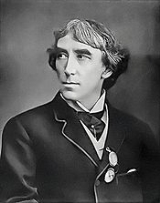
Henry Irving

Encyclopedia

Victorian era
The Victorian era of British history was the period of Queen Victoria's reign from 20 June 1837 until her death on 22 January 1901. It was a long period of peace, prosperity, refined sensibilities and national self-confidence...
, known as an actor-manager
Actor-manager
An actor-manager is a leading actor who sets up their own permanent theatrical company and manages the company's business and financial arrangements, sometimes taking over the management of a theatre, to perform plays of their own choice and in which they will usually star...
because he took complete responsibility (supervision of sets, lighting, direction, casting, as well as playing the leading roles) for season after season at the Lyceum Theatre, establishing himself and his company as representative of English classical theatre. Known as "The Governor" to those under his supervision at the Lyceum, he was the first actor to be awarded a knighthood. Irving is thought to have been the inspiration for the title character in Lyceum manager Bram Stoker
Bram Stoker
Abraham "Bram" Stoker was an Irish novelist and short story writer, best known today for his 1897 Gothic novel Dracula...
's 1897 novel Dracula
Dracula
Dracula is an 1897 novel by Irish author Bram Stoker.Famous for introducing the character of the vampire Count Dracula, the novel tells the story of Dracula's attempt to relocate from Transylvania to England, and the battle between Dracula and a small group of men and women led by Professor...
.
Life and career
Irving was born to a working-class family in Keinton MandevilleKeinton Mandeville
Keinton Mandeville is a village and civil parish in Somerset, England, situated west of Castle Cary in the South Somerset district. The village has a population of 991...
in the county of Somerset
Somerset
The ceremonial and non-metropolitan county of Somerset in South West England borders Bristol and Gloucestershire to the north, Wiltshire to the east, Dorset to the south-east, and Devon to the south-west. It is partly bounded to the north and west by the Bristol Channel and the estuary of the...
. He attended City Commercial School for two years before going to work in the office of a firm of lawyers at the age of 13. After seeing Samuel Phelps
Samuel Phelps
Samuel Phelps was an English actor and theatre manager...
play Hamlet
Prince Hamlet
Prince Hamlet is a fictional character, the protagonist in Shakespeare's tragedy Hamlet. He is the Prince of Denmark, nephew to the usurping Claudius and son of the previous King of Denmark, Old Hamlet. Throughout the play he struggles with whether, and how, to avenge the murder of his father, and...
soon after this, Irving sought out lessons, letters of introduction, and, finally, work in a theatre in Sunderland in 1856. He married Florence O'Callaghan on 15 July 1869 at St. Marylebone, London. Irving labored against great odds from 1856 till his 1871 success in The Bells
The Bells (play)
The Bells is a play in three acts by Leopold Davis Lewis which was one of the greatest successes of the British actor Henry Irving. The play opened on November 25 1871 at the Lyceum Theatre in London and initially ran for 151 performances...
in London
London
London is the capital city of :England and the :United Kingdom, the largest metropolitan area in the United Kingdom, and the largest urban zone in the European Union by most measures. Located on the River Thames, London has been a major settlement for two millennia, its history going back to its...
set him apart from all the rest.
His personal life took second place to his professional life. On opening night of The Bells, 25 November 1871, Irving's wife, Florence criticised his profession: "Are you going on making a fool of yourself like this all your life?" (She was then pregnant with their second boy, Laurence.) Irving got out from their carriage at Hyde Park Corner
Hyde Park Corner
Hyde Park Corner is a place in London, at the south-east corner of Hyde Park. It is a major intersection where Park Lane, Knightsbridge, Piccadilly, Grosvenor Place and Constitution Hill converge...
, walked off into the night and chose never to see her again. He maintained a discreet distance from his children as well, but became closer to them as they grew older.
His elder son, Harry Brodribb Irving
Harry Brodribb Irving
Harry Brodribb Irving , was a British stage actor and actor-manager; the eldest son of Sir Henry Irving and his wife Florence , and father of designer Laurence Irving and actress Elizabeth Irving....
(1870–1919), usually known as "H B Irving", became a famous actor and later a theatre manager. His younger son, Laurence Irving (1871–1914), became a dramatist and later drowned, with his wife, in the sinking of the Empress of Ireland
RMS Empress of Ireland
RMS Empress of Ireland was an ocean liner built in 1905 by Fairfield Shipbuilding and Engineering at Govan on the Clyde in Scotland for Canadian Pacific Steamships...
. Dorothea Baird
Dorothea Baird
Dorothea Baird was an English stage and motion pictures actress, and the daughter of Sir John Forster Baird, a prominent English barrister-at-law.-Career:...
married his son H B and the couple had a son, Laurence Irving
Laurence Irving (set designer)
Squadron Leader Laurence Irving OBE was an artist, book illustrator and Hollywood set designer and art director, the son of actors H. B. Irving and Dorothea Baird, and the biographer of his grandfather, the noted Victorian era actor Henry Irving. His sister was the actress and founder of the Keep...
(1897–1988), who became a well known Hollywood art director and a biographer for his grandfather.
Florence Irving never divorced Irving, and claimed herself "Lady Irving" once he had been knighted. Irving never remarried. In November 1882 Irving became a Freemason
Freemasonry
Freemasonry is a fraternal organisation that arose from obscure origins in the late 16th to early 17th century. Freemasonry now exists in various forms all over the world, with a membership estimated at around six million, including approximately 150,000 under the jurisdictions of the Grand Lodge...
, being initiated into the prestigious Jerusalem Lodge No 197 in London. He went on to take over the management of the Lyceum Theatre and brought the actress Ellen Terry
Ellen Terry
Dame Ellen Terry, GBE was an English stage actress who became the leading Shakespearean actress in Britain. Among the members of her famous family is her great nephew, John Gielgud....
into partnership with him as Ophelia
Ophelia
Ophelia is a fictional character in the play Hamlet by William Shakespeare. She is a young noblewoman of Denmark, the daughter of Polonius, sister of Laertes, and potential wife of Prince Hamlet.-Plot:...
to his Hamlet, Lady Macbeth
Lady Macbeth
Lady Macbeth may refer to:*Lady Macbeth, from William Shakespeare's play Macbeth**Queen Gruoch of Scotland, the real-life Queen on whom Shakespeare based the character...
to his Macbeth
Macbeth (character)
Macbeth is the title character in William Shakespeare's Macbeth . The character is based on the historical king Macbeth of Scotland, and is derived largely from the account in Holinshed's Chronicles , a history of Britain. Macbeth is a Scottish noble and a valiant military man. He is portrayed...
, Portia
Portia (Merchant of Venice)
Portia is the heroine of William Shakespeare's The Merchant of Venice. A rich, beautiful, and intelligent heiress, she is bound by the lottery set forth in her father's will, which gives potential suitors the chance to choose between three caskets composed of gold, silver and lead...
to his Shylock
Shylock
Shylock is a fictional character in Shakespeare's The Merchant of Venice.-In the play:In The Merchant of Venice, Shylock is a Jewish moneylender who lends money to his Christian rival, Antonio, setting the security at a pound of Antonio's flesh...
, Beatrice to his Benedick, etc. Irving might be said to have found his family in his professional company, which included his ardent supporter and manager Bram Stoker
Bram Stoker
Abraham "Bram" Stoker was an Irish novelist and short story writer, best known today for his 1897 Gothic novel Dracula...
and Terry's two illegitimate children, Teddy and Edy.
Whether Irving's long, spectacularly successful relationship with his leading lady Ellen Terry
Ellen Terry
Dame Ellen Terry, GBE was an English stage actress who became the leading Shakespearean actress in Britain. Among the members of her famous family is her great nephew, John Gielgud....
was romantic as well as professional has been the subject of much historical speculation. Most of their correspondence was lost or burned by her descendants. According to Michael Holroyd
Michael Holroyd
Sir Michael De Courcy Fraser Holroyd, FRHS, FRSL is an English biographer.-Life:Holroyd was born in London and educated at Eton College, though he has often claimed Maidenhead Public Library as his alma mater....
's book about Irving and Terry, A Strange Eventful History:
Terry's son Teddy, later known as Edward Gordon Craig
Edward Gordon Craig
Edward Henry Gordon Craig , sometimes known as Gordon Craig, was an English modernist theatre practitioner; he worked as an actor, director and scenic designer, as well as developing an influential body of theoretical writings...
, spent much of his childhood indulged by Irving backstage at the Lyceum (from when he was eight years old in 1879 to 1897). Craig, who came to be regarded as something of a visionary for the theatre of the future, wrote an especially vivid, book-length tribute to Irving. ("Let me state at once, in clearest unmistakable terms, that I have never known of, or seen, or heard, a greater actor than was Irving.") George Bernard Shaw
George Bernard Shaw
George Bernard Shaw was an Irish playwright and a co-founder of the London School of Economics. Although his first profitable writing was music and literary criticism, in which capacity he wrote many highly articulate pieces of journalism, his main talent was for drama, and he wrote more than 60...
, a theatre critic at the time who was jealous of Irving's connection to Ellen Terry (whom Shaw himself wanted in his own plays), conceded Irving's genius after Irving died.
Before joining the Lyceum, Terry had run off from her first marriage and had conceived two children out of wedlock with bohemian artist Godwin. She was somehow able to maintain an exalted position in the hearts of her Victorian audiences, regardless of how much and how often her behavior defied their strict moralities.
Early career
After a few years schooling while living at Halsetown, near St Ives, CornwallSt Ives, Cornwall
St Ives is a seaside town, civil parish and port in Cornwall, England, United Kingdom. The town lies north of Penzance and west of Camborne on the coast of the Celtic Sea. In former times it was commercially dependent on fishing. The decline in fishing, however, caused a shift in commercial...
, he became a clerk to a firm of East India
East India Company
The East India Company was an early English joint-stock company that was formed initially for pursuing trade with the East Indies, but that ended up trading mainly with the Indian subcontinent and China...
merchants in London, but he soon gave up a commercial career and started as an actor. On 29 September 1856 he made his first appearance at Sunderland as Gaston, Duke of Orleans, in Bulwer Lytton
Edward Bulwer-Lytton, 1st Baron Lytton
Edward George Earle Lytton Bulwer-Lytton, 1st Baron Lytton PC , was an English politician, poet, playwright, and novelist. He was immensely popular with the reading public and wrote a stream of bestselling dime-novels which earned him a considerable fortune...
's play, Richelieu, billed as Henry Irving. This name he eventually assumed by royal licence.
For 10 years, he went through an arduous training in various stock companies in Scotland
Scotland
Scotland is a country that is part of the United Kingdom. Occupying the northern third of the island of Great Britain, it shares a border with England to the south and is bounded by the North Sea to the east, the Atlantic Ocean to the north and west, and the North Channel and Irish Sea to the...
and the north of England, acting in more than 500 parts. He gained recognition by degrees, and in 1866 he was engage by Ruth Herbert
Ruth Herbert
Louisa Ruth Herbert was a well-known Victorian-era English stage actress and model for the artist Dante Gabriel Rossetti.-Actress:She was the daughter of a West Country brass founder. She was also known as Mrs...
as her leading man and sometime stage director at the St. James's Theatre, London, where her first played Doricourt in The Belle's Stratagem. One piece that he directed there was W. S. Gilbert
W. S. Gilbert
Sir William Schwenck Gilbert was an English dramatist, librettist, poet and illustrator best known for his fourteen comic operas produced in collaboration with the composer Sir Arthur Sullivan, of which the most famous include H.M.S...
's first successful solo play, Dulcamara, or the Little Duck and the Great Quack
Dulcamara, or the Little Duck and the Great Quack
Dulcamara, or the Little Duck and the Great Quack, is one of the earliest plays written by W.S. Gilbert, his first solo stage success. The work is a musical burlesque of Donizetti's L'Elisir d'Amore, and the music was arranged by Mr. Van Hamme...
(1866) A year later he joined the company of the newly-opened Queen's Theatre, where he acted with Charles Wyndham, J. L. Toole, Lionel Brough, John Clayton, Mr. and Mrs. Alfred Wigan
Alfred Wigan
Alfred Sydney Wigan was an actor-manager who took part in the first Royal Command Performance before Queen Victoria on 28 December 1848....
, Ellen Terry
Ellen Terry
Dame Ellen Terry, GBE was an English stage actress who became the leading Shakespearean actress in Britain. Among the members of her famous family is her great nephew, John Gielgud....
and Nellie Farren
Nellie Farren
Nellie Farren was an English actress and singer best known for her roles as the "principal boy" in musical burlesques at the Gaiety Theatre.Born into a theatrical family, Farren began acting as a child...
. This was followed by short engagements at the Haymarket Theatre
Haymarket Theatre
The Theatre Royal Haymarket is a West End theatre in the Haymarket in the City of Westminster which dates back to 1720, making it the third-oldest London playhouse still in use...
, Drury Lane, and the Gaiety Theatre
Gaiety Theatre, London
The Gaiety Theatre, London was a West End theatre in London, located on Aldwych at the eastern end of the Strand. The theatre was established as the Strand Musick Hall , in 1864 on the former site of the Lyceum Theatre. It was rebuilt several times, but closed from the beginning of World War II...
. At last he made his first conspicuous success as Digby Grant in James Albery
James Albery
James Albery was an English dramatist.-Life and career:Albery was born in London. On leaving school Albery entered an architect's office, and started to write plays. His farce A Pretty Piece of Chiselling was given its first production by the Ingoldsby Club in 1864...
's Two Roses, which was produced at the Vaudeville Theatre
Vaudeville Theatre
The Vaudeville Theatre is a West End theatre on The Strand in the City of Westminster. As the name suggests, the theatre held mostly vaudeville shows and musical revues in its early days. It opened in 1870 and was rebuilt twice, although each new building retained elements of the previous...
on the 4 June 1870 and ran for a very successful 300 nights.
In 1871, Irving began his association with the Lyceum Theatre by an engagement under Bateman's management. The fortunes of the house were at a low ebb when the tide was turned by Irving's sudden success as Mathias in The Bells
The Bells (play)
The Bells is a play in three acts by Leopold Davis Lewis which was one of the greatest successes of the British actor Henry Irving. The play opened on November 25 1871 at the Lyceum Theatre in London and initially ran for 151 performances...
, a version of Erckmann-Chatrian's Le Juif polonais
Le Juif polonais
Le Juif Polonais is an opera in three acts by Camille Erlanger composed to a libretto by Henri Cain. The libretto was adapted from the 1867 play of the same name by Erckmann-Chatrian...
by Leopold Lewis, a property which Irving had found for himself. The play ran for 150 nights, established Irving at the forefront of the British drama, and it would prove a popular vehicle for Irving for the rest of his professional life. With Bateman, Irving was seen in W. G. Wills
William Gorman Wills
William Gorman Wills , was an Irish dramatist and painter.-Biography:The son of James Wills , author of Lives of Illustrious and Distinguished Irishmen, William was born in Dublin and educated at Waterford Grammar School and Trinity College, Dublin.After publishing his novel Old Times in an Irish...
' Charles I and Eugene Aram, in Richelieu, and in 1874 in Hamlet
Hamlet
The Tragical History of Hamlet, Prince of Denmark, or more simply Hamlet, is a tragedy by William Shakespeare, believed to have been written between 1599 and 1601...
. The unconventionality of this last performance, during a run of 200 nights, aroused keen discussion and singled him out as the most interesting English actor of his day. In 1875, again with Bateman, he was seen as the title character in Macbeth
Macbeth
The Tragedy of Macbeth is a play by William Shakespeare about a regicide and its aftermath. It is Shakespeare's shortest tragedy and is believed to have been written sometime between 1603 and 1607...
; in 1876 as Othello
Othello (character)
Othello is a character in Shakespeare's Othello . The character's origin is traced to the tale, "Un Capitano Moro" in Gli Hecatommithi by Giovanni Battista Giraldi Cinthio. There, he is simply referred to as the Moor....
, and as Philip in Alfred Lord Tennyson's Queen Mary; in 1877 in Richard III
Richard III (play)
Richard III is a history play by William Shakespeare, believed to have been written in approximately 1591. It depicts the Machiavellian rise to power and subsequent short reign of Richard III of England. The play is grouped among the histories in the First Folio and is most often classified...
; and in The Lyons Mail. It is in this time that he became life-long friends with Bram Stoker
Bram Stoker
Abraham "Bram" Stoker was an Irish novelist and short story writer, best known today for his 1897 Gothic novel Dracula...
, who praised him in his review of Hamlet and thereafter joined Irving as the manager for the company. Stoker was inspired by Irving for his 1897 novel Dracula
Dracula
Dracula is an 1897 novel by Irish author Bram Stoker.Famous for introducing the character of the vampire Count Dracula, the novel tells the story of Dracula's attempt to relocate from Transylvania to England, and the battle between Dracula and a small group of men and women led by Professor...
.
Peak years
In 1878, Irving entered into a partnership with the actress Ellen TerryEllen Terry
Dame Ellen Terry, GBE was an English stage actress who became the leading Shakespearean actress in Britain. Among the members of her famous family is her great nephew, John Gielgud....
and re-opened the Lyceum under his own management. With Terry as Ophelia and Portia, he revived Hamlet
Hamlet
The Tragical History of Hamlet, Prince of Denmark, or more simply Hamlet, is a tragedy by William Shakespeare, believed to have been written between 1599 and 1601...
and produced The Merchant of Venice
The Merchant of Venice
The Merchant of Venice is a tragic comedy by William Shakespeare, believed to have been written between 1596 and 1598. Though classified as a comedy in the First Folio and sharing certain aspects with Shakespeare's other romantic comedies, the play is perhaps most remembered for its dramatic...
(1879). His Shylock
Shylock
Shylock is a fictional character in Shakespeare's The Merchant of Venice.-In the play:In The Merchant of Venice, Shylock is a Jewish moneylender who lends money to his Christian rival, Antonio, setting the security at a pound of Antonio's flesh...
was as much discussed as his Hamlet had been, the dignity with which he invested the vengeful Jewish merchant marking a departure from the traditional interpretation of the role.
After the production of Tennyson's The Cup and revivals of Othello (in which Irving played Iago
Iago
Iago is a fictional character in Shakespeare's Othello . The character's source is traced to Giovanni Battista Giraldi Cinthio's tale "Un Capitano Moro" in Gli Hecatommithi . There, the character is simply "the ensign". Iago is a soldier and Othello's ancient . He is the husband of Emilia,...
to Edwin Booth
Edwin Booth
Edwin Thomas Booth was a famous 19th century American actor who toured throughout America and the major capitals of Europe, performing Shakespearean plays. In 1869 he founded Booth's Theatre in New York, a spectacular theatre that was quite modern for its time...
's title character) and Romeo and Juliet
Romeo and Juliet
Romeo and Juliet is a tragedy written early in the career of playwright William Shakespeare about two young star-crossed lovers whose deaths ultimately unite their feuding families. It was among Shakespeare's most popular archetypal stories of young, teenage lovers.Romeo and Juliet belongs to a...
, there began a period at the Lyceum which had a potent effect on the English stage.
Much Ado about Nothing
Much Ado About Nothing
Much Ado About Nothing is a comedy written by William Shakespeare about two pairs of lovers, Benedick and Beatrice, and Claudio and Hero....
(1882) was followed by Twelfth Night (1884); an adaptation of Goldsmith
Oliver Goldsmith
Oliver Goldsmith was an Irish writer, poet and physician known for his novel The Vicar of Wakefield , his pastoral poem The Deserted Village , and his plays The Good-Natur'd Man and She Stoops to Conquer...
's Vicar of Wakefield by W. G. Wills (1885); Faust (1886); Macbeth (1888, with incidental music
Incidental music
Incidental music is music in a play, television program, radio program, video game, film or some other form not primarily musical. The term is less frequently applied to film music, with such music being referred to instead as the "film score" or "soundtrack"....
by Arthur Sullivan
Arthur Sullivan
Sir Arthur Seymour Sullivan MVO was an English composer of Irish and Italian ancestry. He is best known for his series of 14 operatic collaborations with the dramatist W. S. Gilbert, including such enduring works as H.M.S. Pinafore, The Pirates of Penzance and The Mikado...
); The Dead Heart, by Watts Phillips (1889); Ravenswood by Herman, and Merivales' dramatic version of Scott's Bride of Lammermoor (1890). Portrayals in 1892 of the characters of Wolsey in Henry VIII
Henry VIII (play)
The Famous History of the Life of King Henry the Eight is a history play by William Shakespeare and John Fletcher, based on the life of Henry VIII of England. An alternative title, All is True, is recorded in contemporary documents, the title Henry VIII not appearing until the play's publication...
and of the title character in King Lear
King Lear
King Lear is a tragedy by William Shakespeare. The title character descends into madness after foolishly disposing of his estate between two of his three daughters based on their flattery, bringing tragic consequences for all. The play is based on the legend of Leir of Britain, a mythological...
were followed in 1893 by a performance of Becket
Thomas Becket
Thomas Becket was Archbishop of Canterbury from 1162 until his murder in 1170. He is venerated as a saint and martyr by both the Roman Catholic Church and the Anglican Communion...
in Tennyson's play of the same name. During these years, too, Irving, with the whole Lyceum company, paid several successful visits to the United States
United States
The United States of America is a federal constitutional republic comprising fifty states and a federal district...
, which were repeated in succeeding years. As Terry grew older, there seemed to be less opportunities for her in his company, and that was one of the reasons why she eventually left, moving on into less steady but nonetheless beloved work on the stage, including solo performances of Shakespeare's women.
Later years

Arthur Conan Doyle
Sir Arthur Ignatius Conan Doyle DL was a Scottish physician and writer, most noted for his stories about the detective Sherlock Holmes, generally considered a milestone in the field of crime fiction, and for the adventures of Professor Challenger...
's Waterloo (1894); J. Comyns Carr
J. Comyns Carr
Joseph William Comyns Carr was an English drama and art critic, gallery director, author, poet, playwright and theatre manager....
's King Arthur in 1895; Cymbeline
Cymbeline
Cymbeline , also known as Cymbeline, King of Britain or The Tragedy of Cymbeline, is a play by William Shakespeare, based on legends concerning the early Celtic British King Cunobelinus. Although listed as a tragedy in the First Folio, modern critics often classify Cymbeline as a romance...
, in which Irving played Iachimo, in 1896; Sardou
Sardou
Sardou is a surname, and may refer to:* Saint Sacerdos of Limoges, also known as Saint Sardou* Victorien Sardou, French dramatist* Victorien Sardou was also the basis for naming Eggs Sardou, which is a part of Creole cuisine....
's Madame Sans-Gene in 1897; and Peter the Great, a play by Laurence Irving, the actor's second son, in 1898. In 1898 Irving was Rede Lecturer at the University of Cambridge
University of Cambridge
The University of Cambridge is a public research university located in Cambridge, United Kingdom. It is the second-oldest university in both the United Kingdom and the English-speaking world , and the seventh-oldest globally...
. The new regime at the Lyceum was signalled by the production of Sardou's Robespierre
Maximilien Robespierre
Maximilien François Marie Isidore de Robespierre is one of the best-known and most influential figures of the French Revolution. He largely dominated the Committee of Public Safety and was instrumental in the period of the Revolution commonly known as the Reign of Terror, which ended with his...
in 1899, in which Irving reappeared after a serious illness, and in 1901 by an elaborate revival of Coriolanus
Coriolanus (play)
Coriolanus is a tragedy by William Shakespeare, believed to have been written between 1605 and 1608. The play is based on the life of the legendary Roman leader, Gaius Marcius Coriolanus.-Characters:*Caius Martius, later surnamed Coriolanus...
. Irving's only subsequent production in London was as Sardou's Dante
DANTE
Delivery of Advanced Network Technology to Europe is a not-for-profit organisation that plans, builds and operates the international networks that interconnect the various national research and education networks in Europe and surrounding regions...
(1903) at the Drury Lane.
Irving died shortly after suffering a stroke
Stroke
A stroke, previously known medically as a cerebrovascular accident , is the rapidly developing loss of brain function due to disturbance in the blood supply to the brain. This can be due to ischemia caused by blockage , or a hemorrhage...
during a performance while on tour in Bradford on 13 October 1905, aged 67. F. Anstey describes the scene in his 'Long Retrospect':
He was brought to the lobby of the Midland Hotel
Midland Hotel, Bradford
The Midland Hotel is a 90-bedroom three-star Victorian hotel in Bradford City Centre, owned and managed by London-based Peel Hotels.The architect was Charles Trubshaw, who was contracted to design many stations for Midland Railway Company...
, where he died. The chair that he was sitting in when he died is now at the Garrick Club
Garrick Club
The Garrick Club is a gentlemen's club in London.-History:The Garrick Club was founded at a meeting in the Committee Room at Theatre Royal, Drury Lane on Wednesday 17 August 1831...
. He was cremated and his ashes buried in Westminster Abbey
Westminster Abbey
The Collegiate Church of St Peter at Westminster, popularly known as Westminster Abbey, is a large, mainly Gothic church, in the City of Westminster, London, United Kingdom, located just to the west of the Palace of Westminster. It is the traditional place of coronation and burial site for English,...
, thereby becoming the first person ever to be cremated prior to interment at Westminster. There is a statue of him near the National Portrait Gallery in London. That statue, as well as the influence of Irving himself, plays an important part in the Robertson Davies
Robertson Davies
William Robertson Davies, CC, OOnt, FRSC, FRSL was a Canadian novelist, playwright, critic, journalist, and professor. He was one of Canada's best-known and most popular authors, and one of its most distinguished "men of letters", a term Davies is variously said to have gladly accepted for himself...
novel World of Wonders.
The Irving Memorial Garden was opened on 19 July 1951 by Laurence Olivier
Laurence Olivier
Laurence Kerr Olivier, Baron Olivier, OM was an English actor, director, and producer. He was one of the most famous and revered actors of the 20th century. He married three times, to fellow actors Jill Esmond, Vivien Leigh, and Joan Plowright...
.
Legacy
Both on and off the stage, Irving always maintained a high ideal of his profession, and in 1895 he received a knighthood, the first ever accorded an actor. He was also the recipient of honorary degrees from the universities of DublinUniversity of Dublin
The University of Dublin , corporately designated the Chancellor, Doctors and Masters of the University of Dublin , located in Dublin, Ireland, was effectively founded when in 1592 Queen Elizabeth I issued a charter for Trinity College, Dublin, as "the mother of a university" – this date making it...
, Cambridge, and Glasgow
University of Glasgow
The University of Glasgow is the fourth-oldest university in the English-speaking world and one of Scotland's four ancient universities. Located in Glasgow, the university was founded in 1451 and is presently one of seventeen British higher education institutions ranked amongst the top 100 of the...
.
His acting divided critics; opinions differed as to the extent to which his mannerisms of voice and deportment interfered with or assisted the expression of his ideas.
Irving's idiosyncratic style of acting and its effect on amateur players was mildly satirised in The Diary of a Nobody. Mr Pooter's son brings Mr Burwin-Fosselton of the Holloway Comedians to supper, a young man who entirely monopolised the conversation, and:
"...who not only looked rather like Mr Irving but seemed to imagine he was the celebrated actor... he began doing the Irving business all through supper. He sank so low down in his chair that his chin was almost on a level with the table, and twice he kicked Carrie under the table, upset his wine, and flashed a knife uncomfortably near Gowing's face."
In the play, The Woman in Black
The Woman in Black (play)
The Woman in Black is a 1987 stage play, adapted by Stephen Mallatratt. The play is based on the book of the same name, which was written in 1983 by Susan Hill. It is notable for only having two actors perform the whole play. It was first performed at the Stephen Joseph Theatre in Scarborough, in...
, set in the Victorian era, the Actor playing Kipps tells Kipps 'We'll make an Irving of you yet,' in Act 1, as Kipps is not a very good actor due to his inexperience.
Biography
In 1906 Bram StokerBram Stoker
Abraham "Bram" Stoker was an Irish novelist and short story writer, best known today for his 1897 Gothic novel Dracula...
(the author of Dracula
Dracula
Dracula is an 1897 novel by Irish author Bram Stoker.Famous for introducing the character of the vampire Count Dracula, the novel tells the story of Dracula's attempt to relocate from Transylvania to England, and the battle between Dracula and a small group of men and women led by Professor...
), published a two volume biography about Henry Irving called Personal Reminiscences of Henry Irving
Personal Reminiscences of Henry Irving
Personal Reminiscences of Henry Irving is the third book of nonfiction by Bram Stoker , published in 1906. It is a biography about the English actor Henry Irving.-Online texts:...
. A complete PDF version of the book can be downloaded from Bram Stoker Online
Further reading
- Stoker, BramBram StokerAbraham "Bram" Stoker was an Irish novelist and short story writer, best known today for his 1897 Gothic novel Dracula...
. Personal Reminiscences of Henry Irving: Volume 1 and Volume 2. London : W. Heinemann, 1906. Scanned books via Internet ArchiveInternet ArchiveThe Internet Archive is a non-profit digital library with the stated mission of "universal access to all knowledge". It offers permanent storage and access to collections of digitized materials, including websites, music, moving images, and nearly 3 million public domain books. The Internet Archive...
. - Archer, WilliamWilliam Archer (critic)William Archer , Scottish critic, was born in Perth, and was educated at the University of Edinburgh, where he received the degree of M.A. in 1876. He was the son of Thomas Archer....
1885. Henry Irving, Actor and Manager: A Critical Study, London:Field & Tuer. - Beerbohm, MaxMax BeerbohmSir Henry Maximilian "Max" Beerbohm was an English essayist, parodist and caricaturist best known today for his 1911 novel Zuleika Dobson.-Early life:...
. 1928. 'Henry Irving' in A Variety of Things. New York, Knopf. - Holroyd, Michael. 2008. A Strange Eventful History, Farrar Straus Giroux, ISBN 0-7011-7987-2
- Irving, Laurence. 1989. Henry Irving: The Actor and His World. Lively Arts. ISBN 0-86287-890-X
- Information about Irving at the PeoplePlay UK website