

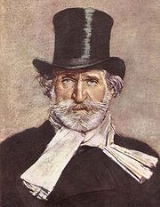
Rigoletto

Encyclopedia
Rigoletto is an opera
in three acts by Giuseppe Verdi
. The Italian
libretto
was written by Francesco Maria Piave
based on the play Le roi s'amuse
by Victor Hugo
. It was first performed at La Fenice
in Venice
on March 11, 1851. It is considered by many to be the first of the operatic masterpieces of Verdi's middle-to-late career.
opera house in Venice
in 1850, at a time when he was already a well-known composer with a degree of freedom in choosing the works he would prefer to set to music. He then asked Piave (with whom he had already created Ernani
, I due Foscari
, Macbeth
, Il Corsaro
and Stiffelio
) to examine the play Kean by Alexandre Dumas, père
, but he felt he needed a more energetic subject to work on.
Verdi soon stumbled upon Victor Hugo's Le roi s'amuse
. He later explained that "It contains extremely powerful positions ... The subject is great, immense, and has a character that is one of the most important creations of the theatre of all countries and all Ages". It was a highly controversial subject and Hugo himself had already had trouble with censorship
in France
, which had banned productions of his play after its first performance nearly twenty years earlier (and would continue to ban it for another thirty years). As Austria
at that time directly controlled much of Northern Italy, it came before the Austrian Board of Censors. Hugo's play depicted a king (Francis I of France
) as an immoral and cynical womanizer, something that was not accepted in Europe during the Restoration period.
From the beginning, Verdi was aware of the risks, as was Piave. In a letter which Verdi wrote to Piave: "Use four legs, run through the town and find me an influential person who can obtain the permission for making Le Roi s'amuse." Correspondence between a prudent Piave and an already committed Verdi followed, and the two remained at risk and underestimated the power and the intentions of Austrians. Even the friendly Guglielmo Brenna, secretary of La Fenice, who had promised them that they would not have problems with the censors, was wrong.
At the beginning of the summer of 1850, rumors started to spread that Austrian censorship was going to forbid the production. They considered the Hugo work to verge on lèse majesté
, and would never permit such a scandalous work to be performed in Venice.
In August, Verdi and Piave prudently retired to Busseto
, Verdi's hometown, to continue the composition and prepare a defensive scheme. They wrote to the theatre, assuring them that the censor's doubts about the morality of the work were not justified but since very little time was left, very little could be done. The work was secretly called by the composers The Malediction (or The Curse), and this unofficial title was used by Austrian censor De Gorzkowski (who evidently had known of it from spies) to enforce, if needed, the violent letter by which he definitively denied consent to its production.
In order not to waste all their work, Piave tried to revise the libretto and was even able to pull from it another opera Il Duca di Vendome, in which the sovereign was substituted with a duke and both the hunchback and the curse disappeared. Verdi was completely against this proposed solution and preferred instead to have direct negotiations with censors, arguing over each and every point of the work.
At this point Brenna, La Fenice's secretary, showed the Austrians some letters and articles depicting the bad character but the great value of the artist, helping to mediate the dispute. In the end the parties were able to agree that the action of the opera had to be moved from the royal court of France to a duchy of France or Italy, as well as a renaming of the characters. In the Italian version the Duke reigns over Mantova and belongs to the Gonzaga
family: the Gonzaga had long been extinct by the mid-19th Century, and the Dukedom of Mantova did not exist anymore, so nobody could be offended. The scene in which the sovereign retires in Gilda's bedroom would be deleted and the visit of the Duke to the Taverna (inn) was not intentional anymore, but provoked by a trick. The hunchback (originally Triboulet) became Rigoletto (from French rigolo = funny). The name of the work too was changed.
For the première, Verdi had Felice Varesi
as Rigoletto, the young tenor Raffaele Mirate
as the Duke, and Teresina Brambilla as Gilda (though Verdi would have preferred Teresa De Giuli Borsi). Teresina Brambilla was a well-known soprano coming from a family of singers and musicians; one of her nieces, Teresa Brambilla, was the wife of Amilcare Ponchielli
.
The opening was a complete triumph, especially the scena drammatica, and the Duke's cynical aria
, "La donna è mobile
", was sung in the streets the next morning.
Due to the high risk of unauthorised copying, Verdi had demanded the maximum secrecy from all his singers and musicians. Mirate had use of his score only a few evenings before the première and was forced to swear he would not sing or even whistle the tune of "La donna è mobile".
Many years later, Giulia Cori, Varesi's daughter, described her father's performance at the premiere. Playing the original Rigoletto, her father was really uncomfortable with the false hump he had to wear; he was so uncertain that, even though he was quite an experienced singer, he had a panic attack when it was his turn to enter the stage. Verdi immediately realised he was paralysed and roughly pushed him on the stage, so he appeared with a clumsy tumble. The audience, thinking it was a gag, was very amused.
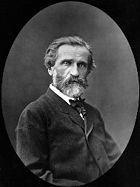
, Covent Garden in London. In the US, the opera was first seen on 19 February 1855 at New York's Academy of Music.
In modern times, it has become a staple of the standard operatic repertoire and it appears as number ten on the Operabase
list of the most-performed operas worldwide.
s, (Flute 2 doubles piccolo
), 2 oboe
s, (Oboe 2 doubles English horn) 2 clarinet
s, 2 bassoon
s, 4 horn
s in Eb, D, C, Ab, G, and F, 2 trumpet
s in C, D, and Eb, 3 trombone
s, cimbasso
, timpani
, bass drum
and cymbals, and strings.
Offstage: Banda
, bass drum
, 2 bells
, thunder machine
Onstage: Violin
s I and II, viola
s, and contrabass
es
At a ball in his palace, the Duke sings of a life of pleasure with as many women as possible (Questa o quella - "This woman or that"). He has seen an unknown beauty in church and desires to possess her, but he also wishes to seduce the Countess of Ceprano. Rigoletto, the Duke's hunchbacked court jester, mocks the husbands of the ladies to whom the Duke is paying attention, and advises the Duke to get rid of them by prison or death. Marullo informs the noblemen that Rigoletto has a "lover", and the noblemen cannot believe it. The noblemen resolve to take vengeance on Rigoletto. Subsequently Rigoletto mocks Count Monterone, whose daughter the Duke had seduced. Count Monterone is arrested at the Duke's order and curses the Duke and Rigoletto. The curse genuinely terrifies Rigoletto.
Scene 2: A street, with the courtyard of Rigoletto's house
Thinking of the curse, Rigoletto approaches his house and is accosted by the assassin Sparafucile, who offers his services. Rigoletto contemplates the similarities between the two of them (Pari siamo! - "We are alike!"); Sparafucile kills men with his sword, and Rigoletto uses "a tongue of malice" to stab his victims. Rigoletto opens a door in the wall and returns home to his daughter Gilda. They greet each other warmly (Figlia!" "Mio padre! - "Daughter!" "My father!"). Rigoletto has been concealing his daughter from the Duke and the rest of the city, and she does not know her father's occupation. Since he has forbidden her to appear in public, she has been nowhere except to church and does not even know her own father's name.
When Rigoletto has gone, the Duke appears and overhears Gilda confess to her nurse Giovanna that she feels guilty for not having told her father about a young man she had met at the church, but that she would love him even more if he were a student and poor. As she declares her love, the Duke enters, overjoyed. Gilda, alarmed, calls for Giovanna, unaware that the Duke had sent her away. Pretending to be a student, the Duke convinces Gilda of his love (E il sol dell'anima - "Love is the sunshine of the soul"). When she asks for his name, he hesitantly calls himself Gualtier Maldè. Hearing sounds and fearing that her father has returned, Gilda sends the Duke away after they quickly trade vows of love (Addio, addio - "Farewell, farewell"). Alone, Gilda meditates on her love for the Duke, whom she believes is a student (Gualtier Maldè! ... Caro nome - "Dearest name").
Later, the hostile noblemen outside the walled garden (believing Gilda to be the jester's mistress) get ready to abduct the helpless girl. Convincing Rigoletto that they are actually abducting the Countess Ceprano, they blindfold him and use him to help with the abduction. He assists them, and Gilda is carried away by the noblemen. Upon realizing that it was in fact Gilda who was carried away, Rigoletto collapses, remembering the curse.
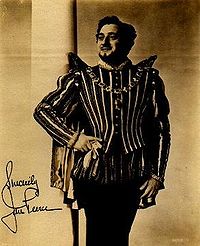
The Duke is concerned that Gilda has disappeared (Ella mi fu rapita! - "She was stolen from me!" and Parmi veder le lagrime - "I seem to see tears"). The noblemen then enter and inform him that they have captured Rigoletto's mistress. By their description, he recognizes it to be Gilda, and he rushes off to the room where she is held (Possente amor mi chiama - "Mighty love beckons me"). Pleased by the Duke's strange excitement, the courtiers now make sport with Rigoletto, who enters singing. He tries to find Gilda by pretending to be uncaring, as he fears she may fall into the hands of the Duke. Finally, he admits that he is in fact seeking his daughter and asks the courtiers to return her to him (Cortigiani, vil razza dannata - "Accursed race of courtiers"). The men beat up Rigoletto after his attempt to run into the room in which Gilda is being held. Gilda rushes in and begs her father to send the people away. The men leave the room believing Rigoletto has gone mad. Gilda describes to her father what has happened to her in the palace (Tutte le feste al tempio - "On all the blessed days"). Rigoletto demands vengeance against the Duke, while Gilda pleads for him (Duet: Sì! Vendetta, tremenda vendetta! - "Yes! Revenge, terrible revenge!").
A portion of Sparafucile's house is seen, with two rooms open to the view of the audience. Rigoletto and Gilda, who still loves the Duke, arrive outside. The Duke's voice can be heard (La donna è mobile
- "Woman is fickle") laying out the infidelity and fickle nature of women. Rigoletto makes Gilda realize that it is the Duke who is in the assassin's house and that he is attempting to seduce Sparafucile's sister, Maddalena.(Bella figlia dell'amore - "Sweet daughter of love")
Rigoletto bargains with the assassin, who is ready to murder his guest for money, and offers him 20 scudi for killing the Duke. He orders his daughter to put on a man's clothes in order to prepare to go to Verona and states that he plans to follow later. With falling darkness, a thunderstorm approaches and the Duke determines to remain in the house. Sparafucile assigns to him the ground floor sleeping quarters.
Gilda, who still loves the Duke despite knowing him to be unfaithful, returns dressed as a man. She overhears Maddalena begging for the Duke's life, and Sparafucile promises her that if by midnight another can be found in place of the Duke, he will spare the Duke's life. Gilda resolves to sacrifice herself for the Duke and enters the house. She is immediately mortally wounded and collapses.
At midnight, when Rigoletto arrives with money, he receives a corpse wrapped in a sack, and rejoices in his triumph. Weighting it with stones, he is about to cast the sack into the river when he hears the voice of the Duke singing a reprise of his "La donna è mobile" aria. Bewildered, Rigoletto opens the sack and, to his despair, discovers his mortally wounded daughter. For a moment, she revives and declares she is glad to die for her beloved (V'ho ingannato - "Father, I deceived you"). She dies in his arms. Rigoletto's wildest fear materializes when he cries out in horror: "The curse!"
produced a piano transcription
of the famous quartet from Act 3 of Rigoletto called Rigoletto Paraphrase.
Opera
Opera is an art form in which singers and musicians perform a dramatic work combining text and musical score, usually in a theatrical setting. Opera incorporates many of the elements of spoken theatre, such as acting, scenery, and costumes and sometimes includes dance...
in three acts by Giuseppe Verdi
Giuseppe Verdi
Giuseppe Fortunino Francesco Verdi was an Italian Romantic composer, mainly of opera. He was one of the most influential composers of the 19th century...
. The Italian
Italian language
Italian is a Romance language spoken mainly in Europe: Italy, Switzerland, San Marino, Vatican City, by minorities in Malta, Monaco, Croatia, Slovenia, France, Libya, Eritrea, and Somalia, and by immigrant communities in the Americas and Australia...
libretto
Libretto
A libretto is the text used in an extended musical work such as an opera, operetta, masque, oratorio, cantata, or musical. The term "libretto" is also sometimes used to refer to the text of major liturgical works, such as mass, requiem, and sacred cantata, or even the story line of a...
was written by Francesco Maria Piave
Francesco Maria Piave
Francesco Maria Piave was an Italian opera librettist who was born in Murano in the lagoon of Venice, during the brief Napoleonic Kingdom of Italy. His career spanned over twenty years working with many of the significant composers of his day...
based on the play Le roi s'amuse
Le roi s'amuse
Le roi s'amuse is a play written by Victor Hugo in 1832. While it depicts the escapades of Francis I of France, censors of the time believed that it also contained insulting references to King Louis-Philippe and banned it after one performance...
by Victor Hugo
Victor Hugo
Victor-Marie Hugo was a Frenchpoet, playwright, novelist, essayist, visual artist, statesman, human rights activist and exponent of the Romantic movement in France....
. It was first performed at La Fenice
La Fenice
Teatro La Fenice is an opera house in Venice, Italy. It is one of the most famous theatres in Europe, the site of many famous operatic premieres. Its name reflects its role in permitting an opera company to "rise from the ashes" despite losing the use of two theatres...
in Venice
Venice
Venice is a city in northern Italy which is renowned for the beauty of its setting, its architecture and its artworks. It is the capital of the Veneto region...
on March 11, 1851. It is considered by many to be the first of the operatic masterpieces of Verdi's middle-to-late career.
Composition history
Verdi was commissioned to write a new opera by the La FeniceLa Fenice
Teatro La Fenice is an opera house in Venice, Italy. It is one of the most famous theatres in Europe, the site of many famous operatic premieres. Its name reflects its role in permitting an opera company to "rise from the ashes" despite losing the use of two theatres...
opera house in Venice
Venice
Venice is a city in northern Italy which is renowned for the beauty of its setting, its architecture and its artworks. It is the capital of the Veneto region...
in 1850, at a time when he was already a well-known composer with a degree of freedom in choosing the works he would prefer to set to music. He then asked Piave (with whom he had already created Ernani
Ernani
Ernani is an operatic dramma lirico in four acts by Giuseppe Verdi to an Italian libretto by Francesco Maria Piave, based on the play Hernani by Victor Hugo. The first production took place at La Fenice Theatre, Venice on 9 March 1844...
, I due Foscari
I due Foscari
I due Foscari is an opera in three acts by Giuseppe Verdi to an Italian libretto by Francesco Maria Piave, based on a historical play, The Two Foscari by Lord Byron....
, Macbeth
Macbeth (opera)
Macbeth is an opera in four acts by Giuseppe Verdi, with an Italian libretto by Francesco Maria Piave and additions by Andrea Maffei, based on Shakespeare's play of the same name...
, Il Corsaro
Il corsaro
Il corsaro is an opera in three acts by Giuseppe Verdi, from a libretto by Francesco Maria Piave, based on Lord Byron's poem The Corsair...
and Stiffelio
Stiffelio
Stiffelio is an opera in three acts by Giuseppe Verdi, from an Italian libretto by Francesco Maria Piave, based on the play Le pasteur, ou L'évangile et le foyer by Émile Souvestre and Eugène Bourgeois...
) to examine the play Kean by Alexandre Dumas, père
Alexandre Dumas, père
Alexandre Dumas, , born Dumas Davy de la Pailleterie was a French writer, best known for his historical novels of high adventure which have made him one of the most widely read French authors in the world...
, but he felt he needed a more energetic subject to work on.
Verdi soon stumbled upon Victor Hugo's Le roi s'amuse
Le roi s'amuse
Le roi s'amuse is a play written by Victor Hugo in 1832. While it depicts the escapades of Francis I of France, censors of the time believed that it also contained insulting references to King Louis-Philippe and banned it after one performance...
. He later explained that "It contains extremely powerful positions ... The subject is great, immense, and has a character that is one of the most important creations of the theatre of all countries and all Ages". It was a highly controversial subject and Hugo himself had already had trouble with censorship
Censorship
thumb|[[Book burning]] following the [[1973 Chilean coup d'état|1973 coup]] that installed the [[Military government of Chile |Pinochet regime]] in Chile...
in France
France
The French Republic , The French Republic , The French Republic , (commonly known as France , is a unitary semi-presidential republic in Western Europe with several overseas territories and islands located on other continents and in the Indian, Pacific, and Atlantic oceans. Metropolitan France...
, which had banned productions of his play after its first performance nearly twenty years earlier (and would continue to ban it for another thirty years). As Austria
Austria
Austria , officially the Republic of Austria , is a landlocked country of roughly 8.4 million people in Central Europe. It is bordered by the Czech Republic and Germany to the north, Slovakia and Hungary to the east, Slovenia and Italy to the south, and Switzerland and Liechtenstein to the...
at that time directly controlled much of Northern Italy, it came before the Austrian Board of Censors. Hugo's play depicted a king (Francis I of France
Francis I of France
Francis I was King of France from 1515 until his death. During his reign, huge cultural changes took place in France and he has been called France's original Renaissance monarch...
) as an immoral and cynical womanizer, something that was not accepted in Europe during the Restoration period.
From the beginning, Verdi was aware of the risks, as was Piave. In a letter which Verdi wrote to Piave: "Use four legs, run through the town and find me an influential person who can obtain the permission for making Le Roi s'amuse." Correspondence between a prudent Piave and an already committed Verdi followed, and the two remained at risk and underestimated the power and the intentions of Austrians. Even the friendly Guglielmo Brenna, secretary of La Fenice, who had promised them that they would not have problems with the censors, was wrong.
At the beginning of the summer of 1850, rumors started to spread that Austrian censorship was going to forbid the production. They considered the Hugo work to verge on lèse majesté
Lèse majesté
Lese-majesty is the crime of violating majesty, an offence against the dignity of a reigning sovereign or against a state.This behavior was first classified as a criminal offence against the dignity of the Roman republic in Ancient Rome...
, and would never permit such a scandalous work to be performed in Venice.
In August, Verdi and Piave prudently retired to Busseto
Busseto
Busseto is a comune in the province of Parma, in Emilia-Romagna in Northern Italy. It was the capital of Stato Pallavicino. Opera composer Giuseppe Verdi was born in the nearby village of Le Roncole and he moved there in 1824...
, Verdi's hometown, to continue the composition and prepare a defensive scheme. They wrote to the theatre, assuring them that the censor's doubts about the morality of the work were not justified but since very little time was left, very little could be done. The work was secretly called by the composers The Malediction (or The Curse), and this unofficial title was used by Austrian censor De Gorzkowski (who evidently had known of it from spies) to enforce, if needed, the violent letter by which he definitively denied consent to its production.
In order not to waste all their work, Piave tried to revise the libretto and was even able to pull from it another opera Il Duca di Vendome, in which the sovereign was substituted with a duke and both the hunchback and the curse disappeared. Verdi was completely against this proposed solution and preferred instead to have direct negotiations with censors, arguing over each and every point of the work.
At this point Brenna, La Fenice's secretary, showed the Austrians some letters and articles depicting the bad character but the great value of the artist, helping to mediate the dispute. In the end the parties were able to agree that the action of the opera had to be moved from the royal court of France to a duchy of France or Italy, as well as a renaming of the characters. In the Italian version the Duke reigns over Mantova and belongs to the Gonzaga
House of Gonzaga
The Gonzaga family ruled Mantua in Northern Italy from 1328 to 1708.-History:In 1433, Gianfrancesco I assumed the title of Marquis of Mantua, and in 1530 Federico II received the title of Duke of Mantua. In 1531, the family acquired the Duchy of Monferrato through marriage...
family: the Gonzaga had long been extinct by the mid-19th Century, and the Dukedom of Mantova did not exist anymore, so nobody could be offended. The scene in which the sovereign retires in Gilda's bedroom would be deleted and the visit of the Duke to the Taverna (inn) was not intentional anymore, but provoked by a trick. The hunchback (originally Triboulet) became Rigoletto (from French rigolo = funny). The name of the work too was changed.
For the première, Verdi had Felice Varesi
Felice Varesi
Felice Varesi was a French-born Italian baritone with an illustrious singing career that began in the 1830s and extended into the 1860s...
as Rigoletto, the young tenor Raffaele Mirate
Raffaele Mirate
Raffaele Mirate was a celebrated Italian operatic tenor who had an active career from the 1830s through the 1860s. Known for his intelligent phrasing and bright and powerful vocal timbre, he was regarded as an outstanding interpreter of the tenor roles in the early and middle period operas of...
as the Duke, and Teresina Brambilla as Gilda (though Verdi would have preferred Teresa De Giuli Borsi). Teresina Brambilla was a well-known soprano coming from a family of singers and musicians; one of her nieces, Teresa Brambilla, was the wife of Amilcare Ponchielli
Amilcare Ponchielli
Amilcare Ponchielli was an Italian composer, largely of operas.-Biography:Born in Paderno Fasolaro, now Paderno Ponchielli, near Cremona, Ponchielli won a scholarship at the age of nine to study music at the Milan Conservatory, writing his first symphony by the time he was ten years old.Two years...
.
The opening was a complete triumph, especially the scena drammatica, and the Duke's cynical aria
Aria
An aria in music was originally any expressive melody, usually, but not always, performed by a singer. The term is now used almost exclusively to describe a self-contained piece for one voice usually with orchestral accompaniment...
, "La donna è mobile
La donna è mobile
"La donna è mobile" is the cynical Duke of Mantua's canzone from Giuseppe Verdi's opera Rigoletto . The inherent irony is that it is the callous playboy Duke himself who is mobile...
", was sung in the streets the next morning.
Due to the high risk of unauthorised copying, Verdi had demanded the maximum secrecy from all his singers and musicians. Mirate had use of his score only a few evenings before the première and was forced to swear he would not sing or even whistle the tune of "La donna è mobile".
Many years later, Giulia Cori, Varesi's daughter, described her father's performance at the premiere. Playing the original Rigoletto, her father was really uncomfortable with the false hump he had to wear; he was so uncertain that, even though he was quite an experienced singer, he had a panic attack when it was his turn to enter the stage. Verdi immediately realised he was paralysed and roughly pushed him on the stage, so he appeared with a clumsy tumble. The audience, thinking it was a gag, was very amused.
Performance history
The UK premiere took place on 14 May 1853 at what is now the Royal Opera HouseRoyal Opera House
The Royal Opera House is an opera house and major performing arts venue in Covent Garden, central London. The large building is often referred to as simply "Covent Garden", after a previous use of the site of the opera house's original construction in 1732. It is the home of The Royal Opera, The...
, Covent Garden in London. In the US, the opera was first seen on 19 February 1855 at New York's Academy of Music.
In modern times, it has become a staple of the standard operatic repertoire and it appears as number ten on the Operabase
Operabase
Operabase is an on-line database of opera performances, opera houses and companies, performers themselves as well as their agents. Operabase, found at operabase.com, is owned and operated by Operabase Ltd, a company located in Luton, England. The site started in 1996 as the hobby of Mike Gibb,...
list of the most-performed operas worldwide.
Roles
| Role | Voice type | Premiere cast, 11 March 1851 (Conductor: - ) |
|---|---|---|
| Rigoletto, the Duke's jester | baritone Baritone Baritone is a type of male singing voice that lies between the bass and tenor voices. It is the most common male voice. Originally from the Greek , meaning deep sounding, music for this voice is typically written in the range from the second F below middle C to the F above middle C Baritone (or... |
Felice Varesi Felice Varesi Felice Varesi was a French-born Italian baritone with an illustrious singing career that began in the 1830s and extended into the 1860s... |
| Gilda, his daughter | soprano Soprano A soprano is a voice type with a vocal range from approximately middle C to "high A" in choral music, or to "soprano C" or higher in operatic music. In four-part chorale style harmony, the soprano takes the highest part, which usually encompasses the melody... |
Teresa Brambilla |
| Duke of Mantua | tenor Tenor The tenor is a type of male singing voice and is the highest male voice within the modal register. The typical tenor voice lies between C3, the C one octave below middle C, to the A above middle C in choral music, and up to high C in solo work. The low extreme for tenors is roughly B2... |
Raffaele Mirate Raffaele Mirate Raffaele Mirate was a celebrated Italian operatic tenor who had an active career from the 1830s through the 1860s. Known for his intelligent phrasing and bright and powerful vocal timbre, he was regarded as an outstanding interpreter of the tenor roles in the early and middle period operas of... |
| Sparafucile, an assassin | bass | Paolo Damini |
| Maddalena, his sister | contralto Contralto Contralto is the deepest female classical singing voice, with the lowest tessitura, falling between tenor and mezzo-soprano. It typically ranges between the F below middle C to the second G above middle C , although at the extremes some voices can reach the E below middle C or the second B above... |
Annetta Casaloni |
| Giovanna, Gilda's Nurse | mezzo-soprano Mezzo-soprano A mezzo-soprano is a type of classical female singing voice whose range lies between the soprano and the contralto singing voices, usually extending from the A below middle C to the A two octaves above... |
Laura Saini |
| Count Ceprano | bass | Andrea Bellini Andrea Bellini Andrea Bellini was an Italian operatic bass who had an active career performing in Italy's major opera houses from the 1840s through the 1870s. He specialized in the buffo repertoire and was most often heard in comprimario roles.-Career:... |
| Countess Ceprano, his wife | mezzo-soprano | Luigia Morselli |
| Matteo Borsa, a courtier | tenor | Angelo Zuliani |
| Count Monterone | baritone | Feliciano Ponz |
| Marullo | baritone | Francesco De Kunnerth |
| A Court Usher | bass | Giovanni Rizzi |
| A Page | mezzo-soprano | |
| Chorus: towns people | ||
Instrumentation
The orchestra calls for 2 fluteFlute
The flute is a musical instrument of the woodwind family. Unlike woodwind instruments with reeds, a flute is an aerophone or reedless wind instrument that produces its sound from the flow of air across an opening...
s, (Flute 2 doubles piccolo
Piccolo
The piccolo is a half-size flute, and a member of the woodwind family of musical instruments. The piccolo has the same fingerings as its larger sibling, the standard transverse flute, but the sound it produces is an octave higher than written...
), 2 oboe
Oboe
The oboe is a double reed musical instrument of the woodwind family. In English, prior to 1770, the instrument was called "hautbois" , "hoboy", or "French hoboy". The spelling "oboe" was adopted into English ca...
s, (Oboe 2 doubles English horn) 2 clarinet
Clarinet
The clarinet is a musical instrument of woodwind type. The name derives from adding the suffix -et to the Italian word clarino , as the first clarinets had a strident tone similar to that of a trumpet. The instrument has an approximately cylindrical bore, and uses a single reed...
s, 2 bassoon
Bassoon
The bassoon is a woodwind instrument in the double reed family that typically plays music written in the bass and tenor registers, and occasionally higher. Appearing in its modern form in the 19th century, the bassoon figures prominently in orchestral, concert band and chamber music literature...
s, 4 horn
Horn (instrument)
The horn is a brass instrument consisting of about of tubing wrapped into a coil with a flared bell. A musician who plays the horn is called a horn player ....
s in Eb, D, C, Ab, G, and F, 2 trumpet
Trumpet
The trumpet is the musical instrument with the highest register in the brass family. Trumpets are among the oldest musical instruments, dating back to at least 1500 BCE. They are played by blowing air through closed lips, producing a "buzzing" sound which starts a standing wave vibration in the air...
s in C, D, and Eb, 3 trombone
Trombone
The trombone is a musical instrument in the brass family. Like all brass instruments, sound is produced when the player’s vibrating lips cause the air column inside the instrument to vibrate...
s, cimbasso
Cimbasso
The cimbasso is a brass instrument in the trombone family, with a sound ranging from warm and mellow to bright and menacing. It has three to five piston or rotary valves, a predominantly cylindrical bore, and is usually pitched in F or B♭...
, timpani
Timpani
Timpani, or kettledrums, are musical instruments in the percussion family. A type of drum, they consist of a skin called a head stretched over a large bowl traditionally made of copper. They are played by striking the head with a specialized drum stick called a timpani stick or timpani mallet...
, bass drum
Bass drum
Bass drums are percussion instruments that can vary in size and are used in several musical genres. Three major types of bass drums can be distinguished. The type usually seen or heard in orchestral, ensemble or concert band music is the orchestral, or concert bass drum . It is the largest drum of...
and cymbals, and strings.
Offstage: Banda
Banda
-People:*Banda people, an ethnic group of the Central African Republic, the Democratic Republic of Congo, Cameroon and Sudan*Rupiah Banda, President of Zambia*Hastings Banda, former President of Malawi...
, bass drum
Bass drum
Bass drums are percussion instruments that can vary in size and are used in several musical genres. Three major types of bass drums can be distinguished. The type usually seen or heard in orchestral, ensemble or concert band music is the orchestral, or concert bass drum . It is the largest drum of...
, 2 bells
Bell (instrument)
A bell is a simple sound-making device. The bell is a percussion instrument and an idiophone. Its form is usually a hollow, cup-shaped object, which resonates upon being struck...
, thunder machine
Onstage: Violin
Violin
The violin is a string instrument, usually with four strings tuned in perfect fifths. It is the smallest, highest-pitched member of the violin family of string instruments, which includes the viola and cello....
s I and II, viola
Viola
The viola is a bowed string instrument. It is the middle voice of the violin family, between the violin and the cello.- Form :The viola is similar in material and construction to the violin. A full-size viola's body is between and longer than the body of a full-size violin , with an average...
s, and contrabass
Contrabass
Contrabass refers to a musical instrument of very low pitch; generally those pitched one octave below instruments of the bass register...
es
Act 1
Scene 1: A room in the palaceAt a ball in his palace, the Duke sings of a life of pleasure with as many women as possible (Questa o quella - "This woman or that"). He has seen an unknown beauty in church and desires to possess her, but he also wishes to seduce the Countess of Ceprano. Rigoletto, the Duke's hunchbacked court jester, mocks the husbands of the ladies to whom the Duke is paying attention, and advises the Duke to get rid of them by prison or death. Marullo informs the noblemen that Rigoletto has a "lover", and the noblemen cannot believe it. The noblemen resolve to take vengeance on Rigoletto. Subsequently Rigoletto mocks Count Monterone, whose daughter the Duke had seduced. Count Monterone is arrested at the Duke's order and curses the Duke and Rigoletto. The curse genuinely terrifies Rigoletto.
Scene 2: A street, with the courtyard of Rigoletto's house
Thinking of the curse, Rigoletto approaches his house and is accosted by the assassin Sparafucile, who offers his services. Rigoletto contemplates the similarities between the two of them (Pari siamo! - "We are alike!"); Sparafucile kills men with his sword, and Rigoletto uses "a tongue of malice" to stab his victims. Rigoletto opens a door in the wall and returns home to his daughter Gilda. They greet each other warmly (Figlia!" "Mio padre! - "Daughter!" "My father!"). Rigoletto has been concealing his daughter from the Duke and the rest of the city, and she does not know her father's occupation. Since he has forbidden her to appear in public, she has been nowhere except to church and does not even know her own father's name.
When Rigoletto has gone, the Duke appears and overhears Gilda confess to her nurse Giovanna that she feels guilty for not having told her father about a young man she had met at the church, but that she would love him even more if he were a student and poor. As she declares her love, the Duke enters, overjoyed. Gilda, alarmed, calls for Giovanna, unaware that the Duke had sent her away. Pretending to be a student, the Duke convinces Gilda of his love (E il sol dell'anima - "Love is the sunshine of the soul"). When she asks for his name, he hesitantly calls himself Gualtier Maldè. Hearing sounds and fearing that her father has returned, Gilda sends the Duke away after they quickly trade vows of love (Addio, addio - "Farewell, farewell"). Alone, Gilda meditates on her love for the Duke, whom she believes is a student (Gualtier Maldè! ... Caro nome - "Dearest name").
Later, the hostile noblemen outside the walled garden (believing Gilda to be the jester's mistress) get ready to abduct the helpless girl. Convincing Rigoletto that they are actually abducting the Countess Ceprano, they blindfold him and use him to help with the abduction. He assists them, and Gilda is carried away by the noblemen. Upon realizing that it was in fact Gilda who was carried away, Rigoletto collapses, remembering the curse.
Act 2
The Duke's PalaceThe Duke is concerned that Gilda has disappeared (Ella mi fu rapita! - "She was stolen from me!" and Parmi veder le lagrime - "I seem to see tears"). The noblemen then enter and inform him that they have captured Rigoletto's mistress. By their description, he recognizes it to be Gilda, and he rushes off to the room where she is held (Possente amor mi chiama - "Mighty love beckons me"). Pleased by the Duke's strange excitement, the courtiers now make sport with Rigoletto, who enters singing. He tries to find Gilda by pretending to be uncaring, as he fears she may fall into the hands of the Duke. Finally, he admits that he is in fact seeking his daughter and asks the courtiers to return her to him (Cortigiani, vil razza dannata - "Accursed race of courtiers"). The men beat up Rigoletto after his attempt to run into the room in which Gilda is being held. Gilda rushes in and begs her father to send the people away. The men leave the room believing Rigoletto has gone mad. Gilda describes to her father what has happened to her in the palace (Tutte le feste al tempio - "On all the blessed days"). Rigoletto demands vengeance against the Duke, while Gilda pleads for him (Duet: Sì! Vendetta, tremenda vendetta! - "Yes! Revenge, terrible revenge!").
Act 3
A street outside Sparafucile's houseA portion of Sparafucile's house is seen, with two rooms open to the view of the audience. Rigoletto and Gilda, who still loves the Duke, arrive outside. The Duke's voice can be heard (La donna è mobile
La donna è mobile
"La donna è mobile" is the cynical Duke of Mantua's canzone from Giuseppe Verdi's opera Rigoletto . The inherent irony is that it is the callous playboy Duke himself who is mobile...
- "Woman is fickle") laying out the infidelity and fickle nature of women. Rigoletto makes Gilda realize that it is the Duke who is in the assassin's house and that he is attempting to seduce Sparafucile's sister, Maddalena.(Bella figlia dell'amore - "Sweet daughter of love")
Rigoletto bargains with the assassin, who is ready to murder his guest for money, and offers him 20 scudi for killing the Duke. He orders his daughter to put on a man's clothes in order to prepare to go to Verona and states that he plans to follow later. With falling darkness, a thunderstorm approaches and the Duke determines to remain in the house. Sparafucile assigns to him the ground floor sleeping quarters.
Gilda, who still loves the Duke despite knowing him to be unfaithful, returns dressed as a man. She overhears Maddalena begging for the Duke's life, and Sparafucile promises her that if by midnight another can be found in place of the Duke, he will spare the Duke's life. Gilda resolves to sacrifice herself for the Duke and enters the house. She is immediately mortally wounded and collapses.
At midnight, when Rigoletto arrives with money, he receives a corpse wrapped in a sack, and rejoices in his triumph. Weighting it with stones, he is about to cast the sack into the river when he hears the voice of the Duke singing a reprise of his "La donna è mobile" aria. Bewildered, Rigoletto opens the sack and, to his despair, discovers his mortally wounded daughter. For a moment, she revives and declares she is glad to die for her beloved (V'ho ingannato - "Father, I deceived you"). She dies in his arms. Rigoletto's wildest fear materializes when he cries out in horror: "The curse!"
Piano transcription
Franz LisztFranz Liszt
Franz Liszt ; ), was a 19th-century Hungarian composer, pianist, conductor, and teacher.Liszt became renowned in Europe during the nineteenth century for his virtuosic skill as a pianist. He was said by his contemporaries to have been the most technically advanced pianist of his age...
produced a piano transcription
Piano transcription
A piano transcription is a piece of music played on one or more pianos that is an approximation of a source piece of music. The source may be music for a solo instrument or voice, an ensemble of instruments and/or voices, or even a piece originally for solo or ensemble piano...
of the famous quartet from Act 3 of Rigoletto called Rigoletto Paraphrase.
External links
- Rigoletto piano vocal score from Indiana University's Online Opera Scores Database
- Rigoletto synopsis from the Metropolitan OperaMetropolitan OperaThe Metropolitan Opera is an opera company, located in New York City. Originally founded in 1880, the company gave its first performance on October 22, 1883. The company is operated by the non-profit Metropolitan Opera Association, with Peter Gelb as general manager...
- DVD from the Piazza del Campo, Siena
- RickRick (film)Rick is a 2003 movie based on Verdi's opera Rigoletto. Rick stars Bill Pullman and Aaron Stanford. It is directed by Curtiss Clayton and written by Daniel Handler.-Plot summary:...
, a 2003 film written by Daniel HandlerDaniel HandlerDaniel Handler is an American author, screenwriter and accordionist. He is best known for his work under the pen name Lemony Snicket.-Personal life:...
(of the Lemony Snicket series), directed by Curtiss Clayton. Based on the opera, the film chronicles the tragic fall of a cursed Wall Street second banana cursed by a job applicant, Rick O'Lette, who tries to get rid of his vile boss, "Duke," through the services of an assassin, Buck, but instead loses his daughter, Eve. - Libretto (in the original Italian only; no translation provided)
- San Diego OperaTalk! with Nick Reveles: Verdi's Rigoletto
- Opera Today: Unique Rigoletto live from Mantua, review of the 2010 RAI film version of Rigoletto, performed live on location in Mantua, Italy and broadcast simultaneously in 148 countries.