


14th Dalai Lama

Encyclopedia
The 14th Dalai Lama is the 14th and current Dalai Lama
. Dalai Lamas are the most influential figures in the Gelug
pa lineage of Tibetan Buddhism
, although the 14th has consolidated control over the other lineages in recent years. He won the Nobel Peace Prize
in 1989, and is also well known for his lifelong advocacy for Tibetans inside and outside Tibet. Tibetans traditionally believe him to be the reincarnation
of his predecessors and a manifestation
of the Bodhisattva of Compassion
.
The Dalai Lama was born in Taktser
, Qinghai
(also known to Tibetans as Amdo
), and was selected as the rebirth
of the 13th Dalai Lama two years later, although he was only formally recognized as the 14th Dalai Lama on 17 November 1950, at the age of 15. He inherited control over a government controlling an area roughly corresponding to the Tibet Autonomous Region
just as the nascent People's Republic of China
wished to reassert central control over it. There is a dispute over whether the respective governments reached an agreement
for a joint Communist-Lamaist administration.
During the 1959 Tibetan uprising
, which China regards as an uprising of feudal landlords
, the Dalai Lama, who regards the uprising as an expression of widespread discontent, fled to India
, where he denounced the People's Republic and established a Tibetan government in exile
. A charismatic speaker, he has since traveled the world, advocating for the welfare of Tibetans, teaching Tibetan Buddhism and talking about the importance of compassion as the source of a happy life. Around the world, institutions face pressure from China not to accept him. He has spoken about such topics as abortion
, economics
, firearms, and sexuality
, and has attracted controversy for his treatment of Dorje Shugden
followers, his relationship with the CIA
, and other issues.
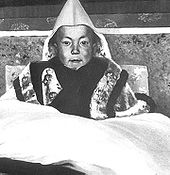
Lhamo Döndrub (or Thondup) was born on 6 July 1935 to a farming and horse trading family in the small hamlet of Taktser
, in the eastern border of the former Tibetan region of Amdo
, then already assimilated into the Chinese province of Qinghai
. He was one of seven siblings to survive childhood. The eldest was his sister Tsering Dolma, eighteen years older. His eldest brother, Thupten Jigme Norbu
, had been recognised at the age of eight as the reincarnation of the high Lama
Taktser Rinpoche
. His sister, Jetsun Pema, spent most of her adult life on the Tibetan Children's Villages project. The Dalai Lama's first language was, in his own words, "a broken Xining
language which was (a dialect of) the Chinese language
" as his family did not speak the local Tibetan language
.
The Dalai Lama and his family spoke a dialect of Xining Chinese as their primary language prior to 1939 when they relocated to Lhasa
.
Tibetans traditionally believe Dalai Lamas to be the reincarnation
of their predecessors, each of whom is believed to be a human emanation of the bodhisattva
Avalokitesvara
. A search party was sent to locate the new incarnation
when the boy who was to become the 14th was about two years old. It is said that, amongst other omens, the head of the embalmed body of the thirteenth Dalai Lama
, at first facing south-east, had mysteriously turned to face the northeast—indicating the direction in which his successor would be found.
The Regent
, Reting Rinpoche
, shortly afterwards had a vision
at the sacred lake of Lhamo La-tso
indicating Amdo as the region to search—specifically a one-story house with distinctive guttering and tiling. After extensive searching, the Thondup house, with its features resembling those in Reting's vision, was finally found.
Thondup was presented with various relics, including toys, some of which had belonged to the 13th Dalai Lama and some of which had not.
It was reported that he had correctly identified all the items owned by the previous Dalai Lama, exclaiming, "That's mine! That's mine!"
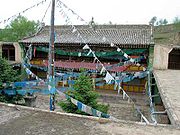 The Chinese Muslim General Ma Bufang
did not want the 14th Dalai Lama to succeed his predecessor. Ma Bufang stationed his men to place the Dalai Lama under effective house arrest, saying it was needed for "protection", refusing to permit his leaving to Tibet. He did all he could to delay the transport of the Dalai Lama from Qinghai to Tibet, by demanding massive sums of money in silver. The demanded payment by Ma Bufang was 100,000 Chinese silver dollars.
Lhamo Thondup was recognised formally as the reincarnated Dalai Lama and renamed Jetsun Jamphel Ngawang Lobsang Yeshe Tenzin Gyatso (Holy Lord, Gentle Glory, Compassionate, Defender of the Faith, Ocean of Wisdom) although he was not formally enthroned as the temporal ruler of Tibet until the age of 15; instead, the regent
acted as the head of the Kashag
until that time. Tibetan Buddhists
normally refer to him as Yishin Norbu (Wish-Fulfilling Gem), Kyabgon (Saviour), or just Kundun (Presence). His devotees often call him His Holiness the Dalai Lama, the style
employed on the Dalai Lama's website.
Monastic education commenced at the age of six years, his principal teachers being Yongdzin Ling Rinpoche
(senior tutor) and Yongdzin Trijang Rinpoche
(junior tutor). At the age of 11 he met the Austrian
mountaineer Heinrich Harrer
, who became his videographer
and tutor about the world outside Lhasa
. Harrer effectively became one of the young Dalai Lama's tutors, teaching him about the outside world. The two remained friends until Harrer's death in 2006.
During 1959, at the age of 23, he took his final examination at Lhasa
's Jokhang Temple
during the annual Monlam or prayer Festival. He passed with honours and was awarded the Lharampa degree
, the highest-level geshe
degree, roughly equivalent to a doctorate in Buddhist philosophy
.
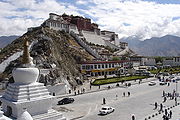 Historically the Dalai Lamas had political and religious influence in the Western Tibetan area of Ü-Tsang
around Lhasa
, where the Gelug
school of Tibetan Buddhism
was popular and the Dalai Lamas held land under their jurisdiction. In 1939, at the age of four, the present Dalai Lama was taken in a procession of lamas to Lhasa.
The Dalai Lama's childhood was spent between the Potala Palace
and Norbulingka
, his summer residence.
China asserts that the Kuomintang
government ratified the 14th Dalai Lama and that a Kuomintang representative, General Wu Zhongxin, presided over the ceremony. It cites a ratification order dated February 1940, and a documentary film of the ceremony. According to Tsering Shakya
, Wu Zhongxin along with other foreign representatives was present at the ceremony, but there is no evidence that he presided over it. He also wrote:
"On 8 July 1949, the Kashag
[Tibetan Parliament] called Chen Xizhang, the acting director of the Mongolian and Tibetan Affairs Commission office in Lhasa. He was informed that the Tibetan Government had decided to expel all Chinese connected with the Guomingdang Government. Fearing that the Chinese might organize protests in the streets of Lhasa, the Kashag imposed a curfew until all the Chinese had left. This they did on 14, 17 and 20 July 1949. At the same time the Tibetan Government sent a telegram to General Chiang Kai-shek and to President Liu Zongren informing them of the decision."
 During his reign, a border crisis erupted with the Republic of China
in 1942. Under orders from the Kuomintang
government of Chiang Kai-shek
, Ma Bufang
repaired Yushu airport to prevent Tibetan separatists from seeking independence. Chiang also ordered Ma Bufang to put his Muslim soldiers on alert for an invasion of Tibet in 1942. Ma Bufang complied, and moved several thousand troops to the border with Tibet. Chiang also threatened the Tibetans with aerial bombardment if they worked with the Japanese. Ma Bufang attacked the Tibetan Buddhist Tsang monastery in 1941. He also constantly attacked the Labrang monastery.
In October 1950 the army of the People's Republic of China
marched to the edge of the Dalai Lama's territory and sent a delegation after defeating a legion of the Tibetan army in warlord
-controlled Kham
. On 17 November 1950, at the age of 15, the 14th Dalai Lama was enthroned formally as the temporal ruler of Tibet.
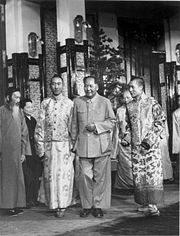
. He worked with the Chinese government: in September 1954, together with the 10th Panchen Lama he went to the Chinese capital to meet Mao Zedong
and attend the first session of the National People's Congress
as a delegate, primarily discussing China's constitution
. On 27 September 1954, the Dalai Lama was selected as a deputy chairman of the Standing Committee of the National People's Congress
, a post he officially held until 1964.
In 1956, on a trip to India to celebrate the Buddha's Birthday
, the Dalai Lama asked the Prime Minister of India
, Jawaharlal Nehru
, if he would allow him political asylum should he choose to stay. Nehru discouraged this as a provocation against peace, and reminded him of the Indian Government's non-interventionist
stance agreed upon with its 1954 treaty with China
. The CIA
, with the Korean War
only recently over, offered the Dalai Lama assistance. In 1956, a large rebellion broke out in eastern Kham
, an ethnically Tibetan region in Sichuan
province. To support the rebels, the CIA launched a covert action campaign against the Communist Chinese. A secret military training camp for the Khampa guerrillas was established in at Camp Hale
near Leadville, Colorado, in the U.S. The guerrillas attacked Communist forces in Amdo
and Kham but were gradually pushed into Central Tibet.
, fearing for his life, the Dalai Lama and his retinue fled Tibet with the help of the CIA's Special Activities Division
, crossing into India on 30 March 1959, reaching Tezpur
in Assam
on 18 April. Some time later he set up the Government of Tibet in Exile in Dharamsala
, India, which is often referred to as "Little Lhasa
". After the founding of the exiled government he re-established the approximately 80,000 Tibetan refugees who followed him into exile in agricultural settlements. He created a Tibetan educational system in order to teach the Tibetan children the language
, history
, religion
, and culture. The Tibetan Institute of Performing Arts
was established in 1959 and the Central Institute of Higher Tibetan Studies
became the primary university for Tibetans in India. He supported the refounding of 200 monasteries and nunneries in an attempt to preserve Tibetan Buddhist teachings and the Tibetan way of life.
The Dalai Lama appealed to the United Nations
on the rights of Tibetans. This appeal resulted in three resolutions adopted by the General Assembly
in 1959, 1961, and 1965, all before the People's Republic was allowed representation at the United Nations. The resolutions called on China to respect the human rights of Tibetans
. During 1963, he promulgated a democratic constitution which is based upon the Universal Declaration of Human Rights
, creating an elected parliament
and an administration
to champion his cause. During 1970, he opened the Library of Tibetan Works and Archives
in Dharamsala
which houses over 80,000 manuscripts and important knowledge resources related to Tibetan history, politics and culture. It is considered one of the most important institutions for Tibetology
in the world.

, the Dalai Lama gave a speech outlining his ideas for the future status of Tibet. The plan called for Tibet to become a democratic "zone of peace" without nuclear weapons, and with support for human rights
, that barred the entry of Han Chinese
. The plan would later be called the "Strasbourg proposal", because he expanded on the plan at Strasbourg
on 15 June 1988. There, he proposed the creation of a self-governing Tibet "in association with the People's Republic of China." This would have been pursued by negotiations with the PRC government, but the plan was rejected by the Tibetan Government-in-Exile during 1991. The Dalai Lama has indicated that he wishes to return to Tibet only if the People's Republic of China agrees not to make any precondition for his return. In the 1970s, the then-Paramount leader
Deng Xiaoping
set China's sole return requirement to the Dalai Lama as that he "must [come back] as a Chinese citizen.... that is, patriotism".
The Dalai Lama celebrated his seventieth birthday on 6 July 2005. About 10,000 Tibetan refugees, monks and foreign tourists gathered outside his home. Patriarch Alexius II
of the Russian Orthodox Church
affirmed positive relations with Buddhists. Then President of the Republic of China (Taiwan), Chen Shui-bian
, attended an evening celebrating the Dalai Lama's birthday at the Chiang Kai-shek Memorial Hall
in Taipei. In October 2008 in Japan, the Dalai Lama addressed the 2008 Tibetan violence
that had erupted and that the Chinese government accused him of fomenting. He responded that he had "lost faith" in efforts to negotiate with the Chinese government, and that it was "up to the Tibetan people" to decide what to do.
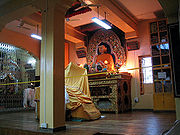 The Dalai Lama has conducted numerous public initiations in the Kalachakra
, and is the author of a great number of books, including books on the topic of Dzogchen
, a practice in which he is accomplished. His teaching activities in the U.S. include the following:
In February 2007, the Dalai Lama was named Presidential Distinguished Professor at Emory University
in Atlanta, Georgia
; it was the first time that he accepted a university appointment. On his April 2008 U.S. tour, he gave lectures at the University of Michigan, Ann Arbor
and at Colgate University
(New York) Later in July, the Dalai Lama gave a public lecture and conducted a series of teachings at Lehigh University
(Pennsylvania).
at the Vatican
in 1973. He met with Pope John Paul II
in 1980 and also later in 1982, 1986, 1988, 1990, and 2003. In 1990, he met in Dharamsala with a delegation of Jewish teachers for an extensive interfaith dialogue. He has since visited Israel three times and met during 2006 with the Chief Rabbi of Israel. In 2006, he met privately with Pope Benedict XVI
. He has met with the Archbishop of Canterbury
, Dr. Robert Runcie
, and other leaders of the Anglican Church in London, Gordon B. Hinckley
, President of the Church of Jesus Christ of Latter-day Saints (Mormons), as well as senior Eastern Orthodox Church
, Muslim
, Hindu
, Jewish, and Sikh
officials. The Dalai Lama is also currently a member of the Board of World Religious Leaders as part of The Elijah Interfaith Institute
and participated in the Third Meeting of the Board of World Religious Leaders in Amritsar
, India, on 26 November 2007 to discuss the topic of Love and Forgiveness.
On 6 January 2009, at Gujarat's Mahuva
, the Dalai Lama inaugurated an interfaith
"World Religions-Dialogue and Symphony" conference convened by Hindu preacher Morari Bapu
. This conference explored "ways and means to deal with the discord among major religions", according to Morari Bapu
. He has stated that modern scientific findings should take precedence where appropriate over disproven religious superstition.
On 12 May 2010, in Bloomington, Indiana
(USA) the Dalai Lama, joined by a panel of select scholars, officially launched the Common Ground Project, which he and HRH Prince Ghazi bin Muhammad of Jordan had planned over the course of several years of personal conversations. The project is based on the book Common Ground between Islam and Buddhism.
is an act of killing, although he has said that there can be an exception "if the unborn child will be retarded
or if the birth will create serious problems for the parent", qualifying his approval or disapproval according to each individual abortion. This position is at odds with cultural attitudes in Tibet, where abortion is unequivocally disapproved of, and where despite its free availability, women do not so avail themselves.
In Tibet, meat being the most common food, most monks have historically been omnivore
s, including the Dalai Lamas. The Dalai Lama experimented with vegetarianism
once, but after getting jaundice
, his doctors advised him to return to eating meat. This became controversial when he visited the White House and was offered a vegetarian menu, he rejected it and replied "I'm a Tibetan monk, not a vegetarian".
In 1993, the Dalai Lama attended the World Conference on Human Rights
and made a speech titled "Human Rights and Universal Responsibility".
In 2001, the Dalai Lama told a girl in a Seattle school that it is permissible to shoot someone with a gun if the person was "trying to kill you", but added that the shot should not be fatal.
On gender equality
and sexism, the Dalai Lama proclaimed at the US National Civil Rights Museum
in 2009: "I call myself a feminist. Isn't that what you call someone who fights for women's rights
?"
went from Nalanda
to Tibet to preach Buddhism in the eighth century. He has noted that millions of people had lost their lives in violence and the economies of many countries were ruined due to conflicts in the 20th century. " Let the 21st century be a century of tolerance and dialogue."
. He reports hearing of communism
when he was very young, but only in the context of the destruction of Communist Mongolia. It was only when he went on his trip to Beijing
that he studied Marxist theory. There, he reports, "I was so attracted to Marxism, I even expressed my wish to become a Communist Party member", citing his favorite concepts of self-sufficiency
and equal distribution of wealth
. He does not believe that China implemented "true Marxist policy", and thinks the historical communist state
s such as the Soviet Union
"were far more concerned with their narrow national interests than with the Workers' International
". Of capitalism, he said that in China
, "millions of people's living standards improved", but that it "is only how to make profits", whereas Marxism has "moral ethics".
, and that the melting of Himalayan glaciers
could affect the countries in which the rivers flow. He acknowledged official Chinese laws against deforestation
in Tibet, but is cynical because of possible official corruption. He was quoted as saying "ecology should be part of our daily life"; personally, he takes showers instead of baths, and turns lights off when he leaves a room. Around 2005, he has started campaigning for wildlife conservation
, including by issuing a religious ruling against wearing tiger and leopard skins as garments. The Dalai Lama supports anti-whaling
partisans in the whaling controversy
, but condemns their violent methods. Ahead of the 2009 United Nations Climate Change Conference
, he urged national leaders to put aside domestic concerns and take collective action against climate change
.
is okay or not, I will ask 'What is your companion's opinion?'. If you both agree, then I think I would say 'if two males or two females voluntarily agree to have mutual satisfaction without further implication of harming others, then it is okay'". However, in his 1996 book Beyond Dogma, he clearly states, "A sexual act is deemed proper when the couples use the organs intended for sexual intercourse and nothing else....Homosexuality, whether it is between men or between women, is not improper in itself. What is improper is the use of organs already defined as inappropriate for sexual contact." He has said that sex spelled fleeting satisfaction and trouble later, while chastity offered a better life and "more independence, more freedom". He says that problems arising from conjugal life could even lead to suicide or murder. The Dalai Lama has said that all religions have the same idea about adultery.
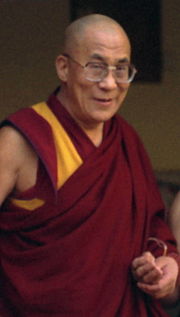 The twelfth Samding Dorje Phagmo (the only prominent female tulku
in Tibet) was quoted in Xinhua as saying that "The sins of the Dalai Lama and his followers seriously violate the basic teachings and precepts of Buddhism and seriously damage traditional Tibetan Buddhism's normal order and good reputation", adding that "Old Tibet was dark and cruel, the serfs lived worse than horses and cattle."
came out to demonstrate against the banning of a prayer to Dorje Shugden
, which they call religious persecution. Similar protests occurred in Sydney when the Dalai Lama arrived in Australia in June 2008. The Dalai Lama says he had not banned the practice, but strongly discourages it as he feels it promotes a spirit as being more important than Buddha, and that it may encourage cult-like practices and sectarianism within Tibetan Buddhism. The Shugden worshipers in India protest that they are denied admission to hospitals, stores, and other social services provided by the local Tibetan community.
. Two factions of the Kagyu
school of Tibetan Buddhism have chosen two different Karmapas, leading to a deep division within the Kagyu school. The Dalai Lama has given his support to Urgyen Trinley Dorje
, while supporters of Trinley Thaye Dorje claim that the Dalai Lama has no authority in the matter, nor is there a historical precedent for a Dalai Lama involving himself in an internal Kagyu dispute. In his 2001 address at the International Karma Kagyu Conference, Kunzig Shamar Rinpoche
—one of the four Karma Kagyu regents—accused the Dalai Lama of adopting a "divide and conquer" policy to eliminate any potential political rivalry arising from within the Kagyu school. For his side, the Dalai Lama accepted the prediction letter presented by Tai Situ Rinpoche (another Karma Kagyu regent) as authentic, and therefore Tai Situ Rinpoche's recognition of Urgyen Trinley Dorje, also as correct. Tibet observer Julian Gearing suggests that there might be political motives to the Dalai Lama's decision: "The Dalai Lama gave his blessing to the recognition of [Urgyen] Trinley, eager to win over the formerly troublesome sect [the Kagyu school], and with the hope that the new Karmapa could play a role in a political solution of the 'Tibet Question.' ...If the allegations are to be believed, a simple nomad boy was turned into a political and religious pawn." However, according to Tsurphu Labrang, articles by Julian Gearing on this subject are biased, unverified and without crosschecking of basic facts.
(CIA), and also trained a resistance movement in Colorado
(USA). When asked by CIA officer John Kenneth Knaus in 1995 whether the organisation did a good or bad thing in providing its support, the Dalai Lama replied that though it helped the morale of those resisting the Chinese, "thousands of lives were lost in the resistance" and further, that "the U.S. Government had involved itself in his country's affairs not to help Tibet but only as a Cold War tactic to challenge the Chinese."
has criticized the Dalai Lama for his close ties with India. His 2010 remarks at the International Buddhist Conference in Gujarat saying that he was "Tibetan in appearance, but an Indian in spirituality" and referral to himself as a "son of India" in particular led the People's Daily
to opine, "Since the Dalai Lama deems himself an Indian rather than Chinese, then why is he entitled to represent the voice of the Tibetan people?" Dhundup Gyalpo of the Tibet Sun
shot back that Tibetan religion could be traced back to Nalanda
in India, and that Tibetans have no connection to Chinese "apart... from a handful of culinary dishes". The People's Daily stressed the links between Chinese Buddhism and Tibetan Buddhism
and accused the Dalai Lama of "betraying southern Tibet
to India". Two years earlier in 2008, the Dalai Lama said for the first time that the territory, which India claims as part of Arunachal Pradesh
, is part of India, citing the disputed 1914 Simla Accord.
, the Dalai Lama said, "Forgiveness doesn't mean forget what happened. … If something is serious and it is necessary to take counter-measures, you have to take counter-measures."
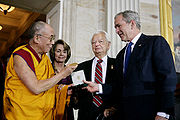 In 2011, the Dalai Lama was listed by the Watkins Review as the second most spiritually influential person in the world. His appeal is variously ascribed to his charismatic personality, international fascination with Buddhism, his universalist values, international sympathy for the Tibetans, and western sinophobia
. In the 1990s, many films were released by the American film industry
about Tibet, including biopics of the Dalai Lama. This is attributed to both the Dalai Lama's 1989 Nobel Peace Prize as well as to the euphoria following the Fall of Communism. The most notable films, Kundun
and Seven Years in Tibet
(both released in 1997), portrayed "an idyllic pre-1950 Tibet, with a smiling, soft-spoken Dalai Lama at the helm – a Dalai Lama sworn to non-violence": portrayals the Chinese government decried as ahistorical. One South African official publicly criticised the Dalai Lama's politics and lamented a taboo on criticism of him, saying "To say anything against the Dalai Lama is, in some quarters, equivalent to trying to shoot Bambi
".
Critics of the news and entertainment media coverage of the controversy charge that feudal Tibet
was not as benevolent as popularly portrayed. The penal code before 1913 included forms of judicial mutilation
and capital punishment
to enforce a social system controversially described as both slavery
and serfdom
. In response, the Dalai Lama agreed many of old Tibet's practices needed reform. His predecessor had banned extreme punishments and the death penalty. And he had started some reforms like removal of debt inheritance during the early years of his government under the People's Republic of China in 1951.
The Dalai Lama has his own page on Facebook
.
and Steven Seagal
, as well as lawmakers from several major countries. His relationships with Gere and Seagal have been criticised by Christopher Hitchens.
for Community Leadership. On 22 June 2006, he became one of only five people ever to be recognised with Honorary Citizenship by the Governor General of Canada
. On 28 May 2005, he received the Christmas Humphreys
Award from the Buddhist Society in the United Kingdom. After the Tiananmen Square protests of 1989
, the Norwegian Nobel Committee
awarded the Dalai Lama the 1989 Nobel Peace Prize
. The Committee officially gave the prize to the Dalai Lama for "the struggle of the liberation of Tibet and the efforts for a peaceful resolution" and "in part a tribute to the memory of Mahatma Gandhi" although the President of the Committee also said that the prize was intended to put pressure on China, who was reportedly infuriated that the award was given to a separatist.
, a senior spokesman for his office, stated that the Dalai Lama was moving into "retirement", but in 2008 the Dalai Lama himself ruled out such a move, saying "There is no... question of retirement." Rigzing stated "The political leadership will be transferred over a period of time but he will inevitably continue to be the spiritual leader". The Dalai Lama announced he would like the Tibetan Parliament in Exile to have more responsibility over the Central Tibetan Administration
.
In response to the 2008 Tibetan unrest
, on 18 March 2008 the Dalai Lama threatened to step down, which would be a first for a Dalai Lama. Aides later clarified that this threat was predicated on a further escalation of violence, and that he did not presently have the intention of leaving his political or spiritual offices.
In the ensuing months, he held meetings aimed at discussing the future institution of the Dalai Lama, including "[A] conclave, like in the Catholic Church, a woman as my successor, no Dalai Lama anymore, or perhaps even two", referring to the possibility of having both his approved successor and China's approved successor both claiming the title. He has clarified that his goal is to relinquish all temporal power and to no longer play a "pronounced spiritual role" and have a simpler monastic life.
In a speech given on 10 March 2011, the 14th Dalai Lama stated that he will propose changes to the constitution of the Tibetan government in exile which will remove the Dalai Lama's role as head of state, replacing him with an elected leader. If accepted by the Tibetan parliament in exile, this will constitute the Dalai Lama's retirement from his formal political role, although he will retain his position as a religious dignitary. He formally submitted his resignation as political leader to the Tibetan Parliament-in-exile in Dharamsala, India, on 14 March 2011.
On May 29, 2011, "His Holiness the Dalai Lama ... ratified the amendment to the charter of Tibetans delegating his administrative and political authorities to the democratically elected leaders of the Central Tibetan Administration."
On 3 October 2011, the Dalai Lama repeated his statement in an interview with Canadian Television. He added that Chinese laws banning the selection of successors based on reincarnation will not impact his decisions. "Naturally my next life is entirely up to me. No one else. And also this is not a political matter," he said in the interview. The Dalai Lama also added that he was not decided on whether he would reincarnate or if he would be the last Dalai Lama.
|-
|-
Dalai Lama
The Dalai Lama is a high lama in the Gelug or "Yellow Hat" branch of Tibetan Buddhism. The name is a combination of the Mongolian word далай meaning "Ocean" and the Tibetan word bla-ma meaning "teacher"...
. Dalai Lamas are the most influential figures in the Gelug
Gelug
The Gelug or Gelug-pa , also known as the Yellow Hat sect, is a school of Buddhism founded by Je Tsongkhapa , a philosopher and Tibetan religious leader...
pa lineage of Tibetan Buddhism
Tibetan Buddhism
Tibetan Buddhism is the body of Buddhist religious doctrine and institutions characteristic of Tibet and certain regions of the Himalayas, including northern Nepal, Bhutan, and India . It is the state religion of Bhutan...
, although the 14th has consolidated control over the other lineages in recent years. He won the Nobel Peace Prize
Nobel Peace Prize
The Nobel Peace Prize is one of the five Nobel Prizes bequeathed by the Swedish industrialist and inventor Alfred Nobel.-Background:According to Nobel's will, the Peace Prize shall be awarded to the person who...
in 1989, and is also well known for his lifelong advocacy for Tibetans inside and outside Tibet. Tibetans traditionally believe him to be the reincarnation
Reincarnation
Reincarnation best describes the concept where the soul or spirit, after the death of the body, is believed to return to live in a new human body, or, in some traditions, either as a human being, animal or plant...
of his predecessors and a manifestation
Incarnation
Incarnation literally means embodied in flesh or taking on flesh. It refers to the conception and birth of a sentient creature who is the material manifestation of an entity, god or force whose original nature is immaterial....
of the Bodhisattva of Compassion
Avalokitesvara
Avalokiteśvara is a bodhisattva who embodies the compassion of all Buddhas. He is one of the more widely revered bodhisattvas in mainstream Mahayana Buddhism....
.
The Dalai Lama was born in Taktser
Taktser
Taktser or Tengster is a village in the Western Chinese province of Qinghai .Taktser was originally an area of pasture land for the larger village of Balangtsa, about two hours walk away in the valley. Cattle were brought to feed on the fertile grazing lands in summer, which caused them to give...
, Qinghai
Qinghai
Qinghai ; Oirat Mongolian: ; ; Salar:) is a province of the People's Republic of China, named after Qinghai Lake...
(also known to Tibetans as Amdo
Amdo
Amdo is one of the three traditional regions of Tibet, the other two being Ü-Tsang and Kham; it is also the birth place of the 14th Dalai Lama. Amdo encompasses a large area from the Machu River to the Drichu river . While culturally and ethnically a Tibetan area, Amdo has been administered by a...
), and was selected as the rebirth
Tulku
In Tibetan Buddhism, a tulku is a particular high-ranking lama, of whom the Dalai Lama is one, who can choose the manner of his rebirth. Normally the lama would be reincarnated as a human, and of the same sex as his predecessor. In contrast to a tulku, all other sentient beings including other...
of the 13th Dalai Lama two years later, although he was only formally recognized as the 14th Dalai Lama on 17 November 1950, at the age of 15. He inherited control over a government controlling an area roughly corresponding to the Tibet Autonomous Region
Tibet Autonomous Region
The Tibet Autonomous Region , Tibet or Xizang for short, also called the Xizang Autonomous Region is a province-level autonomous region of the People's Republic of China , created in 1965....
just as the nascent People's Republic of China
People's Republic of China
China , officially the People's Republic of China , is the most populous country in the world, with over 1.3 billion citizens. Located in East Asia, the country covers approximately 9.6 million square kilometres...
wished to reassert central control over it. There is a dispute over whether the respective governments reached an agreement
Seventeen Point Agreement for the Peaceful Liberation of Tibet
The Agreement of the Central People's Government and the Local Government of Tibet on Measures for the Peaceful Liberation of Tibet, or the Seventeen Point Agreement for the Peaceful Liberation of Tibet for short, is the document by which the delegates of the 14th Dalai Lama allegedly reached an...
for a joint Communist-Lamaist administration.
During the 1959 Tibetan uprising
1959 Tibetan uprising
The 1959 Tibetan uprising, or 1959 Tibetan Rebellion began on 10 March 1959, when a revolt erupted in Lhasa, the capital of Tibet, which had been under the effective control of the Communist Party of China since the Seventeen Point Agreement in 1951...
, which China regards as an uprising of feudal landlords
Serfdom in Tibet controversy
The serfdom in Tibet controversy rests on both a political and an academic debate. In the political debate, Chinese sources claim moral authority for governing Tibet, based on narratives that portray Tibet as a "feudal serfdom" and a "hell on earth" prior to the invasion of Tibet in 1950...
, the Dalai Lama, who regards the uprising as an expression of widespread discontent, fled to India
India
India , officially the Republic of India , is a country in South Asia. It is the seventh-largest country by geographical area, the second-most populous country with over 1.2 billion people, and the most populous democracy in the world...
, where he denounced the People's Republic and established a Tibetan government in exile
Central Tibetan Administration
The Central Tibetan Administration , is an organisation based in India with the stated goals of "rehabilitating Tibetan refugees and restoring freedom and happiness in Tibet". It was established by the 14th Dalai Lama in 1959 shortly after his exile from Tibet...
. A charismatic speaker, he has since traveled the world, advocating for the welfare of Tibetans, teaching Tibetan Buddhism and talking about the importance of compassion as the source of a happy life. Around the world, institutions face pressure from China not to accept him. He has spoken about such topics as abortion
Abortion
Abortion is defined as the termination of pregnancy by the removal or expulsion from the uterus of a fetus or embryo prior to viability. An abortion can occur spontaneously, in which case it is usually called a miscarriage, or it can be purposely induced...
, economics
Economics
Economics is the social science that analyzes the production, distribution, and consumption of goods and services. The term economics comes from the Ancient Greek from + , hence "rules of the house"...
, firearms, and sexuality
Human sexuality
Human sexuality is the awareness of gender differences, and the capacity to have erotic experiences and responses. Human sexuality can also be described as the way someone is sexually attracted to another person whether it is to opposite sexes , to the same sex , to either sexes , or not being...
, and has attracted controversy for his treatment of Dorje Shugden
Dorje Shugden
Dorje Shugden , "Vajra Possessing Strength", or Dolgyal Shugden , "Shugden, King of Dhol" is a deity in Tibetan Buddhism, especially its Gelug school, who is regarded as a Dharma Protector or "guardian angel." The practice of Dharma Protectors is central to most religious Tibetans and...
followers, his relationship with the CIA
Central Intelligence Agency
The Central Intelligence Agency is a civilian intelligence agency of the United States government. It is an executive agency and reports directly to the Director of National Intelligence, responsible for providing national security intelligence assessment to senior United States policymakers...
, and other issues.
Early life and background
Lhamo Döndrub (or Thondup) was born on 6 July 1935 to a farming and horse trading family in the small hamlet of Taktser
Taktser
Taktser or Tengster is a village in the Western Chinese province of Qinghai .Taktser was originally an area of pasture land for the larger village of Balangtsa, about two hours walk away in the valley. Cattle were brought to feed on the fertile grazing lands in summer, which caused them to give...
, in the eastern border of the former Tibetan region of Amdo
Amdo
Amdo is one of the three traditional regions of Tibet, the other two being Ü-Tsang and Kham; it is also the birth place of the 14th Dalai Lama. Amdo encompasses a large area from the Machu River to the Drichu river . While culturally and ethnically a Tibetan area, Amdo has been administered by a...
, then already assimilated into the Chinese province of Qinghai
Qinghai
Qinghai ; Oirat Mongolian: ; ; Salar:) is a province of the People's Republic of China, named after Qinghai Lake...
. He was one of seven siblings to survive childhood. The eldest was his sister Tsering Dolma, eighteen years older. His eldest brother, Thupten Jigme Norbu
Thupten Jigme Norbu
Thubten Jigme Norbu recognised as the Taktser Rinpoche, was a Tibetan lama, writer, civil rights activist and professor of Tibetan studies and is the eldest brother of the fourteenth Dalai Lama, Tenzin Gyatso...
, had been recognised at the age of eight as the reincarnation of the high Lama
Lama
Lama is a title for a Tibetan teacher of the Dharma. The name is similar to the Sanskrit term guru .Historically, the term was used for venerated spiritual masters or heads of monasteries...
Taktser Rinpoche
Taktser Rinpoche
Taktser Rinpoche was a Tibetan lama. Thupten Jigme Norbu, the brother of Tenzin Gyatso, the 14th Dalai Lama of Tibet was recognized in Tibetan Buddhism as his reincarnation....
. His sister, Jetsun Pema, spent most of her adult life on the Tibetan Children's Villages project. The Dalai Lama's first language was, in his own words, "a broken Xining
Xining
Xining is the capital of Qinghai province, People's Republic of China, and the largest city on the Tibetan Plateau. It has 2,208,708 inhabitants at the 2010 census whom 1,198,304 live in the built up area made of 4 urban districts.-History:...
language which was (a dialect of) the Chinese language
Chinese language
The Chinese language is a language or language family consisting of varieties which are mutually intelligible to varying degrees. Originally the indigenous languages spoken by the Han Chinese in China, it forms one of the branches of Sino-Tibetan family of languages...
" as his family did not speak the local Tibetan language
Amdo Tibetan language
The Amdo language is the spoken language of the majority of the people of Amdo in northeastern Tibet, in Chinese states of Qinghai and some parts of Sichuan and Gansu . It is one of the four main spoken languages of Tibetan, the other three being Standard Tibetan Kham and Ladakhi...
.
The Dalai Lama and his family spoke a dialect of Xining Chinese as their primary language prior to 1939 when they relocated to Lhasa
Lhasa
Lhasa is the administrative capital of the Tibet Autonomous Region in the People's Republic of China and the second most populous city on the Tibetan Plateau, after Xining. At an altitude of , Lhasa is one of the highest cities in the world...
.
Tibetans traditionally believe Dalai Lamas to be the reincarnation
Reincarnation
Reincarnation best describes the concept where the soul or spirit, after the death of the body, is believed to return to live in a new human body, or, in some traditions, either as a human being, animal or plant...
of their predecessors, each of whom is believed to be a human emanation of the bodhisattva
Bodhisattva
In Buddhism, a bodhisattva is either an enlightened existence or an enlightenment-being or, given the variant Sanskrit spelling satva rather than sattva, "heroic-minded one for enlightenment ." The Pali term has sometimes been translated as "wisdom-being," although in modern publications, and...
Avalokitesvara
Avalokitesvara
Avalokiteśvara is a bodhisattva who embodies the compassion of all Buddhas. He is one of the more widely revered bodhisattvas in mainstream Mahayana Buddhism....
. A search party was sent to locate the new incarnation
Incarnation
Incarnation literally means embodied in flesh or taking on flesh. It refers to the conception and birth of a sentient creature who is the material manifestation of an entity, god or force whose original nature is immaterial....
when the boy who was to become the 14th was about two years old. It is said that, amongst other omens, the head of the embalmed body of the thirteenth Dalai Lama
Thubten Gyatso, 13th Dalai Lama
Thubten Gyatso was the 13th Dalai Lama of Tibet.During 1878 he was recognized as the reincarnation of the Dalai Lama. He was escorted to Lhasa and given his pre-novice vows by the Panchen Lama, Tenpai Wangchuk, and named "Ngawang Lobsang Thupten Gyatso Jigdral Chokley Namgyal"...
, at first facing south-east, had mysteriously turned to face the northeast—indicating the direction in which his successor would be found.
The Regent
Regent
A regent, from the Latin regens "one who reigns", is a person selected to act as head of state because the ruler is a minor, not present, or debilitated. Currently there are only two ruling Regencies in the world, sovereign Liechtenstein and the Malaysian constitutive state of Terengganu...
, Reting Rinpoche
Jamphel Yeshe Gyaltsen
Jamphel Yeshe Gyaltsen, aka Thupten Jampel Yishey Gyantsen, was a Tibetan tulku and the fifth Reting Rinpoche.-Life:...
, shortly afterwards had a vision
Vision (religion)
In spirituality, a vision is something seen in a dream, trance, or ecstasy, especially a supernatural appearance that conveys a revelation.Visions generally have more clarity than dreams, but traditionally fewer psychological connotations...
at the sacred lake of Lhamo La-tso
Lhamo La-tso
Lhamo La-tso or Lhamo Latso , the small oval 'Oracle Lake', is where senior Tibetan monks go for visions to assist in the discovery of reincarnations of the Dalai Lamas. Other pilgrims also come to seek visions...
indicating Amdo as the region to search—specifically a one-story house with distinctive guttering and tiling. After extensive searching, the Thondup house, with its features resembling those in Reting's vision, was finally found.
Thondup was presented with various relics, including toys, some of which had belonged to the 13th Dalai Lama and some of which had not.
It was reported that he had correctly identified all the items owned by the previous Dalai Lama, exclaiming, "That's mine! That's mine!"
Ma Bufang
Ma Bufang was a prominent Muslim Ma clique warlord in China during the Republic of China era, ruling the northwestern province of Qinghai. His rank was Lieutenant-general...
did not want the 14th Dalai Lama to succeed his predecessor. Ma Bufang stationed his men to place the Dalai Lama under effective house arrest, saying it was needed for "protection", refusing to permit his leaving to Tibet. He did all he could to delay the transport of the Dalai Lama from Qinghai to Tibet, by demanding massive sums of money in silver. The demanded payment by Ma Bufang was 100,000 Chinese silver dollars.
Lhamo Thondup was recognised formally as the reincarnated Dalai Lama and renamed Jetsun Jamphel Ngawang Lobsang Yeshe Tenzin Gyatso (Holy Lord, Gentle Glory, Compassionate, Defender of the Faith, Ocean of Wisdom) although he was not formally enthroned as the temporal ruler of Tibet until the age of 15; instead, the regent
Regent
A regent, from the Latin regens "one who reigns", is a person selected to act as head of state because the ruler is a minor, not present, or debilitated. Currently there are only two ruling Regencies in the world, sovereign Liechtenstein and the Malaysian constitutive state of Terengganu...
acted as the head of the Kashag
Kashag
The Kashag was the governing council of Tibet during Qing Dynasty and Republic of China. It was set by Qianlong Emperor in 1751. In that year the Tibetan government was reorganized after the riots in Lhasa of the previous year...
until that time. Tibetan Buddhists
Tibetan Buddhism
Tibetan Buddhism is the body of Buddhist religious doctrine and institutions characteristic of Tibet and certain regions of the Himalayas, including northern Nepal, Bhutan, and India . It is the state religion of Bhutan...
normally refer to him as Yishin Norbu (Wish-Fulfilling Gem), Kyabgon (Saviour), or just Kundun (Presence). His devotees often call him His Holiness the Dalai Lama, the style
Style (manner of address)
A style of office, or honorific, is a legal, official, or recognized title. A style, by tradition or law, precedes a reference to a person who holds a post or political office, and is sometimes used to refer to the office itself. An honorific can also be awarded to an individual in a personal...
employed on the Dalai Lama's website.
Monastic education commenced at the age of six years, his principal teachers being Yongdzin Ling Rinpoche
Ling Rinpoche
Kyabje Ling Rinpoche was a Tibetan buddhist scholar and teacher.Born in Tibet, northwest of Lhasa, he also was the 97th Ganden Tripa and senior tutor to His Holiness the 14th Dalai Lama. The Ganden Tripa is the spiritual head of the Gelugpa Sect, the largest sect in Tibetan Buddhism. Kyabje Ling...
(senior tutor) and Yongdzin Trijang Rinpoche
Trijang Rinpoche
Kyabje Trijang Rinpoche was a Gelug Lama and a direct disciple of Je Pabongka. He was the junior tutor and spiritual guide of the 14th Dalai Lama for forty years. He is also the root lama of many Gelug Lamas who teach in the West including Zong Rinpoche, Geshe Rabten, Lama Yeshe, Lama Gangchen...
(junior tutor). At the age of 11 he met the Austrian
Austrian
Austrian can refer to:* Someone from Austria or of Austrian descent. See Austrians.* Someone who is considered an Austrian citizen. See Austrian nationality law.* Something associated with the country Austria...
mountaineer Heinrich Harrer
Heinrich Harrer
Heinrich Harrer was an Austrian mountaineer, sportsman, geographer, and author.He is best known for his books Seven Years in Tibet and The White Spider .-Athletics:...
, who became his videographer
Videographer
Strictly speaking, a videographer is a person who works in the field of videography, video production — recording moving images and sound on video tape, disk, other electro-mechanical device. News broadcasting relies heavily on live television where videographers engage in electronic news...
and tutor about the world outside Lhasa
Lhasa
Lhasa is the administrative capital of the Tibet Autonomous Region in the People's Republic of China and the second most populous city on the Tibetan Plateau, after Xining. At an altitude of , Lhasa is one of the highest cities in the world...
. Harrer effectively became one of the young Dalai Lama's tutors, teaching him about the outside world. The two remained friends until Harrer's death in 2006.
During 1959, at the age of 23, he took his final examination at Lhasa
Lhasa
Lhasa is the administrative capital of the Tibet Autonomous Region in the People's Republic of China and the second most populous city on the Tibetan Plateau, after Xining. At an altitude of , Lhasa is one of the highest cities in the world...
's Jokhang Temple
Jokhang
The Jokhang, , also called the Qokang Monastery, Jokang, Jokhang Temple, Jokhang Monastery or Zuglagkang , is located on Barkhor Square in Lhasa. For most Tibetans it is the most sacred and important temple in Tibet. It is in some regards pan-sectarian, but is presently controlled by the Gelug school...
during the annual Monlam or prayer Festival. He passed with honours and was awarded the Lharampa degree
Geshe
Geshe is a Tibetan Buddhist academic degree for monks...
, the highest-level geshe
Geshe
Geshe is a Tibetan Buddhist academic degree for monks...
degree, roughly equivalent to a doctorate in Buddhist philosophy
Buddhist philosophy
Buddhist philosophy deals extensively with problems in metaphysics, phenomenology, ethics, and epistemology.Some scholars assert that early Buddhist philosophy did not engage in ontological or metaphysical speculation, but was based instead on empirical evidence gained by the sense organs...
.
Life as the Dalai Lama
Ü-Tsang
Ü-Tsang , or Tsang-Ü, is one of the three traditional provinces of Tibet, the other two being Amdo and Kham. Geographically Ü-Tsang covered the central and western portions of the Tibetan cultural area, including the Tsang-po watershed, the western districts surrounding and extending past Mount...
around Lhasa
Lhasa
Lhasa is the administrative capital of the Tibet Autonomous Region in the People's Republic of China and the second most populous city on the Tibetan Plateau, after Xining. At an altitude of , Lhasa is one of the highest cities in the world...
, where the Gelug
Gelug
The Gelug or Gelug-pa , also known as the Yellow Hat sect, is a school of Buddhism founded by Je Tsongkhapa , a philosopher and Tibetan religious leader...
school of Tibetan Buddhism
Tibetan Buddhism
Tibetan Buddhism is the body of Buddhist religious doctrine and institutions characteristic of Tibet and certain regions of the Himalayas, including northern Nepal, Bhutan, and India . It is the state religion of Bhutan...
was popular and the Dalai Lamas held land under their jurisdiction. In 1939, at the age of four, the present Dalai Lama was taken in a procession of lamas to Lhasa.
The Dalai Lama's childhood was spent between the Potala Palace
Potala Palace
The Potala Palace is located in Lhasa, Tibet Autonomous Region, China. It was named after Mount Potala, the abode of Chenresig or Avalokitesvara...
and Norbulingka
Norbulingka
Norbulingka is a palace and surrounding park in Lhasa, Tibet, built from 1755. It served as the traditional summer residence of the successive Dalai Lamas from the 1780s up until the 14th Dalai Lama's exile in 1959...
, his summer residence.
China asserts that the Kuomintang
Kuomintang
The Kuomintang of China , sometimes romanized as Guomindang via the Pinyin transcription system or GMD for short, and translated as the Chinese Nationalist Party is a founding and ruling political party of the Republic of China . Its guiding ideology is the Three Principles of the People, espoused...
government ratified the 14th Dalai Lama and that a Kuomintang representative, General Wu Zhongxin, presided over the ceremony. It cites a ratification order dated February 1940, and a documentary film of the ceremony. According to Tsering Shakya
Tsering Shakya
Tsering Wangdu Shakya is a historian and widely cited expert on Tibetan literature and modern Tibet and its relationship with China...
, Wu Zhongxin along with other foreign representatives was present at the ceremony, but there is no evidence that he presided over it. He also wrote:
"On 8 July 1949, the Kashag
Kashag
The Kashag was the governing council of Tibet during Qing Dynasty and Republic of China. It was set by Qianlong Emperor in 1751. In that year the Tibetan government was reorganized after the riots in Lhasa of the previous year...
[Tibetan Parliament] called Chen Xizhang, the acting director of the Mongolian and Tibetan Affairs Commission office in Lhasa. He was informed that the Tibetan Government had decided to expel all Chinese connected with the Guomingdang Government. Fearing that the Chinese might organize protests in the streets of Lhasa, the Kashag imposed a curfew until all the Chinese had left. This they did on 14, 17 and 20 July 1949. At the same time the Tibetan Government sent a telegram to General Chiang Kai-shek and to President Liu Zongren informing them of the decision."
Republic of China
The Republic of China , commonly known as Taiwan , is a unitary sovereign state located in East Asia. Originally based in mainland China, the Republic of China currently governs the island of Taiwan , which forms over 99% of its current territory, as well as Penghu, Kinmen, Matsu and other minor...
in 1942. Under orders from the Kuomintang
Kuomintang
The Kuomintang of China , sometimes romanized as Guomindang via the Pinyin transcription system or GMD for short, and translated as the Chinese Nationalist Party is a founding and ruling political party of the Republic of China . Its guiding ideology is the Three Principles of the People, espoused...
government of Chiang Kai-shek
Chiang Kai-shek
Chiang Kai-shek was a political and military leader of 20th century China. He is known as Jiǎng Jièshí or Jiǎng Zhōngzhèng in Mandarin....
, Ma Bufang
Ma Bufang
Ma Bufang was a prominent Muslim Ma clique warlord in China during the Republic of China era, ruling the northwestern province of Qinghai. His rank was Lieutenant-general...
repaired Yushu airport to prevent Tibetan separatists from seeking independence. Chiang also ordered Ma Bufang to put his Muslim soldiers on alert for an invasion of Tibet in 1942. Ma Bufang complied, and moved several thousand troops to the border with Tibet. Chiang also threatened the Tibetans with aerial bombardment if they worked with the Japanese. Ma Bufang attacked the Tibetan Buddhist Tsang monastery in 1941. He also constantly attacked the Labrang monastery.
In October 1950 the army of the People's Republic of China
People's Republic of China
China , officially the People's Republic of China , is the most populous country in the world, with over 1.3 billion citizens. Located in East Asia, the country covers approximately 9.6 million square kilometres...
marched to the edge of the Dalai Lama's territory and sent a delegation after defeating a legion of the Tibetan army in warlord
Warlord
A warlord is a person with power who has both military and civil control over a subnational area due to armed forces loyal to the warlord and not to a central authority. The term can also mean one who espouses the ideal that war is necessary, and has the means and authority to engage in war...
-controlled Kham
Kham
Kham , is a historical region covering a land area largely divided between present-day Tibetan Autonomous Region and Sichuan province, with smaller portions located within Qinghai, Gansu and Yunnan provinces of China. During the Republic of China's rule over mainland China , most of the region was...
. On 17 November 1950, at the age of 15, the 14th Dalai Lama was enthroned formally as the temporal ruler of Tibet.
Cooperation and conflicts with the PRC
The Dalai Lama's formal rule was brief. He sent a delegation to Beijing, which ratified the Seventeen Point Agreement for the Peaceful Liberation of TibetSeventeen Point Agreement for the Peaceful Liberation of Tibet
The Agreement of the Central People's Government and the Local Government of Tibet on Measures for the Peaceful Liberation of Tibet, or the Seventeen Point Agreement for the Peaceful Liberation of Tibet for short, is the document by which the delegates of the 14th Dalai Lama allegedly reached an...
. He worked with the Chinese government: in September 1954, together with the 10th Panchen Lama he went to the Chinese capital to meet Mao Zedong
Mao Zedong
Mao Zedong, also transliterated as Mao Tse-tung , and commonly referred to as Chairman Mao , was a Chinese Communist revolutionary, guerrilla warfare strategist, Marxist political philosopher, and leader of the Chinese Revolution...
and attend the first session of the National People's Congress
National People's Congress
The National People's Congress , abbreviated NPC , is the highest state body and the only legislative house in the People's Republic of China. The National People's Congress is held in the Great Hall of the People, Beijing, capital of the People's Republic of China; with 2,987 members, it is the...
as a delegate, primarily discussing China's constitution
Constitution of the People's Republic of China
The Constitution of the People's Republic of China is the highest law within the People's Republic of China. The current version was adopted by the 5th National People's Congress on December 4, 1982 with further revisions in 1988, 1993, 1999, and 2004. Three previous state constitutions—those of...
. On 27 September 1954, the Dalai Lama was selected as a deputy chairman of the Standing Committee of the National People's Congress
Standing Committee of the National People's Congress
The Standing Committee of the National People's Congress is a committee of about 150 members of the National People's Congress of the People's Republic of China , which is convened between plenary sessions of the NPC. It has the constitutional authority to modify legislation within limits set by...
, a post he officially held until 1964.
In 1956, on a trip to India to celebrate the Buddha's Birthday
Buddha's Birthday
Buddha's Birthday, the birthday of the Prince Siddhartha Gautama, is a holiday traditionally celebrated in Mahayana Buddhism.- East Asia except Japan :...
, the Dalai Lama asked the Prime Minister of India
Prime Minister of India
The Prime Minister of India , as addressed to in the Constitution of India — Prime Minister for the Union, is the chief of government, head of the Council of Ministers and the leader of the majority party in parliament...
, Jawaharlal Nehru
Jawaharlal Nehru
Jawaharlal Nehru , often referred to with the epithet of Panditji, was an Indian statesman who became the first Prime Minister of independent India and became noted for his “neutralist” policies in foreign affairs. He was also one of the principal leaders of India’s independence movement in the...
, if he would allow him political asylum should he choose to stay. Nehru discouraged this as a provocation against peace, and reminded him of the Indian Government's non-interventionist
Non-interventionism
Nonintervention or non-interventionism is a foreign policy which holds that political rulers should avoid alliances with other nations, but still retain diplomacy, and avoid all wars not related to direct self-defense...
stance agreed upon with its 1954 treaty with China
Five Principles of Peaceful Coexistence
The Five Principles of Peaceful Coexistence, known in India as the Panchsheel, are a set of principles to govern relations between states. Their first formal codification in treaty form was in an agreement between by China and India in 1954...
. The CIA
Central Intelligence Agency
The Central Intelligence Agency is a civilian intelligence agency of the United States government. It is an executive agency and reports directly to the Director of National Intelligence, responsible for providing national security intelligence assessment to senior United States policymakers...
, with the Korean War
Korean War
The Korean War was a conventional war between South Korea, supported by the United Nations, and North Korea, supported by the People's Republic of China , with military material aid from the Soviet Union...
only recently over, offered the Dalai Lama assistance. In 1956, a large rebellion broke out in eastern Kham
Kham
Kham , is a historical region covering a land area largely divided between present-day Tibetan Autonomous Region and Sichuan province, with smaller portions located within Qinghai, Gansu and Yunnan provinces of China. During the Republic of China's rule over mainland China , most of the region was...
, an ethnically Tibetan region in Sichuan
Sichuan
' , known formerly in the West by its postal map spellings of Szechwan or Szechuan is a province in Southwest China with its capital in Chengdu...
province. To support the rebels, the CIA launched a covert action campaign against the Communist Chinese. A secret military training camp for the Khampa guerrillas was established in at Camp Hale
Camp Hale
Camp Hale, between Red Cliff and Leadville in the Eagle River valley in Colorado, was a U.S. Army training facility constructed in 1942 for what became the 10th Mountain Division. It was named for General Irving Hale....
near Leadville, Colorado, in the U.S. The guerrillas attacked Communist forces in Amdo
Amdo
Amdo is one of the three traditional regions of Tibet, the other two being Ü-Tsang and Kham; it is also the birth place of the 14th Dalai Lama. Amdo encompasses a large area from the Machu River to the Drichu river . While culturally and ethnically a Tibetan area, Amdo has been administered by a...
and Kham but were gradually pushed into Central Tibet.
Exile to India
At the outset of the 1959 Tibetan uprising1959 Tibetan uprising
The 1959 Tibetan uprising, or 1959 Tibetan Rebellion began on 10 March 1959, when a revolt erupted in Lhasa, the capital of Tibet, which had been under the effective control of the Communist Party of China since the Seventeen Point Agreement in 1951...
, fearing for his life, the Dalai Lama and his retinue fled Tibet with the help of the CIA's Special Activities Division
Special Activities Division
The Special Activities Division is a division in the United States Central Intelligence Agency's National Clandestine Service responsible for covert operations known as "special activities"...
, crossing into India on 30 March 1959, reaching Tezpur
Tezpur
Tezpur is a city and the administrative headquarters and municipal board of Sonitpur district in the state of Assam in northeastern India. Tezpur is an ancient city on the banks of the river Brahmaputra and is the largest of the north bank towns with a population exceeding 100,000...
in Assam
Assam
Assam , also, rarely, Assam Valley and formerly the Assam Province , is a northeastern state of India and is one of the most culturally and geographically distinct regions of the country...
on 18 April. Some time later he set up the Government of Tibet in Exile in Dharamsala
Dharamsala
Dharamshala or Dharamsala is a city in northern India. It was formerly known as Bhagsu; it is the winter seat of government of the state of Himachal Pradesh and the district headquarters of the Kangra district....
, India, which is often referred to as "Little Lhasa
McLeod Ganj
McLeod Ganj, McLeodGanj, or Mcleodganj, is a suburb of Dharamshala in Kangra district of Himachal Pradesh, India. It has an average elevation of 2,082 metres ....
". After the founding of the exiled government he re-established the approximately 80,000 Tibetan refugees who followed him into exile in agricultural settlements. He created a Tibetan educational system in order to teach the Tibetan children the language
Tibetan language
The Tibetan languages are a cluster of mutually-unintelligible Tibeto-Burman languages spoken primarily by Tibetan peoples who live across a wide area of eastern Central Asia bordering the Indian subcontinent, including the Tibetan Plateau and the northern Indian subcontinent in Baltistan, Ladakh,...
, history
History of Tibet
Tibetan history, as it has been recorded, is particularly focused on the history of Buddhism in Tibet. This is partly due to the pivotal role this religion has played in the development of Tibetan, Mongol, and Manchu cultures, and partly because almost all native historians of the country were...
, religion
Tibetan Buddhism
Tibetan Buddhism is the body of Buddhist religious doctrine and institutions characteristic of Tibet and certain regions of the Himalayas, including northern Nepal, Bhutan, and India . It is the state religion of Bhutan...
, and culture. The Tibetan Institute of Performing Arts
Tibetan Institute of Performing Arts
The Tibetan Institute of Performing Arts was founded by Tenzin Gyatso, 14th Dalai Lama on reaching Dharamsala, India in exile from Tibet in August 1959, it was one of the first institutes set up the Dalai Lama, and was established to preserve Tibetan artistic heritage, especially opera, dance, and...
was established in 1959 and the Central Institute of Higher Tibetan Studies
Central Institute of Higher Tibetan Studies
The Central University for Tibetan Studies is a university institute founded in Sarnath, Varanasi, India in 1967, as an autonomous organization under Union Ministry of Culture.The CIHTS was founded by Pt...
became the primary university for Tibetans in India. He supported the refounding of 200 monasteries and nunneries in an attempt to preserve Tibetan Buddhist teachings and the Tibetan way of life.
The Dalai Lama appealed to the United Nations
United Nations
The United Nations is an international organization whose stated aims are facilitating cooperation in international law, international security, economic development, social progress, human rights, and achievement of world peace...
on the rights of Tibetans. This appeal resulted in three resolutions adopted by the General Assembly
United Nations General Assembly
For two articles dealing with membership in the General Assembly, see:* General Assembly members* General Assembly observersThe United Nations General Assembly is one of the five principal organs of the United Nations and the only one in which all member nations have equal representation...
in 1959, 1961, and 1965, all before the People's Republic was allowed representation at the United Nations. The resolutions called on China to respect the human rights of Tibetans
Tibetan people
The Tibetan people are an ethnic group that is native to Tibet, which is mostly in the People's Republic of China. They number 5.4 million and are the 10th largest ethnic group in the country. Significant Tibetan minorities also live in India, Nepal, and Bhutan...
. During 1963, he promulgated a democratic constitution which is based upon the Universal Declaration of Human Rights
Universal Declaration of Human Rights
The Universal Declaration of Human Rights is a declaration adopted by the United Nations General Assembly . The Declaration arose directly from the experience of the Second World War and represents the first global expression of rights to which all human beings are inherently entitled...
, creating an elected parliament
Parliament of the Central Tibetan Administration
The Parliament of the Central Tibetan Administration, also known as the Tibetan Parliament-in-Exile, is the unicameral legislative organ of the Central Tibetan Administration. Established and based in India, it was founded in 1960, and was most recently elected to a 14th 5-year term from 2006-2011...
and an administration
Central Tibetan Administration
The Central Tibetan Administration , is an organisation based in India with the stated goals of "rehabilitating Tibetan refugees and restoring freedom and happiness in Tibet". It was established by the 14th Dalai Lama in 1959 shortly after his exile from Tibet...
to champion his cause. During 1970, he opened the Library of Tibetan Works and Archives
Library of Tibetan Works and Archives
The Library of Tibetan Works and Archives ' is a Tibetan library in Dharamsala, India. The library was founded by His Holiness Tenzin Gyatso, the 14th Dalai Lama on June 11, 1970 and is considered one of the most important libraries and institutions of Tibetan works in the world.The library...
in Dharamsala
Dharamsala
Dharamshala or Dharamsala is a city in northern India. It was formerly known as Bhagsu; it is the winter seat of government of the state of Himachal Pradesh and the district headquarters of the Kangra district....
which houses over 80,000 manuscripts and important knowledge resources related to Tibetan history, politics and culture. It is considered one of the most important institutions for Tibetology
Tibetology
Tibetology refers to the study of things related to Tibet, including its history, religion, language, politics and the collection of Tibetan articles of historical, cultural and religious significance...
in the world.
International advocacy
At the Congressional Human Rights Caucus in 1987 in Washington, D.C.Washington, D.C.
Washington, D.C., formally the District of Columbia and commonly referred to as Washington, "the District", or simply D.C., is the capital of the United States. On July 16, 1790, the United States Congress approved the creation of a permanent national capital as permitted by the U.S. Constitution....
, the Dalai Lama gave a speech outlining his ideas for the future status of Tibet. The plan called for Tibet to become a democratic "zone of peace" without nuclear weapons, and with support for human rights
Human rights
Human rights are "commonly understood as inalienable fundamental rights to which a person is inherently entitled simply because she or he is a human being." Human rights are thus conceived as universal and egalitarian . These rights may exist as natural rights or as legal rights, in both national...
, that barred the entry of Han Chinese
Han Chinese
Han Chinese are an ethnic group native to China and are the largest single ethnic group in the world.Han Chinese constitute about 92% of the population of the People's Republic of China , 98% of the population of the Republic of China , 78% of the population of Singapore, and about 20% of the...
. The plan would later be called the "Strasbourg proposal", because he expanded on the plan at Strasbourg
Strasbourg
Strasbourg is the capital and principal city of the Alsace region in eastern France and is the official seat of the European Parliament. Located close to the border with Germany, it is the capital of the Bas-Rhin département. The city and the region of Alsace are historically German-speaking,...
on 15 June 1988. There, he proposed the creation of a self-governing Tibet "in association with the People's Republic of China." This would have been pursued by negotiations with the PRC government, but the plan was rejected by the Tibetan Government-in-Exile during 1991. The Dalai Lama has indicated that he wishes to return to Tibet only if the People's Republic of China agrees not to make any precondition for his return. In the 1970s, the then-Paramount leader
Paramount leader
Paramount leader literally "the highest leader of the party and the state ", in modern Chinese political science, unofficially refers to the political leader of the People's Republic of China....
Deng Xiaoping
Deng Xiaoping
Deng Xiaoping was a Chinese politician, statesman, and diplomat. As leader of the Communist Party of China, Deng was a reformer who led China towards a market economy...
set China's sole return requirement to the Dalai Lama as that he "must [come back] as a Chinese citizen.... that is, patriotism".
The Dalai Lama celebrated his seventieth birthday on 6 July 2005. About 10,000 Tibetan refugees, monks and foreign tourists gathered outside his home. Patriarch Alexius II
Patriarch Alexius II
Patriarch Alexy II was the 15th Patriarch of Moscow and All Russia, the primate of the Russian Orthodox Church....
of the Russian Orthodox Church
Russian Orthodox Church
The Russian Orthodox Church or, alternatively, the Moscow Patriarchate The ROC is often said to be the largest of the Eastern Orthodox churches in the world; including all the autocephalous churches under its umbrella, its adherents number over 150 million worldwide—about half of the 300 million...
affirmed positive relations with Buddhists. Then President of the Republic of China (Taiwan), Chen Shui-bian
Chen Shui-bian
Chen Shui-bian is a former Taiwanese politician who was the 10th and 11th-term President of the Republic of China from 2000 to 2008. Chen, whose Democratic Progressive Party has traditionally been supportive of Taiwan independence, ended more than fifty years of Kuomintang rule in Taiwan...
, attended an evening celebrating the Dalai Lama's birthday at the Chiang Kai-shek Memorial Hall
Chiang Kai-shek Memorial Hall
The National Chiang Kai-shek Memorial Hall is a famous monument, landmark and tourist attractions erected in memory of Generalissimo Chiang Kai-shek, former President of the Republic of China. It is located in Taipei, Republic of China ....
in Taipei. In October 2008 in Japan, the Dalai Lama addressed the 2008 Tibetan violence
2008 Tibetan unrest
The 2008 Tibetan unrest, also known from its Chinese name as the 3•14 Riots, was a series of riots, protests, and demonstrations that started in Tibetan regional capital of Lhasa and spread to other Tibetan areas and a number of monasteries including outside the Tibet Autonomous Region...
that had erupted and that the Chinese government accused him of fomenting. He responded that he had "lost faith" in efforts to negotiate with the Chinese government, and that it was "up to the Tibetan people" to decide what to do.
Teaching activities
Kalachakra
Kalachakra is a Sanskrit term used in Tantric Buddhism that literally means "time-wheel" or "time-cycles".The spelling Kalacakra is also correct....
, and is the author of a great number of books, including books on the topic of Dzogchen
Dzogchen
According to Tibetan Buddhism and Bön, Dzogchen is the natural, primordial state or natural condition of the mind, and a body of teachings and meditation practices aimed at realizing that condition. Dzogchen, or "Great Perfection", is a central teaching of the Nyingma school also practiced by...
, a practice in which he is accomplished. His teaching activities in the U.S. include the following:
In February 2007, the Dalai Lama was named Presidential Distinguished Professor at Emory University
Emory University
Emory University is a private research university in metropolitan Atlanta, located in the Druid Hills section of unincorporated DeKalb County, Georgia, United States. The university was founded as Emory College in 1836 in Oxford, Georgia by a small group of Methodists and was named in honor of...
in Atlanta, Georgia
Atlanta, Georgia
Atlanta is the capital and most populous city in the U.S. state of Georgia. According to the 2010 census, Atlanta's population is 420,003. Atlanta is the cultural and economic center of the Atlanta metropolitan area, which is home to 5,268,860 people and is the ninth largest metropolitan area in...
; it was the first time that he accepted a university appointment. On his April 2008 U.S. tour, he gave lectures at the University of Michigan, Ann Arbor
University of Michigan
The University of Michigan is a public research university located in Ann Arbor, Michigan in the United States. It is the state's oldest university and the flagship campus of the University of Michigan...
and at Colgate University
Colgate University
Colgate University is a private liberal arts college in Hamilton, New York, USA. The school was founded in 1819 as a Baptist seminary and later became non-denominational. It is named for the Colgate family who greatly contributed to the university's endowment in the 19th century.Colgate has 52...
(New York) Later in July, the Dalai Lama gave a public lecture and conducted a series of teachings at Lehigh University
Lehigh University
Lehigh University is a private, co-educational university located in Bethlehem, Pennsylvania, in the Lehigh Valley region of the United States. It was established in 1865 by Asa Packer as a four-year technical school, but has grown to include studies in a wide variety of disciplines...
(Pennsylvania).
Interfaith dialogue
The Dalai Lama met with Pope Paul VIPope Paul VI
Paul VI , born Giovanni Battista Enrico Antonio Maria Montini , reigned as Pope of the Catholic Church from 21 June 1963 until his death on 6 August 1978. Succeeding Pope John XXIII, who had convened the Second Vatican Council, he decided to continue it...
at the Vatican
Vatican City
Vatican City , or Vatican City State, in Italian officially Stato della Città del Vaticano , which translates literally as State of the City of the Vatican, is a landlocked sovereign city-state whose territory consists of a walled enclave within the city of Rome, Italy. It has an area of...
in 1973. He met with Pope John Paul II
Pope John Paul II
Blessed Pope John Paul II , born Karol Józef Wojtyła , reigned as Pope of the Catholic Church and Sovereign of Vatican City from 16 October 1978 until his death on 2 April 2005, at of age. His was the second-longest documented pontificate, which lasted ; only Pope Pius IX ...
in 1980 and also later in 1982, 1986, 1988, 1990, and 2003. In 1990, he met in Dharamsala with a delegation of Jewish teachers for an extensive interfaith dialogue. He has since visited Israel three times and met during 2006 with the Chief Rabbi of Israel. In 2006, he met privately with Pope Benedict XVI
Pope Benedict XVI
Benedict XVI is the 265th and current Pope, by virtue of his office of Bishop of Rome, the Sovereign of the Vatican City State and the leader of the Catholic Church as well as the other 22 sui iuris Eastern Catholic Churches in full communion with the Holy See...
. He has met with the Archbishop of Canterbury
Archbishop of Canterbury
The Archbishop of Canterbury is the senior bishop and principal leader of the Church of England, the symbolic head of the worldwide Anglican Communion, and the diocesan bishop of the Diocese of Canterbury. In his role as head of the Anglican Communion, the archbishop leads the third largest group...
, Dr. Robert Runcie
Robert Runcie
Robert Alexander Kennedy Runcie, Baron Runcie, PC, MC was Archbishop of Canterbury from 1980 to 1991.-Early life:...
, and other leaders of the Anglican Church in London, Gordon B. Hinckley
Gordon B. Hinckley
Gordon Bitner Hinckley was an American religious leader and author who served as the 15th President of The Church of Jesus Christ of Latter-day Saints from March 12, 1995 until his death...
, President of the Church of Jesus Christ of Latter-day Saints (Mormons), as well as senior Eastern Orthodox Church
Eastern Orthodox Church
The Orthodox Church, officially called the Orthodox Catholic Church and commonly referred to as the Eastern Orthodox Church, is the second largest Christian denomination in the world, with an estimated 300 million adherents mainly in the countries of Belarus, Bulgaria, Cyprus, Georgia, Greece,...
, Muslim
Muslim
A Muslim, also spelled Moslem, is an adherent of Islam, a monotheistic, Abrahamic religion based on the Quran, which Muslims consider the verbatim word of God as revealed to prophet Muhammad. "Muslim" is the Arabic term for "submitter" .Muslims believe that God is one and incomparable...
, Hindu
Hindu
Hindu refers to an identity associated with the philosophical, religious and cultural systems that are indigenous to the Indian subcontinent. As used in the Constitution of India, the word "Hindu" is also attributed to all persons professing any Indian religion...
, Jewish, and Sikh
Sikh
A Sikh is a follower of Sikhism. It primarily originated in the 15th century in the Punjab region of South Asia. The term "Sikh" has its origin in Sanskrit term शिष्य , meaning "disciple, student" or शिक्ष , meaning "instruction"...
officials. The Dalai Lama is also currently a member of the Board of World Religious Leaders as part of The Elijah Interfaith Institute
The Elijah Interfaith Institute
The Elijah Interfaith Institute is a nonprofit, international, interfaith organization which was founded by Rabbi Alon Goshen-Gottstein in 1997. Its mission is to foster peace between the world's diverse faith communities through interfaith dialogue, education, research and dissemination...
and participated in the Third Meeting of the Board of World Religious Leaders in Amritsar
Amritsar
Amritsar is a city in the northern part of India and is the administrative headquarters of Amritsar district in the state of Punjab, India. The 2001 Indian census reported the population of the city to be over 1,500,000, with that of the entire district numbering 3,695,077...
, India, on 26 November 2007 to discuss the topic of Love and Forgiveness.
On 6 January 2009, at Gujarat's Mahuva
Mahuva (Bhavnagar district)
Mahuva is a small town on the outskirts of Bhavnagar District in the State of Gujarat, India. Mahuva is known for its mild weather and green, lush surroundings, including many coconut tree plantations...
, the Dalai Lama inaugurated an interfaith
Interfaith
The term interfaith dialogue refers to cooperative, constructive and positive interaction between people of different religious traditions and/or spiritual or humanistic beliefs, at both the individual and institutional levels...
"World Religions-Dialogue and Symphony" conference convened by Hindu preacher Morari Bapu
Morari Bapu
Morari Bapu , who has been giving 9 day-long sermons in both Gujarati and Hindi all over the world—including in India, the United States, the United Kingdom, South Africa, Kenya, Uganda, on a cruise ship in the Mediterranean Sea, and on an airplane travelling the world—since the...
. This conference explored "ways and means to deal with the discord among major religions", according to Morari Bapu
Morari Bapu
Morari Bapu , who has been giving 9 day-long sermons in both Gujarati and Hindi all over the world—including in India, the United States, the United Kingdom, South Africa, Kenya, Uganda, on a cruise ship in the Mediterranean Sea, and on an airplane travelling the world—since the...
. He has stated that modern scientific findings should take precedence where appropriate over disproven religious superstition.
On 12 May 2010, in Bloomington, Indiana
Bloomington, Indiana
Bloomington is a city in and the county seat of Monroe County in the southern region of the U.S. state of Indiana. The population was 80,405 at the 2010 census....
(USA) the Dalai Lama, joined by a panel of select scholars, officially launched the Common Ground Project, which he and HRH Prince Ghazi bin Muhammad of Jordan had planned over the course of several years of personal conversations. The project is based on the book Common Ground between Islam and Buddhism.
Social stances
The Dalai Lama reminds that according to Buddhist precepts abortionAbortion
Abortion is defined as the termination of pregnancy by the removal or expulsion from the uterus of a fetus or embryo prior to viability. An abortion can occur spontaneously, in which case it is usually called a miscarriage, or it can be purposely induced...
is an act of killing, although he has said that there can be an exception "if the unborn child will be retarded
Mental retardation
Mental retardation is a generalized disorder appearing before adulthood, characterized by significantly impaired cognitive functioning and deficits in two or more adaptive behaviors...
or if the birth will create serious problems for the parent", qualifying his approval or disapproval according to each individual abortion. This position is at odds with cultural attitudes in Tibet, where abortion is unequivocally disapproved of, and where despite its free availability, women do not so avail themselves.
In Tibet, meat being the most common food, most monks have historically been omnivore
Omnivore
Omnivores are species that eat both plants and animals as their primary food source...
s, including the Dalai Lamas. The Dalai Lama experimented with vegetarianism
Vegetarianism
Vegetarianism encompasses the practice of following plant-based diets , with or without the inclusion of dairy products or eggs, and with the exclusion of meat...
once, but after getting jaundice
Jaundice
Jaundice is a yellowish pigmentation of the skin, the conjunctival membranes over the sclerae , and other mucous membranes caused by hyperbilirubinemia . This hyperbilirubinemia subsequently causes increased levels of bilirubin in the extracellular fluid...
, his doctors advised him to return to eating meat. This became controversial when he visited the White House and was offered a vegetarian menu, he rejected it and replied "I'm a Tibetan monk, not a vegetarian".
In 1993, the Dalai Lama attended the World Conference on Human Rights
World Conference on Human Rights
The World Conference on Human Rights was held by the United Nations in Vienna, Austria, on 14 to 25 June 1993. It was the first human rights conference held since the end of the Cold War...
and made a speech titled "Human Rights and Universal Responsibility".
In 2001, the Dalai Lama told a girl in a Seattle school that it is permissible to shoot someone with a gun if the person was "trying to kill you", but added that the shot should not be fatal.
On gender equality
Gender equality
Gender equality is the goal of the equality of the genders, stemming from a belief in the injustice of myriad forms of gender inequality.- Concept :...
and sexism, the Dalai Lama proclaimed at the US National Civil Rights Museum
National Civil Rights Museum
The National Civil Rights Museum in Memphis, Tennessee, USA, is a privately owned complex of museums and historic buildings built around the former Lorraine Motel at 450 Mulberry Street, where Martin Luther King, Jr...
in 2009: "I call myself a feminist. Isn't that what you call someone who fights for women's rights
Women's rights
Women's rights are entitlements and freedoms claimed for women and girls of all ages in many societies.In some places these rights are institutionalized or supported by law, local custom, and behaviour, whereas in others they may be ignored or suppressed...
?"
Democracy, non-violence, religious harmony and Tibet's relationship with India
The Dalai Lama says that he is active in spreading India's message of non-violence and religious harmony throughout the world. " I am the messenger of India's ancient thoughts the world over." He has said that democracy has deep roots in India. He says he considers India the master and Tibet its disciple as great scholars like NagarjunaNagarjuna
Nāgārjuna was an important Buddhist teacher and philosopher. Along with his disciple Āryadeva, he is credited with founding the Mādhyamaka school of Mahāyāna Buddhism...
went from Nalanda
Nalanda
Nālandā is the name of an ancient center of higher learning in Bihar, India.The site of Nalanda is located in the Indian state of Bihar, about 55 miles south east of Patna, and was a Buddhist center of learning from the fifth or sixth century CE to 1197 CE. It has been called "one of the...
to Tibet to preach Buddhism in the eighth century. He has noted that millions of people had lost their lives in violence and the economies of many countries were ruined due to conflicts in the 20th century. " Let the 21st century be a century of tolerance and dialogue."
Economics
The Dalai Lama calls himself Marxist and often offers criticisms of capitalismCriticisms of capitalism
Capitalism has been the subject of criticism from many perspectives during its history. Criticisms range from people who disagree with the principles of capitalism in its entirety, to those who disagree with particular outcomes of capitalism...
. He reports hearing of communism
Communism
Communism is a social, political and economic ideology that aims at the establishment of a classless, moneyless, revolutionary and stateless socialist society structured upon common ownership of the means of production...
when he was very young, but only in the context of the destruction of Communist Mongolia. It was only when he went on his trip to Beijing
Beijing
Beijing , also known as Peking , is the capital of the People's Republic of China and one of the most populous cities in the world, with a population of 19,612,368 as of 2010. The city is the country's political, cultural, and educational center, and home to the headquarters for most of China's...
that he studied Marxist theory. There, he reports, "I was so attracted to Marxism, I even expressed my wish to become a Communist Party member", citing his favorite concepts of self-sufficiency
Self-sufficiency
Self-sufficiency refers to the state of not requiring any outside aid, support, or interaction, for survival; it is therefore a type of personal or collective autonomy...
and equal distribution of wealth
Distribution of wealth
The distribution of wealth is a comparison of the wealth of various members or groups in a society. It differs from the distribution of income in that it looks at the distribution of ownership of the assets in a society, rather than the current income of members of that society.-Definition of...
. He does not believe that China implemented "true Marxist policy", and thinks the historical communist state
Communist state
A communist state is a state with a form of government characterized by single-party rule or dominant-party rule of a communist party and a professed allegiance to a Leninist or Marxist-Leninist communist ideology as the guiding principle of the state...
s such as the Soviet Union
Soviet Union
The Soviet Union , officially the Union of Soviet Socialist Republics , was a constitutionally socialist state that existed in Eurasia between 1922 and 1991....
"were far more concerned with their narrow national interests than with the Workers' International
International Workingmen's Association
The International Workingmen's Association , sometimes called the First International, was an international organization which aimed at uniting a variety of different left-wing socialist, communist and anarchist political groups and trade union organizations that were based on the working class...
". Of capitalism, he said that in China
Chinese economic reform
The Chinese economic reform refers to the program of economic reforms called "Socialism with Chinese characteristics" in the People's Republic of China that were started in December 1978 by reformists within the Communist Party of China led by Deng Xiaoping.China had one of the world's largest...
, "millions of people's living standards improved", but that it "is only how to make profits", whereas Marxism has "moral ethics".
Environment
He has also expressed his concern for environmental problems. He pointed out that many rivers in Asia originate in TibetGeography of Tibet
The geography of Tibet consists of the high mountains, lakes and rivers lying between Central, East and South Asia. Traditionally, Western sources have regarded Tibet as being in Central Asia, though today's maps show a trend toward considering all of modern China, including Tibet, to be part of...
, and that the melting of Himalayan glaciers
Retreat of glaciers since 1850
The retreat of glaciers since 1850 affects the availability of fresh water for irrigation and domestic use, mountain recreation, animals and plants that depend on glacier-melt, and in the longer term, the level of the oceans...
could affect the countries in which the rivers flow. He acknowledged official Chinese laws against deforestation
Deforestation
Deforestation is the removal of a forest or stand of trees where the land is thereafter converted to a nonforest use. Examples of deforestation include conversion of forestland to farms, ranches, or urban use....
in Tibet, but is cynical because of possible official corruption. He was quoted as saying "ecology should be part of our daily life"; personally, he takes showers instead of baths, and turns lights off when he leaves a room. Around 2005, he has started campaigning for wildlife conservation
Wildlife conservation
Wildlife conservation is the preservation, protection, or restoration of wildlife and their environment, especially in relation to endangered and vulnerable species. All living non-domesticated animals, even if bred, hatched or born in captivity, are considered wild animals. Wildlife represents all...
, including by issuing a religious ruling against wearing tiger and leopard skins as garments. The Dalai Lama supports anti-whaling
Anti-whaling
Anti-whaling refers to actions taken by those who seek to end whaling in various forms, whether locally or globally in the pursuit of marine conservation. Such activism is often a response to specific conflicts with pro-whaling countries and organizations that practice commercial whaling and/or...
partisans in the whaling controversy
Whaling controversy
The whaling controversy is the international environmental and ethical debate over whale hunting. The debate has focused on issues of sustainability and conservation as well as ownership and national sovereignty. Also raised in debates is the question of cetacean intelligence and the level of...
, but condemns their violent methods. Ahead of the 2009 United Nations Climate Change Conference
2009 United Nations Climate Change Conference
The 2009 United Nations Climate Change Conference, commonly known as the Copenhagen Summit, was held at the Bella Center in Copenhagen, Denmark, between 7 December and 18 December. The conference included the 15th Conference of the Parties to the United Nations Framework Convention on Climate...
, he urged national leaders to put aside domestic concerns and take collective action against climate change
Climate change
Climate change is a significant and lasting change in the statistical distribution of weather patterns over periods ranging from decades to millions of years. It may be a change in average weather conditions or the distribution of events around that average...
.
Sexuality
In his view, oral, manual and anal sex (both homosexual and heterosexual) are not acceptable in Buddhism or for Buddhists, but society should tolerate gays and lesbians from a secular point of view. In 1997 he explained that the basis of that teaching was unknown to him and that he at least had some "willingness to consider the possibility that some of the teachings may be specific to a particular cultural and historic context" while reiterating the unacceptable nature saying, "Buddhist sexual proscriptions ban homosexual activity and heterosexual sex through orifices other than the vagina, including masturbation or other sexual activity with the hand... From a Buddhist point of view, lesbian and gay sex is generally considered sexual misconduct". In a 1994 interview with OUT Magazine, the Dalai Lama explained "If someone comes to me and asks whether homosexualityHomosexuality
Homosexuality is romantic or sexual attraction or behavior between members of the same sex or gender. As a sexual orientation, homosexuality refers to "an enduring pattern of or disposition to experience sexual, affectional, or romantic attractions" primarily or exclusively to people of the same...
is okay or not, I will ask 'What is your companion's opinion?'. If you both agree, then I think I would say 'if two males or two females voluntarily agree to have mutual satisfaction without further implication of harming others, then it is okay'". However, in his 1996 book Beyond Dogma, he clearly states, "A sexual act is deemed proper when the couples use the organs intended for sexual intercourse and nothing else....Homosexuality, whether it is between men or between women, is not improper in itself. What is improper is the use of organs already defined as inappropriate for sexual contact." He has said that sex spelled fleeting satisfaction and trouble later, while chastity offered a better life and "more independence, more freedom". He says that problems arising from conjugal life could even lead to suicide or murder. The Dalai Lama has said that all religions have the same idea about adultery.
Controversies
Tulku
In Tibetan Buddhism, a tulku is a particular high-ranking lama, of whom the Dalai Lama is one, who can choose the manner of his rebirth. Normally the lama would be reincarnated as a human, and of the same sex as his predecessor. In contrast to a tulku, all other sentient beings including other...
in Tibet) was quoted in Xinhua as saying that "The sins of the Dalai Lama and his followers seriously violate the basic teachings and precepts of Buddhism and seriously damage traditional Tibetan Buddhism's normal order and good reputation", adding that "Old Tibet was dark and cruel, the serfs lived worse than horses and cattle."
Dorje Shugden
During a teaching tour of the UK in May 2008, members of the Western Shugden SocietyWestern Shugden Society
The Western Shugden Society is a campaigning group established in 2008 to protest against the 14th Dalai Lama's ban of the practice of Dorje Shugden within the Tibetan exile community....
came out to demonstrate against the banning of a prayer to Dorje Shugden
Dorje Shugden
Dorje Shugden , "Vajra Possessing Strength", or Dolgyal Shugden , "Shugden, King of Dhol" is a deity in Tibetan Buddhism, especially its Gelug school, who is regarded as a Dharma Protector or "guardian angel." The practice of Dharma Protectors is central to most religious Tibetans and...
, which they call religious persecution. Similar protests occurred in Sydney when the Dalai Lama arrived in Australia in June 2008. The Dalai Lama says he had not banned the practice, but strongly discourages it as he feels it promotes a spirit as being more important than Buddha, and that it may encourage cult-like practices and sectarianism within Tibetan Buddhism. The Shugden worshipers in India protest that they are denied admission to hospitals, stores, and other social services provided by the local Tibetan community.
Recognition of the 17th Karmapa
Another controversy associated with the Dalai Lama is the recognition of the seventeenth KarmapaKarmapa
The Karmapa is the head of the Karma Kagyu, the largest sub-school of the Kagyupa , itself one of the four major schools of Tibetan Buddhism....
. Two factions of the Kagyu
Kagyu
The Kagyu, Kagyupa, or Kagyud school, also known as the "Oral Lineage" or Whispered Transmission school, is today regarded as one of six main schools of Himalayan or Tibetan Buddhism, the other five being the Nyingma, Sakya, Jonang, Bon and Gelug...
school of Tibetan Buddhism have chosen two different Karmapas, leading to a deep division within the Kagyu school. The Dalai Lama has given his support to Urgyen Trinley Dorje
Urgyen Trinley Dorje
Ogyen Trinley Dorje , also written Urgyen Trinley Dorje , is a claimant to the title of 17th Karmapa.The Karmapa is head of the Karma Kagyu school, one of the four main schools of Tibetan Buddhism...
, while supporters of Trinley Thaye Dorje claim that the Dalai Lama has no authority in the matter, nor is there a historical precedent for a Dalai Lama involving himself in an internal Kagyu dispute. In his 2001 address at the International Karma Kagyu Conference, Kunzig Shamar Rinpoche
Shamarpa
Shamarpa of the Red Crown"), also known as Shamar Rinpoche or more formally Kunzig Shamar Rinpoche is a lineage holder of the Karma Kagyu school of Tibetan Buddhism and the mind manifestation of Amitabha Buddha, He is traditionally associated with Yangpachen monastery near Lhasa.The first...
—one of the four Karma Kagyu regents—accused the Dalai Lama of adopting a "divide and conquer" policy to eliminate any potential political rivalry arising from within the Kagyu school. For his side, the Dalai Lama accepted the prediction letter presented by Tai Situ Rinpoche (another Karma Kagyu regent) as authentic, and therefore Tai Situ Rinpoche's recognition of Urgyen Trinley Dorje, also as correct. Tibet observer Julian Gearing suggests that there might be political motives to the Dalai Lama's decision: "The Dalai Lama gave his blessing to the recognition of [Urgyen] Trinley, eager to win over the formerly troublesome sect [the Kagyu school], and with the hope that the new Karmapa could play a role in a political solution of the 'Tibet Question.' ...If the allegations are to be believed, a simple nomad boy was turned into a political and religious pawn." However, according to Tsurphu Labrang, articles by Julian Gearing on this subject are biased, unverified and without crosschecking of basic facts.
CIA backing
In October 1998, the Dalai Lama's administration acknowledged that it received $1.7 million a year in the 1960s from the U.S. government through the Central Intelligence AgencyCentral Intelligence Agency
The Central Intelligence Agency is a civilian intelligence agency of the United States government. It is an executive agency and reports directly to the Director of National Intelligence, responsible for providing national security intelligence assessment to senior United States policymakers...
(CIA), and also trained a resistance movement in Colorado
Colorado
Colorado is a U.S. state that encompasses much of the Rocky Mountains as well as the northeastern portion of the Colorado Plateau and the western edge of the Great Plains...
(USA). When asked by CIA officer John Kenneth Knaus in 1995 whether the organisation did a good or bad thing in providing its support, the Dalai Lama replied that though it helped the morale of those resisting the Chinese, "thousands of lives were lost in the resistance" and further, that "the U.S. Government had involved itself in his country's affairs not to help Tibet but only as a Cold War tactic to challenge the Chinese."
Ties to India
The Chinese pressMedia of the People's Republic of China
Media of the People's Republic of China primarily consists of television, newspapers, radio, and magazines. Since 2000, the Internet has also emerged as an important communications medium....
has criticized the Dalai Lama for his close ties with India. His 2010 remarks at the International Buddhist Conference in Gujarat saying that he was "Tibetan in appearance, but an Indian in spirituality" and referral to himself as a "son of India" in particular led the People's Daily
People's Daily
The People's Daily is a daily newspaper in the People's Republic of China. The paper is an organ of the Central Committee of the Communist Party of China , published worldwide with a circulation of 3 to 4 million. In addition to its main Chinese-language edition, it has editions in English,...
to opine, "Since the Dalai Lama deems himself an Indian rather than Chinese, then why is he entitled to represent the voice of the Tibetan people?" Dhundup Gyalpo of the Tibet Sun
Tibet Sun
Tibet Sun is an English-language news website focusing on Tibet andthe Tibetan people, world news, opinions, essays, and photography.It was founded and produced by Lobsang Wangyal in 2008, and is based in Dharamshala, India. Lobsang conceived the idea of Tibet Sun in 1999, but got the domain in...
shot back that Tibetan religion could be traced back to Nalanda
Nalanda
Nālandā is the name of an ancient center of higher learning in Bihar, India.The site of Nalanda is located in the Indian state of Bihar, about 55 miles south east of Patna, and was a Buddhist center of learning from the fifth or sixth century CE to 1197 CE. It has been called "one of the...
in India, and that Tibetans have no connection to Chinese "apart... from a handful of culinary dishes". The People's Daily stressed the links between Chinese Buddhism and Tibetan Buddhism
Tibetan Buddhism
Tibetan Buddhism is the body of Buddhist religious doctrine and institutions characteristic of Tibet and certain regions of the Himalayas, including northern Nepal, Bhutan, and India . It is the state religion of Bhutan...
and accused the Dalai Lama of "betraying southern Tibet
South Tibet
The Arunachal Pradesh dispute is a territorial dispute over the region located on the middle of the Yarlung Zangbo River, 300 km north of the Himalayas. It is entirely administered by India as part of its Arunachal Pradesh state; China claims it as a part of its Tibet Autonomous Region and...
to India". Two years earlier in 2008, the Dalai Lama said for the first time that the territory, which India claims as part of Arunachal Pradesh
Arunachal Pradesh
Arunachal Pradesh is a state of India, located in the far northeast. It borders the states of Assam and Nagaland to the south, and shares international borders with Burma in the east, Bhutan in the west, and the People's Republic of China in the north. The majority of the territory is claimed by...
, is part of India, citing the disputed 1914 Simla Accord.
Death of Osama bin Laden
Regarding the killing of Osama bin LadenDeath of Osama bin Laden
Osama bin Laden, then head of the Islamist militant group al-Qaeda, was killed in Pakistan on May 2, 2011, shortly after 1 a.m. local time by a United States special forces military unit....
, the Dalai Lama said, "Forgiveness doesn't mean forget what happened. … If something is serious and it is necessary to take counter-measures, you have to take counter-measures."
Public image
Sinophobia
Sinophobia or anti-Chinese sentiment is the fear of or dislike of China, its people, overseas Chinese, or Chinese Culture...
. In the 1990s, many films were released by the American film industry
Cinema of the United States
The cinema of the United States, also known as Hollywood, has had a profound effect on cinema across the world since the early 20th century. Its history is sometimes separated into four main periods: the silent film era, classical Hollywood cinema, New Hollywood, and the contemporary period...
about Tibet, including biopics of the Dalai Lama. This is attributed to both the Dalai Lama's 1989 Nobel Peace Prize as well as to the euphoria following the Fall of Communism. The most notable films, Kundun
Kundun
Kundun is a 1997 epic biographical film written by Melissa Mathison and directed by Martin Scorsese. It is based on the life and writings of the 14th Dalai Lama, the exiled political and spiritual leader of Tibet...
and Seven Years in Tibet
Seven Years in Tibet (1997 film)
Seven Years in Tibet is a 1997 film based on the book of the same name written by Austrian mountaineer Heinrich Harrer on his experiences in Tibet between 1944 and 1951 during the Second World War, the interim period, and the Chinese People's Liberation Army's invasion of Tibet in 1950. The film...
(both released in 1997), portrayed "an idyllic pre-1950 Tibet, with a smiling, soft-spoken Dalai Lama at the helm – a Dalai Lama sworn to non-violence": portrayals the Chinese government decried as ahistorical. One South African official publicly criticised the Dalai Lama's politics and lamented a taboo on criticism of him, saying "To say anything against the Dalai Lama is, in some quarters, equivalent to trying to shoot Bambi
Bambi (character)
Bambi, a young roe deer, is the main character in Felix Salten's Bambi, A Life in the Woods and in the Disney films based on the book. Bambi has starred in two movies, Bambi and Bambi II, has had cameos in several Disney cartoons, and has been parodied on occasion by other animation companies...
".
Critics of the news and entertainment media coverage of the controversy charge that feudal Tibet
Serfdom in Tibet controversy
The serfdom in Tibet controversy rests on both a political and an academic debate. In the political debate, Chinese sources claim moral authority for governing Tibet, based on narratives that portray Tibet as a "feudal serfdom" and a "hell on earth" prior to the invasion of Tibet in 1950...
was not as benevolent as popularly portrayed. The penal code before 1913 included forms of judicial mutilation
Mutilation
Mutilation or maiming is an act of physical injury that degrades the appearance or function of any living body, usually without causing death.- Usage :...
and capital punishment
Capital punishment
Capital punishment, the death penalty, or execution is the sentence of death upon a person by the state as a punishment for an offence. Crimes that can result in a death penalty are known as capital crimes or capital offences. The term capital originates from the Latin capitalis, literally...
to enforce a social system controversially described as both slavery
Slavery
Slavery is a system under which people are treated as property to be bought and sold, and are forced to work. Slaves can be held against their will from the time of their capture, purchase or birth, and deprived of the right to leave, to refuse to work, or to demand compensation...
and serfdom
Serfdom
Serfdom is the status of peasants under feudalism, specifically relating to Manorialism. It was a condition of bondage or modified slavery which developed primarily during the High Middle Ages in Europe and lasted to the mid-19th century...
. In response, the Dalai Lama agreed many of old Tibet's practices needed reform. His predecessor had banned extreme punishments and the death penalty. And he had started some reforms like removal of debt inheritance during the early years of his government under the People's Republic of China in 1951.
The Dalai Lama has his own page on Facebook
Facebook
Facebook is a social networking service and website launched in February 2004, operated and privately owned by Facebook, Inc. , Facebook has more than 800 million active users. Users must register before using the site, after which they may create a personal profile, add other users as...
.
International reception
The Dalai Lama has been successful in gaining Western sympathy for himself and the cause of greater Tibetan autonomy or independence, including vocal support from numerous Hollywood celebrities, most notably the actors Richard GereRichard Gere
Richard Tiffany Gere is an American actor. He began acting in the 1970s, playing a supporting role in Looking for Mr. Goodbar, and a starring role in Days of Heaven. He came to prominence in 1980 for his role in the film American Gigolo, which established him as a leading man and a sex symbol...
and Steven Seagal
Steven Seagal
Steven Frederic Seagal is an American action film star, producer, writer, martial artist, guitarist and reserve deputy sheriff. A 7th-dan black belt in Aikido, Seagal began his adult life as an Aikido instructor in Japan...
, as well as lawmakers from several major countries. His relationships with Gere and Seagal have been criticised by Christopher Hitchens.
Awards and honors
The Dalai Lama has received numerous awards over his spiritual and political career. In 1959, he received the Ramon Magsaysay AwardRamon Magsaysay Award
The Ramon Magsaysay Award is an annual award established to perpetuate former Philippine President Ramon Magsaysay's example of integrity in government, courageous service to the people, and pragmatic idealism within a democratic society. The Ramon Magsaysay Award is often considered Asia's Nobel...
for Community Leadership. On 22 June 2006, he became one of only five people ever to be recognised with Honorary Citizenship by the Governor General of Canada
Governor General of Canada
The Governor General of Canada is the federal viceregal representative of the Canadian monarch, Queen Elizabeth II...
. On 28 May 2005, he received the Christmas Humphreys
Christmas Humphreys
Travers Christmas Humphreys, QC was a British barrister who prosecuted several controversial cases in the 1940s and 1950s, and later became a judge at the Old Bailey. He was an enthusiastic Shakespeare scholar and proponent of the Oxfordian theory...
Award from the Buddhist Society in the United Kingdom. After the Tiananmen Square protests of 1989
Tiananmen Square protests of 1989
The Tiananmen Square protests of 1989, also known as the June Fourth Incident in Chinese , were a series of demonstrations in and near Tiananmen Square in Beijing in the People's Republic of China beginning on 15 April 1989...
, the Norwegian Nobel Committee
Norwegian Nobel Committee
The Norwegian Nobel Committee awards the Nobel Peace Prize each year.Its five members are appointed by the Norwegian Parliament and roughly represent the political makeup of that body.-History:...
awarded the Dalai Lama the 1989 Nobel Peace Prize
Nobel Peace Prize
The Nobel Peace Prize is one of the five Nobel Prizes bequeathed by the Swedish industrialist and inventor Alfred Nobel.-Background:According to Nobel's will, the Peace Prize shall be awarded to the person who...
. The Committee officially gave the prize to the Dalai Lama for "the struggle of the liberation of Tibet and the efforts for a peaceful resolution" and "in part a tribute to the memory of Mahatma Gandhi" although the President of the Committee also said that the prize was intended to put pressure on China, who was reportedly infuriated that the award was given to a separatist.
Retirement
In May 2007, Chhime RigzingChhime Rigzing
Chhime Rigzing is a Tibetan government official and senior spokesman for Tenzin Gyatso, the 14th Dalai Lama. He functions as a private secretary and is part of the Central Tibetan Administration in exile in Dharamsala in India....
, a senior spokesman for his office, stated that the Dalai Lama was moving into "retirement", but in 2008 the Dalai Lama himself ruled out such a move, saying "There is no... question of retirement." Rigzing stated "The political leadership will be transferred over a period of time but he will inevitably continue to be the spiritual leader". The Dalai Lama announced he would like the Tibetan Parliament in Exile to have more responsibility over the Central Tibetan Administration
Central Tibetan Administration
The Central Tibetan Administration , is an organisation based in India with the stated goals of "rehabilitating Tibetan refugees and restoring freedom and happiness in Tibet". It was established by the 14th Dalai Lama in 1959 shortly after his exile from Tibet...
.
In response to the 2008 Tibetan unrest
2008 Tibetan unrest
The 2008 Tibetan unrest, also known from its Chinese name as the 3•14 Riots, was a series of riots, protests, and demonstrations that started in Tibetan regional capital of Lhasa and spread to other Tibetan areas and a number of monasteries including outside the Tibet Autonomous Region...
, on 18 March 2008 the Dalai Lama threatened to step down, which would be a first for a Dalai Lama. Aides later clarified that this threat was predicated on a further escalation of violence, and that he did not presently have the intention of leaving his political or spiritual offices.
In the ensuing months, he held meetings aimed at discussing the future institution of the Dalai Lama, including "[A] conclave, like in the Catholic Church, a woman as my successor, no Dalai Lama anymore, or perhaps even two", referring to the possibility of having both his approved successor and China's approved successor both claiming the title. He has clarified that his goal is to relinquish all temporal power and to no longer play a "pronounced spiritual role" and have a simpler monastic life.
In a speech given on 10 March 2011, the 14th Dalai Lama stated that he will propose changes to the constitution of the Tibetan government in exile which will remove the Dalai Lama's role as head of state, replacing him with an elected leader. If accepted by the Tibetan parliament in exile, this will constitute the Dalai Lama's retirement from his formal political role, although he will retain his position as a religious dignitary. He formally submitted his resignation as political leader to the Tibetan Parliament-in-exile in Dharamsala, India, on 14 March 2011.
On May 29, 2011, "His Holiness the Dalai Lama ... ratified the amendment to the charter of Tibetans delegating his administrative and political authorities to the democratically elected leaders of the Central Tibetan Administration."
Succession and Reincarnation
On 24 September 2011, the Dalai Lama issued the following statement concerning his reincarnation:When I am about ninety I will consult the high Lamas of the Tibetan Buddhist traditions, the Tibetan public, and other concerned people who follow Tibetan Buddhism, and re-evaluate whether the institution of the Dalai Lama should continue or not. On that basis we will take a decision. If it is decided that the reincarnation of the Dalai Lama should continue and there is a need for the Fifteenth Dalai Lama to be recognized, responsibility for doing so will primarily rest on the concerned officers of the Dalai Lama’s Gaden Phodrang Trust. They should consult the various heads of the Tibetan Buddhist traditions and the reliable oath-bound Dharma Protectors who are linked inseparably to the lineage of the Dalai Lamas. They should seek advice and direction from these concerned beings and carry out the procedures of search and recognition in accordance with past tradition. I shall leave clear written instructions about this. Bear in mind that, apart from the reincarnation recognized through such legitimate methods, no recognition or acceptance should be given to a candidate chosen for political ends by anyone, including those in the People’s Republic of China.
On 3 October 2011, the Dalai Lama repeated his statement in an interview with Canadian Television. He added that Chinese laws banning the selection of successors based on reincarnation will not impact his decisions. "Naturally my next life is entirely up to me. No one else. And also this is not a political matter," he said in the interview. The Dalai Lama also added that he was not decided on whether he would reincarnate or if he would be the last Dalai Lama.
Further reading
- Mullin, Glenn H. (2001). The Fourteen Dalai Lamas: A Sacred Legacy of Reincarnation, pp. 452–515. Clear Light Publishers. Santa Fe, New Mexico. ISBN 978-1-57416-092-5.
External links
- Dalai Lama on Google+Google+Google+ is a social networking and identity service, operated by Google Inc.The service was launched on June 28, 2011, in an invite-only "field testing" phase. The following day, existing users were allowed to invite friends who were over 18 years of age to the service to create their own accounts....
- Collection of speeches and letters
- H.H. the Fourteenth Dalai Lama Tenzin Gyatso – at Rigpa Wiki
- Dalai Lama at facebook.com
|-
|-