

Gelug

Encyclopedia
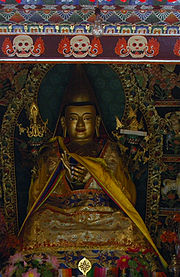
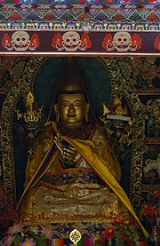
The Gelug or Gelug-pa (or dGe Lugs Pa, dge-lugs-pa, or Dgelugspa), also known as the Yellow Hat sect, is a school of Buddhism
Buddhism
Buddhism is a religion and philosophy encompassing a variety of traditions, beliefs and practices, largely based on teachings attributed to Siddhartha Gautama, commonly known as the Buddha . The Buddha lived and taught in the northeastern Indian subcontinent some time between the 6th and 4th...
founded by Je Tsongkhapa
Je Tsongkhapa
Tsongkhapa , whose name means “The Man from Onion Valley”, was a famous teacher of Tibetan Buddhism whose activities led to the formation of the Geluk school...
(1357–1419), a philosopher and Tibet
Tibet
Tibet is a plateau region in Asia, north-east of the Himalayas. It is the traditional homeland of the Tibetan people as well as some other ethnic groups such as Monpas, Qiang, and Lhobas, and is now also inhabited by considerable numbers of Han and Hui people...
an religious leader. The first monastery
Monastery
Monastery denotes the building, or complex of buildings, that houses a room reserved for prayer as well as the domestic quarters and workplace of monastics, whether monks or nuns, and whether living in community or alone .Monasteries may vary greatly in size – a small dwelling accommodating only...
he established was at Ganden, and to this day the Ganden Tripa
Ganden Tripa
The Ganden Tripa or Gaden Tripa is the title of the spiritual leader of the Gelug school of Tibetan Buddhism, the school which controlled central Tibet from the mid-17th century until 1950s. He is identical with the respective abbot of Ganden Monastery...
is the nominal head of the school, though its most influential figure is the Dalai Lama
Dalai Lama
The Dalai Lama is a high lama in the Gelug or "Yellow Hat" branch of Tibetan Buddhism. The name is a combination of the Mongolian word далай meaning "Ocean" and the Tibetan word bla-ma meaning "teacher"...
. Allying themselves with the Mongols
Mongols
Mongols ) are a Central-East Asian ethnic group that lives mainly in the countries of Mongolia, China, and Russia. In China, ethnic Mongols can be found mainly in the central north region of China such as Inner Mongolia...
as a powerful patron, the Gelug emerged as the pre-eminent Buddhist school in Tibet since the end of the 16th century.
Lama Tsongkhapa
A great admirer of the KadampaKadampa
The Kadampa tradition was a Tibetan Mahayana Buddhist school. Dromtönpa, a Tibetan lay master and the foremost disciple of the great Indian Buddhist Master Atisha , founded it and passed three lineages to his disciples. The Kadampa were quite famous and respected for their proper and earnest...
(Bka'-gdams-pa) teachings, Tsongkhapa was an enthusiastic promoter of the Kadam School's emphasis on the mahāyāna
Mahayana
Mahāyāna is one of the two main existing branches of Buddhism and a term for classification of Buddhist philosophies and practice...
principle of universal compassion as the fundamental spiritual
Spirituality
Spirituality can refer to an ultimate or an alleged immaterial reality; an inner path enabling a person to discover the essence of his/her being; or the “deepest values and meanings by which people live.” Spiritual practices, including meditation, prayer and contemplation, are intended to develop...
orientation. He combined this with a strong emphasis on the cultivation of in-depth insight into the doctrine of emptiness
Shunyata
Śūnyatā, शून्यता , Suññatā , stong-pa nyid , Kòng/Kū, 空 , Gong-seong, 공성 , qoγusun is frequently translated into English as emptiness...
as propounded by the India
India
India , officially the Republic of India , is a country in South Asia. It is the seventh-largest country by geographical area, the second-most populous country with over 1.2 billion people, and the most populous democracy in the world...
n masters Nāgārjuna
Nagarjuna
Nāgārjuna was an important Buddhist teacher and philosopher. Along with his disciple Āryadeva, he is credited with founding the Mādhyamaka school of Mahāyāna Buddhism...
(2nd century) and Candrakīrti
Candrakīrti
Candrakīrti , was an Indian scholar and a khenpo of Nālandā Mahāvihāra. He was a disciple of and a commentator on his works and those of his main disciple, Āryadeva...
(7th century). Tsongkhapa said that these two aspects of the spiritual path, compassion and insight into wisdom, must be rooted in a wholehearted wish for liberation impelled by a genuine sense of renunciation. He called these the "Three Principal Aspects of the Path", and asserted that it is on the basis of these three that one must embark on the profound path of vajrayāna
Vajrayana
Vajrayāna Buddhism is also known as Tantric Buddhism, Tantrayāna, Mantrayāna, Secret Mantra, Esoteric Buddhism and the Diamond Vehicle...
Buddhism
Buddhism
Buddhism is a religion and philosophy encompassing a variety of traditions, beliefs and practices, largely based on teachings attributed to Siddhartha Gautama, commonly known as the Buddha . The Buddha lived and taught in the northeastern Indian subcontinent some time between the 6th and 4th...
.
The central teachings of the Gelug School are the Stages of the Path
Lamrim
Lamrim is a Tibetan Buddhist textual form for presenting the stages in the complete path to enlightenment as taught by Buddha. In Tibetan Buddhist history there have been many different versions of lamrim, presented by different teachers of the Nyingma, Kagyu and Gelug schools...
(lamrim), based on the teachings of the Indian master Atiśa (c. 11th century) and the systematic cultivation of the view of emptiness. This is combined with the yoga
Meditation
Meditation is any form of a family of practices in which practitioners train their minds or self-induce a mode of consciousness to realize some benefit....
s of highest yoga tantra
Highest Yoga Tantra
Anuttarayoga Tantra , often translated as Unexcelled Yoga Tantra or Highest Yoga Tantra, is a term used in Tibetan Buddhism in the categorization of esoteric tantric Indian Buddhist texts that constitute part of the Kangyur, or the 'translated words of the Buddha' in the Tibetan Buddhist canon...
deities
Deity
A deity is a recognized preternatural or supernatural immortal being, who may be thought of as holy, divine, or sacred, held in high regard, and respected by believers....
such as Guhyasamāja, Cakrasaṃvara, Yamāntaka and Kālacakra
Kalachakra
Kalachakra is a Sanskrit term used in Tantric Buddhism that literally means "time-wheel" or "time-cycles".The spelling Kalacakra is also correct....
, where the key focus is the direct experience of the indivisible union of bliss and emptiness.
Six commentaries by Tsongkhapa are the prime source for the studies of the Gelug tradition, as follows:
- The Great Exposition of the Stages of the Path (Lam-rim chen-mo),
- The Great Exposition of Tantras (sNgag-rim chenmo),
- The Essence of Eloquence on the Interpretive and Definitive Teachings (Drnng-nges legs-bshad snying-po),
- The Praise of Relativity (rTen-'brel bstodpa),
- The Clear Exposition of the Five Stages of Guhyasamāja (gSang-'dus rim-lnga gsal-sgron) and
- The Golden Rosary (gSer-phreng).
Each Gelug monastery uses its own set of commentarial texts by different authors, known as monastic manuals (Tib. yigcha). The teachings of Tsongkhapa are seen as a protection against developing misconceptions in understanding and practice of mahāyāna
Mahayana
Mahāyāna is one of the two main existing branches of Buddhism and a term for classification of Buddhist philosophies and practice...
and vajrayāna
Vajrayana
Vajrayāna Buddhism is also known as Tantric Buddhism, Tantrayāna, Mantrayāna, Secret Mantra, Esoteric Buddhism and the Diamond Vehicle...
Buddhism. It is said that his true followers take The Great Exposition of the Stages of the Path as their heart teaching.
The Gelug school focuses on ethics and monastic discipline of the vinaya
Vinaya
The Vinaya is the regulatory framework for the Buddhist monastic community, or sangha, based in the canonical texts called Vinaya Pitaka. The teachings of the Buddha, or Buddhadharma can be divided into two broad categories: 'Dharma' or doctrine, and 'Vinaya', or discipline...
as the central plank of spiritual practice. In particular, the need to pursue spiritual practice in a graded, sequential manner is emphasized. Arguably, Gelug is the only school of vajrayāna Buddhism that prescribes monastic ordination as a necessary qualification and basis in its teachers (lamas / gurus). Lay people are usually not permitted to give initiations if there are teachers with monastic vows within close proximity. This discipline was laid down by Tsongkhapa as a mechanism intended to help prevent Buddhist teachings from degeneration. Je Rinpoche through his unsurpassed wisdom and direct perception of Manjuśri has shown sentient beings a view of how vajrayāna teachings can be practiced without compromising vinaya.
Monasteries and Lineage Holders
Tsongkhapa founded the monastery of GandenGanden Monastery
Ganden Monastery or Ganden Namgyeling is one of the 'great three' Gelukpa university monasteries of Tibet, located at the top of Wangbur Mountain, Tagtse County, 36 kilometers ENE from the Potala Palace in Lhasa, at an altitude of 4,300m...
in 1409 as his main seat. He had many students, his two main disciples being Gyaltsab Je
Gyaltsab Je
Gyaltsab Je or more elaborately, Gyaltsab Dharma Rinchen was born in the Tsang province of central Tibet. He was a famous student of Je Tsongkhapa, and actually became the first Ganden Tripa of the Gelug tradition after Je Tsongkhapa's death.Gyaltsab Je was a prolific writer; one of his most...
(1364–1431) and Khedrub Je (1385–1438). Other outstanding disciples were Togden Jampal Gyatso, Jamyang Choje, Jamchenpa Sherap Senge and Gyalwa Gendün Drup, the 'first' Dalai Lama
Dalai Lama
The Dalai Lama is a high lama in the Gelug or "Yellow Hat" branch of Tibetan Buddhism. The name is a combination of the Mongolian word далай meaning "Ocean" and the Tibetan word bla-ma meaning "teacher"...
(1391–1474). After Tsongkhapa's passing, his teachings were held and spread by Gyaltsab Je
Gyaltsab Je
Gyaltsab Je or more elaborately, Gyaltsab Dharma Rinchen was born in the Tsang province of central Tibet. He was a famous student of Je Tsongkhapa, and actually became the first Ganden Tripa of the Gelug tradition after Je Tsongkhapa's death.Gyaltsab Je was a prolific writer; one of his most...
and Khedrub Je who were his successors as abbots of Ganden monastery. The lineage is still held by the Ganden Tripa
Ganden Tripa
The Ganden Tripa or Gaden Tripa is the title of the spiritual leader of the Gelug school of Tibetan Buddhism, the school which controlled central Tibet from the mid-17th century until 1950s. He is identical with the respective abbot of Ganden Monastery...
s – the throne-holders of Ganden Monastery
Ganden Monastery
Ganden Monastery or Ganden Namgyeling is one of the 'great three' Gelukpa university monasteries of Tibet, located at the top of Wangbur Mountain, Tagtse County, 36 kilometers ENE from the Potala Palace in Lhasa, at an altitude of 4,300m...
– among whom the present holder is Thubten Nyima Lungtok Tenzin Norbu, the 102nd Ganden Tripa (and not, as often misunderstood, by the Dalai Lama).
Drepung Monastery
Drepung Monastery
Drepung Monastery ,, located at the foot of Mount Gephel, is one of the "great three" Gelukpa university monasteries of Tibet...
was founded by Jamyang Choje, Sera Monastery
Sera Monastery
Sera Monastery is one of the 'great three' Gelukpa university monasteries of Tibet, located north of Lhasa. The other two are Ganden Monastery and Drepung Monastery. The origin of the name 'Sera' is attributed to a fact that the site where the monastery was built was surrounded by wild roses in...
was founded by Chöje Shakya Yeshe and the Gyalwa Gendün Drup founded Tashi Lhunpo Monastery.
Labrang Monastery
Labrang Monastery
Labrang Monastery is one of the six great monasteries of the Geluk school of Tibetan Buddhism...
, in Xiahe County in Gansu province (and in the traditional Tibetan province of Amdo), was founded in 1709 by the first Jamyang Zhaypa, Ngawang Tsondru. Many Gelug monasteries were built throughout Tibet as well as in China and Mongolia.
Among the main lineage holders of the Gelug are the successive incarnations of the Dalai Lama (also commonly referred to as 'Gyalwa Rinpoche'), the succession of the Panchen Lama
Panchen Lama
The Panchen Lama , or Bainqên Erdê'ni , is the highest ranking Lama after the Dalai Lama in the Gelugpa lineage of Tibetan Buddhism...
, the Chagkya Dorje Chang, Ngachen Könchok Gyaltsen, Kyishö Tulku Tenzin Thrinly, Jamyang Shepa, Phurchok Jampa Rinpoche, Jamyang Dewe Dorje, Takphu Rinpoche, Khachen Yeshe Gyaltsen, successive incarnations of Kyabje Yongzin Ling Rinpoche
Ling Rinpoche
Kyabje Ling Rinpoche was a Tibetan buddhist scholar and teacher.Born in Tibet, northwest of Lhasa, he also was the 97th Ganden Tripa and senior tutor to His Holiness the 14th Dalai Lama. The Ganden Tripa is the spiritual head of the Gelugpa Sect, the largest sect in Tibetan Buddhism. Kyabje Ling...
, and successive incarnations of Kyabje Yongzin Trijang Rinpoche
Trijang Rinpoche
Kyabje Trijang Rinpoche was a Gelug Lama and a direct disciple of Je Pabongka. He was the junior tutor and spiritual guide of the 14th Dalai Lama for forty years. He is also the root lama of many Gelug Lamas who teach in the West including Zong Rinpoche, Geshe Rabten, Lama Yeshe, Lama Gangchen...
.
Vajrayāna Practice in the Gelug
GuhyasamājaGuhyasamāja tantra
The Guhyasamāja Tantra is one of the most important scriptures of esoteric Buddhism. In its fullest form, it consists of seventeen chapters, though a separate "explanatory tantra" known as the Later Tantra is sometimes considered to be its eighteenth chapter...
, Cakrasaṃvara and Yamāntaka are the three principal yidam
Yidam
In Vajrayana Buddhism, an Ishta-deva or Ishta-devata is a fully enlightened being who is the focus of personal meditation, during a retreat or for life. The term is often translated into English as tutelary deity, meditation deity, or meditational deity...
practices in the Gelug lineage, although Kālacakra
Kalachakra
Kalachakra is a Sanskrit term used in Tantric Buddhism that literally means "time-wheel" or "time-cycles".The spelling Kalacakra is also correct....
practice is also important. Guhyasamāja is the principal one; as the Dalai Lama remarks, "there is a saying in the Gelug, 'If one is on the move it is Guhyasamāja. If one is still, it is Guhyasamāja. If one is meditating, it should be upon Guhyasamāja.' Therefore, whether one is engaged in study or practice, Guhyasamāja should be one's focus."
Influence
Sonam Gyatso, who was considered to be the third incarnation of Gyalwa Gendün Drup, formed an alliance with the then most powerful MongolMongols
Mongols ) are a Central-East Asian ethnic group that lives mainly in the countries of Mongolia, China, and Russia. In China, ethnic Mongols can be found mainly in the central north region of China such as Inner Mongolia...
leader, Altan Khan
Altan Khan
Altan Khan , whose given name was Anda , was the ruler of the Tümet Mongols and de facto ruler of the Right Wing, or western tribes, of the Mongols...
, in 1577. As a result, he was designated as "Dalai" (a translation into Mongolian of the name Gyatso, meaning ocean), and Gyalwa Gendün Drup and Gendun Gyatso were posthumously recognized as the 1st and 2nd Dalai Lama
Dalai Lama
The Dalai Lama is a high lama in the Gelug or "Yellow Hat" branch of Tibetan Buddhism. The name is a combination of the Mongolian word далай meaning "Ocean" and the Tibetan word bla-ma meaning "teacher"...
s. Sonam Gyatso was very active in proselytizing among the Mongols, and the Gelug tradition was to become the main spiritual orientations of the Mongols in the ensuing centuries. This brought the Gelugpas powerful patrons who were to propel them to pre-eminence in Tibet. The Gelug-Mongol alliance was further strengthened as after Sonam Gyatso's death, his incarnation was found to be Altan Khan's great-grandson.
By the end of the 16th century, following violent strife among the sects of Tibetan Buddhism
Tibetan Buddhism
Tibetan Buddhism is the body of Buddhist religious doctrine and institutions characteristic of Tibet and certain regions of the Himalayas, including northern Nepal, Bhutan, and India . It is the state religion of Bhutan...
, the Gelug school emerged as the dominant one. According to Tibetan historian Samten Karmay
Samten Karmay
Samten Gyeltsen Karmay is a writer and researcher in the field of Tibetan Studies. His work is focused on the study of Tibetan myths, beliefs, Bon religion and religious history.-Life and work:...
, "Sonam Chophel (1595-1657), treasurer of the Ganden Palace, was the prime architect of the Gelug's rise to political power. Later he received the title Desi [Wylie: sde-sris], meaning "Regent", which he would earn through his efforts to establish Gelugpa power." From the period of Lozang Gyatso, 5th Dalai Lama
Lozang Gyatso, 5th Dalai Lama
Ngawang Lobsang Gyatso, the Great Fifth Dalai Lama , was a political and religious leader in seventeenth-century Tibet. Ngawang Lozang Gyatso was the ordination name he had received from Panchen Lobsang Chökyi Gyaltsen who was responsible for his ordination...
in the 17th century, the Dalai Lama
Dalai Lama
The Dalai Lama is a high lama in the Gelug or "Yellow Hat" branch of Tibetan Buddhism. The name is a combination of the Mongolian word далай meaning "Ocean" and the Tibetan word bla-ma meaning "teacher"...
s held political control over central Tibet. In the course of this reign, the Jonang
Jonang
The Jonang is one of the schools of Tibetan Buddhism. Its origins in Tibet can be traced to early 12th century master Yumo Mikyo Dorje, but became much wider known with the help of Dolpopa Sherab Gyeltsen, a monk originally trained in the Sakya school...
school was forcibly converted to the Gelug tradition as punishment for treason, along with some Kagyu
Kagyu
The Kagyu, Kagyupa, or Kagyud school, also known as the "Oral Lineage" or Whispered Transmission school, is today regarded as one of six main schools of Himalayan or Tibetan Buddhism, the other five being the Nyingma, Sakya, Jonang, Bon and Gelug...
and Nyingma
Nyingma
The Nyingma tradition is the oldest of the four major schools of Tibetan Buddhism . "Nyingma" literally means "ancient," and is often referred to as Nga'gyur or the "old school" because it is founded on the first translations of Buddhist scriptures from Sanskrit into Tibetan, in the eighth century...
monasteries.
Scottish Botanist George Forrest
George Forrest (botanist)
George Forrest was a Scottish botanist, who was one of the first explorers of China's then remote southwestern province of Yunnan, generally regarded as the most biodiverse province in the country....
, who witnessed the 1905 Tibetan Rebellion
1905 Tibetan Rebellion
-Attacks on Christian Missionaries and Converts:Under pressure from foreigners, the Qing Dynasty government allowed Christian missionaries into Tibetan Buddhist areas in Yunnan province. The Tibetan Lamas had long defied the rule of the Qing authorities and officials, and the Qing dynasty fought...
led by the Gelug Lamas, wrote that the majority of the people in the Mekong
Mekong
The Mekong is a river that runs through China, Burma, Laos, Thailand, Cambodia and Vietnam. It is the world's 10th-longest river and the 7th-longest in Asia. Its estimated length is , and it drains an area of , discharging of water annually....
valley in Yunnan were Tibetan. The Tibetan Buddhist Yellow Sect was the dominant power in the region, with their Lamas effectively governing the area. Forrest had a negative view of their reign, since according to him they used "force and fraud" to "terrorise the... peasantry". The Lamas completely ignored the Imperial Qing authorities in the region.