

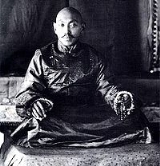
Thubten Gyatso, 13th Dalai Lama

Encyclopedia
Thubten Gyatso was the 13th Dalai Lama
of Tibet
.
During 1878 he was recognized as the reincarnation of the Dalai Lama. He was escorted to Lhasa and given his pre-novice vows by the Panchen Lama
, Tenpai Wangchuk
, and named "Ngawang Lobsang Thupten Gyatso Jigdral Chokley Namgyal". During 1879 he was enthroned at the Potala Palace
, but did not assume political power until 1895, after he had reached his majority.
Thubten Gyatso was an intelligent reformer who proved himself a skillful politician when Tibet became a pawn in The Great Game
between the Russian Empire
and the British Empire
. He was responsible for countering the British expedition to Tibet
, restoring discipline in monastic life, and increasing the number of lay officials
to avoid excessive power being placed in the hands of the monks
.
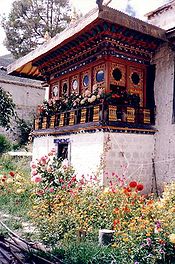 Agvan Dorzhiev
, (1854–1938), a Khori-Buryat
Mongol
, and a Russian subject, was born in the village of Khara-Shibir, not far from Ulan Ude, to the east of Lake Baikal
. He left home during 1873 at nineteen to study at the Gelugpa monastery, Drepung, near Lhasa
, the largest monastery in Tibet
. Having successfully completed the traditional course of religious studies, he began the academic Buddhist degree of Geshey Lharampa (the highest level of 'Doctorate of Buddhist Philosophy'). He continued his studies to become Tsanid-Hambo, or "Master of Buddhist Philosophy". He became a tutor and "debating partner" of the teenage Dalai Lama, who became very friendly with him and later used him as an envoy to Russia and other countries.
C.G.E. Mannerheim met Thubten Gyatso in Utaishan during the course of his expedition from Turkestan to Peking. Mannerheim wrote his diary and notes in Swedish (his mother tongue) to conceal the fact that his ethnographic and scientific party was also an ellaborate intelligence gathering mission for the Russian army. The 13th Dalai Lama gave a blessing of white silk for the Russian Tsar and in return received Mannerheim's precious seven-shot officer's pistol with a full explanation of its use as a gift.
by Sir Francis Younghusband
in early 1904, Dorzhiev convinced the Dalai Lama to flee to Urga in Mongolia
, almost 2400 km (1,491.3 mi) to the northeast of Lhasa, a journey which took four months. The Dalai Lama spent over a year in Urga giving teachings to the Mongolia
ns. While in Urga, the Dalai Lama met with several Russian military intelligence officers, telling them that both Tibet and Mongolia should “irrevocably secede from China to form an independent allied state, accomplishing this operation with Russia’s patronage and support,avoiding bloodshed.” If Russia wouldn’t help, the Dalai Lama insisted, he would even ask Britain, his former foe, for help.
After the Dalai Lama fled, the Qing dynasty
immediately proclaimed him deposed and again asserted sovereignty over Tibet and made claims over Nepal
and Bhutan
as well. A convention was signed at the Potala between Great Britain and Tibet in the presence of the Amban
and Nepalese and Bhutanese representatives on 7 September 1904. The provisions of the 1904 convention were confirmed in a 1906 treaty signed between Great Britain
and China. The British, for a fee from the Qing court, also agreed "not to annex Tibetan territory or to interfere in the administration of Tibet", while China engaged "not to permit any other foreign state to interfere with the territory or internal administration of Tibet".
During October 1906, John Weston Brooke
was the first Englishman to gain an audience with the Dalai Lama, and subsequently he was granted permission to lead two expeditions into Tibet. Also in 1906, Sir Charles Alfred Bell
, was invited to visit Thubten Chökyi Nyima, the 9th Panchen Lama at Tashilhunpo
, where they had friendly discussions on the political situation.
The Dalai Lama later stayed at the great Kumbum Monastery
near Xining
and then travelled east to the most sacred of four Buddhist mountain in China, Wutai Shan
located 300 km from Beijing. From here, the Dalai Lama received a parade of envoys: William Woodville Rockhill, the American Minister in Peking; Gustaf Mannerheim, a Russian army colonel (who later became the president of independent Finland); a German doctor from the Peking Legation; an English explorer named Christopher Irving; R.F. Johnson, a British diplomat from the Colonial Service; and Henri D’Ollone, the French army major and viscount. The Dalai Lama was mounting a campaign to strengthen his international ties and free his kingdom from Chinese rule. Worried about his safety, Mannerheim even gave Tibet's spiritual pontiff a Browning revolver and showed him how to reload the weapon.
In September 1908, the Dalai Lama was granted an audience with Emperor Guangxu and Empress Dowager Cixi
. The emperor tried to stress Tibet's subservient role, although the Dalai Lama refused to kowtow
to him. He stayed in Beijing until the end of 1908.
When he returned to Tibet during December 1908, he began reorganising the government, but the Qing sent a military expedition of its own to Tibet during 1910 and he had to flee to India.
During 1911 the Qing dynasty was overthrown in the Xinhai Revolution
and by the end of 1912 the last Qing troops were escorted out of Tibet.
 During 1895, Thubten Gyatso assumed ruling power from the monasteries which had previously wielded great influence through the Regent. Due to his two periods of exile in 1904–1909, to escape the British invasion of 1904, and from 1910–1913 to escape a Chinese invasion, he became well aware of the complexities of international politics and was the first Dalai Lama to become aware of the importance of foreign relations. The Dalai Lama, "accompanied by six ministers and a small escort" which included his close aide, diplomat and military figure Tsarong Dzasa
, fled via Sikkim
to Darjeeling, where they stayed almost two years. During this period he was invited to Calcutta by the Viceroy
, Lord Minto
, which helped restore relations with the British.
Thubten Gyatso returned to Lhasa during January 1913 with Tsarong Dzasa from Darjeeling, where he had been living in exile. The new Chinese government apologised for the actions of the previous Qing dynasty and offered to restore the Dalai Lama to his former position. He replied that he was not interested in Chinese ranks and was assuming spiritual and political leadership of Tibet.
After his return from exile in India during 1913, Thubten Gyatso assumed control of foreign relations and dealt directly with the Maharaja
and the British Political officer in Sikkim and the king of Nepal
rather than letting the Kashag
or parliament do it.
Thubten Gyatso declared independence
from China during early 1913, after returning from India following three years of exile. He then standardized the Tibetan flag
in its present form. At the end of 1912 the first postage stamps of Tibet
and the first bank notes
were issued.
Thubten Gyatso built a new medical college (Mentsikang) during 1913 on the site of the post-revolutionary traditional hospital near the Jokhang
.
Legislation was introduced to counter corruption among officials
, a national taxation system was established and enforced, and a police force was created. The penal system was revised and made uniform throughout the country. "Capital punishment was completely abolished and corporal punishment was reduced. Living conditions in jails were also improved, and officials were designated to see that these conditions and rules were maintained."
A secular education system was introduced in addition to the religious education system. Thubten Gyatso sent four promising students to England to study, and welcomed foreigners, including Japanese, British and Americans.
As a result of his travels and contacts with foreign powers and their representatives (e.g., Pyotr Kozlov
, Charles Bell
and Gustaf Mannerheim
), the Dalai Lama showed an interest in world affairs and introduced electricity
, the telephone
and the first motor cars to Tibet. Nonetheless, at the end of his life in 1933, he saw that Tibet was about to enter a dark age.
In 1932, the Muslim Qinghai
and Han-Chinese Sichuan
armies of the National Revolutionary Army
led by Chinese Muslim General Ma Bufang
and Han General Liu Wenhui defeated the Tibetan army in the Sino-Tibetan War
when the 13th Dalai Lama tried to seize territory in Qinghai and Xikang. Ma Bufang overran the Tibetan armies and recaptured several counties in Xikang
province. Shiqu, Dengke, and other counties were seized from the Tibetans. The Tibetans were pushed back to the other side of the Jinsha river. Ma and Liu warned Tibetan officials not to dare cross the Jinsha river again. Ma Bufang defeated the Tibetans at Dan Chokorgon. Several Tibetan generals surrendered, and were demoted by the Dalai Lama. By August, the Tibetans lost so much land to Liu Wenhui and Ma Bufang's forces that the Dalai Lama telegraphed the British government of India
for assistance. British pressure led to Nanjing
to declare a ceasefire. Separate truces were signed by Ma and Liu with the Tibetans in 1933, ending the fighting.
Furthermore, the 13th Dalai Lama went on to predict the invasion of Tibet and announced that he would die early, in order that his successor would be old enough to act as a leader for the Tibetan people at the time of this invasion. He died a few months later in Lhasa, in December 1933.
Dalai Lama
The Dalai Lama is a high lama in the Gelug or "Yellow Hat" branch of Tibetan Buddhism. The name is a combination of the Mongolian word далай meaning "Ocean" and the Tibetan word bla-ma meaning "teacher"...
of Tibet
Tibet
Tibet is a plateau region in Asia, north-east of the Himalayas. It is the traditional homeland of the Tibetan people as well as some other ethnic groups such as Monpas, Qiang, and Lhobas, and is now also inhabited by considerable numbers of Han and Hui people...
.
During 1878 he was recognized as the reincarnation of the Dalai Lama. He was escorted to Lhasa and given his pre-novice vows by the Panchen Lama
Panchen Lama
The Panchen Lama , or Bainqên Erdê'ni , is the highest ranking Lama after the Dalai Lama in the Gelugpa lineage of Tibetan Buddhism...
, Tenpai Wangchuk
Tenpai Wangchuk
Tenpai Wangchuk , was the 8th Panchen Lama of Tibet.In 1822 the 10th Dalai Lama, was placed upon the Golden Throne and soon after his enthronement received his pre-novice ordination from Palden Tenpai Nyima, who gave him the name of Tsultrim Gyatso...
, and named "Ngawang Lobsang Thupten Gyatso Jigdral Chokley Namgyal". During 1879 he was enthroned at the Potala Palace
Potala Palace
The Potala Palace is located in Lhasa, Tibet Autonomous Region, China. It was named after Mount Potala, the abode of Chenresig or Avalokitesvara...
, but did not assume political power until 1895, after he had reached his majority.
Thubten Gyatso was an intelligent reformer who proved himself a skillful politician when Tibet became a pawn in The Great Game
The Great Game
The Great Game or Tournament of Shadows in Russia, were terms for the strategic rivalry and conflict between the British Empire and the Russian Empire for supremacy in Central Asia. The classic Great Game period is generally regarded as running approximately from the Russo-Persian Treaty of 1813...
between the Russian Empire
Russian Empire
The Russian Empire was a state that existed from 1721 until the Russian Revolution of 1917. It was the successor to the Tsardom of Russia and the predecessor of the Soviet Union...
and the British Empire
British Empire
The British Empire comprised the dominions, colonies, protectorates, mandates and other territories ruled or administered by the United Kingdom. It originated with the overseas colonies and trading posts established by England in the late 16th and early 17th centuries. At its height, it was the...
. He was responsible for countering the British expedition to Tibet
British expedition to Tibet
The British expedition to Tibet during 1903 and 1904 was an invasion of Tibet by British Indian forces, whose mission was to establish diplomatic relations and trade between the British Raj and Tibet...
, restoring discipline in monastic life, and increasing the number of lay officials
Laity
In religious organizations, the laity comprises all people who are not in the clergy. A person who is a member of a religious order who is not ordained legitimate clergy is considered as a member of the laity, even though they are members of a religious order .In the past in Christian cultures, the...
to avoid excessive power being placed in the hands of the monks
Bhikkhu
A Bhikkhu or Bhikṣu is an ordained male Buddhist monastic. A female monastic is called a Bhikkhuni Nepali: ). The life of Bhikkhus and Bhikkhunis is governed by a set of rules called the patimokkha within the vinaya's framework of monastic discipline...
.
Agvan Dorzhiev
Agvan Dorzhiev
Agvan Lobsan Dorzhiev, also Agvan Dorjiev or Dorjieff , was a Russian-born monk of the Gelug school of Tibetan Buddhism, sometimes referred by his scholarly title as Tsenyi Khempo...
, (1854–1938), a Khori-Buryat
Buryats
The Buryats or Buriyads , numbering approximately 436,000, are the largest ethnic minority group in Siberia and are mainly concentrated in their homeland, the Buryat Republic, a federal subject of Russia...
Mongol
Mongols
Mongols ) are a Central-East Asian ethnic group that lives mainly in the countries of Mongolia, China, and Russia. In China, ethnic Mongols can be found mainly in the central north region of China such as Inner Mongolia...
, and a Russian subject, was born in the village of Khara-Shibir, not far from Ulan Ude, to the east of Lake Baikal
Lake Baikal
Lake Baikal is the world's oldest at 30 million years old and deepest lake with an average depth of 744.4 metres.Located in the south of the Russian region of Siberia, between Irkutsk Oblast to the northwest and the Buryat Republic to the southeast, it is the most voluminous freshwater lake in the...
. He left home during 1873 at nineteen to study at the Gelugpa monastery, Drepung, near Lhasa
Lhasa
Lhasa is the administrative capital of the Tibet Autonomous Region in the People's Republic of China and the second most populous city on the Tibetan Plateau, after Xining. At an altitude of , Lhasa is one of the highest cities in the world...
, the largest monastery in Tibet
Tibet
Tibet is a plateau region in Asia, north-east of the Himalayas. It is the traditional homeland of the Tibetan people as well as some other ethnic groups such as Monpas, Qiang, and Lhobas, and is now also inhabited by considerable numbers of Han and Hui people...
. Having successfully completed the traditional course of religious studies, he began the academic Buddhist degree of Geshey Lharampa (the highest level of 'Doctorate of Buddhist Philosophy'). He continued his studies to become Tsanid-Hambo, or "Master of Buddhist Philosophy". He became a tutor and "debating partner" of the teenage Dalai Lama, who became very friendly with him and later used him as an envoy to Russia and other countries.
C.G.E. Mannerheim met Thubten Gyatso in Utaishan during the course of his expedition from Turkestan to Peking. Mannerheim wrote his diary and notes in Swedish (his mother tongue) to conceal the fact that his ethnographic and scientific party was also an ellaborate intelligence gathering mission for the Russian army. The 13th Dalai Lama gave a blessing of white silk for the Russian Tsar and in return received Mannerheim's precious seven-shot officer's pistol with a full explanation of its use as a gift.
- "Obviously," the [Fourteenth] Dalai Lama said, "The Thirteenth Dalai Lama had a keen desire to establish relations with Russia, and I also think he was a little skeptical toward England at first. Then there was Dorjiev. To the English he was a spy, but in reality he was a good scholar and a sincere Buddhist monk who had great devotion to the Thirteenth Dalai Lama."
Military expeditions in Tibet
After the British expedition to TibetBritish expedition to Tibet
The British expedition to Tibet during 1903 and 1904 was an invasion of Tibet by British Indian forces, whose mission was to establish diplomatic relations and trade between the British Raj and Tibet...
by Sir Francis Younghusband
Francis Younghusband
Lieutenant Colonel Sir Francis Edward Younghusband, KCSI, KCIE was a British Army officer, explorer, and spiritual writer...
in early 1904, Dorzhiev convinced the Dalai Lama to flee to Urga in Mongolia
Mongolia
Mongolia is a landlocked country in East and Central Asia. It is bordered by Russia to the north and China to the south, east and west. Although Mongolia does not share a border with Kazakhstan, its western-most point is only from Kazakhstan's eastern tip. Ulan Bator, the capital and largest...
, almost 2400 km (1,491.3 mi) to the northeast of Lhasa, a journey which took four months. The Dalai Lama spent over a year in Urga giving teachings to the Mongolia
Mongolia
Mongolia is a landlocked country in East and Central Asia. It is bordered by Russia to the north and China to the south, east and west. Although Mongolia does not share a border with Kazakhstan, its western-most point is only from Kazakhstan's eastern tip. Ulan Bator, the capital and largest...
ns. While in Urga, the Dalai Lama met with several Russian military intelligence officers, telling them that both Tibet and Mongolia should “irrevocably secede from China to form an independent allied state, accomplishing this operation with Russia’s patronage and support,avoiding bloodshed.” If Russia wouldn’t help, the Dalai Lama insisted, he would even ask Britain, his former foe, for help.
After the Dalai Lama fled, the Qing dynasty
Qing Dynasty
The Qing Dynasty was the last dynasty of China, ruling from 1644 to 1912 with a brief, abortive restoration in 1917. It was preceded by the Ming Dynasty and followed by the Republic of China....
immediately proclaimed him deposed and again asserted sovereignty over Tibet and made claims over Nepal
Nepal
Nepal , officially the Federal Democratic Republic of Nepal, is a landlocked sovereign state located in South Asia. It is located in the Himalayas and bordered to the north by the People's Republic of China, and to the south, east, and west by the Republic of India...
and Bhutan
Bhutan
Bhutan , officially the Kingdom of Bhutan, is a landlocked state in South Asia, located at the eastern end of the Himalayas and bordered to the south, east and west by the Republic of India and to the north by the People's Republic of China...
as well. A convention was signed at the Potala between Great Britain and Tibet in the presence of the Amban
Amban
Amban is a Manchu word meaning "high official," which corresponds to a number of different official titles in the Qing imperial government...
and Nepalese and Bhutanese representatives on 7 September 1904. The provisions of the 1904 convention were confirmed in a 1906 treaty signed between Great Britain
United Kingdom of Great Britain and Ireland
The United Kingdom of Great Britain and Ireland was the formal name of the United Kingdom during the period when what is now the Republic of Ireland formed a part of it....
and China. The British, for a fee from the Qing court, also agreed "not to annex Tibetan territory or to interfere in the administration of Tibet", while China engaged "not to permit any other foreign state to interfere with the territory or internal administration of Tibet".
During October 1906, John Weston Brooke
John Weston Brooke
John Weston Brooke FRGS was a British military officer and explorer born at Fenay Hall, near Huddersfield, Yorkshire, England. He went to school at Repton. In 1898, he joined the Yorkshire Dragoons, a Yeomanry unit, and served with the Imperial Yeomanry in the Second Boer War. He was promoted to...
was the first Englishman to gain an audience with the Dalai Lama, and subsequently he was granted permission to lead two expeditions into Tibet. Also in 1906, Sir Charles Alfred Bell
Charles Alfred Bell
Sir Charles Alfred Bell K.C.I.E. , born in Calcutta, was a British-Indian tibetologist. He was educated at Winchester College. After joining the Indian Civil Service, he was appointed Political Officer in Sikkim in 1908...
, was invited to visit Thubten Chökyi Nyima, the 9th Panchen Lama at Tashilhunpo
Tashilhunpo
Tashilhunpo Monastery , founded in 1447 by Gendun Drup, the First Dalai Lama, is a historic and culturally important monastery next to Shigatse, the second-largest city in Tibet....
, where they had friendly discussions on the political situation.
The Dalai Lama later stayed at the great Kumbum Monastery
Kumbum Monastery
Kumbum Monastery is a Buddhist monastery in Qinghai province, China. Kumbum was founded in 1583 in a narrow valley close to the village of Lusar in the Tibetan cultural region of Amdo. Its superior monastery is Drepung, immediately to the west of Lhasa...
near Xining
Xining
Xining is the capital of Qinghai province, People's Republic of China, and the largest city on the Tibetan Plateau. It has 2,208,708 inhabitants at the 2010 census whom 1,198,304 live in the built up area made of 4 urban districts.-History:...
and then travelled east to the most sacred of four Buddhist mountain in China, Wutai Shan
Wutai Shan
Mount Wutai , also known as Wutai Mountain or Qingliang Shan, is located in Shanxi, China. The mountain is home to many of China's most important monasteries and temples...
located 300 km from Beijing. From here, the Dalai Lama received a parade of envoys: William Woodville Rockhill, the American Minister in Peking; Gustaf Mannerheim, a Russian army colonel (who later became the president of independent Finland); a German doctor from the Peking Legation; an English explorer named Christopher Irving; R.F. Johnson, a British diplomat from the Colonial Service; and Henri D’Ollone, the French army major and viscount. The Dalai Lama was mounting a campaign to strengthen his international ties and free his kingdom from Chinese rule. Worried about his safety, Mannerheim even gave Tibet's spiritual pontiff a Browning revolver and showed him how to reload the weapon.
In September 1908, the Dalai Lama was granted an audience with Emperor Guangxu and Empress Dowager Cixi
Empress Dowager Cixi
Empress Dowager Cixi1 , of the Manchu Yehenara clan, was a powerful and charismatic figure who became the de facto ruler of the Manchu Qing Dynasty in China for 47 years from 1861 to her death in 1908....
. The emperor tried to stress Tibet's subservient role, although the Dalai Lama refused to kowtow
Kowtow
Kowtow is the act of deep respect shown by kneeling and bowing so low as to have one's head touching the ground. An alternative Chinese term is ketou, however the meaning is somewhat altered: kòu originally meant "knock with reverence", whereas kē has the general meaning of "touch upon ".In Han...
to him. He stayed in Beijing until the end of 1908.
When he returned to Tibet during December 1908, he began reorganising the government, but the Qing sent a military expedition of its own to Tibet during 1910 and he had to flee to India.
During 1911 the Qing dynasty was overthrown in the Xinhai Revolution
Xinhai Revolution
The Xinhai Revolution or Hsinhai Revolution, also known as Revolution of 1911 or the Chinese Revolution, was a revolution that overthrew China's last imperial dynasty, the Qing , and established the Republic of China...
and by the end of 1912 the last Qing troops were escorted out of Tibet.
Assumption of political power
Tsarong Dzasa
Tsarong Dazang Dramdul commonly known simply as Tsarong or by his title Tsarong Dzasa, born Namgang was a Tibetan diplomat, military figure, economist, civil engineer and close aide of the 13th Dalai Lama...
, fled via Sikkim
Sikkim
Sikkim is a landlocked Indian state nestled in the Himalayan mountains...
to Darjeeling, where they stayed almost two years. During this period he was invited to Calcutta by the Viceroy
Viceroy
A viceroy is a royal official who runs a country, colony, or province in the name of and as representative of the monarch. The term derives from the Latin prefix vice-, meaning "in the place of" and the French word roi, meaning king. A viceroy's province or larger territory is called a viceroyalty...
, Lord Minto
Gilbert Elliot-Murray-Kynynmound, 4th Earl of Minto
Gilbert John Elliot-Murray-Kynynmound, 4th Earl of Minto was a British nobleman and politician who served as Governor General of Canada, the eighth since Canadian Confederation, and as Viceroy and Governor-General of India, the country's 17th.-Early life and career:Minto was born in London, the...
, which helped restore relations with the British.
Thubten Gyatso returned to Lhasa during January 1913 with Tsarong Dzasa from Darjeeling, where he had been living in exile. The new Chinese government apologised for the actions of the previous Qing dynasty and offered to restore the Dalai Lama to his former position. He replied that he was not interested in Chinese ranks and was assuming spiritual and political leadership of Tibet.
After his return from exile in India during 1913, Thubten Gyatso assumed control of foreign relations and dealt directly with the Maharaja
Maharaja
Mahārāja is a Sanskrit title for a "great king" or "high king". The female equivalent title Maharani denotes either the wife of a Maharaja or, in states where that was customary, a woman ruling in her own right. The widow of a Maharaja is known as a Rajamata...
and the British Political officer in Sikkim and the king of Nepal
Nepal
Nepal , officially the Federal Democratic Republic of Nepal, is a landlocked sovereign state located in South Asia. It is located in the Himalayas and bordered to the north by the People's Republic of China, and to the south, east, and west by the Republic of India...
rather than letting the Kashag
Kashag
The Kashag was the governing council of Tibet during Qing Dynasty and Republic of China. It was set by Qianlong Emperor in 1751. In that year the Tibetan government was reorganized after the riots in Lhasa of the previous year...
or parliament do it.
Thubten Gyatso declared independence
Independence
Independence is a condition of a nation, country, or state in which its residents and population, or some portion thereof, exercise self-government, and usually sovereignty, over its territory....
from China during early 1913, after returning from India following three years of exile. He then standardized the Tibetan flag
Flag of Tibet
The Tibetan flag, also known as the 'snow lion flag' and the 'Free Tibet flag', was a flag of the military of Tibet, introduced by the 13th Dalai Lama in 1912 and used in the same capacity until 1959. Designed with the help of a Japanese, it reflects the design motif of Japanese military's Rising...
in its present form. At the end of 1912 the first postage stamps of Tibet
Postage stamps of Tibet
This is a survey of the postage stamps and postal history of Tibet.-Foreign stamps:The first adhesive stamps issued for use in Tibet were typewritten overprints on Indian postage stamps through the 1903 period, during which the Tibetan Frontier Commission, led by Sir Francis Younghusband, arrived...
and the first bank notes
Historical money of Tibet
The use of historical money in Tibet started in ancient times, when Tibet had no coined currency of its own. Bartering was common, gold was a medium of exchange, and shell money and stone beads were used for very small purchases...
were issued.
Thubten Gyatso built a new medical college (Mentsikang) during 1913 on the site of the post-revolutionary traditional hospital near the Jokhang
Jokhang
The Jokhang, , also called the Qokang Monastery, Jokang, Jokhang Temple, Jokhang Monastery or Zuglagkang , is located on Barkhor Square in Lhasa. For most Tibetans it is the most sacred and important temple in Tibet. It is in some regards pan-sectarian, but is presently controlled by the Gelug school...
.
Legislation was introduced to counter corruption among officials
Political corruption
Political corruption is the use of legislated powers by government officials for illegitimate private gain. Misuse of government power for other purposes, such as repression of political opponents and general police brutality, is not considered political corruption. Neither are illegal acts by...
, a national taxation system was established and enforced, and a police force was created. The penal system was revised and made uniform throughout the country. "Capital punishment was completely abolished and corporal punishment was reduced. Living conditions in jails were also improved, and officials were designated to see that these conditions and rules were maintained."
A secular education system was introduced in addition to the religious education system. Thubten Gyatso sent four promising students to England to study, and welcomed foreigners, including Japanese, British and Americans.
As a result of his travels and contacts with foreign powers and their representatives (e.g., Pyotr Kozlov
Pyotr Kozlov
Pyotr Kuzmich Kozlov was a Russian and Soviet traveler and explorer who continued the studies of Nikolai Przhevalsky in Mongolia and Tibet.Although prepared by his parents for military career, Kozlov chose to join Przhevalsky's expedition. After his mentor's death, Kozlov continued travelling in...
, Charles Bell
Charles Bell
Sir Charles Bell was a Scottish surgeon, anatomist, neurologist and philosophical theologian.His three older brothers included John Bell , also a noted surgeon and writer; and the advocate George Joseph Bell .-Life:...
and Gustaf Mannerheim
Carl Gustaf Emil Mannerheim
Baron Carl Gustaf Emil Mannerheim was the military leader of the Whites in the Finnish Civil War, Commander-in-Chief of Finland's Defence Forces during World War II, Marshal of Finland, and a Finnish statesman. He was Regent of Finland and the sixth President of Finland...
), the Dalai Lama showed an interest in world affairs and introduced electricity
Electricity
Electricity is a general term encompassing a variety of phenomena resulting from the presence and flow of electric charge. These include many easily recognizable phenomena, such as lightning, static electricity, and the flow of electrical current in an electrical wire...
, the telephone
Telephone
The telephone , colloquially referred to as a phone, is a telecommunications device that transmits and receives sounds, usually the human voice. Telephones are a point-to-point communication system whose most basic function is to allow two people separated by large distances to talk to each other...
and the first motor cars to Tibet. Nonetheless, at the end of his life in 1933, he saw that Tibet was about to enter a dark age.
In 1932, the Muslim Qinghai
Qinghai
Qinghai ; Oirat Mongolian: ; ; Salar:) is a province of the People's Republic of China, named after Qinghai Lake...
and Han-Chinese Sichuan
Sichuan
' , known formerly in the West by its postal map spellings of Szechwan or Szechuan is a province in Southwest China with its capital in Chengdu...
armies of the National Revolutionary Army
National Revolutionary Army
The National Revolutionary Army , pre-1928 sometimes shortened to 革命軍 or Revolutionary Army and between 1928-1947 as 國軍 or National Army was the Military Arm of the Kuomintang from 1925 until 1947, as well as the national army of the Republic of China during the KMT's period of party rule...
led by Chinese Muslim General Ma Bufang
Ma Bufang
Ma Bufang was a prominent Muslim Ma clique warlord in China during the Republic of China era, ruling the northwestern province of Qinghai. His rank was Lieutenant-general...
and Han General Liu Wenhui defeated the Tibetan army in the Sino-Tibetan War
Sino-Tibetan War
The Sino–Tibetan War occurred in 1930–1932 when the Tibetan army under the 13th Dalai Lama invaded Xikang and Yushu in Qinghai in a dispute over monasteries. The Ma clique warlord Ma Bufang secretly sent a telegram to the Sichuan warlord Liu Wenhui, and the leader of the Republic of China, Chiang...
when the 13th Dalai Lama tried to seize territory in Qinghai and Xikang. Ma Bufang overran the Tibetan armies and recaptured several counties in Xikang
Xikang
Xikang or Sikang , is a defunct province of the Republic of China , comprising most of the Kham region of traditional Tibet, where Khampas, a subgroup of the Tibetan ethnicity, live. The area is also home to a small minority of Mongol ethnicity...
province. Shiqu, Dengke, and other counties were seized from the Tibetans. The Tibetans were pushed back to the other side of the Jinsha river. Ma and Liu warned Tibetan officials not to dare cross the Jinsha river again. Ma Bufang defeated the Tibetans at Dan Chokorgon. Several Tibetan generals surrendered, and were demoted by the Dalai Lama. By August, the Tibetans lost so much land to Liu Wenhui and Ma Bufang's forces that the Dalai Lama telegraphed the British government of India
British Raj
British Raj was the British rule in the Indian subcontinent between 1858 and 1947; The term can also refer to the period of dominion...
for assistance. British pressure led to Nanjing
Nanjing
' is the capital of Jiangsu province in China and has a prominent place in Chinese history and culture, having been the capital of China on several occasions...
to declare a ceasefire. Separate truces were signed by Ma and Liu with the Tibetans in 1933, ending the fighting.
Prophecies
The 13th Dalai Lama predicted before dying:"Very soon in this land (with a harmonious blend of religion and politics) deceptive acts may occur from without and within. At that time, if we do not dare to protect our territory, our spiritual personalities including the Victorious Father and Son (Dalai Lama and Panchen LamaPanchen LamaThe Panchen Lama , or Bainqên Erdê'ni , is the highest ranking Lama after the Dalai Lama in the Gelugpa lineage of Tibetan Buddhism...
) may be exterminated without trace, the property and authority of our Lakangs (residences of reincarnated lamas) and monks may be taken away. Moreover, our political system, developed by the Three Great Dharma Kings (Tri Songtsen Gampo, Tri Songdetsen and Tri Ralpachen) will vanish without anything remaining. The property of all people, high and low, will be seized and the people forced to become slaves. All living beings will have to endure endless days of suffering and will be stricken with fear. Such a time will come."
Furthermore, the 13th Dalai Lama went on to predict the invasion of Tibet and announced that he would die early, in order that his successor would be old enough to act as a leader for the Tibetan people at the time of this invasion. He died a few months later in Lhasa, in December 1933.
Footnotes
- Some text used with permission from www.simhas.org. The author of this text has requested that there appear a direct link to the website on which the information is taken. The original text can be found here: http://www.simhas.org/dalai13.html.
Further reading
- Bell, Charles (1946) Portrait of a Dalai Lama: the Life and Times of the Great Thirteenth by Charles Alfred Bell, Sir Charles Bell, Publisher: Wisdom Publications (MA), January 1987, ISBN 9780861710553 (first published as Portrait of the Dalai Lama: London: Collins, 1946).
- Bell, Charles (1924) Tibet: Past and Present. Oxford: Clarendon Press
- Bell, Charles (1931) The Religion of Tibet. Oxford: Clarendon Press
- Gelek, Surkhang Wangchen. 1982. "Tibet: The Critical Years (Part 1) "The Thirteenth Dalai Lama". The Tibet Journal. Vol. VII, No. 4. Winter 1982, pp. 11–19.
- Goldstein, Melvyn C. A History of Modern Tibet, 1913–1951: the demise of the Lamaist state (Berkeley: University of California Press, 1989) ISBN 978-0-520-07590-0
- Mullin, Glenn H. (2001). The Fourteen Dalai Lamas: A Sacred Legacy of Reincarnation, pp. 376–451. Clear Light Publishers. Santa Fe, New Mexico. ISBN 1-57416-092-3.
- Richardson, Hugh E.(1984): Tibet & its History. Boulder and London: Shambala. ISBN 0-87773-292-2.
- Samten, Jampa. (2010). "Notes on the Thirteenth Dalai Lama's Confidential Letter to the Tsar of Russia." In: The Tibet Journal, Special issue. Autumn 2009 vol XXXIV n. 3-Summer 2010 vol XXXV n. 2. "The Earth Ox Papers", edited by Roberto Vitali, pp. 357–370.
- Smith, Warren (1997):Tibetan Nation. New Delhi: HarperCollins. ISBN 0-8133-3155-2
- Tamm, Eric Enno. "The Horse That Leaps Through Clouds: A Tale of Espionage, the Silk Road and the Rise of Modern China." Vancouver: Douglas & McIntyre, 2010, Chapter 17 & 18. ISBN 978-1553652694. See http://horsethatleaps.com
- Tsering Shakya (1999): The Dragon in the Land of Snows. A History of Modern Tibet since 1947. London:Pimlico. ISBN 0-7126-6533-1
- The Wonderful Rosary of Jewels. An official biography compiled for the Tibetan Government, completed in February 1940