
All Topics  
Flying buttress

 
Flying Buttress

   Email Print
   Bookmark   Link


Flying buttress


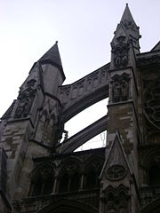
A flying buttress, or arc-boutant, is a specific type of buttress
Buttress

A buttress is an architecture structure built against or projecting from a wall which serves to support or reinforce the wall. Buttresses are fairly common on more ancient buildings, especially in Germany, as a means of providing support to act against the lateral forces arising out of the roof structures that lack adequate bracing....
 usually found on a religious building such as a cathedral
Cathedral

A cathedral is a Christian church that contains the seat of a bishop. It is a Religion building for worship, specifically of a denomination with an episcopal hierarchy, such as the Roman Catholic Church, Anglicanism, Orthodox Christian and some Lutheranism churches, which serves as a bishop's seat, and thus as the central church of a dioc...
.


Discussion
Ask a question about 'Flying buttress'
Start a new discussion about 'Flying buttress'
Answer questions from other users
Full Discussion Forum


Encyclopedia


Bath
Bath
Villardbuttressreims
A flying buttress, or arc-boutant, is a specific type of buttress
Buttress

A buttress is an architecture structure built against or projecting from a wall which serves to support or reinforce the wall. Buttresses are fairly common on more ancient buildings, especially in Germany, as a means of providing support to act against the lateral forces arising out of the roof structures that lack adequate bracing....
 usually found on a religious building such as a cathedral
Cathedral

A cathedral is a Christian church that contains the seat of a bishop. It is a Religion building for worship, specifically of a denomination with an episcopal hierarchy, such as the Roman Catholic Church, Anglicanism, Orthodox Christian and some Lutheranism churches, which serves as a bishop's seat, and thus as the central church of a dioc...
. They are used to transmit the horizontal thrust of a vault
Vault (architecture)

A Vault is an architecture term for an arched form used to provide a space with a ceiling or roof. The parts of a vault exert a thrust that require a counter Friction....
 across an intervening space (which might be an aisle
Aisle

An aisle is, in general, a space for walking with rows of seats on either side or with rows of seats on one side and a wall on the other. Aisles can be seen in certain types of buildings such as Church , synagogues, meeting halls, parliaments and legislatures, courtrooms, theatre s, and in certain types of passenger vehicles....
, chapel
Chapel

A chapel is a building used as a place for fellowship and of worship for Christians. It may be attached to an institution such as a large Church , a college, a hospital, a palace, a prison or a cemetery, or may be an entirely free-standing building, sometimes with its own grounds....
 or cloister
Cloister

A cloister is a covered walk with an open colonnade on one side, running along the walls of buildings that face a quadrangle or garth. The attachment of a cloister to a cathedral or church usually indicates that it is part of a monastic foundation....
), to a buttress outside the building. The employment of the flying buttress means that the load bearing walls can contain cut-outs, such as for large windows, that would otherwise seriously weaken them. Flying buttresses are often found in Gothic architecture
Gothic architecture

Gothic architecture is a style of architecture which flourished during the high and late Middle Ages. It evolved from Romanesque architecture and was succeeded by Renaissance architecture....
.

The purpose of a buttress is to provide horizontal strength to a wall. The majority of the load is carried by the upper part of the buttress, so making the buttress as a semi-arch provides almost the same load bearing capability, yet in a much lighter and cheaper structure. As a result, the buttress seemingly flies through the air, rather than resting on the ground and hence is known as a flying buttress.

Though employed by the Romans
Ancient Rome

Ancient Rome was a civilization that grew out of a small agricultural community founded on the Italian Peninsula as early as the 10th century BC....
 in early Romanesque
Romanesque architecture

Romanesque architecture is the term that is used to describe the architecture of Middle Ages Europe which evolved into the Gothic architecture style beginning in the 12th century....
 work, it was generally masked by other constructions or hidden under a roof. However, in the 12th century it was recognized as rational construction and emphasized by the decorative accentuation of its features, such as in the cathedrals of Chartres
Cathedral of Chartres

The Cathedral of Our Lady of Chartres, , located in Chartres, about southwest of Paris, is considered one of the finest examples in all France of the Gothic architecture style of architecture....
, Le Mans
Le Mans

Le Mans is a commune in France in France, located on the Sarthe River. Traditionally the capital of the province of Maine , it is now the pr?fecture of the Sarthe D?partement in France, and is furthermore the seat of the Roman Catholic diocese of Le Mans....
, Paris
Notre Dame de Paris

Notre Dame de Paris is a Gothic architecture cathedral on the eastern half of the ?le de la Cit? in the 4th arrondissement of Paris of Paris, France, with its main entrance to the west....
, Beauvais
Beauvais

Beauvais is a town and commune in France and capital of the Oise Departments of France in northern France. Population : city: 57,355; city and suburbs: 59,003; metropolitan area: 100,733....
, and Reims
Notre-Dame de Reims

Notre-Dame de Reims is the cathedral of Reims, where the List of French monarchss of France were once crowned. It replaces an older church, destroyed by a fire in 1211, which was built on the site of the basilica where Clovis I was baptized by Saint Remigius, bishop of Reims, in AD 496....
.

Sometimes, for the great height of the vaults, two semi-arches were thrown one above the other, and there are cases where the thrust was transmitted to two or even three butts across intervening spaces. Normal buttresses would add significantly to the weight of the overall structure, so the flying buttress is an essential aspect of the architecture. Because a vertical buttress, placed at a distance, possesses greater power of resistance to thrust than if attached to the wall carrying the vault, vertical buttresses like those at Lincoln Cathedral
Lincoln Cathedral

Lincoln Cathedral is a historic Anglican cathedral in Lincoln, Lincolnshire in England and seat of the Diocese of Lincoln in the Church of England....
 and Westminster Abbey
Westminster Abbey

The Collegiate Church of St Peter at Westminster, which is almost always referred to popularly and informally as Westminster Abbey, is a large, mainly Gothic architecture Church , in Westminster, London, just to the west of the Palace of Westminster....
 were built outside the chapterhouse to receive the thrust. Vertical buttresses are usually weighted with pinnacle
Pinnacle

A pinnacle is an architecture ornament originally forming the cap or crown of a buttress or small turret, but afterwards used on parapets at the corners of towers and in many other situations....
s to give greater power of resistance.

This technique has also been used by Canadian architect William P. Anderson to build lighthouse
Lighthouse

A lighthouse is a tower, building, or framework designed to emit light from a system of lamps and lens or, in older times, from a fire and used as an aid to navigation and to Maritime pilot at sea....
s at the beginning of the 20th century.

Construction

"To build the flying buttress, it was first necessary to construct temporary wooden frames which are called centering. The centering would support the weight of the stones and help maintain the shape of the arch until the mortar was dry. The centering were first built on the ground by the carpenters. Once that was done, they would be hoisted into place and fastened to the piers at the end of one buttress and at the other. These acted as temporary flying buttresses until the actual stone arch was complete."

See also

  • Gothic architecture
    Gothic architecture

    Gothic architecture is a style of architecture which flourished during the high and late Middle Ages. It evolved from Romanesque architecture and was succeeded by Renaissance architecture....
  • Cathedral architecture