

Battle of the Java Sea

Encyclopedia
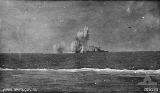
The Battle of the Java Sea was a decisive naval battle
of the Pacific campaign
of World War II, that sealed the fate of the Netherlands East Indies.
Allied
navies suffered a disastrous defeat at the hand of the Imperial Japanese Navy
, on 27 February 1942, and in secondary actions over successive days. The American-British-Dutch-Australian Command
(ABDA) Strike Force commander—Admiral Karel Doorman
—was killed. The aftermath of the battle included several smaller actions around Java, including the smaller but also significant Battle of Sunda Strait
.
progressed at a rapid pace as they advanced from their Palau Islands colony and captured bases in Sarawak
and the southern Philippines. They seized bases in eastern Borneo
and in northern Celebes
while troop convoys, screened by destroyer
s and cruiser
s with air support provided by swarms of fighters operating from captured bases, steamed southward through the Makassar Strait
and into the Molucca Sea
. To oppose these invading forces was a small force, consisting of Dutch, American, British & Australian warships—many of them of World War I vintage—initially under the command of Admiral Thomas C. Hart
.
On 23 January 1942, a force of four American destroyers attacked a Japanese invasion convoy in Makassar Strait as it approached Balikpapan
in Borneo. On 13 February, the Allies fought unsuccessfully—in the Battle of Palembang—to prevent the Japanese from capturing the major oil port in eastern Sumatra
. On the night of 19/20 February, an Allied force attacked the Eastern Invasion Force off Bali
in the Battle of Badung Strait
. Also on the 19th, the Japanese made two air raids on Darwin, one from carrier based planes and the other by land based planes. They attacked and wrecked the port at Darwin in northern Australia which rendered it useless as a supply and naval base to support operations in the East Indies.
Shortly before the battle commenced, the odds were not good for the Allied forces. They were disunited (ships came from four separate navies) and demoralized by constant air attacks, and a general sentiment that the Japanese were unbeatable. In addition, the coordination between Allied navies and air forces was poor.

 The Japanese amphibious forces gathered to strike at Java, and on 27 February 1942, the main American-British-Dutch-Australian Command
(ABDACOM) naval force, under Doorman, sailed northeast from Surabaya
to intercept a convoy of the Eastern Invasion Force approaching from the Makassar Strait. The ABDA
force consisted of two heavy cruiser
s ( and ), three light cruiser
s (HNLMS De Ruyter
(Doorman's flagship), HNLMS Java), and nine destroyers .
The Japanese task force protecting the convoy, commanded by Rear-Admiral Takeo Takagi
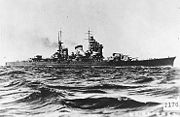
, consisted of two heavy ( and ) and two light cruisers ( and ) and 14 destroyers including the 4th Destroyer Squadron under the command of Rear Admiral Shoji Nishimura. The Japanese heavy cruisers were much more powerful, armed with ten 8 in (203.2 mm) guns each and superb torpedo
es. By comparison, Exeter was armed only with six 8 in (203.2 mm) guns. While Houston carried nine 8 in (203.2 mm) guns, only six remained operable after her aft turret had been knocked out in an earlier air attack.
The ABDA force engaged the Japanese in the Java Sea, and the battle raged intermittently from mid-afternoon to midnight as the Allies tried to reach and attack the troop transports of the Java invasion fleet, but they were repulsed by superior firepower. The Allies had local air superiority during the daylight hours, because Japanese air power could not reach the fleet in the bad weather. The weather also hindered communications, making cooperation between the many Allied parties involved—in reconnaissance, air cover and fleet headquarters—even worse than it already was. The Japanese also jammed the radio frequencies. Exeter was the only ship in the battle equipped with radar
, an emerging technology at the time.
The battle consisted of a series of attempts over a seven-hour period by Doorman's Combined Striking Force to reach and attack the invasion convoy; each was rebuffed by the escort force with heavy losses being inflicted on the Allies.
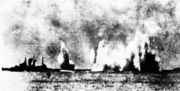 The fleets sighted each other at about 16:00 on 27 February and closed to firing range, opening fire at 16:16. Both sides exhibited poor gunnery and torpedo skills during this phase of the battle. The only notable example of gunnery was Exeter being critically damaged by a hit in the boiler room from an 8 in (203.2 mm) shell. The ship then limped away to Surabaya, escorted by Witte de With. The Japanese launched two huge torpedo salvoes, 92 in all, but scored only one hit, on Kortenaer. She was struck by a Long Lance, broke in two and sank rapidly after the hit. Electra—covering Exeter—engaged in a duel with Jintsu and Asagumo, scoring several hits but suffering severe damage to her superstructure. After a serious fire started on Electra and her remaining turret ran out of ammunition, abandon ship was ordered. On the Japanese side, only Asagumo was forced to retire because of damage.
The Allied fleet broke off and turned away around 18:00, covered by a smoke screen laid by the four destroyers of U.S Destroyer Division 58 (DesDiv 58). They also launched a torpedo attack but at too long a range to be effective. Doorman's force turned south toward the Java coast, then west and north as night fell in an attempt to evade the Japanese escort group and fall on the convoy. It was at this point the ships of DesDiv 58—their torpedoes expended—left on their own initiative to return to Surabaya.
Shortly after, at 21:25, Jupiter ran onto a mine and was sunk, while about 20 minutes later, the fleet passed where Kortenaer had sunk earlier, and Encounter was detached to pick up survivors. Doorman's command, now reduced to four cruisers, again encountered the Japanese escort group at 23:00; both columns exchanged fire in the darkness at long range, until De Ruyter and Java were sunk, by one devastating torpedo salvo. Doorman and most of his crew went down with De Ruyter; only 111 were saved from both ships. Only the cruisers Perth and Houston remained; low on fuel and ammunition, and following Doorman's last instructions, the two ships retired, arriving at Tanjung Priok
on 28 February.
Although the Allied fleet did not reach the invasion fleet, the battle did give the defenders of Java a one-day respite.
to Tjilatjap. Materiel was running short in Java, and neither was able to rearm or fully refuel. Departing at 21:00 on 28 February for the Sunda Strait, by chance they encountered the main Japanese invasion fleet for West Java in Bantam Bay. The Allied ships were engaged by at least three cruisers and several destroyers. In a ferocious night action that ended after midnight on 1 March, Perth and Houston were sunk. A Japanese minesweeper and a troop transport were sunk by friendly fire, while three other transports were damaged and had to be beached.
; she departed Surabaya at dusk on 28 February and limped toward Sunda Strait, escorted by Encounter and Pope. However, all three ships were intercepted and sunk by the Japanese heavy cruisers Nachi and Haguro on the morning of 1 March.
, which they were able to evade, they reached Fremantle
safely on 4 March.
on 28 February. The U.S. and Royal Air Force
then started to retreat to Australia. Dutch troops aided by British remnants fought fiercely for a week. In the campaign the Japanese executed many allied POWs and sympathizing Indonesians. Despite their logistical problems, the decisive factor in Japan's favor seems to have been air power. Eventually, the Japanese won this battle of attrition and ABDA forces surrendered on 9 March.
Naval battle
A naval battle is a battle fought using boats, ships or other waterborne vessels. Most naval battles have occurred at sea, but a few have taken place on lakes or rivers. The earliest recorded naval battle took place in 1210 BC near Cyprus...
of the Pacific campaign
Pacific War
The Pacific War, also sometimes called the Asia-Pacific War refers broadly to the parts of World War II that took place in the Pacific Ocean, its islands, and in East Asia, then called the Far East...
of World War II, that sealed the fate of the Netherlands East Indies.
Allied
Allies of World War II
The Allies of World War II were the countries that opposed the Axis powers during the Second World War . Former Axis states contributing to the Allied victory are not considered Allied states...
navies suffered a disastrous defeat at the hand of the Imperial Japanese Navy
Imperial Japanese Navy
The Imperial Japanese Navy was the navy of the Empire of Japan from 1869 until 1947, when it was dissolved following Japan's constitutional renunciation of the use of force as a means of settling international disputes...
, on 27 February 1942, and in secondary actions over successive days. The American-British-Dutch-Australian Command
American-British-Dutch-Australian Command
The American-British-Dutch-Australian Command, or ABDACOM, was a short-lived, supreme command for all Allied forces in South East Asia, in early 1942, during the Pacific War in World War II...
(ABDA) Strike Force commander—Admiral Karel Doorman
Karel Doorman
Karel Willem Frederik Marie Doorman was a Dutch Rear Admiral who commanded ABDACOM Naval forces, a hastily-organized multinational naval force formed to defend the East Indies against an overwhelming Imperial Japanese attack. Doorman was killed and the main body of ABDACOM Naval forces destroyed...
—was killed. The aftermath of the battle included several smaller actions around Java, including the smaller but also significant Battle of Sunda Strait
Battle of Sunda Strait
The Battle of Sunda Strait was a naval battle which occurred during World War II. On the night of 28 February – 1 March 1942, the Australian light cruiser and the American heavy cruiser faced a major Imperial Japanese Navy task force. After a fierce battle of several hours duration, both Allied...
.
Background
The Japanese invasion of the Dutch East IndiesDutch East Indies
The Dutch East Indies was a Dutch colony that became modern Indonesia following World War II. It was formed from the nationalised colonies of the Dutch East India Company, which came under the administration of the Netherlands government in 1800....
progressed at a rapid pace as they advanced from their Palau Islands colony and captured bases in Sarawak
Sarawak
Sarawak is one of two Malaysian states on the island of Borneo. Known as Bumi Kenyalang , Sarawak is situated on the north-west of the island. It is the largest state in Malaysia followed by Sabah, the second largest state located to the North- East.The administrative capital is Kuching, which...
and the southern Philippines. They seized bases in eastern Borneo
Borneo
Borneo is the third largest island in the world and is located north of Java Island, Indonesia, at the geographic centre of Maritime Southeast Asia....
and in northern Celebes
Sulawesi
Sulawesi is one of the four larger Sunda Islands of Indonesia and is situated between Borneo and the Maluku Islands. In Indonesia, only Sumatra, Borneo, and Papua are larger in territory, and only Java and Sumatra have larger Indonesian populations.- Etymology :The Portuguese were the first to...
while troop convoys, screened by destroyer
Destroyer
In naval terminology, a destroyer is a fast and maneuverable yet long-endurance warship intended to escort larger vessels in a fleet, convoy or battle group and defend them against smaller, powerful, short-range attackers. Destroyers, originally called torpedo-boat destroyers in 1892, evolved from...
s and cruiser
Cruiser
A cruiser is a type of warship. The term has been in use for several hundreds of years, and has had different meanings throughout this period...
s with air support provided by swarms of fighters operating from captured bases, steamed southward through the Makassar Strait
Makassar Strait
Makassar Strait is a strait between the islands of Borneo and Sulawesi in Indonesia. To the north it joins the Celebes Sea, while to the south it meets the Java Sea.The Mahakam River of Borneo empties into the strait....
and into the Molucca Sea
Molucca Sea
The Molucca Sea is located in the western Pacific Ocean, within the country of Indonesia. The region is rich in coral and has many diving sites.-Location:...
. To oppose these invading forces was a small force, consisting of Dutch, American, British & Australian warships—many of them of World War I vintage—initially under the command of Admiral Thomas C. Hart
Thomas C. Hart
Thomas Charles Hart was an admiral of the United States Navy, whose service extended from the Spanish-American War through World War II. Following his retirement from the Navy, he served briefly as a United States Senator from Connecticut.-Life and career:Hart was born in Genesee County, Michigan...
.
On 23 January 1942, a force of four American destroyers attacked a Japanese invasion convoy in Makassar Strait as it approached Balikpapan
Balikpapan
Balikpapan is a seaport city on the eastern coast of the island of Borneo, Indonesia, in the East Kalimantan province, a resource-rich region well known for its timber, mining, and petroleum export products. Two harbors, Semayang and Kariangau , and the Sepinggan International Airport are the main...
in Borneo. On 13 February, the Allies fought unsuccessfully—in the Battle of Palembang—to prevent the Japanese from capturing the major oil port in eastern Sumatra
Sumatra
Sumatra is an island in western Indonesia, westernmost of the Sunda Islands. It is the largest island entirely in Indonesia , and the sixth largest island in the world at 473,481 km2 with a population of 50,365,538...
. On the night of 19/20 February, an Allied force attacked the Eastern Invasion Force off Bali
Bali
Bali is an Indonesian island located in the westernmost end of the Lesser Sunda Islands, lying between Java to the west and Lombok to the east...
in the Battle of Badung Strait
Battle of Badung Strait
The Battle of Badung Strait was a naval battle of the Pacific campaign of World War II, fought on the night of 19/20 February 1942 in Badung Strait between the American-British-Dutch-Australian Command and the Imperial Japanese Navy...
. Also on the 19th, the Japanese made two air raids on Darwin, one from carrier based planes and the other by land based planes. They attacked and wrecked the port at Darwin in northern Australia which rendered it useless as a supply and naval base to support operations in the East Indies.
Shortly before the battle commenced, the odds were not good for the Allied forces. They were disunited (ships came from four separate navies) and demoralized by constant air attacks, and a general sentiment that the Japanese were unbeatable. In addition, the coordination between Allied navies and air forces was poor.
Battle
American-British-Dutch-Australian Command
The American-British-Dutch-Australian Command, or ABDACOM, was a short-lived, supreme command for all Allied forces in South East Asia, in early 1942, during the Pacific War in World War II...
(ABDACOM) naval force, under Doorman, sailed northeast from Surabaya
Surabaya
Surabaya is Indonesia's second-largest city with a population of over 2.7 million , and the capital of the province of East Java...
to intercept a convoy of the Eastern Invasion Force approaching from the Makassar Strait. The ABDA
American-British-Dutch-Australian Command
The American-British-Dutch-Australian Command, or ABDACOM, was a short-lived, supreme command for all Allied forces in South East Asia, in early 1942, during the Pacific War in World War II...
force consisted of two heavy cruiser
Heavy cruiser
The heavy cruiser was a type of cruiser, a naval warship designed for long range, high speed and an armament of naval guns roughly 203mm calibre . The heavy cruiser can be seen as a lineage of ship design from 1915 until 1945, although the term 'heavy cruiser' only came into formal use in 1930...
s ( and ), three light cruiser
Light cruiser
A light cruiser is a type of small- or medium-sized warship. The term is a shortening of the phrase "light armored cruiser", describing a small ship that carried armor in the same way as an armored cruiser: a protective belt and deck...
s (HNLMS De Ruyter
HNLMS De Ruyter (1935)
HNLMS De Ruyter was a light cruiser of the Royal Netherlands Navy, the lead ship of her class. She was originally designed as a ship with a lighter armament due to financial problems and the pacifist movement. Later in the design stage, an extra gun turret was added and the armor was improved...
(Doorman's flagship), HNLMS Java), and nine destroyers .
The Japanese task force protecting the convoy, commanded by Rear-Admiral Takeo Takagi
Takeo Takagi
was an admiral in the Imperial Japanese Navy during World War II.-Biography:Takagi was a native of Iwaki city, Fukushima prefecture. He was a graduate of the 39th class of the Imperial Japanese Naval Academy, ranking 17th of 148 cadets in 1911...
, consisted of two heavy ( and ) and two light cruisers ( and ) and 14 destroyers including the 4th Destroyer Squadron under the command of Rear Admiral Shoji Nishimura. The Japanese heavy cruisers were much more powerful, armed with ten 8 in (203.2 mm) guns each and superb torpedo
Torpedo
The modern torpedo is a self-propelled missile weapon with an explosive warhead, launched above or below the water surface, propelled underwater towards a target, and designed to detonate either on contact with it or in proximity to it.The term torpedo was originally employed for...
es. By comparison, Exeter was armed only with six 8 in (203.2 mm) guns. While Houston carried nine 8 in (203.2 mm) guns, only six remained operable after her aft turret had been knocked out in an earlier air attack.
The ABDA force engaged the Japanese in the Java Sea, and the battle raged intermittently from mid-afternoon to midnight as the Allies tried to reach and attack the troop transports of the Java invasion fleet, but they were repulsed by superior firepower. The Allies had local air superiority during the daylight hours, because Japanese air power could not reach the fleet in the bad weather. The weather also hindered communications, making cooperation between the many Allied parties involved—in reconnaissance, air cover and fleet headquarters—even worse than it already was. The Japanese also jammed the radio frequencies. Exeter was the only ship in the battle equipped with radar
Radar
Radar is an object-detection system which uses radio waves to determine the range, altitude, direction, or speed of objects. It can be used to detect aircraft, ships, spacecraft, guided missiles, motor vehicles, weather formations, and terrain. The radar dish or antenna transmits pulses of radio...
, an emerging technology at the time.
The battle consisted of a series of attempts over a seven-hour period by Doorman's Combined Striking Force to reach and attack the invasion convoy; each was rebuffed by the escort force with heavy losses being inflicted on the Allies.
The Allied fleet broke off and turned away around 18:00, covered by a smoke screen laid by the four destroyers of U.S Destroyer Division 58 (DesDiv 58). They also launched a torpedo attack but at too long a range to be effective. Doorman's force turned south toward the Java coast, then west and north as night fell in an attempt to evade the Japanese escort group and fall on the convoy. It was at this point the ships of DesDiv 58—their torpedoes expended—left on their own initiative to return to Surabaya.
Shortly after, at 21:25, Jupiter ran onto a mine and was sunk, while about 20 minutes later, the fleet passed where Kortenaer had sunk earlier, and Encounter was detached to pick up survivors. Doorman's command, now reduced to four cruisers, again encountered the Japanese escort group at 23:00; both columns exchanged fire in the darkness at long range, until De Ruyter and Java were sunk, by one devastating torpedo salvo. Doorman and most of his crew went down with De Ruyter; only 111 were saved from both ships. Only the cruisers Perth and Houston remained; low on fuel and ammunition, and following Doorman's last instructions, the two ships retired, arriving at Tanjung Priok
Tanjung Priok
Tanjung Priok is a subdistrict of North Jakarta, Jakarta, Indonesia. It hosts the western part of the city's main harbour, the Port of Tanjung Priok...
on 28 February.
Although the Allied fleet did not reach the invasion fleet, the battle did give the defenders of Java a one-day respite.
Battle of Sunda Strait
Perth and Houston were at Tanjung Priok on 28 February when they received orders to sail through Sunda StraitSunda Strait
The Sunda Strait is the strait between the Indonesian islands of Java and Sumatra. It connects the Java Sea to the Indian Ocean...
to Tjilatjap. Materiel was running short in Java, and neither was able to rearm or fully refuel. Departing at 21:00 on 28 February for the Sunda Strait, by chance they encountered the main Japanese invasion fleet for West Java in Bantam Bay. The Allied ships were engaged by at least three cruisers and several destroyers. In a ferocious night action that ended after midnight on 1 March, Perth and Houston were sunk. A Japanese minesweeper and a troop transport were sunk by friendly fire, while three other transports were damaged and had to be beached.
Second Java Sea
After emergency repairs, the badly-damaged Exeter left for CeylonSri Lanka
Sri Lanka, officially the Democratic Socialist Republic of Sri Lanka is a country off the southern coast of the Indian subcontinent. Known until 1972 as Ceylon , Sri Lanka is an island surrounded by the Indian Ocean, the Gulf of Mannar and the Palk Strait, and lies in the vicinity of India and the...
; she departed Surabaya at dusk on 28 February and limped toward Sunda Strait, escorted by Encounter and Pope. However, all three ships were intercepted and sunk by the Japanese heavy cruisers Nachi and Haguro on the morning of 1 March.
Bali Strait
The four U.S destroyers of DesRon 58—John D. Edwards, John D. Ford, Alden and Paul Jones—were also at Surabaya; they left for Australia at nightfall on 28 February. After a brief encounter with a Japanese destroyer in the Bali StraitBali Strait
Bali Strait is a 2.4 kilometer strait between the Indonesian islands of Bali and Java....
, which they were able to evade, they reached Fremantle
Fremantle, Western Australia
Fremantle is a city in Western Australia, located at the mouth of the Swan River. Fremantle Harbour serves as the port of Perth, the state capital. Fremantle was the first area settled by the Swan River colonists in 1829...
safely on 4 March.
Consequences
A further two American, and one Dutch destroyer were sunk as they attempted to escape to Australia. The main ABDA naval force had been almost totally destroyed: 10 ships and approximately 2,173 sailors had been lost. The Battle of the Java Sea ended significant Allied naval operations in South-East Asia in 1942, and Japanese land forces invaded JavaBattle of Java (1942)
The Battle of Java was a battle of the Pacific theatre of World War II. It occurred on the island of Java from 28 February-12 March 1942. It involved forces from the Empire of Japan, which invaded on 28 February 1942, and Allied personnel...
on 28 February. The U.S. and Royal Air Force
Royal Air Force
The Royal Air Force is the aerial warfare service branch of the British Armed Forces. Formed on 1 April 1918, it is the oldest independent air force in the world...
then started to retreat to Australia. Dutch troops aided by British remnants fought fiercely for a week. In the campaign the Japanese executed many allied POWs and sympathizing Indonesians. Despite their logistical problems, the decisive factor in Japan's favor seems to have been air power. Eventually, the Japanese won this battle of attrition and ABDA forces surrendered on 9 March.