

De Stijl

Encyclopedia
Dutch language
Dutch is a West Germanic language and the native language of the majority of the population of the Netherlands, Belgium, and Suriname, the three member states of the Dutch Language Union. Most speakers live in the European Union, where it is a first language for about 23 million and a second...
for "The Style", also known as neoplasticism, was a Dutch art
Art
Art is the product or process of deliberately arranging items in a way that influences and affects one or more of the senses, emotions, and intellect....
istic movement founded in 1917. In a narrower sense, the term De Stijl is used to refer to a body of work from 1917 to 1931 founded in the Netherlands.
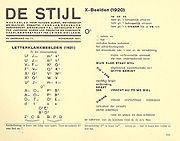
De Stijl is also the name of a journal that was published by the Dutch painter, designer, writer, and critic Theo van Doesburg
Theo van Doesburg
Theo van Doesburg was a Dutch artist, practicing in painting, writing, poetry and architecture. He is best known as the founder and leader of De Stijl.-Biography:-Early life:...
(1883–1931), propagating the group's theories. Next to van Doesburg, the group's principal members were the painters Piet Mondrian
Piet Mondrian
Pieter Cornelis "Piet" Mondriaan, after 1906 Mondrian , was a Dutch painter.He was an important contributor to the De Stijl art movement and group, which was founded by Theo van Doesburg. He evolved a non-representational form which he termed Neo-Plasticism...
(1872–1944), Vilmos Huszár
Vilmos Huszàr
Vilmos Huszár was a Hungarian painter and designer. He lived in The Netherlands, where he was one of the founder members of the art movement De Stijl....
(1884–1960), and Bart van der Leck
Bart van der Leck
Bart van der Leck was a Dutch painter, designer, and ceramacist. With Theo van Doesburg and Piet Mondrian he founded the De Stijl art movement....
(1876–1958), and the architects Gerrit Rietveld
Gerrit Rietveld
Gerrit Thomas Rietveld was a Dutch furniture designer and architect. One of the principal members of the Dutch artistic movement called De Stijl, Rietveld is famous for his Red and Blue Chair and for the Rietveld Schröder House, which is a UNESCO World Heritage Site.-Biography:Rietveld was born in...
(1888–1964), Robert van 't Hoff
Robert van 't Hoff
Robert van 't Hoff , born Robbert van 't Hoff, was a Dutch architect and furniture designer. His Villa Henny, designed in 1914, was one of the earliest modernist houses and one of the first to be built out of reinforced concrete...
(1887–1979), and J.J.P. Oud (1890–1963). The artistic philosophy
Philosophy
Philosophy is the study of general and fundamental problems, such as those connected with existence, knowledge, values, reason, mind, and language. Philosophy is distinguished from other ways of addressing such problems by its critical, generally systematic approach and its reliance on rational...
that formed a basis for the group's work is known as neoplasticism — the new plastic art (or Nieuwe Beelding in Dutch).
Proponents of De Stijl sought to express a new utopia
Utopia
Utopia is an ideal community or society possessing a perfect socio-politico-legal system. The word was imported from Greek by Sir Thomas More for his 1516 book Utopia, describing a fictional island in the Atlantic Ocean. The term has been used to describe both intentional communities that attempt...
n ideal of spiritual harmony and order. They advocated pure abstraction
Abstract art
Abstract art uses a visual language of form, color and line to create a composition which may exist with a degree of independence from visual references in the world. Western art had been, from the Renaissance up to the middle of the 19th century, underpinned by the logic of perspective and an...
and universality by a reduction to the essentials of form and colour; they simplified visual compositions to the vertical and horizontal directions, and used only primary colors
Primary Colors
Primary Colors: A Novel of Politics is a roman à clef, a work of fiction that purports to describe real life characters and events — namely, Bill Clinton's first presidential campaign in 1992...
along with black
Black
Black is the color of objects that do not emit or reflect light in any part of the visible spectrum; they absorb all such frequencies of light...
and white
White
White is a color, the perception of which is evoked by light that stimulates all three types of color sensitive cone cells in the human eye in nearly equal amounts and with high brightness compared to the surroundings. A white visual stimulation will be void of hue and grayness.White light can be...
. Indeed, according to the Tate Gallery
Tate Gallery
The Tate is an institution that houses the United Kingdom's national collection of British Art, and International Modern and Contemporary Art...
's online article on neoplasticism, Mondrian himself sets forth these delimitations in his essay 'Neo-Plasticism in Pictorial Art'. He writes, "... this new plastic idea will ignore the particulars of appearance, that is to say, natural form and colour. On the contrary, it should find its expression in the abstraction of form and colour, that is to say, in the straight line and the clearly defined primary colour." The Tate article further summarizes that this art allows "only primary colours and non-colours, only squares and rectangles, only straight and horizontal or vertical line." The Guggenheim Museum
Solomon R. Guggenheim Museum
The Solomon R. Guggenheim Museum is a well-known museum located on the Upper East Side of Manhattan in New York City, United States. It is the permanent home to a renowned collection of Impressionist, Post-Impressionist, early Modern, and contemporary art and also features special exhibitions...
's online article on De Stijl summarizes these traits in similar terms: "It [De Stijl] was posited on the fundamental principle of the geometry of the straight line, the square, and the rectangle, combined with a strong asymmetricality; the predominant use of pure primary colors with black and white; and the relationship between positive and negative elements in an arrangement of non-objective forms and lines."
Principles and influences
The name De Stijl is supposedly derived from Gottfried SemperGottfried Semper
Gottfried Semper was a German architect, art critic, and professor of architecture, who designed and built the Semper Opera House in Dresden between 1838 and 1841. In 1849 he took part in the May Uprising in Dresden and was put on the government's wanted list. Semper fled first to Zürich and later...
's Der Stil in den technischen und tektonischen Künsten oder Praktische Ästhetik (1861–3), which Curl suggests was mistakenly believed to advocate materialism
Materialism
In philosophy, the theory of materialism holds that the only thing that exists is matter; that all things are composed of material and all phenomena are the result of material interactions. In other words, matter is the only substance...
and functionalism
Functionalism (architecture)
Functionalism, in architecture, is the principle that architects should design a building based on the purpose of that building. This statement is less self-evident than it first appears, and is a matter of confusion and controversy within the profession, particularly in regard to modern...
. In general, De Stijl proposed ultimate simplicity and abstraction, both in architecture and painting, by using only straight horizontal and vertical lines and rectangular forms. Furthermore, their formal vocabulary was limited to the primary colours, red
Red
Red is any of a number of similar colors evoked by light consisting predominantly of the longest wavelengths of light discernible by the human eye, in the wavelength range of roughly 630–740 nm. Longer wavelengths than this are called infrared , and cannot be seen by the naked eye...
, yellow
Yellow
Yellow is the color evoked by light that stimulates both the L and M cone cells of the retina about equally, with no significant stimulation of the S cone cells. Light with a wavelength of 570–590 nm is yellow, as is light with a suitable mixture of red and green...
, and blue
Blue
Blue is a colour, the perception of which is evoked by light having a spectrum dominated by energy with a wavelength of roughly 440–490 nm. It is considered one of the additive primary colours. On the HSV Colour Wheel, the complement of blue is yellow; that is, a colour corresponding to an equal...
, and the three primary values, black
Black
Black is the color of objects that do not emit or reflect light in any part of the visible spectrum; they absorb all such frequencies of light...
, white
White
White is a color, the perception of which is evoked by light that stimulates all three types of color sensitive cone cells in the human eye in nearly equal amounts and with high brightness compared to the surroundings. A white visual stimulation will be void of hue and grayness.White light can be...
, and grey
Grey
Grey or gray is an achromatic or neutral color.Complementary colors are defined to mix to grey, either additively or subtractively, and many color models place complements opposite each other in a color wheel. To produce grey in RGB displays, the R, G, and B primary light sources are combined in...
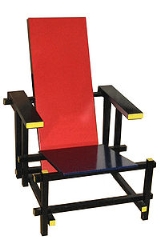
. The works avoided symmetry and attained aesthetic balance by the use of opposition. This element of the movement embodies the second meaning of stijl: “a post, jamb or support”; this is best exemplified by the construction of crossing joints, most commonly seen in carpentry.
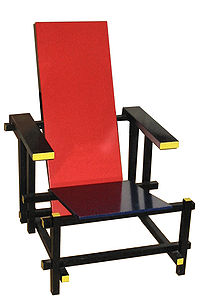
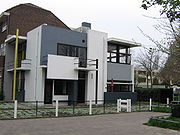
In many of the group's three-dimensional works, vertical and horizontal lines are positioned in layers or planes that do not intersect, thereby allowing each element to exist independently and unobstructed by other elements. This feature can be found in the Rietveld Schröder House
Rietveld Schröder House
The Rietveld Schröder House in Utrecht was built in 1924 by Dutch architect Gerrit Rietveld for Mrs. Truus Schröder-Schräder and her three children. She commissioned the house to be designed preferably without walls. Rietveld worked side by side with Schröder-Schräder to create the house...
and the Red and Blue Chair
Red and Blue Chair
The Red Blue Chair is a chair designed in 1917 by Gerrit Rietveld. It represents one of the first explorations by the De Stijl art movement in three dimensions. The original chair was constructed of unstained beech wood and was not painted until the early 1920's...
.
De Stijl was influenced by Cubist painting as well as by the mysticism and the ideas about "ideal" geometric forms (such as the "perfect straight line") in the neoplatonic philosophy of mathematician
Mathematician
A mathematician is a person whose primary area of study is the field of mathematics. Mathematicians are concerned with quantity, structure, space, and change....
M.H.J. Schoenmaekers. The works of De Stijl would influence the Bauhaus
Bauhaus
', commonly known simply as Bauhaus, was a school in Germany that combined crafts and the fine arts, and was famous for the approach to design that it publicized and taught. It operated from 1919 to 1933. At that time the German term stood for "School of Building".The Bauhaus school was founded by...
style and the international style
International style (architecture)
The International style is a major architectural style that emerged in the 1920s and 1930s, the formative decades of Modern architecture. The term originated from the name of a book by Henry-Russell Hitchcock and Philip Johnson, The International Style...
of architecture as well as clothing and interior design
Design
Design as a noun informally refers to a plan or convention for the construction of an object or a system while “to design” refers to making this plan...
. However, it did not follow the general guidelines of an “ism” (Cubism, Futurism, Surrealism), nor did it adhere to the principles of art schools like the Bauhaus; it was a collective project, a joint enterprise.
In music
Music
Music is an art form whose medium is sound and silence. Its common elements are pitch , rhythm , dynamics, and the sonic qualities of timbre and texture...
, De Stijl was an influence only on the work of composer Jakob van Domselaer
Jakob van Domselaer
Jakob van Domselaer was a Dutch composer.Domselaer was born at Nijkerk, Netherlands...
, a close friend of Mondrian. Between 1913 and 1916, he composed his Proeven van Stijlkunst (Experiments in Artistic Style), inspired mainly by Mondrian's paintings. This minimalistic—and, at the time, revolutionary—music defined "horizontal" and "vertical" musical elements and aimed at balancing those two principles. Van Domselaer was relatively unknown in his lifetime, and did not play a significant role within the De Stijl group.
Early history
Cubism
Cubism was a 20th century avant-garde art movement, pioneered by Pablo Picasso and Georges Braque, that revolutionized European painting and sculpture, and inspired related movements in music, literature and architecture...
arose in the early twentieth century as an important and influential new direction. In the Netherlands
Netherlands
The Netherlands is a constituent country of the Kingdom of the Netherlands, located mainly in North-West Europe and with several islands in the Caribbean. Mainland Netherlands borders the North Sea to the north and west, Belgium to the south, and Germany to the east, and shares maritime borders...
, too, there was interest in this "new art."
However, because the Netherlands remained neutral in World War I
World War I
World War I , which was predominantly called the World War or the Great War from its occurrence until 1939, and the First World War or World War I thereafter, was a major war centred in Europe that began on 28 July 1914 and lasted until 11 November 1918...
, Dutch artists were not able to leave the country after 1914 and were thus effectively isolated from the international art world—and in particular, from Paris, which was its centre at that time.
During that period, painter Theo van Doesburg
Theo van Doesburg
Theo van Doesburg was a Dutch artist, practicing in painting, writing, poetry and architecture. He is best known as the founder and leader of De Stijl.-Biography:-Early life:...
started looking for other artists to set up a journal
Literary magazine
A literary magazine is a periodical devoted to literature in a broad sense. Literary magazines usually publish short stories, poetry and essays along with literary criticism, book reviews, biographical profiles of authors, interviews and letters...
and start an art movement. Van Doesburg was also a writer, poet, and critic, who had been more successful writing about art than working as an independent artist. Quite adept at making new contacts due to his flamboyant personality and outgoing nature, he had many useful connections in the art world.
Founding of De Stijl

Piet Mondrian
Pieter Cornelis "Piet" Mondriaan, after 1906 Mondrian , was a Dutch painter.He was an important contributor to the De Stijl art movement and group, which was founded by Theo van Doesburg. He evolved a non-representational form which he termed Neo-Plasticism...
at an exhibition in the Amsterdam
Amsterdam
Amsterdam is the largest city and the capital of the Netherlands. The current position of Amsterdam as capital city of the Kingdom of the Netherlands is governed by the constitution of August 24, 1815 and its successors. Amsterdam has a population of 783,364 within city limits, an urban population...
Stedelijk Museum
Stedelijk Museum
Founded in 1874, the Stedelijk Museum Amsterdam is a museum for classic modern and contemporary art in Amsterdam in the Netherlands. It has been housed on the Paulus Potterstraat, next to Museum Square Museumplein and to the Rijksmuseum, Van Gogh Museum and the Concertgebouw, in Amsterdam Zuid...
. Mondrian, who had moved to Paris in 1912 (and there, changed his name from "Mondriaan"), had been visiting the Netherlands when war broke out. He could not return to Paris, and was staying in the artists' community of Laren
Laren
is a municipality and a town in the Netherlands, in the province of North Holland. Located in the region called 't Gooi, it is the oldest town in that area. It is one of the richest towns in the Netherlands, along with its neighbour Blaricum...
, where he met Bart van der Leck
Bart van der Leck
Bart van der Leck was a Dutch painter, designer, and ceramacist. With Theo van Doesburg and Piet Mondrian he founded the De Stijl art movement....
and regularly saw M.H.J. Schoenmaekers. In 1915, Schoenmaekers published Het nieuwe wereldbeeld (The New Image of the World), followed in 1916 by Beginselen der beeldende wiskunde (Principles of Plastic Mathematics). These two publications would greatly influence Mondrian and other members of De Stijl.
Van Doesburg also knew J.J.P. Oud and the Hungarian artist Vilmos Huszàr
Vilmos Huszàr
Vilmos Huszár was a Hungarian painter and designer. He lived in The Netherlands, where he was one of the founder members of the art movement De Stijl....
. In 1917, the cooperation of these artists, together with the poet Anthony Kok, resulted in the founding of De Stijl. The young architect Gerrit Rietveld
Gerrit Rietveld
Gerrit Thomas Rietveld was a Dutch furniture designer and architect. One of the principal members of the Dutch artistic movement called De Stijl, Rietveld is famous for his Red and Blue Chair and for the Rietveld Schröder House, which is a UNESCO World Heritage Site.-Biography:Rietveld was born in...
joined the group in 1918.
During those first few years, the group was still relatively homogeneous, although Van der Leck left in 1918 due to artistic differences of opinion. Manifestos were being published, signed by all members. The social and economic circumstances of the time formed an important source of inspiration for their theories, and their ideas about architecture were heavily influenced by Berlage
Hendrik Petrus Berlage
thumb|120px|left|BerlageHendrik Petrus Berlage, Amsterdam, 21 February 1856 — The Hague 12 August 1934, was a prominent Dutch architect.-Overview:...
and Frank Lloyd Wright
Frank Lloyd Wright
Frank Lloyd Wright was an American architect, interior designer, writer and educator, who designed more than 1,000 structures and completed 500 works. Wright believed in designing structures which were in harmony with humanity and its environment, a philosophy he called organic architecture...
.
The name Nieuwe Beelding was a term first coined in 1917 by Mondrian, who wrote a series of twelve articles called De Nieuwe Beelding in de schilderkunst (Neo-Plasticism in Painting) that were published in the journal De Stijl. In 1920, he published a book titled Le Neo-Plasticisme.
After 1920
.jpg)
Bauhaus
', commonly known simply as Bauhaus, was a school in Germany that combined crafts and the fine arts, and was famous for the approach to design that it publicized and taught. It operated from 1919 to 1933. At that time the German term stood for "School of Building".The Bauhaus school was founded by...
, other influences started playing a role. These influences were mainly Malevich and Russian Constructivism
Constructivism (art)
Constructivism was an artistic and architectural philosophy that originated in Russia beginning in 1919, which was a rejection of the idea of autonomous art. The movement was in favour of art as a practice for social purposes. Constructivism had a great effect on modern art movements of the 20th...
, to which not all members agreed. In 1924, Mondrian broke with the group after van Doesburg proposed the theory of elementarism, proposing that the diagonal line was more vital than the horizontal and the vertical. In addition, the De Stijl group acquired many new "members." Dadaist influences, such as I.K. Bonset's poetry and Aldo Camini's "antiphilosophy," generated controversy as well. Only after van Doesburg's death was it revealed that Bonset and Camini were two of his pseudonyms.
After van Doesburg's death
Theo van Doesburg died in DavosDavos
Davos is a municipality in the district of Prättigau/Davos in the canton of Graubünden, Switzerland. It has a permanent population of 11,248 . Davos is located on the Landwasser River, in the Swiss Alps, between the Plessur and Albula Range...
in 1931. His wife, Nelly, administered his estate.
Because of van Doesburg's pivotal role within De Stijl, the group did not survive. Individual members remained in contact, but De Stijl could not exist without a strong central character. Thus, it may be wrong to think of De Stijl as a close-knit group of artists. The members knew each other, but most communication took place by letter. For example, Mondrian and Rietveld never met in person.
Many, though not all, artists did stay true to the movement's basic ideas, even after 1931. Rietveld, for instance, continued designing furniture according to De Stijl principles, while Mondrian continued working in the style he had initiated around 1920. Van der Leck, on the other hand, went back to figurative compositions after his departure from the group.
Influence on architecture
Gerrit Rietveld
Gerrit Thomas Rietveld was a Dutch furniture designer and architect. One of the principal members of the Dutch artistic movement called De Stijl, Rietveld is famous for his Red and Blue Chair and for the Rietveld Schröder House, which is a UNESCO World Heritage Site.-Biography:Rietveld was born in...
designed the Rietveld Schröder House
Rietveld Schröder House
The Rietveld Schröder House in Utrecht was built in 1924 by Dutch architect Gerrit Rietveld for Mrs. Truus Schröder-Schräder and her three children. She commissioned the house to be designed preferably without walls. Rietveld worked side by side with Schröder-Schräder to create the house...
, the only building to have been created completely according to De Stijl principles. Examples of Stijl-influenced works by J.J.P. Oud can be found in Rotterdam
Rotterdam
Rotterdam is the second-largest city in the Netherlands and one of the largest ports in the world. Starting as a dam on the Rotte river, Rotterdam has grown into a major international commercial centre...
(Café De Unie) and Hoek van Holland
Hoek van Holland
The Hook of Holland , also known in English as the Hook, is a town in South Holland in the Netherlands. It is situated on the North Sea coast, on the north bank of the Nieuwe Waterweg ship canal. The town is administered by the municipality of Rotterdam as a district of that city...
.
Present day
Works by De Stijl members are scattered all over the world, but De Stijl-themed exhibitions are organised regularly. Museums with large De Stijl collections include the Gemeentemuseum in The HagueThe Hague
The Hague is the capital city of the province of South Holland in the Netherlands. With a population of 500,000 inhabitants , it is the third largest city of the Netherlands, after Amsterdam and Rotterdam...
(which owns the world's most extensive, although not exclusively De Stijl-related, Mondrian collection) and the Amsterdam
Amsterdam
Amsterdam is the largest city and the capital of the Netherlands. The current position of Amsterdam as capital city of the Kingdom of the Netherlands is governed by the constitution of August 24, 1815 and its successors. Amsterdam has a population of 783,364 within city limits, an urban population...
Stedelijk Museum
Stedelijk Museum
Founded in 1874, the Stedelijk Museum Amsterdam is a museum for classic modern and contemporary art in Amsterdam in the Netherlands. It has been housed on the Paulus Potterstraat, next to Museum Square Museumplein and to the Rijksmuseum, Van Gogh Museum and the Concertgebouw, in Amsterdam Zuid...
, where many works by Rietveld and Van Doesburg are on display. The Centraal Museum
Centraal Museum
The Centraal Museum is a museum in Utrecht, The Netherlands. The museum was founded in 1838. Initially, the collection - exhibited on the top floor of the Utrecht townhall - was limited to art related to the city of Utrecht...
of Utrecht
Utrecht (city)
Utrecht city and municipality is the capital and most populous city of the Dutch province of Utrecht. It is located in the eastern corner of the Randstad conurbation, and is the fourth largest city of the Netherlands with a population of 312,634 on 1 Jan 2011.Utrecht's ancient city centre features...
has the largest Rietveld collection worldwide; it also owns the Rietveld Schröder House
Rietveld Schröder House
The Rietveld Schröder House in Utrecht was built in 1924 by Dutch architect Gerrit Rietveld for Mrs. Truus Schröder-Schräder and her three children. She commissioned the house to be designed preferably without walls. Rietveld worked side by side with Schröder-Schräder to create the house...
, Rietveld's adjacent "show house," and the Rietveld Schröder Archives.
List of neoplasticists
This list is not exhaustive. Because of the loose associations many artists had with De Stijl, it is difficult to get a complete overview of contributors.- Ilya BolotowskyIlya BolotowskyIlya Bolotowsky was a leading early 20th-century painter in abstract styles in New York City. His work, a search for philosophical order through visual expression, embraced cubism and geometric abstraction and was much influenced by Dutch painter Piet Mondrian.Born to Jewish parents in St...
(1907–1981), painter and sculptor. - Burgoyne DillerBurgoyne DillerBurgoyne A. Diller was an American abstract painter. Many of his best-known works are characterized by orthogonal geometric forms that reflect his strong interest in the De Stijl movement and the work of Piet Mondrian in particular...
(1906–1965), painter. - Theo van DoesburgTheo van DoesburgTheo van Doesburg was a Dutch artist, practicing in painting, writing, poetry and architecture. He is best known as the founder and leader of De Stijl.-Biography:-Early life:...
(1883–1931), painter, designer, and writer; published De Stijl, 1917–1931. - Cornelis van Eesteren (1897–1981), architect.
- Jean Gorin (1899–1981), painter.
- Robert van 't HoffRobert van 't HoffRobert van 't Hoff , born Robbert van 't Hoff, was a Dutch architect and furniture designer. His Villa Henny, designed in 1914, was one of the earliest modernist houses and one of the first to be built out of reinforced concrete...
(1887–1979), architect. - Vilmos HuszárVilmos HuszàrVilmos Huszár was a Hungarian painter and designer. He lived in The Netherlands, where he was one of the founder members of the art movement De Stijl....
(1884–1960), painter. - Anthony Kok (1882–1969), poet.
- Bart van der LeckBart van der LeckBart van der Leck was a Dutch painter, designer, and ceramacist. With Theo van Doesburg and Piet Mondrian he founded the De Stijl art movement....
(1876–1958), painter. - Piet MondrianPiet MondrianPieter Cornelis "Piet" Mondriaan, after 1906 Mondrian , was a Dutch painter.He was an important contributor to the De Stijl art movement and group, which was founded by Theo van Doesburg. He evolved a non-representational form which he termed Neo-Plasticism...
(1872–1944), painter. - Marlow MossMarlow MossMarjorie Jewel "Marlow" Moss was a British Constructivist artist who worked in painting and sculpture.-Life:Born in Kilburn, she was the daughter of Lionel Moss, a master hosier and clothier, and his wife Frannie Jacobs...
(1890–1958), painter and sculptor. - J.J.P. OudJacobus OudJacobus Johannes Pieter Oud, commonly called J. J. P. Oud was a Dutch architect. His fame began as a follower of the De Stijl movement....
(1890–1963), architect. - Gerrit RietveldGerrit RietveldGerrit Thomas Rietveld was a Dutch furniture designer and architect. One of the principal members of the Dutch artistic movement called De Stijl, Rietveld is famous for his Red and Blue Chair and for the Rietveld Schröder House, which is a UNESCO World Heritage Site.-Biography:Rietveld was born in...
(1888–1964), architect and designer. - Georges VantongerlooGeorges VantongerlooGeorges Vantongerloo was a Belgian abstract sculptor and painter and founding member of the De Stijl group.-Life:...
(1886–1965), sculptor. - Friedrich Vordemberge-GildewartFriedrich Vordemberge-GildewartFriedrich Vordemberge-Gildewart was a German Neo-plasticist painter...
, painter. - Jan WilsJan WilsJan Wils was a Dutch architect.He was born in Alkmaar and died in Voorburg.Wils was one of the founding members of the De Stijl movement, which also included artists as Piet Mondrian, Theo van Doesburg and Gerrit Rietveld.Among others, Wils designed the Olympic stadium for the 1928 Summer Olympics...
(1891–1972), architect.
External links
- De Stijl
- Jakob van DomselaerJakob van DomselaerJakob van Domselaer was a Dutch composer.Domselaer was born at Nijkerk, Netherlands...
's Proeven van Stijlkunst, rare recording. - Essay about Mondrian and mysticism Scans of the complete first volume of the journal.