

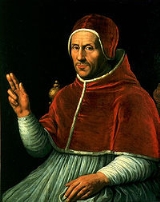
Pope Adrian VI

Encyclopedia
Pope Adrian VI born Adriaan Florenszoon Boeyens, served as Pope
from 9 January 1522 until his death some 18 months later. Born in the Low Countries
, he was the last non-Italian Pope until John Paul II, 455 years later, and is, together with Marcellus II
, one of only two modern popes to retain his baptismal name after election.
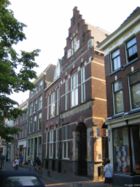 Adrian was born into modest circumstances in the city of Utrecht
, which was then the capital of the prince-bishopric of Utrecht, a part of the Burgundian Netherlands
in the Holy Roman Empire
. He was the son of Florens Boeyens van Utrecht, also born in Utrecht, and his wife Gertruid. He is the only Dutchman
to have ever become pope. He is often called a 'German pope', because prior to the 16th-century national identity in the Low Countries was fledgling and 'Dutch' and 'German' were not yet distinct concepts.
Adrian was probably born in a house on the corner of the Brandsteeg and Oude Gracht that was owned by his grandfather Boudewijn (Boeyen for short). His father, a carpenter and likely shipwright, died when Adrian was 10 years or younger. Adrian VI studied from a very young age under the Brethren of the Common Life
, either at Zwolle
or Deventer
and was also a student of the Latin school
(now Gymnasium Celeanum) in Zwolle
. In June 1476, he started his studies at the University of Leuven, where he pursued philosophy
, theology
and Canon Law
, due to a scholarship granted by Margaret of York
, Duchess of Burgundy, becoming a Doctor
of Theology in 1491, Dean
of St. Peter's and vice-chancellor
of the university. His lectures were published, as recreated from his students' notes; among those who attended was the young Erasmus.
In 1507 he was appointed tutor
to Emperor Maximilian I
's (1493–1519) seven year old grandson, Charles, who was later to become Emperor Charles V
(1519 – 56). In 1515 Adrian was sent to Spain
on a diplomatic errand, and after his arrival at the Imperial Court in Toledo
, Charles V secured his succession to the See
of Tortosa
, and on 14 November 1516 commissioned him Inquisitor
General of Aragon
. The following year, Pope Leo X
(1513–21) made Adrian a cardinal
, naming him Cardinal Priest of the Basilica
of Saints John and Paul.
During the minority of Charles V, Adrian was named to serve with Cardinal Francisco Jimenez de Cisneros as co-regent
of Spain. After the death of Jimenez, Adrian was appointed (14 March 1518) General of the Reunited Inquisition
s of Castile
and Aragon
, in which capacity he acted until his departure for Rome
. During this period, Charles V left for the Netherlands in 1520, making the future pope Regent of Spain, during which time he had to deal with the Revolt of the Comuneros.
Pope Leo X
, his cousin, Cardinal Giulio de' Medici
was the leading figure. With Spanish and French cardinals in a deadlock, the absent Adrian was proposed as a compromise and on 9 January 1522 he was elected by an almost unanimous vote. Charles V was delighted upon hearing that his tutor had been elected to the papacy but soon realised that Adrian VI was determined to reign impartially. Francis I of France
, who feared that Adrian would become a tool of the Emperor, and had uttered threats of a schism, later relented and sent an embassy to present his homage. Fears of a Spanish Avignon based on the strength of his relationship with the Emperor as his former tutor and regent proved baseless, and Adrian left for Italy at the earliest opportunity, making his solemn entry into Rome on 29 August. He was crowned in St. Peter's Basilica
on 31 August 1522, at the age of sixty-three and immediately entered upon the path of the reformer. The 1908 edition of the Catholic Encyclopedia characterised the task that faced him:
His plan was to attack notorious abuses one by one; however, in his attempt to improve the system of indulgences he was hampered by his cardinals. He found reduction of the number of matrimonial dispensations to be impossible, as the income had been farmed out for years in advance by Pope Leo X
.
Adrian, who had never before been to Rome, was so ignorant of affairs that he had written asking that some suitable lodgings be obtained for him in Rome whence he could discharge his duties as pope.
, blind to the beauty of classical antiquity. Musicians such as Carpentras
, the composer and singer from Avignon
who was master of the papal chapel under Leo X, left Rome due to Adrian VI's indifference to the arts. Thus musical standards at the Vatican
declined significantly during his tenure.
Adrian was not successful as a peacemaker among Christian prince
s, whom he hoped to unite in a war against the Turks. In August 1523 he was forced into an alliance with the Empire
, England
, and Venice
against France
; meanwhile, in 1522 the Sultan
Suleiman I (1520–66) had conquered Rhodes
.
In his reaction to the early stages of the Lutheran revolt, Adrian VI did not completely understand the gravity of the situation. At the Diet of Nuremberg
, which opened in December 1522, he was represented by Francesco Chiericati, whose private instructions contain the frank admission that the disorder of the Church was perhaps the fault of the Roman Curia
itself, and that it should be reformed. However, the former professor and Inquisitor General was strongly opposed to any change in doctrine (In Catholic doctrine, the Church's dogmata are infallible) and demanded that Luther
be punished for teaching heresy
.
The pope was mocked by the people of Rome on the Pasquino, and the Romans, who had never taken a liking to a man they saw as a "barbarian", rejoiced at his death, declaring that a statue ought to be erected to his doctor. The statement in one of his works that a pope may err, privately or in a minor decree, including matters of faith, attracted attention.
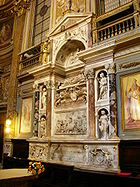 Adrian VI died in Rome
on 14 September 1523, after a somewhat brief tenure as pope. Most of his official papers were lost after his death. He published Quaestiones in quartum sententiarum praesertim circa sacramenta (Paris, 1512, 1516, 1518, 1537; Rome, 1522), and Quaestiones quodlibeticae XII. (1st ed., Leuven, 1515). He is buried in the Santa Maria dell'Anima
church in Rome.
's theatre play The Tragical History of Doctor Faustus (published 1604).
Italian writer Luigi Malerba
used the confusion among the leaders of the Catholic Church, which was created by Adrian's unexpected election, as a backdrop for his 1995 novel, Le maschere (The Masks), about the struggle between two Roman cardinals for a well-endowed church office.
Pope
The Pope is the Bishop of Rome, a position that makes him the leader of the worldwide Catholic Church . In the Catholic Church, the Pope is regarded as the successor of Saint Peter, the Apostle...
from 9 January 1522 until his death some 18 months later. Born in the Low Countries
Low Countries
The Low Countries are the historical lands around the low-lying delta of the Rhine, Scheldt, and Meuse rivers, including the modern countries of Belgium, the Netherlands, Luxembourg and parts of northern France and western Germany....
, he was the last non-Italian Pope until John Paul II, 455 years later, and is, together with Marcellus II
Pope Marcellus II
Pope Marcellus II , born Marcello Cervini degli Spannochi, was Pope from 9 April 1555 to 1 May 1555, succeeding Pope Julius III. Before his accession as Pope he had been Cardinal-Priest of Santa Croce in Gerusalemme. He is the most recent Pope to choose to retain his birth name as his regnal name...
, one of only two modern popes to retain his baptismal name after election.
Early life
Utrecht (city)
Utrecht city and municipality is the capital and most populous city of the Dutch province of Utrecht. It is located in the eastern corner of the Randstad conurbation, and is the fourth largest city of the Netherlands with a population of 312,634 on 1 Jan 2011.Utrecht's ancient city centre features...
, which was then the capital of the prince-bishopric of Utrecht, a part of the Burgundian Netherlands
Burgundian Netherlands
In the history of the Low Countries, the Burgundian Netherlands refers to a number of Imperial and French fiefs ruled in personal union by the House of Valois-Burgundy and their Habsburg heirs in the period from 1384 to 1482...
in the Holy Roman Empire
Holy Roman Empire
The Holy Roman Empire was a realm that existed from 962 to 1806 in Central Europe.It was ruled by the Holy Roman Emperor. Its character changed during the Middle Ages and the Early Modern period, when the power of the emperor gradually weakened in favour of the princes...
. He was the son of Florens Boeyens van Utrecht, also born in Utrecht, and his wife Gertruid. He is the only Dutchman
Dutch people
The Dutch people are an ethnic group native to the Netherlands. They share a common culture and speak the Dutch language. Dutch people and their descendants are found in migrant communities worldwide, notably in Suriname, Chile, Brazil, Canada, Australia, South Africa, New Zealand, and the United...
to have ever become pope. He is often called a 'German pope', because prior to the 16th-century national identity in the Low Countries was fledgling and 'Dutch' and 'German' were not yet distinct concepts.
Adrian was probably born in a house on the corner of the Brandsteeg and Oude Gracht that was owned by his grandfather Boudewijn (Boeyen for short). His father, a carpenter and likely shipwright, died when Adrian was 10 years or younger. Adrian VI studied from a very young age under the Brethren of the Common Life
Brethren of the Common Life
The Brethren of the Common Life was a Roman Catholic pietist religious community founded in the 14th century by Gerard Groote, formerly a successful and worldly educator who had had a religious experience and preached a life of simple devotion to Jesus Christ...
, either at Zwolle
Zwolle
Zwolle is a municipality and the capital city of the province of Overijssel, Netherlands, 120 kilometers northeast of Amsterdam. Zwolle has about 120,000 citizens.-History:...
or Deventer
Deventer
Deventer is a municipality and city in the Salland region of the Dutch province of Overijssel. Deventer is largely situated on the east bank of the river IJssel, but also has a small part of its territory on the west bank. In 2005 the municipality of Bathmen Deventer is a municipality and city in...
and was also a student of the Latin school
Latin School
Latin School may refer to:* Latin schools of Medieval Europe* These schools in the United States:** Boston Latin School, Boston, MA** Brooklyn Latin School, New York, NY** Brother Joseph C. Fox Latin School, Long Island, NY...
(now Gymnasium Celeanum) in Zwolle
Zwolle
Zwolle is a municipality and the capital city of the province of Overijssel, Netherlands, 120 kilometers northeast of Amsterdam. Zwolle has about 120,000 citizens.-History:...
. In June 1476, he started his studies at the University of Leuven, where he pursued philosophy
Philosophy
Philosophy is the study of general and fundamental problems, such as those connected with existence, knowledge, values, reason, mind, and language. Philosophy is distinguished from other ways of addressing such problems by its critical, generally systematic approach and its reliance on rational...
, theology
Theology
Theology is the systematic and rational study of religion and its influences and of the nature of religious truths, or the learned profession acquired by completing specialized training in religious studies, usually at a university or school of divinity or seminary.-Definition:Augustine of Hippo...
and Canon Law
Canon law (Catholic Church)
The canon law of the Catholic Church, is a fully developed legal system, with all the necessary elements: courts, lawyers, judges, a fully articulated legal code and principles of legal interpretation. It lacks the necessary binding force present in most modern day legal systems. The academic...
, due to a scholarship granted by Margaret of York
Margaret of York
Margaret of York – also by marriage known as Margaret of Burgundy – was Duchess of Burgundy as the third wife of Charles the Bold and acted as a protector of the Duchy after his death. She was a daughter of Richard Plantagenet, 3rd Duke of York, and Cecily Neville, and the sister of...
, Duchess of Burgundy, becoming a Doctor
Doctorate
A doctorate is an academic degree or professional degree that in most countries refers to a class of degrees which qualify the holder to teach in a specific field, A doctorate is an academic degree or professional degree that in most countries refers to a class of degrees which qualify the holder...
of Theology in 1491, Dean
Dean (religion)
A dean, in a church context, is a cleric holding certain positions of authority within a religious hierarchy. The title is used mainly in the Anglican Communion and the Roman Catholic Church.-Anglican Communion:...
of St. Peter's and vice-chancellor
Chancellor
Chancellor is the title of various official positions in the governments of many nations. The original chancellors were the Cancellarii of Roman courts of justice—ushers who sat at the cancelli or lattice work screens of a basilica or law court, which separated the judge and counsel from the...
of the university. His lectures were published, as recreated from his students' notes; among those who attended was the young Erasmus.
Early career
In 1507 he was appointed tutor
Tutor
A tutor is a person employed in the education of others, either individually or in groups. To tutor is to perform the functions of a tutor.-Teaching assistance:...
to Emperor Maximilian I
Maximilian I, Holy Roman Emperor
Maximilian I , the son of Frederick III, Holy Roman Emperor and Eleanor of Portugal, was King of the Romans from 1486 and Holy Roman Emperor from 1493 until his death, though he was never in fact crowned by the Pope, the journey to Rome always being too risky...
's (1493–1519) seven year old grandson, Charles, who was later to become Emperor Charles V
Charles V, Holy Roman Emperor
Charles V was ruler of the Holy Roman Empire from 1519 and, as Charles I, of the Spanish Empire from 1516 until his voluntary retirement and abdication in favor of his younger brother Ferdinand I and his son Philip II in 1556.As...
(1519 – 56). In 1515 Adrian was sent to Spain
Spain
Spain , officially the Kingdom of Spain languages]] under the European Charter for Regional or Minority Languages. In each of these, Spain's official name is as follows:;;;;;;), is a country and member state of the European Union located in southwestern Europe on the Iberian Peninsula...
on a diplomatic errand, and after his arrival at the Imperial Court in Toledo
Toledo, Spain
Toledo's Alcázar became renowned in the 19th and 20th centuries as a military academy. At the outbreak of the Spanish Civil War in 1936 its garrison was famously besieged by Republican forces.-Economy:...
, Charles V secured his succession to the See
Episcopal See
An episcopal see is, in the original sense, the official seat of a bishop. This seat, which is also referred to as the bishop's cathedra, is placed in the bishop's principal church, which is therefore called the bishop's cathedral...
of Tortosa
Tortosa
-External links:* *** * * *...
, and on 14 November 1516 commissioned him Inquisitor
Inquisitor
An inquisitor was an official in an Inquisition, an organisation or program intended to eliminate heresy and other things frowned on by the Roman Catholic Church...
General of Aragon
Aragon
Aragon is a modern autonomous community in Spain, coextensive with the medieval Kingdom of Aragon. Located in northeastern Spain, the Aragonese autonomous community comprises three provinces : Huesca, Zaragoza, and Teruel. Its capital is Zaragoza...
. The following year, Pope Leo X
Pope Leo X
Pope Leo X , born Giovanni di Lorenzo de' Medici, was the Pope from 1513 to his death in 1521. He was the last non-priest to be elected Pope. He is known for granting indulgences for those who donated to reconstruct St. Peter's Basilica and his challenging of Martin Luther's 95 Theses...
(1513–21) made Adrian a cardinal
Cardinal (Catholicism)
A cardinal is a senior ecclesiastical official, usually an ordained bishop, and ecclesiastical prince of the Catholic Church. They are collectively known as the College of Cardinals, which as a body elects a new pope. The duties of the cardinals include attending the meetings of the College and...
, naming him Cardinal Priest of the Basilica
Basilica
The Latin word basilica , was originally used to describe a Roman public building, usually located in the forum of a Roman town. Public basilicas began to appear in Hellenistic cities in the 2nd century BC.The term was also applied to buildings used for religious purposes...
of Saints John and Paul.
During the minority of Charles V, Adrian was named to serve with Cardinal Francisco Jimenez de Cisneros as co-regent
Regent
A regent, from the Latin regens "one who reigns", is a person selected to act as head of state because the ruler is a minor, not present, or debilitated. Currently there are only two ruling Regencies in the world, sovereign Liechtenstein and the Malaysian constitutive state of Terengganu...
of Spain. After the death of Jimenez, Adrian was appointed (14 March 1518) General of the Reunited Inquisition
Inquisition
The Inquisition, Inquisitio Haereticae Pravitatis , was the "fight against heretics" by several institutions within the justice-system of the Roman Catholic Church. It started in the 12th century, with the introduction of torture in the persecution of heresy...
s of Castile
Crown of Castile
The Crown of Castile was a medieval and modern state in the Iberian Peninsula that formed in 1230 as a result of the third and definitive union of the crowns and parliaments of the kingdoms of Castile and León upon the accession of the then King Ferdinand III of Castile to the vacant Leonese throne...
and Aragon
Crown of Aragon
The Crown of Aragon Corona d'Aragón Corona d'Aragó Corona Aragonum controlling a large portion of the present-day eastern Spain and southeastern France, as well as some of the major islands and mainland possessions stretching across the Mediterranean as far as Greece...
, in which capacity he acted until his departure for Rome
Rome
Rome is the capital of Italy and the country's largest and most populated city and comune, with over 2.7 million residents in . The city is located in the central-western portion of the Italian Peninsula, on the Tiber River within the Lazio region of Italy.Rome's history spans two and a half...
. During this period, Charles V left for the Netherlands in 1520, making the future pope Regent of Spain, during which time he had to deal with the Revolt of the Comuneros.
Election as Bishop of Rome
In the conclave after the death of the MediciMedici
The House of Medici or Famiglia de' Medici was a political dynasty, banking family and later royal house that first began to gather prominence under Cosimo de' Medici in the Republic of Florence during the late 14th century. The family originated in the Mugello region of the Tuscan countryside,...
Pope Leo X
Pope Leo X
Pope Leo X , born Giovanni di Lorenzo de' Medici, was the Pope from 1513 to his death in 1521. He was the last non-priest to be elected Pope. He is known for granting indulgences for those who donated to reconstruct St. Peter's Basilica and his challenging of Martin Luther's 95 Theses...
, his cousin, Cardinal Giulio de' Medici
Pope Clement VII
Clement VII , born Giulio di Giuliano de' Medici, was a cardinal from 1513 to 1523 and was Pope from 1523 to 1534.-Early life:...
was the leading figure. With Spanish and French cardinals in a deadlock, the absent Adrian was proposed as a compromise and on 9 January 1522 he was elected by an almost unanimous vote. Charles V was delighted upon hearing that his tutor had been elected to the papacy but soon realised that Adrian VI was determined to reign impartially. Francis I of France
Francis I of France
Francis I was King of France from 1515 until his death. During his reign, huge cultural changes took place in France and he has been called France's original Renaissance monarch...
, who feared that Adrian would become a tool of the Emperor, and had uttered threats of a schism, later relented and sent an embassy to present his homage. Fears of a Spanish Avignon based on the strength of his relationship with the Emperor as his former tutor and regent proved baseless, and Adrian left for Italy at the earliest opportunity, making his solemn entry into Rome on 29 August. He was crowned in St. Peter's Basilica
St. Peter's Basilica
The Papal Basilica of Saint Peter , officially known in Italian as ' and commonly known as Saint Peter's Basilica, is a Late Renaissance church located within the Vatican City. Saint Peter's Basilica has the largest interior of any Christian church in the world...
on 31 August 1522, at the age of sixty-three and immediately entered upon the path of the reformer. The 1908 edition of the Catholic Encyclopedia characterised the task that faced him:
- "To extirpate inveterate abuses; to reform a court which thrived on corruption, and detested the very name of reform; to hold in leash young and warlike princes, ready to bound at each other's throats; to stem the rising torrent of revolt in Germany; to save ChristendomChristendomChristendom, or the Christian world, has several meanings. In a cultural sense it refers to the worldwide community of Christians, adherents of Christianity...
from the TurksOttoman EmpireThe Ottoman EmpireIt was usually referred to as the "Ottoman Empire", the "Turkish Empire", the "Ottoman Caliphate" or more commonly "Turkey" by its contemporaries...
, who from BelgradeBelgradeBelgrade is the capital and largest city of Serbia. It is located at the confluence of the Sava and Danube rivers, where the Pannonian Plain meets the Balkans. According to official results of Census 2011, the city has a population of 1,639,121. It is one of the 15 largest cities in Europe...
now threatened HungaryHungaryHungary , officially the Republic of Hungary , is a landlocked country in Central Europe. It is situated in the Carpathian Basin and is bordered by Slovakia to the north, Ukraine and Romania to the east, Serbia and Croatia to the south, Slovenia to the southwest and Austria to the west. The...
, and if RhodesRhodesRhodes is an island in Greece, located in the eastern Aegean Sea. It is the largest of the Dodecanese islands in terms of both land area and population, with a population of 117,007, and also the island group's historical capital. Administratively the island forms a separate municipality within...
fell would be masters of the Mediterranean-- these were herculean labours for one who was in his sixty-third year, had never seen Italy, and was sure to be despised by the Romans as a 'barbarian'.
His plan was to attack notorious abuses one by one; however, in his attempt to improve the system of indulgences he was hampered by his cardinals. He found reduction of the number of matrimonial dispensations to be impossible, as the income had been farmed out for years in advance by Pope Leo X
Pope Leo X
Pope Leo X , born Giovanni di Lorenzo de' Medici, was the Pope from 1513 to his death in 1521. He was the last non-priest to be elected Pope. He is known for granting indulgences for those who donated to reconstruct St. Peter's Basilica and his challenging of Martin Luther's 95 Theses...
.
Adrian, who had never before been to Rome, was so ignorant of affairs that he had written asking that some suitable lodgings be obtained for him in Rome whence he could discharge his duties as pope.
Papacy
The Italians saw him as a pedantic foreign professorProfessor
A professor is a scholarly teacher; the precise meaning of the term varies by country. Literally, professor derives from Latin as a "person who professes" being usually an expert in arts or sciences; a teacher of high rank...
, blind to the beauty of classical antiquity. Musicians such as Carpentras
Carpentras (composer)
Carpentras was a French composer of the Renaissance. He was famous during his lifetime, and was especially notable for his settings of the Lamentations which remained in the repertory of the Papal Choir throughout the 16th century...
, the composer and singer from Avignon
Avignon
Avignon is a French commune in southeastern France in the départment of the Vaucluse bordered by the left bank of the Rhône river. Of the 94,787 inhabitants of the city on 1 January 2010, 12 000 live in the ancient town centre surrounded by its medieval ramparts.Often referred to as the...
who was master of the papal chapel under Leo X, left Rome due to Adrian VI's indifference to the arts. Thus musical standards at the Vatican
Vatican City
Vatican City , or Vatican City State, in Italian officially Stato della Città del Vaticano , which translates literally as State of the City of the Vatican, is a landlocked sovereign city-state whose territory consists of a walled enclave within the city of Rome, Italy. It has an area of...
declined significantly during his tenure.
Adrian was not successful as a peacemaker among Christian prince
Prince
Prince is a general term for a ruler, monarch or member of a monarch's or former monarch's family, and is a hereditary title in the nobility of some European states. The feminine equivalent is a princess...
s, whom he hoped to unite in a war against the Turks. In August 1523 he was forced into an alliance with the Empire
Holy Roman Empire
The Holy Roman Empire was a realm that existed from 962 to 1806 in Central Europe.It was ruled by the Holy Roman Emperor. Its character changed during the Middle Ages and the Early Modern period, when the power of the emperor gradually weakened in favour of the princes...
, England
England
England is a country that is part of the United Kingdom. It shares land borders with Scotland to the north and Wales to the west; the Irish Sea is to the north west, the Celtic Sea to the south west, with the North Sea to the east and the English Channel to the south separating it from continental...
, and Venice
Republic of Venice
The Republic of Venice or Venetian Republic was a state originating from the city of Venice in Northeastern Italy. It existed for over a millennium, from the late 7th century until 1797. It was formally known as the Most Serene Republic of Venice and is often referred to as La Serenissima, in...
against France
France
The French Republic , The French Republic , The French Republic , (commonly known as France , is a unitary semi-presidential republic in Western Europe with several overseas territories and islands located on other continents and in the Indian, Pacific, and Atlantic oceans. Metropolitan France...
; meanwhile, in 1522 the Sultan
Sultan
Sultan is a title with several historical meanings. Originally, it was an Arabic language abstract noun meaning "strength", "authority", "rulership", and "dictatorship", derived from the masdar سلطة , meaning "authority" or "power". Later, it came to be used as the title of certain rulers who...
Suleiman I (1520–66) had conquered Rhodes
Rhodes
Rhodes is an island in Greece, located in the eastern Aegean Sea. It is the largest of the Dodecanese islands in terms of both land area and population, with a population of 117,007, and also the island group's historical capital. Administratively the island forms a separate municipality within...
.
In his reaction to the early stages of the Lutheran revolt, Adrian VI did not completely understand the gravity of the situation. At the Diet of Nuremberg
Diet of Nuremberg
The Diet of Nuremberg is often called the Imperial Diet at Nuremberg.There were several of them because, according to the Golden Bull of 1356, each Holy Roman Emperor had to hold his first diet in Nuremberg after his election...
, which opened in December 1522, he was represented by Francesco Chiericati, whose private instructions contain the frank admission that the disorder of the Church was perhaps the fault of the Roman Curia
Roman Curia
The Roman Curia is the administrative apparatus of the Holy See and the central governing body of the entire Catholic Church, together with the Pope...
itself, and that it should be reformed. However, the former professor and Inquisitor General was strongly opposed to any change in doctrine (In Catholic doctrine, the Church's dogmata are infallible) and demanded that Luther
Martin Luther
Martin Luther was a German priest, professor of theology and iconic figure of the Protestant Reformation. He strongly disputed the claim that freedom from God's punishment for sin could be purchased with money. He confronted indulgence salesman Johann Tetzel with his Ninety-Five Theses in 1517...
be punished for teaching heresy
Christian heresy
Christian heresy refers to non-orthodox practices and beliefs that were deemed to be heretical by one or more of the Christian churches. In Western Christianity, the term "heresy" most commonly refers to those beliefs which were declared to be anathema by the Catholic Church prior to the schism of...
.
The pope was mocked by the people of Rome on the Pasquino, and the Romans, who had never taken a liking to a man they saw as a "barbarian", rejoiced at his death, declaring that a statue ought to be erected to his doctor. The statement in one of his works that a pope may err, privately or in a minor decree, including matters of faith, attracted attention.
Rome
Rome is the capital of Italy and the country's largest and most populated city and comune, with over 2.7 million residents in . The city is located in the central-western portion of the Italian Peninsula, on the Tiber River within the Lazio region of Italy.Rome's history spans two and a half...
on 14 September 1523, after a somewhat brief tenure as pope. Most of his official papers were lost after his death. He published Quaestiones in quartum sententiarum praesertim circa sacramenta (Paris, 1512, 1516, 1518, 1537; Rome, 1522), and Quaestiones quodlibeticae XII. (1st ed., Leuven, 1515). He is buried in the Santa Maria dell'Anima
Santa Maria dell'Anima
Santa Maria dell'Anima is a Roman Catholic church in central Rome, Italy, just west of the Piazza Navona and near the Santa Maria della Pace church. It was the national church of the Holy Roman Empire in Rome...
church in Rome.
Pope Adrian VI in popular culture
Pope Adrian VI was a character in Christopher MarloweChristopher Marlowe
Christopher Marlowe was an English dramatist, poet and translator of the Elizabethan era. As the foremost Elizabethan tragedian, next to William Shakespeare, he is known for his blank verse, his overreaching protagonists, and his mysterious death.A warrant was issued for Marlowe's arrest on 18 May...
's theatre play The Tragical History of Doctor Faustus (published 1604).
Italian writer Luigi Malerba
Luigi Malerba
Luigi Malerba was an Italian author who wrote short stories , historical novels, and screenplays, and who co-founded the Gruppo 63, based on Marxism and Structuralism...
used the confusion among the leaders of the Catholic Church, which was created by Adrian's unexpected election, as a backdrop for his 1995 novel, Le maschere (The Masks), about the struggle between two Roman cardinals for a well-endowed church office.
External links
- Pope Adrian VI Catholic Encyclopedia
- Pope Adrian VI to Francesco Chieregati, Nov. 25, 1522http://www.newadvent.org/cathen/03658b.htm Re: Luther, corruption in the Catholic Church, the need for reform, etc.
- Writings of Pope Adrian VI in Latin