


Dagobert I

Encyclopedia
Dagobert I was the king of Austrasia
(623–634), king of all the Franks (629–634), and king of Neustria
and Burgundy (629–639). He was the last Merovingian dynast to wield any real royal power. Dagobert was the first of the Frankish kings to be buried in the royal tombs at Saint Denis Basilica
.
When Chlothar II granted Austrasia to Dagobert, he initially excluded Alsace
, the Vosges
, and the Ardennes
, but shortly thereafter the Austrasian nobility forced him to concede these regions to Dagobert. The rule of a Frank from the Austrasian heartland tied Alsace more closely to the Austrasian court. Dagobert created a new duchy (the later Duchy of Alsace
) in southwest Austrasia to guard the region from Burgundian or Alemannic encroachments and ambitions. The duchy comprised the Vosges, the Burgundian Gate, and the Transjura. Dagobert made his courtier Gundoin the first duke of this new polity that was to last until the end of the Merovingian dynasty.
, son of Sichilde
, claimed Neustria but Dagobert opposed him. Brodulf, the brother of Sichilde, petitioned Dagobert on behalf of his young nephew, but Dagobert assassinated him and gave his younger sibling Aquitaine.
Charibert died in 632 and his son Chilperic
was assassinated on Dagobert's orders. By 632, Dagobert had Burgundy and Aquitaine firmly under his rule, becoming the most powerful Merovingian king in many years and the most respected ruler in the West.
In 631, Dagobert led three armies against Samo
, the rulers of the Slav
s, but his Austrasian forces were defeated at Wogastisburg
.
, Pepin of Landen. In 634, Dagobert appeased the rebellious nobles by putting his three-year-old son, Sigebert III
, on the throne, thereby ceding royal power in the easternmost of his realms, just as his father had done for him eleven years earlier.
As king, Dagobert made Paris
his capital. During his reign, he built the Altes Schloss
in Meersburg
(in modern Germany
), which today is the oldest inhabited castle in that country. Devoutly religious, Dagobert was also responsible for the construction of the Saint Denis Basilica
, at the site of a Benedictine
monastery in Paris.
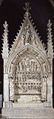
Dagobert died in the abbey of Saint-Denis and was the first Frankish king to be buried in the Saint Denis Basilica
, Paris
.
 The pattern of division and assassination which characterise even the strong king Dagobert's reign continued for the next century until Pepin the Short finally deposed the last Merovingian king in 751, establishing the Carolingian
dynasty. The Merovingian boy-kings remained ineffective rulers who inherited the throne as young children and lived only long enough to produce a male heir or two, while real power lay in the hands of the noble families who exercised feudal control over most of the land.
Dagobert was immortalized in the song Le bon roi Dagobert
(The Good King Dagobert), a nursery rhyme featuring exchanges between the king and his chief adviser, Saint Eligius
(Eloi in French). The satirical rhymes place Dagobert in various ridiculous positions from which Eligius' good advice manages to extract him. The text, which probably originated in the 18th century, became extremely popular as an expression of the anti-monarchist sentiment of the French Revolution
. Other than placing Dagobert and Eligius in their respective roles, it has no historical accuracy.
In 1984, a 112-minute long French-Italian comedy, Le bon roi Dagobert
(Good King Dagobert) was made, based on Dagobert I. The movie is surprisingly realistic in showing the realities of early barbarian France. The soundtrack was composed by Guido & Maurizio De Angelis
.
criticises the king for his loose morals in having "three queens almost simultaneously, as well as several concubines". The chronicle names the queens, Nanthild
and the otherwise obscure Wulfegundis and Berchildis, but none of the concubines, stating that a full list of concubines would be too long.
In 625/6 Dagobert married Gormatrude, a sister of his father's wife Sichilde
; but the marriage was childless. After divorcing Gormatrude in 629/30 he made Nanthild
, a Saxon servant (puella) from his personal entourage, his new queen. She gave birth to:
Shortly after his marriage to Nanthild, he took a girl called Ragnetrude to his bed, who gave birth to his oldest son:
It is possible that Regintrud
, abbess of Nonnberg Abbey
, was also a child of Dagobert. She married into the Bavarian Agilolfing family (either Theodo, Duke of Bavaria
or his son Duke in Salzburg
).
Austrasia
Austrasia formed the northeastern portion of the Kingdom of the Merovingian Franks, comprising parts of the territory of present-day eastern France, western Germany, Belgium, Luxembourg and the Netherlands. Metz served as its capital, although some Austrasian kings ruled from Rheims, Trier, and...
(623–634), king of all the Franks (629–634), and king of Neustria
Neustria
The territory of Neustria or Neustrasia, meaning "new [western] land", originated in 511, made up of the regions from Aquitaine to the English Channel, approximating most of the north of present-day France, with Paris and Soissons as its main cities...
and Burgundy (629–639). He was the last Merovingian dynast to wield any real royal power. Dagobert was the first of the Frankish kings to be buried in the royal tombs at Saint Denis Basilica
Saint Denis Basilica
The Cathedral Basilica of Saint Denis is a large medieval abbey church in the commune of Saint-Denis, now a northern suburb of Paris. The abbey church was created a cathedral in 1966 and is the seat of the Bishop of Saint-Denis, Pascal Michel Ghislain Delannoy...
.
Rule in Austrasia
Dagobert was the eldest son of Chlothar II and Haldetrude (575–604). Chlothar II had reigned alone over all the Franks since 613. In 623, Chlothar was forced to make Dagobert king of Austrasia by the nobility of that region, who wanted a king of their own.When Chlothar II granted Austrasia to Dagobert, he initially excluded Alsace
Alsace
Alsace is the fifth-smallest of the 27 regions of France in land area , and the smallest in metropolitan France. It is also the seventh-most densely populated region in France and third most densely populated region in metropolitan France, with ca. 220 inhabitants per km²...
, the Vosges
Vosges
Vosges is a French department, named after the local mountain range. It contains the hometown of Joan of Arc, Domrémy.-History:The Vosges department is one of the original 83 departments of France, created on February 9, 1790 during the French Revolution. It was made of territories that had been...
, and the Ardennes
Ardennes
The Ardennes is a region of extensive forests, rolling hills and ridges formed within the Givetian Ardennes mountain range, primarily in Belgium and Luxembourg, but stretching into France , and geologically into the Eifel...
, but shortly thereafter the Austrasian nobility forced him to concede these regions to Dagobert. The rule of a Frank from the Austrasian heartland tied Alsace more closely to the Austrasian court. Dagobert created a new duchy (the later Duchy of Alsace
Duchy of Alsace
The Duchy of Alsace was a large political subdivision of the Frankish Empire during the last decade and a half of Merovingian rule. It corresponded to the territory of Alsace and was carved out of southern Austrasia in the last decade of the reign of Dagobert I, probably to stabilise the southern...
) in southwest Austrasia to guard the region from Burgundian or Alemannic encroachments and ambitions. The duchy comprised the Vosges, the Burgundian Gate, and the Transjura. Dagobert made his courtier Gundoin the first duke of this new polity that was to last until the end of the Merovingian dynasty.
United rule
On the death of his father in 629, Dagobert inherited the Neustrian and Burgundian kingdoms. His half-brother CharibertCharibert II
Charibert II , a son of Clotaire II and his junior wife Sichilde, was briefly King of Aquitaine from 629 to his death, with his capital at Toulouse. We have no direct statement about when Charibert was born exact that he was "a few years younger" than his half-brother Dagobert...
, son of Sichilde
Sichilde
Sichilde was a Frankish queen consort in 618–627; married to Clotaire II.She was the daughter of count Brunulphe II of the Ardennes and the sister of Gomatrude , who was married to Dagobert I; her maternal grandfather was royal maior domus. She married Clotaire in about 618...
, claimed Neustria but Dagobert opposed him. Brodulf, the brother of Sichilde, petitioned Dagobert on behalf of his young nephew, but Dagobert assassinated him and gave his younger sibling Aquitaine.
Charibert died in 632 and his son Chilperic
Chilperic of Aquitaine
Chilperic was the infant son of Charibert II, and briefly king of Aquitaine in 632. He was killed shortly after his father in 632, under orders by Dagobert I, Charibert's half-brother....
was assassinated on Dagobert's orders. By 632, Dagobert had Burgundy and Aquitaine firmly under his rule, becoming the most powerful Merovingian king in many years and the most respected ruler in the West.
In 631, Dagobert led three armies against Samo
Samo
Samo was a Frankish merchant from the "Senonian country" , probably modern Soignies, Belgium or Sens, France. He was the first ruler of the Slavs whose name is known, and established one of the earliest Slav states, a supra-tribal union usually called Samo's empire, realm, kingdom, or tribal...
, the rulers of the Slav
Slavic peoples
The Slavic people are an Indo-European panethnicity living in Eastern Europe, Southeast Europe, North Asia and Central Asia. The term Slavic represents a broad ethno-linguistic group of people, who speak languages belonging to the Slavic language family and share, to varying degrees, certain...
s, but his Austrasian forces were defeated at Wogastisburg
Battle of Wogastisburg
According to the contemporary Chronicle of Fredegar, the battle of Wogastisburg was a battle between Slavs under King Samo and Franks under King Dagobert I in 631. The Frankish armies were advancing the area of Slavic tribal union in three streams - Alamanni, Lombards, and Austrasian Franks...
.
Rule in Neustria, from Paris
Also in 632, the nobles of Austrasia revolted under the mayor of the palaceMayor of the Palace
Mayor of the Palace was an early medieval title and office, also called majordomo, from the Latin title maior domus , used most notably in the Frankish kingdoms in the 7th and 8th centuries....
, Pepin of Landen. In 634, Dagobert appeased the rebellious nobles by putting his three-year-old son, Sigebert III
Sigebert III
Sigebert III was the king of Austrasia from 634 to his death; probably on 1 February 656, or maybe as late as 660. He was the eldest son of Dagobert I....
, on the throne, thereby ceding royal power in the easternmost of his realms, just as his father had done for him eleven years earlier.
As king, Dagobert made Paris
Paris
Paris is the capital and largest city in France, situated on the river Seine, in northern France, at the heart of the Île-de-France region...
his capital. During his reign, he built the Altes Schloss
Burg Meersburg
Burg Meersburg, also known as the Alte Burg , in Meersburg on Lake Constance in Baden-Württemberg, Germany is the oldest inhabited castle in Germany. The central tower was first built during the 7th century, though the original structure is no longer visible...
in Meersburg
Meersburg
Meersburg is a town of Baden-Württemberg in the southwest of Germany at Lake Constance.It is famous for its charming medieval city. The lower town and upper town are reserved for pedestrians only and connected by two stairways and a steep street .-History:The name of the town means "Burg on the...
(in modern Germany
Germany
Germany , officially the Federal Republic of Germany , is a federal parliamentary republic in Europe. The country consists of 16 states while the capital and largest city is Berlin. Germany covers an area of 357,021 km2 and has a largely temperate seasonal climate...
), which today is the oldest inhabited castle in that country. Devoutly religious, Dagobert was also responsible for the construction of the Saint Denis Basilica
Saint Denis Basilica
The Cathedral Basilica of Saint Denis is a large medieval abbey church in the commune of Saint-Denis, now a northern suburb of Paris. The abbey church was created a cathedral in 1966 and is the seat of the Bishop of Saint-Denis, Pascal Michel Ghislain Delannoy...
, at the site of a Benedictine
Benedictine
Benedictine refers to the spirituality and consecrated life in accordance with the Rule of St Benedict, written by Benedict of Nursia in the sixth century for the cenobitic communities he founded in central Italy. The most notable of these is Monte Cassino, the first monastery founded by Benedict...
monastery in Paris.
Dagobert died in the abbey of Saint-Denis and was the first Frankish king to be buried in the Saint Denis Basilica
Saint Denis Basilica
The Cathedral Basilica of Saint Denis is a large medieval abbey church in the commune of Saint-Denis, now a northern suburb of Paris. The abbey church was created a cathedral in 1966 and is the seat of the Bishop of Saint-Denis, Pascal Michel Ghislain Delannoy...
, Paris
Paris
Paris is the capital and largest city in France, situated on the river Seine, in northern France, at the heart of the Île-de-France region...
.
Legacy
Carolingian
The Carolingian dynasty was a Frankish noble family with origins in the Arnulfing and Pippinid clans of the 7th century AD. The name "Carolingian", Medieval Latin karolingi, an altered form of an unattested Old High German *karling, kerling The Carolingian dynasty (known variously as the...
dynasty. The Merovingian boy-kings remained ineffective rulers who inherited the throne as young children and lived only long enough to produce a male heir or two, while real power lay in the hands of the noble families who exercised feudal control over most of the land.
Dagobert was immortalized in the song Le bon roi Dagobert
Le bon roi Dagobert (song)
"Le bon roi Dagobert" is an old French song featuring King Dagobert and Saint Eligius , two historical people. The song was created in the epoch of the French Revolution, and was intended to ridicule royalty...
(The Good King Dagobert), a nursery rhyme featuring exchanges between the king and his chief adviser, Saint Eligius
Saint Eligius
Saint Eligius is the patron saint of goldsmiths, other metalworkers, and coin collectors. He is also the patron saint of the Royal Electrical and Mechanical Engineers , a corps of the British Army, but he is best known for being the patron saint of horses and those who work with them...
(Eloi in French). The satirical rhymes place Dagobert in various ridiculous positions from which Eligius' good advice manages to extract him. The text, which probably originated in the 18th century, became extremely popular as an expression of the anti-monarchist sentiment of the French Revolution
French Revolution
The French Revolution , sometimes distinguished as the 'Great French Revolution' , was a period of radical social and political upheaval in France and Europe. The absolute monarchy that had ruled France for centuries collapsed in three years...
. Other than placing Dagobert and Eligius in their respective roles, it has no historical accuracy.
In 1984, a 112-minute long French-Italian comedy, Le bon roi Dagobert
Le bon roi Dagobert (1984 film)
Le Bon Roi Dagobert is a 1984 French-Italian film directed by Dino Risi.-Cast and roles:* Coluche - Dagobert I* Michel Serrault - Otarius* Ugo Tognazzi - Pope Honorius and his look-alike* Carole Bouquet - Héméré...
(Good King Dagobert) was made, based on Dagobert I. The movie is surprisingly realistic in showing the realities of early barbarian France. The soundtrack was composed by Guido & Maurizio De Angelis
Guido & Maurizio De Angelis
Guido and Maurizio de Angelis are Italian musicians.-Beginnings:The brothers were born in Rocca di Papa, near Rome; Guido de Angelis in 1944 , and Maurizio de Angelis in 1947 . Their musical career started in 1963, where, after successfully publishing an LP, they became arrangers for RCA Italiana...
.
Marriage and issue
The author of the Chronicle of FredegarChronicle of Fredegar
The Chronicle of Fredegar is a chronicle that is a primary source of events in Frankish Gaul from 584 to around 641. Later authors continued the history to the coronation of Charlemagne and his brother Carloman on 9 October 768....
criticises the king for his loose morals in having "three queens almost simultaneously, as well as several concubines". The chronicle names the queens, Nanthild
Nanthild
Nanthild , also known as Nantéchilde, Nanthechilde, Nanthildis, Nanthilde, or Nantechildis, was a Frankish queen consort and regent, the third of many consorts of Dagobert I, king of the Franks ....
and the otherwise obscure Wulfegundis and Berchildis, but none of the concubines, stating that a full list of concubines would be too long.
In 625/6 Dagobert married Gormatrude, a sister of his father's wife Sichilde
Sichilde
Sichilde was a Frankish queen consort in 618–627; married to Clotaire II.She was the daughter of count Brunulphe II of the Ardennes and the sister of Gomatrude , who was married to Dagobert I; her maternal grandfather was royal maior domus. She married Clotaire in about 618...
; but the marriage was childless. After divorcing Gormatrude in 629/30 he made Nanthild
Nanthild
Nanthild , also known as Nantéchilde, Nanthechilde, Nanthildis, Nanthilde, or Nantechildis, was a Frankish queen consort and regent, the third of many consorts of Dagobert I, king of the Franks ....
, a Saxon servant (puella) from his personal entourage, his new queen. She gave birth to:
- Clovis IIClovis IIClovis II succeeded his father Dagobert I in 639 as King of Neustria and Burgundy. His brother Sigebert III had been King of Austrasia since 634. He was initially under the regency of his mother Nanthild until her death in her early thirties in 642...
(b. 634/5) later king of Neustria and Burgundy.
Shortly after his marriage to Nanthild, he took a girl called Ragnetrude to his bed, who gave birth to his oldest son:
- Sigebert IIISigebert IIISigebert III was the king of Austrasia from 634 to his death; probably on 1 February 656, or maybe as late as 660. He was the eldest son of Dagobert I....
(b. 630/1) later king of Austrasia.
It is possible that Regintrud
Regintrud
Regintrud , d. 730–740) is something of an enigma. The sources quoted by Schreibner indicate that the records show a Regentrud as the sister of Adela of Pfalzel and daughter of king Dagobert I...
, abbess of Nonnberg Abbey
Nonnberg Abbey
Nonnberg Abbey is a Benedictine monastery in Salzburg, Austria.It was founded ca. 714 by Saint Rupert of Salzburg and is the oldest women's religious house in the German-speaking world...
, was also a child of Dagobert. She married into the Bavarian Agilolfing family (either Theodo, Duke of Bavaria
Theodo of Bavaria
Theodo also known as Theodo V and Theodo II, was the Duke of Bavaria from 670 or, more probably, 680 to his death.It is with Theodo that the well-sourced history of Bavaria begins...
or his son Duke in Salzburg
Theodbert of Bavaria
Theodbert was the duke of Bavaria in some capacity or other from 702 to his death. He was the eldest son of Duke Theodo of Bavaria and Folchaid. He was first associated with his father as duke in 702, ruling from Salzburg...
).