
Encyclopedia
A
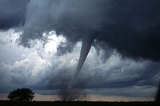
tornado is a violently rotating column of air which is in contact with both a
cumulonimbus cloud base and the surface of the earth. Tornadoes can come in many shapes, but are typically in the form of a visible condensation funnel, with the narrow end touching the earth. Often, a cloud of debris encircles the lower portion of the funnel.
Tornadoes can be very destructive. Most have winds of 110 mph or less, are approximately 250 feet across, and travel a few miles before dissipating. However, some tornadoes can have winds of more than 300 mph , be more than a mile across, and stay on the ground for dozens of miles .
They have been observed on every continent except
Antarctica; a significant percentage of the world's tornadoes occur in the
United States. This is mostly due to the unique geography of the country, which allows the conditions which breed strong, long-lived storms to occur many times a year. Other areas which commonly experience tornadoes include
Australia, south-central
Canada, northwestern
Europe, south-central and eastern
Asia, east-central
South America, and
South Africa..
Etymology
The word "tornado" is an altered form of the
Spanish word
tronada, which means "
thunderstorm". This in turn was taken from the
Latin tronar, meaning "to
thunder". It most likely reached its present form through a combination of the Spanish
tronada and
tornar ; however, this may be a folk etymology.
Some common, related slang terms include:
twister,
whirlwind,
cyclone,
funnel,
wedge,
finger of God,
Devil's tail,
rope, or
stovepipe. The word
willy-willy is also rarely applied to tornadoes, however, the usual definition of the term is of a
dust devil in Australia.
Definitions
A
tornado is defined by the
National Weather Service as "
a violently rotating column of air in contact with the ground and extending from a thunderstorm base." A tornado does not necessarily have to be visible; however, the low pressures caused by the fast wind speeds usually cause water vapor in the air to condense into a visible
condensation funnel.
funnel cloud is a low-hanging, rotating cloud, with no associated strong winds at the surface. Funnel clouds are not tornadoes, however, many tornadoes initially descend from the parent storm as a funnel cloud. It is often difficult to tell the difference between a funnel cloud and a tornado from a distance. Many tornadoes can produce strong winds at the surface while the visible funnel is still a good distance from the ground.nger tornadoes are often observed to have
multiple vortices, or many columns of violently spinning air rotating around a common center. However, a
satellite tornado is a term for a weak tornado which forms very near a large, strong tornado, often lasting no more than a minute. The satellite tornado may appear to "orbit" the larger tornado , giving the appearance of one, large multi-vortex tornado. However, a satellite tornado is a distinct funnel, and is much smaller than the main funnel.
waterspout is a tornado over water. In general, most tornadoes over land are associated with a severe thunderstorm; however, the National Weather Service in the United States considers all waterspouts—including "fair weather" waterspouts—to be tornadoes. These less severe relatives of classic tornadoes are almost always weak , and spawn from non-rotating thunderstorms, or even regular summer showers. Typically, waterspouts moving onto land cause little or no damage, and dissipate within minutes. However, strong waterspouts from
supercells can cause significant damage if they impact land areas. In addition, strong tornadoes can move over lakes or over the ocean, becoming waterspouts, without losing intensity.
A
landspout is an unofficial term for a tornado not associated with a
mesocyclone. Known officially as a
dust-tube tornado, it is usually weak, features a small condensation funnel which often does not appear to reach the ground, and is often marked by a tall tube of dust and/or debris reaching as far up as the parent cloud. Though usually weaker than ordinary tornadoes, they are tornadoes, and can cause serious damagegustnado
is a small, vertical swirl associated with a gust front or downburst is a column of sinking air that is capable of producing damaging straight-line winds of ...
. Because they are technically not associated with the cloud base, there is some debate as to whether or not gustnadoes are actually tornadoes.
dust devil is also a vertical swirling column of air. These phenomena resemble tornadoes, but are rarely as strong as even the weakest tornadoes, and tend to form under clear skies. Dust devils are not considered tornadoes because they form during fair weather, and are not associated with thunderstorms. However, they can, on occasion, result in major damage and fatalities, especially in arid areas.
Life cycle
Most tornadoes follow a recognizable life cycle.
Characteristics
Shape
Most tornadoes take on the traditional appearance of a narrow
funnel, a few hundred yards across, with a small cloud of
debris near the ground. However, tornadoes can appear in all manner of shapes and sizes.
Small, relatively weak landspouts might only be visible as a small swirl of dust on the ground. While the condensation funnel may not extend all the way to the ground, if associated surface winds are greater than 40 mph , it is considered a tornado.
Large single-vortex twisters, often violent, can look like a large wedge stuck into the ground, and are known as
wedge tornadoes or
wedges. Wedges can be so wide that they appear to be a block of dark clouds. Even experienced storm observers may not be able to tell the difference between a low-hanging cloud and a wedge tornado from a distance.
Tornadoes in the dissipating stage can appear like narrow tubes, or ropes, twisting into all manner of curls, twists, and s-shapes. These tornadoes, such as the one pictured at right, are
roping out, or becoming a
rope tornado. Multiple-vortex tornadoes can appear as a family of swirls circling a common center, or may be completely obscured by condensation, dust, and debris, appearing to be a single funnel.
In addition to these appearances, tornadoes may be obscured completely by rain or dust. These tornadoes are especially dangerous, as even experienced meteorologists might not spot them.Size
In the United States, an average tornado is around 500 feet across, and stays on the ground for 5 miles . While this is the average, there is an extremely wide range of tornado sizes, even for typical tornadoes.
Weak tornadoes, or strong but dissipating tornadoes, can be exceedingly narrow, sometimes only a few feet across. In fact, a tornado was once reported to have a damage path only 7 feet long.he other end of the spectrum, wedge tornadoes can have a damage path a mile wide or more. A tornado which affected Hallam, Nebraska on May 22, 2004 was at one point 2.5 miles wide.
In terms of path length, some meteorologists believe that the Tri-State Tornado, which affected parts of Missouri, Illinois, and Indiana on March 18, 1925, was on the ground continuously for 219 miles . However, without a modern damage survey, it is impossible to determine whether or not the deadly event was a single tornado or a series of violent tornadoes produced by the same storm. The longest modern-day damage path was caused by a tornado which was on the ground for 160 miles in northeastern North Carolina on November 22, 1992.
Appearance
Tornadoes, depending on the environment in which they form, can have a wide range of colors. Tornadoes which form in a dry environment can be nearly invisible, marked only by swirling debris at the base of the funnel. Condensation funnels which pick up little or no debris can be grey to white. While travelling over a body of water as a waterspout, they can turn very white or even blue. Funnels which move slowly, ingesting a lot of debris and dirt, are usually darker, taking on the color of debris. Tornadoes in the Great Plains can turn red because of the reddish tint of the soil, and tornadoes in mountainous areas can travel over snow-covered ground, turning brilliantly white in the process.
Lighting conditions are also a major factor in the appearance of a tornado. A tornado which is "back-lit", or viewed with the sun behind it, will appear to be very dark. The same tornado, viewed with the sun at the observer's back, may appear grey or brilliant white. Tornadoes which occur near the time of sunset can be many different colors, appearing in hues of yellow, orange, and pink.
Dust kicked up by the winds of the parent thunderstorm, heavy rain and hail, and the darkness of night are all factors which can reduce the visibility of tornadoes, making them "invisible", in essence. Tornadoes occurring in these conditions are especially dangerous, since only radar observations, or possibly the sound of an approaching tornado, serve as any warning to those in the storm's path. Fortunately most significant tornadoes form under the storm's rain-free base, or the area under the thunderstorm's updraft, where there is little or no rain. In addition, most tornadoes occur between the hours of 4 and 8 pm, when the bright sun can penetrate even the thickest clouds. Also, night-time tornadoes are often illuminated by frequent lightning.
There is mounting evidence, including doppler radar images and eyewitness accounts, which suggest that most tornadoes have a clear, calm center with extremely low pressure, akin to the eye found in tropical cyclones. This area would be clear , have relatively light winds, and be very dark, with the light blocked out by swirling debris on the outside of the tornado. Lightning is said to be the source of illumination for those who claim to have seen the interior of a tornado.
Rotation
Tornadoes normally rotate in a cyclonic direction . Large-scale storms always rotate cyclonically because of the Coriolis effect; however, tornadoes are too small in scale to be directly affected by the rotation of the earth. Approximately 1 tornado in 100 rotates in an anticyclonic direction. Typically, only landspouts and gustnados also rotate anticyclonically. However, on very rare occasions, an anticyclonic supercell can develop, producing a tornado that is typical except for its direction of rotation.
Intensity and damage
Tornadoes vary in intensity regardless of shape, size, and location. While strong tornadoes are typically larger than weak tornadoes, there are several instances of F5 tornadoes with damage paths less than 500 feet wide. istory of tornado intensity measurements
For many years, before the advent of home movies and doppler radar, scientists had nothing more than educated guesses as to the speed of the winds in a tornado. The only evidence indicating the wind speeds found in the tornado was the damage left behind by tornadoes which struck populated areas. Some thought they might exceed 500 mph, and perhaps even be supersonic.
In the 1950s, however, evidence mounted that the actual wind speeds were much lower than this. On April 2, 1957, a slow moving tornado traversed the south and east parts of
Dallas, Texas. Before this day, only a few photographs and
motion pictures of tornadoes were known to exist. However, because of many factors, including the tornado's high visibility, slow forward motion, and proximity to an urban center, it became the most filmed and photographed tornado in history. Frame-by-frame analysis of several pieces of footage taken that day showed that the debris flung about by the tornado was travelling at speeds up to 170 mph.ear}}
In 1971, Dr. Tetsuya Theodore Fujita introduced the idea for a scale of tornado winds. With the help of colleague Allen Pearson, he created and introduced what came to be called the
Fujita scale in 1973. The scale was based on a relationship between the Beaufort scale and the
Mach number scale; the low end of
F1 on his scale corresponds to the low end of
B12 on the Beaufort scale, and the low end of
F12 corresponds to the speed of sound at sea level, or Mach 1. In practice, tornadoes are only assigned categories
F0 through
F5.
The TORRO scale, developed by the Tornado and Storm Research Organisation , was developed in 1974, and published a year later. The TORRO scale has 12 levels, which cover a broader range with tighter graduations. It ranges from a
T0 for extremely weak tornadoes to
T11 for the most powerful known tornadoes.
There is some debate as to the usefulness of the TORRO scale over the Fujita scale—while it may be helpful for statistical purposes to have more levels of tornado strength, often the damage caused could be created by a large range of winds, rendering it hard to narrow the tornado down to a single TORRO scale category.
Research conducted in the late 1980s and 1990s suggested that, even with the implication of the Fujita scale, tornado winds were notoriously overestimated, especially in significant and violent tornadoes. Because of this, in 2006, the American Meteorological Society introduced the
Enhanced Fujita Scale, to help assign realistic wind speeds to tornado damage. The scientists specifically designed the scale so that a tornado assessed on the Fujita scale and the Enhanced Fujita scale would receive the same ranking. The EF-scale is more specific in detailing the degrees of damage on different types of structures for a given wind speed. While the F-scale goes from
F0 to
F12 in theory, the EF-scale is capped at
EF5, which is defined as "winds = 200 mph ".age:F0 tornado damage example.jpg|thumb|300px|right|An example of
F0 damage. The only significant damage to structures in this picture was caused by tree branches which fell due to the tornado's winds. Even though well-built structures are typically unscathed by
F0 tornadoes, falling trees and tree branches can injure and kill people, even when they are inside a sturdy structure.]]
The first observation which confirmed that
F5 winds could occur happened on April 26, 1991. A tornado near Red Rock, Oklahoma was monitored by scientists using a portable Doppler radar, an experimental radar device that measures wind speed. Near the tornado's peak intensity, they recorded a wind speed of 115-120 m/s . Though the portable radar had uncertainty of ± 5-10 m/s , this reading was probably within the
F5 range, confirming that tornadoes were capable of violent winds found nowhere else on earth.
Eight years later, during the Oklahoma Tornado Outbreak of May 3, 1999, another scientific team was monitoring an exceptionally violent tornado . At about 7 pm, they recorded one measurement of 318 mph ypical intensity
In the United States, F0 and F1 tornadoes account for 80% of all tornadoes. On the other hand, violent tornadoes , account for less than 1%. Worldwide, strong tornadoes account for an even smaller percentage of total tornadoes. Violent tornadoes are extremely rare outside of the United States and Bangladesh.
Typical damage
As stated in the lede section, a typical tornado has winds of 110 mph or less, is approximately 250 feet across, and travels a mile or so before dissipating. However, there is no such thing as a typical tornado.
Two tornadoes that look almost exactly the same can produce drastically different effects. Also, two tornadoes which look very different can produce similar damage. This is due to the fact that tornadoes form by several different mechanisms, and also that they follow a life cycle which causes the same tornado to change in appearance over time. People in the path of a tornado should never attempt to determine its strength as it approaches. Between 1997 and 2005 in the United States, 38 people were killed by F1 tornadoes, and 3 were killed by F0 tornadoes. Even the weakest tornado can kill.
As stated in the previous section, an overwhelming majority of tornadoes are designated F1 or F0, also known as "weak" tornadoes. However, weak is a relative term for tornadoes, as even these can cause significant damage. F0 and F1 tornadoes are typically short-lived—since 1980 almost 75% of tornadoes rated weak stayed on the ground for one mile or less.0 damage is characterized by superficial damage to structures and vegitation. Well-built structures are typically unscathed, sometimes sustaining broken windows, with minor damage to roofs and chimneys. Billboards and large signs can be knocked down. Trees have large branches broken off, and can be uprooted if they have shallow roots.
F1 damage has caused significantly more fatalities than that caused by F0 tornadoes. At this level, damage to mobile homes and other temporary structures becomes significant, and cars and other vehicles can be pushed off the road. Permanent structures can suffer major damage to their roofs.
F2 tornadoes are the lower end of "significant", and yet are stronger than most tropical cyclones . Well-built structures can suffer serious damage, including roof loss and collapse of outer walls. Mobile homes, however, are almost totally destroyed. Vehicles can be lifted off the ground, and lighter objects can become small missiles, causing damage outside of the tornado's main path. Wooded areas will have a large percentage of their trees snapped or uprooted.
F3 damage is a serious risk to life and limb. Few parts of affected buildings are left standing; well-built structures lose outer and inner walls. Cars are lifted off the ground, and can be tossed through the air for some distance. Wooded areas will suffer almost total loss of vegitation.
F4 damage typically results in a total loss of the affected structure. Well-built homes are reduced to a short pile of debris. Even heavy vehicles can become airborne, with very large projectiles being flung some distance.
F5 damage is almost always total. F5 tornadoes demolish well-built houses and sweep the foundation clean. The official description of this damage states that "incredible phenomena will occur". In history, F5 tornadoes have twisted skyscrapers, levelled entire communities, and stripped asphalt from the ground.
Prediction and detection
United States
In the United States, severe weather predictions are issued by the Storm Prediction Center, based in Norman, Oklahoma. Issued for the next three days, as well as for the four through eight day period, they will determine the probability of severe weather, including tornadoes. The SPC uses computer models, such as the NAM, GFS, WRF, and RUC to predict severe weather. They issue their outlooks based on data from these models, using such indicies as Lifted Index, CAPE, as well as temperature and dewpoint.
Warnings are issued by the regional National Weather Service offices, while watches are issued directly from the SPC.
The National Weather Service trains Skywarn spotters, consisting of local sheriff's deputies, state troopers, and ordinary citizens, to spot key features of storms which indicate severe hail, strong winds, and tornadoes. When severe weather is anticipated, local weather service offices request that these spotters be on the lookout for severe weather, and report any possible tornadoes immediately, so the office can issue a timely warning.
United Kingdom
In the United Kingdom, the Tornado and Storm Research Organisation makes experimental predictions.
Other countries
In the Japan, predictions and study of tornadoes in Japan are handled by the Japan Meteorological Agency.
Climatology
Geography
The UK has the highest average number of recorded tornadoes per area of any country , but most are small and result in minor damage.
. Bangladesh also suffers from tornadoes of equal severity to those in the USA but these tend to be less well reported because of the scarcity of media coverage. The annual human death toll at about 179 deaths per year from tornadoes in Bangladesh is however much greater than in the USA.
Frequency of occurrence
Time of occurrence
As stated in previously, worldwide statistics for tornado occurrences are intermittant at best, so data presented here may not be valid worldwide.
Tornado occurrence in the United States is highly dependant on the time of day.
Extremes
Tornadoes are the most violent weather events in the world. As such, they have been recorded to produce some incredible phenomena.
In terms of the most extreme tornado in history, the honor undoubtedly goes to the Tri-State Tornado which roared through parts of Missouri, Illinois, and Indiana on March 18, 1925. This tornado set records for the deadliest single United States tornado , longest path length , longest duration , and fastest forward speed for a significant tornado .
The deadliest tornado in world history occurred on April 26, 1989 in Bangladesh, killing 1300 people. pandsection}}
Tornado safety
Precautions
Though it is uncommon to get more than a few minutes warning before a tornado strikes, there are precautions and preventative measures that you can take in order to increase the chances of surviving a tornado.
In tornado-prone areas, most homes have a storm cellar on the property. These underground refuges have saved thousands of lives.
If a tornado approaches...
If a tornado approaches and you are outside, seek shelter immediately in a well structured building. If a building is out of your reach, drop in a ditch.
If on the road, try to look for shelter. If there isn't any near try to look for a ditch and stay there until the danger passes. Never try to outrun a twister, for it may cost you your life as it may take an unexpected turn.
If in a house or building, seek shelter in the basement. If the structure does not have a basement, or if the tornado's so close that it won't allow you to reach a basement, go to the most innermost part of the house, preferably and usually a bathroom, and lay in the bathtub or hang on to the plumbing.andsection}}
Myths and misconceptions
Continuing research
Though scientists have learned much from years of research, there are still many things about tornadoes which remain a mystery. In fact, scientists still don't know exactly how a rotation in the middle of the thunderstorm descends to become a tornado. Research programs, including VORTEX, deployment of TOTO , and dozens of other programs, hope to solve many questions that still plague meteorologists.
Social implications of tornadoes
Tornado damage to man-made structures is a result of the high wind velocity and windblown debris. Tornadic winds have been measured in excess of 300 mph . Tornado season in North America is generally March through November, although tornadoes can occur at any time of year. They tend to occur in the afternoons and evenings; over 80% of all tornadoes strike between noon and midnight.
Some individuals and hobbyists, known as storm chasers, enjoy pursuing thunderstorms and tornadoes to explore their many visual and scientific aspects. Attempts have been made by some storm chasers from educational and scientific institutions to drop probes in the path of oncoming tornadoes in an effort to analyze the interior of the storms, but only about five drops have been successful since around 1990.
Due to the relative rarity and large scale of destructive power that tornadoes possess, their occurrence or the possibility that they may occur can often create what could be considered sensationalism in their reporting. This results in so-called weather wars, in which competing local media outlets, particularly TV news stations, engage in continually escalating technological one-upsmanship and drama in order to increase their market share. This is especially evident in tornado-prone markets, such as those in the Great Plains.
According to Environment Canada, the chances of being killed by a tornado are 12 million to 1 . One may revise this yearly and/or regionally, but the probability may be factually stated to be low. Tornadoes do cause millions of dollars in damage, both economic and physical, displacement, and many injuries every year.
Cultural significance
Tornadoes as a metaphor
The tornado has been used by cartoonists for over 100 years as a metaphor for political upheaval. For example, according to political interpretations of The Wizard of Oz, the tornado takes Dorothy to a utopia, the Land of Oz, and kills the Wicked Witch of the East, who had oppressed a little people, the Munchkins. The storm cellar has also been used as a metaphor for seeking safety, as shown in the cartoon from 1894 at right.
A 1960s advertising campaign for the household cleaner, Ajax, claimed the product "Cleans like a white tornado".
Tornadoes in dreams are sometimes said to be associated with fear, chaos, and upheaval. It is alleged that the location where one is during a tornado dream, e.g. at home, can help to determine the meaning.
Motion pictures with a tornado theme
- The Wizard of Oz, 1939.
- Mr. and Mrs. Bridge is a 1990 [i] is a Merchant Ivory Film [i] ...
, 1990. - , 1996.
- , 1996.
- Twister, 1996.
- Atomic Twister , 2001.
- The Day After Tomorrow is a 2004 [i] apocalyptic science-fiction [i] ...
, 2004. - , premiered on March 19, 2006.
- , 2005.
See also
References
Further reading
- Thomas P. Grazulis . Significant Tornadoes 1680-1991, A Chronology and Analysis of Events. The Tornado Project of Environmental Films. ISBN 1-879362-00-7
External links
;General
- ~ Animation from MSNBC Interactive
- Free archive of more than 50,000 newspaper articles detailing tornadoes through out history.
;Regional prediction
;Research
;Images
;Safety and Preparedness
;Miscellaneous